Dr. Jim Tritten Chief, Defense Threat Reduction University Defense Threat Reduction Agency (DTRA/CSU) [email_address] 505-846-8734 Nuclear Weapons Workforce Development  February 25, 2008
What Are The Issues? Existing knowledgeable / skilled nuclear weapons workforce will depart very soon In many cases they have left workforce already but are still available to pass on knowledge New workforce needs to be recruited Military talent pool no longer available in same numbers Quality of military talent is not same at expected points in career Nuclear weapons workforce talent pool may come from different backgrounds Other nuclear areas States New workforce needs to be developed Basic level of knowledge may be different than in past Opportunities to learn and gain experience will be different New workforce needs to be recruited & retained Generation N / Millennium Generation is motivated by different things than workers in the past Workers will have more power than in past and perhaps more than employers Cannot just be left to chance
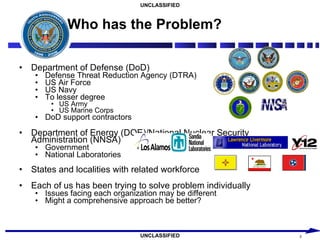
Who has the Problem? Department of Defense (DoD) Defense Threat Reduction Agency (DTRA) US Air Force US Navy To lesser degree US Army US Marine Corps DoD support contractors Department of Energy (DOE)/National Nuclear Security Administration (NNSA) Government National Laboratories States and localities with related workforce Each of us has been trying to solve problem individually Issues facing each organization may be different Might a comprehensive approach be better?
How do we Build Tomorrow’s Workforce?  Must capture knowledge before it is gone Time is of the essence Need a vision, a plan, and aggressive recruitment program Identify new sources of talent, create applicant pool, & use human resources flexibilities to reach them Need career development opportunities Career track with experiential opportunities that go beyond individual organizations Education & training with continuous learning Cross-organizational management similar to career development programs of Military Services?
Methods Proposed to Address Problem Knowledge Management Education Partnerships Outreach Workforce Training Experience Tours Growing Expertise Enterprise Model Competency / Skill certification Support for Programs
Methods:  Knowledge Management Defense Threat Reduction Information Analysis Center (DTRIAC) as repository of knowledge Aggressive program to capture before it is too late Protect but expand availability to those who need to know Those leaving DoD need broadening Those not coming from DoD need technical details Can technology provide assistance and make up for human capital problems? Technology Innovation Consortium (TIC) Communities of practice and communities of interest
Methods:  Education Partnerships Afford academe, labs, industry and other government organizations opportunity to participate in nuclear weapons training & education programs Adjunct instructors & thesis advisors Afford students opportunities to intern or work on projects with nuclear weapons workforce Post-docs Share knowledge with full range of potential partners affords opportunity to gain different perspective University of Virginia (UVa) / FBI Academy model Universities put Defense Threat Reduction University (DTRU) staff on faculty? Targeted education for students that already live in areas where the jobs are located The basis for subsequent skill training
Methods:  Outreach Outreach programs provide exposure to potential recruits Afford academe, labs, industry and government organizations opportunity for existing workforce to serve as outreach instructors Affords participants opportunity to gain different perspective
Methods:  Workforce Training Capabilities-based approach Shift from requirements-based to capabilities-based based upon employer generated competencies and skills Individual training Shift to learner-centric model of instruction on-demand Not just distance learning Role of instructor changes Shift to “just-in-time” training with reachback Cannot afford the bill for everyone to be trained in everything How to reach senior personnel who do not come to courses? Tailored mentoring Collective training Involve entire nuclear weapons community Joint National Training Capability (JNTC) linkages to real world Get Combating Weapons of Mass Destruction (CbtWMD) training embedded within larger exercise programs Build communities of interest/practice to reinforce younger generation’s desire to use new e-social networking mechanisms
Methods: Experience Tours Manage workforce like military manages personnel Experience tours in various areas required for upward mobility Agencies to cooperate and ensure viability of the entire workforce rather than just their small piece Younger workers want broadening experiences outside of technical areas – similar to company intern programs Target interns who use social networks to spread positive experiences to peers
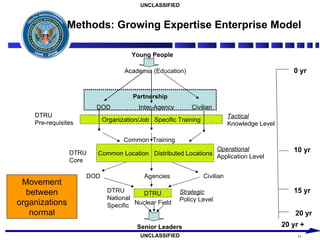
Partnership Young People Academia (Education) DOD  Inter-Agency  Civilian Organization/Job  Specific Training DTRU Pre-requisites Tactical Knowledge Level Common Location  Distributed Locations Common  Training DTRU Core Operational Application Level DOD  Agencies  Civilian DTRU Strategic Policy Level Nuclear Field Senior Leaders 0 yr 10 yr 15 yr 20 yr Methods: Growing Expertise Enterprise Model 20 yr + DTRU National  Specific Movement between organizations normal
Methods:  Competency / Skill Certification Certification of nuclear weapons specialists Nuclear weapons workforce for multinational, federal, state, and local entities Start with DoD/DOE instructors for training Grow into certification all nuclear weapons specialists Borrow from other nuclear certification programs such as the UK nuclear “passports” those used by Department of Homeland Security (DHS)
Methods:  Support for Programs Global Initiative (GI) to Combat Nuclear Terrorism Portal and exploring role in training & education Nuclear weapons programs Need to contribute to education and training Stockpile maintenance / inspections
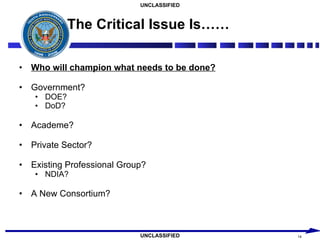
The Critical Issue Is…… Who will champion what needs to be done? Government? DOE? DoD? Academe? Private Sector? Existing Professional Group? NDIA? A New Consortium?
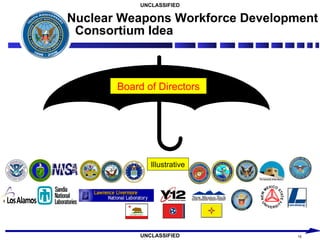
Nuclear Weapons Workforce Development Consortium Idea Board of Directors Illustrative
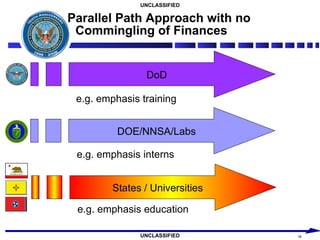
Parallel Path Approach with no Commingling of Finances DoD DOE/NNSA/Labs States / Universities e.g. emphasis education e.g. emphasis interns e.g. emphasis training
For More Information Dr. James J. Tritten Chief, Defense Threat Reduction University Defense Threat Reduction Agency (DTRA/CSU) 1680 Texas St., SE Kirtland AFB, NM 87117-5669 [email_address] [email_address] (505) 846-8734 (505) 228-6316 (cell) (888) 449-9657 (pager)

Nuclear Weapons Workforce Development Feb 25 2008 V5

  • 1.
    Dr. Jim TrittenChief, Defense Threat Reduction University Defense Threat Reduction Agency (DTRA/CSU) [email_address] 505-846-8734 Nuclear Weapons Workforce Development February 25, 2008
  • 2.
    What Are TheIssues? Existing knowledgeable / skilled nuclear weapons workforce will depart very soon In many cases they have left workforce already but are still available to pass on knowledge New workforce needs to be recruited Military talent pool no longer available in same numbers Quality of military talent is not same at expected points in career Nuclear weapons workforce talent pool may come from different backgrounds Other nuclear areas States New workforce needs to be developed Basic level of knowledge may be different than in past Opportunities to learn and gain experience will be different New workforce needs to be recruited & retained Generation N / Millennium Generation is motivated by different things than workers in the past Workers will have more power than in past and perhaps more than employers Cannot just be left to chance
  • 3.
    Who has theProblem? Department of Defense (DoD) Defense Threat Reduction Agency (DTRA) US Air Force US Navy To lesser degree US Army US Marine Corps DoD support contractors Department of Energy (DOE)/National Nuclear Security Administration (NNSA) Government National Laboratories States and localities with related workforce Each of us has been trying to solve problem individually Issues facing each organization may be different Might a comprehensive approach be better?
  • 4.
    How do weBuild Tomorrow’s Workforce? Must capture knowledge before it is gone Time is of the essence Need a vision, a plan, and aggressive recruitment program Identify new sources of talent, create applicant pool, & use human resources flexibilities to reach them Need career development opportunities Career track with experiential opportunities that go beyond individual organizations Education & training with continuous learning Cross-organizational management similar to career development programs of Military Services?
  • 5.
    Methods Proposed toAddress Problem Knowledge Management Education Partnerships Outreach Workforce Training Experience Tours Growing Expertise Enterprise Model Competency / Skill certification Support for Programs
  • 6.
    Methods: KnowledgeManagement Defense Threat Reduction Information Analysis Center (DTRIAC) as repository of knowledge Aggressive program to capture before it is too late Protect but expand availability to those who need to know Those leaving DoD need broadening Those not coming from DoD need technical details Can technology provide assistance and make up for human capital problems? Technology Innovation Consortium (TIC) Communities of practice and communities of interest
  • 7.
    Methods: EducationPartnerships Afford academe, labs, industry and other government organizations opportunity to participate in nuclear weapons training & education programs Adjunct instructors & thesis advisors Afford students opportunities to intern or work on projects with nuclear weapons workforce Post-docs Share knowledge with full range of potential partners affords opportunity to gain different perspective University of Virginia (UVa) / FBI Academy model Universities put Defense Threat Reduction University (DTRU) staff on faculty? Targeted education for students that already live in areas where the jobs are located The basis for subsequent skill training
  • 8.
    Methods: OutreachOutreach programs provide exposure to potential recruits Afford academe, labs, industry and government organizations opportunity for existing workforce to serve as outreach instructors Affords participants opportunity to gain different perspective
  • 9.
    Methods: WorkforceTraining Capabilities-based approach Shift from requirements-based to capabilities-based based upon employer generated competencies and skills Individual training Shift to learner-centric model of instruction on-demand Not just distance learning Role of instructor changes Shift to “just-in-time” training with reachback Cannot afford the bill for everyone to be trained in everything How to reach senior personnel who do not come to courses? Tailored mentoring Collective training Involve entire nuclear weapons community Joint National Training Capability (JNTC) linkages to real world Get Combating Weapons of Mass Destruction (CbtWMD) training embedded within larger exercise programs Build communities of interest/practice to reinforce younger generation’s desire to use new e-social networking mechanisms
  • 10.
    Methods: Experience ToursManage workforce like military manages personnel Experience tours in various areas required for upward mobility Agencies to cooperate and ensure viability of the entire workforce rather than just their small piece Younger workers want broadening experiences outside of technical areas – similar to company intern programs Target interns who use social networks to spread positive experiences to peers
  • 11.
    Partnership Young PeopleAcademia (Education) DOD Inter-Agency Civilian Organization/Job Specific Training DTRU Pre-requisites Tactical Knowledge Level Common Location Distributed Locations Common Training DTRU Core Operational Application Level DOD Agencies Civilian DTRU Strategic Policy Level Nuclear Field Senior Leaders 0 yr 10 yr 15 yr 20 yr Methods: Growing Expertise Enterprise Model 20 yr + DTRU National Specific Movement between organizations normal
  • 12.
    Methods: Competency/ Skill Certification Certification of nuclear weapons specialists Nuclear weapons workforce for multinational, federal, state, and local entities Start with DoD/DOE instructors for training Grow into certification all nuclear weapons specialists Borrow from other nuclear certification programs such as the UK nuclear “passports” those used by Department of Homeland Security (DHS)
  • 13.
    Methods: Supportfor Programs Global Initiative (GI) to Combat Nuclear Terrorism Portal and exploring role in training & education Nuclear weapons programs Need to contribute to education and training Stockpile maintenance / inspections
  • 14.
    The Critical IssueIs…… Who will champion what needs to be done? Government? DOE? DoD? Academe? Private Sector? Existing Professional Group? NDIA? A New Consortium?
  • 15.
    Nuclear Weapons WorkforceDevelopment Consortium Idea Board of Directors Illustrative
  • 16.
    Parallel Path Approachwith no Commingling of Finances DoD DOE/NNSA/Labs States / Universities e.g. emphasis education e.g. emphasis interns e.g. emphasis training
  • 17.
    For More InformationDr. James J. Tritten Chief, Defense Threat Reduction University Defense Threat Reduction Agency (DTRA/CSU) 1680 Texas St., SE Kirtland AFB, NM 87117-5669 [email_address] [email_address] (505) 846-8734 (505) 228-6316 (cell) (888) 449-9657 (pager)