
Foundations (Year Two)


“Encountering the New Testament”

   Session #5. Encountering
  EPHESIANS, COLOSSIANS,
  PHILEMON & PHILIPPIANS
Written earlier:
    The NT Writings             Letter of James (40’s/50’s)


Letters of Paul:                Written later:
Galatians (48/49 CE)           Letters of Peter (64-66)
1 & 2 Thessalonians (51-52)    Mark (68-70 )
1 & 2 Corinthians (53-57)      Matthew (70-80)
Romans (56-57)                 Luke-Acts (70-80)
Prison letters (61-62):
                                Hebrews (50’s/60’s?)
 (Colossians, Ephesians,
 Philemon & Philippians)        Letter of Jude (50’s ?)
Pastoral letters (64-66):      Writings of John:
       (1, 2 Timothy & Titus)
                                 Gospel, Letters &
                                 Revelation (90-96)
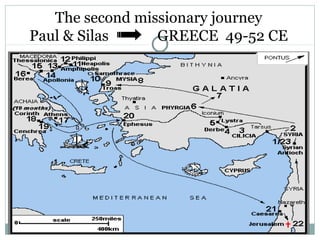
The second missionary journey
Paul & Silas     GREECE 49-52 CE
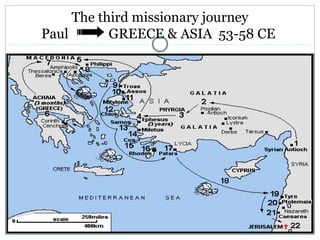
The third missionary journey
Paul       GREECE & ASIA 53-58 CE
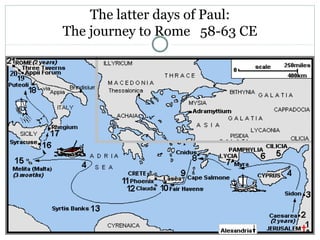
The latter days of Paul:
The journey to Rome 58-63 CE
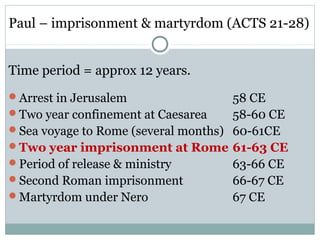
Paul – imprisonment & martyrdom (ACTS 21-28)


Time period = approx 12 years.
Arrest in Jerusalem                 58 CE
Two year confinement at Caesarea    58-60 CE
Sea voyage to Rome (several months) 60-61CE
Two year imprisonment at Rome 61-63 CE
Period of release & ministry        63-66 CE
Second Roman imprisonment           66-67 CE
Martyrdom under Nero                67 CE
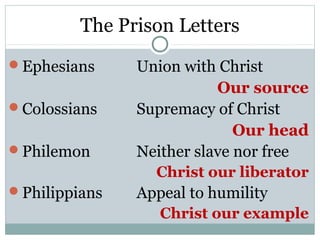
The Prison Letters
Ephesians     Union with Christ
                          Our source
Colossians    Supremacy of Christ
                             Our head
Philemon      Neither slave nor free
                 Christ our liberator
Philippians   Appeal to humility
                  Christ our example
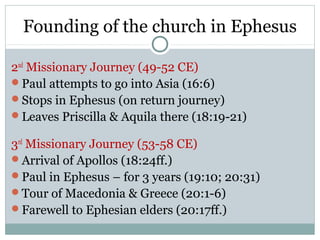
Founding of the church in Ephesus

2nd Missionary Journey (49-52 CE)
Paul attempts to go into Asia (16:6)
Stops in Ephesus (on return journey)
Leaves Priscilla & Aquila there (18:19-21)

3rd Missionary Journey (53-58 CE)
Arrival of Apollos (18:24ff.)
Paul in Ephesus – for 3 years (19:10; 20:31)
Tour of Macedonia & Greece (20:1-6)
Farewell to Ephesian elders (20:17ff.)
Ephesians
Ephesians
“I owe my very life to this book…for in it I saw a new
  world…I received a new outlook, a new experience
  of God, new attitudes to other people. Everything
  was new. I loved the God I saw there & Jesus Christ
  became the centre of everything…I was really alive
  at last…
Ephesians is surely the greatest, maturest & most
  relevant of all Paul’s works. We find here the
  distilled essence of Christianity as it relates to God &
  our fellow man…This letter is pure music. When we
  read it, it is as if truth sings and doctrine is set to
  music.” (John Mackay, Princeton Seminary)
“To the Ephesians”?
A circular letter
Similarities to Colossians (theology & practice)

“Prisoner for the Lord”
 Eph. 3:1; 4:1; 6:20 (“ambassador in chains”)
 Col. 4:18 (“remember my chains”)
 Philemon: 1, 9
 Phil. 1:7, 13-14 (“in chains”)

 About to be released? (Phile:22; Phil.1:19,25; 2:24)
Ephesians – an outline
“God’s new society”
Blessings of God’s new people (1:1-14)
Resources of God’s new people (1:15-23)
Formation of God’s new people (2:1-22)

Interlude: Paul’s prayer for them (3:1-21)

Walk of God’s new people (4:1-6:9)
Warfare of God’s new people (6:10-24)
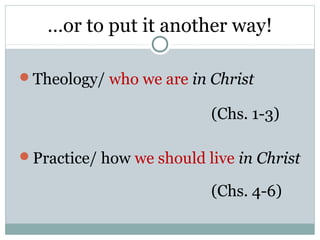
…or to put it another way!

Theology/ who we are in Christ

                          (Chs. 1-3)

Practice/ how we should live in Christ

                          (Chs. 4-6)
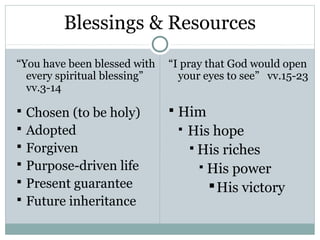
Blessings & Resources
“You have been blessed with   “I pray that God would open
  every spiritual blessing”     your eyes to see” vv.15-23
  vv.3-14

 Chosen (to be holy)          Him
 Adopted                         His hope
 Forgiven                          His riches
 Purpose-driven life                 His power
 Present guarantee                     His victory
 Future inheritance
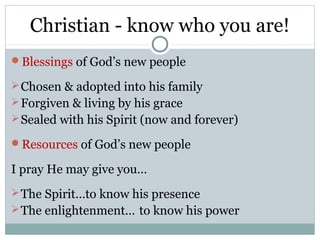
Christian - know who you are!
Blessings of God’s new people

 Chosen & adopted into his family
 Forgiven & living by his grace
 Sealed with his Spirit (now and forever)

Resources of God’s new people

I pray He may give you…
 The Spirit…to know his presence
 The enlightenment… to know his power
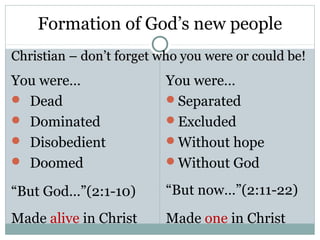
Formation of God’s new people
Christian – don’t forget who you were or could be!
You were…                 You were…
 Dead                    Separated
 Dominated               Excluded
 Disobedient             Without hope
 Doomed                  Without God

“But God…”(2:1-10)        “But now…”(2:11-22)
Made alive in Christ      Made one in Christ
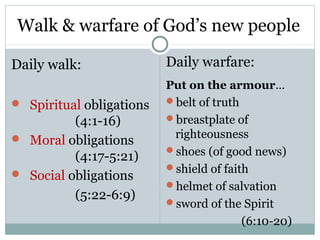
Walk & warfare of God’s new people

Daily walk:               Daily warfare:
                          Put on the armour…
 Spiritual obligations   belt of truth

          (4:1-16)        breastplate of

 Moral obligations        righteousness
                          shoes (of good news)
          (4:17-5:21)
                          shield of faith
 Social obligations
                          helmet of salvation
          (5:22-6:9)      sword of the Spirit
                                         (6:10-20)
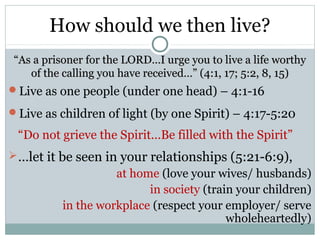
How should we then live?
 “As a prisoner for the LORD…I urge you to live a life worthy
    of the calling you have received…” (4:1, 17; 5:2, 8, 15)
Live as one people (under one head) – 4:1-16

Live as children of light (by one Spirit) – 4:17-5:20

 “Do not grieve the Spirit…Be filled with the Spirit”
 …let it be seen in your relationships (5:21-6:9),
                     at home (love your wives/ husbands)
                           in society (train your children)
           in the workplace (respect your employer/ serve
                                           wholeheartedly)
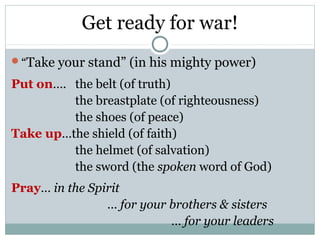
Get ready for war!
“Take   your stand” (in his mighty power)
Put on…. the belt (of truth)
         the breastplate (of righteousness)
         the shoes (of peace)
Take up…the shield (of faith)
         the helmet (of salvation)
         the sword (the spoken word of God)
Pray… in the Spirit
                … for your brothers & sisters
                           … for your leaders
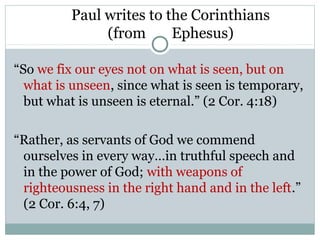
Paul writes to the Corinthians
               (from      Ephesus)

“So we fix our eyes not on what is seen, but on
  what is unseen, since what is seen is temporary,
  but what is unseen is eternal.” (2 Cor. 4:18)

“Rather, as servants of God we commend
 ourselves in every way…in truthful speech and
 in the power of God; with weapons of
 righteousness in the right hand and in the left.”
 (2 Cor. 6:4, 7)
“Some people think that we live by the standards of
  this world. For though we live in the world, we do not
  wage war as the world does. The weapons we fight
  with are not the weapons of the world. On the
  contrary, they have divine power to demolish
  strongholds. We demolish arguments and every
  pretension that sets itself up against the knowledge
  of God, and we take captive every thought to make it
  obedient to Christ.” (2 Corinthians 10:2-5)

“…in order that Satan might not outwit us. For we are
 not unaware of his schemes.”(2 Corinthians 2:11)
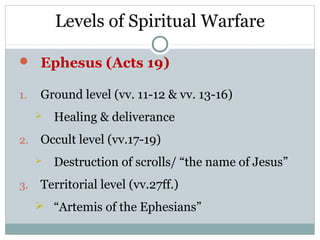
Levels of Spiritual Warfare

 Ephesus (Acts 19)

1.   Ground level (vv. 11-12 & vv. 13-16)
        Healing & deliverance
2.   Occult level (vv.17-19)
        Destruction of scrolls/ “the name of Jesus”
3.   Territorial level (vv.27ff.)
      “Artemis of the Ephesians”
Philippians
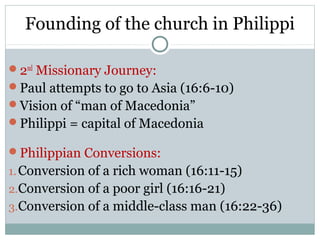
Founding of the church in Philippi

2nd Missionary Journey:
Paul attempts to go to Asia (16:6-10)
Vision of “man of Macedonia”
Philippi = capital of Macedonia

Philippian Conversions:
1. Conversion of a rich woman (16:11-15)
2.Conversion of a poor girl (16:16-21)
3.Conversion of a middle-class man (16:22-36)
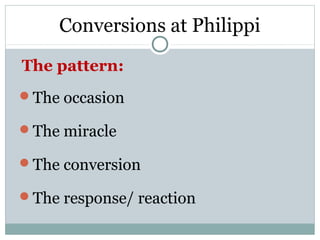
Conversions at Philippi

The pattern:
The occasion

The miracle

The conversion

The response/ reaction
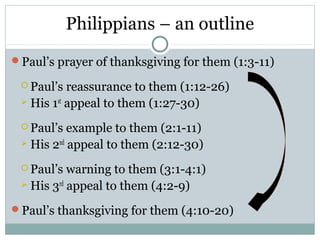
Philippians – an outline
Paul’s prayer of thanksgiving for them (1:3-11)

  Paul’s  reassurance to them (1:12-26)
  His 1st appeal to them (1:27-30)

  Paul’s  example to them (2:1-11)
  His 2nd appeal to them (2:12-30)

  Paul’s  warning to them (3:1-4:1)
  His 3rd appeal to them (4:2-9)

Paul’s thanksgiving for them (4:10-20)
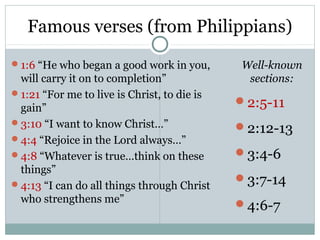
Famous verses (from Philippians)
1:6 “He who began a good work in you,       Well-known
 will carry it on to completion”              sections:
1:21 “For me to live is Christ, to die is
                                             2:5-11
 gain”
3:10 “I want to know Christ…”
                                             2:12-13
4:4 “Rejoice in the Lord always…”
4:8 “Whatever is true…think on these        3:4-6
 things”
4:13 “I can do all things through Christ
                                             3:7-14
 who strengthens me”                         4:6-7
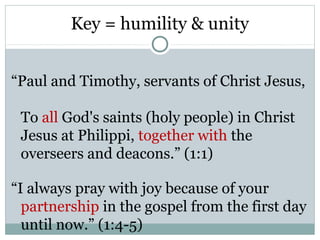
Key = humility & unity


“Paul and Timothy, servants of Christ Jesus,

 To all God's saints (holy people) in Christ
 Jesus at Philippi, together with the
 overseers and deacons.” (1:1)

“I always pray with joy because of your
  partnership in the gospel from the first day
  until now.” (1:4-5)
“Whatever happens, as citizens of heaven live in a
 manner worthy of the gospel of Christ. Then, whether
 I come and see you or only hear about you in my
 absence, I will know that you stand firm in the one
 Spirit, striving together with one accord for the faith
 of the gospel.” (1:27)
“Make my joy complete by being like-minded, having
 the same love, being one in spirit and of one mind.
 Do nothing out of selfish ambition or vain conceit.
 Rather, in humility value others above
 yourselves, not looking to your own interests but
 each of you to the interests of the others.” (2:2-4)
“I plead with Euodia and I plead with
 Syntyche to be of the same mind in the
 Lord. Yes, and I ask you, my true
 companion, help these women since
 they have contended at my side in the
 cause of the gospel, along with Clement
 and the rest of my co-workers, whose
 names are in the book of life.” (4:2-3)
Prayer of thanksgiving (1:3-11)

“I thank my God every time I remember you”

Partnership in the gospel (joy)


I have you in my heart (grace)


That your love may abound (righteous)
Reassurance & appeal (1:12-30)

“Paul’s chains = a motivation”

 For others to witness (vv.12-14)
 For Christ to be known (vv.15-18)
 For believers to be encouraged (vv.19-26)

Appeal:
Contend (as one) for the faith
Be ready to suffer for Christ
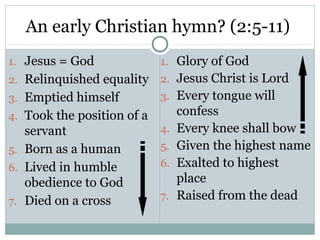
An early Christian hymn? (2:5-11)
1. Jesus = God              1. Glory of God
2. Relinquished equality    2. Jesus Christ is Lord
3. Emptied himself          3. Every tongue will
4. Took the position of a        confess
   servant                  4.   Every knee shall bow
5. Born as a human          5.   Given the highest name
6. Lived in humble          6.   Exalted to highest
   obedience to God              place
7. Died on a cross          7.   Raised from the dead
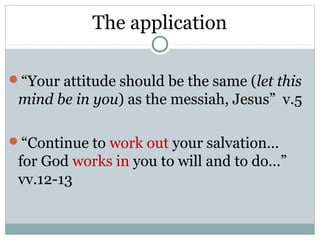
The application

“Your attitude should be the same (let this
 mind be in you) as the messiah, Jesus” v.5

“Continue to work out your salvation…
 for God works in you to will and to do…”
 vv.12-13
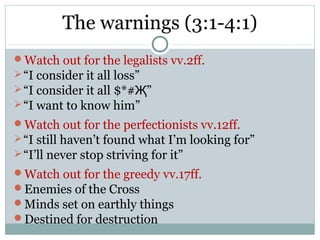
The warnings (3:1-4:1)
Watch out for the legalists vv.2ff.
 “I consider it all loss”
 “I consider it all $*#Җ”
 “I want to know him”
Watch out for the perfectionists vv.12ff.
 “I still haven’t found what I’m looking for”
 “I’ll never stop striving for it”
Watch out for the greedy vv.17ff.
Enemies of the Cross
Minds set on earthly things
Destined for destruction
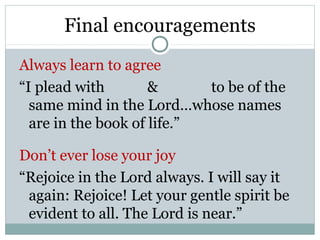
Final encouragements
Always learn to agree
“I plead with        &      to be of the
  same mind in the Lord…whose names
  are in the book of life.”

Don’t ever lose your joy
“Rejoice in the Lord always. I will say it
 again: Rejoice! Let your gentle spirit be
 evident to all. The Lord is near.”
Stop worrying/ start praying

“Do not be anxious about anything, but in
 every situation, by prayer and petition,
 with thanksgiving, present your requests to
 God. And the peace of God, which
 transcends all understanding, will guard
 your hearts and your minds in Christ
 Jesus.”
Think on the positive
“Finally, brothers and sisters, whatever is true,
 whatever is noble, whatever is right, whatever
 is pure, whatever is lovely, whatever is
 admirable - if anything is excellent or
 praiseworthy -think about such things.
 Whatever you have learned or received or
 heard from me, or seen in me - put it into
 practice.
And the God of peace will be with you.”
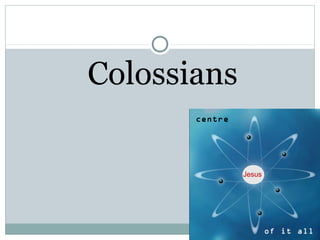
Colossians
       centre


                Jesus


                        of it all
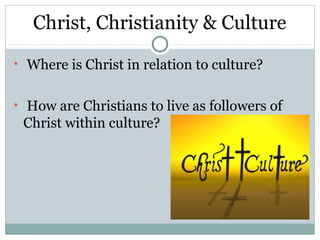
Christ, Christianity & Culture
• Where is Christ in relation to culture?


• How are Christians to live as followers of
 Christ within culture?
The Message of Colossians

Christ & Culture

 Theology – how knowing Christ should
 guard our convictions       (Col. 1:3-2:5)

 Lifestyle – how knowing Christ should
 govern our conduct          (Col. 2:6-3:17)

 Relationships – how knowing Christ
 should guide our contacts   (Col. 3:18-4:17)
Understanding culture/ understanding
               scripture

The culture in which the book was written

The context of the author & readers

How to read the Bible for all it’s worth:
1. Learning to read slowly
   (get the big picture first & then look at the details)
2. Learning to read in paragraphs
3. Learning to read sentences
4. Learning to read words
What does it say?

A letter!
Who
What
Where
When
Why
Who?

   Paul, the author (1:1,23; 4:18)

   Colossian Christians, the recipients (1:1,21,27)

   Epaphras, the minister/ pastor (1:7-8; 4:12)

   Tychicus, the letter carrier (4:7-8)
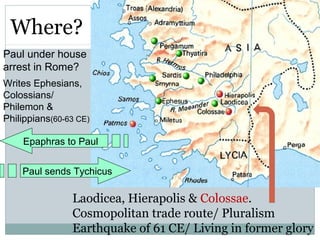
Where?
Paul under house
arrest in Rome?
Writes Ephesians,
Colossians/
Philemon &
Philippians(60-63 CE)

    Epaphras to Paul


    Paul sends Tychicus

                Laodicea, Hierapolis & Colossae.
                Cosmopolitan trade route/ Pluralism
                Earthquake of 61 CE/ Living in former glory
When?
   From imprisonment in Rome, 60-63 CE
       (Acts 28:30-31; Col. 1:24; 4:3,18)

   From imprisonment in Caesarea, c. 59 CE
       (Acts 23:23-24:27)

   While in Ephesus for 3 years (52-55 CE)
      (Acts 19)
             “Eusebius   Church History” (11.22.1)
Context: Missionary Journey #3

“After spending some time in Antioch, Paul set
 out from there and traveled from place to
 place throughout the region of Galatia and
 Phrygia, strengthening all the disciples.”
 (18:23)

“Paul took the road through the interior and
 arrived at Ephesus.” (19:1)
“Paul entered the synagogue and spoke boldly there for three
  months, arguing persuasively about the kingdom of God.
  But some of them became obstinate; they refused to
  believe and publicly maligned the Way…This went on for
  two years, so that all the Jews and Greeks who lived in the
  province of Asia heard the word of the Lord. God did
  extraordinary miracles through Paul, so that even
  handkerchiefs and aprons that had touched him were
  taken to the sick, and their illnesses were cured and the evil
  spirits left them... In this way the word of the Lord spread
  widely and grew in power. After all this had happened,
  Paul...stayed in the province of Asia a little longer.” (19:8-
  12, 20-22)
Why?

Epaphras’ report (1:7-8; 4:12; 2:1-4; 4:16)

 To warn them of impending danger (false
  teaching. Gnostics: 2nd major Christian heresy)
 To encourage them to remain true to Christ
 To instruct them how to live out their faith
 To inform them of his circumstances & his
  prayers for them
What?

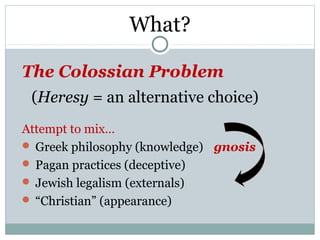
The Colossian Problem
 (Heresy = an alternative choice)
Attempt to mix…
 Greek philosophy (knowledge) gnosis
 Pagan practices (deceptive)
 Jewish legalism (externals)
 “Christian” (appearance)
Introductions (1:1-14)
Paul & Timothy

Thanksgiving (“faith, love & hope”)

Prayer: filled with knowledge
          live a life worthy of the LORD
          you have been rescued & reclaimed by God

 Theme: The supremacy of Jesus Christ.
What’s the point of theology?
“Filled with…growing in…strengthened by the
 knowledge of God” (1:9-11)

“We proclaim him…that we may present everyone
 perfect in Christ” (1:28-29)

“To know the mystery of God in Christ” (2:2)

“That no one may deceive you by: fine-sounding
 arguments…hollow philosophy…human tradition…
 worldly principles” (2:4, 8)
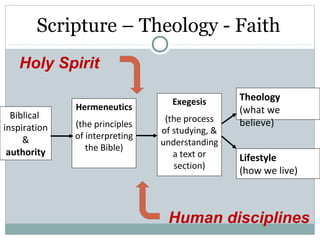
Scripture – Theology - Faith
   Holy Spirit

                                  Exegesis       Theology
              Hermeneutics                       (what we
  Biblical                       (the process
inspiration   (the principles                    believe)
                                of studying, &
     &        of interpreting
                                understanding
 authority       the Bible)
                                   a text or     Lifestyle
                                   section)
                                                 (how we live)


                                 Human disciplines
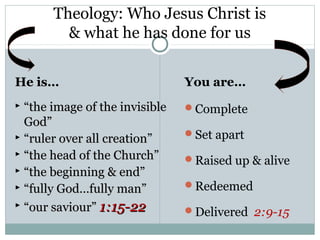
Theology: Who Jesus Christ is
         & what he has done for us


He is…                          You are…
 “the image of the invisible   Complete
  God”
 “ruler over all creation”     Set apart
 “the head of the Church”
                                Raised up & alive
 “the beginning & end”
 “fully God…fully man”         Redeemed
 “our saviour” 1:15-22
                                Delivered 2:9-15
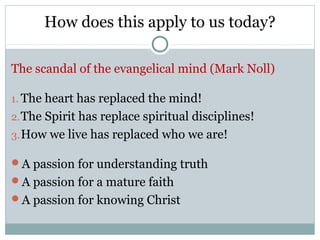
How does this apply to us today?

The scandal of the evangelical mind (Mark Noll)

1. The heart has replaced the mind!
2. The Spirit has replace spiritual disciplines!
3. How we live has replaced who we are!

A passion for understanding truth
A passion for a mature faith
A passion for knowing Christ
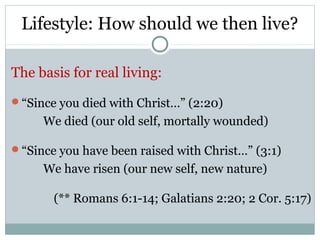
Lifestyle: How should we then live?

The basis for real living:
“Since you died with Christ…” (2:20)
     We died (our old self, mortally wounded)

“Since you have been raised with Christ…” (3:1)
     We have risen (our new self, new nature)

       (** Romans 6:1-14; Galatians 2:20; 2 Cor. 5:17)
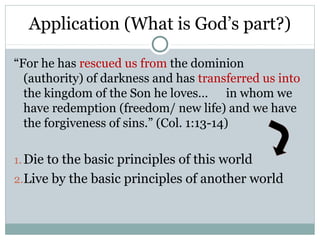
Application (What is God’s part?)

“For he has rescued us from the dominion
  (authority) of darkness and has transferred us into
  the kingdom of the Son he loves… in whom we
  have redemption (freedom/ new life) and we have
  the forgiveness of sins.” (Col. 1:13-14)

1. Die to the basic principles of this world
2.Live by the basic principles of another world
Dying to the principles of this world

You don’t become good…
 by trying to keep the rules!

1.Because they are human
2.Because they are an illusion
3.Because they are worthless
Living by the principles of another world

 “Set your hearts on things above”
 (desire these things)
 “Set your minds on things above”
 (think on these things)

Your true life
 …is now hidden with God
 …will one day appear, perfect with God
Application (what is our part?)
Put to death ( 7 vices):    Put on ( 7 virtues):
1. Sexual immorality       1. Compassion
2.Impurity                 2.Kindness
3.Lust                     3.Humility
4.Greed (Idolatry)         4.Meekness
5. Anger & rage            5. Patience
6.Malice & slander         6.Forgiveness
7. Swearing & lying        7. Love
“you have taken off        “you have put on the
   the old self”            new self”
Relationships 101

Foundation for how we relate to one another:
1. We are part of one common body
           (“the body of Christ”)
2.We live under one common head
           (the person of Christ)
3.We share one common blood
           (salvation in Christ)
The 3 great sins of North America!

The sin of individualism
   (“It’s all about me”)
The sin of independence
   (“I did it my way”)
The sin of freedom
   (“I can do whatever I want”)
The source of good relationships

“Let the peace of      “Let the word of Christ
 Christ rule in your    dwell in your minds”
 hearts” (3:15)         (3:16)

Whatever you do…       Whatever the circumstances
 “do it all in the name “give thanks to God the
 of Jesus”              Father”

“Over all these virtues put on love, which binds
  them all together in perfect unity.” (3:14)
Wives       &   husbands


“Submit to your “Love your
 husbands, as is wives, and do
 fitting in the  not be harsh
 Lord.”          with them.”

            ** Ephesians 5:22-33
Children    & parents

“Obey your       “Do not embitter
 parents in       your children, or
 everything, for they will become
 this pleases the discouraged.”
 Lord.”

              ** Ephesians 6:1-4
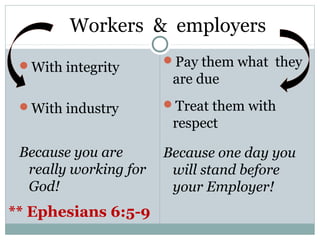
Workers & employers
 With integrity       Pay them what they
                        are due
 With industry        Treat them with
                        respect

 Because you are       Because one day you
  really working for    will stand before
  God!                  your Employer!
** Ephesians 6:5-9
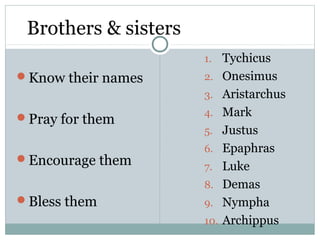
Brothers & sisters
                      1.    Tychicus
Know their names     2.    Onesimus
                      3.    Aristarchus
Pray for them        4.    Mark
                      5.    Justus
                      6.    Epaphras
Encourage them
                      7.    Luke
                      8.    Demas
Bless them           9.    Nympha
                      10.   Archippus
Philemon
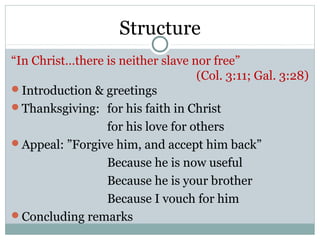
Structure
“In Christ…there is neither slave nor free”
                                   (Col. 3:11; Gal. 3:28)
Introduction & greetings
Thanksgiving: for his faith in Christ
                 for his love for others
Appeal: ”Forgive him, and accept him back”
                 Because he is now useful
                 Because he is your brother
                 Because I vouch for him
Concluding remarks

NT Session 5 Prison Letters of Paul

  • 1.
    Foundations (Year Two) “Encounteringthe New Testament” Session #5. Encountering EPHESIANS, COLOSSIANS, PHILEMON & PHILIPPIANS
  • 2.
    Written earlier: The NT Writings Letter of James (40’s/50’s) Letters of Paul: Written later: Galatians (48/49 CE) Letters of Peter (64-66) 1 & 2 Thessalonians (51-52) Mark (68-70 ) 1 & 2 Corinthians (53-57) Matthew (70-80) Romans (56-57) Luke-Acts (70-80) Prison letters (61-62): Hebrews (50’s/60’s?) (Colossians, Ephesians, Philemon & Philippians) Letter of Jude (50’s ?) Pastoral letters (64-66): Writings of John: (1, 2 Timothy & Titus) Gospel, Letters & Revelation (90-96)
  • 3.
    The second missionaryjourney Paul & Silas GREECE 49-52 CE
  • 4.
    The third missionaryjourney Paul GREECE & ASIA 53-58 CE
  • 5.
    The latter daysof Paul: The journey to Rome 58-63 CE
  • 6.
    Paul – imprisonment& martyrdom (ACTS 21-28) Time period = approx 12 years. Arrest in Jerusalem 58 CE Two year confinement at Caesarea 58-60 CE Sea voyage to Rome (several months) 60-61CE Two year imprisonment at Rome 61-63 CE Period of release & ministry 63-66 CE Second Roman imprisonment 66-67 CE Martyrdom under Nero 67 CE
  • 7.
    The Prison Letters Ephesians Union with Christ Our source Colossians Supremacy of Christ Our head Philemon Neither slave nor free Christ our liberator Philippians Appeal to humility Christ our example
  • 8.
    Founding of thechurch in Ephesus 2nd Missionary Journey (49-52 CE) Paul attempts to go into Asia (16:6) Stops in Ephesus (on return journey) Leaves Priscilla & Aquila there (18:19-21) 3rd Missionary Journey (53-58 CE) Arrival of Apollos (18:24ff.) Paul in Ephesus – for 3 years (19:10; 20:31) Tour of Macedonia & Greece (20:1-6) Farewell to Ephesian elders (20:17ff.)
  • 9.
  • 10.
    Ephesians “I owe myvery life to this book…for in it I saw a new world…I received a new outlook, a new experience of God, new attitudes to other people. Everything was new. I loved the God I saw there & Jesus Christ became the centre of everything…I was really alive at last… Ephesians is surely the greatest, maturest & most relevant of all Paul’s works. We find here the distilled essence of Christianity as it relates to God & our fellow man…This letter is pure music. When we read it, it is as if truth sings and doctrine is set to music.” (John Mackay, Princeton Seminary)
  • 11.
    “To the Ephesians”? Acircular letter Similarities to Colossians (theology & practice) “Prisoner for the Lord”  Eph. 3:1; 4:1; 6:20 (“ambassador in chains”)  Col. 4:18 (“remember my chains”)  Philemon: 1, 9  Phil. 1:7, 13-14 (“in chains”)  About to be released? (Phile:22; Phil.1:19,25; 2:24)
  • 12.
    Ephesians – anoutline “God’s new society” Blessings of God’s new people (1:1-14) Resources of God’s new people (1:15-23) Formation of God’s new people (2:1-22) Interlude: Paul’s prayer for them (3:1-21) Walk of God’s new people (4:1-6:9) Warfare of God’s new people (6:10-24)
  • 13.
    …or to putit another way! Theology/ who we are in Christ (Chs. 1-3) Practice/ how we should live in Christ (Chs. 4-6)
  • 14.
    Blessings & Resources “Youhave been blessed with “I pray that God would open every spiritual blessing” your eyes to see” vv.15-23 vv.3-14  Chosen (to be holy)  Him  Adopted  His hope  Forgiven  His riches  Purpose-driven life  His power  Present guarantee  His victory  Future inheritance
  • 15.
    Christian - knowwho you are! Blessings of God’s new people  Chosen & adopted into his family  Forgiven & living by his grace  Sealed with his Spirit (now and forever) Resources of God’s new people I pray He may give you…  The Spirit…to know his presence  The enlightenment… to know his power
  • 16.
    Formation of God’snew people Christian – don’t forget who you were or could be! You were… You were…  Dead Separated  Dominated Excluded  Disobedient Without hope  Doomed Without God “But God…”(2:1-10) “But now…”(2:11-22) Made alive in Christ Made one in Christ
  • 17.
    Walk & warfareof God’s new people Daily walk: Daily warfare: Put on the armour…  Spiritual obligations belt of truth (4:1-16) breastplate of  Moral obligations righteousness shoes (of good news) (4:17-5:21) shield of faith  Social obligations helmet of salvation (5:22-6:9) sword of the Spirit (6:10-20)
  • 18.
    How should wethen live? “As a prisoner for the LORD…I urge you to live a life worthy of the calling you have received…” (4:1, 17; 5:2, 8, 15) Live as one people (under one head) – 4:1-16 Live as children of light (by one Spirit) – 4:17-5:20 “Do not grieve the Spirit…Be filled with the Spirit”  …let it be seen in your relationships (5:21-6:9), at home (love your wives/ husbands) in society (train your children) in the workplace (respect your employer/ serve wholeheartedly)
  • 19.
    Get ready forwar! “Take your stand” (in his mighty power) Put on…. the belt (of truth) the breastplate (of righteousness) the shoes (of peace) Take up…the shield (of faith) the helmet (of salvation) the sword (the spoken word of God) Pray… in the Spirit … for your brothers & sisters … for your leaders
  • 20.
    Paul writes tothe Corinthians (from Ephesus) “So we fix our eyes not on what is seen, but on what is unseen, since what is seen is temporary, but what is unseen is eternal.” (2 Cor. 4:18) “Rather, as servants of God we commend ourselves in every way…in truthful speech and in the power of God; with weapons of righteousness in the right hand and in the left.” (2 Cor. 6:4, 7)
  • 21.
    “Some people thinkthat we live by the standards of this world. For though we live in the world, we do not wage war as the world does. The weapons we fight with are not the weapons of the world. On the contrary, they have divine power to demolish strongholds. We demolish arguments and every pretension that sets itself up against the knowledge of God, and we take captive every thought to make it obedient to Christ.” (2 Corinthians 10:2-5) “…in order that Satan might not outwit us. For we are not unaware of his schemes.”(2 Corinthians 2:11)
  • 22.
    Levels of SpiritualWarfare  Ephesus (Acts 19) 1. Ground level (vv. 11-12 & vv. 13-16)  Healing & deliverance 2. Occult level (vv.17-19)  Destruction of scrolls/ “the name of Jesus” 3. Territorial level (vv.27ff.)  “Artemis of the Ephesians”
  • 23.
  • 24.
    Founding of thechurch in Philippi 2nd Missionary Journey: Paul attempts to go to Asia (16:6-10) Vision of “man of Macedonia” Philippi = capital of Macedonia Philippian Conversions: 1. Conversion of a rich woman (16:11-15) 2.Conversion of a poor girl (16:16-21) 3.Conversion of a middle-class man (16:22-36)
  • 25.
    Conversions at Philippi Thepattern: The occasion The miracle The conversion The response/ reaction
  • 26.
    Philippians – anoutline Paul’s prayer of thanksgiving for them (1:3-11)  Paul’s reassurance to them (1:12-26)  His 1st appeal to them (1:27-30)  Paul’s example to them (2:1-11)  His 2nd appeal to them (2:12-30)  Paul’s warning to them (3:1-4:1)  His 3rd appeal to them (4:2-9) Paul’s thanksgiving for them (4:10-20)
  • 27.
    Famous verses (fromPhilippians) 1:6 “He who began a good work in you, Well-known will carry it on to completion” sections: 1:21 “For me to live is Christ, to die is 2:5-11 gain” 3:10 “I want to know Christ…” 2:12-13 4:4 “Rejoice in the Lord always…” 4:8 “Whatever is true…think on these 3:4-6 things” 4:13 “I can do all things through Christ 3:7-14 who strengthens me” 4:6-7
  • 28.
    Key = humility& unity “Paul and Timothy, servants of Christ Jesus, To all God's saints (holy people) in Christ Jesus at Philippi, together with the overseers and deacons.” (1:1) “I always pray with joy because of your partnership in the gospel from the first day until now.” (1:4-5)
  • 29.
    “Whatever happens, ascitizens of heaven live in a manner worthy of the gospel of Christ. Then, whether I come and see you or only hear about you in my absence, I will know that you stand firm in the one Spirit, striving together with one accord for the faith of the gospel.” (1:27) “Make my joy complete by being like-minded, having the same love, being one in spirit and of one mind. Do nothing out of selfish ambition or vain conceit. Rather, in humility value others above yourselves, not looking to your own interests but each of you to the interests of the others.” (2:2-4)
  • 30.
    “I plead withEuodia and I plead with Syntyche to be of the same mind in the Lord. Yes, and I ask you, my true companion, help these women since they have contended at my side in the cause of the gospel, along with Clement and the rest of my co-workers, whose names are in the book of life.” (4:2-3)
  • 31.
    Prayer of thanksgiving(1:3-11) “I thank my God every time I remember you” Partnership in the gospel (joy) I have you in my heart (grace) That your love may abound (righteous)
  • 32.
    Reassurance & appeal(1:12-30) “Paul’s chains = a motivation”  For others to witness (vv.12-14)  For Christ to be known (vv.15-18)  For believers to be encouraged (vv.19-26) Appeal: Contend (as one) for the faith Be ready to suffer for Christ
  • 33.
    An early Christianhymn? (2:5-11) 1. Jesus = God 1. Glory of God 2. Relinquished equality 2. Jesus Christ is Lord 3. Emptied himself 3. Every tongue will 4. Took the position of a confess servant 4. Every knee shall bow 5. Born as a human 5. Given the highest name 6. Lived in humble 6. Exalted to highest obedience to God place 7. Died on a cross 7. Raised from the dead
  • 34.
    The application “Your attitudeshould be the same (let this mind be in you) as the messiah, Jesus” v.5 “Continue to work out your salvation… for God works in you to will and to do…” vv.12-13
  • 35.
    The warnings (3:1-4:1) Watchout for the legalists vv.2ff.  “I consider it all loss”  “I consider it all $*#Җ”  “I want to know him” Watch out for the perfectionists vv.12ff.  “I still haven’t found what I’m looking for”  “I’ll never stop striving for it” Watch out for the greedy vv.17ff. Enemies of the Cross Minds set on earthly things Destined for destruction
  • 36.
    Final encouragements Always learnto agree “I plead with & to be of the same mind in the Lord…whose names are in the book of life.” Don’t ever lose your joy “Rejoice in the Lord always. I will say it again: Rejoice! Let your gentle spirit be evident to all. The Lord is near.”
  • 37.
    Stop worrying/ startpraying “Do not be anxious about anything, but in every situation, by prayer and petition, with thanksgiving, present your requests to God. And the peace of God, which transcends all understanding, will guard your hearts and your minds in Christ Jesus.”
  • 38.
    Think on thepositive “Finally, brothers and sisters, whatever is true, whatever is noble, whatever is right, whatever is pure, whatever is lovely, whatever is admirable - if anything is excellent or praiseworthy -think about such things. Whatever you have learned or received or heard from me, or seen in me - put it into practice. And the God of peace will be with you.”
  • 39.
    Colossians centre Jesus of it all
  • 40.
    Christ, Christianity &Culture • Where is Christ in relation to culture? • How are Christians to live as followers of Christ within culture?
  • 41.
    The Message ofColossians Christ & Culture  Theology – how knowing Christ should guard our convictions (Col. 1:3-2:5)  Lifestyle – how knowing Christ should govern our conduct (Col. 2:6-3:17)  Relationships – how knowing Christ should guide our contacts (Col. 3:18-4:17)
  • 42.
    Understanding culture/ understanding scripture The culture in which the book was written The context of the author & readers How to read the Bible for all it’s worth: 1. Learning to read slowly (get the big picture first & then look at the details) 2. Learning to read in paragraphs 3. Learning to read sentences 4. Learning to read words
  • 43.
    What does itsay? A letter! Who What Where When Why
  • 44.
    Who?  Paul, the author (1:1,23; 4:18)  Colossian Christians, the recipients (1:1,21,27)  Epaphras, the minister/ pastor (1:7-8; 4:12)  Tychicus, the letter carrier (4:7-8)
  • 45.
    Where? Paul under house arrestin Rome? Writes Ephesians, Colossians/ Philemon & Philippians(60-63 CE) Epaphras to Paul Paul sends Tychicus Laodicea, Hierapolis & Colossae. Cosmopolitan trade route/ Pluralism Earthquake of 61 CE/ Living in former glory
  • 46.
    When?  From imprisonment in Rome, 60-63 CE (Acts 28:30-31; Col. 1:24; 4:3,18)  From imprisonment in Caesarea, c. 59 CE (Acts 23:23-24:27)  While in Ephesus for 3 years (52-55 CE) (Acts 19)  “Eusebius Church History” (11.22.1)
  • 47.
    Context: Missionary Journey#3 “After spending some time in Antioch, Paul set out from there and traveled from place to place throughout the region of Galatia and Phrygia, strengthening all the disciples.” (18:23) “Paul took the road through the interior and arrived at Ephesus.” (19:1)
  • 48.
    “Paul entered thesynagogue and spoke boldly there for three months, arguing persuasively about the kingdom of God. But some of them became obstinate; they refused to believe and publicly maligned the Way…This went on for two years, so that all the Jews and Greeks who lived in the province of Asia heard the word of the Lord. God did extraordinary miracles through Paul, so that even handkerchiefs and aprons that had touched him were taken to the sick, and their illnesses were cured and the evil spirits left them... In this way the word of the Lord spread widely and grew in power. After all this had happened, Paul...stayed in the province of Asia a little longer.” (19:8- 12, 20-22)
  • 49.
    Why? Epaphras’ report (1:7-8;4:12; 2:1-4; 4:16)  To warn them of impending danger (false teaching. Gnostics: 2nd major Christian heresy)  To encourage them to remain true to Christ  To instruct them how to live out their faith  To inform them of his circumstances & his prayers for them
  • 50.
    What? The Colossian Problem (Heresy = an alternative choice) Attempt to mix…  Greek philosophy (knowledge) gnosis  Pagan practices (deceptive)  Jewish legalism (externals)  “Christian” (appearance)
  • 51.
    Introductions (1:1-14) Paul &Timothy Thanksgiving (“faith, love & hope”) Prayer: filled with knowledge live a life worthy of the LORD you have been rescued & reclaimed by God  Theme: The supremacy of Jesus Christ.
  • 52.
    What’s the pointof theology? “Filled with…growing in…strengthened by the knowledge of God” (1:9-11) “We proclaim him…that we may present everyone perfect in Christ” (1:28-29) “To know the mystery of God in Christ” (2:2) “That no one may deceive you by: fine-sounding arguments…hollow philosophy…human tradition… worldly principles” (2:4, 8)
  • 53.
    Scripture – Theology- Faith Holy Spirit Exegesis Theology Hermeneutics (what we Biblical (the process inspiration (the principles believe) of studying, & & of interpreting understanding authority the Bible) a text or Lifestyle section) (how we live) Human disciplines
  • 54.
    Theology: Who JesusChrist is & what he has done for us He is… You are…  “the image of the invisible Complete God”  “ruler over all creation” Set apart  “the head of the Church” Raised up & alive  “the beginning & end”  “fully God…fully man” Redeemed  “our saviour” 1:15-22 Delivered 2:9-15
  • 55.
    How does thisapply to us today? The scandal of the evangelical mind (Mark Noll) 1. The heart has replaced the mind! 2. The Spirit has replace spiritual disciplines! 3. How we live has replaced who we are! A passion for understanding truth A passion for a mature faith A passion for knowing Christ
  • 56.
    Lifestyle: How shouldwe then live? The basis for real living: “Since you died with Christ…” (2:20) We died (our old self, mortally wounded) “Since you have been raised with Christ…” (3:1) We have risen (our new self, new nature) (** Romans 6:1-14; Galatians 2:20; 2 Cor. 5:17)
  • 57.
    Application (What isGod’s part?) “For he has rescued us from the dominion (authority) of darkness and has transferred us into the kingdom of the Son he loves… in whom we have redemption (freedom/ new life) and we have the forgiveness of sins.” (Col. 1:13-14) 1. Die to the basic principles of this world 2.Live by the basic principles of another world
  • 58.
    Dying to theprinciples of this world You don’t become good… by trying to keep the rules! 1.Because they are human 2.Because they are an illusion 3.Because they are worthless
  • 59.
    Living by theprinciples of another world  “Set your hearts on things above” (desire these things)  “Set your minds on things above” (think on these things) Your true life  …is now hidden with God  …will one day appear, perfect with God
  • 60.
    Application (what isour part?) Put to death ( 7 vices):  Put on ( 7 virtues): 1. Sexual immorality 1. Compassion 2.Impurity 2.Kindness 3.Lust 3.Humility 4.Greed (Idolatry) 4.Meekness 5. Anger & rage 5. Patience 6.Malice & slander 6.Forgiveness 7. Swearing & lying 7. Love “you have taken off “you have put on the the old self” new self”
  • 61.
    Relationships 101 Foundation forhow we relate to one another: 1. We are part of one common body (“the body of Christ”) 2.We live under one common head (the person of Christ) 3.We share one common blood (salvation in Christ)
  • 62.
    The 3 greatsins of North America! The sin of individualism (“It’s all about me”) The sin of independence (“I did it my way”) The sin of freedom (“I can do whatever I want”)
  • 63.
    The source ofgood relationships “Let the peace of “Let the word of Christ Christ rule in your dwell in your minds” hearts” (3:15) (3:16) Whatever you do… Whatever the circumstances “do it all in the name “give thanks to God the of Jesus” Father” “Over all these virtues put on love, which binds them all together in perfect unity.” (3:14)
  • 64.
    Wives & husbands “Submit to your “Love your husbands, as is wives, and do fitting in the not be harsh Lord.” with them.” ** Ephesians 5:22-33
  • 65.
    Children & parents “Obey your “Do not embitter parents in your children, or everything, for they will become this pleases the discouraged.” Lord.” ** Ephesians 6:1-4
  • 66.
    Workers & employers With integrity Pay them what they are due With industry Treat them with respect Because you are Because one day you really working for will stand before God! your Employer! ** Ephesians 6:5-9
  • 67.
    Brothers & sisters 1. Tychicus Know their names 2. Onesimus 3. Aristarchus Pray for them 4. Mark 5. Justus 6. Epaphras Encourage them 7. Luke 8. Demas Bless them 9. Nympha 10. Archippus
  • 68.
  • 69.
    Structure “In Christ…there isneither slave nor free” (Col. 3:11; Gal. 3:28) Introduction & greetings Thanksgiving: for his faith in Christ for his love for others Appeal: ”Forgive him, and accept him back” Because he is now useful Because he is your brother Because I vouch for him Concluding remarks