Foundations (Year Two)


“Encountering the New Testament”


          Session #2.
Encountering the Synoptic Gospels
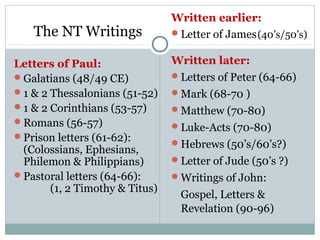
Written earlier:
    The NT Writings             Letter of James (40’s/50’s)


Letters of Paul:                Written later:
Galatians (48/49 CE)           Letters of Peter (64-66)
1 & 2 Thessalonians (51-52)    Mark (68-70 )
1 & 2 Corinthians (53-57)      Matthew (70-80)
Romans (56-57)                 Luke-Acts (70-80)
Prison letters (61-62):
                                Hebrews (50’s/60’s?)
 (Colossians, Ephesians,
 Philemon & Philippians)        Letter of Jude (50’s ?)
Pastoral letters (64-66):      Writings of John:
       (1, 2 Timothy & Titus)
                                 Gospel, Letters &
                                 Revelation (90-96)
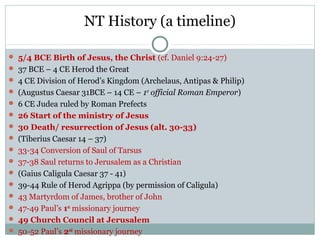
NT History (a timeline)

 5/4 BCE Birth of Jesus, the Christ (cf. Daniel 9:24-27)
 37 BCE – 4 CE Herod the Great
 4 CE Division of Herod’s Kingdom (Archelaus, Antipas & Philip)
 (Augustus Caesar 31BCE – 14 CE – 1st official Roman Emperor)
 6 CE Judea ruled by Roman Prefects
 26 Start of the ministry of Jesus
 30 Death/ resurrection of Jesus (alt. 30-33)
 (Tiberius Caesar 14 – 37)
 33-34 Conversion of Saul of Tarsus
 37-38 Saul returns to Jerusalem as a Christian
 (Gaius Caligula Caesar 37 - 41)
 39-44 Rule of Herod Agrippa (by permission of Caligula)
 43 Martyrdom of James, brother of John
 47-49 Paul’s 1st missionary journey
 49 Church Council at Jerusalem
 50-52 Paul’s 2nd missionary journey
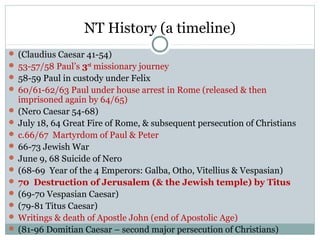
NT History (a timeline)
 (Claudius Caesar 41-54)
 53-57/58 Paul’s 3rd missionary journey
 58-59 Paul in custody under Felix
 60/61-62/63 Paul under house arrest in Rome (released & then
  imprisoned again by 64/65)
 (Nero Caesar 54-68)
 July 18, 64 Great Fire of Rome, & subsequent persecution of Christians
 c.66/67 Martyrdom of Paul & Peter
 66-73 Jewish War
 June 9, 68 Suicide of Nero
 (68-69 Year of the 4 Emperors: Galba, Otho, Vitellius & Vespasian)
 70 Destruction of Jerusalem (& the Jewish temple) by Titus
 (69-70 Vespasian Caesar)
 (79-81 Titus Caesar)
 Writings & death of Apostle John (end of Apostolic Age)
 (81-96 Domitian Caesar – second major persecution of Christians)
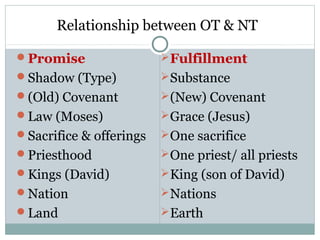
Relationship between OT & NT

Promise                  Fulfillment
Shadow (Type)            Substance
(Old) Covenant           (New) Covenant
Law (Moses)              Grace (Jesus)
Sacrifice & offerings    One sacrifice
Priesthood               One priest/ all priests
Kings (David)            King (son of David)
Nation                   Nations
Land                     Earth
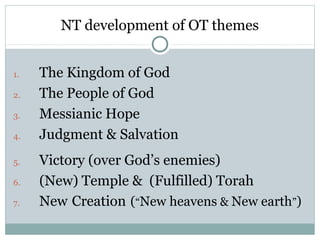
NT development of OT themes


1.   The Kingdom of God
2.   The People of God
3.   Messianic Hope
4.   Judgment & Salvation
5.   Victory (over God’s enemies)
6.   (New) Temple & (Fulfilled) Torah
7.   New Creation (“New heavens & New earth”)
God’s original promise!
The LORD had said to Abram, "Leave your
  country, your people and your father's
  household & go to the land I will show you.
I will make you into a great nation
       and I will bless you;
       I will make your name great,
       and you will be a blessing.
I will bless those who bless you,
       and whoever curses you I will curse;
       and all peoples on earth
       will be blessed through you."
                                    (Gen. 12:1-3)
When Abram was ninety-nine years old, the LORD
 appeared to him and said, "I am God Almighty...I
 will confirm my covenant between me and you and I
 will greatly increase your numbers
This is my covenant with you: You will be the
 father of many nations. No longer will you be
 called Abram (exalted father) ; your name will be
 Abraham (father of many), for I have made you a
 father of many nations. I will make you very
 fruitful; I will make nations of you, and kings
 will come from you. I will establish my covenant as
 an everlasting covenant between me and you and
 your descendants after you for the generations to
 come, to be your God and the God of your
 descendants after you.”
                                        (Gen. 17:1-7)
This is what Isaiah saw concerning Judah and Jerusalem: In
 the last days the mountain of the LORD's temple will
 be established as chief among the mountains; it will be
 raised above the hills, and all nations will stream to it.
Many peoples will come and say, “Come, let us go up to the
 mountain of the LORD, to the house of the God of Jacob. He
 will teach us his ways, so that we may walk in his paths.”
The law will go out from Zion, the word of the LORD from
 Jerusalem. He will judge between the nations and will settle
 disputes for many peoples.
They will beat their swords into plowshares and their spears
 into pruning hooks. Nation will not take up sword against
 nation, nor will they train for war anymore.
Come, O house of Jacob, let us walk in the light of the LORD.
       (Isaiah 2:1-5)
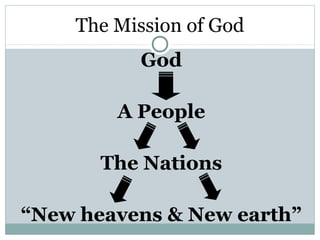
The Mission of God
          God

        A People

       The Nations

“New heavens & New earth”
A New Covenant
“The time is coming,” declares the LORD,
    ”when I will make a new covenant
    with the house of Israel
    and with the house of Judah.
It will not be like the covenant
    I made with their forefathers
    when I took them by the hand
    to lead them out of Egypt,
    because they broke my covenant,
    though I was a husband to them,"
           declares the LORD…”
“This is the covenant I will make with the house of
  Israel after that time,” declares the LORD.
      “I will put my law in their minds
    and write it on their hearts.
    I will be their God,
    and they will be my people.
No longer will a man teach his neighbor, or a man
  his brother, saying, 'Know the LORD,'
    because they will all know me,
  from the least of them to the greatest,”
    declares the LORD.
“For I will forgive their wickedness and will
  remember their sins no more.” (Jer.31:31-34)
A New Relationship
       Did you know that God
      was divorced & remarried?
“I gave faithless Israel her certificate of divorce
  and sent her away because of all her adulteries.
  Yet I saw that her unfaithful sister Judah had no
  fear; she also went out and committed adultery.”
  (Jeremiah 3:8-9)
This is what the LORD says:
  "Where is your mother's certificate of divorce
   with which I sent her away?” (Isaiah 50:1)
"Rebuke your mother, rebuke her,
      for she is not my wife,
      and I am not her husband.
Let her remove the adulterous look from her face
  and the unfaithfulness from between her breasts.”
"In that day," declares the LORD,
  "you will call me 'my husband';
   you will no longer call me 'my master.'
I will betroth you to me forever;
   I will betroth you in righteousness and justice,
   in love and compassion.
I will betroth you in faithfulness,
   and you will acknowledge the LORD.”
                                    (Hosea 2:2, 16-20)
The last words of the Prophets

"Remember the law of my servant Moses, the
 decrees and laws I gave him at Horeb for all
 Israel.

See, I will send you the prophet Elijah before
 that great and dreadful day of the LORD
 comes. He will turn the hearts of the fathers
 to their children, and the hearts of the
 children to their fathers; or else I will come
 and strike the land with a curse.“
                                 (Malachi 4:4-6)
The timing of God

“But when the right time came (when the
 time had fully come), God sent his Son,
 born of a woman, subject to the law.
 God sent him to buy freedom for us
 who were slaves to the law, so that he
 could adopt us as his very own
 children.” (Galatians 4:4-5 NLT)
The Good News of JESUS
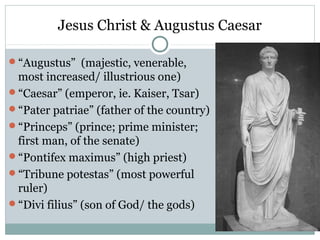
Jesus Christ & Augustus Caesar

“Augustus” (majestic, venerable,
 most increased/ illustrious one)
“Caesar” (emperor, ie. Kaiser, Tsar)
“Pater patriae” (father of the country)
“Princeps” (prince; prime minister;
 first man, of the senate)
“Pontifex maximus” (high priest)
“Tribune potestas” (most powerful
 ruler)
“Divi filius” (son of God/ the gods)
The Gospel

“The beginning of the gospel about Jesus
 Christ, the Son of God.” (Mark 1:1)

godspell (old English for good news)

euangelion (εὐαγγέλιον x75) = good
 news
(always referring to a message, not a book)
Origin of the title

The earliest extant use of εὐαγγέλιον
 "gospel" to denote a particular genre of
 writing dates to the 2nd century.
Justin Martyr (c. 155 CE) in 1 Apology 66
 writes: "...the apostles, in the memoirs
 composed by them, which are called
 Gospels".
“Good News”

“How beautiful on the mountains are the
 feet of those who bring good news, who
 proclaim peace, who bring good tidings,
 who proclaim salvation, who say to Zion,
 ‘Your God reigns!’” (Is. 52:7)

“Look, there on the mountains, the feet of
 one who brings good news, who
 proclaims peace!” (Nahum 1:15)
The message of Jesus

In those days John the Baptist came, preaching in the
  wilderness of Judea and saying, “Repent, for the
  kingdom of heaven has come near.” (Matt. 3:1-2)
From that time on Jesus began to preach, “Repent, for
 the kingdom of heaven has come near.” (Matt. 4:17)
The beginning of the good news about Jesus the
 Messiah… Jesus went into Galilee, proclaiming the
 good news of God. "The time has come," he said. "The
 kingdom of God has come near. Repent and believe the
 good news!" (Mark 1:1, 14-15)
The Spirit of the Sovereign LORD is on me,   “The Spirit of the Lord is on
  because the LORD has anointed me             me because he has
  to preach good news to the poor.
                                               anointed me to preach
He has sent me to bind up the brokenhearted,   good news to the poor.
  to proclaim freedom for the captives
                                             He has sent me to proclaim
  and release from darkness for the
  prisoners,                                   freedom for the prisoners
  to proclaim the year of the LORD's favor     and recovery of sight
  and the day of vengeance of our God,                for the blind,
  to comfort all who mourn,                      to release the oppressed,
  and provide for those who grieve in Zion—      to proclaim the year
    to bestow on them a crown of beauty
         instead of ashes,                            of the Lord's favor.”
    the oil of gladness
                                             Then…he began by saying to
         instead of mourning,
    and a garment of praise                    them, “Today this scripture
         instead of a spirit of despair.       is fulfilled in your hearing”.
They will be called oaks of righteousness,                   (Luke 4:18-21)
    a planting of the LORD, for the display
        of his splendor. (Is. 61:1-3)
Four Perspectives/ One Gospel

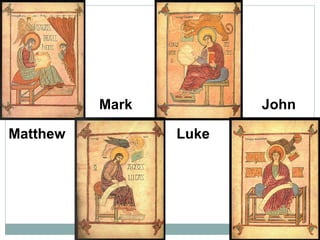
The gospel according to…Matthew (man)
The gospel according to…Mark (lion)
The gospel according to…Luke (ox)
The gospel according to…John (eagle)


The Message: That God has broken into history,
   in the person of Jesus Christ, to bring salvation
 to all people, and to establish his kingdom (reign)
Four living creatures

“In the fire was what looked like four living
  creatures. In appearance their form was that of
  a man, but each of them had four faces and four
  wings…
Their faces looked like this: Each of the four had
  the face of a man, and on the right side each had
  the face of a lion, and on the left the face of an
  ox; each also had the face of an eagle…
This was the appearance of the likeness of the
  glory of the LORD. When I saw it, I fell
  facedown.”                 (Ezekiel 1:5-10, 28)
Four living creatures
In the centre, around the throne, were four living
  creatures, and they were covered with eyes, in
  front and in back. The first living creature was
  like a lion, the second was like an ox, the third
  had a face like a man, the fourth was like a flying
  eagle. Each of the four living creatures had six
  wings and was covered with eyes all around, even
  under his wings. Day and night they never stop
  saying: “Holy, holy, holy is the Lord God
  Almighty, who was, and is, and is to come.”
                                 (Revelation 4:6-8)
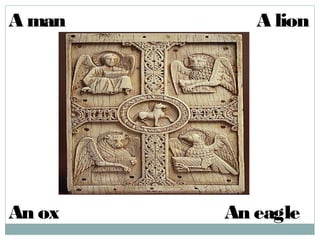
A man      A lion


An ox   An eagle
Mark          John

Matthew          Luke
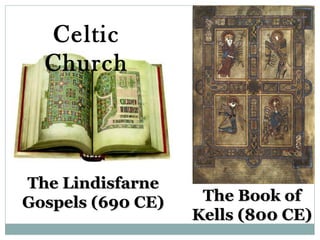
Celtic
  Church


The Lindisfarne
Gospels (690 CE)    The Book of
                   Kells (800 CE)
A nice
Christmas
 present!
The Gospels: Cautions
There are not four gospels, only one.
There are only four, not forty accounts.
Be very careful harmonizing them.
They are not biographies.
Recognize their unity,
 …but don’t ignore their diversity.
Read the gospels as good news
                           story
                           history
                           theology
Themes of the gospels

1. Matthew (Jesus = the Messiah of Israel &
    fulfillment of the Promise to Abraham)
2. Mark (Jesus = the man of action)
3. Luke (Jesus = the saviour of the world)
4. John (Jesus = the son of God)

 Acts (Jesus = the giver of the Holy Spirit
     – his ongoing ministry through his people)
Synoptic problem
Synoptic = “see together; see with same eye”
Literary relationship between the gospels
Similarities, differences, order, source, audience
Development: events, testimonies & collected reports
Differences in   content
                  wording
                  order
Mark = the middle factor
Matthew only one to bear name of an apostle. Most
 popular for church fathers (first 400 years).
“According to…” added several hundred years later.
Who copied from who?
 Mark    –  90% of content, also in Matthew
             53% of content, also in Luke
Of Mark’s 661 verses, 500 also appear verbatim in Matthew &
  350 verbatim in Luke.
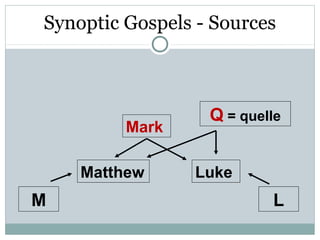
 Another 250 verses in Matthew & Luke parallel each other
 (“Q”?)

 Anytime Matthew & Mark differ, Mark & Luke always agree
 Anytime Luke & Mark differ, Mark & Matthew always agree

 Anytime Matthew & Luke differ, they never agree against Mark
 Therefore Mark cut and edited Matthew & Luke –
      or Matthew & Luke edited and expanded Mark!
Synoptics – an alternative
 The Jerusalem Phase (30-42 CE. Acts 1-12)
…under the leadership of Peter
Matthew’s Gospel: Manifesto of Jerusalem Church. Earliest
  Christian document. Teaching manual.
 The Gentile Phase (42-62 CE. Acts 13-28)
…under the leadership of Paul
A new gospel required for a new Church, carefully compiled by
  Luke. Universal son of God, for all people.
 The Roman Phase (62-67 CE)
…joint endorsement by Peter & Paul
Peter preaches series of sermons, prior to his death, in Rome.
  Based on Matthew & Luke. Mark is his recorder.
 John’s Supplement (90-95 CE The Christ of Faith/ spiritual)
Synoptic Gospels - Sources


                  Q = quelle
         Mark

    Matthew     Luke
M                         L
The gospels: What we can be sure of

“Many have undertaken to draw up an account
 of the things that have been fulfilled among us,
 just as they were handed down to us by those
 who from the first were eyewitnesses and
 servants of the word.
Therefore, since I myself have carefully
 investigated everything from the beginning, it
 seemed good also to me to write an orderly
 account for you, most excellent Theophilus, so
 that you may know the certainty of the things
 you have been taught.” (Luke 1:1-4)
Mark’s Jesus
Mark’s Jesus
Judea: Preparation for his ministry 1:1-13
Galilee & surroundings 1:14-9:50
    Preaching, teaching & healing 1:14-8:26
    Impending suffering 8:27-9:50
Return from Galilee to Judea 10:1-52
Judea & Jerusalem 11:1-13:37
    Controversy 11:1-12:44
    Discourse (signs of the times 13:1-37)
Jerusalem (Last supper to resurrection)
                                  14:1-16:8 [9-20]
Mark’s Jesus
Peter’s gospel (1 Pet. 5:13), from Rome
Very earthy, poor grammar. Sermons?
“Beginning of the gospel” (1:14-15)
kai euthus (x11 in chap. 1 & x40 in book)
Use of “historic present” (ie. “He says…”)
Mid-point (8:27-30 “immediately” fades)
Key text (14:45)
The abrupt ending? (16:8)
Mark’s Jesus: The roar of the lion

The lion’s appearance (1-8)
 The bounding lion (kai euthus)
 The beast of conflict (first miracle, 1:21-28)
The lion & his pride (1:14; 2:13; 3:13; 6:6; 8:27)
What kind of creature is this? (8-10)
Jerusalem: the lion’s lair or robber’s den (11-13)
In for the kill (14-15)
Risen from it’s prey (16)
Mark’s Jesus

Mark presents…      Jesus in his claims
                    Jesus in his mighty works
                    Jesus in his preaching
                    Jesus in his suffering
                    Jesus in his victory
…& the response of ordinary people to Jesus.
Matthew’s Jesus
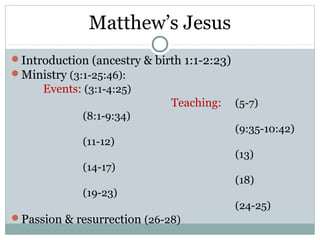
Matthew’s Jesus
Introduction (ancestry & birth 1:1-2:23)
Ministry (3:1-25:46):
     Events: (3:1-4:25)
                             Teaching:      (5-7)
             (8:1-9:34)
                                            (9:35-10:42)
             (11-12)
                                            (13)
             (14-17)
                                            (18)
             (19-23)
                                            (24-25)
Passion & resurrection (26-28)
Matthew’s Jesus: The teacher of Israel


God with a human face (1-2)
 Who is the real king of the Jews?
A new Moses (3-8, baptism, desert, people, law)
A new teaching (discourses, ie. 5-7)
Conflict with the teacher (8-23)
The suffering & rejection of the teacher (26-27)
The vindication of the teacher (28)
Luke’s Jesus
Luke’s Jesus
The prologue (1:1-4)
The birth & boyhood of Jesus (1:15-2:52)
Preparation for the journey (John, Baptism,
    Genealogy & Temptation – 3:1-4:13)
The journey
    Ministry in Galilee (4:14-9:50)
    Return to Jerusalem (9:51-19:27)
    Ministry in Jerusalem (19:28-21:38)
The burden of Jesus (22-24)
Luke’s Jesus: The bearer of burdens

The powerful ox (1-4)
 The ox in the stall…& in the temple
The ox plods a long, slow journey (4-21)
The ox & the herd (5:1; 6:12; 9:1; 10:1; 14:25)
Those who are burdened (stories & encounters - 15)
 Strength to bear the burdens (ministry – 19:10)
The ox: a sacrificial victim (22-23)
The ox: more fields to plough (24 & beyond)

NT Session 2 Synoptic Gospels

  • 1.
    Foundations (Year Two) “Encounteringthe New Testament” Session #2. Encountering the Synoptic Gospels
  • 2.
    Written earlier: The NT Writings Letter of James (40’s/50’s) Letters of Paul: Written later: Galatians (48/49 CE) Letters of Peter (64-66) 1 & 2 Thessalonians (51-52) Mark (68-70 ) 1 & 2 Corinthians (53-57) Matthew (70-80) Romans (56-57) Luke-Acts (70-80) Prison letters (61-62): Hebrews (50’s/60’s?) (Colossians, Ephesians, Philemon & Philippians) Letter of Jude (50’s ?) Pastoral letters (64-66): Writings of John: (1, 2 Timothy & Titus) Gospel, Letters & Revelation (90-96)
  • 3.
    NT History (atimeline)  5/4 BCE Birth of Jesus, the Christ (cf. Daniel 9:24-27)  37 BCE – 4 CE Herod the Great  4 CE Division of Herod’s Kingdom (Archelaus, Antipas & Philip)  (Augustus Caesar 31BCE – 14 CE – 1st official Roman Emperor)  6 CE Judea ruled by Roman Prefects  26 Start of the ministry of Jesus  30 Death/ resurrection of Jesus (alt. 30-33)  (Tiberius Caesar 14 – 37)  33-34 Conversion of Saul of Tarsus  37-38 Saul returns to Jerusalem as a Christian  (Gaius Caligula Caesar 37 - 41)  39-44 Rule of Herod Agrippa (by permission of Caligula)  43 Martyrdom of James, brother of John  47-49 Paul’s 1st missionary journey  49 Church Council at Jerusalem  50-52 Paul’s 2nd missionary journey
  • 4.
    NT History (atimeline)  (Claudius Caesar 41-54)  53-57/58 Paul’s 3rd missionary journey  58-59 Paul in custody under Felix  60/61-62/63 Paul under house arrest in Rome (released & then imprisoned again by 64/65)  (Nero Caesar 54-68)  July 18, 64 Great Fire of Rome, & subsequent persecution of Christians  c.66/67 Martyrdom of Paul & Peter  66-73 Jewish War  June 9, 68 Suicide of Nero  (68-69 Year of the 4 Emperors: Galba, Otho, Vitellius & Vespasian)  70 Destruction of Jerusalem (& the Jewish temple) by Titus  (69-70 Vespasian Caesar)  (79-81 Titus Caesar)  Writings & death of Apostle John (end of Apostolic Age)  (81-96 Domitian Caesar – second major persecution of Christians)
  • 5.
    Relationship between OT& NT Promise  Fulfillment Shadow (Type)  Substance (Old) Covenant  (New) Covenant Law (Moses)  Grace (Jesus) Sacrifice & offerings  One sacrifice Priesthood  One priest/ all priests Kings (David)  King (son of David) Nation  Nations Land  Earth
  • 6.
    NT development ofOT themes 1. The Kingdom of God 2. The People of God 3. Messianic Hope 4. Judgment & Salvation 5. Victory (over God’s enemies) 6. (New) Temple & (Fulfilled) Torah 7. New Creation (“New heavens & New earth”)
  • 7.
    God’s original promise! TheLORD had said to Abram, "Leave your country, your people and your father's household & go to the land I will show you. I will make you into a great nation and I will bless you; I will make your name great, and you will be a blessing. I will bless those who bless you, and whoever curses you I will curse; and all peoples on earth will be blessed through you." (Gen. 12:1-3)
  • 8.
    When Abram wasninety-nine years old, the LORD appeared to him and said, "I am God Almighty...I will confirm my covenant between me and you and I will greatly increase your numbers This is my covenant with you: You will be the father of many nations. No longer will you be called Abram (exalted father) ; your name will be Abraham (father of many), for I have made you a father of many nations. I will make you very fruitful; I will make nations of you, and kings will come from you. I will establish my covenant as an everlasting covenant between me and you and your descendants after you for the generations to come, to be your God and the God of your descendants after you.” (Gen. 17:1-7)
  • 9.
    This is whatIsaiah saw concerning Judah and Jerusalem: In the last days the mountain of the LORD's temple will be established as chief among the mountains; it will be raised above the hills, and all nations will stream to it. Many peoples will come and say, “Come, let us go up to the mountain of the LORD, to the house of the God of Jacob. He will teach us his ways, so that we may walk in his paths.” The law will go out from Zion, the word of the LORD from Jerusalem. He will judge between the nations and will settle disputes for many peoples. They will beat their swords into plowshares and their spears into pruning hooks. Nation will not take up sword against nation, nor will they train for war anymore. Come, O house of Jacob, let us walk in the light of the LORD. (Isaiah 2:1-5)
  • 10.
    The Mission ofGod God A People The Nations “New heavens & New earth”
  • 11.
    A New Covenant “Thetime is coming,” declares the LORD, ”when I will make a new covenant with the house of Israel and with the house of Judah. It will not be like the covenant I made with their forefathers when I took them by the hand to lead them out of Egypt, because they broke my covenant, though I was a husband to them," declares the LORD…”
  • 12.
    “This is thecovenant I will make with the house of Israel after that time,” declares the LORD. “I will put my law in their minds and write it on their hearts. I will be their God, and they will be my people. No longer will a man teach his neighbor, or a man his brother, saying, 'Know the LORD,' because they will all know me, from the least of them to the greatest,” declares the LORD. “For I will forgive their wickedness and will remember their sins no more.” (Jer.31:31-34)
  • 13.
    A New Relationship Did you know that God was divorced & remarried? “I gave faithless Israel her certificate of divorce and sent her away because of all her adulteries. Yet I saw that her unfaithful sister Judah had no fear; she also went out and committed adultery.” (Jeremiah 3:8-9) This is what the LORD says: "Where is your mother's certificate of divorce with which I sent her away?” (Isaiah 50:1)
  • 14.
    "Rebuke your mother,rebuke her, for she is not my wife, and I am not her husband. Let her remove the adulterous look from her face and the unfaithfulness from between her breasts.” "In that day," declares the LORD, "you will call me 'my husband'; you will no longer call me 'my master.' I will betroth you to me forever; I will betroth you in righteousness and justice, in love and compassion. I will betroth you in faithfulness, and you will acknowledge the LORD.” (Hosea 2:2, 16-20)
  • 15.
    The last wordsof the Prophets "Remember the law of my servant Moses, the decrees and laws I gave him at Horeb for all Israel. See, I will send you the prophet Elijah before that great and dreadful day of the LORD comes. He will turn the hearts of the fathers to their children, and the hearts of the children to their fathers; or else I will come and strike the land with a curse.“ (Malachi 4:4-6)
  • 16.
    The timing ofGod “But when the right time came (when the time had fully come), God sent his Son, born of a woman, subject to the law. God sent him to buy freedom for us who were slaves to the law, so that he could adopt us as his very own children.” (Galatians 4:4-5 NLT)
  • 17.
    The Good Newsof JESUS
  • 18.
    Jesus Christ &Augustus Caesar “Augustus” (majestic, venerable, most increased/ illustrious one) “Caesar” (emperor, ie. Kaiser, Tsar) “Pater patriae” (father of the country) “Princeps” (prince; prime minister; first man, of the senate) “Pontifex maximus” (high priest) “Tribune potestas” (most powerful ruler) “Divi filius” (son of God/ the gods)
  • 19.
    The Gospel “The beginningof the gospel about Jesus Christ, the Son of God.” (Mark 1:1) godspell (old English for good news) euangelion (εὐαγγέλιον x75) = good news (always referring to a message, not a book)
  • 20.
    Origin of thetitle The earliest extant use of εὐαγγέλιον "gospel" to denote a particular genre of writing dates to the 2nd century. Justin Martyr (c. 155 CE) in 1 Apology 66 writes: "...the apostles, in the memoirs composed by them, which are called Gospels".
  • 21.
    “Good News” “How beautifulon the mountains are the feet of those who bring good news, who proclaim peace, who bring good tidings, who proclaim salvation, who say to Zion, ‘Your God reigns!’” (Is. 52:7) “Look, there on the mountains, the feet of one who brings good news, who proclaims peace!” (Nahum 1:15)
  • 22.
    The message ofJesus In those days John the Baptist came, preaching in the wilderness of Judea and saying, “Repent, for the kingdom of heaven has come near.” (Matt. 3:1-2) From that time on Jesus began to preach, “Repent, for the kingdom of heaven has come near.” (Matt. 4:17) The beginning of the good news about Jesus the Messiah… Jesus went into Galilee, proclaiming the good news of God. "The time has come," he said. "The kingdom of God has come near. Repent and believe the good news!" (Mark 1:1, 14-15)
  • 23.
    The Spirit ofthe Sovereign LORD is on me, “The Spirit of the Lord is on because the LORD has anointed me me because he has to preach good news to the poor. anointed me to preach He has sent me to bind up the brokenhearted, good news to the poor. to proclaim freedom for the captives He has sent me to proclaim and release from darkness for the prisoners, freedom for the prisoners to proclaim the year of the LORD's favor and recovery of sight and the day of vengeance of our God, for the blind, to comfort all who mourn, to release the oppressed, and provide for those who grieve in Zion— to proclaim the year to bestow on them a crown of beauty instead of ashes, of the Lord's favor.” the oil of gladness Then…he began by saying to instead of mourning, and a garment of praise them, “Today this scripture instead of a spirit of despair. is fulfilled in your hearing”. They will be called oaks of righteousness, (Luke 4:18-21) a planting of the LORD, for the display of his splendor. (Is. 61:1-3)
  • 24.
    Four Perspectives/ OneGospel The gospel according to…Matthew (man) The gospel according to…Mark (lion) The gospel according to…Luke (ox) The gospel according to…John (eagle) The Message: That God has broken into history, in the person of Jesus Christ, to bring salvation to all people, and to establish his kingdom (reign)
  • 25.
    Four living creatures “Inthe fire was what looked like four living creatures. In appearance their form was that of a man, but each of them had four faces and four wings… Their faces looked like this: Each of the four had the face of a man, and on the right side each had the face of a lion, and on the left the face of an ox; each also had the face of an eagle… This was the appearance of the likeness of the glory of the LORD. When I saw it, I fell facedown.” (Ezekiel 1:5-10, 28)
  • 26.
    Four living creatures Inthe centre, around the throne, were four living creatures, and they were covered with eyes, in front and in back. The first living creature was like a lion, the second was like an ox, the third had a face like a man, the fourth was like a flying eagle. Each of the four living creatures had six wings and was covered with eyes all around, even under his wings. Day and night they never stop saying: “Holy, holy, holy is the Lord God Almighty, who was, and is, and is to come.” (Revelation 4:6-8)
  • 27.
    A man A lion An ox An eagle
  • 28.
    Mark John Matthew Luke
  • 29.
    Celtic Church TheLindisfarne Gospels (690 CE) The Book of Kells (800 CE)
  • 30.
  • 31.
    The Gospels: Cautions Thereare not four gospels, only one. There are only four, not forty accounts. Be very careful harmonizing them. They are not biographies. Recognize their unity, …but don’t ignore their diversity. Read the gospels as good news story history theology
  • 32.
    Themes of thegospels 1. Matthew (Jesus = the Messiah of Israel & fulfillment of the Promise to Abraham) 2. Mark (Jesus = the man of action) 3. Luke (Jesus = the saviour of the world) 4. John (Jesus = the son of God)  Acts (Jesus = the giver of the Holy Spirit – his ongoing ministry through his people)
  • 33.
    Synoptic problem Synoptic =“see together; see with same eye” Literary relationship between the gospels Similarities, differences, order, source, audience Development: events, testimonies & collected reports Differences in content wording order Mark = the middle factor Matthew only one to bear name of an apostle. Most popular for church fathers (first 400 years). “According to…” added several hundred years later.
  • 34.
    Who copied fromwho?  Mark – 90% of content, also in Matthew 53% of content, also in Luke Of Mark’s 661 verses, 500 also appear verbatim in Matthew & 350 verbatim in Luke.  Another 250 verses in Matthew & Luke parallel each other (“Q”?)  Anytime Matthew & Mark differ, Mark & Luke always agree  Anytime Luke & Mark differ, Mark & Matthew always agree  Anytime Matthew & Luke differ, they never agree against Mark  Therefore Mark cut and edited Matthew & Luke – or Matthew & Luke edited and expanded Mark!
  • 35.
    Synoptics – analternative  The Jerusalem Phase (30-42 CE. Acts 1-12) …under the leadership of Peter Matthew’s Gospel: Manifesto of Jerusalem Church. Earliest Christian document. Teaching manual.  The Gentile Phase (42-62 CE. Acts 13-28) …under the leadership of Paul A new gospel required for a new Church, carefully compiled by Luke. Universal son of God, for all people.  The Roman Phase (62-67 CE) …joint endorsement by Peter & Paul Peter preaches series of sermons, prior to his death, in Rome. Based on Matthew & Luke. Mark is his recorder.  John’s Supplement (90-95 CE The Christ of Faith/ spiritual)
  • 36.
    Synoptic Gospels -Sources Q = quelle Mark Matthew Luke M L
  • 37.
    The gospels: Whatwe can be sure of “Many have undertaken to draw up an account of the things that have been fulfilled among us, just as they were handed down to us by those who from the first were eyewitnesses and servants of the word. Therefore, since I myself have carefully investigated everything from the beginning, it seemed good also to me to write an orderly account for you, most excellent Theophilus, so that you may know the certainty of the things you have been taught.” (Luke 1:1-4)
  • 38.
  • 39.
    Mark’s Jesus Judea: Preparationfor his ministry 1:1-13 Galilee & surroundings 1:14-9:50 Preaching, teaching & healing 1:14-8:26 Impending suffering 8:27-9:50 Return from Galilee to Judea 10:1-52 Judea & Jerusalem 11:1-13:37 Controversy 11:1-12:44 Discourse (signs of the times 13:1-37) Jerusalem (Last supper to resurrection) 14:1-16:8 [9-20]
  • 40.
    Mark’s Jesus Peter’s gospel(1 Pet. 5:13), from Rome Very earthy, poor grammar. Sermons? “Beginning of the gospel” (1:14-15) kai euthus (x11 in chap. 1 & x40 in book) Use of “historic present” (ie. “He says…”) Mid-point (8:27-30 “immediately” fades) Key text (14:45) The abrupt ending? (16:8)
  • 41.
    Mark’s Jesus: Theroar of the lion The lion’s appearance (1-8)  The bounding lion (kai euthus)  The beast of conflict (first miracle, 1:21-28) The lion & his pride (1:14; 2:13; 3:13; 6:6; 8:27) What kind of creature is this? (8-10) Jerusalem: the lion’s lair or robber’s den (11-13) In for the kill (14-15) Risen from it’s prey (16)
  • 42.
    Mark’s Jesus Mark presents… Jesus in his claims Jesus in his mighty works Jesus in his preaching Jesus in his suffering Jesus in his victory …& the response of ordinary people to Jesus.
  • 43.
  • 44.
    Matthew’s Jesus Introduction (ancestry& birth 1:1-2:23) Ministry (3:1-25:46): Events: (3:1-4:25) Teaching: (5-7) (8:1-9:34) (9:35-10:42) (11-12) (13) (14-17) (18) (19-23) (24-25) Passion & resurrection (26-28)
  • 45.
    Matthew’s Jesus: Theteacher of Israel God with a human face (1-2)  Who is the real king of the Jews? A new Moses (3-8, baptism, desert, people, law) A new teaching (discourses, ie. 5-7) Conflict with the teacher (8-23) The suffering & rejection of the teacher (26-27) The vindication of the teacher (28)
  • 46.
  • 47.
    Luke’s Jesus The prologue(1:1-4) The birth & boyhood of Jesus (1:15-2:52) Preparation for the journey (John, Baptism, Genealogy & Temptation – 3:1-4:13) The journey Ministry in Galilee (4:14-9:50) Return to Jerusalem (9:51-19:27) Ministry in Jerusalem (19:28-21:38) The burden of Jesus (22-24)
  • 48.
    Luke’s Jesus: Thebearer of burdens The powerful ox (1-4)  The ox in the stall…& in the temple The ox plods a long, slow journey (4-21) The ox & the herd (5:1; 6:12; 9:1; 10:1; 14:25) Those who are burdened (stories & encounters - 15)  Strength to bear the burdens (ministry – 19:10) The ox: a sacrificial victim (22-23) The ox: more fields to plough (24 & beyond)