Norton’s Theorem
Mrs.M.Vaishnavi KIT-CBE
Norton’s Theorem
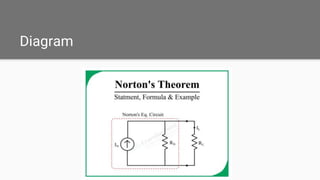
Norton's Theorem states that it is possible to simplify any linear circuit,
no matter how complex, to an equivalent circuit with just a single
current source and parallel resistance connected to a load.
Diagram
Steps to Apply Norton's Theorem
● Step 1: Identify the load resistor
● Step 2: Remove the load resistor and open the terminals
● Step 3: Determine the short-circuit current (I_sc)
● Step 4: Determine the equivalent resistance (R_th)
● Step 5: Draw the Norton equivalent circuit
● Step 6: Reconnect the load resistor
Advantages and Limitations
● Norton's theorem is only applicable to linear circuits that have a
constant resistance.
● Non-linear circuits or circuits with varying resistance cannot be
simplified using Norton's theorem.
● Limited to DC circuits: Norton's theorem is limited to DC circuits,
which means it ca
Applications
● Simplifying complex circuits
● Designing and analyzing electronic circuits
● Troubleshooting electrical networks

Nortons theorem.pptx

  • 1.
  • 2.
    Norton’s Theorem Norton's Theoremstates that it is possible to simplify any linear circuit, no matter how complex, to an equivalent circuit with just a single current source and parallel resistance connected to a load.
  • 3.
  • 4.
    Steps to ApplyNorton's Theorem ● Step 1: Identify the load resistor ● Step 2: Remove the load resistor and open the terminals ● Step 3: Determine the short-circuit current (I_sc) ● Step 4: Determine the equivalent resistance (R_th) ● Step 5: Draw the Norton equivalent circuit ● Step 6: Reconnect the load resistor
  • 5.
    Advantages and Limitations ●Norton's theorem is only applicable to linear circuits that have a constant resistance. ● Non-linear circuits or circuits with varying resistance cannot be simplified using Norton's theorem. ● Limited to DC circuits: Norton's theorem is limited to DC circuits, which means it ca
  • 6.
    Applications ● Simplifying complexcircuits ● Designing and analyzing electronic circuits ● Troubleshooting electrical networks