GANDHINAGAR INSTITUTE 
OF TECHNOLOGY 
Case study on: 
Application of Thevenin and Norton’s 
theorem 
Guided by: pratik 
Branch: I.T.(C) 
Academic Year:2013-14
 Application of Thevenin’s Theorem: 
 Thevenin’s theorem is a simplification technique used in circuit analysis. Any complex 
network with several voltage sources & resistors can be reduced to a Thevenin’s equivalent 
circuit consist of a single voltage source and a series resistance connected to a load. 
 Thevenin’s theorem can be applied in various networks and these applications of Thevenin 
theorem are, 
 This theorem is very useful tool in circuit analysis method where the network is linear & 
bilateral. 
 Practically, Thevenin’s Theorem is considered as a very useful tool in analyzing a special 
type of circuits where a particular load resistor in the circuit is varying, the voltage across it 
and current through it is easily calculated by analyzing the circuit with each trial value of that 
load resistance. 
 Measurement of resistance with the Wheatstone bridge is a important application of the 
Thevenin’s theorem. 
 However, Thevenin’s equivalent circuits of active networks consisting of transistors, voltage 
Sources such as batteries etc are very useful in circuit design. 
 Another practical application of this theorem is, the Thevenin theorem is used to solve 
asymmetrical series faults in any network. 
 By using Thevenin's theorem we can make a complex circuit into a simple circuit with a 
voltage source(Vth) in series with a resistance(Rth) 
 Thevenin's Theorem is especially useful in analyzing power systems and other circuits where 
one particular resistor in the circuit (called the "load" resistor) is subject to change, and re-calculation 
of the circuit is necessary with each trial value of load resistance, to determine 
voltage across it and current through it. 
 Thevenin's theorem is only valid for linear and bilateral networks. Practically, linearity of 
any circuit is over a certain range. Hence it is only valid for certain range. 
 Thevenin's Theorem is especially useful in analyzing power systems and other circuits where 
one particular resistor in the circuit (called the “load” resistor) is subject to change, and re-
calculation of the circuit is necessary with each trial value of load resistance, to determine 
voltage across it and current through it. 
 Application of Norton’s Theorem: 
 Norton’s Theorem allows us to replace a complicated circuit with a simple equivalent 
circuit containing only a current source and a parallel connected resistor. This 
theorem is very important from both theoretical and practical viewpoints. 
 It is important to note that the Norton equivalent circuit provides equivalence at the 
terminals only. Obviously, the internal structure and therefore the characteristics of 
the original circuit and its Norton equivalent are quite different. 
Concisely stated, Norton’s Theorem says: 
 “Any two-terminal linear circuit can be replaced by an equivalent circuit consisting of 
a current source (IN) and a parallel resistor (RN).” 
 We want to concentrate on a specific portion of a circuit. The rest of the circuit can be 
replaced by a simple Norton equivalent. 
 We have to study the circuit with different load values at the terminals. Using the 
Norton equivalent, we can avoid having to analyze the complex original circuit each 
time. 
 In some ways Norton’s Theorem can be thought of as the opposite to “Thevenins 
Theorem”, in that Thevenin reduces his circuit down to a single resistance in series 
with a single voltage. Norton on the other hand reduces his circuit down to a single 
resistance in parallel with a constant current source. 
 Norton’s Theorem states that “Any linear circuit containing several energy sources 
and resistances can be replaced by a single Constant Current generator in parallel 
with a Single Resistor“. 
 Norton's Theorem states that it is possible to simplify any linear circuit, no matter 
how complex, to an equivalent circuit with just a single current source and parallel 
resistance connected to a load. Just as with Thevenin's Theorem, the qualification of
“linear” is identical to that found in the Superposition Theorem: all underlying 
equations must be linear (no exponents or roots). 
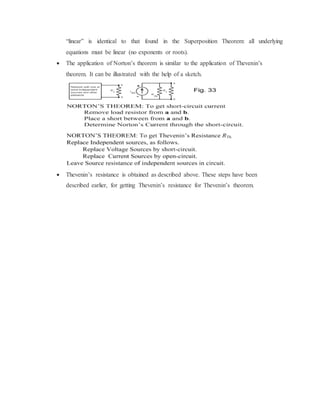
 The application of Norton’s theorem is similar to the application of Thevenin’s 
theorem. It can be illustrated with the help of a sketch. 
 Thevenin’s resistance is obtained as described above. These steps have been 
described earlier, for getting Thevenin’s resistance for Thevenin’s theorem.

Case study

  • 1.
    GANDHINAGAR INSTITUTE OFTECHNOLOGY Case study on: Application of Thevenin and Norton’s theorem Guided by: pratik Branch: I.T.(C) Academic Year:2013-14
  • 2.
     Application ofThevenin’s Theorem:  Thevenin’s theorem is a simplification technique used in circuit analysis. Any complex network with several voltage sources & resistors can be reduced to a Thevenin’s equivalent circuit consist of a single voltage source and a series resistance connected to a load.  Thevenin’s theorem can be applied in various networks and these applications of Thevenin theorem are,  This theorem is very useful tool in circuit analysis method where the network is linear & bilateral.  Practically, Thevenin’s Theorem is considered as a very useful tool in analyzing a special type of circuits where a particular load resistor in the circuit is varying, the voltage across it and current through it is easily calculated by analyzing the circuit with each trial value of that load resistance.  Measurement of resistance with the Wheatstone bridge is a important application of the Thevenin’s theorem.  However, Thevenin’s equivalent circuits of active networks consisting of transistors, voltage Sources such as batteries etc are very useful in circuit design.  Another practical application of this theorem is, the Thevenin theorem is used to solve asymmetrical series faults in any network.  By using Thevenin's theorem we can make a complex circuit into a simple circuit with a voltage source(Vth) in series with a resistance(Rth)  Thevenin's Theorem is especially useful in analyzing power systems and other circuits where one particular resistor in the circuit (called the "load" resistor) is subject to change, and re-calculation of the circuit is necessary with each trial value of load resistance, to determine voltage across it and current through it.  Thevenin's theorem is only valid for linear and bilateral networks. Practically, linearity of any circuit is over a certain range. Hence it is only valid for certain range.  Thevenin's Theorem is especially useful in analyzing power systems and other circuits where one particular resistor in the circuit (called the “load” resistor) is subject to change, and re-
  • 3.
    calculation of thecircuit is necessary with each trial value of load resistance, to determine voltage across it and current through it.  Application of Norton’s Theorem:  Norton’s Theorem allows us to replace a complicated circuit with a simple equivalent circuit containing only a current source and a parallel connected resistor. This theorem is very important from both theoretical and practical viewpoints.  It is important to note that the Norton equivalent circuit provides equivalence at the terminals only. Obviously, the internal structure and therefore the characteristics of the original circuit and its Norton equivalent are quite different. Concisely stated, Norton’s Theorem says:  “Any two-terminal linear circuit can be replaced by an equivalent circuit consisting of a current source (IN) and a parallel resistor (RN).”  We want to concentrate on a specific portion of a circuit. The rest of the circuit can be replaced by a simple Norton equivalent.  We have to study the circuit with different load values at the terminals. Using the Norton equivalent, we can avoid having to analyze the complex original circuit each time.  In some ways Norton’s Theorem can be thought of as the opposite to “Thevenins Theorem”, in that Thevenin reduces his circuit down to a single resistance in series with a single voltage. Norton on the other hand reduces his circuit down to a single resistance in parallel with a constant current source.  Norton’s Theorem states that “Any linear circuit containing several energy sources and resistances can be replaced by a single Constant Current generator in parallel with a Single Resistor“.  Norton's Theorem states that it is possible to simplify any linear circuit, no matter how complex, to an equivalent circuit with just a single current source and parallel resistance connected to a load. Just as with Thevenin's Theorem, the qualification of
  • 4.
    “linear” is identicalto that found in the Superposition Theorem: all underlying equations must be linear (no exponents or roots).  The application of Norton’s theorem is similar to the application of Thevenin’s theorem. It can be illustrated with the help of a sketch.  Thevenin’s resistance is obtained as described above. These steps have been described earlier, for getting Thevenin’s resistance for Thevenin’s theorem.