Muhammad Aamir
MS-1 (Media and Communication Studies)
Submitted to: Sir Rooh Ul Amin

 A Normative theory describes an ideal way for a media
system to be controlled and operated by the government,
authority, leader and public.
 Normative theories of press are not providing any scientific
explanations or prediction.
 At the same these “four theories of press” were came from
many sources rather than a single source.
 Media practitioners, social critics and academics also
involved to develop these normative theories.
Introduction

 Normative theories are more focused in the
relationship between Press and the Government than
press and the audience.
 These theories are more concern about the
ownership of the media and who controls the press
of media in the country.
Importance of Normative theory

1. Authoritarian theory
2. Libertarian theory
3. Social responsibility theory
4. Soviet media theory
The four theories of the
Press/Media

 Is media can published or broadcast any types of
content will earn more profits in a shortest time?
 Is media can provide any public service even if no
immediate profits can be earned?
 Is media can participate in any issues and solving the
social problem?
 Is it essential for media to protect the consumers
from the culprits, business frauds and corrupt
bureaucrats by serving as a watch dog?
Major Questions

 What people expect from media during the time of
crisis?
 Is media should broadcast the highly rated content
even if it has high level of violence?
 Is a newspaper publishing the unethical business
content to encourage the company for its higher
advertisements pay?
Major Questions

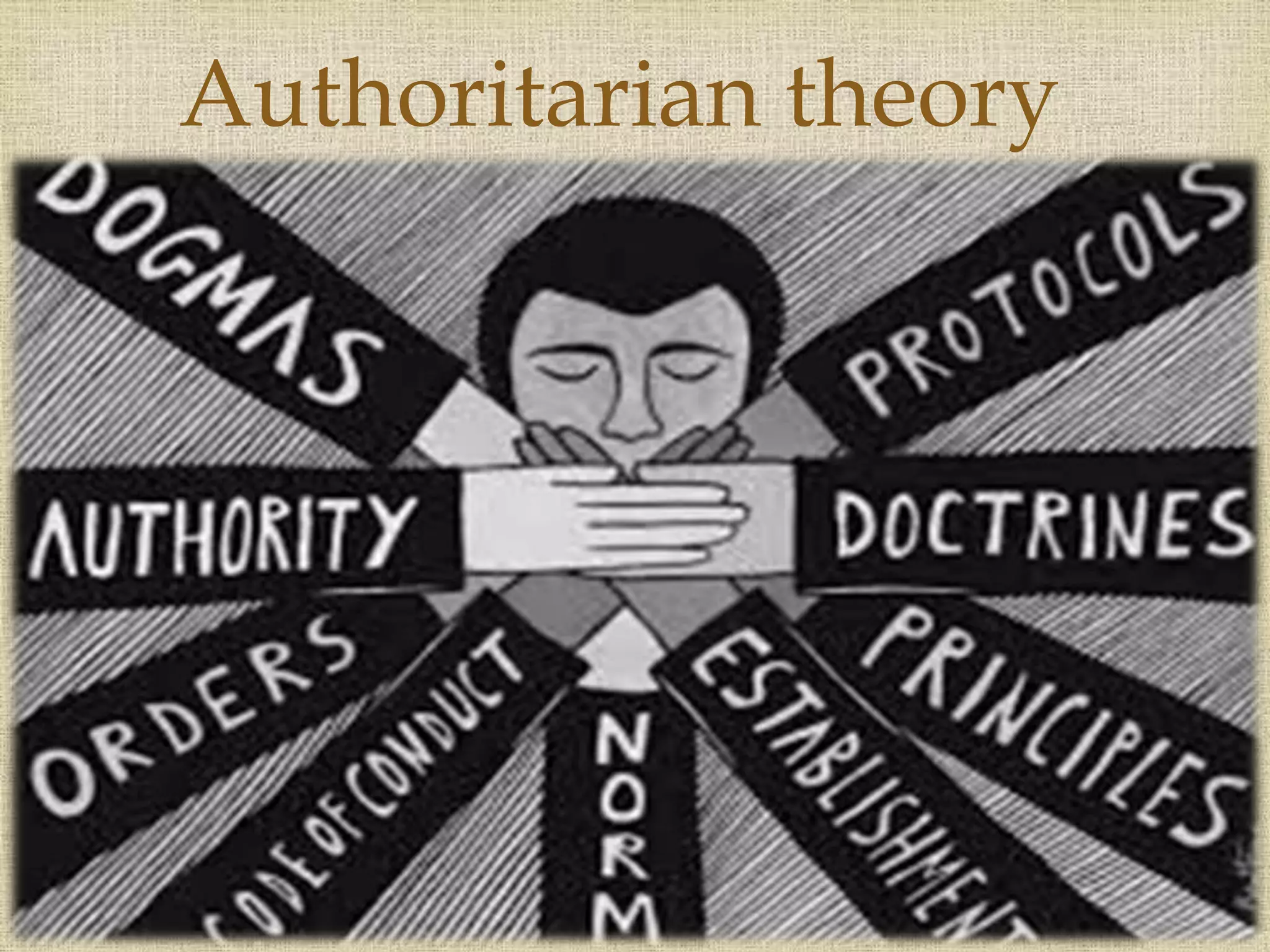
Authoritarian theory

 Authoritarian theory of mass communication
originated from the philosophy of Plato.
 The English monarchs used this approach when
printing press was invented by censoring, licensing,
taxation and making laws.
Authoritarian theory

 It is a normative theory of mass communication
where mass media is influenced and overpowered
by power and authority in the nations.
 The press and media cannot work independently
and their works are suspected to censorship.
Description

 Authoritarians are necessary to control the media.
 The press is an instrument to enhance the ruler’s
power in the country.
 The authorities have all rights to permit any media and
control it by providing license to the media and make
certain censorship.
Assumptions

 Press is taken as a weapon of the powerful. It is
used to increase the power of the rulers.
 The authorities can also cancel the license.
 Authoritarian theory is taken as a theory used by
the dictatorship governments, but can also be seen
in democratic as well as dictatorial nations.
Concepts of Authoritarian
Theory of Press

 Information, when distributed, might put security at
risk and cause to be a national threat. Thus, the
theory is justified by saying that state is greater than
individual rights where state controls the media,
especially in the time of emergencies like wars and
conflicts.
Concepts of Authoritarian
Theory of Press

 Control of government and authority
 Oppressed Media
 Use of Power.
 Punishment rule
 Limited Rights
 Cancelation of license
 Privatize
 Concept of propaganda
 Media to strengthen the government.
Major Features of
Authoritarian theory of press

 This approach is sometimes better for resolving
social and cultural conflicts.
 It is also better sometimes because it motivates
people to work for the country and its people.
 This theory can act as a gatekeeper and prevent the
media that act irresponsibly.
 The theory can be used for establishing
propaganda.
Strengths of Authoritarian
theory of Press

 Common people are taken as less intelligent and as
an easy target to manipulate.
 The ruling class uses the media only for their own
benefits.
 The freedom of expression and information of
normal people is attacked.
Weaknesses of Authoritarian
theory of Press

 The theory is
originally came from
libertarian thoughts
from 16th century in
Europe.
 Libertarian theorists
are against the
authoritarian
thoughts.
Libertarian theory

 Libertarian theory sees people are more enough to
find and judge good ideas from bad.
 The theory says people are rational and their rational
thoughts lead them to find out what are good and
bad.
 The press should not restrict anything even a
negative content may give knowledge and can make
better decision whilst worst situation.
Concept of Libertarian
theory

 Free Media
 Freedom of thoughts
 Individualism
 No censorship
 High competition
 No government influence
 Accountability
 Majority rule
Major Features

 Media can give true information without any control.
 There is no censorship.
 All individuals can express their opinion and thoughts
in the media openly.
 The theory encourages healthy competition among the
thoughts and ideas.
 Every work will be transparent to all.
 It checks the government and the state authorities and
also prevents corruption.
 It functions with democracy.
Strengths

 Media might not always act responsibly.
 Individuals might not always have good intentions and
ethics.
 People can not always make rational judgements.
 Freedom of different type of people, ideas, opinions, school
of thoughts, and group objectives can be in a conflict.
 Media can misuse its power and harm other people’s privacy
and dignity.
 Media might defame, cause sedition, libel or slander, be
immodest, publish obscenity and cause trouble.
 Media might challenge the security of the state.
Weaknesses

 Social responsibility
theory of mass media is
relatively a new concept
which started in the
mid-20th century and is
used mostly by
developing and least
developed countries.
Social Responsibility
Theory

 Social responsibility is ethics that guide any action, be it
in media or other organization that put an obligation
towards environment, society, culture and economy.
 The media like any other sector should not harm, but
should promoted environment and socio-cultural
aspects in relation to the economy of the place.
 It encourages total freedom to press and no censorship,
but it should be regulated according to social
responsibilities and external controls.
 Content is also filtered through public obligation and
interference.
Social Responsibility
theory

 Private press ownership
 Helps democracy prosper
 Media as a democratic institution
 Public participation
 Emphasis on social responsibility
 Self-regulation in media
 Code of ethics
 Helping eradicate social problems
 Media role of criticizing government
Major Features

 It helps in avoiding conflicts during wars and
conflicts.
 It accepts public opinion and works for the citizens.
 Press and media houses do not have monopoly as
rules and ethics guide them.
 The media publishes truth due to regulatory
activities and their moral obligation to do so.
 Yellow journalism decreases as media can be
questioned by the law and public.
Strengths

 Ethics are always vague, ambiguous and differ from
case to case.
 It is difficult to determine who sets clear principles
and standards.
 Social responsibility and ethics are morally
obligatory things.
Weaknesses

 The communist theory of
mass media came into being
along with the concept of
communism.
 Media is taken as a part of
the state in Communist
theory. The ownership of
media is with the state and
the country runs the media
as per their wishes to fulfill
their propaganda of control.
Soviet Communist

Authoritarian, there is
private ownership of
media
Soviet communist
theory, the control lies
in very small number
of leaders in soviet
communist theory.
Difference between Authoritarian and
Communist theory

 Media followed communist ideology of governance and
political system.
 Media was used to transmit propaganda and for transmission
of social policies.
 Media was taken as government instrument.
 Media was owned by the state.
 Criticism of communist ideology was taken as a crime.
 It helped the working class to work better and highlighting
their problems and it made people aware about communism.
 The theory was a positive one as it tried to ensure truthful
information and not let the information get manipulated by
private media.
Features

Thanks…

Normative theories

  • 1.
    Muhammad Aamir MS-1 (Mediaand Communication Studies) Submitted to: Sir Rooh Ul Amin
  • 2.
      A Normativetheory describes an ideal way for a media system to be controlled and operated by the government, authority, leader and public.  Normative theories of press are not providing any scientific explanations or prediction.  At the same these “four theories of press” were came from many sources rather than a single source.  Media practitioners, social critics and academics also involved to develop these normative theories. Introduction
  • 3.
      Normative theoriesare more focused in the relationship between Press and the Government than press and the audience.  These theories are more concern about the ownership of the media and who controls the press of media in the country. Importance of Normative theory
  • 4.
     1. Authoritarian theory 2.Libertarian theory 3. Social responsibility theory 4. Soviet media theory The four theories of the Press/Media
  • 5.
      Is mediacan published or broadcast any types of content will earn more profits in a shortest time?  Is media can provide any public service even if no immediate profits can be earned?  Is media can participate in any issues and solving the social problem?  Is it essential for media to protect the consumers from the culprits, business frauds and corrupt bureaucrats by serving as a watch dog? Major Questions
  • 6.
      What peopleexpect from media during the time of crisis?  Is media should broadcast the highly rated content even if it has high level of violence?  Is a newspaper publishing the unethical business content to encourage the company for its higher advertisements pay? Major Questions
  • 7.
  • 8.
      Authoritarian theoryof mass communication originated from the philosophy of Plato.  The English monarchs used this approach when printing press was invented by censoring, licensing, taxation and making laws. Authoritarian theory
  • 9.
      It isa normative theory of mass communication where mass media is influenced and overpowered by power and authority in the nations.  The press and media cannot work independently and their works are suspected to censorship. Description
  • 10.
      Authoritarians arenecessary to control the media.  The press is an instrument to enhance the ruler’s power in the country.  The authorities have all rights to permit any media and control it by providing license to the media and make certain censorship. Assumptions
  • 11.
      Press istaken as a weapon of the powerful. It is used to increase the power of the rulers.  The authorities can also cancel the license.  Authoritarian theory is taken as a theory used by the dictatorship governments, but can also be seen in democratic as well as dictatorial nations. Concepts of Authoritarian Theory of Press
  • 12.
      Information, whendistributed, might put security at risk and cause to be a national threat. Thus, the theory is justified by saying that state is greater than individual rights where state controls the media, especially in the time of emergencies like wars and conflicts. Concepts of Authoritarian Theory of Press
  • 13.
      Control ofgovernment and authority  Oppressed Media  Use of Power.  Punishment rule  Limited Rights  Cancelation of license  Privatize  Concept of propaganda  Media to strengthen the government. Major Features of Authoritarian theory of press
  • 14.
      This approachis sometimes better for resolving social and cultural conflicts.  It is also better sometimes because it motivates people to work for the country and its people.  This theory can act as a gatekeeper and prevent the media that act irresponsibly.  The theory can be used for establishing propaganda. Strengths of Authoritarian theory of Press
  • 15.
      Common peopleare taken as less intelligent and as an easy target to manipulate.  The ruling class uses the media only for their own benefits.  The freedom of expression and information of normal people is attacked. Weaknesses of Authoritarian theory of Press
  • 16.
      The theoryis originally came from libertarian thoughts from 16th century in Europe.  Libertarian theorists are against the authoritarian thoughts. Libertarian theory
  • 17.
      Libertarian theorysees people are more enough to find and judge good ideas from bad.  The theory says people are rational and their rational thoughts lead them to find out what are good and bad.  The press should not restrict anything even a negative content may give knowledge and can make better decision whilst worst situation. Concept of Libertarian theory
  • 18.
      Free Media Freedom of thoughts  Individualism  No censorship  High competition  No government influence  Accountability  Majority rule Major Features
  • 19.
      Media cangive true information without any control.  There is no censorship.  All individuals can express their opinion and thoughts in the media openly.  The theory encourages healthy competition among the thoughts and ideas.  Every work will be transparent to all.  It checks the government and the state authorities and also prevents corruption.  It functions with democracy. Strengths
  • 20.
      Media mightnot always act responsibly.  Individuals might not always have good intentions and ethics.  People can not always make rational judgements.  Freedom of different type of people, ideas, opinions, school of thoughts, and group objectives can be in a conflict.  Media can misuse its power and harm other people’s privacy and dignity.  Media might defame, cause sedition, libel or slander, be immodest, publish obscenity and cause trouble.  Media might challenge the security of the state. Weaknesses
  • 21.
      Social responsibility theoryof mass media is relatively a new concept which started in the mid-20th century and is used mostly by developing and least developed countries. Social Responsibility Theory
  • 22.
      Social responsibilityis ethics that guide any action, be it in media or other organization that put an obligation towards environment, society, culture and economy.  The media like any other sector should not harm, but should promoted environment and socio-cultural aspects in relation to the economy of the place.  It encourages total freedom to press and no censorship, but it should be regulated according to social responsibilities and external controls.  Content is also filtered through public obligation and interference. Social Responsibility theory
  • 23.
      Private pressownership  Helps democracy prosper  Media as a democratic institution  Public participation  Emphasis on social responsibility  Self-regulation in media  Code of ethics  Helping eradicate social problems  Media role of criticizing government Major Features
  • 24.
      It helpsin avoiding conflicts during wars and conflicts.  It accepts public opinion and works for the citizens.  Press and media houses do not have monopoly as rules and ethics guide them.  The media publishes truth due to regulatory activities and their moral obligation to do so.  Yellow journalism decreases as media can be questioned by the law and public. Strengths
  • 25.
      Ethics arealways vague, ambiguous and differ from case to case.  It is difficult to determine who sets clear principles and standards.  Social responsibility and ethics are morally obligatory things. Weaknesses
  • 26.
      The communisttheory of mass media came into being along with the concept of communism.  Media is taken as a part of the state in Communist theory. The ownership of media is with the state and the country runs the media as per their wishes to fulfill their propaganda of control. Soviet Communist
  • 27.
     Authoritarian, there is privateownership of media Soviet communist theory, the control lies in very small number of leaders in soviet communist theory. Difference between Authoritarian and Communist theory
  • 28.
      Media followedcommunist ideology of governance and political system.  Media was used to transmit propaganda and for transmission of social policies.  Media was taken as government instrument.  Media was owned by the state.  Criticism of communist ideology was taken as a crime.  It helped the working class to work better and highlighting their problems and it made people aware about communism.  The theory was a positive one as it tried to ensure truthful information and not let the information get manipulated by private media. Features
  • 29.