Role of Non-Teaching Staff in
College administration
And
NAAC Accreditation
Dr. Anil Dusane
anildusane@gmail.com
www.careerguru.co.com
1
Behind Every ‘Good Teacher’
is a great teaching assistant
2
Non-teaching staff/Support staff
Nonteaching staff is an
employee within an academic
or vocational environment
whose jobs do not involve
teaching.
3
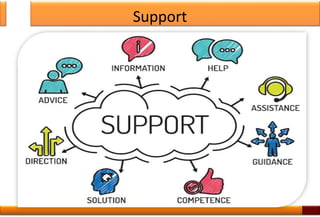
Support
4
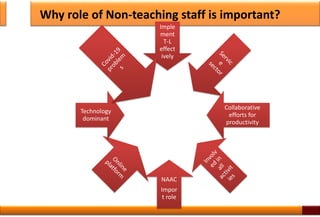
Why role of Non-teaching staff is important?
5
Imple
ment
T-L
effect
ively
Collaborative
efforts for
productivity
NAAC
Impor
t role
Technology
dominant
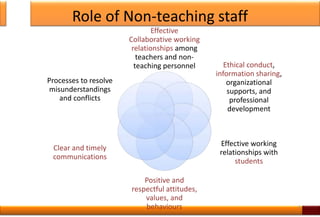
Role of Non-teaching staff
Effective
Collaborative working
relationships among
teachers and non-
teaching personnel Ethical conduct,
information sharing,
organizational
supports, and
professional
development
Effective working
relationships with
students
Positive and
respectful attitudes,
values, and
behaviours
Clear and timely
communications
Processes to resolve
misunderstandings
and conflicts
6
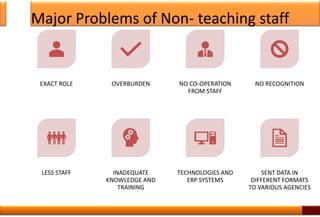
Major Problems of Non- teaching staff
7
EXACT ROLE OVERBURDEN NO CO-OPERATION
FROM STAFF
NO RECOGNITION
LESS STAFF INADEQUATE
KNOWLEDGE AND
TRAINING
TECHNOLOGIES AND
ERP SYSTEMS
SENT DATA IN
DIFFERENT FORMATS
TO VARIOUS AGENCIES
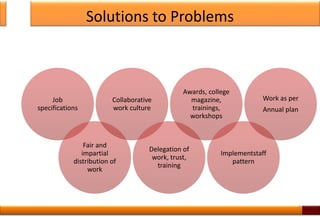
Solutions to Problems
8
Job
specifications
Fair and
impartial
distribution of
work
Collaborative
work culture
Delegation of
work, trust,
training
Awards, college
magazine,
trainings,
workshops
Implementstaff
pattern
Work as per
Annual plan
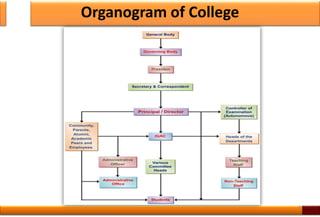
Organogram of College
9
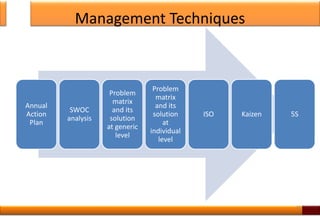
Management Techniques
Annual
Action
Plan
SWOC
analysis
Problem
matrix
and its
solution
at generic
level
Problem
matrix
and its
solution
at
individual
level
ISO Kaizen 5S
10
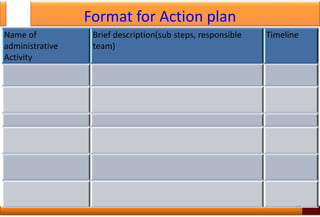
Format for Action plan
Name of
administrative
Activity
Brief description(sub steps, responsible
team)
Timeline
11
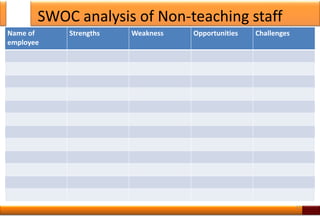
SWOC analysis of Non-teaching staff
Name of
employee
Strengths Weakness Opportunities Challenges
12
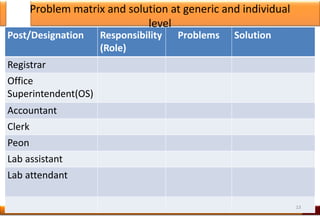
Problem matrix and solution at generic and individual
level
Post/Designation Responsibility
(Role)
Problems Solution
Registrar
Office
Superintendent(OS)
Accountant
Clerk
Peon
Lab assistant
Lab attendant
13
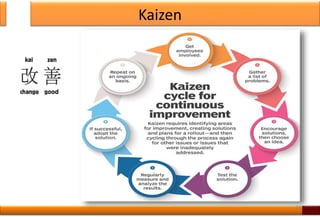
Kaizen
14
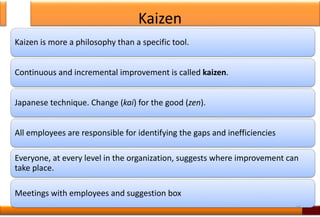
Kaizen
Kaizen is more a philosophy than a specific tool.
Continuous and incremental improvement is called kaizen.
Japanese technique. Change (kai) for the good (zen).
All employees are responsible for identifying the gaps and inefficiencies
Everyone, at every level in the organization, suggests where improvement can
take place.
Meetings with employees and suggestion box
15
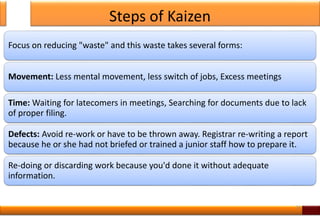
Steps of Kaizen
Focus on reducing "waste" and this waste takes several forms:
Movement: Less mental movement, less switch of jobs, Excess meetings
Time: Waiting for latecomers in meetings, Searching for documents due to lack
of proper filing.
Defects: Avoid re-work or have to be thrown away. Registrar re-writing a report
because he or she had not briefed or trained a junior staff how to prepare it.
Re-doing or discarding work because you'd done it without adequate
information.
16
Steps of Kaizen
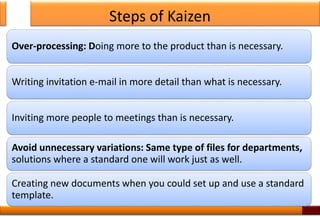
Over-processing: Doing more to the product than is necessary.
Writing invitation e-mail in more detail than what is necessary.
Inviting more people to meetings than is necessary.
Avoid unnecessary variations: Same type of files for departments,
solutions where a standard one will work just as well.
Creating new documents when you could set up and use a standard
template.
17
Major Benefits of Kaizen
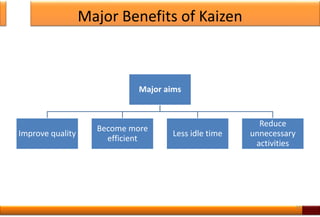
Major aims
Improve quality
Become more
efficient
Less idle time
Reduce
unnecessary
activities
18
Benefits of Kaizen
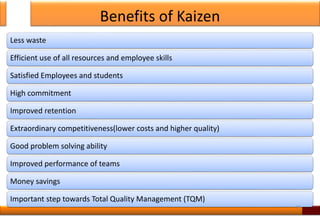
Less waste
Efficient use of all resources and employee skills
Satisfied Employees and students
High commitment
Improved retention
Extraordinary competitiveness(lower costs and higher quality)
Good problem solving ability
Improved performance of teams
Money savings
Important step towards Total Quality Management (TQM)
19
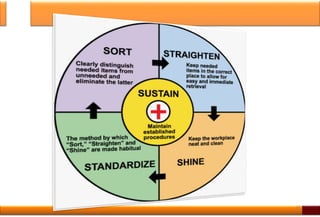
5S technique
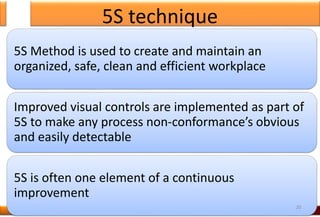
5S Method is used to create and maintain an
organized, safe, clean and efficient workplace
Improved visual controls are implemented as part of
5S to make any process non-conformance’s obvious
and easily detectable
5S is often one element of a continuous
improvement
20
21
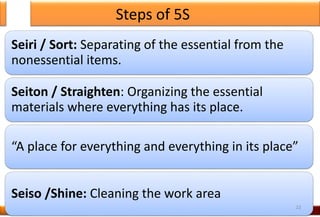
Steps of 5S
Seiri / Sort: Separating of the essential from the
nonessential items.
Seiton / Straighten: Organizing the essential
materials where everything has its place.
“A place for everything and everything in its place”
Seiso /Shine: Cleaning the work area
22
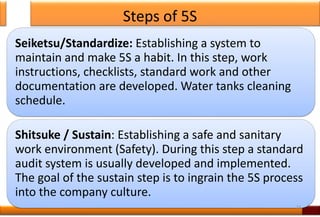
Steps of 5S
Seiketsu/Standardize: Establishing a system to
maintain and make 5S a habit. In this step, work
instructions, checklists, standard work and other
documentation are developed. Water tanks cleaning
schedule.
Shitsuke / Sustain: Establishing a safe and sanitary
work environment (Safety). During this step a standard
audit system is usually developed and implemented.
The goal of the sustain step is to ingrain the 5S process
into the company culture.
23
24
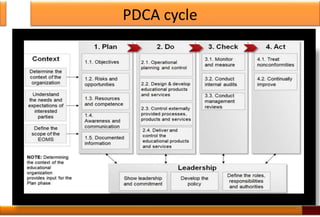
ISO 21001:2018
It specifies requirements for a management system for educational organizations (EOMS)
It is for development of competence through teaching, learning or research.
It aims to enhance satisfaction of learners, other beneficiaries and staff through the effective
application of its EOMS
It includes the processes for improvement of the system and assurance of conformity to the
requirements of learners and other beneficiaries.
All requirements of ISO 21001:2018 are generic and intended to be applicable to any organization that
uses a curriculum to support the development of competence through teaching, learning or research,
regardless of the type, size or method of delivery.
25
PDCA cycle
26
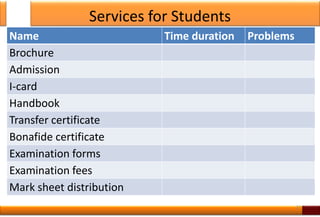
Services for Students
Name Time duration Problems
Brochure
Admission
I-card
Handbook
Transfer certificate
Bonafide certificate
Examination forms
Examination fees
Mark sheet distribution
27
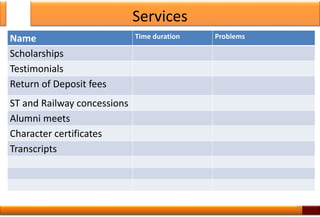
Services
Name Time duration Problems
Scholarships
Testimonials
Return of Deposit fees
ST and Railway concessions
Alumni meets
Character certificates
Transcripts
28
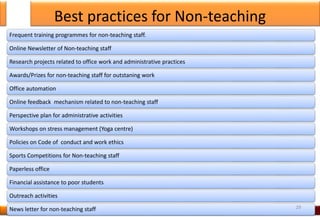
Best practices for Non-teaching
Frequent training programmes for non-teaching staff.
Online Newsletter of Non-teaching staff
Research projects related to office work and administrative practices
Awards/Prizes for non-teaching staff for outstaning work
Office automation
Online feedback mechanism related to non-teaching staff
Perspective plan for administrative activities
Workshops on stress management (Yoga centre)
Policies on Code of conduct and work ethics
Sports Competitions for Non-teaching staff
Paperless office
Financial assistance to poor students
Outreach activities
News letter for non-teaching staff 29
Best practices
Study visits of Non-teaching staff
Exchange programme
You-tube videos related to work
Dashboard for yearly data and activities
Skill development
Higher education opportunities
Association with management institutes and industries related to activities
Implementation of ISO, Kaizen, 5S, etc.
Covid-19 related activities
Competition on ‘Innovative Office/administration practices’
30
Role of E-governance
E-governance deals with the use
of ICT tools such as internet to
enhance the efficiency and
effectiveness of day to day
working of the institute.
31
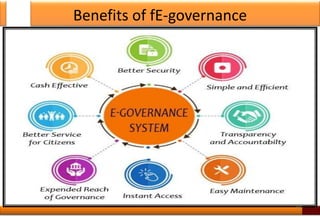
Benefits of fE-governance
32
E-administration
33
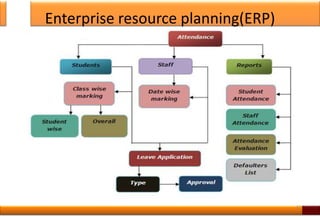
Enterprise resource planning(ERP) and Managerial Information system
(MIS) are the e-administration platforms. These systems enable easy
entry of data, its storage, its retrieval and analysis. This is mostly used
for taking informed decisions and for strategic planning.
E-administration programmes for students, teachers and non-teaching
staff significantly improves transparency and efficiency of administration.
It provides simplified procedures for maintenance of campus
infrastructure.
Trello Software has been launched on 2011.
• Trello is a visual collaboration tool for planning tasks and projects.
• It is flexible, easy to use and free app.
• Trello keeps track of everything, from big picture to minute details.
• This software enables for updation and e and co-odrdination among various
committees in college and avoids redundancy and increase productivity.
https://trello.com
https://www.youtube.com/watch?v=2e3yt75N46E&list=PLnjj5SJ-
i9vJz5wPLi_xb7vlu24hlQFgx&index=6
34
E-administration platform
E-governance in finance and accounts
College can keep updated and error-free financial records
with Tally Erp software.
For mass purchasing E-tendering can be carried out on
https://mahatenders.gov.in
Data related to admission and examination fees is made
available to the students on college website.
The minutes of finance committee are put on the college
website.
35
Important modules of ERP system for exam
Examination of Time Table,
Exam calendar
Exam notices
Exam Results
Feedback system
Convocation Registration System
Online certificate verification system (OCVS)
And many more… 36
Enterprise resource planning(ERP)
37
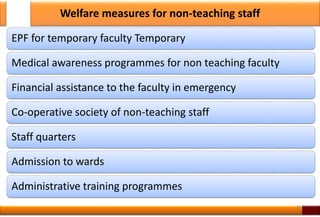
Welfare measures for non-teaching staff
38
EPF for temporary faculty Temporary
Medical awareness programmes for non teaching faculty
Financial assistance to the faculty in emergency
Co-operative society of non-teaching staff
Staff quarters
Admission to wards
Administrative training programmes
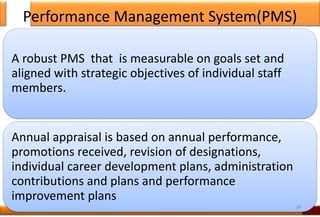
Performance Management System(PMS)
A robust PMS that is measurable on goals set and
aligned with strategic objectives of individual staff
members.
Annual appraisal is based on annual performance,
promotions received, revision of designations,
individual career development plans, administration
contributions and plans and performance
improvement plans
39
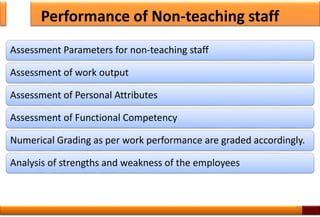
Performance of Non-teaching staff
Assessment Parameters for non-teaching staff
Assessment of work output
Assessment of Personal Attributes
Assessment of Functional Competency
Numerical Grading as per work performance are graded accordingly.
Analysis of strengths and weakness of the employees
40
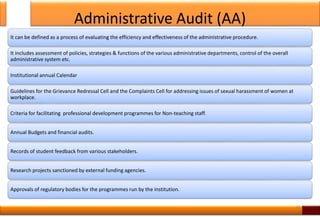
Administrative Audit (AA)
It can be defined as a process of evaluating the efficiency and effectiveness of the administrative procedure.
It includes assessment of policies, strategies & functions of the various administrative departments, control of the overall
administrative system etc.
Institutional annual Calendar
Guidelines for the Grievance Redressal Cell and the Complaints Cell for addressing issues of sexual harassment of women at
workplace.
Criteria for facilitating professional development programmes for Non-teaching staff.
Annual Budgets and financial audits.
Records of student feedback from various stakeholders.
Research projects sanctioned by external funding agencies.
Approvals of regulatory bodies for the programmes run by the institution.
41
Thank you
Dr. Anil Dusane
Vice Principal
Sir Parashurambhau College, Pune
anildusane@gmail.com
42

nonteachingstaffppt1-200703160454.pdf

  • 1.
    Role of Non-TeachingStaff in College administration And NAAC Accreditation Dr. Anil Dusane anildusane@gmail.com www.careerguru.co.com 1
  • 2.
    Behind Every ‘GoodTeacher’ is a great teaching assistant 2
  • 3.
    Non-teaching staff/Support staff Nonteachingstaff is an employee within an academic or vocational environment whose jobs do not involve teaching. 3
  • 4.
  • 5.
    Why role ofNon-teaching staff is important? 5 Imple ment T-L effect ively Collaborative efforts for productivity NAAC Impor t role Technology dominant
  • 6.
    Role of Non-teachingstaff Effective Collaborative working relationships among teachers and non- teaching personnel Ethical conduct, information sharing, organizational supports, and professional development Effective working relationships with students Positive and respectful attitudes, values, and behaviours Clear and timely communications Processes to resolve misunderstandings and conflicts 6
  • 7.
    Major Problems ofNon- teaching staff 7 EXACT ROLE OVERBURDEN NO CO-OPERATION FROM STAFF NO RECOGNITION LESS STAFF INADEQUATE KNOWLEDGE AND TRAINING TECHNOLOGIES AND ERP SYSTEMS SENT DATA IN DIFFERENT FORMATS TO VARIOUS AGENCIES
  • 8.
    Solutions to Problems 8 Job specifications Fairand impartial distribution of work Collaborative work culture Delegation of work, trust, training Awards, college magazine, trainings, workshops Implementstaff pattern Work as per Annual plan
  • 9.
  • 10.
    Management Techniques Annual Action Plan SWOC analysis Problem matrix and its solution atgeneric level Problem matrix and its solution at individual level ISO Kaizen 5S 10
  • 11.
    Format for Actionplan Name of administrative Activity Brief description(sub steps, responsible team) Timeline 11
  • 12.
    SWOC analysis ofNon-teaching staff Name of employee Strengths Weakness Opportunities Challenges 12
  • 13.
    Problem matrix andsolution at generic and individual level Post/Designation Responsibility (Role) Problems Solution Registrar Office Superintendent(OS) Accountant Clerk Peon Lab assistant Lab attendant 13
  • 14.
  • 15.
    Kaizen Kaizen is morea philosophy than a specific tool. Continuous and incremental improvement is called kaizen. Japanese technique. Change (kai) for the good (zen). All employees are responsible for identifying the gaps and inefficiencies Everyone, at every level in the organization, suggests where improvement can take place. Meetings with employees and suggestion box 15
  • 16.
    Steps of Kaizen Focuson reducing "waste" and this waste takes several forms: Movement: Less mental movement, less switch of jobs, Excess meetings Time: Waiting for latecomers in meetings, Searching for documents due to lack of proper filing. Defects: Avoid re-work or have to be thrown away. Registrar re-writing a report because he or she had not briefed or trained a junior staff how to prepare it. Re-doing or discarding work because you'd done it without adequate information. 16
  • 17.
    Steps of Kaizen Over-processing:Doing more to the product than is necessary. Writing invitation e-mail in more detail than what is necessary. Inviting more people to meetings than is necessary. Avoid unnecessary variations: Same type of files for departments, solutions where a standard one will work just as well. Creating new documents when you could set up and use a standard template. 17
  • 18.
    Major Benefits ofKaizen Major aims Improve quality Become more efficient Less idle time Reduce unnecessary activities 18
  • 19.
    Benefits of Kaizen Lesswaste Efficient use of all resources and employee skills Satisfied Employees and students High commitment Improved retention Extraordinary competitiveness(lower costs and higher quality) Good problem solving ability Improved performance of teams Money savings Important step towards Total Quality Management (TQM) 19
  • 20.
    5S technique 5S Methodis used to create and maintain an organized, safe, clean and efficient workplace Improved visual controls are implemented as part of 5S to make any process non-conformance’s obvious and easily detectable 5S is often one element of a continuous improvement 20
  • 21.
  • 22.
    Steps of 5S Seiri/ Sort: Separating of the essential from the nonessential items. Seiton / Straighten: Organizing the essential materials where everything has its place. “A place for everything and everything in its place” Seiso /Shine: Cleaning the work area 22
  • 23.
    Steps of 5S Seiketsu/Standardize:Establishing a system to maintain and make 5S a habit. In this step, work instructions, checklists, standard work and other documentation are developed. Water tanks cleaning schedule. Shitsuke / Sustain: Establishing a safe and sanitary work environment (Safety). During this step a standard audit system is usually developed and implemented. The goal of the sustain step is to ingrain the 5S process into the company culture. 23
  • 24.
  • 25.
    ISO 21001:2018 It specifiesrequirements for a management system for educational organizations (EOMS) It is for development of competence through teaching, learning or research. It aims to enhance satisfaction of learners, other beneficiaries and staff through the effective application of its EOMS It includes the processes for improvement of the system and assurance of conformity to the requirements of learners and other beneficiaries. All requirements of ISO 21001:2018 are generic and intended to be applicable to any organization that uses a curriculum to support the development of competence through teaching, learning or research, regardless of the type, size or method of delivery. 25
  • 26.
  • 27.
    Services for Students NameTime duration Problems Brochure Admission I-card Handbook Transfer certificate Bonafide certificate Examination forms Examination fees Mark sheet distribution 27
  • 28.
    Services Name Time durationProblems Scholarships Testimonials Return of Deposit fees ST and Railway concessions Alumni meets Character certificates Transcripts 28
  • 29.
    Best practices forNon-teaching Frequent training programmes for non-teaching staff. Online Newsletter of Non-teaching staff Research projects related to office work and administrative practices Awards/Prizes for non-teaching staff for outstaning work Office automation Online feedback mechanism related to non-teaching staff Perspective plan for administrative activities Workshops on stress management (Yoga centre) Policies on Code of conduct and work ethics Sports Competitions for Non-teaching staff Paperless office Financial assistance to poor students Outreach activities News letter for non-teaching staff 29
  • 30.
    Best practices Study visitsof Non-teaching staff Exchange programme You-tube videos related to work Dashboard for yearly data and activities Skill development Higher education opportunities Association with management institutes and industries related to activities Implementation of ISO, Kaizen, 5S, etc. Covid-19 related activities Competition on ‘Innovative Office/administration practices’ 30
  • 31.
    Role of E-governance E-governancedeals with the use of ICT tools such as internet to enhance the efficiency and effectiveness of day to day working of the institute. 31
  • 32.
  • 33.
    E-administration 33 Enterprise resource planning(ERP)and Managerial Information system (MIS) are the e-administration platforms. These systems enable easy entry of data, its storage, its retrieval and analysis. This is mostly used for taking informed decisions and for strategic planning. E-administration programmes for students, teachers and non-teaching staff significantly improves transparency and efficiency of administration. It provides simplified procedures for maintenance of campus infrastructure.
  • 34.
    Trello Software hasbeen launched on 2011. • Trello is a visual collaboration tool for planning tasks and projects. • It is flexible, easy to use and free app. • Trello keeps track of everything, from big picture to minute details. • This software enables for updation and e and co-odrdination among various committees in college and avoids redundancy and increase productivity. https://trello.com https://www.youtube.com/watch?v=2e3yt75N46E&list=PLnjj5SJ- i9vJz5wPLi_xb7vlu24hlQFgx&index=6 34 E-administration platform
  • 35.
    E-governance in financeand accounts College can keep updated and error-free financial records with Tally Erp software. For mass purchasing E-tendering can be carried out on https://mahatenders.gov.in Data related to admission and examination fees is made available to the students on college website. The minutes of finance committee are put on the college website. 35
  • 36.
    Important modules ofERP system for exam Examination of Time Table, Exam calendar Exam notices Exam Results Feedback system Convocation Registration System Online certificate verification system (OCVS) And many more… 36
  • 37.
  • 38.
    Welfare measures fornon-teaching staff 38 EPF for temporary faculty Temporary Medical awareness programmes for non teaching faculty Financial assistance to the faculty in emergency Co-operative society of non-teaching staff Staff quarters Admission to wards Administrative training programmes
  • 39.
    Performance Management System(PMS) Arobust PMS that is measurable on goals set and aligned with strategic objectives of individual staff members. Annual appraisal is based on annual performance, promotions received, revision of designations, individual career development plans, administration contributions and plans and performance improvement plans 39
  • 40.
    Performance of Non-teachingstaff Assessment Parameters for non-teaching staff Assessment of work output Assessment of Personal Attributes Assessment of Functional Competency Numerical Grading as per work performance are graded accordingly. Analysis of strengths and weakness of the employees 40
  • 41.
    Administrative Audit (AA) Itcan be defined as a process of evaluating the efficiency and effectiveness of the administrative procedure. It includes assessment of policies, strategies & functions of the various administrative departments, control of the overall administrative system etc. Institutional annual Calendar Guidelines for the Grievance Redressal Cell and the Complaints Cell for addressing issues of sexual harassment of women at workplace. Criteria for facilitating professional development programmes for Non-teaching staff. Annual Budgets and financial audits. Records of student feedback from various stakeholders. Research projects sanctioned by external funding agencies. Approvals of regulatory bodies for the programmes run by the institution. 41
  • 42.
    Thank you Dr. AnilDusane Vice Principal Sir Parashurambhau College, Pune anildusane@gmail.com 42