Web Application Development
with Node.js
• Building Scalable Server-Side Applications
Introduction to Node.js
• - Open-source, cross-platform JavaScript
runtime
• - Built on Chrome's V8 JavaScript engine
• - Enables JavaScript for server-side
programming
Why Node.js?
• - Non-blocking, event-driven architecture
• - High performance for I/O-heavy apps
• - Large ecosystem with npm (Node Package
Manager)
• - Used by companies like Netflix, PayPal,
LinkedIn
Key Features of Node.js
• - Asynchronous and event-driven
• - Single-threaded but highly scalable
• - npm with 1M+ packages
• - Cross-platform and lightweight
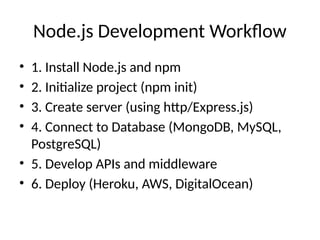
Node.js Development Workflow
• 1. Install Node.js and npm
• 2. Initialize project (npm init)
• 3. Create server (using http/Express.js)
• 4. Connect to Database (MongoDB, MySQL,
PostgreSQL)
• 5. Develop APIs and middleware
• 6. Deploy (Heroku, AWS, DigitalOcean)
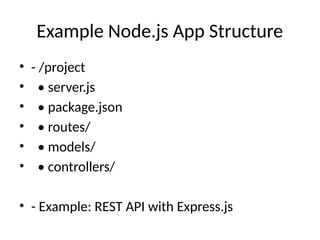
Example Node.js App Structure
• - /project
• • server.js
• • package.json
• • routes/
• • models/
• • controllers/
• - Example: REST API with Express.js
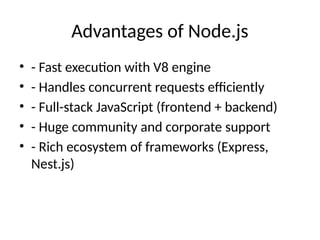
Advantages of Node.js
• - Fast execution with V8 engine
• - Handles concurrent requests efficiently
• - Full-stack JavaScript (frontend + backend)
• - Huge community and corporate support
• - Rich ecosystem of frameworks (Express,
Nest.js)
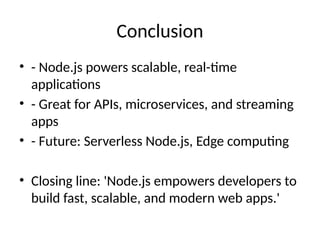
Conclusion
• - Node.js powers scalable, real-time
applications
• - Great for APIs, microservices, and streaming
apps
• - Future: Serverless Node.js, Edge computing
• Closing line: 'Node.js empowers developers to
build fast, scalable, and modern web apps.'
NodeJS_WebApp_Dev slides for begginers .pptx

  • 1.
    Web Application Development withNode.js • Building Scalable Server-Side Applications
  • 2.
    Introduction to Node.js •- Open-source, cross-platform JavaScript runtime • - Built on Chrome's V8 JavaScript engine • - Enables JavaScript for server-side programming
  • 3.
    Why Node.js? • -Non-blocking, event-driven architecture • - High performance for I/O-heavy apps • - Large ecosystem with npm (Node Package Manager) • - Used by companies like Netflix, PayPal, LinkedIn
  • 4.
    Key Features ofNode.js • - Asynchronous and event-driven • - Single-threaded but highly scalable • - npm with 1M+ packages • - Cross-platform and lightweight
  • 5.
    Node.js Development Workflow •1. Install Node.js and npm • 2. Initialize project (npm init) • 3. Create server (using http/Express.js) • 4. Connect to Database (MongoDB, MySQL, PostgreSQL) • 5. Develop APIs and middleware • 6. Deploy (Heroku, AWS, DigitalOcean)
  • 6.
    Example Node.js AppStructure • - /project • • server.js • • package.json • • routes/ • • models/ • • controllers/ • - Example: REST API with Express.js
  • 7.
    Advantages of Node.js •- Fast execution with V8 engine • - Handles concurrent requests efficiently • - Full-stack JavaScript (frontend + backend) • - Huge community and corporate support • - Rich ecosystem of frameworks (Express, Nest.js)
  • 8.
    Conclusion • - Node.jspowers scalable, real-time applications • - Great for APIs, microservices, and streaming apps • - Future: Serverless Node.js, Edge computing • Closing line: 'Node.js empowers developers to build fast, scalable, and modern web apps.'