SUMBUL FATIMA
B.Ed(HONS)
UNIVERSITY OF EDUCATION
COMPARATIVE EDUCATION
COMPARISION BETWEEN THE
EDUCATIONAL SYSTEM OF NIGERIA
AND PAKISTAN
EDUCATION SYSTEM IN NIGERIA
CONTENT
INTRODUCTION
PRESCHOOL
PRIMARY SCHOOL EDUCATION
JUNIOR SECONDARY EDUCATION
SENIOR SECONDARY EDUCATION
CURRICULUM
OBJECTIVES
CONTENT
TERTIARY EDUCATION
VOCATIONAL EDUCATION
TEACHER TRAINING EDUCATION
FACILITIES
COMPARING THE EDUCATIONAL SYSTEMS OF
NIGERA AND PAKISTAN
Nigeria  AFRICA HAS 54 STATES .
NIGERIA IS CULTURALLY A
DIVERSE COUNTRY WITH A
PUPULATION OF 170.1
MILLION IN 36 STATES.
• 50% MUSLIMS
40%CHRISTENS AND 10%
OTHER MINOROTIES.
• MUSLIMS ARE LOCTED IN THE
COUNTRY S NORTH PART
AND CHRISTENS IN SOUTH OF
THE COUNTRY
Objectives
acquire knowledge
promote loyalty for nation
responsible and socially well-adjusted person.
Identify individual talents and develop them.
Build a foundation for technological and
industrial development.
Promote positive environmental and health
practices.
objectives
awareness towards politics
awareness towards economical factors
religious concentration
respect for different cultures
Teaching methodologies
lecture method
demonstration method
instructional method
project method
source method
research method
group participation
peer discussion
question /answer method
PRESCHOOL
PRESCHOOLING IS NOT FREE IN NIGERIA .
Where they were thought the basics like art
,color ,days ,month names etc.
AS CHILD GETS PREPARE FOR ADMISSION IN
SCHOOL THE PRESCHOOL IS ONLY LOCATED
IN THE PRIVATE SECTOR.
Primary school education
PRIMARY SCHOOL EDUCATION
(Grades 1-6) is free and compulsory, and offered to children aged5, 6-
12. The curriculum is geared toward providing permanent literacy,
laying a sound basis for scientific, critical and reflective thinking, and
also in equipping children with the core life skills to function
effectively in society.
CURRICULUM at primary education
• biblical
• Islamic studies
• English language
• mathematics
• science
• ethnic
• geographic
• Computer science
• Arts
Junior and senior secondary education
Junior and Senior Secondary Education
Secondary education is now divided
into general secondary education and
secondary vocational education, and
begins at the age of 12. After 3 years of
Junior Secondary School, the Junior
School Certificate is awarded.
Junior and senior secondary education
the Nigerian primary and secondary education
system consist of 6 years of primary education
for children, 3 years of junior secondary
education and 3 years of senior secondary
education. This is called a 6-3-3 system. As
already mentioned education has been
compulsory since 1999 for children aged 6 to
15, i.e. for the duration of Primary and Junior
Secondary Education. These first 9 years are
also referred to as Basic Education.
Curriculum at junior and senior
secondary school
English, French, science, technology, Nigerian
language (Hausa, Ibo and Yoruba),
mathematics, and social studies.
Students may also
choose to study a
number of elective
subjects.
 Facilities
free primary education
free libraries
LAPTOPS
computer labs
free internet
10% to 20% books dues are
paid by Government
Assessment Methodology
Tertiary Education
Tertiary Education
Presently there are 117 universities; 36 federal, 36 state and 45 private
universities. The National Universities Commission (NUC) is the
government umbrella organization that oversees the administration of
higher education in Nigeria. The 36 federal universities and dozens of
teaching hospitals and colleges are under its purview. State governments
have responsibility for the administration and financing of the 36 state
universities. The NUC approves and accredits all university programs.
Tertiary Education is divided into to fields
Formal Education Vocational Education
Tertiary Education
(FORMAL)
Direct entry candidates for degree programs
spend three instead of the usual four years for
first degree courses in Arts, Social Sciences and
Pure Sciences. There are three stages of
education at the University level:
First Degree Program
Master's Degree Program
Doctorate Degree Program
Degree program
The first degree program
leads to the award of a Bachelor's Degree, which can be a Single Honor or
Combined Honors. Students who graduate from the faculty of Humanities are
awarded B.A. (Single or Combined Honors) while graduates in science courses
are awarded B.Sc.
The Master's degree program
takes one or two years after the first degree while the PhD
Program lasts for two or three years after the Master's Degree
DEGREE PROGRAM FOR UNIVERSITIES AND
VOCATIONAL TRAINING PROGRAM
Polytechnics awarded by HND of two years
National diplomas of two year program with one year practical
experience
Higher education diploma of three years (I.T ,SCIENCE
SUBJECTS ,MATHEMATICS ,GEOGRAPHY ,STATISTICS
,AGRICULTURE ,INDUSTRIUAL ,HISTORY ,
ENGINEERING ETC. )
COLLEGES OF EDUCATION
UNIVERSITY ASSESSMENT
METHODOLOGY
VOCATIONAL EDUCATION
It has been said that vocational education and job
training is the missing link in Nigeria’s development
plan. Certainly in rural areas facilities and
motivation are sparse, for what is there afterwards
but a life in fields for most. Those who drift to cities
are fortunate enough to find work at all.
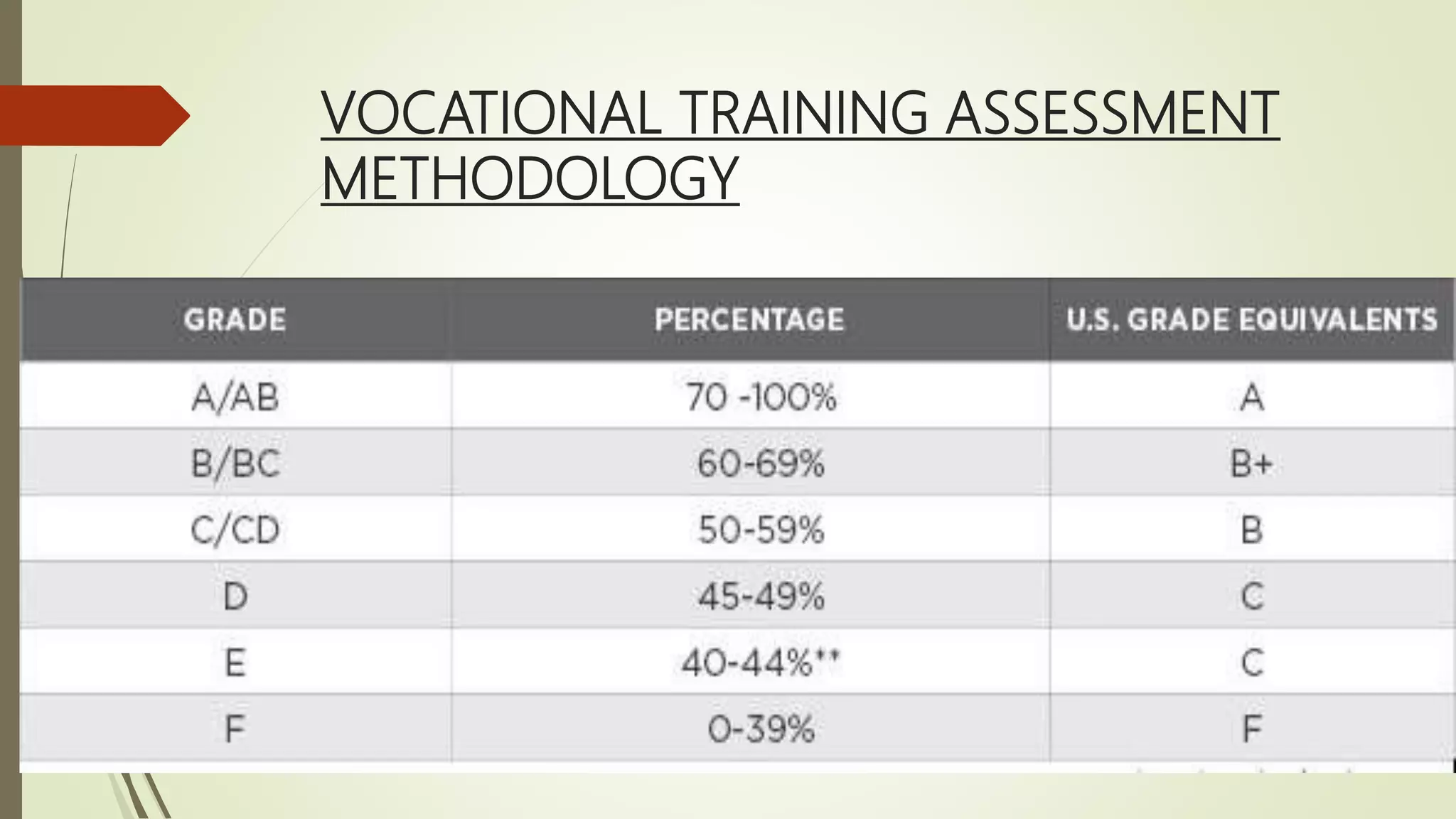
VOCATIONAL TRAINING ASSESSMENT
METHODOLOGY
TEACHER TRAINING PROGRAM
Colleges of Education award the Nigerian Certificate of Education (NCE) at the end
of a 3-year program. Most NCE-holders seek admission into universities with a view
to obtaining bachelor's degrees in education, the B.Ed., which could increase their
chances of teaching at the senior secondary schools or becoming
headmistresses/headmasters at primary schools. The higher institutions of education
also run sandwich courses to enable the working population further their education or
obtain the qualifications necessary for their present jobs.
COMPAISING THE PROMINENT EDUCATIONAL
FEATURES OF NIGERIA AND PAKISTAN
NIGERIA PAKISTAN
ORGANIZATIONAL STRUCTURE
Nigeria Pakistan
School timing is 8 :30 am to 3:00
pm
School timing is usually 8:00 am to
2 :15
School year starts from October to
September.
School year starts from April to
march
Lunch is provided. Lunch is not provided at
Government schools but at some of
the trusty ,NGOs provide lunch.
DIFFRENCE BETWEEN THE EDUCATION
SYSTEM OF NIGERIA AND PAKISTAN
 Free primary education
 Free labs ,libraries
 Free internet
 10% to20% fund provided by
Government for books and
uniforms
 Compulsory junior school
education
 Compulsory teacher training
education
 One curriculum
 Medium of instruction is English
 free Secondary education
 Free books and free uniform for
needy students .
 No rules for compulsory
education
 Government is taking initial steps
for teacher training programs
 Different curriculum regarding
social difference .
 Two mediums of instructions
English and Urdu
Thanks

Nigeria

  • 1.
  • 2.
    COMPARATIVE EDUCATION COMPARISION BETWEENTHE EDUCATIONAL SYSTEM OF NIGERIA AND PAKISTAN
  • 3.
  • 4.
    CONTENT INTRODUCTION PRESCHOOL PRIMARY SCHOOL EDUCATION JUNIORSECONDARY EDUCATION SENIOR SECONDARY EDUCATION CURRICULUM OBJECTIVES
  • 5.
    CONTENT TERTIARY EDUCATION VOCATIONAL EDUCATION TEACHERTRAINING EDUCATION FACILITIES COMPARING THE EDUCATIONAL SYSTEMS OF NIGERA AND PAKISTAN
  • 6.
    Nigeria  AFRICAHAS 54 STATES . NIGERIA IS CULTURALLY A DIVERSE COUNTRY WITH A PUPULATION OF 170.1 MILLION IN 36 STATES. • 50% MUSLIMS 40%CHRISTENS AND 10% OTHER MINOROTIES. • MUSLIMS ARE LOCTED IN THE COUNTRY S NORTH PART AND CHRISTENS IN SOUTH OF THE COUNTRY
  • 7.
    Objectives acquire knowledge promote loyaltyfor nation responsible and socially well-adjusted person. Identify individual talents and develop them. Build a foundation for technological and industrial development. Promote positive environmental and health practices.
  • 8.
    objectives awareness towards politics awarenesstowards economical factors religious concentration respect for different cultures
  • 9.
    Teaching methodologies lecture method demonstrationmethod instructional method project method source method research method group participation peer discussion question /answer method
  • 10.
    PRESCHOOL PRESCHOOLING IS NOTFREE IN NIGERIA . Where they were thought the basics like art ,color ,days ,month names etc. AS CHILD GETS PREPARE FOR ADMISSION IN SCHOOL THE PRESCHOOL IS ONLY LOCATED IN THE PRIVATE SECTOR.
  • 12.
  • 13.
    PRIMARY SCHOOL EDUCATION (Grades1-6) is free and compulsory, and offered to children aged5, 6- 12. The curriculum is geared toward providing permanent literacy, laying a sound basis for scientific, critical and reflective thinking, and also in equipping children with the core life skills to function effectively in society.
  • 14.
    CURRICULUM at primaryeducation • biblical • Islamic studies • English language • mathematics • science • ethnic • geographic • Computer science • Arts
  • 15.
    Junior and seniorsecondary education Junior and Senior Secondary Education Secondary education is now divided into general secondary education and secondary vocational education, and begins at the age of 12. After 3 years of Junior Secondary School, the Junior School Certificate is awarded.
  • 16.
    Junior and seniorsecondary education the Nigerian primary and secondary education system consist of 6 years of primary education for children, 3 years of junior secondary education and 3 years of senior secondary education. This is called a 6-3-3 system. As already mentioned education has been compulsory since 1999 for children aged 6 to 15, i.e. for the duration of Primary and Junior Secondary Education. These first 9 years are also referred to as Basic Education.
  • 17.
    Curriculum at juniorand senior secondary school English, French, science, technology, Nigerian language (Hausa, Ibo and Yoruba), mathematics, and social studies. Students may also choose to study a number of elective subjects.
  • 18.
     Facilities free primaryeducation free libraries LAPTOPS computer labs free internet 10% to 20% books dues are paid by Government
  • 19.
  • 20.
  • 21.
    Tertiary Education Presently thereare 117 universities; 36 federal, 36 state and 45 private universities. The National Universities Commission (NUC) is the government umbrella organization that oversees the administration of higher education in Nigeria. The 36 federal universities and dozens of teaching hospitals and colleges are under its purview. State governments have responsibility for the administration and financing of the 36 state universities. The NUC approves and accredits all university programs.
  • 22.
    Tertiary Education isdivided into to fields Formal Education Vocational Education
  • 23.
    Tertiary Education (FORMAL) Direct entrycandidates for degree programs spend three instead of the usual four years for first degree courses in Arts, Social Sciences and Pure Sciences. There are three stages of education at the University level: First Degree Program Master's Degree Program Doctorate Degree Program
  • 24.
    Degree program The firstdegree program leads to the award of a Bachelor's Degree, which can be a Single Honor or Combined Honors. Students who graduate from the faculty of Humanities are awarded B.A. (Single or Combined Honors) while graduates in science courses are awarded B.Sc. The Master's degree program takes one or two years after the first degree while the PhD Program lasts for two or three years after the Master's Degree
  • 25.
    DEGREE PROGRAM FORUNIVERSITIES AND VOCATIONAL TRAINING PROGRAM Polytechnics awarded by HND of two years National diplomas of two year program with one year practical experience Higher education diploma of three years (I.T ,SCIENCE SUBJECTS ,MATHEMATICS ,GEOGRAPHY ,STATISTICS ,AGRICULTURE ,INDUSTRIUAL ,HISTORY , ENGINEERING ETC. ) COLLEGES OF EDUCATION
  • 26.
  • 27.
    VOCATIONAL EDUCATION It hasbeen said that vocational education and job training is the missing link in Nigeria’s development plan. Certainly in rural areas facilities and motivation are sparse, for what is there afterwards but a life in fields for most. Those who drift to cities are fortunate enough to find work at all.
  • 28.
  • 29.
    TEACHER TRAINING PROGRAM Collegesof Education award the Nigerian Certificate of Education (NCE) at the end of a 3-year program. Most NCE-holders seek admission into universities with a view to obtaining bachelor's degrees in education, the B.Ed., which could increase their chances of teaching at the senior secondary schools or becoming headmistresses/headmasters at primary schools. The higher institutions of education also run sandwich courses to enable the working population further their education or obtain the qualifications necessary for their present jobs.
  • 30.
    COMPAISING THE PROMINENTEDUCATIONAL FEATURES OF NIGERIA AND PAKISTAN NIGERIA PAKISTAN
  • 31.
    ORGANIZATIONAL STRUCTURE Nigeria Pakistan Schooltiming is 8 :30 am to 3:00 pm School timing is usually 8:00 am to 2 :15 School year starts from October to September. School year starts from April to march Lunch is provided. Lunch is not provided at Government schools but at some of the trusty ,NGOs provide lunch.
  • 32.
    DIFFRENCE BETWEEN THEEDUCATION SYSTEM OF NIGERIA AND PAKISTAN  Free primary education  Free labs ,libraries  Free internet  10% to20% fund provided by Government for books and uniforms  Compulsory junior school education  Compulsory teacher training education  One curriculum  Medium of instruction is English  free Secondary education  Free books and free uniform for needy students .  No rules for compulsory education  Government is taking initial steps for teacher training programs  Different curriculum regarding social difference .  Two mediums of instructions English and Urdu
  • 33.