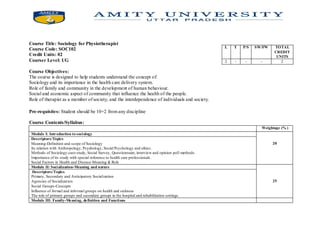
Course Title: Sociology for Physiotherapist
Course Code: SOC102
Credit Units: 02
Courser Level: UG
Course Objectives:
The course is designed to help students understand the concept of:
Sociology and its importance in the health care delivery system.
Role of family and community in the development of human behaviour.
Social and economic aspect of community that influence the health of the people.
Role of therapist as a member of society, and the interdependence of individuals and society.
Pre-requisites: Student should be 10+2 from any discipline
Course Contents/Syllabus:
Weightage (% )
Module I: Introduction to sociology
20
Descriptors/Topics
Meaning-Definition and scope of Sociology
Its relation with Anthropology, Psychology, Social Psychology and ethics.
Methods of Sociology-case study, Social Survey, Questionnaire, interview and opinion poll methods.
Importance of its study with special reference to health care professionals.
Social Factors in Health and Disease-Meaning & Role
Module II: Socialization-Meaning and nature
25
Descriptors/Topics
Primary, Secondary and Anticipatory Socialization
Agencies of Socialization
Social Groups-Concepts
Influence of formal and informal groups on health and sickness
The role of primary groups and secondary groups in the hospital and rehabilitation settings.
Module III: Family-Meaning, definition and Functions
L T P/S SW/FW TOTAL
CREDIT
UNITS
2 - - - 2
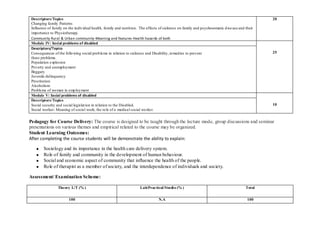
Descriptors/Topics
Changing family Patterns
Influence of family on the individual health, family and nutrition. The effects of sickness on family and psychosomatic disease and their
importance to Physiotherapy.
Community Rural & Urban community-Meaning and features-Health hazards of both
20
Module IV: Social problems of disabled
25
Descriptors/Topics
Consequences of the following social problems in relation to sickness and Disability, remedies to prevent
these problems.
Population explosion
Poverty and unemployment
Beggary
Juvenile delinquency
Prostitution
Alcoholism
Problems of women in employment
Module V: Social problems of disabled
10
Descriptors/Topics
Social security and social legislation in relation to the Disabled.
Social worker- Meaning of social work; the role of a medical social worker.
Pedagogy for Course Delivery: The course is designed to be taught through the lecture mode, group discussions and seminar
presentations on various themes and empirical related to the course may be organized.
Student Learning Outcomes:
After completing the course students will be demonstrate the ability to explain:
Sociology and its importance in the health care delivery system.
Role of family and community in the development of human behaviour.
Social and economic aspect of community that influence the health of the people.
Role of therapist as a member of society, and the interdependence of individuals and society.
Assessment/ Examination Scheme:
Theory L/T (% ) Lab/Practical/Studio (% ) Total
100 N.A 100
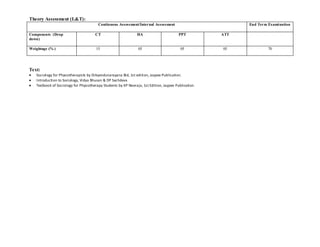
Theory Assessment (L&T):
Continuous Assessment/Internal Assessment End Term Examination
Components (Drop
down)
CT HA PPT ATT
Weightage (% ) 15 05 05 05 70
Text:
Sociology for Physiotherapists by Dibyendunarayana Bid, 1st edition, Jaypee Publication.
Introduction to Sociology, Vidya Bhusan & DP Sachdeva
Textbook of Sociology for Physiotherapy Students by KP Neeraja, 1st Edition, Jaypee Publication.

NewSyllabus_112620148825045.pdf

  • 1.
    Course Title: Sociologyfor Physiotherapist Course Code: SOC102 Credit Units: 02 Courser Level: UG Course Objectives: The course is designed to help students understand the concept of: Sociology and its importance in the health care delivery system. Role of family and community in the development of human behaviour. Social and economic aspect of community that influence the health of the people. Role of therapist as a member of society, and the interdependence of individuals and society. Pre-requisites: Student should be 10+2 from any discipline Course Contents/Syllabus: Weightage (% ) Module I: Introduction to sociology 20 Descriptors/Topics Meaning-Definition and scope of Sociology Its relation with Anthropology, Psychology, Social Psychology and ethics. Methods of Sociology-case study, Social Survey, Questionnaire, interview and opinion poll methods. Importance of its study with special reference to health care professionals. Social Factors in Health and Disease-Meaning & Role Module II: Socialization-Meaning and nature 25 Descriptors/Topics Primary, Secondary and Anticipatory Socialization Agencies of Socialization Social Groups-Concepts Influence of formal and informal groups on health and sickness The role of primary groups and secondary groups in the hospital and rehabilitation settings. Module III: Family-Meaning, definition and Functions L T P/S SW/FW TOTAL CREDIT UNITS 2 - - - 2
  • 2.
    Descriptors/Topics Changing family Patterns Influenceof family on the individual health, family and nutrition. The effects of sickness on family and psychosomatic disease and their importance to Physiotherapy. Community Rural & Urban community-Meaning and features-Health hazards of both 20 Module IV: Social problems of disabled 25 Descriptors/Topics Consequences of the following social problems in relation to sickness and Disability, remedies to prevent these problems. Population explosion Poverty and unemployment Beggary Juvenile delinquency Prostitution Alcoholism Problems of women in employment Module V: Social problems of disabled 10 Descriptors/Topics Social security and social legislation in relation to the Disabled. Social worker- Meaning of social work; the role of a medical social worker. Pedagogy for Course Delivery: The course is designed to be taught through the lecture mode, group discussions and seminar presentations on various themes and empirical related to the course may be organized. Student Learning Outcomes: After completing the course students will be demonstrate the ability to explain: Sociology and its importance in the health care delivery system. Role of family and community in the development of human behaviour. Social and economic aspect of community that influence the health of the people. Role of therapist as a member of society, and the interdependence of individuals and society. Assessment/ Examination Scheme: Theory L/T (% ) Lab/Practical/Studio (% ) Total 100 N.A 100
  • 3.
    Theory Assessment (L&T): ContinuousAssessment/Internal Assessment End Term Examination Components (Drop down) CT HA PPT ATT Weightage (% ) 15 05 05 05 70 Text: Sociology for Physiotherapists by Dibyendunarayana Bid, 1st edition, Jaypee Publication. Introduction to Sociology, Vidya Bhusan & DP Sachdeva Textbook of Sociology for Physiotherapy Students by KP Neeraja, 1st Edition, Jaypee Publication.