ዘኢትዮጵያ ጋዜጣ ZethiopiaEthiopian American Community News NO.82 Jan 2014 202 518 0245 P.o.box 2049, Fairfax, VA 22031 www.zethiopia com
8
DC Mayor: 30 percent of African populations are from Ethiopia
cultural and educational
exchanges for the benefit
of residents in both cities
as well as provide an
opportunity for the District
and Addis Ababa to share
information and collaborate
on mutual priorities in many
areas, including economic
development,
public
health, urban planning,
transportation and youth
engagement.
DC and Addis signed
sister city Agreement
“Ethiopian
represents
the largest African
population in the
District of Colombia,
30 percent of the
African population
is from Ethiopia. I
can tell you that 30
percent of population
is vibrant, vital,
active, and engaged,
business leaders, are
very involved in basic
fabrics of our city.”
Mayor Vincent C. Gray
noted during his opening
remarks at DC Addis Sister
City Agreement ceremony
on December 11, 2013 in
John A. Wilson Building,
Washington D.C’s City Hall.
The Agreement was signed
by the DC Mayor Vincent C.
Gray and Mayor Diriba Kuma
of Addis Ababa, Ethiopia.
Mayor Gray continued:
“Inspired by the District’s
vibrant Ethiopian diaspora
and by the similarities shared
by our two capital cities, I
am proud today to call Addis
Ababa the District’s newest
Sister City. I am deeply
grateful to the members of
the Ethiopian community
for their contributions to
the District and view this
signing ceremony and the
partnering of our two cities
as an opportunity for the
residents of these two great
capital cities to enrich each
other culturally, educationally,
economically and in quality of
life.”
The 5 year agreement of
sister cityhood will facilitate
Mayor Diriba Kuma of Addis
Ababa echoed many of the
sentiments of Mayor Gray. He
noted that many Ethiopians
live in the District. And also
said “ I look forward to having
the chance to learn from our
cities best experiences in
addressing urban challenges
the sister city partnership
is opens up opportunities
for Addis Ababa to pick
best practices to pick from
the District of Colombia.
Moreover, Chambers of
Commerce’s of the two cities
could also exchange trade
missions so as to boost up
business cooperation between
the two countries at large.”
The DC Mayor concluded:
Ethiopians are truly a huge
part of the culture of the
District of Colombia. And
we are very excited about
this partnership. With such
a large Ethiopian community
right here in the District,
the signing of this Sister
City Agreement presents an
unprecedented opportunity
for the District and Addis
Ababa to work and grow
together, and I am very
excited about the prospects
of our bright future.
Connect To Your Favorite
Amharic Programs By Phone
Dial these US numbers from your mobile phone
and listen to the following stations for free!
Admas Radio
712.432.8435
Ethiopiawinet
BBN Our Voice
857.232.0104
Fana FM Radio
712.432.9944
Bereka Broadcasting
712.432.8427
FM Addis 97.1
231.460.1971
832.225.5387
Bilal Communication 712.432.6826
Helina Radio Las Vegas 712.432.8498
Dallas Ethiopian
Community Radio
Hiber Radio Las Vegas 712.432.8451
DireTube Radio
712.432.8435
716.274.2515
ETHIO Diaspora Radio 832.999.5222
Ethiopia Rise and Shine 857.232.0135
ESAT
213.992.4334
Sheger 102.1 FM
712.432.6885
VOA Amharic
213.493.0122
VOA Tigrigna
213.493.0272
WENTC
213.992.4363
Calls only use mobile minutes.
Powered By
International Organisation
for Migration assisting the
Ethiopian government to
manage influx of returnees
from the Middle East.
Ethiopian migrants from the
Kingdom of Saudi Arabia
continue to arrive in Addis
Ababa, with the number of
returnees reaching more
than 100,000. Meanwhile, the
International Organization
for Migration (IOM)
estimates that the number
may even surpass 120,000.
But, Ethiopian Foreign
Minister Tedros Adhanom
said “All citizens that
were detained in Riyadh
deportation camps are back.”
After thousands of migrant
workers were arrested and
deported from the Kingdom
due to an expiry of a grace
period, the number of the
returnees has increased
dramatically, and the IOM
is requesting international
donors to contribute more
finance to avert the problem.
Human Rights Watch has
urged Saudi authorities to
launch an investigation into
the violence, and warned
of a potential humanitarian
ገበታ ምግብ ቤት በንጽህና በምግብ ጥራትና በመስተንግዶ ተወዳዳሪ ያልተገኘለት ልዩ የኢትዮጱያውያን
disaster for workers held in
ምግብ ቤት
custody.
በሜሪላንድ ሲልቨር እስፕሪንግ ብቻዎትን ቢመጡ ከቤተሰብ ጋር ቢመጡ ከጓደኞቾት ጋር ቢመጡ ጥሩ
ጊዜ የሚያሳልፉበት ልዩ ምግብ ቤት።
ይምጡና ይጎብኙን በምግባችን ይደነቃሉ በንጽህናችን ይኮራሉ በመስተንግዷችን ይደሰታሉ
ኬተሪንግ ወይም ቱጎ ማዘዝ ቢፈልጉ በዚህ ስልክ ቁጥር ይደውሉ 301-588-0000
አድራሻችን 8123 Georgia Ave. Silver Spring MD, 20910
ዘወትር እሁድ ይህንን ፍላይር ይዘው ከመጡ በጠረጴዛ 5፥ ቅናሽ ያገኛሉ።
Hours of operation Tuesday to Thursday 4pm -11am
Friday 4pm - 1am Saturday 12pm – 12am
Sunday 12pm – 11pm
HAPPY HOUR Monday – FRIDAY 4:00pm - 7:00pm
Entertainment every Friday Ethiopian Cultural Music by
Artist Gizachew T/Mariam from 8pm – 12am
በተጨማሪ አዲሱን
አስደናቂ
የኢትዮጱያውያን አመት አብረን እንድናከብር በዋዜማው ታላቅ ያድርግልንየሙዚቃና
የእራት ዝግጅት አዘጋጅተናል አዲሱን አመት የሰላምና የብለጽግና
ከምሽቱ
6ፒኤም ጀምሮ።
AMZING CULTURAL SHOW AND MUSIC FOR NEW YEAR
ጋር ቢመጡ ጥሩ
EVE CELEBRATION STARTS AT 6PM December 31 2013.
ብ ቤት በንጽህና ምግብ ቤት በንጽህና በምግብ ጥራትና መስተንግዶ ተወዳዳሪያልተገኘለት ልዩ
ገበታ በምግብ ጥራትና በመስተንግዶ ተወዳዳሪ
ያልተገኘለት ልዩ የኢትዮጵያውያን ምግብ ቤት
ምግብ ቤት
ሲልቨር በሜሪላንድ ሲልቭር ስፕሪንግ
እስፕሪንግ ብቻዎትን ቢመጡ ከቤተሰብ ጋር ቢመጡ ከጓደኞቾት
ከወዳጅ ዘመድ ጋር ይምጡ ጥሩ መስተንግዶ ይጠብቅዎታል
ጊዜ የሚያሳልፉበት ልዩ ምግብ ቤት።
ጡና ይጎብኙን ወይም ቱጎ ማዘዝ ከፈለጉ ይደውሉ 301-588-0000
በምግባችን ይደነቃሉ በንጽህናችን ይኮራሉ በመስተንግዷችን ይደሰታሉ lunch discount every Sunday if you bring back this flyer you
Special
ኬተሪንግ
ኬተሪንግአድራሻችን 8123 Georgia Ave. ቢፈልጉ በዚህ ስልክ ቁጥር ይደውሉ 301-588-0000
ወይም ቱጎ ማዘዝ Silver Spring MD, 20910
will get 5% off. One flyer per table
አድራሻችን 8123 Georgia Ave. Silver Spring MD, 20910
ዘወትር እሁድ ይህንን ማስታወቂያ ይዘው ከመጡ በጠረጱዛ ቁጥር 5 ቅናሽ ያገኛሉ
ዘወትር እሁድ ይህንን ፍላይር ይዘው ከመጡ በጠረጴዛ 5፥ ቅናሽ ያገኛሉ።
f operation Tuesday to Thursday 4pm -11am
ዘኢትዮጵያ ጋዜጣ ZethiopiaEthiopian American Community News NO.82 Jan 2014 202 518 0245 P.o.box 2049, Fairfax, VA 22031 www.zethiopia com
11
Ethiopia: A Lifeline to the World
Amnesty International (London)
Birtukan Mideksa spent years
in an Ethiopian prison, and was
featured in Write for Rights 2009
as a prisoner of conscience. She told
Amnesty International what global
support meant to her, and how
the power of letter writing can be
harnessed again this year to help her
good friend, Eskinder Nega.
Birtukan Mideksa speaks to us from
her desk in Boston, USA, amid the
bustle of student life. A Harvard
fellow, she is taking an MA in Public
Administration at Kennedy School
and is a thriving academic.
It’s a far cry from the Ethiopian
prison cell she occupied only a
few years ago - a place her friend,
Eskinder Nega, knows only too well.
He is currently serving an 18-year
sentence because of his journalism.
In fact, the two were detained
together between 2005 and 2007,
alongside Eskinder’s wife Serkalem.
All three were declared prisoners
of conscience. They have also
featured in Amnesty’s Write for
Rights campaign - Serkalem in
2006, Birtukan in 2009, and this
year, Eskinder, because he’s in prison
again.
“I was incarcerated twice. The first
time, for 18 months, the second, 21
months,” recalls Birtukan. “Look at
how many times Eskinder has been
imprisoned over the past 10 years
- eight times. His wife, Serkalem,
was also incarcerated. This is a
story of thousands and millions of
government opponents in Ethiopia.
If you look at the pattern, it’s getting
worse.”
The toughest time in prison
In 2005, Birtukan was
leader of Ethiopia’s main
opposition party, Unity for
Democracy and Justice.
Her party contested the
elections that year, but
lost under questionable
circumstances.
When she and her
supporters
peacefully
protested against the
legitimacy of the election
results, thousands were
arrested.
Birtukan,
Eskinder, Serkalem and over 100
journalists, opposition leaders and
others were put on trial.
“The whole time was very difficult,
especially for Serkalem,” says
Birtukan, who shared a cell with
her at one point. “She was pregnant
and she had to live with 70 to 80
prisoners in a very unclean cell. The
smell was terrible.
Mrs. Obama challenged
the students to emulate
Menbere's story
“When she finally had her baby, that
was one of the times I really felt low.
She went to the hospital and... came
back alone. She had to leave the little
one with her mum. My daughter
was with my mum - she was eight
months old. So we consoled each
other. Our major difficulties came
because of our responsibilities as
mothers, and our attachment to
our children. That was really the
James Madison University in
May. Her family emigrated from
Ethiopia when she was 8 years
old and stressed the importance
of education.
Mrs. Obama is co-ordinating
with Education Secretary Arne
Duncan, who has been overseeing
the president’s efforts to boost
the nation’s college graduation
rate. The president has cited
statistics showing that the
U.S. ranks 12th globally in the
proportion of people who hold
college degrees.
Edging into a broader policy
role, Michelle Obama is joining
President Barack Obama’s efforts
to get the United States on track
to have the highest percentage of
college graduates by 2020.
Mrs. Obama spoke to students,
at Bell Multicultural High School
just a few miles from the White
House. Officials say the event is
part of what will be a broader
focus for the first lady on getting
students — especially those in
underserved communities — on
track to attend college.
The first lady told students
that meeting the 2020 goal is
important, but their personal
success is just as significant.
Mrs. Obama challenged the
students to emulate Menbere
Assefa’s story. Assefa, 22, is a
Bell Multicultural alumna who
graduated on scholarship from
“There’s scholarships out there,
there are funds out there for
people to get and make sure that
they attend higher education,”
said Assefa, who works as a
management assistant in policy
and compliance administration
for the District of Columbia
government.
In addition to access to various
resources, Assefa said it’s
important that students know
they are supported.
“This gives the students an
opportunity to see that somebody
else is supporting them, and
motivating them as well, such as
the first lady,” Assefa said.
“No matter what the president
does, no matter what your
teachers and principals do, or
whatever is going on in your
home or neighbourhood, the
person with the biggest impact
on your education is you,” Mrs.
Obama said. “It’s going to take
young people like all of you across
the country stepping up and
taking control of your education.”
Mrs. Obama also drew from her
own experience as she encouraged
students at the high school with
a large immigrant population to
attend college. She said neither of
her parents went to college, but
they had an “unwavering belief in
the power of education.”
The first lady said she attended
one of the best high schools
in Chicago across town that
required her to wake up at 6 a.m.
and travel at least an hour on the
bus. Mrs. Obama, who grew up in
a working class family, went on to
Princeton University and Harvard
Law School. But not before facing
discouragement as she applied
to Princeton, an Ivy League
university.
“Some of my teachers straight
up told me that I was setting
my sights too high. They told
me I was never going to get into
a school like Princeton,” Mrs.
Obama said to a hushed crowd
of 10th graders. “It was clear to
me that nobody was going to take
my hand and lead me to where
I needed to go; instead it was
going to be up to me to reach my
goals.”
American students once again lag
behind many of their Asian and
European peers on a global exam,
a continuing trend that often is
blamed on child poverty and a
diverse population in U.S. schools.
Education Secretary Arne Duncan
called the results a “picture
of educational stagnation” as
U.S. students showed little
improvement over three years,
failing to score in the top 20 on
math, reading or science.
Students in Shanghai, China’s
largest city, had the top scores in
all subjects, and Singapore, South
Korea, Japan and Hong Kong
students weren’t far behind. Even
Vietnam, which had its students
participate for the first time, had
a higher average score in math
and science than
the United States.
to page 16
Silver lining
Birtukan was given a life sentence,
but was eventually pardoned and
released after nearly 18 months in
detention. Her freedom, however,
was short-lived. After speaking
publicly in Sweden in November
Page 13
Ethio Telecom to
retain monopoly
for now
Ethiopian Prime Minister
Menbere Assefa, works as a management assistant in policy and compliance administration for the District
of Columbia government.
toughest time in prison.”
Hailemariam Desalegn
is reported to have
confirmed that Ethio Telecom (formerly Ethiopia
Telecom Corporation) will remain as the monopoly
provider in all of the country’s telecoms sectors for
the time being. According to Africa Review, speaking
at the National Business Forum in Addis Ababa , Mr
Hailemariam noted that the state-owned operator
would not face competition in order to ensure it
helps the government generate funds for a railway
project. The PM was said to have claimed that were
the telecoms sectors to be liberalised the state would
be lose the ETB6 billion (USD316 million) per year
that it currently gets from Ethio Telecom. With this
revenue being used to finance the Ethiopia-Djibouti
railway project, Mr Hailemariam noted: ‘You may think
that the government can get money from taxation, but
there is no way that we can generate this much from
taxation … Therefore, the sector remains with us [the
government] for the years to come.’
12.
ዘኢትዮጵያ ጋዜጣ ZethiopiaEthiopian American Community News NO.82 Jan 2014 202 518 0245 P.o.box 2049, Fairfax, VA 22031 www.zethiopia com
Culture
12
Heritage Camp: Ethiopian Celebration
Maureen McCauley Evans.
Recently, I’ve written often about the trial of Larry
and Carri Williams, adoptive parents accused of
homicide and manslaughter of their Ethiopian
adopted daughter Hana and accused of first degree
assault of their Ethiopian adopted son Immanuel. The
case is tragic, unacceptable, and horrifying. It is also
not representative of the vast majority of adoptions
from Ethiopia to the United States. Here’s another,
important perspective.
Emebet Sabela
An Open Letter to
My Fellow Citizens:
We finally
figured out
What Axum
Obelisk means
to the People
of Wolayta
There’s nothing as clear and as loud as the beautiful
sound of truth. When you hear it, it makes all
previous concepts obsolete. For most of my adult
life, I’ve lived with a picture of Ethiopia as a country
of different faces, of different ethnicities that were
somehow held together. Though I’ve always believed
in our unity, I’d subconsciously accepted the idea
that we are actually far apart to be living as one
nation. The words that our late leader once said has
echoed in my head subconsciously for years: What
is Axum’s obelisk to the guy in Wolayta?
Somebody once said, our true character is revealed
in the split second decisions that we take when we’re
faced with an unfamiliar situation. There have been
many times when my definition of being brave has
changed when faced with the unexpected. But in
those split-second decisions I took, I found out what
I was made of.
When the news of our citizens being ruthlessly
dealt with in the streets of Riyadh was broadcasted,
every Ethiopian reacted in split seconds. We reacted
as Ethiopian first. In the moments we watched the
horrific videos and pictures, nothing mattered more
than ‘Ethiopian-ness’ being disrespected. I realized
then, that not only the obelisk, but also the boy
in Axum, had value to the people in Wolayta. The
woman in Wolayta had value to the people in Axum.
Ethiopians all over the world took to the streets and
cried for and shouted for the lives of Ethiopians in
Saudi. Finally, light in the darkness – the sentiment
called One Nation still exists in Ethiopia! In the
unexpected and unknown, the picture we’ve left
behind emerges – an Ethiopia which is one! It’s time
we realize that our fate has long been intertwined
and predates us. Yes, we might be different, the way
two brothers or sisters would be different in one
family, but nevertheless, they’re one family and we
are one nation!
Whenever we start to think in terms of ethnicity,
let us remember what happened to us in Saudi and
how we reacted. A house divided unto itself will
fall; we can’t help our brothers and sisters when
we ourselves don’t know how to stand together.
The next time you feel the urge to talk your Oromo
brothers down, please remember you cried for them
when they were suffering in Saudi. Whenever you
feel like you’ve had it with Tigres, please remember,
you felt sad and got upset for them when you saw
their pictures on the streets of Saudi. The next time
you think Amharas are worthless, think of a face in
Saudi that you cried for. Anytime you feel contempt
for any of your fellow citizens, understand that, that
was the reason why we couldn’t help Ethiopia with
one voice, and think of all those whose sufferings you
cried over.
Being Ethiopian is enough to care for the obelisk
and the people. We finally figured it out - and
proved it too. I genuinely wish our late Prime
Minister was still alive to see and live the answer to
his question!
This past August, my twin daughters Adanech and
Aselefech (adopted at 6 years old from Ethiopia, now
almost 25), my granddaughter Zariyah, and I attended
the Ethiopian Heritage and Culture Camp held in
Harrisonburg, Virginia, at the Massanetta Springs
Conference Center.
We joined over 200 people there, mostly other
adoptive families like ours, as well as some Ethiopian
families raising their children in the US. The camp is the beloved brainchild of
Mekdes Bekele, the founder of the camp and a beautiful dynamo. This was the
People
Wegene Ethiopian Foundation (WEF) Now
registered in the Combined Federal Campaign
In 2012 Nini Legesse honored as a White House champion of Change. Born in
Addis Ababa Ethiopia, attended her primary and secondary in Nazareth School.
She arrived in the United States at the age of 17. She received her undergraduate
degree from Berea College in Kentucky and her Master’s Degree in Industrial
Technology from Ball State University in Indiana. She has been working as a
patent examiner for the U.S. Patent and Trademark Office, since 2001. One of
her most important
accomplishments is
serving as the president
of a dynamic non-profit
organization called
Wegene Ethiopian
Foundation (WEF), which
she founded with the
help of her friends and
family members in the
year 2000.
Wegene Ethiopian
Foundation (WEF) is a
philanthropic, non-profit
organization engaged
in helping families with
disadvantages in Ethiopia.
WEF also aims to foster
goodwill and hope in
these families, and create
and strengthen their
ties with the donors
that reside outside of
Ethiopia.
Through a sustainable
manner, Wegene’s
Nini Legesse
mission is to improve
the everyday lives of less fortunate and disadvantaged children and their families
in Ethiopia. This mission is based on the philosophy that if hardworking, destitute
families are given the opportunity, tools, and resources to improve their lives, they
will have a stepping stone to emerge from the poverty cycle and give their children
better educational opportunities in order to lead happier, healthier lives. Wegene
creates opportunities for families to become self-sufficient through vocational
training and small start-up grants.
•
All the kids, from toddlers through teens, had their
own track of activities. Most of the kids were Ethiopian,
and some were siblings of adopted Ethiopian children.
It was wonderful and amazing to see the kids connect.
Some had been here before; for others, like my
granddaughter, it was their first time. They learned to
make chechebsa and to make Ethiopian baskets. They
listened to Esubalew Meaza talk about the stories
behind his travels across Ethiopia, gathering photos for
his beautiful book, Ethiopia: Inspiring Journey.
The parents also listened to wonderful speakers,
including Esubalew Meaza, Dr. Electron Kebebew
(chief of the Endocrine Oncology Branch of the
National Cancer Institute, and possessor of a cool
name) and writer Jane Kurtz (Jane grew up in
Ethiopia as the child of missionary parents, and
has written many award-winning children’s books,
including several about Ethiopia; she is also a founder
of Ethiopia Reads).
Perhaps the most meaningful time for the children
and the parents was the Saturday night traditional
Ethiopian banquet, for which everyone wore their
beautiful Ethiopian clothing.
While that was great fun in itself, it was witnessing
the sheer joy of children taking pride in their culture
and witnessing the strength and love given to the
children by the many Ethiopian role models that was
astonishingly powerful.
Many of these role models are immigrants themselves,
who love and Miss Ethiopia, and who left Ethiopia
to find more opportunities in America. They have a
special place in their hearts for the Ethiopian adoptees.
An amazing, beautiful weekend.
8 families are now self-sufficient
•
This is the camp’s fifth year, an achievement in
itself. Designed for both Ethiopian-American families
and American families who have adopted Ethiopian
children, the camp aims to connect and to educate, to
celebrate being Ethiopian. It is a family camp, and not
specifically focused on adoption, but adoption is a big
part of this camp.
Wegene has supported 28 families
•
5th year that families had gathered to celebrate and
share their love for Ethiopia and its rich culture.
Mekdes would be the first to say the camp is the
result of a lot of wonderful, passionate volunteers
working extremely hard to present this thoughtful
planned and executed 4 day event of workshops, kids’
activities, dancing, storytelling, amazing food, terrific
speakers, and more. That’s true. But Mekdes is the
compassionate, energetic force of nature that propels
the camp into existence.
enrolled over 75 homeless children in schools
All Wegene board members are volunteers who are highly dedicated to the
foundation’s mission. The Wegene Kids Club also raises funds through bake sales,
movie nights, crafting, and other various activities in order to create awareness
and reach out to Ethiopian American youth. In addition to wegene’s projects in
Ethiopia, the kids Club volunteers by feeding and distributing clothing to the
homeless in the Washington, D.C. area.
Wegene has now registered in the Combined Federal Campaign (CFC). Wogene
calls for the Ethiopian American community members to pass this information to
all the Federal government employees they know. Wegene’s assigned CFC No. is
16021.
WEF provides shelter, food, clothing, school supplies, vaccinations, vocational
trainings, and scholarships to sponsored poor families with children in Ethiopia.
WEF aggressively promotes self-sufficiency, according to the CFC.
CFC is the world largest and most successful annual workplace charity campaign,
with almost 200 CFC campaigns throughout the country and overseas raising
millions of dollars each year. The CFC the most inclusive workplace giving
campaign in the world with the number of participating charities estimated at
over 20,000 nonprofit charitable organizations worldwide. The charities supported
through the CFC range from nascent community groups to large, well-known
charities.
This post gives you, I hope, a sense for the overall
energy of Heritage Camp. My next article will look at
some of the challenging, courageous conversations that
occurred around race, around bigotry, around hope,
around expectations, and around listening.
(This article was originally posted on August 12, 2013, http://
lightofdaystories.com/ It is being reprinted here with the
permission of the writer, Maureen McCauley Evans. She is a
writer, editor, and artist living in Seattle.)
13.
ዘኢትዮጵያ ጋዜጣ ZethiopiaEthiopian American Community News NO.82 Jan 2014 202 518 0245 P.o.box 2049, Fairfax, VA 22031 www.zethiopia com
Affordable
Care Act
(Obama Care)
o Small business owners will be
eligible for billions in tax credits to
help offer insurance coverage to
employees;
o New plans will have to offer free
preventive care and immunizations
;
Hamrawit Tesfa
In a survey that was done in 2011,
49.9 millions of Americans did not
have health insurance. In a country
that is very rich, many people suffer
unnecessarily because of the highly
expensive health care cost. It is
estimated that many countries that
have much less economic power than
the U.S.A have a much better health
care laws, than seen here. It is true
that there are many people who get
insurance through their job. Still, there
are lots of others who find their job
insurance too expensive. In addition,
many people don’t have insurance
because they simply don’t have the
income to buy one or their companies
don’t offer health insurance.
The affordable care act, nick named
Obama care, was introduced to cover
all those who are unable to afford
health insurance.
Among the many changes the
affordable care act introduces, let us
look at the few main ones
o Medicaid is expanding to cover
more people who can’t afford
medical care; more people will be
able to get a low or no cost health
insurance
o People who are not eligible for
Medicaid, yet still need assistance,
will be able to get financial
assistance from government, in
order to buy insurance from private
insurance companies.
o New plans and certain existing
plans that offer dependent
coverage will have to cover an
enrollee’s dependent children until
age 26;
o Insurance
companies won’t
be able to charge
more for preexisting conditions;
For example, if
a person with
severe diabetics
wants to buy
health insurance,
insurance
companies will not
be able to charge
him more because
of his/her preexisting condition
o Companies with 50 people or more
are required to give insurance
coverage to their full time
employees
o New plans and certain existing
plans that offer dependent
coverage will have to cover an
enrollee’s dependent children until
age 26;
o We can only get coverage during
special enrollment period. For
example march 2014 is the
deadline for enrollment in Md.
o There will be penalty for those
who could but did not register to
have health insurance; this is to
encourage the public to be insured
•
Insurance Company
Accountability:
o Prohibits new plans and existing
group health plans from denying
coverage for children because of a
pre-existing medical condition;
o Remove arbitrary lifetime limits on
coverage in all plans, and remove
restrictive annual limits on benefits
in all new plans and existing group
health plans so people know that
all of the care they need will be
paid for;
premium and or
lower insurance
Cost if your
income is this
one
Less than 15,856
15,857-45,960
two
Less than 21,404
21,405-62,040
three
Less than 26,951
26,952-78,120
Four
Less than 32,499
32,500-94,200
Five
Less than 38,047
38,048-110,280
Six
Less than 43,595
43,596-126,360
Less than 49,143
49,144-142,440
Less than 54,691
54,692-158,520
o You have the right to quickly
appeal any health insurance
company decision.
The existence of endowment companies owned and controlled by political
parties is one of the controversial aspects of the investment climate in Ethiopia.
Endowment companies are allowed to own enterprises that compete with the
private sector, although it is unclear how the initial capital of these companies was
paid. To date these companies are presented as if they are regional development
organizations and each federal region is supposed to have at least one endowment
company holding various enterprises that operate factories, banks, insurance
companies, and other
business activities.
At present, there are
four endowments
under the umbrella
of the EPRDF. These
are: EFFORT (for
the rehabilitation
of Tigray region),
Endeavour (for
rehabilitation of
Amhara region),
Dinsho (focused
on rehabilitation
of Oromia Region),
and Wondo-Trading
(for rehabilitation
of Southern region).
EFFORT (The
Endowment Fund for
the Rehabilitation of
Tigray) is a multibillion dollars business
conglomerate, which
holds over eighty
portfolio companies
under it. In the financial sector, EFFORT is the sole shareholder of EPRDF
controlled Wegagen Bank.
A Glimpse of the Operation of Private Banks- Asnakech. G.
Medicaid
if your income
is this
o Essential health
Seven
benefits like
emergency care,
Eight
hospitalization,
prescription drugs,
and maternity and newborn care
must be included on all plans
Mix Of Politics and
Business in Ethiopia
In addition to this, three new parties owned banks were also established including,
Abay Bank, Lion International Bank, and Debub Global Bank. Lion International
o Prevent insurance companies from
Bank is composed of top party affiliated individuals, such as, Sebehat Nega
dropping insurance coverage when
(founder of the TPLF), and General Samora Yenus (Chief staff of the National
a person gets sick and needs it
Army). Abay Bank chair Tadesse Kassa (a member of the executive committee of
most.
the EPRDF); major shareholders include companies under Endeavour endowment.
Overall, The Affordable Care Act has two primary mechanisms Super patrons of Debub Global Bank include Shiferaw Shigute (President of
Southern regional state).
for increasing insurance coverage; expanding Medicaid
eligibility to include individuals within 138% poverty level and From the perspective of efficient competition, TPLF being the ruling party in the
creating state based insurance exchanges where individuals and present Ethiopian government creates suspicion concerning the equal treatment
small business can buy health insurance plans.
of EFFORT-companies and other non-party-related private companies. Given the
Individuals with incomes between 100% and
blending of politics and business, it is highly probable that business decisions are
400% of the federal poverty level will be eligible
being made solely on political justification rather than sound business principles.
Hence, in the absence of a conducive and reliable business environment, the
for some type of assistance.
growth of the private sector based on competition and vigorous market principles
What does income between 100% and 400
is futile.
means? Let us review it in the chart below
you may be eligible for
If your
household Size
is
13
Quality, affordable care for all, is the motto of the
affordable care act and its aim is to insure that as
many people are enrolled in a health insurance
they can afford.
Ethiopia is currently the
second lowest Internetpenetrated country in subSaharan Africa,
the first being Sierra Leone.
Approximately 700,000 of Ethiopia’s 85 million citizens had Internet access in
2010, reports Internet filtering and censorship watchdog OpenNet Initiative. As of
2006, those who accessed the Web via Internet cafes were also required to register
their name and address so the government can track down online illegal activities.
Even though e-mail service websites, major search engines, and VOIP service
homepages are not currently blocked in Ethiopia, a draconian punishment is likely
to keep citizens clear of online forms of communication.
However, there may still be hope for such technology in the future, claims the
blog Transforming Ethiopia. ”Having a television satellite dish was a criminal act in
Ethiopia 15 years before,” the post states. “Ironically, even low-cost houses built by
the government, dubbed condominiums, are now swarmed by the devices.”
The blog also noted that credit cards were also considered illegal for some time.
”Both examples show the distrust that the Ethiopian state has always had towards
technological advancement.”
If so, we could only wonder how the first jailed citizens of VOIP users would feel
when they get out of prison 15 years from now to find Skype possibly legal. (digital
trends)
Ethiopia: A Lifeline... from page 11
2008 about the process that had led to her
release, she was re-arrested in Ethiopia on 28
December 2008. Her pardon was revoked and
her life sentence re-imposed.
Amnesty International issued Urgent Actions
on her behalf and promoted her case in Write
for Rights 2009. For Birtukan, who was kept
in solitary confinement for long periods, this
collective effort was a lifeline.
“In 2009, only my mum and my daughter were
allowed to visit me,” says Birtukan. “I was really
cut off from the whole world. I didn’t have any
access to the media. We were not allowed to
talk about Amnesty International’s initiatives,
but my mum mentioned to me that Amnesty
people were trying to advocate for me. That
was like a silver lining. It gave me hope. It
connected me to the real world.”
Birtukan was finally freed in October 2010.
“The pressure you guys were exerting on the
Ethiopian government was very instrumental
in securing my release,” says Birtukan.
She hopes it will be possible to do this again,
this time for Eskinder.
Sustained optimism
In 2012, Eskinder was jailed for “terrorism”
after giving speeches and writing articles
criticizing the government and supporting
free speech. To Birtukan, his struggle is almost
heroic.
“Eskinder is one of the most virtuous people
I know in my country,” she says. “He really
believes in the good in all of us. It’s vivid in his
personal life and in his activism. The love he
has for his country, his dedication to seeing
people living a dignified life - it’s really huge.
“He didn’t start his activism with just criticizing
the government. He always gave them the
benefit of the doubt. He was relentlessly
committed to expressing his views, his ideas.”
That commitment triggered a campaign of
harassment, including threats, a ban on the
newspaper Eskinder ran with Serkalem, and
repeated imprisonment.
In 2005, when all three were jailed, Eskinder
was thrown into solitary confinement for
months on end. “That didn’t make him a
hateful person,” observes Birtukan. “Still, he
sustained his optimism and strong belief in
his cause.”
Indispensible support
With its network of supporters worldwide,
Amnesty’s potential to secure Eskinder’s
freedom is significant, notes Birtukan. “The
support we get as political prisoners is
indispensible.”
But, she adds, “We shouldn’t forget the people
back home - they would love to support
us - but the suppression is huge. People
can’t express that kind of protest against our
imprisonment in an organized way.” This
makes Amnesty International’s support all the
more crucial, she says.
It also lends legitimacy to the struggle. “Some
people say fighting for rights and democracy
in Africa is futile,” explains Birtukan. “Some
people even try to focus on the economic
performance of a country. But we mustn’t
trade off our human rights for monetary
benefit.
“The things you are working on - they validate
and reassert those aspirations and those
rights we have as human beings as inviolable,
no matter what. It has huge significance in
terms of the moral support you generate for
activists like Eskinder and myself.”
ዘኢትዮጵያ ጋዜጣ ZethiopiaEthiopian American Community News NO.82 Jan 2014 202 518 0245 www.zethiopia com
Mrs. Obama... from page 11
First lady Michelle Obama hugs Bell Multicultural High School
alumni, an Ethiopian-American, Menbere Assefa as she arrives
to speak at school in Washington, Tuesday, Nov. 12, 2013. Mrs.
Obama spoke to students about committing to education
to create a better future for themselves and their country.
Menbere introduced the first lady. (AP Photo/Carolyn Kaster)
These results again raise the question of whether the United
States is consistently outperformed because of the widely
varied backgrounds of its students. Some are from low-income
households, for example. Others don’t have English as their
primary language.
But some countries that outperform the United States also
experience such challenges.
“Americans have got a thousand reasons that one country
after another is surpassing our achievement, and I have yet
to find a good excuse,” said Marc Tucker, president of the
National Center on Education and the Economy.
“We must invest in early education, raise academic standards,
make college affordable and do more to recruit and retain
top-notch educators,” he said.
National Education Association President Dennis Van Roekel
said among the Asian nations dominating the test, “The
one thing they all have in common is that they make a real
commitment to education for all kids, and nothing deters
them from that vision, and then they do what’s necessary to
make that happen. In the United States, we don’t have the
commitment for all kids and it needs to change.
This article is compiled from different Associated Press writers Greg
Katz and Sylvia Hui in London contributed, Washington (AP)
16
Fun-tastic Feedel!
It is well known that by learning and speaking a language
we can more naturally connect with a culture. For children
growing up outside of Ethiopia, the ability to speak the
language of their heritage will encourage them to embrace
their heritage which will in turn help them develop a
positive self-image and identity. However, for families raising
children outside of their
homeland, teaching
language is quite a
difficult task because of
the scarcity of resources
and teaching tools, not
to mention our hectic
schedule.
Abshirokids has been
working diligently
over the last several
years to alleviate this
problem by creating
and distributing the
tools and resources
for teaching Amharic
to kids. With its
recently launched DVD,
Abshirokids has put out
the first in a series of
4 programs designed
to teach children the
Amharic language.
This DVD, based on
Abshirokids’ popular
Feedel Poster and
Placemat series, is a fully animated video that offers a quick,
easy and natural way to teach Amharic to kids. The characters
and themes originally developed in these highly successful
products have been incorporated (along with many more new
characters) into the DVD and made even more engaging by
utilizing catchy original tunes and hundreds of everyday words
and phrases.
The video reminds us of how we ourselves learned the
Feedel by incorporating the traditional and authentic manner
of counting “ሀ” “ሁ” by kids. While animation holds the
attention of children, music and songs, which are incorporated
throughout the DVD, keeps their memory fresh long after the
video is turned off. A mother of a four year old who recently
purchased Fun-tastic Feedel! #1, the 1st in the series wrote,
“The best part was to hear my son continue to sing the song
he just heard after we turned off the video. Just that makes
it worth every penny!” A unique aspect of this program also
features Amharic Sign Language (ASL) animation for each
Feedel, giving an opportunity for all children – both hearing
and hearing-impaired children - to learn how to sign the
complete Feedel.
As challenging as it is, there is no better way to impart in our
kids a strong sense of their cultural heritage than teaching
them their language. While fitting in our hectic schedules,
teaching them the language should also be fun and employ
the learning styles children are accustomed to these days.
Abshirokids new DVD has what parents are looking for - an
easy, entertaining and fun way to keep children interested
while absorbing the language. A comment from a father sums
up this video nicely when he said, “A very catch children’s
video!”
Zeትhiopia
ለብሔራዊ ቲአትር ሕንጻ ግንባታ 10 ሚሊዮን ዩሮ ተገኘ
በኢትዮጵያ ትልቁ የሆነውና እንደ አዲስ ይገነባል ተብሎ ለሚጠበቀው
የብሔራዊ ቴአትር ሕንፃ ከአውሮፓ ኅብረት አገሮች አሥር ሚሊዮን
ዩሮ ድጋፍ ተገኘ። ብሔራዊ ማዕከልነቱ የተለያየ ማኅበረሰባዊና ባህላዊ
እሴቶችን ሊያመላክት የሚችል ዘመናዊ ሕንፃ ያስልፈገዋል በመባሉ
የገንዘብ ማሰባሰብ ሥራው ከጥቂት ዓመታት በፊት ጀምሯል። ከዓመታት
በፊት 50ኛ ዓመት የወርቅ ኢዩቤልዩ በዓሉን ያከበረው ብሔራዊ ቴአትር
በቀዳማዊ አፄ ኃይለ ሥላሴ ዘመነ መንግሥት የታነፀ መሆኑ ይታወቃል፡፡
የባህልና ቱሪዝም ሚኒስቴር እንደሚለው ከሆነ ግንባታው በአፍሪካ ደረጃ
ተጠቃሽ የሥነ ጥበብና የኪነ ጥበብ ማዕከል ያደርገዋል፡፡ የአስተዳደርና
የፖሊሲ ችግሮችም እንዳሉበት የሚነገርለት ኢትዮጵያዊው ተቋም የህንጻ
ተሐድሶ ብቻ እንደማይደርገለት ተስፋ ይደረጋል።
36 ሰዎች ብቻ እንዲሞቱ ታቅዷል
“በተያዘው በጀት ዓመት በዕድገትና ትራንስፎርሜሽን ዕቅድ የተቀመጠውን
ግብ ለማሳካት የመንገድ ትራፊክ ደህንነት የቁጥጥርና የሕግ ማስከበር ሥራ
የሚጠናከር በመንገድ ትራፊክ አደጋ የሚደርሰውን የሰዎች ሞት በግማሽ
ለመቀነስ ታቅዷል።” ሲሉ የትንራንስፖርት ባለሥልጣን ዋና ዳይሬክተር
አቶ ካሳሁን ኃይለማርያም ተናገሩ።
እዚያ ላይ፣ መንግሥት በ2005 ዓ.ም የበጀት ዓመት፣ በመንገድ ትራፊክ
አደጋ ይደርስ የነበረውን የሰዎች ሞት ለመቀነስ የታቀደውን ግብ ማሳካት
እንዳልቻለም ድሬክተሩ ነሐሴ 15/2006 በተደረገ ውይይት ተናግረዋል።
በተያዘው በጀት ዓመት ግን በዕድገትና ትራንስፎርሜሽን ዕቅድ
የተቀመጠውን ግብ ለማሳካት የመንገድ ትራፊክ ደህንነት የቁጥጥርና
የሕግ ማስከበር ሥራ የሚጠናከር መሆኑንም አስታውቀዋል። በሁሉም
ክልሎች በ2005 ዓ.ም በጀት ዓመት የተመዘገበውን የትራፊክ አደጋና
የሚሞቱ ሰዎች ቁጥር በ50 በመቶ ለመቀነስ ግብ የተጣለ መሆኑን ገልጸው
“በተያዘው በጀት ዓመት በመንገድ ትራፊክ አደጋ በ10 ሺህ ተሽከርካሪዎች
ይደርስ የነበረውን የ72 ሰዎች ሞት ወደ 36 ዝቅ ለማድረግ” መታቀዱን
አስረድተዋል። ሰው እቅዱን እንዳያበላሽ ተጠንቅቆ ቢነዳ ይሻለዋል።
መንግሥቱ ለማንዴላ 100ሺ ዶላር ሰጥቻለሁ አሉ
"..ለሰውየው ትልቅ ክብር ስላለኝ በመሪ ደረጃ ያን ጊዜ ባይሆኑም
አውሮፕላን ማረፊያ ድረስ ሸኘኋቸው፡፡ የዚያን ጊዜ ኦሊቨር ታምቦ
በፅኑ ታሞ ስለነበር እርሱን ስዊድን ሄጄ ልጠይቅና ህንድ ደርሼ ወደ
አገሬ እመለሳለሁ አሉኝ፡፡ " መቼም ከእስር ቤት ነው የወጡት፡፡ ምንም
ነገር የላቸውም በሚል ግምት አንድ መቶ ሺሕ የአሜሪካ ዶላር ቼክ
ሰጠኋቸው፡" ሲሉ የቀድሞ የኢት ፕሬዚዳንት መንግሥቱ ኃ/ማርያም
የኔልሰን ማንዴላን ሞት በማስመልከት አውስትራሊያ ከሚገኘው ኤቢኤስ
ሬዲዮ የአማርኛ አገልግሎት ጋር ባደረጉት ቃለ ምልልስ ተናግረዋል ፡፡
ድሮም ኢትዮጵያ ለአፍሪካ ነጻነት ፍቱን ናት። "የኛ ሰው ለኛ አይሆንም!"
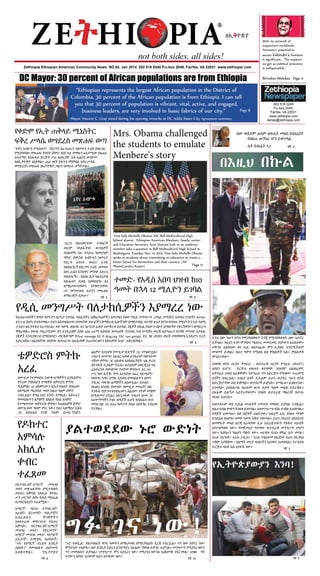
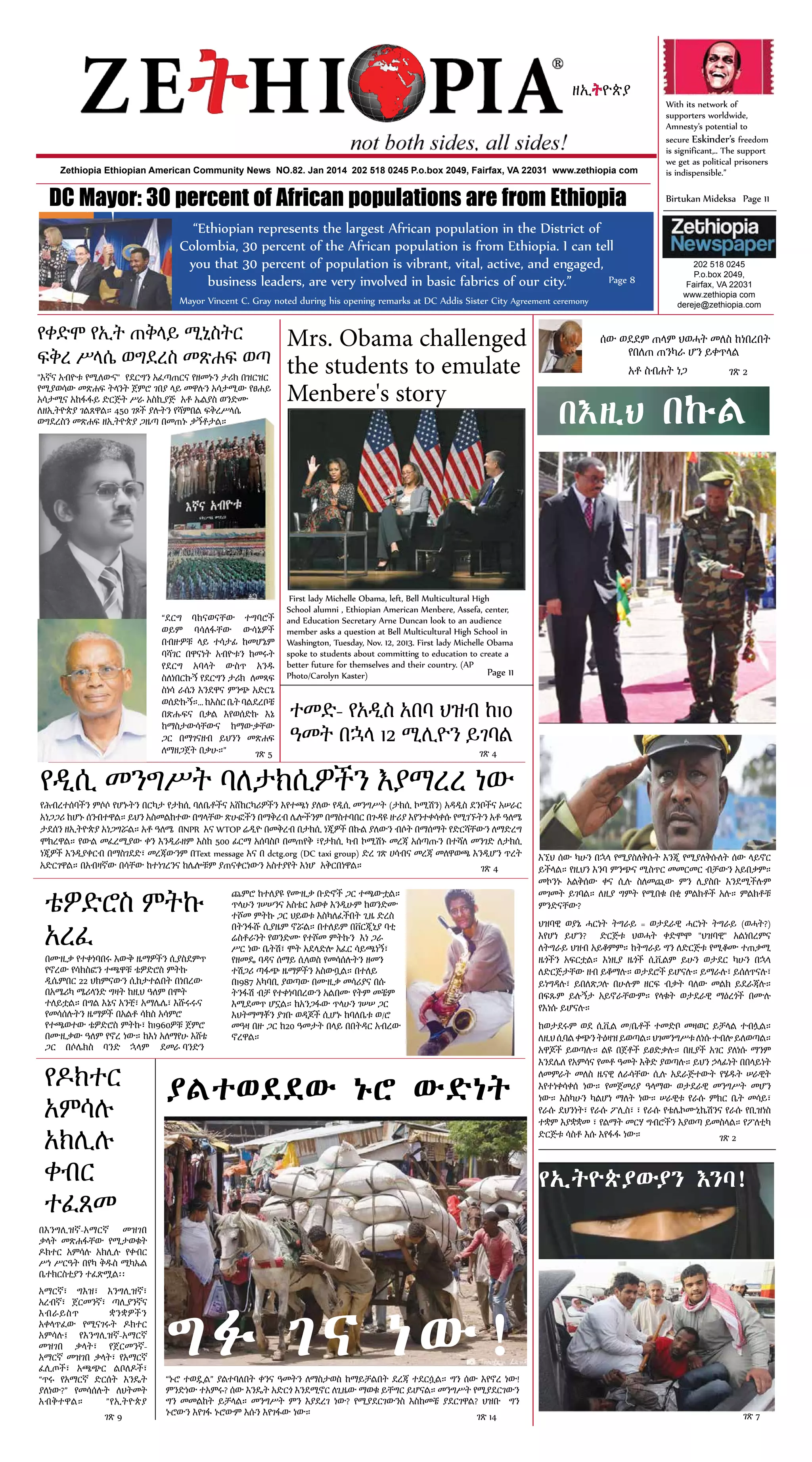
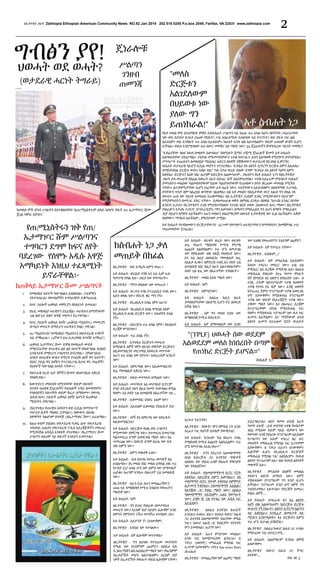

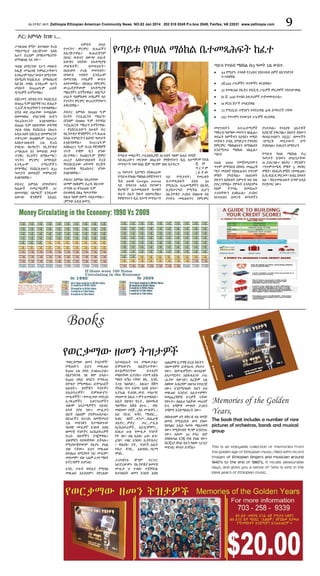
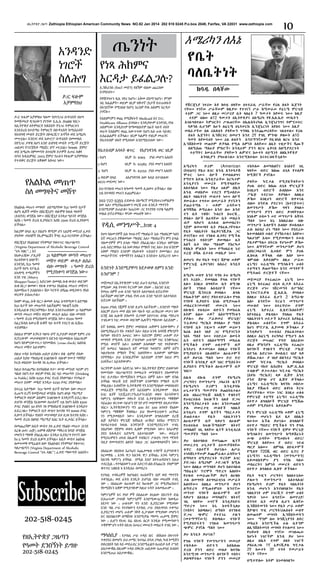
![ዘኢትዮጵያ ጋዜጣ Zethiopia Ethiopian American Community News NO.82 Jan 2014 202 518 0245 P.o.box 2049, Fairfax, VA 22031 www.zethiopia com
11
Ethiopia: A Lifeline to the World
Amnesty International (London)
Birtukan Mideksa spent years
in an Ethiopian prison, and was
featured in Write for Rights 2009
as a prisoner of conscience. She told
Amnesty International what global
support meant to her, and how
the power of letter writing can be
harnessed again this year to help her
good friend, Eskinder Nega.
Birtukan Mideksa speaks to us from
her desk in Boston, USA, amid the
bustle of student life. A Harvard
fellow, she is taking an MA in Public
Administration at Kennedy School
and is a thriving academic.
It’s a far cry from the Ethiopian
prison cell she occupied only a
few years ago - a place her friend,
Eskinder Nega, knows only too well.
He is currently serving an 18-year
sentence because of his journalism.
In fact, the two were detained
together between 2005 and 2007,
alongside Eskinder’s wife Serkalem.
All three were declared prisoners
of conscience. They have also
featured in Amnesty’s Write for
Rights campaign - Serkalem in
2006, Birtukan in 2009, and this
year, Eskinder, because he’s in prison
again.
“I was incarcerated twice. The first
time, for 18 months, the second, 21
months,” recalls Birtukan. “Look at
how many times Eskinder has been
imprisoned over the past 10 years
- eight times. His wife, Serkalem,
was also incarcerated. This is a
story of thousands and millions of
government opponents in Ethiopia.
If you look at the pattern, it’s getting
worse.”
The toughest time in prison
In 2005, Birtukan was
leader of Ethiopia’s main
opposition party, Unity for
Democracy and Justice.
Her party contested the
elections that year, but
lost under questionable
circumstances.
When she and her
supporters
peacefully
protested against the
legitimacy of the election
results, thousands were
arrested.
Birtukan,
Eskinder, Serkalem and over 100
journalists, opposition leaders and
others were put on trial.
“The whole time was very difficult,
especially for Serkalem,” says
Birtukan, who shared a cell with
her at one point. “She was pregnant
and she had to live with 70 to 80
prisoners in a very unclean cell. The
smell was terrible.
Mrs. Obama challenged
the students to emulate
Menbere's story
“When she finally had her baby, that
was one of the times I really felt low.
She went to the hospital and... came
back alone. She had to leave the little
one with her mum. My daughter
was with my mum - she was eight
months old. So we consoled each
other. Our major difficulties came
because of our responsibilities as
mothers, and our attachment to
our children. That was really the
James Madison University in
May. Her family emigrated from
Ethiopia when she was 8 years
old and stressed the importance
of education.
Mrs. Obama is co-ordinating
with Education Secretary Arne
Duncan, who has been overseeing
the president’s efforts to boost
the nation’s college graduation
rate. The president has cited
statistics showing that the
U.S. ranks 12th globally in the
proportion of people who hold
college degrees.
Edging into a broader policy
role, Michelle Obama is joining
President Barack Obama’s efforts
to get the United States on track
to have the highest percentage of
college graduates by 2020.
Mrs. Obama spoke to students,
at Bell Multicultural High School
just a few miles from the White
House. Officials say the event is
part of what will be a broader
focus for the first lady on getting
students — especially those in
underserved communities — on
track to attend college.
The first lady told students
that meeting the 2020 goal is
important, but their personal
success is just as significant.
Mrs. Obama challenged the
students to emulate Menbere
Assefa’s story. Assefa, 22, is a
Bell Multicultural alumna who
graduated on scholarship from
“There’s scholarships out there,
there are funds out there for
people to get and make sure that
they attend higher education,”
said Assefa, who works as a
management assistant in policy
and compliance administration
for the District of Columbia
government.
In addition to access to various
resources, Assefa said it’s
important that students know
they are supported.
“This gives the students an
opportunity to see that somebody
else is supporting them, and
motivating them as well, such as
the first lady,” Assefa said.
“No matter what the president
does, no matter what your
teachers and principals do, or
whatever is going on in your
home or neighbourhood, the
person with the biggest impact
on your education is you,” Mrs.
Obama said. “It’s going to take
young people like all of you across
the country stepping up and
taking control of your education.”
Mrs. Obama also drew from her
own experience as she encouraged
students at the high school with
a large immigrant population to
attend college. She said neither of
her parents went to college, but
they had an “unwavering belief in
the power of education.”
The first lady said she attended
one of the best high schools
in Chicago across town that
required her to wake up at 6 a.m.
and travel at least an hour on the
bus. Mrs. Obama, who grew up in
a working class family, went on to
Princeton University and Harvard
Law School. But not before facing
discouragement as she applied
to Princeton, an Ivy League
university.
“Some of my teachers straight
up told me that I was setting
my sights too high. They told
me I was never going to get into
a school like Princeton,” Mrs.
Obama said to a hushed crowd
of 10th graders. “It was clear to
me that nobody was going to take
my hand and lead me to where
I needed to go; instead it was
going to be up to me to reach my
goals.”
American students once again lag
behind many of their Asian and
European peers on a global exam,
a continuing trend that often is
blamed on child poverty and a
diverse population in U.S. schools.
Education Secretary Arne Duncan
called the results a “picture
of educational stagnation” as
U.S. students showed little
improvement over three years,
failing to score in the top 20 on
math, reading or science.
Students in Shanghai, China’s
largest city, had the top scores in
all subjects, and Singapore, South
Korea, Japan and Hong Kong
students weren’t far behind. Even
Vietnam, which had its students
participate for the first time, had
a higher average score in math
and science than
the United States.
to page 16
Silver lining
Birtukan was given a life sentence,
but was eventually pardoned and
released after nearly 18 months in
detention. Her freedom, however,
was short-lived. After speaking
publicly in Sweden in November
Page 13
Ethio Telecom to
retain monopoly
for now
Ethiopian Prime Minister
Menbere Assefa, works as a management assistant in policy and compliance administration for the District
of Columbia government.
toughest time in prison.”
Hailemariam Desalegn
is reported to have
confirmed that Ethio Telecom (formerly Ethiopia
Telecom Corporation) will remain as the monopoly
provider in all of the country’s telecoms sectors for
the time being. According to Africa Review, speaking
at the National Business Forum in Addis Ababa , Mr
Hailemariam noted that the state-owned operator
would not face competition in order to ensure it
helps the government generate funds for a railway
project. The PM was said to have claimed that were
the telecoms sectors to be liberalised the state would
be lose the ETB6 billion (USD316 million) per year
that it currently gets from Ethio Telecom. With this
revenue being used to finance the Ethiopia-Djibouti
railway project, Mr Hailemariam noted: ‘You may think
that the government can get money from taxation, but
there is no way that we can generate this much from
taxation … Therefore, the sector remains with us [the
government] for the years to come.’](https://image.slidesharecdn.com/newspaperjan-140210202002-phpapp01/85/Zethiopia-Newspaper-Jan-2014-11-320.jpg)
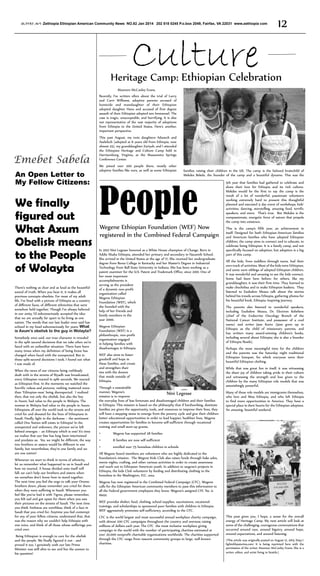




![የአድዋ ጦርነት (Battle of adwa) [Autosaved].pptx](https://cdn.slidesharecdn.com/ss_thumbnails/battleofadwaautosaved-240305163824-1b3d65b1-thumbnail.jpg?width=640&height=640&fit=bounds)
