• Click to edit Master text styles
— Second level
• Third level
— Fourth level
» Fifth level
Practical New
Developments
in the
BREACH Attack
Dimitris Karakostas
Dionysis Zindros
• Click to edit Master text styles
— Second level
• Third level
— Fourth level
» Fifth level
HTTPS is broken
• BREACH broke HTTPS + RC4 in 2013
• People upgraded to AES – thought they were safe
Today...
• We show TLS + AES is still broken
• HTTPS can be decrypted - quick and easy
• We launch open source tool to do it here in Singapore
• Click to edit Master text styles
— Second level
• Third level
— Fourth level
» Fifth level
Overview
• BREACH review
• Our contributions
• Statistical attacks
• Attacking block ciphers
• Attacking noise
• Optimization techniques
• Our tool: Rupture
• Mitigation recommendations
• Click to edit Master text styles
— Second level
• Third level
— Fourth level
» Fifth level
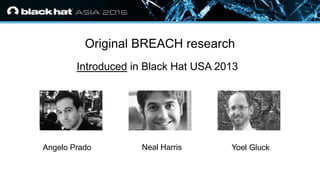
Original BREACH research
Introduced in Black Hat USA 2013
Yoel GluckAngelo Prado Neal Harris
• Click to edit Master text styles
— Second level
• Third level
— Fourth level
» Fifth level
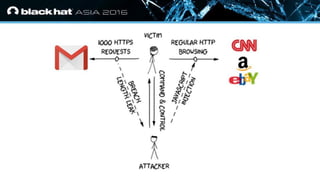
BREACH attack anatomy
• Click to edit Master text styles
— Second level
• Third level
— Fourth level
» Fifth level
• Click to edit Master text styles
— Second level
• Third level
— Fourth level
» Fifth level
Original BREACH assumptions
Target website:
• Uses HTTPS
• Compresses response using gzip
• Uses stream cipher
• Response has zero noise
• Contains end-point that reflects URL parameter
• Click to edit Master text styles
— Second level
• Third level
— Fourth level
» Fifth level
Original BREACH target
1. Steal secret in HTTPS response (CSRF tokens)
2. Use CSRF to impersonate victim client to victim server
• Click to edit Master text styles
— Second level
• Third level
— Fourth level
» Fifth level
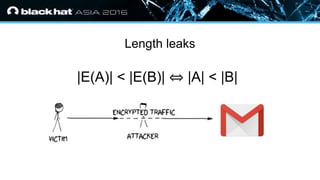
Length leaks
|E(A)| < |E(B)| ⇔ |A| < |B|
• Click to edit Master text styles
— Second level
• Third level
— Fourth level
» Fifth level
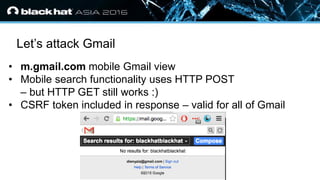
Let’s attack Gmail
• m.gmail.com mobile Gmail view
• Mobile search functionality uses HTTP POST
– but HTTP GET still works :)
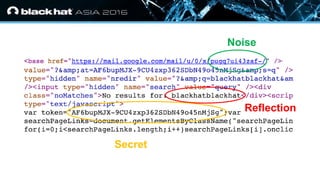
• CSRF token included in response – valid for all of Gmail
• Click to edit Master text styles
— Second level
• Third level
— Fourth level
» Fifth level
Noise
Reflection
Secret
• Click to edit Master text styles
— Second level
• Third level
— Fourth level
» Fifth level
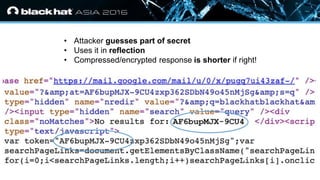
• Attacker guesses part of secret
• Uses it in reflection
• Compressed/encrypted response is shorter if right!
• Click to edit Master text styles
— Second level
• Third level
— Fourth level
» Fifth level
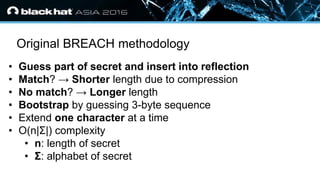
Original BREACH methodology
• Guess part of secret and insert into reflection
• Match? → Shorter length due to compression
• No match? → Longer length
• Bootstrap by guessing 3-byte sequence
• Extend one character at a time
• O(n|Σ|) complexity
• n: length of secret
• Σ: alphabet of secret
• Click to edit Master text styles
— Second level
• Third level
— Fourth level
» Fifth level
Can we really attack Gmail?
• Uses AES
• Has random bytes in response
• Click to edit Master text styles
— Second level
• Third level
— Fourth level
» Fifth level
Our contributions
• Click to edit Master text styles
— Second level
• Third level
— Fourth level
» Fifth level
Our contributions
We extend the BREACH attack
1. Attack noisy end-points
2. Attack block cipher end-points
3. Optimize attack
4. Propose novel mitigation techniques
The whole web is vulnerable
• Click to edit Master text styles
— Second level
• Third level
— Fourth level
» Fifth level
Statistical methods
• Click to edit Master text styles
— Second level
• Third level
— Fourth level
» Fifth level
Statistical methods
• We can attack noisy end-points
• Multiple requests per alphabet symbol
• Take mean response length
• m-sized noise → attack works in O(n|Σ|√m)
• m = (max response size) - (min response size)
• Length converges to correct results (LLN)
• Click to edit Master text styles
— Second level
• Third level
— Fourth level
» Fifth level
Statistical methods against block ciphers
• Everyone uses block ciphers
• Statistical methods break them
• We introduce artificial noise
• Block ciphers round length to 128-bits
• In practice 16x more requests
• Blocks aligned → Length difference measurable
• Click to edit Master text styles
— Second level
• Third level
— Fourth level
» Fifth level
Experimental results
• AES_128 is vulnerable
• Popular web services are vulnerable:
• Gmail
• Facebook
• etc.
• Click to edit Master text styles
— Second level
• Third level
— Fourth level
» Fifth level
Optimizations
• Click to edit Master text styles
— Second level
• Third level
— Fourth level
» Fifth level
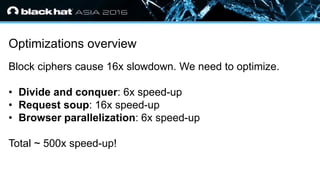
Optimizations overview
Block ciphers cause 16x slowdown. We need to optimize.
• Divide and conquer: 6x speed-up
• Request soup: 16x speed-up
• Browser parallelization: 6x speed-up
Total ~ 500x speed-up!
• Click to edit Master text styles
— Second level
• Third level
— Fourth level
» Fifth level
Optimization: Divide & Conquer
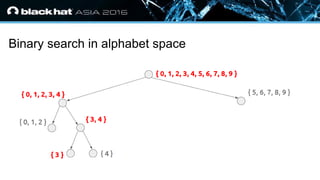
• Each request tries multiple candidates from alphabet
• Partition alphabet using divide-and-conquer
• Binary search on alphabet partitions
• Reduces attack complexity from O(n|Σ|) to O(n lg|Σ|)
• Practically this gives 6x speed-up
• Click to edit Master text styles
— Second level
• Third level
— Fourth level
» Fifth level
Binary search in alphabet space
• Click to edit Master text styles
— Second level
• Third level
— Fourth level
» Fifth level
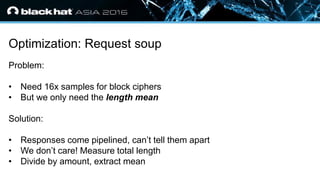
Optimization: Request soup
Problem:
• Need 16x samples for block ciphers
• But we only need the length mean
Solution:
• Responses come pipelined, can’t tell them apart
• We don’t care! Measure total length
• Divide by amount, extract mean
• Click to edit Master text styles
— Second level
• Third level
— Fourth level
» Fifth level
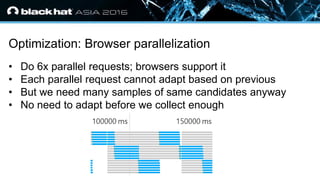
Optimization: Browser parallelization
• Do 6x parallel requests; browsers support it
• Each parallel request cannot adapt based on previous
• But we need many samples of same candidates anyway
• No need to adapt before we collect enough
• Click to edit Master text styles
— Second level
• Third level
— Fourth level
» Fifth level
RUPTURE
• Click to edit Master text styles
— Second level
• Third level
— Fourth level
» Fifth level
Today, we make BREACH easy
• Over the past months, we’ve developed rupture
• Today in Black Hat Asia 2016, we make it open source
https://github.com/dionyziz/rupture
ruptureit.com
• Click to edit Master text styles
— Second level
• Third level
— Fourth level
» Fifth level
Rupture
• Extensible
• Modular analysis / optimizations / strategies
• Experiment with your own
• General web attack framework
• Can be adapted to work for CRIME, POODLE, …
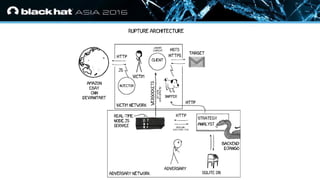
• Persistent command & control channel
• Scalable architecture: Multiple attacks simultaneously
• Come help us make it better
• Click to edit Master text styles
— Second level
• Third level
— Fourth level
» Fifth level
• Click to edit Master text styles
— Second level
• Third level
— Fourth level
» Fifth level
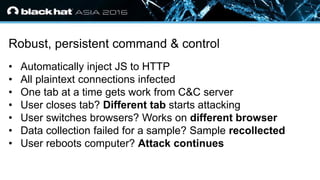
Robust, persistent command & control
• Automatically inject JS to HTTP
• All plaintext connections infected
• One tab at a time gets work from C&C server
• User closes tab? Different tab starts attacking
• User switches browsers? Works on different browser
• Data collection failed for a sample? Sample recollected
• User reboots computer? Attack continues
• Click to edit Master text styles
— Second level
• Third level
— Fourth level
» Fifth level
Persistent attack data storage
• Collected data processed by Django middleware
• Attack historical data stored permanently in MySQL db
• Future analysis with new techniques possible
• Click to edit Master text styles
— Second level
• Third level
— Fourth level
» Fifth level
Rupture demo
• Click to edit Master text styles
— Second level
• Third level
— Fourth level
» Fifth level
Mitigation
• Click to edit Master text styles
— Second level
• Third level
— Fourth level
» Fifth level
First-party cookies
• Don’t send auth cookies cross-origin
• Backwards compatibility: Web server opts-in
• Mike West implemented it in Chrome 51
• Coming April 8th
Set-Cookie: SID=31d4d96e407aad42; First-Party
• Click to edit Master text styles
— Second level
• Third level
— Fourth level
» Fifth level
Key takeaways
1. HTTPS + gzip = broken
2. Rupture framework is live – attacks are easy
3. Enable first-party cookies on your web app
• Click to edit Master text styles
— Second level
• Third level
— Fourth level
» Fifth level
Thank you! Questions?
twitter.com/dionyziz
45DC 00AE FDDF 5D5C B988 EC86 2DA4 50F3 AFB0 46C7
github.com/dimkarakostas
DF46 7AFF 3398 BB31 CEA7 1E77 F896 1969 A339 D2E9

New Developments in the BREACH attack

  • 1.
    • Click toedit Master text styles — Second level • Third level — Fourth level » Fifth level Practical New Developments in the BREACH Attack Dimitris Karakostas Dionysis Zindros
  • 2.
    • Click toedit Master text styles — Second level • Third level — Fourth level » Fifth level HTTPS is broken • BREACH broke HTTPS + RC4 in 2013 • People upgraded to AES – thought they were safe Today... • We show TLS + AES is still broken • HTTPS can be decrypted - quick and easy • We launch open source tool to do it here in Singapore
  • 3.
    • Click toedit Master text styles — Second level • Third level — Fourth level » Fifth level Overview • BREACH review • Our contributions • Statistical attacks • Attacking block ciphers • Attacking noise • Optimization techniques • Our tool: Rupture • Mitigation recommendations
  • 4.
    • Click toedit Master text styles — Second level • Third level — Fourth level » Fifth level Original BREACH research Introduced in Black Hat USA 2013 Yoel GluckAngelo Prado Neal Harris
  • 5.
    • Click toedit Master text styles — Second level • Third level — Fourth level » Fifth level BREACH attack anatomy
  • 6.
    • Click toedit Master text styles — Second level • Third level — Fourth level » Fifth level
  • 7.
    • Click toedit Master text styles — Second level • Third level — Fourth level » Fifth level Original BREACH assumptions Target website: • Uses HTTPS • Compresses response using gzip • Uses stream cipher • Response has zero noise • Contains end-point that reflects URL parameter
  • 8.
    • Click toedit Master text styles — Second level • Third level — Fourth level » Fifth level Original BREACH target 1. Steal secret in HTTPS response (CSRF tokens) 2. Use CSRF to impersonate victim client to victim server
  • 9.
    • Click toedit Master text styles — Second level • Third level — Fourth level » Fifth level Length leaks |E(A)| < |E(B)| ⇔ |A| < |B|
  • 10.
    • Click toedit Master text styles — Second level • Third level — Fourth level » Fifth level Let’s attack Gmail • m.gmail.com mobile Gmail view • Mobile search functionality uses HTTP POST – but HTTP GET still works :) • CSRF token included in response – valid for all of Gmail
  • 11.
    • Click toedit Master text styles — Second level • Third level — Fourth level » Fifth level Noise Reflection Secret
  • 12.
    • Click toedit Master text styles — Second level • Third level — Fourth level » Fifth level • Attacker guesses part of secret • Uses it in reflection • Compressed/encrypted response is shorter if right!
  • 13.
    • Click toedit Master text styles — Second level • Third level — Fourth level » Fifth level Original BREACH methodology • Guess part of secret and insert into reflection • Match? → Shorter length due to compression • No match? → Longer length • Bootstrap by guessing 3-byte sequence • Extend one character at a time • O(n|Σ|) complexity • n: length of secret • Σ: alphabet of secret
  • 14.
    • Click toedit Master text styles — Second level • Third level — Fourth level » Fifth level Can we really attack Gmail? • Uses AES • Has random bytes in response
  • 15.
    • Click toedit Master text styles — Second level • Third level — Fourth level » Fifth level Our contributions
  • 16.
    • Click toedit Master text styles — Second level • Third level — Fourth level » Fifth level Our contributions We extend the BREACH attack 1. Attack noisy end-points 2. Attack block cipher end-points 3. Optimize attack 4. Propose novel mitigation techniques The whole web is vulnerable
  • 17.
    • Click toedit Master text styles — Second level • Third level — Fourth level » Fifth level Statistical methods
  • 18.
    • Click toedit Master text styles — Second level • Third level — Fourth level » Fifth level Statistical methods • We can attack noisy end-points • Multiple requests per alphabet symbol • Take mean response length • m-sized noise → attack works in O(n|Σ|√m) • m = (max response size) - (min response size) • Length converges to correct results (LLN)
  • 19.
    • Click toedit Master text styles — Second level • Third level — Fourth level » Fifth level Statistical methods against block ciphers • Everyone uses block ciphers • Statistical methods break them • We introduce artificial noise • Block ciphers round length to 128-bits • In practice 16x more requests • Blocks aligned → Length difference measurable
  • 20.
    • Click toedit Master text styles — Second level • Third level — Fourth level » Fifth level Experimental results • AES_128 is vulnerable • Popular web services are vulnerable: • Gmail • Facebook • etc.
  • 21.
    • Click toedit Master text styles — Second level • Third level — Fourth level » Fifth level Optimizations
  • 22.
    • Click toedit Master text styles — Second level • Third level — Fourth level » Fifth level Optimizations overview Block ciphers cause 16x slowdown. We need to optimize. • Divide and conquer: 6x speed-up • Request soup: 16x speed-up • Browser parallelization: 6x speed-up Total ~ 500x speed-up!
  • 23.
    • Click toedit Master text styles — Second level • Third level — Fourth level » Fifth level Optimization: Divide & Conquer • Each request tries multiple candidates from alphabet • Partition alphabet using divide-and-conquer • Binary search on alphabet partitions • Reduces attack complexity from O(n|Σ|) to O(n lg|Σ|) • Practically this gives 6x speed-up
  • 24.
    • Click toedit Master text styles — Second level • Third level — Fourth level » Fifth level Binary search in alphabet space
  • 25.
    • Click toedit Master text styles — Second level • Third level — Fourth level » Fifth level Optimization: Request soup Problem: • Need 16x samples for block ciphers • But we only need the length mean Solution: • Responses come pipelined, can’t tell them apart • We don’t care! Measure total length • Divide by amount, extract mean
  • 26.
    • Click toedit Master text styles — Second level • Third level — Fourth level » Fifth level Optimization: Browser parallelization • Do 6x parallel requests; browsers support it • Each parallel request cannot adapt based on previous • But we need many samples of same candidates anyway • No need to adapt before we collect enough
  • 27.
    • Click toedit Master text styles — Second level • Third level — Fourth level » Fifth level RUPTURE
  • 28.
    • Click toedit Master text styles — Second level • Third level — Fourth level » Fifth level Today, we make BREACH easy • Over the past months, we’ve developed rupture • Today in Black Hat Asia 2016, we make it open source https://github.com/dionyziz/rupture ruptureit.com
  • 29.
    • Click toedit Master text styles — Second level • Third level — Fourth level » Fifth level Rupture • Extensible • Modular analysis / optimizations / strategies • Experiment with your own • General web attack framework • Can be adapted to work for CRIME, POODLE, … • Persistent command & control channel • Scalable architecture: Multiple attacks simultaneously • Come help us make it better
  • 30.
    • Click toedit Master text styles — Second level • Third level — Fourth level » Fifth level
  • 31.
    • Click toedit Master text styles — Second level • Third level — Fourth level » Fifth level Robust, persistent command & control • Automatically inject JS to HTTP • All plaintext connections infected • One tab at a time gets work from C&C server • User closes tab? Different tab starts attacking • User switches browsers? Works on different browser • Data collection failed for a sample? Sample recollected • User reboots computer? Attack continues
  • 32.
    • Click toedit Master text styles — Second level • Third level — Fourth level » Fifth level Persistent attack data storage • Collected data processed by Django middleware • Attack historical data stored permanently in MySQL db • Future analysis with new techniques possible
  • 33.
    • Click toedit Master text styles — Second level • Third level — Fourth level » Fifth level Rupture demo
  • 34.
    • Click toedit Master text styles — Second level • Third level — Fourth level » Fifth level Mitigation
  • 35.
    • Click toedit Master text styles — Second level • Third level — Fourth level » Fifth level First-party cookies • Don’t send auth cookies cross-origin • Backwards compatibility: Web server opts-in • Mike West implemented it in Chrome 51 • Coming April 8th Set-Cookie: SID=31d4d96e407aad42; First-Party
  • 36.
    • Click toedit Master text styles — Second level • Third level — Fourth level » Fifth level Key takeaways 1. HTTPS + gzip = broken 2. Rupture framework is live – attacks are easy 3. Enable first-party cookies on your web app
  • 37.
    • Click toedit Master text styles — Second level • Third level — Fourth level » Fifth level Thank you! Questions? twitter.com/dionyziz 45DC 00AE FDDF 5D5C B988 EC86 2DA4 50F3 AFB0 46C7 github.com/dimkarakostas DF46 7AFF 3398 BB31 CEA7 1E77 F896 1969 A339 D2E9