1
NETWORKING :
MASTERING THE BASICS
2
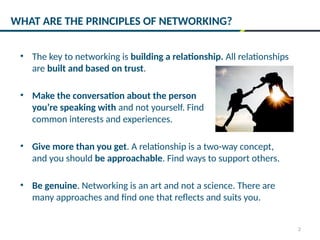
• The key to networking is building a relationship. All relationships
are built and based on trust.
• Make the conversation about the person
you’re speaking with and not yourself. Find
common interests and experiences.
• Give more than you get. A relationship is a two-way concept,
and you should be approachable. Find ways to support others.
• Be genuine. Networking is an art and not a science. There are
many approaches and find one that reflects and suits you.
WHAT ARE THE PRINCIPLES OF NETWORKING?
3
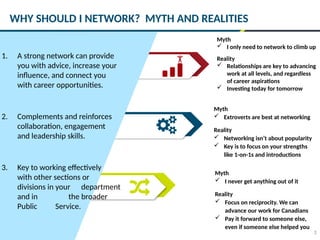
Myth
 Extroverts are best at networking
Reality
 Networking isn’t about popularity
 Key is to focus on your strengths
like 1-on-1s and introductions
Myth
 I never get anything out of it
Reality
 Focus on reciprocity. We can
advance our work for Canadians
 Pay it forward to someone else,
even if someone else helped you
Myth
 I only need to network to climb up
Reality
 Relationships are key to advancing
work at all levels, and regardless
of career aspirations
 Investing today for tomorrow
1. A strong network can provide
you with advice, increase your
influence, and connect you
with career opportunities.
2. Complements and reinforces
collaboration, engagement
and leadership skills.
3. Key to working effectively
with other sections or
divisions in your department
and in the broader
Public Service.
WHY SHOULD I NETWORK? MYTH AND REALITIES
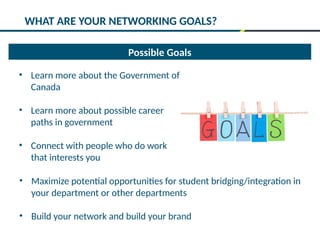
Possible Goals
• Learn more about the Government of
Canada
• Learn more about possible career
paths in government
• Connect with people who do work
that interests you
WHAT ARE YOUR NETWORKING GOALS?
• Maximize potential opportunities for student bridging/integration in
your department or other departments
• Build your network and build your brand
In-Person
Determine who you would like to network with
• Students from your departments or other departments
• Colleagues in your department or other departments
• Hiring managers in the Government of Canada
Participate in networking activities and learning events.
• Interdepartmental networking events (regional FYN, Interdepartmental
Student Committee, other communities)
• Intergovernmental networking (IPAC, Policy Ignite or other communities,
functional cross-government communities)
Coffee chats
• Networking events aren’t for everyone. If you’re not comfortable with
those events, do something that works for you, like a coffee chat or lunch
WHERE, WHEN AND HOW SHOULD I NETWORK?
6
CONVERSATION STARTERS
One-on-one
1. “So, what do you do for work?”
2. “What do you love most about your job?”
3. “How did you hear about this event?”
4. “What’s your favorite part of the event?”
5. Compliment people on their clothes and/or accessories “I like your…where did you get it?”
6. “What do you think of the food? Are there any good restaurants around here?”
7. Talk about the news “Did you catch the game last night? What did you think about [insert one
of the highlights]?”
Breaking into a group
8. “How do you all know each other?”
9. “You guys look like you’re having a lot more fun than the last group I was talking to.”
10. “I’m sorry I couldn’t help but overhear …”
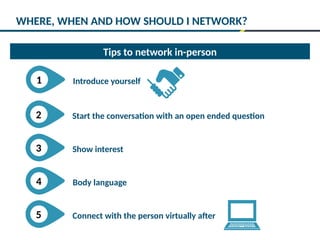
Tips to network in-person
WHERE, WHEN AND HOW SHOULD I NETWORK?
1 Introduce yourself
2 Start the conversation with an open ended question
3 Show interest
4 Body language
5 Connect with the person virtually after
8
Virtual
Social media are designed for 2-way exchanges
(e.g., Twitter, Instagram).
Find a medium and engage. Don’t try and do it all. Use a medium
that you enjoy using, and that works with your messaging.
Create, and maintain an active LinkedIn profile.
Search for people by organization, search for jobs, build your
professional CV, share articles, endorse skills, congratulate others.
Explore the spaces on GC Tools.
Many active groups on GCconnex, and GCcollab let you connect
externally. Connect with communities that interest you (Policy,
Communications, Social Media, Financial Specialists etc.)
WHERE, WHEN AND HOW SHOULD I NETWORK?
9
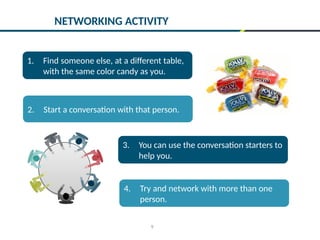
NETWORKING ACTIVITY
1. Find someone else, at a different table,
with the same color candy as you.
2. Start a conversation with that person.
3. You can use the conversation starters to
help you.
4. Try and network with more than one
person.
10
CONVERSATION STARTERS
One-on-one
1. “So, what do you do for work?”
2. “What do you love most about your job?”
3. “How did you hear about this event?”
4. “What’s your favorite part of the event so far?”
5. Compliment people on their clothes and/or accessories “I like your…where did you get it?”
6. “What do you think of the food? Are there any good restaurants around here?”
7. Talk about the news “Did you catch the game last night? I can’t believe all the crazy headlines
lately. What do you think about…?”
Breaking into a group
8. “How do you all know each other?”
9. “You guys look like you’re having a lot more fun than the last group I was talking to.”
10. “I’m sorry I couldn’t help but overhear …”
11
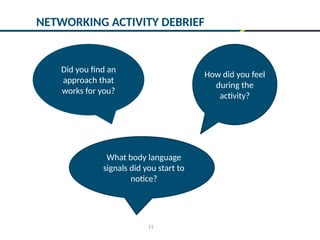
NETWORKING ACTIVITY DEBRIEF
How did you feel
during the
activity?
Did you find an
approach that
works for you?
What body language
signals did you start to
notice?
12
Be Yourself
• Networking isn’t about being someone you’re not
• Use the in-person approaches and virtual tools that work for you,
and fit with what you’re comfortable with
•
Don’t be afraid to contact people you don’t know – the worst that
can happen is they don’t respond
• Show your value – connect with virtual and in-person networks that
fit your interests
• It’s not about level or status – connect with people who interest
you, not just people who you think can get you a job
CLOSING REMARKS
13
LET’S CONNECT!
• Connect with me on
joshua.frame@canada.ca
@mahalojosh
Joshua Frame, National Chair of the Federal
Youth Network & Associate Faculty at the Canada
School of Public Service

Networking MASTERING THE BASICS - workshop.pptx

  • 1.
  • 2.
    2 • The keyto networking is building a relationship. All relationships are built and based on trust. • Make the conversation about the person you’re speaking with and not yourself. Find common interests and experiences. • Give more than you get. A relationship is a two-way concept, and you should be approachable. Find ways to support others. • Be genuine. Networking is an art and not a science. There are many approaches and find one that reflects and suits you. WHAT ARE THE PRINCIPLES OF NETWORKING?
  • 3.
    3 Myth  Extroverts arebest at networking Reality  Networking isn’t about popularity  Key is to focus on your strengths like 1-on-1s and introductions Myth  I never get anything out of it Reality  Focus on reciprocity. We can advance our work for Canadians  Pay it forward to someone else, even if someone else helped you Myth  I only need to network to climb up Reality  Relationships are key to advancing work at all levels, and regardless of career aspirations  Investing today for tomorrow 1. A strong network can provide you with advice, increase your influence, and connect you with career opportunities. 2. Complements and reinforces collaboration, engagement and leadership skills. 3. Key to working effectively with other sections or divisions in your department and in the broader Public Service. WHY SHOULD I NETWORK? MYTH AND REALITIES
  • 4.
    Possible Goals • Learnmore about the Government of Canada • Learn more about possible career paths in government • Connect with people who do work that interests you WHAT ARE YOUR NETWORKING GOALS? • Maximize potential opportunities for student bridging/integration in your department or other departments • Build your network and build your brand
  • 5.
    In-Person Determine who youwould like to network with • Students from your departments or other departments • Colleagues in your department or other departments • Hiring managers in the Government of Canada Participate in networking activities and learning events. • Interdepartmental networking events (regional FYN, Interdepartmental Student Committee, other communities) • Intergovernmental networking (IPAC, Policy Ignite or other communities, functional cross-government communities) Coffee chats • Networking events aren’t for everyone. If you’re not comfortable with those events, do something that works for you, like a coffee chat or lunch WHERE, WHEN AND HOW SHOULD I NETWORK?
  • 6.
    6 CONVERSATION STARTERS One-on-one 1. “So,what do you do for work?” 2. “What do you love most about your job?” 3. “How did you hear about this event?” 4. “What’s your favorite part of the event?” 5. Compliment people on their clothes and/or accessories “I like your…where did you get it?” 6. “What do you think of the food? Are there any good restaurants around here?” 7. Talk about the news “Did you catch the game last night? What did you think about [insert one of the highlights]?” Breaking into a group 8. “How do you all know each other?” 9. “You guys look like you’re having a lot more fun than the last group I was talking to.” 10. “I’m sorry I couldn’t help but overhear …”
  • 7.
    Tips to networkin-person WHERE, WHEN AND HOW SHOULD I NETWORK? 1 Introduce yourself 2 Start the conversation with an open ended question 3 Show interest 4 Body language 5 Connect with the person virtually after
  • 8.
    8 Virtual Social media aredesigned for 2-way exchanges (e.g., Twitter, Instagram). Find a medium and engage. Don’t try and do it all. Use a medium that you enjoy using, and that works with your messaging. Create, and maintain an active LinkedIn profile. Search for people by organization, search for jobs, build your professional CV, share articles, endorse skills, congratulate others. Explore the spaces on GC Tools. Many active groups on GCconnex, and GCcollab let you connect externally. Connect with communities that interest you (Policy, Communications, Social Media, Financial Specialists etc.) WHERE, WHEN AND HOW SHOULD I NETWORK?
  • 9.
    9 NETWORKING ACTIVITY 1. Findsomeone else, at a different table, with the same color candy as you. 2. Start a conversation with that person. 3. You can use the conversation starters to help you. 4. Try and network with more than one person.
  • 10.
    10 CONVERSATION STARTERS One-on-one 1. “So,what do you do for work?” 2. “What do you love most about your job?” 3. “How did you hear about this event?” 4. “What’s your favorite part of the event so far?” 5. Compliment people on their clothes and/or accessories “I like your…where did you get it?” 6. “What do you think of the food? Are there any good restaurants around here?” 7. Talk about the news “Did you catch the game last night? I can’t believe all the crazy headlines lately. What do you think about…?” Breaking into a group 8. “How do you all know each other?” 9. “You guys look like you’re having a lot more fun than the last group I was talking to.” 10. “I’m sorry I couldn’t help but overhear …”
  • 11.
    11 NETWORKING ACTIVITY DEBRIEF Howdid you feel during the activity? Did you find an approach that works for you? What body language signals did you start to notice?
  • 12.
    12 Be Yourself • Networkingisn’t about being someone you’re not • Use the in-person approaches and virtual tools that work for you, and fit with what you’re comfortable with • Don’t be afraid to contact people you don’t know – the worst that can happen is they don’t respond • Show your value – connect with virtual and in-person networks that fit your interests • It’s not about level or status – connect with people who interest you, not just people who you think can get you a job CLOSING REMARKS
  • 13.
    13 LET’S CONNECT! • Connectwith me on joshua.frame@canada.ca @mahalojosh Joshua Frame, National Chair of the Federal Youth Network & Associate Faculty at the Canada School of Public Service

Editor's Notes

  • #6 One-one-one: One of the easiest/safest topics is work so ask any work related questions Talk about the event, conference, venue Give people a compliment. This can work for men and women. Everyone loves food and it’s an easy subject to talk about so use this to your advantage. If there’s no food at the event, ask about nearby restaurants. Talk about the news just be careful to avoid topics such a religion and politics. Instead talk about sports, upcoming events, or even the weather if all else fails. Breaking into a group: If you want to break into a group make sure to observe the group’s body language first If the bodies are turned out looking at the crowd this shows that the group is open and you can approach. If everyone is turned in facing each other they are most likely in a deep discussion and if you try and break into the circle they may not acknowledge you.
  • #7 Show interest during the conversation Actively listen to what the other person is saying. This means that you are focused on what the person is saying and not on what you are going to say next Ask relevant questions, but do not monopolize the conversation Body Language Your body language should convey confidence and show that you are interested in the conversation Stand straight and face the person you are talking to Maintain good eye contact. You don’t need to stare at the person straight in their eyes but if your gaze keeps wandering around the room it might seem like you aren’t interested Avoid crossing your arms because this makes you seem closed off. You should also pay attention to the other person’s body language to see if they are engaged. Are their feet pointed outward and away from you? Are their eyes shifting from side to side? When they smile are they only using their mouth? Are their lips tight and pursed? If the answer is yes, than this can mean that the person isn’t interested in continuing the conversation. However, these signs aren’t foolproof, the person’s culture and their general body language habits must also be taken into consideration. Connect with the person virtually after Networking doesn’t end in person, you can connect with the person virtually after the event It is easy to get lost in the clutter at an event and you rarely get the time to make a lasting impression so if you’ve had a great exchange ask the person what is the best way to stay in touch. Message the person within 48 hrs of meeting them and reference something you discussed to help the contact remember you.
  • #8 You can also use social media platforms to reach out to people you have not met in person.
  • #9 Find someone else, at a different table, with the same color candy as you. Start a conversation with that person. You can use the conversation starters to help you or even ask the question that is associated to the color of the candy Try and network with more than one person. The more people you talk to, the easier it will get and the more comfortable you will feel approaching people.
  • #10 Keep on the screen as participants network
  • #11 How did you feel during the activity? What was uncomfortable? What did you like the most? As you talked to more and more people did you become more comfortable? Did you discover an approach that works for you? What body language signals did you start to pick up on that showed you that the person was either interested or disinterested in the conversation?