Chapter 11
Enterprise & Distributed Networks

Networking Concepts – Eric Vanderburg ©2005
Expanding Networks
 Modem

(Modulator/Demodulator)

 RJ11

phone port
 External modems use RS-232
(Recommended Standard 232) serial port
 Hayes-compatible – works with software
designed for the original Hayes modems in
the early 80’s

Networking Concepts – Eric
Vanderburg ©2005
Modems
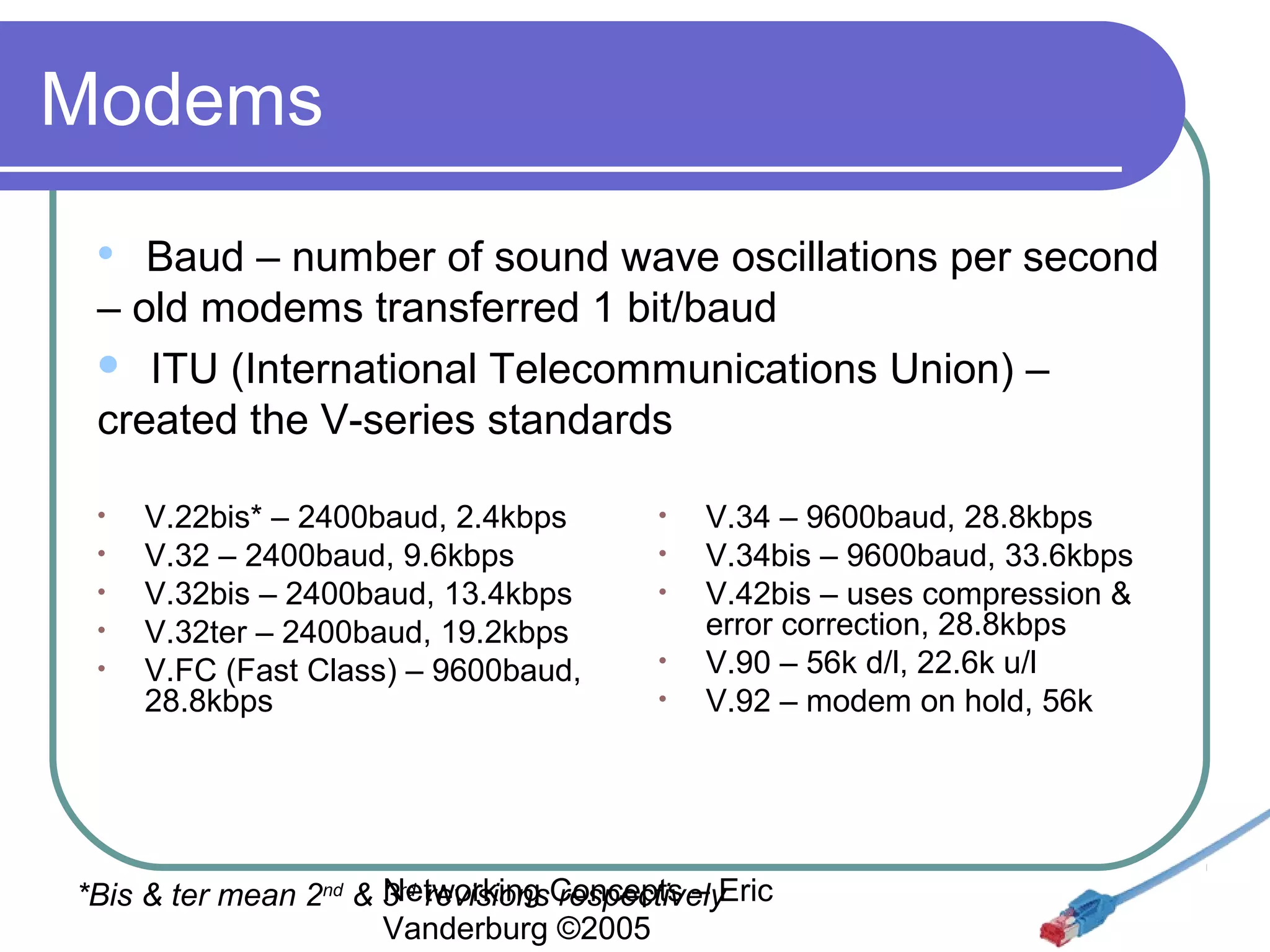
Baud – number of sound wave oscillations per second
– old modems transferred 1 bit/baud
 ITU (International Telecommunications Union) –
created the V-series standards


•
•
•
•
•

V.22bis* – 2400baud, 2.4kbps
V.32 – 2400baud, 9.6kbps
V.32bis – 2400baud, 13.4kbps
V.32ter – 2400baud, 19.2kbps
V.FC (Fast Class) – 9600baud,
28.8kbps

•
•
•
•
•

V.34 – 9600baud, 28.8kbps
V.34bis – 9600baud, 33.6kbps
V.42bis – uses compression &
error correction, 28.8kbps
V.90 – 56k d/l, 22.6k u/l
V.92 – modem on hold, 56k

Networking respectively
*Bis & ter mean 2nd & 3rd revisionsConcepts – Eric
Vanderburg ©2005
Modems
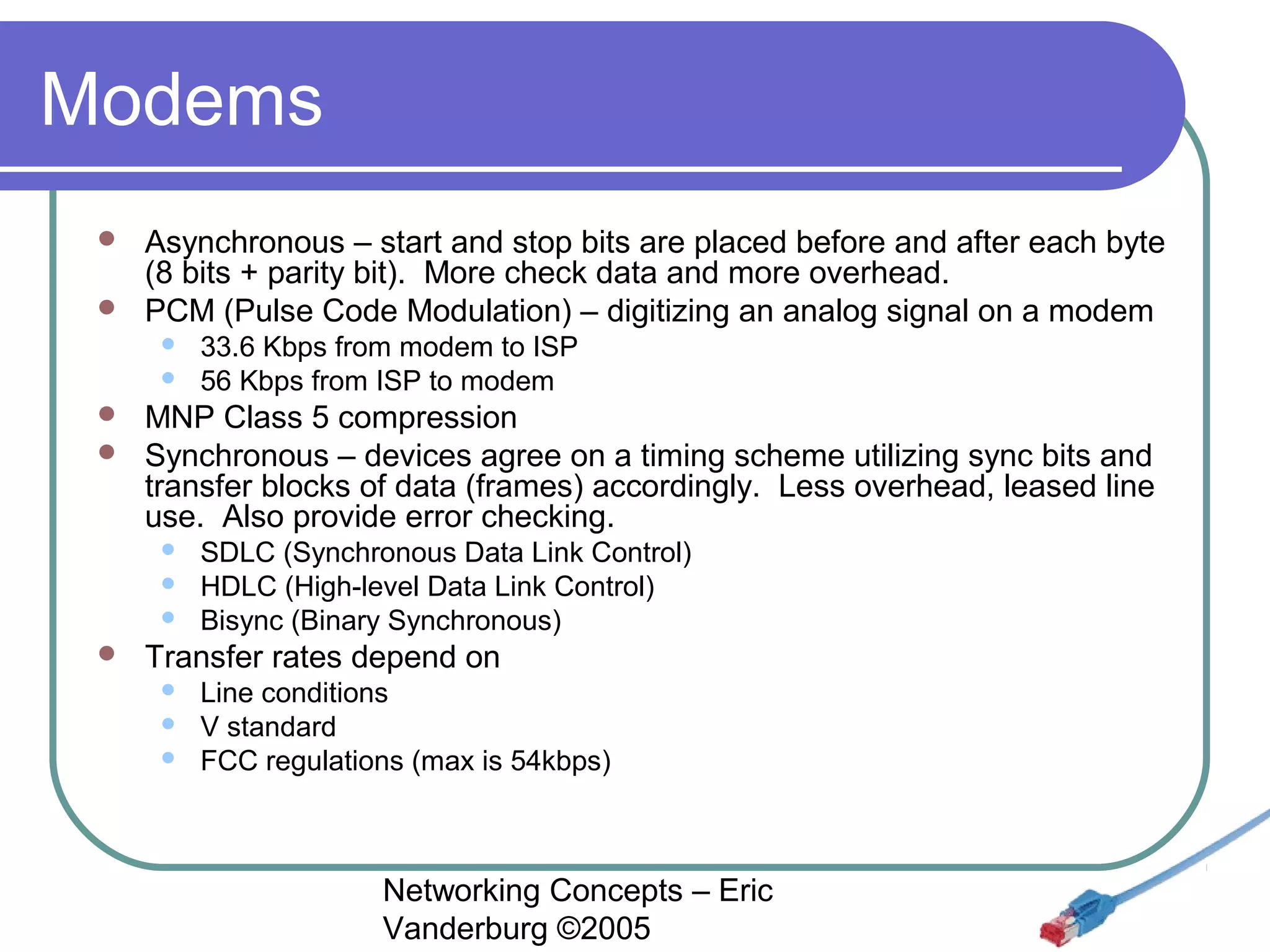
Asynchronous – start and stop bits are placed before and after each byte
(8 bits + parity bit). More check data and more overhead.
 PCM (Pulse Code Modulation) – digitizing an analog signal on a modem





33.6 Kbps from modem to ISP
56 Kbps from ISP to modem

MNP Class 5 compression
 Synchronous – devices agree on a timing scheme utilizing sync bits and
transfer blocks of data (frames) accordingly. Less overhead, leased line
use. Also provide error checking.








SDLC (Synchronous Data Link Control)
HDLC (High-level Data Link Control)
Bisync (Binary Synchronous)

Transfer rates depend on




Line conditions
V standard
FCC regulations (max is 54kbps)

Networking Concepts – Eric
Vanderburg ©2005
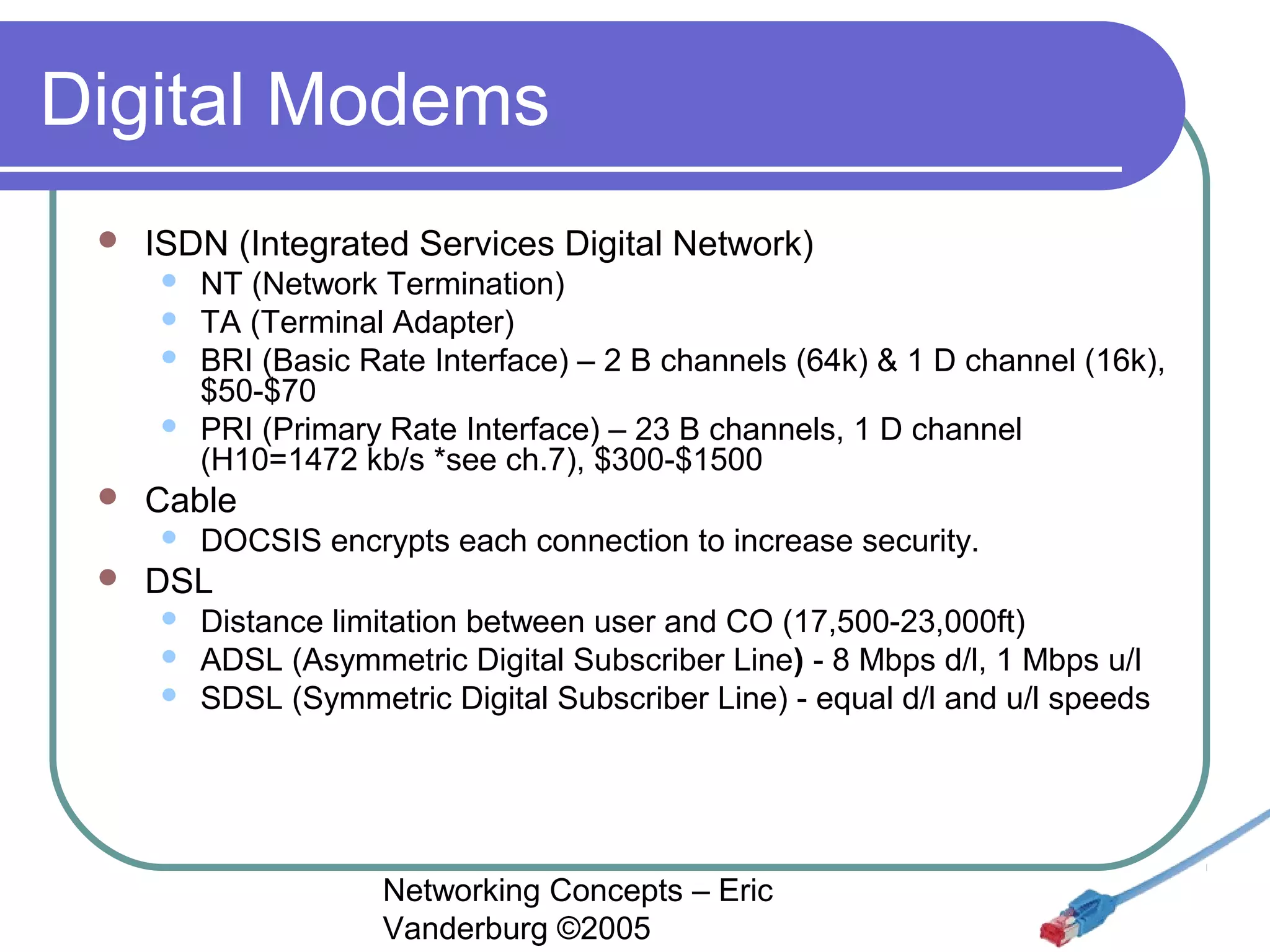
Digital Modems


ISDN (Integrated Services Digital Network)







Cable




NT (Network Termination)
TA (Terminal Adapter)
BRI (Basic Rate Interface) – 2 B channels (64k) & 1 D channel (16k),
$50-$70
PRI (Primary Rate Interface) – 23 B channels, 1 D channel
(H10=1472 kb/s *see ch.7), $300-$1500
DOCSIS encrypts each connection to increase security.

DSL




Distance limitation between user and CO (17,500-23,000ft)
ADSL (Asymmetric Digital Subscriber Line) - 8 Mbps d/l, 1 Mbps u/l
SDSL (Symmetric Digital Subscriber Line) - equal d/l and u/l speeds

Networking Concepts – Eric
Vanderburg ©2005
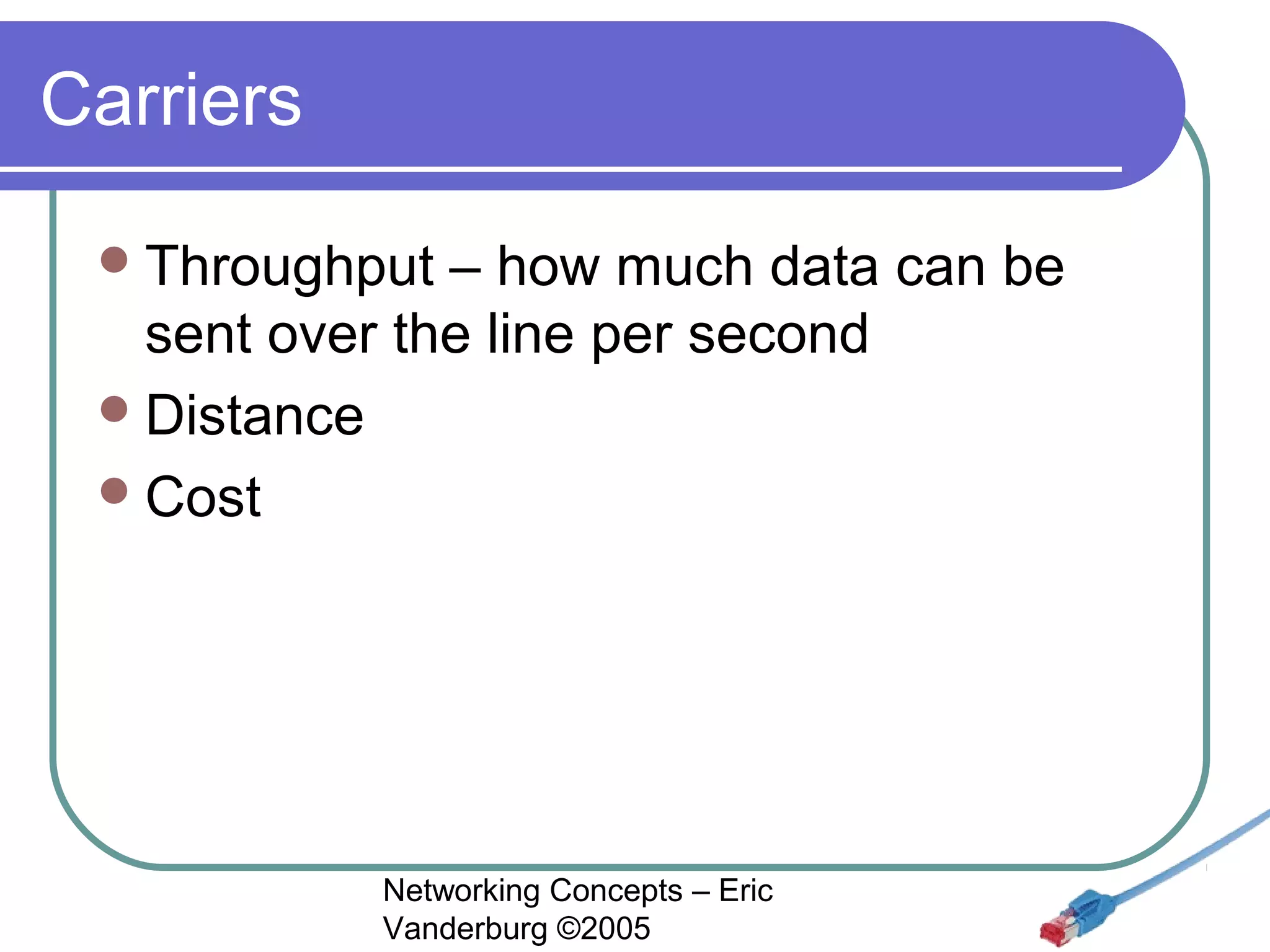
Carriers
 Throughput

– how much data can be
sent over the line per second
 Distance
 Cost

Networking Concepts – Eric
Vanderburg ©2005
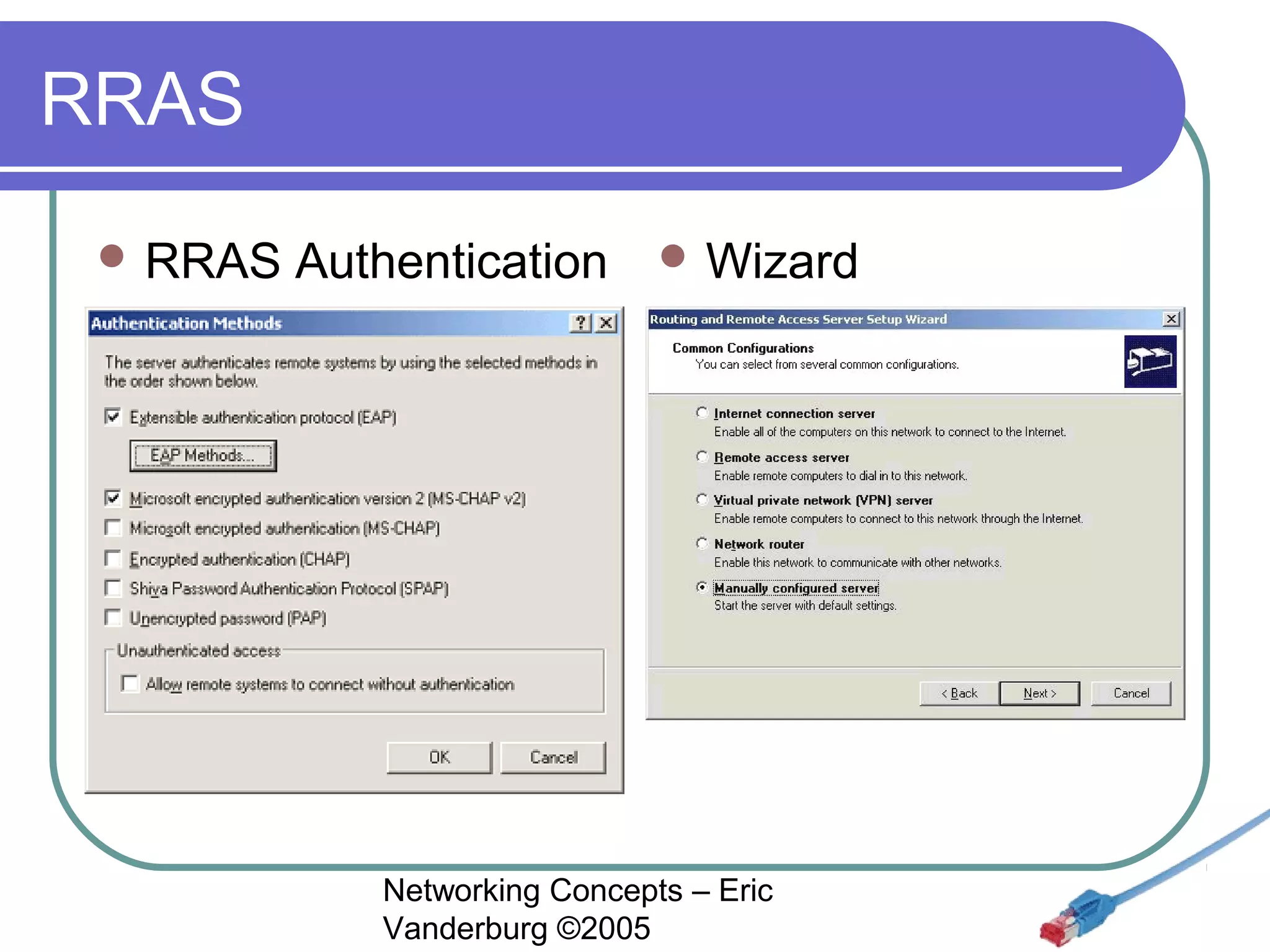
RRAS
 RRAS

Authentication

 Wizard

Networking Concepts – Eric
Vanderburg ©2005
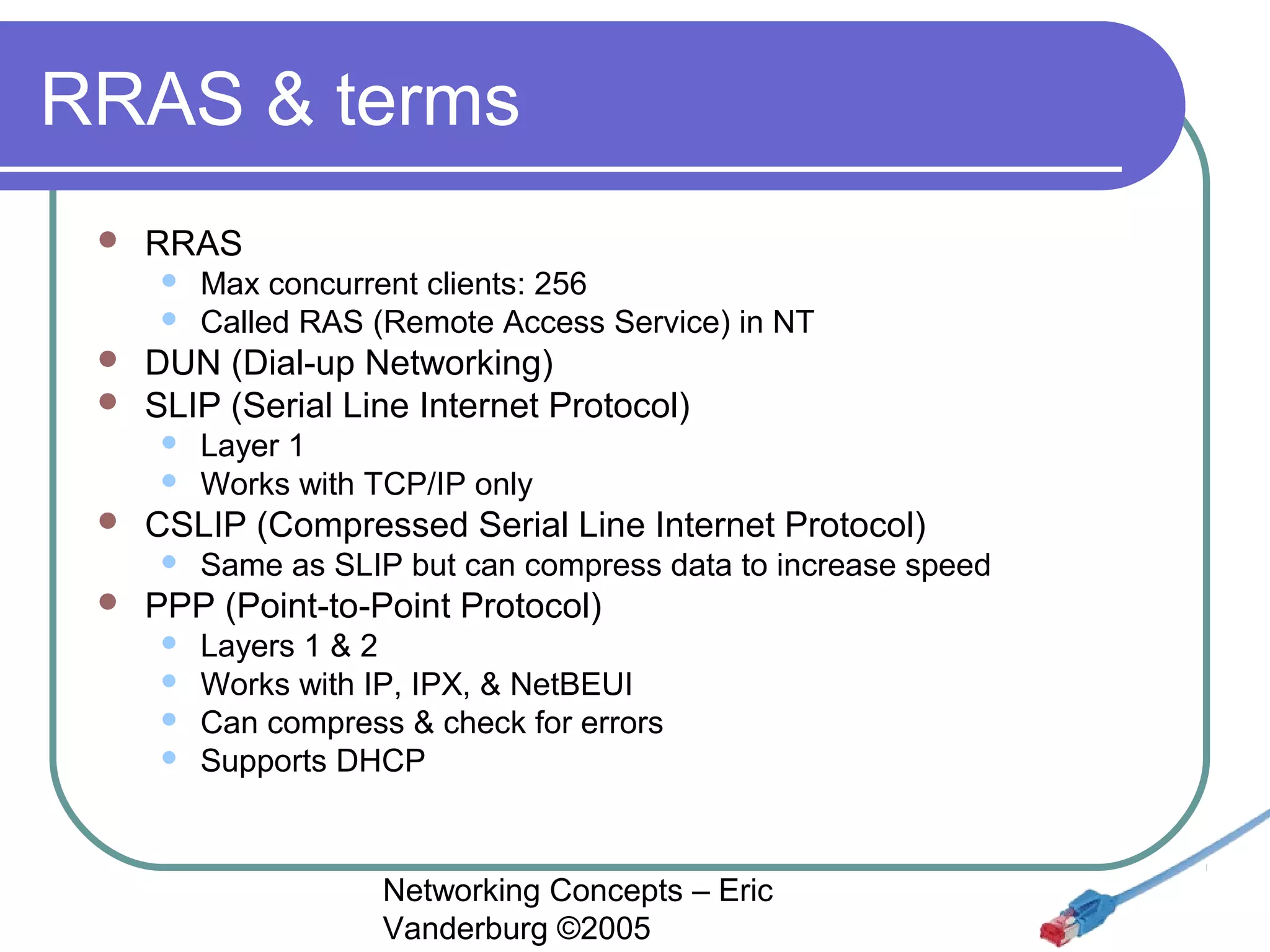
RRAS & terms


RRAS






DUN (Dial-up Networking)
SLIP (Serial Line Internet Protocol)





Layer 1
Works with TCP/IP only

CSLIP (Compressed Serial Line Internet Protocol)




Max concurrent clients: 256
Called RAS (Remote Access Service) in NT

Same as SLIP but can compress data to increase speed

PPP (Point-to-Point Protocol)





Layers 1 & 2
Works with IP, IPX, & NetBEUI
Can compress & check for errors
Supports DHCP

Networking Concepts – Eric
Vanderburg ©2005
Other Vendors


Novell NetWare provides VPN server connections







Able to form VPN WAN by connecting corporate LANs over
VPN connections through the Internet

Mac OS version 9 and above support VPN client
connections to Windows servers using PPTP or IPSec
Mac OS X Server provides a VPN server service that
permits Mac OS, Windows, and Linux/Unix clients to
connect to the corporate LAN
Linux versions using L2TP may not be compatible with
Windows VPN solutions

Networking Concepts – Eric
Vanderburg ©2005
VPN
 Linux

supports VPN client and server
applications
 Not

compatible with Windows L2TP
 More difficult to use; may require a patch to
the kernel
 VPNs

are Less expensive than a modem
pool. Internet connection replaces direct
modem connection
Networking Concepts – Eric
Vanderburg ©2005
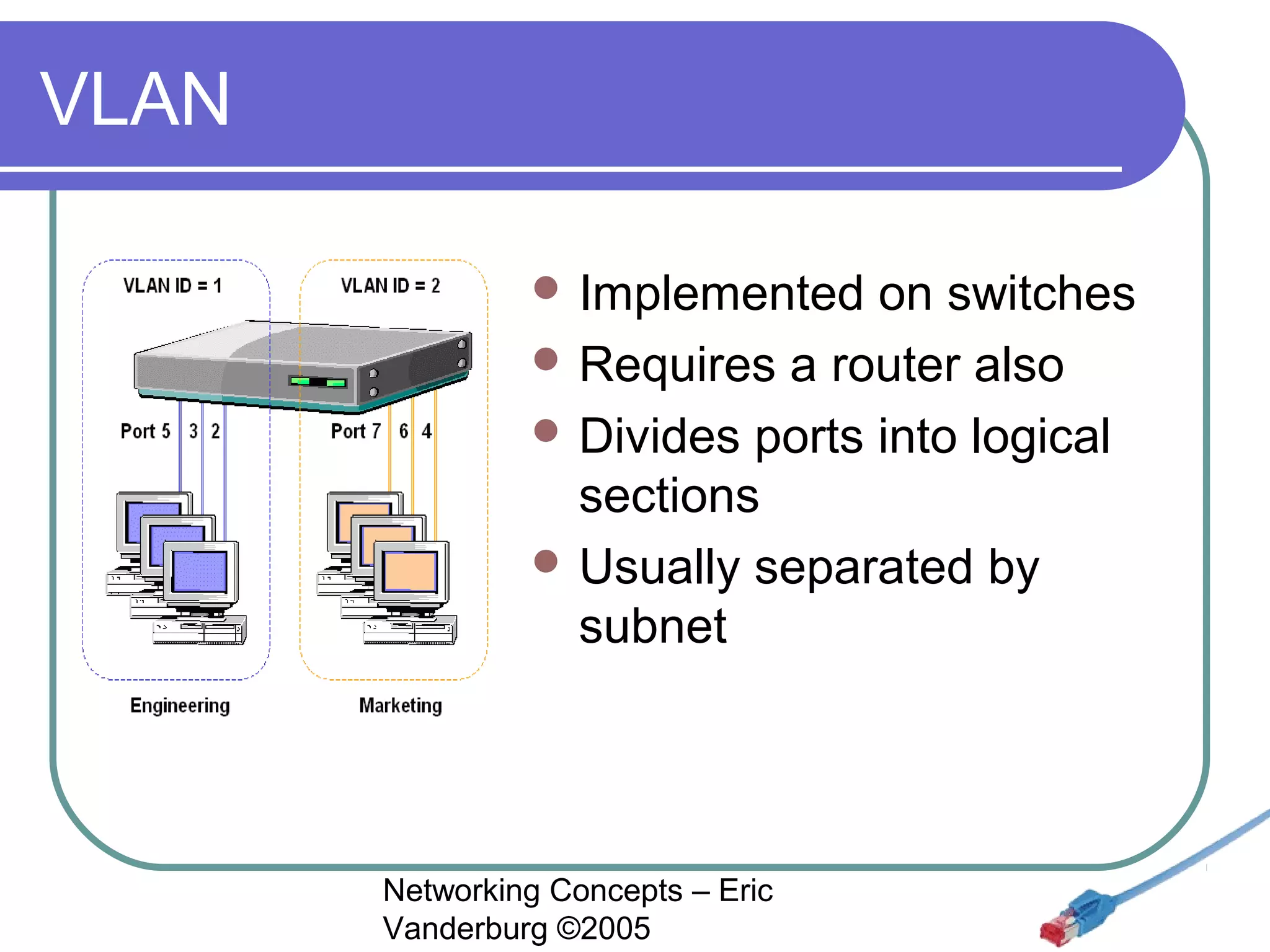
VLAN
 Implemented

on switches
 Requires a router also
 Divides ports into logical
sections
 Usually separated by
subnet

Networking Concepts – Eric
Vanderburg ©2005
Routing
 Static

routing – each path must be
manually entered – same path is used
each time
 Dynamic routing – router determines the
best route based on available info

Networking Concepts – Eric
Vanderburg ©2005
Brouters
 Routes

packets that use routable
protocols
 Forwards packets that are not routable
 Useful in hybrid network with mixture of
routable and nonroutable protocols
 May be identified as router with bridging
capabilities
Networking Concepts – Eric
Vanderburg ©2005
Gateway
 Operates

at layer 7
 Translates between most dissimilar
networks
 GSNW…

Networking Concepts – Eric
Vanderburg ©2005

Networking Concepts Lesson 11 - Enterprise & Distributed Networks - Eric Vanderburg

  • 1.
    Chapter 11 Enterprise &Distributed Networks Networking Concepts – Eric Vanderburg ©2005
  • 2.
    Expanding Networks  Modem (Modulator/Demodulator) RJ11 phone port  External modems use RS-232 (Recommended Standard 232) serial port  Hayes-compatible – works with software designed for the original Hayes modems in the early 80’s Networking Concepts – Eric Vanderburg ©2005
  • 3.
    Modems Baud – numberof sound wave oscillations per second – old modems transferred 1 bit/baud  ITU (International Telecommunications Union) – created the V-series standards  • • • • • V.22bis* – 2400baud, 2.4kbps V.32 – 2400baud, 9.6kbps V.32bis – 2400baud, 13.4kbps V.32ter – 2400baud, 19.2kbps V.FC (Fast Class) – 9600baud, 28.8kbps • • • • • V.34 – 9600baud, 28.8kbps V.34bis – 9600baud, 33.6kbps V.42bis – uses compression & error correction, 28.8kbps V.90 – 56k d/l, 22.6k u/l V.92 – modem on hold, 56k Networking respectively *Bis & ter mean 2nd & 3rd revisionsConcepts – Eric Vanderburg ©2005
  • 4.
    Modems Asynchronous – startand stop bits are placed before and after each byte (8 bits + parity bit). More check data and more overhead.  PCM (Pulse Code Modulation) – digitizing an analog signal on a modem    33.6 Kbps from modem to ISP 56 Kbps from ISP to modem MNP Class 5 compression  Synchronous – devices agree on a timing scheme utilizing sync bits and transfer blocks of data (frames) accordingly. Less overhead, leased line use. Also provide error checking.      SDLC (Synchronous Data Link Control) HDLC (High-level Data Link Control) Bisync (Binary Synchronous) Transfer rates depend on    Line conditions V standard FCC regulations (max is 54kbps) Networking Concepts – Eric Vanderburg ©2005
  • 5.
    Digital Modems  ISDN (IntegratedServices Digital Network)      Cable   NT (Network Termination) TA (Terminal Adapter) BRI (Basic Rate Interface) – 2 B channels (64k) & 1 D channel (16k), $50-$70 PRI (Primary Rate Interface) – 23 B channels, 1 D channel (H10=1472 kb/s *see ch.7), $300-$1500 DOCSIS encrypts each connection to increase security. DSL    Distance limitation between user and CO (17,500-23,000ft) ADSL (Asymmetric Digital Subscriber Line) - 8 Mbps d/l, 1 Mbps u/l SDSL (Symmetric Digital Subscriber Line) - equal d/l and u/l speeds Networking Concepts – Eric Vanderburg ©2005
  • 6.
    Carriers  Throughput – howmuch data can be sent over the line per second  Distance  Cost Networking Concepts – Eric Vanderburg ©2005
  • 7.
    RRAS  RRAS Authentication  Wizard NetworkingConcepts – Eric Vanderburg ©2005
  • 8.
    RRAS & terms  RRAS     DUN(Dial-up Networking) SLIP (Serial Line Internet Protocol)    Layer 1 Works with TCP/IP only CSLIP (Compressed Serial Line Internet Protocol)   Max concurrent clients: 256 Called RAS (Remote Access Service) in NT Same as SLIP but can compress data to increase speed PPP (Point-to-Point Protocol)     Layers 1 & 2 Works with IP, IPX, & NetBEUI Can compress & check for errors Supports DHCP Networking Concepts – Eric Vanderburg ©2005
  • 9.
    Other Vendors  Novell NetWareprovides VPN server connections     Able to form VPN WAN by connecting corporate LANs over VPN connections through the Internet Mac OS version 9 and above support VPN client connections to Windows servers using PPTP or IPSec Mac OS X Server provides a VPN server service that permits Mac OS, Windows, and Linux/Unix clients to connect to the corporate LAN Linux versions using L2TP may not be compatible with Windows VPN solutions Networking Concepts – Eric Vanderburg ©2005
  • 10.
    VPN  Linux supports VPNclient and server applications  Not compatible with Windows L2TP  More difficult to use; may require a patch to the kernel  VPNs are Less expensive than a modem pool. Internet connection replaces direct modem connection Networking Concepts – Eric Vanderburg ©2005
  • 11.
    VLAN  Implemented on switches Requires a router also  Divides ports into logical sections  Usually separated by subnet Networking Concepts – Eric Vanderburg ©2005
  • 12.
    Routing  Static routing –each path must be manually entered – same path is used each time  Dynamic routing – router determines the best route based on available info Networking Concepts – Eric Vanderburg ©2005
  • 13.
    Brouters  Routes packets thatuse routable protocols  Forwards packets that are not routable  Useful in hybrid network with mixture of routable and nonroutable protocols  May be identified as router with bridging capabilities Networking Concepts – Eric Vanderburg ©2005
  • 14.
    Gateway  Operates at layer7  Translates between most dissimilar networks  GSNW… Networking Concepts – Eric Vanderburg ©2005