Course Code: CSE 317
Course Title: Computer Network
Topic: Network Topology
Submitted To:
Pranab Bandhu Nath
Senior Lecturer,
CSE Department,
City University, Dhaka
Submitted By:
Name: Supriya Debnath
ID: 1915002506
Batch: 50th
Program: B.Sc. in CSE
What is Network Topology?
Network topology refers to the manner in which the links and nodes of a
network are arranged to relate to each other. ... Physical network
topology examples include star, mesh, tree, ring, point-to-point, circular,
hybrid, and bus topology networks, each consisting of different
configurations of nodes and links.
Types of Network Topology…….
• Bus Topology.
• Ring Topology.
• Star Topology.
• Mesh Topology.
• Tree Topology.
• Hybrid Topology.
Bus Topology: A bus network is a network topology in which nodes are
directly connected to a common half-duplex link called a bus. A host on a
bus network is called a station. In a bus network, every station will receive
all network traffic, and the traffic generated by each station has equal
transmission priority.
Bus Topology
Ring Topology: A ring network is a network topology in which each node
connects to exactly two other nodes, forming a single continuous pathway
for signals through each node – a ring. Data travels from node to node, with
each node along the way handling every packet.
As explained above, IBM Token Ring (802.5) networks imitate a ring at layer 2 but use
a physical star at layer 1. "Rings prevent collisions." The term "ring" only refers to the
layout of the cables.
Ring Topology
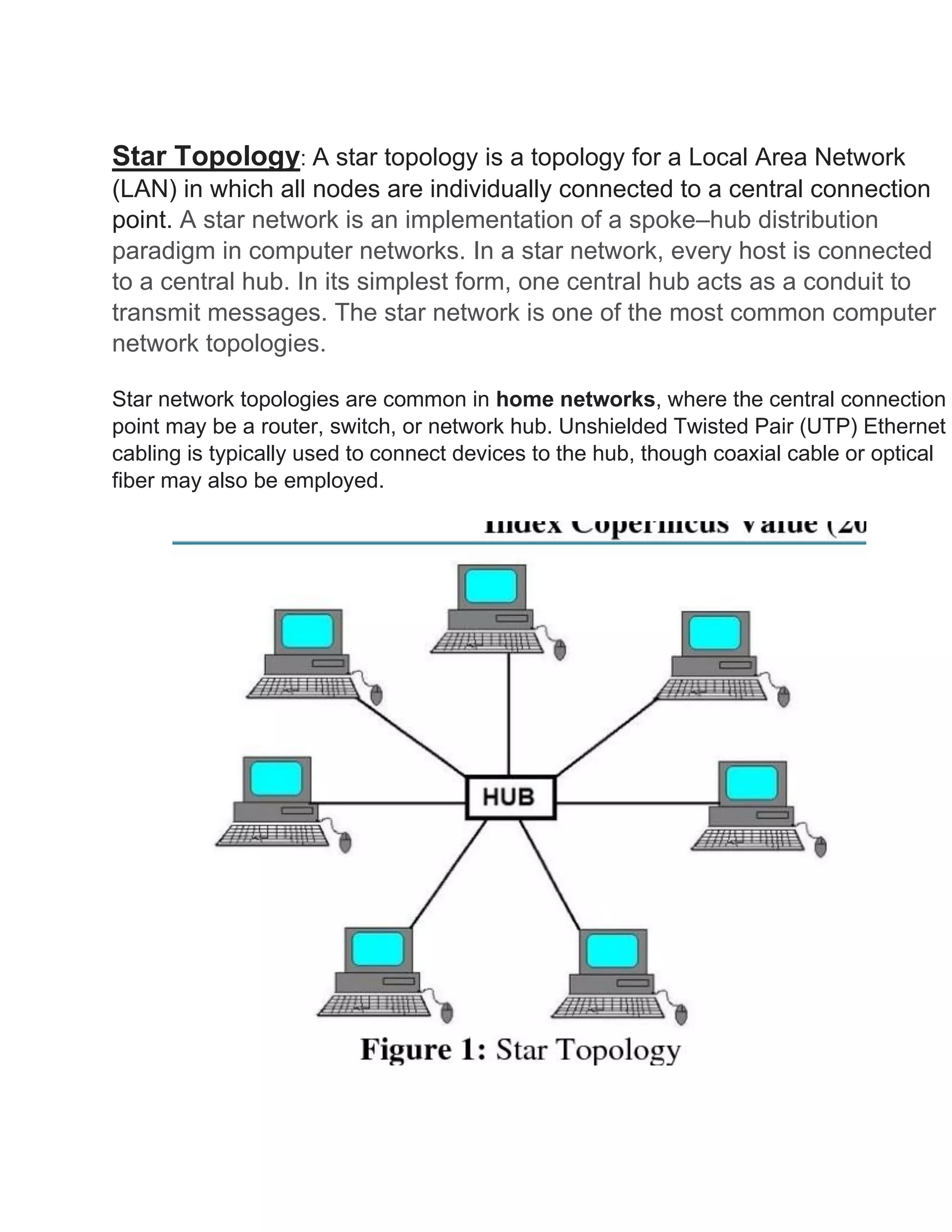
Star Topology: A star topology is a topology for a Local Area Network
(LAN) in which all nodes are individually connected to a central connection
point. A star network is an implementation of a spoke–hub distribution
paradigm in computer networks. In a star network, every host is connected
to a central hub. In its simplest form, one central hub acts as a conduit to
transmit messages. The star network is one of the most common computer
network topologies.
Star network topologies are common in home networks, where the central connection
point may be a router, switch, or network hub. Unshielded Twisted Pair (UTP) Ethernet
cabling is typically used to connect devices to the hub, though coaxial cable or optical
fiber may also be employed.
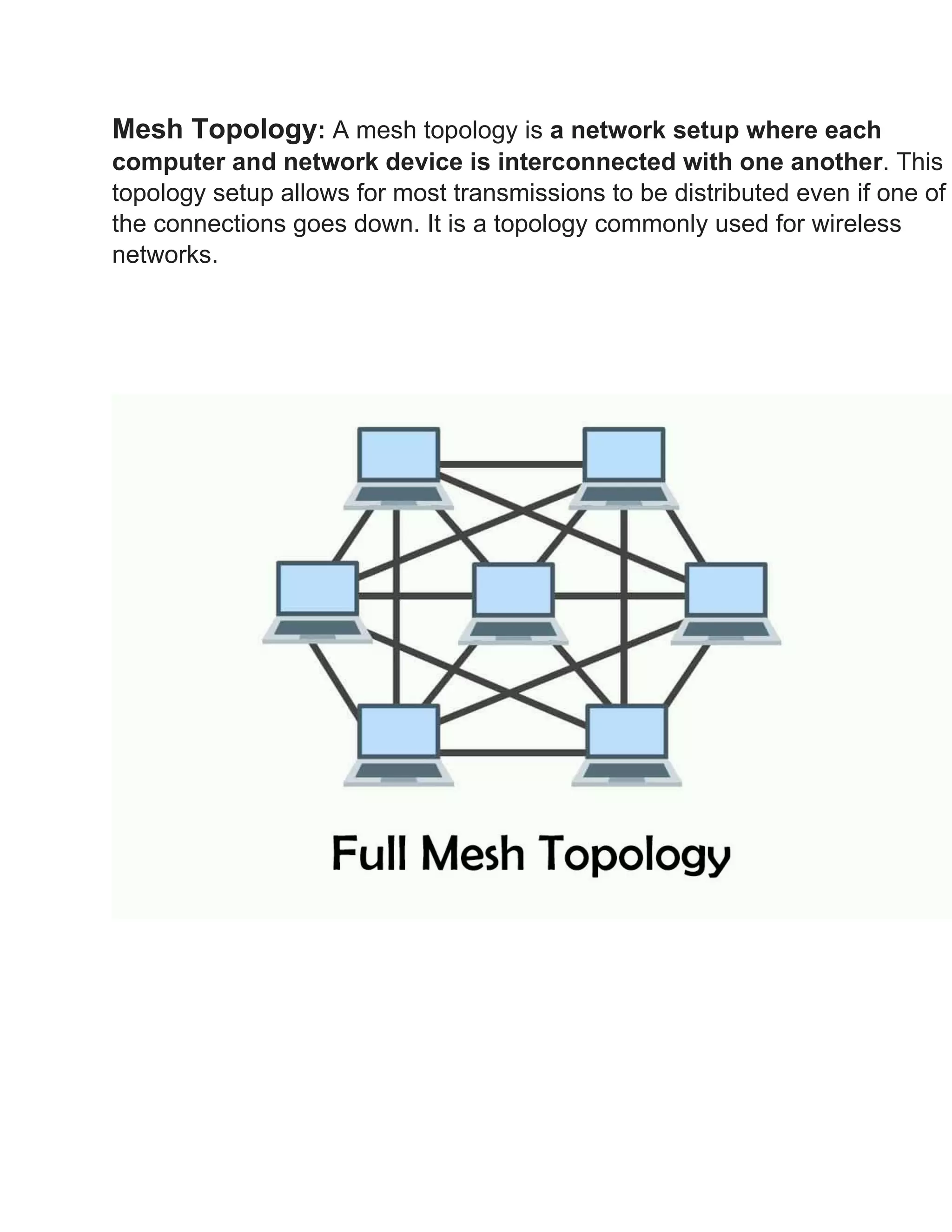
Mesh Topology: A mesh topology is a network setup where each
computer and network device is interconnected with one another. This
topology setup allows for most transmissions to be distributed even if one of
the connections goes down. It is a topology commonly used for wireless
networks.
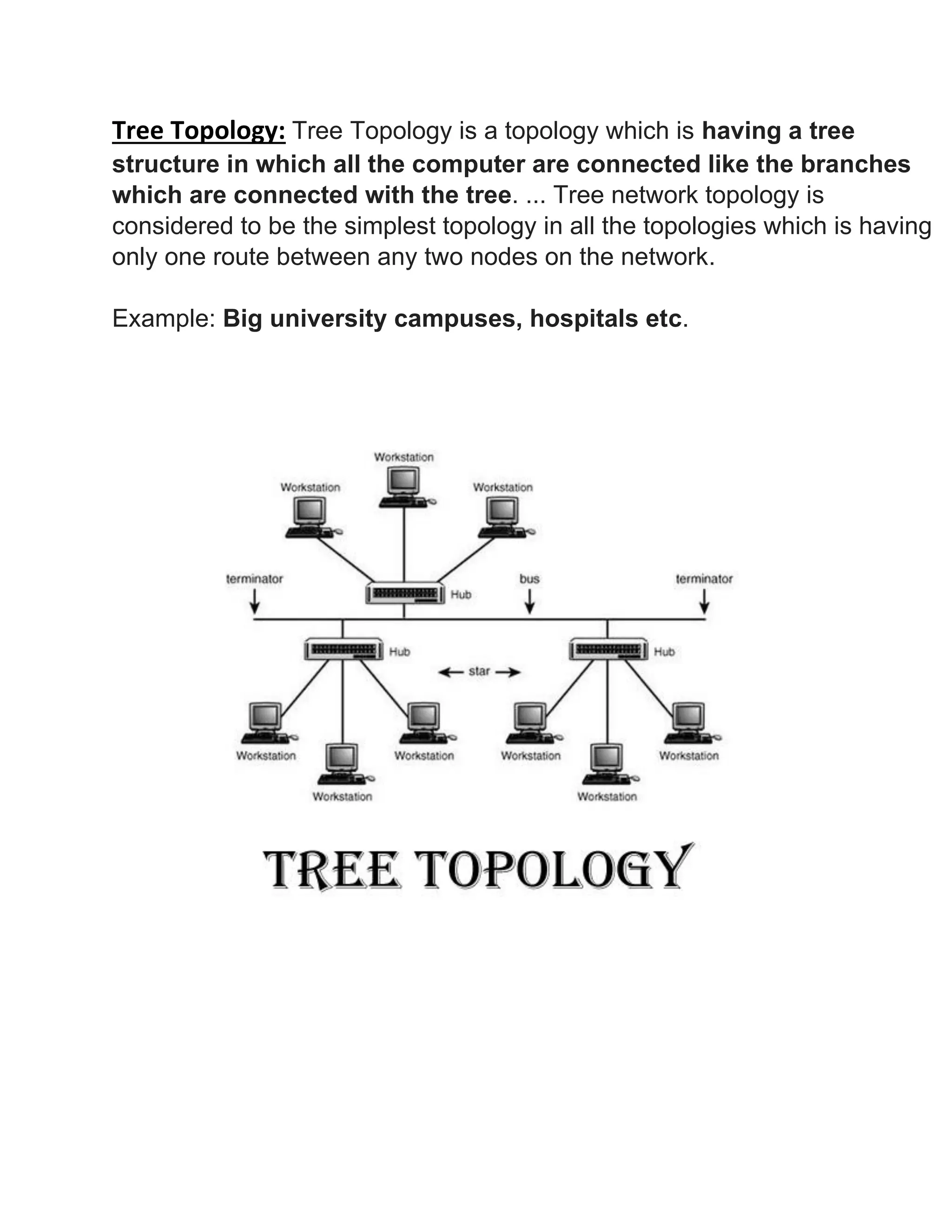
Tree Topology: Tree Topology is a topology which is having a tree
structure in which all the computer are connected like the branches
which are connected with the tree. ... Tree network topology is
considered to be the simplest topology in all the topologies which is having
only one route between any two nodes on the network.
Example: Big university campuses, hospitals etc.
Hybrid Topology: A hybrid topology is a kind of network topology that is
a combination of two or more network topologies, such as mesh
topology, bus topology, and ring topology. ... Also, it includes an advantage
as increasing flexibility; it can increase fault tolerance, and allows new basic
topologies to be added or removed easily.

Network topology

  • 1.
    Course Code: CSE317 Course Title: Computer Network Topic: Network Topology Submitted To: Pranab Bandhu Nath Senior Lecturer, CSE Department, City University, Dhaka Submitted By: Name: Supriya Debnath ID: 1915002506 Batch: 50th Program: B.Sc. in CSE
  • 2.
    What is NetworkTopology? Network topology refers to the manner in which the links and nodes of a network are arranged to relate to each other. ... Physical network topology examples include star, mesh, tree, ring, point-to-point, circular, hybrid, and bus topology networks, each consisting of different configurations of nodes and links. Types of Network Topology……. • Bus Topology. • Ring Topology. • Star Topology. • Mesh Topology. • Tree Topology. • Hybrid Topology. Bus Topology: A bus network is a network topology in which nodes are directly connected to a common half-duplex link called a bus. A host on a bus network is called a station. In a bus network, every station will receive all network traffic, and the traffic generated by each station has equal transmission priority. Bus Topology
  • 3.
    Ring Topology: Aring network is a network topology in which each node connects to exactly two other nodes, forming a single continuous pathway for signals through each node – a ring. Data travels from node to node, with each node along the way handling every packet. As explained above, IBM Token Ring (802.5) networks imitate a ring at layer 2 but use a physical star at layer 1. "Rings prevent collisions." The term "ring" only refers to the layout of the cables. Ring Topology
  • 4.
    Star Topology: Astar topology is a topology for a Local Area Network (LAN) in which all nodes are individually connected to a central connection point. A star network is an implementation of a spoke–hub distribution paradigm in computer networks. In a star network, every host is connected to a central hub. In its simplest form, one central hub acts as a conduit to transmit messages. The star network is one of the most common computer network topologies. Star network topologies are common in home networks, where the central connection point may be a router, switch, or network hub. Unshielded Twisted Pair (UTP) Ethernet cabling is typically used to connect devices to the hub, though coaxial cable or optical fiber may also be employed.
  • 5.
    Mesh Topology: Amesh topology is a network setup where each computer and network device is interconnected with one another. This topology setup allows for most transmissions to be distributed even if one of the connections goes down. It is a topology commonly used for wireless networks.
  • 6.
    Tree Topology: TreeTopology is a topology which is having a tree structure in which all the computer are connected like the branches which are connected with the tree. ... Tree network topology is considered to be the simplest topology in all the topologies which is having only one route between any two nodes on the network. Example: Big university campuses, hospitals etc.
  • 7.
    Hybrid Topology: Ahybrid topology is a kind of network topology that is a combination of two or more network topologies, such as mesh topology, bus topology, and ring topology. ... Also, it includes an advantage as increasing flexibility; it can increase fault tolerance, and allows new basic topologies to be added or removed easily.