For more Https://www.ThesisScientist.com
UNIT 5 .NET TECHNOLOGIES
5.1 .NET FRAMEWORK
“.NET IS A SET OF TECHNOLOGIES DESIGNED TO ALLOW APPLICATIONS TO
WORK TOGETHER WHETHER THEY RESIDE ON THE USER’S HARD DRIVE, THE
LOCAL NETWORK, A REMOTE COMPUTER, OR THE INTERNET.”
The Microsoft. NET strategy was presented by Microsoft officials in June 2000:
 .NET is Microsoft's new Internet and Web strategy
 .NET is NOT a new operating system
 .NET is a new Internet and Web based infrastructure
 .NET delivers software as Web Services
 .NET is a framework for universal services
 .NET is a server centric computing model
 .NET will run in any browser on any platform
 .NET is based on the newest Web standards
Because .NET applies to almost all Microsoft products, the company divides .NET into
several areas including .NET servers and the .NET Framework.
The .NET servers provide services to client applications or other services. For example,
Microsoft SQL Server 2000 provides relational database management system (RDBMS)
services.
“THE .NET FRAMEWORK IS A COMMON ENVIRONMENT FOR BUILDING,
DEPLOYING, AND RUNNING WEB SERVICES AND WEB APPLICATIONS.”
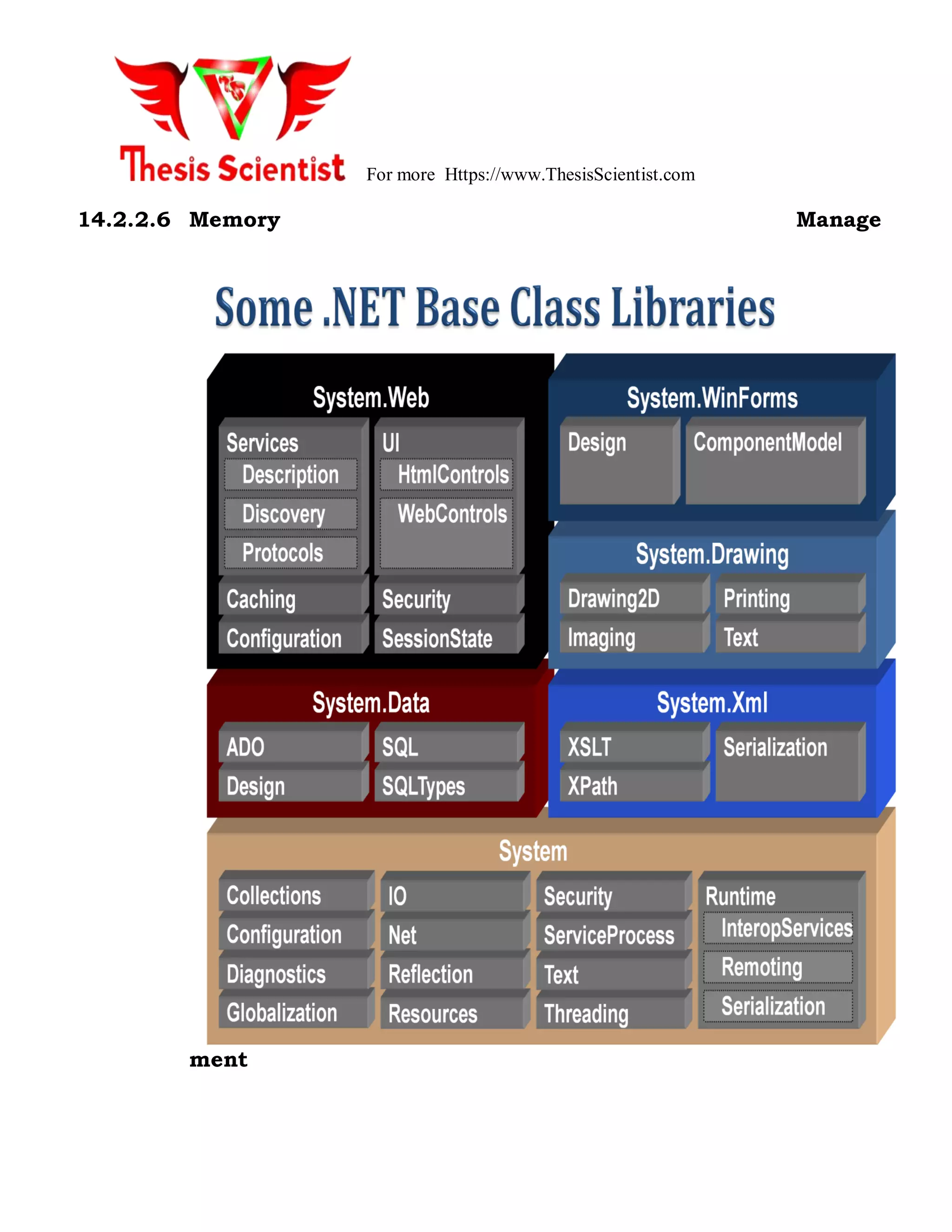
The .NET Framework contains common class libraries - like ADO.NET, ASP.NET and
Windows Forms - to provide advanced standard services that can be integrated into a
variety of computer systems.
The .NET Framework is language neutral. Currently it supports C++, C#, Visual
Basic, JScript (The Microsoft version of JavaScript) and COBOL. Third-party languages
- like Eiffel, Perl, Python, Smalltalk, and others - will also be available for building
future .NET Framework applications.
For more Https://www.ThesisScientist.com
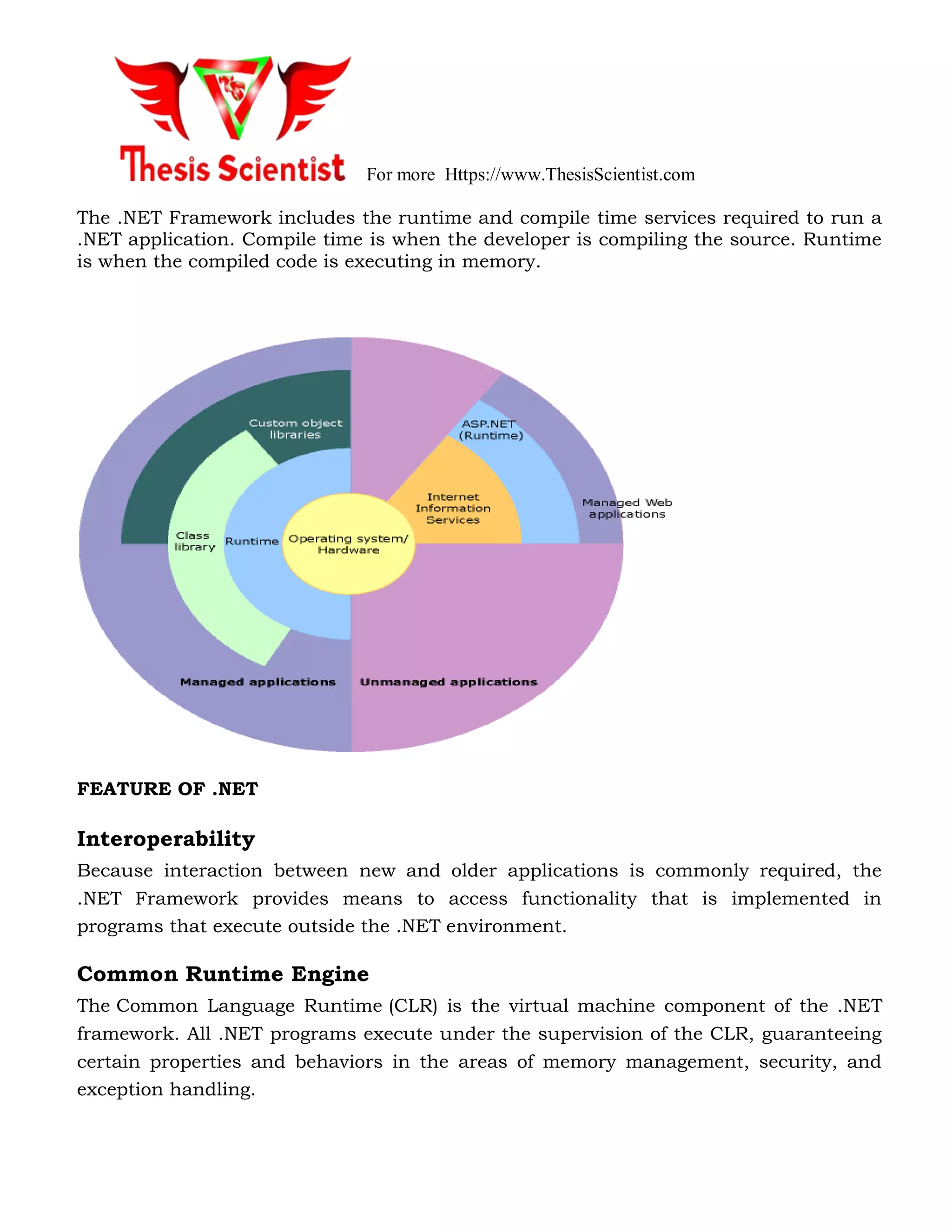
The .NET Framework includes the runtime and compile time services required to run a
.NET application. Compile time is when the developer is compiling the source. Runtime
is when the compiled code is executing in memory.
FEATURE OF .NET
Interoperability
Because interaction between new and older applications is commonly required, the
.NET Framework provides means to access functionality that is implemented in
programs that execute outside the .NET environment.
Common Runtime Engine
The Common Language Runtime (CLR) is the virtual machine component of the .NET
framework. All .NET programs execute under the supervision of the CLR, guaranteeing
certain properties and behaviors in the areas of memory management, security, and
exception handling.
For more Https://www.ThesisScientist.com
Base Class Library
The Base Class Library (BCL), part of the Framework Class Library (FCL), is a library of
functionality available to all languages using the .NET Framework. The BCL
provides classes which encapsulate a number of common functions,
including file reading and writing, graphic rendering, database interaction
and XML document manipulation.
Simplified Deployment
Installation of computer software must be carefully managed to ensure that it does not
interfere with previously installed software, and that it conforms to security
requirements. The .NET framework includes design features and tools that help address
these requirements.
Security
The design is meant to address some of the vulnerabilities, such as buffer overflows,
that have been exploited by malicious software. Additionally, .NET provides a common
security model for all applications.
Portability
The design of the .NET Framework allows it to theoretically be platform agnostic, and
thus cross-platform compatible. That is, a program written to use the framework
should run without change on any type of system for which the framework is
implemented.
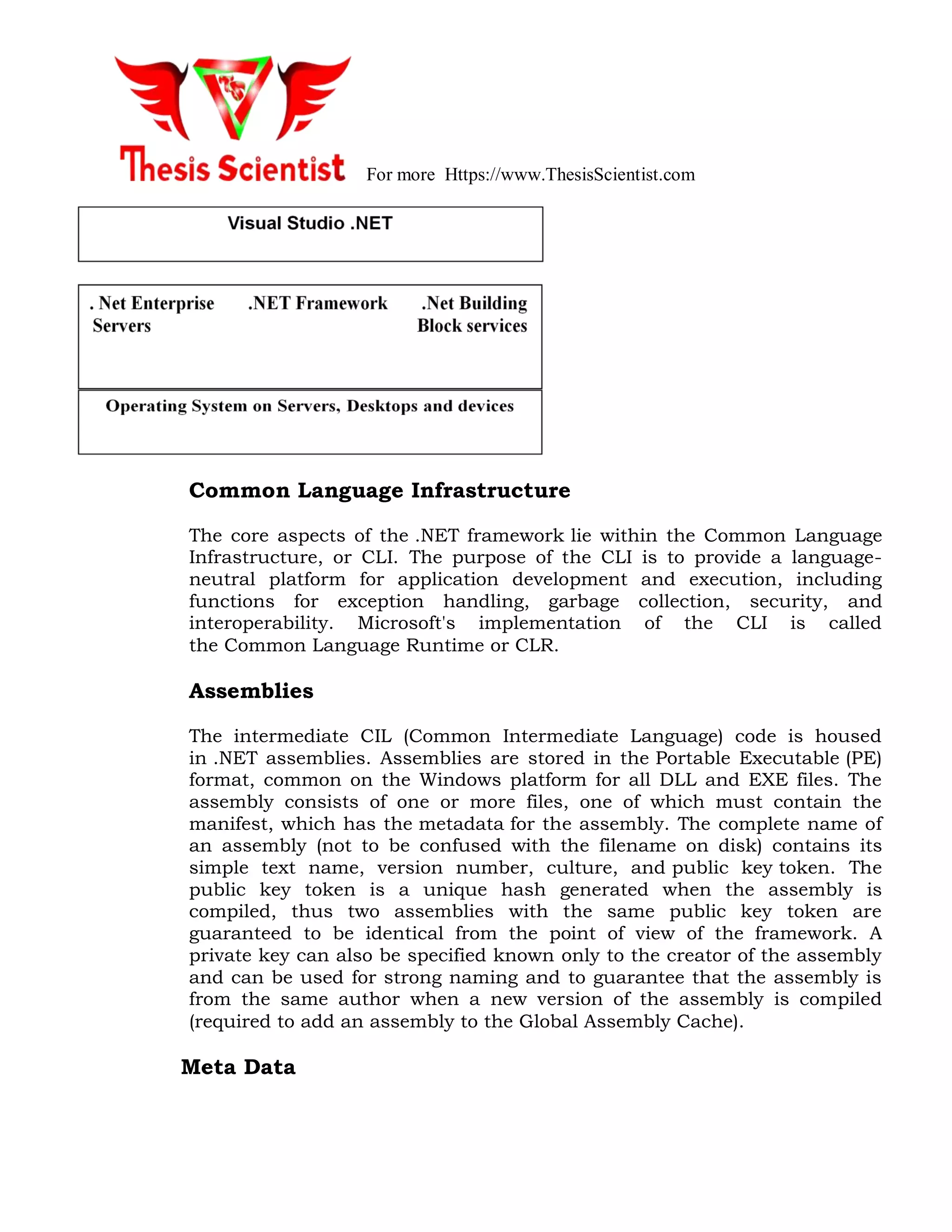
ARCTITECTURE OF .NET
A .NET Framework consists of various components as explaiend below:
For more Https://www.ThesisScientist.com
Common Language Infrastructure
The core aspects of the .NET framework lie within the Common Language
Infrastructure, or CLI. The purpose of the CLI is to provide a language-
neutral platform for application development and execution, including
functions for exception handling, garbage collection, security, and
interoperability. Microsoft's implementation of the CLI is called
the Common Language Runtime or CLR.
Assemblies
The intermediate CIL (Common Intermediate Language) code is housed
in .NET assemblies. Assemblies are stored in the Portable Executable (PE)
format, common on the Windows platform for all DLL and EXE files. The
assembly consists of one or more files, one of which must contain the
manifest, which has the metadata for the assembly. The complete name of
an assembly (not to be confused with the filename on disk) contains its
simple text name, version number, culture, and public key token. The
public key token is a unique hash generated when the assembly is
compiled, thus two assemblies with the same public key token are
guaranteed to be identical from the point of view of the framework. A
private key can also be specified known only to the creator of the assembly
and can be used for strong naming and to guarantee that the assembly is
from the same author when a new version of the assembly is compiled
(required to add an assembly to the Global Assembly Cache).
Meta Data
For more Https://www.ThesisScientist.com
All CLI is self-describing through .NET metadata. The CLR checks the
metadata to ensure that the correct method is called. Metadata is usually
generated by language compilers but developers can create their own
metadata through custom attributes. Metadata contains information about
the assembly, and is also used to implement the reflective
programming capabilities of .NET Framework.
Security
.NET has its own security mechanism with two general features: Code
Access Security (CAS), and validation and verification. Code Access
Security is based on evidence that is associated with a specific assembly.
Typically the evidence is the source of the assembly (whether it is installed
on the local machine or has been downloaded from the intranet or
Internet). Code Access Security uses evidence to determine the permissions
granted to the code. Other code can demand that calling code is granted a
specified permission. The demand causes the CLR to perform a call stack
walk: every assembly of each method in the call stack is checked for the
required permission; if any assembly is not granted the permission a
security exception is thrown.
When an assembly is loaded the CLR performs various tests. Two such
tests are validation and verification.
During validation the CLR checks that the assembly contains valid
metadata and CIL, and whether the internal tables are correct.
Verification is not so exact. The verification mechanism checks to see if
the code does anything that is 'unsafe'. The algorithm used is quite
conservative; hence occasionally code that is 'safe' does not pass. Unsafe
code will only be executed if the assembly has the 'skip verification'
permission, which generally means code that is installed on the local
machine.
Class Library
For more Https://www.ThesisScientist.com
To create a .NET application, a developer must be able to use the .NET
Class Library, which is a core component of the .NET Framework. The
library includes support for the common type system (CTS) and provides
the classes for basic and complex tasks, such as a String class for read-
only text data and a Form class for creating a window. Because the library
supplies hundreds of classes, Microsoft placed each class in a group that
specifies what that class does. These groups are called namespaces.
Namespaces
A namespace is a grouping of data types that have a common purpose. For
example, data types in the System.Windows.Forms namespace all relate
to building applications that have stand-alone user interfaces (UIs). These
data types include the Form class, the
Button class, and the MenuItem class. When you create data types in a
.NET application, always include them in a namespace. The convention for
namespace naming is to choose the organization name and then the
purpose of the namespace. For example:
Namespace FooCo.AccountsReceivable.
This example declares a namespace for classes related to the accounts
receivable application.
This convention allows developers to distinguish their classes from other
classes that have the same name. For example, there could be a Payment
class in the AccountsReceivable namespace and a Payment class in the
Payroll namespace.
For more Https://www.ThesisScientist.com
14.2.2.6 Memory Manage
ment
For more Https://www.ThesisScientist.com
The .NET Framework CLR frees the developer from the burden of managing
memory (allocating and freeing up when done); instead it does the memory
management itself. To this end, the memory allocated to instantiations of
.NET types (objects) is done contiguously from the managed heap, a pool of
memory managed by the CLR. As long as there exists a reference to an
object, which might be either a direct reference to an object or via
a graph of objects, the object is considered to be in use by the CLR. When
there is no reference to an object, and it cannot be reached or used, it
becomes garbage. However, it still holds on to the memory allocated to it.
.NET Framework includes a garbage collector which runs periodically, on
a separate thread from the application's thread, that enumerates all the
unusable objects and reclaims the memory allocated to them.
The .NET Garbage Collector (GC) is a non-deterministic, compacting,
mark-and-sweep garbage collector. The GC runs only when a certain
amount of memory has been used or there is enough pressure for memory
on the system. Since it is not guaranteed when the conditions to reclaim
memory are reached, the GC runs are non-deterministic.
BENEFITS OF .NET FRAMEWORK
EASY TO USE
o Object-oriented model
 Everything is an object
o Namespace and Framework structure
 Easier to comprehend and use
 Naming scheme of namespaces reflects the underlying
functionality
 Freedom to Choose:
o The language that meets your needs
o The development tool that is best for you
o The “features and functionality” to “plug in to”
 Stability
o Say “goodbye” to memory leaks
o Garbage collection manages memory
For more Https://www.ThesisScientist.com
o Assembly eliminates DLL compatibility issues
o Deliverables are restricted to an assembly
 Security
o Restricting or containing the illegal memory reference
o Comprehensive security model
 Assembly specific
 System wide
 Code inspection through MSIL
 Deployment and Management
o Deployment: Code is “Assembled” and Run “Securely”
o Maintenance: Version Maintenance Simplified
 Unified Experience
o Integrate disparate services into a new, unified solution
 Web Services
 The Web the Way You Want It
o Anywhere
o Anytime
o On any device
SUMMERY TO .NET FRAMEWORK
The .NET Framework is a paradigm shift from previous Microsoft development
strategies. Points to note about .NET development are:
• Source code is compiled by a .NET compiler into byte code called Microsoft
Intermediate Language (MSIL) code.
• The Common Language Runtime (CLR) is a virtual operating environment
that loads and manages MSIL.
• The CLR tracks and references objects, and then destroys them once they are
no longer used. This process is called garbage collection (GC).
• To allow MSIL to be 100% compatible with all .NET runtimes, no matter
which platform they are run on, developers must base all their code on the
.NET Framework Class Library. This library is based on the Common Type
System (CTS) specification.
 The Class Library, and all libraries developed by .NET developers, is portioned
into namespaces. These namespaces logically divide classes, structures, and
enumerators into groups based on their functionality. Examples of these
groups are ADO.NET, Web Forms, and Drawing.
• Compiled .NET files are called portable executables (PEs) and have either an
.EXE or .DLL extension.
For more Https://www.ThesisScientist.com
• The most basic unit of deployment is an assembly. The assembly is made up
of one or more PEs and optional resource files such as .BMPs.
• Every assembly contains a section of metadata called the manifest. The
manifest contains information about all the files contained in the assembly as
well as all the data types and members that the assembly implements.
• When the CLR loads an assembly, only the manifest is compiled. The
members are only compiled when they are needed. This strategy is called
just-in-time (JIT) compilation.
– J2EE platform to J2EE platform through the
exchange of JMS or XML-based messages
Programming with the .NET Framework
Accessing Data with ADO.NET
Describes the ADO.NET architecture and how to use the ADO.NET classes to
manage application data and interact with data sources, including Microsoft SQL
Server, OLE DB data sources, and XML.
Accessing Objects in Other Application Domains Using .NET Remoting
The various communications methods available in the .NET Framework for
remote communications.
Accessing the Internet
Shows how to use Internet access classes to implement both Web- and Internet-
based applications.
Creating Active Directory Components
Discusses using Active Directory Services Interfaces (ADSI).
Creating Messaging Components
Discusses how to build complex messaging into your applications.
Creating System Monitoring Components
Discusses how to use performance counters and event logs with your application.
Creating Timer-Based Server Tasks
Discusses how to create events that are raised on reoccurring intervals.
Developing Components
Provides an overview of component programming and explains how those
concepts work with the .NET Framework.
Developing World-Ready Applications
For more Https://www.ThesisScientist.com
Explains the extensive support the .NET Framework provides for developing
international applications.
Discovering Type Information at Run Time
Explains how to get access to type information at run time by using reflection.
Drawing and Editing Images
Discusses using GDI+ with the .NET Framework.
Emitting Dynamic Assemblies
Describes the set of managed types in the System.Reflection.Emit namespace.
Employing XML in the .NET Framework
Provides an overview to a comprehensive and integrated set of classes that work
with XML documents and data in the .NET Framework.
Extending Metadata Using Attributes
Describes how you can use attributes to customize metadata.
Generating and Compiling Source Code Dynamically in Multiple Languages
Explains the .NET Framework SDK mechanism called the Code Document Object
Model (CodeDOM), which enables the output of source code in multiple
programming languages.
Grouping Data in Collections
Discusses the various collection types available in the .NET Framework, including
stacks, queues, lists, arrays, and structs.
Handling and Raising Events
Provides an overview of the event model in the .NET Framework.
Handling and Throwing Exceptions
Describes error handling provided by the .NET Framework and the fundamentals
of handling exceptions.
Hosting the Common Language Runtime
Explains the concept of a runtime host, which loads the runtime into a process,
creates the application domain within the process, and loads and executes user
code.
Processing Transactions
Discusses the .NET Framework support for transactions.
Programming for Garbage Collection
Discusses how the garbage collector manages memory and how you can
program to use memory more efficiently.
Programming with Application Domains and Assemblies
Describes how to create and work with assemblies and application domains.
For more Https://www.ThesisScientist.com
Securing Applications
Describes .NET Framework code access security, role-based security, security
policy, and security tools.
Serializing Objects
Discusses XML serialization.
Threading
Explains the runtime support for threading and how to program using various
synchronization techniques.
Using Side-by-Side Execution
Explains what side-by-side execution is and how you can use it to run multiple
copies of an application, a component, or the entire runtime.
Working With Base Types
Discusses formatting and parsing base data types and using regular expressions
to process text.
Working with I/O
Explains how you can perform synchronous and asynchronous file and data
stream access, and how to use to isolated storage.
Writing Serviced Components
Describes how to configure and register serviced components to access COM+
services.
BUILDING APPLICATION
Creating ASP.NET Web Applications
Provides information about how to develop enterprise-class Web applications
with ASP.NET.
Creating ASP.NET Mobile Web Applications
Provides information about how to develop Web applications for mobile devices,
including Web-enabled cell phones, pagers, and personal digital assistants (PDAs)
such as the Pocket PC.
Creating Windows Forms Applications
Introduces Windows Forms, the new object-oriented platform for developing
Windows-based applications.
Windows Service Applications
Describes creating, installing, starting, and stopping Windows system services.
Building Console Applications
Describes writing applications that use the system console for input and output.
Enhancing Design-Time Support
For more Https://www.ThesisScientist.com
Describes the .NET Framework's rich design-time architecture and support for
visual design environments.
J2EE AN INTRODUCTION
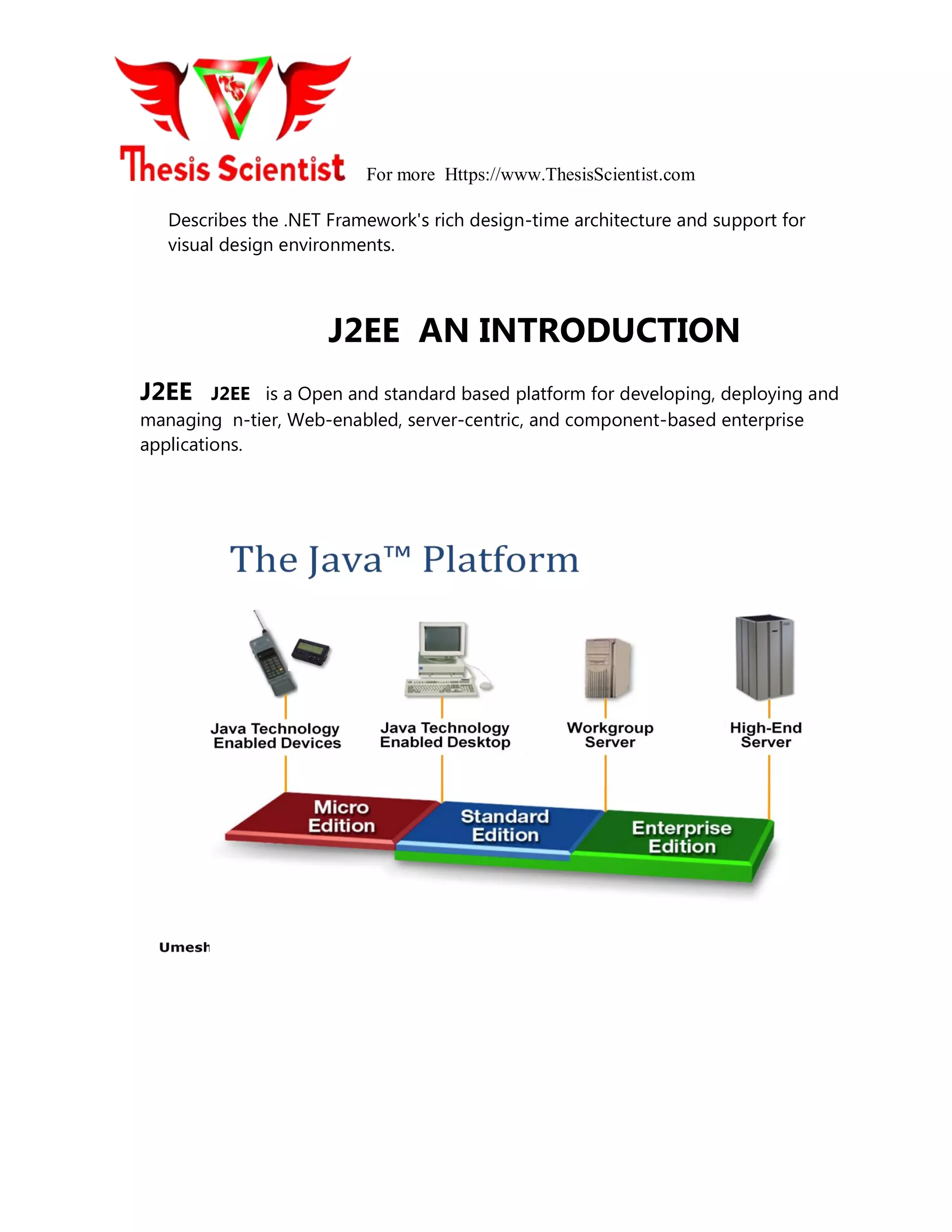
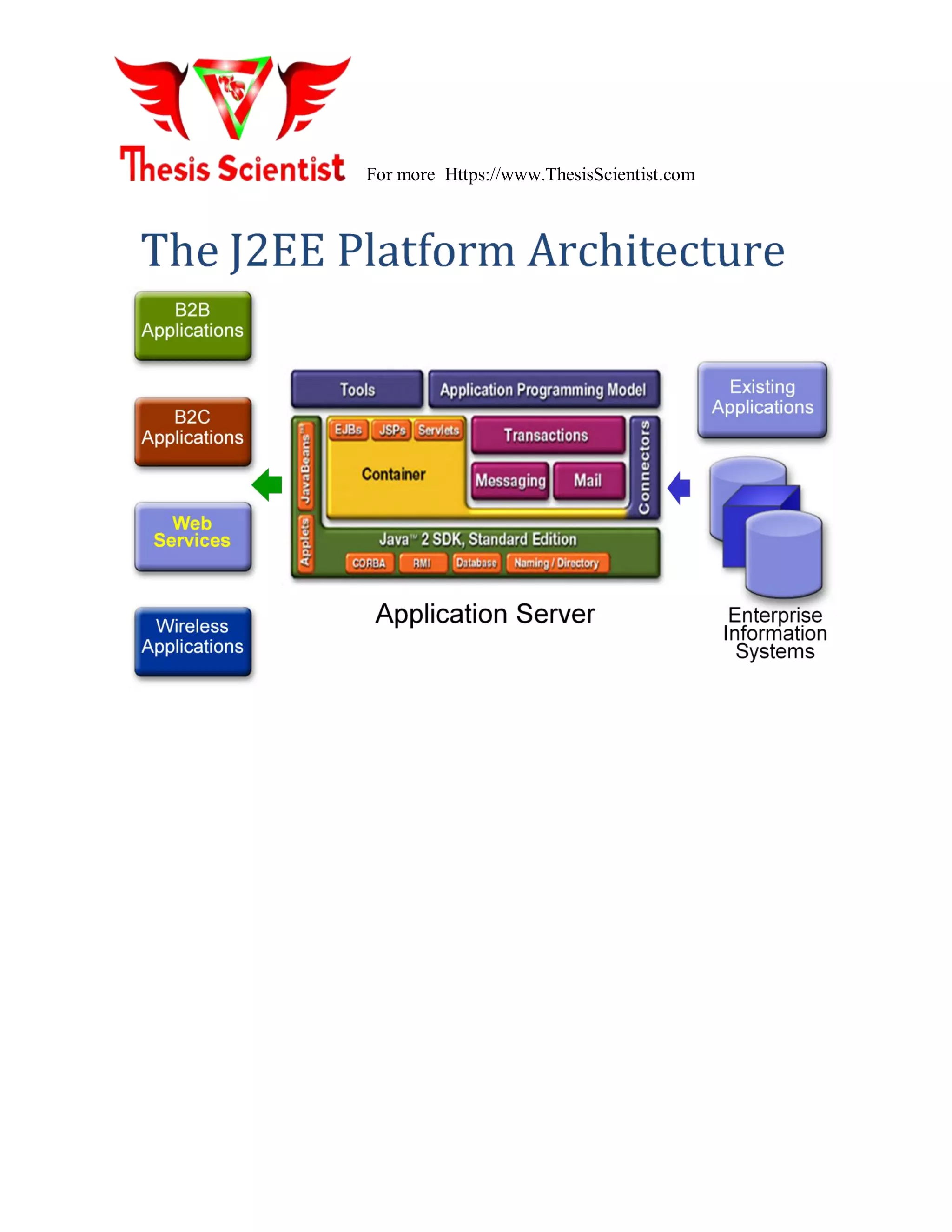
J2EE J2EE is a Open and standard based platform for developing, deploying and
managing n-tier, Web-enabled, server-centric, and component-based enterprise
applications.
For more Https://www.ThesisScientist.com
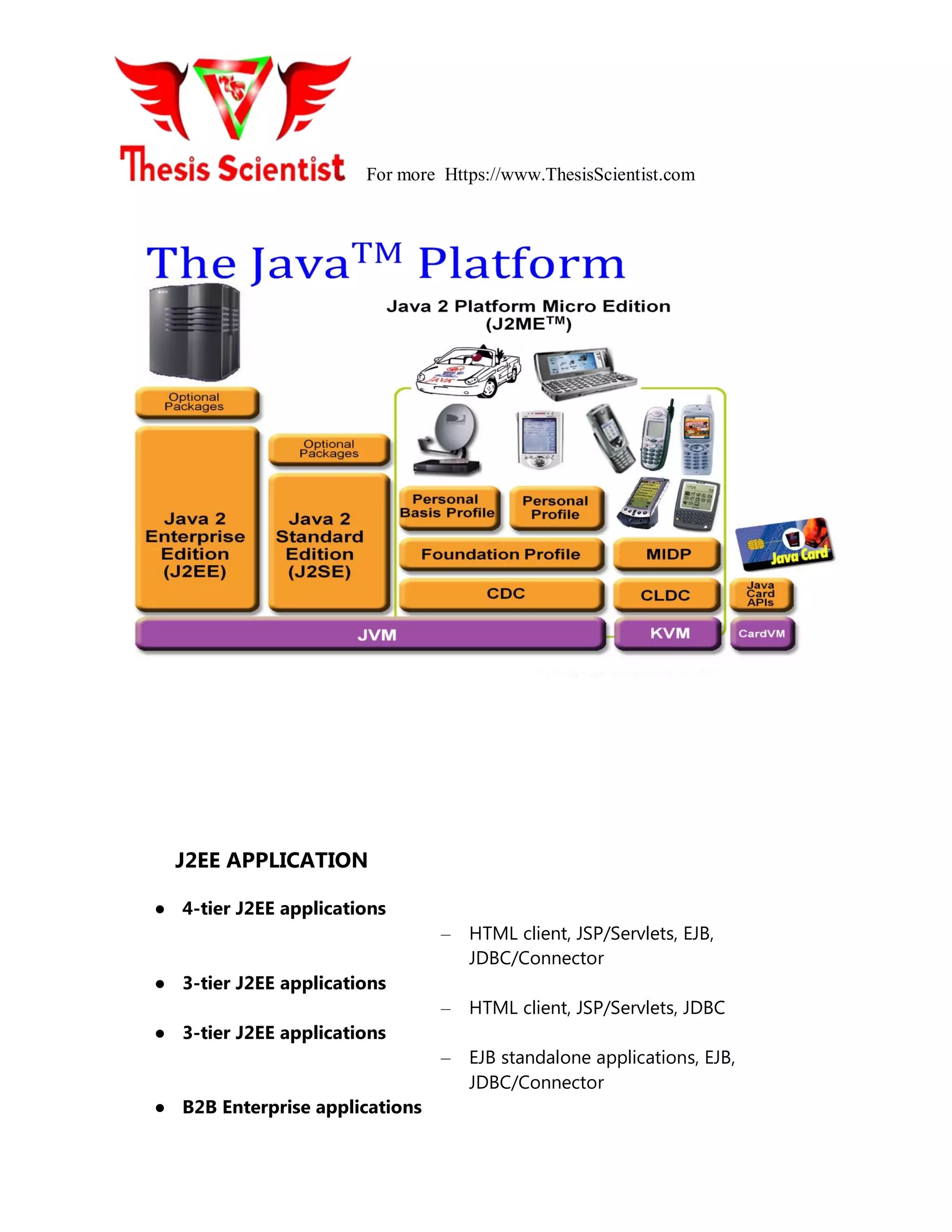
J2EE APPLICATION
● 4-tier J2EE applications
– HTML client, JSP/Servlets, EJB,
JDBC/Connector
● 3-tier J2EE applications
– HTML client, JSP/Servlets, JDBC
● 3-tier J2EE applications
– EJB standalone applications, EJB,
JDBC/Connector
● B2B Enterprise applications
For more Https://www.ThesisScientist.com

.NET TECHNOLOGIES

  • 1.
    For more Https://www.ThesisScientist.com UNIT5 .NET TECHNOLOGIES 5.1 .NET FRAMEWORK “.NET IS A SET OF TECHNOLOGIES DESIGNED TO ALLOW APPLICATIONS TO WORK TOGETHER WHETHER THEY RESIDE ON THE USER’S HARD DRIVE, THE LOCAL NETWORK, A REMOTE COMPUTER, OR THE INTERNET.” The Microsoft. NET strategy was presented by Microsoft officials in June 2000:  .NET is Microsoft's new Internet and Web strategy  .NET is NOT a new operating system  .NET is a new Internet and Web based infrastructure  .NET delivers software as Web Services  .NET is a framework for universal services  .NET is a server centric computing model  .NET will run in any browser on any platform  .NET is based on the newest Web standards Because .NET applies to almost all Microsoft products, the company divides .NET into several areas including .NET servers and the .NET Framework. The .NET servers provide services to client applications or other services. For example, Microsoft SQL Server 2000 provides relational database management system (RDBMS) services. “THE .NET FRAMEWORK IS A COMMON ENVIRONMENT FOR BUILDING, DEPLOYING, AND RUNNING WEB SERVICES AND WEB APPLICATIONS.” The .NET Framework contains common class libraries - like ADO.NET, ASP.NET and Windows Forms - to provide advanced standard services that can be integrated into a variety of computer systems. The .NET Framework is language neutral. Currently it supports C++, C#, Visual Basic, JScript (The Microsoft version of JavaScript) and COBOL. Third-party languages - like Eiffel, Perl, Python, Smalltalk, and others - will also be available for building future .NET Framework applications.
  • 2.
    For more Https://www.ThesisScientist.com The.NET Framework includes the runtime and compile time services required to run a .NET application. Compile time is when the developer is compiling the source. Runtime is when the compiled code is executing in memory. FEATURE OF .NET Interoperability Because interaction between new and older applications is commonly required, the .NET Framework provides means to access functionality that is implemented in programs that execute outside the .NET environment. Common Runtime Engine The Common Language Runtime (CLR) is the virtual machine component of the .NET framework. All .NET programs execute under the supervision of the CLR, guaranteeing certain properties and behaviors in the areas of memory management, security, and exception handling.
  • 3.
    For more Https://www.ThesisScientist.com BaseClass Library The Base Class Library (BCL), part of the Framework Class Library (FCL), is a library of functionality available to all languages using the .NET Framework. The BCL provides classes which encapsulate a number of common functions, including file reading and writing, graphic rendering, database interaction and XML document manipulation. Simplified Deployment Installation of computer software must be carefully managed to ensure that it does not interfere with previously installed software, and that it conforms to security requirements. The .NET framework includes design features and tools that help address these requirements. Security The design is meant to address some of the vulnerabilities, such as buffer overflows, that have been exploited by malicious software. Additionally, .NET provides a common security model for all applications. Portability The design of the .NET Framework allows it to theoretically be platform agnostic, and thus cross-platform compatible. That is, a program written to use the framework should run without change on any type of system for which the framework is implemented. ARCTITECTURE OF .NET A .NET Framework consists of various components as explaiend below:
  • 4.
    For more Https://www.ThesisScientist.com CommonLanguage Infrastructure The core aspects of the .NET framework lie within the Common Language Infrastructure, or CLI. The purpose of the CLI is to provide a language- neutral platform for application development and execution, including functions for exception handling, garbage collection, security, and interoperability. Microsoft's implementation of the CLI is called the Common Language Runtime or CLR. Assemblies The intermediate CIL (Common Intermediate Language) code is housed in .NET assemblies. Assemblies are stored in the Portable Executable (PE) format, common on the Windows platform for all DLL and EXE files. The assembly consists of one or more files, one of which must contain the manifest, which has the metadata for the assembly. The complete name of an assembly (not to be confused with the filename on disk) contains its simple text name, version number, culture, and public key token. The public key token is a unique hash generated when the assembly is compiled, thus two assemblies with the same public key token are guaranteed to be identical from the point of view of the framework. A private key can also be specified known only to the creator of the assembly and can be used for strong naming and to guarantee that the assembly is from the same author when a new version of the assembly is compiled (required to add an assembly to the Global Assembly Cache). Meta Data
  • 5.
    For more Https://www.ThesisScientist.com AllCLI is self-describing through .NET metadata. The CLR checks the metadata to ensure that the correct method is called. Metadata is usually generated by language compilers but developers can create their own metadata through custom attributes. Metadata contains information about the assembly, and is also used to implement the reflective programming capabilities of .NET Framework. Security .NET has its own security mechanism with two general features: Code Access Security (CAS), and validation and verification. Code Access Security is based on evidence that is associated with a specific assembly. Typically the evidence is the source of the assembly (whether it is installed on the local machine or has been downloaded from the intranet or Internet). Code Access Security uses evidence to determine the permissions granted to the code. Other code can demand that calling code is granted a specified permission. The demand causes the CLR to perform a call stack walk: every assembly of each method in the call stack is checked for the required permission; if any assembly is not granted the permission a security exception is thrown. When an assembly is loaded the CLR performs various tests. Two such tests are validation and verification. During validation the CLR checks that the assembly contains valid metadata and CIL, and whether the internal tables are correct. Verification is not so exact. The verification mechanism checks to see if the code does anything that is 'unsafe'. The algorithm used is quite conservative; hence occasionally code that is 'safe' does not pass. Unsafe code will only be executed if the assembly has the 'skip verification' permission, which generally means code that is installed on the local machine. Class Library
  • 6.
    For more Https://www.ThesisScientist.com Tocreate a .NET application, a developer must be able to use the .NET Class Library, which is a core component of the .NET Framework. The library includes support for the common type system (CTS) and provides the classes for basic and complex tasks, such as a String class for read- only text data and a Form class for creating a window. Because the library supplies hundreds of classes, Microsoft placed each class in a group that specifies what that class does. These groups are called namespaces. Namespaces A namespace is a grouping of data types that have a common purpose. For example, data types in the System.Windows.Forms namespace all relate to building applications that have stand-alone user interfaces (UIs). These data types include the Form class, the Button class, and the MenuItem class. When you create data types in a .NET application, always include them in a namespace. The convention for namespace naming is to choose the organization name and then the purpose of the namespace. For example: Namespace FooCo.AccountsReceivable. This example declares a namespace for classes related to the accounts receivable application. This convention allows developers to distinguish their classes from other classes that have the same name. For example, there could be a Payment class in the AccountsReceivable namespace and a Payment class in the Payroll namespace.
  • 7.
  • 8.
    For more Https://www.ThesisScientist.com The.NET Framework CLR frees the developer from the burden of managing memory (allocating and freeing up when done); instead it does the memory management itself. To this end, the memory allocated to instantiations of .NET types (objects) is done contiguously from the managed heap, a pool of memory managed by the CLR. As long as there exists a reference to an object, which might be either a direct reference to an object or via a graph of objects, the object is considered to be in use by the CLR. When there is no reference to an object, and it cannot be reached or used, it becomes garbage. However, it still holds on to the memory allocated to it. .NET Framework includes a garbage collector which runs periodically, on a separate thread from the application's thread, that enumerates all the unusable objects and reclaims the memory allocated to them. The .NET Garbage Collector (GC) is a non-deterministic, compacting, mark-and-sweep garbage collector. The GC runs only when a certain amount of memory has been used or there is enough pressure for memory on the system. Since it is not guaranteed when the conditions to reclaim memory are reached, the GC runs are non-deterministic. BENEFITS OF .NET FRAMEWORK EASY TO USE o Object-oriented model  Everything is an object o Namespace and Framework structure  Easier to comprehend and use  Naming scheme of namespaces reflects the underlying functionality  Freedom to Choose: o The language that meets your needs o The development tool that is best for you o The “features and functionality” to “plug in to”  Stability o Say “goodbye” to memory leaks o Garbage collection manages memory
  • 9.
    For more Https://www.ThesisScientist.com oAssembly eliminates DLL compatibility issues o Deliverables are restricted to an assembly  Security o Restricting or containing the illegal memory reference o Comprehensive security model  Assembly specific  System wide  Code inspection through MSIL  Deployment and Management o Deployment: Code is “Assembled” and Run “Securely” o Maintenance: Version Maintenance Simplified  Unified Experience o Integrate disparate services into a new, unified solution  Web Services  The Web the Way You Want It o Anywhere o Anytime o On any device SUMMERY TO .NET FRAMEWORK The .NET Framework is a paradigm shift from previous Microsoft development strategies. Points to note about .NET development are: • Source code is compiled by a .NET compiler into byte code called Microsoft Intermediate Language (MSIL) code. • The Common Language Runtime (CLR) is a virtual operating environment that loads and manages MSIL. • The CLR tracks and references objects, and then destroys them once they are no longer used. This process is called garbage collection (GC). • To allow MSIL to be 100% compatible with all .NET runtimes, no matter which platform they are run on, developers must base all their code on the .NET Framework Class Library. This library is based on the Common Type System (CTS) specification.  The Class Library, and all libraries developed by .NET developers, is portioned into namespaces. These namespaces logically divide classes, structures, and enumerators into groups based on their functionality. Examples of these groups are ADO.NET, Web Forms, and Drawing. • Compiled .NET files are called portable executables (PEs) and have either an .EXE or .DLL extension.
  • 10.
    For more Https://www.ThesisScientist.com •The most basic unit of deployment is an assembly. The assembly is made up of one or more PEs and optional resource files such as .BMPs. • Every assembly contains a section of metadata called the manifest. The manifest contains information about all the files contained in the assembly as well as all the data types and members that the assembly implements. • When the CLR loads an assembly, only the manifest is compiled. The members are only compiled when they are needed. This strategy is called just-in-time (JIT) compilation. – J2EE platform to J2EE platform through the exchange of JMS or XML-based messages Programming with the .NET Framework Accessing Data with ADO.NET Describes the ADO.NET architecture and how to use the ADO.NET classes to manage application data and interact with data sources, including Microsoft SQL Server, OLE DB data sources, and XML. Accessing Objects in Other Application Domains Using .NET Remoting The various communications methods available in the .NET Framework for remote communications. Accessing the Internet Shows how to use Internet access classes to implement both Web- and Internet- based applications. Creating Active Directory Components Discusses using Active Directory Services Interfaces (ADSI). Creating Messaging Components Discusses how to build complex messaging into your applications. Creating System Monitoring Components Discusses how to use performance counters and event logs with your application. Creating Timer-Based Server Tasks Discusses how to create events that are raised on reoccurring intervals. Developing Components Provides an overview of component programming and explains how those concepts work with the .NET Framework. Developing World-Ready Applications
  • 11.
    For more Https://www.ThesisScientist.com Explainsthe extensive support the .NET Framework provides for developing international applications. Discovering Type Information at Run Time Explains how to get access to type information at run time by using reflection. Drawing and Editing Images Discusses using GDI+ with the .NET Framework. Emitting Dynamic Assemblies Describes the set of managed types in the System.Reflection.Emit namespace. Employing XML in the .NET Framework Provides an overview to a comprehensive and integrated set of classes that work with XML documents and data in the .NET Framework. Extending Metadata Using Attributes Describes how you can use attributes to customize metadata. Generating and Compiling Source Code Dynamically in Multiple Languages Explains the .NET Framework SDK mechanism called the Code Document Object Model (CodeDOM), which enables the output of source code in multiple programming languages. Grouping Data in Collections Discusses the various collection types available in the .NET Framework, including stacks, queues, lists, arrays, and structs. Handling and Raising Events Provides an overview of the event model in the .NET Framework. Handling and Throwing Exceptions Describes error handling provided by the .NET Framework and the fundamentals of handling exceptions. Hosting the Common Language Runtime Explains the concept of a runtime host, which loads the runtime into a process, creates the application domain within the process, and loads and executes user code. Processing Transactions Discusses the .NET Framework support for transactions. Programming for Garbage Collection Discusses how the garbage collector manages memory and how you can program to use memory more efficiently. Programming with Application Domains and Assemblies Describes how to create and work with assemblies and application domains.
  • 12.
    For more Https://www.ThesisScientist.com SecuringApplications Describes .NET Framework code access security, role-based security, security policy, and security tools. Serializing Objects Discusses XML serialization. Threading Explains the runtime support for threading and how to program using various synchronization techniques. Using Side-by-Side Execution Explains what side-by-side execution is and how you can use it to run multiple copies of an application, a component, or the entire runtime. Working With Base Types Discusses formatting and parsing base data types and using regular expressions to process text. Working with I/O Explains how you can perform synchronous and asynchronous file and data stream access, and how to use to isolated storage. Writing Serviced Components Describes how to configure and register serviced components to access COM+ services. BUILDING APPLICATION Creating ASP.NET Web Applications Provides information about how to develop enterprise-class Web applications with ASP.NET. Creating ASP.NET Mobile Web Applications Provides information about how to develop Web applications for mobile devices, including Web-enabled cell phones, pagers, and personal digital assistants (PDAs) such as the Pocket PC. Creating Windows Forms Applications Introduces Windows Forms, the new object-oriented platform for developing Windows-based applications. Windows Service Applications Describes creating, installing, starting, and stopping Windows system services. Building Console Applications Describes writing applications that use the system console for input and output. Enhancing Design-Time Support
  • 13.
    For more Https://www.ThesisScientist.com Describesthe .NET Framework's rich design-time architecture and support for visual design environments. J2EE AN INTRODUCTION J2EE J2EE is a Open and standard based platform for developing, deploying and managing n-tier, Web-enabled, server-centric, and component-based enterprise applications.
  • 14.
  • 15.
    For more Https://www.ThesisScientist.com J2EEAPPLICATION ● 4-tier J2EE applications – HTML client, JSP/Servlets, EJB, JDBC/Connector ● 3-tier J2EE applications – HTML client, JSP/Servlets, JDBC ● 3-tier J2EE applications – EJB standalone applications, EJB, JDBC/Connector ● B2B Enterprise applications
  • 16.