Needs for Quality
• Customer satisfaction and happiness
• Goodwill (image of the organisation) and high productivity
• Capturing the market
• Minimising the cost as well as losses
• Maximising the profit
• Recognising the role of everyone in the organisation
• Fixing a common goal for the entire organisation
• Emphasising teamwork among the staff
• Establishing performance measures for the employees
• Betterment of employees
• Increased viability.
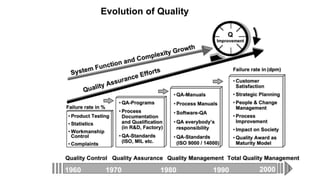
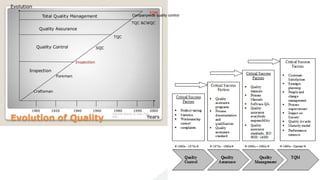
Evolution of Quality
7/20/2023
Sample Footer Text 3
Companywide quality control
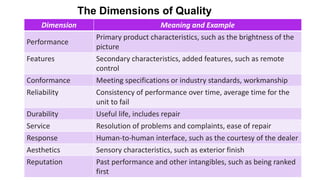
The Dimensions of Quality
Dimension Meaning and Example
Performance
Primary product characteristics, such as the brightness of the
picture
Features Secondary characteristics, added features, such as remote
control
Conformance Meeting specifications or industry standards, workmanship
Reliability Consistency of performance over time, average time for the
unit to fail
Durability Useful life, includes repair
Service Resolution of problems and complaints, ease of repair
Response Human-to-human interface, such as the courtesy of the dealer
Aesthetics Sensory characteristics, such as exterior finish
Reputation Past performance and other intangibles, such as being ranked
first
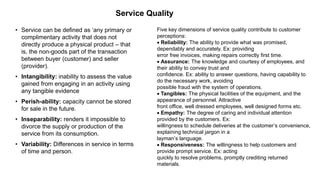
Service Quality
• Service can be defined as ‘any primary or
complimentary activity that does not
directly produce a physical product – that
is, the non-goods part of the transaction
between buyer (customer) and seller
(provider).
• Intangibility: inability to assess the value
gained from engaging in an activity using
any tangible evidence
• Perish-ability: capacity cannot be stored
for sale in the future.
• Inseparability: renders it impossible to
divorce the supply or production of the
service from its consumption.
• Variability: Differences in service in terms
of time and person.
Five key dimensions of service quality contribute to customer
perceptions:
 Reliability: The ability to provide what was promised,
dependably and accurately. Ex: providing
error free invoices, making repairs correctly first time.
 Assurance: The knowledge and courtesy of employees, and
their ability to convey trust and
confidence. Ex: ability to answer questions, having capability to
do the necessary work, avoiding
possible fraud with the system of operations.
 Tangibles: The physical facilities of the equipment, and the
appearance of personnel. Attractive
front office, well dressed employees, well designed forms etc.
 Empathy: The degree of caring and individual attention
provided by the customers. Ex:
willingness to schedule deliveries at the customer’s convenience,
explaining technical jargon in a
layman’s language.
 Responsiveness: The willingness to help customers and
provide prompt service. Ex: acting
quickly to resolve problems, promptly crediting returned
materials.
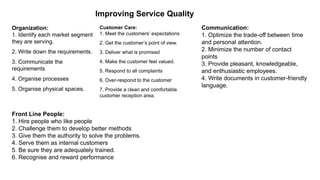
Improving Service Quality
Organization:
1. Identify each market segment
they are serving.
2. Write down the requirements.
3. Communicate the
requirements
4. Organise processes
5. Organise physical spaces.
Customer Care:
1. Meet the customers’ expectations
2. Get the customer’s point of view.
3. Deliver what is promised
4. Make the customer feel valued.
5. Respond to all complaints
6. Over-respond to the customer
7. Provide a clean and comfortable
customer reception area.
Communication:
1. Optimize the trade-off between time
and personal attention.
2. Minimize the number of contact
points
3. Provide pleasant, knowledgeable,
and enthusiastic employees.
4. Write documents in customer-friendly
language.
Front Line People:
1. Hire people who like people
2. Challenge them to develop better methods
3. Give them the authority to solve the problems.
4. Serve them as internal customers
5. Be sure they are adequately trained.
6. Recognise and reward performance

Needs for Quality.pptx

  • 1.
    Needs for Quality •Customer satisfaction and happiness • Goodwill (image of the organisation) and high productivity • Capturing the market • Minimising the cost as well as losses • Maximising the profit • Recognising the role of everyone in the organisation • Fixing a common goal for the entire organisation • Emphasising teamwork among the staff • Establishing performance measures for the employees • Betterment of employees • Increased viability.
  • 2.
  • 3.
    7/20/2023 Sample Footer Text3 Companywide quality control
  • 4.
    The Dimensions ofQuality Dimension Meaning and Example Performance Primary product characteristics, such as the brightness of the picture Features Secondary characteristics, added features, such as remote control Conformance Meeting specifications or industry standards, workmanship Reliability Consistency of performance over time, average time for the unit to fail Durability Useful life, includes repair Service Resolution of problems and complaints, ease of repair Response Human-to-human interface, such as the courtesy of the dealer Aesthetics Sensory characteristics, such as exterior finish Reputation Past performance and other intangibles, such as being ranked first
  • 5.
    Service Quality • Servicecan be defined as ‘any primary or complimentary activity that does not directly produce a physical product – that is, the non-goods part of the transaction between buyer (customer) and seller (provider). • Intangibility: inability to assess the value gained from engaging in an activity using any tangible evidence • Perish-ability: capacity cannot be stored for sale in the future. • Inseparability: renders it impossible to divorce the supply or production of the service from its consumption. • Variability: Differences in service in terms of time and person. Five key dimensions of service quality contribute to customer perceptions:  Reliability: The ability to provide what was promised, dependably and accurately. Ex: providing error free invoices, making repairs correctly first time.  Assurance: The knowledge and courtesy of employees, and their ability to convey trust and confidence. Ex: ability to answer questions, having capability to do the necessary work, avoiding possible fraud with the system of operations.  Tangibles: The physical facilities of the equipment, and the appearance of personnel. Attractive front office, well dressed employees, well designed forms etc.  Empathy: The degree of caring and individual attention provided by the customers. Ex: willingness to schedule deliveries at the customer’s convenience, explaining technical jargon in a layman’s language.  Responsiveness: The willingness to help customers and provide prompt service. Ex: acting quickly to resolve problems, promptly crediting returned materials.
  • 6.
    Improving Service Quality Organization: 1.Identify each market segment they are serving. 2. Write down the requirements. 3. Communicate the requirements 4. Organise processes 5. Organise physical spaces. Customer Care: 1. Meet the customers’ expectations 2. Get the customer’s point of view. 3. Deliver what is promised 4. Make the customer feel valued. 5. Respond to all complaints 6. Over-respond to the customer 7. Provide a clean and comfortable customer reception area. Communication: 1. Optimize the trade-off between time and personal attention. 2. Minimize the number of contact points 3. Provide pleasant, knowledgeable, and enthusiastic employees. 4. Write documents in customer-friendly language. Front Line People: 1. Hire people who like people 2. Challenge them to develop better methods 3. Give them the authority to solve the problems. 4. Serve them as internal customers 5. Be sure they are adequately trained. 6. Recognise and reward performance