Necrotizing Enterocolitis
In
Neonates
Done By :
Dr . Mohammed Fawzy
Necrotizing Enterocolitis
• Definition.
• Epidemiology
• Risk Factors
• Pathophysiology
• Clinical Presentation
• Diagnosis
• Management
• Prognosis
• Prevention
Definition :
is one of the most common gastrointestinal emergencie
s
in the newborn infant. It is a disorder characterized by
ischemic necrosis of the intestinal mucosa, which is
associated with inflammation, invasion of enteric gas
forming organisms, and dissection of gas mural and
luminal .
• Although early recognition and aggressive treatme
nt of this disorder has improved clinical outcomes,
NEC accounts for substantial long-term morbidity i
n survivors of neonatal intensive care, particularly i
n
premature very low birth weight infants (birth weig
Epidemiology :
• Incidence: 0.3-2.4 / 1000 live births .
• 2-5 % of all NICU admissions .
• 5-10 % of VLBW infants .
• Over 90 % of cases occur in preterm babies
• About 10 % occur in term newborns: essentially li
mited to those that have some underlying illness
or condition requiring NICU admission.
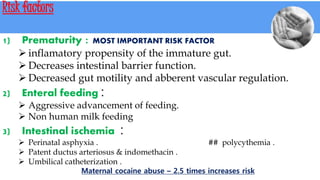
Risk factors
1) Prematurity : MOST IMPORTANT RISK FACTOR
 inflamatory propensity of the immature gut.
 Decreases intestinal barrier function.
 Decreased gut motility and abberent vascular regulation.
2) Enteral feeding :
 Aggressive advancement of feeding.
 Non human milk feeding
3) Intestinal ischemia :
 Perinatal asphyxia . ## polycythemia .
 Patent ductus arteriosus & indomethacin .
 Umbilical catheterization .
Maternal cocaine abuse – 2.5 times increases risk
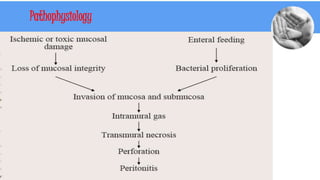
Pathophysiology
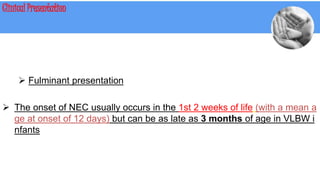
Clinical Presentation
 Fulminant presentation
 The onset of NEC usually occurs in the 1st 2 weeks of life (with a mean a
ge at onset of 12 days) but can be as late as 3 months of age in VLBW i
nfants
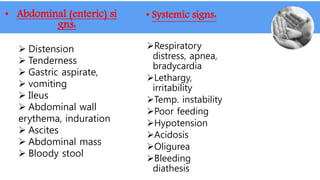
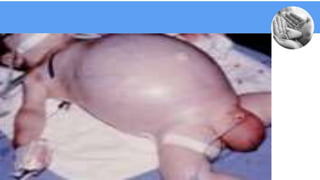
• Abdominal (enteric) si
gns:
 Distension
 Tenderness
 Gastric aspirate,
 vomiting
 Ileus
 Abdominal wall
erythema, induration
 Ascites
 Abdominal mass
 Bloody stool
• Systemic signs:
Respiratory
distress, apnea,
bradycardia
Lethargy,
irritability
Temp. instability
Poor feeding
Hypotension
Acidosis
Oligurea
Bleeding
diathesis
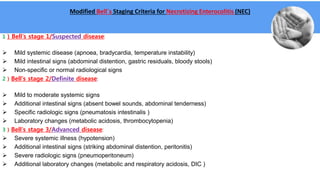
Modified Bell´s Staging Criteria for Necrotizing Enterocolitis (NEC)
1 ) Bell's stage 1/Suspected disease:
 Mild systemic disease (apnoea, bradycardia, temperature instability)
 Mild intestinal signs (abdominal distention, gastric residuals, bloody stools)
 Non-specific or normal radiological signs
2 ) Bell's stage 2/Definite disease:
 Mild to moderate systemic signs
 Additional intestinal signs (absent bowel sounds, abdominal tenderness)
 Specific radiologic signs (pneumatosis intestinalis )
 Laboratory changes (metabolic acidosis, thrombocytopenia)
3 ) Bell's stage 3/Advanced disease:
 Severe systemic illness (hypotension)
 Additional intestinal signs (striking abdominal distention, peritonitis)
 Severe radiologic signs (pneumoperitoneum)
 Additional laboratory changes (metabolic and respiratory acidosis, DIC )
Diagnosis :
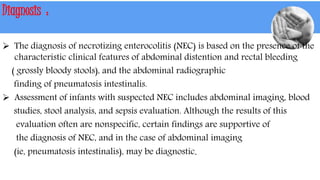
 The diagnosis of necrotizing enterocolitis (NEC) is based on the presence of the
characteristic clinical features of abdominal distention and rectal bleeding
( grossly bloody stools), and the abdominal radiographic
finding of pneumatosis intestinalis.
 Assessment of infants with suspected NEC includes abdominal imaging, blood
studies, stool analysis, and sepsis evaluation. Although the results of this
evaluation often are nonspecific, certain findings are supportive of
the diagnosis of NEC, and in the case of abdominal imaging
(ie, pneumatosis intestinalis), may be diagnostic.
Laboratory studies :-
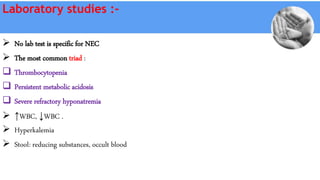
 No lab test is specific for NEC
 The most common triad :
 Thrombocytopenia
 Persistent metabolic acidosis
 Severe refractory hyponatremia
 ↑WBC, ↓WBC .
 Hyperkalemia
 Stool: reducing substances, occult blood
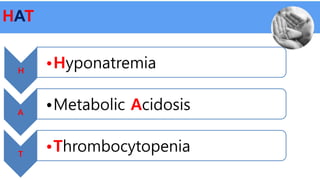
HAT
H
•Hyponatremia
A
•Metabolic Acidosis
T
•Thrombocytopenia
Radiologic studies
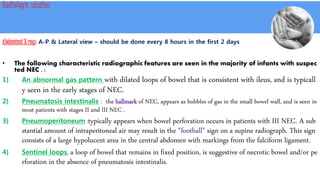
Abdominal X-ray: A-P & Lateral view – should be done every 8 hours in the first 2 days
• The following characteristic radiographic features are seen in the majority of infants with suspec
ted NEC . :
1) An abnormal gas pattern with dilated loops of bowel that is consistent with ileus, and is typicall
y seen in the early stages of NEC.
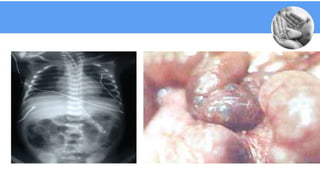
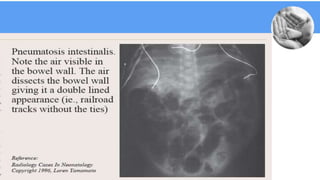
2) Pneumatosis intestinalis : the hallmark of NEC, appears as bubbles of gas in the small bowel wall, and is seen in
most patients with stages II and III NEC .
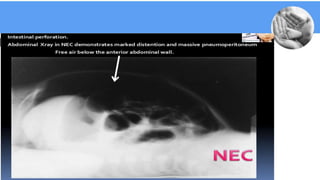
3) Pneumoperitoneum :typically appears when bowel perforation occurs in patients with III NEC. A sub
stantial amount of intraperitoneal air may result in the "football" sign on a supine radiograph. This sign
consists of a large hypolucent area in the central abdomen with markings from the falciform ligament.
4) Sentinel loops, a loop of bowel that remains in fixed position, is suggestive of necrotic bowel and/or pe
rforation in the absence of pneumatosis intestinalis.
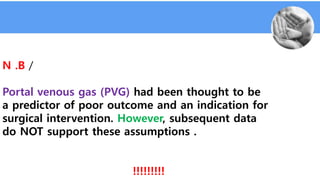
N .B /
Portal venous gas (PVG) had been thought to be
a predictor of poor outcome and an indication for
surgical intervention. However, subsequent data
do NOT support these assumptions .
!!!!!!!!!
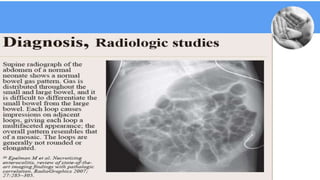
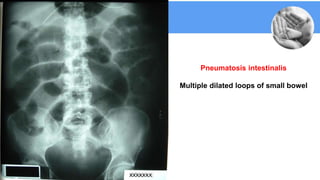
Pneumatosis intestinalis
Multiple dilated loops of small bowel
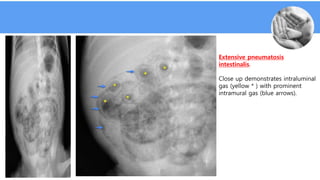
Extensive pneumatosis
intestinalis.
Close up demonstrates intraluminal
gas (yellow * ) with prominent
intramural gas (blue arrows).
Ultrasound :
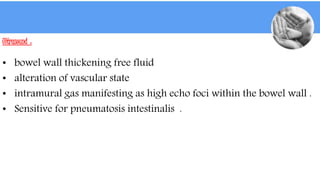
• bowel wall thickening free fluid
• alteration of vascular state
• intramural gas manifesting as high echo foci within the bowel wall .
• Sensitive for pneumatosis intestinalis .
Contrast enema :
Contrast enemas are NOT recommended if NEC is suspected, as it may
result in bowel perforation with extravasation of contrast material into
the peritoneum .
Sepsis evaluation : A sepsis evaluation is performed when NEC is suspected becau
se of sepsis is a common concomitant finding . Culture results may be used
in guiding antibiotic therapy.
A diagnostic abdominal paracentesis :
occasionally is performed to obtain fluid for culture and Gram stain in infant
with severe ascites or when peritonitis is suspected because of progressive
clinical deterioration and an unchanging radiographic bowel gas pattern. In
these cases, the identification of enteric organisms in the peritoneal fluid
supports the diagnosis of peritonitis from intestinal perforation and helps
guide appropriate antibiotic coverage .
Management
A ) Medical :
• Rapid initiation of therapy is required for suspected as well as proven NEC cases.
• There is no definitive treatment for established NEC and, therapy is directed at
supportive care and preventing further injury with
-Cessation of feeding,
-Nasogastric decompression, and
-Administration of intravenous fluids.
• Once blood has been drawn for culture, systemic antibiotics (with broad coverage for
gram-positive, gram-negative, and anaerobic organisms) should be started immediat
ely.
B ) Indications for surgery :
1 ) Absolute indications:
• Evidence of perforation on abdominal roentgenograms (pneumoperitoneum) or
• Positive abdominal paracentesis (stool or organism on Gram stain from peritoneal fluid).
2 ) Relative indications:
• Failure of medical management,
• Single fixed bowel loop on roentgenograms,
• Abdominal wall erythema, or
• A palpable mass.
PROGNOSIS.:
• Medical management fails in about 20–40% of patients with
pneumatosis intestinalis at diagnosis; of these, 10–30% die.
• Early postoperative complications : Wound infection, dehiscenc
e, and stomal problems (prolapse, necrosis).
• Later complications : Intestinal strictures develop at the site of the ne
crotizing lesion in about 10% of surgically or medically managed
patients.
• After massive intestinal resection,
-Complications from postoperative NEC include short-bowel
syndrome (malabsorption, growth failure, malnutrition),
• Premature infants with NEC who require surgical intervention or who
have concomitant bacteremia are at increased risk for adverse growth
and neurodevelopmental outcome.
• The overall mortality is 9% to 28% regardless of surgical or medical
intervention.
PREVENTION:
Always better than cure!
• Newborns exclusively breast-fed have a reduced risk of NEC.
• Early initiation of aggressive feeding may increase the risk of NEC in VLBW infants.
• Gut stimulation protocol of minimal enteral feeds followed by judicious volume advancement may
decrease the risk.
• Probiotic preparations have also decreased the incidence of NEC. . Induction of GI maturation.
• Incidence of NEC is significantly reduced after prenatal steroid therapy.
• Alteration of the immunologic status of the intestine using immunoglobulin A (IgA) and immunoglo
bulin G (IgG) supplementation
SUMMARY AND RECOMMENDATIONS
• Necrotizing enterocolitis (NEC) is one of the most common gastrointestinal emergencies in
the newborn infant . It occurs in 1 to 3 per 1000 live births. The incidence decreases with increasing
gestational age and birth weight (BW), and is about 6 to 7 percent in very low birth weight infants (BW less
than 1500 g). Term infants who develop NEC usually have a preexisting illness, such as congenital heart di
sease or sepsis.
• NEC primarily occurs in healthy, growing, and feeding premature infants. It presents with both
nonspecific systemic signs (eg, apnea, respiratory failure, poor feeding, lethargy, or temperature instability)
and abdominal signs (eg, distension, gastric retention, tenderness, vomiting, rectal bleeding, and diarrhea).
• The Bell staging criteria defines the different stages of NEC based upon the severity of clinical findings
.
• The diagnosis of NEC is based upon the presence of the characteristic clinical features of abdominal
distention and rectal bleeding (hematochezia), and the abdominal radiographic finding of pneumatosis
intestinalis. At times, radiographic findings may be equivocal and treatment decision should be based upo
n clinical suspicion and findings.
• Results of laboratory evaluation, including blood studies and stool analysis, are nonspecific, but may b
e supportive of the diagnosis of NEC. In particular, low platelet count, metabolic acidosis, and
• a heme-positive stool are associated with NEC.
THANK YOU
Dr . Mohammed Fawzy

Necrotizing Enterocolitis

  • 2.
  • 3.
    Necrotizing Enterocolitis • Definition. •Epidemiology • Risk Factors • Pathophysiology • Clinical Presentation • Diagnosis • Management • Prognosis • Prevention
  • 4.
    Definition : is oneof the most common gastrointestinal emergencie s in the newborn infant. It is a disorder characterized by ischemic necrosis of the intestinal mucosa, which is associated with inflammation, invasion of enteric gas forming organisms, and dissection of gas mural and luminal .
  • 5.
    • Although earlyrecognition and aggressive treatme nt of this disorder has improved clinical outcomes, NEC accounts for substantial long-term morbidity i n survivors of neonatal intensive care, particularly i n premature very low birth weight infants (birth weig
  • 6.
    Epidemiology : • Incidence:0.3-2.4 / 1000 live births . • 2-5 % of all NICU admissions . • 5-10 % of VLBW infants . • Over 90 % of cases occur in preterm babies • About 10 % occur in term newborns: essentially li mited to those that have some underlying illness or condition requiring NICU admission.
  • 7.
    Risk factors 1) Prematurity: MOST IMPORTANT RISK FACTOR  inflamatory propensity of the immature gut.  Decreases intestinal barrier function.  Decreased gut motility and abberent vascular regulation. 2) Enteral feeding :  Aggressive advancement of feeding.  Non human milk feeding 3) Intestinal ischemia :  Perinatal asphyxia . ## polycythemia .  Patent ductus arteriosus & indomethacin .  Umbilical catheterization . Maternal cocaine abuse – 2.5 times increases risk

  • 8.
  • 9.
    Clinical Presentation  Fulminantpresentation  The onset of NEC usually occurs in the 1st 2 weeks of life (with a mean a ge at onset of 12 days) but can be as late as 3 months of age in VLBW i nfants
  • 10.
    • Abdominal (enteric)si gns:  Distension  Tenderness  Gastric aspirate,  vomiting  Ileus  Abdominal wall erythema, induration  Ascites  Abdominal mass  Bloody stool • Systemic signs: Respiratory distress, apnea, bradycardia Lethargy, irritability Temp. instability Poor feeding Hypotension Acidosis Oligurea Bleeding diathesis
  • 12.
    Modified Bell´s StagingCriteria for Necrotizing Enterocolitis (NEC) 1 ) Bell's stage 1/Suspected disease:  Mild systemic disease (apnoea, bradycardia, temperature instability)  Mild intestinal signs (abdominal distention, gastric residuals, bloody stools)  Non-specific or normal radiological signs 2 ) Bell's stage 2/Definite disease:  Mild to moderate systemic signs  Additional intestinal signs (absent bowel sounds, abdominal tenderness)  Specific radiologic signs (pneumatosis intestinalis )  Laboratory changes (metabolic acidosis, thrombocytopenia) 3 ) Bell's stage 3/Advanced disease:  Severe systemic illness (hypotension)  Additional intestinal signs (striking abdominal distention, peritonitis)  Severe radiologic signs (pneumoperitoneum)  Additional laboratory changes (metabolic and respiratory acidosis, DIC )
  • 13.
    Diagnosis :  Thediagnosis of necrotizing enterocolitis (NEC) is based on the presence of the characteristic clinical features of abdominal distention and rectal bleeding ( grossly bloody stools), and the abdominal radiographic finding of pneumatosis intestinalis.  Assessment of infants with suspected NEC includes abdominal imaging, blood studies, stool analysis, and sepsis evaluation. Although the results of this evaluation often are nonspecific, certain findings are supportive of the diagnosis of NEC, and in the case of abdominal imaging (ie, pneumatosis intestinalis), may be diagnostic.
  • 14.
    Laboratory studies :- No lab test is specific for NEC  The most common triad :  Thrombocytopenia  Persistent metabolic acidosis  Severe refractory hyponatremia  ↑WBC, ↓WBC .  Hyperkalemia  Stool: reducing substances, occult blood
  • 15.
  • 16.
    Radiologic studies Abdominal X-ray:A-P & Lateral view – should be done every 8 hours in the first 2 days • The following characteristic radiographic features are seen in the majority of infants with suspec ted NEC . : 1) An abnormal gas pattern with dilated loops of bowel that is consistent with ileus, and is typicall y seen in the early stages of NEC. 2) Pneumatosis intestinalis : the hallmark of NEC, appears as bubbles of gas in the small bowel wall, and is seen in most patients with stages II and III NEC . 3) Pneumoperitoneum :typically appears when bowel perforation occurs in patients with III NEC. A sub stantial amount of intraperitoneal air may result in the "football" sign on a supine radiograph. This sign consists of a large hypolucent area in the central abdomen with markings from the falciform ligament. 4) Sentinel loops, a loop of bowel that remains in fixed position, is suggestive of necrotic bowel and/or pe rforation in the absence of pneumatosis intestinalis.
  • 17.
    N .B / Portalvenous gas (PVG) had been thought to be a predictor of poor outcome and an indication for surgical intervention. However, subsequent data do NOT support these assumptions . !!!!!!!!!
  • 20.
  • 21.
    Extensive pneumatosis intestinalis. Close updemonstrates intraluminal gas (yellow * ) with prominent intramural gas (blue arrows).
  • 24.
    Ultrasound : • bowelwall thickening free fluid • alteration of vascular state • intramural gas manifesting as high echo foci within the bowel wall . • Sensitive for pneumatosis intestinalis .
  • 25.
    Contrast enema : Contrastenemas are NOT recommended if NEC is suspected, as it may result in bowel perforation with extravasation of contrast material into the peritoneum . Sepsis evaluation : A sepsis evaluation is performed when NEC is suspected becau se of sepsis is a common concomitant finding . Culture results may be used in guiding antibiotic therapy.
  • 26.
    A diagnostic abdominalparacentesis : occasionally is performed to obtain fluid for culture and Gram stain in infant with severe ascites or when peritonitis is suspected because of progressive clinical deterioration and an unchanging radiographic bowel gas pattern. In these cases, the identification of enteric organisms in the peritoneal fluid supports the diagnosis of peritonitis from intestinal perforation and helps guide appropriate antibiotic coverage .
  • 27.
    Management A ) Medical: • Rapid initiation of therapy is required for suspected as well as proven NEC cases. • There is no definitive treatment for established NEC and, therapy is directed at supportive care and preventing further injury with -Cessation of feeding, -Nasogastric decompression, and -Administration of intravenous fluids. • Once blood has been drawn for culture, systemic antibiotics (with broad coverage for gram-positive, gram-negative, and anaerobic organisms) should be started immediat ely.
  • 28.
    B ) Indicationsfor surgery : 1 ) Absolute indications: • Evidence of perforation on abdominal roentgenograms (pneumoperitoneum) or • Positive abdominal paracentesis (stool or organism on Gram stain from peritoneal fluid). 2 ) Relative indications: • Failure of medical management, • Single fixed bowel loop on roentgenograms, • Abdominal wall erythema, or • A palpable mass.
  • 29.
    PROGNOSIS.: • Medical managementfails in about 20–40% of patients with pneumatosis intestinalis at diagnosis; of these, 10–30% die. • Early postoperative complications : Wound infection, dehiscenc e, and stomal problems (prolapse, necrosis). • Later complications : Intestinal strictures develop at the site of the ne crotizing lesion in about 10% of surgically or medically managed patients.
  • 30.
    • After massiveintestinal resection, -Complications from postoperative NEC include short-bowel syndrome (malabsorption, growth failure, malnutrition), • Premature infants with NEC who require surgical intervention or who have concomitant bacteremia are at increased risk for adverse growth and neurodevelopmental outcome. • The overall mortality is 9% to 28% regardless of surgical or medical intervention.
  • 31.
    PREVENTION: Always better thancure! • Newborns exclusively breast-fed have a reduced risk of NEC. • Early initiation of aggressive feeding may increase the risk of NEC in VLBW infants. • Gut stimulation protocol of minimal enteral feeds followed by judicious volume advancement may decrease the risk. • Probiotic preparations have also decreased the incidence of NEC. . Induction of GI maturation. • Incidence of NEC is significantly reduced after prenatal steroid therapy. • Alteration of the immunologic status of the intestine using immunoglobulin A (IgA) and immunoglo bulin G (IgG) supplementation
  • 32.
    SUMMARY AND RECOMMENDATIONS •Necrotizing enterocolitis (NEC) is one of the most common gastrointestinal emergencies in the newborn infant . It occurs in 1 to 3 per 1000 live births. The incidence decreases with increasing gestational age and birth weight (BW), and is about 6 to 7 percent in very low birth weight infants (BW less than 1500 g). Term infants who develop NEC usually have a preexisting illness, such as congenital heart di sease or sepsis. • NEC primarily occurs in healthy, growing, and feeding premature infants. It presents with both nonspecific systemic signs (eg, apnea, respiratory failure, poor feeding, lethargy, or temperature instability) and abdominal signs (eg, distension, gastric retention, tenderness, vomiting, rectal bleeding, and diarrhea). • The Bell staging criteria defines the different stages of NEC based upon the severity of clinical findings .
  • 33.
    • The diagnosisof NEC is based upon the presence of the characteristic clinical features of abdominal distention and rectal bleeding (hematochezia), and the abdominal radiographic finding of pneumatosis intestinalis. At times, radiographic findings may be equivocal and treatment decision should be based upo n clinical suspicion and findings. • Results of laboratory evaluation, including blood studies and stool analysis, are nonspecific, but may b e supportive of the diagnosis of NEC. In particular, low platelet count, metabolic acidosis, and • a heme-positive stool are associated with NEC.
  • 34.
    THANK YOU Dr .Mohammed Fawzy