NDIS Support Worker Pay Rates 2024: Latest Updates
1.
1/5
NDIS Support WorkerPay Rates 2024
clearcarecommunity.com.au/ndis-support-worker-pay-rates-2024
NDIS support workers are crucial in assisting individuals with disabilities and providing
personalised care to improve their quality of life. With changes in funding models and
policy, it’s essential to understand the NDIS support worker pay rates 2024 and how they
affect both workers and participants.
This guide breaks down the key components of NDIS support worker rates, including
factors that influence the rates, how they vary by location and time, and much more. If
you’re an NDIS support worker or someone who relies on their services, this article is for
you.
Understanding NDIS Support Worker Pay Rates 2024
NDIS support worker pay rates are not fixed across the board. They depend on several
factors, such as the time of day, the day of the week, and whether the support worker is
delivering services in a remote or very remote area. The NDIS has a structured pricing
guide that helps determine how much a support worker should be paid, but there is
flexibility depending on how the participant manages their plan.
Key Factors Affecting NDIS Pay Rates for Support Workers
Several key factors influence the rates for NDIS support workers:
2.
2/5
1. Time ofDay
The time a support service is provided can affect the pay rate. Support workers who
provide services during non-standard hours (evenings, nights, or weekends) are often
paid at higher rates.
2. Day of the Week
Rates differ between weekdays, weekends, and public holidays. For example, public
holiday rates tend to be the highest.
3. Location
Remote or very remote areas have higher rates due to the increased cost of living and
service provision.
4. Participant’s Plan Management
Whether a participant’s plan is agency-managed, self-managed, or plan-managed can
affect how the rates are applied.
5. TTP Rates
Some providers can charge higher Temporary Transformation Payment (TTP) rates for
workers.
What Are the TTP Rates?
TTP rates are slightly higher rates provided to NDIS providers that have undergone a
specific transformation process to improve their services. TTP is aimed at providers
transitioning from older systems and methods into more effective models. Participants
who use TTP-registered providers can expect to see marginally higher pay rates for their
support workers.
The NDIS Pay Rates for Support Workers in 2024
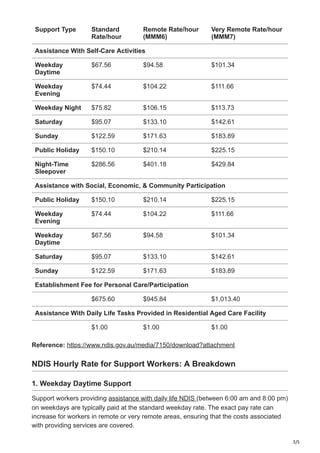
The following table presents the NDIS hourly rate for support workers, based on the latest
price guide.
Assistance with Daily Life, Social, Economic, & Community Participation
3.
3/5
Support Type Standard
Rate/hour
RemoteRate/hour
(MMM6)
Very Remote Rate/hour
(MMM7)
Assistance With Self-Care Activities
Weekday
Daytime
$67.56 $94.58 $101.34
Weekday
Evening
$74.44 $104.22 $111.66
Weekday Night $75.82 $106.15 $113.73
Saturday $95.07 $133.10 $142.61
Sunday $122.59 $171.63 $183.89
Public Holiday $150.10 $210.14 $225.15
Night-Time
Sleepover
$286.56 $401.18 $429.84
Assistance with Social, Economic, & Community Participation
Public Holiday $150.10 $210.14 $225.15
Weekday
Evening
$74.44 $104.22 $111.66
Weekday
Daytime
$67.56 $94.58 $101.34
Saturday $95.07 $133.10 $142.61
Sunday $122.59 $171.63 $183.89
Establishment Fee for Personal Care/Participation
$675.60 $945.84 $1,013.40
Assistance With Daily Life Tasks Provided in Residential Aged Care Facility
$1.00 $1.00 $1.00
Reference: https://www.ndis.gov.au/media/7150/download?attachment
NDIS Hourly Rate for Support Workers: A Breakdown
1. Weekday Daytime Support
Support workers providing assistance with daily life NDIS (between 6:00 am and 8:00 pm)
on weekdays are typically paid at the standard weekday rate. The exact pay rate can
increase for workers in remote or very remote areas, ensuring that the costs associated
with providing services are covered.
4.
4/5
2. Evening andNight Support Rates
Support workers who provide care in the evenings (after 8:00 pm) or at night are paid at a
higher rate due to the less convenient working hours. These rates also increase when
services are provided in remote or very remote areas.
3. Weekend and Public Holiday Rates
Saturday and Sunday rates are higher than regular weekday rates. Public holiday rates
are the highest, compensating workers for their time during what are typically non-
working days for most people. The exact increase depends on the location and the time
spent delivering the service.
Understanding Remote and Very Remote Areas
What is a Remote Area (MMM6)?
According to the Modified Monash Model (MMM), a remote area is a location where the
population density is low, and it may be more difficult for support workers to access. For
these areas, pay rates are increased to account for the higher living costs and additional
challenges faced by support workers.
What is a Very Remote Area (MMM7)?
A very remote area is even more isolated and has fewer available services. As a result,
NDIS support workers are paid higher rates to compensate for the difficulty of reaching
such areas and providing services.
For both MMM6 and MMM7 areas, the hourly rate increases, ensuring that workers are
fairly compensated for their time and effort.
How Travel and Transport Costs Affect NDIS Support Worker Pay
Rates
Support workers often incur additional costs for travel, such as parking, tolls, or fuel.
These additional costs can be claimed as part of the support provided under the NDIS.
Traveling Between Participants
When support workers are required to travel between multiple participants, travel time
and expenses may be accounted for separately, ensuring that workers are fairly
compensated for their time spent in transit.
Vehicle Depreciation and Non-Labour Costs
In some cases, vehicle depreciation and other non-labour-related expenses may be
reimbursed as part of the support worker’s overall pay, adding an extra layer of financial
support for the worker.
5.
5/5
Providing Support toMore Than One Participant
When an Disability support worker provides services to multiple participants at the same
time, the price for each participant is divided by the number of participants in the group.
This pricing model ensures that the cost of group-based services remains fair and aligned
with the number of people being supported.
How NDIS Participants Manage Their Plans and Its Effect on Pay
Rates
There are three main ways that NDIS participants can manage their plans:
Agency Managed: In this case, the NDIS directly handles the funding and provider
agreements, and the provider cannot charge more than the price guide.
Plan Managed: The participant works with a plan manager who helps with
budgeting and service provider agreements, but service rates remain within NDIS
price limits.
Self-Managed: The participant has full control over their funds and can negotiate
pay rates directly with their support workers.
Self-managed participants are the only ones who can negotiate rates outside the
standard NDIS price guide, which can benefit workers and participants who wish to
establish unique agreements.
Final Thoughts
The NDIS support worker pay rates 2024 are structured to ensure fair wages while
maintaining service affordability for participants. Understanding these rates allows
workers to maximise their earnings and participants to make informed choices about their
care. Keeping up with the latest NDIS updates is essential for both parties.