What does a disability support worker do? In this presentation, learn the role of a disability support worker in assisting NDIS participants with daily tasks and care.
The role ofa disability support worker is indispensable in the life
of NDIS participants. Stick to this presentation post to find out
how they create a difference in their lives.
As an NDIS participant or a caregiver of an NDIS participant, life
has been restlessly throwing stones at you. Even the daily tasks
like cleaning, walking, and preparing meals seem like an uphill
task- leaving you wondering when this all will come to rest.
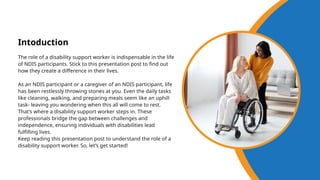
That’s where a disability support worker steps in. These
professionals bridge the gap between challenges and
independence, ensuring individuals with disabilities lead
fulfilling lives.
Keep reading this presentation post to understand the role of a
disability support worker. So, let’s get started!
Intoduction
3.
From household assistanceto personal care, and transport
assistance to social support, a disability support worker is a
highly versatile individual and can help the NDIS participant
with almost everything to foster their well-being, while
upholding their dignity and respect.
The Role of a Disability Support Worker
1. Personal Care and Daily Assistance
Almost every aspect of a disabled person’s life is challenging-
from showering, dressing, to eating. The disability support
workers assist them with these tasks, while promoting as much
as independence as possible.
• Assisting with bathing, showering, and maintaining personal
hygiene
• Helping with dressing and choosing appropriate clothing
• Supporting with grooming, including hair care, shaving, and
nail trimming
• Providing assistance with toileting and continence
management
4.
2. Emotional andSocial Support
Disability support workers aren’t just caregivers; they
emerge as friend for support workers. As NDIS participants
often feel social isolation, having a support worker
encourages interaction and engagement making a world of
difference for them.
5.
3. Household Assistance
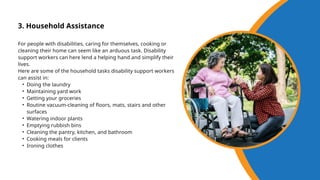
Forpeople with disabilities, caring for themselves, cooking or
cleaning their home can seem like an arduous task. Disability
support workers can here lend a helping hand and simplify their
lives.
Here are some of the household tasks disability support workers
can assist in:
• Doing the laundry
• Maintaining yard work
• Getting your groceries
• Routine vacuum-cleaning of floors, mats, stairs and other
surfaces
• Watering indoor plants
• Emptying rubbish bins
• Cleaning the pantry, kitchen, and bathroom
• Cooking meals for clients
• Ironing clothes
6.
4. Education andEmployment
For individuals looking to study or work, disability support workers
can be an essential part of their journey. They can assist them with
their transportation needs, provide guidance in educational settings,
support them in developing job-related skills, and assist with
workplace accommodations to ensure a smooth and inclusive
experience.
5. Assistance With Transport
Services
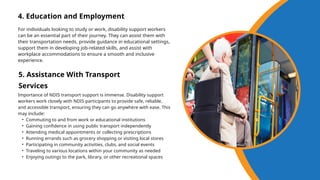
Importance of NDIS transport support is immense. Disability support
workers work closely with NDIS participants to provide safe, reliable,
and accessible transport, ensuring they can go anywhere with ease. This
may include:
• Commuting to and from work or educational institutions
• Gaining confidence in using public transport independently
• Attending medical appointments or collecting prescriptions
• Running errands such as grocery shopping or visiting local stores
• Participating in community activities, clubs, and social events
• Traveling to various locations within your community as needed
• Enjoying outings to the park, library, or other recreational spaces
7.
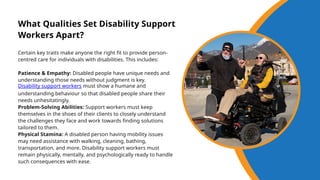
Certain key traitsmake anyone the right fit to provide person-
centred care for individuals with disabilities. This includes:
Patience & Empathy: Disabled people have unique needs and
understanding those needs without judgment is key.
Disability support workers must show a humane and
understanding behaviour so that disabled people share their
needs unhesitatingly.
Problem-Solving Abilities: Support workers must keep
themselves in the shoes of their clients to closely understand
the challenges they face and work towards finding solutions
tailored to them.
Physical Stamina: A disabled person having mobility issues
may need assistance with walking, cleaning, bathing,
transportation, and more. Disability support workers must
remain physically, mentally, and psychologically ready to handle
such consequences with ease.
What Qualities Set Disability Support
Workers Apart?
8.
When it comesto choosing the right NDIS provider in Sydney,
you might come across a tidal wave of choices on the Internet
just by entering the keyphrase “disability support worker in
Sydney”. However, remember that not every NDIS provider in
Sydney offers the level of services you expect. Here are a few
tips that can help you land the right disability support worker in
Sydney!
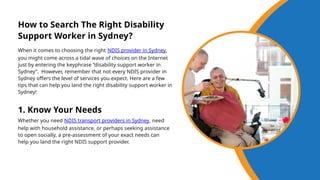
How to Search The Right Disability
Support Worker in Sydney?
1. Know Your Needs
Whether you need NDIS transport providers in Sydney, need
help with household assistance, or perhaps seeking assistance
to open socially, a pre-assessment of your exact needs can
help you land the right NDIS support provider.
9.
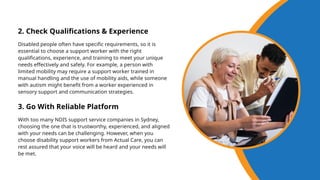
2. Check Qualifications& Experience
Disabled people often have specific requirements, so it is
essential to choose a support worker with the right
qualifications, experience, and training to meet your unique
needs effectively and safely. For example, a person with
limited mobility may require a support worker trained in
manual handling and the use of mobility aids, while someone
with autism might benefit from a worker experienced in
sensory support and communication strategies.
3. Go With Reliable Platform
With too many NDIS support service companies in Sydney,
choosing the one that is trustworthy, experienced, and aligned
with your needs can be challenging. However, when you
choose disability support workers from Actual Care, you can
rest assured that your voice will be heard and your needs will
be met.
10.
At the endof the day, the role of disability support workers isn’t just to
provide care, but change lives. They help individuals break down
barriers, build confidence, and participate in society in ways they might
not have thought possible.
At Actual Care, we emerge as a trusted NDIS support provider in
Sydney. With over 20 carer staff and having offered NDIS transport
services to over 250 participants and household services to over 300
participants, you can trust us for all your needs. Come, contact us today
and we’ll go above and beyond to bring a change in your life.
Conclusion