1
Evolutionary
Computation
Unit # 2
2
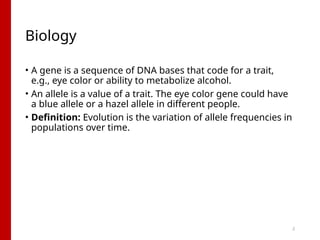
Biology
• A gene is a sequence of DNA bases that code for a trait,
e.g., eye color or ability to metabolize alcohol.
• An allele is a value of a trait. The eye color gene could have
a blue allele or a hazel allele in different people.
• Definition: Evolution is the variation of allele frequencies in
populations over time.
3
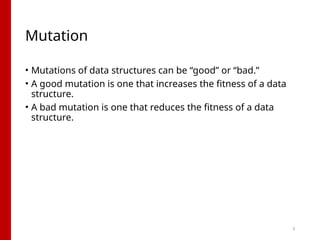
Mutation
• Mutations of data structures can be “good” or “bad.”
• A good mutation is one that increases the fitness of a data
structure.
• A bad mutation is one that reduces the fitness of a data
structure.
4
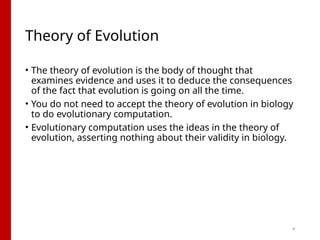
Theory of Evolution
• The theory of evolution is the body of thought that
examines evidence and uses it to deduce the consequences
of the fact that evolution is going on all the time.
• You do not need to accept the theory of evolution in biology
to do evolutionary computation.
• Evolutionary computation uses the ideas in the theory of
evolution, asserting nothing about their validity in biology.
5
Variation and Selection in Biology
• There are two opposing forces that drive evolution:
variation and selection.
• Variation is the process that produces new genes. Variation
can also change which genes are or are not expressed in a
given individual.
• Selection is the process whereby some alleles survive and
others do not.
• Variation builds up genetic diversity; selection reduces it.
6
Variation and Selection in EC
• Evolutionary computation operates on populations of data
structures.
• It accomplishes variation by making random changes in
these data structures and by blending parts of different
structures. These two processes are called mutation and
crossover, and together are referred to as variation
operators.
• Selection is accomplished with any algorithm that favors
data structures with a higher fitness score. There are many
different possible selection methods.
7
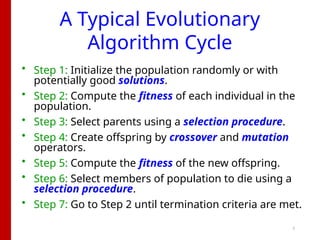
• Step 1: Initialize the population randomly or with
potentially good solutions.
• Step 2: Compute the fitness of each individual in the
population.
• Step 3: Select parents using a selection procedure.
• Step 4: Create offspring by crossover and mutation
operators.
• Step 5: Compute the fitness of the new offspring.
• Step 6: Select members of population to die using a
selection procedure.
• Step 7: Go to Step 2 until termination criteria are met.
A Typical Evolutionary
Algorithm Cycle
8
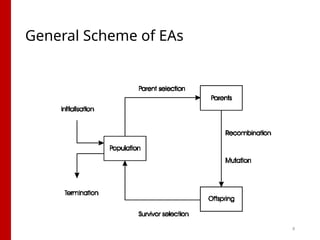
General Scheme of EAs
9
Components of Evolutionary
Algorithms
• Representation (definition of individuals)
• Evaluation function (or fitness function)
• Population
• Parent selection mechanism
• Variation operators, recombination and mutation
• Survivor selection mechanism (replacement)
10
Representation
• The first step in defining an EA is to link the “real world” to the
“EA world”.
• Objects forming possible solution within the original problem
context are referred to as phenotypes, while their encoding in
the EA are called genotypes.
• Within the EC literature many synonyms can be found:
• Candidate solution and individuals denote points in the phenotype
space.
• Chromosome and individuals denote points in the genotype space.
11
Representation Example
• An individual is typically described as a fixed length vector
of L features which are chosen presumably because of their
(potential) relevance to estimating an individual’s fitness.
For example,
• <hair color, eye color, skin color, height, weight>
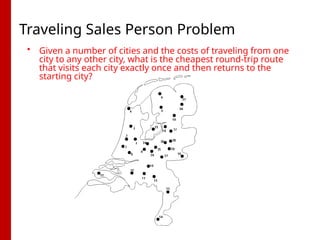
Traveling Sales Person Problem
• Given a number of cities and the costs of traveling from one
city to any other city, what is the cheapest round-trip route
that visits each city exactly once and then returns to the
starting city?
13
Permutation Representation: TSP
• Problem:
• Given n cities
• Find a complete tour with
minimal length
• Encoding:
• Label the cities 1, 2, … , n
• One complete tour is one
permutation (e.g. for n =4
[1,2,3,4], [3,4,2,1] are OK)
• Search space is BIG:
for 30 cities there are 30! 
1032
possible tours
14
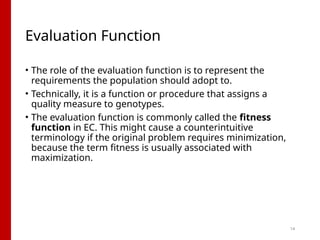
Evaluation Function
• The role of the evaluation function is to represent the
requirements the population should adopt to.
• Technically, it is a function or procedure that assigns a
quality measure to genotypes.
• The evaluation function is commonly called the fitness
function in EC. This might cause a counterintuitive
terminology if the original problem requires minimization,
because the term fitness is usually associated with
maximization.
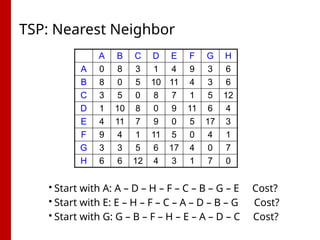
TSP: Nearest Neighbor
A B C D E F G H
A 0 8 3 1 4 9 3 6
B 8 0 5 10 11 4 3 6
C 3 5 0 8 7 1 5 12
D 1 10 8 0 9 11 6 4
E 4 11 7 9 0 5 17 3
F 9 4 1 11 5 0 4 1
G 3 3 5 6 17 4 0 7
H 6 6 12 4 3 1 7 0
• Start with A: A – D – H – F – C – B – G – E Cost?
• Start with E: E – H – F – C – A – D – B – G Cost?
• Start with G: G – B – F – H – E – A – D – C Cost?
16
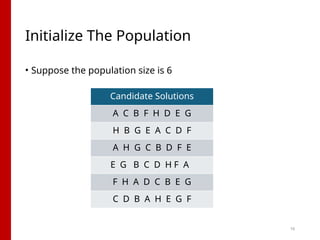
Initialize The Population
• Suppose the population size is 6
Candidate Solutions
A C B F H D E G
H B G E A C D F
A H G C B D F E
E G B C D H F A
F H A D C B E G
C D B A H E G F
17
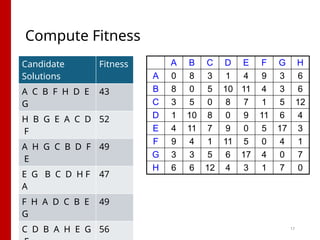
Compute Fitness
A B C D E F G H
A 0 8 3 1 4 9 3 6
B 8 0 5 10 11 4 3 6
C 3 5 0 8 7 1 5 12
D 1 10 8 0 9 11 6 4
E 4 11 7 9 0 5 17 3
F 9 4 1 11 5 0 4 1
G 3 3 5 6 17 4 0 7
H 6 6 12 4 3 1 7 0
Candidate
Solutions
Fitness
A C B F H D E
G
43
H B G E A C D
F
52
A H G C B D F
E
49
E G B C D H F
A
47
F H A D C B E
G
49
C D B A H E G 56
18
Parent Selection Mechanism
• The role of parent selection is to distinguish among
individuals based on their quality, and, in particular, to allow
the better individuals to become parents of the next
generation.
• An individual is a parent if it has been selected to undergo
variation in order to create offspring.
• In EC, parent selection is typically probabilistic.
19
Variation Operators
• The role of variation operators is to create new individuals
from old ones.
• In the corresponding phenotype space this amounts to
generating new candidate solutions.
• Variation operators in EC are divided into two types based
on their arity:
• Mutation
• Crossover
20
Crossover
• A binary variation operators is called recombination or
crossover.
• This operator merges information from two parent
genotypes into one or two offspring genotypes.
• Recombination is a stochastic operator: the choices of what
parts of each parent are combined and how this is done,
depend on random drawings.
• The principle behind recombination is simple – by mating
two individuals with different but desirable features, we can
produce an offspring that combines both of those features.
21
Mutation
• Mutation is a unary variation operator.
• It is applied to one genotype and delivers a (slightly)
modified mutant, the child or offspring.
• A mutation operator is always stochastic: its output – the
child – depends on the outcomes of a series of random
choices.
22
Crossover OR Mutation?
• Exploration: Discovering promising areas in the search space,
i.e. gaining information on the problem
• Exploitation: Optimizing within a promising area, i.e. using
information
• There is co-operation AND competition between them
• Crossover is explorative, it makes a big jump to an area
somewhere “in between” two (parent) areas
• Mutation is exploitative, it creates random small diversions,
thereby staying near (in the area of ) the parent
• Only crossover can combine information from two parents
• Only mutation can introduce new information (alleles)
23
Survival Selection Mechansim
• The role of survival selection (replacement) is to distinguish
among individuals based on their quality.
• It is similar to parent selection, but it is used I a different
stage of the evolutionary cycle.
• In contrast to parent selection, which is typically stochastic,
survivor selection is often deterministic.
24
Initialization and Termination
• Initialization is kept simple in most EA applications, the first
population is seeded by randomly generated individuals.
• Problem specific heuristics can also be used in this step to
create an initial population with higher fitness.
• The following options are used for termination:
• The maximally allowed CPU time elapses.
• The fitness improvement remains under a threshold value for a
given period of time.
• The population diversity drops under a given threshold.
25
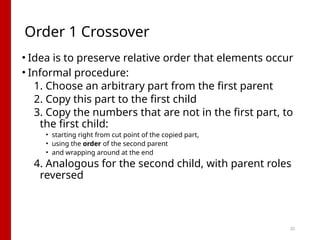
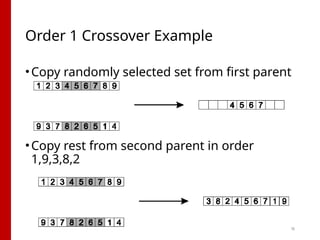
Order 1 Crossover
• Idea is to preserve relative order that elements occur
• Informal procedure:
1. Choose an arbitrary part from the first parent
2. Copy this part to the first child
3. Copy the numbers that are not in the first part, to
the first child:
• starting right from cut point of the copied part,
• using the order of the second parent
• and wrapping around at the end
4. Analogous for the second child, with parent roles
reversed
26
Order 1 Crossover Example
•Copy randomly selected set from first parent
•Copy rest from second parent in order
1,9,3,8,2
27
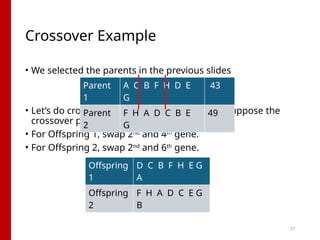
Crossover Example
• We selected the parents in the previous slides
• Let’s do crossover to produce two offspring. Suppose the
crossover points are 3 and 5
• For Offspring 1, swap 2nd
and 4th
gene.
• For Offspring 2, swap 2nd
and 6th
gene.
Parent
1
A C B F H D E
G
43
Parent
2
F H A D C B E
G
49
Offspring
1
D C B F H E G
A
Offspring
2
F H A D C E G
B
28
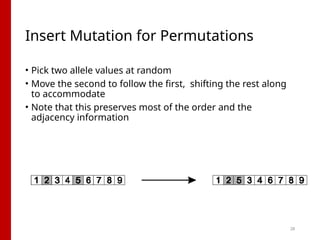
Insert Mutation for Permutations
• Pick two allele values at random
• Move the second to follow the first, shifting the rest along
to accommodate
• Note that this preserves most of the order and the
adjacency information
29
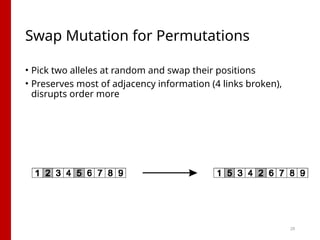
Swap Mutation for Permutations
• Pick two alleles at random and swap their positions
• Preserves most of adjacency information (4 links broken),
disrupts order more
30
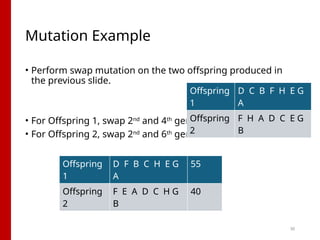
Mutation Example
• Perform swap mutation on the two offspring produced in
the previous slide.
• For Offspring 1, swap 2nd
and 4th
gene.
• For Offspring 2, swap 2nd
and 6th
gene.
Offspring
1
D C B F H E G
A
Offspring
2
F H A D C E G
B
Offspring
1
D F B C H E G
A
55
Offspring
2
F E A D C H G
B
40

Nature’s Algorithm: Cracking Problems with Evolutionary Computation

  • 1.
  • 2.
    2 Biology • A geneis a sequence of DNA bases that code for a trait, e.g., eye color or ability to metabolize alcohol. • An allele is a value of a trait. The eye color gene could have a blue allele or a hazel allele in different people. • Definition: Evolution is the variation of allele frequencies in populations over time.
  • 3.
    3 Mutation • Mutations ofdata structures can be “good” or “bad.” • A good mutation is one that increases the fitness of a data structure. • A bad mutation is one that reduces the fitness of a data structure.
  • 4.
    4 Theory of Evolution •The theory of evolution is the body of thought that examines evidence and uses it to deduce the consequences of the fact that evolution is going on all the time. • You do not need to accept the theory of evolution in biology to do evolutionary computation. • Evolutionary computation uses the ideas in the theory of evolution, asserting nothing about their validity in biology.
  • 5.
    5 Variation and Selectionin Biology • There are two opposing forces that drive evolution: variation and selection. • Variation is the process that produces new genes. Variation can also change which genes are or are not expressed in a given individual. • Selection is the process whereby some alleles survive and others do not. • Variation builds up genetic diversity; selection reduces it.
  • 6.
    6 Variation and Selectionin EC • Evolutionary computation operates on populations of data structures. • It accomplishes variation by making random changes in these data structures and by blending parts of different structures. These two processes are called mutation and crossover, and together are referred to as variation operators. • Selection is accomplished with any algorithm that favors data structures with a higher fitness score. There are many different possible selection methods.
  • 7.
    7 • Step 1:Initialize the population randomly or with potentially good solutions. • Step 2: Compute the fitness of each individual in the population. • Step 3: Select parents using a selection procedure. • Step 4: Create offspring by crossover and mutation operators. • Step 5: Compute the fitness of the new offspring. • Step 6: Select members of population to die using a selection procedure. • Step 7: Go to Step 2 until termination criteria are met. A Typical Evolutionary Algorithm Cycle
  • 8.
  • 9.
    9 Components of Evolutionary Algorithms •Representation (definition of individuals) • Evaluation function (or fitness function) • Population • Parent selection mechanism • Variation operators, recombination and mutation • Survivor selection mechanism (replacement)
  • 10.
    10 Representation • The firststep in defining an EA is to link the “real world” to the “EA world”. • Objects forming possible solution within the original problem context are referred to as phenotypes, while their encoding in the EA are called genotypes. • Within the EC literature many synonyms can be found: • Candidate solution and individuals denote points in the phenotype space. • Chromosome and individuals denote points in the genotype space.
  • 11.
    11 Representation Example • Anindividual is typically described as a fixed length vector of L features which are chosen presumably because of their (potential) relevance to estimating an individual’s fitness. For example, • <hair color, eye color, skin color, height, weight>
  • 12.
    Traveling Sales PersonProblem • Given a number of cities and the costs of traveling from one city to any other city, what is the cheapest round-trip route that visits each city exactly once and then returns to the starting city?
  • 13.
    13 Permutation Representation: TSP •Problem: • Given n cities • Find a complete tour with minimal length • Encoding: • Label the cities 1, 2, … , n • One complete tour is one permutation (e.g. for n =4 [1,2,3,4], [3,4,2,1] are OK) • Search space is BIG: for 30 cities there are 30!  1032 possible tours
  • 14.
    14 Evaluation Function • Therole of the evaluation function is to represent the requirements the population should adopt to. • Technically, it is a function or procedure that assigns a quality measure to genotypes. • The evaluation function is commonly called the fitness function in EC. This might cause a counterintuitive terminology if the original problem requires minimization, because the term fitness is usually associated with maximization.
  • 15.
    TSP: Nearest Neighbor AB C D E F G H A 0 8 3 1 4 9 3 6 B 8 0 5 10 11 4 3 6 C 3 5 0 8 7 1 5 12 D 1 10 8 0 9 11 6 4 E 4 11 7 9 0 5 17 3 F 9 4 1 11 5 0 4 1 G 3 3 5 6 17 4 0 7 H 6 6 12 4 3 1 7 0 • Start with A: A – D – H – F – C – B – G – E Cost? • Start with E: E – H – F – C – A – D – B – G Cost? • Start with G: G – B – F – H – E – A – D – C Cost?
  • 16.
    16 Initialize The Population •Suppose the population size is 6 Candidate Solutions A C B F H D E G H B G E A C D F A H G C B D F E E G B C D H F A F H A D C B E G C D B A H E G F
  • 17.
    17 Compute Fitness A BC D E F G H A 0 8 3 1 4 9 3 6 B 8 0 5 10 11 4 3 6 C 3 5 0 8 7 1 5 12 D 1 10 8 0 9 11 6 4 E 4 11 7 9 0 5 17 3 F 9 4 1 11 5 0 4 1 G 3 3 5 6 17 4 0 7 H 6 6 12 4 3 1 7 0 Candidate Solutions Fitness A C B F H D E G 43 H B G E A C D F 52 A H G C B D F E 49 E G B C D H F A 47 F H A D C B E G 49 C D B A H E G 56
  • 18.
    18 Parent Selection Mechanism •The role of parent selection is to distinguish among individuals based on their quality, and, in particular, to allow the better individuals to become parents of the next generation. • An individual is a parent if it has been selected to undergo variation in order to create offspring. • In EC, parent selection is typically probabilistic.
  • 19.
    19 Variation Operators • Therole of variation operators is to create new individuals from old ones. • In the corresponding phenotype space this amounts to generating new candidate solutions. • Variation operators in EC are divided into two types based on their arity: • Mutation • Crossover
  • 20.
    20 Crossover • A binaryvariation operators is called recombination or crossover. • This operator merges information from two parent genotypes into one or two offspring genotypes. • Recombination is a stochastic operator: the choices of what parts of each parent are combined and how this is done, depend on random drawings. • The principle behind recombination is simple – by mating two individuals with different but desirable features, we can produce an offspring that combines both of those features.
  • 21.
    21 Mutation • Mutation isa unary variation operator. • It is applied to one genotype and delivers a (slightly) modified mutant, the child or offspring. • A mutation operator is always stochastic: its output – the child – depends on the outcomes of a series of random choices.
  • 22.
    22 Crossover OR Mutation? •Exploration: Discovering promising areas in the search space, i.e. gaining information on the problem • Exploitation: Optimizing within a promising area, i.e. using information • There is co-operation AND competition between them • Crossover is explorative, it makes a big jump to an area somewhere “in between” two (parent) areas • Mutation is exploitative, it creates random small diversions, thereby staying near (in the area of ) the parent • Only crossover can combine information from two parents • Only mutation can introduce new information (alleles)
  • 23.
    23 Survival Selection Mechansim •The role of survival selection (replacement) is to distinguish among individuals based on their quality. • It is similar to parent selection, but it is used I a different stage of the evolutionary cycle. • In contrast to parent selection, which is typically stochastic, survivor selection is often deterministic.
  • 24.
    24 Initialization and Termination •Initialization is kept simple in most EA applications, the first population is seeded by randomly generated individuals. • Problem specific heuristics can also be used in this step to create an initial population with higher fitness. • The following options are used for termination: • The maximally allowed CPU time elapses. • The fitness improvement remains under a threshold value for a given period of time. • The population diversity drops under a given threshold.
  • 25.
    25 Order 1 Crossover •Idea is to preserve relative order that elements occur • Informal procedure: 1. Choose an arbitrary part from the first parent 2. Copy this part to the first child 3. Copy the numbers that are not in the first part, to the first child: • starting right from cut point of the copied part, • using the order of the second parent • and wrapping around at the end 4. Analogous for the second child, with parent roles reversed
  • 26.
    26 Order 1 CrossoverExample •Copy randomly selected set from first parent •Copy rest from second parent in order 1,9,3,8,2
  • 27.
    27 Crossover Example • Weselected the parents in the previous slides • Let’s do crossover to produce two offspring. Suppose the crossover points are 3 and 5 • For Offspring 1, swap 2nd and 4th gene. • For Offspring 2, swap 2nd and 6th gene. Parent 1 A C B F H D E G 43 Parent 2 F H A D C B E G 49 Offspring 1 D C B F H E G A Offspring 2 F H A D C E G B
  • 28.
    28 Insert Mutation forPermutations • Pick two allele values at random • Move the second to follow the first, shifting the rest along to accommodate • Note that this preserves most of the order and the adjacency information
  • 29.
    29 Swap Mutation forPermutations • Pick two alleles at random and swap their positions • Preserves most of adjacency information (4 links broken), disrupts order more
  • 30.
    30 Mutation Example • Performswap mutation on the two offspring produced in the previous slide. • For Offspring 1, swap 2nd and 4th gene. • For Offspring 2, swap 2nd and 6th gene. Offspring 1 D C B F H E G A Offspring 2 F H A D C E G B Offspring 1 D F B C H E G A 55 Offspring 2 F E A D C H G B 40