Corporate social responsibilityand sustainability
Sustainability profile of National Grid
Muhammad Gias Uddin
Valentina Denaro
Md Asharaful Alam
Supervisor:
ANTONIO TENCATI
2.
National Grid
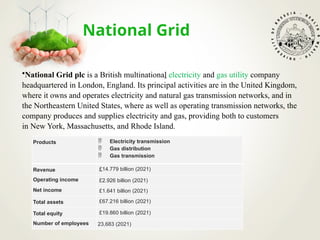
•National Gridplc is a British multinational electricity and gas utility company
headquartered in London, England. Its principal activities are in the United Kingdom,
where it owns and operates electricity and natural gas transmission networks, and in
the Northeastern United States, where as well as operating transmission networks, the
company produces and supplies electricity and gas, providing both to customers
in New York, Massachusetts, and Rhode Island.
Products Electricity transmission
Gas distribution
Gas transmission
Revenue £14.779 billion (2021)
Operating income £2.926 billion (2021)
Net income £1.641 billion (2021)
Total assets £67.216 billion (2021)
Total equity £19.860 billion (2021)
Number of employees 23,683 (2021)
3.
Mission & Vision
Mission,We exist to ‘Bring Energy to Life’.
We do this by delivering the electricity and gas that our customers and
communities rely on, and we aim to do this in ever more sustainable,
reliable, safe, fair and affordable ways. National Grid operates at the
heart of the energy system, connecting millions of people to the energy
they use every day. Behaving responsibly is key to our success and our
stakeholders expect it of us. This Responsible Business Report (RBR)
sets out our progress.
Vision To be at the heart of a clean, fair and affordable energy future
Value Every day we… do the right thing, find a better way and make
it happen
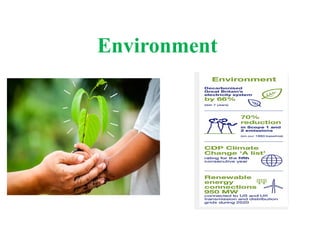
Net Zero Our Net Zero commitment is to reduce our own
greenhouse gas emissions to Net Zero by 2050
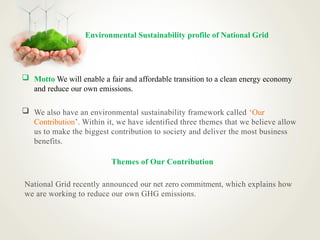
Environmental Sustainability profileof National Grid
Motto We will enable a fair and affordable transition to a clean energy economy
and reduce our own emissions.
We also have an environmental sustainability framework called ‘Our
Contribution’. Within it, we have identified three themes that we believe allow
us to make the biggest contribution to society and deliver the most business
benefits.
Themes of Our Contribution
National Grid recently announced our net zero commitment, which explains how
we are working to reduce our own GHG emissions.
6.
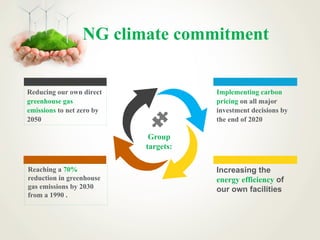
NG climate commitment
Group
targets:
Implementingcarbon
pricing on all major
investment decisions by
the end of 2020
Increasing the
energy efficiency of
our own facilities
Reducing our own direct
greenhouse gas
emissions to net zero by
2050
Reaching a 70%
reduction in greenhouse
gas emissions by 2030
from a 1990 .
7.
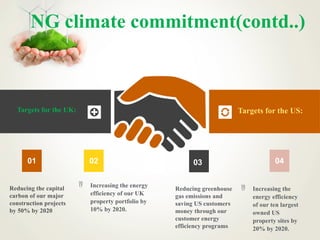
NG climate commitment(contd..)
Targetsfor the UK: Targets for the US:
01 02 03
03 04
Reducing the capital
carbon of our major
construction projects
by 50% by 2020
Increasing the energy
efficiency of our UK
property portfolio by
10% by 2020.
Reducing greenhouse
gas emissions and
saving US customers
money through our
customer energy
efficiency programs
Increasing the
energy efficiency
of our ten largest
owned US
property sites by
20% by 2020.
8.
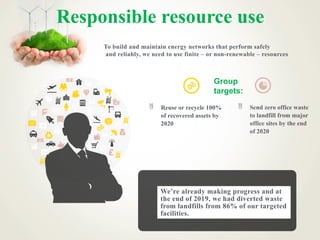
Responsible resource use
We’realready making progress and at
the end of 2019, we had diverted waste
from landfills from 86% of our targeted
facilities.
Send zero office waste
to landfill from major
office sites by the end
of 2020
Reuse or recycle 100%
of recovered assets by
2020
To build and maintain energy networks that perform safely
and reliably, we need to use finite – or non-renewable – resources
Group
targets:
9.
Caring for ournatural environment
•It's important that NG manage the land we own in ways that create the most value
for us and our stakeholders, and for the wider environment in which we operate.
•Through our Natural Grid program in the UK, we're working with local
communities and stakeholders to make the best of our green spaces and efficiently
manage them in a way that benefits local communities and habitats.
•We're also making sure that we minimize the impact of our construction projects,
as we work to maintain and expand our energy networks.
Group targets:
Recognizing and enhancing the value of our natural assets on at least 50 sites by the end
of 2020
Driving net gain in environmental value on major construction projects by 2020.
Working in partnership
NG have strategic partnerships with specialist environmental organizations
that help us to shape new ways of managing our natural assets on a local
scale. This collaborative approach is already creating significant benefits,
including lower management costs, reduced risks, improved biodiversity and
positive relationships with the communities we serve
10.
Summary of ourResponsible Business Charter Commitments
i) Achieve Net Zero by 2050. We will reduce Scope 1 and 2 greenhouse gas
(GHG) emissions 80% by 2030, 90% by 2040, and to Net Zero by 2050 from a
1990 baseline
ii) Reduce Scope 3 GHG emissions 37.5% by financial year 2034 (from a financial
year 2019 baseline
iii)Reduce SF6 emissions from our operations 50% by 2030, from a 2019 baseline.
iv)Move to a 100% electric fleet by 2030 for our light-duty vehicles and pursue
the replacement of our medium and heavy-duty vehicles with zero carbon
alternatives.
v) Reduce energy consumption in our offices 20% by 2030, from a 2020 baseline
(amended from 2019 baseline).
vi)Improve the natural environment by 10% on the land we own by 2030
vii)Achieve zero carbon emissions from business air travel. From this year (2020)
onwards, we will reduce our annual air miles travelled by at least 50% from a
2019 baseline on an enduring basis, and we will offset any remaining emissions
responsibly.
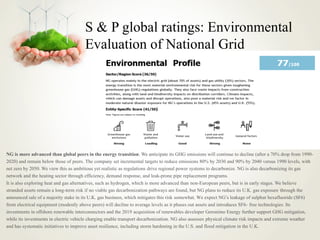
S & Pglobal ratings: Environmental
Evaluation of National Grid
NG is more advanced than global peers in the energy transition. We anticipate its GHG emissions will continue to decline (after a 70% drop from 1990-
2020) and remain below those of peers. The company set incremental targets to reduce emissions 80% by 2030 and 90% by 2040 versus 1990 levels, with
net zero by 2050. We view this as ambitious yet realistic as regulations drive regional power systems to decarbonize. NG is also decarbonizing its gas
network and the heating sector through efficiency, demand response, and leak-prone pipe replacement programs.
It is also exploring heat and gas alternatives, such as hydrogen, which is more advanced than non-European peers, but is in early stages. We believe
stranded assets remain a long-term risk if no viable gas decarbonization pathways are found, but NG plans to reduce its U.K. gas exposure through the
announced sale of a majority stake in its U.K. gas business, which mitigates this risk somewhat. We expect NG’s leakage of sulphur hexafluoride (SF6)
from electrical equipment (modestly above peers) will decline to average levels as it phases out assets and introduces SF6- free technologies. Its
investments in offshore renewable interconnectors and the 2019 acquisition of renewables developer Geronimo Energy further support GHG mitigation,
while its investments in electric vehicle charging enable transport decarbonization. NG also assesses physical climate risk impacts and extreme weather
and has systematic initiatives to improve asset resilience, including storm hardening in the U.S. and flood mitigation in the U.K.
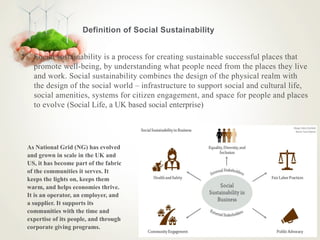
Definition of SocialSustainability
• Social sustainability is a process for creating sustainable successful places that
promote well-being, by understanding what people need from the places they live
and work. Social sustainability combines the design of the physical realm with
the design of the social world – infrastructure to support social and cultural life,
social amenities, systems for citizen engagement, and space for people and places
to evolve (Social Life, a UK based social enterprise)
As National Grid (NG) has evolved
and grown in scale in the UK and
US, it has become part of the fabric
of the communities it serves. It
keeps the lights on, keeps them
warm, and helps economies thrive.
It is an operator, an employer, and
a supplier. It supports its
communities with the time and
expertise of its people, and through
corporate giving programs.
15.
Responsibility in communities
•NationalGrid delivers sustainable energy safely, reliably,
and affordably, ensuring no one gets left behind.
•National Grid’s approaches to responsibility in its communities go
beyond safely maintaining the resilient energy systems society
expects. It’s also about making sure its economic and social role in
the community has the greatest possible positive impact.
•That includes developing infrastructure and helping customers use
energy more efficiently. It also means partnering with charity
organizations and encouraging National Grid’s employees to support
social, economic, and environmental development.
•National Grid’s Responsible Business Charter sets out its
commitments and ambitions to make a positive impact in the
communities it serves and further detail how it will achieve them.
16.
National Grid’s commitmentsto Communities
Deliver energy fairly and affordably to the communities we
serve
Play our role in ensuring no one is left behind in the transition
to clean energy
Continue to reinvest in energy infrastructure at approximately
£5 billion eachyear
Report transparently on energy costs throughout the energy
transition
Provide access to skills development for 45,000 people by 2030
Achieve 500,000 employee volunteering hours by2030
17.
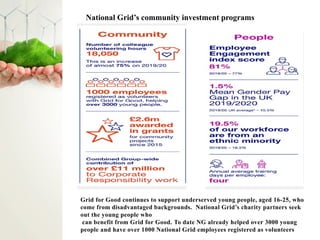
National Grid’s communityinvestment programs
Grid for Good continues to support underserved young people, aged 16-25, who
come from disadvantaged backgrounds. National Grid’s charity partners seek
out the young people who
can benefit from Grid for Good. To date NG already helped over 3000 young
people and have over 1000 National Grid employees registered as volunteers
18.
Responsibility to peopleor employees
•NG seeks to find the best talent and develop the right skills to enable and
accelerate the energy transition and strive to build a diverse workforce and
inclusive culture.
•The 23,000 people it employs in the UK and the US are the lifeblood of the
company. Their safety and wellbeing are a top priority for everyone at National
Grid – it underpins everything we do.
•Diversity matters
National Grid’s vision is to build and develop an inclusive culture and a diverse
workforce that is fully representative of the communities it serves. NG treats
everyone fairly and equally, without discrimination on the grounds of race, age,
role, gender, gender identity, color, religion, country of origin, gender
orientation, marital status, dependents, disability, social class, or political views.
National Grid’s commitments to employees
Be as transparent aspossible internally and externally on gender and ethnicity/
race
Work until pay equity is achieved for our employees
Achieve 50% diversity in our Senior Leadership group by 2025
Achieve 50% diversity inall our new talent programs by 2025
Provide unconscious bias training to all our people overthe next year
19.
National Grid’s ambitionsfor employees
Eradicate discrimination of any kind
Among our people, reflect the diversity of the communities we serve
Develop the skills needed for the net-zero workforces of the future by investing
indeveloping our people
Making sure its workforce reflects the diversity of the communities it
serves is also important to National Grid. That’s why it reports annually on
its progress on ethnic minority and female representation on its Board, at the
manager level, among new joiners, and its workforce as a whole.
Fair pay
•Fairness in pay also reflects our approach to responsibility. NG is a living wage
employer in the UK and undertakes a Living Wage review each year to ensure
continued alignment. It also reviews its Gender Pay reporting annually. NG has
closed this gap over time and now ranks in the top quartile.
20.
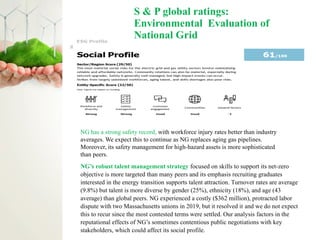
S & Pglobal ratings:
Environmental Evaluation of
National Grid
NG has a strong safety record, with workforce injury rates better than industry
averages. We expect this to continue as NG replaces aging gas pipelines.
Moreover, its safety management for high-hazard assets is more sophisticated
than peers.
NG’s robust talent management strategy focused on skills to support its net-zero
objective is more targeted than many peers and its emphasis recruiting graduates
interested in the energy transition supports talent attraction. Turnover rates are average
(9.8%) but talent is more diverse by gender (25%), ethnicity (18%), and age (43
average) than global peers. NG experienced a costly ($362 million), protracted labor
dispute with two Massachusetts unions in 2019, but it resolved it and we do not expect
this to recur since the most contested terms were settled. Our analysis factors in the
reputational effects of NG’s sometimes contentious public negotiations with key
stakeholders, which could affect its social profile.
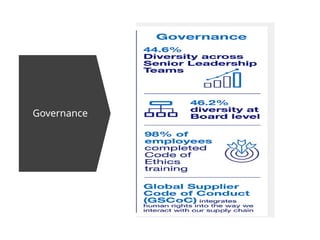
GOVERNANCE System ofNational
Grid
• In the last few years, the role of company boards has been
under the microscope.
• In the UK, the Corporate Governance Code was revised in
2018 and greater emphasis was placed on promoting the
long-term success of the Company for the benefit of its
members as a whole, and in doing so having regard to the
likely consequences of any decision on the interests of the
Company’s employees, the need to foster the Company’s
business relationships with suppliers, customers, and others,
and the impact of the Company’s operations on the
community and the environment.
• It also stressed the desirability of the Company to maintain a
reputation for high standards of business conduct.
• From transparency and culture, to make sure we have a
diverse leadership team, National Grid adheres to the
highest standards of corporate governance and we
continually apply best practices.
23.
GOVERNANCE
System of National
Grid
•Therole of the Board
The National Grid Board is collectively responsible
for the effective oversight of the Company and its
businesses. It determines the company’s strategic
direction and objectives, business plan, viability, and
governance structure to help achieve long-term
success and deliver sustainable shareholder value.
•Embracing diversity and inclusion
The National Grid’s approach to corporate governance
plays an important role in helping us develop its
culture, which embraces diversity and inclusion and
strives to create an environment where everyone can
fulfill their potential.
NG’s Board will continue to play a vital role in setting
the tone right from the top. It applies a robust
framework to ensure it captures stakeholder
considerations and strengthens their voice in the
boardroom.
24.
National Grid’s commitmentsand ambitions in
its Responsible Business Charter
NG’s commitments
Continue to review and adapt our governance policies to reflect and
support our responsible business commitments and ambitions
Continually review the company culture to ensure it is inclusive
Listen to our people and ensure their voices are heard at Group
Executive and Board level
Ensure the voices of all our stakeholders are heard and understood by
the National Grid Board
Achieve 50% diversity in our Group Executive Committee
NG’s ambitions
Aim for our responsible business actions and impact to
differentiate us from our peer group, and to make us a clear
choice for ESG-minded investors
Meet and ultimately exceed the Hampton-Alexander and Parker
diversity review standards and achieve 50% diversity in our
Board
• Build a company where everybody can achieve their potential
25.
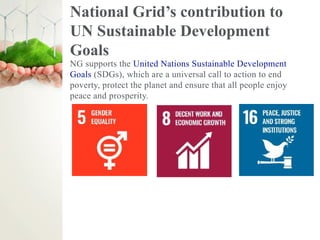
National Grid’s contributionto
UN Sustainable Development
Goals
NG supports the United Nations Sustainable Development
Goals (SDGs), which are a universal call to action to end
poverty, protect the planet and ensure that all people enjoy
peace and prosperity.
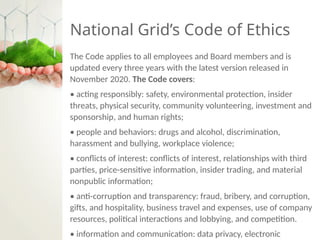
National Grid’s Codeof Ethics
The Code applies to all employees and Board members and is
updated every three years with the latest version released in
November 2020. The Code covers:
• acting responsibly: safety, environmental protection, insider
threats, physical security, community volunteering, investment and
sponsorship, and human rights;
• people and behaviors: drugs and alcohol, discrimination,
harassment and bullying, workplace violence;
• conflicts of interest: conflicts of interest, relationships with third
parties, price-sensitive information, insider trading, and material
nonpublic information;
• anti-corruption and transparency: fraud, bribery, and corruption,
gifts, and hospitality, business travel and expenses, use of company
resources, political interactions and lobbying, and competition.
• information and communication: data privacy, electronic
28.
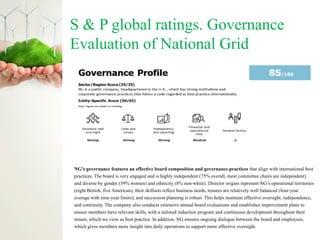
S & Pglobal ratings. Governance
Evaluation of National Grid
NG’s governance features an effective board composition and governance practices that align with international best
practices. The board is very engaged and is highly independent (75% overall, most committee chairs are independent)
and diverse by gender (39% women) and ethnicity (8% non-white). Director origins represent NG’s operational territories
(eight British, five American), their skillsets reflect business needs, tenures are relatively well balanced (four-year
average with nine-year limits), and succession planning is robust. This helps maintain effective oversight, independence,
and continuity. The company also conducts extensive annual board evaluations and establishes improvement plans to
ensure members have relevant skills, with a tailored induction program and continuous development throughout their
tenure, which we view as best practice. In addition, NG ensures ongoing dialogue between the board and employees,
which gives members more insight into daily operations to support more effective oversight.
29.
NG has establisheda strong and coherent values framework across its footprint that
meets global standards. The company's clearly articulated values support its vision of being at
the heart of a clean, fair, and affordable energy future. In our view, this framework is relevant,
aligned with environmental and social values, and applied in practice via its decarbonization
programs and green financings. Executive remuneration is in line with industry standards and
incentives largely reinforce its strategy, with variable pay linked to financial and operational
targets. About 65% of total executive pay is issued in shares vesting over two to three years,
and high shareholding requirements ensure leadership maintains a long-term view. NG also
established extensive policies for ethical behavior and has a coherent code of conduct applied
across its operations and supply chain, with training and mechanisms to ensure compliance.
Disclosure and reporting practices are more comprehensive than global peers, covering a
wide range of financial and non-financial metrics, policies, governance information, and taxation
issues. NG releases an integrated annual report that merges financial and sustainability
information. Sustainability metrics have been reported consistently since 2001, which enables
historical analysis. Financial disclosures are in line with peers, with no major restatements. In
addition, NG has issued Task Force on Climate-Related Financial Disclosures reports for three
years. NG’s sustainability disclosure for U.K. operations is extensive, although U.S. reporting is
not as detailed. While the quantity of disclosures is vast, information is dispersed across various
reports and places.
30.
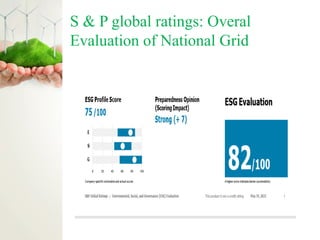
S & Pglobal ratings: Overal
Evaluation of National Grid
31.
Reference
1. https://nbs.net/articles/what-is-social-sustainability/
2. https://www.nationalgrid.com/responsibility/environment/environment
al-sustainability
3.https://www.nationalgrid.com/responsibility
4. https://www.nationalgrid.com/responsibility/people
5. https://www.nationalgrid.com/responsibility/community
6. https://www.nationalgrid.com/responsibility/governance
7. https://www.nationalgrid.com/responsibility/responsible-business-repor
t
8. https://www.nationalgrid.com/responsibility-and-sustainability/our-prog
ress
9. Logan, K. G., Nelson, J. D., & Hastings, A. (2022). Low emission
vehicle integration: Will National Grid electricity generation mix
meet UK net-zero? Proceedings of the Institution of Mechanical
Engineers, Part A: Journal of Power and Energy, 236(1), 159–175.
https://doi.org/10.1177/09576509211015472