Civil UAV 
Capability Assessment 
Draft Version 
Prepared For: Lawrence Camacho 
UAV Vehicle Sector Manager, Vehicle Systems Program 
NASA Aeronautics Research Mission Directorate 
Cheryl Yuhas 
Suborbital Science Program Manager 
NASA Science Mission Directorate 
Prepared By: Timothy H. Cox 
NASA 
Christopher J. Nagy 
NASA 
Mark A. Skoog 
NASA 
Ivan A. Somers 
CSM, Inc. 
December 2004
Civil UAV Capability Assessment December 2004 
Table of Contents 
1 Introduction ....................................................................................................3 
1.1 Purpose ..................................................................................................3 
1.2 Scope .....................................................................................................4 
1.3 Approach ................................................................................................5 
1.4 Acronyms and Definitions .......................................................................7 
2 UAV Programs...............................................................................................8 
2.1 Historical.................................................................................................8 
2.2 Civil UAVs...............................................................................................9 
2.2.1 Operational Civil UAVs ....................................................................9 
2.2.2 UAV Technology Development Programs.....................................12 
2.3 Military UAVs........................................................................................13 
2.3.1 Classes of Military UAVs ...............................................................14 
2.3.2 UAV Technology Development Programs.....................................16 
2.4 UAV Proliferation ..................................................................................17 
2.4.1 Market Forecast ............................................................................18 
2.4.2 UAV Development in the U.S. .......................................................19 
2.4.3 European and Worldwide UAVs ....................................................19 
2.4.4 Role of US export controls.............................................................21 
3 UAV Mission Requirements.........................................................................22 
3.1 Mission Summaries ..............................................................................22 
3.1.1 Commercial ...................................................................................22 
3.1.2 Earth Science ................................................................................22 
3.1.3 Homeland Security ........................................................................28 
3.1.4 Land Management.........................................................................28 
3.2 Existing Mission Capabilities ................................................................29 
3.3 Requisite Capabilities and Technologies..............................................29 
4 UAV Status Assessment..............................................................................33 
4.1 UAV Economics....................................................................................33 
4.1.1 Non-Recurring Costs.....................................................................33 
4.1.2 Recurring Costs.............................................................................34 
4.1.3 Reducing Costs .............................................................................35 
4.2 Capabilities ...........................................................................................36 
4.2.1 Access to the National and International Air Space.......................36 
4.2.2 Command and control from an outside entity ................................38 
4.2.3 Long Range and Endurance..........................................................39 
4.2.4 Formation flight..............................................................................39 
4.2.5 Monitor/control of multi-ship operations.........................................40 
4.2.6 High Altitude ..................................................................................40 
4.2.7 Increased Platform Availability ......................................................40 
4.2.8 Terrain Avoidance .........................................................................41 
4.2.9 Vertical Profiling ............................................................................42 
4.2.10 Deploy / potentially retrieve ...........................................................42 
Draft Version i
Civil UAV Capability Assessment December 2004 
4.2.11 Quick deployment times ................................................................43 
4.2.12 Precision aircraft state data ...........................................................43 
4.2.13 Precision trajectories .....................................................................44 
4.2.14 All-Weather....................................................................................44 
4.2.15 Base of operations in remote area.................................................45 
4.3 Technologies ........................................................................................45 
4.3.1 Autonomous mission management ...............................................45 
4.3.2 Sophisticated contingency management.......................................46 
4.3.3 Collision Avoidance .......................................................................47 
4.3.4 Intelligent system health monitoring ..............................................48 
4.3.5 Reliable Flight Systems .................................................................48 
4.3.6 Over-the-Horizon Communication .................................................49 
4.4 Technology Development Schedule .....................................................50 
4.5 Payload sensor development: autonomy and miniaturization...............53 
List of Appendices 
Appendix A Customer List 
Appendix B Interview Questionnaire 
Appendix C Acronyms, Abbreviations, and Definitions 
Appendix D UAV Mission Descriptions 
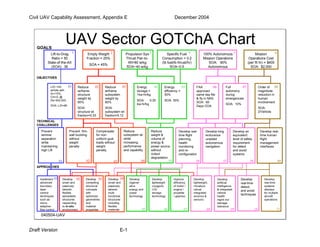
Appendix E UAV GOTChA Chart 
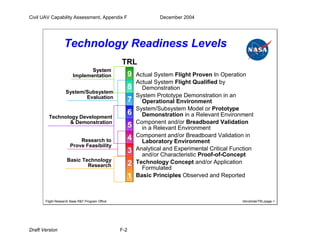
Appendix F Technology Readiness Levels 
Draft Version ii
Civil UAV Capability Assessment December 2004 
Acknowledgements 
The authors are grateful for and would like to acknowledge the efforts of the 
following personnel who, in addition to the authors, contributed to this document. 
Randal T. Albertson (NASA)………………………………………….Section 4.4 
Jay Levine (Analytical Sciences & Materials, Inc)…………………Section 2.1 
Draft Version iii
Civil UAV Capability Assessment December 2004 
Executive Summary 
This document presents the findings of a NASA led capabilities assessment of 
Uninhabited Aerial Vehicles (UAVs) for civil use. The intent of the report, which 
is intended to complement the Office of the Secretary of Defense UAV Roadmap, 
is four-fold: 
• To determine and document potential future civil missions for all UAVs 
based on user-defined needs 
• To determine and document the technologies necessary to support those 
future missions 
• To discuss the present state of the platform capabilities and required 
technologies; identifying those in progress, those planned, and those for 
which no current plans exist. 
• Provide the foundations for development of a comprehensive civil UAV 
roadmap 
It is expected that the content of this report will continue to be used to assess the 
feasibility of future missions and to help influence funding decisions to develop 
those technologies that are considered enabling or necessary but are not 
contained within approved funding plans. 
Discussed within section 2 of the report is a brief summary of current UAV 
platforms, both in the civil and military arena. The role of UAVs in enhancing 
warfighting capability has long been recognized by DOD, and current plans 
emphasize significant capability growth for UAVs within the next 10 years. 
Although this report does not focus on the military sector, it is recognized that a 
great deal of military UAV technology will be applicable to civil UAVs. Also 
discussed is an overview of market forecasts for civil use of UAV platforms. 
Tremendous potential for market growth exists, but some limiting factors 
preventing this growth create a high degree of uncertainty on the forecasts. 
Section 3 of the report summarizes the documentation of several civil missions 
used for analysis. For this first edition, a total of thirty five missions were 
documented and analyzed. These missions came from various government and 
private sector agencies for both science and public benefit under the broad 
categories of (see Figure 1): 
Homeland Security 
Earth Science 
Commercial 
Land Management 
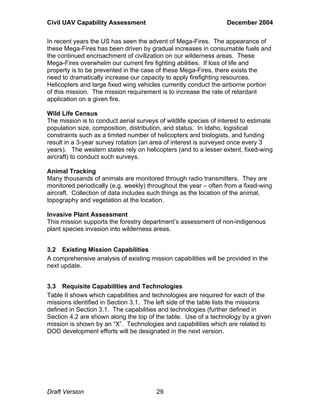
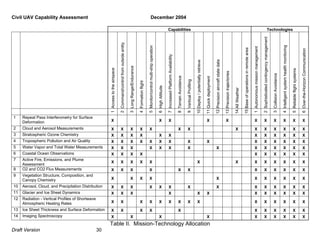
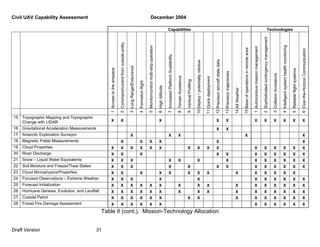
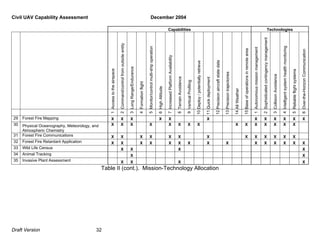
From these 35 missions, most of which fall under the earth science category, 21 
capabilities and technologies are identified as required to support the missions. 
Specific capabilities include such items as access to the National Air Space, long 
range/endurance, Over-the-Horizon communication, and formation flight. A 
complete list of capabilities allocated to the various missions is shown in Table II. 
Draft Version 1
Civil UAV Capability Assessment December 2004 
An assessment of civil UAV use is addressed in section 4 of the report. Several 
aspects of one of the primary obstacles to UAV use - cost - are discussed, 
including the role that safety, reliability, and operability of UAV’s has in cost 
reduction. Also included is a general description and status for each of the 
capabilities and technologies identified in section 3. Over-the-Horizon 
communication and ‘file and fly’ access to the national air space are two 
capabilities which are seen as critical to expanding the civil use of UAVs. 
Another area of technology development which is required, particularly for earth 
science applications, is sensor development in terms of autonomy and size. 
Finally, a general schedule shows when some of the capabilities and 
technologies might be available. 
While Department of Defense (DOD) missions are not considered as part of this 
report, it is recognized that many of the enabling technologies developed for 
military UAVs will be similar or identical to those required for civil UAVs. As a 
result, this effort will require close and continuing coordination between NASA 
and DOD in order to utilize and include, where possible, those military 
technologies that support civil missions. 
This goal of fostering the capabilities of UAVs can most easily be accomplished 
by removing the technical and regulatory barriers to civil UAV flight. This means 
that NASA must endeavor to develop technologies from the low technology 
readiness levels to ones that can be readily developed in the commercial sense; 
then cost will become a lesser impact to market development. It also means 
developing technology and policies that facilitate flight in the National Air Space. 
When these occur, innovation and entrepreneurship will drive down the cost of 
UAV flights and drive up the safety, reliability, and operability of UAVs. As the 
costs go down and access to the airspace becomes routine, the market for UAV 
is expected to expand rapidly based on various market forecasts. 
Draft Version 2
Civil UAV Capability Assessment December 2004 
1 Introduction 
In 1944 (60 years ago), Clarence "Kelly" Johnson, the legendary founder of 
Lockheed’s Skunk Works and designer of the SR-71 and U-2 aircraft, predicted 
that the future of military aviation would belong to Uninhabited Aerial Vehicles 
(UAVs1). Judging by the increased roles for UAVs, it appears that Johnson’s 
foresight is coming to fruition. Currently, the Air Force, Army, Marine Corps, and 
Navy possess and operate some type of UAV for ISR and combat support. 
Recent literature indicates that the military UAV application is maturing in a 
technology sense. On the civil side, National Aeronautics and Space 
Administration (NASA), National Oceanic and Atmospheric Association (NOAA), 
and Department of Homeland Security (DHS), and others are examples of 
agencies with UAV interests other than for combat support. It would be 
interesting to know whether Johnson predicted the civil role for UAVs, as well. 
1.1 Purpose 
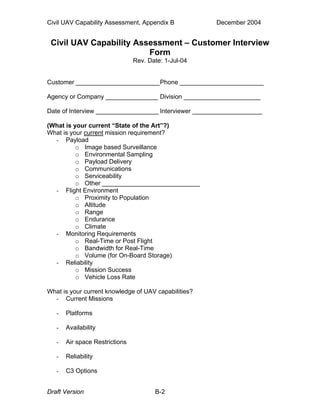
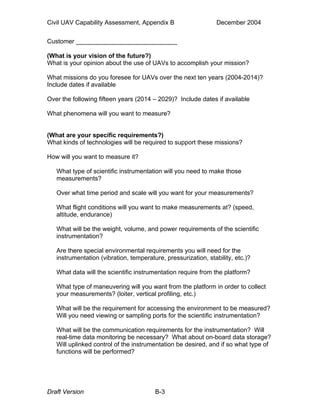
This document provides an assessment of the civil uninhabited aerial vehicle 
(UAV) missions and technologies and is intended to parallel the Office of the 
Secretary of Defense UAV Roadmap. The intent of this document is four-fold: 
1. Determine and document desired future missions of all civil UAVs based 
on user defined needs 
2. Determine and document the technologies necessary to support those 
missions 
3. Discuss the present state of the platform capabilities and required 
technologies identifying those in progress, those planned, and those for 
which no current plans exist. 
4. Provide the foundations for development of a comprehensive civil UAV 
roadmap to complement the DOD effort. 
Two aspects of the President’s Management Agenda are supported by this 
undertaking. First, it is one that will engage multiple Agencies in the effort as 
1 The term UAV is representative of a class of air vehicles known by different names: uninhabited 
aerial vehicle, unmanned aerial vehicle, remotely operated aircraft (ROA), and remotely piloted 
vehicle (RPV). For the purposes of this document, the term UAV will use a definition consistent 
with the Department of Defense, to wit: “A powered, aerial vehicle that does not carry a human 
operator, uses aerodynamic forces to provide vehicle lift, can fly autonomously or be piloted 
remotely, can be expendable or recoverable, and can carry a lethal or non-lethal payload. 
Ballistic or semi-ballistic vehicles, cruise missiles, and artillery projectiles are not considered 
unmanned aerial vehicles.” The above definition would rule out unmanned dirigibles or airships. 
For the purpose of this report, these will considered if they are both powered and controllable. 
Another definition is found in the AIAA Committee of Standards, “Lexicon of UAV/ROA 
Terminology”. It defines a UAV to be “An aircraft which is designed or modified, not to carry a 
human pilot and is operated through electronic input initiated by the flight controller or by an 
onboard autonomous flight management control system that does not require flight controller 
intervention.” Either definition is appropriate for the subject of this report. 
Draft Version 3
Civil UAV Capability Assessment December 2004 
stakeholders and benefactors of the systems. In that sense, the market will be 
driven by the user requirements and applications. The second aspect is one of 
supporting economic development in the commercial sector. Market forecasts 
for the civil use of UAVs have indicated an infant market stage at present with a 
sustained forecasted growth. There is some difficulty in quantifying the value of 
the market since the typical estimate excludes system components other than 
the aerial platforms. (Section 2.4.1 addresses the civil UAV market forecast.) 
One point that can be drawn from these forecasts is that all show a sustained 
growth for the duration of the long-term. 
1.2 Scope 
The analysis of the proposed missions for this effort is limited to the civil UAV 
sector. The scope will address various government and private sector missions. 
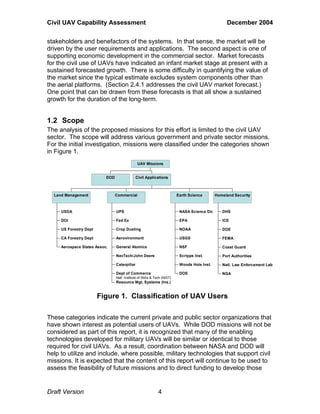
For the initial investigation, missions were classified under the categories shown 
in Figure 1. 
DOD 
Land Management 
USDA 
DOI 
US Forestry Dept 
CA Forestry Dept 
Aerospace States Assoc. 
Commercial 
UAV Missions 
UPS 
Fed Ex 
Crop Dusting 
Aerovironment 
General Atomics 
NavTech/John Deere 
Caterpillar 
Dept of Commerce 
Natl. Institute of Stdrs & Tech (NIST) 
Resource Mgt. Systems (Ins.) 
Earth Science 
Homeland Security 
These categories indicate the current private and public sector organizations that 
have shown interest as potential users of UAVs. While DOD missions will not be 
considered as part of this report, it is recognized that many of the enabling 
technologies developed for military UAVs will be similar or identical to those 
required for civil UAVs. As a result, coordination between NASA and DOD will 
help to utilize and include, where possible, military technologies that support civil 
missions. It is expected that the content of this report will continue to be used to 
assess the feasibility of future missions and to direct funding to develop those 
Draft Version 4 
NASA Science Dir. 
EPA 
NOAA 
USGS 
NSF 
Scripps Inst. 
Woods Hole Inst. 
DOE 
DHS 
ICE 
DOE 
FEMA 
Coast Guard 
Port Authorities 
Natl. Law Enforcement Lab 
NGA 
Civil Applications 
Figure 1. Classification of UAV Users
Civil UAV Capability Assessment December 2004 
technologies that are considered necessary but are not contained within funding 
plans. 
Although the basic UAV technologies for both the DOD (DARPA and the 
uniformed services) effort and this NASA project are similar, there are large 
economic and philosophical differences between the programs. First, the DOD 
UAV has a specific combat role to fulfill. The vehicle must be combat equipped 
(including armor shielding, sensor suites and munitions). In this role, the 
completion of the mission without harm to personnel is supra to the economics of 
the vehicle. The basic objective of the NASA effort is to further develop the core 
technologies to reduce cost of acquisition and operation and to increase flight 
safety in order to help develop commercial applications for these vehicles. It is 
expected that many of the technological advancements made by NASA will be 
utilized by DOD in its UAV fleets. 
This report is the initial version of the Civil UAV Capabilities Assessment and, 
because of time constraints, is heavily weighted toward the Earth Science 
missions. Additional workshops and interviews will be conducted to fuel a major 
update and scope expansion to this document scheduled for completion in March 
2006. The March 2006 release will contain suggested paths to a greater UAV 
capability. Thereafter, minor updates will be made annually with a major update 
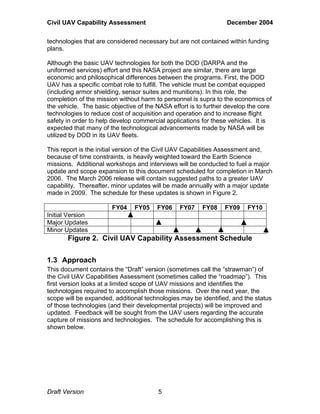
made in 2009. The schedule for these updates is shown in Figure 2. 
FY04 FY05 FY06 FY07 FY08 FY09 FY10 
Initial Version 
Major Updates 
Minor Updates 
Figure 2. Civil UAV Capability Assessment Schedule 
1.3 Approach 
This document contains the “Draft” version (sometimes call the “strawman”) of 
the Civil UAV Capabilities Assessment (sometimes called the “roadmap”). This 
first version looks at a limited scope of UAV missions and identifies the 
technologies required to accomplish those missions. Over the next year, the 
scope will be expanded, additional technologies may be identified, and the status 
of those technologies (and their developmental projects) will be improved and 
updated. Feedback will be sought from the UAV users regarding the accurate 
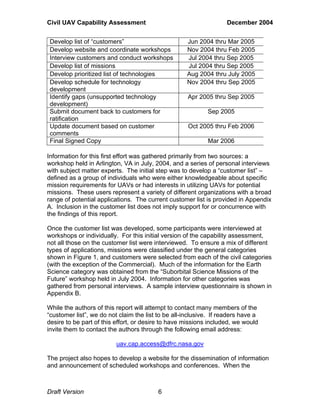
capture of missions and technologies. The schedule for accomplishing this is 
shown below. 
Draft Version 5
Civil UAV Capability Assessment December 2004 
Develop list of “customers” Jun 2004 thru Mar 2005 
Develop website and coordinate workshops Nov 2004 thru Feb 2005 
Interview customers and conduct workshops Jul 2004 thru Sep 2005 
Develop list of missions Jul 2004 thru Sep 2005 
Develop prioritized list of technologies Aug 2004 thru July 2005 
Develop schedule for technology 
development 
Draft Version 6 
Nov 2004 thru Sep 2005 
Identify gaps (unsupported technology 
development) 
Apr 2005 thru Sep 2005 
Submit document back to customers for 
ratification 
Sep 2005 
Update document based on customer 
comments 
Oct 2005 thru Feb 2006 
Final Signed Copy Mar 2006 
Information for this first effort was gathered primarily from two sources: a 
workshop held in Arlington, VA in July, 2004, and a series of personal interviews 
with subject matter experts. The initial step was to develop a “customer list” – 
defined as a group of individuals who were either knowledgeable about specific 
mission requirements for UAVs or had interests in utilizing UAVs for potential 
missions. These users represent a variety of different organizations with a broad 
range of potential applications. The current customer list is provided in Appendix 
A. Inclusion in the customer list does not imply support for or concurrence with 
the findings of this report. 
Once the customer list was developed, some participants were interviewed at 
workshops or individually. For this initial version of the capability assessment, 
not all those on the customer list were interviewed. To ensure a mix of different 
types of applications, missions were classified under the general categories 
shown in Figure 1, and customers were selected from each of the civil categories 
(with the exception of the Commercial). Much of the information for the Earth 
Science category was obtained from the “Suborbital Science Missions of the 
Future” workshop held in July 2004. Information for other categories was 
gathered from personal interviews. A sample interview questionnaire is shown in 
Appendix B. 
While the authors of this report will attempt to contact many members of the 
“customer list”, we do not claim the list to be all-inclusive. If readers have a 
desire to be part of this effort, or desire to have missions included, we would 
invite them to contact the authors through the following email address: 
uav.cap.access@dfrc.nasa.gov 
The project also hopes to develop a website for the dissemination of information 
and announcement of scheduled workshops and conferences. When the
Civil UAV Capability Assessment December 2004 
website is established, members of the customer list with e-mail addresses will 
be notified of the URL. 
Other sources of information to be considered during the first major update are: 
1. The Revolutionary Aerospace Systems Concepts Science Workshop, 
June 2002 
2. The UAV National Task Force results 
3. The Office of the Secretary of Defense UAV Roadmap 
1.4 Acronyms and Definitions 
Acronyms used in this document are contained in Appendix C. Where 
appropriate, a short definition has been included to help define the acronym. 
Draft Version 7
Civil UAV Capability Assessment December 2004 
2 UAV Programs 
2.1 Historical 
Since the first automatically controlled flight of an aircraft in 1916, military 
planners have imagined the value of an uninhabited air vehicle (UAV) that could 
spy on the enemy, or even deliver munitions to a target without endangering a 
human pilot. 
In 1916 Lawrence and Elmer Sperry combined the stabilizing gyro and a steering 
gyro to make an automatic pilot system they called the aerial torpedo. That 
aircraft flew for more than 30 miles with Lawrence Sperry as a passenger. It is 
generally considered the first automatic steering of an aircraft. However, the 
technology was not yet mature and the military later was forced to abandon the 
aerial torpedo. 
Although the notion of using UAVs, in one form or another, has been around 
since World War I, the US did not begin experimenting seriously with unmanned 
reconnaissance drones until the late 1950s. The idea of being able to carry out 
airborne missions behind enemy lines without harm to a pilot intrigued war 
strategists. Although the initial efforts proved unsuccessful, the Vietnam War and 
the Cold War spurred a variety of development programs, which led to several 
reconnaissance drones, such as the Firebee and Lightning Bug. 
Although those early UAVs were sometimes difficult to operate and maintain, the 
Air Force deployed them for a variety of missions, including gathering signals 
intelligence and collecting high- and low-altitude imagery both during the day and 
at night. By the end of the Vietnam War, concern about casualties meant that 
only two aircraft were allowed to fly reconnaissance missions over North 
Vietnam: the Lightning Bug UAV and the SR-71, a high-altitude, manned 
reconnaissance plane. The urgent need for unmanned aerial vehicles ended 
with the Vietnam War, but the services remained interested in exploring the 
capabilities that those aircraft had to offer. 
The modern UAV era originated in the early 1970s. Designers in the United 
States and Israel started experimenting with smaller, slower, cheaper UAVs. 
These UAVs resembled large model airplanes, powered by motorbike or 
snowmobile engines. Their most important feature was that they used new, 
small video cameras that could send pictures to the operator in real time. 
The US Army began developing a tactical UAV called Aquila in 1979. It suffered 
many growing pains (developmental problems, cost overruns, changes in 
requirements) and was finally canceled in 1987. During that time, the Israelis 
used very simple and cheap drones to good effect to destroy Syrian air defenses 
in Lebanon’s Bekaa Valley in 1982. Their success inspired then Secretary of the 
Navy John Lehman to push for his service to acquire UAVs, primarily to support 
Draft Version 8
Civil UAV Capability Assessment December 2004 
targeting by, and conduct battle-damage assessment for U.S. battleships. The 
UAV efforts by the Navy led to newer systems developed by the Air Force that 
were used successfully for combat operations during the 1991 and 2003 middle 
east conflicts. The military use for UAVs was reinforced by these operations. 
On the civil side, NASA programs such as the PA-30 in 1969 looked at 
automatically controlling an aircraft, but a pilot was in the cockpit to take over if 
the research didn’t go as expected. NASA engaged in several other successful 
programs to help develop data bases for future UAV researchers such as the F- 
15 Spin Research Vehicle, a 3/8 scale aircraft; Drones for Aerodynamic and 
Structural Testing (DAST); and the Highly Maneuverable Aircraft Technology 
(HiMAT) program. 
The need for technologies to assist a fledgling UAV market led to a key 1990s 
NASA-led program that, initiated with industry partners, brought the potential of a 
commercial UAV market into focus. Continuing work developed from that effort 
seeks resolution of major technological and policy impediments that yet dam up 
the waters of potential. The nine-year long NASA program called Environmental 
Research Aircraft and Sensor Technology (ERAST) helped to redefine UAV 
technology with research on engines, sensors and integrated vehicles that would 
conquer the barriers to high altitude, long-endurance (HALE) aircraft. Products 
resulting from the ERAST partnership include Pathfinder, Helios, Altus, and 
Perseus B, and potentially could result in vehicles with altitude ceilings above 
100,000 feet and endurances up to 6 months. 
2.2 Civil UAVs 
The following sections describe the characteristics of some of the more 
prominent UAVs applicable to civilian missions. The aircraft listed here, chosen 
primarily for previous roles in science missions, serves as a sampling of civil 
UAV systems and is not intended to be complete and exhaustive. A more 
complete listing of UAV’s may be found in the following reference: 
Aviation Week and Space Technology, “2005 Aerospace Source Book”. January 
17, 2005. 
2.2.1 Operational Civil UAVs 
The following sections discuss a few of the civilian UAV that are considered to be 
operational 
2.2.1.1 Aerosonde 
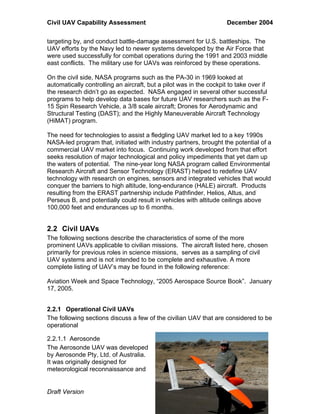
The Aerosonde UAV was developed 
by Aerosonde Pty, Ltd. of Australia. 
It was originally designed for 
meteorological reconnaissance and 
Draft Version 9
Civil UAV Capability Assessment December 2004 
environmental monitoring although it has found additional missions. It has a 
gross take-off weight of 33 lbs (15 kg) and a payload weight ranging from 4.5 to 
11 lb (2 to 5 kg) depending on the desired endurance. For intermediate weights, 
the Aerosonde has a ceiling of 23,000 ft (7 km). It has an endurance of 10 to 30 
hours and a range of 1100 to 1600 nm (2000 to 3000 km), depending on the 
payload weight. Aerosondes are currently being operated by NASA Goddard 
Space Flight Center for earth science missions. 
2.2.1.2 Altair 
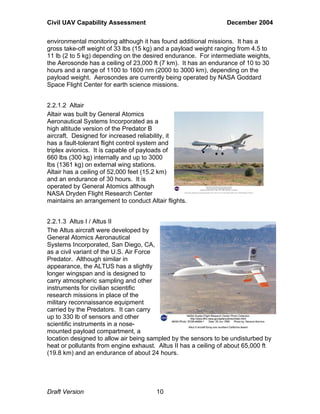
Altair was built by General Atomics 
Aeronautical Systems Incorporated as a 
high altitude version of the Predator B 
aircraft. Designed for increased reliability, it 
has a fault-tolerant flight control system and 
triplex avionics. It is capable of payloads of 
660 lbs (300 kg) internally and up to 3000 
lbs (1361 kg) on external wing stations. 
Altair has a ceiling of 52,000 feet (15.2 km) 
and an endurance of 30 hours. It is 
operated by General Atomics although 
NASA Dryden Flight Research Center 
maintains an arrangement to conduct Altair flights. 
2.2.1.3 Altus I / Altus II 
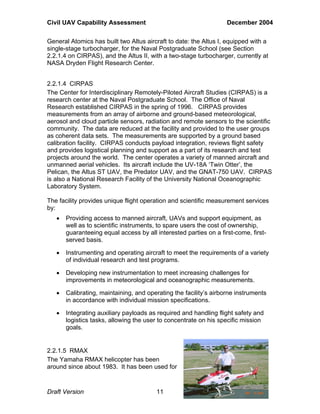
The Altus aircraft were developed by 
General Atomics Aeronautical 
Systems Incorporated, San Diego, CA, 
as a civil variant of the U.S. Air Force 
Predator. Although similar in 
appearance, the ALTUS has a slightly 
longer wingspan and is designed to 
carry atmospheric sampling and other 
instruments for civilian scientific 
research missions in place of the 
military reconnaissance equipment 
carried by the Predators. It can carry 
up to 330 lb of sensors and other 
scientific instruments in a nose-mounted 
payload compartment, a 
location designed to allow air being sampled by the sensors to be undisturbed by 
heat or pollutants from engine exhaust. Altus II has a ceiling of about 65,000 ft 
(19.8 km) and an endurance of about 24 hours. 
Draft Version 10
Civil UAV Capability Assessment December 2004 
General Atomics has built two Altus aircraft to date: the Altus I, equipped with a 
single-stage turbocharger, for the Naval Postgraduate School (see Section 
2.2.1.4 on CIRPAS), and the Altus II, with a two-stage turbocharger, currently at 
NASA Dryden Flight Research Center. 
2.2.1.4 CIRPAS 
The Center for Interdisciplinary Remotely-Piloted Aircraft Studies (CIRPAS) is a 
research center at the Naval Postgraduate School. The Office of Naval 
Research established CIRPAS in the spring of 1996. CIRPAS provides 
measurements from an array of airborne and ground-based meteorological, 
aerosol and cloud particle sensors, radiation and remote sensors to the scientific 
community. The data are reduced at the facility and provided to the user groups 
as coherent data sets. The measurements are supported by a ground based 
calibration facility. CIRPAS conducts payload integration, reviews flight safety 
and provides logistical planning and support as a part of its research and test 
projects around the world. The center operates a variety of manned aircraft and 
unmanned aerial vehicles. Its aircraft include the UV-18A ‘Twin Otter’, the 
Pelican, the Altus ST UAV, the Predator UAV, and the GNAT-750 UAV. CIRPAS 
is also a National Research Facility of the University National Oceanographic 
Laboratory System. 
The facility provides unique flight operation and scientific measurement services 
by: 
• Providing access to manned aircraft, UAVs and support equipment, as 
well as to scientific instruments, to spare users the cost of ownership, 
guaranteeing equal access by all interested parties on a first-come, first-served 
basis. 
• Instrumenting and operating aircraft to meet the requirements of a variety 
of individual research and test programs. 
• Developing new instrumentation to meet increasing challenges for 
improvements in meteorological and oceanographic measurements. 
• Calibrating, maintaining, and operating the facility’s airborne instruments 
in accordance with individual mission specifications. 
• Integrating auxiliary payloads as required and handling flight safety and 
logistics tasks, allowing the user to concentrate on his specific mission 
goals. 
2.2.1.5 RMAX 
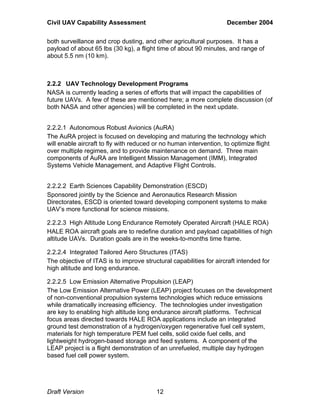
The Yamaha RMAX helicopter has been 
around since about 1983. It has been used for 
Draft Version 11
Civil UAV Capability Assessment December 2004 
both surveillance and crop dusting, and other agricultural purposes. It has a 
payload of about 65 lbs (30 kg), a flight time of about 90 minutes, and range of 
about 5.5 nm (10 km). 
2.2.2 UAV Technology Development Programs 
NASA is currently leading a series of efforts that will impact the capabilities of 
future UAVs. A few of these are mentioned here; a more complete discussion (of 
both NASA and other agencies) will be completed in the next update. 
2.2.2.1 Autonomous Robust Avionics (AuRA) 
The AuRA project is focused on developing and maturing the technology which 
will enable aircraft to fly with reduced or no human intervention, to optimize flight 
over multiple regimes, and to provide maintenance on demand. Three main 
components of AuRA are Intelligent Mission Management (IMM), Integrated 
Systems Vehicle Management, and Adaptive Flight Controls. 
2.2.2.2 Earth Sciences Capability Demonstration (ESCD) 
Sponsored jointly by the Science and Aeronautics Research Mission 
Directorates, ESCD is oriented toward developing component systems to make 
UAV’s more functional for science missions. 
2.2.2.3 High Altitude Long Endurance Remotely Operated Aircraft (HALE ROA) 
HALE ROA aircraft goals are to redefine duration and payload capabilities of high 
altitude UAVs. Duration goals are in the weeks-to-months time frame. 
2.2.2.4 Integrated Tailored Aero Structures (ITAS) 
The objective of ITAS is to improve structural capabilities for aircraft intended for 
high altitude and long endurance. 
2.2.2.5 Low Emission Alternative Propulsion (LEAP) 
The Low Emission Alternative Power (LEAP) project focuses on the development 
of non-conventional propulsion systems technologies which reduce emissions 
while dramatically increasing efficiency. The technologies under investigation 
are key to enabling high altitude long endurance aircraft platforms. Technical 
focus areas directed towards HALE ROA applications include an integrated 
ground test demonstration of a hydrogen/oxygen regenerative fuel cell system, 
materials for high temperature PEM fuel cells, solid oxide fuel cells, and 
lightweight hydrogen-based storage and feed systems. A component of the 
LEAP project is a flight demonstration of an unrefueled, multiple day hydrogen 
based fuel cell power system. 
Draft Version 12
Civil UAV Capability Assessment December 2004 
The focus of the LEAP project is to develop propulsion systems suitable for long 
duration missions. 
2.2.2.6 Remotely Operated Aircraft in the National Airspace (ROA in the NAS) 
NASA centers, the Federal Aviation Administration and other governmental 
agencies have united in an effort to develop recommendations to the FAA for 
certifications and procedures to incorporate UAVs into the national airspace. The 
assignment is a key impediment to development of the commercial UAV market. 
2.3 Military UAVs 
The DOD recognizes that UAV technology has the potential to transform the way 
in which warfighting is conducted. In recent military operations operational 
UAVs, such as Predator, Hunter, and Shadow; and developmental UAVs, such 
as Global Hawk, have demonstrated a significant force multiplier capability. As 
such the DOD is expanding the role of the UAV within military concepts of 
operation. Due to the large variety of military UAVs, a brief summary of the 
classes of UAVs in current operation or development follows, as well as a 
description of some current military technology development programs which will 
provide the capability for operational concepts using UAVs over the next 20 
years. More specific information can be found in the DOD UAV roadmap 
(Unmanned Aerial Vehicles Roadmap, Office of the Secretary of Defense, 
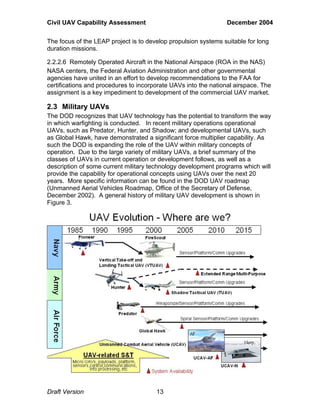
December 2002). A general history of military UAV development is shown in 
Figure 3. 
Draft Version 13
Civil UAV Capability Assessment December 2004 
Figure 3. History of Military UAVs 
2.3.1 Classes of Military UAVs 
For the purposes of this report, UAVs are classified into 4 categories: micro-aerial 
vehicles, local area support vehicles, tactical area support vehicles, and 
theatre area support vehicles. 
Micro-aerial vehicles are defined by their physical dimensions. They are no larger 
than 12 inches (.3 m) in any direction. Total weights of these vehicles range from 
.2 lbs (.1 kg) to a few pounds with payload weights on the order of fractions of 
pounds. They are easily transported and operated by one individual, through 
both autopilot and remotely piloted modes. The primary use is for 
reconnaissance support of the individual soldier or squad of soldiers. The 
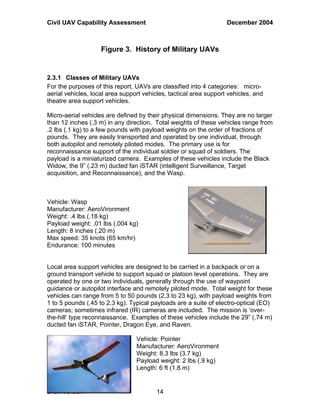
payload is a miniaturized camera. Examples of these vehicles include the Black 
Widow, the 9” (.23 m) ducted fan iSTAR (intelligent Surveillance, Target 
acquisition, and Reconnaissance), and the Wasp. 
Vehicle: Wasp 
Manufacturer: AeroVironment 
Weight: .4 lbs (.18 kg) 
Payload weight: .01 lbs (.004 kg) 
Length: 8 inches (.20 m) 
Max speed: 35 knots (65 km/hr) 
Endurance: 100 minutes 
Local area support vehicles are designed to be carried in a backpack or on a 
ground transport vehicle to support squad or platoon level operations. They are 
operated by one or two individuals, generally through the use of waypoint 
guidance or autopilot interface and remotely piloted mode. Total weight for these 
vehicles can range from 5 to 50 pounds (2.3 to 23 kg), with payload weights from 
1 to 5 pounds (.45 to 2.3 kg). Typical payloads are a suite of electro-optical (EO) 
cameras; sometimes infrared (IR) cameras are included. The mission is ‘over-the- 
hill’ type reconnaissance. Examples of these vehicles include the 29” (.74 m) 
ducted fan iSTAR, Pointer, Dragon Eye, and Raven. 
Vehicle: Pointer 
Manufacturer: AeroVironment 
Weight: 8.3 lbs (3.7 kg) 
Payload weight: 2 lbs (.9 kg) 
Length: 6 ft (1.8 m) 
Draft Version 14
Civil UAV Capability Assessment December 2004 
Max speed: 43 knot (80 km/hr) 
Endurance: 120 minutes 
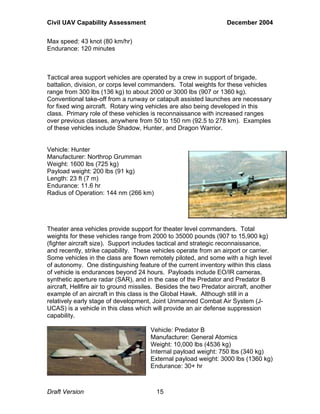
Tactical area support vehicles are operated by a crew in support of brigade, 
battalion, division, or corps level commanders. Total weights for these vehicles 
range from 300 lbs (136 kg) to about 2000 or 3000 lbs (907 or 1360 kg). 
Conventional take-off from a runway or catapult assisted launches are necessary 
for fixed wing aircraft. Rotary wing vehicles are also being developed in this 
class. Primary role of these vehicles is reconnaissance with increased ranges 
over previous classes, anywhere from 50 to 150 nm (92.5 to 278 km). Examples 
of these vehicles include Shadow, Hunter, and Dragon Warrior. 
Vehicle: Hunter 
Manufacturer: Northrop Grumman 
Weight: 1600 lbs (725 kg) 
Payload weight: 200 lbs (91 kg) 
Length: 23 ft (7 m) 
Endurance: 11.6 hr 
Radius of Operation: 144 nm (266 km) 
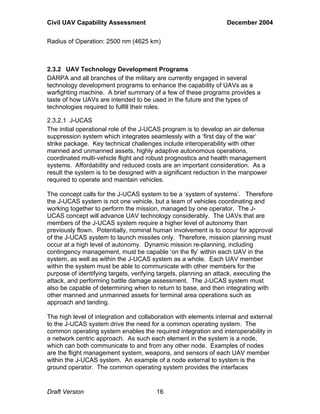
Theater area vehicles provide support for theater level commanders. Total 
weights for these vehicles range from 2000 to 35000 pounds (907 to 15,900 kg) 
(fighter aircraft size). Support includes tactical and strategic reconnaissance, 
and recently, strike capability. These vehicles operate from an airport or carrier. 
Some vehicles in the class are flown remotely piloted, and some with a high level 
of autonomy. One distinguishing feature of the current inventory within this class 
of vehicle is endurances beyond 24 hours. Payloads include EO/IR cameras, 
synthetic aperture radar (SAR), and in the case of the Predator and Predator B 
aircraft, Hellfire air to ground missiles. Besides the two Predator aircraft, another 
example of an aircraft in this class is the Global Hawk. Although still in a 
relatively early stage of development, Joint Unmanned Combat Air System (J-UCAS) 
is a vehicle in this class which will provide an air defense suppression 
capability. 
Vehicle: Predator B 
Manufacturer: General Atomics 
Weight: 10,000 lbs (4536 kg) 
Internal payload weight: 750 lbs (340 kg) 
External payload weight: 3000 lbs (1360 kg) 
Endurance: 30+ hr 
Draft Version 15
Civil UAV Capability Assessment December 2004 
Radius of Operation: 2500 nm (4625 km) 
2.3.2 UAV Technology Development Programs 
DARPA and all branches of the military are currently engaged in several 
technology development programs to enhance the capability of UAVs as a 
warfighting machine. A brief summary of a few of these programs provides a 
taste of how UAVs are intended to be used in the future and the types of 
technologies required to fulfill their roles. 
2.3.2.1 J-UCAS 
The initial operational role of the J-UCAS program is to develop an air defense 
suppression system which integrates seamlessly with a ‘first day of the war’ 
strike package. Key technical challenges include interoperability with other 
manned and unmanned assets, highly adaptive autonomous operations, 
coordinated multi-vehicle flight and robust prognostics and health management 
systems. Affordability and reduced costs are an important consideration. As a 
result the system is to be designed with a significant reduction in the manpower 
required to operate and maintain vehicles. 
The concept calls for the J-UCAS system to be a ‘system of systems’. Therefore 
the J-UCAS system is not one vehicle, but a team of vehicles coordinating and 
working together to perform the mission, managed by one operator. The J-UCAS 
concept will advance UAV technology considerably. The UAVs that are 
members of the J-UCAS system require a higher level of autonomy than 
previously flown. Potentially, nominal human involvement is to occur for approval 
of the J-UCAS system to launch missiles only. Therefore, mission planning must 
occur at a high level of autonomy. Dynamic mission re-planning, including 
contingency management, must be capable ‘on the fly’ within each UAV in the 
system, as well as within the J-UCAS system as a whole. Each UAV member 
within the system must be able to communicate with other members for the 
purpose of identifying targets, verifying targets, planning an attack, executing the 
attack, and performing battle damage assessment. The J-UCAS system must 
also be capable of determining when to return to base, and then integrating with 
other manned and unmanned assets for terminal area operations such as 
approach and landing. 
The high level of integration and collaboration with elements internal and external 
to the J-UCAS system drive the need for a common operating system. The 
common operating system enables the required integration and interoperability in 
a network centric approach. As such each element in the system is a node, 
which can both communicate to and from any other node. Examples of nodes 
are the flight management system, weapons, and sensors of each UAV member 
within the J-UCAS system. An example of a node external to system is the 
ground operator. The common operating system provides the interfaces 
Draft Version 16
Civil UAV Capability Assessment December 2004 
between these nodes and the means to manage the nodes. The common 
operating system also provides and manages the communication links between 
members within the J-UCAS system. A standard architecture for plugging into 
the common operating system increases the platforms availability for missions 
and reduces operating costs. 
Operational assessment of the J-UCAS system is scheduled for 2010. The 
results for these assessments will then be directed into capabilities and 
requirements for follow on systems. 
2.3.2.2 Unmanned Combat Armed Rotorcraft (UCAR) 
The UCAR program is to demonstrate the technical feasibility, military utility, and 
operational value of UAV rotorcraft affordably performing armed reconnaissance 
and strike missions. Key technologies are autonomous and collaborative 
operations, autonomous low altitude flight, affordability and survivability, and 
target recognition and strike. Similar to J-UCAS in many respects, the UCAR 
concept employs high levels of autonomy and a ‘system of systems’ approach. 
As such it must integrate seamlessly with manned assets. One element of 
UCAR, not part of J-UCAS, is the ability to operate at low altitudes. Therefore, 
an important component of the UCAR program is the development of an obstacle 
avoidance sensor. The sensor must identify ground terrain and man-made 
obstacles, such as buildings or power lines, since the UCAR concept does not 
restrict operations in urban areas. Target recognition of enemy ground assets, 
not only hardware but personnel, is another key challenge in the UCAR program. 
Plans call for UCAR to be at a technology readiness level (TRL) of 7 by 2009. 
2.4 UAV Proliferation 
Although UAVs represent a relatively small segment of the aerospace market 
(about $1.25B in research and production funding in 2003), they constitute the 
dynamic portion of the industry. What attracts so much attention to them is the 
potential for a major expansion and new roles in both the defense and civil 
applications (articulated elsewhere in this document). Since the development is 
in the early stages, there are many uses that are being proposed for them. 
However, several pre-conditions must be satisfied to render the UAV a viable, 
cost effective and regulated alternative to existing resources. Major civil and 
commercial market barriers include:- 
• Lack of airspace regulation that covers all types of UAV systems 
(encompassing ‘sense and avoid’, airspace integration and airworthiness 
issues) 
• Affordability - price and customization issues (e.g. commercial off-the-shelf, 
open modular architecture) 
• Efforts to establish joint customer requirements (although this is gradually 
changing) 
• Liability for civil operation 
Draft Version 17
Civil UAV Capability Assessment December 2004 
• Capacity for payload flexibility 
• Lack of secure non-military frequency for civil operation 
• Perceived reliability (e.g. vehicle attrition rate vs. manned aircraft) 
• Operator training issues 
• Recognition/customer perception 
• Technology developments for multi-mission capability 
2.4.1 Market Forecast 
UAV suitability for use in “dull, dirty and dangerous” missions, their increasing 
success in service and demonstration, increases in payload capability, the war 
on terrorism (with its homeland security implications) and the need for multi-mission 
capabilities have unlocked new markets beyond current 
military/paramilitary requirements. These include diverse civil and commercial 
applications for a wide range of international public service agencies. 
Market forecasts for the UAV industry are tempered by the fact that they do not 
include the projections for payload costs or operational costs. The lack of 
inclusion of these cost elements makes it difficult to develop a very accurate 
forecast of the market. Table I lists various forecasts based on the number of 
units of demand (basic systems) rather than total market including operations 
and sensor suites. Of interest to this effort is the fact that all indicate a high rate 
of growth in the number of units over the next ten years. By extension, the growth 
in the support market could be considered as explosive as well. As indicated in 
the previous section, price structure will play a major influence in the civil sector 
growth rate. 
Source Date Forecast Uses Comments 
Department of 
Defense 
FY 2001 
budget 
Strike force to be 
1/3 UAVs by 2010 
Draft Version 18 
Military Airframe 
and 
avionics 
Teal Group Dec 
2002 
Market to double by 
2014 
Military, science, 
homeland 
security 
Airframe 
and 
avionics 
Frost and 
Sullivan 
Oct 2003 5.5B EUR by 2012 Military, science, 
homeland 
security 
Airframe 
and 
avionics 
Forecast Int’l Oct 2003 $10.6B by 2013 
Massive growth 
2010 
Military, science, 
homeland 
security 
Airframe 
and 
avionics 
Teal Group Aug 
2004 
$4.5B/yr by 2014 Military, science, 
homeland 
security 
Airframe 
and 
avionics 
Table I. UAV Market Forecasts
Civil UAV Capability Assessment December 2004 
2.4.2 UAV Development in the U.S. 
A recent study (Forecast International) of the worldwide UAV market concluded 
that U.S. spending on UAVs amounted to about 73% of worldwide research and 
production spending in 2003. The U.S. has dominated this market in recent 
years due, in part, to the depth of research and wide range of production 
programs. UAV development has been spotty, with clear leadership in 
endurance UAVs but laggard performance in fielding tactical UAVs, especially 
compared with Europe. The RQ-4A Global Hawk reached the serial production 
stage in 2003. Despite the “newness” of the system, it has become synonymous 
with high-endurance UAVs. A single Global Hawk was employed in Operation 
Iraqi Freedom, but was credited with providing intelligence that led to destruction 
of 13 air defense missile batteries, 50 surface-to-air missile launchers and 300 
tanks. Because of its reliability, Global Hawk was the first UAV to be granted an 
overarching Certificate of Authorization by the FAA to fly in U.S. air space. This 
allows Global Hawk to significantly reduce the time notification to the FAA when 
a flight is required. This is a critical hurdle, not only for Global Hawk but for 
UAVs in general, particularly if they are to break into the civilian market. 
The dominant U.S. manufacturers include: 
• Lockheed Martin 
• Aurora Flight Sciences 
• General Atomics 
• Northrop Grumman 
• AeroVironment 
2.4.3 European and Worldwide UAVs 
Europe currently represents the second-largest UAV market. While quite a bit of 
research has been funded in Europe over the past decade, procurement has 
been modest and mostly confined to small numbers of tactical UAV systems. For 
example, France acquired less than two dozen Crecerelle UAVs and Britain's 
Phoenix tactical UAV program involved only about 100 air vehicles. More 
ambitious programs are underway, with most of the major armed forces acquiring 
more modern tactical UAV systems and beginning to acquire endurance systems 
comparable to the U.S. Air Force Predator. A recent study concluded that 
Europe will nearly double its share of the world UAV market in 10 years, to about 
19% from about 11% of the market due to these many new programs. Britain 
has a comprehensive program under its Watchkeeper program, with two teams 
now competing for an eventual procurement phase. France is planning to 
acquire an upgraded version of the Crecerelle/Sperwer for its tactical UAV 
requirement, and is also acquiring a version of the Israeli Heron as part of its 
Eagle endurance UAV program. France is also sponsoring a broad range of 
other UAV systems from micro- and mini-UAVs through to other novel 
applications such as naval UAVs. Germany is finally acquiring the Tucan tactical 
UAV, a derivative of the long-delayed, multinational Brevel program in which 
France was once a partner. The German army has been a particularly active 
Draft Version 19
Civil UAV Capability Assessment December 2004 
supporter of mini-UAVs, with the Luna already in service, and several other 
programs underway. In the endurance field, Germany is also studying the Global 
Hawk for maritime surveillance under its Eurohawk program. Italy has 
significantly expanded its UAV efforts, prompted in no small measure by turmoil 
in the neighboring Balkans in the 1990s. Having already procured Predators for 
the endurance role, it is finally funding a long-delayed tactical UAV system for the 
army and beginning to examine other requirements. Sweden has a broad 
research effort on UAVs, though so far Swedish procurement has been fairly 
limited. Many of the smaller European armed forces have already fielded a new-generation 
tactical UAV system, though often in small numbers. The most 
popular system has proven to be the Sagem Sperwer. 
Non-European countries also have a significant UAV role. Israel, which was the 
pioneer for many of the current tactical UAV efforts, has continued to be a major 
player in UAV sales to smaller armed forces around the globe. Israel continues 
to innovate in the UAV field. One of its more intriguing programs is an effort to 
contract out UAV services. Aeronautics Unmanned Systems has been 
employing its Aerostar tactical UAV to conduct surveillance missions for the 
Israeli Defense Forces under a government contract rather than directly selling 
the systems. One of Israel's most important UAV sales in recent years was to 
India, as part of a broader effort to involve the latter in joint military technology 
ties. India is interested in a robust reconnaissance capability in the difficult 
terrain of Kashmir, and decided to buy some off-the-shelf Israeli UAVs rather 
than wait for its indigenous programs to mature. Pakistan is employing 
indigenous UAVs as well as imported Chinese UAVs along the troubled frontier 
with India. In the Pacific, Japan has an active UAV program, but long-term goals 
remain sketchy. Japan is planning to develop an analog to Global Hawk, 
Australia has shown special interest in endurance UAVs due to the sheer scale 
of its zone of strategic interest. With conditions in Indonesia remaining so 
unsettled, Australia is considering the Global Hawk as a means to monitor 
trouble spots along its northern maritime frontier. Australia has already deployed 
small numbers of UAVs for surveillance and patrol on several of its peace-keeping 
missions in the southwestern Pacific. China has displayed a variety of 
UAVs at international trade shows; though there is little evidence to what extent 
such systems have been deployed in its army. 
Non-U.S. UAV manufacturers include: 
• Elbit 
• Israeli Aircraft Industries, Inc. 
• Sagem SA 
• European Aeronautic Defense and Space Company 
• Dassault Aviation 
Draft Version 20
Civil UAV Capability Assessment December 2004 
2.4.4 Role of US export controls 
A potentially significant negative influence on the proliferation of UAV’s in the 
market place is export control. For the international market, UAVs are controlled 
for export from the United States (US) under the International Traffic in Arms 
Regulations (ITAR) issued by the State Department. Contained within these 
regulations is the munitions list which defines those items considered by State to 
require approval and license to export because of the potential for military use. 
There are several sections of the current ITAR under which UAVs are controlled 
for export: Section 121.2 and 121.3 because of the command and control 
electronics as well as any imaging sensor suite as payload. Also prohibited is 
the export of navigation systems that contain spread spectrum technology or 
systems that allow navigation above 60,000 feet. 
If a US company wants to export UAVs without navigation or sensors, ITAR may 
prevent export of these as well. UAVs, including drones and reconnaissance 
drones, with 500kg payload capability and a range of 300 km are covered within 
the statute. 
It appears that under current ITAR definitions, the international market for US 
UAV manufacturers may be somewhat constrained. Since the European and 
Asian manufacturers are not covered by ITAR, it may pose an obstacle for 
foreign sales by US-based companies. Partnering with a foreign manufacturer 
may not work since the basic technologies to the items covered by ITAR are 
subject to the law, as well. 
Draft Version 21
Civil UAV Capability Assessment December 2004 
3 UAV Mission Requirements 
3.1 Mission Summaries 
The following sections provide a brief description of the potential missions 
documented by the authors to date. A complete description of each mission 
along with platform and communication requirements may be found in Appendix 
D. Missions have been divided into the categories defined by Figure 1, i.e. 
Commercial, Earth Science, Homeland Security, and Land Management. 
3.1.1 Commercial 
No commercial missions have been documented to date although preliminary 
discussions indicate that a significant number of these exist including precision 
agriculture. Commercial missions will be included in the next version of this 
document. 
3.1.2 Earth Science 
The following missions have been documented primarily through the Suborbital 
Science Missions of the Future Workshop and personal interviews. Missions 
involve both in situ and remote sensing applications. The unanimous consensus 
among scientists however, was that UAV missions would augment rather than 
replace satellite observations. Inclusion in this report does not imply that these 
missions have been funded or otherwise validated by any government agency. 
Repeat Pass Interferometry for Surface Deformation 
This mission would allow measurement of the geophysical processes associated 
with natural hazards such as earthquakes, landslide, and volcanoes as they are 
manifested by deformations in the Earth's crust. Measurements of the crustal 
deformation would be made by an interferometric synthetic aperture radar (SAR) 
carried by the UAV platform. 
Cloud and Aerosol Measurements 
This suborbital mission would study transformations of aerosols and gases in 
cloud systems in the following domains: 
• Convective systems: to include areas of Costa Rica, Southern Florida, and 
Central United States 
• Sea breeze cloud formation – wide areas of coastal U.S. 
• Marine stratiform – primarily the California coastal areas 
• Contrails in the Central U.S. in air traffic regions and ship tracks in oceans 
• Synoptic scale systems & Fronts – in the Central U.S. region 
• Cirrus outflow – large areas of the tropics, Southern Florida, and Central 
U.S. 
Draft Version 22
Civil UAV Capability Assessment December 2004 
Stratospheric Ozone Chemistry 
The purpose of this mission is to observe changes in the stratospheric ozone 
chemistry by the profiling of source gases, water, aerosols, and temperatures in 
the mid-latitudes and Polar Regions in the upper troposphere/lower stratosphere. 
In addition to source gases, tracers as well as reservoir species and radicals are 
to be measured. The mission will make simultaneous measurements of water 
vapor, total water temperature, pressure, winds, ozone, aerosols, and polar 
stratospheric clouds (PSC). 
Tropospheric Pollution and Air Quality 
The objective of this suborbital mission is to study the sources, evolution, and 
distribution of tropospheric pollutants. The pollutants and particles and their 
source emissions would be profiled on regional to hemispheric scales from near 
the surface to the tropopause region. This profiling would cause determination of 
where plumes of pollution are transported and how they evolve. 
Water Vapor and Total Water Measurements 
The objective of this mission is to study water vapor and total water in the tropical 
tropopause layer. The focus will be to profile water from the mid-troposphere to 
the lower stratosphere and from the tropics into the mid-latitudes. This study will 
try to determine what controls upper troposphere/lower stratosphere water and 
how it impacts climate change feedbacks. 
Coastal Ocean Observations 
This suborbital mission would help scientists understand further coastal bloom 
compositions and the changes over time and space. In addition, the science 
data will help scientists quantify the submerged aquatic vegetation and coral 
reefs, measure an estuarine condition, and evaluate how nutrients are consumed 
and released into the coastal zone and the impact on the carbon cycle. The 
science data gathered would reduce the uncertainties in the fluxes and coastal 
sea dynamics by resolving horizontal and vertical resolution (improved spatial 
and temporal resolution) and multiple sensor integration. 
Active Fire, Emissions, and Plume Assessment 
This suborbital mission would help Earth Science scientists further understand 
the influence of disturbance on carbon cycle dynamics by observing and 
measuring: the atmospheric chemistry; the thermal intensity time-series; the 
plume composition, including the volume, albedo, particle size distribution; and, 
the fuel type and quality. The measurements would also provide the atmospheric 
composition focus area a better understanding of fire plume chemical 
constituents resulting from different fuels under different intensities of fire. 
O2 and CO2 Flux Measurements 
This suborbital mission would help scientists further understand the flux of O2 
and CO2 and other trace gases between the surface (land and sea) and 
atmosphere and how it changes with space and time. Diurnal time series 
Draft Version 23
Civil UAV Capability Assessment December 2004 
measurements of surface to atmosphere gas flux are critical. Specifically the 
mission must provide science data that contains CO2 and O2 measurements, 
separating out land from ocean fluxes, to less than 0.1 parts per million. 
Vegetation Structure, Composition, and Canopy Chemistry 
This suborbital mission would help scientists improve the characterization of 
terrestrial biomass, leaf level chemistry and canopy water content. The science 
data will provide vegetation 3-dimensional structure and information on 
composition and chemistry. In addition, the observations will elucidate functional 
groups and physiological impacts on the carbon cycle. 
Aerosol, Cloud, and Precipitation Distribution 
This mission is designed to measure the distribution in space and time of 
aerosols in regions polluted by industrialized areas. The data collected during 
this mission will improve the evaluation of climate sensitivity to the forcing of 
aerosols by: 
• Quantifying how urban aerosol sources contribute to global aerosol 
budgets and loading 
• Detecting the indirect effect of anthropogenic aerosol on cloud formation 
and radiative forcing 
• Detecting multi-year to decadal trends in direct and indirect aerosol 
forcing. 
• Developing a statistical data base of pollution impacts downstream of 
pollution sources 
Glacier and Ice Sheet Dynamics 
This mission supports measurements of the dynamics of the breakup of polar 
glacier and polar ice sheets. The measurements enable direct observation of the 
evolution in time of ice and land topography, iceberg volume, glacier profiles, and 
glacier channel profiles and provide data for validating simulations of these 
dynamics and their interaction with the ocean environment. 
Radiation - Vertical Profiles of Shortwave Atmospheric Heating Rates 
This mission will collect data on the vertical profile of shortwave atmospheric 
heating rates in polluted and unpolluted clear and cloudy skies. Measurements 
will take place in mega-cities and industrialized regions in different climatological 
regimes. The data collected will improve the evaluation of climate sensitivity to 
the forcing of aerosols by: 
• Quantifying how urban aerosol sources contribute to global aerosol forcing 
• Detecting the indirect effect of anthropogenic aerosol on cloud radiative 
forcing 
Ice Sheet Thickness and Surface Deformation 
The purpose of this mission is the accurate measurement of ice sheet thickness 
and crustal deformation of underlying surfaces due to ice sheet loading and earth 
internal activities such as earthquakes. These measurements are important for 
Draft Version 24
Civil UAV Capability Assessment December 2004 
the study of glaciers and global warming. 
Imaging Spectroscopy 
The intent of this mission is to collect spectra as images to determine surface 
composition, change, water vapor and sulfur dioxide in space and time. 
Specifically, this mission would measure: 
• the composition and change at the surface-atmosphere interface 
• accurate and precise 3-dimensional water vapor for GPS based 
derivations 
• 3-dimensional SO2 and other phenomena associated with active 
volcanology 
• earthquake fault optical spectroscopy properties before and after 
Topographic Mapping and Topographic Change with LIDAR 
The purpose of this mission would be to generate high-resolution topographic 
mapping and topographic change-detection of targeted ground areas (including 
those covered by vegetation) using LIDAR measurements. All-terrain 
topographic change detection by repeat mapping compliments interferometric 
SAR measurements of sub-centimeter to decimeter surface levels (e.g., observe 
decimeter to tens of meter near-field surface deformation in the vicinity of 
ruptured faults and inflating volcanoes to understand earthquake and magmatic 
processes; observe decimeter to hundreds of meters topographic change 
associated with landslides, volcanic eruptions and flows, coastal and fluvial 
erosion and sediment redistribution). Targets of highest priority are narrow, long, 
quasi-linear features (e.g. fault zones, coastal zones) amenable to targeted 
mapping or point features (e.g. volcanoes) amenable to station-keeping 
monitoring. 
Gravitational Acceleration Measurements 
This mission would accurately measure gravitational acceleration that varies 
spatially and temporally near Earth, as a consequence of the inhomogeneity and 
the dynamics of Earth’s mass density structure. This spatial variation occurs at 
all scales, from thousands of kilometers, due to core/mantle boundary anomalies, 
to sub-kilometer and smaller, due to local topographic (or bathymetric) masses. 
Earth’s gravitational field defines satellite orbits, affects inertial navigation, 
reflects oil and mineral deposits, and characterizes crustal geologic structure. 
The equipotential surface, known as the geoid, defines a reference for sea 
surface topography (leading to oceanographic current determination through 
satellite ocean altimetry), and it defines the conventional reference of heights for 
national vertical geodetic control. 
Antarctic Exploration Surveyor 
This mission would provide coordinated magnetometer, gravity, and LIDAR 
measurements from a small, easily deployed autonomous low-cost aircraft 
platform. These measurements would allow basic mapping to determine ice 
Draft Version 25
Civil UAV Capability Assessment December 2004 
sheet bed characteristics and ice sheet elevation. This data would allow 
scientists to examine the geologic controls on ice sheet dynamics. 
Magnetic Fields Measurements 
The purpose of this mission would be to measure vector and tensor magnetic 
fields to support comprehensive magnetic field source models and isolate time-varying 
crustal field components. The magnetic field spectrum is under-sampled 
in the spatial wavelengths intermediate between the near-surface (up to 1.1 nm 
(2 km) ) and satellite altitude (190 nm to 380 nm) (350 to 700 km). These 
measurements are critical to producing models that account for all sources of 
magnetic fields from crust to core. 
Cloud Properties 
This mission is designed to collect in situ data on cloud microphysics. The data 
will allow better understanding of cloud dynamics and lead to improved weather 
and climate models. Weather, climate, and atmospheric composition focus areas 
will also benefit from the data collected in this mission. 
River Discharge 
This mission will collect data on the volume of water flowing in a river at multiple 
points. The data is critical for global and regional water balance studies. Other 
beneficiaries of this data include USGS, EPA, coastal zone studies, and 
floodplain mapping efforts. 
Snow – Liquid Water Equivalents 
This mission was conceived to measure the amount of water stored in the 
snowpack at very high spatial resolution (≈ 165 ft (50m)). Also, snowpack 
characteristics such as depth, density, wetness, age, emissivity, albedo, etc will 
be measured. Measuring the snow characteristics has significant application for 
decision makers and is important for water budget. It would allow for 
improvements in snow prediction as well as understanding the climate data 
record. 
Soil Moisture and Freeze/Thaw States 
This mission was envisioned for measuring surface soil moisture, deep soil 
moisture, and the freeze or thaw state of surface soil in the presence of 
vegetation. Benefits include improved water budgets and better modeling of the 
carbon cycle. 
Cloud Microphysics/Properties 
The purpose of this mission is to observe the microphysics and properties of 
clouds. Specifically this entails measurements of: 
• Turbulence, vertical velocity 
• Particle size distributions, habit, phases 
• Liquid/ice contents 
• Highly-accurate thermodynamic information 
Draft Version 26
Civil UAV Capability Assessment December 2004 
• Electrical and radiation characteristics 
These data would provide better understanding of tropical rainfall and energy 
release, rain particle growth, and stratospheric water exchange enabling the 
improvement of satellite algorithms. 
Focused Observations – Extreme Weather 
The purpose of this mission would be to accomplish process studies involving 
severe and hazardous weather events to improve the physics in mesoscale 
models (parameterizations). This approach would use high altitude remote 
sensing to gather data on precipitation, clouds, electrical phenomenon, and 
microphysics. These data would improve models used to predict winter storm 
hazards and provide accurate regional forecasting of rain and snow for economic 
decisions. 
Forecast Initialization 
The intent of this mission is to gather data that will improve weather forecasting 
and augment data available from satellites. This includes both a research 
element such as determining data sensitive regions (e.g. THORPEX, 
atmospheric rivers) and an operational element (e.g. NOAA/NCEP winter storms 
program). Missions would include observations would be made for short term 
(24 hour) initialization where observable events were already formed, and longer 
term (3 to 7 days). Additional benefits would include satellite validation (e.g. 
GPM and GIFTS) and the improved use of satellites for forecasting. Missions 
would be event oriented with the Eastern Pacific, Northern Atlantic, and 
Arctic/Antarctic as probable target areas. 
Hurricane Genesis, Evolution, and Landfall 
The purpose of this mission would be to accomplish observations of hurricanes 
to improve predictions of hurricane paths and landfall. This approach would use 
high altitude remote sensing to gather data on precipitation, clouds, electrical 
phenomenon, microphysics, and dust. Daughter ships or drop-sondes would 
gather data (four-dimensional cubes of thermodynamic variables and winds) at 
lower altitudes. Additional data would be gathered in the boundary layer (sea 
surface temperature and surface winds, surface imaging, turbulent fluxes, water 
surface state). Measurements of this type would improve hurricane modeling 
capability to increase human safety. 
Physical Oceanography, Meteorology, and Atmospheric Chemistry 
During seasonal storms in the North Pacific, North Atlantic, and the Southern 
Ocean small scale but relatively intense exchanges of mass and energy occur 
between the ocean surface and the lower atmosphere. This mission would allow 
scientists to study these exchanges in turbulent, high energy density 
environments in or near storm systems and will help them understand their 
broader implications for larger scale phenomena such as: 
• Understanding break-up or development of the thermocline and surface 
mixed layer during high winds 
Draft Version 27
Civil UAV Capability Assessment December 2004 
• Understanding transition between disorganized and coherent wave 
patterns that transit whole ocean basins 
• Understanding vertical transport of oceanic aerosols to the marine 
boundary layer inversion where they participate in the Earth’s radiation 
balance by acting as cloud condensation nuclei 
• Understanding the transport of oceanic gases to the free troposphere and 
stratosphere where they are photo-oxidized and participate in gas-particle 
conversion and atmospheric processes involving heterogeneous 
chemistry 
3.1.3 Homeland Security 
The following mission has been documented from a personal interview. Inclusion 
in this report does not imply that this mission has been funded or otherwise 
validated by any government agency. 
Coastal Patrol 
This is a U.S. Coast Guard mission. It is a surveillance mission of maritime traffic 
off the shores of the USA (east & west coast, Alaska & Hawaii). Flights would 
launch and recover from one to three locations within 100 miles (213 km) of the 
coast for each of the four regions listed above. Missions would traverse our 
coastal waters 50 to 500 miles (106.5 to 1065 km) off shore. 
3.1.4 Land Management 
The following missions have been documented from personal interviews. 
Inclusion in this report does not imply that these missions have been funded or 
otherwise validated by any government agency. 
Forest Fire Damage Assessment 
This mission determines the level of damage to an area following a fire. Areas of 
flight would be in remote areas and occasionally near and slightly into 
urban/moderately populated areas. 
Forest Fire Mapping 
This mission determines the location of active fires in support of fire fighting 
agencies. These fires may include the major fire front as well as hotspots behind 
the fire front with flames as small as 6 inches (15 cm) high. 
Forest Fire Communications 
This mission provides a communications relay between the field command center 
and personnel in the field fighting the fire. Fire fighting typically takes place in 
rugged terrain, which at times renders standard line-of-sight communication 
inoperative. 
Forest Fire Retardant Application 
Draft Version 28
Civil UAV Capability Assessment December 2004 
In recent years the US has seen the advent of Mega-Fires. The appearance of 
these Mega-Fires has been driven by gradual increases in consumable fuels and 
the continued encroachment of civilization on our wilderness areas. These 
Mega-Fires overwhelm our current fire fighting abilities. If loss of life and 
property is to be prevented in the case of these Mega-Fires, there exists the 
need to dramatically increase our capacity to apply firefighting resources. 
Helicopters and large fixed wing vehicles currently conduct the airborne portion 
of this mission. The mission requirement is to increase the rate of retardant 
application on a given fire. 
Wild Life Census 
The mission is to conduct aerial surveys of wildlife species of interest to estimate 
population size, composition, distribution, and status. In Idaho, logistical 
constraints such as a limited number of helicopters and biologists, and funding 
result in a 3-year survey rotation (an area of interest is surveyed once every 3 
years). The western states rely on helicopters (and to a lesser extent, fixed-wing 
aircraft) to conduct such surveys. 
Animal Tracking 
Many thousands of animals are monitored through radio transmitters. They are 
monitored periodically (e.g. weekly) throughout the year – often from a fixed-wing 
aircraft. Collection of data includes such things as the location of the animal, 
topography and vegetation at the location. 
Invasive Plant Assessment 
This mission supports the forestry department’s assessment of non-indigenous 
plant species invasion into wilderness areas. 
3.2 Existing Mission Capabilities 
A comprehensive analysis of existing mission capabilities will be provided in the 
next update. 
3.3 Requisite Capabilities and Technologies 
Table II shows which capabilities and technologies are required for each of the 
missions identified in Section 3.1. The left side of the table lists the missions 
defined in Section 3.1. The capabilities and technologies (further defined in 
Section 4.2 are shown along the top of the table. Use of a technology by a given 
mission is shown by an “X”. Technologies and capabilities which are related to 
DOD development efforts will be designated in the next version. 
Draft Version 29
Civil UAV Capability Assessment December 2004 
Draft Version 30 
Capabilities Technologies 
Access to the airspace 
Command/control from outside entity 
Long Range/Endurance 
Formation flight 
Monitor/control multi-ship operation 
High Altitude 
Increased Platform Availability 
Terrain Avoidance 
Vertical Profiling 
Deploy / potentially retrieve 
Quick deployment 
Precision aircraft state data 
Precision trajectories 
All Weather 
Base of operations in remote area 
Autonomous mission management 
Sophisticated contingency management 
Collision Avoidance 
Intelligent system health monitoring 
Reliable flight systems 
Over-the-Horizon Communication 
1 
2 
3 
4 
5 
6 
7 
8 
9 
10 
11 
12 
13 
14 
15 
1 
2 
3 
4 
5 
6 
1 Repeat Pass Interferometry for Surface 
Deformation X X X X X X X X X X X 
2 Cloud and Aerosol Measurements X X X X X X X X X X X X X X 
3 Stratospheric Ozone Chemistry X X X X X X X X X X X X 
4 Tropospheric Pollution and Air Quality X X X X X X X X X X X X X X X 
5 Water Vapor and Total Water Measurements X X X X X X X X X X X X X X 
6 Coastal Ocean Observations X X X X X X X X X X 
7 Active Fire, Emissions, and Plume 
Assessment X X X X X X X X X X X X X 
8 O2 and CO2 Flux Measurements X X X X X X X X X X X X 
9 Vegetation Structure, Composition, and 
Canopy Chemistry X X X X X X X X X X X 
10 Aerosol, Cloud, and Precipitation Distribution X X X X X X X X X X X X X X 
11 Glacier and Ice Sheet Dynamics X X X X X X X X X X X X 
12 Radiation - Vertical Profiles of Shortwave 
Atmospheric Heating Rates X X X X X X X X X X X X X X X 
13 Ice Sheet Thickness and Surface Deformation X X X X X X X X X X X 
14 Imaging Spectroscopy X X X X X X X X X X 
Table II. Mission-Technology Allocation
Civil UAV Capability Assessment December 2004 
Draft Version 31 
Capabilities Technologies 
Access to the airspace 
Command/control from outside entity 
Long Range/Endurance 
Formation flight 
Monitor/control multi-ship operation 
High Altitude 
Increased Platform Availability 
Terrain Avoidance 
Vertical Profiling 
Deploy / potentially retrieve 
Quick deployment 
Precision aircraft state data 
Precision trajectories 
All Weather 
Base of operations in remote area 
Autonomous mission management 
Sophisticated contingency management 
Collision Avoidance 
Intelligent system health monitoring 
Reliable flight systems 
Over-the-Horizon Communication 
1 
2 
3 
4 
5 
6 
7 
8 
9 
10 
11 
12 
13 
14 
15 
1 
2 
3 
4 
5 
6 
15 Topographic Mapping and Topographic 
Change with LIDAR X X X X X X X X X X X 
16 Gravitational Acceleration Measurements X X 
17 Antarctic Exploration Surveyor X X X X X 
18 Magnetic Fields Measurements X X X X X X 
19 Cloud Properties X X X X X X X X X X X X X X X X 
20 River Discharge X X X X X X X X X X X 
21 Snow – Liquid Water Equivalents X X X X X X X X X X X X X 
22 Soil Moisture and Freeze/Thaw States X X X X X X X X X X X X X 
23 Cloud Microphysics/Properties X X X X X X X X X X X X X X 
24 Focused Observations – Extreme Weather X X X X X X X X X X X 
25 Forecast Initialization X X X X X X X X X X X X X X X X 
26 Hurricane Genesis, Evolution, and Landfall X X X X X X X X X X X X X X X X 
27 Coastal Patrol X X X X X X X X X X X X X X X 
28 Forest Fire Damage Assessment X X X X X X X X X X X X 
Table II (cont.). Mission-Technology Allocation
Civil UAV Capability Assessment December 2004 
Draft Version 32 
Capabilities Technologies 
Access to the airspace 
Command/control from outside entity 
Long Range/Endurance 
Formation flight 
Monitor/control multi-ship operation 
High Altitude 
Increased Platform Availability 
Terrain Avoidance 
Vertical Profiling 
Deploy / potentially retrieve 
Quick deployment 
Precision aircraft state data 
Precision trajectories 
All Weather 
Base of operations in remote area 
Autonomous mission management 
Sophisticated contingency management 
Collision Avoidance 
Intelligent system health monitoring 
Reliable flight systems 
Over-the-Horizon Communication 
1 
2 
3 
4 
5 
6 
7 
8 
9 
10 
11 
12 
13 
14 
15 
1 
2 
3 
4 
5 
6 
29 Forest Fire Mapping X X X X X X X X X X X X 
30 Physical Oceanography, Meteorology, and 
Atmospheric Chemistry 
X X X X X X X X X X X X X X X 
31 Forest Fire Communications X X X X X X X X X X X X X 
32 Forest Fire Retardant Application X X X X X X X X X X X X X X X 
33 Wild Life Census X X X X 
34 Animal Tracking X X 
35 Invasive Plant Assessment X X X X 
Table II (cont.). Mission-Technology Allocation
Civil UAV Capability Assessment December 2004 
4 UAV Status Assessment 
A review of the missions listed in Section 3.1 (and described in detail in Appendix 
D) suggests a number of technologies and capabilities required for the 
accomplishment of those missions. Section 4.1 discusses top-level 
considerations for the success of UAV applications. These tend to have wide 
applicability to all UAVs. Specific technologies required for missions are 
described in Section 4.2. Technologies are listed in the order of use by the most 
missions, i.e. technologies required most frequently are listed first. Section 3.3 
provides an allocation of technologies and capabilities to the various missions. 
The next edition of this report will improve the assessment of technology status 
and highlight technology gaps and the missions that are impacted. 
Many of the general and specific capabilities have been captured in NASA’s UAV 
Sector “GOTChA” chart. Developed by the UAV Sector of NASA’s Aeronautics 
Research Directorate, the GOTChA chart is a hierarchical breakdown of Goals, 
Objectives, Technical Challenges, and Approaches desirable for improving the 
state-of-the-art for UAVs. In many of the following sections, a reference is made 
to the GOTChA chart where warranted. The UAV Sector GOTChA chart is 
shown in Appendix E. 
4.1 UAV Economics 
One of the common desires from potential UAV users is the desire to reduce 
costs for UAV use. One user commented that if the flight cost were to reduce to 
$400 per hour that Agency would be ready to drop its piloted flight operations 
and change to UAVs. It is noteworthy that this desire lines up precisely with Goal 
6 of the GOTChA chart. However, cost-per-hour quotes for UAV use are often 
misleading in that they address only the recurring costs of actually flying the 
vehicle. Non-recurring costs must also be considered. For a recent mission 
conducted from NASA Dryden Flight Research Center, the total mission cost per 
flight hour was computed to be on the order of $12,500. The following sections 
will discuss some of the non-recurring and recurring costs associated with UAV 
flights and some steps that could be taken to reduce them. These discussions 
do not include the price of additional technology that might need to be developed 
to accomplish the mission. A more complete discussion of costs can be found in 
“Cost and Business Model Analysis for Civilian UAV Missions – Final Report”, 
Basil Papadales, June 8 2004. 
4.1.1 Non-Recurring Costs 
Payload Integration – The largest non-recurring cost is often the cost of 
integrating the payload onto the aircraft. Depending on the payload involved, this 
may require aircraft modifications which can be quite expensive. One of the 
ways to decrease these costs is to develop, document, and implement payload 
Draft Version 33
Civil UAV Capability Assessment December 2004 
interface standards to support a “plug and play” concept. NASA’s Earth Science 
Capability Project has accepted the task to accomplish this. The first set of 
documented standards is expected to be published around the end of fiscal year 
2005. 
Vehicle Transport – For many missions, the UAV must be transported from its 
home base to the area of interest. Depending on the UAV and access to 
airspace, this may be accomplished by flying the UAV there or by ground 
shipment. In either case, the cost of transportation must be included in the 
mission cost. 
Support Team Travel – Some UAV missions require a deployment to a specific 
area of interest. When this occurs, there is a team of support personnel that 
must accompany the UAV. This usually includes technicians for UAV setup, 
operation and maintenance, ground operators, payload specialists, and users 
interested in mission results. The travel costs for these personnel must be 
included in mission costs. One of the ways to decrease these costs is to make 
UAVs more operable. Operability refers to the ease with which the UAV can 
accomplish its mission. One of the large factors in this area is the ability to fly 
“where you want, when you want”. Access to the NAS on a “file and fly” basis 
will be a key factor in providing operability. Another factor that determines a 
UAV’s operability is the ability to quickly deploy and launch. This means that the 
UAV must be rapidly tailored for a given mission by installing the appropriate 
payload, transporting the UAV to the test site, and developing the flight plan. 
Payloads must have the capability to be integrated quickly using standard 
interfaces and protocols. Finally, the UAV must remain ready during the course 
of the mission which may include multiple flights over a period of time. This 
necessitates minimal pre-flight and post-flight procedures and high system 
reliability. Ground systems to support flight plan development must be intuitive 
and rely heavily on automation. Large groups of required support personnel are 
not conducive to operability or affordability. Objective 8 of the GOTChA chart 
addresses the desired reduction in required human support. 
Aircraft Acquisition – For most users it does not make economic sense to acquire 
an aircraft to accomplish their mission. UAV services would typically be 
purchased from a UAV operator or owner. The exception to this statement may 
be an organization that has a constantly recurring mission (e.g. Coast Guard 
patrol). 
4.1.2 Recurring Costs 
Recurring costs are those that are proportional to the number of hours the UAV 
actually flies. Some of these are included in quoted “cost per hour” figures. 
Direct Costs – During the actual flight hours of the UAV, some consumables will 
be expended; these usually include fuel and oil. The cost of routine maintenance 
Draft Version 34
Civil UAV Capability Assessment December 2004 
is often included in this category since it is often based on a number of operation 
hours. The cost of ground operators or other support is also part of this category. 
Increased on-board intelligence such that less ground support is required will 
help to lower direct costs. 
Insurance - Another significant cost in the operation of current UAVs is the cost 
of insurance. Insurance costs are driven by the amount of risk assumed by the 
insurer and the number of clients underwriting that risk. Insurance costs will be 
reduced by increasing the safety and reliability of UAVs (see Section 4.1.3) and 
increasing the number of UAV operators. As the cost of UAV operations 
decreases, the number of UAV operators will increase. 
Communication Support – The cost of communication must be included for each 
hour of operation (usually with some margin to account for uncertainty in flight 
times). The cost will vary greatly with the bandwidth required to support a 
mission. Communication costs can be reduced substantially by limiting the 
bandwidth for UAV/Payload to command, control, and health status. In this case, 
wideband data would need to be stored on-board. 
Data Analysis – The cost of data analysis is another cost which is proportional to 
the number of hours flown. 
4.1.3 Reducing Costs 
One obstacle that is present in all forecasts is the cost factor (development, 
acquisition, and operation), especially in the civil market. The general perception 
of the user community at this time is that UAVs are expensive to use. This 
perception is especially justified for larger UAVs which are in limited production 
(which means high cost to procure) and require significant personnel to setup 
and operate (which means high cost per hour). The mitigation of this obstacle 
can most easily be accomplished by removing the technical and regulatory 
barriers to UAV flight. This means that NASA must endeavor to develop 
technologies from the low technology readiness levels (TRLs, see Appendix F) to 
ones that can be readily developed in the commercial sense; then cost will 
become a lesser impact to market development. It also means developing 
technology and policies that facilitate flight in the National Air Space (NAS). Two 
technology models that can be used as examples are the commercialization of 
the Global Positioning System (GPS) and the Earth Observing System (EOS). 
The GPS industry has grown to the point that receivers and systems have 
become a part of the infrastructure. Users range from all levels of government to 
all levels of consumer markets. The EOS segment is not as mature as the GPS 
industry, but the signs of growth are there including new companies such as 
Orbimage and Digital Globe, courses in schools teaching remote sensing, clips 
on news casts taken from remote sensor assets, etc. The civil UAV may foster a 
similar role in future economic development. 
Draft Version 35
Civil UAV Capability Assessment December 2004 
Safety and reliability will also play a major role in reducing the cost of UAV 
missions. Safety in this context applies to both the safety of the general public 
and the safety of the platform itself. An onset of UAV mishaps involving the 
public would result in increased regulation for UAVs and increased costs, locking 
out some suppliers and users. However, even the loss of UAVs in unpopulated 
areas can be expensive to the users. In addition to the loss of the vehicle itself, 
the user would lose the payload/sensor. In some cases, these payloads are one-of- 
a-kind devices costing millions of dollars, and their loss is difficult to tolerate. 
One of the topics in early discussions with the Federal Aviation Administration 
(FAA) was the requirement that the UAV “be just as reliable as a piloted aircraft”. 
This implies both system reliability (minimization of component failures) and 
onboard intelligence which is capable of making decisions similar to a pilot. 
Autonomous mission management (Section 4.3.1), sophisticated mission 
management (Section 4.3.2), collision avoidance (Section 4.3.3), intelligent 
system health monitoring (Section 4.3.4), and reliable flight systems (Section 
4.3.5) will provide major improvements in this area. 
The cost of the military UAV is orders of magnitude greater than the level where 
civil use would make economic sense. For example, a Predator B, without any 
payload or sensor suite, costs greater than $5M per copy, not including the 
support personnel or command and control systems. Without the need for 
technologies required for military UAVs such as stealth, weaponry, military 
hardening, etc., the economics of civil use UAVs can be reduced dramatically. 
As new technologies are developed for the airframe, sensors, propulsion, etc., 
these price points will be further reduced over time. Innovation, competition, and 
economies of scale in production will also reduce acquisition costs. For civil use 
to make a sensible business case, these costs would need to be in the tens of 
thousands, not millions of dollars. The operating costs along with the acquisition 
costs will determine the success for civil applications. 
4.2 Capabilities 
The following sections discuss the specific technologies and capabilities required 
to accomplish the missions listed in Section 2. For each technology or capability, 
a description of the technology will be provided followed by a status of that 
technology. Future editions of this report will provide a better and more current 
update of these statuses. Within the title of each section, a first-cut estimate of 
the need of that technology is given. If the technology/capability supported at 
least half of the missions, it received a “High” rating. If it supported at least 25% 
of the missions, it earned a “Medium” rating. The remainder (those supporting 
less than 25%) were rated “Low”. Scheduled milestones for various existing UAV 
projects are shown in Section 4.4. 
4.2.1 Access to the National and International Air Space 
Need: High 
Draft Version 36
Civil UAV Capability Assessment December 2004 
Virtually all of the missions discussed will require access to either the United 
States national air space and/or foreign air space at some point in the flight 
pattern. Even missions intended for remote areas require access to get the 
aircraft to the area. Often, this will require access not only to United States air 
space, but foreign air space as well. Access to the National Air Space can only 
be obtained through certification of the aircraft or through a waiver termed a 
Certificate of Authorization (COA). There currently exists no method to certify a 
UAV through the FAA. Therefore, all UAV flight within the NAS has been 
obtained through certificates of authorization thus far. A certificate of 
authorization takes up to sixty days to obtain and only permits execution of a 
predefined mission flight path on specific dates at specific times and is typically 
valid for a very limited time period. Many of the missions require fast access to 
the air space; it is not sufficient to obtain a certificate of authorization because 
many of the missions intend to study phenomena which are not predictable sixty 
days in advance. The goal is to achieve seamless integration into the NAS (the 
so-called “file-and-fly” status) through certification which means that the flight 
may begin shortly after the flight plan is filed. This is the same system used for 
piloted aircraft. An FAA certification process must be established to achieve this. 
Several attributes of the UAV will likely be required to be granted certification. 
One of these is a method for the UAV to safely integrate into the air traffic 
system. This will require the UAV operator to respond in a timely fashion to 
commands from air traffic control. Typically changes to course, altitude, speed, 
etc. are required to avoid other air traffic. Another likely system is called 
contingency management which allows the vehicle to plan for an alternate course 
of action if something goes wrong requiring it to deviate from its original flight 
plan. Inherent in contingency management is a vehicle health management 
system which is capable of detecting anomalous conditions or situations. A third 
attribute is a collision avoidance system which allows the UAV to detect other 
aircraft and maneuver around them. In summary, the UAV must achieve the 
equivalent level of safety as a manned aircraft. A significant effort in systems 
sophistication, aircraft reliability, and policy/regulation development will be 
required to accomplish this. The technologies discussed in Sections 4.3.1 
through 4.3.5 are large contributors to this effort. 
Current UAVs cannot fly in the air space in the manner described here. 
Developing the ability to provide “file-and-fly” is the goal of NASA’s HALE ROA 
Access to the NAS project (often called Access 5). This project is to be 
accomplished in four steps. 
1) Develop and recommend policy to the FAA for routine UAV flight above 
40000 feet assuming launch and recovery in controlled air space. 
2) Develop and recommend policy to the FAA for routine UAV flight above 
18000 feet assuming launch and recovery in controlled air space. 
3) Develop and recommend policy to the FAA for launch and recovery in 
designated ROA-capable airfields. 
4) Develop the technology (if necessary) for sophisticated contingency 
management handling. 
Draft Version 37
Civil UAV Capability Assessment December 2004 
Steps 3 and 4 are currently unfunded. The Access 5 approach towards 
achieving these goals is a seamless integration of UAVs into the air space with 
little to no additional requirements being placed on existing piloted aircraft. 
Before UAVs have file-and-fly capabilities, two other steps are necessary. Once 
the policy has been developed and recommended, it will still require FAA 
implementation. Finally, UAVs will likely need the on-board technology to satisfy 
the policies adopted by the FAA. The schedule for Access 5 is shown in Section 
4.4. Sections 4.3.1 through 4.3.5 discuss supporting technologies required to 
achieve this capability. The overall intent for routine operations in the NAS is 
Objective 6 of the GOTChA chart. Much of the technology required to provide 
this capability is discussed in other sections describing individual technologies, 
but integrating them into the airframe is not a trivial task. Access 5 only 
addresses United States air space. Clearance to fly in the air space of other 
countries is being addressed but is probably a little behind Access 5 pace. 
Currently, some areas (notably Africa and Australia) are UAV friendly. The ability 
to fly UAVs in other areas of the world is more limited. 
4.2.2 Command and control from an outside entity 
Need: High 
Typical UAV operations utilize a mission manager programmed during pre-flight 
to steer the vehicle around a prescribed course and altitude. Some mission 
managers will allow the operator to define new waypoints in flight. Future 
mission concepts require an ability for the aircraft’s mission manager to be 
directed during its mission from a number of sources, including a ground-based 
operator or scientist observer, other aircraft (e.g. formation flying), a payload 
sensor, or satellites. This ability to re-direct a flight is instrumental for tracking 
dynamic phenomena such as hurricanes or volcanic plume, for adjusting to 
unplanned phenomena of interest, and for steering around unplanned obstacles, 
such as adverse weather, to meet a mission objective. An enabling technology 
to meet this capability is OTH communication, where a ‘sensor web’ approach to 
the mission can easily be achieved. One consideration is that allowing other 
entities to take control of the vehicle provides a mechanism that hostile entities 
(e.g. terrorists, hackers) can take advantage of. The system which develops 
must preclude takeover by any hostile operations. 
Currently some limited command and control authority can be exerted from a 
ground-based operator on some UAVs. However, the technology required for 
future missions has much broader implications on command and control in terms 
of the level of autonomy it interfaces with and the infrastructure that is implied. 
One example is in the scenario where the payload sensor ‘drives’ the platform. 
This technology is currently planned under NASA's AuRA project, but it is only in 
its formulation stage. This capability supports Approach 11 of the GOTChA 
chart. 
Draft Version 38
Civil UAV Capability Assessment December 2004 
4.2.3 Long Range and Endurance 
Need: High 
Many of the missions conceive of a platform, or series of platforms, which clearly 
extend range and endurance beyond the capability of existing vehicles. These 
missions require ranges of 10,000 to 13,000 nautical miles (18500 to 24000 km) 
and endurances between 24 to 72 hours. A few of the missions indicated that 
endurances up to two to three weeks would be beneficial, if feasible. In particular 
the long-endurance requirements of these missions, as conceived, highlight the 
necessity for a UAV platform. 
Some existing production UAVs are capable of endurance in the 24 to 36 hour 
time frame. A few, notably Northrop-Grumman’s Global Hawk, have significant 
range capability. NASA, in conjunction with several private companies, is 
working on the technologies to enhance this capability. Under the HALE ROA 
project, NASA is developing several new aircraft with long endurance (one to two 
weeks) capability. The largest advances in technologies for these aircraft will 
come in the propulsion and power generation areas. Improvements in both of 
these areas are Goals 3 and 4 of the GOTChA chart. Long range also supports 
Goals 1 and 2. 
4.2.4 Formation flight 
Need: High 
A technology related to precision trajectories is the ability to fly a formation of 
aircraft maintaining precise distances between them. Formation flight provides 
the ability to carry a synchronized set of scientific sensors on a team of 
coordinated vehicles. In a flight formation, one entity would be the “lead”; all 
other aircraft would fly relative to the lead. The lead could be another UAV, a 
piloted aircraft, or even a satellite. While it is not expected that an aircraft would 
keep pace with a satellite, the ability to position the aircraft relative to the satellite 
is desirable. Formation flight can be thought as two separate capabilities. The 
first is a series of aircraft which might be hundreds of meters to several miles 
apart. In this case, precision is desirable, but sensors would need to work over 
large distances. The second capability is close maneuvering wherein a pair of 
aircraft would fly relative to each other in close proximity. This capability would 
be used to accomplish air refueling as well as a small aircraft “docking” to a 
larger one. Proximity sensors for this requirement would probably be different 
from large-distance formation navigation and would require accuracies down to 
the several-centimeter level. 
Most UAV operations involve one aircraft on a single mission. Objective 8 from 
the GOTChA chart calls for a significant reduction of human operators necessary 
to control a group of UAVs leading to a reduction in cost per flight hour. The 
closest system to the “distant” formation is DOD’s station keeping equipment, but 
accuracies for this capability are far less than what is desired for precision 
formation flight. Some components of the close formation technology have been 
Draft Version 39
Civil UAV Capability Assessment December 2004 
successfully flight tested in NASA’s Autonomous Formation Flight program and in 
the J-UCAS program. These technologies can be leveraged to meet the future 
science mission capability for formation flight. 
4.2.5 Monitor/control of multi-ship operations 
Need: High 
Many of the future mission concepts require ground (operator) control of multi-ship 
operation and coordination. A key enabling technology which supports 
multi-ship missions is the over-the-horizon communication (see Section 4.3.6). 
Since a key motivation for using UAVs as an earth science platform is reduced 
cost per flight hour, the ability of one operator to monitor multiple vehicles 
significantly reduces the support personnel required on-station. Also, some of 
the missions describe coordination with mini- or micro- air vehicles. 
Currently UAV operations involve one aircraft on a single mission. The concept 
for future missions, where one operator controls a team of coordinated vehicles, 
is just beginning to be developed with MAVs and J-UCAS. Part of the J-UCAS 
program is to develop the capability of four or more UAVs to operate as a 
coordinated team. This effort supports Objective 8 of the GOTChA chart. 
4.2.6 High Altitude 
Need: High 
Many of the missions require a platform, or series of platforms capable of 
sustained flight at altitudes above 40,000 feet (12 km), with up to 100,000 feet 
(30 km) being desirable for some missions. A complicating factor in required 
aircraft design is performance for an aircraft which climbs to an altitude and 
cruises there versus an aircraft that must traverse wide altitude bands. The latter 
capability is called vertical profiling and is discussed in Section 4.2.9. An aircraft 
that will accomplish both high altitude and vertical profiling is decidedly more 
complex. 
Although an important capability, the ER-2 and Global Hawk have routinely flown 
at most of the altitudes outlined in the future science missions. Therefore, the 
ability to fly at relatively high altitudes is an existing capability that only needs to 
be defined as a requirement in the aircraft development. One caveat is that 
some missions desired flight in the region of 100,000 ft (30 km) altitude. The 
Helios aircraft has flown in that altitude region, but it is considered to be a 
prototype and has limited payload capability. The inclusion of the 100,000 ft (30 
km) requirement with a significant payload presents an added level of difficulty. 
High altitude technology supports Goals 1 and 2 of the GOTChA chart. 
4.2.7 Increased Platform Availability 
Need: Medium 
Draft Version 40
Civil UAV Capability Assessment December 2004 
A key development for enabling future missions will be to increase the availability 
of the science platform for collecting data. In other words, future missions will 
require that the ratio between the amount of time the platform is either on a 
mission or ready to start a mission to the total time the platform is on deployment 
be increased. One key component in increasing availability is the ability to 
significantly reduce the amount of time to pre-flight and launch a mission. This 
not only increases the availability of the platform for data collection, but also 
increases the likelihood of being able turn a mission around to collect data on 
dynamic events as they are discovered. Electrical and power interfaces will have 
to be standardized. The ability to integrate varied payloads in a ‘plug and play’ 
capability is necessary for quick deployments and for quick a turn-around 
between missions where a sensor package may change. Intuitive flight planning 
tools and pre-flight processes and an efficient process for downloading and 
archiving on-board recorded data will also be key factors in reducing the time on 
the ground. And platforms must allow maintenance and pre-flight procedures to 
be performed easily and efficiently. Another key component to increasing 
availability is increased platform endurance, which allows the capability to extend 
mission duration. An added benefit to increasing availability is a lower cost per 
flight hour, as the personnel required to be on station are reduced. 
Current technology assessments indicate limitations on availability are based on 
human endurance, turn–around processes, payload, aircraft and payload 
maintenance processes, and data downloading and archiving procedures. 
Taking the on-board pilot ‘out-of-the-loop’ and smart integration of these 
processes with intelligent vehicle health management technology, autonomous 
mission management technology, and the OTH web-based approach to 
communication will allow much greater aircraft availability. For example the ability 
of the flight planner to interface with the mission manager at the mission 
objective level will reduce the level of human involvement in pre-flight processes. 
Another example is the ability of the platform management system to identify 
when excess bandwidth exists in the OTH and then to download and archive on-board 
recorded data during the mission. This will reduce the level of human 
interaction in performing this function post-flight. NASA’s Earth Sciences 
Capability Demonstration project is working on payload interface standards to 
facilitate the “plug-and-play” concept for payload integration. Much of this type of 
interface has not been done before and depends heavily on other technologies 
such as autonomous mission management. These capabilities support Goal 6 of 
the GOTChA chart. 
4.2.8 Terrain Avoidance 
Need: Medium 
To increase the spatial resolution for some missions, a requirement is placed on 
the platform to fly 500 feet (152 m) above ground level or even lower. The 
missions envision the use of both MAVs and UAVs in this capacity and may 
Draft Version 41
Civil UAV Capability Assessment December 2004 
include flight in mountainous terrain. As such, complex flight path maneuvering 
and terrain avoidance is required of the platform’s flight management system. 
The technology for terrain avoidance and terrain following has existed for several 
years on military vehicles. Commercial airliners have employed an Enhanced 
Ground Proximity Warning System for many years. While the technology is 
available to implement this capability, the integration to the platform requirements 
still exists. This capability is included in Approach 10 of the GOTChA chart. 
4.2.9 Vertical Profiling 
Need: Medium 
Some of the missions depict the collection of spatial data in the vertical axis 
above a particular ground station of interest. Although drop-sondes can be used 
for a limited set of vertical spatial measurements, some of the missions envision 
the entire platform performing vertical profile maneuvers to collect the data. As 
such, the platform must deploy to a region of interest and collect data across a 
vertical profile from its altitude ceiling down to 1000 feet above ground level. 
This implies that the aircraft has sufficient performance and power to maintain a 
reasonable climb rate over the majority of its envelope which will impact the trade 
study for efficient climb versus efficient cruise. 
Designing a flight management system to perform vertical profiling requires no 
new technology. Many current UAVs are capable of vertical profiling. However, 
the combination of vertical profiling and high altitude, long endurance may tax the 
aircraft designers. 
4.2.10 Deploy / potentially retrieve 
Need: Medium 
One of the capabilities required for several of the missions is to have a UAV act 
as a mother ship for the deployment of drop-sondes, buoys, or small UAVs called 
daughter ships. In the case of the drop-sondes or buoys, the mother ship would 
release these at designated locations (pre-defined or initiated from the ground). 
The dispensing of drop-sondes or buoys is relatively simple but suffers from 
several drawbacks. First, the drop-sondes or buoys are not controllable; they are 
maneuvered only by the wind and gravity. Second, a long mission may require a 
large stock of drop-sondes or buoys to adequately cover the area of interest. 
This may have some significant consequences on mother ship payload weight 
and volume. Third, there are some environmental concerns about “littering” 
areas with many drop-sondes or buoys which may not be recoverable. An 
alternative to this approach is the use of daughter ships which would be 
launched, fly to an area to collect data, and then would fly back to the mother 
ship and re-dock. Daughter ship data would be downloaded to the mother ship 
and the daughter ship would be refueled for later use. This has the advantage 
that the daughter ships would be re-usable, so the mother ship would not need to 
Draft Version 42
Civil UAV Capability Assessment December 2004 
carry nearly as many of them. The daughter ships would also be under the 
control of the mother ship so that precise areas for information gathering could 
be targeted. Daughter ships would be more complex and, consequently, more 
expensive, but their ability to be recovered and used again may offset the 
increased cost of purchase. 
Deploying aircraft or drop-sondes from a mother ship has been done previously 
and does not require new technology developments. However, retrieving a 
daughter ship does require some technology development, principally in the area 
of precision state data and formation flying. Also, very little experience has been 
accumulated with the concept of re-docking. Lockheed-Martin has made some 
proposals involving launching and re-capture of UAVs. The common feeling is 
that if the technology exists to autonomously refuel a UAV, that same technology 
can be used to re-dock it. The concept of re-docking to a high altitude, long 
endurance aircraft is also without precedent. 
4.2.11 Quick deployment times 
Need: Medium 
Several of the missions envisioned a UAV which could deploy within a few days 
to an area of interest and launch a mission to collect data on a dynamic 
phenomenon as it developed. The capability to quickly deploy ties together 
many of the other capabilities previously defined. Key enabling technologies are 
access to the NAS, quick and efficient payload integration, an OTH network 
available when needed, and an intelligent mission management system which 
reduces pre-flight planning activity. 
This capability is strongly linked with platform availability. Currently, quick and 
easy access to the NAS is not available but is being developed by NASA and the 
FAA. Payload interface standards have been developed to some degree and will 
be improved by NASA’s Earth Science Capability Demonstration project. OTH 
capability will also be improved by the same project. The intelligent mission 
management capability will be developed by NASA’s AuRA project. These 
efforts support Objective 8 of the GOTChA Chart. However, the integration of 
these technologies into a cohesive system has not begun. 
4.2.12 Precision aircraft state data 
Need: Medium 
Several missions required the ability to measure attitude data to relatively high 
precision (as high as 0.001 degrees). There is an additional requirement, 
however, for the aircraft to provide state data to the sensors or experiment 
packages. The state data might be in the form of aircraft attitudes, position, 
ground speed, air speed, etc. While it is possible that each individual experiment 
packages might measure their own data, this approach would be cumbersome, 
expensive, and inconsistent with the plug-and-play philosophy. Provisions 
Draft Version 43
Civil UAV Capability Assessment December 2004 
should be made for the UAV to accurately measure its state data and make it 
available to the experiment package(s). 
For the most part, current technology can provide instruments capable of 
generating state data to the desired level of precision. Therefore, this capability 
exists but must be specified in the requirements for a given platform, and there 
will be a cost associated with the requirement. 
4.2.13 Precision trajectories 
Need: Low 
Several missions require the location of the UAV to be controlled very precisely. 
Flight trajectories within ±5 meters from the prescribed flight path are desirable. 
This capability requires both the real-time knowledge of where the UAV is and 
the ability to control or maneuver the UAV to the desired position in the sky. 
Additionally, some missions have constraints on the dynamics of the flight path 
so that high-gain system may not be suitable. 
The development of a common method of knowing the current location of the 
aircraft is well within the capability of current technology. NASA’s Jet Propulsion 
Laboratory (JPL) has flight tested a Global Differential Global Positioning System 
(Global DGPS) which advertises accuracies in the 10 centimeter range over 
populated land areas and 50 centimeter range over areas like the North and 
South Poles. The development of UAV control systems to maneuver the aircraft 
correctly will be largely dependent on the characteristics of the UAV in question. 
For years autopilots have been designed that follow a given trajectory. The issue 
is whether a particular UAV system can be adjusted to provide the desired 
precision. Unfortunately the ability to achieve the desired precision is dependent 
on the type of aircraft. Aircraft with light wing loadings and low speeds are more 
susceptible to crosswinds and gusts which may hamper the ability to maintain an 
accurate position. Regardless of the controllability characteristics of the UAV in 
question, very little new technology needs to be developed to perform this 
function. The Danish Center for Remote Sensing has demonstrated flights to 
approximately five-meter accuracy using a business jet. NASA’s Earth Science 
Capability Demonstration project is pursuing the capability to maintain aircraft 
position with a 10-meter (or better) tube. However, the integration to UAVs on a 
wide scale has yet to be demonstrated. 
4.2.14 All-Weather 
Need: Low 
Some of the missions, such as the Hurricane Tracking Mission, indicate that 
platforms are required to penetrate severe storms and fly in all types of weather, 
including icing conditions, strong wind shears, lightning, and severe convective 
environments. 
Draft Version 44
Civil UAV Capability Assessment December 2004 
Building a platform rugged enough to withstand flight in severe storms is within 
current technology. However this requirement places additional burdens on flight 
controls, and potentially platform performance goals, depending on the design 
solution of system. For example, it would be difficult to develop a high altitude, 
long endurance aircraft (which may require a “gossamer” design) which would 
also survive high winds and turbulence. One design solution for performing 
these is to launch a series of rugged MAVs into the storm from a mother ship. 
The mother ship can meet performance requirements without the burden of 
meeting this requirement. The technology currently exists to build all-weather 
aircraft, but the requirement must be stated at the time aircraft is developed. It is 
difficult to “retrofit” all-weather capability to an existing aircraft. All-weather 
capability will add to the cost of the aircraft design and construction. 
4.2.15 Base of operations in remote area 
Need: Low 
The capability to deploy a small, inexpensive UAV from a remote location near 
an area of interest was conceived to obtain specific scientific data in remote 
areas. The requirement for this capability is a UAV platform which requires very 
little support equipment and minimal personnel for pre-flight, launch, and 
recovery. With this capability, range and endurance requirements on the UAV 
platform can be reduced. This concept may also impact the mode of operation 
for an autonomous ground station which could pave the way for a planetary-exploring 
UAV. 
Certainly MAVs can be launched with minimal support personnel and equipment 
without any advances in technology; however the concept of a fully automated 
ground station has not been demonstrated. Using them for the Earth Science 
application may depend on payload sensor technology advances, since payload 
weight and volume capability is limited. Also, it is likely that high levels of 
automated mission management, intelligent flight control, and health monitoring 
may not be available because of the limited computation resources on a MAV. 
Therefore payload sensors on a MAV may have to be expendable. The 
construction of a more sophisticated, even autonomous, base of operations in a 
remote area (even the Moon or another planet) remains in the conceptual state 
only. 
4.3 Technologies 
4.3.1 Autonomous mission management 
Need: High 
A high level of autonomy in the mission management function is required to take 
advantage of using a UAV platform to support the missions. Less direct human 
interaction in flying the UAV allows less on-station personnel, less on–station 
Draft Version 45
Civil UAV Capability Assessment December 2004 
support infrastructure, and one operator to monitor several vehicles at a given 
time. These goals must be balanced with the requirement for the operator and 
vehicle to respond to air traffic control in a timely manner. The mission 
management system should also allow re-direction of the mission (including 
activating the contingency management system) from the ground. This would 
especially be useful for moving phenomena which cannot be adequately located 
prior to mission initiation. It is envisioned that the human interaction with the on-board 
mission manager system will occur at the mission objectives level. In the 
ideal scenario, the on-board mission manager, starting with the mission 
objectives, would be responsible for pre-flight planning, real-time flight path 
adjustments during the mission, and even real-time mission objective 
adjustments during the mission based on air traffic control and contingency 
management. It is also desired for the scientist or possibly the payload sensor to 
interact with the mission manager, as well as the operator responsible for the 
mission. Providing these functions will require a shift in the paradigm of how 
flight management software is currently written. The desired system is an open 
behavior system. This approach enables much of the capability conceived in the 
future missions, such as efficient mission re-tasking, increased platform 
availability, efficient contingency management, and coordinated team formation 
flying. As such it is highly dependent on the current condition at the time a 
behavior is executed and is difficult to precisely predict. Increasing the 
complexity is the fact that any intent to deviate from the original mission plan 
must be first conveyed to and approved by air traffic control prior to being 
executed. 
The level of autonomy in the future mission management function is significantly 
more sophisticated then exists with current UAVs. Additionally, verification and 
validation of these systems will be a challenge. Currently the Joint Unmanned 
Combat Air System program (J-UCAS) is employing a similar software approach 
to mission management. NASA, under the AuRA program, is also working on a 
similar Intelligent Mission Management system. Autonomous mission 
management supports Approach 9 of the GOTChA chart. The TRL is estimated 
at 4, since some components of these methods are modeled in the simulation 
environment. 
4.3.2 Sophisticated contingency management 
Need: High 
UAVs will require some level of contingency management system to all flight in 
the NAS. The on-board contingency management system should react to 
unforeseen events and failures according to the something like the following 
priorities: 
1) Minimize expectation of casualty (Ec) 
2) Minimize external property damage 
3) Maximize the chance of aircraft survival 
Draft Version 46
Civil UAV Capability Assessment December 2004 
4) Maximize the chance of payload survival 
For the long term, it will be unreasonable to consider many UAVs as expendable. 
In addition to the cost of UAV, the cost of its sensor suite (which may be one-of-a- 
kind) must be considered. Loss of the UAV and payload should only be 
considered when there is a significant risk to the general public or property. One 
of the primary contingencies to be planned for is the loss of link between the UAV 
and the operator. In this case, if the vehicle can not continue on its original 
mission plan the vehicle should have the capability to achieve an approved 
landing area while considering the priorities above and attempting to re-establish 
the communications. During these events, the UAV must have alternate means 
to communicate its intended flight plan. However, other contingencies must also 
be considered. These might include sensor or payload failures, aircraft failures, 
and other communication failures. The contingency management system should 
be able to decide, depending on the nature of the problem (see Section 4.3.2), 
whether it should attempt landing at the airport it was based out of, or a landing 
at an alternate airport, or some other impact (ditch) in a remote area. Intelligent 
contingency management will also reduce the human oversight required for UAV 
flight and contribute to the goal or reducing mission costs. 
Contingency management for UAVs at the level described will require a 
sophistication that currently doesn’t exist. Relatively little development of this 
capability has occurred to date although several promising concepts have been 
proposed. Global Hawk and Predator have contingency management systems to 
some degree, although they lack the sophistication and intelligence that would be 
desirable for ease of use. NASA, under the HALE ROA in the NAS project, is 
currently working to define a UAV “code of ethics” and policy regarding 
contingency management systems. Contingency management supports 
Objective 7 of the GOTChA chart. An overall TRL of 4 is assigned. 
4.3.3 Collision Avoidance 
Need: High 
To fly with few restrictions in the NAS, UAVs will require some sort of collision 
avoidance system. The intent is to have an “equivalent level of safety” when 
compared to piloted aircraft. This system will allow UAVs to “see” or detect other 
aircraft (piloted or uninhabited) and avoid them. The technology for this system 
is decomposed into two elements “see” and “avoid”. The “see” portion involves 
the detection of intruding aircraft through some type of sensor. The “avoid” 
portion involves predicting if the intruding aircraft poses a danger and what 
course of action should be taken through a software algorithm. For sensors, the 
priority should be to detect aircraft at sufficient distance so that emergency 
maneuvering can be avoided. The first step in this development will be to 
implement a cooperative sensor for collision avoidance. Under the cooperative 
category, aircraft will have transponders or data links notifying other aircraft of 
their position. The second and more difficult portion is non-cooperative 
Draft Version 47
Civil UAV Capability Assessment December 2004 
detection. In this case, the “other” aircraft does not share its position (as would 
be the case for many general aviation aircraft) and must be detected with radar 
or optics. For avoidance, sensor information must be used to predict future 
positions of host (ownship) and intruder aircraft to determine collision potential. If 
a collision potential exists, a safe escape trajectory must be derived and 
automatically executed if the operator has insufficient time to react. 
Some significant work has already been done in this area. The NASA ERAST 
project tested both a cooperative and non-cooperative sensor. Also, the Air 
Force has completed a project evaluating an avoidance algorithm coupled to an 
automatic evasion maneuver. Both cooperative and non-cooperative sensors 
were demonstrated in the Air Force project with promising results. Collision 
avoidance systems are also being worked under NASA HALE ROA Access to 
the NAS project, and collision avoidance supports Objective 7 of the GOTChA 
chart. The overall TRL for this technology is estimated to be at 6. However, no 
viable non-cooperative sensor or sensor suite has been developed to date 
placing this component at a TRL of 2. 
4.3.4 Intelligent system health monitoring 
Need: High 
The ability of a UAV system to reliably identify failures and classify them 
according to their impact on vehicle safety and mission success is a key 
technology for flying UAVs with an acceptable level of safety. This technology, 
generic to any UAV application, allows intelligent contingency management 
based on the failed vehicle state and is a foundation for free access to the air 
space by UAVs. Additional cost benefits are accrued by using this system to 
monitor sub-systems for maintenance purposes. Identification of sub-systems as 
they deteriorate will focus maintenance efforts, decreasing the turn-around times 
between missions and reducing costs per flight hour. 
Health monitoring concepts and limited systems have been around for some 
time, but comprehensive and generic systems have languished due to lack of 
funding. Specific systems have been developed and proven, particularly for new 
fighter aircraft. Additional work is in progress under NASA’s Autonomous Robust 
Avionics (AuRA) project. Intelligent system health monitoring is covered under 
Technical Challenge 6 of the GOTChA chart. As overall TRL of 5 is assigned. 
4.3.5 Reliable Flight Systems 
Need: High 
The ability of a UAV flight system to adapt to system or hardware failures is a key 
technology for flying UAVs with an acceptable level of safety and perhaps the 
most critical system for the aircraft is the flight control system (FCS). This 
technology, generic to any UAV application, provides for high reliability and is 
one of the foundations for unrestricted access to the air space by UAVs. Initial 
Draft Version 48
Civil UAV Capability Assessment December 2004 
reports from the FAA regarding UAVs indicate they are looking for “reliability 
comparable to a piloted aircraft”. The issue of reliability can be addressed from 
two viewpoints. The first is basic reliability of the onboard systems. The second 
is the reliability of an on-board pilot in being able to recognize a failure and adapt 
to the situation (see Section 4.3.2 on Sophisticated Contingency Management). 
Both of these viewpoints must be considered in assessing the reliability of UAV 
flight systems. This technology is especially important for long endurance flights 
in remote areas, where options for recovery are limited. 
One approach to system reliability is simply to increase the redundancy of flight 
systems. This comes with both an initial cost and an on-going weight penalty. 
Another approach would add on-board intelligence to recognize and remedy a 
failure. Simulations of adaptive flight control systems have shown promise for 
many years, and several methods of adaptive control have found their way to 
flight test projects. The latest of these is a neural-net based system scheduled to 
fly on an F-15 aircraft at NASA. It is likely that the final solution will be a 
compromise or combination of the two approaches. Efforts on reliable flight 
systems for UAVs are supported by Approach 9 of the GOTChA chart. Based on 
ongoing intelligent flight control efforts, a TRL of 6 is assigned. 
4.3.6 Over-the-Horizon Communication 
Need: High 
A key technology which supports all of the future missions is the ability to 
transmit data over the horizon (OTH). The OTH capability is a “web-based”, 
network approach to communication for a given mission. Key elements within 
the mission are considered as a node. Data then can flow to and from any node 
to any other node. Examples of nodes are a scientist observer, a UAV operator, 
the vehicle’s platform’s mission manager, satellites orbiting overhead, the 
vehicle’s payload, other aircraft, etc. This means that an aircraft flying over the 
North Pole could be controlled by an operator in California while experiment data 
was monitored by a scientist in Washington, DC. The OTH network must include 
the ability to pass high bandwidth data, even in remote areas such as the poles. 
The network should be available with very little interface required by the mission 
planning team. Additionally, the network should be configurable based on the 
data flow requirements for a given mission. In other words the network should be 
able to provide the level of bandwidth required for a given mission so that 
missions which don’t require high bandwidth communication do not have to pay 
for the resources necessary to effect it. This technology will reduce the cost per 
flight hour by creating more efficient data handling and reducing the need for 
personnel at the base of operations. The communication network might also 
satisfy the requirement to have a voice link between the FAA controller and UAV 
operator, although other options are also being considered. 
Satellite communication links have been used in flight operations to provide over-the- 
horizon communication. However, the concept described here significantly 
Draft Version 49
Civil UAV Capability Assessment December 2004 
expands the concept beyond what has been flown to date. Adjustable 
bandwidth’s and a ‘web-based’ use as needed approach are concepts which still 
require significant technology developments. There is strong interest in this 
concept from both civilian (NASA) and DOD agencies. NASA is pursuing this 
technology under their Earth Sciences Capability Demonstration project in 
conjunction with the Integrated Network Enhanced Telemetry (iNet) efforts. For 
this technology a TRL of 3 is estimated. 
4.4 Technology Development Schedule 
The information for this section predominantly reflects the effort NASA is 
associated with at the time of publication. It includes some DOD related work, 
but is not intended to be comprehensive of DOD UAV related efforts. The 
information was obtained from NASA Vehicle System Program and sub-project 
plans and interviews with project people. It does not reflect at this time UAV 
development work being accomplished in other government agencies (except as 
noted in sections 4.2 and 4.3), the private sector, or academia. The triangles on 
the chart indicate a project completion milestone. The word boxes in the chart 
are milestone labels and do not indicate schedule activity. 
Draft Version 50
Civil UAV Capability Assessment December 2004 
Draft Version 51 
FY05 FY06 
FY07 FY08 FY09 FY10 FY11 FY12 FY13 FY14 
Access to the air space 4.2.1 
Autonomous mission management 
4.3.1 
Sophisticated contingency 
4.3.2 
management 
Collision avoidance 4.3.3 
Intelligent system health monitoring 4.3.4 
Reliable flight system 4.3.5 
Over-the-Horizon Communication 4.3.6 
Command/control from outside entity 4.2.2 
Long Range/Endurance 4.2.3 
High Altitude 4.2.6 
Formation flight 4.2.4 
Monitor/control multi-ship operation 4.2.5 
Efficient turn-around/Availability 4.2.7 * 
Access to FL400^ 
Access 
to FL180^ 
UAV Adaptive Optimal 
OTH & Networks Req’t 
JUCAS Capability Development 
SOLEO# 
Demo IMM for 
payload directed LE 
PAGNC & PRGNC Mixed Fleet 
Mission-level 
decision aid 
PRGNC for Formation 
Global 
Observer# 
JUCAS Capability Development Program 
Initial UAV Adaptive 
Optimal Demo 
Class 
A,B,C 
air 
space 
File & Fly 
>FL180^ 
FL400 CM^ 
FL180 
CM^ 
Class 
A,B,C 
airspace 
CM^ 
Mature 
CM^ 
GCAS – ACAS Development Evaluation 
OPFMS flight demo OPFMS auto reconfigure flight
Civil UAV Capability Assessment December 2004 
Draft Version 52 
FY05 FY06 FY07FY08 FY09 FY10 FY11 FY12 FY13 FY14 
Precision aircraft state data 4.2.12 * 
Deploy / potentially retrieve 4.2.10 
Quick deployment 4.2.11 * 
Vertical Profiling 4.2.9 * 
Terrain Avoidance 4.2.8 
GCAS – ACAS Development Evaluation 
Precision trajectories 4.2.13 
10m Flight Demo 
All Weather 4.2.14 * 
Base of operations in remote area 4.2.15 * 
* = Technology is available to enable these capabilities. These capabilities are viewed as procurement issues in nature. 
^ = Denotes deliverable to FAA are policy guidelines and capability/technology demonstrations. 
# = Proof of concept vehicles. 
Table III: Technology Development Schedule 
The information for this section predominantly reflects the effort NASA is associated with at the time of publication. It 
includes some DOD related work, but is not intended to be comprehensive of DOD UAV related efforts. The information 
was obtained from NASA Vehicle System Program and sub-project plans and interviews with project people. It does not 
reflect at this time UAV development work being accomplished in other government agencies (except as noted in sections 
4.2 and 4.3), the private sector, or academia. The triangles on the chart indicate a project completion milestone. The 
word boxes in the chart are milestone labels and do not indicate schedule activity.
Civil UAV Capability Assessment December 2004 
4.5 Payload sensor development: autonomy and miniaturization 
Although not considered directly under the version of the document, the 
conceived missions require payload sensor development in parallel with the UAV 
technology development. Autonomous operation of some payloads will be 
required, and for other payloads the ability of the scientist to remotely control its 
configuration will be required. The ability of a payload to either autonomously 
calibrate itself or to be calibrated more efficiently than current technology allows 
will enhance the utility of the UAV science platform and reduce mission costs. 
For some missions small daughter vehicles carry a subset of payload sensors for 
specific data collection tasks. Therefore some payloads may require 
miniaturization to support those missions. For now, this technology is not 
included in the Technology/Mission Allocation table (see Section 3.3). 
Payloads for the UAVs will vary with the intended mission. Some missions will 
require a suite of sensors along with communications systems while others will 
utilize a single sensor. Many of the missions will require that two types of 
measurements be made: in situ data collection and remotely-sensed data. Some 
of the missions will require that orbiting platforms (space-based) provide 
additional data. It is expected that the capabilities (ranges and resolutions) and 
size (physical and weight) will change over the years prior to the initial proof-of-concept 
test flights. The status and TRLs of payload sensor development will not 
be included in this version of the assessment document, but an evaluation will be 
made in the final version. 
One approach suggested to forecast these technology changes is to establish a 
group of subject matter experts with theoretical design focus on the various types 
of sensors. Included in the sensor technologies would be: lidar, radar, infrared, 
magnetometers, visual and spectroscopy devices. The group would be asked to 
develop time lines for which various performance characteristics of the sensors 
would be available including size and weight reductions and levels of increased 
performances. The results would then be used to forecast as a function of time 
the volumes, power requirements, etc. for a particular mission or set of missions. 
This forecast could then be used to establish the timing of the program plans for 
the test schedules. The information could also be used to support R&D in those 
technology areas that appear weakest but necessary for mission success. 
Draft Version 53
Civil UAV Capability Assessment, Appendix A December 2004 
Appendix A 
Customer List 
Draft Version A-1
Civil UAV Capability Assessment, Appendix A December 2004 
The Civil UAV Assessment Team maintains a contact listing of all those that 
have attended the workshops, have espressed interest in UAV missions or have 
been interviewed by the Team. 
Draft Version A-2
Civil UAV Capability Assessment, Appendix B December 2004 
Appendix B 
Interview Questionnaire 
Draft Version B-1
Civil UAV Capability Assessment, Appendix B December 2004 
Civil UAV Capability Assessment – Customer Interview 
Form 
Rev. Date: 1-Jul-04 
Customer ________________________ Phone ________________________ 
Agency or Company _______________ Division ______________________ 
Date of Interview __________________ Interviewer ____________________ 
(What is your current “State of the Art”?) 
What is your current mission requirement? 
- Payload 
o Image based Surveillance 
o Environmental Sampling 
o Payload Delivery 
o Communications 
o Serviceability 
o Other ____________________________ 
- Flight Environment 
o Proximity to Population 
o Altitude 
o Range 
o Endurance 
o Climate 
- Monitoring Requirements 
o Real-Time or Post Flight 
o Bandwidth for Real-Time 
o Volume (for On-Board Storage) 
- Reliability 
o Mission Success 
o Vehicle Loss Rate 
What is your current knowledge of UAV capabilities? 
- Current Missions 
- Platforms 
- Availability 
- Air space Restrictions 
- Reliability 
- C3 Options 
Draft Version B-2
Civil UAV Capability Assessment, Appendix B December 2004 
Customer _____________________________ 
(What is your vision of the future?) 
What is your opinion about the use of UAVs to accomplish your mission? 
What missions do you foresee for UAVs over the next ten years (2004-2014)? 
Include dates if available 
Over the following fifteen years (2014 – 2029)? Include dates if available 
What phenomena will you want to measure? 
(What are your specific requirements?) 
What kinds of technologies will be required to support these missions? 
How will you want to measure it? 
What type of scientific instrumentation will you need to make those 
measurements? 
Over what time period and scale will you want for your measurements? 
What flight conditions will you want to make measurements at? (speed, 
altitude, endurance) 
What will be the weight, volume, and power requirements of the scientific 
instrumentation? 
Are there special environmental requirements you will need for the 
instrumentation (vibration, temperature, pressurization, stability, etc.)? 
What data will the scientific instrumentation require from the platform? 
What type of maneuvering will you want from the platform in order to collect 
your measurements? (loiter, vertical profiling, etc.) 
What will be the requirement for accessing the environment to be measured? 
Will you need viewing or sampling ports for the scientific instrumentation? 
What will be the communication requirements for the instrumentation? Will 
real-time data monitoring be necessary? What about on-board data storage? 
Will uplinked control of the instrumentation be desired, and if so what type of 
functions will be performed? 
Draft Version B-3
Civil UAV Capability Assessment, Appendix B December 2004 
Customer _____________________________ 
What support equipment will be necessary for pre-flight instrumentation 
checkout? 
Is there anything else we should know about? 
Is there anyone else you think we should talk to regarding this subject? 
- What other elements (horizontal or vertical) of your organization may 
benefit from the use of UAVs? 
- Should anyone in your chain of authority be made aware of this effort? 
Draft Version B-4
Civil UAV Capability Assessment, Appendix C December 2004 
Appendix C 
Acronyms, Abbreviations and Definitions 
Draft Version C-1
Civil UAV Capability Assessment, Appendix C December 2004 
ASC/RA Aeronautical Systems Center / Reconnaissance Aircraft 
AFRL Air Force Research Laboratory 
AuRA Autonomous Robust Avionics – A NASA project intended to 
enable aircraft to fly with reduced or no human intervention, to 
optimize flight over multiple regimes, and to provide maintenance 
on demand towards the goal of a feeling, seeing, sensing, sentient 
air vehicle. <http://avst.larc.nasa.gov/projects_aura.html> 
cm centimeter 
C a frequency sub-band 
CA California 
Cnty. County 
CIRPAS Center for Inter-Disciplinary Remotely Piloted Aircraft Studies (see 
Section 2.1) 
CO2 Carbon dioxide 
COA Certificate of Authorization 
Dept. Department 
DHS Department of Homeland Security 
Dir. Directorate 
DOD Department of Defense 
DOE Department of Energy 
DOI Department of the Interior 
Ec Expectation of Casualty 
Emer. Emergency 
EO Electro-Optical 
EOS Earth Observing System – EOS is composed of a series of 
satellites, a science component, and a data system supporting a 
coordinated series of polar-orbiting and low inclination satellites for 
long-term global observations of the land surface, biosphere, solid 
Earth, atmosphere, and oceans. <http://eospso.gsfc.nasa.gov/> 
EPA Environmental Protection Agency 
ESCD Earth Sciences Capability Demonstration 
FAA Federal Aviation Administration 
FCS Flight control system 
FedEx Federal Express 
FEMA Federal Emergency Management Agency 
ft feet 
FTIR Fourier Transform Infrared – An analytical technique used to 
identify organic and inorganic materials which measure the 
absorption of various infrared light wavelengths by the material of 
interest. These infrared absorption bands identify specific 
molecular components and structures. 
<http://www.mee-inc.com/ftir.html> 
FY Fiscal Year 
GHz Giga-Hertz 
GIFTS Geostationary Imaging Fourier Transform Spectrometer – This 
Draft Version C-2
Civil UAV Capability Assessment, Appendix C December 2004 
satellite uses an Imaging Fourier Transform Spectrometer to 
observe atmospheric temperature, water vapor content and 
distribution, and the concentration of certain other atmospheric 
gases present at a given altitude over time < 
http://oea.larc.nasa.gov/PAIS/GIFTS.html> 
GPM Global Precipitation Measurement – This science mission has the 
goals of improving the accuracy of climate predictions, providing 
more frequent and complete sampling of the Earth's precipitation, 
and increase the accuracy of weather and precipitation forecasts < 
http://gpm.gsfc.nasa.gov/index.html> 
GPS Global Positioning System 
Grp. Group 
HALE High Altitude Long Endurance 
hr hour 
Hz Hertz 
ICE Immigration and Customs Enforcement 
IMU Inertial Measurement Unit 
iNet Integrated Network Enhanced Telemetry 
INST Institute 
IR InfraRed 
ISR Intelligence, Surveillance, and Reconnaissance 
ITAS Integrated Tailored Aero Structures 
J-UCAS Joint Unmanned Combat Air System 
K a frequency sub-band 
Ka a frequency sub-band 
Ku a frequency sub-band 
kg kilograms 
km kilometer 
kW kilowatt 
L a frequency sub-band 
lbs pounds 
LEAP Low Emission Alternative Propulsion 
LIDAR LIght Detection And Ranging – This instrument transmits light 
which interacts with and is changed by a target. Some of this light 
is reflected / scattered back to the instrument where it is analyzed. 
It can be used to measure distance, speed, rotation, or chemical 
composition and concentration. 
<http://wwwghcc.msfc.nasa.gov/sparcle/sparcle_tutorial.html> 
m meter 
M Million 
MAV Mini Aerial Vehicle 
Mbps Mega-bits per second 
MODIS Moderate Resolution Imaging Spectroradiometer - This instrument 
aboard the Terra and Aqua satellites is used for acquiring data 
about the global dynamics and processes occurring on the land, in 
the oceans, and in the lower atmosphere. 
Draft Version C-3
Civil UAV Capability Assessment, Appendix C December 2004 
<http://modis.gsfc.nasa.gov/about/index.html> 
NAS National Air Space 
NASA National Aeronautics and Space Administration 
Natl National 
NCEP National Centers for Environmental Prediction – This organization 
delivers national and global weather, water, climate and space 
weather guidance, forecasts, warnings and analyses to its 
partners and external user communities. 
<http://wwwt.ncep.noaa.gov/mission/> 
NGA National Geospatial-Intelligence Agency – This organization 
provides geospatial intelligence, which includes but is not limited 
to imagery, maps, charts, and environmental data, in support of 
national security. <http://www.nga.mil> 
nm nautical miles 
NIST National Institute of Standards and Technology 
NOAA National Oceanic and Atmospheric Administration 
NFS National Forest Service 
NSF National Science Foundation 
O2 Oxygen 
OTH Over-The-Horizon 
P a frequency sub-band 
PAGNC Precision Absolute Guidance, Navigation, and Control 
PRGNC Precision Relative Guidance, Navigation, and Control 
PSC Polar Stratospheric Clouds 
ROA Remotely Operated Aircraft 
SAR Synthetic Aperture Radar 
sec Second 
Serv. Services 
SO2 Sulfur dioxide 
TBD To Be Determined 
Tech Technology 
THORPEX THe Observing-system Research and Predictability Experiment – 
THORPEX is an international research and development program 
to accelerate improvements in the accuracy high impact weather 
forecasts. <http://www.wmo.int/thorpex/mission.html> 
TRL Technology Readiness Level 
UAV Uninhabited Aerial Vehicle 
UPS United Parcel Service 
US United States 
USDA United States Department of Agriculture 
USGS United States Geological Survey 
VHF Very High Frequency 
VIIRS Visible Infrared Imager Radiometer Suite – The group of 
instruments collects visible/infrared imagery and radiometric data, 
which includes atmospheric, clouds, earth radiation budget, clear-air 
land/water surfaces, sea surface temperature, ocean color, and 
Draft Version C-4
Civil UAV Capability Assessment, Appendix C December 2004 
low light visible imagery. 
http://www.ipo.noaa.gov/Technology/viirs_summary.html> 
W Watts 
Draft Version C-5
Civil UAV Capability Assessment, Appendix D December 2004 
Appendix D 
UAV Mission Descriptions 
A list of representative missions has been compiled and is described in the following 
sections. It is recognized that this list is not complete; additional efforts will be 
completed after the initial version of this report. Missions are not listed in any particular 
order. Within each mission section, the paragraphs will address: 
1) The mission description, benefits and justification 
2) The platform operational requirements 
3) The payload attributes and requirements 
4) The communication requirements 
Draft Version D-1
Civil UAV Capability Assessment, Appendix D December 2004 
D.1 Commercial Missions 
D.2 Earth Science UAV Missions 
Mission: Repeat Pass Interferometry for Surface Deformation 
Source: NASA Science Mission Directorate / Earth Surface and Interior Structure 
Focus 
This mission would allow measurement of the geophysical processes associated with 
natural hazards such as earthquakes, landslide, and volcanoes as they are manifested 
by deformations in the Earth's crust. Measurements of the crustal deformation would be 
made by an interferometric synthetic aperture radar (SAR) carried by the UAV platform. 
The benefits of these measurements include: 
• Driven by slow plate motions, rapid injection of magma into the plumbing system 
of a volcano can lead to explosive eruptions over hours to days. Measurements 
from this system will lead to better models of the internal plumbing and magma 
flow within a volcano. 
• Steady slip along a fault in the crust can lead to sudden, major earthquakes and 
days of continuing slip. Using measurements from this system a better 
understanding and assessment of the rate of slip and rebound surrounding a 
seismic event can be obtained. 
• Gradual movement of hillsides as a result of heavy rainfalls may eventually lead 
to catastrophic landslides. Accurate measurements of surface deformation over 
areas prone to landslide will assist in assessment of the process. 
Interferometric measurements would be made by flying a single aircraft along a 
precisely defined trajectory or by a pair of aircraft flying in a precision formation. Passes 
would be made days or weeks apart to monitor the change in topography. 
The aircraft platform should be able to fly a defined trajectory within approximately ±16 
feet (±5 meters) accuracy. The platform must be able to fly above normal air traffic, 
approximately 45,000 feet (14 kilometers) is desired. The platform should be capable of 
flying in a variety of weather conditions and operate from conventional airports. The 
aircraft should have a minimum range of 2000 nautical miles (3700 km). The aircraft 
must also provide the ability to mount an external, side-looking, active array antenna 
(1.6 ft by 6.5 ft (0.5 m by 2.0 m)) without obstruction. 
Payload weight and volume are estimated to be 660 pounds (300 kilograms) and 35 
cubic ft respectively (one cubic meter). Two thousand watts of direct current power are 
estimated to operate the radar. 
The aircraft will require a low-bandwidth, over-the-horizon communication link to support 
radar operation and health/status monitoring (a high-bandwidth capability would be an 
asset). 
Draft Version D-2
Civil UAV Capability Assessment, Appendix D December 2004 
Mission: Cloud and Aerosol Measurements 
Source: NASA Science Mission Directorate / Atmospheric Composition Focus 
This suborbital mission would study transformations of aerosols and gases in cloud 
systems in the following domains: 
• Convective systems: to include areas of Costa Rica, Southern Florida, and 
Central United States 
• Sea breeze cloud formation – wide areas of coastal U.S. 
• Marine stratiform – primarily the California coastal areas 
• Contrails in the Central U.S. in air traffic regions and ship tracks in oceans 
• Synoptic scale systems & Fronts – in the Central U.S. region 
• Cirrus outflow – large areas of the tropics, Southern Florida, and Central U.S. 
To accomplish this mission, formation flying of four vehicles would be required – three 
for in situ sampling of the in-flow region, out-flow region, and convective core, and one 
for high altitude remote sensing aircraft (near tropopause). This formation would allow 
profiling of cloud and clear sky environments (optical, composition, and microphysical 
parameters) to examine variability of aerosols and direct and indirect chemical and 
radiative effects of clouds and aerosols. 
In addition, investigations of the fundamental microphysics of cloud drop formation and 
evolution could be accomplished by looking at inflow and outflow through these systems 
to see the transformations. For example, the sensors would determine differences in the 
inflow into cumulus convection in the boundary layer and lower troposphere and the 
outflow in the mid-to-upper troposphere. Aerosols and pollutants are modified by these 
convective systems as they are lofted into upper troposphere/lower stratosphere. It is 
expected that these flights may occur in severe convective environments (i.e., strong 
vertical wind shear, severe lightning). Observations of these aerosol & cloud events 
could be made synergistically with inputs from satellite platforms. 
In the performance of this mission the in situ, in-flow measurement platform is required 
to fly between the surface and 20,000 feet (6 km). As such its vehicle management 
system should employ terrain avoidance. The other in situ platforms are required to fly 
between 20,000 and 60,000 feet (6 km and 18 km). And the remote platform must fly 
between 40,000 to 60,000 feet (12 km to 18 km). All platforms are required to have a 
range of 6000 nm (11100 km) and an endurance of 24 hr. Although the vehicles would 
operate with pre-programmed profiles, their vehicle management systems must support 
re-tasking during the mission. The in situ vehicle management system must be able to 
receive re-tasking commands from the remote platform. The in situ, convective platform 
must be sustainable in severe turbulence (165 ft/sec, 50 m/sec downdraft), lightning 
strikes, and large hail. The platforms must be available for a 4 week campaign where 3 
flights per week are flown. 
All instrument payloads for these missions would have dedicated computation and data 
storage. Aircraft data inputs such as altitude, attitude, latitude, longitude, speed and 
time are required for data analyses. The typical sensor suite for the remote sensing 
vehicle would be nine instruments with a total weight of 2000 lbs (900 kg). The 
Draft Version D-3
Civil UAV Capability Assessment, Appendix D December 2004 
necessary volume for the suite would be around 150 ft3 (4.25 m3). Some of the sensors 
will require unrestricted ports for accuracy. The in situ measurements platforms would 
have between 14 and 24 instruments (depending on focus with a weight range between 
1600 lbs and 2800 lbs (725 and 1275 kg). The volume for the instruments would be less 
than 180 ft3 (5 m3). The operating environmental conditions require free stream 
sampling, no pressurization, some air flow scoops and venting. Instrument cooling may 
be a major issue for tropospheric sampling and active temperature control may be 
necessary. 
Since optimal mission achievement requires in-flight re-tasking in near-real time, over 
the horizon (OTH) communications capabilities is essential. This re-tasking of the 
vehicle would occur in mid-flight as meteorological, cloud, and near real time radar 
imagery evolves. It is estimated that a minimum data rate of 9600 baud for the 
instruments would be needed. 
Mission: Stratospheric Ozone Chemistry 
Source: NASA Science Mission Directorate / Atmospheric Composition Focus 
The purpose of this mission is to observe changes in the stratospheric ozone chemistry 
by the profiling of source gases, water, aerosols, and temperatures in the mid-latitudes 
and Polar Regions in the upper troposphere/lower stratosphere. In addition to source 
gases, tracers as well as reservoir species and radicals are to be measured. The 
mission will make simultaneous measurements of water vapor, total water temperature, 
pressure, winds, ozone, aerosols, and polar stratospheric clouds (PSC). Part of this 
study will be to determine whether the stratospheric ozone layer (i.e., Antarctic ozone 
hole, Arctic ozone levels, mid-latitude) will recover to pre-1980 levels and how climate 
change will interact with the expected decrease of ozone-depleting substances. An 
alternative scenario for this mission might be to split the payload into in situ and remote 
sensing instruments and to fly these payloads in formation on separate aircraft. In this 
mode, the in situ vehicle’s measurements would be taken simultaneously with those in 
the remote sensing platform and correlated with each other. 
The platforms must provide a long range (>13000 nm, 24000 km), long duration (2 – 5 
days), high altitude (70,000 ft, 21 km), and heavy lift capability. Cruise speed must be 
between Mach .4 to .7. In addition the platforms must be highly reliable, 1000 flight 
hours over a 4 month period, and they must conduct missions at a frequency of 1 per 
week during a 1 month campaign. 
These measurements will be accomplished by both in situ and remote sensing suites of 
instruments. The 21 in situ instruments will have a total weight of 2500 lbs. (1125 kg) 
and a volume of 150 ft3 (4.25 m3). The 6 remote sensing instruments will have a total 
weight of 1000 lbs (450 kg) and a volume of 75 ft3 (2.1 m3). Additional support of the 
mission includes: 
• All instruments with dedicated computers and data storage. 
• Aircraft performance data (altitude, latitude, longitude, time, attitude) required by 
the instruments. 
Draft Version D-4
Civil UAV Capability Assessment, Appendix D December 2004 
• Experimenters will need easy access to instruments, and instruments with 
capability to be off-loaded from aircraft after each flight. 
• All instruments weight, volume, and power estimates are based upon current 
capabilities. 
• Environmental conditions – free stream sampling, no pressurization, some air 
flow scoops and venting. 
Real time communication for re-tasking aircraft in mid-air during the mission as 
meteorological, PSC, and chemical forecasts evolve as well as OTH communications 
capability are essential. The OTH network requires a minimum baud rate of 9600. 
Mission: Tropospheric Pollution and Air Quality 
Source: NASA Science Mission Directorate / Atmospheric Composition Focus 
The objective of this suborbital mission is to study the sources, evolution, and 
distribution of tropospheric pollutants. The pollutants and particles and their source 
emissions would be profiled on regional to hemispheric scales from near the surface to 
the tropopause region. This profiling would cause determination of where plumes of 
pollution are transported and how they evolve. 
The mission would involve formation flying of four aircraft platforms for in situ 
measurements in the boundary layer, mid-tropospheric and upper tropospheric regions 
and a high altitude remote sensing platform (near tropopause). This type of formation 
would begin with a pre-programmed scenario with the capability of re-tasking during the 
mission. The aircraft formation would follow plume events over several days and over 
several thousand km. The observation data of these plume events would be combined 
with data from geostationary platforms. 
The platforms required to do this mission should have a range of 8100 nm (15,000 km) 
and an endurance of 2 to 4 days. Remote sensing vehicles should operate 40,000 to 
60,000 feet (12 km to 18 km). The in situ vehicles operate from near the surface to 
60,000 ft (18 km). The in situ vehicle management system should be able to receive re-tasking 
commands from the remote platform. In addition the platforms should be highly 
reliable, 1000 flight hours over a 4 month period, and they should conduct missions at a 
frequency of 1 per week during a 1 month campaign. Turn-around time between 
missions should be less than 48 hours. 
The sensor suite will consist of seven instruments for the remote sensing vehicle with 
an expected weight of 1600 lbs (725 kg) and a volume of 100 ft3 (2.8 m3). The 
instruments required for the in situ measurements have an expected weight of 2500 lbs 
(1130 kg) and a volume of 150 ft3 (4.25 m3). All instruments weight and volume 
estimates are based upon current capabilities. Additional mission support factors are: 
• All instruments with dedicated computers and data storage. 
• Aircraft performance data (altitude, latitude, longitude, time, attitude) required by 
the instruments. 
• Experimenters will need easy access to instruments, and instruments with 
capability to be off-loaded from aircraft after each flight. 
Draft Version D-5
Civil UAV Capability Assessment, Appendix D December 2004 
• Environmental conditions – free stream sampling, no pressurization, some air 
flow scoops and venting. 
Over the horizon communication and control of the aircraft by ground base is required. 
Also necessary is the capability for near real-time re-tasking based upon observations 
from the remote sensing platform. The minimum acceptable baud rate is 9600. 
Mission: Water Vapor and Total Water Measurements 
Source: NASA Science Mission Directorate / Atmospheric Composition Focus 
The objective of this mission is to study water vapor and total water in the tropical 
tropopause layer. The focus will be to profile water from the mid-troposphere to the 
lower stratosphere and from the tropics into the mid-latitudes. This study will try to 
determine what controls upper troposphere/lower stratosphere water and how it impacts 
climate change feedbacks. The study will utilize two platforms for the measurements: 
one for the in situ platform instruments in the upper troposphere/lower stratosphere; and 
one for the remote sensing platform instruments that will be in the stratosphere. 
The platforms to perform this mission require 22,000 nm (40,000 km) range capability 
and 3 to 5 days endurance capability. Both aircraft platforms will operate between 
30,000 and 70,000 feet (9 and 21 km). The platform must have high reliability, that is, 
the aircraft must be able to conduct 2 to 3 flights over a one month campaign. The 
vehicle management systems of both platforms must work together as a coordinated 
team, and must accept real-time re-tasking in mid-air as meteorological, cloud, and 
chemical forecasts evolve. 
The instruments on both platforms will measure simultaneously water vapor, total water, 
water isotopes, temperature, pressure, winds, ozone and other gases and particles. The 
in situ platform will have available 17 instruments with a total weight of 1800 lbs (820 
kg) requiring a total volume of 120 ft3 (3.4 m3). The five remote sensing instruments, 
consisting of 2 Light Detection and Ranging (LIDAR) units, 1 Fourier Transform 
InfraRed (FTIR), 1 microwave, and 1 drop-sonde2 are expected to have a total weight 
of 1200 lbs (550 kg) using a total volume of 80 ft3 (2.3 m3). All instruments will have 
dedicated computers and data storage. Vehicle performance data (altitude, latitude, 
longitude, time, and attitude) will be required by the instruments. Experimenters will 
need easy access to instruments, and instruments will probably be off-loaded from 
aircraft after each flight. All instruments weight and volume estimates are based upon 
current capabilities. Additionally, the operating environment will require free stream 
sampling, no pressurization, air flow scoops and venting. Some ports and side window 
for LIDAR, microwave and FTIR will be needed. 
Real-time re-tasking of the aircraft requires an over the horizon network capability with a 
minimum of 9600 baud rate. 
Mission: Coastal Ocean Observations 
2 Several of the missions originally referred to the drop-sonde concept in a variety of terms such as sonde 
or smart-sonde. To keep consistent terminology the term ‘drop-sonde’ will be used throughout this report. 
Draft Version D-6
Civil UAV Capability Assessment, Appendix D December 2004 
Source: NASA Science Mission Directorate / Carbon Cycle, Ecosystems, and 
Biogeochemistry Focus 
This suborbital mission would help scientists understand further coastal bloom 
compositions and the changes over time and space. In addition, the science data will 
help scientists quantify the submerged aquatic vegetation and coral reefs, measure an 
estuarine condition, and evaluate how nutrients are consumed and released into the 
coastal zone and the impact on the carbon cycle. The science data gathered would 
reduce the uncertainties in the fluxes and coastal sea dynamics by resolving horizontal 
and vertical resolution (improved spatial and temporal resolution) and multiple sensor 
integration. This approach leverages the suborbital platform inherent advantages of 
high frequency and high resolution measurements that can be used to resolve temporal 
variation in space time and spectra. 
The mission calls for the aircraft platform to loiter over a particular region of interest, 
such as a bay, or perform transects of larger coastal regions. The science data from 
the suborbital platform will be integrated with a deployable underwater vehicle(s), which 
provides measurements such as salinity, temperature, and chemical and optical 
properties. The underwater vehicles will be deployed from air or land. Measurements 
will yield, at a minimum, a profile and quantification of the biomass, and the sea surface 
roughness and salinity. Primary areas of interest are the continental shelves off North 
America and in the tropics. Data will be gathered from the coast from to 25 to 110 nm 
(50 to 200 km), depending on the depth of the shelf. The missions will be cued from 
Moderate Resolution Imaging Spectroradiometer (MODIS) / Visible Infrared Imager 
Radiometer Suite (VIIRS) ocean color measurements or in situ buoys, or following 
cyclone/hurricane events. Aircraft will be deployed before the bloom to observe and 
measure the development and waning. This mission may be flown in tandem with the 
CO2 flux mission. 
Aircraft platform requirements include one 24 hr mission per season, with 
measurements every 65 ft (20 meters). The platform should fly above 40,000 feet (12 
km) to avoid commercial traffic. The vehicle management system should allow 
integration of payload measurements with underwater vehicles and buoys for the 
purposes of re-tasking. 
The suborbital payload will consist of five instruments: hypersprectral sensor (350 nm to 
1000 nm, 650 km to 1850 km); tunable laser diode; Terminal Imaging Radar sensor (8- 
12micron); a scatterometer (Ku band) for roughness; and, a microwave for salinity. The 
two sensors and laser diode combine for 165 lbs (75 kg) weight and 300 W required 
power. The microwave will be similar to that used for Aquarius satellite. 
The command and control and data telemetry will be at 20 Mbps. Over-the-horizon 
network capability is required with near real-time communication with underwater 
vehicles and buoys to support flexibility in tasking. 
Mission: Active Fire, Emissions, and Plume Assessment 
Draft Version D-7
Civil UAV Capability Assessment, Appendix D December 2004 
Source: NASA Science Mission Directorate / Carbon Cycle, Ecosystems, and 
Biogeochemistry Focus 
This suborbital mission would help Earth Science scientists further understand the 
influence of disturbance on carbon cycle dynamics by observing and measuring: the 
atmospheric chemistry; the thermal intensity time-series; the plume composition, 
including the volume, albedo, particle size distribution; and, the fuel type and quality. 
The measurements would also provide the atmospheric composition focus area a better 
understanding of fire plume chemical constituents resulting from different fuels under 
different intensities of fire. The suborbital platform is ideally suited for these 
measurements because of its loitering capabilities and the fact that the plume 
measurements are dangerous and dirty. 
The mission will be based on the fire season, which in North America is from May 
through September. The mission requires a flying formation of at least two platforms – 
one (disposable) for in situ plume measurements and the other, at a higher altitude, for 
fire dynamics. An alternative to the configuration is to drop the instruments into the 
plume. The mission will follow the plume and will range from the source of the plume to 
deposition. Deployment will be contingent upon human or satellite detection. 
Specifically, the deployment may be cued from: 
• MODIS/VIIRS active fire detection or human detection; specific flight 
preparations would be determined by fire season and fire risk assessment. In 
addition, flights would follow dry lightning storms to search for new fires. 
• A high-altitude, long duration aircraft could loiter over an area for week to 
months, wait for fire and task lower altitude assets. 
• A prescribed burn that would allow for more thorough assessment of pre and 
post fire carbon mass balance. 
The platforms must have an endurance capability of 24 to 72 hours, the typical duration 
of a fire. Range must be up to 5500 nm (10000 km). The in situ platform may also have 
several unique issues: 
• plume sampling would require the ability of the platform to withstand extreme vertical 
velocities coming off the fire 
• an electric propulsion system would prevent issues associated with engine air intake 
and fuel flammability 
• airframe and sensor materials would need to be fire proof. 
The suborbital payload for this mission will consist of three groups of instrumentation: a) 
isotope ratio mass spectrometers, gas chromatographer, non-dispersive infrared (IR) 
analyzer; b) imaging spectroscopy and c) a LIDAR. The spectrometers, 
chromatographer and IR analyzer will weigh between 110 and 220 lbs (50 and 100kg), 
and will require an accurate IMU and a 3-dimensional wind field at 10 Hz or better. The 
imaging spectroscopy will be less than 110 lbs (50kg), 18 ft3 (0.5 m3) and require 200 
W. The LIDAR will be a waveform and will be able to resolve particles ranging from less 
than 0.05micron – 20 microns. It will weigh approximately 66 lbs (30kg) and require 600 
W. Both the imaging spectroscopy and the LIDAR require downward looking ports. 
The imaging spectroscopy will have a 16 to 66 ft (5 to 20 m) horizontal and a 2.7 to 27 
Draft Version D-8
Civil UAV Capability Assessment, Appendix D December 2004 
nm (5 to 50 km) swath; the LIDAR will cover a 3.25 ft (1 m) horizontal, 0.5 ft (15 cm) 
vertical and less than 1.6 nm (3 km) swath. 
The command and control and data telemetry will require over-the-horizon capability. In 
addition, real-time data would be telemetered to the field. 
Mission: O2 and CO2 Flux Measurements 
Source: NASA Science Mission Directorate / Carbon Cycle, Ecosystems, and 
Biogeochemistry Focus 
This suborbital mission would help scientists further understand the flux of O2 and CO2 
and other trace gases between the surface (land and sea) and atmosphere and how it 
changes with space and time. Diurnal time series measurements of surface to 
atmosphere gas flux are critical. Specifically the mission must provide science data that 
contains CO2 and O2 measurements, separating out land from ocean fluxes, to less 
than 0.1 parts per million. The data must have a vertical resolution of column CO2 that 
is expressed as a function of atmospheric pressure gradients, with resolved differences 
as low as 10 millibar and a horizontal resolution of 328 ft (100 m) for interferometer and 
33 ft (10 m) for flux measurements. 
These observations and measurements will support the carbon cycle science focus 
area roadmap. They will provide higher resolution data on sources and sinks of 
atmospheric CO2 on land and in the ocean and information to scale up flux 
measurements from tower networks. 
Flight characteristics will include multiple platforms, depending on the complexity of the 
mission, that resolve horizontal distribution and errors introduced by advection. 
Scientific measurements will be global (land and sea) and seasonal. The mission flight 
path will vary according to changes in weather, input from in situ sensors, and other 
UAVs in swarm, etc. Flight profiles and maneuvers in time, space and geographic 
coordinates include: 
• multiple altitudes, either by ascending spiral or stacked array 
• flying as low as possible, appropriate to regime being measured by the 
interferometer 
• determining the speed as a function of the integration time of instruments 
• determining airspeed as a function of the speed of the air mass being measured 
• establishing a racetrack pattern to follow the air mass. 
One unique mission issue is the fact that the land fluxes are 10 to 50 times greater than 
the ocean fluxes. 
This mission places the following requirements on the platforms. The platforms must 
have a 24-hour endurance capability to obtain data for diurnal patterns. The platforms 
will have a pressurized, temperature controlled hard-drive for on-board data storage. 
The vehicle management system must provide for coordinating multiple platforms and 
inputs from several sources. The system must also provide for low altitude flight down to 
328 ft (100 m), thereby requiring terrain avoidance algorithms. 
Draft Version D-9
Civil UAV Capability Assessment, Appendix D December 2004 
The suborbital payload will consist of two groups of instrumentation: isotope ratio mass 
spectrometers, gas chromatographer, non-dispersive IR analyzer; and an upward-looking 
Michelson interferometer in the 4 micron band. The spectrometers, 
chromatographer and IR analyzer will weigh between 110 and 220 lbs (50 and 100 kg), 
and will require an accurate IMU and a 3-dimensional wind field at 10 Hz or better. The 
upward looking Michelson interferometer will weigh approximately 110 lbs (50kg), have 
an upward viewing port and fly in an attitude as low as possible. 
The command and control and data telemetry will require over the horizon capability for 
control and data relay. The data rate is expected to be greater than 1 Mbps. 
Mission: Vegetation Structure, Composition, and Canopy Chemistry 
Source: NASA Science Mission Directorate / Carbon Cycle, Ecosystems, and 
Biogeochemistry Focus 
This suborbital mission would help scientists improve the characterization of terrestrial 
biomass, leaf level chemistry and canopy water content. The science data will provide 
vegetation 3-dimensional structure and information on composition and chemistry. In 
addition, the observations will elucidate functional groups and physiological impacts on 
the carbon cycle. 
The missions will include observations at flux tower locations and long term ecological 
experiments and ecological transects along ecological gradients. Collection 
opportunities will be optimized using meteorological data. To accomplish the mission, 
the formation will require 3 to 7 platforms each carrying P/L band radars and a subset 
carrying hyperspectral and LIDAR instruments. Weekly, during all seasons, the 
missions will cover major ecological biomes distributed worldwide. 
To perform this mission the platforms will be required to cruise at approximately 40,000 
ft (12 km) with an endurance of between 12 and 24 hours. The platforms will be in 
straight and level flight with sufficient geolocation and attitude through GPS or 
metrology. 
The payload will consist of four instruments: a) Radar: interferometric, weighing less 
than 660 lbs (300 kg), less than 35 ft3 (1 m3), 2 to 3 kW, 16 to 32 ft (5 to 10 m) 
horizontal, 3.3 ft (1 m) vertical and 2.7 to 11 nm (5 to 20 km) swath; b) Imaging 
spectroscopy, a hyperspectral sensor (350 nm to 2500 nm, 650 km to 4600 km), 
weighing less than 110 lbs (50 kg), 16 ft3 (0.5 m3), 200 W with a downward-looking port, 
16 to 66 ft (5 to 20 m) horizontal and 2.7 to 27 nm (5 to 50 km) swath; c) LIDAR: two 
frequency (1700 ft (525 m), 1050 nm (1950 km)) digitized waveform, weighing less than 
66 lbs (30 kg), approximately 600 W or power, downward-looking port, 3.2 ft (1 m) 
horizontal and 0.5 ft (15 cm) vertical with less than 1.6 nm (3 km) swath; and d) Very 
High Frequency (VHF) antenna, details to be defined. 
Mission achievement requires over the horizon communications capabilities; with 
telemetry and command and control rates at 1 Mbps. In addition, precise position and 
Draft Version D-10
Civil UAV Capability Assessment, Appendix D December 2004 
attitude information to the level of sub-meter positioning for GPS (1 ft, 30cm); 5-10 arc 
sec attitude knowledge and active metrology for radar implementation will be needed. 
Mission: Aerosol, Cloud, and Precipitation Distribution 
Source: NASA Science Mission Directorate / Climate Variability and Change 
Focus 
This mission is designed to measure the distribution in space and time of aerosols in 
regions polluted by industrialized areas. The data collected during this mission will 
improve the evaluation of climate sensitivity to the forcing of aerosols by: 
• Quantifying how urban aerosol sources contribute to global aerosol budgets and 
loading 
• Detecting the indirect effect of anthropogenic aerosol on cloud formation and 
radiative forcing 
• Detecting multi-year to decadal trends in direct and indirect aerosol forcing. 
• Developing a statistical data base of pollution impacts downstream of pollution 
sources 
Other areas impacted by these observations include water cycle variability, regional 
weather, cloud and precipitation, and the carbon cycle through absorbing aerosols. 
This mission requires the UAV platform to follow a pollution stream and collect spatially 
varying data on the chemical evolution and aerosol formation in the air. The UAV 
mission will range from 110 nm (200 km) upstream from a pollution source to 1100 nm 
(2000 km) downstream of that source. At various points downstream (5.5, 27, 135, and 
675 nm) (10, 50, 250, and 1250 km) the aircraft will perform vertical and cross-track 
profile measurements. Flights will take place mainly in urban centers around the globe, 
but may also include flights into remote tropical and temperate latitudes. In some 
locations a sampling of the cloud systems may be desirable. To reconstruct the 
evolution of polluted air for a variety of meteorological conditions this mission should be 
repeated daily at a given source for a minimum of three weeks. To detect trends in the 
multi-year time scale this set of missions should be completed once a year. A large 
number of flights (about 10000 flight hours) over several years are required to collect 
the desired data, therefore it is critical to keep the cost per flight hour low (< 1000 $/hr). 
In general, the statistical nature of climate studies requires low flight hour costs. 
Other variations of the mission are also postulated. Simultaneously collecting data 
along the direction of the pollution transport would be ideal. This would require multiple 
aircraft (possibly a piloted and unpiloted mixture) deployed from different locations 
working in close coordination. Another variation of the mission is to measure temporal 
effects by collecting data over a diurnal cycle at each measurement location. 
The mission requires the vehicle’s flight management system to allow a ground 
commanded re-direction of the flight path during the flight. Also, since data collection 
occurs near urban pollution sources, air space access for UAVs and cooperation with 
air traffic control is necessary. The platform’s range must be a minimum of 1100 nm 
Draft Version D-11
Civil UAV Capability Assessment, Appendix D December 2004 
(2000 km). The platform must be capable of maneuvering between 2,000 and 60,000 
feet (0.61 and 18 km) to sample cloud systems. Endurance requirements, based on the 
diurnal cycle mission variations, are 20 to 30 hours. In addition mission variations 
require the vehicle management system to allow multiple platform coordination. 
To perform the mission the platform must carry a large variety of payload sensors as 
listed: scanning polarimeter, atmospheric gas and particle samplers (e.g. mass 
spectrometer), broadband and spectral flux radiometers with precise attitude 
measurements (< 0.1 degree from horizontal), interferometer for measuring water 
vapor, LIDAR, cloud radar, and simple imagers. Payload weight is anticipated to be 
1100 lbs (500 kg) and power requirements are 5 to 10 kW. Some external sampling 
probes and up and down looking ports must be provided. 
Since data monitoring requirements are primarily for the purpose of quality assurance, 
the aircraft must only support low communication bandwidths. However, an OTH 
communication network may be required, which supports operations in remote 
locations. 
Mission: Glacier and Ice Sheet Dynamics 
Source: NASA Science Mission Directorate / Climate Variability and Change 
Focus 
This mission supports measurements of the dynamics of the breakup of polar glacier 
and polar ice sheets. The measurements enable direct observation of the evolution in 
time of ice and land topography, iceberg volume, glacier profiles, and glacier channel 
profiles and provide data for validating simulations of these dynamics and their 
interaction with the ocean environment. Other benefits include measures of the impacts 
on ocean currents, regional weather and climate, water cycle variability, and clouds and 
precipitation. 
To understand the impact of ice sheet dynamics on various systems the initial states of 
those systems must be measured. Thus, this mission requires two phases. The first 
phase involves initial mapping and documenting of the polar regions, particularly those 
where breakups are anticipated (e.g. Larsen C in Antarctica). This phase, in particular, 
involves a relatively large number of flight hours. As such low costs per flight hour 
(<1000 $/hr) and quick turn-around times between flights (or multiple platforms) are 
critical. The second phase occurs when the beginning of a breakup is detected. At that 
point a quick deployment of the platform and its support equipment to the nearest 
serviceable airport is necessary. Unique characteristics of this mission will include 
dropping buoys for ocean measurements, and dropping radio frequency transponders 
on large icebergs that break off the ice sheet for tracking purposes. After collecting data 
during the break-up a final mapping and documenting of the polar region occurs. 
For both phases of the mission the platform must have the range to reach any part of 
either polar region from a base of operations, with an endurance of up to 24 hours. 
High altitude flight is not required, but variations in altitude from 12,000 feet (3.6 km) to 
20,000 feet (6.1 km) are. Turn-around times between flights should allow the platform 
Draft Version D-12
Civil UAV Capability Assessment, Appendix D December 2004 
to be available for a mission at least 50% of its deployment time. During the ice 
breakup, the platform should be able to perform 1 mission every 3 days over the course 
of a 2 month campaign. During the second phase, the ability to upload a new flight 
profile to the vehicle’s flight management system to re-task the platform while in flight is 
critical for catching interesting dynamic events as they develop. The platform must 
provide for deployment of drop buoys as well. 
Because of the large variety of measurements required, e.g. ocean salinity, 
temperature, and current flow both at the surface and at iceberg depths; a host of 
sensor payloads are carried by the platform. These are listed as follows: radar depth 
sounder, scanning LIDAR, drop buoys, drop-sondes, microwave sounder, radio 
frequency transponders for tracking icebergs, magnetometer, atmospheric gas and 
particle samplers, and simple imagers. Anticipated payload weight is 1000 lbs (454 kg) 
and power requirements are 10 kW. 
An over-the-horizon network to support data quality assurance is required, but data 
bandwidth can be low. 
Mission: Radiation - Vertical Profiles of Shortwave Atmospheric Heating Rates 
Source: NASA Science Mission Directorate / Climate Variability and Change 
Focus 
This mission will collect data on the vertical profile of shortwave atmospheric heating 
rates in polluted and unpolluted clear and cloudy skies. Measurements will take place 
in mega-cities and industrialized regions in different climatological regimes. The data 
collected will improve the evaluation of climate sensitivity to the forcing of aerosols by: 
• Quantifying how urban aerosol sources contribute to global aerosol forcing 
• Detecting the indirect effect of anthropogenic aerosol on cloud radiative forcing 
The data also impacts weather forecasting, the role of heating rates in cloud and 
precipitation processes, carbon cycles through absorbing aerosols, and the capability 
for detecting bio-aerosol sources and dispersion. 
The mission concept calls for a major platform to make cloud and aerosol state 
parameter measurements and up to ten Mini-Aerial Vehicles (MAVs) platforms to make 
radiative flux measurements. A geographic point of interest within a region is selected 
and the major platform is launched and flown to that point. At that time either the MAVs 
are launched from the major platform, or the MAVs are launched separately and 
rendezvous with major platform. In either case each of the smaller UAVs are assigned 
to hover or circle at a given altitude to form a column around the point of interest. The 
major platform then flies in upward and downward spirals around the column. After data 
is collected the mission is repeated at another point of interest within a 54 nm by 54 nm 
(100 km by 100 km) region of interest. Collection of 50 sets of data within a region is 
desired. To get the effects due to varying weather conditions the mission is repeated on 
a near daily basis. Many flight hours are required to perform this mission in order to 
Draft Version D-13
Civil UAV Capability Assessment, Appendix D December 2004 
obtain statistically meaningful data across a variety of aerosol types and meteorological 
conditions. A low cost per flight hour is essential (<1000 $/hr). 
The platforms in support of this mission must be capable of flying between the surface 
and 60,000 feet (18.3 km). The MAVs must be able to hover over a geographic location 
within a 328 feet (100 meter) radius at a given altitude. On-station endurance for both 
platforms is 6 hours for one set of data, centered on solar noon. Vehicle management 
system for the major platform must allow re-tasking, while the vehicle management 
system on both types of platforms must allow for coordinated flying. The system must 
support flying within the air space and, since the major platform in particular will fly near 
the surface, the system should employ terrain avoidance algorithms. 
Payload for the major platform consists of broadband and spectral flux radiometers with 
upward and downward looking ports, drop-sondes or balloon sondes for temperature 
and water profiles, atmospheric gas and particle samplers, LIDAR and cloud radar, and 
sky imagers. Payload weight is anticipated to be 660 lbs (300 kg) and total power 
required to be 3 to 5 kW. 
Payload for the MAV platforms include broadband and spectral flux radiometers with 
upward and downward looking ports, temperature monitoring, a simple imager, and a 
transmitter to transmit data to the major platform. Payload weight is anticipated to be 22 
to 44 lbs (10 to 20 kg). The total power is estimated to be 10W with a total payload 
volume of 7 cubic inches (100 cubic cm). 
Some unique communication requirements exist for this mission. The location and 
altitude targets for the MAVs are uploaded from the ground to the major platform during 
the mission. These targets can be adjusted as the mission progresses. The major 
platform then communicates to each of the MAVs their assigned altitude. The data 
from the MAVs consists of status and information required to perform the mission as 
well as the payload sensor data, which is recorded on-board the major platform or 
down-linked for recording on a ground computer. 
Mission: Ice Sheet Thickness and Surface Deformation 
Source: NASA Science Mission Directorate / Earth Surface and Interior Structure 
Focus 
The purpose of this mission is the accurate measurement of ice sheet thickness and 
crustal deformation of underlying surfaces due to ice sheet loading and earth internal 
activities such as earthquakes. These measurements are important for the study of 
glaciers and global warming. 
The approach would be to use many (> 50) MAV platforms, each carrying a 
synchronized VHF or Ultra High Frequency transmitter/receiver module, in formation 
flight. This would require relative positioning of the platforms with respect to a 
coordinate system to within a fraction of a wavelength. These would operate at about 
500 feet (152 m) to achieve high resolution and for signal/noise considerations. The 
MAVs would fly parallel straight lines to get a raster image of 5.4 nm by 1 nm (10 km by 
Draft Version D-14
Civil UAV Capability Assessment, Appendix D December 2004 
2 km). 
Since flight at low altitude is required, the vehicle management system should employ a 
terrain avoidance algorithm. The system must also allow multi-ship coordination 
amongst vehicles in formation flight. The platform range requirement is estimated to be 
100 nm (185 km). 
Payload requirements for weight and volume would be about 7 lbs (3.2 kg) and 70 cubic 
inches (1000 cubic cm). The MAV platform would need to supply about ten watts of 
power to the payload. 
It would also need a relatively high data rate communication link to a satellite, base 
station, or mother ship for data collection, command, and control. 
Mission: Imaging Spectroscopy 
Source: NASA Science Mission Directorate / Earth Surface and Interior Structure 
Focus 
The intent of this mission is to collect spectra as images to determine surface 
composition, change, water vapor and sulfur dioxide in space and time. Specifically, 
this mission would measure: 
• the composition and change at the surface-atmosphere interface 
• accurate and precise 3-dimensional water vapor for GPS based derivations 
• 3-dimensional SO2 and other phenomena associated with active volcanology 
• earthquake fault optical spectroscopy properties before and after 
Baseline data would be collected and updated periodically. Phenomena (volcanic 
eruption, earthquake, flood, etc) data could also be measured as desirable. 
The UAV platform would fly at approximately 45000 feet (13.7 km) altitude and would 
need an endurance of 12-24 hours. Rapid response would be necessary to support 
phenomena measurements. Mission support anywhere in the world should be possible. 
The payload for this mission would weigh about 110 lbs (50 kg) and would require the 
volume of about 17.6 ft3 (0.5 m3). About 200W of power would be required. A down-looking 
port is also necessary. 
Real-time communication for quick-look data is required. 
Mission: Topographic Mapping and Topographic Change with LIDAR 
Source: NASA Science Mission Directorate / Earth Surface and Interior Structure 
Focus 
The purpose of this mission would be to generate high-resolution topographic mapping 
and topographic change-detection of targeted ground areas (including those covered by 
vegetation) using LIDAR measurements. All-terrain topographic change detection by 
repeat mapping compliments interferometric SAR measurements of sub-centimeter to 
decimeter surface levels (e.g., observe decimeter to tens of meter near-field surface 
deformation in the vicinity of ruptured faults and inflating volcanoes to understand 
Draft Version D-15
Civil UAV Capability Assessment, Appendix D December 2004 
earthquake and magmatic processes; observe decimeter to hundreds of meters 
topographic change associated with landslides, volcanic eruptions and flows, coastal 
and fluvial erosion and sediment redistribution). Targets of highest priority are narrow, 
long, quasi-linear features (e.g. fault zones, coastal zones) amenable to targeted 
mapping or point features (e.g. volcanoes) amenable to station-keeping monitoring. 
The mission requires data to be collected over a series of offset, parallel, overlapping 
flight tracks to build up a corridor of data covering the region of interest. 
To collect the desired data the platform should operate at a constant altitude of 65000 
feet (19.8 km) with a ground speed of about 200 knots (100 m/sec). Target positioning 
(achieved by combination of platform navigation and sensor steering to compensate for 
platform roll) should provide a ground track with cross-track accuracy of 490 ft (150 m). 
Precision knowledge of the flight path (2 inches) (5 cm) and sensor attitude (5 arc sec) 
is required for post-mission processing of the data. Platform range should be on the 
order of 2000 nm (3700 km). The platform should be capable of autonomous operation 
with human intervention and should provide on-board intelligence with operational limits 
for instrument health and safety as is done for orbital instruments. The platform’s 
vehicle management system must be able to optimize flight path based on weather and 
cloud cover information to acquire data in clearest areas. 
The primary payload is a geodetic imaging LIDAR (i.e., scanning laser altimeter) 
capable of 1.5 million range observations per second (1.6 nm (3 km) swath width, 5 
returns per 3.28 ft (1 m) pixel, & 200 knots (100 m/sec) ground speed). Based on 
expected advances in instrument technology, the expected weight, volume and power 
requirements are 65 pounds (30 kg), 2.5 cubic feet (64000 cm3), and 200 watts 
respectively. 
Low-rate, over-the-horizon communication is required for performance assessment and 
command/control. A high-bandwidth (megabits/second) data downlink is also required 
for time intervals on the order of a day. Full-rate data should be stored on board for 
retrieval at the end of a flight. A sensor web implementation is needed to autonomously 
provide weather and cloud cover information to the platform. 
Mission: Gravitational Acceleration Measurements 
Source: NASA Science Mission Directorate / Earth Surface and Interior Structure 
Focus 
This mission would accurately measure gravitational acceleration that varies spatially 
and temporally near Earth, as a consequence of the inhomogeneity and the dynamics of 
Earth’s mass density structure. This spatial variation occurs at all scales, from 
thousands of kilometers, due to core/mantle boundary anomalies, to sub-kilometer and 
smaller, due to local topographic (or bathymetric) masses. Earth’s gravitational field 
defines satellite orbits, affects inertial navigation, reflects oil and mineral deposits, and 
characterizes crustal geologic structure. The equipotential surface, known as the geoid, 
defines a reference for sea surface topography (leading to oceanographic current 
determination through satellite ocean altimetry), and it defines the conventional 
reference of heights for national vertical geodetic control. 
Draft Version D-16
Civil UAV Capability Assessment, Appendix D December 2004 
The UAV platform would fly a grid pattern at 15,000 to 30,000 feet (4.5 to 9 km) altitude 
utilizing long (~60 nautical miles (111 km)) straight tracks. The accuracy requirements 
for trajectories are on the order of 100 feet (30.5 m). Time synchronization with GPS 
time is critical, and geospatial registration is required to an accuracy of 10 feet (3.1 m). 
Simple gravimetry systems weigh about 20 pounds (9.1 kg), require about 0.4 cubic feet 
of volume (.01 m3), and consume about 20 W of power; higher accuracy units require 
more of each capability, and specialized, high-cost measurement units are also 
available. 
Real-time data transmission to a base station is not required, since post-mission 
processing of data is the common application, but on-board data recording is 
necessary. 
Mission: Antarctic Exploration Surveyor 
Source: NASA Science Mission Directorate / Earth Surface and Interior Structure 
Focus 
This mission would provide coordinated magnetometer, gravity, and LIDAR 
measurements from a small, easily deployed autonomous low-cost aircraft platform. 
These measurements would allow basic mapping to determine ice sheet bed 
characteristics and ice sheet elevation. This data would allow scientists to examine the 
geologic controls on ice sheet dynamics. 
To perform this mission flights would be conducted from the coast into the interior at a 
low altitude, thereby setting the range requirement for the platform. One concept would 
be to deploy from an ice breaker, which would allow a lower range (~500 nautical miles 
(925 km)) to be used. 
The UAV platform payload would include a lightweight compact vector or scalar 
magnetometer, a strap-down gravity measurement system, and a small LIDAR system. 
A low-data-rate telemetry system would be required for communication purposes. 
Mission: Magnetic Fields Measurements 
Source: NASA Science Mission Directorate / Earth Surface and Interior Structure 
Focus 
The purpose of this mission would be to measure vector and tensor magnetic fields to 
support comprehensive magnetic field source models and isolate time-varying crustal 
field components. The magnetic field spectrum is under-sampled in the spatial 
wavelengths intermediate between the near-surface (up to 1.1 nm (2 km) ) and satellite 
altitude (190 nm to 380 nm) (350 to 700 km). These measurements are critical to 
producing models that account for all sources of magnetic fields from crust to core. 
Flight scenarios could range from a calibrated vector magnetometer on a single UAV 
platform, to simultaneous measurements from coordinated platforms over a wide area 
Draft Version D-17
Civil UAV Capability Assessment, Appendix D December 2004 
(thus eliminating noise from external time-varying fields), to magnetic tensor 
measurements using four MAVs flying in formation. Measurements would be obtained 
either in a grid pattern or long prescribed flight lines. 
The platform is required to collect data flying a pre-designated flight plan at altitudes 
ranging from 3000 feet (1 km) to 100,000 feet (30.5 km). The platform should be 
capable of night flying, because of a preference for the quiet external field environment. 
Additionally, the platform would need to magnetically quiet. 
The magnetometer weight is less than 5 pounds (2.3 kg) and would require 
approximately 60 cubic inches of volume (983 cm3). Instrument attitude would need to 
be known within a few arc-sec of accuracy. Data would be sampled in the 1 to 20 
samples per second range. 
The data volume is relatively low and could be stored onboard, although some low 
bandwidth communication for command and monitoring would be desirable. 
Mission: Cloud Properties 
Source: NASA Science Mission Directorate / Water and Energy Cycles Focus 
This mission is designed to collect in situ data on cloud microphysics. The data will 
allow better understanding of cloud dynamics and lead to improved weather and climate 
models. Weather, climate, and atmospheric composition focus areas will also benefit 
from the data collected in this mission. 
The concept for this mission requires at least two, perhaps three, types of platforms. An 
imager platform hovers or circles a region of interest looking for critical environmental 
characteristics. It activates and then directs a second type of platform to perform spiral 
descents and ascents through clouds for in situ measurements. The capability to fly 
multiple in situ platforms (even if weighing < 4.4 lbs (2kg)) at once would increase the 
science return. In situ platforms could be tailored for specific measurements and tasked 
based on previous platform data. One option may be to include a third type of platform 
that stores and launches multiple in situ MAV platforms. It is desired to collect data 
anywhere in the globe, excluding polar regions. When a region of interest develops, the 
entire system has to be able to be shipped to base of operations, integrated, and 
launched within 1 to 3 days. 
The imager platform requires an ability to station keep anywhere from a low altitude of 
3000 feet (1 km) to a high altitude, perhaps 82,000 ft (25 km). To obtain temporal 
variations the imager must have at least 24 – 48 hours of endurance. Ideally one-week 
endurance would provide greater return on the science. A transport range for the 
imager platform of 5400 nm (10,000 km) before station keeping is desirable. Storage 
platform requirements are the same as the imager platform. The in situ platform 
requires altitude capability from 82,000 ft (25 km) to the surface. Range and endurance 
can be less (perhaps on the order of 5.4 nm (10 km) range) than the imager since in situ 
platforms can be launched in succession. But the total in situ platform system should 
provide data collecting capability that is equal to the imager endurance. The in situ 
Draft Version D-18
Civil UAV Capability Assessment, Appendix D December 2004 
platform may require a smart system that can direct its instrumentation based on imager 
commands or its own sensor data. A unique requirement for the in situ platform is that it 
should not influence (via chemical or heat exhaust) its own cloud measurements as it 
flies through the clouds. All aircraft involved require positional accuracy to 33 ft (10m) 
with an attitude accuracy of 0.1 degree for the imager. 
Instrumentation for the Imager platform includes a passive microwave imager with 
minimally a 19 to183 GHz range, but ideally a 10 to 600 GHz range, a dual-pole multiple 
frequency microwave radar, a LIDAR, and smart drop-sondes. In situ type 
instrumentation is required for the In situ platform such as cloud particle imagers. 
Communication links between the imager and the in situ platform should be available. 
The in situ platform should send measurement data back to the imager platform data 
recording. Using the OTH network, it is desired to send data to a ground station for data 
recording and data review. Given a storage platform, additional communication 
between it and the imager platform would be required. 
Mission: River Discharge 
Source: NASA Science Mission Directorate / Water and Energy Cycles Focus 
This mission will collect data on the volume of water flowing in a river at multiple points. 
The data is critical for global and regional water balance studies. Other beneficiaries of 
this data include USGS, EPA, coastal zone studies, and floodplain mapping efforts. 
To support the objective of this mission river geometry measurements and river height 
measurements are required. Two platforms will be utilized to collect these 
measurements. One platform equipped with a LIDAR, will be used to measure river 
geometry. The other platform, equipped with a SAR, will be used to measure river 
height. Three scenarios are presented to envision how this system might be used. In 
the first scenario the LIDAR platform is sent to fly the length of a river channel of 
interest. River geometry and path measurements from the LIDAR are fed back into the 
platform guidance routine, allowing the LIDAR to fly the platform along the river channel. 
After completing the flight, the data from the LIDAR platform is extracted and transferred 
into the radar platform vehicle management system. This platform then flies over the 
river in regions of interest to measure river height. The second scenario is a variation of 
the first one. In this scenario the radar platform flies in formation at some distance 
behind the LIDAR platform. In this case the geometry data from the LIDAR platform is 
required by the radar platform for guidance purposes. In the third scenario heavy 
upstream rains have occurred for a previously LIDAR mapped river. The radar platform 
is then deployed by itself to measure the river height dynamics. Flights during the low 
flow season, late summer or early fall, are best for collecting the geometry data. River 
heights should be measured at least once per year, especially during high flow periods. 
River geometry data should be collected a few times for each river, but river height data 
should be collected on demand, perhaps weekly. 
For all scenarios the LIDAR platform must be able to fly below the clouds. The radar 
platform must collect data at a high enough altitude, 16,500 to 33,000 ft (5 to 10 km), for 
Draft Version D-19
Civil UAV Capability Assessment, Appendix D December 2004 
robust measurements. Accurate position knowledge is required for both vehicles. 
Endurance for the vehicles is established by how long it takes to fly a given river 
channel, and given the desired level of resolution, how long it takes to fly it’s primary, 
secondary channels, etc. 
Payload sensors required for these missions include a scanning LIDAR for the LIDAR 
platform and a dual-frequency radar on the Radar platform. LIDAR constraints in 
weight, volume, and power are 55 lbs (25 kg), 7 ft3 (0.2 m3), and 500W respectively. 
The dual frequency radar constraints for weight and power are 440 lbs (200 kg) 
(depending on antennae size) and 1 – 5 kW. Also, a C-band along-track radar 
interferometer on both platforms would allow additional calibration and cross-platform 
comparison. 
Real-time ground station communication requirements for this mission can be of the 
quality assurance nature, hence low bandwidth. In the case of the second scenario 
real-time trajectory information from the LIDAR platform must be transmitted to the 
radar platform. 
Mission: Snow – Liquid Water Equivalents 
Source: NASA Science Mission Directorate / Water and Energy Cycles Focus 
This mission was conceived to measure the amount of water stored in the snowpack at 
very high spatial resolution (≈ 165 ft (50m)). Also, snowpack characteristics such as 
depth, density, wetness, age, emissivity, albedo, etc will be measured. Measuring the 
snow characteristics has significant application for decision makers and is important for 
water budget. It would allow for improvements in snow prediction as well as 
understanding the climate data record. 
The mission can be motivated by either a seasonal event, such as a large snowfall in a 
particular region, or a season long monitoring of selected snow covered regions all over 
the globe. The platform is programmed with a flight profile based on the location of the 
desired region of observation. Maneuvers and flight profiles will change based on the 
location, but flights in mountainous terrain are required. Collecting data at low above 
ground level altitudes and at specific points of interest are desired. Also, at points of 
interest the ability to drop a drop-sonde with in situ measurement capability would be of 
interest. Limited flight path re-direction from a ground control station is required. After 
the mission is completed the data, recorded on-board the platform, is downloaded and 
the airplane turned-around for another flight within 1 hour. The platform must be 
available for flight primarily in the spring, but also in the winter and fall. 
Specific mission requirements include the ability of the platform to fly 330 ft (100m) 
above ground level, within a few meters precision, in mountainous terrain, while 
providing a relatively stable platform (3 degrees pitch, 5 degrees roll, and 3 degrees 
yaw) for payload sensors. As such the vehicle management system will have complex 
flight path maneuvering and terrain avoidance requirements. And the management 
system must allow re-direction from a ground station during the flight. The platform must 
fly a desired track within < 33 ft (10m). And since seasonal monitoring is a key concept 
Draft Version D-20
Civil UAV Capability Assessment, Appendix D December 2004 
for this mission, a 70 – 80% duty cycle over a 6-month season is required to get 
sufficient coverage. Desired endurance is 24 hours, but can be relaxed for complex 
terrain missions. The ability to launch multiple platforms is a desired feature that would 
enable greater spatial coverage. 
Payload instrumentation required for this mission includes a dual-frequency SAR (C and 
Ku band), a dual frequency radiometer (K and Ka band), a camera, and a thermal 
camera. Total weight is about 660 lbs (300 kg), and total power required about 1 kW. 
Drop-sonde in situ sensors would have to be developed. 
A relatively low bandwidth data communication link is required for real-time quality 
assurance data monitoring and limited platform re-tasking during the flight. 
Mission: Soil Moisture and Freeze/Thaw States 
Source: NASA Science Mission Directorate / Water and Energy Cycles Focus 
This mission was envisioned for measuring surface soil moisture, deep soil moisture, 
and the freeze or thaw state of surface soil in the presence of vegetation. Benefits 
include improved water budgets and better modeling of the carbon cycle. 
The mission is simply to fly the platform aircraft from the base of operations to a 
specified point of interest. The aircraft circles this location or flies repeated passes over 
this location for the purposes of collecting data. Variations in altitude between circles or 
passes may be required. As the mission progresses a team on the ground reviews the 
data and, if desired, re-directs the flight path or alters sensor specifications via an uplink 
capability from a ground station. After the mission, sensor data recorded on-board is 
downloaded quickly and the platform prepared for the next flight. An alternative to 
downloading on-board data after the mission is to develop the capability to download 
the data periodically during the mission. Geographic regions of interest include all land 
areas not covered by snow or ice. 
To support this mission, the platform will typically fly between 3300 and 33,000 ft (1 and 
10 km) in altitude, depending on the observation scale desired. A 70-80% duty cycle is 
required to support the mission, but for missions in remote areas the platform should 
have an endurance of 24 hours over the point of interest, and be capable of flying 2 to 3 
times a week, as required. Ground track precision should be < 33 ft (10m) and a 
pointing accuracy of <0.1 degree is necessary for payload sensors. The platform 
systems should support high-speed download of the data, which is desirable for quick 
turn-around of the platform for the subsequent flight. 
Payload instrumentation includes active and passive microwave with L band for 
measuring surface soil moisture and P bands and potentially longer wavelengths for 
deep soil moisture. Multi-polarization and conical scanning is desired. Total weight is 
less than 440 lbs (200 kg). Volume is dictated by antennae size, typically 10.8 to 53.8 
ft2 (1 to 5 m2). The power required, depending on the instruments, range from 1 to 5 
kW. 
Draft Version D-21
Civil UAV Capability Assessment, Appendix D December 2004 
A low bandwidth uplink command is necessary with higher bandwidth downlinks 
available for real-time decision making. 
Mission: Cloud Microphysics/Properties 
Source: NASA Science Mission Directorate / Weather Focus 
The purpose of this mission is to observe the microphysics and properties of clouds. 
Specifically this entails measurements of: 
• Turbulence, vertical velocity 
• Particle size distributions, habit, phases 
• Liquid/ice contents 
• Highly-accurate thermodynamic information 
• Electrical and radiation characteristics 
These data would provide better understanding of tropical rainfall and energy release, 
rain particle growth, and stratospheric water exchange enabling the improvement of 
satellite algorithms. 
Cloud-penetrating UAV or MAV platforms might be launched from a mother ship or 
might take-off from the ground and fly into a cloud in formation. The platforms would be 
capable of different flight profiles, but would be under the supervision of a mother ship, 
other lead aircraft, or a ground-based control station. They would require a controlled 
descent and safe recovery at locations of opportunity, including automated landing site 
selection. These aircraft should be able to launch and fly on very short notice (2 to 3 
hours). 
The platforms would be hardened to severe environments (e.g. electrical, icing, 
turbulence). Ideally, they would fly at a slow airspeed (~100 knots (50 m/sec)), but 
should retain some maneuverability against headwinds. The altitude range for these 
UAVs would be from ground level to 100,000 feet (30.5 km). They would need a range 
of in excess of 500 nautical miles (925 km) and an endurance of about five hours. 
They would carry particle size probes, a laser hygrometer, radiation pyrometers, electric 
field sensors/probes, and microwave sensors (optional). 
The UAVs would require aircraft-to-aircraft or aircraft-to-ground high bandwidth/line-of-sight 
communications. On-board partial processing of measurements may also be 
required. 
Mission: Focused Observations – Extreme Weather 
Source: NASA Science Mission Directorate / Weather Focus 
The purpose of this mission would be to accomplish process studies involving severe 
and hazardous weather events to improve the physics in mesoscale models 
(parameterizations). This approach would use high altitude remote sensing to gather 
data on precipitation, clouds, electrical phenomenon, and microphysics. These data 
would improve models used to predict winter storm hazards and provide accurate 
regional forecasting of rain and snow for economic decisions. 
Draft Version D-22
Civil UAV Capability Assessment, Appendix D December 2004 
The UAV platform for this mission would fly at altitudes of 50,000 (15.2 km) to 65,000 
feet (19.8 km) and would have a range of approximately 1000 nautical miles (1850 km) 
with an endurance of 1 to 2 days for continuous coverage of the storm event. The 
platform would be autonomously guided by satellite and ground-based measurement 
systems using targeted and adaptive operation with possible real-time human 
intervention. 
Sensors would include remote sensing of temperature and water vapor, a radar and 
radiometer for clouds and precipitation, sensors for electrical activity and lightning, and 
drop-sondes when possible. It is expected that these sensors would weigh 
approximately 1000 pounds (455 kg) and would require 1 to 2 kilowatts of power. 
Appropriate viewing ports would be necessary. A pod may be necessary to carry the 
drop-sondes. 
Communication rates on the order of 300 kilobits/second are required to telemeter data 
in real-time. On-board processing of the merged sensor data may also be required. 
Real-time control of the instruments (at a low bandwidth) will also be needed. 
Mission: Forecast Initialization 
Source: NASA Science Mission Directorate / Weather Focus 
The intent of this mission is to gather data that will improve weather forecasting and 
augment data available from satellites. This includes both a research element such as 
determining data sensitive regions (e.g. THORPEX, atmospheric rivers) and an 
operational element (e.g. NOAA/NCEP winter storms program). Missions would include 
observations would be made for short term (24 hour) initialization where observable 
events were already formed, and longer term (3 to 7 days). Additional benefits would 
include satellite validation (e.g. GPM and GIFTS) and the improved use of satellites for 
forecasting. The use of UAVs provides an opportunity for measurements from vertical 
profiling that are not available from satellites. Missions would be event oriented with the 
Eastern Pacific, Northern Atlantic, and Arctic/Antarctic as probable target areas. 
Several types of platforms would be used for this mission. A mother ship would fly at 
high altitudes (~50, 000 feet (15.2 km)), with an endurance ranging from twelve hours to 
several days. Platform range would need to be better than 1000 nautical miles (1850 
km). At least two tropospheric and five boundary layer aircraft would be required for 
supplemental measurements. The tropospheric aircraft would need to fly in the 20000 
to 40000 feet (6.1 to 12.2 km) range; the boundary layer aircraft would fly between 500 
feet (.15 km) and 20000 feet (6.1 km). Daughter ships would need to be rugged with 
all-weather performance during lightning, icing, graupel, turbulence. The daughter ships 
would need to be autonomously controlled in formation flight by a lead entity: a satellite, 
the mother ship or a ground control station but would allow for human intervention. The 
daughter ships could be expendable, but would preferably be redockable to the mother 
ship so that they could be reused. An alternative to daughter ships would be drop-sondes. 
Draft Version D-23
Civil UAV Capability Assessment, Appendix D December 2004 
Sensors for the high-altitude aircraft would include in situ meteorological 
measurements, remote sensing of temperature and water vapor, a radar and radiometer 
for clouds and precipitation, sensors for electrical activity and lightning, sensors for 
surface wave spectra (GPS reflectance, LIDAR), and instruments for visible imaging for 
eye wall (Rossby waves). Appropriate viewing ports would be necessary. A pod may 
be necessary to carry the drop-sondes. The total payload weight would be on the order 
of 1000 lbs (455 kg). Sensors for the tropospheric aircraft would be similar to 
instrumentation found on drop-sondes. Boundary layer aircraft would carry an infrared 
pyrometer, an instrument to measure in situ winds (new instrument development), an 
instrument for surface imaging (visible), a sensor to measure turbulent fluxes (new 
instrument development), and other instruments commonly found on a meteorological 
drop-sonde. 
Communication rates on the order of 300 kilobits/second are required to telemeter data 
in real-time. A wide-band, line-of-sight data link will be necessary to coordinate data. 
On-board processing of the merged sensor data may also be required. Real-time data 
assimilation into forecast models would be the goal. Real-time control of the 
instruments (at a low bandwidth) will be needed. 
Mission: Hurricane Genesis, Evolution, and Landfall 
Source: NASA Science Mission Directorate / Weather Focus 
The purpose of this mission would be to accomplish observations of hurricanes to 
improve predictions of hurricane paths and landfall. This approach would use high 
altitude remote sensing to gather data on precipitation, clouds, electrical phenomenon, 
microphysics, and dust. Daughter ships or drop-sondes would gather data (four-dimensional 
cubes of thermodynamic variables and winds) at lower altitudes. Additional 
data would be gathered in the boundary layer (sea surface temperature and surface 
winds, surface imaging, turbulent fluxes, water surface state). Measurements of this 
type would improve hurricane modeling capability to increase human safety. 
Several types of UAV platforms would be used for this mission. A mother ship would fly 
at high altitudes (~65,000 (19.8 km)) above the storm. Mission durations would be on 
the order of two to three weeks, but could be accomplished with multiple platforms with 
less endurance capability. Aircraft range would need to be better than 1000 nautical 
miles (1850 km). At least two tropospheric and five boundary layer aircraft would be 
required for supplemental measurements. The tropospheric aircraft would need to fly in 
the 20,000-40,000 feet (6.1 to 12.2 km) range; the boundary layer aircraft would fly 
between 500 feet (.15 km) and 20,000 feet (6.1 km). Daughter ships would need to be 
rugged with all-weather performance during lightning, icing, graupel, turbulence. The 
daughter ships would need to be autonomously controlled in formation flight by a lead 
entity, a satellite, the mother ship or a ground control station but would allow for human 
intervention. The daughter ships could be expendable, but would preferably be 
redockable to the mother ship so that they could be reused. An alternative to daughter 
ships would be drop-sondes, although many would have to be carried by the mother 
ship to provide measurements for two weeks. 
Draft Version D-24
Civil UAV Capability Assessment, Appendix D December 2004 
Sensors for the high-altitude aircraft would include in situ meteorological 
measurements, remote sensing of temperature and water vapor, a radar and radiometer 
for clouds and precipitation, sensors for electrical activity and lightning, sensors for 
surface wave spectra (GPS reflectance, LIDAR), and instruments for visible imaging for 
eye wall (Rossby waves). Appropriate viewing ports would be necessary. A pod may 
be necessary to carry the drop-sondes. Sensors for the tropospheric aircraft would be 
similar to instrumentation found on drop-sondes. The boundary layer aircraft would 
carry an infrared pyrometer, an instrument to measure in situ winds (new instrument 
development), an instrument for surface imaging (visible), a sensor to measure 
turbulent fluxes (new instrument development), and other instruments commonly found 
on a meteorological drop-sonde. 
Communication rates on the order of 300 kilobits/second are required to telemeter data 
in real-time. A wide-band, line-of-sight data link will be necessary to coordinate data. 
On-board processing of the merged sensor data may also be required. Real-time 
control of the instruments (at a low bandwidth) will be needed. 
Mission: Physical Oceanography, Meteorology, and Atmospheric Chemistry 
Source: University of Hawaii / Department of Oceanography 
During seasonal storms in the North Pacific, North Atlantic, and the Southern Ocean 
small scale but relatively intense exchanges of mass and energy occur between the 
ocean surface and the lower atmosphere. This mission would allow scientists to study 
these exchanges in turbulent, high energy density environments in or near storm 
systems and will help them understand their broader implications for larger scale 
phenomena such as: 
• Understanding break-up or development of the thermocline and surface mixed 
layer during high winds. 
• Understanding transition between disorganized and coherent wave patterns that 
transit whole ocean basins 
• Understanding vertical transport of oceanic aerosols to the marine boundary 
layer inversion where they participate in the Earth’s radiation balance by acting 
as cloud condensation nuclei. 
• Understanding the transport of oceanic gases to the free troposphere and 
stratosphere where they are photo-oxidized and participate in gas-particle 
conversion and atmospheric processes involving heterogeneous chemistry. 
The mission would require one or possibly two UAV platforms. The concept calls for a 
low-altitude UAV to be designed to operate from an oceanic research vessel. During 
the appropriate season the ship would be stationed near a cyclogenesis region. When 
periodic lows developed and passed near the ship, this UAV platform could deployed 
into the cyclogenesis region with high waves and turbulence. Since cloud cover may 
preclude the platform from using satellite data to autonomously track the storm system, 
it may be desirable to have a second UAV platform at a higher altitude to perform this 
function. This data could be downlinked to the control station on the ship to allow an 
operator on the ground to re-direct the low-altitude platform’s flight path. At various 
Draft Version D-25
Civil UAV Capability Assessment, Appendix D December 2004 
points in the mission it would be desirable for the low-altitude platform to deploy drop-sondes 
or buoys to track ocean surface features. Another feature of the mission would 
require the low-altitude platform to fly along- and across wind patterns for collecting 
thermodynamic, gas, and aerosol data. After the mission the low-altitude platform 
would be recovered by the ship. 
To perform this mission the low-altitude UAV platform requires an endurance of 6 to 24 
hours. Altitude range does not have to be great, but should cover 10 ft (3 meters) from 
the surface up to 19,700 ft (6000 meters). As such the vehicle management system 
should include terrain avoidance and should be able to operate in seas with 33 ft (10m) 
face-height swells. The management system should also allow flight path re-direction 
from the ground station. Despite the maneuvering required and the turbulence, it is 
desired to keep the platform at a relatively stable attitude. The platform must be 
rugged, capable of operating in Beaufort scale 6+ winds/sea state. An additional feature 
is that the platform should be waterproof, corrosion resistant, and able to withstand the 
likely event it crashes into the ocean. In this event a transponder and a neutrally 
buoyant recovery system would aid in the recovery of the vehicle. The platform should 
fly 3 days continuously with re-fueling, or fly 2 to 3 times per week. 
The payload is divided into three classes of measurements: 
meteorology/thermodynamic, trace gases, and aerosols/droplets. The total estimated 
weight is 2200 to 8800 lbs (1000 to 4000 kg), and the estimated volume is 35.3 to 141 
ft3 (1 to 4 m3). The payload requires rear-facing trace gas sampling ports, self-aspirating 
aerosol sampling ports designed to reduce droplet shatter, and forward and 
nadir viewing imaging equipment that is self-cleaning in the presence of sea spray. 
Fast, reliable communication links that allow real-time monitoring of the platform and 
data recording on the ground station is essential. Also, some uplink control of the low-altitude 
payload instrumentation is necessary. 
D.3 Homeland Security Missions 
Mission: Coastal Patrol 
Source: US Coast Guard 
This is a U.S. Coast Guard mission. It is a surveillance mission of maritime traffic off 
the shores of the USA (east & west coast, Alaska & Hawaii). Flights would launch and 
recover from one to three locations within 100 miles (213 km) of the coast for each of 
the four regions listed above. Missions would traverse our coastal waters 50 to 500 
miles (106.5 to 1065 km) off shore. 
Aircraft will be flown primarily at an altitude between 20,000 (6.1 km) and 50,000 feet 
(15.2 km) ; however, occasional descents to 2,000 feet (.61 km) will occur with potential 
multiple unplanned climbs and descents during any given mission. The aircraft would 
fly from one sea region to the next and loiter in each region for a period of time. The 
UAV would provide surveillance support to the cutter Commander responsible for that 
Draft Version D-26
Civil UAV Capability Assessment, Appendix D December 2004 
region during that loiter-period. As such, partial or full command and control may be 
passed to an operator onboard that cutter. This is a year-round mission precipitating 
the need for an anti-icing capability. Platform range will be a minimum of TBD nm. The 
vehicle management system should allow for direct control or flight path re-direction 
from a ground station. An additional variation of this mission may include the carriage 
and deployment of a mini-UAV (MAV) that would be used in closer proximity to 
suspicious vessels. The MAV would be released at altitudes 20,000 feet (6.1 km) and 
above and fly to altitudes as low as 100 feet (30 m). The MAV would maneuver as 
directed to within 300 feet (91 m) in real-time in and around the vessel under suspicion. 
The MAV would either terminate its mission into the ocean or be recovered on shore. 
Payloads will consist of various EO and IR sensors up to TBD pounds and TBD cubic 
feet. Sensing requirements include the ability to read vessel name, detect ship 
personnel activity, determine dumping activities and detect driftnets deployed in the 
water. 
Sensor data from the UAV and MAV must be available real-time. OTH network 
communications for command and control of the UAV are required. Command and 
control of the MAV could be routed through the mother ship. 
D.4 Land Management Missions 
Mission: Forest Fire Damage Assessment 
Source: US Forest Service 
This mission determines the level of damage to an area following a fire. Areas of flight 
would be in remote areas and occasionally near and slightly into urban/moderately 
populated areas. 
This mission could be conducted at high altitude (20,000 (6.1 km) to 60,000 feet (18.3 
km)) with high fidelity sensors or low altitude using low fidelity EO and IR sensors. The 
high altitude approach to this mission would parallel other High Altitude, Long 
Endurance (HALE) missions. The low altitude approach would require multiple MAVs 
collaborating on areas of overflight. Collaboration may be directed from a single point 
ground control element or directly between the UAVs. 
The low-altitude payloads would be in the one or two pound (.5 or 1 kg) category, thus 
enabling the use of smaller and more economical MAVs. Additional payload required 
with weight and volume requirements are TBD. 
Communication requirements are TBD, but some level of real-time availability is 
anticipated. 
Mission: Forest Fire Mapping 
Source: US Forest Service 
Draft Version D-27
Civil UAV Capability Assessment, Appendix D December 2004 
This mission determines the location of active fires in support of fire fighting agencies. 
These fires may include the major fire front as well as hotspots behind the fire front with 
flames as small as 6 inches (15 cm) high. 
Launch and recovery would occur at either field locations or dedicated fire fighting 
airfield locations. Flights emanating and terminating at field locations would require 
aircraft with high crosswind and gust limits. Payloads would provide multi-spectral 
imagery in real-time that must be geo-referenced and available at field locations within 
TBD minutes of real-time. This geo-referenced data could be fed into fire prediction 
models on the ground to better understand the hazards to personnel and better direct 
resources. This is a seasonal mission. Fire season starts in late spring in the south east 
of the US and ends in November in the west. The Alaska fire season lasts from late 
May to early September. It may be more cost effective for aircraft supporting fire 
fighting to be able to adapt to another mission in the winter time to allow cost sharing. 
The platform required for this mission may need to have range capabilities of 2,000 nm 
(3700 km) and transit from one fire location to the next around the country. Air space 
requirements extend from 10,000 to 60,000 feet (3.1 to 18.3 km) in and around the fire 
area (this area is typically a special use area during a fire), as such, transit to and from 
the fire area would occur from altitudes of 20,000 feet (6.2 km) up to 60,000 feet (18.3 
km). 
Payload requirements are TBD. 
Communication requirements are TBD. 
Mission: Forest Fire Communications 
Source: US Forest Service 
This mission provides a communications relay between the field command center and 
personnel in the field fighting the fire. Fire fighting typically takes place in rugged 
terrain, which at times renders standard line-of-sight communication inoperative. 
The mission requires a UAV to loiter over the fire fighting personnel and maintain line-of- 
sight between them and the field command center. One larger UAV could be used at 
medium to high altitude (possibly the same vehicle used for mapping in 3.29) or multiple 
MAVs could be used at lower altitudes. Platforms in the low to medium altitude range 
require either awareness of plume location to avoid engine out or propulsion with the 
ability to operate in dense smoke for extended periods. This is a seasonal mission. 
Fire season starts in late spring in the south east of the US and ends in November in 
the west. The Alaska fire season lasts from late May to early September. It may be 
more cost effective for vehicles supporting fire fighting to be able to adapt to another 
mission in the winter time to allow cost sharing. 
Payload requirements are TBD. 
Communication requirements are TBD. 
Draft Version D-28
Civil UAV Capability Assessment, Appendix D December 2004 
Mission: Forest Fire Retardant Application 
Source: US Forest Service 
In recent years the US has seen the advent of Mega-Fires. The appearance of these 
Mega-Fires has been driven by gradual increases in consumable fuels and the 
continued encroachment of civilization on our wilderness areas. These Mega-Fires 
overwhelm our current fire fighting abilities. If loss of life and property is to be prevented 
in the case of these Mega-Fires, there exists the need to dramatically increase our 
capacity to apply firefighting resources. Helicopters and large fixed wing vehicles 
currently conduct the airborne portion of this mission. The mission requirement is to 
increase the rate of retardant application on a given fire. 
Mission: Wild Life Census 
Source: Idaho Department of Fish and Game 
The mission is to conduct aerial surveys of wildlife species of interest to estimate 
population size, composition, distribution, and status. In Idaho, logistical constraints 
such as a limited number of helicopters and biologists, and funding result in a 3-year 
survey rotation (an area of interest is surveyed once every 3 years). The western 
states rely on helicopters (and to a lesser extent, fixed-wing aircraft) to conduct such 
surveys. 
The UAV mission concept calls for streaming IR video and a real-time camera 
controlled by a ground operator. Real-time camera control functions would include 
zoom and pan functions and include a fixed geo-referencing capability, slaving the EO 
camera to the IR line-of-sight. The vehicle would need to operate at low altitudes in and 
around terrain. Air space could be restricted to overflight of sparsely populated areas. 
The viability of this mission would be constrained by the cost of operations. As an 
example, the current elk survey mission for Idaho covers 70,000 square miles (317,600 
km2) at the cost of $1.8M over a 3-year period. The current deer survey mission for 
Idaho covers 42,000 square miles (190,500 km2) at the cost of $1.8M over a 3-year 
period. UAV endurance could be traded off for multiple cheaper vehicles covering the 
same area in a less amount of time. The platform for this mission must operate in and 
around terrain, thereby imposing a terrain avoidance algorithm in the vehicle 
management system. Additional platform requirements are TBD, including range and 
endurance. Similar missions exist in most of the other states as well as Canada, Africa, 
Central America, etc. 
Payload consists of low resolution infrared video camera and high resolution still 
imagery. 
Communication requirements consist of IR video downlinks and a real-time camera 
control by a ground operator. 
Mission: Animal Tracking 
Source: Idaho Department of Fish and Game 
Draft Version D-29
Civil UAV Capability Assessment, Appendix D December 2004 
Many thousands of animals are monitored through radio transmitters. They are 
monitored periodically (e.g. weekly) throughout the year – often from a fixed-wing 
aircraft. Collection of data includes such things as the location of the animal, 
topography and vegetation at the location. 
The platform for this mission would fly at a reasonably low altitude looking for signal 
from animals with transmitters. A grid pattern would be used to traverse large areas. 
Sensor equipment would include receivers to identify animals to be tracked. 
Communications requirements for this mission are minimal. 
Mission: Invasive Plant Assessment 
Source: Idaho Department of Fish and Game 
This mission is the forestry department’s assessment of non-indigenous plant species 
invasion into wilderness areas. 
The UAV mission concept calls for streaming IR video and a real-time camera 
controlled by a ground operator. Real-time camera control functions would include 
zoom and pan functions and include a fixed geo-referencing capability, slaving the EO 
camera to the IR line-of-sight. The vehicle would need to operate at low altitudes in and 
around terrain. Air space could be restricted to overflight of sparsely populated areas. 
The viability of this mission would be constrained by the cost of operations. The 
platform for this mission must operate in and around terrain, thereby imposing a terrain 
avoidance algorithm in the vehicle management system. Additional platform 
requirements are TBD, including range and endurance. 
Payload consists of low resolution infrared video camera and high resolution still 
imagery. 
Communication requirements consist of IR video downlinks and a real-time camera 
control by a ground operator. 
To accomplish this mission, the combined methods of day and night operations, real-time 
directed precision drops based off of mapping information (3.29 above) and rapid 
re-supply will be used. Night operations will be enabled by terrain awareness through 
digital terrain data which will enable automatic terrain following and terrain collision 
avoidance. Precision application will be accomplished through automated deliveries 
driven by desired pattern shape and density of retardant, terrain awareness through 
digital terrain systems, and plume avoidance, all directed in near real-time from field 
command locations based on available fire mapping data. Multiple aircraft might be 
used to blanket a large area with retardant. Rapid re-supply may be accomplished via 
preloaded containers swapped out at the local airfield or an airborne re-supply ship. 
The platform requires a vehicle management system that will allow flight path re-direction 
from an operator located at a ground station. It must also incorporate terrain 
Draft Version D-30
Civil UAV Capability Assessment, Appendix D December 2004 
following or avoidance algorithms. Consistent with air space requirements, the platform 
must fly from the surface to 20,000 feet (6.1 km) within the special use air space of the 
fire, transit between the fire area and remote airfield at altitudes ranging from 5,000 to 
20,000 feet (1.5 to 6.1 km), and deployment from NFS airfields to remote airfields at 
20,000 feet (6.1 km) and greater. More specific platform requirements are TBD. This is 
a seasonal mission. Fire season starts in late spring in the south east of the US and 
ends in November in the west. The Alaska fire season lasts from late May to early 
September. It may be more cost effective for vehicles supporting fire fighting to be able 
to adapt to another mission in the winter time to allow cost sharing. 
Payload requirements are TBD. 
Near real-time communication is required for ground based command and control. 
Draft Version D-31
Civil UAV Capability Assessment, Appendix E December 2004 
Appendix E 
NASA Aeronautics Research Mission Directorate 
UAV Sector GOTChA Chart 
Draft Version E-1
Civil UAV Capability Assessment, Appendix E December 2004 
UAV Sector GOTChA Chart GOALS 
1 2 3 4 5 6 
01 02 
03 
Draft Version E-1 
100% Autonomous 
Mission Operations 
SOA: 90% 
Autonomous 
Lift-to-Drag 
Ratio = 50 
State-of-the-Art 
(SOA): 36 
Propulsion Sys 
Thrust Pwr-to- 
Wt>80 w/kg 
SOA~40 w/kg 
Empty Weight 
Fraction = 25% 
SOA = 45% 
OBJECTIVES 
TECHNICAL 
CHALLENGES 
APPROACHES 
Mission 
Operations Cost 
(per flt hr) = $400 
SOA: $2,000 
L/D~100 
airfoils with 
t/c>15%, 
Cm>0, @ 
Re~500,000 
SOA: L/D=80 
Implement 
advanced 
boundary 
layer 
control 
techniques 
such as 
micro-adaptive 
flow control 
Prevent thin-wall 
buckling 
without 
weight 
penalty 
Compensate 
for non-uniform 
gust 
loads without 
weight 
penalty 
Develop 
competing 
structural 
concepts 
with 
optimized 
geometries 
and 
material 
properties 
Develop 
smart and 
passively 
tailored 
multi-functional 
structures 
including 
flexible 
materials 
Specific Fuel 
Consumption < 0.2 
(lb fuel/lb thrust/hr) 
SOA~0.5 
Reduce 
airframe 
structure 
weight by 
60% 
SOA: 
structure wt 
fraction=0.33 
Energy 
storage > 
1kw-hr/kg 
SOA: 0.25 
kw-hr/kg 
Reduce 
weight & 
volume of 
energy & 
power source 
without 
output 
degradation 
Develop 
regener-ative 
energy and 
power 
technology 
Energy 
efficiency > 
50% 
SOA: 35% 
Improve 
efficiency 
of motor / 
engine / 
propeller 
/ gearbox 
06 07 
FAA 
approved 
same day file 
& fly in NAS 
SOA: 60 
Days COA 
Develop real-time 
flight 
planning, 
health 
monitoring 
and re-configuration 
Develop an 
equivalent 
level of safety 
requirement 
for detect 
and avoid 
systems 
Prevent 
laminar 
separation 
while 
maintaining 
high Lift 
Develop 
smart and 
passively 
tailored 
flexible 
aeroelastic 
structures 
responding 
to in-situ 
environment 
Full 
autonomy 
during 
emergencies 
SOA: 10% 
Develop 
lightweight 
cryogenic 
LH2 
storage 
technology 
Order of 
magnitude 
reduction in 
human 
involvement 
SOA: 
2/Vehicle 
Develop real-time 
human 
flight 
management 
interfaces 
Develop 
real-time 
systems 
displays 
for multiple 
aircraft 
operations 
Develop long 
endurance 
unaided 
autonomous 
navigation 
Develop 
lightweight, 
miniature 
robust 
integrated 
avionics & 
sensors 
040504-UAV 
Reduce 
airframe 
subsystem 
weight by 
60% 
SOA: 
subsystem wt 
fraction=0.12 
Develop 
artificial 
intelligence 
& integrated 
vehicle 
health 
mgmt incl 
damage 
tolerance 
Reduce 
subsystem wt 
while 
increasing 
performance 
and capability 
Develop 
real-time 
detect, 
and avoid 
techniques 
08 
06 07 
04 05 
03 
01 02 
04 
05 08 09 
01 02 
03 04 
05 06 07 08 09 10 11
Civil UAV Capability Assessment, Appendix F December 2004 
Appendix F 
Technology Readiness Levels 
Draft Version F-1
Civil UAV Capability Assessment, Appendix F December 2004 
Technology Readiness Levels 
Technology Development 
& Demonstration 
Flight Research Base R&T Program Office /dmcbride/TRL/page-1 
Draft Version F-2 
9 
8 
7 
6 
5 
4 
3 
2 
1 
System 
Implementation Actual System Flight Proven In Operation 
Actual System Flight Qualified by 
Demonstration 
System Prototype Demonstration in an 
Operational Environment 
System/Subsystem Model or Prototype 
Demonstration in a Relevant Environment 
Component and/or Breadboard Validation 
in a Relevant Environment 
Component and/or Breadboard Validation in 
Laboratory Environment 
Analytical and Experimental Critical Function 
and/or Characteristic Proof-of-Concept 
Technology Concept and/or Application 
Formulated 
Basic Principles Observed and Reported 
System/Subsystem 
Evaluation 
Research to 
Prove Feasibility 
Basic Technology 
Research 
TRL

Nasa main uav capabilities_assessment

  • 1.
    Civil UAV CapabilityAssessment Draft Version Prepared For: Lawrence Camacho UAV Vehicle Sector Manager, Vehicle Systems Program NASA Aeronautics Research Mission Directorate Cheryl Yuhas Suborbital Science Program Manager NASA Science Mission Directorate Prepared By: Timothy H. Cox NASA Christopher J. Nagy NASA Mark A. Skoog NASA Ivan A. Somers CSM, Inc. December 2004
  • 2.
    Civil UAV CapabilityAssessment December 2004 Table of Contents 1 Introduction ....................................................................................................3 1.1 Purpose ..................................................................................................3 1.2 Scope .....................................................................................................4 1.3 Approach ................................................................................................5 1.4 Acronyms and Definitions .......................................................................7 2 UAV Programs...............................................................................................8 2.1 Historical.................................................................................................8 2.2 Civil UAVs...............................................................................................9 2.2.1 Operational Civil UAVs ....................................................................9 2.2.2 UAV Technology Development Programs.....................................12 2.3 Military UAVs........................................................................................13 2.3.1 Classes of Military UAVs ...............................................................14 2.3.2 UAV Technology Development Programs.....................................16 2.4 UAV Proliferation ..................................................................................17 2.4.1 Market Forecast ............................................................................18 2.4.2 UAV Development in the U.S. .......................................................19 2.4.3 European and Worldwide UAVs ....................................................19 2.4.4 Role of US export controls.............................................................21 3 UAV Mission Requirements.........................................................................22 3.1 Mission Summaries ..............................................................................22 3.1.1 Commercial ...................................................................................22 3.1.2 Earth Science ................................................................................22 3.1.3 Homeland Security ........................................................................28 3.1.4 Land Management.........................................................................28 3.2 Existing Mission Capabilities ................................................................29 3.3 Requisite Capabilities and Technologies..............................................29 4 UAV Status Assessment..............................................................................33 4.1 UAV Economics....................................................................................33 4.1.1 Non-Recurring Costs.....................................................................33 4.1.2 Recurring Costs.............................................................................34 4.1.3 Reducing Costs .............................................................................35 4.2 Capabilities ...........................................................................................36 4.2.1 Access to the National and International Air Space.......................36 4.2.2 Command and control from an outside entity ................................38 4.2.3 Long Range and Endurance..........................................................39 4.2.4 Formation flight..............................................................................39 4.2.5 Monitor/control of multi-ship operations.........................................40 4.2.6 High Altitude ..................................................................................40 4.2.7 Increased Platform Availability ......................................................40 4.2.8 Terrain Avoidance .........................................................................41 4.2.9 Vertical Profiling ............................................................................42 4.2.10 Deploy / potentially retrieve ...........................................................42 Draft Version i
  • 3.
    Civil UAV CapabilityAssessment December 2004 4.2.11 Quick deployment times ................................................................43 4.2.12 Precision aircraft state data ...........................................................43 4.2.13 Precision trajectories .....................................................................44 4.2.14 All-Weather....................................................................................44 4.2.15 Base of operations in remote area.................................................45 4.3 Technologies ........................................................................................45 4.3.1 Autonomous mission management ...............................................45 4.3.2 Sophisticated contingency management.......................................46 4.3.3 Collision Avoidance .......................................................................47 4.3.4 Intelligent system health monitoring ..............................................48 4.3.5 Reliable Flight Systems .................................................................48 4.3.6 Over-the-Horizon Communication .................................................49 4.4 Technology Development Schedule .....................................................50 4.5 Payload sensor development: autonomy and miniaturization...............53 List of Appendices Appendix A Customer List Appendix B Interview Questionnaire Appendix C Acronyms, Abbreviations, and Definitions Appendix D UAV Mission Descriptions Appendix E UAV GOTChA Chart Appendix F Technology Readiness Levels Draft Version ii
  • 4.
    Civil UAV CapabilityAssessment December 2004 Acknowledgements The authors are grateful for and would like to acknowledge the efforts of the following personnel who, in addition to the authors, contributed to this document. Randal T. Albertson (NASA)………………………………………….Section 4.4 Jay Levine (Analytical Sciences & Materials, Inc)…………………Section 2.1 Draft Version iii
  • 5.
    Civil UAV CapabilityAssessment December 2004 Executive Summary This document presents the findings of a NASA led capabilities assessment of Uninhabited Aerial Vehicles (UAVs) for civil use. The intent of the report, which is intended to complement the Office of the Secretary of Defense UAV Roadmap, is four-fold: • To determine and document potential future civil missions for all UAVs based on user-defined needs • To determine and document the technologies necessary to support those future missions • To discuss the present state of the platform capabilities and required technologies; identifying those in progress, those planned, and those for which no current plans exist. • Provide the foundations for development of a comprehensive civil UAV roadmap It is expected that the content of this report will continue to be used to assess the feasibility of future missions and to help influence funding decisions to develop those technologies that are considered enabling or necessary but are not contained within approved funding plans. Discussed within section 2 of the report is a brief summary of current UAV platforms, both in the civil and military arena. The role of UAVs in enhancing warfighting capability has long been recognized by DOD, and current plans emphasize significant capability growth for UAVs within the next 10 years. Although this report does not focus on the military sector, it is recognized that a great deal of military UAV technology will be applicable to civil UAVs. Also discussed is an overview of market forecasts for civil use of UAV platforms. Tremendous potential for market growth exists, but some limiting factors preventing this growth create a high degree of uncertainty on the forecasts. Section 3 of the report summarizes the documentation of several civil missions used for analysis. For this first edition, a total of thirty five missions were documented and analyzed. These missions came from various government and private sector agencies for both science and public benefit under the broad categories of (see Figure 1): Homeland Security Earth Science Commercial Land Management From these 35 missions, most of which fall under the earth science category, 21 capabilities and technologies are identified as required to support the missions. Specific capabilities include such items as access to the National Air Space, long range/endurance, Over-the-Horizon communication, and formation flight. A complete list of capabilities allocated to the various missions is shown in Table II. Draft Version 1
  • 6.
    Civil UAV CapabilityAssessment December 2004 An assessment of civil UAV use is addressed in section 4 of the report. Several aspects of one of the primary obstacles to UAV use - cost - are discussed, including the role that safety, reliability, and operability of UAV’s has in cost reduction. Also included is a general description and status for each of the capabilities and technologies identified in section 3. Over-the-Horizon communication and ‘file and fly’ access to the national air space are two capabilities which are seen as critical to expanding the civil use of UAVs. Another area of technology development which is required, particularly for earth science applications, is sensor development in terms of autonomy and size. Finally, a general schedule shows when some of the capabilities and technologies might be available. While Department of Defense (DOD) missions are not considered as part of this report, it is recognized that many of the enabling technologies developed for military UAVs will be similar or identical to those required for civil UAVs. As a result, this effort will require close and continuing coordination between NASA and DOD in order to utilize and include, where possible, those military technologies that support civil missions. This goal of fostering the capabilities of UAVs can most easily be accomplished by removing the technical and regulatory barriers to civil UAV flight. This means that NASA must endeavor to develop technologies from the low technology readiness levels to ones that can be readily developed in the commercial sense; then cost will become a lesser impact to market development. It also means developing technology and policies that facilitate flight in the National Air Space. When these occur, innovation and entrepreneurship will drive down the cost of UAV flights and drive up the safety, reliability, and operability of UAVs. As the costs go down and access to the airspace becomes routine, the market for UAV is expected to expand rapidly based on various market forecasts. Draft Version 2
  • 7.
    Civil UAV CapabilityAssessment December 2004 1 Introduction In 1944 (60 years ago), Clarence "Kelly" Johnson, the legendary founder of Lockheed’s Skunk Works and designer of the SR-71 and U-2 aircraft, predicted that the future of military aviation would belong to Uninhabited Aerial Vehicles (UAVs1). Judging by the increased roles for UAVs, it appears that Johnson’s foresight is coming to fruition. Currently, the Air Force, Army, Marine Corps, and Navy possess and operate some type of UAV for ISR and combat support. Recent literature indicates that the military UAV application is maturing in a technology sense. On the civil side, National Aeronautics and Space Administration (NASA), National Oceanic and Atmospheric Association (NOAA), and Department of Homeland Security (DHS), and others are examples of agencies with UAV interests other than for combat support. It would be interesting to know whether Johnson predicted the civil role for UAVs, as well. 1.1 Purpose This document provides an assessment of the civil uninhabited aerial vehicle (UAV) missions and technologies and is intended to parallel the Office of the Secretary of Defense UAV Roadmap. The intent of this document is four-fold: 1. Determine and document desired future missions of all civil UAVs based on user defined needs 2. Determine and document the technologies necessary to support those missions 3. Discuss the present state of the platform capabilities and required technologies identifying those in progress, those planned, and those for which no current plans exist. 4. Provide the foundations for development of a comprehensive civil UAV roadmap to complement the DOD effort. Two aspects of the President’s Management Agenda are supported by this undertaking. First, it is one that will engage multiple Agencies in the effort as 1 The term UAV is representative of a class of air vehicles known by different names: uninhabited aerial vehicle, unmanned aerial vehicle, remotely operated aircraft (ROA), and remotely piloted vehicle (RPV). For the purposes of this document, the term UAV will use a definition consistent with the Department of Defense, to wit: “A powered, aerial vehicle that does not carry a human operator, uses aerodynamic forces to provide vehicle lift, can fly autonomously or be piloted remotely, can be expendable or recoverable, and can carry a lethal or non-lethal payload. Ballistic or semi-ballistic vehicles, cruise missiles, and artillery projectiles are not considered unmanned aerial vehicles.” The above definition would rule out unmanned dirigibles or airships. For the purpose of this report, these will considered if they are both powered and controllable. Another definition is found in the AIAA Committee of Standards, “Lexicon of UAV/ROA Terminology”. It defines a UAV to be “An aircraft which is designed or modified, not to carry a human pilot and is operated through electronic input initiated by the flight controller or by an onboard autonomous flight management control system that does not require flight controller intervention.” Either definition is appropriate for the subject of this report. Draft Version 3
  • 8.
    Civil UAV CapabilityAssessment December 2004 stakeholders and benefactors of the systems. In that sense, the market will be driven by the user requirements and applications. The second aspect is one of supporting economic development in the commercial sector. Market forecasts for the civil use of UAVs have indicated an infant market stage at present with a sustained forecasted growth. There is some difficulty in quantifying the value of the market since the typical estimate excludes system components other than the aerial platforms. (Section 2.4.1 addresses the civil UAV market forecast.) One point that can be drawn from these forecasts is that all show a sustained growth for the duration of the long-term. 1.2 Scope The analysis of the proposed missions for this effort is limited to the civil UAV sector. The scope will address various government and private sector missions. For the initial investigation, missions were classified under the categories shown in Figure 1. DOD Land Management USDA DOI US Forestry Dept CA Forestry Dept Aerospace States Assoc. Commercial UAV Missions UPS Fed Ex Crop Dusting Aerovironment General Atomics NavTech/John Deere Caterpillar Dept of Commerce Natl. Institute of Stdrs & Tech (NIST) Resource Mgt. Systems (Ins.) Earth Science Homeland Security These categories indicate the current private and public sector organizations that have shown interest as potential users of UAVs. While DOD missions will not be considered as part of this report, it is recognized that many of the enabling technologies developed for military UAVs will be similar or identical to those required for civil UAVs. As a result, coordination between NASA and DOD will help to utilize and include, where possible, military technologies that support civil missions. It is expected that the content of this report will continue to be used to assess the feasibility of future missions and to direct funding to develop those Draft Version 4 NASA Science Dir. EPA NOAA USGS NSF Scripps Inst. Woods Hole Inst. DOE DHS ICE DOE FEMA Coast Guard Port Authorities Natl. Law Enforcement Lab NGA Civil Applications Figure 1. Classification of UAV Users
  • 9.
    Civil UAV CapabilityAssessment December 2004 technologies that are considered necessary but are not contained within funding plans. Although the basic UAV technologies for both the DOD (DARPA and the uniformed services) effort and this NASA project are similar, there are large economic and philosophical differences between the programs. First, the DOD UAV has a specific combat role to fulfill. The vehicle must be combat equipped (including armor shielding, sensor suites and munitions). In this role, the completion of the mission without harm to personnel is supra to the economics of the vehicle. The basic objective of the NASA effort is to further develop the core technologies to reduce cost of acquisition and operation and to increase flight safety in order to help develop commercial applications for these vehicles. It is expected that many of the technological advancements made by NASA will be utilized by DOD in its UAV fleets. This report is the initial version of the Civil UAV Capabilities Assessment and, because of time constraints, is heavily weighted toward the Earth Science missions. Additional workshops and interviews will be conducted to fuel a major update and scope expansion to this document scheduled for completion in March 2006. The March 2006 release will contain suggested paths to a greater UAV capability. Thereafter, minor updates will be made annually with a major update made in 2009. The schedule for these updates is shown in Figure 2. FY04 FY05 FY06 FY07 FY08 FY09 FY10 Initial Version Major Updates Minor Updates Figure 2. Civil UAV Capability Assessment Schedule 1.3 Approach This document contains the “Draft” version (sometimes call the “strawman”) of the Civil UAV Capabilities Assessment (sometimes called the “roadmap”). This first version looks at a limited scope of UAV missions and identifies the technologies required to accomplish those missions. Over the next year, the scope will be expanded, additional technologies may be identified, and the status of those technologies (and their developmental projects) will be improved and updated. Feedback will be sought from the UAV users regarding the accurate capture of missions and technologies. The schedule for accomplishing this is shown below. Draft Version 5
  • 10.
    Civil UAV CapabilityAssessment December 2004 Develop list of “customers” Jun 2004 thru Mar 2005 Develop website and coordinate workshops Nov 2004 thru Feb 2005 Interview customers and conduct workshops Jul 2004 thru Sep 2005 Develop list of missions Jul 2004 thru Sep 2005 Develop prioritized list of technologies Aug 2004 thru July 2005 Develop schedule for technology development Draft Version 6 Nov 2004 thru Sep 2005 Identify gaps (unsupported technology development) Apr 2005 thru Sep 2005 Submit document back to customers for ratification Sep 2005 Update document based on customer comments Oct 2005 thru Feb 2006 Final Signed Copy Mar 2006 Information for this first effort was gathered primarily from two sources: a workshop held in Arlington, VA in July, 2004, and a series of personal interviews with subject matter experts. The initial step was to develop a “customer list” – defined as a group of individuals who were either knowledgeable about specific mission requirements for UAVs or had interests in utilizing UAVs for potential missions. These users represent a variety of different organizations with a broad range of potential applications. The current customer list is provided in Appendix A. Inclusion in the customer list does not imply support for or concurrence with the findings of this report. Once the customer list was developed, some participants were interviewed at workshops or individually. For this initial version of the capability assessment, not all those on the customer list were interviewed. To ensure a mix of different types of applications, missions were classified under the general categories shown in Figure 1, and customers were selected from each of the civil categories (with the exception of the Commercial). Much of the information for the Earth Science category was obtained from the “Suborbital Science Missions of the Future” workshop held in July 2004. Information for other categories was gathered from personal interviews. A sample interview questionnaire is shown in Appendix B. While the authors of this report will attempt to contact many members of the “customer list”, we do not claim the list to be all-inclusive. If readers have a desire to be part of this effort, or desire to have missions included, we would invite them to contact the authors through the following email address: uav.cap.access@dfrc.nasa.gov The project also hopes to develop a website for the dissemination of information and announcement of scheduled workshops and conferences. When the
  • 11.
    Civil UAV CapabilityAssessment December 2004 website is established, members of the customer list with e-mail addresses will be notified of the URL. Other sources of information to be considered during the first major update are: 1. The Revolutionary Aerospace Systems Concepts Science Workshop, June 2002 2. The UAV National Task Force results 3. The Office of the Secretary of Defense UAV Roadmap 1.4 Acronyms and Definitions Acronyms used in this document are contained in Appendix C. Where appropriate, a short definition has been included to help define the acronym. Draft Version 7
  • 12.
    Civil UAV CapabilityAssessment December 2004 2 UAV Programs 2.1 Historical Since the first automatically controlled flight of an aircraft in 1916, military planners have imagined the value of an uninhabited air vehicle (UAV) that could spy on the enemy, or even deliver munitions to a target without endangering a human pilot. In 1916 Lawrence and Elmer Sperry combined the stabilizing gyro and a steering gyro to make an automatic pilot system they called the aerial torpedo. That aircraft flew for more than 30 miles with Lawrence Sperry as a passenger. It is generally considered the first automatic steering of an aircraft. However, the technology was not yet mature and the military later was forced to abandon the aerial torpedo. Although the notion of using UAVs, in one form or another, has been around since World War I, the US did not begin experimenting seriously with unmanned reconnaissance drones until the late 1950s. The idea of being able to carry out airborne missions behind enemy lines without harm to a pilot intrigued war strategists. Although the initial efforts proved unsuccessful, the Vietnam War and the Cold War spurred a variety of development programs, which led to several reconnaissance drones, such as the Firebee and Lightning Bug. Although those early UAVs were sometimes difficult to operate and maintain, the Air Force deployed them for a variety of missions, including gathering signals intelligence and collecting high- and low-altitude imagery both during the day and at night. By the end of the Vietnam War, concern about casualties meant that only two aircraft were allowed to fly reconnaissance missions over North Vietnam: the Lightning Bug UAV and the SR-71, a high-altitude, manned reconnaissance plane. The urgent need for unmanned aerial vehicles ended with the Vietnam War, but the services remained interested in exploring the capabilities that those aircraft had to offer. The modern UAV era originated in the early 1970s. Designers in the United States and Israel started experimenting with smaller, slower, cheaper UAVs. These UAVs resembled large model airplanes, powered by motorbike or snowmobile engines. Their most important feature was that they used new, small video cameras that could send pictures to the operator in real time. The US Army began developing a tactical UAV called Aquila in 1979. It suffered many growing pains (developmental problems, cost overruns, changes in requirements) and was finally canceled in 1987. During that time, the Israelis used very simple and cheap drones to good effect to destroy Syrian air defenses in Lebanon’s Bekaa Valley in 1982. Their success inspired then Secretary of the Navy John Lehman to push for his service to acquire UAVs, primarily to support Draft Version 8
  • 13.
    Civil UAV CapabilityAssessment December 2004 targeting by, and conduct battle-damage assessment for U.S. battleships. The UAV efforts by the Navy led to newer systems developed by the Air Force that were used successfully for combat operations during the 1991 and 2003 middle east conflicts. The military use for UAVs was reinforced by these operations. On the civil side, NASA programs such as the PA-30 in 1969 looked at automatically controlling an aircraft, but a pilot was in the cockpit to take over if the research didn’t go as expected. NASA engaged in several other successful programs to help develop data bases for future UAV researchers such as the F- 15 Spin Research Vehicle, a 3/8 scale aircraft; Drones for Aerodynamic and Structural Testing (DAST); and the Highly Maneuverable Aircraft Technology (HiMAT) program. The need for technologies to assist a fledgling UAV market led to a key 1990s NASA-led program that, initiated with industry partners, brought the potential of a commercial UAV market into focus. Continuing work developed from that effort seeks resolution of major technological and policy impediments that yet dam up the waters of potential. The nine-year long NASA program called Environmental Research Aircraft and Sensor Technology (ERAST) helped to redefine UAV technology with research on engines, sensors and integrated vehicles that would conquer the barriers to high altitude, long-endurance (HALE) aircraft. Products resulting from the ERAST partnership include Pathfinder, Helios, Altus, and Perseus B, and potentially could result in vehicles with altitude ceilings above 100,000 feet and endurances up to 6 months. 2.2 Civil UAVs The following sections describe the characteristics of some of the more prominent UAVs applicable to civilian missions. The aircraft listed here, chosen primarily for previous roles in science missions, serves as a sampling of civil UAV systems and is not intended to be complete and exhaustive. A more complete listing of UAV’s may be found in the following reference: Aviation Week and Space Technology, “2005 Aerospace Source Book”. January 17, 2005. 2.2.1 Operational Civil UAVs The following sections discuss a few of the civilian UAV that are considered to be operational 2.2.1.1 Aerosonde The Aerosonde UAV was developed by Aerosonde Pty, Ltd. of Australia. It was originally designed for meteorological reconnaissance and Draft Version 9
  • 14.
    Civil UAV CapabilityAssessment December 2004 environmental monitoring although it has found additional missions. It has a gross take-off weight of 33 lbs (15 kg) and a payload weight ranging from 4.5 to 11 lb (2 to 5 kg) depending on the desired endurance. For intermediate weights, the Aerosonde has a ceiling of 23,000 ft (7 km). It has an endurance of 10 to 30 hours and a range of 1100 to 1600 nm (2000 to 3000 km), depending on the payload weight. Aerosondes are currently being operated by NASA Goddard Space Flight Center for earth science missions. 2.2.1.2 Altair Altair was built by General Atomics Aeronautical Systems Incorporated as a high altitude version of the Predator B aircraft. Designed for increased reliability, it has a fault-tolerant flight control system and triplex avionics. It is capable of payloads of 660 lbs (300 kg) internally and up to 3000 lbs (1361 kg) on external wing stations. Altair has a ceiling of 52,000 feet (15.2 km) and an endurance of 30 hours. It is operated by General Atomics although NASA Dryden Flight Research Center maintains an arrangement to conduct Altair flights. 2.2.1.3 Altus I / Altus II The Altus aircraft were developed by General Atomics Aeronautical Systems Incorporated, San Diego, CA, as a civil variant of the U.S. Air Force Predator. Although similar in appearance, the ALTUS has a slightly longer wingspan and is designed to carry atmospheric sampling and other instruments for civilian scientific research missions in place of the military reconnaissance equipment carried by the Predators. It can carry up to 330 lb of sensors and other scientific instruments in a nose-mounted payload compartment, a location designed to allow air being sampled by the sensors to be undisturbed by heat or pollutants from engine exhaust. Altus II has a ceiling of about 65,000 ft (19.8 km) and an endurance of about 24 hours. Draft Version 10
  • 15.
    Civil UAV CapabilityAssessment December 2004 General Atomics has built two Altus aircraft to date: the Altus I, equipped with a single-stage turbocharger, for the Naval Postgraduate School (see Section 2.2.1.4 on CIRPAS), and the Altus II, with a two-stage turbocharger, currently at NASA Dryden Flight Research Center. 2.2.1.4 CIRPAS The Center for Interdisciplinary Remotely-Piloted Aircraft Studies (CIRPAS) is a research center at the Naval Postgraduate School. The Office of Naval Research established CIRPAS in the spring of 1996. CIRPAS provides measurements from an array of airborne and ground-based meteorological, aerosol and cloud particle sensors, radiation and remote sensors to the scientific community. The data are reduced at the facility and provided to the user groups as coherent data sets. The measurements are supported by a ground based calibration facility. CIRPAS conducts payload integration, reviews flight safety and provides logistical planning and support as a part of its research and test projects around the world. The center operates a variety of manned aircraft and unmanned aerial vehicles. Its aircraft include the UV-18A ‘Twin Otter’, the Pelican, the Altus ST UAV, the Predator UAV, and the GNAT-750 UAV. CIRPAS is also a National Research Facility of the University National Oceanographic Laboratory System. The facility provides unique flight operation and scientific measurement services by: • Providing access to manned aircraft, UAVs and support equipment, as well as to scientific instruments, to spare users the cost of ownership, guaranteeing equal access by all interested parties on a first-come, first-served basis. • Instrumenting and operating aircraft to meet the requirements of a variety of individual research and test programs. • Developing new instrumentation to meet increasing challenges for improvements in meteorological and oceanographic measurements. • Calibrating, maintaining, and operating the facility’s airborne instruments in accordance with individual mission specifications. • Integrating auxiliary payloads as required and handling flight safety and logistics tasks, allowing the user to concentrate on his specific mission goals. 2.2.1.5 RMAX The Yamaha RMAX helicopter has been around since about 1983. It has been used for Draft Version 11
  • 16.
    Civil UAV CapabilityAssessment December 2004 both surveillance and crop dusting, and other agricultural purposes. It has a payload of about 65 lbs (30 kg), a flight time of about 90 minutes, and range of about 5.5 nm (10 km). 2.2.2 UAV Technology Development Programs NASA is currently leading a series of efforts that will impact the capabilities of future UAVs. A few of these are mentioned here; a more complete discussion (of both NASA and other agencies) will be completed in the next update. 2.2.2.1 Autonomous Robust Avionics (AuRA) The AuRA project is focused on developing and maturing the technology which will enable aircraft to fly with reduced or no human intervention, to optimize flight over multiple regimes, and to provide maintenance on demand. Three main components of AuRA are Intelligent Mission Management (IMM), Integrated Systems Vehicle Management, and Adaptive Flight Controls. 2.2.2.2 Earth Sciences Capability Demonstration (ESCD) Sponsored jointly by the Science and Aeronautics Research Mission Directorates, ESCD is oriented toward developing component systems to make UAV’s more functional for science missions. 2.2.2.3 High Altitude Long Endurance Remotely Operated Aircraft (HALE ROA) HALE ROA aircraft goals are to redefine duration and payload capabilities of high altitude UAVs. Duration goals are in the weeks-to-months time frame. 2.2.2.4 Integrated Tailored Aero Structures (ITAS) The objective of ITAS is to improve structural capabilities for aircraft intended for high altitude and long endurance. 2.2.2.5 Low Emission Alternative Propulsion (LEAP) The Low Emission Alternative Power (LEAP) project focuses on the development of non-conventional propulsion systems technologies which reduce emissions while dramatically increasing efficiency. The technologies under investigation are key to enabling high altitude long endurance aircraft platforms. Technical focus areas directed towards HALE ROA applications include an integrated ground test demonstration of a hydrogen/oxygen regenerative fuel cell system, materials for high temperature PEM fuel cells, solid oxide fuel cells, and lightweight hydrogen-based storage and feed systems. A component of the LEAP project is a flight demonstration of an unrefueled, multiple day hydrogen based fuel cell power system. Draft Version 12
  • 17.
    Civil UAV CapabilityAssessment December 2004 The focus of the LEAP project is to develop propulsion systems suitable for long duration missions. 2.2.2.6 Remotely Operated Aircraft in the National Airspace (ROA in the NAS) NASA centers, the Federal Aviation Administration and other governmental agencies have united in an effort to develop recommendations to the FAA for certifications and procedures to incorporate UAVs into the national airspace. The assignment is a key impediment to development of the commercial UAV market. 2.3 Military UAVs The DOD recognizes that UAV technology has the potential to transform the way in which warfighting is conducted. In recent military operations operational UAVs, such as Predator, Hunter, and Shadow; and developmental UAVs, such as Global Hawk, have demonstrated a significant force multiplier capability. As such the DOD is expanding the role of the UAV within military concepts of operation. Due to the large variety of military UAVs, a brief summary of the classes of UAVs in current operation or development follows, as well as a description of some current military technology development programs which will provide the capability for operational concepts using UAVs over the next 20 years. More specific information can be found in the DOD UAV roadmap (Unmanned Aerial Vehicles Roadmap, Office of the Secretary of Defense, December 2002). A general history of military UAV development is shown in Figure 3. Draft Version 13
  • 18.
    Civil UAV CapabilityAssessment December 2004 Figure 3. History of Military UAVs 2.3.1 Classes of Military UAVs For the purposes of this report, UAVs are classified into 4 categories: micro-aerial vehicles, local area support vehicles, tactical area support vehicles, and theatre area support vehicles. Micro-aerial vehicles are defined by their physical dimensions. They are no larger than 12 inches (.3 m) in any direction. Total weights of these vehicles range from .2 lbs (.1 kg) to a few pounds with payload weights on the order of fractions of pounds. They are easily transported and operated by one individual, through both autopilot and remotely piloted modes. The primary use is for reconnaissance support of the individual soldier or squad of soldiers. The payload is a miniaturized camera. Examples of these vehicles include the Black Widow, the 9” (.23 m) ducted fan iSTAR (intelligent Surveillance, Target acquisition, and Reconnaissance), and the Wasp. Vehicle: Wasp Manufacturer: AeroVironment Weight: .4 lbs (.18 kg) Payload weight: .01 lbs (.004 kg) Length: 8 inches (.20 m) Max speed: 35 knots (65 km/hr) Endurance: 100 minutes Local area support vehicles are designed to be carried in a backpack or on a ground transport vehicle to support squad or platoon level operations. They are operated by one or two individuals, generally through the use of waypoint guidance or autopilot interface and remotely piloted mode. Total weight for these vehicles can range from 5 to 50 pounds (2.3 to 23 kg), with payload weights from 1 to 5 pounds (.45 to 2.3 kg). Typical payloads are a suite of electro-optical (EO) cameras; sometimes infrared (IR) cameras are included. The mission is ‘over-the- hill’ type reconnaissance. Examples of these vehicles include the 29” (.74 m) ducted fan iSTAR, Pointer, Dragon Eye, and Raven. Vehicle: Pointer Manufacturer: AeroVironment Weight: 8.3 lbs (3.7 kg) Payload weight: 2 lbs (.9 kg) Length: 6 ft (1.8 m) Draft Version 14
  • 19.
    Civil UAV CapabilityAssessment December 2004 Max speed: 43 knot (80 km/hr) Endurance: 120 minutes Tactical area support vehicles are operated by a crew in support of brigade, battalion, division, or corps level commanders. Total weights for these vehicles range from 300 lbs (136 kg) to about 2000 or 3000 lbs (907 or 1360 kg). Conventional take-off from a runway or catapult assisted launches are necessary for fixed wing aircraft. Rotary wing vehicles are also being developed in this class. Primary role of these vehicles is reconnaissance with increased ranges over previous classes, anywhere from 50 to 150 nm (92.5 to 278 km). Examples of these vehicles include Shadow, Hunter, and Dragon Warrior. Vehicle: Hunter Manufacturer: Northrop Grumman Weight: 1600 lbs (725 kg) Payload weight: 200 lbs (91 kg) Length: 23 ft (7 m) Endurance: 11.6 hr Radius of Operation: 144 nm (266 km) Theater area vehicles provide support for theater level commanders. Total weights for these vehicles range from 2000 to 35000 pounds (907 to 15,900 kg) (fighter aircraft size). Support includes tactical and strategic reconnaissance, and recently, strike capability. These vehicles operate from an airport or carrier. Some vehicles in the class are flown remotely piloted, and some with a high level of autonomy. One distinguishing feature of the current inventory within this class of vehicle is endurances beyond 24 hours. Payloads include EO/IR cameras, synthetic aperture radar (SAR), and in the case of the Predator and Predator B aircraft, Hellfire air to ground missiles. Besides the two Predator aircraft, another example of an aircraft in this class is the Global Hawk. Although still in a relatively early stage of development, Joint Unmanned Combat Air System (J-UCAS) is a vehicle in this class which will provide an air defense suppression capability. Vehicle: Predator B Manufacturer: General Atomics Weight: 10,000 lbs (4536 kg) Internal payload weight: 750 lbs (340 kg) External payload weight: 3000 lbs (1360 kg) Endurance: 30+ hr Draft Version 15
  • 20.
    Civil UAV CapabilityAssessment December 2004 Radius of Operation: 2500 nm (4625 km) 2.3.2 UAV Technology Development Programs DARPA and all branches of the military are currently engaged in several technology development programs to enhance the capability of UAVs as a warfighting machine. A brief summary of a few of these programs provides a taste of how UAVs are intended to be used in the future and the types of technologies required to fulfill their roles. 2.3.2.1 J-UCAS The initial operational role of the J-UCAS program is to develop an air defense suppression system which integrates seamlessly with a ‘first day of the war’ strike package. Key technical challenges include interoperability with other manned and unmanned assets, highly adaptive autonomous operations, coordinated multi-vehicle flight and robust prognostics and health management systems. Affordability and reduced costs are an important consideration. As a result the system is to be designed with a significant reduction in the manpower required to operate and maintain vehicles. The concept calls for the J-UCAS system to be a ‘system of systems’. Therefore the J-UCAS system is not one vehicle, but a team of vehicles coordinating and working together to perform the mission, managed by one operator. The J-UCAS concept will advance UAV technology considerably. The UAVs that are members of the J-UCAS system require a higher level of autonomy than previously flown. Potentially, nominal human involvement is to occur for approval of the J-UCAS system to launch missiles only. Therefore, mission planning must occur at a high level of autonomy. Dynamic mission re-planning, including contingency management, must be capable ‘on the fly’ within each UAV in the system, as well as within the J-UCAS system as a whole. Each UAV member within the system must be able to communicate with other members for the purpose of identifying targets, verifying targets, planning an attack, executing the attack, and performing battle damage assessment. The J-UCAS system must also be capable of determining when to return to base, and then integrating with other manned and unmanned assets for terminal area operations such as approach and landing. The high level of integration and collaboration with elements internal and external to the J-UCAS system drive the need for a common operating system. The common operating system enables the required integration and interoperability in a network centric approach. As such each element in the system is a node, which can both communicate to and from any other node. Examples of nodes are the flight management system, weapons, and sensors of each UAV member within the J-UCAS system. An example of a node external to system is the ground operator. The common operating system provides the interfaces Draft Version 16
  • 21.
    Civil UAV CapabilityAssessment December 2004 between these nodes and the means to manage the nodes. The common operating system also provides and manages the communication links between members within the J-UCAS system. A standard architecture for plugging into the common operating system increases the platforms availability for missions and reduces operating costs. Operational assessment of the J-UCAS system is scheduled for 2010. The results for these assessments will then be directed into capabilities and requirements for follow on systems. 2.3.2.2 Unmanned Combat Armed Rotorcraft (UCAR) The UCAR program is to demonstrate the technical feasibility, military utility, and operational value of UAV rotorcraft affordably performing armed reconnaissance and strike missions. Key technologies are autonomous and collaborative operations, autonomous low altitude flight, affordability and survivability, and target recognition and strike. Similar to J-UCAS in many respects, the UCAR concept employs high levels of autonomy and a ‘system of systems’ approach. As such it must integrate seamlessly with manned assets. One element of UCAR, not part of J-UCAS, is the ability to operate at low altitudes. Therefore, an important component of the UCAR program is the development of an obstacle avoidance sensor. The sensor must identify ground terrain and man-made obstacles, such as buildings or power lines, since the UCAR concept does not restrict operations in urban areas. Target recognition of enemy ground assets, not only hardware but personnel, is another key challenge in the UCAR program. Plans call for UCAR to be at a technology readiness level (TRL) of 7 by 2009. 2.4 UAV Proliferation Although UAVs represent a relatively small segment of the aerospace market (about $1.25B in research and production funding in 2003), they constitute the dynamic portion of the industry. What attracts so much attention to them is the potential for a major expansion and new roles in both the defense and civil applications (articulated elsewhere in this document). Since the development is in the early stages, there are many uses that are being proposed for them. However, several pre-conditions must be satisfied to render the UAV a viable, cost effective and regulated alternative to existing resources. Major civil and commercial market barriers include:- • Lack of airspace regulation that covers all types of UAV systems (encompassing ‘sense and avoid’, airspace integration and airworthiness issues) • Affordability - price and customization issues (e.g. commercial off-the-shelf, open modular architecture) • Efforts to establish joint customer requirements (although this is gradually changing) • Liability for civil operation Draft Version 17
  • 22.
    Civil UAV CapabilityAssessment December 2004 • Capacity for payload flexibility • Lack of secure non-military frequency for civil operation • Perceived reliability (e.g. vehicle attrition rate vs. manned aircraft) • Operator training issues • Recognition/customer perception • Technology developments for multi-mission capability 2.4.1 Market Forecast UAV suitability for use in “dull, dirty and dangerous” missions, their increasing success in service and demonstration, increases in payload capability, the war on terrorism (with its homeland security implications) and the need for multi-mission capabilities have unlocked new markets beyond current military/paramilitary requirements. These include diverse civil and commercial applications for a wide range of international public service agencies. Market forecasts for the UAV industry are tempered by the fact that they do not include the projections for payload costs or operational costs. The lack of inclusion of these cost elements makes it difficult to develop a very accurate forecast of the market. Table I lists various forecasts based on the number of units of demand (basic systems) rather than total market including operations and sensor suites. Of interest to this effort is the fact that all indicate a high rate of growth in the number of units over the next ten years. By extension, the growth in the support market could be considered as explosive as well. As indicated in the previous section, price structure will play a major influence in the civil sector growth rate. Source Date Forecast Uses Comments Department of Defense FY 2001 budget Strike force to be 1/3 UAVs by 2010 Draft Version 18 Military Airframe and avionics Teal Group Dec 2002 Market to double by 2014 Military, science, homeland security Airframe and avionics Frost and Sullivan Oct 2003 5.5B EUR by 2012 Military, science, homeland security Airframe and avionics Forecast Int’l Oct 2003 $10.6B by 2013 Massive growth 2010 Military, science, homeland security Airframe and avionics Teal Group Aug 2004 $4.5B/yr by 2014 Military, science, homeland security Airframe and avionics Table I. UAV Market Forecasts
  • 23.
    Civil UAV CapabilityAssessment December 2004 2.4.2 UAV Development in the U.S. A recent study (Forecast International) of the worldwide UAV market concluded that U.S. spending on UAVs amounted to about 73% of worldwide research and production spending in 2003. The U.S. has dominated this market in recent years due, in part, to the depth of research and wide range of production programs. UAV development has been spotty, with clear leadership in endurance UAVs but laggard performance in fielding tactical UAVs, especially compared with Europe. The RQ-4A Global Hawk reached the serial production stage in 2003. Despite the “newness” of the system, it has become synonymous with high-endurance UAVs. A single Global Hawk was employed in Operation Iraqi Freedom, but was credited with providing intelligence that led to destruction of 13 air defense missile batteries, 50 surface-to-air missile launchers and 300 tanks. Because of its reliability, Global Hawk was the first UAV to be granted an overarching Certificate of Authorization by the FAA to fly in U.S. air space. This allows Global Hawk to significantly reduce the time notification to the FAA when a flight is required. This is a critical hurdle, not only for Global Hawk but for UAVs in general, particularly if they are to break into the civilian market. The dominant U.S. manufacturers include: • Lockheed Martin • Aurora Flight Sciences • General Atomics • Northrop Grumman • AeroVironment 2.4.3 European and Worldwide UAVs Europe currently represents the second-largest UAV market. While quite a bit of research has been funded in Europe over the past decade, procurement has been modest and mostly confined to small numbers of tactical UAV systems. For example, France acquired less than two dozen Crecerelle UAVs and Britain's Phoenix tactical UAV program involved only about 100 air vehicles. More ambitious programs are underway, with most of the major armed forces acquiring more modern tactical UAV systems and beginning to acquire endurance systems comparable to the U.S. Air Force Predator. A recent study concluded that Europe will nearly double its share of the world UAV market in 10 years, to about 19% from about 11% of the market due to these many new programs. Britain has a comprehensive program under its Watchkeeper program, with two teams now competing for an eventual procurement phase. France is planning to acquire an upgraded version of the Crecerelle/Sperwer for its tactical UAV requirement, and is also acquiring a version of the Israeli Heron as part of its Eagle endurance UAV program. France is also sponsoring a broad range of other UAV systems from micro- and mini-UAVs through to other novel applications such as naval UAVs. Germany is finally acquiring the Tucan tactical UAV, a derivative of the long-delayed, multinational Brevel program in which France was once a partner. The German army has been a particularly active Draft Version 19
  • 24.
    Civil UAV CapabilityAssessment December 2004 supporter of mini-UAVs, with the Luna already in service, and several other programs underway. In the endurance field, Germany is also studying the Global Hawk for maritime surveillance under its Eurohawk program. Italy has significantly expanded its UAV efforts, prompted in no small measure by turmoil in the neighboring Balkans in the 1990s. Having already procured Predators for the endurance role, it is finally funding a long-delayed tactical UAV system for the army and beginning to examine other requirements. Sweden has a broad research effort on UAVs, though so far Swedish procurement has been fairly limited. Many of the smaller European armed forces have already fielded a new-generation tactical UAV system, though often in small numbers. The most popular system has proven to be the Sagem Sperwer. Non-European countries also have a significant UAV role. Israel, which was the pioneer for many of the current tactical UAV efforts, has continued to be a major player in UAV sales to smaller armed forces around the globe. Israel continues to innovate in the UAV field. One of its more intriguing programs is an effort to contract out UAV services. Aeronautics Unmanned Systems has been employing its Aerostar tactical UAV to conduct surveillance missions for the Israeli Defense Forces under a government contract rather than directly selling the systems. One of Israel's most important UAV sales in recent years was to India, as part of a broader effort to involve the latter in joint military technology ties. India is interested in a robust reconnaissance capability in the difficult terrain of Kashmir, and decided to buy some off-the-shelf Israeli UAVs rather than wait for its indigenous programs to mature. Pakistan is employing indigenous UAVs as well as imported Chinese UAVs along the troubled frontier with India. In the Pacific, Japan has an active UAV program, but long-term goals remain sketchy. Japan is planning to develop an analog to Global Hawk, Australia has shown special interest in endurance UAVs due to the sheer scale of its zone of strategic interest. With conditions in Indonesia remaining so unsettled, Australia is considering the Global Hawk as a means to monitor trouble spots along its northern maritime frontier. Australia has already deployed small numbers of UAVs for surveillance and patrol on several of its peace-keeping missions in the southwestern Pacific. China has displayed a variety of UAVs at international trade shows; though there is little evidence to what extent such systems have been deployed in its army. Non-U.S. UAV manufacturers include: • Elbit • Israeli Aircraft Industries, Inc. • Sagem SA • European Aeronautic Defense and Space Company • Dassault Aviation Draft Version 20
  • 25.
    Civil UAV CapabilityAssessment December 2004 2.4.4 Role of US export controls A potentially significant negative influence on the proliferation of UAV’s in the market place is export control. For the international market, UAVs are controlled for export from the United States (US) under the International Traffic in Arms Regulations (ITAR) issued by the State Department. Contained within these regulations is the munitions list which defines those items considered by State to require approval and license to export because of the potential for military use. There are several sections of the current ITAR under which UAVs are controlled for export: Section 121.2 and 121.3 because of the command and control electronics as well as any imaging sensor suite as payload. Also prohibited is the export of navigation systems that contain spread spectrum technology or systems that allow navigation above 60,000 feet. If a US company wants to export UAVs without navigation or sensors, ITAR may prevent export of these as well. UAVs, including drones and reconnaissance drones, with 500kg payload capability and a range of 300 km are covered within the statute. It appears that under current ITAR definitions, the international market for US UAV manufacturers may be somewhat constrained. Since the European and Asian manufacturers are not covered by ITAR, it may pose an obstacle for foreign sales by US-based companies. Partnering with a foreign manufacturer may not work since the basic technologies to the items covered by ITAR are subject to the law, as well. Draft Version 21
  • 26.
    Civil UAV CapabilityAssessment December 2004 3 UAV Mission Requirements 3.1 Mission Summaries The following sections provide a brief description of the potential missions documented by the authors to date. A complete description of each mission along with platform and communication requirements may be found in Appendix D. Missions have been divided into the categories defined by Figure 1, i.e. Commercial, Earth Science, Homeland Security, and Land Management. 3.1.1 Commercial No commercial missions have been documented to date although preliminary discussions indicate that a significant number of these exist including precision agriculture. Commercial missions will be included in the next version of this document. 3.1.2 Earth Science The following missions have been documented primarily through the Suborbital Science Missions of the Future Workshop and personal interviews. Missions involve both in situ and remote sensing applications. The unanimous consensus among scientists however, was that UAV missions would augment rather than replace satellite observations. Inclusion in this report does not imply that these missions have been funded or otherwise validated by any government agency. Repeat Pass Interferometry for Surface Deformation This mission would allow measurement of the geophysical processes associated with natural hazards such as earthquakes, landslide, and volcanoes as they are manifested by deformations in the Earth's crust. Measurements of the crustal deformation would be made by an interferometric synthetic aperture radar (SAR) carried by the UAV platform. Cloud and Aerosol Measurements This suborbital mission would study transformations of aerosols and gases in cloud systems in the following domains: • Convective systems: to include areas of Costa Rica, Southern Florida, and Central United States • Sea breeze cloud formation – wide areas of coastal U.S. • Marine stratiform – primarily the California coastal areas • Contrails in the Central U.S. in air traffic regions and ship tracks in oceans • Synoptic scale systems & Fronts – in the Central U.S. region • Cirrus outflow – large areas of the tropics, Southern Florida, and Central U.S. Draft Version 22
  • 27.
    Civil UAV CapabilityAssessment December 2004 Stratospheric Ozone Chemistry The purpose of this mission is to observe changes in the stratospheric ozone chemistry by the profiling of source gases, water, aerosols, and temperatures in the mid-latitudes and Polar Regions in the upper troposphere/lower stratosphere. In addition to source gases, tracers as well as reservoir species and radicals are to be measured. The mission will make simultaneous measurements of water vapor, total water temperature, pressure, winds, ozone, aerosols, and polar stratospheric clouds (PSC). Tropospheric Pollution and Air Quality The objective of this suborbital mission is to study the sources, evolution, and distribution of tropospheric pollutants. The pollutants and particles and their source emissions would be profiled on regional to hemispheric scales from near the surface to the tropopause region. This profiling would cause determination of where plumes of pollution are transported and how they evolve. Water Vapor and Total Water Measurements The objective of this mission is to study water vapor and total water in the tropical tropopause layer. The focus will be to profile water from the mid-troposphere to the lower stratosphere and from the tropics into the mid-latitudes. This study will try to determine what controls upper troposphere/lower stratosphere water and how it impacts climate change feedbacks. Coastal Ocean Observations This suborbital mission would help scientists understand further coastal bloom compositions and the changes over time and space. In addition, the science data will help scientists quantify the submerged aquatic vegetation and coral reefs, measure an estuarine condition, and evaluate how nutrients are consumed and released into the coastal zone and the impact on the carbon cycle. The science data gathered would reduce the uncertainties in the fluxes and coastal sea dynamics by resolving horizontal and vertical resolution (improved spatial and temporal resolution) and multiple sensor integration. Active Fire, Emissions, and Plume Assessment This suborbital mission would help Earth Science scientists further understand the influence of disturbance on carbon cycle dynamics by observing and measuring: the atmospheric chemistry; the thermal intensity time-series; the plume composition, including the volume, albedo, particle size distribution; and, the fuel type and quality. The measurements would also provide the atmospheric composition focus area a better understanding of fire plume chemical constituents resulting from different fuels under different intensities of fire. O2 and CO2 Flux Measurements This suborbital mission would help scientists further understand the flux of O2 and CO2 and other trace gases between the surface (land and sea) and atmosphere and how it changes with space and time. Diurnal time series Draft Version 23
  • 28.
    Civil UAV CapabilityAssessment December 2004 measurements of surface to atmosphere gas flux are critical. Specifically the mission must provide science data that contains CO2 and O2 measurements, separating out land from ocean fluxes, to less than 0.1 parts per million. Vegetation Structure, Composition, and Canopy Chemistry This suborbital mission would help scientists improve the characterization of terrestrial biomass, leaf level chemistry and canopy water content. The science data will provide vegetation 3-dimensional structure and information on composition and chemistry. In addition, the observations will elucidate functional groups and physiological impacts on the carbon cycle. Aerosol, Cloud, and Precipitation Distribution This mission is designed to measure the distribution in space and time of aerosols in regions polluted by industrialized areas. The data collected during this mission will improve the evaluation of climate sensitivity to the forcing of aerosols by: • Quantifying how urban aerosol sources contribute to global aerosol budgets and loading • Detecting the indirect effect of anthropogenic aerosol on cloud formation and radiative forcing • Detecting multi-year to decadal trends in direct and indirect aerosol forcing. • Developing a statistical data base of pollution impacts downstream of pollution sources Glacier and Ice Sheet Dynamics This mission supports measurements of the dynamics of the breakup of polar glacier and polar ice sheets. The measurements enable direct observation of the evolution in time of ice and land topography, iceberg volume, glacier profiles, and glacier channel profiles and provide data for validating simulations of these dynamics and their interaction with the ocean environment. Radiation - Vertical Profiles of Shortwave Atmospheric Heating Rates This mission will collect data on the vertical profile of shortwave atmospheric heating rates in polluted and unpolluted clear and cloudy skies. Measurements will take place in mega-cities and industrialized regions in different climatological regimes. The data collected will improve the evaluation of climate sensitivity to the forcing of aerosols by: • Quantifying how urban aerosol sources contribute to global aerosol forcing • Detecting the indirect effect of anthropogenic aerosol on cloud radiative forcing Ice Sheet Thickness and Surface Deformation The purpose of this mission is the accurate measurement of ice sheet thickness and crustal deformation of underlying surfaces due to ice sheet loading and earth internal activities such as earthquakes. These measurements are important for Draft Version 24
  • 29.
    Civil UAV CapabilityAssessment December 2004 the study of glaciers and global warming. Imaging Spectroscopy The intent of this mission is to collect spectra as images to determine surface composition, change, water vapor and sulfur dioxide in space and time. Specifically, this mission would measure: • the composition and change at the surface-atmosphere interface • accurate and precise 3-dimensional water vapor for GPS based derivations • 3-dimensional SO2 and other phenomena associated with active volcanology • earthquake fault optical spectroscopy properties before and after Topographic Mapping and Topographic Change with LIDAR The purpose of this mission would be to generate high-resolution topographic mapping and topographic change-detection of targeted ground areas (including those covered by vegetation) using LIDAR measurements. All-terrain topographic change detection by repeat mapping compliments interferometric SAR measurements of sub-centimeter to decimeter surface levels (e.g., observe decimeter to tens of meter near-field surface deformation in the vicinity of ruptured faults and inflating volcanoes to understand earthquake and magmatic processes; observe decimeter to hundreds of meters topographic change associated with landslides, volcanic eruptions and flows, coastal and fluvial erosion and sediment redistribution). Targets of highest priority are narrow, long, quasi-linear features (e.g. fault zones, coastal zones) amenable to targeted mapping or point features (e.g. volcanoes) amenable to station-keeping monitoring. Gravitational Acceleration Measurements This mission would accurately measure gravitational acceleration that varies spatially and temporally near Earth, as a consequence of the inhomogeneity and the dynamics of Earth’s mass density structure. This spatial variation occurs at all scales, from thousands of kilometers, due to core/mantle boundary anomalies, to sub-kilometer and smaller, due to local topographic (or bathymetric) masses. Earth’s gravitational field defines satellite orbits, affects inertial navigation, reflects oil and mineral deposits, and characterizes crustal geologic structure. The equipotential surface, known as the geoid, defines a reference for sea surface topography (leading to oceanographic current determination through satellite ocean altimetry), and it defines the conventional reference of heights for national vertical geodetic control. Antarctic Exploration Surveyor This mission would provide coordinated magnetometer, gravity, and LIDAR measurements from a small, easily deployed autonomous low-cost aircraft platform. These measurements would allow basic mapping to determine ice Draft Version 25
  • 30.
    Civil UAV CapabilityAssessment December 2004 sheet bed characteristics and ice sheet elevation. This data would allow scientists to examine the geologic controls on ice sheet dynamics. Magnetic Fields Measurements The purpose of this mission would be to measure vector and tensor magnetic fields to support comprehensive magnetic field source models and isolate time-varying crustal field components. The magnetic field spectrum is under-sampled in the spatial wavelengths intermediate between the near-surface (up to 1.1 nm (2 km) ) and satellite altitude (190 nm to 380 nm) (350 to 700 km). These measurements are critical to producing models that account for all sources of magnetic fields from crust to core. Cloud Properties This mission is designed to collect in situ data on cloud microphysics. The data will allow better understanding of cloud dynamics and lead to improved weather and climate models. Weather, climate, and atmospheric composition focus areas will also benefit from the data collected in this mission. River Discharge This mission will collect data on the volume of water flowing in a river at multiple points. The data is critical for global and regional water balance studies. Other beneficiaries of this data include USGS, EPA, coastal zone studies, and floodplain mapping efforts. Snow – Liquid Water Equivalents This mission was conceived to measure the amount of water stored in the snowpack at very high spatial resolution (≈ 165 ft (50m)). Also, snowpack characteristics such as depth, density, wetness, age, emissivity, albedo, etc will be measured. Measuring the snow characteristics has significant application for decision makers and is important for water budget. It would allow for improvements in snow prediction as well as understanding the climate data record. Soil Moisture and Freeze/Thaw States This mission was envisioned for measuring surface soil moisture, deep soil moisture, and the freeze or thaw state of surface soil in the presence of vegetation. Benefits include improved water budgets and better modeling of the carbon cycle. Cloud Microphysics/Properties The purpose of this mission is to observe the microphysics and properties of clouds. Specifically this entails measurements of: • Turbulence, vertical velocity • Particle size distributions, habit, phases • Liquid/ice contents • Highly-accurate thermodynamic information Draft Version 26
  • 31.
    Civil UAV CapabilityAssessment December 2004 • Electrical and radiation characteristics These data would provide better understanding of tropical rainfall and energy release, rain particle growth, and stratospheric water exchange enabling the improvement of satellite algorithms. Focused Observations – Extreme Weather The purpose of this mission would be to accomplish process studies involving severe and hazardous weather events to improve the physics in mesoscale models (parameterizations). This approach would use high altitude remote sensing to gather data on precipitation, clouds, electrical phenomenon, and microphysics. These data would improve models used to predict winter storm hazards and provide accurate regional forecasting of rain and snow for economic decisions. Forecast Initialization The intent of this mission is to gather data that will improve weather forecasting and augment data available from satellites. This includes both a research element such as determining data sensitive regions (e.g. THORPEX, atmospheric rivers) and an operational element (e.g. NOAA/NCEP winter storms program). Missions would include observations would be made for short term (24 hour) initialization where observable events were already formed, and longer term (3 to 7 days). Additional benefits would include satellite validation (e.g. GPM and GIFTS) and the improved use of satellites for forecasting. Missions would be event oriented with the Eastern Pacific, Northern Atlantic, and Arctic/Antarctic as probable target areas. Hurricane Genesis, Evolution, and Landfall The purpose of this mission would be to accomplish observations of hurricanes to improve predictions of hurricane paths and landfall. This approach would use high altitude remote sensing to gather data on precipitation, clouds, electrical phenomenon, microphysics, and dust. Daughter ships or drop-sondes would gather data (four-dimensional cubes of thermodynamic variables and winds) at lower altitudes. Additional data would be gathered in the boundary layer (sea surface temperature and surface winds, surface imaging, turbulent fluxes, water surface state). Measurements of this type would improve hurricane modeling capability to increase human safety. Physical Oceanography, Meteorology, and Atmospheric Chemistry During seasonal storms in the North Pacific, North Atlantic, and the Southern Ocean small scale but relatively intense exchanges of mass and energy occur between the ocean surface and the lower atmosphere. This mission would allow scientists to study these exchanges in turbulent, high energy density environments in or near storm systems and will help them understand their broader implications for larger scale phenomena such as: • Understanding break-up or development of the thermocline and surface mixed layer during high winds Draft Version 27
  • 32.
    Civil UAV CapabilityAssessment December 2004 • Understanding transition between disorganized and coherent wave patterns that transit whole ocean basins • Understanding vertical transport of oceanic aerosols to the marine boundary layer inversion where they participate in the Earth’s radiation balance by acting as cloud condensation nuclei • Understanding the transport of oceanic gases to the free troposphere and stratosphere where they are photo-oxidized and participate in gas-particle conversion and atmospheric processes involving heterogeneous chemistry 3.1.3 Homeland Security The following mission has been documented from a personal interview. Inclusion in this report does not imply that this mission has been funded or otherwise validated by any government agency. Coastal Patrol This is a U.S. Coast Guard mission. It is a surveillance mission of maritime traffic off the shores of the USA (east & west coast, Alaska & Hawaii). Flights would launch and recover from one to three locations within 100 miles (213 km) of the coast for each of the four regions listed above. Missions would traverse our coastal waters 50 to 500 miles (106.5 to 1065 km) off shore. 3.1.4 Land Management The following missions have been documented from personal interviews. Inclusion in this report does not imply that these missions have been funded or otherwise validated by any government agency. Forest Fire Damage Assessment This mission determines the level of damage to an area following a fire. Areas of flight would be in remote areas and occasionally near and slightly into urban/moderately populated areas. Forest Fire Mapping This mission determines the location of active fires in support of fire fighting agencies. These fires may include the major fire front as well as hotspots behind the fire front with flames as small as 6 inches (15 cm) high. Forest Fire Communications This mission provides a communications relay between the field command center and personnel in the field fighting the fire. Fire fighting typically takes place in rugged terrain, which at times renders standard line-of-sight communication inoperative. Forest Fire Retardant Application Draft Version 28
  • 33.
    Civil UAV CapabilityAssessment December 2004 In recent years the US has seen the advent of Mega-Fires. The appearance of these Mega-Fires has been driven by gradual increases in consumable fuels and the continued encroachment of civilization on our wilderness areas. These Mega-Fires overwhelm our current fire fighting abilities. If loss of life and property is to be prevented in the case of these Mega-Fires, there exists the need to dramatically increase our capacity to apply firefighting resources. Helicopters and large fixed wing vehicles currently conduct the airborne portion of this mission. The mission requirement is to increase the rate of retardant application on a given fire. Wild Life Census The mission is to conduct aerial surveys of wildlife species of interest to estimate population size, composition, distribution, and status. In Idaho, logistical constraints such as a limited number of helicopters and biologists, and funding result in a 3-year survey rotation (an area of interest is surveyed once every 3 years). The western states rely on helicopters (and to a lesser extent, fixed-wing aircraft) to conduct such surveys. Animal Tracking Many thousands of animals are monitored through radio transmitters. They are monitored periodically (e.g. weekly) throughout the year – often from a fixed-wing aircraft. Collection of data includes such things as the location of the animal, topography and vegetation at the location. Invasive Plant Assessment This mission supports the forestry department’s assessment of non-indigenous plant species invasion into wilderness areas. 3.2 Existing Mission Capabilities A comprehensive analysis of existing mission capabilities will be provided in the next update. 3.3 Requisite Capabilities and Technologies Table II shows which capabilities and technologies are required for each of the missions identified in Section 3.1. The left side of the table lists the missions defined in Section 3.1. The capabilities and technologies (further defined in Section 4.2 are shown along the top of the table. Use of a technology by a given mission is shown by an “X”. Technologies and capabilities which are related to DOD development efforts will be designated in the next version. Draft Version 29
  • 34.
    Civil UAV CapabilityAssessment December 2004 Draft Version 30 Capabilities Technologies Access to the airspace Command/control from outside entity Long Range/Endurance Formation flight Monitor/control multi-ship operation High Altitude Increased Platform Availability Terrain Avoidance Vertical Profiling Deploy / potentially retrieve Quick deployment Precision aircraft state data Precision trajectories All Weather Base of operations in remote area Autonomous mission management Sophisticated contingency management Collision Avoidance Intelligent system health monitoring Reliable flight systems Over-the-Horizon Communication 1 2 3 4 5 6 7 8 9 10 11 12 13 14 15 1 2 3 4 5 6 1 Repeat Pass Interferometry for Surface Deformation X X X X X X X X X X X 2 Cloud and Aerosol Measurements X X X X X X X X X X X X X X 3 Stratospheric Ozone Chemistry X X X X X X X X X X X X 4 Tropospheric Pollution and Air Quality X X X X X X X X X X X X X X X 5 Water Vapor and Total Water Measurements X X X X X X X X X X X X X X 6 Coastal Ocean Observations X X X X X X X X X X 7 Active Fire, Emissions, and Plume Assessment X X X X X X X X X X X X X 8 O2 and CO2 Flux Measurements X X X X X X X X X X X X 9 Vegetation Structure, Composition, and Canopy Chemistry X X X X X X X X X X X 10 Aerosol, Cloud, and Precipitation Distribution X X X X X X X X X X X X X X 11 Glacier and Ice Sheet Dynamics X X X X X X X X X X X X 12 Radiation - Vertical Profiles of Shortwave Atmospheric Heating Rates X X X X X X X X X X X X X X X 13 Ice Sheet Thickness and Surface Deformation X X X X X X X X X X X 14 Imaging Spectroscopy X X X X X X X X X X Table II. Mission-Technology Allocation
  • 35.
    Civil UAV CapabilityAssessment December 2004 Draft Version 31 Capabilities Technologies Access to the airspace Command/control from outside entity Long Range/Endurance Formation flight Monitor/control multi-ship operation High Altitude Increased Platform Availability Terrain Avoidance Vertical Profiling Deploy / potentially retrieve Quick deployment Precision aircraft state data Precision trajectories All Weather Base of operations in remote area Autonomous mission management Sophisticated contingency management Collision Avoidance Intelligent system health monitoring Reliable flight systems Over-the-Horizon Communication 1 2 3 4 5 6 7 8 9 10 11 12 13 14 15 1 2 3 4 5 6 15 Topographic Mapping and Topographic Change with LIDAR X X X X X X X X X X X 16 Gravitational Acceleration Measurements X X 17 Antarctic Exploration Surveyor X X X X X 18 Magnetic Fields Measurements X X X X X X 19 Cloud Properties X X X X X X X X X X X X X X X X 20 River Discharge X X X X X X X X X X X 21 Snow – Liquid Water Equivalents X X X X X X X X X X X X X 22 Soil Moisture and Freeze/Thaw States X X X X X X X X X X X X X 23 Cloud Microphysics/Properties X X X X X X X X X X X X X X 24 Focused Observations – Extreme Weather X X X X X X X X X X X 25 Forecast Initialization X X X X X X X X X X X X X X X X 26 Hurricane Genesis, Evolution, and Landfall X X X X X X X X X X X X X X X X 27 Coastal Patrol X X X X X X X X X X X X X X X 28 Forest Fire Damage Assessment X X X X X X X X X X X X Table II (cont.). Mission-Technology Allocation
  • 36.
    Civil UAV CapabilityAssessment December 2004 Draft Version 32 Capabilities Technologies Access to the airspace Command/control from outside entity Long Range/Endurance Formation flight Monitor/control multi-ship operation High Altitude Increased Platform Availability Terrain Avoidance Vertical Profiling Deploy / potentially retrieve Quick deployment Precision aircraft state data Precision trajectories All Weather Base of operations in remote area Autonomous mission management Sophisticated contingency management Collision Avoidance Intelligent system health monitoring Reliable flight systems Over-the-Horizon Communication 1 2 3 4 5 6 7 8 9 10 11 12 13 14 15 1 2 3 4 5 6 29 Forest Fire Mapping X X X X X X X X X X X X 30 Physical Oceanography, Meteorology, and Atmospheric Chemistry X X X X X X X X X X X X X X X 31 Forest Fire Communications X X X X X X X X X X X X X 32 Forest Fire Retardant Application X X X X X X X X X X X X X X X 33 Wild Life Census X X X X 34 Animal Tracking X X 35 Invasive Plant Assessment X X X X Table II (cont.). Mission-Technology Allocation
  • 37.
    Civil UAV CapabilityAssessment December 2004 4 UAV Status Assessment A review of the missions listed in Section 3.1 (and described in detail in Appendix D) suggests a number of technologies and capabilities required for the accomplishment of those missions. Section 4.1 discusses top-level considerations for the success of UAV applications. These tend to have wide applicability to all UAVs. Specific technologies required for missions are described in Section 4.2. Technologies are listed in the order of use by the most missions, i.e. technologies required most frequently are listed first. Section 3.3 provides an allocation of technologies and capabilities to the various missions. The next edition of this report will improve the assessment of technology status and highlight technology gaps and the missions that are impacted. Many of the general and specific capabilities have been captured in NASA’s UAV Sector “GOTChA” chart. Developed by the UAV Sector of NASA’s Aeronautics Research Directorate, the GOTChA chart is a hierarchical breakdown of Goals, Objectives, Technical Challenges, and Approaches desirable for improving the state-of-the-art for UAVs. In many of the following sections, a reference is made to the GOTChA chart where warranted. The UAV Sector GOTChA chart is shown in Appendix E. 4.1 UAV Economics One of the common desires from potential UAV users is the desire to reduce costs for UAV use. One user commented that if the flight cost were to reduce to $400 per hour that Agency would be ready to drop its piloted flight operations and change to UAVs. It is noteworthy that this desire lines up precisely with Goal 6 of the GOTChA chart. However, cost-per-hour quotes for UAV use are often misleading in that they address only the recurring costs of actually flying the vehicle. Non-recurring costs must also be considered. For a recent mission conducted from NASA Dryden Flight Research Center, the total mission cost per flight hour was computed to be on the order of $12,500. The following sections will discuss some of the non-recurring and recurring costs associated with UAV flights and some steps that could be taken to reduce them. These discussions do not include the price of additional technology that might need to be developed to accomplish the mission. A more complete discussion of costs can be found in “Cost and Business Model Analysis for Civilian UAV Missions – Final Report”, Basil Papadales, June 8 2004. 4.1.1 Non-Recurring Costs Payload Integration – The largest non-recurring cost is often the cost of integrating the payload onto the aircraft. Depending on the payload involved, this may require aircraft modifications which can be quite expensive. One of the ways to decrease these costs is to develop, document, and implement payload Draft Version 33
  • 38.
    Civil UAV CapabilityAssessment December 2004 interface standards to support a “plug and play” concept. NASA’s Earth Science Capability Project has accepted the task to accomplish this. The first set of documented standards is expected to be published around the end of fiscal year 2005. Vehicle Transport – For many missions, the UAV must be transported from its home base to the area of interest. Depending on the UAV and access to airspace, this may be accomplished by flying the UAV there or by ground shipment. In either case, the cost of transportation must be included in the mission cost. Support Team Travel – Some UAV missions require a deployment to a specific area of interest. When this occurs, there is a team of support personnel that must accompany the UAV. This usually includes technicians for UAV setup, operation and maintenance, ground operators, payload specialists, and users interested in mission results. The travel costs for these personnel must be included in mission costs. One of the ways to decrease these costs is to make UAVs more operable. Operability refers to the ease with which the UAV can accomplish its mission. One of the large factors in this area is the ability to fly “where you want, when you want”. Access to the NAS on a “file and fly” basis will be a key factor in providing operability. Another factor that determines a UAV’s operability is the ability to quickly deploy and launch. This means that the UAV must be rapidly tailored for a given mission by installing the appropriate payload, transporting the UAV to the test site, and developing the flight plan. Payloads must have the capability to be integrated quickly using standard interfaces and protocols. Finally, the UAV must remain ready during the course of the mission which may include multiple flights over a period of time. This necessitates minimal pre-flight and post-flight procedures and high system reliability. Ground systems to support flight plan development must be intuitive and rely heavily on automation. Large groups of required support personnel are not conducive to operability or affordability. Objective 8 of the GOTChA chart addresses the desired reduction in required human support. Aircraft Acquisition – For most users it does not make economic sense to acquire an aircraft to accomplish their mission. UAV services would typically be purchased from a UAV operator or owner. The exception to this statement may be an organization that has a constantly recurring mission (e.g. Coast Guard patrol). 4.1.2 Recurring Costs Recurring costs are those that are proportional to the number of hours the UAV actually flies. Some of these are included in quoted “cost per hour” figures. Direct Costs – During the actual flight hours of the UAV, some consumables will be expended; these usually include fuel and oil. The cost of routine maintenance Draft Version 34
  • 39.
    Civil UAV CapabilityAssessment December 2004 is often included in this category since it is often based on a number of operation hours. The cost of ground operators or other support is also part of this category. Increased on-board intelligence such that less ground support is required will help to lower direct costs. Insurance - Another significant cost in the operation of current UAVs is the cost of insurance. Insurance costs are driven by the amount of risk assumed by the insurer and the number of clients underwriting that risk. Insurance costs will be reduced by increasing the safety and reliability of UAVs (see Section 4.1.3) and increasing the number of UAV operators. As the cost of UAV operations decreases, the number of UAV operators will increase. Communication Support – The cost of communication must be included for each hour of operation (usually with some margin to account for uncertainty in flight times). The cost will vary greatly with the bandwidth required to support a mission. Communication costs can be reduced substantially by limiting the bandwidth for UAV/Payload to command, control, and health status. In this case, wideband data would need to be stored on-board. Data Analysis – The cost of data analysis is another cost which is proportional to the number of hours flown. 4.1.3 Reducing Costs One obstacle that is present in all forecasts is the cost factor (development, acquisition, and operation), especially in the civil market. The general perception of the user community at this time is that UAVs are expensive to use. This perception is especially justified for larger UAVs which are in limited production (which means high cost to procure) and require significant personnel to setup and operate (which means high cost per hour). The mitigation of this obstacle can most easily be accomplished by removing the technical and regulatory barriers to UAV flight. This means that NASA must endeavor to develop technologies from the low technology readiness levels (TRLs, see Appendix F) to ones that can be readily developed in the commercial sense; then cost will become a lesser impact to market development. It also means developing technology and policies that facilitate flight in the National Air Space (NAS). Two technology models that can be used as examples are the commercialization of the Global Positioning System (GPS) and the Earth Observing System (EOS). The GPS industry has grown to the point that receivers and systems have become a part of the infrastructure. Users range from all levels of government to all levels of consumer markets. The EOS segment is not as mature as the GPS industry, but the signs of growth are there including new companies such as Orbimage and Digital Globe, courses in schools teaching remote sensing, clips on news casts taken from remote sensor assets, etc. The civil UAV may foster a similar role in future economic development. Draft Version 35
  • 40.
    Civil UAV CapabilityAssessment December 2004 Safety and reliability will also play a major role in reducing the cost of UAV missions. Safety in this context applies to both the safety of the general public and the safety of the platform itself. An onset of UAV mishaps involving the public would result in increased regulation for UAVs and increased costs, locking out some suppliers and users. However, even the loss of UAVs in unpopulated areas can be expensive to the users. In addition to the loss of the vehicle itself, the user would lose the payload/sensor. In some cases, these payloads are one-of- a-kind devices costing millions of dollars, and their loss is difficult to tolerate. One of the topics in early discussions with the Federal Aviation Administration (FAA) was the requirement that the UAV “be just as reliable as a piloted aircraft”. This implies both system reliability (minimization of component failures) and onboard intelligence which is capable of making decisions similar to a pilot. Autonomous mission management (Section 4.3.1), sophisticated mission management (Section 4.3.2), collision avoidance (Section 4.3.3), intelligent system health monitoring (Section 4.3.4), and reliable flight systems (Section 4.3.5) will provide major improvements in this area. The cost of the military UAV is orders of magnitude greater than the level where civil use would make economic sense. For example, a Predator B, without any payload or sensor suite, costs greater than $5M per copy, not including the support personnel or command and control systems. Without the need for technologies required for military UAVs such as stealth, weaponry, military hardening, etc., the economics of civil use UAVs can be reduced dramatically. As new technologies are developed for the airframe, sensors, propulsion, etc., these price points will be further reduced over time. Innovation, competition, and economies of scale in production will also reduce acquisition costs. For civil use to make a sensible business case, these costs would need to be in the tens of thousands, not millions of dollars. The operating costs along with the acquisition costs will determine the success for civil applications. 4.2 Capabilities The following sections discuss the specific technologies and capabilities required to accomplish the missions listed in Section 2. For each technology or capability, a description of the technology will be provided followed by a status of that technology. Future editions of this report will provide a better and more current update of these statuses. Within the title of each section, a first-cut estimate of the need of that technology is given. If the technology/capability supported at least half of the missions, it received a “High” rating. If it supported at least 25% of the missions, it earned a “Medium” rating. The remainder (those supporting less than 25%) were rated “Low”. Scheduled milestones for various existing UAV projects are shown in Section 4.4. 4.2.1 Access to the National and International Air Space Need: High Draft Version 36
  • 41.
    Civil UAV CapabilityAssessment December 2004 Virtually all of the missions discussed will require access to either the United States national air space and/or foreign air space at some point in the flight pattern. Even missions intended for remote areas require access to get the aircraft to the area. Often, this will require access not only to United States air space, but foreign air space as well. Access to the National Air Space can only be obtained through certification of the aircraft or through a waiver termed a Certificate of Authorization (COA). There currently exists no method to certify a UAV through the FAA. Therefore, all UAV flight within the NAS has been obtained through certificates of authorization thus far. A certificate of authorization takes up to sixty days to obtain and only permits execution of a predefined mission flight path on specific dates at specific times and is typically valid for a very limited time period. Many of the missions require fast access to the air space; it is not sufficient to obtain a certificate of authorization because many of the missions intend to study phenomena which are not predictable sixty days in advance. The goal is to achieve seamless integration into the NAS (the so-called “file-and-fly” status) through certification which means that the flight may begin shortly after the flight plan is filed. This is the same system used for piloted aircraft. An FAA certification process must be established to achieve this. Several attributes of the UAV will likely be required to be granted certification. One of these is a method for the UAV to safely integrate into the air traffic system. This will require the UAV operator to respond in a timely fashion to commands from air traffic control. Typically changes to course, altitude, speed, etc. are required to avoid other air traffic. Another likely system is called contingency management which allows the vehicle to plan for an alternate course of action if something goes wrong requiring it to deviate from its original flight plan. Inherent in contingency management is a vehicle health management system which is capable of detecting anomalous conditions or situations. A third attribute is a collision avoidance system which allows the UAV to detect other aircraft and maneuver around them. In summary, the UAV must achieve the equivalent level of safety as a manned aircraft. A significant effort in systems sophistication, aircraft reliability, and policy/regulation development will be required to accomplish this. The technologies discussed in Sections 4.3.1 through 4.3.5 are large contributors to this effort. Current UAVs cannot fly in the air space in the manner described here. Developing the ability to provide “file-and-fly” is the goal of NASA’s HALE ROA Access to the NAS project (often called Access 5). This project is to be accomplished in four steps. 1) Develop and recommend policy to the FAA for routine UAV flight above 40000 feet assuming launch and recovery in controlled air space. 2) Develop and recommend policy to the FAA for routine UAV flight above 18000 feet assuming launch and recovery in controlled air space. 3) Develop and recommend policy to the FAA for launch and recovery in designated ROA-capable airfields. 4) Develop the technology (if necessary) for sophisticated contingency management handling. Draft Version 37
  • 42.
    Civil UAV CapabilityAssessment December 2004 Steps 3 and 4 are currently unfunded. The Access 5 approach towards achieving these goals is a seamless integration of UAVs into the air space with little to no additional requirements being placed on existing piloted aircraft. Before UAVs have file-and-fly capabilities, two other steps are necessary. Once the policy has been developed and recommended, it will still require FAA implementation. Finally, UAVs will likely need the on-board technology to satisfy the policies adopted by the FAA. The schedule for Access 5 is shown in Section 4.4. Sections 4.3.1 through 4.3.5 discuss supporting technologies required to achieve this capability. The overall intent for routine operations in the NAS is Objective 6 of the GOTChA chart. Much of the technology required to provide this capability is discussed in other sections describing individual technologies, but integrating them into the airframe is not a trivial task. Access 5 only addresses United States air space. Clearance to fly in the air space of other countries is being addressed but is probably a little behind Access 5 pace. Currently, some areas (notably Africa and Australia) are UAV friendly. The ability to fly UAVs in other areas of the world is more limited. 4.2.2 Command and control from an outside entity Need: High Typical UAV operations utilize a mission manager programmed during pre-flight to steer the vehicle around a prescribed course and altitude. Some mission managers will allow the operator to define new waypoints in flight. Future mission concepts require an ability for the aircraft’s mission manager to be directed during its mission from a number of sources, including a ground-based operator or scientist observer, other aircraft (e.g. formation flying), a payload sensor, or satellites. This ability to re-direct a flight is instrumental for tracking dynamic phenomena such as hurricanes or volcanic plume, for adjusting to unplanned phenomena of interest, and for steering around unplanned obstacles, such as adverse weather, to meet a mission objective. An enabling technology to meet this capability is OTH communication, where a ‘sensor web’ approach to the mission can easily be achieved. One consideration is that allowing other entities to take control of the vehicle provides a mechanism that hostile entities (e.g. terrorists, hackers) can take advantage of. The system which develops must preclude takeover by any hostile operations. Currently some limited command and control authority can be exerted from a ground-based operator on some UAVs. However, the technology required for future missions has much broader implications on command and control in terms of the level of autonomy it interfaces with and the infrastructure that is implied. One example is in the scenario where the payload sensor ‘drives’ the platform. This technology is currently planned under NASA's AuRA project, but it is only in its formulation stage. This capability supports Approach 11 of the GOTChA chart. Draft Version 38
  • 43.
    Civil UAV CapabilityAssessment December 2004 4.2.3 Long Range and Endurance Need: High Many of the missions conceive of a platform, or series of platforms, which clearly extend range and endurance beyond the capability of existing vehicles. These missions require ranges of 10,000 to 13,000 nautical miles (18500 to 24000 km) and endurances between 24 to 72 hours. A few of the missions indicated that endurances up to two to three weeks would be beneficial, if feasible. In particular the long-endurance requirements of these missions, as conceived, highlight the necessity for a UAV platform. Some existing production UAVs are capable of endurance in the 24 to 36 hour time frame. A few, notably Northrop-Grumman’s Global Hawk, have significant range capability. NASA, in conjunction with several private companies, is working on the technologies to enhance this capability. Under the HALE ROA project, NASA is developing several new aircraft with long endurance (one to two weeks) capability. The largest advances in technologies for these aircraft will come in the propulsion and power generation areas. Improvements in both of these areas are Goals 3 and 4 of the GOTChA chart. Long range also supports Goals 1 and 2. 4.2.4 Formation flight Need: High A technology related to precision trajectories is the ability to fly a formation of aircraft maintaining precise distances between them. Formation flight provides the ability to carry a synchronized set of scientific sensors on a team of coordinated vehicles. In a flight formation, one entity would be the “lead”; all other aircraft would fly relative to the lead. The lead could be another UAV, a piloted aircraft, or even a satellite. While it is not expected that an aircraft would keep pace with a satellite, the ability to position the aircraft relative to the satellite is desirable. Formation flight can be thought as two separate capabilities. The first is a series of aircraft which might be hundreds of meters to several miles apart. In this case, precision is desirable, but sensors would need to work over large distances. The second capability is close maneuvering wherein a pair of aircraft would fly relative to each other in close proximity. This capability would be used to accomplish air refueling as well as a small aircraft “docking” to a larger one. Proximity sensors for this requirement would probably be different from large-distance formation navigation and would require accuracies down to the several-centimeter level. Most UAV operations involve one aircraft on a single mission. Objective 8 from the GOTChA chart calls for a significant reduction of human operators necessary to control a group of UAVs leading to a reduction in cost per flight hour. The closest system to the “distant” formation is DOD’s station keeping equipment, but accuracies for this capability are far less than what is desired for precision formation flight. Some components of the close formation technology have been Draft Version 39
  • 44.
    Civil UAV CapabilityAssessment December 2004 successfully flight tested in NASA’s Autonomous Formation Flight program and in the J-UCAS program. These technologies can be leveraged to meet the future science mission capability for formation flight. 4.2.5 Monitor/control of multi-ship operations Need: High Many of the future mission concepts require ground (operator) control of multi-ship operation and coordination. A key enabling technology which supports multi-ship missions is the over-the-horizon communication (see Section 4.3.6). Since a key motivation for using UAVs as an earth science platform is reduced cost per flight hour, the ability of one operator to monitor multiple vehicles significantly reduces the support personnel required on-station. Also, some of the missions describe coordination with mini- or micro- air vehicles. Currently UAV operations involve one aircraft on a single mission. The concept for future missions, where one operator controls a team of coordinated vehicles, is just beginning to be developed with MAVs and J-UCAS. Part of the J-UCAS program is to develop the capability of four or more UAVs to operate as a coordinated team. This effort supports Objective 8 of the GOTChA chart. 4.2.6 High Altitude Need: High Many of the missions require a platform, or series of platforms capable of sustained flight at altitudes above 40,000 feet (12 km), with up to 100,000 feet (30 km) being desirable for some missions. A complicating factor in required aircraft design is performance for an aircraft which climbs to an altitude and cruises there versus an aircraft that must traverse wide altitude bands. The latter capability is called vertical profiling and is discussed in Section 4.2.9. An aircraft that will accomplish both high altitude and vertical profiling is decidedly more complex. Although an important capability, the ER-2 and Global Hawk have routinely flown at most of the altitudes outlined in the future science missions. Therefore, the ability to fly at relatively high altitudes is an existing capability that only needs to be defined as a requirement in the aircraft development. One caveat is that some missions desired flight in the region of 100,000 ft (30 km) altitude. The Helios aircraft has flown in that altitude region, but it is considered to be a prototype and has limited payload capability. The inclusion of the 100,000 ft (30 km) requirement with a significant payload presents an added level of difficulty. High altitude technology supports Goals 1 and 2 of the GOTChA chart. 4.2.7 Increased Platform Availability Need: Medium Draft Version 40
  • 45.
    Civil UAV CapabilityAssessment December 2004 A key development for enabling future missions will be to increase the availability of the science platform for collecting data. In other words, future missions will require that the ratio between the amount of time the platform is either on a mission or ready to start a mission to the total time the platform is on deployment be increased. One key component in increasing availability is the ability to significantly reduce the amount of time to pre-flight and launch a mission. This not only increases the availability of the platform for data collection, but also increases the likelihood of being able turn a mission around to collect data on dynamic events as they are discovered. Electrical and power interfaces will have to be standardized. The ability to integrate varied payloads in a ‘plug and play’ capability is necessary for quick deployments and for quick a turn-around between missions where a sensor package may change. Intuitive flight planning tools and pre-flight processes and an efficient process for downloading and archiving on-board recorded data will also be key factors in reducing the time on the ground. And platforms must allow maintenance and pre-flight procedures to be performed easily and efficiently. Another key component to increasing availability is increased platform endurance, which allows the capability to extend mission duration. An added benefit to increasing availability is a lower cost per flight hour, as the personnel required to be on station are reduced. Current technology assessments indicate limitations on availability are based on human endurance, turn–around processes, payload, aircraft and payload maintenance processes, and data downloading and archiving procedures. Taking the on-board pilot ‘out-of-the-loop’ and smart integration of these processes with intelligent vehicle health management technology, autonomous mission management technology, and the OTH web-based approach to communication will allow much greater aircraft availability. For example the ability of the flight planner to interface with the mission manager at the mission objective level will reduce the level of human involvement in pre-flight processes. Another example is the ability of the platform management system to identify when excess bandwidth exists in the OTH and then to download and archive on-board recorded data during the mission. This will reduce the level of human interaction in performing this function post-flight. NASA’s Earth Sciences Capability Demonstration project is working on payload interface standards to facilitate the “plug-and-play” concept for payload integration. Much of this type of interface has not been done before and depends heavily on other technologies such as autonomous mission management. These capabilities support Goal 6 of the GOTChA chart. 4.2.8 Terrain Avoidance Need: Medium To increase the spatial resolution for some missions, a requirement is placed on the platform to fly 500 feet (152 m) above ground level or even lower. The missions envision the use of both MAVs and UAVs in this capacity and may Draft Version 41
  • 46.
    Civil UAV CapabilityAssessment December 2004 include flight in mountainous terrain. As such, complex flight path maneuvering and terrain avoidance is required of the platform’s flight management system. The technology for terrain avoidance and terrain following has existed for several years on military vehicles. Commercial airliners have employed an Enhanced Ground Proximity Warning System for many years. While the technology is available to implement this capability, the integration to the platform requirements still exists. This capability is included in Approach 10 of the GOTChA chart. 4.2.9 Vertical Profiling Need: Medium Some of the missions depict the collection of spatial data in the vertical axis above a particular ground station of interest. Although drop-sondes can be used for a limited set of vertical spatial measurements, some of the missions envision the entire platform performing vertical profile maneuvers to collect the data. As such, the platform must deploy to a region of interest and collect data across a vertical profile from its altitude ceiling down to 1000 feet above ground level. This implies that the aircraft has sufficient performance and power to maintain a reasonable climb rate over the majority of its envelope which will impact the trade study for efficient climb versus efficient cruise. Designing a flight management system to perform vertical profiling requires no new technology. Many current UAVs are capable of vertical profiling. However, the combination of vertical profiling and high altitude, long endurance may tax the aircraft designers. 4.2.10 Deploy / potentially retrieve Need: Medium One of the capabilities required for several of the missions is to have a UAV act as a mother ship for the deployment of drop-sondes, buoys, or small UAVs called daughter ships. In the case of the drop-sondes or buoys, the mother ship would release these at designated locations (pre-defined or initiated from the ground). The dispensing of drop-sondes or buoys is relatively simple but suffers from several drawbacks. First, the drop-sondes or buoys are not controllable; they are maneuvered only by the wind and gravity. Second, a long mission may require a large stock of drop-sondes or buoys to adequately cover the area of interest. This may have some significant consequences on mother ship payload weight and volume. Third, there are some environmental concerns about “littering” areas with many drop-sondes or buoys which may not be recoverable. An alternative to this approach is the use of daughter ships which would be launched, fly to an area to collect data, and then would fly back to the mother ship and re-dock. Daughter ship data would be downloaded to the mother ship and the daughter ship would be refueled for later use. This has the advantage that the daughter ships would be re-usable, so the mother ship would not need to Draft Version 42
  • 47.
    Civil UAV CapabilityAssessment December 2004 carry nearly as many of them. The daughter ships would also be under the control of the mother ship so that precise areas for information gathering could be targeted. Daughter ships would be more complex and, consequently, more expensive, but their ability to be recovered and used again may offset the increased cost of purchase. Deploying aircraft or drop-sondes from a mother ship has been done previously and does not require new technology developments. However, retrieving a daughter ship does require some technology development, principally in the area of precision state data and formation flying. Also, very little experience has been accumulated with the concept of re-docking. Lockheed-Martin has made some proposals involving launching and re-capture of UAVs. The common feeling is that if the technology exists to autonomously refuel a UAV, that same technology can be used to re-dock it. The concept of re-docking to a high altitude, long endurance aircraft is also without precedent. 4.2.11 Quick deployment times Need: Medium Several of the missions envisioned a UAV which could deploy within a few days to an area of interest and launch a mission to collect data on a dynamic phenomenon as it developed. The capability to quickly deploy ties together many of the other capabilities previously defined. Key enabling technologies are access to the NAS, quick and efficient payload integration, an OTH network available when needed, and an intelligent mission management system which reduces pre-flight planning activity. This capability is strongly linked with platform availability. Currently, quick and easy access to the NAS is not available but is being developed by NASA and the FAA. Payload interface standards have been developed to some degree and will be improved by NASA’s Earth Science Capability Demonstration project. OTH capability will also be improved by the same project. The intelligent mission management capability will be developed by NASA’s AuRA project. These efforts support Objective 8 of the GOTChA Chart. However, the integration of these technologies into a cohesive system has not begun. 4.2.12 Precision aircraft state data Need: Medium Several missions required the ability to measure attitude data to relatively high precision (as high as 0.001 degrees). There is an additional requirement, however, for the aircraft to provide state data to the sensors or experiment packages. The state data might be in the form of aircraft attitudes, position, ground speed, air speed, etc. While it is possible that each individual experiment packages might measure their own data, this approach would be cumbersome, expensive, and inconsistent with the plug-and-play philosophy. Provisions Draft Version 43
  • 48.
    Civil UAV CapabilityAssessment December 2004 should be made for the UAV to accurately measure its state data and make it available to the experiment package(s). For the most part, current technology can provide instruments capable of generating state data to the desired level of precision. Therefore, this capability exists but must be specified in the requirements for a given platform, and there will be a cost associated with the requirement. 4.2.13 Precision trajectories Need: Low Several missions require the location of the UAV to be controlled very precisely. Flight trajectories within ±5 meters from the prescribed flight path are desirable. This capability requires both the real-time knowledge of where the UAV is and the ability to control or maneuver the UAV to the desired position in the sky. Additionally, some missions have constraints on the dynamics of the flight path so that high-gain system may not be suitable. The development of a common method of knowing the current location of the aircraft is well within the capability of current technology. NASA’s Jet Propulsion Laboratory (JPL) has flight tested a Global Differential Global Positioning System (Global DGPS) which advertises accuracies in the 10 centimeter range over populated land areas and 50 centimeter range over areas like the North and South Poles. The development of UAV control systems to maneuver the aircraft correctly will be largely dependent on the characteristics of the UAV in question. For years autopilots have been designed that follow a given trajectory. The issue is whether a particular UAV system can be adjusted to provide the desired precision. Unfortunately the ability to achieve the desired precision is dependent on the type of aircraft. Aircraft with light wing loadings and low speeds are more susceptible to crosswinds and gusts which may hamper the ability to maintain an accurate position. Regardless of the controllability characteristics of the UAV in question, very little new technology needs to be developed to perform this function. The Danish Center for Remote Sensing has demonstrated flights to approximately five-meter accuracy using a business jet. NASA’s Earth Science Capability Demonstration project is pursuing the capability to maintain aircraft position with a 10-meter (or better) tube. However, the integration to UAVs on a wide scale has yet to be demonstrated. 4.2.14 All-Weather Need: Low Some of the missions, such as the Hurricane Tracking Mission, indicate that platforms are required to penetrate severe storms and fly in all types of weather, including icing conditions, strong wind shears, lightning, and severe convective environments. Draft Version 44
  • 49.
    Civil UAV CapabilityAssessment December 2004 Building a platform rugged enough to withstand flight in severe storms is within current technology. However this requirement places additional burdens on flight controls, and potentially platform performance goals, depending on the design solution of system. For example, it would be difficult to develop a high altitude, long endurance aircraft (which may require a “gossamer” design) which would also survive high winds and turbulence. One design solution for performing these is to launch a series of rugged MAVs into the storm from a mother ship. The mother ship can meet performance requirements without the burden of meeting this requirement. The technology currently exists to build all-weather aircraft, but the requirement must be stated at the time aircraft is developed. It is difficult to “retrofit” all-weather capability to an existing aircraft. All-weather capability will add to the cost of the aircraft design and construction. 4.2.15 Base of operations in remote area Need: Low The capability to deploy a small, inexpensive UAV from a remote location near an area of interest was conceived to obtain specific scientific data in remote areas. The requirement for this capability is a UAV platform which requires very little support equipment and minimal personnel for pre-flight, launch, and recovery. With this capability, range and endurance requirements on the UAV platform can be reduced. This concept may also impact the mode of operation for an autonomous ground station which could pave the way for a planetary-exploring UAV. Certainly MAVs can be launched with minimal support personnel and equipment without any advances in technology; however the concept of a fully automated ground station has not been demonstrated. Using them for the Earth Science application may depend on payload sensor technology advances, since payload weight and volume capability is limited. Also, it is likely that high levels of automated mission management, intelligent flight control, and health monitoring may not be available because of the limited computation resources on a MAV. Therefore payload sensors on a MAV may have to be expendable. The construction of a more sophisticated, even autonomous, base of operations in a remote area (even the Moon or another planet) remains in the conceptual state only. 4.3 Technologies 4.3.1 Autonomous mission management Need: High A high level of autonomy in the mission management function is required to take advantage of using a UAV platform to support the missions. Less direct human interaction in flying the UAV allows less on-station personnel, less on–station Draft Version 45
  • 50.
    Civil UAV CapabilityAssessment December 2004 support infrastructure, and one operator to monitor several vehicles at a given time. These goals must be balanced with the requirement for the operator and vehicle to respond to air traffic control in a timely manner. The mission management system should also allow re-direction of the mission (including activating the contingency management system) from the ground. This would especially be useful for moving phenomena which cannot be adequately located prior to mission initiation. It is envisioned that the human interaction with the on-board mission manager system will occur at the mission objectives level. In the ideal scenario, the on-board mission manager, starting with the mission objectives, would be responsible for pre-flight planning, real-time flight path adjustments during the mission, and even real-time mission objective adjustments during the mission based on air traffic control and contingency management. It is also desired for the scientist or possibly the payload sensor to interact with the mission manager, as well as the operator responsible for the mission. Providing these functions will require a shift in the paradigm of how flight management software is currently written. The desired system is an open behavior system. This approach enables much of the capability conceived in the future missions, such as efficient mission re-tasking, increased platform availability, efficient contingency management, and coordinated team formation flying. As such it is highly dependent on the current condition at the time a behavior is executed and is difficult to precisely predict. Increasing the complexity is the fact that any intent to deviate from the original mission plan must be first conveyed to and approved by air traffic control prior to being executed. The level of autonomy in the future mission management function is significantly more sophisticated then exists with current UAVs. Additionally, verification and validation of these systems will be a challenge. Currently the Joint Unmanned Combat Air System program (J-UCAS) is employing a similar software approach to mission management. NASA, under the AuRA program, is also working on a similar Intelligent Mission Management system. Autonomous mission management supports Approach 9 of the GOTChA chart. The TRL is estimated at 4, since some components of these methods are modeled in the simulation environment. 4.3.2 Sophisticated contingency management Need: High UAVs will require some level of contingency management system to all flight in the NAS. The on-board contingency management system should react to unforeseen events and failures according to the something like the following priorities: 1) Minimize expectation of casualty (Ec) 2) Minimize external property damage 3) Maximize the chance of aircraft survival Draft Version 46
  • 51.
    Civil UAV CapabilityAssessment December 2004 4) Maximize the chance of payload survival For the long term, it will be unreasonable to consider many UAVs as expendable. In addition to the cost of UAV, the cost of its sensor suite (which may be one-of-a- kind) must be considered. Loss of the UAV and payload should only be considered when there is a significant risk to the general public or property. One of the primary contingencies to be planned for is the loss of link between the UAV and the operator. In this case, if the vehicle can not continue on its original mission plan the vehicle should have the capability to achieve an approved landing area while considering the priorities above and attempting to re-establish the communications. During these events, the UAV must have alternate means to communicate its intended flight plan. However, other contingencies must also be considered. These might include sensor or payload failures, aircraft failures, and other communication failures. The contingency management system should be able to decide, depending on the nature of the problem (see Section 4.3.2), whether it should attempt landing at the airport it was based out of, or a landing at an alternate airport, or some other impact (ditch) in a remote area. Intelligent contingency management will also reduce the human oversight required for UAV flight and contribute to the goal or reducing mission costs. Contingency management for UAVs at the level described will require a sophistication that currently doesn’t exist. Relatively little development of this capability has occurred to date although several promising concepts have been proposed. Global Hawk and Predator have contingency management systems to some degree, although they lack the sophistication and intelligence that would be desirable for ease of use. NASA, under the HALE ROA in the NAS project, is currently working to define a UAV “code of ethics” and policy regarding contingency management systems. Contingency management supports Objective 7 of the GOTChA chart. An overall TRL of 4 is assigned. 4.3.3 Collision Avoidance Need: High To fly with few restrictions in the NAS, UAVs will require some sort of collision avoidance system. The intent is to have an “equivalent level of safety” when compared to piloted aircraft. This system will allow UAVs to “see” or detect other aircraft (piloted or uninhabited) and avoid them. The technology for this system is decomposed into two elements “see” and “avoid”. The “see” portion involves the detection of intruding aircraft through some type of sensor. The “avoid” portion involves predicting if the intruding aircraft poses a danger and what course of action should be taken through a software algorithm. For sensors, the priority should be to detect aircraft at sufficient distance so that emergency maneuvering can be avoided. The first step in this development will be to implement a cooperative sensor for collision avoidance. Under the cooperative category, aircraft will have transponders or data links notifying other aircraft of their position. The second and more difficult portion is non-cooperative Draft Version 47
  • 52.
    Civil UAV CapabilityAssessment December 2004 detection. In this case, the “other” aircraft does not share its position (as would be the case for many general aviation aircraft) and must be detected with radar or optics. For avoidance, sensor information must be used to predict future positions of host (ownship) and intruder aircraft to determine collision potential. If a collision potential exists, a safe escape trajectory must be derived and automatically executed if the operator has insufficient time to react. Some significant work has already been done in this area. The NASA ERAST project tested both a cooperative and non-cooperative sensor. Also, the Air Force has completed a project evaluating an avoidance algorithm coupled to an automatic evasion maneuver. Both cooperative and non-cooperative sensors were demonstrated in the Air Force project with promising results. Collision avoidance systems are also being worked under NASA HALE ROA Access to the NAS project, and collision avoidance supports Objective 7 of the GOTChA chart. The overall TRL for this technology is estimated to be at 6. However, no viable non-cooperative sensor or sensor suite has been developed to date placing this component at a TRL of 2. 4.3.4 Intelligent system health monitoring Need: High The ability of a UAV system to reliably identify failures and classify them according to their impact on vehicle safety and mission success is a key technology for flying UAVs with an acceptable level of safety. This technology, generic to any UAV application, allows intelligent contingency management based on the failed vehicle state and is a foundation for free access to the air space by UAVs. Additional cost benefits are accrued by using this system to monitor sub-systems for maintenance purposes. Identification of sub-systems as they deteriorate will focus maintenance efforts, decreasing the turn-around times between missions and reducing costs per flight hour. Health monitoring concepts and limited systems have been around for some time, but comprehensive and generic systems have languished due to lack of funding. Specific systems have been developed and proven, particularly for new fighter aircraft. Additional work is in progress under NASA’s Autonomous Robust Avionics (AuRA) project. Intelligent system health monitoring is covered under Technical Challenge 6 of the GOTChA chart. As overall TRL of 5 is assigned. 4.3.5 Reliable Flight Systems Need: High The ability of a UAV flight system to adapt to system or hardware failures is a key technology for flying UAVs with an acceptable level of safety and perhaps the most critical system for the aircraft is the flight control system (FCS). This technology, generic to any UAV application, provides for high reliability and is one of the foundations for unrestricted access to the air space by UAVs. Initial Draft Version 48
  • 53.
    Civil UAV CapabilityAssessment December 2004 reports from the FAA regarding UAVs indicate they are looking for “reliability comparable to a piloted aircraft”. The issue of reliability can be addressed from two viewpoints. The first is basic reliability of the onboard systems. The second is the reliability of an on-board pilot in being able to recognize a failure and adapt to the situation (see Section 4.3.2 on Sophisticated Contingency Management). Both of these viewpoints must be considered in assessing the reliability of UAV flight systems. This technology is especially important for long endurance flights in remote areas, where options for recovery are limited. One approach to system reliability is simply to increase the redundancy of flight systems. This comes with both an initial cost and an on-going weight penalty. Another approach would add on-board intelligence to recognize and remedy a failure. Simulations of adaptive flight control systems have shown promise for many years, and several methods of adaptive control have found their way to flight test projects. The latest of these is a neural-net based system scheduled to fly on an F-15 aircraft at NASA. It is likely that the final solution will be a compromise or combination of the two approaches. Efforts on reliable flight systems for UAVs are supported by Approach 9 of the GOTChA chart. Based on ongoing intelligent flight control efforts, a TRL of 6 is assigned. 4.3.6 Over-the-Horizon Communication Need: High A key technology which supports all of the future missions is the ability to transmit data over the horizon (OTH). The OTH capability is a “web-based”, network approach to communication for a given mission. Key elements within the mission are considered as a node. Data then can flow to and from any node to any other node. Examples of nodes are a scientist observer, a UAV operator, the vehicle’s platform’s mission manager, satellites orbiting overhead, the vehicle’s payload, other aircraft, etc. This means that an aircraft flying over the North Pole could be controlled by an operator in California while experiment data was monitored by a scientist in Washington, DC. The OTH network must include the ability to pass high bandwidth data, even in remote areas such as the poles. The network should be available with very little interface required by the mission planning team. Additionally, the network should be configurable based on the data flow requirements for a given mission. In other words the network should be able to provide the level of bandwidth required for a given mission so that missions which don’t require high bandwidth communication do not have to pay for the resources necessary to effect it. This technology will reduce the cost per flight hour by creating more efficient data handling and reducing the need for personnel at the base of operations. The communication network might also satisfy the requirement to have a voice link between the FAA controller and UAV operator, although other options are also being considered. Satellite communication links have been used in flight operations to provide over-the- horizon communication. However, the concept described here significantly Draft Version 49
  • 54.
    Civil UAV CapabilityAssessment December 2004 expands the concept beyond what has been flown to date. Adjustable bandwidth’s and a ‘web-based’ use as needed approach are concepts which still require significant technology developments. There is strong interest in this concept from both civilian (NASA) and DOD agencies. NASA is pursuing this technology under their Earth Sciences Capability Demonstration project in conjunction with the Integrated Network Enhanced Telemetry (iNet) efforts. For this technology a TRL of 3 is estimated. 4.4 Technology Development Schedule The information for this section predominantly reflects the effort NASA is associated with at the time of publication. It includes some DOD related work, but is not intended to be comprehensive of DOD UAV related efforts. The information was obtained from NASA Vehicle System Program and sub-project plans and interviews with project people. It does not reflect at this time UAV development work being accomplished in other government agencies (except as noted in sections 4.2 and 4.3), the private sector, or academia. The triangles on the chart indicate a project completion milestone. The word boxes in the chart are milestone labels and do not indicate schedule activity. Draft Version 50
  • 55.
    Civil UAV CapabilityAssessment December 2004 Draft Version 51 FY05 FY06 FY07 FY08 FY09 FY10 FY11 FY12 FY13 FY14 Access to the air space 4.2.1 Autonomous mission management 4.3.1 Sophisticated contingency 4.3.2 management Collision avoidance 4.3.3 Intelligent system health monitoring 4.3.4 Reliable flight system 4.3.5 Over-the-Horizon Communication 4.3.6 Command/control from outside entity 4.2.2 Long Range/Endurance 4.2.3 High Altitude 4.2.6 Formation flight 4.2.4 Monitor/control multi-ship operation 4.2.5 Efficient turn-around/Availability 4.2.7 * Access to FL400^ Access to FL180^ UAV Adaptive Optimal OTH & Networks Req’t JUCAS Capability Development SOLEO# Demo IMM for payload directed LE PAGNC & PRGNC Mixed Fleet Mission-level decision aid PRGNC for Formation Global Observer# JUCAS Capability Development Program Initial UAV Adaptive Optimal Demo Class A,B,C air space File & Fly >FL180^ FL400 CM^ FL180 CM^ Class A,B,C airspace CM^ Mature CM^ GCAS – ACAS Development Evaluation OPFMS flight demo OPFMS auto reconfigure flight
  • 56.
    Civil UAV CapabilityAssessment December 2004 Draft Version 52 FY05 FY06 FY07FY08 FY09 FY10 FY11 FY12 FY13 FY14 Precision aircraft state data 4.2.12 * Deploy / potentially retrieve 4.2.10 Quick deployment 4.2.11 * Vertical Profiling 4.2.9 * Terrain Avoidance 4.2.8 GCAS – ACAS Development Evaluation Precision trajectories 4.2.13 10m Flight Demo All Weather 4.2.14 * Base of operations in remote area 4.2.15 * * = Technology is available to enable these capabilities. These capabilities are viewed as procurement issues in nature. ^ = Denotes deliverable to FAA are policy guidelines and capability/technology demonstrations. # = Proof of concept vehicles. Table III: Technology Development Schedule The information for this section predominantly reflects the effort NASA is associated with at the time of publication. It includes some DOD related work, but is not intended to be comprehensive of DOD UAV related efforts. The information was obtained from NASA Vehicle System Program and sub-project plans and interviews with project people. It does not reflect at this time UAV development work being accomplished in other government agencies (except as noted in sections 4.2 and 4.3), the private sector, or academia. The triangles on the chart indicate a project completion milestone. The word boxes in the chart are milestone labels and do not indicate schedule activity.
  • 57.
    Civil UAV CapabilityAssessment December 2004 4.5 Payload sensor development: autonomy and miniaturization Although not considered directly under the version of the document, the conceived missions require payload sensor development in parallel with the UAV technology development. Autonomous operation of some payloads will be required, and for other payloads the ability of the scientist to remotely control its configuration will be required. The ability of a payload to either autonomously calibrate itself or to be calibrated more efficiently than current technology allows will enhance the utility of the UAV science platform and reduce mission costs. For some missions small daughter vehicles carry a subset of payload sensors for specific data collection tasks. Therefore some payloads may require miniaturization to support those missions. For now, this technology is not included in the Technology/Mission Allocation table (see Section 3.3). Payloads for the UAVs will vary with the intended mission. Some missions will require a suite of sensors along with communications systems while others will utilize a single sensor. Many of the missions will require that two types of measurements be made: in situ data collection and remotely-sensed data. Some of the missions will require that orbiting platforms (space-based) provide additional data. It is expected that the capabilities (ranges and resolutions) and size (physical and weight) will change over the years prior to the initial proof-of-concept test flights. The status and TRLs of payload sensor development will not be included in this version of the assessment document, but an evaluation will be made in the final version. One approach suggested to forecast these technology changes is to establish a group of subject matter experts with theoretical design focus on the various types of sensors. Included in the sensor technologies would be: lidar, radar, infrared, magnetometers, visual and spectroscopy devices. The group would be asked to develop time lines for which various performance characteristics of the sensors would be available including size and weight reductions and levels of increased performances. The results would then be used to forecast as a function of time the volumes, power requirements, etc. for a particular mission or set of missions. This forecast could then be used to establish the timing of the program plans for the test schedules. The information could also be used to support R&D in those technology areas that appear weakest but necessary for mission success. Draft Version 53
  • 58.
    Civil UAV CapabilityAssessment, Appendix A December 2004 Appendix A Customer List Draft Version A-1
  • 59.
    Civil UAV CapabilityAssessment, Appendix A December 2004 The Civil UAV Assessment Team maintains a contact listing of all those that have attended the workshops, have espressed interest in UAV missions or have been interviewed by the Team. Draft Version A-2
  • 60.
    Civil UAV CapabilityAssessment, Appendix B December 2004 Appendix B Interview Questionnaire Draft Version B-1
  • 61.
    Civil UAV CapabilityAssessment, Appendix B December 2004 Civil UAV Capability Assessment – Customer Interview Form Rev. Date: 1-Jul-04 Customer ________________________ Phone ________________________ Agency or Company _______________ Division ______________________ Date of Interview __________________ Interviewer ____________________ (What is your current “State of the Art”?) What is your current mission requirement? - Payload o Image based Surveillance o Environmental Sampling o Payload Delivery o Communications o Serviceability o Other ____________________________ - Flight Environment o Proximity to Population o Altitude o Range o Endurance o Climate - Monitoring Requirements o Real-Time or Post Flight o Bandwidth for Real-Time o Volume (for On-Board Storage) - Reliability o Mission Success o Vehicle Loss Rate What is your current knowledge of UAV capabilities? - Current Missions - Platforms - Availability - Air space Restrictions - Reliability - C3 Options Draft Version B-2
  • 62.
    Civil UAV CapabilityAssessment, Appendix B December 2004 Customer _____________________________ (What is your vision of the future?) What is your opinion about the use of UAVs to accomplish your mission? What missions do you foresee for UAVs over the next ten years (2004-2014)? Include dates if available Over the following fifteen years (2014 – 2029)? Include dates if available What phenomena will you want to measure? (What are your specific requirements?) What kinds of technologies will be required to support these missions? How will you want to measure it? What type of scientific instrumentation will you need to make those measurements? Over what time period and scale will you want for your measurements? What flight conditions will you want to make measurements at? (speed, altitude, endurance) What will be the weight, volume, and power requirements of the scientific instrumentation? Are there special environmental requirements you will need for the instrumentation (vibration, temperature, pressurization, stability, etc.)? What data will the scientific instrumentation require from the platform? What type of maneuvering will you want from the platform in order to collect your measurements? (loiter, vertical profiling, etc.) What will be the requirement for accessing the environment to be measured? Will you need viewing or sampling ports for the scientific instrumentation? What will be the communication requirements for the instrumentation? Will real-time data monitoring be necessary? What about on-board data storage? Will uplinked control of the instrumentation be desired, and if so what type of functions will be performed? Draft Version B-3
  • 63.
    Civil UAV CapabilityAssessment, Appendix B December 2004 Customer _____________________________ What support equipment will be necessary for pre-flight instrumentation checkout? Is there anything else we should know about? Is there anyone else you think we should talk to regarding this subject? - What other elements (horizontal or vertical) of your organization may benefit from the use of UAVs? - Should anyone in your chain of authority be made aware of this effort? Draft Version B-4
  • 64.
    Civil UAV CapabilityAssessment, Appendix C December 2004 Appendix C Acronyms, Abbreviations and Definitions Draft Version C-1
  • 65.
    Civil UAV CapabilityAssessment, Appendix C December 2004 ASC/RA Aeronautical Systems Center / Reconnaissance Aircraft AFRL Air Force Research Laboratory AuRA Autonomous Robust Avionics – A NASA project intended to enable aircraft to fly with reduced or no human intervention, to optimize flight over multiple regimes, and to provide maintenance on demand towards the goal of a feeling, seeing, sensing, sentient air vehicle. <http://avst.larc.nasa.gov/projects_aura.html> cm centimeter C a frequency sub-band CA California Cnty. County CIRPAS Center for Inter-Disciplinary Remotely Piloted Aircraft Studies (see Section 2.1) CO2 Carbon dioxide COA Certificate of Authorization Dept. Department DHS Department of Homeland Security Dir. Directorate DOD Department of Defense DOE Department of Energy DOI Department of the Interior Ec Expectation of Casualty Emer. Emergency EO Electro-Optical EOS Earth Observing System – EOS is composed of a series of satellites, a science component, and a data system supporting a coordinated series of polar-orbiting and low inclination satellites for long-term global observations of the land surface, biosphere, solid Earth, atmosphere, and oceans. <http://eospso.gsfc.nasa.gov/> EPA Environmental Protection Agency ESCD Earth Sciences Capability Demonstration FAA Federal Aviation Administration FCS Flight control system FedEx Federal Express FEMA Federal Emergency Management Agency ft feet FTIR Fourier Transform Infrared – An analytical technique used to identify organic and inorganic materials which measure the absorption of various infrared light wavelengths by the material of interest. These infrared absorption bands identify specific molecular components and structures. <http://www.mee-inc.com/ftir.html> FY Fiscal Year GHz Giga-Hertz GIFTS Geostationary Imaging Fourier Transform Spectrometer – This Draft Version C-2
  • 66.
    Civil UAV CapabilityAssessment, Appendix C December 2004 satellite uses an Imaging Fourier Transform Spectrometer to observe atmospheric temperature, water vapor content and distribution, and the concentration of certain other atmospheric gases present at a given altitude over time < http://oea.larc.nasa.gov/PAIS/GIFTS.html> GPM Global Precipitation Measurement – This science mission has the goals of improving the accuracy of climate predictions, providing more frequent and complete sampling of the Earth's precipitation, and increase the accuracy of weather and precipitation forecasts < http://gpm.gsfc.nasa.gov/index.html> GPS Global Positioning System Grp. Group HALE High Altitude Long Endurance hr hour Hz Hertz ICE Immigration and Customs Enforcement IMU Inertial Measurement Unit iNet Integrated Network Enhanced Telemetry INST Institute IR InfraRed ISR Intelligence, Surveillance, and Reconnaissance ITAS Integrated Tailored Aero Structures J-UCAS Joint Unmanned Combat Air System K a frequency sub-band Ka a frequency sub-band Ku a frequency sub-band kg kilograms km kilometer kW kilowatt L a frequency sub-band lbs pounds LEAP Low Emission Alternative Propulsion LIDAR LIght Detection And Ranging – This instrument transmits light which interacts with and is changed by a target. Some of this light is reflected / scattered back to the instrument where it is analyzed. It can be used to measure distance, speed, rotation, or chemical composition and concentration. <http://wwwghcc.msfc.nasa.gov/sparcle/sparcle_tutorial.html> m meter M Million MAV Mini Aerial Vehicle Mbps Mega-bits per second MODIS Moderate Resolution Imaging Spectroradiometer - This instrument aboard the Terra and Aqua satellites is used for acquiring data about the global dynamics and processes occurring on the land, in the oceans, and in the lower atmosphere. Draft Version C-3
  • 67.
    Civil UAV CapabilityAssessment, Appendix C December 2004 <http://modis.gsfc.nasa.gov/about/index.html> NAS National Air Space NASA National Aeronautics and Space Administration Natl National NCEP National Centers for Environmental Prediction – This organization delivers national and global weather, water, climate and space weather guidance, forecasts, warnings and analyses to its partners and external user communities. <http://wwwt.ncep.noaa.gov/mission/> NGA National Geospatial-Intelligence Agency – This organization provides geospatial intelligence, which includes but is not limited to imagery, maps, charts, and environmental data, in support of national security. <http://www.nga.mil> nm nautical miles NIST National Institute of Standards and Technology NOAA National Oceanic and Atmospheric Administration NFS National Forest Service NSF National Science Foundation O2 Oxygen OTH Over-The-Horizon P a frequency sub-band PAGNC Precision Absolute Guidance, Navigation, and Control PRGNC Precision Relative Guidance, Navigation, and Control PSC Polar Stratospheric Clouds ROA Remotely Operated Aircraft SAR Synthetic Aperture Radar sec Second Serv. Services SO2 Sulfur dioxide TBD To Be Determined Tech Technology THORPEX THe Observing-system Research and Predictability Experiment – THORPEX is an international research and development program to accelerate improvements in the accuracy high impact weather forecasts. <http://www.wmo.int/thorpex/mission.html> TRL Technology Readiness Level UAV Uninhabited Aerial Vehicle UPS United Parcel Service US United States USDA United States Department of Agriculture USGS United States Geological Survey VHF Very High Frequency VIIRS Visible Infrared Imager Radiometer Suite – The group of instruments collects visible/infrared imagery and radiometric data, which includes atmospheric, clouds, earth radiation budget, clear-air land/water surfaces, sea surface temperature, ocean color, and Draft Version C-4
  • 68.
    Civil UAV CapabilityAssessment, Appendix C December 2004 low light visible imagery. http://www.ipo.noaa.gov/Technology/viirs_summary.html> W Watts Draft Version C-5
  • 69.
    Civil UAV CapabilityAssessment, Appendix D December 2004 Appendix D UAV Mission Descriptions A list of representative missions has been compiled and is described in the following sections. It is recognized that this list is not complete; additional efforts will be completed after the initial version of this report. Missions are not listed in any particular order. Within each mission section, the paragraphs will address: 1) The mission description, benefits and justification 2) The platform operational requirements 3) The payload attributes and requirements 4) The communication requirements Draft Version D-1
  • 70.
    Civil UAV CapabilityAssessment, Appendix D December 2004 D.1 Commercial Missions D.2 Earth Science UAV Missions Mission: Repeat Pass Interferometry for Surface Deformation Source: NASA Science Mission Directorate / Earth Surface and Interior Structure Focus This mission would allow measurement of the geophysical processes associated with natural hazards such as earthquakes, landslide, and volcanoes as they are manifested by deformations in the Earth's crust. Measurements of the crustal deformation would be made by an interferometric synthetic aperture radar (SAR) carried by the UAV platform. The benefits of these measurements include: • Driven by slow plate motions, rapid injection of magma into the plumbing system of a volcano can lead to explosive eruptions over hours to days. Measurements from this system will lead to better models of the internal plumbing and magma flow within a volcano. • Steady slip along a fault in the crust can lead to sudden, major earthquakes and days of continuing slip. Using measurements from this system a better understanding and assessment of the rate of slip and rebound surrounding a seismic event can be obtained. • Gradual movement of hillsides as a result of heavy rainfalls may eventually lead to catastrophic landslides. Accurate measurements of surface deformation over areas prone to landslide will assist in assessment of the process. Interferometric measurements would be made by flying a single aircraft along a precisely defined trajectory or by a pair of aircraft flying in a precision formation. Passes would be made days or weeks apart to monitor the change in topography. The aircraft platform should be able to fly a defined trajectory within approximately ±16 feet (±5 meters) accuracy. The platform must be able to fly above normal air traffic, approximately 45,000 feet (14 kilometers) is desired. The platform should be capable of flying in a variety of weather conditions and operate from conventional airports. The aircraft should have a minimum range of 2000 nautical miles (3700 km). The aircraft must also provide the ability to mount an external, side-looking, active array antenna (1.6 ft by 6.5 ft (0.5 m by 2.0 m)) without obstruction. Payload weight and volume are estimated to be 660 pounds (300 kilograms) and 35 cubic ft respectively (one cubic meter). Two thousand watts of direct current power are estimated to operate the radar. The aircraft will require a low-bandwidth, over-the-horizon communication link to support radar operation and health/status monitoring (a high-bandwidth capability would be an asset). Draft Version D-2
  • 71.
    Civil UAV CapabilityAssessment, Appendix D December 2004 Mission: Cloud and Aerosol Measurements Source: NASA Science Mission Directorate / Atmospheric Composition Focus This suborbital mission would study transformations of aerosols and gases in cloud systems in the following domains: • Convective systems: to include areas of Costa Rica, Southern Florida, and Central United States • Sea breeze cloud formation – wide areas of coastal U.S. • Marine stratiform – primarily the California coastal areas • Contrails in the Central U.S. in air traffic regions and ship tracks in oceans • Synoptic scale systems & Fronts – in the Central U.S. region • Cirrus outflow – large areas of the tropics, Southern Florida, and Central U.S. To accomplish this mission, formation flying of four vehicles would be required – three for in situ sampling of the in-flow region, out-flow region, and convective core, and one for high altitude remote sensing aircraft (near tropopause). This formation would allow profiling of cloud and clear sky environments (optical, composition, and microphysical parameters) to examine variability of aerosols and direct and indirect chemical and radiative effects of clouds and aerosols. In addition, investigations of the fundamental microphysics of cloud drop formation and evolution could be accomplished by looking at inflow and outflow through these systems to see the transformations. For example, the sensors would determine differences in the inflow into cumulus convection in the boundary layer and lower troposphere and the outflow in the mid-to-upper troposphere. Aerosols and pollutants are modified by these convective systems as they are lofted into upper troposphere/lower stratosphere. It is expected that these flights may occur in severe convective environments (i.e., strong vertical wind shear, severe lightning). Observations of these aerosol & cloud events could be made synergistically with inputs from satellite platforms. In the performance of this mission the in situ, in-flow measurement platform is required to fly between the surface and 20,000 feet (6 km). As such its vehicle management system should employ terrain avoidance. The other in situ platforms are required to fly between 20,000 and 60,000 feet (6 km and 18 km). And the remote platform must fly between 40,000 to 60,000 feet (12 km to 18 km). All platforms are required to have a range of 6000 nm (11100 km) and an endurance of 24 hr. Although the vehicles would operate with pre-programmed profiles, their vehicle management systems must support re-tasking during the mission. The in situ vehicle management system must be able to receive re-tasking commands from the remote platform. The in situ, convective platform must be sustainable in severe turbulence (165 ft/sec, 50 m/sec downdraft), lightning strikes, and large hail. The platforms must be available for a 4 week campaign where 3 flights per week are flown. All instrument payloads for these missions would have dedicated computation and data storage. Aircraft data inputs such as altitude, attitude, latitude, longitude, speed and time are required for data analyses. The typical sensor suite for the remote sensing vehicle would be nine instruments with a total weight of 2000 lbs (900 kg). The Draft Version D-3
  • 72.
    Civil UAV CapabilityAssessment, Appendix D December 2004 necessary volume for the suite would be around 150 ft3 (4.25 m3). Some of the sensors will require unrestricted ports for accuracy. The in situ measurements platforms would have between 14 and 24 instruments (depending on focus with a weight range between 1600 lbs and 2800 lbs (725 and 1275 kg). The volume for the instruments would be less than 180 ft3 (5 m3). The operating environmental conditions require free stream sampling, no pressurization, some air flow scoops and venting. Instrument cooling may be a major issue for tropospheric sampling and active temperature control may be necessary. Since optimal mission achievement requires in-flight re-tasking in near-real time, over the horizon (OTH) communications capabilities is essential. This re-tasking of the vehicle would occur in mid-flight as meteorological, cloud, and near real time radar imagery evolves. It is estimated that a minimum data rate of 9600 baud for the instruments would be needed. Mission: Stratospheric Ozone Chemistry Source: NASA Science Mission Directorate / Atmospheric Composition Focus The purpose of this mission is to observe changes in the stratospheric ozone chemistry by the profiling of source gases, water, aerosols, and temperatures in the mid-latitudes and Polar Regions in the upper troposphere/lower stratosphere. In addition to source gases, tracers as well as reservoir species and radicals are to be measured. The mission will make simultaneous measurements of water vapor, total water temperature, pressure, winds, ozone, aerosols, and polar stratospheric clouds (PSC). Part of this study will be to determine whether the stratospheric ozone layer (i.e., Antarctic ozone hole, Arctic ozone levels, mid-latitude) will recover to pre-1980 levels and how climate change will interact with the expected decrease of ozone-depleting substances. An alternative scenario for this mission might be to split the payload into in situ and remote sensing instruments and to fly these payloads in formation on separate aircraft. In this mode, the in situ vehicle’s measurements would be taken simultaneously with those in the remote sensing platform and correlated with each other. The platforms must provide a long range (>13000 nm, 24000 km), long duration (2 – 5 days), high altitude (70,000 ft, 21 km), and heavy lift capability. Cruise speed must be between Mach .4 to .7. In addition the platforms must be highly reliable, 1000 flight hours over a 4 month period, and they must conduct missions at a frequency of 1 per week during a 1 month campaign. These measurements will be accomplished by both in situ and remote sensing suites of instruments. The 21 in situ instruments will have a total weight of 2500 lbs. (1125 kg) and a volume of 150 ft3 (4.25 m3). The 6 remote sensing instruments will have a total weight of 1000 lbs (450 kg) and a volume of 75 ft3 (2.1 m3). Additional support of the mission includes: • All instruments with dedicated computers and data storage. • Aircraft performance data (altitude, latitude, longitude, time, attitude) required by the instruments. Draft Version D-4
  • 73.
    Civil UAV CapabilityAssessment, Appendix D December 2004 • Experimenters will need easy access to instruments, and instruments with capability to be off-loaded from aircraft after each flight. • All instruments weight, volume, and power estimates are based upon current capabilities. • Environmental conditions – free stream sampling, no pressurization, some air flow scoops and venting. Real time communication for re-tasking aircraft in mid-air during the mission as meteorological, PSC, and chemical forecasts evolve as well as OTH communications capability are essential. The OTH network requires a minimum baud rate of 9600. Mission: Tropospheric Pollution and Air Quality Source: NASA Science Mission Directorate / Atmospheric Composition Focus The objective of this suborbital mission is to study the sources, evolution, and distribution of tropospheric pollutants. The pollutants and particles and their source emissions would be profiled on regional to hemispheric scales from near the surface to the tropopause region. This profiling would cause determination of where plumes of pollution are transported and how they evolve. The mission would involve formation flying of four aircraft platforms for in situ measurements in the boundary layer, mid-tropospheric and upper tropospheric regions and a high altitude remote sensing platform (near tropopause). This type of formation would begin with a pre-programmed scenario with the capability of re-tasking during the mission. The aircraft formation would follow plume events over several days and over several thousand km. The observation data of these plume events would be combined with data from geostationary platforms. The platforms required to do this mission should have a range of 8100 nm (15,000 km) and an endurance of 2 to 4 days. Remote sensing vehicles should operate 40,000 to 60,000 feet (12 km to 18 km). The in situ vehicles operate from near the surface to 60,000 ft (18 km). The in situ vehicle management system should be able to receive re-tasking commands from the remote platform. In addition the platforms should be highly reliable, 1000 flight hours over a 4 month period, and they should conduct missions at a frequency of 1 per week during a 1 month campaign. Turn-around time between missions should be less than 48 hours. The sensor suite will consist of seven instruments for the remote sensing vehicle with an expected weight of 1600 lbs (725 kg) and a volume of 100 ft3 (2.8 m3). The instruments required for the in situ measurements have an expected weight of 2500 lbs (1130 kg) and a volume of 150 ft3 (4.25 m3). All instruments weight and volume estimates are based upon current capabilities. Additional mission support factors are: • All instruments with dedicated computers and data storage. • Aircraft performance data (altitude, latitude, longitude, time, attitude) required by the instruments. • Experimenters will need easy access to instruments, and instruments with capability to be off-loaded from aircraft after each flight. Draft Version D-5
  • 74.
    Civil UAV CapabilityAssessment, Appendix D December 2004 • Environmental conditions – free stream sampling, no pressurization, some air flow scoops and venting. Over the horizon communication and control of the aircraft by ground base is required. Also necessary is the capability for near real-time re-tasking based upon observations from the remote sensing platform. The minimum acceptable baud rate is 9600. Mission: Water Vapor and Total Water Measurements Source: NASA Science Mission Directorate / Atmospheric Composition Focus The objective of this mission is to study water vapor and total water in the tropical tropopause layer. The focus will be to profile water from the mid-troposphere to the lower stratosphere and from the tropics into the mid-latitudes. This study will try to determine what controls upper troposphere/lower stratosphere water and how it impacts climate change feedbacks. The study will utilize two platforms for the measurements: one for the in situ platform instruments in the upper troposphere/lower stratosphere; and one for the remote sensing platform instruments that will be in the stratosphere. The platforms to perform this mission require 22,000 nm (40,000 km) range capability and 3 to 5 days endurance capability. Both aircraft platforms will operate between 30,000 and 70,000 feet (9 and 21 km). The platform must have high reliability, that is, the aircraft must be able to conduct 2 to 3 flights over a one month campaign. The vehicle management systems of both platforms must work together as a coordinated team, and must accept real-time re-tasking in mid-air as meteorological, cloud, and chemical forecasts evolve. The instruments on both platforms will measure simultaneously water vapor, total water, water isotopes, temperature, pressure, winds, ozone and other gases and particles. The in situ platform will have available 17 instruments with a total weight of 1800 lbs (820 kg) requiring a total volume of 120 ft3 (3.4 m3). The five remote sensing instruments, consisting of 2 Light Detection and Ranging (LIDAR) units, 1 Fourier Transform InfraRed (FTIR), 1 microwave, and 1 drop-sonde2 are expected to have a total weight of 1200 lbs (550 kg) using a total volume of 80 ft3 (2.3 m3). All instruments will have dedicated computers and data storage. Vehicle performance data (altitude, latitude, longitude, time, and attitude) will be required by the instruments. Experimenters will need easy access to instruments, and instruments will probably be off-loaded from aircraft after each flight. All instruments weight and volume estimates are based upon current capabilities. Additionally, the operating environment will require free stream sampling, no pressurization, air flow scoops and venting. Some ports and side window for LIDAR, microwave and FTIR will be needed. Real-time re-tasking of the aircraft requires an over the horizon network capability with a minimum of 9600 baud rate. Mission: Coastal Ocean Observations 2 Several of the missions originally referred to the drop-sonde concept in a variety of terms such as sonde or smart-sonde. To keep consistent terminology the term ‘drop-sonde’ will be used throughout this report. Draft Version D-6
  • 75.
    Civil UAV CapabilityAssessment, Appendix D December 2004 Source: NASA Science Mission Directorate / Carbon Cycle, Ecosystems, and Biogeochemistry Focus This suborbital mission would help scientists understand further coastal bloom compositions and the changes over time and space. In addition, the science data will help scientists quantify the submerged aquatic vegetation and coral reefs, measure an estuarine condition, and evaluate how nutrients are consumed and released into the coastal zone and the impact on the carbon cycle. The science data gathered would reduce the uncertainties in the fluxes and coastal sea dynamics by resolving horizontal and vertical resolution (improved spatial and temporal resolution) and multiple sensor integration. This approach leverages the suborbital platform inherent advantages of high frequency and high resolution measurements that can be used to resolve temporal variation in space time and spectra. The mission calls for the aircraft platform to loiter over a particular region of interest, such as a bay, or perform transects of larger coastal regions. The science data from the suborbital platform will be integrated with a deployable underwater vehicle(s), which provides measurements such as salinity, temperature, and chemical and optical properties. The underwater vehicles will be deployed from air or land. Measurements will yield, at a minimum, a profile and quantification of the biomass, and the sea surface roughness and salinity. Primary areas of interest are the continental shelves off North America and in the tropics. Data will be gathered from the coast from to 25 to 110 nm (50 to 200 km), depending on the depth of the shelf. The missions will be cued from Moderate Resolution Imaging Spectroradiometer (MODIS) / Visible Infrared Imager Radiometer Suite (VIIRS) ocean color measurements or in situ buoys, or following cyclone/hurricane events. Aircraft will be deployed before the bloom to observe and measure the development and waning. This mission may be flown in tandem with the CO2 flux mission. Aircraft platform requirements include one 24 hr mission per season, with measurements every 65 ft (20 meters). The platform should fly above 40,000 feet (12 km) to avoid commercial traffic. The vehicle management system should allow integration of payload measurements with underwater vehicles and buoys for the purposes of re-tasking. The suborbital payload will consist of five instruments: hypersprectral sensor (350 nm to 1000 nm, 650 km to 1850 km); tunable laser diode; Terminal Imaging Radar sensor (8- 12micron); a scatterometer (Ku band) for roughness; and, a microwave for salinity. The two sensors and laser diode combine for 165 lbs (75 kg) weight and 300 W required power. The microwave will be similar to that used for Aquarius satellite. The command and control and data telemetry will be at 20 Mbps. Over-the-horizon network capability is required with near real-time communication with underwater vehicles and buoys to support flexibility in tasking. Mission: Active Fire, Emissions, and Plume Assessment Draft Version D-7
  • 76.
    Civil UAV CapabilityAssessment, Appendix D December 2004 Source: NASA Science Mission Directorate / Carbon Cycle, Ecosystems, and Biogeochemistry Focus This suborbital mission would help Earth Science scientists further understand the influence of disturbance on carbon cycle dynamics by observing and measuring: the atmospheric chemistry; the thermal intensity time-series; the plume composition, including the volume, albedo, particle size distribution; and, the fuel type and quality. The measurements would also provide the atmospheric composition focus area a better understanding of fire plume chemical constituents resulting from different fuels under different intensities of fire. The suborbital platform is ideally suited for these measurements because of its loitering capabilities and the fact that the plume measurements are dangerous and dirty. The mission will be based on the fire season, which in North America is from May through September. The mission requires a flying formation of at least two platforms – one (disposable) for in situ plume measurements and the other, at a higher altitude, for fire dynamics. An alternative to the configuration is to drop the instruments into the plume. The mission will follow the plume and will range from the source of the plume to deposition. Deployment will be contingent upon human or satellite detection. Specifically, the deployment may be cued from: • MODIS/VIIRS active fire detection or human detection; specific flight preparations would be determined by fire season and fire risk assessment. In addition, flights would follow dry lightning storms to search for new fires. • A high-altitude, long duration aircraft could loiter over an area for week to months, wait for fire and task lower altitude assets. • A prescribed burn that would allow for more thorough assessment of pre and post fire carbon mass balance. The platforms must have an endurance capability of 24 to 72 hours, the typical duration of a fire. Range must be up to 5500 nm (10000 km). The in situ platform may also have several unique issues: • plume sampling would require the ability of the platform to withstand extreme vertical velocities coming off the fire • an electric propulsion system would prevent issues associated with engine air intake and fuel flammability • airframe and sensor materials would need to be fire proof. The suborbital payload for this mission will consist of three groups of instrumentation: a) isotope ratio mass spectrometers, gas chromatographer, non-dispersive infrared (IR) analyzer; b) imaging spectroscopy and c) a LIDAR. The spectrometers, chromatographer and IR analyzer will weigh between 110 and 220 lbs (50 and 100kg), and will require an accurate IMU and a 3-dimensional wind field at 10 Hz or better. The imaging spectroscopy will be less than 110 lbs (50kg), 18 ft3 (0.5 m3) and require 200 W. The LIDAR will be a waveform and will be able to resolve particles ranging from less than 0.05micron – 20 microns. It will weigh approximately 66 lbs (30kg) and require 600 W. Both the imaging spectroscopy and the LIDAR require downward looking ports. The imaging spectroscopy will have a 16 to 66 ft (5 to 20 m) horizontal and a 2.7 to 27 Draft Version D-8
  • 77.
    Civil UAV CapabilityAssessment, Appendix D December 2004 nm (5 to 50 km) swath; the LIDAR will cover a 3.25 ft (1 m) horizontal, 0.5 ft (15 cm) vertical and less than 1.6 nm (3 km) swath. The command and control and data telemetry will require over-the-horizon capability. In addition, real-time data would be telemetered to the field. Mission: O2 and CO2 Flux Measurements Source: NASA Science Mission Directorate / Carbon Cycle, Ecosystems, and Biogeochemistry Focus This suborbital mission would help scientists further understand the flux of O2 and CO2 and other trace gases between the surface (land and sea) and atmosphere and how it changes with space and time. Diurnal time series measurements of surface to atmosphere gas flux are critical. Specifically the mission must provide science data that contains CO2 and O2 measurements, separating out land from ocean fluxes, to less than 0.1 parts per million. The data must have a vertical resolution of column CO2 that is expressed as a function of atmospheric pressure gradients, with resolved differences as low as 10 millibar and a horizontal resolution of 328 ft (100 m) for interferometer and 33 ft (10 m) for flux measurements. These observations and measurements will support the carbon cycle science focus area roadmap. They will provide higher resolution data on sources and sinks of atmospheric CO2 on land and in the ocean and information to scale up flux measurements from tower networks. Flight characteristics will include multiple platforms, depending on the complexity of the mission, that resolve horizontal distribution and errors introduced by advection. Scientific measurements will be global (land and sea) and seasonal. The mission flight path will vary according to changes in weather, input from in situ sensors, and other UAVs in swarm, etc. Flight profiles and maneuvers in time, space and geographic coordinates include: • multiple altitudes, either by ascending spiral or stacked array • flying as low as possible, appropriate to regime being measured by the interferometer • determining the speed as a function of the integration time of instruments • determining airspeed as a function of the speed of the air mass being measured • establishing a racetrack pattern to follow the air mass. One unique mission issue is the fact that the land fluxes are 10 to 50 times greater than the ocean fluxes. This mission places the following requirements on the platforms. The platforms must have a 24-hour endurance capability to obtain data for diurnal patterns. The platforms will have a pressurized, temperature controlled hard-drive for on-board data storage. The vehicle management system must provide for coordinating multiple platforms and inputs from several sources. The system must also provide for low altitude flight down to 328 ft (100 m), thereby requiring terrain avoidance algorithms. Draft Version D-9
  • 78.
    Civil UAV CapabilityAssessment, Appendix D December 2004 The suborbital payload will consist of two groups of instrumentation: isotope ratio mass spectrometers, gas chromatographer, non-dispersive IR analyzer; and an upward-looking Michelson interferometer in the 4 micron band. The spectrometers, chromatographer and IR analyzer will weigh between 110 and 220 lbs (50 and 100 kg), and will require an accurate IMU and a 3-dimensional wind field at 10 Hz or better. The upward looking Michelson interferometer will weigh approximately 110 lbs (50kg), have an upward viewing port and fly in an attitude as low as possible. The command and control and data telemetry will require over the horizon capability for control and data relay. The data rate is expected to be greater than 1 Mbps. Mission: Vegetation Structure, Composition, and Canopy Chemistry Source: NASA Science Mission Directorate / Carbon Cycle, Ecosystems, and Biogeochemistry Focus This suborbital mission would help scientists improve the characterization of terrestrial biomass, leaf level chemistry and canopy water content. The science data will provide vegetation 3-dimensional structure and information on composition and chemistry. In addition, the observations will elucidate functional groups and physiological impacts on the carbon cycle. The missions will include observations at flux tower locations and long term ecological experiments and ecological transects along ecological gradients. Collection opportunities will be optimized using meteorological data. To accomplish the mission, the formation will require 3 to 7 platforms each carrying P/L band radars and a subset carrying hyperspectral and LIDAR instruments. Weekly, during all seasons, the missions will cover major ecological biomes distributed worldwide. To perform this mission the platforms will be required to cruise at approximately 40,000 ft (12 km) with an endurance of between 12 and 24 hours. The platforms will be in straight and level flight with sufficient geolocation and attitude through GPS or metrology. The payload will consist of four instruments: a) Radar: interferometric, weighing less than 660 lbs (300 kg), less than 35 ft3 (1 m3), 2 to 3 kW, 16 to 32 ft (5 to 10 m) horizontal, 3.3 ft (1 m) vertical and 2.7 to 11 nm (5 to 20 km) swath; b) Imaging spectroscopy, a hyperspectral sensor (350 nm to 2500 nm, 650 km to 4600 km), weighing less than 110 lbs (50 kg), 16 ft3 (0.5 m3), 200 W with a downward-looking port, 16 to 66 ft (5 to 20 m) horizontal and 2.7 to 27 nm (5 to 50 km) swath; c) LIDAR: two frequency (1700 ft (525 m), 1050 nm (1950 km)) digitized waveform, weighing less than 66 lbs (30 kg), approximately 600 W or power, downward-looking port, 3.2 ft (1 m) horizontal and 0.5 ft (15 cm) vertical with less than 1.6 nm (3 km) swath; and d) Very High Frequency (VHF) antenna, details to be defined. Mission achievement requires over the horizon communications capabilities; with telemetry and command and control rates at 1 Mbps. In addition, precise position and Draft Version D-10
  • 79.
    Civil UAV CapabilityAssessment, Appendix D December 2004 attitude information to the level of sub-meter positioning for GPS (1 ft, 30cm); 5-10 arc sec attitude knowledge and active metrology for radar implementation will be needed. Mission: Aerosol, Cloud, and Precipitation Distribution Source: NASA Science Mission Directorate / Climate Variability and Change Focus This mission is designed to measure the distribution in space and time of aerosols in regions polluted by industrialized areas. The data collected during this mission will improve the evaluation of climate sensitivity to the forcing of aerosols by: • Quantifying how urban aerosol sources contribute to global aerosol budgets and loading • Detecting the indirect effect of anthropogenic aerosol on cloud formation and radiative forcing • Detecting multi-year to decadal trends in direct and indirect aerosol forcing. • Developing a statistical data base of pollution impacts downstream of pollution sources Other areas impacted by these observations include water cycle variability, regional weather, cloud and precipitation, and the carbon cycle through absorbing aerosols. This mission requires the UAV platform to follow a pollution stream and collect spatially varying data on the chemical evolution and aerosol formation in the air. The UAV mission will range from 110 nm (200 km) upstream from a pollution source to 1100 nm (2000 km) downstream of that source. At various points downstream (5.5, 27, 135, and 675 nm) (10, 50, 250, and 1250 km) the aircraft will perform vertical and cross-track profile measurements. Flights will take place mainly in urban centers around the globe, but may also include flights into remote tropical and temperate latitudes. In some locations a sampling of the cloud systems may be desirable. To reconstruct the evolution of polluted air for a variety of meteorological conditions this mission should be repeated daily at a given source for a minimum of three weeks. To detect trends in the multi-year time scale this set of missions should be completed once a year. A large number of flights (about 10000 flight hours) over several years are required to collect the desired data, therefore it is critical to keep the cost per flight hour low (< 1000 $/hr). In general, the statistical nature of climate studies requires low flight hour costs. Other variations of the mission are also postulated. Simultaneously collecting data along the direction of the pollution transport would be ideal. This would require multiple aircraft (possibly a piloted and unpiloted mixture) deployed from different locations working in close coordination. Another variation of the mission is to measure temporal effects by collecting data over a diurnal cycle at each measurement location. The mission requires the vehicle’s flight management system to allow a ground commanded re-direction of the flight path during the flight. Also, since data collection occurs near urban pollution sources, air space access for UAVs and cooperation with air traffic control is necessary. The platform’s range must be a minimum of 1100 nm Draft Version D-11
  • 80.
    Civil UAV CapabilityAssessment, Appendix D December 2004 (2000 km). The platform must be capable of maneuvering between 2,000 and 60,000 feet (0.61 and 18 km) to sample cloud systems. Endurance requirements, based on the diurnal cycle mission variations, are 20 to 30 hours. In addition mission variations require the vehicle management system to allow multiple platform coordination. To perform the mission the platform must carry a large variety of payload sensors as listed: scanning polarimeter, atmospheric gas and particle samplers (e.g. mass spectrometer), broadband and spectral flux radiometers with precise attitude measurements (< 0.1 degree from horizontal), interferometer for measuring water vapor, LIDAR, cloud radar, and simple imagers. Payload weight is anticipated to be 1100 lbs (500 kg) and power requirements are 5 to 10 kW. Some external sampling probes and up and down looking ports must be provided. Since data monitoring requirements are primarily for the purpose of quality assurance, the aircraft must only support low communication bandwidths. However, an OTH communication network may be required, which supports operations in remote locations. Mission: Glacier and Ice Sheet Dynamics Source: NASA Science Mission Directorate / Climate Variability and Change Focus This mission supports measurements of the dynamics of the breakup of polar glacier and polar ice sheets. The measurements enable direct observation of the evolution in time of ice and land topography, iceberg volume, glacier profiles, and glacier channel profiles and provide data for validating simulations of these dynamics and their interaction with the ocean environment. Other benefits include measures of the impacts on ocean currents, regional weather and climate, water cycle variability, and clouds and precipitation. To understand the impact of ice sheet dynamics on various systems the initial states of those systems must be measured. Thus, this mission requires two phases. The first phase involves initial mapping and documenting of the polar regions, particularly those where breakups are anticipated (e.g. Larsen C in Antarctica). This phase, in particular, involves a relatively large number of flight hours. As such low costs per flight hour (<1000 $/hr) and quick turn-around times between flights (or multiple platforms) are critical. The second phase occurs when the beginning of a breakup is detected. At that point a quick deployment of the platform and its support equipment to the nearest serviceable airport is necessary. Unique characteristics of this mission will include dropping buoys for ocean measurements, and dropping radio frequency transponders on large icebergs that break off the ice sheet for tracking purposes. After collecting data during the break-up a final mapping and documenting of the polar region occurs. For both phases of the mission the platform must have the range to reach any part of either polar region from a base of operations, with an endurance of up to 24 hours. High altitude flight is not required, but variations in altitude from 12,000 feet (3.6 km) to 20,000 feet (6.1 km) are. Turn-around times between flights should allow the platform Draft Version D-12
  • 81.
    Civil UAV CapabilityAssessment, Appendix D December 2004 to be available for a mission at least 50% of its deployment time. During the ice breakup, the platform should be able to perform 1 mission every 3 days over the course of a 2 month campaign. During the second phase, the ability to upload a new flight profile to the vehicle’s flight management system to re-task the platform while in flight is critical for catching interesting dynamic events as they develop. The platform must provide for deployment of drop buoys as well. Because of the large variety of measurements required, e.g. ocean salinity, temperature, and current flow both at the surface and at iceberg depths; a host of sensor payloads are carried by the platform. These are listed as follows: radar depth sounder, scanning LIDAR, drop buoys, drop-sondes, microwave sounder, radio frequency transponders for tracking icebergs, magnetometer, atmospheric gas and particle samplers, and simple imagers. Anticipated payload weight is 1000 lbs (454 kg) and power requirements are 10 kW. An over-the-horizon network to support data quality assurance is required, but data bandwidth can be low. Mission: Radiation - Vertical Profiles of Shortwave Atmospheric Heating Rates Source: NASA Science Mission Directorate / Climate Variability and Change Focus This mission will collect data on the vertical profile of shortwave atmospheric heating rates in polluted and unpolluted clear and cloudy skies. Measurements will take place in mega-cities and industrialized regions in different climatological regimes. The data collected will improve the evaluation of climate sensitivity to the forcing of aerosols by: • Quantifying how urban aerosol sources contribute to global aerosol forcing • Detecting the indirect effect of anthropogenic aerosol on cloud radiative forcing The data also impacts weather forecasting, the role of heating rates in cloud and precipitation processes, carbon cycles through absorbing aerosols, and the capability for detecting bio-aerosol sources and dispersion. The mission concept calls for a major platform to make cloud and aerosol state parameter measurements and up to ten Mini-Aerial Vehicles (MAVs) platforms to make radiative flux measurements. A geographic point of interest within a region is selected and the major platform is launched and flown to that point. At that time either the MAVs are launched from the major platform, or the MAVs are launched separately and rendezvous with major platform. In either case each of the smaller UAVs are assigned to hover or circle at a given altitude to form a column around the point of interest. The major platform then flies in upward and downward spirals around the column. After data is collected the mission is repeated at another point of interest within a 54 nm by 54 nm (100 km by 100 km) region of interest. Collection of 50 sets of data within a region is desired. To get the effects due to varying weather conditions the mission is repeated on a near daily basis. Many flight hours are required to perform this mission in order to Draft Version D-13
  • 82.
    Civil UAV CapabilityAssessment, Appendix D December 2004 obtain statistically meaningful data across a variety of aerosol types and meteorological conditions. A low cost per flight hour is essential (<1000 $/hr). The platforms in support of this mission must be capable of flying between the surface and 60,000 feet (18.3 km). The MAVs must be able to hover over a geographic location within a 328 feet (100 meter) radius at a given altitude. On-station endurance for both platforms is 6 hours for one set of data, centered on solar noon. Vehicle management system for the major platform must allow re-tasking, while the vehicle management system on both types of platforms must allow for coordinated flying. The system must support flying within the air space and, since the major platform in particular will fly near the surface, the system should employ terrain avoidance algorithms. Payload for the major platform consists of broadband and spectral flux radiometers with upward and downward looking ports, drop-sondes or balloon sondes for temperature and water profiles, atmospheric gas and particle samplers, LIDAR and cloud radar, and sky imagers. Payload weight is anticipated to be 660 lbs (300 kg) and total power required to be 3 to 5 kW. Payload for the MAV platforms include broadband and spectral flux radiometers with upward and downward looking ports, temperature monitoring, a simple imager, and a transmitter to transmit data to the major platform. Payload weight is anticipated to be 22 to 44 lbs (10 to 20 kg). The total power is estimated to be 10W with a total payload volume of 7 cubic inches (100 cubic cm). Some unique communication requirements exist for this mission. The location and altitude targets for the MAVs are uploaded from the ground to the major platform during the mission. These targets can be adjusted as the mission progresses. The major platform then communicates to each of the MAVs their assigned altitude. The data from the MAVs consists of status and information required to perform the mission as well as the payload sensor data, which is recorded on-board the major platform or down-linked for recording on a ground computer. Mission: Ice Sheet Thickness and Surface Deformation Source: NASA Science Mission Directorate / Earth Surface and Interior Structure Focus The purpose of this mission is the accurate measurement of ice sheet thickness and crustal deformation of underlying surfaces due to ice sheet loading and earth internal activities such as earthquakes. These measurements are important for the study of glaciers and global warming. The approach would be to use many (> 50) MAV platforms, each carrying a synchronized VHF or Ultra High Frequency transmitter/receiver module, in formation flight. This would require relative positioning of the platforms with respect to a coordinate system to within a fraction of a wavelength. These would operate at about 500 feet (152 m) to achieve high resolution and for signal/noise considerations. The MAVs would fly parallel straight lines to get a raster image of 5.4 nm by 1 nm (10 km by Draft Version D-14
  • 83.
    Civil UAV CapabilityAssessment, Appendix D December 2004 2 km). Since flight at low altitude is required, the vehicle management system should employ a terrain avoidance algorithm. The system must also allow multi-ship coordination amongst vehicles in formation flight. The platform range requirement is estimated to be 100 nm (185 km). Payload requirements for weight and volume would be about 7 lbs (3.2 kg) and 70 cubic inches (1000 cubic cm). The MAV platform would need to supply about ten watts of power to the payload. It would also need a relatively high data rate communication link to a satellite, base station, or mother ship for data collection, command, and control. Mission: Imaging Spectroscopy Source: NASA Science Mission Directorate / Earth Surface and Interior Structure Focus The intent of this mission is to collect spectra as images to determine surface composition, change, water vapor and sulfur dioxide in space and time. Specifically, this mission would measure: • the composition and change at the surface-atmosphere interface • accurate and precise 3-dimensional water vapor for GPS based derivations • 3-dimensional SO2 and other phenomena associated with active volcanology • earthquake fault optical spectroscopy properties before and after Baseline data would be collected and updated periodically. Phenomena (volcanic eruption, earthquake, flood, etc) data could also be measured as desirable. The UAV platform would fly at approximately 45000 feet (13.7 km) altitude and would need an endurance of 12-24 hours. Rapid response would be necessary to support phenomena measurements. Mission support anywhere in the world should be possible. The payload for this mission would weigh about 110 lbs (50 kg) and would require the volume of about 17.6 ft3 (0.5 m3). About 200W of power would be required. A down-looking port is also necessary. Real-time communication for quick-look data is required. Mission: Topographic Mapping and Topographic Change with LIDAR Source: NASA Science Mission Directorate / Earth Surface and Interior Structure Focus The purpose of this mission would be to generate high-resolution topographic mapping and topographic change-detection of targeted ground areas (including those covered by vegetation) using LIDAR measurements. All-terrain topographic change detection by repeat mapping compliments interferometric SAR measurements of sub-centimeter to decimeter surface levels (e.g., observe decimeter to tens of meter near-field surface deformation in the vicinity of ruptured faults and inflating volcanoes to understand Draft Version D-15
  • 84.
    Civil UAV CapabilityAssessment, Appendix D December 2004 earthquake and magmatic processes; observe decimeter to hundreds of meters topographic change associated with landslides, volcanic eruptions and flows, coastal and fluvial erosion and sediment redistribution). Targets of highest priority are narrow, long, quasi-linear features (e.g. fault zones, coastal zones) amenable to targeted mapping or point features (e.g. volcanoes) amenable to station-keeping monitoring. The mission requires data to be collected over a series of offset, parallel, overlapping flight tracks to build up a corridor of data covering the region of interest. To collect the desired data the platform should operate at a constant altitude of 65000 feet (19.8 km) with a ground speed of about 200 knots (100 m/sec). Target positioning (achieved by combination of platform navigation and sensor steering to compensate for platform roll) should provide a ground track with cross-track accuracy of 490 ft (150 m). Precision knowledge of the flight path (2 inches) (5 cm) and sensor attitude (5 arc sec) is required for post-mission processing of the data. Platform range should be on the order of 2000 nm (3700 km). The platform should be capable of autonomous operation with human intervention and should provide on-board intelligence with operational limits for instrument health and safety as is done for orbital instruments. The platform’s vehicle management system must be able to optimize flight path based on weather and cloud cover information to acquire data in clearest areas. The primary payload is a geodetic imaging LIDAR (i.e., scanning laser altimeter) capable of 1.5 million range observations per second (1.6 nm (3 km) swath width, 5 returns per 3.28 ft (1 m) pixel, & 200 knots (100 m/sec) ground speed). Based on expected advances in instrument technology, the expected weight, volume and power requirements are 65 pounds (30 kg), 2.5 cubic feet (64000 cm3), and 200 watts respectively. Low-rate, over-the-horizon communication is required for performance assessment and command/control. A high-bandwidth (megabits/second) data downlink is also required for time intervals on the order of a day. Full-rate data should be stored on board for retrieval at the end of a flight. A sensor web implementation is needed to autonomously provide weather and cloud cover information to the platform. Mission: Gravitational Acceleration Measurements Source: NASA Science Mission Directorate / Earth Surface and Interior Structure Focus This mission would accurately measure gravitational acceleration that varies spatially and temporally near Earth, as a consequence of the inhomogeneity and the dynamics of Earth’s mass density structure. This spatial variation occurs at all scales, from thousands of kilometers, due to core/mantle boundary anomalies, to sub-kilometer and smaller, due to local topographic (or bathymetric) masses. Earth’s gravitational field defines satellite orbits, affects inertial navigation, reflects oil and mineral deposits, and characterizes crustal geologic structure. The equipotential surface, known as the geoid, defines a reference for sea surface topography (leading to oceanographic current determination through satellite ocean altimetry), and it defines the conventional reference of heights for national vertical geodetic control. Draft Version D-16
  • 85.
    Civil UAV CapabilityAssessment, Appendix D December 2004 The UAV platform would fly a grid pattern at 15,000 to 30,000 feet (4.5 to 9 km) altitude utilizing long (~60 nautical miles (111 km)) straight tracks. The accuracy requirements for trajectories are on the order of 100 feet (30.5 m). Time synchronization with GPS time is critical, and geospatial registration is required to an accuracy of 10 feet (3.1 m). Simple gravimetry systems weigh about 20 pounds (9.1 kg), require about 0.4 cubic feet of volume (.01 m3), and consume about 20 W of power; higher accuracy units require more of each capability, and specialized, high-cost measurement units are also available. Real-time data transmission to a base station is not required, since post-mission processing of data is the common application, but on-board data recording is necessary. Mission: Antarctic Exploration Surveyor Source: NASA Science Mission Directorate / Earth Surface and Interior Structure Focus This mission would provide coordinated magnetometer, gravity, and LIDAR measurements from a small, easily deployed autonomous low-cost aircraft platform. These measurements would allow basic mapping to determine ice sheet bed characteristics and ice sheet elevation. This data would allow scientists to examine the geologic controls on ice sheet dynamics. To perform this mission flights would be conducted from the coast into the interior at a low altitude, thereby setting the range requirement for the platform. One concept would be to deploy from an ice breaker, which would allow a lower range (~500 nautical miles (925 km)) to be used. The UAV platform payload would include a lightweight compact vector or scalar magnetometer, a strap-down gravity measurement system, and a small LIDAR system. A low-data-rate telemetry system would be required for communication purposes. Mission: Magnetic Fields Measurements Source: NASA Science Mission Directorate / Earth Surface and Interior Structure Focus The purpose of this mission would be to measure vector and tensor magnetic fields to support comprehensive magnetic field source models and isolate time-varying crustal field components. The magnetic field spectrum is under-sampled in the spatial wavelengths intermediate between the near-surface (up to 1.1 nm (2 km) ) and satellite altitude (190 nm to 380 nm) (350 to 700 km). These measurements are critical to producing models that account for all sources of magnetic fields from crust to core. Flight scenarios could range from a calibrated vector magnetometer on a single UAV platform, to simultaneous measurements from coordinated platforms over a wide area Draft Version D-17
  • 86.
    Civil UAV CapabilityAssessment, Appendix D December 2004 (thus eliminating noise from external time-varying fields), to magnetic tensor measurements using four MAVs flying in formation. Measurements would be obtained either in a grid pattern or long prescribed flight lines. The platform is required to collect data flying a pre-designated flight plan at altitudes ranging from 3000 feet (1 km) to 100,000 feet (30.5 km). The platform should be capable of night flying, because of a preference for the quiet external field environment. Additionally, the platform would need to magnetically quiet. The magnetometer weight is less than 5 pounds (2.3 kg) and would require approximately 60 cubic inches of volume (983 cm3). Instrument attitude would need to be known within a few arc-sec of accuracy. Data would be sampled in the 1 to 20 samples per second range. The data volume is relatively low and could be stored onboard, although some low bandwidth communication for command and monitoring would be desirable. Mission: Cloud Properties Source: NASA Science Mission Directorate / Water and Energy Cycles Focus This mission is designed to collect in situ data on cloud microphysics. The data will allow better understanding of cloud dynamics and lead to improved weather and climate models. Weather, climate, and atmospheric composition focus areas will also benefit from the data collected in this mission. The concept for this mission requires at least two, perhaps three, types of platforms. An imager platform hovers or circles a region of interest looking for critical environmental characteristics. It activates and then directs a second type of platform to perform spiral descents and ascents through clouds for in situ measurements. The capability to fly multiple in situ platforms (even if weighing < 4.4 lbs (2kg)) at once would increase the science return. In situ platforms could be tailored for specific measurements and tasked based on previous platform data. One option may be to include a third type of platform that stores and launches multiple in situ MAV platforms. It is desired to collect data anywhere in the globe, excluding polar regions. When a region of interest develops, the entire system has to be able to be shipped to base of operations, integrated, and launched within 1 to 3 days. The imager platform requires an ability to station keep anywhere from a low altitude of 3000 feet (1 km) to a high altitude, perhaps 82,000 ft (25 km). To obtain temporal variations the imager must have at least 24 – 48 hours of endurance. Ideally one-week endurance would provide greater return on the science. A transport range for the imager platform of 5400 nm (10,000 km) before station keeping is desirable. Storage platform requirements are the same as the imager platform. The in situ platform requires altitude capability from 82,000 ft (25 km) to the surface. Range and endurance can be less (perhaps on the order of 5.4 nm (10 km) range) than the imager since in situ platforms can be launched in succession. But the total in situ platform system should provide data collecting capability that is equal to the imager endurance. The in situ Draft Version D-18
  • 87.
    Civil UAV CapabilityAssessment, Appendix D December 2004 platform may require a smart system that can direct its instrumentation based on imager commands or its own sensor data. A unique requirement for the in situ platform is that it should not influence (via chemical or heat exhaust) its own cloud measurements as it flies through the clouds. All aircraft involved require positional accuracy to 33 ft (10m) with an attitude accuracy of 0.1 degree for the imager. Instrumentation for the Imager platform includes a passive microwave imager with minimally a 19 to183 GHz range, but ideally a 10 to 600 GHz range, a dual-pole multiple frequency microwave radar, a LIDAR, and smart drop-sondes. In situ type instrumentation is required for the In situ platform such as cloud particle imagers. Communication links between the imager and the in situ platform should be available. The in situ platform should send measurement data back to the imager platform data recording. Using the OTH network, it is desired to send data to a ground station for data recording and data review. Given a storage platform, additional communication between it and the imager platform would be required. Mission: River Discharge Source: NASA Science Mission Directorate / Water and Energy Cycles Focus This mission will collect data on the volume of water flowing in a river at multiple points. The data is critical for global and regional water balance studies. Other beneficiaries of this data include USGS, EPA, coastal zone studies, and floodplain mapping efforts. To support the objective of this mission river geometry measurements and river height measurements are required. Two platforms will be utilized to collect these measurements. One platform equipped with a LIDAR, will be used to measure river geometry. The other platform, equipped with a SAR, will be used to measure river height. Three scenarios are presented to envision how this system might be used. In the first scenario the LIDAR platform is sent to fly the length of a river channel of interest. River geometry and path measurements from the LIDAR are fed back into the platform guidance routine, allowing the LIDAR to fly the platform along the river channel. After completing the flight, the data from the LIDAR platform is extracted and transferred into the radar platform vehicle management system. This platform then flies over the river in regions of interest to measure river height. The second scenario is a variation of the first one. In this scenario the radar platform flies in formation at some distance behind the LIDAR platform. In this case the geometry data from the LIDAR platform is required by the radar platform for guidance purposes. In the third scenario heavy upstream rains have occurred for a previously LIDAR mapped river. The radar platform is then deployed by itself to measure the river height dynamics. Flights during the low flow season, late summer or early fall, are best for collecting the geometry data. River heights should be measured at least once per year, especially during high flow periods. River geometry data should be collected a few times for each river, but river height data should be collected on demand, perhaps weekly. For all scenarios the LIDAR platform must be able to fly below the clouds. The radar platform must collect data at a high enough altitude, 16,500 to 33,000 ft (5 to 10 km), for Draft Version D-19
  • 88.
    Civil UAV CapabilityAssessment, Appendix D December 2004 robust measurements. Accurate position knowledge is required for both vehicles. Endurance for the vehicles is established by how long it takes to fly a given river channel, and given the desired level of resolution, how long it takes to fly it’s primary, secondary channels, etc. Payload sensors required for these missions include a scanning LIDAR for the LIDAR platform and a dual-frequency radar on the Radar platform. LIDAR constraints in weight, volume, and power are 55 lbs (25 kg), 7 ft3 (0.2 m3), and 500W respectively. The dual frequency radar constraints for weight and power are 440 lbs (200 kg) (depending on antennae size) and 1 – 5 kW. Also, a C-band along-track radar interferometer on both platforms would allow additional calibration and cross-platform comparison. Real-time ground station communication requirements for this mission can be of the quality assurance nature, hence low bandwidth. In the case of the second scenario real-time trajectory information from the LIDAR platform must be transmitted to the radar platform. Mission: Snow – Liquid Water Equivalents Source: NASA Science Mission Directorate / Water and Energy Cycles Focus This mission was conceived to measure the amount of water stored in the snowpack at very high spatial resolution (≈ 165 ft (50m)). Also, snowpack characteristics such as depth, density, wetness, age, emissivity, albedo, etc will be measured. Measuring the snow characteristics has significant application for decision makers and is important for water budget. It would allow for improvements in snow prediction as well as understanding the climate data record. The mission can be motivated by either a seasonal event, such as a large snowfall in a particular region, or a season long monitoring of selected snow covered regions all over the globe. The platform is programmed with a flight profile based on the location of the desired region of observation. Maneuvers and flight profiles will change based on the location, but flights in mountainous terrain are required. Collecting data at low above ground level altitudes and at specific points of interest are desired. Also, at points of interest the ability to drop a drop-sonde with in situ measurement capability would be of interest. Limited flight path re-direction from a ground control station is required. After the mission is completed the data, recorded on-board the platform, is downloaded and the airplane turned-around for another flight within 1 hour. The platform must be available for flight primarily in the spring, but also in the winter and fall. Specific mission requirements include the ability of the platform to fly 330 ft (100m) above ground level, within a few meters precision, in mountainous terrain, while providing a relatively stable platform (3 degrees pitch, 5 degrees roll, and 3 degrees yaw) for payload sensors. As such the vehicle management system will have complex flight path maneuvering and terrain avoidance requirements. And the management system must allow re-direction from a ground station during the flight. The platform must fly a desired track within < 33 ft (10m). And since seasonal monitoring is a key concept Draft Version D-20
  • 89.
    Civil UAV CapabilityAssessment, Appendix D December 2004 for this mission, a 70 – 80% duty cycle over a 6-month season is required to get sufficient coverage. Desired endurance is 24 hours, but can be relaxed for complex terrain missions. The ability to launch multiple platforms is a desired feature that would enable greater spatial coverage. Payload instrumentation required for this mission includes a dual-frequency SAR (C and Ku band), a dual frequency radiometer (K and Ka band), a camera, and a thermal camera. Total weight is about 660 lbs (300 kg), and total power required about 1 kW. Drop-sonde in situ sensors would have to be developed. A relatively low bandwidth data communication link is required for real-time quality assurance data monitoring and limited platform re-tasking during the flight. Mission: Soil Moisture and Freeze/Thaw States Source: NASA Science Mission Directorate / Water and Energy Cycles Focus This mission was envisioned for measuring surface soil moisture, deep soil moisture, and the freeze or thaw state of surface soil in the presence of vegetation. Benefits include improved water budgets and better modeling of the carbon cycle. The mission is simply to fly the platform aircraft from the base of operations to a specified point of interest. The aircraft circles this location or flies repeated passes over this location for the purposes of collecting data. Variations in altitude between circles or passes may be required. As the mission progresses a team on the ground reviews the data and, if desired, re-directs the flight path or alters sensor specifications via an uplink capability from a ground station. After the mission, sensor data recorded on-board is downloaded quickly and the platform prepared for the next flight. An alternative to downloading on-board data after the mission is to develop the capability to download the data periodically during the mission. Geographic regions of interest include all land areas not covered by snow or ice. To support this mission, the platform will typically fly between 3300 and 33,000 ft (1 and 10 km) in altitude, depending on the observation scale desired. A 70-80% duty cycle is required to support the mission, but for missions in remote areas the platform should have an endurance of 24 hours over the point of interest, and be capable of flying 2 to 3 times a week, as required. Ground track precision should be < 33 ft (10m) and a pointing accuracy of <0.1 degree is necessary for payload sensors. The platform systems should support high-speed download of the data, which is desirable for quick turn-around of the platform for the subsequent flight. Payload instrumentation includes active and passive microwave with L band for measuring surface soil moisture and P bands and potentially longer wavelengths for deep soil moisture. Multi-polarization and conical scanning is desired. Total weight is less than 440 lbs (200 kg). Volume is dictated by antennae size, typically 10.8 to 53.8 ft2 (1 to 5 m2). The power required, depending on the instruments, range from 1 to 5 kW. Draft Version D-21
  • 90.
    Civil UAV CapabilityAssessment, Appendix D December 2004 A low bandwidth uplink command is necessary with higher bandwidth downlinks available for real-time decision making. Mission: Cloud Microphysics/Properties Source: NASA Science Mission Directorate / Weather Focus The purpose of this mission is to observe the microphysics and properties of clouds. Specifically this entails measurements of: • Turbulence, vertical velocity • Particle size distributions, habit, phases • Liquid/ice contents • Highly-accurate thermodynamic information • Electrical and radiation characteristics These data would provide better understanding of tropical rainfall and energy release, rain particle growth, and stratospheric water exchange enabling the improvement of satellite algorithms. Cloud-penetrating UAV or MAV platforms might be launched from a mother ship or might take-off from the ground and fly into a cloud in formation. The platforms would be capable of different flight profiles, but would be under the supervision of a mother ship, other lead aircraft, or a ground-based control station. They would require a controlled descent and safe recovery at locations of opportunity, including automated landing site selection. These aircraft should be able to launch and fly on very short notice (2 to 3 hours). The platforms would be hardened to severe environments (e.g. electrical, icing, turbulence). Ideally, they would fly at a slow airspeed (~100 knots (50 m/sec)), but should retain some maneuverability against headwinds. The altitude range for these UAVs would be from ground level to 100,000 feet (30.5 km). They would need a range of in excess of 500 nautical miles (925 km) and an endurance of about five hours. They would carry particle size probes, a laser hygrometer, radiation pyrometers, electric field sensors/probes, and microwave sensors (optional). The UAVs would require aircraft-to-aircraft or aircraft-to-ground high bandwidth/line-of-sight communications. On-board partial processing of measurements may also be required. Mission: Focused Observations – Extreme Weather Source: NASA Science Mission Directorate / Weather Focus The purpose of this mission would be to accomplish process studies involving severe and hazardous weather events to improve the physics in mesoscale models (parameterizations). This approach would use high altitude remote sensing to gather data on precipitation, clouds, electrical phenomenon, and microphysics. These data would improve models used to predict winter storm hazards and provide accurate regional forecasting of rain and snow for economic decisions. Draft Version D-22
  • 91.
    Civil UAV CapabilityAssessment, Appendix D December 2004 The UAV platform for this mission would fly at altitudes of 50,000 (15.2 km) to 65,000 feet (19.8 km) and would have a range of approximately 1000 nautical miles (1850 km) with an endurance of 1 to 2 days for continuous coverage of the storm event. The platform would be autonomously guided by satellite and ground-based measurement systems using targeted and adaptive operation with possible real-time human intervention. Sensors would include remote sensing of temperature and water vapor, a radar and radiometer for clouds and precipitation, sensors for electrical activity and lightning, and drop-sondes when possible. It is expected that these sensors would weigh approximately 1000 pounds (455 kg) and would require 1 to 2 kilowatts of power. Appropriate viewing ports would be necessary. A pod may be necessary to carry the drop-sondes. Communication rates on the order of 300 kilobits/second are required to telemeter data in real-time. On-board processing of the merged sensor data may also be required. Real-time control of the instruments (at a low bandwidth) will also be needed. Mission: Forecast Initialization Source: NASA Science Mission Directorate / Weather Focus The intent of this mission is to gather data that will improve weather forecasting and augment data available from satellites. This includes both a research element such as determining data sensitive regions (e.g. THORPEX, atmospheric rivers) and an operational element (e.g. NOAA/NCEP winter storms program). Missions would include observations would be made for short term (24 hour) initialization where observable events were already formed, and longer term (3 to 7 days). Additional benefits would include satellite validation (e.g. GPM and GIFTS) and the improved use of satellites for forecasting. The use of UAVs provides an opportunity for measurements from vertical profiling that are not available from satellites. Missions would be event oriented with the Eastern Pacific, Northern Atlantic, and Arctic/Antarctic as probable target areas. Several types of platforms would be used for this mission. A mother ship would fly at high altitudes (~50, 000 feet (15.2 km)), with an endurance ranging from twelve hours to several days. Platform range would need to be better than 1000 nautical miles (1850 km). At least two tropospheric and five boundary layer aircraft would be required for supplemental measurements. The tropospheric aircraft would need to fly in the 20000 to 40000 feet (6.1 to 12.2 km) range; the boundary layer aircraft would fly between 500 feet (.15 km) and 20000 feet (6.1 km). Daughter ships would need to be rugged with all-weather performance during lightning, icing, graupel, turbulence. The daughter ships would need to be autonomously controlled in formation flight by a lead entity: a satellite, the mother ship or a ground control station but would allow for human intervention. The daughter ships could be expendable, but would preferably be redockable to the mother ship so that they could be reused. An alternative to daughter ships would be drop-sondes. Draft Version D-23
  • 92.
    Civil UAV CapabilityAssessment, Appendix D December 2004 Sensors for the high-altitude aircraft would include in situ meteorological measurements, remote sensing of temperature and water vapor, a radar and radiometer for clouds and precipitation, sensors for electrical activity and lightning, sensors for surface wave spectra (GPS reflectance, LIDAR), and instruments for visible imaging for eye wall (Rossby waves). Appropriate viewing ports would be necessary. A pod may be necessary to carry the drop-sondes. The total payload weight would be on the order of 1000 lbs (455 kg). Sensors for the tropospheric aircraft would be similar to instrumentation found on drop-sondes. Boundary layer aircraft would carry an infrared pyrometer, an instrument to measure in situ winds (new instrument development), an instrument for surface imaging (visible), a sensor to measure turbulent fluxes (new instrument development), and other instruments commonly found on a meteorological drop-sonde. Communication rates on the order of 300 kilobits/second are required to telemeter data in real-time. A wide-band, line-of-sight data link will be necessary to coordinate data. On-board processing of the merged sensor data may also be required. Real-time data assimilation into forecast models would be the goal. Real-time control of the instruments (at a low bandwidth) will be needed. Mission: Hurricane Genesis, Evolution, and Landfall Source: NASA Science Mission Directorate / Weather Focus The purpose of this mission would be to accomplish observations of hurricanes to improve predictions of hurricane paths and landfall. This approach would use high altitude remote sensing to gather data on precipitation, clouds, electrical phenomenon, microphysics, and dust. Daughter ships or drop-sondes would gather data (four-dimensional cubes of thermodynamic variables and winds) at lower altitudes. Additional data would be gathered in the boundary layer (sea surface temperature and surface winds, surface imaging, turbulent fluxes, water surface state). Measurements of this type would improve hurricane modeling capability to increase human safety. Several types of UAV platforms would be used for this mission. A mother ship would fly at high altitudes (~65,000 (19.8 km)) above the storm. Mission durations would be on the order of two to three weeks, but could be accomplished with multiple platforms with less endurance capability. Aircraft range would need to be better than 1000 nautical miles (1850 km). At least two tropospheric and five boundary layer aircraft would be required for supplemental measurements. The tropospheric aircraft would need to fly in the 20,000-40,000 feet (6.1 to 12.2 km) range; the boundary layer aircraft would fly between 500 feet (.15 km) and 20,000 feet (6.1 km). Daughter ships would need to be rugged with all-weather performance during lightning, icing, graupel, turbulence. The daughter ships would need to be autonomously controlled in formation flight by a lead entity, a satellite, the mother ship or a ground control station but would allow for human intervention. The daughter ships could be expendable, but would preferably be redockable to the mother ship so that they could be reused. An alternative to daughter ships would be drop-sondes, although many would have to be carried by the mother ship to provide measurements for two weeks. Draft Version D-24
  • 93.
    Civil UAV CapabilityAssessment, Appendix D December 2004 Sensors for the high-altitude aircraft would include in situ meteorological measurements, remote sensing of temperature and water vapor, a radar and radiometer for clouds and precipitation, sensors for electrical activity and lightning, sensors for surface wave spectra (GPS reflectance, LIDAR), and instruments for visible imaging for eye wall (Rossby waves). Appropriate viewing ports would be necessary. A pod may be necessary to carry the drop-sondes. Sensors for the tropospheric aircraft would be similar to instrumentation found on drop-sondes. The boundary layer aircraft would carry an infrared pyrometer, an instrument to measure in situ winds (new instrument development), an instrument for surface imaging (visible), a sensor to measure turbulent fluxes (new instrument development), and other instruments commonly found on a meteorological drop-sonde. Communication rates on the order of 300 kilobits/second are required to telemeter data in real-time. A wide-band, line-of-sight data link will be necessary to coordinate data. On-board processing of the merged sensor data may also be required. Real-time control of the instruments (at a low bandwidth) will be needed. Mission: Physical Oceanography, Meteorology, and Atmospheric Chemistry Source: University of Hawaii / Department of Oceanography During seasonal storms in the North Pacific, North Atlantic, and the Southern Ocean small scale but relatively intense exchanges of mass and energy occur between the ocean surface and the lower atmosphere. This mission would allow scientists to study these exchanges in turbulent, high energy density environments in or near storm systems and will help them understand their broader implications for larger scale phenomena such as: • Understanding break-up or development of the thermocline and surface mixed layer during high winds. • Understanding transition between disorganized and coherent wave patterns that transit whole ocean basins • Understanding vertical transport of oceanic aerosols to the marine boundary layer inversion where they participate in the Earth’s radiation balance by acting as cloud condensation nuclei. • Understanding the transport of oceanic gases to the free troposphere and stratosphere where they are photo-oxidized and participate in gas-particle conversion and atmospheric processes involving heterogeneous chemistry. The mission would require one or possibly two UAV platforms. The concept calls for a low-altitude UAV to be designed to operate from an oceanic research vessel. During the appropriate season the ship would be stationed near a cyclogenesis region. When periodic lows developed and passed near the ship, this UAV platform could deployed into the cyclogenesis region with high waves and turbulence. Since cloud cover may preclude the platform from using satellite data to autonomously track the storm system, it may be desirable to have a second UAV platform at a higher altitude to perform this function. This data could be downlinked to the control station on the ship to allow an operator on the ground to re-direct the low-altitude platform’s flight path. At various Draft Version D-25
  • 94.
    Civil UAV CapabilityAssessment, Appendix D December 2004 points in the mission it would be desirable for the low-altitude platform to deploy drop-sondes or buoys to track ocean surface features. Another feature of the mission would require the low-altitude platform to fly along- and across wind patterns for collecting thermodynamic, gas, and aerosol data. After the mission the low-altitude platform would be recovered by the ship. To perform this mission the low-altitude UAV platform requires an endurance of 6 to 24 hours. Altitude range does not have to be great, but should cover 10 ft (3 meters) from the surface up to 19,700 ft (6000 meters). As such the vehicle management system should include terrain avoidance and should be able to operate in seas with 33 ft (10m) face-height swells. The management system should also allow flight path re-direction from the ground station. Despite the maneuvering required and the turbulence, it is desired to keep the platform at a relatively stable attitude. The platform must be rugged, capable of operating in Beaufort scale 6+ winds/sea state. An additional feature is that the platform should be waterproof, corrosion resistant, and able to withstand the likely event it crashes into the ocean. In this event a transponder and a neutrally buoyant recovery system would aid in the recovery of the vehicle. The platform should fly 3 days continuously with re-fueling, or fly 2 to 3 times per week. The payload is divided into three classes of measurements: meteorology/thermodynamic, trace gases, and aerosols/droplets. The total estimated weight is 2200 to 8800 lbs (1000 to 4000 kg), and the estimated volume is 35.3 to 141 ft3 (1 to 4 m3). The payload requires rear-facing trace gas sampling ports, self-aspirating aerosol sampling ports designed to reduce droplet shatter, and forward and nadir viewing imaging equipment that is self-cleaning in the presence of sea spray. Fast, reliable communication links that allow real-time monitoring of the platform and data recording on the ground station is essential. Also, some uplink control of the low-altitude payload instrumentation is necessary. D.3 Homeland Security Missions Mission: Coastal Patrol Source: US Coast Guard This is a U.S. Coast Guard mission. It is a surveillance mission of maritime traffic off the shores of the USA (east & west coast, Alaska & Hawaii). Flights would launch and recover from one to three locations within 100 miles (213 km) of the coast for each of the four regions listed above. Missions would traverse our coastal waters 50 to 500 miles (106.5 to 1065 km) off shore. Aircraft will be flown primarily at an altitude between 20,000 (6.1 km) and 50,000 feet (15.2 km) ; however, occasional descents to 2,000 feet (.61 km) will occur with potential multiple unplanned climbs and descents during any given mission. The aircraft would fly from one sea region to the next and loiter in each region for a period of time. The UAV would provide surveillance support to the cutter Commander responsible for that Draft Version D-26
  • 95.
    Civil UAV CapabilityAssessment, Appendix D December 2004 region during that loiter-period. As such, partial or full command and control may be passed to an operator onboard that cutter. This is a year-round mission precipitating the need for an anti-icing capability. Platform range will be a minimum of TBD nm. The vehicle management system should allow for direct control or flight path re-direction from a ground station. An additional variation of this mission may include the carriage and deployment of a mini-UAV (MAV) that would be used in closer proximity to suspicious vessels. The MAV would be released at altitudes 20,000 feet (6.1 km) and above and fly to altitudes as low as 100 feet (30 m). The MAV would maneuver as directed to within 300 feet (91 m) in real-time in and around the vessel under suspicion. The MAV would either terminate its mission into the ocean or be recovered on shore. Payloads will consist of various EO and IR sensors up to TBD pounds and TBD cubic feet. Sensing requirements include the ability to read vessel name, detect ship personnel activity, determine dumping activities and detect driftnets deployed in the water. Sensor data from the UAV and MAV must be available real-time. OTH network communications for command and control of the UAV are required. Command and control of the MAV could be routed through the mother ship. D.4 Land Management Missions Mission: Forest Fire Damage Assessment Source: US Forest Service This mission determines the level of damage to an area following a fire. Areas of flight would be in remote areas and occasionally near and slightly into urban/moderately populated areas. This mission could be conducted at high altitude (20,000 (6.1 km) to 60,000 feet (18.3 km)) with high fidelity sensors or low altitude using low fidelity EO and IR sensors. The high altitude approach to this mission would parallel other High Altitude, Long Endurance (HALE) missions. The low altitude approach would require multiple MAVs collaborating on areas of overflight. Collaboration may be directed from a single point ground control element or directly between the UAVs. The low-altitude payloads would be in the one or two pound (.5 or 1 kg) category, thus enabling the use of smaller and more economical MAVs. Additional payload required with weight and volume requirements are TBD. Communication requirements are TBD, but some level of real-time availability is anticipated. Mission: Forest Fire Mapping Source: US Forest Service Draft Version D-27
  • 96.
    Civil UAV CapabilityAssessment, Appendix D December 2004 This mission determines the location of active fires in support of fire fighting agencies. These fires may include the major fire front as well as hotspots behind the fire front with flames as small as 6 inches (15 cm) high. Launch and recovery would occur at either field locations or dedicated fire fighting airfield locations. Flights emanating and terminating at field locations would require aircraft with high crosswind and gust limits. Payloads would provide multi-spectral imagery in real-time that must be geo-referenced and available at field locations within TBD minutes of real-time. This geo-referenced data could be fed into fire prediction models on the ground to better understand the hazards to personnel and better direct resources. This is a seasonal mission. Fire season starts in late spring in the south east of the US and ends in November in the west. The Alaska fire season lasts from late May to early September. It may be more cost effective for aircraft supporting fire fighting to be able to adapt to another mission in the winter time to allow cost sharing. The platform required for this mission may need to have range capabilities of 2,000 nm (3700 km) and transit from one fire location to the next around the country. Air space requirements extend from 10,000 to 60,000 feet (3.1 to 18.3 km) in and around the fire area (this area is typically a special use area during a fire), as such, transit to and from the fire area would occur from altitudes of 20,000 feet (6.2 km) up to 60,000 feet (18.3 km). Payload requirements are TBD. Communication requirements are TBD. Mission: Forest Fire Communications Source: US Forest Service This mission provides a communications relay between the field command center and personnel in the field fighting the fire. Fire fighting typically takes place in rugged terrain, which at times renders standard line-of-sight communication inoperative. The mission requires a UAV to loiter over the fire fighting personnel and maintain line-of- sight between them and the field command center. One larger UAV could be used at medium to high altitude (possibly the same vehicle used for mapping in 3.29) or multiple MAVs could be used at lower altitudes. Platforms in the low to medium altitude range require either awareness of plume location to avoid engine out or propulsion with the ability to operate in dense smoke for extended periods. This is a seasonal mission. Fire season starts in late spring in the south east of the US and ends in November in the west. The Alaska fire season lasts from late May to early September. It may be more cost effective for vehicles supporting fire fighting to be able to adapt to another mission in the winter time to allow cost sharing. Payload requirements are TBD. Communication requirements are TBD. Draft Version D-28
  • 97.
    Civil UAV CapabilityAssessment, Appendix D December 2004 Mission: Forest Fire Retardant Application Source: US Forest Service In recent years the US has seen the advent of Mega-Fires. The appearance of these Mega-Fires has been driven by gradual increases in consumable fuels and the continued encroachment of civilization on our wilderness areas. These Mega-Fires overwhelm our current fire fighting abilities. If loss of life and property is to be prevented in the case of these Mega-Fires, there exists the need to dramatically increase our capacity to apply firefighting resources. Helicopters and large fixed wing vehicles currently conduct the airborne portion of this mission. The mission requirement is to increase the rate of retardant application on a given fire. Mission: Wild Life Census Source: Idaho Department of Fish and Game The mission is to conduct aerial surveys of wildlife species of interest to estimate population size, composition, distribution, and status. In Idaho, logistical constraints such as a limited number of helicopters and biologists, and funding result in a 3-year survey rotation (an area of interest is surveyed once every 3 years). The western states rely on helicopters (and to a lesser extent, fixed-wing aircraft) to conduct such surveys. The UAV mission concept calls for streaming IR video and a real-time camera controlled by a ground operator. Real-time camera control functions would include zoom and pan functions and include a fixed geo-referencing capability, slaving the EO camera to the IR line-of-sight. The vehicle would need to operate at low altitudes in and around terrain. Air space could be restricted to overflight of sparsely populated areas. The viability of this mission would be constrained by the cost of operations. As an example, the current elk survey mission for Idaho covers 70,000 square miles (317,600 km2) at the cost of $1.8M over a 3-year period. The current deer survey mission for Idaho covers 42,000 square miles (190,500 km2) at the cost of $1.8M over a 3-year period. UAV endurance could be traded off for multiple cheaper vehicles covering the same area in a less amount of time. The platform for this mission must operate in and around terrain, thereby imposing a terrain avoidance algorithm in the vehicle management system. Additional platform requirements are TBD, including range and endurance. Similar missions exist in most of the other states as well as Canada, Africa, Central America, etc. Payload consists of low resolution infrared video camera and high resolution still imagery. Communication requirements consist of IR video downlinks and a real-time camera control by a ground operator. Mission: Animal Tracking Source: Idaho Department of Fish and Game Draft Version D-29
  • 98.
    Civil UAV CapabilityAssessment, Appendix D December 2004 Many thousands of animals are monitored through radio transmitters. They are monitored periodically (e.g. weekly) throughout the year – often from a fixed-wing aircraft. Collection of data includes such things as the location of the animal, topography and vegetation at the location. The platform for this mission would fly at a reasonably low altitude looking for signal from animals with transmitters. A grid pattern would be used to traverse large areas. Sensor equipment would include receivers to identify animals to be tracked. Communications requirements for this mission are minimal. Mission: Invasive Plant Assessment Source: Idaho Department of Fish and Game This mission is the forestry department’s assessment of non-indigenous plant species invasion into wilderness areas. The UAV mission concept calls for streaming IR video and a real-time camera controlled by a ground operator. Real-time camera control functions would include zoom and pan functions and include a fixed geo-referencing capability, slaving the EO camera to the IR line-of-sight. The vehicle would need to operate at low altitudes in and around terrain. Air space could be restricted to overflight of sparsely populated areas. The viability of this mission would be constrained by the cost of operations. The platform for this mission must operate in and around terrain, thereby imposing a terrain avoidance algorithm in the vehicle management system. Additional platform requirements are TBD, including range and endurance. Payload consists of low resolution infrared video camera and high resolution still imagery. Communication requirements consist of IR video downlinks and a real-time camera control by a ground operator. To accomplish this mission, the combined methods of day and night operations, real-time directed precision drops based off of mapping information (3.29 above) and rapid re-supply will be used. Night operations will be enabled by terrain awareness through digital terrain data which will enable automatic terrain following and terrain collision avoidance. Precision application will be accomplished through automated deliveries driven by desired pattern shape and density of retardant, terrain awareness through digital terrain systems, and plume avoidance, all directed in near real-time from field command locations based on available fire mapping data. Multiple aircraft might be used to blanket a large area with retardant. Rapid re-supply may be accomplished via preloaded containers swapped out at the local airfield or an airborne re-supply ship. The platform requires a vehicle management system that will allow flight path re-direction from an operator located at a ground station. It must also incorporate terrain Draft Version D-30
  • 99.
    Civil UAV CapabilityAssessment, Appendix D December 2004 following or avoidance algorithms. Consistent with air space requirements, the platform must fly from the surface to 20,000 feet (6.1 km) within the special use air space of the fire, transit between the fire area and remote airfield at altitudes ranging from 5,000 to 20,000 feet (1.5 to 6.1 km), and deployment from NFS airfields to remote airfields at 20,000 feet (6.1 km) and greater. More specific platform requirements are TBD. This is a seasonal mission. Fire season starts in late spring in the south east of the US and ends in November in the west. The Alaska fire season lasts from late May to early September. It may be more cost effective for vehicles supporting fire fighting to be able to adapt to another mission in the winter time to allow cost sharing. Payload requirements are TBD. Near real-time communication is required for ground based command and control. Draft Version D-31
  • 100.
    Civil UAV CapabilityAssessment, Appendix E December 2004 Appendix E NASA Aeronautics Research Mission Directorate UAV Sector GOTChA Chart Draft Version E-1
  • 101.
    Civil UAV CapabilityAssessment, Appendix E December 2004 UAV Sector GOTChA Chart GOALS 1 2 3 4 5 6 01 02 03 Draft Version E-1 100% Autonomous Mission Operations SOA: 90% Autonomous Lift-to-Drag Ratio = 50 State-of-the-Art (SOA): 36 Propulsion Sys Thrust Pwr-to- Wt>80 w/kg SOA~40 w/kg Empty Weight Fraction = 25% SOA = 45% OBJECTIVES TECHNICAL CHALLENGES APPROACHES Mission Operations Cost (per flt hr) = $400 SOA: $2,000 L/D~100 airfoils with t/c>15%, Cm>0, @ Re~500,000 SOA: L/D=80 Implement advanced boundary layer control techniques such as micro-adaptive flow control Prevent thin-wall buckling without weight penalty Compensate for non-uniform gust loads without weight penalty Develop competing structural concepts with optimized geometries and material properties Develop smart and passively tailored multi-functional structures including flexible materials Specific Fuel Consumption < 0.2 (lb fuel/lb thrust/hr) SOA~0.5 Reduce airframe structure weight by 60% SOA: structure wt fraction=0.33 Energy storage > 1kw-hr/kg SOA: 0.25 kw-hr/kg Reduce weight & volume of energy & power source without output degradation Develop regener-ative energy and power technology Energy efficiency > 50% SOA: 35% Improve efficiency of motor / engine / propeller / gearbox 06 07 FAA approved same day file & fly in NAS SOA: 60 Days COA Develop real-time flight planning, health monitoring and re-configuration Develop an equivalent level of safety requirement for detect and avoid systems Prevent laminar separation while maintaining high Lift Develop smart and passively tailored flexible aeroelastic structures responding to in-situ environment Full autonomy during emergencies SOA: 10% Develop lightweight cryogenic LH2 storage technology Order of magnitude reduction in human involvement SOA: 2/Vehicle Develop real-time human flight management interfaces Develop real-time systems displays for multiple aircraft operations Develop long endurance unaided autonomous navigation Develop lightweight, miniature robust integrated avionics & sensors 040504-UAV Reduce airframe subsystem weight by 60% SOA: subsystem wt fraction=0.12 Develop artificial intelligence & integrated vehicle health mgmt incl damage tolerance Reduce subsystem wt while increasing performance and capability Develop real-time detect, and avoid techniques 08 06 07 04 05 03 01 02 04 05 08 09 01 02 03 04 05 06 07 08 09 10 11
  • 102.
    Civil UAV CapabilityAssessment, Appendix F December 2004 Appendix F Technology Readiness Levels Draft Version F-1
  • 103.
    Civil UAV CapabilityAssessment, Appendix F December 2004 Technology Readiness Levels Technology Development & Demonstration Flight Research Base R&T Program Office /dmcbride/TRL/page-1 Draft Version F-2 9 8 7 6 5 4 3 2 1 System Implementation Actual System Flight Proven In Operation Actual System Flight Qualified by Demonstration System Prototype Demonstration in an Operational Environment System/Subsystem Model or Prototype Demonstration in a Relevant Environment Component and/or Breadboard Validation in a Relevant Environment Component and/or Breadboard Validation in Laboratory Environment Analytical and Experimental Critical Function and/or Characteristic Proof-of-Concept Technology Concept and/or Application Formulated Basic Principles Observed and Reported System/Subsystem Evaluation Research to Prove Feasibility Basic Technology Research TRL