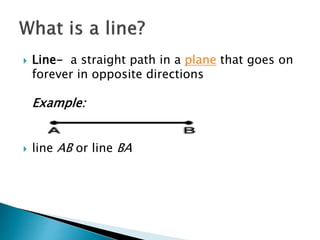
 Line- a straight path in a plane that goes on
forever in opposite directions
Example:
 line AB or line BA
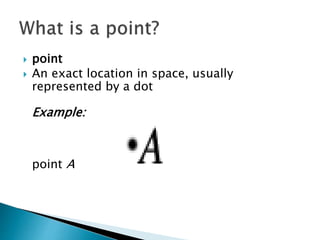
 point
 An exact location in space, usually
represented by a dot
Example:
point A
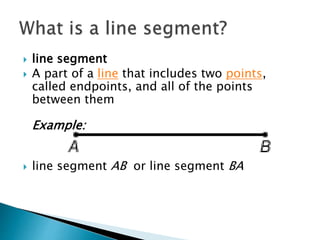
 line segment
 A part of a line that includes two points,
called endpoints, and all of the points
between them
Example:
 line segment AB or line segment BA
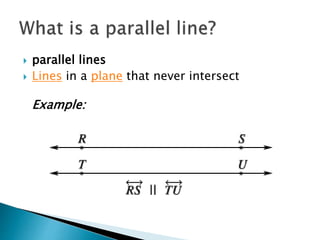
 parallel lines
 Lines in a plane that never intersect
Example:
 Two angles are complementary
if the sum of their angles equals
90*.
 If one angle is known, its
complementary angle can be
found by subtracting the
measure of its angle from 90*.
 What is the complementary angle of 43*?
◦ SOLUTION: 90* - 43* = 47*
◦ So, 43* and 47* are complementary angles
 Angle A measures 25* and Angle B measures 65*.
Angle A and Angle B are complementary angles
because together they create a 90* angle.
◦ JUSTIFICATION: 25* + 65* = 90*
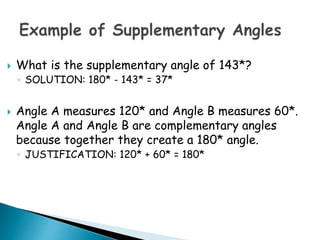
 Two angles are supplementary if
the sum of their angles equals
180*.
 If one angle is known, its
supplementary angle can be
found by subtracting the
measure of its angle from 180*.
 What is the supplementary angle of 143*?
◦ SOLUTION: 180* - 143* = 37*
 Angle A measures 120* and Angle B measures 60*.
Angle A and Angle B are complementary angles
because together they create a 180* angle.
◦ JUSTIFICATION: 120* + 60* = 180*
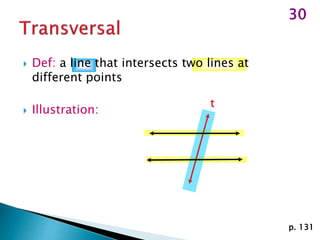
 Def: a line that intersects two lines at
different points
 Illustration:
t
p. 131
30
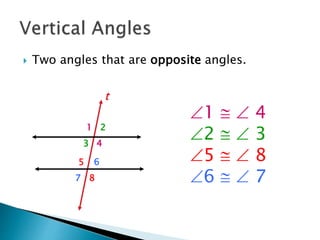
 Two angles that are opposite angles.
1 2
3 4
5 6
7 8
t
1   4
2   3
5   8
6   7

My lines

  • 2.
     Line- astraight path in a plane that goes on forever in opposite directions Example:  line AB or line BA
  • 3.
     point  Anexact location in space, usually represented by a dot Example: point A
  • 4.
     line segment A part of a line that includes two points, called endpoints, and all of the points between them Example:  line segment AB or line segment BA
  • 5.
     parallel lines Lines in a plane that never intersect Example:
  • 7.
     Two anglesare complementary if the sum of their angles equals 90*.  If one angle is known, its complementary angle can be found by subtracting the measure of its angle from 90*.
  • 8.
     What isthe complementary angle of 43*? ◦ SOLUTION: 90* - 43* = 47* ◦ So, 43* and 47* are complementary angles  Angle A measures 25* and Angle B measures 65*. Angle A and Angle B are complementary angles because together they create a 90* angle. ◦ JUSTIFICATION: 25* + 65* = 90*
  • 9.
     Two anglesare supplementary if the sum of their angles equals 180*.  If one angle is known, its supplementary angle can be found by subtracting the measure of its angle from 180*.
  • 10.
     What isthe supplementary angle of 143*? ◦ SOLUTION: 180* - 143* = 37*  Angle A measures 120* and Angle B measures 60*. Angle A and Angle B are complementary angles because together they create a 180* angle. ◦ JUSTIFICATION: 120* + 60* = 180*
  • 11.
     Def: aline that intersects two lines at different points  Illustration: t p. 131 30
  • 12.
     Two anglesthat are opposite angles. 1 2 3 4 5 6 7 8 t 1   4 2   3 5   8 6   7