Multiple Functions of
Schools
1. Technical/Economic
Functions:
• refer
schools

to
to

the
the

contribution

of

technical

or

economic development and needs
of the individual, the institution,
the local community, the society
and the inter-national community.
2. Human/Social
Functions
• refer to the contribution of schools to human
development and social relationships at different
levels of the society

A. AT THE INDIVIDUAL LEVEL
 schools help develop students to develop their
potentials psychologically, socially, and physically
B. AT THE INSTITUTIONAL LEVEL
a school is a social system composed of different human
relationships
to provide the environment of quality
C. AT THE COMMUNITY AND SOCIETY LEVELS
 schools serve the social needs or functions of the
local community,
 support social integration of multiple and diverse
constituencies of society,
 facilitate the social mobility within the existing
social class structure
 select

and

allocate

competent

people

to

appropriate roles and position,
 contribute to social change and development in
the long run
D. AT THE INTERNATIONAL LEVEL
 schools are expected to play an important role in
preparing

students

for

international

harmony,

social cooperation, global human relationship and
elimination of national, regional, racial and gender
biases.
3. POLITICAL
FUNCTIONS
• refer to the contribution of schools to the political
development at different levels of society.
A.AT THE INDIVIDUAL LEVEL
 schools help student to develop positive civic
attitudes and skills to exercise the rights and
responsibilities of citizenship.
B. AT THE INTERNATIONAL LEVELS


schools act as a place for systematically socializing
students into a set of political norms, values, and
beliefs, or for critically discussing and reflecting on
the existing political events.



schools

often

become

a

political

coalition

of

teachers, parents, and students that can contribute
to the stability of the political power structure.
C. AT THE COMMUNITY AND SOCIETY LEVELS
 schools play an important role to serve the
political needs of the local community
 maintain the stability of the political structure
 promote awareness and movement of
democracy
 facilitate the planned political
development and changes
D. AT THE INTERNATIONAL LEVEL
 the growing awareness of international dependence
reinforces the need for the contribution of school
education
common

to

international

interest,

understanding,

international

coalitions,

global
peace

movement against war, and eliminations of conflicts
between region and nations.
4. CULTURAL
FUNCTIONS
• refer to the contribution of schools to the cultural
transmission and development at different levels of
society.
A.AT THE INDIVIDUAL LEVEL


schools help students to develop their creativity
and aesthetic awareness and to be socialized with
the successful norms, values, and beliefs of society.
B. AT THE INSTITUTIONAL LEVEL
 schools act as a place for systematic cultural transmission
to

and

reproduction

of

the

next

generation,

cultural

integration among the multiple and diverse constituencies,
and cultural revitalization of the outdated poor traditions.
C. AT THE COMMUNITY AND SOCIETY LEVELS
 schools often serve as a cultural unit carrying the explicit
norms and expectations of the local community,
 Revitalize the strengths of the existing culture such that
the society or nation can reduce internal conflicts and
wastage
 transmit all the important values and artifacts of society
to students
 integrate

the

diverse

subcultures

from

different

background
 build up a unifying force for national conflicts.
D. AT THE INTERNATIONAL LEVEL
 schools can encourage appreciation of cultural diversity
and acceptance of different norms, traditions, values,
and beliefs in different countries and regions, and finally
contribute to the development of global culture through
integration of different cultures.
5. EDUCATION
FUNCTIONS

• refer to the contribution of schools to the development
and maintenance of education at the different levels of
society.
A.AT THE INDIVIDUAL LEVEL


it is important for schools to help students how to
learn and help teachers to learn how to teach

 Facilitating teachers’ professional
development
B. AT THE INSTITUTIONAL LEVEL
 school serve as a systematic place for a systematic
learning, teaching, and disseminating knowledge, and
as a center for systematically experimenting

and

implementing educational changes and developments.
C. AT THE COMMUNITY AND SOCIETY LEVELS


schools provide service for different educational
needs of the local community



facilitate development of education
professions and education structures,


disseminate knowledge and information to
the next generation,



Contribute to the formation of learning society

D. AT THE INTERNATIONAL LEVEL


in order to promote mutual understanding among nations
and build “build up a global family” for the younger
generation, schools can contribute to the development of
global education and international education exchange and
cooperation



schools can make an important contribution to education
for the whole world
2.3 MANIFEST
FUNCTIONS OF SCHOOLS
The manifest functions of education are the open and
intended goals or consequences of activities within an
organization or institution

1.SOCIALIZATION
 from kindergarten through college, schools teach
students the student role, specific academic
subjects, and political socialization


in the primary and secondary
schools,

students

are

taught

specific subject matter appropriate
to

their

age,

skill

level

and

previous education experience
 in the college level, students focus
on

more

detailed

knowledge

of

subjects that they have previously
studied while also being exposed to
the

new

research

areas

---

study

and
2. SOCIAL CONTROL
 schools are responsible for teaching values such as
discipline, respect, obedience, punctuality, and
perseverance.
 schools teach conformity by encouraging young people
to be good students, conscientious, future workers,
and low-abiding citizens.

3. SOCIAL PLACEMENT
 schools are responsible for identifying the most
qualified people to fill available positions in society
4. TRANSMITTING CULTURE
 as a social institution, education performs a rather
conservable function – transmitting the dominant
culture
 through schooling, each generation of young people is
exposed to the existing beliefs, norms and values of
our culture
 we learn respect for social control and reverence for
established institutions such as religion, the family,
and the government
5. PROMOTING SOCIAL AND POLITICAL
INTEGRATION
 education
political

serves
and

the

social

latent

function

integration

by

of

promoting

transforming

its

population composed of diverse ethnic and religious
groups into a society whose members share – to some
extent at least – a common identity
6. AGENT OF CHANGE
 education can stimulate or bring about desired social
change
 it promotes social change by serving as meeting ground
where each society’s distinctive beliefs and traditions
can be shared
 numerous sociological studies have revealed the increased
years of formal schooling are associated with openness
to new ideas and more liberal social and political
viewpoints.
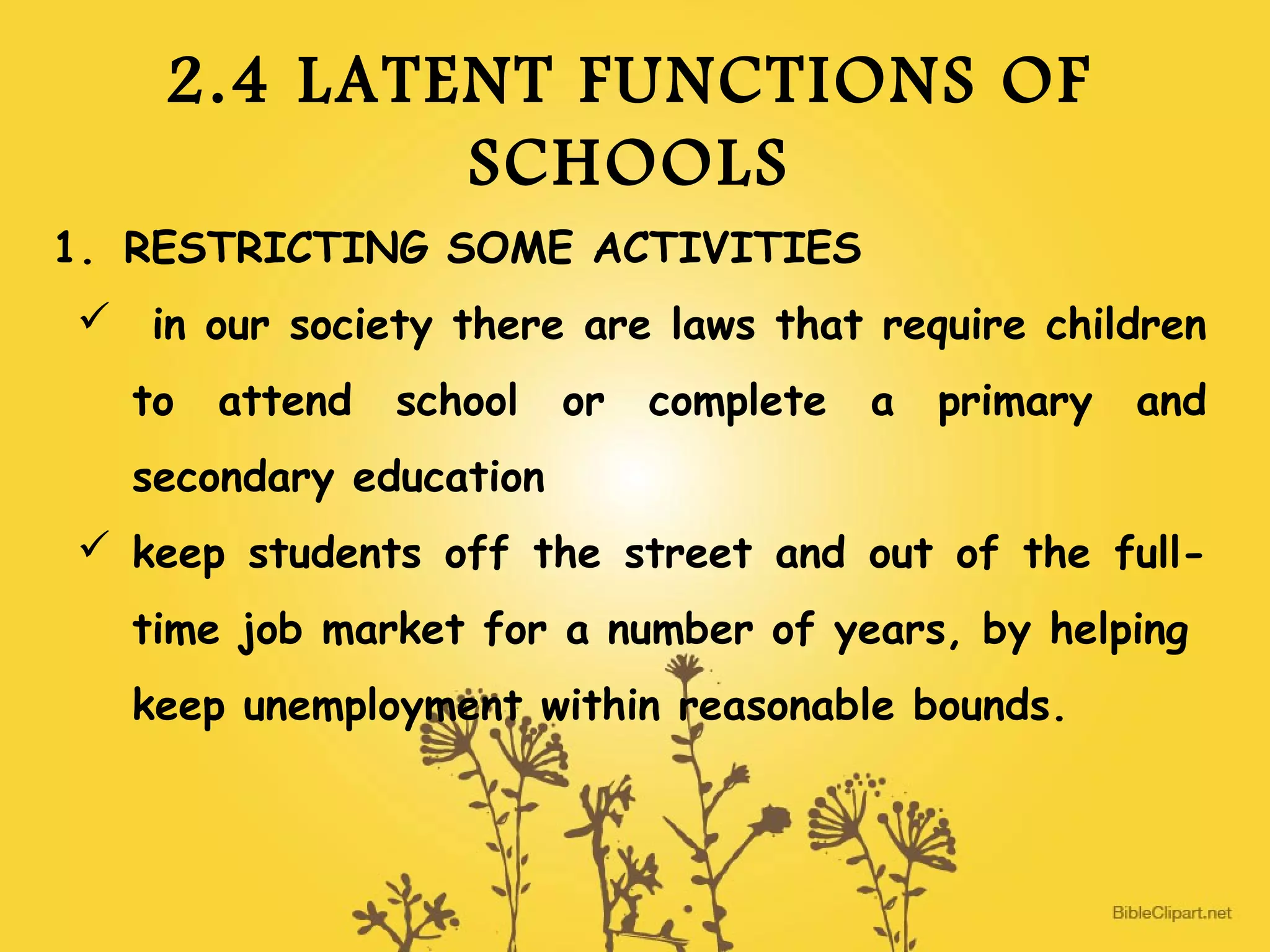
2.4 LATENT FUNCTIONS OF
SCHOOLS
1. RESTRICTING SOME ACTIVITIES
 in our society there are laws that require children
to

attend

school

or

complete

a

primary

and

secondary education
 keep students off the street and out of the fulltime job market for a number of years, by helping
keep unemployment within reasonable bounds.
2. MATCHMAKING AND PRODUCTION OF SOCIAL
NETWORKS
 because school brings together people of similar
ages, social class, and race, young people often
meet future marriage partners and develop social
networks that may last for many years
3. CREATION OF GENERATION GAP
 students may learn information in school
that

contradicts

beliefs

held

by

their

parents or their religion
 a generation gap is created when education
conflicts with parental attitudes and beliefs
Presented To:
Dr. Felicidad O. Rodelas
Presented By:
Anne Bernadette E. Laudato

Multiple Functions of School

  • 1.
  • 2.
    1. Technical/Economic Functions: • refer schools to to the the contribution of technical or economicdevelopment and needs of the individual, the institution, the local community, the society and the inter-national community.
  • 3.
    2. Human/Social Functions • referto the contribution of schools to human development and social relationships at different levels of the society A. AT THE INDIVIDUAL LEVEL  schools help develop students to develop their potentials psychologically, socially, and physically
  • 4.
    B. AT THEINSTITUTIONAL LEVEL a school is a social system composed of different human relationships to provide the environment of quality C. AT THE COMMUNITY AND SOCIETY LEVELS  schools serve the social needs or functions of the local community,  support social integration of multiple and diverse constituencies of society,  facilitate the social mobility within the existing social class structure
  • 5.
     select and allocate competent people to appropriate rolesand position,  contribute to social change and development in the long run D. AT THE INTERNATIONAL LEVEL  schools are expected to play an important role in preparing students for international harmony, social cooperation, global human relationship and elimination of national, regional, racial and gender biases.
  • 6.
    3. POLITICAL FUNCTIONS • referto the contribution of schools to the political development at different levels of society. A.AT THE INDIVIDUAL LEVEL  schools help student to develop positive civic attitudes and skills to exercise the rights and responsibilities of citizenship.
  • 7.
    B. AT THEINTERNATIONAL LEVELS  schools act as a place for systematically socializing students into a set of political norms, values, and beliefs, or for critically discussing and reflecting on the existing political events.  schools often become a political coalition of teachers, parents, and students that can contribute to the stability of the political power structure.
  • 8.
    C. AT THECOMMUNITY AND SOCIETY LEVELS  schools play an important role to serve the political needs of the local community  maintain the stability of the political structure  promote awareness and movement of democracy  facilitate the planned political development and changes
  • 9.
    D. AT THEINTERNATIONAL LEVEL  the growing awareness of international dependence reinforces the need for the contribution of school education common to international interest, understanding, international coalitions, global peace movement against war, and eliminations of conflicts between region and nations.
  • 10.
    4. CULTURAL FUNCTIONS • referto the contribution of schools to the cultural transmission and development at different levels of society. A.AT THE INDIVIDUAL LEVEL  schools help students to develop their creativity and aesthetic awareness and to be socialized with the successful norms, values, and beliefs of society.
  • 11.
    B. AT THEINSTITUTIONAL LEVEL  schools act as a place for systematic cultural transmission to and reproduction of the next generation, cultural integration among the multiple and diverse constituencies, and cultural revitalization of the outdated poor traditions. C. AT THE COMMUNITY AND SOCIETY LEVELS  schools often serve as a cultural unit carrying the explicit norms and expectations of the local community,  Revitalize the strengths of the existing culture such that the society or nation can reduce internal conflicts and wastage
  • 12.
     transmit allthe important values and artifacts of society to students  integrate the diverse subcultures from different background  build up a unifying force for national conflicts. D. AT THE INTERNATIONAL LEVEL  schools can encourage appreciation of cultural diversity and acceptance of different norms, traditions, values, and beliefs in different countries and regions, and finally contribute to the development of global culture through integration of different cultures.
  • 13.
    5. EDUCATION FUNCTIONS • referto the contribution of schools to the development and maintenance of education at the different levels of society. A.AT THE INDIVIDUAL LEVEL  it is important for schools to help students how to learn and help teachers to learn how to teach  Facilitating teachers’ professional development
  • 14.
    B. AT THEINSTITUTIONAL LEVEL  school serve as a systematic place for a systematic learning, teaching, and disseminating knowledge, and as a center for systematically experimenting and implementing educational changes and developments. C. AT THE COMMUNITY AND SOCIETY LEVELS  schools provide service for different educational needs of the local community  facilitate development of education professions and education structures,
  • 15.
     disseminate knowledge andinformation to the next generation,  Contribute to the formation of learning society D. AT THE INTERNATIONAL LEVEL  in order to promote mutual understanding among nations and build “build up a global family” for the younger generation, schools can contribute to the development of global education and international education exchange and cooperation  schools can make an important contribution to education for the whole world
  • 16.
    2.3 MANIFEST FUNCTIONS OFSCHOOLS The manifest functions of education are the open and intended goals or consequences of activities within an organization or institution 1.SOCIALIZATION  from kindergarten through college, schools teach students the student role, specific academic subjects, and political socialization
  • 17.
     in the primaryand secondary schools, students are taught specific subject matter appropriate to their age, skill level and previous education experience  in the college level, students focus on more detailed knowledge of subjects that they have previously studied while also being exposed to the new research areas --- study and
  • 18.
    2. SOCIAL CONTROL schools are responsible for teaching values such as discipline, respect, obedience, punctuality, and perseverance.  schools teach conformity by encouraging young people to be good students, conscientious, future workers, and low-abiding citizens. 3. SOCIAL PLACEMENT  schools are responsible for identifying the most qualified people to fill available positions in society
  • 19.
    4. TRANSMITTING CULTURE as a social institution, education performs a rather conservable function – transmitting the dominant culture  through schooling, each generation of young people is exposed to the existing beliefs, norms and values of our culture  we learn respect for social control and reverence for established institutions such as religion, the family, and the government
  • 20.
    5. PROMOTING SOCIALAND POLITICAL INTEGRATION  education political serves and the social latent function integration by of promoting transforming its population composed of diverse ethnic and religious groups into a society whose members share – to some extent at least – a common identity
  • 21.
    6. AGENT OFCHANGE  education can stimulate or bring about desired social change  it promotes social change by serving as meeting ground where each society’s distinctive beliefs and traditions can be shared  numerous sociological studies have revealed the increased years of formal schooling are associated with openness to new ideas and more liberal social and political viewpoints.
  • 22.
    2.4 LATENT FUNCTIONSOF SCHOOLS 1. RESTRICTING SOME ACTIVITIES  in our society there are laws that require children to attend school or complete a primary and secondary education  keep students off the street and out of the fulltime job market for a number of years, by helping keep unemployment within reasonable bounds.
  • 23.
    2. MATCHMAKING ANDPRODUCTION OF SOCIAL NETWORKS  because school brings together people of similar ages, social class, and race, young people often meet future marriage partners and develop social networks that may last for many years
  • 24.
    3. CREATION OFGENERATION GAP  students may learn information in school that contradicts beliefs held by their parents or their religion  a generation gap is created when education conflicts with parental attitudes and beliefs
  • 25.
    Presented To: Dr. FelicidadO. Rodelas Presented By: Anne Bernadette E. Laudato