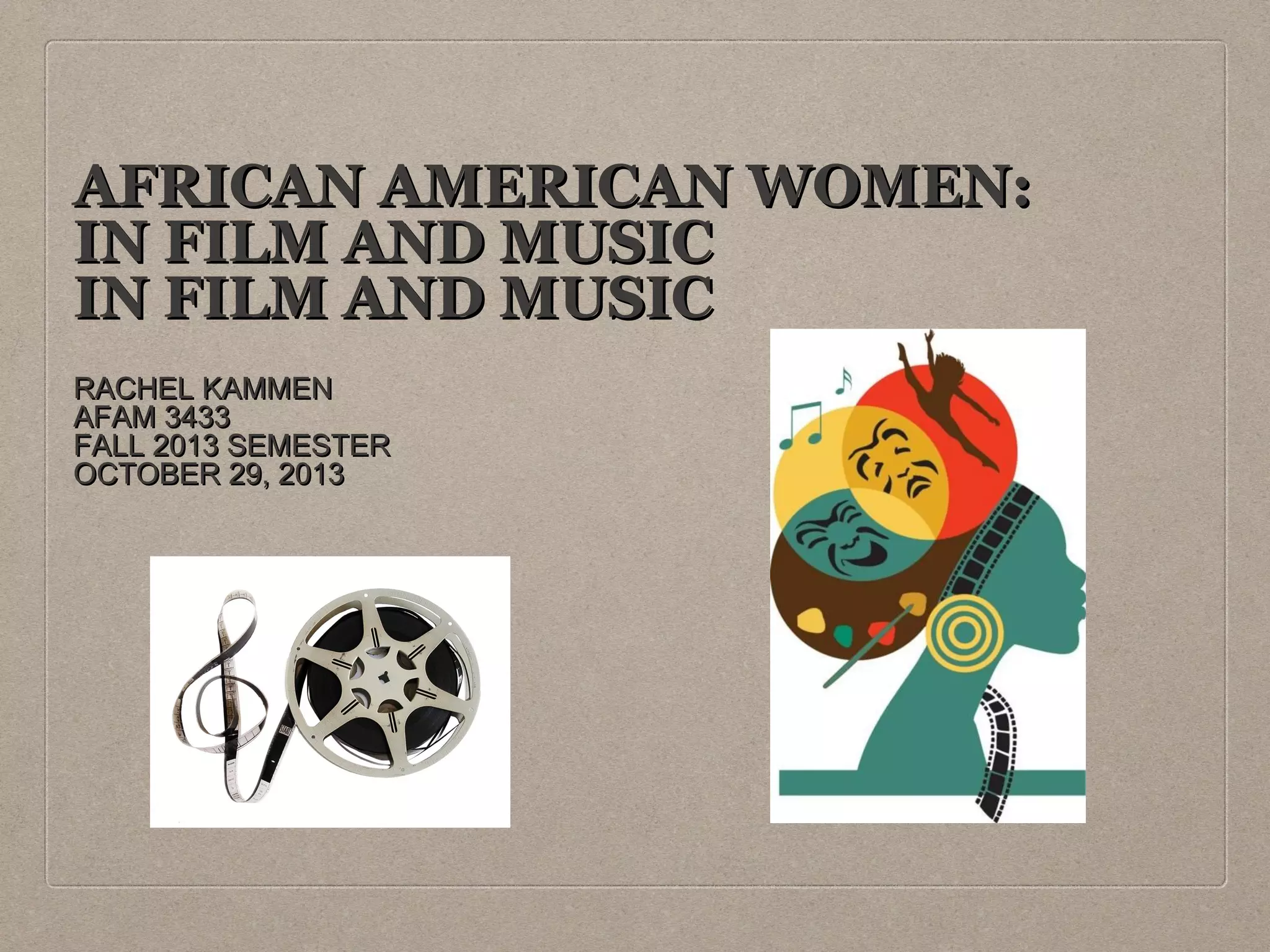
AFRICAN AMERICAN WOMEN:
IN FILM AND MUSIC
IN FILM AND MUSIC
RACHEL KAMMEN
AFAM 3433
FALL 2013 SEMESTER
OCTOBER 29, 2013
ISSUES REGARDING BLACK
WOMEN IN FILM AND MUSIC
•

In today’s society, black women do not get the
recognition they deserve or a lot of role choices in
films. They are limited to what the casting director or
writer of the films want.

•

As for music, black women are often sexualized in
every aspect and their music is not taken seriously.

•

In this presentation I will go through history of some
films and musicians and how it is today.
STEREOTYPES
•

Stereotypes run rampant in every culture.

•

In our society there are many stereotypes of African American
women in film, to name a few:
•

The strong, independent black woman

•

The black maid of white children who is wise but no one
notices

•

The comedic, fat black woman or as made famous by Tyler
Perry, Madea
FILM HISTORY
In the film history of African American women there are a few
types of women: “the mammy” figure in the 1930s who is a
heavy set and very loyal despite her oppression. The next
woman is in the 1960s who shows a confident, assertive, and
sexual woman. The 1980s shows a more developed character
with situations regarding sexuality, creativity, racism, and
friendships. The 1990s has films that show professional black
women dealing with gender inequality and racial uplift. However,
a few films still show black women fighting white women for men
and is not a progression. (Jones 35-38)
FILM ROLES
•

The winners of the Academy Awards were unfortunately
playing stereotypical roles of African American women.
McDaniel plays the ultimate role of the mammy, Goldberg
uses comedic performances to be an ‘overexcitable’
character in her film, and Berry’s role “fits a set of
stereotypes about black women as bad mothers and
oversexualized whores.” (Wanzo 136)

•

They have all filled roles of the fat, black woman, the
funny, black woman, and the beautiful, bad mother.
BLACK ACTRESSES TODAY
Unfortunately not much has changed with African
American actresses today. There are many famous
actresses, but they aren’t as many roles available to
them. Halle Berry, Queen Latifah, Angela Bassett,
Oprah Winfrey, Whoopi Goldberg, Zoe Saldana, Kerry
Washington etc. All of these actresses have had to
overcome the difficulties of being a black women in
“white” Hollywood.
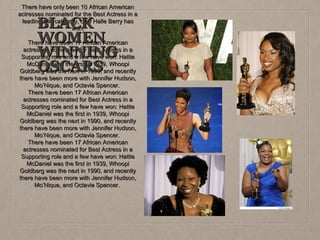
There have only been 10 African American
actresses nominated for the Best Actress in a
leading role category, only Halle Berry has
won.

BLACK
WOMEN
WINNING
OSCARS

There have been 17 African American
actresses nominated for Best Actress in a
Supporting role and a few have won: Hattie
McDaniel was the first in 1939, Whoopi
Goldberg was the next in 1990, and recently
there have been more with Jennifer Hudson,
Mo’Nique, and Octavia Spencer.
There have been 17 African American
actresses nominated for Best Actress in a
Supporting role and a few have won: Hattie
McDaniel was the first in 1939, Whoopi
Goldberg was the next in 1990, and recently
there have been more with Jennifer Hudson,
Mo’Nique, and Octavia Spencer.
There have been 17 African American
actresses nominated for Best Actress in a
Supporting role and a few have won: Hattie
McDaniel was the first in 1939, Whoopi
Goldberg was the next in 1990, and recently
there have been more with Jennifer Hudson,
Mo’Nique, and Octavia Spencer.
STEREOTYPES
•

In our society there are many stereotypes of African
American women in music:
•

All black women sing rap or r&b

•

They dance promiscuously

•

Cannot break into mainstream music
BLACK FEMALE RAPPERS
•

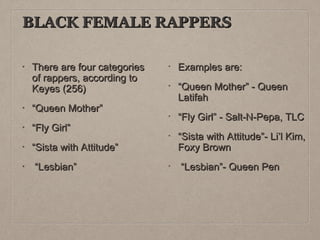
There are four categories
of rappers, according to
Keyes (256)

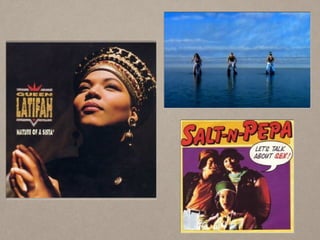
Examples are:
“Queen Mother” - Queen
Latifah

•

“Queen Mother”

•

“Fly Girl”

•

“Sista with Attitude”

“Sista with Attitude”- Li’l Kim,
Foxy Brown

“Lesbian”

“Lesbian”- Queen Pen

•

“Fly Girl” - Salt-N-Pepa, TLC
BLACK FEMALE RAPPERS
IN THE 90S
•

They used their music to defy the sexist repression
that they faced and did most things by themselves.

•

By utilizing rap music they are creating a safe space
for femininity, feminism, and black female sexuality.

•

They have to face the dominant culture of white
musicians, white rappers, and black male rappers.
(Keyes 265)
MUSIC VIDEOS
•

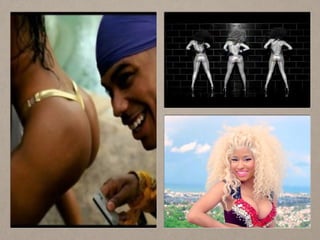
Music videos featuring women and especially black women are
often misogynistic, sexist, and hypersexualized.

•

African American women are sometimes in music videos
dancing scantily clad and having men objectify their bodies, ie
swiping a credit card in a woman’s buttocks.

•

These images perpetuate the idea that black women’s bodies
are property and show how the dominant culture has connected
sex, gender, and race to African American women’s sexuality.
(Littlefield 680)
BLACK FEMALE ARTISTS TODAY
•

In my opinion, it seems to me like black female artists
have shifted backwards in some ways. The musicians
want to be successful and sex sells. The artists of the
90s were educating others and weren’t as caught up in
the industry as others today

•

On the other hand, the artists are reclaiming their
sexuality and behavior into something good and
showing others that it is okay to be this way and that
you shouldn’t be slut shamed.
FEMALE RAPPERS
•

There are differences when the main artist is female
instead of male

•

They have challenged an overly male field and have
shown that women can be in the music business as well

•

However the way the female rappers display themselves
is not a step up from the back up dancers

•

They are not uniting together to support each other, but
rather fighting against each other. (Littlefield 681)
OTHER BLACK FEMALE ARTISTS

•

Beyonce: uses her sex appeal
in order to sell her music
•

•

created alter ego, Sasha
Fierce, but got rid of her to
become more mature
is very successful but is she
doing it the right way by
controlling the system and
taking charge of her body or
is she just seen as a sex
symbol? (Tuttle 18-20)

•

Nicki Minaj: female rapper
that challenge patriarchy
and women’s submission
•

She uses her image to her
advantage as being a sex
symbol to men and being
a black Barbie

•

Trying to become the first
black female hip hop
mogul (Tuttle 21-23)
FEMALE SEXUALITY AND
VIOLENCE IN MUSIC
One famous artist, Rihanna, has been in the spotlight for
many years regarding an incident with Chris Brown. This has
sparked many scholars to discuss what it means to be a black
woman in today’s culture. One scholar, has argued that “three
dominant frameworks have been employed to analyze
Rihanna's onstage and offstage performances and personae
since the assault: an universalizing narrative of domestic
violence victimization; a familiar narrative of black female
survival; and a coercive agenda that I call black recuperative
heterosexuality. (Fleetwood 442)”
THE MEDIA
•

The media does not do a good job showcasing successful
African American actresses and musicians in a good light.

•

It is difficult for young, aspiring black women to see themselves
in these careers or even have the opportunity to, because of all
the negative stereotypes associated with them

•

As more feminist scholars become public and people start to
gain common sense, there will be more film roles available to
black women and music will be seen for what it truly is, just
music
RESPONSE

•

There are more social media outlets than ever before supporting African
American actresses and musicians. They are available to many people,
so they can listen to and watch whoever they want to.

•

Black feminist scholars have done research regarding the media and how
black women are represented. This research is also being more public as
schools start to implement WGS and AFAM courses/majors.

•

As in recent years, black women have won more Oscars so perhaps the
industry will keep providing roles to those actresses.

•

As for music, black women in hip hop and other genres are coming to the
forefront and being taken seriously.
WORKS CITED
Fleetwood, Nicole R. "The Case Of Rihanna: Erotic Violence And Black Female Desire." African American
Review 45.3 (2012): 419-435. Academic Search Premier. Web. 29 Oct. 2013.
Jones, Sharon L. "From Margin To Centre? Images Of African-American Women In Film." Social Alternatives
17.4 (1998): 35-39. Academic Search Premier. Web. 15 Oct. 2013.
Keyes, Cheryl L. "Empowering Self, Making Choices, Creating Spaces: Black Female Identity Via Rap Music
Performance." Journal Of American Folklore 113.449 (2000): 255-269. Art Index (H.W. Wilson). Web. 29 Oct.
2013.
Littlefield, Marci Bounds. "The Media As A System Of Racialization: Exploring Images Of African American
Women And The New Racism." American Behavioral Scientist 51.5 (2008): 675-685. Business Source
Premier. Web. 15 Oct. 2013.
Tuttle, Kenya J. “THIS MOMENT FOR LIFE”: “POPULAR CULTURE’S IMPACT ON THE MORAL SPHERE OF
YOUNG BLACK WOMEN” Vanderbilt University Thesis (2012) 1-34 Web. 29. Oct. 2013.
Wanzo, Rebecca. "Beyond A 'Just' Syntax: Black Actresses, Hollywood And Complex Personhood." Women &
Performance 16.1 (2006): 135-152. International Bibliography of Theatre & Dance with Full Text. Web. 29 Oct.
2013.

Multimedia Project 2

  • 1.
    AFRICAN AMERICAN WOMEN: INFILM AND MUSIC IN FILM AND MUSIC RACHEL KAMMEN AFAM 3433 FALL 2013 SEMESTER OCTOBER 29, 2013
  • 2.
    ISSUES REGARDING BLACK WOMENIN FILM AND MUSIC • In today’s society, black women do not get the recognition they deserve or a lot of role choices in films. They are limited to what the casting director or writer of the films want. • As for music, black women are often sexualized in every aspect and their music is not taken seriously. • In this presentation I will go through history of some films and musicians and how it is today.
  • 3.
    STEREOTYPES • Stereotypes run rampantin every culture. • In our society there are many stereotypes of African American women in film, to name a few: • The strong, independent black woman • The black maid of white children who is wise but no one notices • The comedic, fat black woman or as made famous by Tyler Perry, Madea
  • 4.
    FILM HISTORY In thefilm history of African American women there are a few types of women: “the mammy” figure in the 1930s who is a heavy set and very loyal despite her oppression. The next woman is in the 1960s who shows a confident, assertive, and sexual woman. The 1980s shows a more developed character with situations regarding sexuality, creativity, racism, and friendships. The 1990s has films that show professional black women dealing with gender inequality and racial uplift. However, a few films still show black women fighting white women for men and is not a progression. (Jones 35-38)
  • 5.
    FILM ROLES • The winnersof the Academy Awards were unfortunately playing stereotypical roles of African American women. McDaniel plays the ultimate role of the mammy, Goldberg uses comedic performances to be an ‘overexcitable’ character in her film, and Berry’s role “fits a set of stereotypes about black women as bad mothers and oversexualized whores.” (Wanzo 136) • They have all filled roles of the fat, black woman, the funny, black woman, and the beautiful, bad mother.
  • 6.
    BLACK ACTRESSES TODAY Unfortunatelynot much has changed with African American actresses today. There are many famous actresses, but they aren’t as many roles available to them. Halle Berry, Queen Latifah, Angela Bassett, Oprah Winfrey, Whoopi Goldberg, Zoe Saldana, Kerry Washington etc. All of these actresses have had to overcome the difficulties of being a black women in “white” Hollywood.
  • 7.
    There have onlybeen 10 African American actresses nominated for the Best Actress in a leading role category, only Halle Berry has won. BLACK WOMEN WINNING OSCARS There have been 17 African American actresses nominated for Best Actress in a Supporting role and a few have won: Hattie McDaniel was the first in 1939, Whoopi Goldberg was the next in 1990, and recently there have been more with Jennifer Hudson, Mo’Nique, and Octavia Spencer. There have been 17 African American actresses nominated for Best Actress in a Supporting role and a few have won: Hattie McDaniel was the first in 1939, Whoopi Goldberg was the next in 1990, and recently there have been more with Jennifer Hudson, Mo’Nique, and Octavia Spencer. There have been 17 African American actresses nominated for Best Actress in a Supporting role and a few have won: Hattie McDaniel was the first in 1939, Whoopi Goldberg was the next in 1990, and recently there have been more with Jennifer Hudson, Mo’Nique, and Octavia Spencer.
  • 8.
    STEREOTYPES • In our societythere are many stereotypes of African American women in music: • All black women sing rap or r&b • They dance promiscuously • Cannot break into mainstream music
  • 9.
    BLACK FEMALE RAPPERS • Thereare four categories of rappers, according to Keyes (256) Examples are: “Queen Mother” - Queen Latifah • “Queen Mother” • “Fly Girl” • “Sista with Attitude” “Sista with Attitude”- Li’l Kim, Foxy Brown “Lesbian” “Lesbian”- Queen Pen • “Fly Girl” - Salt-N-Pepa, TLC
  • 11.
    BLACK FEMALE RAPPERS INTHE 90S • They used their music to defy the sexist repression that they faced and did most things by themselves. • By utilizing rap music they are creating a safe space for femininity, feminism, and black female sexuality. • They have to face the dominant culture of white musicians, white rappers, and black male rappers. (Keyes 265)
  • 12.
    MUSIC VIDEOS • Music videosfeaturing women and especially black women are often misogynistic, sexist, and hypersexualized. • African American women are sometimes in music videos dancing scantily clad and having men objectify their bodies, ie swiping a credit card in a woman’s buttocks. • These images perpetuate the idea that black women’s bodies are property and show how the dominant culture has connected sex, gender, and race to African American women’s sexuality. (Littlefield 680)
  • 14.
    BLACK FEMALE ARTISTSTODAY • In my opinion, it seems to me like black female artists have shifted backwards in some ways. The musicians want to be successful and sex sells. The artists of the 90s were educating others and weren’t as caught up in the industry as others today • On the other hand, the artists are reclaiming their sexuality and behavior into something good and showing others that it is okay to be this way and that you shouldn’t be slut shamed.
  • 15.
    FEMALE RAPPERS • There aredifferences when the main artist is female instead of male • They have challenged an overly male field and have shown that women can be in the music business as well • However the way the female rappers display themselves is not a step up from the back up dancers • They are not uniting together to support each other, but rather fighting against each other. (Littlefield 681)
  • 16.
    OTHER BLACK FEMALEARTISTS • Beyonce: uses her sex appeal in order to sell her music • • created alter ego, Sasha Fierce, but got rid of her to become more mature is very successful but is she doing it the right way by controlling the system and taking charge of her body or is she just seen as a sex symbol? (Tuttle 18-20) • Nicki Minaj: female rapper that challenge patriarchy and women’s submission • She uses her image to her advantage as being a sex symbol to men and being a black Barbie • Trying to become the first black female hip hop mogul (Tuttle 21-23)
  • 17.
    FEMALE SEXUALITY AND VIOLENCEIN MUSIC One famous artist, Rihanna, has been in the spotlight for many years regarding an incident with Chris Brown. This has sparked many scholars to discuss what it means to be a black woman in today’s culture. One scholar, has argued that “three dominant frameworks have been employed to analyze Rihanna's onstage and offstage performances and personae since the assault: an universalizing narrative of domestic violence victimization; a familiar narrative of black female survival; and a coercive agenda that I call black recuperative heterosexuality. (Fleetwood 442)”
  • 18.
    THE MEDIA • The mediadoes not do a good job showcasing successful African American actresses and musicians in a good light. • It is difficult for young, aspiring black women to see themselves in these careers or even have the opportunity to, because of all the negative stereotypes associated with them • As more feminist scholars become public and people start to gain common sense, there will be more film roles available to black women and music will be seen for what it truly is, just music
  • 19.
    RESPONSE • There are moresocial media outlets than ever before supporting African American actresses and musicians. They are available to many people, so they can listen to and watch whoever they want to. • Black feminist scholars have done research regarding the media and how black women are represented. This research is also being more public as schools start to implement WGS and AFAM courses/majors. • As in recent years, black women have won more Oscars so perhaps the industry will keep providing roles to those actresses. • As for music, black women in hip hop and other genres are coming to the forefront and being taken seriously.
  • 20.
    WORKS CITED Fleetwood, NicoleR. "The Case Of Rihanna: Erotic Violence And Black Female Desire." African American Review 45.3 (2012): 419-435. Academic Search Premier. Web. 29 Oct. 2013. Jones, Sharon L. "From Margin To Centre? Images Of African-American Women In Film." Social Alternatives 17.4 (1998): 35-39. Academic Search Premier. Web. 15 Oct. 2013. Keyes, Cheryl L. "Empowering Self, Making Choices, Creating Spaces: Black Female Identity Via Rap Music Performance." Journal Of American Folklore 113.449 (2000): 255-269. Art Index (H.W. Wilson). Web. 29 Oct. 2013. Littlefield, Marci Bounds. "The Media As A System Of Racialization: Exploring Images Of African American Women And The New Racism." American Behavioral Scientist 51.5 (2008): 675-685. Business Source Premier. Web. 15 Oct. 2013. Tuttle, Kenya J. “THIS MOMENT FOR LIFE”: “POPULAR CULTURE’S IMPACT ON THE MORAL SPHERE OF YOUNG BLACK WOMEN” Vanderbilt University Thesis (2012) 1-34 Web. 29. Oct. 2013. Wanzo, Rebecca. "Beyond A 'Just' Syntax: Black Actresses, Hollywood And Complex Personhood." Women & Performance 16.1 (2006): 135-152. International Bibliography of Theatre & Dance with Full Text. Web. 29 Oct. 2013.

Editor's Notes

  • #2 picture: www.cctvcambridge.org  picture: bwafphilly.homestead.com -
  • #8 Pictures: newsone.com -Halle Berry www.bvnewswire.com -Mo’Nique abcnews.go.com -Octavia Spencer www.aliceinnappyland.com -Whoopi Goldberg epatototozo.sourceforge.net -Jennifer Hudson
  • #11 respectthenext.com  www.melodycenta.com  1000thingswehate.wordpress.com
  • #14 antsthoughts.wordpress.com  www.mp3dload.com  www.aceshowbiz.com