Green Office
Maastricht University Journal
of Sustainability Studies 2014
Vol. 2 November 2014
Maastricht University Journal of Sustainability Studies, Vol. 2, November 2014
21 papers were submitted
6 passed the initial review
4 were selected for publication
Editorial Board
• Dr. Yvonne van der Meer FHS
• Emeritus Prof.Wim Passchier FHML
• Dr. Aalok Khandekar FASoS
• Dr. Jens Lachmund FASoS
• Dr. Ron Cörvers Director of ICIS
• Dr.Veronique Vasseur ICIS
• Dr. Marc Dijk ICIS
• Judith Enders Student Research Coordinator UM Green Office & student SBE
• Alex Baker-Shelley PhD candidate ICIS
• Michael Veale Student ICIS
• Liza Wood Student ICIS
• Iva Hořejší Student ICIS
• Martina Kühner PhD candidate FASoS
• Lotti Mischka Student FASoS
• Laura Niessen Student FASoS
• Mona Sachter Student FASoS
• Theresa Pham Student FASoS
• Merle Temme Student FdR
• Adam Strobejko Student FdR
• Miriam Betz Student SBE
• Melvin Nalbach Student SBE
• Yusuke Ota Student SBE
• Evert Mink Student SBE
• Natalie Geiger Student SBE
• Luca Werth Student FHS
• Samantha Jenkins Student FHS
• Einav Bloom Student FHS
• Ricardo Leclaire Student FPN
• Bram Brouwers PhD candidate FHML
• Charles Crépeau Student Nice-Sophia Antipolis University
• Georg Rute Student Imperial College London
UM: Maastricht University | FHML: Faculty of Health, Medicine and Life Sciences | FASoS: Faculty of Arts and Social Sciences
FHS: Faculty of Humanities and Sciences | FdR: Faculty of Law | ICIS: International Centre for Integrated assessment and
Sustainable development | SBE: School of Business and Economics | FPN: Faculty of Psychology and Neuroscience
Profile of Contributors
Margit Hain
In summer 2014 Margit finished her Bachelor’s degree in Psychology at Maastricht University. For her personal profession
she intends to combine her Bachelor’s with her interest in economics. Currently, Margit is doing an internship in the field
of economics and preparing for a Master in Economic Psychology. In the future she would like to combine her expertise in
economic psychology with the fields of sustainability to support the growth of ecological businesses and innovations.
Michael Veale
Michael has a Bachelor’s degree in Government and Economics from LSE and a Master’s degree in Sustainability Science
and Policy from Maastricht University. His main research interests are sustainability at the border of science and policy,
private governance and certification, data visualisation, stakeholder participation and innovation. He is currently
gathering experience in real-world public and private policy making before hoping to return to academia to co-create
some useful insights into complex problems.
Lucy Hunt
Lucy completed her Bachelor’s degree in German and Contemporary Chinese Studies at the University of Nottingham
in the UK. Her interest in sustainability was first ignited during two extended visits to China as part of this course, by
witnessing first-hand the rapid pace of development in Beijing and the social issues and environmental degradation that
this was causing. She took this interest further by choosing a Master’s degree in Sustainability Science and Policy at ICIS,
which enabled her to to study sustainability issues closer to home. Lucy is currently working for a small company in the
UK that focuses on finding sustainable solutions for a variety of projects and institutions.
Juan Guevara
Juan David Guevara received his Bachelor’s degree in Biology from Universidad Nacional de Colombia. Soon after finishing
he decided to focus his career on sustainability issues. He then completed an internship at the Organization of American
States (Washington D.C.) at the Department of Sustainable Development. Back in Colombia he joined one of the largest
environmental NGOs to provide support for the cooperation office with the goal of seeking new opportunities for
developing sustainable actions in the country. Last year, sponsored by the government of Colombia, Juan enrolled at the
Master in Sustainability Science and Policy at ICIS, Maastricht University, in order to ultimately be able to contribute to his
own country’s environmental development.
Liza Wood
Liza Wood has received her Bachelor’s degree Political Science and Biology from the College of Charleston and her Master
in Sustainability Science and Policy from Maastricht University. Her research interests include producer and consumer
movements towards alternative food systems, climate change adaptation, and sustainable agricultural production
methods. She is currently a Master student in Organic Farming and Food Production Systems at Newcastle University in
the UK, where she hopes to improve her understanding of agricultural science and farm management techniques. Liza
hopes to continue a career path that allows her to engage with sustainability challenges as they relate to agriculture,
human development, and environmental protection.
Florian Simonsen and Lukas Warning
Florian Simonsen and Lukas Warning will both receive their Bachelor’s degree in Liberal Arts and Sciences at the
University College Maastricht in January 2015.While Florian focuses on political science, economics, and sustainability
studies with a high interest in energy policy, Lukas specializes in policy, sustainability and political economy.They have
gathered rich practical and project-based experience in the field of sustainability improvements regarding energy,
catering, transportation and waste.The paper was the result of an undergraduate research project, in which the authors
participated in fall 2013.
Maastricht University Journal of Sustainability Studies • 2014 • Vol. II, Issue 1
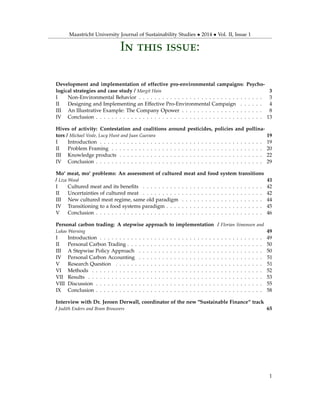
In this issue:
Development and implementation of effective pro-environmental campaigns: Psycho-
logical strategies and case study / Margit Hain 3
I Non-Environmental Behavior . . . . . . . . . . . . . . . . . . . . . . . . . . . . . . . . 3
II Designing and Implementing an Effective Pro-Environmental Campaign . . . . . . 4
III An Illustrative Example: The Company Opower . . . . . . . . . . . . . . . . . . . . . 8
IV Conclusion . . . . . . . . . . . . . . . . . . . . . . . . . . . . . . . . . . . . . . . . . . . 13
Hives of activity: Contestation and coalitions around pesticides, policies and pollina-
tors / Michael Veale, Lucy Hunt and Juan Guevara 19
I Introduction . . . . . . . . . . . . . . . . . . . . . . . . . . . . . . . . . . . . . . . . . . 19
II Problem Framing . . . . . . . . . . . . . . . . . . . . . . . . . . . . . . . . . . . . . . . 20
III Knowledge products . . . . . . . . . . . . . . . . . . . . . . . . . . . . . . . . . . . . . 22
IV Conclusion . . . . . . . . . . . . . . . . . . . . . . . . . . . . . . . . . . . . . . . . . . . 29
Mo’ meat, mo’ problems: An assessment of cultured meat and food system transitions
/ Liza Wood 41
I Cultured meat and its benefits . . . . . . . . . . . . . . . . . . . . . . . . . . . . . . . 42
II Uncertainties of cultured meat . . . . . . . . . . . . . . . . . . . . . . . . . . . . . . . 42
III New cultured meat regime, same old paradigm . . . . . . . . . . . . . . . . . . . . . 44
IV Transitioning to a food systems paradigm . . . . . . . . . . . . . . . . . . . . . . . . . 45
V Conclusion . . . . . . . . . . . . . . . . . . . . . . . . . . . . . . . . . . . . . . . . . . . 46
Personal carbon trading: A stepwise approach to implementation / Florian Simonsen and
Lukas Warning 49
I Introduction . . . . . . . . . . . . . . . . . . . . . . . . . . . . . . . . . . . . . . . . . . 49
II Personal Carbon Trading . . . . . . . . . . . . . . . . . . . . . . . . . . . . . . . . . . . 50
III A Stepwise Policy Approach . . . . . . . . . . . . . . . . . . . . . . . . . . . . . . . . 50
IV Personal Carbon Accounting . . . . . . . . . . . . . . . . . . . . . . . . . . . . . . . . 51
V Research Question . . . . . . . . . . . . . . . . . . . . . . . . . . . . . . . . . . . . . . 51
VI Methods . . . . . . . . . . . . . . . . . . . . . . . . . . . . . . . . . . . . . . . . . . . . 52
VII Results . . . . . . . . . . . . . . . . . . . . . . . . . . . . . . . . . . . . . . . . . . . . . 53
VIII Discussion . . . . . . . . . . . . . . . . . . . . . . . . . . . . . . . . . . . . . . . . . . . 55
IX Conclusion . . . . . . . . . . . . . . . . . . . . . . . . . . . . . . . . . . . . . . . . . . . 58
Interview with Dr. Jeroen Derwall, coordinator of the new "Sustainable Finance“ track
/ Judith Enders and Bram Brouwers 65
1
Maastricht University Journal of Sustainability Studies • 2014 • Vol. II, Issue 1
2
Maastricht University Journal of Sustainability Studies • 2014 • Vol. II, Issue 1
Development and implementation of
effective pro-environmental
campaigns: Psychological strategies
and case study
Margit Hain
Faculty of Psychology and Neuroscience, Maastricht University
m.hain@student.maastrichtuniversity.nl
Abstract
It is generally acknowledged that human behavior is one of the main factors contributing to climate change.
Therefore, there is an increasing need for campaigns addressing environmentally unfriendly habits while
promoting an environmentally friendly lifestyle. These ecological campaigns are able to improve their
effectiveness by integrating various psychological strategies and theories. Furthermore, statistical analyses
enable campaigners to gain more insight into attitudes, norms and behaviors of their target group, and
even enable the setting of benchmarks for further campaigns. Based on psychological studies this paper
proposes a general design for such a pro-environmental campaign. This design comprises 1) identifying
the target group, 2) identifying effective strategies, 3) implementing the campaign and 4) evaluating the
implementation. In consideration of this proposed design the last section provides a practical example: the
applied strategies of Opower - a company which claims to foster ecological behavior change in households.
I. Non-Environmental Behavior
I
t is common knowledge that the ongoing
climate change is and will be one of our ma-
jor global challenges in the future. Despite
the urgency of this issue, there is still a lack
of political, economical and civil action. The
main paradox, hereby, is that people are aware
of and concerned about environmental issues
without taking any action (Ozaki, 2011; Ver-
meir & Verberke 2006). This human impact on
the environment is, among others, triggered by
minor non-ecological behaviors. These every-
day behaviors begin with a certain action such
as not switching off the lights when leaving
a room. If the outcomes of an action are gen-
erally satisfactory, e.g., convenient, then this
course of behavior will be maintained (Wood&
Neal, 2007). The more frequent a certain combi-
nation of setting and behavior occurs, the more
dominant and accessible the link between them
becomes. Once that a non-ecological habit is
formed, the more probable it is that an indi-
vidual constantly follows this cognitive schema
(Verplanken, Aarts & Van Knippenberg, 1998).
In order to solve the aforementioned paradox,
there is a need for effective campaigns inter-
vening into these harmful habits. Although the
broad persuasion research, the integration of
psychological strategies into campaigns’ mes-
sages is very limited (Bator & Cialdini, 2000).
Accordingly, the amount of papers engaging
with the design of pro-environmental cam-
paigns is restricted. Therefore, this review
paper aims to answer the research question
on how psychological knowledge can trigger
3
Maastricht University Journal of Sustainability Studies • 2014 • Vol. II, Issue 1
pro-environmental behavior change within the
framework of a campaign. First, the following
section proposes a general framework for de-
signing a campaign, from the initial analysis
to the final evaluation. Hereby, the results of
various studies regarding ecological behavior
are integrated into this design. The concluding
section looks closely at the realization of this
theoretical knowledge into a real-life setting: A
company called Opower claims to successfully
incorporates psychological tactics and strate-
gies into its ecological campaign. The applied
method for data collection is a literature re-
search gathering information about designing
campaigns, persuasive strategies regarding eco-
logical actions and the company Opower.
II. Designing and Implementing an
Effective Pro-Environmental
Campaign
T
oday’s environmental challenge is rooted
in a wide range of everyday issues from
social awareness to technological options;
it is an “ecological, technological and socio-
cultural problem” (Steg & Vlek, 2009). There-
fore, the change towards more environmen-
tally friendly attitudes and behavior cannot be
mastered by one single discipline but requires
a multidisciplinary approach. Designing and
implementing a successful campaign requires
a variety of expertise ranging from social psy-
chologists (identifying target groups and strate-
gies, data analysis and evaluation), engineers
(designing the required software applications
and websites) and policy makers (providing
political and financial guidelines) (Steg & Vlek,
2009). In addition to a multidisciplinary ap-
proach the campaigners should apply psycho-
logical knowledge and strategies. The design
of the proposed campaign includes 1) identify-
ing the target population, 2) identifying effec-
tive strategies, 3) implementing the campaign
and, 4) evaluating the results (Kok, Lo, Peters
& Ruiter, 2011; McGuire, 1989).
II.I. Identifying the Target Group
The initial step in designing any effective cam-
paign consists in identifying the target group:
“Who are the people the campaign will act
upon?” By understanding their attitudes, be-
liefs and norms towards environmental issues
as well as their present (non-)environmental
behavior, the campaign can be adapted accord-
ingly. Hereby, this first analysis of the target
group guides the manner of applied psycho-
logical strategies for the campaign. For ex-
ample, some light may be shed on the differ-
ence between people engaging in a certain pro-
environmental behavior and people who do
not. Ideally, this comparison leads to the iden-
tification of specific barriers which can then
be addressed, e.g., external barriers such as
a lack of environmentally friendly technology
or internal barriers such as a lack of required
skills to properly apply this technology (Abra-
hamse et al., 2007). Moreover, this first analysis
creates a benchmark allowing the campaigners
to spot deviations in attitudes and behavior
within the selected target group after the cam-
paign has been implemented (Kok, Lo, Peters
& Ruiter, 2011; McGuire, 1989). Within the
subsequent section this paper is further respon-
sive to several psychological strategies address-
ing determinants such as norms, attitudes and
knowledge contributing to non-ecological be-
havior.
II.II. Identifying Effective Strategies
II.II.I. Moral Obligation and Social
Norms
Moral Obligation and Social Norms
One psychological strategy is altering or
strengthening the target group’s moral obliga-
tion towards the environment. Moral obliga-
tion is rooted in the belief that climate change
is something which has to be dealt with, fol-
lowed by a perceived general responsibility
(Ozaki, 2011; Roberts, 1996; Tanner & Kast,
2003). This moral sensation can also be re-
garded as a social norm – a belief on how one
should act in a certain situation. Generally,
4
Maastricht University Journal of Sustainability Studies • 2014 • Vol. II, Issue 1
individuals tend to adapt to prevalent norms
due to the urge not to deviate from the ma-
jority. Being part of the norm creates a sense
of belonging to a greater group and assists
maintaining a positive self-image. Normative
and environmental concerns can highly in-
fluence behavioral intentions (Bamberg, 2003;
Gadenne, Sharma, Kerr & Smith, 2011) and it
is even argued that they provide the most solid
base for pro-environmental acting compared
to hedonistic or economic drives (Tanner &
Kast, 2003; Lindenberg & Steg, 2007). More-
over, social norms regarding the environment
can cause a domino-effect: The more individ-
uals are prompted to act upon an ecological
lifestyle, the more prominent this social norm
of environmental awareness becomes. This
increased awareness will trigger even more
moral responsibility and the need to take ac-
tion in other individuals provoking them to
change their environmental behavior (Ozaki,
2011).
Descriptive and Injunctive Norms
Additionally, a group of researchers (Cialdini,
Reno & Kallgren, 1990, 1991, 1993) distin-
guished between two different types of social
norms: descriptive norms, what people actu-
ally do, and injunctive norms, what people ap-
prove or disapprove of. Studies point out that
the failure of many campaigns are due to the
emphasis on negative descriptive norms which
might be followed by the so-called boomerang
effect (Cialdini, 2003; Schultz, Nolan, Cialdini,
Goldstein & Griskevicius, 2007). Negative de-
scriptive norms communicate that the plurality
of people engage in an undesirable negative
behavior. This message, however, implies that
this certain behavior is the general average,
e.g., many people throw their trash directly
into the environment. Hereby, the emphasis
on the negative average withholds people from
changing their behavior for the better. Ad-
ditionally, people displaying positive behav-
ior above the average are entrapped to adapt
themselves to the lower general mean – lead-
ing to a decrease of one’s pro-environmental
behavior. Thus, the campaigners’ intention
to prompt positive behavior may lead to even
more negative behavior: the boomerang effect.
Therefore, descriptive norms should mainly fo-
cus on positive norms. Advertising that many
people engage in a desired positive behavior
induces more individuals to imitate their be-
havior, e.g., if many people place their compost
in front of (instead of behind) their house then
other individuals are also encouraged to com-
post (McKenzie-Mohr, 2000; Cialdini, 2003). By
adding negative injunctive norms, what people
disapprove, the boomerang effect can be ad-
ditionally prevented, e.g., displaying that the
majority disapproves that people throw their
trash directly into the environment (Cialdini et
al., 2006). In order to apply these descriptive
as well as injunctive norms effectively, it is ad-
visable that the displayed norms are rather spe-
cific than general (Bator & Cialdini, 2000). In
the following section the importance of speci-
ficity is further illustrated, also in the field of
attitudes, intentions and goals.
II.II.II. Specific Attitudes, Intentions
and Goals
Several studies are in agreement with the fact
that specific information and goals are more
effective than broad information/goals (Gar-
dener & Stern, 1996; Locke & Latham, 2006):
A general concern about environmental and
global changes is not very probable to prompt
minor small-scale actions such as composting
(Locke & Latham, 2006). Additionally, specific
attitudes and beliefs, e.g., towards environmen-
tal protection, fair trade and local production,
were found to result in more positive environ-
mental behavior (Tanner & Kast, 2003). Hence,
Pratkanis and Greenwald (1993) recommend
to implement very particular message content.
According to them the target group should be
addressed with very clear instructions on how
to solve specific problems. Additionally, super-
fluous and distracting information should be
completely excluded, particularly in our over-
whelming message-dense culture. As a result,
the specificity of the information facilitates to
overcome the interfering effect of deeply rooted
5
Maastricht University Journal of Sustainability Studies • 2014 • Vol. II, Issue 1
habits (Danner, Aarts, Papies & Vries, 2010).
These habits are a consequence of the cognitive
coactivation between a certain situation and a
subsequent behavior. However, entering this
familiar situation might trigger an automatic
behavioral response in return, which is more
easily accessible than the novel and unfamiliar
action (Danner et al., 2010; Wood & Neal, 2007).
In practice, an encoding cue can be in-
tegrated into the campaign’s message to fa-
cilitate the change towards new more pro-
environmental routines (Bamberg, Hunecke &
Blöbaum, 2007; Wood & Neal, 2007). An encod-
ing cue is a certain object, setting or situation
which will be associated by the target person
with an appropriate ecological behavior (Neal,
Wood, Labreque & Lally, 2012). By placing an
encoding cue into the visual field the activation
of the new behavioral response is facilitated,
e.g., placing a recycling sign directly next to
a trash bin. Due to the integration of such
a cue, there is also an increased probability
that the relevant social norms will be triggered
at the appropriate time and situation (Bator
& Cialdini, 2000). The inclusion of encoding
cues and other specific rather than general at-
titudes, behaviors and goals should, therefore,
be distinctly implemented into each ecological
message.
II.II.III. Increasing Individual Knowl-
edge and Involvement
Lacking Knowledge and Applied Heuristics
In order to shape a persuasive pro-
environmental message, each individual of
the target group has to have a feeling of per-
sonal relevance and importance (Vermeir &
Verbeke, 2005). One possible strategy to reach
this goal is the implementation of self-reports
as a measurement method. The individual
has to analyze his/her own environmental
actions in order to be able to comprehend the
consequences of his/her behavior and how it
is related to resource use. Generally, studies re-
vealed that individuals’ knowledge about their
own behavior-energy relation is insignificantly
small (Steg, 2008). For instance, if individuals
have to assess the energy use of an appliance
they generally tend to use heuristic assump-
tions – such as “the bigger the appliance, the
more energy consumed”. This assumption
that energy consumption of an appliance is di-
rectly linked to its size is obviously not always
valid (Schuitema & Steg, 2005a). Similarly,
the resource use which is required to heat
up water is generally underestimated due to
the lacking awareness that hereby energy is
needed (Schuitema & Steg, 2005b). Individual
self-reports are able to reveal absent knowl-
edge/ applied heuristics and create, moreover,
awareness for our human flaws (Steg, 2008).
Particularly this consciousness between behav-
ioral cause and environmental consequence is
a necessity for any change in behavior. How-
ever, an effective message does not only have
to illustrate what but also how to modify non-
environmental actions for the better.
Action-Related Knowledge
One method which facilitates the change to-
wards more ecological behavior is the integra-
tion of action-related knowledge into a cam-
paign’s message. Schahn and Holzer (1990)
distinguish between two general types of en-
vironmental knowledge: factual and action-
related. Factual knowledge embraces defi-
nitions, causes as well as the consequences
of environmental issues: “What is the green-
house effect?” However, only action-related
type of knowledge incorporates information
about potential human action: “Which hu-
man behaviors are related to the greenhouse
effect?” This second category of knowledge
has a higher probability to effectively guide
individuals to act more pro-environmentally.
Thus, the campaign’s message is only suffi-
cient if it specifically describes what action has
to be changed as well as how the individual
can execute a new alternative behavior as a
replacement of the old habituated one (Tanner
& Kast, 2003). The application of action-related
knowledge can also be reinforced by integrat-
ing the already mentioned encoding cues. An
additional and highly effective strategy is the
6
Maastricht University Journal of Sustainability Studies • 2014 • Vol. II, Issue 1
usage of tailored feedback (Gatersleben, Steg
& Vlek, 2002; Steg & Vlek, 2009) which will be
further elaborated within the following section.
Increased Individual Involvement through Tai-
lored Feedback
By integrating tailored information and action-
related feedback campaigners are able to as-
sist each single individual at a very personal
level. First, each individual can comprehend
the relation between his/her environmental be-
havior and subsequent resource use. Secondly,
the individual can overcome his/her own in-
formational barriers (Abrahamse et al, 2007;
Daamen, Staats, Wilke & Engelen, 2001). Fre-
quently, the campaigners address their target
group in the style of mass media, such as broad
advertisements. Hereby, these campaigns are
not completely adapted to the knowledge level,
cognitive abilities, interests, beliefs and behav-
ior patterns of their individual receiver. Ad-
dressing the general public and, thereby, ne-
glecting the specific characteristics of the indi-
vidual causes less attention, less receptiveness
and less impact on beliefs, attitudes and be-
havior (McGuire, 1989). This approach can in
the end lead to the failure of a campaign. In
order to reduce the investment of time and
money incurred by approaching and assessing
each single person, the pro-environmental cam-
paigners might address a higher-ranking per-
son such as the management of a company or
a prominent person of a community. This indi-
rect approach is able to provide the supervisors
with information about tailored possibilities on
how to reduce the impact of the greenhouse
effect within their area of management. This
simplified, cost and time reduced, method can
lead to significantly more knowledge about
causes and subsequent consequences of behav-
iors while supporting the individual to stay
on track (Daamen et al., 2001). Thus, tailored
feedback is able to strengthen the intention
as well as the action-related knowledge of an
individual which consequently leads to more
pro-environmental action.
II.III. Implementing the Campaign
After the decision of which strategies should
be integrated is made, the designers can test
a preliminary version of the campaign on a
small sample group. During this testing phase
individual components of the campaign can be
pilot tested and examined. This whole process
is based on an experimental research design,
thus on comparing a control with an exper-
imental group (Bartholomew, Kok & Parcel,
1998). Based on the results the message can
be modified in order to maximize its impact.
Ideally, the same pretesting phase should be
repeated with the almost finished campaign to
analyze the gathered reactions and effective-
ness of the message (Bator & Cialdini, 2000).
After this fine tuning, the campaign can be im-
plemented. If the designers and implementers
of a campaign work for the same organization,
as is the case with the pro-environmental com-
pany Opower (see III. An Illustrative Example:
The Company Opower), the implementation
question “Who has to do What implementation
behavior and Why would they do that?” (Kok
et al., 2011) is not difficult to answer. However,
if the final implementation is conducted by an
external institution then the designers have to
search for an adequate external organization
willing to take over their design. Hereby, it is of
particular importance that the designers ensure
that the campaign is correctly implemented in
order to avoid any loss of its effectiveness (Kok
et al., 2011). One might assume that the im-
plementation might be the last step, however,
one essential part in creating and conducting
an effective pro-environmental campaign is its
evaluation.
II.IV. Evaluating the Campaign
The final step of each campaign is analyzing
the real-life effectiveness of the implemented
message by using an experimental design. This
evaluation should occur during as well as af-
ter the campaign’s implementation (Flay &
Cook, 1989). Steg and Vlek (2009) state that the
emphasis of the evaluation should be mainly
on three aspects: behavioral determinants, en-
7
Maastricht University Journal of Sustainability Studies • 2014 • Vol. II, Issue 1
vironmental impact and people’s quality of
life. The first aspect can shed light on the
grade and the underlying reasons for a (non-
)effective campaign. As it is the greater goal
of each environmental campaign to change
certain behaviors in order to diminish environ-
mental impact, the evaluation should measure
the change by statistical methods. The last
aspect of people’s quality of life is aligned
with the more general notion of sustainable
living. An effective environmental intervention
can only be long-lasting if its strategies do not
severely restrict people’s lives. This can be
examined by analyzing attitudes, social norms
and specific beliefs which can be compared to
the previously measured attitudes. In short,
the evaluation of the campaign should not
only focus on environmental behaviors but
also on the more general terms of ecological
and human sustainability. The evaluation is
an essential step within the framework of the
campaign because it enables the campaign-
ers to recognize failures and successes, which
might be the guidance for further campaigns.
Although the evaluation might be time and
cost consuming in the short-term, it allows
the campaigners to identify more powerful
strategies and determinants for environmental
behavior in the long run. Besides its function of
implicating possible improvements, the evalua-
tion can also be a tool for providing feedback.
By informing the target group of monitored
changes the personal commitment might be
increased and the positive changes are easier to
be maintained (Steg & Vlek, 2009). Therefore,
the final step of evaluating the process as well
as the results of the campaign is essential in
designing and conducting a campaign.
In the previous section information was
provided towards a possible design of a pro-
environmental campaign including various
strategies and determinants of environmental
behavior. But how come that there are still
many pro-environmental campaigns that do
not receive a lot of attention? It has been sug-
gested that the failure of pro-environmental
campaigns is due to the underestimation of
environmental behavior change (Costanzo,
Archer, Aronson & Pettigrew, 1986). The stan-
dardized pro-environmental campaign is based
on traditional marketing techniques. However,
prompting more sustainable actions cannot be
advertised like a product. Changing behav-
ior is far more complex than just purchasing
a new attractive product due to the fact that
the process of behavior change includes many
cognitive, financial and temporal barriers to
overcome (Costanzo et al., 1986). As can be
seen designing and implementing a campaign,
which triggers people to change their inherited
and convenient behaviors in order to act more
environmentally friendly, is an enormous chal-
lenge. As a result, the successful integration
of theoretical strategies into practices has been
shown to be difficult (Kok et al., 2011). The
final section illustrates the psychological strate-
gies of the company Opower which aims to
master this challenge.
III. An Illustrative Example: The
Company Opower
III.I. Introducing Opower
Founded 2007 in San Francisco, Opower has
evolved into an international company whose
“mission [...] is to motivate everyone on earth
to save energy” (http://opower.com/). The
company acts as a mediator between utilities
and their customers aiming to persuade the lat-
ter to reduce energy consumption and to save
money. According to Opower, the company
reaches up to 22 million homes in the U.S.,
the U.K., Australia, New Zealand, France and
Canada, and therefore contributes to reduce
carbon emissions (http://opower.com/). The
high demand for a company such as Opower
can be explained by the fact that utilities are
nowadays required to meet energy-efficiency
targets. However, these utilities struggle to re-
alize residential energy-efficiency portfolios as
they cannot control the individual energy con-
sumption of their customers: Even ecological
light bulbs can consume a tremendous amount
of energy if utilities’ costumers let them con-
8
Maastricht University Journal of Sustainability Studies • 2014 • Vol. II, Issue 1
stantly switched on. Opower’s role, then, is to
intervene in this non-ecological behavior. In
accordance with the framework of the afore-
mentioned design, Opower 1) collects and ana-
lyzes data on energy consumption, 2) applies
several strategies such as sending tailored and
personalized energy reports to each customer,
3) conducts the implementation, and 4) eval-
uates its efficiency by comparing new with
old data. Hereby, it should be noted that this
process from data collection to individual feed-
back is continuous and that everything is gen-
erated and conducted by the company itself
(http://opower.com/). The following sections
take a closer look at the second step of the
framework - applying effective strategies. The
aim here is to illustrate the practical realization
of several strategies and contrast them with the
aforementioned theoretical findings.
III.II. Illustration of Several Applied
Strategies
Social Norms
The foundation of Opower began with a field
experiment which evolved to be “the largest
continuing behavioral field experiments in the
world” (Opower, 2013c). The initial aim of
this field experiment was to filter out the most
effective message in persuading households
to turn off their air conditioning and, alterna-
tively, to turn on their fans. The result of this
long-lasting study is a very descriptive exam-
ple of the persuasive power of social norms in
comparison to other strategies. For the field
experiment, Opower asked graduate students
to approach households and to distribute some
information about air conditioning/fans. Addi-
tionally, the students advertised this particular
behavior change with a persuasive message
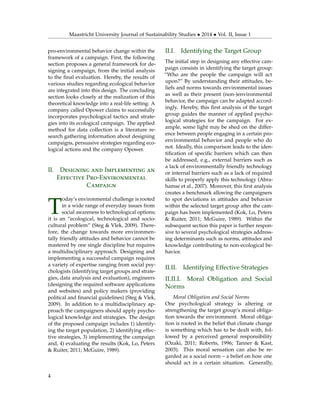
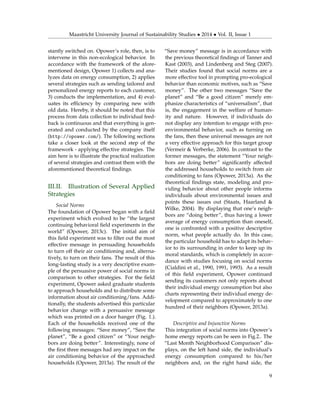
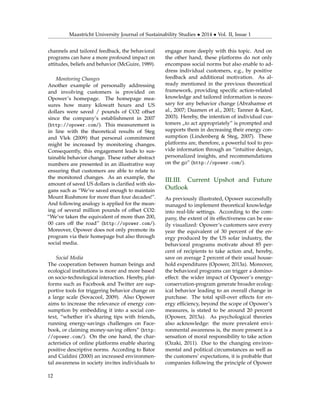
which was printed on a door hanger (Fig. 1.).
Each of the households received one of the
following messages: “Save money”, “Save the
planet”, “Be a good citizen” or “Your neigh-
bors are doing better”. Interestingly, none of
the first three messages had any impact on the
air conditioning behavior of the approached
households (Opower, 2013a). The result of the
“Save money” message is in accordance with
the previous theoretical findings of Tanner and
Kast (2003), and Lindenberg and Steg (2007).
Their studies found that social norms are a
more effective tool in prompting pro-ecological
behavior than economic motives, such as “Save
money”. The other two messages “Save the
planet” and “Be a good citizen” merely em-
phasize characteristics of “universalism”, that
is, the engagement in the welfare of human-
ity and nature. However, if individuals do
not display any intention to engage with pro-
environmental behavior, such as turning on
the fans, then these universal messages are not
a very effective approach for this target group
(Vermeir & Verberke, 2006). In contrast to the
former messages, the statement “Your neigh-
bors are doing better” significantly affected
the addressed households to switch from air
conditioning to fans (Opower, 2013a). As the
theoretical findings state, modeling and pro-
viding behavior about other people informs
individuals about environmental issues and
points these issues out (Staats, Haarland &
Wilke, 2004). By displaying that one’s neigh-
bors are “doing better”, thus having a lower
average of energy consumption than oneself,
one is confronted with a positive descriptive
norm, what people actually do. In this case,
the particular household has to adapt its behav-
ior to its surrounding in order to keep up its
moral standards, which is completely in accor-
dance with studies focusing on social norms
(Cialdini et al., 1990, 1991, 1993). As a result
of this field experiment, Opower continued
sending its customers not only reports about
their individual energy consumption but also
charts representing their individual energy de-
velopment compared to approximately to one
hundred of their neighbors (Opower, 2013a).
Descriptive and Injunctive Norms
This integration of social norms into Opower’s
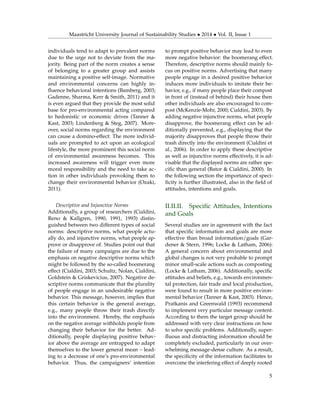
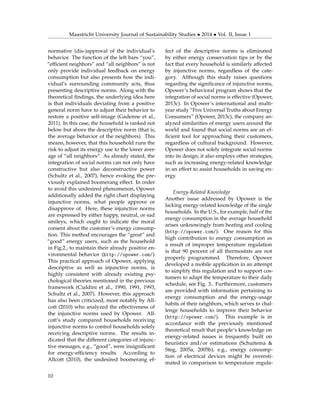
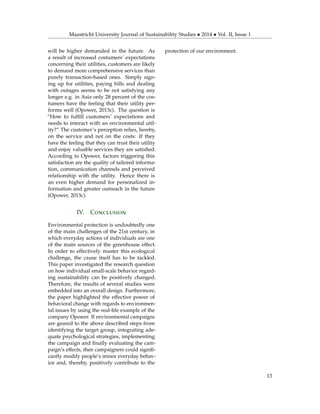
home energy reports can be seen in Fig.2.. The
“Last Month Neighborhood Comparison” dis-
plays, on the left hand side, the individual’s
energy consumption compared to his/her
neighbors and, on the right hand side, the
9
Maastricht University Journal of Sustainability Studies • 2014 • Vol. II, Issue 1
normative (dis-)approval of the individual’s
behavior. The function of the left bars “you”,
“efficient neighbors” and “all neighbors” is not
only provide individual feedback on energy
consumption but also presents how the indi-
vidual’s surrounding community acts, thus
presenting descriptive norms. Along with the
theoretical findings, the underlying idea here
is that individuals deviating from a positive
general norm have to adjust their behavior to
restore a positive self-image (Gadenne et al.,
2011). In this case, the household is ranked not
below but above the descriptive norm (that is,
the average behavior of the neighbors). This
means, however, that this household runs the
risk to adjust its energy use to the lower aver-
age of “all neighbors”. As already stated, the
integration of social norms can not only have
constructive but also deconstructive power
(Schultz et al., 2007), hence evoking the pre-
viously explained boomerang effect. In order
to avoid this undesired phenomenon, Opower
additionally added the right chart displaying
injunctive norms, what people approve or
disapprove of. Here, these injunctive norms
are expressed by either happy, neutral, or sad
smileys, which ought to indicate the moral
consent about the customer’s energy consump-
tion. This method encourages the “great” and
“good” energy users, such as the household
in Fig.2., to maintain their already positive en-
vironmental behavior (http://opower.com/).
This practical approach of Opower, applying
descriptive as well as injunctive norms, is
highly consistent with already existing psy-
chological theories mentioned in the previous
framework (Cialdini et al., 1990, 1991, 1993,
Schultz et al., 2007). However, this approach
has also been criticized, most notably by All-
cott (2010) who analyzed the effectiveness of
the injunctive norms used by Opower. All-
cott’s study compared households receiving
injunctive norms to control households solely
receiving descriptive norms. The results in-
dicated that the different categories of injunc-
tive messages, e.g., “good”, were insignificant
for energy-efficiency results. According to
Allcott (2010), the undesired boomerang ef-
fect of the descriptive norms is eliminated
by either energy conservation tips or by the
fact that every household is similarly affected
by injunctive norms, regardless of the cate-
gory. Although this study raises questions
regarding the significance of injunctive norms,
Opower’s behavioral program shows that the
integration of social norms is effective (Opower,
2013c). In Opower’s international and multi-
year study “Five Universal Truths about Energy
Consumers” (Opower, 2013c), the company an-
alyzed similarities of energy users around the
world and found that social norms are an ef-
ficient tool for approaching their customers,
regardless of cultural background. However,
Opower does not solely integrate social norms
into its design; it also employs other strategies,
such as increasing energy-related knowledge
in an effort to assist households in saving en-
ergy.
Energy-Related Knowledge
Another issue addressed by Opower is the
lacking energy-related knowledge of the single
households. In the U.S., for example, half of the
energy consumption in the average household
arises unknowingly from heating and cooling
(http://opower.com/). One reason for this
high contribution to energy consumption as
a result of improper temperature regulation
is that 90 percent of all thermostats are not
properly programmed. Therefore, Opower
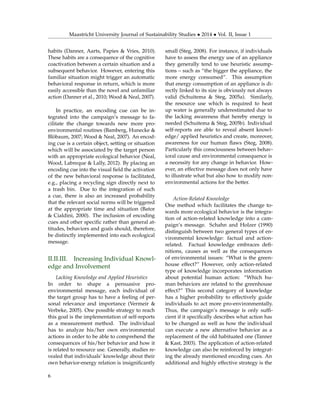
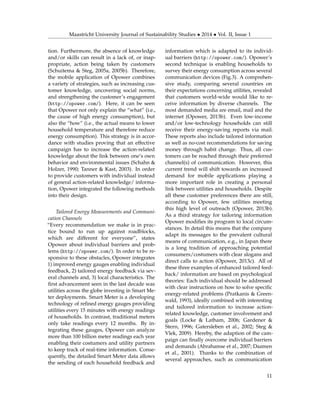
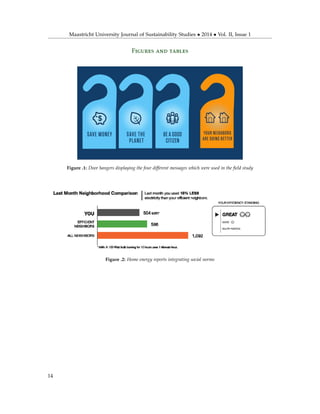
developed a mobile application in an attempt
to simplify this regulation and to support cos-
tumers to adapt the temperature to their daily
schedule, see Fig. 3.. Furthermore, customers
are provided with information pertaining to
energy consumption and the energy-usage
habits of their neighbors, which serves to chal-
lenge households to improve their behavior
(http://opower.com/). This example is in
accordance with the previously mentioned
theoretical result that people’s knowledge on
energy-related issues is frequently built on
heuristics and/or estimations (Schuitema &
Steg, 2005a, 2005b), e.g., energy consump-
tion of electrical devices might be overesti-
mated in comparison to temperature regula-
10
Maastricht University Journal of Sustainability Studies • 2014 • Vol. II, Issue 1
tion. Furthermore, the absence of knowledge
and/or skills can result in a lack of, or inap-
propriate, action being taken by customers
(Schuitema & Steg, 2005a, 2005b). Therefore,
the mobile application of Opower combines
a variety of strategies, such as increasing cus-
tomer knowledge, uncovering social norms,
and strengthening the customer’s engagement
(http://opower.com/). Here, it can be seen
that Opower not only explain the “what” (i.e.,
the cause of high energy consumption), but
also the “how” (i.e., the actual means to lower
household temperature and therefore reduce
energy consumption). This strategy is in accor-
dance with studies proving that an effective
campaign has to increase the action-related
knowledge about the link between one’s own
behavior and environmental issues (Schahn &
Holzer, 1990; Tanner & Kast, 2003). In order
to provide customers with individual instead
of general action-related knowledge/ informa-
tion, Opower integrated the following methods
into their design.
Tailored Energy Measurements and Communi-
cation Channels
“Every recommendation we make is in prac-
tice bound to run up against roadblocks,
which are different for everyone”, states
Opower about individual barriers and prob-
lems (http://opower.com/). In order to be re-
sponsive to these obstacles, Opower integrates
1) improved energy gauges enabling individual
feedback, 2) tailored energy feedback via sev-
eral channels and, 3) local characteristics. The
first advancement seen in the last decade was
utilities across the globe investing in Smart Me-
ter deployments. Smart Meter is a developing
technology of refined energy gauges providing
utilities every 15 minutes with energy readings
of households. In contrast, traditional meters
only take readings every 12 months. By in-
tegrating these gauges, Opower can analyze
more than 100 billion meter readings each year
enabling their costumers and utility partners
to keep track of real-time information. Conse-
quently, the detailed Smart Meter data allows
the sending of each household feedback and
information which is adapted to its individ-
ual barriers (http://opower.com/). Opower’s
second technique is enabling households to
survey their energy consumption across several
communication devices (Fig.3). A comprehen-
sive study, comparing several countries on
their expectations concerning utilities, revealed
that customers world-wide would like to re-
ceive information by diverse channels. The
most demanded media are email, mail and the
internet (Opower, 2013b). Even low-income
and/or low-technology households can still
receive their energy-saving reports via mail.
These reports also include tailored information
as well as no-cost recommendations for saving
money through habit change. Thus, all cus-
tomers can be reached through their preferred
channel(s) of communication. However, this
current trend will shift towards an increased
demand for mobile applications playing a
more important role in creating a personal
link between utilities and households. Despite
all these customer preferences there are still,
according to Opower, few utilities meeting
this high level of outreach (Opower, 2013b).
As a third strategy for tailoring information
Opower modifies its program to local circum-
stances. In detail this means that the company
adapt its messages to the prevalent cultural
means of communication, e.g., in Japan there
is a long tradition of approaching potential
consumers/costumers with clear slogans and
direct calls to action (Opower, 2013c). All of
these three examples of enhanced tailored feed-
back/ information are based on psychological
theories: Each individual should be addressed
with clear instructions on how to solve specific
energy-related problems (Pratkanis & Green-
wald, 1993), ideally combined with interesting
and tailored information to increase action-
related knowledge, customer involvement and
goals (Locke & Latham, 2006; Gardener &
Stern, 1996; Gatersleben et al., 2002; Steg &
Vlek, 2009). Hereby, the adaption of the cam-
paign can finally overcome individual barriers
and demands (Abrahamse et al., 2007; Daamen
et al., 2001). Thanks to the combination of
several approaches, such as communication
11
Maastricht University Journal of Sustainability Studies • 2014 • Vol. II, Issue 1
channels and tailored feedback, the behavioral
programs can have a more profound impact on
attitudes, beliefs and behavior (McGuire, 1989).
Monitoring Changes
Another example of personally addressing
and involving customers is provided on
Opower’s homepage. The homepage mea-
sures how many kilowatt hours and US
dollars were saved / pounds of CO2 offset
since the company’s establishment in 2007
(http://opower.com/). This measurement is
in line with the theoretical results of Steg
and Vlek (2009) that personal commitment
might be increased by monitoring changes.
Consequently, this engagement leads to sus-
tainable behavior change. These rather abstract
numbers are presented in an illustrative way
ensuring that customers are able to relate to
the monitored changes. As an example, the
amount of saved US dollars is clarified with slo-
gans such as “We’ve saved enough to maintain
Mount Rushmore for more than four decades!”.
And following analogy is applied for the mean-
ing of several million pounds of offset CO2:
“We’ve taken the equivalent of more than 200,
00 cars off the road” (http://opower.com/).
Moreover, Opower does not only promote its
program via their homepage but also through
social media.
Social Media
The cooperation between human beings and
ecological institutions is more and more based
on socio-technological interaction. Hereby, plat-
forms such as Facebook and Twitter are sup-
portive tools for triggering behavior change on
a large scale (Sovacool, 2009). Also Opower
aims to increase the relevance of energy con-
sumption by embedding it into a social con-
text, “whether it’s sharing tips with friends,
running energy-savings challenges on Face-
book, or claiming money-saving offers” (http:
//opower.com/). On the one hand, the char-
acteristics of online platforms enable sharing
positive descriptive norms. According to Bator
and Cialdini (2000) an increased environmen-
tal awareness in society invites individuals to
engage more deeply with this topic. And on
the other hand, these platforms do not only
encompass social norms but also enable to ad-
dress individual customers, e.g., by positive
feedback and additional motivation. As al-
ready mentioned in the previous theoretical
framework, providing specific action-related
knowledge and tailored information is neces-
sary for any behavior change (Abrahamse et
al., 2007; Daamen et al., 2001; Tanner & Kast,
2003). Hereby, the intention of individual cus-
tomers „to act appropriately” is prompted and
supports them in decreasing their energy con-
sumption (Lindenberg & Steg, 2007). These
platforms are, therefore, a powerful tool to pro-
vide information through an “intuitive design,
personalized insights, and recommendations
on the go” (http://opower.com/).
III.III. Current Upshot and Future
Outlook
As previously illustrated, Opower successfully
managed to implement theoretical knowledge
into real-life settings. According to the com-
pany, the extent of its effectiveness can be eas-
ily visualized: Opower’s customers save every
year the equivalent of 30 percent of the en-
ergy produced by the US solar industry, the
behavioral programs motivate about 85 per-
cent of recipients to take action and, hereby,
save on average 2 percent of their usual house-
hold expenditures (Opower, 2013a). Moreover,
the behavioral programs can trigger a domino-
effect: the wider impact of Opower’s energy-
conservation-program generate broader ecolog-
ical behavior leading to an overall change in
purchase. The total spill-over effects for en-
ergy efficiency, beyond the scope of Opower’s
measures, is stated to be around 20 percent
(Opower, 2013a). As psychological theories
also acknowledge: the more prevalent envi-
ronmental awareness is, the more present is a
sensation of moral responsibility to take action
(Ozaki, 2011). Due to the changing environ-
mental and political circumstances as well as
the customers’ expectations, it is probable that
companies following the principle of Opower
12
Maastricht University Journal of Sustainability Studies • 2014 • Vol. II, Issue 1
will be higher demanded in the future. As
a result of increased costumers’ expectations
concerning their utilities, customers are likely
to demand more comprehensive services than
purely transaction-based ones. Simply sign-
ing up for utilities, paying bills and dealing
with outages seems to be not satisfying any
longer e.g. in Asia only 28 percent of the cos-
tumers have the feeling that their utility per-
forms well (Opower, 2013c). The question is
“How to fulfill customers’ expectations and
needs to interact with an environmental util-
ity?” The customer’s perception relies, hereby,
on the service and not on the costs: If they
have the feeling that they can trust their utility
and enjoy valuable services they are satisfied.
According to Opower, factors triggering this
satisfaction are the quality of tailored informa-
tion, communication channels and perceived
relationship with the utility. Hence there is
an even higher demand for personalized in-
formation and greater outreach in the future
(Opower, 2013c).
IV. Conclusion
Environmental protection is undoubtedly one
of the main challenges of the 21st century, in
which everyday actions of individuals are one
of the main sources of the greenhouse effect.
In order to effectively master this ecological
challenge, the cause itself has to be tackled.
This paper investigated the research question
on how individual small-scale behavior regard-
ing sustainability can be positively changed.
Therefore, the results of several studies were
embedded into an overall design. Furthermore,
the paper highlighted the effective power of
behavioral change with regards to environmen-
tal issues by using the real-life example of the
company Opower. If environmental campaigns
are geared to the above described steps from
identifying the target group, integrating ade-
quate psychological strategies, implementing
the campaign and finally evaluating the cam-
paign’s effects, then campaigners could signifi-
cantly modify people’s minor everyday behav-
ior and, thereby, positively contribute to the
protection of our environment.
13
Maastricht University Journal of Sustainability Studies • 2014 • Vol. II, Issue 1
Figures and tables
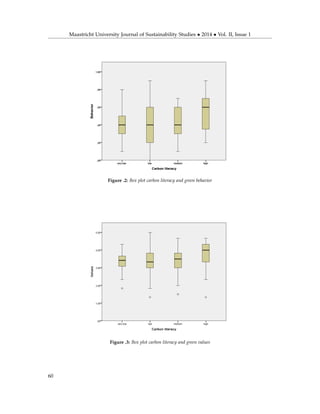
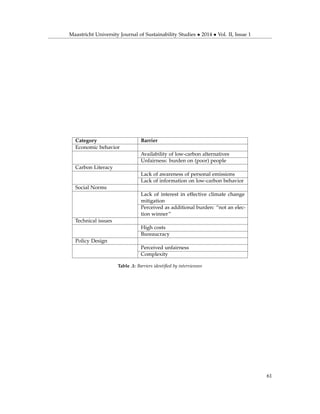
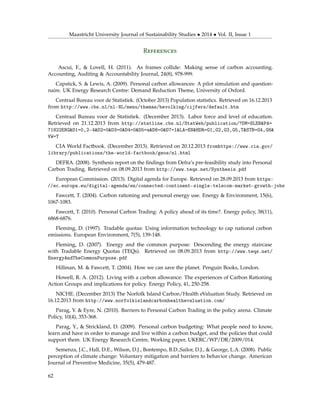
Figure .1: Door hangers displaying the four different messages which were used in the field study
Figure .2: Home energy reports integrating social norms
14
Maastricht University Journal of Sustainability Studies • 2014 • Vol. II, Issue 1
Figure .3: Tailored feedback and information via several communication channels
References
Abrahamse, W., Steg, L., Vlek, C., & Rothengatter, T. (2005). A review of intervention studies
aimed at household energy conservation. Journal of Environmental Psychology, 25(3), 273-291.
Abrahamse, W., Steg, L., Vlek, C., & Rothengatter, T. (2007). The effect of tailored information,
goal setting, and tailored feedback on household energy use, energy-related behaviors, and
behavioral antecedents. Journal of Environmental Psychology, 27(4), 265-276.
Allcott, H. (2011). Social norms and energy conservation. Journal of Public Economics, 95(9),
1082-1095.
Bamberg, S. (2003). How does environmental concern influence specific environmentally
related behaviors? A new answer to an old question. Journal of environmental psychology, 23(1),
21-32.
Bamberg, S., Hunecke, M. & Blöbaum, A.. (2007). Social context, personal norms and the use
of public transportation: Two field studies. Journal of Environmental Psychology, 27(3), 190-203.
Bartholomew, L. K., Parcel, G. S., & Kok, G. (1998). Intervention mapping: A process for
developing theory and evidence-based health education programs.Health Education & Behavior,
25(5), 545-563.
Bator, R., & Cialdini, R. (2000). The application of persuasion theory to the development of
effective proenvironmental public service announcements.Journal of Social Issues, 56(3), 527-542.
15
Maastricht University Journal of Sustainability Studies • 2014 • Vol. II, Issue 1
Cialdini, R. B. (2003). Crafting normative messages to protect the environment.Current
directions in psychological science, 12(4), 105-109.
Cialdini, R. B., Demaine, L. J., Sagarin, B. J., Barrett, D. W., Rhoads, K., & Winter, P. L. (2006).
Managing social norms for persuasive impact. Social influence, 1(1), 3-15.
Cialdini, R. B., Reno, R. R., & Kallgren, C. A. (1990). A focus theory of normative conduct:
Recycling the concept of norms to reduce littering in public places. Journal of personality and
social psychology, 58(6), 1015.
Cialdini, R. B., Reno, R. R., & Kallgren, C. A. (1991). A focus theory of normative conduct:
A theoretical refinement and reevaluation of the role of norms in human behavior. Advances in
experimental social psychology, 24(20), 1-243.
Cialdini, R. B., Reno, R. R., &. Kallgren, C. A. (1993). The transsituational influence of social
norms. Journal of personality and social psychology, 64(1), 104.
Cialdini, R. B., Demaine, L. J., Sagarin, B. J., Barrett, D. W., Rhoads, K., & Winter, P. L. (2006).
Managing social norms for persuasive impact. Social influence, 1(1), 3-15.
Costanzo, M., Archer, D., Aronson, E., & Pettigrew, T. (1986). Energy conservation behavior:
The difficult path from information to action. American psychologist, 41(5), 521.
Daamen, D. D., Staats, H., Wilke, H. A., & Engelen, M. (2001). Improving Environmental Be-
havior in Companies The Effectiveness of Tailored Versus Nontailored Interventions. Environment
and Behavior, 33(2), 229-248.
Danner, U. N., Aarts, H., Papies, E. K., & de Vries, N. K. (2011). Paving the path for habit change:
Cognitive shielding of intentions against habit intrusion. British journal of health psychology,
16(1), 189-200.
Flay, B. R., & Cook, T. D. (1989). Three models for summative evaluation of prevention
campaigns with a mass media component. Public communication campaigns, 2, 175-195.
Gadenne, D., Sharma, B., Kerr, D. & Smith, T. (2011). The influence of consumers’ environmen-
tal beliefs and attitudes on energy saving behaviours.Energy Policy, 39(12), 7684-7694.
Gardner, G. T., & Stern, P. C. (1996). Environmental problems and human behavior. Allyn &
Bacon.
Gatersleben, B., Steg, L., & Vlek, C. (2002). Measurement and determinants of environmentally
significant consumer behavior. Environment and Behavior,34(3), 335-362.
Kok, G., Lo, S. H., Peters, G. J. Y., & Ruiter, R. A. (2011). Changing energy-related behavior: An
Intervention Mapping approach. Energy Policy, 39(9), 5280-5286.
Lindenberg, S., & Steg, L. (2007). Normative, gain and hedonic goal frames guiding environ-
mental behavior. Journal of Social issues, 63(1), 117-137.
Locke, E. A., & Latham, G. P. (2006). New directions in goal-setting theory. Current Directions
in Psychological Science, 15(5), 265-268.
McGuire, W. J. (1989). Theoretical foundations of campaigns. Public communication campaigns,
2, 43-65.
McKenzie Mohr, D. (2000). New Ways to Promote Proenvironmental Behavior: Promoting
Sustainable Behavior: An Introduction to Community Based Social Marketing. Journal of social
16
Maastricht University Journal of Sustainability Studies • 2014 • Vol. II, Issue 1
issues, 56(3), 543-554.
Neal, D. T., Wood, W., Labrecque, J. S., & Lally, P. (2012). How do habits guide behavior?
Perceived and actual triggers of habits in daily life. Journal of Experimental Social Psychology,
48(2), 492-498.
Opower (2013a). Fitting a Square Peg into a Round Hole: Behavioral Energy Efficiency at Scale.
Retrieved from http://opower.com/company/library/white-papers
Opower (2013b). Is mobile turning into a missed opportunity? Retrieved from http://opower.
com/company/library/white-papers
Opower (2013c). Five Universal Truths about Energy Consumers. Retrieved from http:
//opower.com/company/library/white-papers
Ozaki, R. (2011). Adopting sustainable innovation: what makes consumers sign up to green
electricity?. Business Strategy and the Environment, 20(1), 1-17.
Pickett-Baker, J., & Ozaki, R. (2008). Pro-environmental products: marketing influence on
consumer purchase decision. Journal of Consumer Marketing,25(5), 281-293.
Pratkanis, A. R., & Greenwald, A. G. (1993). Consumer involvement, message attention, and
the persistence of persuasive impact in a message dense environment. Psychology & Marketing,
10(4), 321-332.
Roberts, J. A. (1996). Green consumers in the 1990s: profile and implications for advertising.
Journal of business research, 36(3), 217-231.
Schahn, J., & Holzer, E. (1990). Studies of Individual Environmental Concern The Role of
Knowledge, Gender, and Background Variables. Environment and Behavior, 22(6), 767-786.
Schuitema, G., & Steg, L. (2005a). Percepties van energieverbruik van huishoudelijke apparaten
(Perception of energy use of domestic appliances). Ontwikkelingen in het marktonderzoek.
Jaarboek, 2005, 165-180.
Schuitema, G., & Steg, L. (2005b). Factors that affect the acceptability of pricing policies in
transport. In 7th Nordic Environmental Social Science (NESS) Research Conference, Göteborg,
Sweden (pp. 15-17).
Schultz, P. W., Nolan, J. M., Cialdini, R. B., Goldstein, N. J., & Griskevicius, V. (2007). The
constructive, destructive, and reconstructive power of social norms. Psychological science, 18(5),
429-434.
Sovacool, B. K. (2009). Rejecting renewables: the socio-technical impediments to renewable
electricity in the United States. Energy Policy, 37(11), 4500-4513.
Steg, L. (2008). Promoting household energy conservation. Energy policy,36(12), 4449-4453.
Steg, L., & Vlek, C. (2009). Encouraging pro-environmental behaviour: An integrative review
and research agenda. Journal of Environmental Psychology, 29(3), 309-317.
Tanner, C., & Wölfing Kast, S. (2003). Promoting sustainable consumption: Determinants of
green purchases by Swiss consumers. Psychology & Marketing, 20(10), 883-902.
Verplanken, B., Aarts, H., & Knippenberg, A. (1998). Predicting behavior from actions in the
past: Repeated decision making or a matter of habit? Journal of Applied Social Psychology, 28(15),
1355-1374.
17
Maastricht University Journal of Sustainability Studies • 2014 • Vol. II, Issue 1
Vermeir, I., & Verberke, W., (2006) Sustainable Food Consumption: Exploring the Consumer
“Attitude – Behavioral Intention” Gap. Journal of Agricultural and Environmental Ethics, 19(2),
169-194.
Wood, W., & Neal, D. T. (2007). A new look at habits and the habit-goal interface. Psychological
review, 114(4), 843.
18
Maastricht University Journal of Sustainability Studies • 2014 • Vol. II, Issue 1
Hives of activity: Contestation and
coalitions around pesticides, policies
and pollinators
Michael Veale
Lucy Hunt
Juan Guevara
International Centre for Integrated assessment and Sustainable development (ICIS), Maastricht
University
Correspondence: michaelrveale@gmail.com
Abstract
Apian decline is a severe problem threatening ecosystems around the world. The exact reasons for it are as
yet unknown. In this atmosphere of uncertainty, some have blamed a widely used family of pesticides known
as neonicotinoids for the decline, while others claim that there is no evidence for the alleged effects. This
paper reviews the knowledge products that both coalitions use to support their claims, and identifies common
core policy beliefs held by each side. It argues that some unanswered questions with particularly uncertain
outcomes are systematically ignored by both coalitions in research and discussion, and that these areas are
crucial to understanding the true nature of the problem. Furthermore, it argues that the qualitative features
of prominent science policy boundary objects provide some insight into why cross-coalition progress has been
so slow. A facilitator perceived by both sides as impartial appears to be needed to achieve more consensus and
credible understanding about the issue, but questions persist regarding who could be accepted for this role.
I. Introduction
T
he issue of declining bee populations has
become an increasingly salient policy is-
sue in recent years. Pollinators, such as
bees, have been observed to be dwindling in
number in many regions of the world (vanEn-
gelsdorp et al., 2012; van der Zee et al., 2012).
If this trend continues, this is expected have se-
vere negative impacts on both agriculture and
natural ecosystems. New and old groups of ac-
tivists and researchers have been mobilised and
created with the specific aim of understanding
and communicating what they believe to be the
main causes of this decline, as well as lobbying
for relevant policy and behavioural change.
Recently, one particular practice has been
brought to attention and has been alleged to be
at least partly responsible for apian decline –
the use in varying forms of a chemical fam-
ily of insecticides known as neonicotinoids.
This caused a rise in the prominence both of
coalitions advocating precautionary regulatory
action against these products, and opposing
coalitions which have denied their relevance
to the problem, or requested further research
Submitted: 9 February 2014, accepted for publication: June 27 2014
19
Maastricht University Journal of Sustainability Studies • 2014 • Vol. II, Issue 1
in the field before action. These coalitions
further crystallised when the European Com-
mission (EC) initiated legislative action to ban
three common neonicotinoids, imidacloprid,
clothianidin and thiamethoxam, being used on
or in relation to the main bee-attractive crops
within the European Union (EU). At this point,
governments and other actors initially less in-
volved revealed their stance on both the issue
and the current state of the scientific literature.
Despite no qualified majority for or against the
legislation in the Council of Ministers, the na-
ture of the issue allows the EC to implement
immediate action, which it did with a ban that
entered into force at the beginning of Decem-
ber 2013, and will be reviewed in 2015.
This paper positions the actors in two main
coalitions, those in favour of an immediate
regulatory ban and those opposed. It examines
the use of information by these two coalitions,
and how their competing views and framings
of the problem, current research, and types
of knowledge interact to produce stances and
policy outcomes. We consider how the fram-
ings of the coalitions connect to their view of
research, and conceive each coalitions view
of what they know and don’t know using the
concepts of knowledge, nonknowledge and
negative knowledge. This allows us to con-
sider what each coalition think they know,
what they want to know, and what they don’t
want to or don’t think they can currently know,
and identify similarities between the coalitions
at deeper levels. We then move on to analyse
the approach and roles adopted by scientists
and organisations in four salient knowledge
products and three main science-policy inter-
face texts with some core frameworks largely
derived from the STS literature. We conclude
with discussing some of the key barriers to
communication and progress across the coali-
tion, and some comments on anticipated future
directions and disrupters of the current struc-
ture.
II. Problem Framing
II.I. Identifying and placing actors
The approach taken in this paper is the identi-
fication of coalitions and their environments in
line with the Advocacy Coalition Framework
(ACF), as adapted for European policy-making
(Sabatier, 1998). This framework combines the
literatures on policy implementation with the
literatures on technical knowledge used in pub-
lic policy, and therefore appears well-suited for
our case study. However, this paper is not a
full application of the framework, as it deals
mostly with a set of decisions made within a
short time period, largely beginning from a
series of acute apian poisoning in the south
of Germany in 2008, which brought the issue
into the policy arena. The ACF requires a more
longitudinal study of issue development over
a decade or more, while our case study is cer-
tainly only in an early phase of existence and
understanding. However, we seek to apply the
basic premise of the ACF: that the two main
causal drivers of policy change are changes
in the core values of coalition members, and
external perturbations.In the ACF, a coalition
is defined as a group of “actors from various
governmental and private organizations who
both (a) share a set of normative and causal
beliefs and (b) engage in a non-trivial degree of
co-ordinated activity over time” (Sabatier, 1998,
p. 103). They hold both deep-set normative
beliefs as well as less rigidly held policy core
beliefs, an example of the latter being the rela-
tive importance of economy to environment, or
the structure or causal connections of a prob-
lem. We identify two main coalitions in the
neonicotinoid debate: the first, which we call
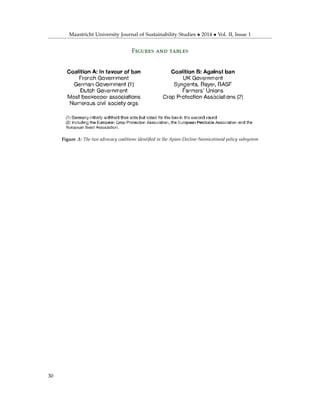
Coalition A, is in favour of the ban. They en-
vision the problem as mainly concerned with
long term agricultural and environmental is-
sues. The second, Coalition B, perceives the
problem as largely about medium term agricul-
tural and economic interests. Important mem-
bers of the two coalitions can be seen in Figure
1.
20
Maastricht University Journal of Sustainability Studies • 2014 • Vol. II, Issue 1
Coalition A includes several European gov-
ernments, for a variety of reasons. Some coun-
tries, like France, had already placed a ban
due to public support despite having powerful
farmers’ unions. Consequently, their position
has often been stated in terms of competitive
benefits of harmonised policy (EurActiv, 2013).
Germany’s position was less certain, as while
it had banned application of certain neonicoti-
noids on corn and maize following deaths of
managed bee colonies from acute poisonings
in 2008 (Benjamin, 2008), it is also the home of
one of the main manufacturers of this type of
pesticide, Bayer AG. This may explain its ab-
stention in the first round of voting on the ban
on March 15 2013, compared to its affirmative
vote in the final round on April 29 2013. The
Netherlands, one of the countries to first for-
mally request the European Commission to un-
dertake legislative action, declared themselves
in this coalition at an early stage (Dutch Dele-
gation to the Council of the European Union,
2013).
Coalition B includes the UK Government,
usually represented in publications by the De-
partment for Environment, Farming and Rural
Affairs (DEFRA); the main pesticide manufac-
turers including Bayer CropScience and Syn-
genta, the former turning over e697m from
neonicotinoid sales in 2007 (Garwood, 2010);
and farmers’ unions and crop protection asso-
ciations at national and supranational levels.
II.II. Issue framing by the identified
advocacy coalitions
We argue that the coalitions have shared core
policy beliefs, especially regarding the nature
and structure of the problem. While they may
individually have different priorities and pre-
cise beliefs, each coalition shares general con-
cerns about the ways the other coalition frames
the neonicotinoid debate. Consequently, their
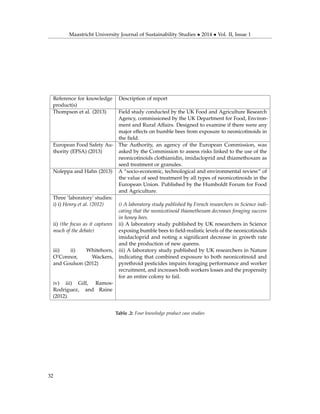
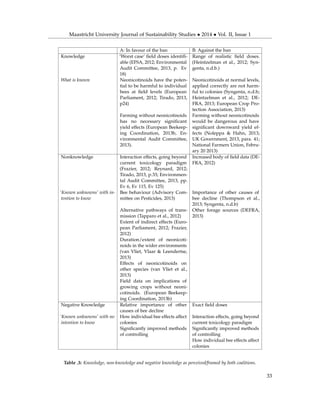
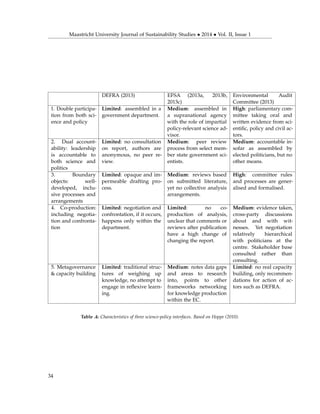
views are best visualised in a table, as coali-
tions are both defined by what they think and
what they do not think. Our tabular visualisa-
tion of the views of the two coalitions can be
found in Table 1. Both coalitions share general
concerns about the issue at hand. It is in no-
one’s benefit to see pollinator numbers decline,
as in addition to having intrinsic value, they
provide a crucial ecosystem service for agricul-
ture. The worldwide value of pollinators has
been placed at e153bn (Gallai, Salles, Settele
and Vaissière, 2009), although it has also been
claimed that our current understanding of the
role of pollinators means that many benefits
are unable to be quantified (Losey & Vaughan,
2006). Consequently, they have a shared def-
inition of the larger problem of reducing the
occurrence of pollinator decline. On more spe-
cific topics, divisions begin to appear. Coalition
A believes that the evidence indicating danger-
ous side-effects of neonicotinoid pesticides are
sufficient to warrant a European ban. They
emphasise indirect effects as well as acute di-
rect toxicity, such as reducing bees’ immune
capabilities, their homing or memory skills,
communication and foraging abilities. In gen-
eral, although some coalition members view
the problems through more complex lenses, a
large number see apian decline fundamentally
as a man-made problem, which equally has
relatively linear human solutions. Neonicoti-
noids are framed by this coalition as being a
central enabling factor to a large number of
identified causes of the decline, although it is
unclear to what extent this is a belief held by
all coalition members, and how much some
members are using this framing instrumentally
to support a ban they feel to be at least par-
tially constructive. Despite this lack of belief in
problem complexity, they tend to trust method-
ologically complex research, believing that the
current paradigm of proof of safety in toxicol-
ogy research is inadequate to demonstrate the
true dangers of many chemical products.
Coalition B, on the other hand, uses the un-
certainty present in current research to frame
the ban as a rushed and potentially economi-
cally damaging move with little or no proven
positive environmental consequences. Instead
of framing neonicotinoids as a central causal
factor, they point to other causes of decline,
both natural and man-made, such as habitat
21
Maastricht University Journal of Sustainability Studies • 2014 • Vol. II, Issue 1
loss, disease and weather. Coalition B fun-
damentally weights environmental precaution
less heavily than economic factors compared
to Coalition A. Consequently many of their
arguments are termed in the language of mon-
etary valuation, especially when compared to
reports produced by members of Coalition A.
Coalition B tends to express the belief that the
traditional methodologies and paradigms of
proving toxicological safety to the environment
are adequate to understand problems, and we
should be wary of drawing conclusions from
new methods, for example, those that extrapo-
late field conclusions from allegedly unrepre-
sentative lab results.
III. Knowledge products
III.I. Approach and methodology
In order to choose knowledge products to anal-
yse, we initially ran searches for the term
“neonicotinoids” and its respective transla-
tion(s) in French, German, Spanish and Dutch
through government websites we were aware
of, national and European parliamentary de-
bate records, and the ProQuest, Nexis and Fac-
tiva news databases. By reading the documents
we identified further stakeholder organisations
and reports that had not initially been raised
in our search. By the end of the search pe-
riod we had filed 380 journal articles, reports,
press releases, presentations and regulatory
documents. Some knowledge products, while
extensive, were not referenced heavily by key
actors, whereas others were referred to by the
actors that we initially noted to be important
in decision-making and problem framing. We
observed that four products were extensively
used, discussed and debated by actors on both
sides of the coalition. These are listed in Table
2.
III.II. Competitive knowledge claims
Competing knowledge claims exist both be-
tween actors and between the reports. Because
many of the knowledge products in this field
were either commissioned or funded by stake-
holder bodies, it is difficult to precisely de-
lineate the views of actors’ from the views of
researchers. We do not believe, however, that
an academic paper is the right venue for build-
ing allegations of bias, especially not without
primary interviews or communication with au-
thors and clients to establish story lines. In-
stead, we use concepts of meta-knowledge to
argue that many of the key disagreements be-
tween actors and research can be understood
through how each has understood the quality
of our nonknowledge and negative knowledge
surrounding neonicotinoid effects and pollina-
tor behaviour in general.
Nonknowledge (Gross, 2010) can be
thought of as knowledge about the extent of
not knowing, with an intention to explore it.
Actors gain nonknowledge in response to unex-
pected events, developments or demands. For
example, theories may be lacking to explain
certain phenomena or adequately develop hy-
potheses, or data insufficiencies may cause
large uncertainties in results, making them
uninterpretable. In a similar vein is the idea
of negative knowledge (Knorr-Cetina, 1999),
which is similar to nonknowledge but differs
insofar as actors do not wish to explore what
they do not know, because they may think it
futile, counterproductive or even dangerous
given their values and goals.
As discussed, the coalitions in favour of the
ban tend to believe that laboratory tests can
be extrapolated to field effects, and dispute
the findings and methodologies of field tests.
The coalition opposed to the ban argues the
opposite, that laboratory tests are unrealistic
and methodologically questionable, while field
tests represent real risks and are methodologi-
cally defensible. This divide is at the heart of
the debate on valid research, since high profile
laboratory tests (e.g. Gill, Ramos-Rodriguez,
22
Maastricht University Journal of Sustainability Studies • 2014 • Vol. II, Issue 1
& Raine, 2012; Henry et al., 2012; Whitehorn,
O’Connor, Wackers, & Goulson, 2012) have
demonstrated adverse affects, while high pro-
file field tests (Pilling, Campbell, Coulson, Rud-
dle, & Tornier, 2013; e.g. Thompson et al., 2013)
have concluded that there is no significant risk.
Table 3 shows examples how the differ-
ent coalitions classify topics as already known
(knowledge), not yet known but with intention
to know (nonknowledge), and not yet known
with no intention of knowing (negative knowl-
edge). We have provided evidence for the first
two categories, which is primarily found in
the parts of reports reviewing or consolidat-
ing knowledge, and the parts calling for fur-
ther research respectively. The final category
of negative knowledge is harder to locate and
evidence, due to its nature. Regarding nega-
tive knowledge, coalitions wish to reduce the
salience of such questions, due often to uncer-
tainty about how this knowledge may change
conclusions. Consequently, one major caveat
of our methodology is the heuristic identifi-
cation of the contents of this section, which
can be subject to the perspectives of individual
readers.
The first category of knowledge is quite
simply analysed. The coalitions represent two
diametrically opposite views and readings of
data. One set of claims from Coalition A argue
that we know ‘worst case’ field doses, and that
these doses are common enough to cause harm
to individual bees, which is a cause for concern.
Furthermore, there is no evidence that success-
ful farming requires neonicotinoids, and exam-
ples of countries where they have been banned
already, such as Italy, are given to support this.
The claims from Coalition B note that general
field doses, which are what we should base risk
assessments on, are within a known, safe range
to colonies. Moreover, farming without neoni-
cotinoids would be riskier and less productive,
and not necessarily beneficial to bees. Australia
is often cited as an example of a country where
neonicotinoids are used heavily but bees are
flourishing, arguably due to the lack of the var-
roa mite. The disputes between these claims
are twofold. Firstly, there is an argument over
which data, examples and methodologies are
reliable, which result in data claims. Secondly,
there is an argument about framing. This is
most clearly seen in the way that Coalition
A points to data of individual bee harm, and
Coalition B uses data pointing to colony safety.
This will be returned to shortly.
The second and third categories of non-
knowledge and negative knowledge become
more strategic in nature. These represent tac-
tics which are beneficial for each coalition. Ar-
eas of nonknowledge are in this case areas
where coalitions hold prior beliefs about what
exploration of these areas would show, and
wish to explore these areas to gain knowledge
that can support both their strategic positions
and their cognitive framework. Nonknowledge
for each coalition is often a direct extension of
their own perceived knowledge. For exam-
ple, Coalition A indicates wishes to further
explore bee behaviour, alternative pathways of
transmission, and interaction effects, as these
under-researched areas have shown promise of
highlighting methodological problems in field
trials. Coalition B highlights other research
directions, such as how far bees avoid neoni-
cotinoid forage sources, and alternative causes
of decline, as these often undermine laboratory
trials’ claims to field-relevance.
Finally, negative knowledge indicates ar-
eas which are not currently known about, but
a coalition is actively avoiding pursuing re-
search into. This is likely because the expected
conclusions have an unacceptably high per-
ceived chance of being contrary to a coalition’s
argumentation and worldview. Interestingly,
perhaps due to the high uncertainty in these
areas, both coalitions share topics in this cat-
egory. We could not find evidence of a coali-
tion seeking to pursue research in how individ-
ual bees affect their colonies, which has been
noted to be a large gap in knowledge (Cress-
well & Thompson, 2012). This is intuitive: little
knowledge exists on the intricacies of complex
systems like bee colonies, so predicted results
from research, if it were at all possible, would
23
Maastricht University Journal of Sustainability Studies • 2014 • Vol. II, Issue 1
be unclear. To find that individual bee death
do not endanger colonies would largely un-
dermine the laboratory studies, which have
shown stronger evidence for individual level
effects than colony collapse. Equally, to find
that they do would cast the credibility of all
contradictory field studies into doubt. This is
an interesting finding, because it indicates that
advocacy coalitions, who often wield signifi-
cant funds for scientific research, may actively
wish to neglect the more complex, foggy and
uncertain questions in a field.
III.III. Differing roles of scientists
Scientists take many roles, both independently
and in relation to policy. As independent re-
searchers, Stokes (1997) classifies those solely
interested by use, such as Thomas Edison,
those solely interested in basic research for re-
search’s sake, such as Niels Bohr, and those
who conduct ‘use-inspired basic research’ such
as Louis Pasteur. Pielke Jr (2007) argues for a
typology in four parts: pure scientists disin-
terested in policy, science arbiters answering
specific questions posed by policymakers, issue
advocates who limit scope of choice by using
scientific research and/or authority to advance
particular ideas they believe in, and honest bro-
kers, who widen the scope of choice for policy-
makers by linking research to different paths
of action. Jasanoff (1987) notes that the percep-
tion and definition of science’s objective nature
and its link to policy is inherently political
and constantly redrawn by both scientists who
may see politicisation as potentially endanger-
ing their cognitive authority and policymakers,
who often strategically demand arrangements
allowing ‘science’ to legitimise policy in uncer-
tain, grey areas. Finally, Cash et al. (2003) pro-
vide a useful framework of salience, credibility
and legitimacy, with which to analyse the suc-
cess and acceptability of knowledge products.
Since all of our case studies are chosen based
on salience, we focus here on credibility and
legitimacy. We take the lexicon of these frame-
works to analyse our four knowledge products
(see Table 2) in an attempt to conceive both
some of the roles that scientists are taking, and
the roles they are perceived as taking.
III.III.I. Thompson et al. (2013)
This study was carried out with the explicit
intention of field testing the laboratory-based
conclusions of Whitehorn et al. (2012) that
neonicotinoids have a an effect on colony
growth and queen production. To this extent, it
is clear that it is a report that seeks to contribute
to basic knowledge on this topic. Indeed, the
study claims that there were at time of publish-
ing “no published field data evaluating such
effects on bee species other than honeybees”
(Thompson et al., 2013, para. i). Yet in addi-
tion to this, it is a document which has been
produced with policy relevance in mind. The
initial publication on the FERA website was
in March 2013, which coincided with the vot-
ing rounds in the European Union on March
15 and April 29. The report states that peer
review was opted out of for this publication,
as “it was considered that the data should be
available for review in a shorter timescale than
is achievable through peer reviewed publica-
tion”. In this sense, the report already indicates
a trade-off being made across the worlds of sci-
ence and policy. This would perhaps initially
place them in the position of a science arbiter,
answering the question provided by DEFRA,
and undertaking use-inspired basic research,
with the use being that of regulatory advice.
However, other actors have perceived the
roles that the researchers took differently.
These actors, many of which exhibit views or
conclusions consistent to those described of
Coalition A, seek to cast doubt upon the cog-
nitive authority of the FERA scientists in two
ways.
Firstly, they question the credibility of their
findings. The Advisory Committee on Pesti-
cides, which is an UK government body com-
prised of experts, the House of Commons En-
vironmental Audit Committee and the EFSA
24
Maastricht University Journal of Sustainability Studies • 2014 • Vol. II, Issue 1
all concluded that the report’s conclusion of no
risk was difficult to justify. The reasons given
were the report being hastily set up in the two
weeks following the EFSA report, it being diffi-
cult to reproduce due to problems with the con-
trol colonies being introduced at a later date,
and some colonies being larger or more devel-
oped at introduction (Advisory Committee on
Pesticides, 2013; Environmental Audit Commit-
tee, 2013; EFSA 2013). Dr Lynn Dicks noted
before the study was concluded that the abil-
ity to draw conclusions would be confounded
by non knowledge about bee behaviour (En-
vironmental Audit Committee, 2013), and the
Advisory Committee on Pesticides noted the
same after completion (Advisory Committee
on Pesticides, 2013). All in all, given the sub-
ject matter and time-frame, many of the critical
actors appear to claim that role of FERA as sci-
ence arbiter is to answer, in the words of Wein-
berg (1972), “questions which can be asked of
science and yet which cannot be answered of
science”. While this may still mean we con-
sider the FERA scientists as science arbiters, it
also raises the possibility that they are acting,
either knowingly or unknowingly, as issue ad-
vocates. The implication of this would be that
they either knowingly over-inferred from their
data, or that the inconclusive results arising
from DEFRA’s ‘grey area’ hasty questioning
were intended to be used strategically, render-
ing them unintentional stealth issue advocates,
in Pielke Jr’s words. The Guardian newspaper
also argued that the report would be unlikely
to be accepted into a peer-reviewed journal
(Carrington, 2013a). The use of this research
is widely used within Coalition B. B member
Syngenta cites the report prominently on the
front page of the website, The Plight of the
Bees, as a report that “confirms that there is no
significant link between neonics and bumble
bees” (Syngenta AG, n.d.a).
Secondly, they question the legitimacy of
their findings. An article in the Guardian, a
debate in the House of Lords and public rela-
tions material from the European Beekeeping
Coordination all question the appropriateness
of the announcement of the move of the lead
author from her career as a UK civil servant
to scientist for the neonicotinoid manufacturer
Syngenta three months after the publication of
the FERA report (Carrington, 2013b; European
Beekeeping Coordination, 2013a; Hansard, 30
July 2013 col 1636).
III.III.II. Noleppa and Hahn (2013)
This study by the Humboldt Foundation for
Food and Agriculture e.V. (HFFA) examines
the economic effect of ceasing neonicotinoid
use on crops within the European Union. It
concludes that there are high costs to abandon-
ing the use of neonicotinoids, and it may have
an upward effect on food prices.
Criticism once again targeted both credi-
bility and legitimacy. In terms of credibility,
Coalition A members Pesticide Action Network
Europe claimed that the valuation method was
questionable, while the Soil Association noted
that the report did not place a value on pollina-
tors, which it claims are worth three times as
much as the estimates of the costs of neonicoti-
noid abatement (Environmental Audit Com-
mittee, 2013, para. 68).
In terms of legitimacy, much criticism was
focused in this area. The publisher, HFFA
was established only in 2009 with direct fund-
ing from Bayer AG (von Witzke, Noleppa &
Schwartz, 2009), and now acknowledges ad-
ditional support from Syngenta AG, the Euro-
pean Crop Protection Association, KWF Seed
and BASF SE (HFFA, n.d.), all of whom fall
strongly in Coalition B. The report has a sep-
arate website, neonicreport.com, containing
videos about neonicotinoid use and links to
several Coalition B members. Consequently,
David Goulson, a professor at the University
of Sussex (then at University of Stirling) de-
scribed it as “laughable propaganda” with “no
basis in fact” (Stafford, 2013). Corporate Eu-
rope Observatory, a research and campaign
group examining corporate lobbying in the EU,
attempted to show Bayer and Syngenta both at-
tempting to portray the HFFA as a pure science
25
Maastricht University Journal of Sustainability Studies • 2014 • Vol. II, Issue 1
organisation, whereas they believed it to be a
stealth issue advocate, basing their claim on a
lack of acknowledgement of funding sources
in some letters from Syngenta and Bayer cit-
ing the Noleppa and Hahn report (Corporate
Europe Observatory, 2013). The House of Com-
mons Environmental Audit Committee (2013)
also noted that the HFFA was asked to con-
sider the economic effects of a ban on all neon-
icotinoids, rather than just those in the pro-
posed EU legislation, for the proposed banned
purposes. They fundamentally claim that the
HFFA, in its role as science arbiter, is acting as
a stealth issue advocate by feigning the produc-
tion of policy relevant research to its client’s
own ends. Syngenta however argue that fund-
ing does not cause bias and undermine cog-
nitive authority, writing on their website that
“research directly or indirectly paid for” by any
stakeholders is not "discredited just because of
the source of its funding. Some of this research
is important and useful”.
Potentially in response to these credibility
and legitimacy concerns, DEFRA revealed in
a Freedom of Information Request that they
are currently working on their own economic
valuation of neonicotinoid abatement as part
of an impact assessment to be published in
April 2014 (DEFRA, personal communication,
December 2, 2013).
III.III.III. European Food Safety Au-
thority (EFSA) (2013a, 2013b, 2013a)
The European Food Safety Authority (EFSA),
an EC agency, aims to be an “independent
source of scientific advice and communication
on risks associated with the food chain”. In
2012 the EC asked the EFSA to perform an as-
sessment of the risks the three main neonicoti-
noid pesticides pose to bees and their colonies.
The report, delivered in three parts represent-
ing the three substances on January 16 2013,
synthesised submitted studies, concluding in
a press release that “only uses on crops not
attractive to honey bees were considered ac-
ceptable” (EFSA, 2013d). Despite identifying
significant data gaps and uncertainties, the EC
used this report as the main justification for the
two-year ban that started in December 2013.
In regard to legitimacy, Coalition B mem-
bers Syngenta and the European Crop Protec-
tion Association (ECPA, 2013) argued that the
EFSA was not representative in its choice of re-
ports. Syngenta claimed the EFSA ignored all
field studies they submitted, since they exhib-
ited “non-compliance” with the review criteria
due to not representing the worst case scenar-
ios (Ashurst LLP, 2013). In addition, they claim
that the EFSA allowed only ten days instead
of the usual thirty for submitting a response
to the risk assessment, which Syngenta ad-
hered to, and yet a call for “swift and decisive
action” was made by the Commision eleven
days later, leading Syngenta to believe their
response was “disregarded” (Syngenta, Febru-
ary 8 2013). Furthermore, Coalition B mem-
bers DEFRA (Environmental Audit Committee,
2013, Q596), the National Farmers Union (Na-
tional Farmers Union, February 20 2013) and
Syngenta argue that the EFSA misrepresented
its report in its press release, going beyond
its mandate in deciding what is “acceptable”
or not. Syngenta was particularly concerned
about misrepresentation of the extent of risk
from its thiamethoxam product, noting that
the widespread use of this press release was
damaging (Syngenta, January 15 2013). In le-
gitimacy terms, the EFSA has been accused
of acting as a stealth issue advocate deliber-
ately ‘doing bad science’ and misrepresenting
its results.
Credibility is an area that is more broadly
targeted. Coalition B members claim the re-
port is overly conservative (Campbell, 2013),
overly theoretical (European Seed Association,
2013; Syngenta, 2013) and rushed (Environ-
mental Audit Committee, 2013, para. 71). The
result coming down in favour of banning neon-
icotinoids has been claimed to be biased, as
evidence indicating harm is “easily accepted”,
while evidence indicating safety is “subject to
deep scrutiny” (Campbell, 2013 p. 55).
The EFSA identified many ‘data gaps’ and
26
Maastricht University Journal of Sustainability Studies • 2014 • Vol. II, Issue 1
uncertainties in each risk assessment, and were
required to compile a lot of evidence that may
be contradictory. The controversy around their
centres worries that they have attempted to
“banish” uncertainty rather than communicate
it, which is unsuited to areas where the politi-
cal stakes are high and the uncertainties large
and varied (Funtowicz & Ravetz, 1993). As-
suming the role of a science arbiter for the
European Commission in a situation like this
may be inappropriate, as complex questions of
risk are inherently questions of societal values
(Giddens, 1999). Instead, a role of an honest
broker may be more appropriate, widening
the scope of choice and communicating uncer-
tainty along with possible paths of action to
both reduce it and make relevant policy. How-
ever, this is easier said than done, as has been
shown with the difficulties and criticism the
Intergovernmental Panel on Climate Change
has faced in spite of the efforts it has made to
communicate uncertainty in innovative ways
(Patt & Dessai, 2005).
III.III.IV. Henry et al. (2012)
The Henry et al. (2012) paper is an example of
a number of papers published in high-impact
scientific journals in 2012 regarding bees and
neonicotinoids (see also Gill et al., 2012; White-
horn et al., 2012). This paper was one of the
main reasons for the European Commission to
request the EFSA to produce the risk assess-
ment report discussed above (EFSA, 2012). This
paper can be considered to have been produced
on a largely pure science basis, by university re-
searchers seeking to publish studies. However,
it can also be considered as use-inspired. The
word “common” in the title, “A common pesti-
cide decreases foraging success and survival in
honey bees” is one sign that this research was
done with the situation on the ground strongly
in mind.
Legitimacy of the research itself has not been
very highly criticised in this case. Most of
the legitimacy criticisms have been levelled at
those using the research. Syngenta, for exam-
ple, claims that the paper is a “good example
of research being misused” by the French gov-
ernment (Syngenta, n.d.b). Other actors, such
as David Goulson at the University of Sussex,
have defended its legitimacy against perceived
attacks, stating that they “are published in the
best journals in the world ... have been through
an excruciatingly tough peer review process
... Which group of studies would you trust?”
(Goulson, 2013).
Credibility on the other hand was much
more hotly disputed. A report produced by
Bayer that was unpublished but was deliv-
ered to boundary institutions such as the Con-
gressional Research Service in the US (Sci-
erow, Johnson & Corn, 2012, p.27) claimed
that Henry et al. tested bees at dosages “over
twenty times greater than a worst-case esti-
mate of the acute oral dose that is field rel-
evant” (Heintzelman, Kelly, Fischer & Maus,
2012, p.1). Syngenta on their website put this
objection more informally, claiming that “dose
rate was so high and the period of exposure so
short that it would have been equivalent to a
person consuming 5 bottles of wine in a day
instead of just a glass” (Syngenta, n.d.b). Other
researchers however are critical of the objec-
tion of Heintzelman et al., claiming that their
concern “is based on an unnamed estimated
level derived from an unnamed acute dose for
reduction in foraging flights. This violates the
standard practice of giving the authors or any
other reader the option to refute any calculated
dose raised as an objection by checking the
calculation for themselves” (Frazier, 2012, p.3).
Coalition B member DEFRA raise related con-
cerns to fellow members Bayer and Sygenta,
claiming that the credibility of the report is
limited to an “unusually extreme case”, not
one that is “average or normal” (DEFRA, 2013,
p.3). As it can be seen here, coalitions do not at-
tempt to hijack or discredit these papers based
on the role of the scientist, since that remains
relatively agreed upon between coalitions as
a pure, use-inspired position. Instead, the de-
bate largely falls to the previously discussed
divides between the coalitions on stated core
beliefs.
27
Maastricht University Journal of Sustainability Studies • 2014 • Vol. II, Issue 1
III.IV. Science–policy interfaces
There are many science-policy interfaces active
in this case, which connect research and scien-
tific thought to policy options and approaches.
A key issue is both how far they are accepted
by all actors, and how far they are perceived
as falling into a particular coalition. We fo-
cus on boundary texts, which are one type
of boundary work, and argue that two of the
main interfaces – the DEFRA policy text “An
assessment of key evidence about Neonicoti-
noids and bees” and the EFSA policy report
discussed in 3.3.3 – are considered too partial
to be at the boundary of the whole issue, and
instead are considered communication from
coalitions B and A respectively. A third re-
port, the report from the UK Parliament Envi-
ronmental Audit Committee, has not been at-
tacked or accused of bias despite coming down
in favour of the ban, yet has also not managed
to extensively influence views. We argue that
this is because it better approximates Hoppe’s
(2010) conditions (see Table 4) for successful
boundary arrangements.
DEFRA (2013) summarises and weighs the
three laboratory studies in laboratory against
five field studies, which are represented by
Thompson et al. (2013), in an attempt to com-
municate the state of the knowledge in a five-
page policy-relevant document. However, it
is not only the report’s strong preference for
the results and methodology of the criticised
DEFRA-commissioned study that cause con-
cern about its acceptability. The text’s construc-
tion occurred within the department, behind
closed doors, and in an unclear ad-hoc arrange-
ment. Co-production and double participation
were minimal, perhaps why the report cites
Thompson et al. (2013) as “representative” of
four other field experiments. Goulson (2013)
notes this is incorrect as two contain only field
observations and no experiments at all and
one contains no new data whatsoever. In gen-
eral, the report, while claiming to work on
the boundary of science and policy, both falls
firmly and is perceived to be within the belief
structures of Coalition B, and therefore cannot
straddle the entire issue. EFSA (2013a, 2013b,
2013c), as mentioned in 3.3.3, serves as a re-
search synthesis of studies. As shown in Table
4, it performs better than DEFRA due to a more
inclusive process with a larger variety of ex-
perts, peer review and comment structures, as
well as direct links to flexible EC research fund-
ing. However, the exercise is not fully open,
the actual analysis is not co-produced, and
there were worries, especially from Coalition B,
about the clout of research being linked to the
results. Subsequently, despite its central, pan-
European position, the EFSA has been widely
perceived as a Coalition A actor, and an illegit-
imate forum for broadly accepted knowledge
production and communication.
The final report, from the Environmental
Audit Committee (2013), took written and oral
evidence from a wide variety of actors. This
evidence was assembled by members of Parlia-
ment, who themselves have legitimacy through
a political mandate. Consequently, despite
the recommendations of the committee’s re-
port resembling the EFSA’s to a certain degree,
and the report being publicised and salient,
we could find no examples of it being framed
as illegitimate. However, similarly, there is lit-
tle evidence that it changed the views of any
key coalition actors. Jasanoff (2005) uses the
example of biotechnology to argue that negoti-
ated, state-led committee systems such as this
committee may generate knowledge that is ac-
cepted more readily by the public. However,
public knowledge creation in the US is more
pluralistic and less service-based. Those struc-
tures can create legitimacy in the eyes of pri-
vate actors who hold relatively large stakes, but
may fail to convince the public. While the En-
vironmental Audit Committees report may be
legitimate in the eyes of the public and there-
fore difficult for any coalition to delegitimise,
it is important to consider too the set of actors
that a report must be legitimate to, in order to
reach agreement. In the case of neonicotinoids,
compromise between the coalitions has to be
reached, rather than simply public consensus.
Fundamentally, while the Environmental Audit
28
Maastricht University Journal of Sustainability Studies • 2014 • Vol. II, Issue 1
Committee is a step in the right direction, there
are currently no boundary actors that truly are
perceived as existing between the coalitions,
able to create a focal point for co-operation,
contestation and consensus-building.
IV. Conclusion
As this issue is still ongoing, it is difficult to
reach strong conclusions about any future di-
rection now. As one columnist in Nature wrote,
the current ban will, more than anything else
“buy some time” for more research on the sub-
ject (Dicks, 2013, p. 283). Yet we can draw a
few points out of our analysis which both help
understand the situation and may be useful
recommendations for the future.
Firstly, the shared negative knowledge pos-
sessed by both coalitions strongly hinders un-
derstanding of the subject. These topics, which
both sides have incentives to keep off the ta-
ble lest they discover something which under-
mines their carefully constructed argumenta-
tion and beliefs, are under-researched, under-
funded and generally lack salience. There is a
strong role for a central actor outside of coali-
tion to promote and fund research in areas of
scaling bee effects to colony effects, and devel-
oping understanding that help us better control
in the field – for example, developing method-
ologies to mapping pesticide use on nearby
fields to identify potential test sites. However,
there are of course caveats here. Both endeav-
ours are complex: negative knowledge is not
just something you might not wish to know,
but also something you think you cannot know.
To that extent, resolving conflict through better
understanding the evidence may be limited by
our current ability to understand these topics.
Secondly, there is no easily identifiable ac-
tor which has a central, international and cross-
sectoral role, yet has not arguably placed them-
selves in a coalition. The European Commis-
sion would be a prime candidate, yet its percep-
tion of being one-and-the-same as the EFSA,
and adding a political spin to research, means
it is no longer able to act as a facilitator both
on the boundary of science and policy, and
between coalitions with divergent views. The
UK Parliament had a strong and admirable
attempt to produce a report, yet that report
may, for the reasons discussed above, be more
convincing for the public than for stakeholders.
Progress on understanding and interpreting
the evidence may be made if such a facilitator
could be found, or if the European Commis-
sion is able to create a forum for debate where
it is not perceived as a partisan actor.
Thirdly, the divide in knowledge is quite a
neat one, given the divisions between ‘labora-
tory’ and ‘field’ studies coinciding with the re-
sults. While this divide arises somewhat from
methodological differences, it is not so clear
that it is a particularly robust relationship. The
coalitions are likely to be shaken up, were rep-
utable field studies to show positive effects, or
laboratory studies negative ones.
To conclude – unlike many complex prob-
lems, everyone agrees that bees are important.
The real debate here is about the knowledge,
and policy’s responses to and interpretations
of ‘the science’. We have illustrated the key di-
vides in thought, and shown how until certain
under-researched topics are examined, there is
little hope for the debate to be resolved with
‘brute force’ of evidence. Instead, an arena is
required where this problem can be thought of
as a puzzle rather than a political debate. Frus-
tratingly, there is no key actor that is currently
well positioned to facilitate such a collabora-
tive zone. Time will tell how the tensions and
adversarial positions will resolve themselves
or develop further. However, it is clear that
agreement on the validity of this issue, and the
consequent approach to be taken, will require
techniques of discussion and engagement that
have so far been conspicuous by their absence.
29
Maastricht University Journal of Sustainability Studies • 2014 • Vol. II, Issue 1
Figures and tables
Figure .1: The two advocacy coalitions identified in the Apian-Decline-Neonicotinoid policy subsystem
30
Maastricht University Journal of Sustainability Studies • 2014 • Vol. II, Issue 1
Core policy belief Coalition A: In favour of the ban Coalition B: Against the ban
Shared problem statement Pollinator decline is threatening
global agriculture
Pollinator decline is threatening
global agriculture
Specific problem state-
ment
Negative long term agricultural
and environmental effects arise
due to neonicotinoids’ effects on
bee colonies
Agricultural competitiveness is
threatened by a ban on neonicoti-
noid pesticides
View on uncertainty Uncertainty means precaution
should be taken
Agricultural competitiveness is
threatened by a ban on neonicoti-
noid pesticides
Focus of arguments Environmental arguments, polli-
nator decline
Economic arguments, food inse-
curity and price increases
Causes of apian decline Neonicotinoids both as direct
cause and/or indirectly facilitat-
ing other factors
A myriad of factors
View on pesticides in gen-
eral
1.minimal, best avoided 1. newer pesticides crucial for
food safety and security
2. potentially dangerous for hu-
man health
2. must be correctly applied
3. potential danger from replac-
ing [neonicotinoids] with older
products
View on body of research Adequate to demonstrate di-
rect/indirect effects on bees
Inadequate logical upscaling
from individual bee effects in the
laboratory to colony effects in
the field
Choice of policy instru-
ment
European ban as a minimum
standard
More focussed (EU) efforts on
apian nutrition, viruses and
habitat loss
More focussed (EU) ef-
forts on apian nutrition,
viruses and habitat loss
High, as many related issues
solvable with command and con-
trol style ban
Low, due to no core problem
causing apian decline
Table .1: Core policy beliefs of the two identified coalitions
31
Maastricht University Journal of Sustainability Studies • 2014 • Vol. II, Issue 1
Reference for knowledge
product(s)
Description of report
Thompson et al. (2013) Field study conducted by the UK Food and Agriculture Research
Agency, commissioned by the UK Department for Food, Environ-
ment and Rural Affairs. Designed to examine if there were any
major effects on bumble bees from exposure to neonicotinoids in
the field.
European Food Safety Au-
thority (EFSA) (2013)
The Authority, an agency of the European Commission, was
asked by the Commission to assess risks linked to the use of the
neonicotinoids clothianidin, imidacloprid and thiamethoxam as
seed treatment or granules.
Noleppa and Hahn (2013) A “socio-economic, technological and environmental review” of
the value of seed treatment by all types of neonicotinoids in the
European Union. Published by the Humboldt Forum for Food
and Agriculture.
Three ‘laboratory’ studies:
i) i) Henry et al. (2012) i) A laboratory study published by French researchers in Science indi-
cating that the neonicotinoid thiamethoxam decreases foraging success
in honey bees.
ii) (the focus as it captures
much of the debate)
ii) A laboratory study published by UK researchers in Science
exposing bumble bees to field-realistic levels of the neonicotinoids
imidacloprid and noting a significant decrease in growth rate
and the production of new queens.
iii) ii) Whitehorn,
O’Connor, Wackers,
and Goulson (2012)
iii) A laboratory study published by UK researchers in Nature
indicating that combined exposure to both neonicotinoid and
pyrethroid pesticides impairs foraging performance and worker
recruitment, and increases both workers losses and the propensity
for an entire colony to fail.
iv) iii) Gill, Ramos-
Rodriguez, and Raine
(2012).
Table .2: Four knowledge product case studies
32
Maastricht University Journal of Sustainability Studies • 2014 • Vol. II, Issue 1
A: In favour of the ban B: Against the ban
Knowledge ‘Worst case’ field doses identifi-
able (EFSA, 2012; Environmental
Audit Committee, 2013, p. Ev
18)
Range of realistic field doses.
(Heintzelman et al., 2012; Syn-
genta, n.d.b.)
What is known Neonicotinoids have the poten-
tial to be harmful to individual
bees at field levels (European
Parliament, 2012; Tirado, 2013,
p24)
Neonicotinoids at normal levels,
applied correctly are not harm-
ful to colonies (Syngenta, n.d.b;
Heintzelman et al., 2012; DE-
FRA, 2013; European Crop Pro-
tection Association, 2013)
Farming without neonicotinoids
has no necessary significant
yield effects (European Beekeep-
ing Coordination, 2013b, En-
vironmental Audit Committee,
2013).
Farming without neonicotinoids
would be dangerous and have
significant downward yield ef-
fects (Noleppa & Hahn, 2013;
UK Government, 2013, para. 41;
National Farmers Union, Febru-
ary 20 2013)
Nonknowledge Interaction effects, going beyond
current toxicology paradigm
(Frazier, 2012; Reynard, 2012;
Tirado, 2013, p.33; Environmen-
tal Audit Committee, 2013, pp.
Ev 6, Ev 115, Ev 125)
Increased body of field data (DE-
FRA, 2012)
‘Known unknowns’ with in-
tention to know
Bee behaviour (Advisory Com-
mittee on Pesticides, 2013)
Importance of other causes of
bee decline (Thompson et al.,
2013; Syngenta, n.d.b)
Alternative pathways of trans-
mission (Tapparo et al., 2012)
Other forage sources (DEFRA,
2013)
Extent of indirect effects (Euro-
pean Parliament, 2012; Frazier,
2012)
Duration/extent of neonicoti-
noids in the wider environments
(van Vliet, Vlaar & Leendertse,
2013)
Effects of neonicotinoids on
other species (van Vliet et al.,
2013)
Field data on implications of
growing crops without neoni-
cotinoids. (European Beekeep-
ing Coordination, 2013b)
Negative Knowledge Relative importance of other
causes of bee decline
Exact field doses
‘Known unknowns’ with no
intention to know
How individual bee effects affect
colonies
Interaction effects, going beyond
current toxicology paradigm
Significantly improved methods
of controlling
Significantly improved methods
of controlling
How individual bee effects affect
colonies
Table .3: Knowledge, non-knowledge and negative knowledge as perceived/framed by both coalitions.
33
Maastricht University Journal of Sustainability Studies • 2014 • Vol. II, Issue 1
DEFRA (2013) EFSA (2013a, 2013b,
2013c)
Environmental Audit
Committee (2013)
1. Double participa-
tion from both sci-
ence and policy
Limited: assembled in a
government department.
Medium: assembled in
a supranational agency
with the role of impartial
policy-relevant science ad-
visor.
High: parliamentary com-
mittee taking oral and
written evidence from sci-
entific, policy and civil ac-
tors.
2. Dual account-
ability: leadership
is accountable to
both science and
politics
Limited: no consultation
on report, authors are
anonymous, no peer re-
view.
Medium: peer review
process from select mem-
ber state government sci-
entists.
Medium: accountable in-
sofar as assembled by
elected politicians, but no
other means.
3. Boundary
objects: well-
developed, inclu-
sive processes and
arrangements
Limited: opaque and im-
permeable drafting pro-
cess.
Medium: reviews based
on submitted literature,
yet no collective analysis
arrangements.
High: committee rules
and processes are gener-
alised and formalised.
4. Co-production:
including negotia-
tion and confronta-
tion
Limited: negotiation and
confrontation, if it occurs,
happens only within the
department.
Limited: no co-
production of analysis,
unclear that comments or
reviews after publication
have a high change of
changing the report.
Medium: evidence taken,
cross-party discussions
about and with wit-
nesses. Yet negotiation
relatively hierarchical
with politicians at the
centre. Stakeholder base
consulted rather than
consulting.
5. Metagovernance
& capacity building
Limited: traditional struc-
tures of weighing up
knowledge, no attempt to
engage in reflexive learn-
ing.
Medium: notes data gaps
and areas to research
into, points to other
frameworks networking
for knowledge production
within the EC.
Limited: no real capacity
building, only recommen-
dations for action of ac-
tors such as DEFRA.
Table .4: Characteristics of three science-policy interfaces. Based on Hoppe (2010).
34
Maastricht University Journal of Sustainability Studies • 2014 • Vol. II, Issue 1
References
Advisory Committee on Pesticides (2013), Agenda item 1: Pesticides and Bees: 29 January
2013 Detailed Record of Discussion [online] ACP 7 359/2013. Retrieved from:
http://www.pesticides.gov.uk/guidance/industries/pesticides/advisory-groups/acp/ACP-News/
ACP-359-29-January-2013-Detailed-Record-of-Discussion
Ashurst LLP (2013, April 3). [Letter to Ladislav Miko]. Retrieved from:
http://www.syngenta.com/eame/plightofthebees/SiteCollectionDocuments/correspondence/
ares-2013-544997-letter-miko.pdf [Accessed: 10 December].
Benjamin, A. (2008). Pesticides: Germany bans chemicals linked to honeybee devastation.
The Guardian [online] 23 May. Retrieved from: http://gu.com/p/xc984 [Accessed: 10 December
2013].
Campbell, P. J. (2013). Declining European bee health: Banning the neonicotinoids is not the
answer. Outlooks on Pest Management, April. doi:10.1564/v24_apr_02
Carrington, D. (2013a). UK bee insecticide study flawed, says EU food agency. The Guardian,
[online] 26 July. Retrieved from: http://gu.com/p/3gb2n [Accessed: 9 December 2013].
Carrington, D. (2013b). Government bee scientist behind controversial study joins pesticide
firm. The Guardian, [online] 5 June. Retrieved from: http://gu.com/p/3hfd7 [Accessed: 9
December 2013].
Cash, D. W., Clark, W. C., Alcock, F., Dickson, N. M., Eckley, N., Guston, D. H., ... & Mitchell, R.
B. (2003). Knowledge systems for sustainable development. Proceedings of the National Academy
of Sciences, 100(14), 8086-8091.
Corporate Europe Observatory (2013). Pesticides against pollinators [Website]. Retrieved from:
http://corporateeurope.org/agribusiness/2013/04/pesticides-against-pollinators [Ac-
cessed: 9 December 2013].
Cresswell, J. E., & Thompson, H. M. (2012). Comment on “A Common Pesticide Decreases
Foraging Success and Survival in Honey Bees.” Science, 337(6101), 1453–1453.
Department for Environment, Food and Rural Affairs (DEFRA) (2012). Neonicotinoid insecti-
cides and bees: The state of the science and the regulatory response. Retrieved from:
http://webarchive.nationalarchives.gov.uk/20130123162956
http://www.defra.gov.uk/publications/files/pb13818-neonicotinoid-bees-20120918.pdf
[Accessed 10 December 2013].
Department for Environment, Food and Rural Affairs (DEFRA) (2013). An assessment of key
evidence about neonicotinoids and bees [online]. Retrieved from:
https://www.gov.uk/government/uploads/system/uploads/attachment_data/file/221052/ pb13937-
neonicotinoidbees20130326.pdf [Accessed: 10 December 2013].
Dicks, L. (2013). Bees, lies and evidence-based policy. Nature, 494, 283. doi:10.1038/494283a
Dutch Delegation to the Council of the European Union (2013), EFSA conclusions on the risk
assessment for bees for three neonicotinoids January 24 5667/13 AGRI 37 PHYTOSAN 1.
Environmental Audit Committee (2013), Pollinators and pesticides: Seventh report of ses-
sion 2012-13 vol I HC 668 [Electronic version]. Retrieved from: http://www.publications.
35
Maastricht University Journal of Sustainability Studies • 2014 • Vol. II, Issue 1
parliament.uk/pa/cm201213/cmselect/cmenvaud/668/668.pdf [Accessed: 9 December 2013].
EurActiv. (2013, April 30). Green NGOs hail “historic” victory in pesticides vote. Retrieved
from:
http://www.euractiv.com/sustainability/environment-ngos-hail-historic-v-news-519428
[Accessed December 10 2013]
European Beekeeping Coordination. (2013a). Doors keep revolving [Press release]. Retrieved
from: http://bee-life.eu/en/article/47/ [Accessed: 9 December 2013].
European Beekeeping Coordination (2013b). Farming without neonicotinoids. Proceed-
ings of the “Pollinator friendly farming is possible” Conference, March 22 2013. Retrieved
from: http://bee-life.eu/medias/temp/4112013_report_farming-without-neonicotinoids.
pdf [Accessed 10 December 2013].
European Crop Protection Association (ECPA) (2013). EFSA acknowledges high level of
uncertainty in its negative evaluation of the risk of neonicotinoids to bees [Press release]. Re-
trieved from: http://www.ecpa.eu/news-item/environmental-protection/01-16-2013/705/
efsa-acknowledges-high-level-uncertainty-its-negat [Accessed: 10 December 2013].
European Food Safety Authority (EFSA) (2012). Statement on the findings in recent studies
investigating sub-lethal effects in bees of some neonicotinoids in consideration of the uses currently
authorised in Europe. EFSA Journal 10(6). Retrieved from: http://www.efsa.europa.eu/en/
efsajournal/doc/2752.pdf [Accessed: 10 December 2013].
European Food Safety Authority (EFSA) (2013a). Conclusion on the peer review of the
pesticide risk assessment for bees for the active substance clothianidin. EFSA Journal, 11(1), 3066.
doi:10.2903/j.efsa.2013.3066
European Food Safety Authority (EFSA) (2013b). Conclusion on the peer review of the
pesticide risk assessment for bees for the active substance thiamethoxam. EFSA Journal, 11(1),
3067. doi:10.2903/j.efsa.2013.3067
European Food Safety Authority (EFSA) (2013a). Conclusion on the peer review of the
pesticide risk assessment for bees for the active substance imidacloprid. EFSA Journal, 11(1), 3068.
doi:10.2903/j.efsa.2013.3068
European Food Safety Authority (EFSA) (2013d). EFSA identifies risks to bees from neonicoti-
noids [Press release]. Retrieved from: http://www.efsa.europa.eu/en/press/news/130116.htm
European Food Safety Authority (EFSA) (2013e). Evaluation of the FERA study on bumble
bees and consideration of its potential impact on the EFSA conclusions on neonicotinoids. EFSA
Journal, 11(6), 3242. doi:10.2903/j.efsa.2013.3242
European Parliament. (2012). Existing scientific evidence of the effects of neonicotinoid
pesticides on bees (No. IP/A/ENVI/NT/2012-09 PE 492.465).
European Seed Association (2013). EFSA states high level of uncertainty in its evaluations of
neonicotinoids and their impact on bee health [Press release], January 16. Retrieved from: http:
//www.euroseeds.org/news-room/news-archive/2013/esa_13.0030.2 [Accessed 10 December
2013].
Frazier, J. L. (2012). A critique of Dr. Richard Heintzelman, Dr. Iain D. Kelly, Dr. David L.
Fischer, Dr. Christian Maus; 23 May 2012; Overview of recent publications on neonicotinoids and
pollinators. Unpublished manuscript prepared for Mr. Peter T. Jenkins, Attorney/Consultant,
36
Maastricht University Journal of Sustainability Studies • 2014 • Vol. II, Issue 1
Center for Food Safety. Retrieved from: http://www.entomology.umn.edu/cues/pollinators/
pdf-HBcolony/2012FrazierCritique.pdf [Accessed: 10 December 2013].
Funtowicz, S. O., & Ravetz, J. R. (1993). Science for the post-normal age. Futures, 25(7), 739-755.
Gallai, N., Salles, J. M., Settele, J., & Vaissière, B. E. (2009). Economic valuation of the
vulnerability of world agriculture confronted with pollinator decline. Ecological Economics, 68(3),
810-821.
Garwood, J. (2010). Honey bee mortality crisis: One big sticky mess? Lab Times [online] June.
Retrieved from: http://www.labtimes.org/labtimes/issues/lt2010/lt06/lt_2010_06_30_35.
pdf [Accessed: 10 December 2013].
Giddens, A. (1999). Risk and responsibility. The Modern Law Review, 62(1), 1-10. doi:
10.1111/1468-2230.00188
Gill, R. J., Ramos-Rodriguez, O., & Raine, N. E. (2012). Combined pesticide exposure severely
affects individual-and colony-level traits in bees. Nature,491(7422), 105-108.
Goulson, D. (2013). One more unto the breach; a look at Defra’s stance on neonicotinoids.
University of Sussex SPLASH [online]. Retrieved from:
http://splash.sussex.ac.uk/blog/for/dg229/2013/09/13/one-more-unto-the-breach-a-look-at-defras-
stance-on-neonicotinoids [Accessed: 10 December 2013].
Gross, M. (2010). Ignorance and Surprise. Cambridge, MA: MIT Press.
Hansard HL Deb vol 748 col 1636 (30 July 2013).
Heintzelman, R., Kelly, I.D., Fischer, D.L., & Maus, C. (2012). Overview of recent publi-
cations on neonicotinoids and pollinators. Unpublished manuscript. Leverkusen, Germany:
Bayer AG. Retrieved from: http://www.entomology.umn.edu/cues/pollinators/pdf-HBfor/
2012Heintzelman.pdf [Accessed: 10 December 2013].
Henry, M., Béguin, M., Requier, F., Rollin, O., Odoux, J.-F., Aupinel, P., et al. (2012). A common
pesticide decreases foraging success and survival in honey bees. Science, 336(6079), 348–350.
doi:10.1126/science.1215039
Hoppe, R. (2010). From “knowledge use” towards “boundary work”. In R. J. in’t Veld (ed.)
Knowledge Democracy (pp. 25-36). Berlin: Springer.
Humboldt Forum for Food and Agriculture e.V. (HFFA) (n.d.). Supporters/partners [Web-
site]. Retrieved from: http://www.hffa.info/index.php/about-us/supporterspartners.html
[Accessed: 9 December 2013].
Knorr-Cetina, K. (1999). Epistemic cultures. Cambridge, MA: Harvard University Press.
Jasanoff, S. (1987). Contested boundaries in policy-relevant science. Social Studies of Science,
17(2), 195–230. doi:10.1177/030631287017002001
Jasanoff, S. (2005). Designs on nature. Princeton: Princeton University Press.
Losey, J. E., & Vaughan, M. (2006). The economic value of ecological services provided by
insects. Bioscience, 56(4), 311-323.
National Farmers Union (2013, February 20). [Letter to Owen Paterson M.P.]. Retrieved from
https://www.gov.uk/government/publications/communications-on-neonicotinoids-1-june-2012-
to-13-august-2013 [Accessed: 10 December 2013].
37
Maastricht University Journal of Sustainability Studies • 2014 • Vol. II, Issue 1
Noleppa, S. & Hahn, T. (2013). The value of neonicotinoid seed treatment in the Euro-
pean Union. HFFA Working Paper 01/2013. Retrieved from: http://www.neonicreport.com/
wp-content/uploads/2013/01/HFFA%20Report.pdf [Accessed: 9 December 2013].
Patt, A., & Dessai, S. (2005). Communicating uncertainty: lessons learned and suggestions for
climate change assessment. Comptes Rendus Geoscience, 337(4), 425-441. doi: 10.1016/j.crte.2004.10.004
Pielke, R. A., Jr. (2007). The Honest Broker. Cambridge, UK: Cambridge University Press.
Pilling, E., Campbell, P., Coulson, M., Ruddle, N., & Tornier, I. (2013). A four-year field
program investigating long-term effects of repeated exposure of honey bee colonies to flowering
crops treated with thiamethoxam. PLoS ONE, 8(10), e77193. doi:10.1371/journal.pone.0077193
Reynard, B. (2012). The producer-pollinator dilemma: Neonicotinoids and honey bee colony col-
lapse. Unpublished manuscript. Retrieved from http://repository.upenn.edu/mes_capstones/
50/ [Accessed: 10 December 2013].
Sabatier, P. A. (1998). The advocacy coalition framework: revisions and relevance for Europe.
Journal of European Public Policy, 5(1), 98–130. doi:10.1080/13501768880000051
Scierow, L. J. , Johnson, R., & Corn, M.L. (2012). Bee health: The role of pesticides. Con-
gressional Research Service Report for Congress, [online] R42855. Retrieved from: https:
//www.fas.org/sgp/crs/misc/R42855.pdf [Accessed: 10 December 2013].
Stafford, N. (2013). EU food agency links pesticides to bee decline. Chemistry World [online]
18 January. Retrieved from:
www.rsc.org/chemistryworld/2013/01/efsa-europe-honey-bee-decline-neonicotinoid-pesticides
[Accessed: 9 December 2013].
Stokes, D. E. (1997). Pasteur’s quadrant. Washington, DC: Brookings Institution Press.
Syngenta AG (n.d.a). The plight of the bees [Website]. Retrieved from: http://www.syngenta.
com/eame/plightofthebees/en/Pages/home.aspx [Accessed: 9 December 2013].
Syngenta AG (n.d.b). Research FAQs [Website]. Retrieved from: http://www.syngenta.com/
eame/plightofthebees/en/bee-research/Pages/research-faqs.aspx [Accessed: 9 December
2013].
Syngenta AG (2013, February 8). [Letter to José Manuel Barroso]. Retrieved from:
http://www.syngenta.com/eame/plightofthebees/SiteCollectionDocuments/correspondence/
flawed-process-9-fpd.pdf [Accessed: 10 December 2013]
Syngenta AG (2013, January 15). [Letter to Kirsten Haupt]. Retrieved from:
http://www.syngenta.com/eame/plightofthebees/SiteCollectionDocuments/correspondence/
efsa-misrepresentation-12-4-letterhaupt.pdf [Accessed: 10 December 2013].
Syngenta AG (2013). EFSA review of the risk to bees from thiamethoxam: Response by
Syngenta to the European Commission. Retrieved from: http://www.syngenta.com/eame/
plightofthebees/SiteCollectionDocuments/correspondence/compelling-evidence-2-2fluh.
pdf [Accessed: 10 December 2013].
Thompson, H., Harrington, P., Wilkins, S., Pietravalle, S., Sweet, D., & Jones, A. (2013). Effects
of neonicotinoid seed treatments on bumble bee colonies under field conditions. FERA (UK Food
and Environment Research Agency). Retrieved from: http://fera.co.uk/ccss/documents/
defraBumbleBeeReportPS2371V4a.pdf
38
Maastricht University Journal of Sustainability Studies • 2014 • Vol. II, Issue 1
Tirado, R., Simon, G., & Johnston, P. (2013). Bees in decline: A review of factors that put
pollinators and agriculture in Europe at risk (No. 01/2013). Greenpeace Research Laboratories.
Retrieved from: http://www.greenpeace.org/eu-unit/Global/eu-unit/reports-briefings/
2013/130409_GPI-Report_BeesInDecline.pdf [Accessed: 10 December 2013].
UK Government (2013). Appendix–Government response. In: Environmental Audit Committee
(ed.) Pollinators and pesticides: government response to the committee’s seventh report of ses-
sion 2012–13 HC 631. Retrieved from: http://www.publications.parliament.uk/pa/cm201213/
cmselect/cmenvaud/631/631.pdf [Accessed: 10 December 2013].
vanEngelsdorp, D., Caron, D., Hayes, J., Underwood, R., Henson, M., Rennich, K., et al.
(2012). A national survey of managed honey bee 2010-11 winter colony losses in the USA:
results from the Bee Informed Partnership. Journal of Apicultural Research, 51(1), 115–124.
doi:10.3896/IBRA.1.51.1.14
van der Zee, R., Pisa, L., Andonov, S., Brodschneider, R., Charrière, J.-D., Chlebo, R., . . .
& Wilkins, S. (2012). Managed honey bee colony losses in Canada, China, Europe, Israel and
Turkey, for the winters of 2008-9 and 2009-10. Journal of Apicultural Research, 51(1), 100–114.
doi:10.3896/IBRA.1.51.1.12
van Vliet, J., Vlaar, L. N. C., & Leendertse, P. C. (2013). Toepassingen, gebruik en verbod van
drie neonicotinoïden in de Nederlandse land- en tuinbouw (No. 825-2013). CLM Onderzoek en
Advies. Retrieved from http://www.clm.nl/uploads/pdf/825-Gebruik_toepassing_verbod_
neonicotinoiden.pdf
von Witzke H., Noleppa S., & Schwartz G. (2009) Global agricultural market trends revisited:
The roles of energy prices and biofuel production. Humboldt-Universität Working Paper 89/2009.
Retrieved from: http://ageconsearch.umn.edu/bitstream/48596/2/wp89.pdf [Accessed: 9 De-
cember 2013].
Weinberg, A. M. (1972). Science and trans-science. Minerva, 10(2), 209–222. doi:10.1007/BF01682418
Whitehorn, P. R., O’Connor, S., Wackers, F. L., & Goulson, D. (2012). Neonicotinoid pes-
ticide reduces bumble bee colony growth and queen production. Science, 336(6079), 351–352.
doi:10.1126/science.1215025
39
Maastricht University Journal of Sustainability Studies • 2014 • Vol. II, Issue 1
40
Maastricht University Journal of Sustainability Studies • 2014 • Vol. II, Issue 1
Mo’ meat, mo’ problems: An
assessment of cultured meat and
food system transitions
Liza Wood
International Centre for Integrated assessment and Sustainable development (ICIS), Maastricht
University
beverleylizawood@gmail.com
Abstract
Global food security is a pressing concern in our world, where population is growing and demand for meat is
rising alongside development. As such, our current food system needs to be seriously reconsidered. But what
a new food system looks like and how to achieve it is widely disputed. Recently, technologies of lab-cultured
meat have been proposed as a sustainable alternative to the current meat production system – a prime culprit
of unsustainability. This paper discusses lab-cultured meat and its potential benefits and drawbacks for
sustainability. Moreover, it analyzes the paradigmatic underpinnings of this technology, based on which I
contend that lab-cultured meat is not an effective means of addressing global food insecurity. The paper
concludes by discussing the paradigm shifts needed for a truly sustainable food regime and the process by
which this transition can occur.
Introduction
E
nvision the Anthropocene – a layer of
the earth demarcated by non-degradable
plastics, depleted soils, and excessive car-
bon sequestration. This will be the geologi-
cal proof found by future scientists (if there
are any) of our society’s rapid environmental
degradation (Steffen et al., 2004). As social
awareness of such degradation increases, vari-
ous movements aim to reduce human impact
and transition to a more sustainable system,
environmentally and socially. One major as-
pect of these hopeful transitions is the food
system, as our current food regime is linked to
environmental degradation, energy consump-
tion, and inequitable distribution. But what a
new food system looks like and how to achieve
it is widely disputed. Recently, technologies
of lab-cultured meat have been proposed as
a sustainable alternative to the current meat
production system – a prime culprit of unsus-
tainability. Section one of this paper discusses
lab-cultured meat and its potential benefits for
sustainability, followed by uncertainties of this
technology in section two. In section three,
the paradigmatic underpinnings of a cultured
meat regime are explored, based on which I
contend that lab-cultured meat is not an effec-
tive means of addressing global food insecu-
rity. As such, section four proposes the nec-
essary paradigm shifts needed for a truly sus-
tainable food regime and discusses the process
by which this transition can occur.
41
Maastricht University Journal of Sustainability Studies • 2014 • Vol. II, Issue 1
I. Cultured meat and its benefits
Cultured meat, also referred to as in vitro meat,
lab meat, and schmeat, is meat grown from an-
imal cells in a laboratory. This innovation’s
inception is traced to the scientist Willem van
Eelen, who patented one technique in 1999, but
has since been advanced by research funded by
NASA, the Dutch government, and Sergey Brin
of Google (Chiles, 2013; Steffen et al., 2004).
Most recently, Professor Mark Post of Maas-
tricht University has been making advances in
the field, and in August 2013 his lab burger was
cultured and taste-tested (Barclay, 2013; Post,
2012).1 Post used skeletal muscle stem cells,
also called satellite cells, from a cow and cul-
tured them in fetal bovine serum (calf’s blood).
The cells were then anchored to a scaffold and
stationed in a bioreactor to exercise the mus-
cles for growth (Post, 2012). After years of
experimentation and three months of cultur-
ing muscle strands, Post and his team were
able to produce a five ounce burger consist-
ing of 20,000 layered meat strips, totaling in
at $325,000 (Duhaime-Ross, 2013). Media, aca-
demics, and animals rights groups alike have
championed this technology as the sustainable
future of meat production. As the economies
of newly industrialized countries grow, the
demand for meat is projected to increase by
at least two thirds by 2050 (Alexandratos &
Bruinsma, 2012). Proponents claim that cul-
tured meat can contribute to feeding the grow-
ing population by meeting their protein de-
mands (NPR, 2011). Moreover, environmental
improvements to meat production include re-
duced use of land, energy, and water, as well as
reduced greenhouse gas emissions (Tuomisto &
de Mattos, 2011). Animal welfare activists, par-
ticularly People for the Ethical Treatment of An-
imals, also consider this a huge step forward,
as cultured meat reduces, if not eliminates, an-
imal suffering (PETA, n.d.). Proponents also
claim improved safety, as close monitoring can
be done in ways that aren’t possible on a farm
(Langelaan et al., 2010). Lastly, scientists work-
ing on cell culturing maintain that they may be
able to reduce unhealthy dietary aspects, such
as the polyunsaturated fatty acid content of red
meat (Post, 2012). All in all, the benefits put
forth by cultured meat proponents are grand
in scope and impact, and have helped garner
support for the ‘meat of the future.’
II. Uncertainties of cultured
meat
While the benefits of lab-cultured meat sound
promising, they come with a lot of condi-
tional statements and potential drawbacks.
Not only are there the technical hurdles of
scaling up, such as finding a quickly prolif-
erating cell source and non-animal growth
medium (Langelaan et al., 2010; Post, 2012),
but there are also uncertainties regarding the
benefits previously mentioned: environment,
food safety, and consumer health. Even be-
yond that, broader sociopolitical uncertainties
regarding meat production, which have been
rather absent from the current literature, must
be considered to ensure a fully rounded assess-
ment of this technological alternative and its
impacts on food security.
Environmental uncertainties
Almost every environmental benefit claimed
by proponents of cultured meat carries with
it conditionalities. The environmental impact
projection of the cultured meat industry by
Tuomisto and de Mattos (2011) stands alone as
a reference, and I argue that its measures make
gratuitous assumptions that merit further re-
search. Its first assumption is that scientists
will be able to overcome their aforementioned
cell and culture limitations, and be able to
grow cells on cyanobacteria medium (as op-
posed to the bovine serum currently used) on a
large scale. Cyanobacteria cultivation on such
a large scale has never been done before, so it is
hard to use a simple scaling up of resource and
1Artists Catts and Zurr actually fed lab-grown meat (frog and sheep) at an art exhibit in 2002 (Catts & Zurr, 2013), but
in vitro meat as a post-modern philosophical art form that’s questions ‘what is human?’ is beyond the scope of this paper.
42
Maastricht University Journal of Sustainability Studies • 2014 • Vol. II, Issue 1
land use to estimate the needs of the operation.
Moreover, the study’s estimate that lab meat
will require 99% less land excludes indirect
land use such as laboratories and space to raise
cattle for stem cells. Secondly, its estimate of
7-45% energy reduction assumes that transport
of cyanobacteria to culturing lab would be
under 50 kilometers. However, I regard this as
an underestimate when practically considering
the spatial needs of cyanobacteria production
(which requires large areas and a seawater
source) and the technological infrastructure for
meat culturing. Third, the reduction in water
use also seems optimistic and even somewhat
ignorant of environmental limitations, as the
report excludes seawater – a key ingredient
in cyanobacteria cultivation. Seawater is ex-
cluded from calculations because “seawater
resources are abundant” (Tuomisto & de Mat-
tos, 2011, p. 6120), but I contend that ignoring
potential drawbacks of excessive seawater use
due to its current abundance is irresponsible.
These skepticisms of cultured meat produc-
tion’s environmental impact, just to name of a
few, demand continued assessment and urge
technological and political investments not to
rest on the positive claims of this single report.
Health and safety uncertainties
Much like the environmental assessment, the
promises of cultured meat’s improved food
safety and consumer health are quite attractive,
but also need to be considered more critically.
Proponents argue that lab settings allow for
increased monitoring, and thus a lower threat
of food-related disease outbreaks. However, as
Metcalf (2013) points out, disease outbreaks
are not inherent in the current food system, but
rather, they are a consequence of large scale
production. Lab meat may fall victim to this
same issue, because the fact that scientists can
monitor production makes them no different
from conventional meat, and nothing about a
lab setting means they will. I would further
argue that any scaling up of a monoculture,
in or out of a lab, increases vulnerability to
contamination and disease (Oupkaew et al.,
2010). In terms of consumer health, proponents
claim that they can alter cellular composition
to reduce meat-related health problems such
as heart disease and colorectal cancer. How-
ever, scientists are not able to identify what
it is about meat that causes the cancer (Post,
2012), and therefore their ability to manufac-
ture such benefits into the meat is not feasible.
Additionally, scientists have made it clear that
their top priority is mimicry of the taste of
real meat and texture (Bhat & Fayaz, 2011),
and if that requires adding the same type and
amount of fats, the value of taste will trump
the engineering of health.
Sociopolitical uncertainties
In addition to the more publicized promises
and uncertainties of cultured meat, its sociopo-
litical uncertainties and impacts for food secu-
rity go largely unmentioned. Scientists point
generally to statistics about rising demand for
meat and unequal distribution of food (Bhat
& Fayaz, 2011; Post, 2012) and media have re-
ferred to this as a way of feeding the world’s
growing population (NPR, 2011). However,
none of these claims have been elaborated on,
nor have they been contested in scholarly lit-
erature. Instead, discussion of in vitro meat
technology has taken place largely between
scientists and animal welfare activists, with
farmers conspicuously absent (Driessen & Ko-
rthals, 2012). The absence of these grassroots
stakeholders generates a high degree of un-
certainty regarding the meat’s sociopolitical
impacts on production. Thus far, the power of
in vitro meat resides in the hand of few, and
diffusion of such methods is uncertain. The
technologies for production are expensive and
certain methods of production have already
been patented (Steffen et al., 2004), implying
that this method of meat cultivation is not for
the masses – at least not without extra costs.
As such, there is the threat of technological
exclusion (Hall, Matos, & Langford, 2008) as
well as drawbacks similar to those of patent-
ing seeds, with disproportionate gains seen
for those who hold the power of technology
(Stiglitz, 2006). Additionally, though the criti-
cism of industrial factory farms in the United
43
Maastricht University Journal of Sustainability Studies • 2014 • Vol. II, Issue 1
States is merited, small-scale pastoralism is still
the basis of livelihoods for one billion of the
world’s poor (FAO, 2006). The role of cultured
meat in the market is still unknown, but if it
were to become competitive, traditional live-
stock raising may be pressured out of practice
– in fact, this is already beginning to happen
from factory farm pressure (FAO, 2006) – and
the world’s poor will be further marginalized.
Therefore, while cultured meat may remove the
unfavorable practices of factory farming, it may
also impact traditional livestock industries, po-
tentially disempowering these producers and
forcing reliance on an industry controlled by
technocrats. Ultimately, there are a number of
technical hurdles, assumptions, and condition-
alities upon which the cultured meat propo-
nent’s promises rest; and public, scientific, and
political spheres should critically assess each
issue before joining the cultured meat fan club.
III. New cultured meat regime,
same old paradigm
As global sustainability concerns increase,
pushes for alternatives to the current regime
become stronger, providing an opportunity for
a food system transition. For some, an incre-
mental shift from factory farms to in vitro meat
may seem like a positive step forward, and per-
haps even a moral obligation (Driessen & Ko-
rthals, 2012; Hopkins & Dacey, 2008). However,
despite the potential benefits of an environmen-
tally sound and animal-friendly meat product,
the transition to lab-cultured meat is not the
appropriate response to global food insecurity.
While it serves as a popular attractor to the
sustainability-conscious scientists and western
consumers, this option fails to divorce us from
our current paradigm of neoliberal develop-
ment solutions, productivity as progress, lim-
itless consumption, and mechanistic thinking.
These elements of our paradigm are root causes
of global unsustainability, and if unchanged,
food security is unlikely to be solved. The cur-
rent food system regime relies on a paradigm
of linear progress, in which neoliberal develop-
ment pushes for a global model of economic
growth. However, this model advances the
power of corporations and nation-states with-
out consideration of power imbalances (Stiglitz,
2006). If the global food system were to transi-
tion from industrial farming to in vitro meat,
the concentration of power is likely to change
hands, without the paradigmatic change that
needs to accompany it. Institutions, policies,
and subsidies built up around feedlots, corn,
and fossil fuels would transition a regime built
up around cyanobacteria, bioreactors, and stem
cell lobbies, but the power imbalance would
remain. Cultured meat will be just another
product embedded in the market system, and
as such will provide an opportunity for corpo-
rate control and exploitation of the cheapest
production. In addition to imbalanced pro-
duction power, our current paradigm tends
to assume that more efficient production will
result in feeding the world’s population (Beck-
erman, 2010; Bhat & Fayaz, 2011) However,
as seen in agriculture, inefficient production
is not what leads to regional food insecurity
and hunger, but rather, it is the distribution
of food (Chappell & LaValle, 2011). Thus far,
equitable distribution of cultured meat to those
that need it most seems unlikely. The first lab
burger cost $325,000, and its current market
value averaged about $30 per pound (Barclay,
2013). Furthermore, though future costs are es-
timated to be ‘accessible,’ it is still more likely
for it to be a “boutique item marketed toward
the ethical desires of vegetarians and vegans,
not a cheap protein source for the global South”
(Metcalf, 2013, p. 81). A third way in which
cultured meat remains in our current, unsus-
tainable paradigm is its perpetuation of con-
sumerism. In such a globalized society, much
of the developed world believes that we have
the right to eat whatever we want, whenever
we want. In vitro meat further accommodates
this mentality, and can even add a “guilt-free”
label to the environmentally aware and animal-
friendly consumers. And what’s more is that
cultured meat scientists want to appeal to our
extreme consumptive desires by potentially cre-
ating hybrid “unimaginable meats” (Post, 2012,
44
Maastricht University Journal of Sustainability Studies • 2014 • Vol. II, Issue 1
p. 298) and even endangered or extinct species
(Bhat & Fayaz, 2011). Instead of pointing to
our unsustainable and environmentally unre-
alistic consumer demands, in vitro meat pro-
ponents emphasize the faults of current pro-
duction and insist we can improve technology
for the sake of even more consumption. Lastly,
not only would this new regime maintain the
current power imbalances and exacerbate con-
sumerism, but it would also perpetuate a mech-
anistic worldview by furthering the separation
between humans and the environment (Capra,
1996). As Metcalf (2013) puts it, cultured meat
“is fast becoming a key example of the molecu-
larization and decontextualization of sustain-
ability – it is molecularly tuned flesh with no
body and thus no apparent ecology” (p. 75).
By removing meat from the context of the ani-
mal, scientists are taking control to a new class
of exploitation (Catts & Zurr, 2013). As such, in
vitro meat would only intensify our disconnect
from the natural world and contribute to our
illusion of control. Ultimately, it is unlikely
that cultured meat will make any strides in ad-
dressing world hunger, because it fails to chal-
lenge our unsustainable paradigm of neoliberal
development, inefficiency, consumerism, and
isolation of nature, all of which hinder true
progress towards food security.
IV. Transitioning to a food
systems paradigm
It is widely agreed that the current global food
system is unstable, as the climate is changing,
12% of the world suffers from chronic hunger
(FAO, IFAD & WFP, 2013), and agri-businesses
dominate the global economy. As such, so-
ciety is nearing a bifurcation point in terms
of food production, and we are looking for
an attractor to lead us into a new era of food.
However, as explained above, a shift from the
conventional system to an in vitro regime, with
no change to our ideas of development, distri-
bution, consumption, or mechanistic thinking
would be only driving us further from food
security. Instead, we are in need of a new
food regime that is coupled with a complete
paradigm shift to systems thinking. This new
paradigm includes principles of local produc-
tion, biodiversity, tempered consumption, and
equitable distribution, and I propose such a
transition by means of micro and macro-level
forcings on the meso-level regime. Integrat-
ing food production into systems thinking is
no easy task, as there is no miracle crop, nor
single stem cell, that can provide food for ev-
eryone. Instead, a new food system requires
playing to a variety of strengths based on local
diversity. These localized systems will have in-
creased resilience by scaling down from mono-
culture to permaculture, focusing on regional
diversity, and utilizing ecosystem services for
increased output (Badgley et al., 2007; Hosking
& Green, 2009). Such systems would reduce
reliance on foreign inputs and technologies,
which is particularly important as the looming
era of peak-oil threatens the foundations upon
which conventional agriculture depends. In
terms of meat, a systems paradigm calls for
similar solutions. Production will have to shift
from factory farms to smaller-scale systems,
such as silvopastoralism – the practice of in-
tegrating livestock grazing into forested areas
(Sharrow, 1997). Meat will not disappear alto-
gether, as pastured animals play an important
role in a balanced ecosystem and can provide
additional services such a power, manure, and
dairy products (Barber in Specter, 2011; FAO
2006). However, livestock will have to be less
densely distributed and properly managed, de-
creasing the availability of meat. These changes
to production will be coupled with patterns of
consumption and distribution. Dietary pref-
erences must be tempered and adaptable to
the capacities and seasonal availabilities of lo-
cal food systems. Similarly, the nutrients and
proteins we seek from meat will have to be
largely replaced with plant-based sources such
as legumes, nuts, and whole grains (American
Dietetic Association, 2003). Consumers will
have to redefine their relationship to food, par-
ticularly meat, as a reduction in consumption
of non-local foods and meat will be a necessity
for maintaining a good balance in the ecolog-
45
Maastricht University Journal of Sustainability Studies • 2014 • Vol. II, Issue 1
ical system. Socially, this process of scaling
down and diversifying will come with a weak-
ening of corporate food power and imbalanced
global trade, and as such, will empower local
producers. Ultimately, a social and political fo-
cus will be placed on ensuring that more food
is distributed regionally, facilitating a more eq-
uitable system. A transition to such a different
paradigm would be dramatic, and therefore
needs to come from a coordinated push at the
macro-, meso-, and micro-levels of a sociopo-
litical system (van der Brugge, 2004). On the
macro-level, forces of climate change, environ-
mental degradation, and declining availability
of inputs such as oil will destabilize the cur-
rent regime of conventional farming and fac-
tory farming. From the micro-level, the food
movements that have emerged due through the
discontent and deterritorialization of our cur-
rent era (Scholte, 2002) will have to make their
presence as a noticeable alternative.2 Farmers’
rights movements and localist consumers alike
will have to unify as one grassroots voice –
a globally democratic food empire (Martens,
Dreher, & Gaston, 2010) – to pressure institu-
tional and political reform on the meso-level.
Generally, such institutional changes would in-
clude internalizing environmental costs, alter-
ing imbalanced trade agreements, and shifting
subsidies away from corporate interests to di-
verse, small-scale, agro-ecological production.
While no transition is perfect, I contend that
this new regime would allow for a paradigm
in which human society can co-evolve with
its food system, balancing consumption pat-
terns with environmental fluctuations and poli-
cies of distribution. In this new paradigm we
would find a dynamic equilibrium that aims
to balance the social and ecological concerns,
ultimately addressing the food security needs
of the world without reliance on engineered
control.
V. Conclusion
In conclusion, lab-cultured meat is marketing
its technologies as a sustainable way forward
for our food system, as it will decrease land,
energy, and water use, reduce animal suffering,
and improve human health and safety. How-
ever, there are significant uncertainties of these
claims, and each aspect of this technology re-
quires much greater scrutiny than the existing
literature provides, particularly in the sociopo-
litical realm. All things considered, I ultimately
argue that a transition lab-cultured meat would
be undesirable for food security, as such a
regime change would only shift power and
potentially ease resources without addressing
the paradigmatic foundations that drive global
unsustainable development. Instead, I envi-
sion a more holistic paradigm change, from
power imbalances, consumption, and mecha-
nistic thinking, to a dynamic system of local,
diverse, and balanced socio-ecological relation-
ships.
References
Alexandratos, N., & Bruinsma, J. (2012). World agriculture towards 2030/2050: the 2012
revision. (Vol. ESA Working paper No. 12-03). Rome: FAO.
American Dietetic Association. (2003). Position of the American Dietetic Association and
Dietitians of Canada: Vegetarian diets. J Am Diet Assoc, 103, 748-765. doi: 10.1053/jada.2003.50142
Badgley, C., Moghtadera, J., Quinteroa, E., Zakema, E., Chappell, M. J., Avilés-Vázqueza, K., . .
. Perfectoa, I. (2007). Organic agriculture and the global food supply. Renewable Agriculture and
Food Systems, 22(2), 86-108.
2For instance, La Via Campesina is a peasant’s movement that rallies around issues of food sovereignty and have
established a significant following (Edelman, 2005).
46
Maastricht University Journal of Sustainability Studies • 2014 • Vol. II, Issue 1
Barclay, E. (2013, August 5). Long awaited lab-grown burger Is unveiled In London. National
Public Radio. Retrieved from http://www.npr.org/blogs/thesalt/2013/08/05/209163204/
long-awaited-lab-grown-burger-is-unveiled-in-london
Beckerman, M. (2010, August 6). How lab-grown steak could save the world. Esquire. Retrieved
from http://www.esquire.com/blogs/food-for-men/cloned-meat-environment-080610
Bhat, Z. F., & Fayaz, H. (2011). Prospectus of cultured meat—advancing meat alternatives.
Journal of Food Science and Technology, 48(2), 125-140. doi: 10.1007/s13197-010-0198-7
Capra, F. (1996). The web of life. New York, NY: Doubleday.
Catts, O., & Zurr, I. (2013). Disembodied livestock: The promise of a semi-Living utopia.
Parallax, 19, 101-113. doi: 10.1080/13534645.2013.752062
Chappell, M. J., & LaValle, L. A. (2011). Food security and biodiversity: can we have both? An
agroecological analysis. Agriculture and Human Values, 28, 3-26. doi: 10.1007/s10460-009-9251-4
Chiles, R. M. (2013). If they come, we will build it: in vitro meat and the discursive struggle
over future agrofood expectations. Agriculture and Human Values, 1-13. doi: 10.1007/s10460-013-
9427-9
Driessen, C., & Korthals, M. (2012). Pig towers and in vitro meat: Disclosing moral worlds by
design. Social Studies of Science, 42(6), 797–820. doi: 10.1177/0306312712457110
Duhaime-Ross, A. (2013, August 5). Test-tube burger: lab-cultured meat passes taste test (sort
of). Scientific American. Retrieved from http://www.scientificamerican.com/article.cfm?
id=test-tube-burger-lab-culture
Edelman, M. (2005). Bringing the Moral Economy back in. . . to the Study of 21st-Century
Transnational Peasant Movements. American Anthropologist, 107(3), 331–345.
FAO. (2006). Livestock’s long shadow. Rome: FAO.
FAO, IFAD & WFP. (2013). The state of food insecurity in the world 2013. The multiple
dimensions of food security. Rome, FAO.
Hall, J., Matos, S., & Langford, C. H. (2008). Social exclusion and transgenic technology: The
case of brazilian agriculture. Journal of Business Ethics, 77(1), 45-63. doi: 10.1007A10551-006-9293-0
Hopkins, P. D., & Dacey, A. (2008). Vegetarian meat: Could technology save animals and satisfy
meat eaters? Journal of Agricultural and Environmental Ethics, 21, 579-596. doi: 10.1007/s10806-
008-9110-0
Hosking, R., & Green, T. (Writers). (2009). A farm for the future. BBC2 (Producer).
Langelaan, M. L. P., Boonen, K. J. M., Polak, R. B., Baaijens, F. P. T., Post, M. J., & van der Schaft,
D. W. J. (2010). Meet the new meat: tissue engineered skeletal muscle. Trends in Food Science &
Technology, 21, 59-66. doi: 10.1016/j.tifs.2009.11.001
Martens, P., Dreher, A., & Gaston, N. (2010). Globalisation, the global village and the civil
society. Futures, 42(6), 574-582. doi: 10.1016/j.futures.2010.01.008
Metcalf, J. (2013). Meet shmeat: Food system ethics, biotechnology and re-worlding techno-
science. Parallax, 19(1), 74-87. doi:10.1080/13534645.2013.743294
NPR. (2011, August 8). Tube burgers: The world of in vitro meat. NPR. Retrieved from
47
Maastricht University Journal of Sustainability Studies • 2014 • Vol. II, Issue 1
http://www.npr.org/2011/08/30/139786731/tube-burgers-the-world-of-in-vitro-meat
Oupkaew, P., Pusadee, T., Sirabanchongkran, A., Rerkasem, K., Jamjod, S., & Rerkasem, B.
(2010). Complexity and adaptability of a traditional agricultural system: case study of a gall midge
resistant rice landrace from northern Thailand. Genetic Resources and Crop Evolution, 58(3),
361-372. doi: 10.1007/s10722-010-9579-z
PETA. (n.d.). PETA offers $1 million reward to first person to make ’test tube’ meat. Retrieved
October 17, 2013 from http://www.peta.org/features/in-vitro-meat-contest.aspx
Post, M. J. (2012). Cultured meat from stem cells: challenges and prospects. Meat Science,
92(3), 297-301. doi: 10.1016/j.meatsci.2012.04.008
Scholte, J. A. (2002). What is globalization? The definitional issue – again. University of
Warwick: Centre for the Study of Globalisation and Regionalisation. Working paper.
Sharrow, S. H. (1997). The biology of silvopastoralism. Agroforestry Notes (USDA-NAC).
Working paper (7).
Specter, M. (2011, May 23). Test-tube burgers. The New Yorker. Retrieved from http:
//www.newyorker.com/reporting/2011/05/23/110523fa_fact_specter
Steffen, W., Sanderson, A., Tyson, P. D., Jäger, J., Matson, P. A., Moore III, B., . . . Wasson, R. J.
(2004). Global change and the earth system: A planet under pressure. Stockhold: Royal Swedish
Academy of Sciences. Executive Summary.
Stiglitz, J. E. (2006). Making globalization work. New York, NY: W.W. Norton & Company, Inc.
Tuomisto, H. L., & de Mattos, M. J. (2011). Environmental impacts of cultured meat production.
Environ Sci Technol, 45(14), 6117-6123. doi: 10.1021/es200130u
van der Brugge, R. (2004). Transition dynamics: the case of Dutch water management. Dutch
Research Institute for Transitions (DRIFT Erasmus University Rotterdam.
48
Maastricht University Journal of Sustainability Studies • 2014 • Vol. II, Issue 1
Personal carbon trading: A stepwise
approach to implementation
Florian Simonsen and Lukas Warning
University College Maastricht (UCM), Maastricht University
f.simonsen@student.maastrichtuniversity.nl
l.warning@student.maastrichtuniversity.nl
Abstract
If negative effects of anthropogenic climate change are to be minimized, downstream policies play an impor-
tant role. This mixed-methods study investigates to what extent the feasibility of implementation of Personal
Carbon Trading (PCT) could be increased through prior introduction of Personal Carbon Accounting (PCA).
The main barriers to the implementation of PCT, and the extent to which PCA, as a preparatory stage
in a stepwise policy approach can contribute to overcoming these, are investigated with a focus on the
Netherlands. The study finds that while PCA can help create favorable conditions for implementing PCT,
important barriers remain.
I. Introduction
A
chieving a transformation to a sus-
tainable world in which environmen-
tal integrity is assured is the single
biggest challenge faced by humanity in the
21st century. A substantial part of this chal-
lenge is the mitigation of anthropogenic cli-
mate change. Significant reductions in the
emissions of greenhouse gases (GHG) need to
be realized very soon if the worst consequences
are to be avoided. Existing measures in the EU,
as well as in the Netherlands, may fall short
of effectively and timely reducing GHG emis-
sions to a sufficient degree. Accordingly, new
and more effective policy is called for. This
study focuses on demand-side, consumer ori-
ented energy policy in the Netherlands with
its potential effects on personal behavior and
individual consumption patterns. Engaging
citizens with the issue of climate change, their
personal emissions, and creating a feeling of
individual responsibility can render the devel-
opment of a much-needed social discussion
and value changes possible. As one viable and
potentially effective demand-side policy, which
has the benefit of directly involving citizens,
the introduction of a cap-and-trade scheme on
the personal level, a market based mechanism
usually referred to as Personal Carbon Trading
(PCT), is the object of this research. In existing
literature, barriers to the introduction of PCT
can be identified, which mainly concern politi-
cal acceptability and public perception, techni-
cal feasibility and costs, as well as the fairness
of such a scheme. As an intermediate policy
stage that could help overcome some of these
barriers, the prior introduction of a Personal
Carbon Accounting (PCA) scheme is proposed
and tested. Accordingly, this study attempts
to address the question to what extent the in-
troduction of Personal Carbon Accounting can
contribute to the feasibility of implementation
of a Personal Carbon Trading scheme in the
Netherlands by overcoming existing barriers.
This study sets out with an introduction to PCT.
49
Maastricht University Journal of Sustainability Studies • 2014 • Vol. II, Issue 1
Consequently, the stepwise policy approach
used in this study is lined out and PCA as a
preparatory policy stage is described. Build-
ing on this background, the research question
is formulated and the scope of the study is
defined. The methods used in this study, a
questionnaire and qualitative research through
semi-structured interviews, as well as the meth-
ods of analysis are introduced, followed by a
description of the results. Finally, the results
are discussed in the context of the existing lit-
erature and conclusions on the fruitfulness of
PCA in overcoming existing barriers to PCT
are drawn.
II. Personal Carbon Trading
The concept of Personal Carbon Trading has
been developed in the UK as an alternative to
carbon taxes. PCT figures under several names
and appears in different forms and models.1
Common to the various models is that indi-
viduals are assigned free, tradable rights to
carbon emissions on a yearly basis, that par-
ticipation in the scheme is mandatory, and
that the total amount of assigned emissions
rights is reduced annually (Fawcett, 2010). The
goal of these schemes is to bring about “guar-
anteed carbon savings in an egalitarian way”
(Fawcett, 2004, p.1067). For the purpose of
this study, PCT is defined, based on the liter-
ature, as a scheme in which individuals are
assigned free, tradable rights to carbon emis-
sions, in which participation is mandatory, and
in which the total amount of emissions rights
is reduced on a yearly basis. This scheme
covers individual emissions for household en-
ergy consumption and personal transportation.
Most of the research activity on PCT schemes
has been in the UK. In the Netherlands, PCT
has gained only limited attention (e.g. Wo-
erdman & Wolderdijk, 2010; Roy & Woerd-
man, forthcoming). Yet, PCT implementation
could be particularly interesting in this coun-
try, being relatively small and therefore requir-
ing comparably little administration activities.
The Netherlands furthermore possesses a rich
infrastructure that includes extensive virtual
banking and e-governance tools. Finally, be-
ing a democratically organized country with a
relatively wealthy population, policies can be
implemented that require public participation
and the availability of resources. Among the
barriers to PCT implementation in the UK were
high costs of implementation, as well as low
public acceptability (DEFRA, 2008). The imple-
mentation of such a “radical policy invention”
(Parag & Eyre, 2010) requires a well-developed
implementation strategy that involves the pub-
lic, takes into consideration existing barriers
and addresses them in the development phase.
III. A Stepwise Policy Approach
Introducing PCT on a local level, as a voluntary
scheme or as a virtual model can be helpful,
yet falls short of incorporating the nature of a
mandatory, trade-based scheme that deals with
millions of participants (Parag & Eyre, 2010).
Simulations and pilot projects can add to the
research (Howell, 2012; RSA, 2008; Capstick
& Lewis, 2009; NICHE, December 2013), but
will not yield the preparatory effects on public
perception, political acceptability, and technical
maturing that are necessary for successful im-
plementation. Parag and Eyre (2010) propose
an “incremental implementation”, where emis-
sions credits are allocated and surrendered
with trading and penalties only introduced
later. This approach is thought to deliver bene-
fits in terms of “policy learning, better design,
and error correction”, as well as increasing po-
litical acceptability (Parag & Eyre, 2010, p. 364).
Building on this recommendation, a stepwise
policy introduction as a solution to the imple-
mentation difficulties of PCT is developed and
tested here. Though it is rarely described in the
literature on policy implementation, in prac-
tice, stepwise implementation is often used by
policy makers. This approach can be explicit or
1Most prominent among these are Tradable Energy Quotas (TEQs), also known as Domestic Tradable Quotas (DTQs)
(Fleming, 1997; 2007; Starkey & Anderson, 2005), and Personal Carbon Allowances (Hillmann & Fawcett, 2004).
50
Maastricht University Journal of Sustainability Studies • 2014 • Vol. II, Issue 1
implicit to the policy making process, as with
the EU’s policy on bringing forward the single
market in telecommunication (European Com-
mission, 2013). A policy step towards a desired
final policy goal can be an end in itself and will
likely serve one or more goals independently
of the final policy. At the same time, however,
the implementation of the first step or stage
will encounter fewer barriers and will thus be
easier to achieve. It can render the final pol-
icy more feasible by involving and preparing
the public, identifying and solving technical
challenges and strengthening political accept-
ability. However, if the preparatory stage is
perceived as a premature or costly experiment,
it could lead to unintended consequences and
negatively affect public opinion.
IV. Personal Carbon Accounting
Main barriers encountered by PCT, as can be
identified in the existing literature, regard po-
litical acceptability, public perception, techni-
cal issues and cost (DEFRA, 2008). Some of
these barriers could potentially be overcome
through a stepwise policy implementation. Per-
sonal Carbon Accounting is proposed here as
a feasible intermediate step towards the imple-
mentation of PCT, which could help overcome
some of the existing barriers. For the purpose
of this study, the concept of Personal Carbon
Accounting is defined as a nationwide scheme
in which citizens have a digital carbon account
to keep track of their emissions in the areas
of energy consumption and personal trans-
port, enabling them to compare their emissions
with a set threshold level that is desired for
climate change mitigation. One potential effect
through which PCA could help create favor-
able conditions for the implementation of PCT
is by increasing carbon literacy. Carbon liter-
acy describes an individual’s understanding of
the basic functioning of anthropogenic climate
change and knowledge of the emissions that
are attributable to the person’s activities and
their effect on global climate change. Knowl-
edge of the emitted amount and comparing
own emissions to those of the country average
or a targeted ‘safe’ amount can enhance the
individual’s feeling of responsibility (Semenza
et al., 2008). Other effects beyond increased
carbon literacy are expected.
V. Research Question
PCT is neither the only option nor a stand-
alone policy for downstream emissions reduc-
tion, but one that, if developed and imple-
mented, promises to yield significant results.
Downstream carbon trading schemes, such
as PCT, have the benefit of engaging citizens
directly and thereby enabling changes in social
norms (Matthews, 2010; Sorrell, 2010). Iden-
tifying barriers to decisive action and steps
that can help overcome them is a particularly
interesting and fruitful field of research when
focusing on a small, wealthy and democrati-
cally organized country like the Netherlands,
where emissions reduction policies are not
sufficient. This research investigates the role
of a stepwise approach in the implementation
of a radical policy. It does so by studying in
how far PCA contributes to the feasibility of
implementing PCT if introduced as a prepara-
tory step. The research question addressed in
this study is thus:
To what extent can the introduction of Personal
Carbon Accounting contribute to the feasibility
of implementation of a Personal Carbon Trading
scheme in the Netherlands by overcoming existing
barriers?
In order to address the research question,
the main barriers to PCT in the Netherlands
are identified, the potential of PCA for address-
ing these barriers is tested and the process,
benefits and limitations of a stepwise policy
approach are discussed. Barriers to PCT and
the analysis of PCA’s contribution in creating
favorable conditions by overcoming these can
be organized in five categories that help in
the analysis, while the interrelatedness of the
51
Maastricht University Journal of Sustainability Studies • 2014 • Vol. II, Issue 1
different factors must be acknowledged2: eco-
nomic behavior - choices of individuals under
external constraints, such as PCT’s economic
mechanisms and the availability of low-carbon
alternatives -, carbon literacy - general aware-
ness individuals have of climate change and
their individual contribution thereto -, social
norms - values that people hold and the im-
portance, framing of and support for emissions
reduction policy -, technical questions - the
cost and technical details of PCT implementa-
tion -, and policy design - the exact scope and
functioning of PCT.
VI. Methods
Additionally to a comprehensive literature re-
view, a mixed-methods approach was taken
which included semi-structured interviews
with PCT experts and policy makers and a
questionnaire among Dutch citizens. Barriers
to and desirability of both PCA and PCT as
well as the potential role of a preparatory pol-
icy stage were assessed. Together, interviews
and questionnaire offer a valuable indication
of the extent to which existing barriers to PCT
in the Netherlands could be overcome through
the introduction of PCA as a preparatory pol-
icy stage.
Questionnaire3
The questionnaire was used to test background
knowledge of the general population concern-
ing individual carbon emissions and its climate
change effects, their values related to this and
in how far citizens act on these. One of the
aims was a better understanding of the cor-
relation between carbon literacy, values, and
green behavior. Additionally, the question-
naire served as a first indication of the public
perception of PCT in the Netherlands, and
more importantly as an indication of how ac-
ceptability of PCT relates to Personal Carbon
Accounting, carbon literacy, values and behav-
ior. The population under study includes all
Dutch citizens above sixteen years of age. As
a sampling method, snowball sampling was
used. The online questionnaire was distributed
via friends and colleagues of the researchers,
who in turn were asked to forward it to friends,
colleagues and family members. The question-
naire was online for three weeks in late 2013. It
contained 25 questions and took around 10-15
minutes to fill out.
Interviews
Overall, 34 people were contacted, and inter-
views were conducted with eight individuals
that fall into the following categories: (i) re-
searchers on PCT (4), (ii) experts of the Dutch
energy policy arena (2), (iii) Dutch energy and
climate policy makers (1), and (iv) civil society
groups that support the introduction of PCT
(1).4 The 30 to 45 minute semi-structured inter-
views were conducted via telephone and Skype.
The interviews shared the same basic structure
and questions5 but particular topics of inter-
est were added for the individual interviews
and flexibility was allowed for following up on
unexpected and important insights and com-
ments. The aim of the interviews was to get
a deeper understanding of the current status
of PCT in the policy arena, to identify barriers
that are encountered and ways in which these
could be overcome. The experts’ perspective
on PCA and the relevance of carbon literacy in
making PCT more feasible as well as the im-
pact of a stepwise approach on the feasibility
of implementation in the Dutch policy arena
were other important aspects studied.
2These categories are informed by Parag and Strickland’s account of the working mechanisms of PCT as economic
behavior, carbon perception and social norms (2009) and adapted here to cover the most relevant factors that influence the
feasibility of implementation of PCT.
3The full questionnaire will be provided by the authors upon request.
4A list of interviewees will be provided by the authors upon request.
5An example will be provided by the authors upon request.
52
Maastricht University Journal of Sustainability Studies • 2014 • Vol. II, Issue 1
VII. Results
Questionnaire
131 responses were recorded, of which 127
were applicable.6 The sample is not perfectly
representative for all Dutch citizens above
16 years.7 When analyzing the proxy values
for green values and green behavior, a clear
correlation can be identified. As Figure 1
shows, and as the correlation coefficient of
r=0.49 indicates, there is a significant associ-
ation between the green values variable and
the green behavior variable. There are only
few outliers that do not significantly affect
the significance of the correlation. The cor-
relation between carbon literacy and green
behavior is less strong. Here, the correlation
coefficient is r=0.20, which shows a significant,
but comparatively weak association. It follows
that the higher the carbon literacy, the higher
the levels of green behavior. However, as the
boxplot in Figure 2 indicates, green behavior
is only considerably higher at high levels of
carbon literacy and comparatively low at very
low, low, and medium levels of carbon liter-
acy. As Figure 3 indicates, there is a positive
association between carbon literacy and green
values. However, the correlation coefficient of
r=0.15 indicates a significant, but rather weak
association, which indicates that higher carbon
literacy can be associated with a higher score
on the green values scale. Green values are
clearly higher for those with high carbon liter-
acy, but other levels of carbon literacy do not
affect green values strongly. Participants were
briefly introduced to PCA. Of the participants,
about 53% indicated that they would make
use of the scheme to compare own emissions
and their impact on climate change to those of
others while around 31% answered that they
would not do so. Moreover, about 81% indi-
cated that knowing about the emissions related
to a product or service would influence their
consumption behavior for some or most prod-
uct choices, while only about 12% indicated
that such knowledge would not affect their con-
sumption choices. Potential problems relating
to the introduction of PCA that were voiced
by respondents are that such a scheme would
be ignored by a large part of the population,
privacy concerns, the fear that a quota system
could follow, as well as the fear of misuse and
fraud through product labels. The respondents
were introduced to PCT as an extension of
PCA. Around 44% were in principle in favor of
such a scheme. Of these, about 57% would sign
a petition for the introduction, while around
12% would not do so. Of all participants, about
39% were in principle against the introduction
of a PCT scheme. Reasons for their opposition
varied widely. Participants indicated that other
options to reduce emissions, such as a carbon
tax, would be more effective, that the scheme
was unfair or that it was the responsibility of
the private sector or the government to address
emissions reductions and that people did not
want to be directly involved in reducing carbon
emissions. Some participants opposed PCT
because they saw no need to reduce emissions,
because of a lack of trust in the government
and in the working of such a scheme, a lack
of flexibility to take into consideration indi-
vidual situations, as well as privacy concerns.
Finally, some respondents opposed PCT indi-
cating that emissions reductions must result
from awareness and responsibility and that
it is everyone’s personal responsibility to re-
duce emissions. While 76% of the respondents
indicated that individuals have high or very
high responsibility for reducing GHG emis-
sions in the Netherlands, even more indicated
a high responsibility of the government and
the EU. This perspective is a potential barrier
to the introduction of PCT. Support of PCT
6Four participants were of other nationalities and therefore excluded from analysis.
7Respondents were on average 34.7 years old, with a median age of 24, which is significantly lower than the median
age of Dutch citizens of 41.8 years (CIA World Factbook, December 2013). In terms of gender distribution the sample is,
with a male/female ratio of 0.61 compared to the ratio of 0.98 of the Netherlands, also not representative (Centraal Bureau
voor de Statistiek, October 2013). Regarding the level of education and party affiliation, the sample is not representative
either. The average level of education of the sample is significantly higher than that of the average population (Centraal
Bureau voor de Statistiek, December 2013).
53
Maastricht University Journal of Sustainability Studies • 2014 • Vol. II, Issue 1
can clearly be associated with higher scores
on carbon literacy, green behavior, and green
values. More carbon literate citizens, as well
as those with higher green values and greener
behavior, are more likely to also support the
introduction of a PCT scheme. More indirectly,
participants were also asked whether they
would be in favor of prices of products and
services that reflect their real impact on climate
change through carbon emissions, offering an
indication whether a radical policy that affects
prices and the burden on individuals, be it a
trading scheme or a carbon tax, is supported.
About 78% of the respondents indicated their
approval of such pricing, while only 15% were
against it. This result, which is unexpected
when the feeling of individual responsibility
in carbon emissions reduction is considered,
can partly be due to a response bias. Of the re-
spondents, 39% have calculated their ecological
footprint before. Of these, around 59% were
for the introduction of a PCT scheme, while
about 31% were opposed. Of those that have
not calculated their own ecological footprint,
around 35% were for the introduction of PCT,
while about 45% were against such a scheme.
A clear correlation between having calculated
the own ecological footprint, and supporting
the introduction of a PCT scheme follows,
although this relationship is confounded by
green values and behavior. At the same time,
these results do suggest that people who hold
strong green values and are concerned about
their environmental impact are more likely to
actively seek further knowledge and to pursue
increased carbon literacy. This supposition is
supported when looking at the extent to which
respondents affiliated with different parties
support the introduction of PCT. Of those that
voted for GroenLinks and PvdA in the last elec-
tion, 80% and 55% respectively were in favor
of the scheme with 7% and 24% opposing to
it, while of those that voted for D66 and VVD,
34% and 26% respectively were in favor with
50% and 68% being against the introduction
of such a scheme. These findings support the
earlier identified correlation between green
values and the support of PCT, while the lack
of support from the neoliberal camp for the
market-based tool PCT is surprising.
Interviews
All of the experts interviewed stated that PCT
is currently not on the political or research
agenda in their respective countries. Reasons
mentioned were insufficient research funding,
and the fact that other issues including energy
security and the economic crisis have ousted
PCT from the policy arena (personal commu-
nication: Fawcett, 6.12.2013; Parag, 19.11.2013;
Dosch, 4.12.2013). Attention in the Netherlands
has been limited to occasional research (per-
sonal communication: Sijm, 19.11.2013; and
Holtrop, 12.12.2013). Politically, PCT has, if at
all, only been considered briefly and discarded
as not fitting the long-term policy (cf. personal
communication: Holtrop, 12.12.2013; Swinkels,
12.12.2013). Many respondents consider PCT
as necessary and, given political support, feasi-
ble. Others argue that the introduction is not
possible in the current policy arena and yet oth-
ers claim that PCT is not what is needed, as it is
not expected to yield the needed value changes
(personal communication: Brown, 26.11.2013,
Dalhammar, 26.11.2013), or will not be as ef-
fective as upstream policies or a carbon tax.
Within the analytical framework introduced
above, the barriers mentioned by interviewees
can be organized into five different categories.
Of course, barriers can each relate to several
categories and both barriers and categories
are not static but interlinked and interacting.
When asked to put forward suggestions on
how the identified barriers could be overcome,
respondents proposed a number of different
approaches of which the most important re-
curring ideas included increasing carbon liter-
acy, framing and “selling” PCT as an attractive
and fair policy that needs to be regarded as
an alternative to other effective emissions re-
duction policies such as a carbon tax, rather
than as an alternative to the status quo. Creat-
ing grass-root citizen support and/or private
sector demand for PCT and action on climate
change in general, accompanied by a national
conversation, were other approaches brought
54
Maastricht University Journal of Sustainability Studies • 2014 • Vol. II, Issue 1
forward. Conducting further research for de-
veloping technical solutions is considered an
important prerequisite by some, while others
argue that further research will only be benefi-
cial in a changed political atmosphere (Parag,
personal communication, 19.11.2013). Offering
alternative choices that provide citizens with
low-carbon options for energy choices and per-
sonal transportation before introducing PCT
was another important way in which the barri-
ers could be addressed and a question around
which an interesting debate is evolving. At
the same time, some suggested that the market
would react to PCT by providing options that
people seek. In the end, it seems that there
is consensus that despite the market effects of
PCT, enabling policies need to be developed
at least parallel to PCT. When PCT is consid-
ered as an alternative to other effective down-
stream policies and not compared to the status
quo, many respondents argue the public would
prefer PCT over a carbon tax, because PCT is
perceived as more empowering and granting
more freedom to the individual. Others claim
that a carbon tax may, on the contrary, be eas-
ier to implement as the taxing infrastructure
exists and that taxation may be preferable be-
cause of lower transaction costs and higher ef-
ficiency. At the same time, it is acknowledged
that PCT is advantageous in actively and ef-
fectively engaging citizens and impacting their
behavior more directly than a tax. An impor-
tant remark made by a Dutch policy expert
was that the Netherlands is a moderate country,
where radical policy is not often proposed or
implemented (Sijm, personal communication,
19.11.2013). After being introduced to PCA
as a preparatory step that could contribute to
the feasibility of implementation of PCT, most
respondents stated that PCA would be a suit-
able, feasible, maybe even necessary step that
could serve to inform, sensitize, reduce fear,
raise interest and start a national debate. While
technical barriers to PCA were not expected,
concerns were voiced on privacy, as much data
needs to be made available, as well as the high
cost with little immediate returns. The need
for prolonged information and the lack of in-
terest of people in their carbon emissions were
voiced. More skeptical respondents stated that
information is not that relevant for changes in
behavior and values and that people require
information on alternatives rather than on their
current emissions. There was no consensus on
PCA’s effectiveness and the public’s reaction
to it.
VIII. Discussion
In order to adequately address the research
question, barriers to the implementation of
PCT in the Netherlands have been identified
and the extent to which these could be over-
come by the prior introduction of Personal
Carbon Accounting as a preparatory policy
stage was studied. While the representative-
ness of the samples of both the interviews
and the questionnaire is limited, important
conclusions can still be drawn from the find-
ings. While most interviewees and 44% of
the participants of the questionnaire support
the implementation of PCT (39% were against
it), many concerns have been voiced. Barri-
ers to and perceived weaknesses of PCT can
be divided into those that are specific to this
scheme and those concerns that are directed
against effective emission reduction policy in
general. Despite a potential response bias, the
questionnaire results suggest that many more
people are in favor of prices that reflect carbon
emissions than are for the introduction of PCT.
It could be that concerns specific to PCT lead to
this difference, which could include that PCT is
regarded as too effective and too constraining.
For an effective analysis, the barriers to PCT
that have been identified, as well as the extent
to which PCA can help to overcome these, are
discussed within the analytical framework that
has been proposed earlier on. Although the
complexity and interrelatedness of barriers to
PCT and the mechanisms through which PCA
affects the feasibility of PCT are acknowledged,
this framework can be of help in the analysis
thereof.
55
Maastricht University Journal of Sustainability Studies • 2014 • Vol. II, Issue 1
Economic behavior: Concerns against PCT
voiced in both the interviews and the ques-
tionnaire related to the unavailability or high
cost of low-carbon transportation and energy
alternatives as well as to the unfairness of the
scheme.8 PCA could help to identify the most
problematic areas, in which compensating poli-
cies need to be taken. Another advantage of
the prior introduction of PCA, which includes
no negative financial incentives, is the oppor-
tunity and time that is offered for secondary
policy, providing low-carbon alternatives, to be
developed in a way that renders PCT attractive
and empowering as well as fairer. Additionally,
PCA can help addressing perceived unfairness
of PCT through a discourse that prepares the
policy arena for the implementation of low-
carbon alternatives in the transport sector etc.
The economic constraints of a cap and trade
system and the cost of alternatives are not
impacted by PCA.
Carbon literacy: A role that PCA plays is that
of increasing individuals’ knowledge of climate
change, their own carbon footprint and how
their emissions impact global climate change.
Carbon literacy has been shown, based on the
questionnaire, to have a strong correlation with
green values and climate conscious behavior.
Although a clear causation is difficult to es-
tablish the results of the questionnaire as well
as the information provided by the interview
respondents do suggest that increasing carbon
literacy can help overcome one of the main
barriers to PCT, namely a lack of awareness
of the personal emissions. Although action
does not immediately follow from knowledge
nor values, knowledge enables people to make
conscious choices. Another barrier to PCT,
related to the availability of low-carbon alter-
natives mentioned before, is the awareness of
these options’ availability. Accompanying PCA
by a provision of information on alternative
choices, integrated into the accounting tool
could further increase people’s knowledge of
carbon conscious behavior.
Social norms: Social norms or values, as
used here, entail the way the urgency of solv-
ing anthropogenic climate change is framed
and perceived by society. Holding strong green
values does not necessarily result in green be-
havior, although a correlation is undeniable
as this study has shown. However, socially
shared norms that acknowledge the relevance
of the problem and call for decisive action
make the implementation of policy, which may
be perceived as undesirable and burdensome,
much more acceptable. Increased carbon lit-
eracy can impact positively these values and
thereby create more favorable conditions for
policy, including PCT. Through this effect, PCA
could help pave the way for this quite radi-
cal policy. The correlations that can be seen
between PCT support and preference for the
GroenLinks party or to having calculated one’s
carbon footprint further illustrate how values
are in close correspondence with support of
downstream emissions reduction policy or at
least acknowledgement of the necessity thereof.
An inclusive public debate, although certainly
needed, cannot be made a precondition for
the introduction of effective policy. PCA can
be regarded as a way to set the agenda and
foster public debate and making changes in
social norms possible through increasing the
individuals’ carbon literacy. The fact that indi-
viduals are hesitant to accept effective policy
interventions and that politicians do not see
them as ‘election winners’, is another point em-
phasizing the important role of starting a real
debate about the urgency of emissions reduc-
tion. An important insight that was brought
up repeatedly in interviews was that PCT must
be compared to other emissions reduction poli-
cies, not as an alternative to the status quo. For
this framing to succeed, the necessity of action
would, of course, first have to be grounded
deeper in the public perception and in social
norms. PCA can serve as a catalyst for this
8Although the scheme is regarded as an overall progressive policy that redistributes wealth from rich to poor, there are
cases in which poorer people are further disadvantaged, for example through higher heating energy consumption in a
badly insulated house or if public transport is not available in rural areas.
56
Maastricht University Journal of Sustainability Studies • 2014 • Vol. II, Issue 1
debate and is expected to enable change in
social norms, if developed and implemented
with care and based on inclusive and credible
citizen participation.
Technical questions:The most important tech-
nical barriers to implementing PCT regard the
cost and the bureaucratic effort that the scheme
requires. These aspects have been mentioned
both in the literature and by interviewees. It is
likely, but needs to be investigated further, that
PCA would prepare the technical implemen-
tation of PCT, for example by creating a test
environment through the installation of the
infrastructure, from which important lessons
for the later trading can be drawn. Question-
naire respondents, on the other hand, have
rather focused on the perceived (in)capability
of the government to establish and securely
run such a scheme. The introduction of PCA
could potentially be beneficial in this respect
by building trust in the government. If the
technical infrastructure for PCA can be estab-
lished successfully and if problems are dealt
with in a transparent and competent way, the
public will be more likely to trust the gov-
ernment with the establishment of the more
complex PCT scheme. The prior introduction
of PCA would necessarily be accompanied by
increased research activity and funding and
would offer opportunities for addressing the
remaining technical questions.
Policy design: The exact design of PCT as a
policy is still very much debated. The vague-
ness and multitude of concepts can be seen
as enriching as it leaves room for an inclusive
policy development process where the most
desirable solution will be chosen. At the same
time, the openness can lead to misconceptions,
doubts and opposition. Beyond the inherent
problems of unfairness with PCT negatively
affecting some low-income households, which
need to be addressed by a sophisticated policy
design and compensation policies, perceived
unfairness goes much further. Framing PCT
as a fair scheme because it is (mainly) pro-
gressive and allows for consumption choices
within certain constraints to the individual, is
an important task that needs to take place in a
favorable policy arena. At the same time, the
right framing also contributes to more favor-
able conditions. The challenge of beginning
the dialogue and discussion about the most
desirable policy design is a difficult one be-
cause of this circular dependence. PCA could,
however, offer an opportunity to create such
dialogue without immediately testing policy
designs on the citizens. The stepwise policy
approach allows for learning and adaptation in
a way that can be inclusive, empowering and
problem solving. Additionally to the many
interrelated ways in which PCA could create
more favorable conditions for the introduction
of PCT, PCA is also expected to have certain di-
rect effects and to encounter barriers of its own.
While it can be argued that disclosing infor-
mation about individual carbon emissions and
raising awareness can yield emissions reduc-
tions without any financial incentives (Ascui &
Lovell, 2011), this positive effect is confronted
with certain limitations. The questionnaire re-
sults show that, although more than 80% of
the respondents feel that emissions labeling
would affect their consumption choices, only
around half of the participants would actively
make use of the scheme in the sense of com-
paring their emissions to others. The concern
that people would not be interested in PCA or
not understand it was reflected in comments
made in the questionnaire and interviews alike.
Additionally, PCA can be perceived as an ad-
ditional hassle. A concern that regards PCA
and PCT alike is the risk of manipulation of
carbon emissions of fuels, energy and products.
Another recurring issue that needs to be ad-
dressed in the phase of policy design of PCA
is privacy. Many questionnaire respondents
were concerned about the disclosure of per-
sonal information. Building the trust required
to overcome these concerns requires a trans-
parent policy process and thoughtful design
of the policy. The introduction of PCA may
also lead to negative consequences. Concerns
regarding privacy, the credibility of labeling,
57
Maastricht University Journal of Sustainability Studies • 2014 • Vol. II, Issue 1
high cost and mistrust in the government may
lead to a backlash against PCT. As several com-
ments from the questionnaire and an interview
suggest, people are highly suspecting of gov-
ernment activity being transformed into tax-
ation and may, when confronted with PCA,
decline the policy because of negative finan-
cial incentives that are expected to come. Both
cost and mistrust do not allow for PCA to be
introduced ahead of PCT without disclosing
long-term plans. The decision to take effec-
tive emissions reduction policy that includes
and engages citizens needs to be made and
publicized widely and confidently to prevent
premature opposition and engage opponents
in a constructive debate.
IX. Conclusion
Taking radical policy decisions does not fit well
into the Dutch policy framework, where mod-
erate changes are traditionally preferred. How-
ever, as long-term Dutch and European policy
on climate change mitigation focuses exclu-
sively on upstream policies and seems to avoid
public debate, PCA may be even more desir-
able and necessary in this context. It could
help stimulate public discussion and consensus
building regarding the approach to be taken
in the development and implementation of ef-
fective emissions reduction policy. The precise
design of PCT requires an active and credible
involvement of citizens. In the process of cre-
ating more favorable conditions for effective
emissions reduction policy, transparent policy
development, citizen engagement and possibly
higher climate pressures all play a role. When
the need for decisive policy is more widely
acknowledged and social norms allow for the
individual to take part in the reduction efforts
in a meaningful way, a fruitful and inclusive
debate can be led with the aim of designating
the most desirable policy mix. Other policies
besides PCT, as well as secondary or enabling
policies that offer low-carbon alternatives, are
also more likely to be implemented success-
fully in such an open policy arena. It is im-
portant to note that policy does not need to
wait for social norms to shift, but can create
favorable conditions for behavior, value and
further policy shifts. Behavior, being embed-
ded in its social, cultural and technological en-
vironment, is of course also affected by policy.
PCA could be an enabling policy, if its limita-
tions, both internal and regarding the extent
to which it paves the way for PCT, and these
interrelations are acknowledged and the policy
design takes place in an inclusive way that em-
powers people to make conscious choices. In
conclusion, PCA is expected to impact social
norms through increased carbon literacy and
to help start a national conversation in which
responsibilities, values and the question of ur-
gency of emissions reduction are discussed.
PCA allows for learning and problem solv-
ing in the areas of policy design and technical
questions and it allows for low-carbon alterna-
tives and appropriate complementary policy
to be created as awareness on demand and
supply side is raised. However, PCA cannot
overcome all barriers to the implementation
of PCT and it encounters significant barriers
itself. Beyond these insights, the fundamental
question whether the market-based tool PCT
as such is appropriate for addressing the un-
derlying economic drivers of climate change
remains open.
58
Maastricht University Journal of Sustainability Studies • 2014 • Vol. II, Issue 1
Figures and tables
Figure .1: Correlation green values and green behavior
59
Maastricht University Journal of Sustainability Studies • 2014 • Vol. II, Issue 1
Figure .2: Box plot carbon literacy and green behavior
Figure .3: Box plot carbon literacy and green values
60
Maastricht University Journal of Sustainability Studies • 2014 • Vol. II, Issue 1
Category Barrier
Economic behavior
Availability of low-carbon alternatives
Unfairness: burden on (poor) people
Carbon Literacy
Lack of awareness of personal emissions
Lack of information on low-carbon behavior
Social Norms
Lack of interest in effective climate change
mitigation
Perceived as additional burden: “not an elec-
tion winner”
Technical issues
High costs
Bureaucracy
Policy Design
Perceived unfairness
Complexity
Table .1: Barriers identified by interviewees
61
Maastricht University Journal of Sustainability Studies • 2014 • Vol. II, Issue 1
References
Ascui, F., & Lovell, H. (2011). As frames collide: Making sense of carbon accounting.
Accounting, Auditing & Accountability Journal, 24(8), 978-999.
Capstick, S. & Lewis, A. (2009). Personal carbon allowances: A pilot simulation and question-
naire. UK Energy Research Centre: Demand Reduction Theme, University of Oxford.
Centraal Bureau voor de Statistiek. (October 2013) Population statistics. Retrieved on 16.12.2013
from http://www.cbs.nl/nl-NL/menu/themas/bevolking/cijfers/default.htm
Centraal Bureau voor de Statistiek. (December 2013). Labor force and level of education.
Retrieved on 21.12.2013 from http://statline.cbs.nl/StatWeb/publication/?DM=SLEN&PA=
71822ENG&D1=0,2-4&D2=0&D3=0&D4=0&D5=a&D6=0&D7=l&LA=EN&HDR=G1,G2,G3,G5,T&STB=G4,G6&
VW=T
CIA World Factbook. (December 2013). Retrieved on 20.12.2013 fromhttps://www.cia.gov/
library/publications/the-world-factbook/geos/nl.html
DEFRA. (2008). Synthesis report on the findings from Defra’s pre-feasibility study into Personal
Carbon Trading. Retrieved on 08.09.2013 from http://www.teqs.net/Synthesis.pdf
European Commission. (2013). Digital agenda for Europe. Retrieved on 28.09.2013 from https:
//ec.europa.eu/digital-agenda/en/connected-continent-single-telecom-market-growth-jobs
Fawcett, T. (2004). Carbon rationing and personal energy use. Energy & Environment, 15(6),
1067-1083.
Fawcett, T. (2010). Personal Carbon Trading: A policy ahead of its time?. Energy policy, 38(11),
6868-6876.
Fleming, D. (1997). Tradable quotas: Using information technology to cap national carbon
emissions. European Environment, 7(5), 139-148.
Fleming, D. (2007). Energy and the common purpose: Descending the energy staircase
with Tradable Energy Quotas (TEQs). Retrieved on 08.09.2013 from http://www.teqs.net/
EnergyAndTheCommonPurpose.pdf
Hillman, M. & Fawcett, T. (2004). How we can save the planet. Penguin Books, London.
Howell, R. A. (2012). Living with a carbon allowance: The experiences of Carbon Rationing
Action Groups and implications for policy. Energy Policy, 41, 250-258.
NICHE. (December 2013) The Norfolk Island Carbon/Health eValuation Study. Retrieved on
16.12.2013 from http://www.norfolkislandcarbonhealthevaluation.com/
Parag, Y. & Eyre, N. (2010). Barriers to Personal Carbon Trading in the policy arena. Climate
Policy, 10(4), 353-368.
Parag, Y., & Strickland, D. (2009). Personal carbon budgeting: What people need to know,
learn and have in order to manage and live within a carbon budget, and the policies that could
support them. UK Energy Research Centre, Working paper, UKERC/WP/DR/2009/014.
Semenza, J.C., Hall, D.E., Wilson, D.J., Bontempo, B.D.,Sailor, D.J., & George, L.A. (2008). Public
perception of climate change: Voluntary mitigation and barriers to behavior change. American
Journal of Preventive Medicine, 35(5), 479-487.
62
Maastricht University Journal of Sustainability Studies • 2014 • Vol. II, Issue 1
Starkey, R., & Anderson, K. (2005). Domestic tradable quotas: A policy instrument for reducing
greenhouse gas emissions from energy use. Tyndall Center for Climate Change Research.
63
Maastricht University Journal of Sustainability Studies • 2014 • Vol. II, Issue 1
64
Maastricht University Journal of Sustainability Studies • 2014 • Vol. II, Issue 1
Interview with Dr. Jeroen Derwall,
coordinator of the new "Sustainable
Finance“ track
Photo by Wim Smeets
Dr. Jeroen Derwall, track coordinator of the new Sus-
tainable Finance track of the International Business
Master program at the School of Business and Eco-
nomics, sat down with Judith Enders, research project
coordinator, and Bram Brouwers, volunteer at Maas-
tricht University Green Office, to talk about the track,
what it offers, as well as how the idea came about
and his own background and thoughts on sustainable
finance.
The Sustainable Finance Master track started for
the first time this September. What is this course
about?
Sustainable Finance is a track within the Interna-
tional Business Master program at the School of Busi-
ness and Economics. You graduate with a Master
degree in International Business with a specialization
in Sustainable Finance.
Apart from covering some courses from other IB
tracks, the Sustainable Finance track covers two manda-
tory courses that are different from the other tracks.
Sustainable Finance, Management, and Strategy is
a course in which we look into what strategic, managerial, and financial decisions companies
have to consider if they want to embrace sustainability in the right way, as part of their DNA. For
example, people with different backgrounds, and working in different areas of the organization,
have different opinions about what sustainability constitutes. This creates a communication barrier
that makes it more difficult for people within the company to introduce a business case for
sustainability and further develop sustainability targets for different units or departments. With
this course, we want to give students insights into the implementation process of sustainability
in companies. It’s all about developing a clear strategy, implementing control mechanisms and
measuring progress to report results in a way that makes sense to relevant stakeholders. We also
discuss what implementation of sustainability means for the finance department. Questions we
ask along the way are: Is the company still competitive? And are consumers interested, are they
willing to pay more for products and services of a sustainable company, if necessary? With this
course, we want students to feel comfortable facing these kind of processes and obstacles.
The other mandatory course is on sustainable investments. Here, we focus on what kind of
65
Maastricht University Journal of Sustainability Studies • 2014 • Vol. II, Issue 1
sustainable investment strategies are available, how do they perform on the stock market and
other markets, and how can active portfolio managers integrate sustainable investments into
their portfolios. Also in this area of finance, there are issues that stretch to other disciplines. For
example, students will learn about issues such as investor trust and loyalty, which may affect the
ways a financial institution can profitably introduce specific sustainable financial products.
How is this track different from the regular finance track?
The Sustainable Finance track really combines finance with sustainable aspects. It is for people
who want to graduate in mainstream finance plus sustainability, not finance or sustainability. You
learn everything you would also learn in regular finance courses plus relevant knowledge on
sustainability.
How many students are following the course at the moment? Did you expect this many
students, and how many students do you hope to attract for the next round in January?
Our target number for the first year is about 25 students. This semester 13 students enrolled,
which is to be expected for a new course. We hope to enroll 12 more students in January 2015.
To reach this goal we will continue to promote the course. We especially want to increase the
awareness among applicants that the Sustainable Finance track is a hard core finance Master. So
we expect Bachelor knowledge in finance.
How is the course going so far?
So far the course is going great. With the current group of students I am able to interact
with everybody and detect any problems they might experience early. For example, for students
that need some rehearsal on financial basics, I’ve put a lot of e-learning material online. We are
fortunate to have a very ambitious group of students. They chose this track because they are truly
interested in the combination of finance with a sustainable approach.
Was or is there notable criticism or doubt about the legitimacy of the program?
Doubts? Absolutely. Many people in finance have long seen sustainability as philanthropy in
the very negative sense. Philanthropy is traditionally often associated with decreasing a company’s
competitive edge. There are people who say that by integrating sustainability in the world of
finance, in the long run, you put yourself out of business. Also the social role companies should
play in society is thought to be inefficient when it comes to profit maximization. However, we are
turning these ideas around in order to fulfill a pressing need in the financial sector: to help the
sector further understand the benefits that can reaped from running a sustainable business. It is
indeed true that companies should focus on profit maximization, but we believe there are a lot
of opportunities for those companies to fulfil the social role they have to play, and this might be
even beneficial for their profit. If we simply adopt all the logics that we have learned in classic
finance and we include all the new information in those classical frameworks, the importance of
sustainable finance becomes clear. Especially in the long term.
What triggered your interest in sustainability and finance?
Back in 2001 when I was a student at Maastricht University and working on my master
dissertation about forecasting investment strategies, I questioned myself what would be my next
step. It was right after the tech-bubble had crashed and the opportunities in the labor market
were not looking fantastic. I felt that the very commercial financial industry was not for me, so I
searched for other opportunities. Then my Master thesis got published which was great news.
My promoter at that time was Prof. Dr. Rob Bauer, part-time associate professor and part-time
66
Maastricht University Journal of Sustainability Studies • 2014 • Vol. II, Issue 1
head of research at ABP investments, who encouraged me to do a PhD. He had just written a
paper on sustainable investment together with people from the University of Rotterdam. I was
very interested in the topic and I started conducting research myself on sustainable investment
while being unemployed. That research actually got published as well and in June 2003 the people
from Rotterdam offered me a PhD position. In Rotterdam I continued to work on sustainable
investment. The first paper I published (“The Eco-Efficiency Premium Puzzle”) documented the
positive return on a sustainable investment and had a big impact in the financial world.
In 2005 we received a large amount of funding from a Swedish foundation for a proposal on
how institutional investors might be able to promote sustainable investment. In collaboration
with Maastricht University we build the European Centre for Corporate Engagement (ECCE), a
research institute on sustainable finance. We also approached companies to collaborate, and this is
how it all started.
What is ECCE doing exactly?
We have seen that people in sustainable finance, for example rating agencies, usually have a
more ethical background and are criticized for having a lack of financial expertise. At the other
end of the spectrum you have the hardcore finance people, who are suddenly confronted with
sustainability problems. At ECCE we are trying to find out how financial institutions can deal
with the topic of sustainability, keeping in mind their core business and their mainstream way of
doing things. We speak and communicate in the language that finance people are familiar with,
and we try to fill the gap that exists in between those two parties.
How and why did this idea about a Sustainable Finance Master come up?
Nowadays ECCE is fully Maastricht based and part of the finance department. We agreed we
wanted to set up a track in which we could teach the expertise we have accumulated on sustainable
finance. We were already teaching courses to pension funds and asset managers, so we knew that
the topic was much appreciated by these partners. Therefore we thought also students would be
interested.
In how far does your involvement with ECCE have an effect on the course content?
Basically ECCE is the finance department, and the finance department is responsible for the
track and I am the track coordinator. The sponsors from ECCE may be involved in guest lectures,
and can be very useful for Master thesis topics and internships. For example, the first 25 students
that enroll in the sustainable finance master can expect an internship offer arranged via us and the
ECCE network, if they are interested.
Are there other known sustainable finance programs in the Netherlands or worldwide?
We are the only ones in the world who now have a full Master in sustainable finance, though
Berkeley provides an MBA class on sustainable finance, and Harvard one on sustainable business.
I think one of the main reasons why sustainable finance curriculums are still scarce is that
there was no incentive for research in this area in the past. Until very recently, most top journals
in finance were unlikely to accept papers on sustainable finance. So if you wanted a nice career
in academic finance, you needed to go for something more traditional. However, in Maastricht
we have build up a good academic track record. We are able to publish our research in the top
six most read financial journals. We build up a lot of expertise in the area. Due to our success,
interest in the sustainable finance track is growing. Also students have to be convinced of this
track’s benefits, especially when comparing it to the mainstream finance Master. We intend to
67
Maastricht University Journal of Sustainability Studies • 2014 • Vol. II, Issue 1
give finance students extra baggage on the labor market by letting them know how sustainability
issues affect financial problems, the mainstream tools used in financial practice today, and financial
outcomes. This track has mandatory courses that focus more on investments compared to regular
IB/finance, which has more mandatory courses on corporate finance.
What major trends or problems do you see with regards to sustainable finance?
The financial sector is already changing more to sustainable investment because pension
funds are increasingly confronted with it. But there are still quite some obstacles that need to
be overcome. One problem is the reporting of relevant information. Companies need to report
their sustainable investment and profit in clearer ways. However, this is a very new field so lots of
learning needs to take place first. We can currently observe a trend towards integrated reporting.
For example it is already mandatory in South Africa to conduct integrated reporting and other
countries are following.
A major problem is that investments on sustainability might only pay off in 20 to 40 years, if
not more. So the cash flow decreases in the short run, and many shareholders do not like this
very much. Moreover, a portfolio manager is judged on his performance over at most one year.
Therefore it is unlikely that he will invest in companies that go sustainable if their returns will
consequently not be great in the short run. Hence, incentive systems would need to change too.
In summary the financial sector should look more at the long-term profit of sustainable
investment.
In your opinion, what should the financial industry ideally look like?
I think right now the financial sector is making money on things that are not good for the
wellbeing of the customer. Financial service providers often try to sell things in an aggressive way
in order to get rich in the short term. However, the fact is that in a well-functioning capital market
you need to focus on the long run. Plus, sustainable finance is not only about investments that are
good for the environment, it is more generally about making financially sound investments from
which society ultimately benefits.
If you want to learn more about the one-year Master, visit
http://www.maastrichtuniversity.nl/web/faculties/sbe/targetgroup/education/mastersprogrammes/sustainablefinance.htm
68
Maastricht University Journal of Sustainability Studies, Vol. 2, November 2014
21 papers were submitted
6 passed the initial review
4 were selected for publication
Editorial Board
• Dr. Yvonne van der Meer FHS
• Emeritus Prof.Wim Passchier FHML
• Dr. Aalok Khandekar FASoS
• Dr. Jens Lachmund FASoS
• Dr. Ron Cörvers Director of ICIS
• Dr.Veronique Vasseur ICIS
• Dr. Marc Dijk ICIS
• Judith Enders Student Research Coordinator UM Green Office & student SBE
• Alex Baker-Shelley PhD candidate ICIS
• Michael Veale Student ICIS
• Liza Wood Student ICIS
• Iva Hořejší Student ICIS
• Martina Kühner PhD candidate FASoS
• Lotti Mischka Student FASoS
• Laura Niessen Student FASoS
• Mona Sachter Student FASoS
• Theresa Pham Student FASoS
• Merle Temme Student FdR
• Adam Strobejko Student FdR
• Miriam Betz Student SBE
• Melvin Nalbach Student SBE
• Yusuke Ota Student SBE
• Evert Mink Student SBE
• Natalie Geiger Student SBE
• Luca Werth Student FHS
• Samantha Jenkins Student FHS
• Einav Bloom Student FHS
• Ricardo Leclaire Student FPN
• Bram Brouwers PhD candidate FHML
• Charles Crépeau Student Nice-Sophia Antipolis University
• Georg Rute Student Imperial College London
UM: Maastricht University | FHML: Faculty of Health, Medicine and Life Sciences | FASoS: Faculty of Arts and Social Sciences
FHS: Faculty of Humanities and Sciences | FdR: Faculty of Law | ICIS: International Centre for Integrated assessment and
Sustainable development | SBE: School of Business and Economics | FPN: Faculty of Psychology and Neuroscience
Profile of Contributors
Margit Hain
In summer 2014 Margit finished her Bachelor’s degree in Psychology at Maastricht University. For her personal profession
she intends to combine her Bachelor’s with her interest in economics. Currently, Margit is doing an internship in the field
of economics and preparing for a Master in Economic Psychology. In the future she would like to combine her expertise in
economic psychology with the fields of sustainability to support the growth of ecological businesses and innovations.
Michael Veale
Michael has a Bachelor’s degree in Government and Economics from LSE and a Master’s degree in Sustainability Science
and Policy from Maastricht University. His main research interests are sustainability at the border of science and policy,
private governance and certification, data visualisation, stakeholder participation and innovation. He is currently
gathering experience in real-world public and private policy making before hoping to return to academia to co-create
some useful insights into complex problems.
Lucy Hunt
Lucy completed her Bachelor’s degree in German and Contemporary Chinese Studies at the University of Nottingham
in the UK. Her interest in sustainability was first ignited during two extended visits to China as part of this course, by
witnessing first-hand the rapid pace of development in Beijing and the social issues and environmental degradation that
this was causing. She took this interest further by choosing a Master’s degree in Sustainability Science and Policy at ICIS,
which enabled her to to study sustainability issues closer to home. Lucy is currently working for a small company in the
UK that focuses on finding sustainable solutions for a variety of projects and institutions.
Juan Guevara
Juan David Guevara received his Bachelor’s degree in Biology from Universidad Nacional de Colombia. Soon after finishing
he decided to focus his career on sustainability issues. He then completed an internship at the Organization of American
States (Washington D.C.) at the Department of Sustainable Development. Back in Colombia he joined one of the largest
environmental NGOs to provide support for the cooperation office with the goal of seeking new opportunities for
developing sustainable actions in the country. Last year, sponsored by the government of Colombia, Juan enrolled at the
Master in Sustainability Science and Policy at ICIS, Maastricht University, in order to ultimately be able to contribute to his
own country’s environmental development.
Liza Wood
Liza Wood has received her Bachelor’s degree Political Science and Biology from the College of Charleston and her Master
in Sustainability Science and Policy from Maastricht University. Her research interests include producer and consumer
movements towards alternative food systems, climate change adaptation, and sustainable agricultural production
methods. She is currently a Master student in Organic Farming and Food Production Systems at Newcastle University in
the UK, where she hopes to improve her understanding of agricultural science and farm management techniques. Liza
hopes to continue a career path that allows her to engage with sustainability challenges as they relate to agriculture,
human development, and environmental protection.
Florian Simonsen and Lukas Warning
Florian Simonsen and Lukas Warning will both receive their Bachelor’s degree in Liberal Arts and Sciences at the
University College Maastricht in January 2015.While Florian focuses on political science, economics, and sustainability
studies with a high interest in energy policy, Lukas specializes in policy, sustainability and political economy.They have
gathered rich practical and project-based experience in the field of sustainability improvements regarding energy,
catering, transportation and waste.The paper was the result of an undergraduate research project, in which the authors
participated in fall 2013.
Maastricht University Journal of Sustainability Studies is a
peer-reviewed journal that presents some of the best
sustainability related academic papers,written by
Maastricht University students and recent alumni as a
part of their Bachelor,Master or independent research
projects.This journal aims to present a variety of
approaches to and understandings of sustainability,in
order to reflect the multi-faceted nature of the concept.
The editorial board,organised by Maastricht University
Green Office,consists of students from different academic
backgrounds,supported by a team of professors,
Content printed on 100% recycled Cradle to Cradle paper
who jointly selected the best papers related to sustainability
and assured their academic standards.The journal thereby
offers a valuable experience for both the authors and to the
student editors.The goal of Maastricht University Journal of
Sustainability Studies is to encourage student research on
sustainability across various disciplinary fields,as well as to
promote originality and excellence in research.In addition
to Maastricht University students,the journal is also open to
highly motivated students enrolled at other accredited
institutions of higher education.
CBS10960Design&PrintCanonBusinessServices,Maastricht
Green Office
Maastricht University Journal
of Sustainability Studies 2014
Vol. 2 November 2014
www.maastrichtuniversity.nl
Based in Europe,focused on the world.Maastricht University is
a stimulating environment.Where research and teaching are
complementary.Where innovation is our focus.Where talent
can flourish.A truly student oriented research university.
Visiting adress
Sint Servaasklooster 32, room 0.08
6211 TE Maastricht
Phone: +31 (0) 433 88 51 82
Email: greenoffice@maastrichtuniversity.nl
Postal adress
Maastricht University Green Office
Postbus 616
6200 MD Maastricht
EU – The Netherlands
The Green Office is a student-driven university department that is responsible for managing
Maastricht University’s sustainability portfolio.Green Office initiates and coordinates sustainability
projects at Maastricht University by empowering students and staff members.
Please visit our website to request a hard copy of the journal:www.greenofficemaastricht.nl

MUJoSS 2014

  • 1.
    Green Office Maastricht UniversityJournal of Sustainability Studies 2014 Vol. 2 November 2014
  • 2.
    Maastricht University Journalof Sustainability Studies, Vol. 2, November 2014 21 papers were submitted 6 passed the initial review 4 were selected for publication Editorial Board • Dr. Yvonne van der Meer FHS • Emeritus Prof.Wim Passchier FHML • Dr. Aalok Khandekar FASoS • Dr. Jens Lachmund FASoS • Dr. Ron Cörvers Director of ICIS • Dr.Veronique Vasseur ICIS • Dr. Marc Dijk ICIS • Judith Enders Student Research Coordinator UM Green Office & student SBE • Alex Baker-Shelley PhD candidate ICIS • Michael Veale Student ICIS • Liza Wood Student ICIS • Iva Hořejší Student ICIS • Martina Kühner PhD candidate FASoS • Lotti Mischka Student FASoS • Laura Niessen Student FASoS • Mona Sachter Student FASoS • Theresa Pham Student FASoS • Merle Temme Student FdR • Adam Strobejko Student FdR • Miriam Betz Student SBE • Melvin Nalbach Student SBE • Yusuke Ota Student SBE • Evert Mink Student SBE • Natalie Geiger Student SBE • Luca Werth Student FHS • Samantha Jenkins Student FHS • Einav Bloom Student FHS • Ricardo Leclaire Student FPN • Bram Brouwers PhD candidate FHML • Charles Crépeau Student Nice-Sophia Antipolis University • Georg Rute Student Imperial College London UM: Maastricht University | FHML: Faculty of Health, Medicine and Life Sciences | FASoS: Faculty of Arts and Social Sciences FHS: Faculty of Humanities and Sciences | FdR: Faculty of Law | ICIS: International Centre for Integrated assessment and Sustainable development | SBE: School of Business and Economics | FPN: Faculty of Psychology and Neuroscience Profile of Contributors Margit Hain In summer 2014 Margit finished her Bachelor’s degree in Psychology at Maastricht University. For her personal profession she intends to combine her Bachelor’s with her interest in economics. Currently, Margit is doing an internship in the field of economics and preparing for a Master in Economic Psychology. In the future she would like to combine her expertise in economic psychology with the fields of sustainability to support the growth of ecological businesses and innovations. Michael Veale Michael has a Bachelor’s degree in Government and Economics from LSE and a Master’s degree in Sustainability Science and Policy from Maastricht University. His main research interests are sustainability at the border of science and policy, private governance and certification, data visualisation, stakeholder participation and innovation. He is currently gathering experience in real-world public and private policy making before hoping to return to academia to co-create some useful insights into complex problems. Lucy Hunt Lucy completed her Bachelor’s degree in German and Contemporary Chinese Studies at the University of Nottingham in the UK. Her interest in sustainability was first ignited during two extended visits to China as part of this course, by witnessing first-hand the rapid pace of development in Beijing and the social issues and environmental degradation that this was causing. She took this interest further by choosing a Master’s degree in Sustainability Science and Policy at ICIS, which enabled her to to study sustainability issues closer to home. Lucy is currently working for a small company in the UK that focuses on finding sustainable solutions for a variety of projects and institutions. Juan Guevara Juan David Guevara received his Bachelor’s degree in Biology from Universidad Nacional de Colombia. Soon after finishing he decided to focus his career on sustainability issues. He then completed an internship at the Organization of American States (Washington D.C.) at the Department of Sustainable Development. Back in Colombia he joined one of the largest environmental NGOs to provide support for the cooperation office with the goal of seeking new opportunities for developing sustainable actions in the country. Last year, sponsored by the government of Colombia, Juan enrolled at the Master in Sustainability Science and Policy at ICIS, Maastricht University, in order to ultimately be able to contribute to his own country’s environmental development. Liza Wood Liza Wood has received her Bachelor’s degree Political Science and Biology from the College of Charleston and her Master in Sustainability Science and Policy from Maastricht University. Her research interests include producer and consumer movements towards alternative food systems, climate change adaptation, and sustainable agricultural production methods. She is currently a Master student in Organic Farming and Food Production Systems at Newcastle University in the UK, where she hopes to improve her understanding of agricultural science and farm management techniques. Liza hopes to continue a career path that allows her to engage with sustainability challenges as they relate to agriculture, human development, and environmental protection. Florian Simonsen and Lukas Warning Florian Simonsen and Lukas Warning will both receive their Bachelor’s degree in Liberal Arts and Sciences at the University College Maastricht in January 2015.While Florian focuses on political science, economics, and sustainability studies with a high interest in energy policy, Lukas specializes in policy, sustainability and political economy.They have gathered rich practical and project-based experience in the field of sustainability improvements regarding energy, catering, transportation and waste.The paper was the result of an undergraduate research project, in which the authors participated in fall 2013.
  • 3.
    Maastricht University Journalof Sustainability Studies • 2014 • Vol. II, Issue 1 In this issue: Development and implementation of effective pro-environmental campaigns: Psycho- logical strategies and case study / Margit Hain 3 I Non-Environmental Behavior . . . . . . . . . . . . . . . . . . . . . . . . . . . . . . . . 3 II Designing and Implementing an Effective Pro-Environmental Campaign . . . . . . 4 III An Illustrative Example: The Company Opower . . . . . . . . . . . . . . . . . . . . . 8 IV Conclusion . . . . . . . . . . . . . . . . . . . . . . . . . . . . . . . . . . . . . . . . . . . 13 Hives of activity: Contestation and coalitions around pesticides, policies and pollina- tors / Michael Veale, Lucy Hunt and Juan Guevara 19 I Introduction . . . . . . . . . . . . . . . . . . . . . . . . . . . . . . . . . . . . . . . . . . 19 II Problem Framing . . . . . . . . . . . . . . . . . . . . . . . . . . . . . . . . . . . . . . . 20 III Knowledge products . . . . . . . . . . . . . . . . . . . . . . . . . . . . . . . . . . . . . 22 IV Conclusion . . . . . . . . . . . . . . . . . . . . . . . . . . . . . . . . . . . . . . . . . . . 29 Mo’ meat, mo’ problems: An assessment of cultured meat and food system transitions / Liza Wood 41 I Cultured meat and its benefits . . . . . . . . . . . . . . . . . . . . . . . . . . . . . . . 42 II Uncertainties of cultured meat . . . . . . . . . . . . . . . . . . . . . . . . . . . . . . . 42 III New cultured meat regime, same old paradigm . . . . . . . . . . . . . . . . . . . . . 44 IV Transitioning to a food systems paradigm . . . . . . . . . . . . . . . . . . . . . . . . . 45 V Conclusion . . . . . . . . . . . . . . . . . . . . . . . . . . . . . . . . . . . . . . . . . . . 46 Personal carbon trading: A stepwise approach to implementation / Florian Simonsen and Lukas Warning 49 I Introduction . . . . . . . . . . . . . . . . . . . . . . . . . . . . . . . . . . . . . . . . . . 49 II Personal Carbon Trading . . . . . . . . . . . . . . . . . . . . . . . . . . . . . . . . . . . 50 III A Stepwise Policy Approach . . . . . . . . . . . . . . . . . . . . . . . . . . . . . . . . 50 IV Personal Carbon Accounting . . . . . . . . . . . . . . . . . . . . . . . . . . . . . . . . 51 V Research Question . . . . . . . . . . . . . . . . . . . . . . . . . . . . . . . . . . . . . . 51 VI Methods . . . . . . . . . . . . . . . . . . . . . . . . . . . . . . . . . . . . . . . . . . . . 52 VII Results . . . . . . . . . . . . . . . . . . . . . . . . . . . . . . . . . . . . . . . . . . . . . 53 VIII Discussion . . . . . . . . . . . . . . . . . . . . . . . . . . . . . . . . . . . . . . . . . . . 55 IX Conclusion . . . . . . . . . . . . . . . . . . . . . . . . . . . . . . . . . . . . . . . . . . . 58 Interview with Dr. Jeroen Derwall, coordinator of the new "Sustainable Finance“ track / Judith Enders and Bram Brouwers 65 1
  • 4.
    Maastricht University Journalof Sustainability Studies • 2014 • Vol. II, Issue 1 2
  • 5.
    Maastricht University Journalof Sustainability Studies • 2014 • Vol. II, Issue 1 Development and implementation of effective pro-environmental campaigns: Psychological strategies and case study Margit Hain Faculty of Psychology and Neuroscience, Maastricht University m.hain@student.maastrichtuniversity.nl Abstract It is generally acknowledged that human behavior is one of the main factors contributing to climate change. Therefore, there is an increasing need for campaigns addressing environmentally unfriendly habits while promoting an environmentally friendly lifestyle. These ecological campaigns are able to improve their effectiveness by integrating various psychological strategies and theories. Furthermore, statistical analyses enable campaigners to gain more insight into attitudes, norms and behaviors of their target group, and even enable the setting of benchmarks for further campaigns. Based on psychological studies this paper proposes a general design for such a pro-environmental campaign. This design comprises 1) identifying the target group, 2) identifying effective strategies, 3) implementing the campaign and 4) evaluating the implementation. In consideration of this proposed design the last section provides a practical example: the applied strategies of Opower - a company which claims to foster ecological behavior change in households. I. Non-Environmental Behavior I t is common knowledge that the ongoing climate change is and will be one of our ma- jor global challenges in the future. Despite the urgency of this issue, there is still a lack of political, economical and civil action. The main paradox, hereby, is that people are aware of and concerned about environmental issues without taking any action (Ozaki, 2011; Ver- meir & Verberke 2006). This human impact on the environment is, among others, triggered by minor non-ecological behaviors. These every- day behaviors begin with a certain action such as not switching off the lights when leaving a room. If the outcomes of an action are gen- erally satisfactory, e.g., convenient, then this course of behavior will be maintained (Wood& Neal, 2007). The more frequent a certain combi- nation of setting and behavior occurs, the more dominant and accessible the link between them becomes. Once that a non-ecological habit is formed, the more probable it is that an indi- vidual constantly follows this cognitive schema (Verplanken, Aarts & Van Knippenberg, 1998). In order to solve the aforementioned paradox, there is a need for effective campaigns inter- vening into these harmful habits. Although the broad persuasion research, the integration of psychological strategies into campaigns’ mes- sages is very limited (Bator & Cialdini, 2000). Accordingly, the amount of papers engaging with the design of pro-environmental cam- paigns is restricted. Therefore, this review paper aims to answer the research question on how psychological knowledge can trigger 3
  • 6.
    Maastricht University Journalof Sustainability Studies • 2014 • Vol. II, Issue 1 pro-environmental behavior change within the framework of a campaign. First, the following section proposes a general framework for de- signing a campaign, from the initial analysis to the final evaluation. Hereby, the results of various studies regarding ecological behavior are integrated into this design. The concluding section looks closely at the realization of this theoretical knowledge into a real-life setting: A company called Opower claims to successfully incorporates psychological tactics and strate- gies into its ecological campaign. The applied method for data collection is a literature re- search gathering information about designing campaigns, persuasive strategies regarding eco- logical actions and the company Opower. II. Designing and Implementing an Effective Pro-Environmental Campaign T oday’s environmental challenge is rooted in a wide range of everyday issues from social awareness to technological options; it is an “ecological, technological and socio- cultural problem” (Steg & Vlek, 2009). There- fore, the change towards more environmen- tally friendly attitudes and behavior cannot be mastered by one single discipline but requires a multidisciplinary approach. Designing and implementing a successful campaign requires a variety of expertise ranging from social psy- chologists (identifying target groups and strate- gies, data analysis and evaluation), engineers (designing the required software applications and websites) and policy makers (providing political and financial guidelines) (Steg & Vlek, 2009). In addition to a multidisciplinary ap- proach the campaigners should apply psycho- logical knowledge and strategies. The design of the proposed campaign includes 1) identify- ing the target population, 2) identifying effec- tive strategies, 3) implementing the campaign and, 4) evaluating the results (Kok, Lo, Peters & Ruiter, 2011; McGuire, 1989). II.I. Identifying the Target Group The initial step in designing any effective cam- paign consists in identifying the target group: “Who are the people the campaign will act upon?” By understanding their attitudes, be- liefs and norms towards environmental issues as well as their present (non-)environmental behavior, the campaign can be adapted accord- ingly. Hereby, this first analysis of the target group guides the manner of applied psycho- logical strategies for the campaign. For ex- ample, some light may be shed on the differ- ence between people engaging in a certain pro- environmental behavior and people who do not. Ideally, this comparison leads to the iden- tification of specific barriers which can then be addressed, e.g., external barriers such as a lack of environmentally friendly technology or internal barriers such as a lack of required skills to properly apply this technology (Abra- hamse et al., 2007). Moreover, this first analysis creates a benchmark allowing the campaigners to spot deviations in attitudes and behavior within the selected target group after the cam- paign has been implemented (Kok, Lo, Peters & Ruiter, 2011; McGuire, 1989). Within the subsequent section this paper is further respon- sive to several psychological strategies address- ing determinants such as norms, attitudes and knowledge contributing to non-ecological be- havior. II.II. Identifying Effective Strategies II.II.I. Moral Obligation and Social Norms Moral Obligation and Social Norms One psychological strategy is altering or strengthening the target group’s moral obliga- tion towards the environment. Moral obliga- tion is rooted in the belief that climate change is something which has to be dealt with, fol- lowed by a perceived general responsibility (Ozaki, 2011; Roberts, 1996; Tanner & Kast, 2003). This moral sensation can also be re- garded as a social norm – a belief on how one should act in a certain situation. Generally, 4
  • 7.
    Maastricht University Journalof Sustainability Studies • 2014 • Vol. II, Issue 1 individuals tend to adapt to prevalent norms due to the urge not to deviate from the ma- jority. Being part of the norm creates a sense of belonging to a greater group and assists maintaining a positive self-image. Normative and environmental concerns can highly in- fluence behavioral intentions (Bamberg, 2003; Gadenne, Sharma, Kerr & Smith, 2011) and it is even argued that they provide the most solid base for pro-environmental acting compared to hedonistic or economic drives (Tanner & Kast, 2003; Lindenberg & Steg, 2007). More- over, social norms regarding the environment can cause a domino-effect: The more individ- uals are prompted to act upon an ecological lifestyle, the more prominent this social norm of environmental awareness becomes. This increased awareness will trigger even more moral responsibility and the need to take ac- tion in other individuals provoking them to change their environmental behavior (Ozaki, 2011). Descriptive and Injunctive Norms Additionally, a group of researchers (Cialdini, Reno & Kallgren, 1990, 1991, 1993) distin- guished between two different types of social norms: descriptive norms, what people actu- ally do, and injunctive norms, what people ap- prove or disapprove of. Studies point out that the failure of many campaigns are due to the emphasis on negative descriptive norms which might be followed by the so-called boomerang effect (Cialdini, 2003; Schultz, Nolan, Cialdini, Goldstein & Griskevicius, 2007). Negative de- scriptive norms communicate that the plurality of people engage in an undesirable negative behavior. This message, however, implies that this certain behavior is the general average, e.g., many people throw their trash directly into the environment. Hereby, the emphasis on the negative average withholds people from changing their behavior for the better. Ad- ditionally, people displaying positive behav- ior above the average are entrapped to adapt themselves to the lower general mean – lead- ing to a decrease of one’s pro-environmental behavior. Thus, the campaigners’ intention to prompt positive behavior may lead to even more negative behavior: the boomerang effect. Therefore, descriptive norms should mainly fo- cus on positive norms. Advertising that many people engage in a desired positive behavior induces more individuals to imitate their be- havior, e.g., if many people place their compost in front of (instead of behind) their house then other individuals are also encouraged to com- post (McKenzie-Mohr, 2000; Cialdini, 2003). By adding negative injunctive norms, what people disapprove, the boomerang effect can be ad- ditionally prevented, e.g., displaying that the majority disapproves that people throw their trash directly into the environment (Cialdini et al., 2006). In order to apply these descriptive as well as injunctive norms effectively, it is ad- visable that the displayed norms are rather spe- cific than general (Bator & Cialdini, 2000). In the following section the importance of speci- ficity is further illustrated, also in the field of attitudes, intentions and goals. II.II.II. Specific Attitudes, Intentions and Goals Several studies are in agreement with the fact that specific information and goals are more effective than broad information/goals (Gar- dener & Stern, 1996; Locke & Latham, 2006): A general concern about environmental and global changes is not very probable to prompt minor small-scale actions such as composting (Locke & Latham, 2006). Additionally, specific attitudes and beliefs, e.g., towards environmen- tal protection, fair trade and local production, were found to result in more positive environ- mental behavior (Tanner & Kast, 2003). Hence, Pratkanis and Greenwald (1993) recommend to implement very particular message content. According to them the target group should be addressed with very clear instructions on how to solve specific problems. Additionally, super- fluous and distracting information should be completely excluded, particularly in our over- whelming message-dense culture. As a result, the specificity of the information facilitates to overcome the interfering effect of deeply rooted 5
  • 8.
    Maastricht University Journalof Sustainability Studies • 2014 • Vol. II, Issue 1 habits (Danner, Aarts, Papies & Vries, 2010). These habits are a consequence of the cognitive coactivation between a certain situation and a subsequent behavior. However, entering this familiar situation might trigger an automatic behavioral response in return, which is more easily accessible than the novel and unfamiliar action (Danner et al., 2010; Wood & Neal, 2007). In practice, an encoding cue can be in- tegrated into the campaign’s message to fa- cilitate the change towards new more pro- environmental routines (Bamberg, Hunecke & Blöbaum, 2007; Wood & Neal, 2007). An encod- ing cue is a certain object, setting or situation which will be associated by the target person with an appropriate ecological behavior (Neal, Wood, Labreque & Lally, 2012). By placing an encoding cue into the visual field the activation of the new behavioral response is facilitated, e.g., placing a recycling sign directly next to a trash bin. Due to the integration of such a cue, there is also an increased probability that the relevant social norms will be triggered at the appropriate time and situation (Bator & Cialdini, 2000). The inclusion of encoding cues and other specific rather than general at- titudes, behaviors and goals should, therefore, be distinctly implemented into each ecological message. II.II.III. Increasing Individual Knowl- edge and Involvement Lacking Knowledge and Applied Heuristics In order to shape a persuasive pro- environmental message, each individual of the target group has to have a feeling of per- sonal relevance and importance (Vermeir & Verbeke, 2005). One possible strategy to reach this goal is the implementation of self-reports as a measurement method. The individual has to analyze his/her own environmental actions in order to be able to comprehend the consequences of his/her behavior and how it is related to resource use. Generally, studies re- vealed that individuals’ knowledge about their own behavior-energy relation is insignificantly small (Steg, 2008). For instance, if individuals have to assess the energy use of an appliance they generally tend to use heuristic assump- tions – such as “the bigger the appliance, the more energy consumed”. This assumption that energy consumption of an appliance is di- rectly linked to its size is obviously not always valid (Schuitema & Steg, 2005a). Similarly, the resource use which is required to heat up water is generally underestimated due to the lacking awareness that hereby energy is needed (Schuitema & Steg, 2005b). Individual self-reports are able to reveal absent knowl- edge/ applied heuristics and create, moreover, awareness for our human flaws (Steg, 2008). Particularly this consciousness between behav- ioral cause and environmental consequence is a necessity for any change in behavior. How- ever, an effective message does not only have to illustrate what but also how to modify non- environmental actions for the better. Action-Related Knowledge One method which facilitates the change to- wards more ecological behavior is the integra- tion of action-related knowledge into a cam- paign’s message. Schahn and Holzer (1990) distinguish between two general types of en- vironmental knowledge: factual and action- related. Factual knowledge embraces defi- nitions, causes as well as the consequences of environmental issues: “What is the green- house effect?” However, only action-related type of knowledge incorporates information about potential human action: “Which hu- man behaviors are related to the greenhouse effect?” This second category of knowledge has a higher probability to effectively guide individuals to act more pro-environmentally. Thus, the campaign’s message is only suffi- cient if it specifically describes what action has to be changed as well as how the individual can execute a new alternative behavior as a replacement of the old habituated one (Tanner & Kast, 2003). The application of action-related knowledge can also be reinforced by integrat- ing the already mentioned encoding cues. An additional and highly effective strategy is the 6
  • 9.
    Maastricht University Journalof Sustainability Studies • 2014 • Vol. II, Issue 1 usage of tailored feedback (Gatersleben, Steg & Vlek, 2002; Steg & Vlek, 2009) which will be further elaborated within the following section. Increased Individual Involvement through Tai- lored Feedback By integrating tailored information and action- related feedback campaigners are able to as- sist each single individual at a very personal level. First, each individual can comprehend the relation between his/her environmental be- havior and subsequent resource use. Secondly, the individual can overcome his/her own in- formational barriers (Abrahamse et al, 2007; Daamen, Staats, Wilke & Engelen, 2001). Fre- quently, the campaigners address their target group in the style of mass media, such as broad advertisements. Hereby, these campaigns are not completely adapted to the knowledge level, cognitive abilities, interests, beliefs and behav- ior patterns of their individual receiver. Ad- dressing the general public and, thereby, ne- glecting the specific characteristics of the indi- vidual causes less attention, less receptiveness and less impact on beliefs, attitudes and be- havior (McGuire, 1989). This approach can in the end lead to the failure of a campaign. In order to reduce the investment of time and money incurred by approaching and assessing each single person, the pro-environmental cam- paigners might address a higher-ranking per- son such as the management of a company or a prominent person of a community. This indi- rect approach is able to provide the supervisors with information about tailored possibilities on how to reduce the impact of the greenhouse effect within their area of management. This simplified, cost and time reduced, method can lead to significantly more knowledge about causes and subsequent consequences of behav- iors while supporting the individual to stay on track (Daamen et al., 2001). Thus, tailored feedback is able to strengthen the intention as well as the action-related knowledge of an individual which consequently leads to more pro-environmental action. II.III. Implementing the Campaign After the decision of which strategies should be integrated is made, the designers can test a preliminary version of the campaign on a small sample group. During this testing phase individual components of the campaign can be pilot tested and examined. This whole process is based on an experimental research design, thus on comparing a control with an exper- imental group (Bartholomew, Kok & Parcel, 1998). Based on the results the message can be modified in order to maximize its impact. Ideally, the same pretesting phase should be repeated with the almost finished campaign to analyze the gathered reactions and effective- ness of the message (Bator & Cialdini, 2000). After this fine tuning, the campaign can be im- plemented. If the designers and implementers of a campaign work for the same organization, as is the case with the pro-environmental com- pany Opower (see III. An Illustrative Example: The Company Opower), the implementation question “Who has to do What implementation behavior and Why would they do that?” (Kok et al., 2011) is not difficult to answer. However, if the final implementation is conducted by an external institution then the designers have to search for an adequate external organization willing to take over their design. Hereby, it is of particular importance that the designers ensure that the campaign is correctly implemented in order to avoid any loss of its effectiveness (Kok et al., 2011). One might assume that the im- plementation might be the last step, however, one essential part in creating and conducting an effective pro-environmental campaign is its evaluation. II.IV. Evaluating the Campaign The final step of each campaign is analyzing the real-life effectiveness of the implemented message by using an experimental design. This evaluation should occur during as well as af- ter the campaign’s implementation (Flay & Cook, 1989). Steg and Vlek (2009) state that the emphasis of the evaluation should be mainly on three aspects: behavioral determinants, en- 7
  • 10.
    Maastricht University Journalof Sustainability Studies • 2014 • Vol. II, Issue 1 vironmental impact and people’s quality of life. The first aspect can shed light on the grade and the underlying reasons for a (non- )effective campaign. As it is the greater goal of each environmental campaign to change certain behaviors in order to diminish environ- mental impact, the evaluation should measure the change by statistical methods. The last aspect of people’s quality of life is aligned with the more general notion of sustainable living. An effective environmental intervention can only be long-lasting if its strategies do not severely restrict people’s lives. This can be examined by analyzing attitudes, social norms and specific beliefs which can be compared to the previously measured attitudes. In short, the evaluation of the campaign should not only focus on environmental behaviors but also on the more general terms of ecological and human sustainability. The evaluation is an essential step within the framework of the campaign because it enables the campaign- ers to recognize failures and successes, which might be the guidance for further campaigns. Although the evaluation might be time and cost consuming in the short-term, it allows the campaigners to identify more powerful strategies and determinants for environmental behavior in the long run. Besides its function of implicating possible improvements, the evalua- tion can also be a tool for providing feedback. By informing the target group of monitored changes the personal commitment might be increased and the positive changes are easier to be maintained (Steg & Vlek, 2009). Therefore, the final step of evaluating the process as well as the results of the campaign is essential in designing and conducting a campaign. In the previous section information was provided towards a possible design of a pro- environmental campaign including various strategies and determinants of environmental behavior. But how come that there are still many pro-environmental campaigns that do not receive a lot of attention? It has been sug- gested that the failure of pro-environmental campaigns is due to the underestimation of environmental behavior change (Costanzo, Archer, Aronson & Pettigrew, 1986). The stan- dardized pro-environmental campaign is based on traditional marketing techniques. However, prompting more sustainable actions cannot be advertised like a product. Changing behav- ior is far more complex than just purchasing a new attractive product due to the fact that the process of behavior change includes many cognitive, financial and temporal barriers to overcome (Costanzo et al., 1986). As can be seen designing and implementing a campaign, which triggers people to change their inherited and convenient behaviors in order to act more environmentally friendly, is an enormous chal- lenge. As a result, the successful integration of theoretical strategies into practices has been shown to be difficult (Kok et al., 2011). The final section illustrates the psychological strate- gies of the company Opower which aims to master this challenge. III. An Illustrative Example: The Company Opower III.I. Introducing Opower Founded 2007 in San Francisco, Opower has evolved into an international company whose “mission [...] is to motivate everyone on earth to save energy” (http://opower.com/). The company acts as a mediator between utilities and their customers aiming to persuade the lat- ter to reduce energy consumption and to save money. According to Opower, the company reaches up to 22 million homes in the U.S., the U.K., Australia, New Zealand, France and Canada, and therefore contributes to reduce carbon emissions (http://opower.com/). The high demand for a company such as Opower can be explained by the fact that utilities are nowadays required to meet energy-efficiency targets. However, these utilities struggle to re- alize residential energy-efficiency portfolios as they cannot control the individual energy con- sumption of their customers: Even ecological light bulbs can consume a tremendous amount of energy if utilities’ costumers let them con- 8
  • 11.
    Maastricht University Journalof Sustainability Studies • 2014 • Vol. II, Issue 1 stantly switched on. Opower’s role, then, is to intervene in this non-ecological behavior. In accordance with the framework of the afore- mentioned design, Opower 1) collects and ana- lyzes data on energy consumption, 2) applies several strategies such as sending tailored and personalized energy reports to each customer, 3) conducts the implementation, and 4) eval- uates its efficiency by comparing new with old data. Hereby, it should be noted that this process from data collection to individual feed- back is continuous and that everything is gen- erated and conducted by the company itself (http://opower.com/). The following sections take a closer look at the second step of the framework - applying effective strategies. The aim here is to illustrate the practical realization of several strategies and contrast them with the aforementioned theoretical findings. III.II. Illustration of Several Applied Strategies Social Norms The foundation of Opower began with a field experiment which evolved to be “the largest continuing behavioral field experiments in the world” (Opower, 2013c). The initial aim of this field experiment was to filter out the most effective message in persuading households to turn off their air conditioning and, alterna- tively, to turn on their fans. The result of this long-lasting study is a very descriptive exam- ple of the persuasive power of social norms in comparison to other strategies. For the field experiment, Opower asked graduate students to approach households and to distribute some information about air conditioning/fans. Addi- tionally, the students advertised this particular behavior change with a persuasive message which was printed on a door hanger (Fig. 1.). Each of the households received one of the following messages: “Save money”, “Save the planet”, “Be a good citizen” or “Your neigh- bors are doing better”. Interestingly, none of the first three messages had any impact on the air conditioning behavior of the approached households (Opower, 2013a). The result of the “Save money” message is in accordance with the previous theoretical findings of Tanner and Kast (2003), and Lindenberg and Steg (2007). Their studies found that social norms are a more effective tool in prompting pro-ecological behavior than economic motives, such as “Save money”. The other two messages “Save the planet” and “Be a good citizen” merely em- phasize characteristics of “universalism”, that is, the engagement in the welfare of human- ity and nature. However, if individuals do not display any intention to engage with pro- environmental behavior, such as turning on the fans, then these universal messages are not a very effective approach for this target group (Vermeir & Verberke, 2006). In contrast to the former messages, the statement “Your neigh- bors are doing better” significantly affected the addressed households to switch from air conditioning to fans (Opower, 2013a). As the theoretical findings state, modeling and pro- viding behavior about other people informs individuals about environmental issues and points these issues out (Staats, Haarland & Wilke, 2004). By displaying that one’s neigh- bors are “doing better”, thus having a lower average of energy consumption than oneself, one is confronted with a positive descriptive norm, what people actually do. In this case, the particular household has to adapt its behav- ior to its surrounding in order to keep up its moral standards, which is completely in accor- dance with studies focusing on social norms (Cialdini et al., 1990, 1991, 1993). As a result of this field experiment, Opower continued sending its customers not only reports about their individual energy consumption but also charts representing their individual energy de- velopment compared to approximately to one hundred of their neighbors (Opower, 2013a). Descriptive and Injunctive Norms This integration of social norms into Opower’s home energy reports can be seen in Fig.2.. The “Last Month Neighborhood Comparison” dis- plays, on the left hand side, the individual’s energy consumption compared to his/her neighbors and, on the right hand side, the 9
  • 12.
    Maastricht University Journalof Sustainability Studies • 2014 • Vol. II, Issue 1 normative (dis-)approval of the individual’s behavior. The function of the left bars “you”, “efficient neighbors” and “all neighbors” is not only provide individual feedback on energy consumption but also presents how the indi- vidual’s surrounding community acts, thus presenting descriptive norms. Along with the theoretical findings, the underlying idea here is that individuals deviating from a positive general norm have to adjust their behavior to restore a positive self-image (Gadenne et al., 2011). In this case, the household is ranked not below but above the descriptive norm (that is, the average behavior of the neighbors). This means, however, that this household runs the risk to adjust its energy use to the lower aver- age of “all neighbors”. As already stated, the integration of social norms can not only have constructive but also deconstructive power (Schultz et al., 2007), hence evoking the pre- viously explained boomerang effect. In order to avoid this undesired phenomenon, Opower additionally added the right chart displaying injunctive norms, what people approve or disapprove of. Here, these injunctive norms are expressed by either happy, neutral, or sad smileys, which ought to indicate the moral consent about the customer’s energy consump- tion. This method encourages the “great” and “good” energy users, such as the household in Fig.2., to maintain their already positive en- vironmental behavior (http://opower.com/). This practical approach of Opower, applying descriptive as well as injunctive norms, is highly consistent with already existing psy- chological theories mentioned in the previous framework (Cialdini et al., 1990, 1991, 1993, Schultz et al., 2007). However, this approach has also been criticized, most notably by All- cott (2010) who analyzed the effectiveness of the injunctive norms used by Opower. All- cott’s study compared households receiving injunctive norms to control households solely receiving descriptive norms. The results in- dicated that the different categories of injunc- tive messages, e.g., “good”, were insignificant for energy-efficiency results. According to Allcott (2010), the undesired boomerang ef- fect of the descriptive norms is eliminated by either energy conservation tips or by the fact that every household is similarly affected by injunctive norms, regardless of the cate- gory. Although this study raises questions regarding the significance of injunctive norms, Opower’s behavioral program shows that the integration of social norms is effective (Opower, 2013c). In Opower’s international and multi- year study “Five Universal Truths about Energy Consumers” (Opower, 2013c), the company an- alyzed similarities of energy users around the world and found that social norms are an ef- ficient tool for approaching their customers, regardless of cultural background. However, Opower does not solely integrate social norms into its design; it also employs other strategies, such as increasing energy-related knowledge in an effort to assist households in saving en- ergy. Energy-Related Knowledge Another issue addressed by Opower is the lacking energy-related knowledge of the single households. In the U.S., for example, half of the energy consumption in the average household arises unknowingly from heating and cooling (http://opower.com/). One reason for this high contribution to energy consumption as a result of improper temperature regulation is that 90 percent of all thermostats are not properly programmed. Therefore, Opower developed a mobile application in an attempt to simplify this regulation and to support cos- tumers to adapt the temperature to their daily schedule, see Fig. 3.. Furthermore, customers are provided with information pertaining to energy consumption and the energy-usage habits of their neighbors, which serves to chal- lenge households to improve their behavior (http://opower.com/). This example is in accordance with the previously mentioned theoretical result that people’s knowledge on energy-related issues is frequently built on heuristics and/or estimations (Schuitema & Steg, 2005a, 2005b), e.g., energy consump- tion of electrical devices might be overesti- mated in comparison to temperature regula- 10
  • 13.
    Maastricht University Journalof Sustainability Studies • 2014 • Vol. II, Issue 1 tion. Furthermore, the absence of knowledge and/or skills can result in a lack of, or inap- propriate, action being taken by customers (Schuitema & Steg, 2005a, 2005b). Therefore, the mobile application of Opower combines a variety of strategies, such as increasing cus- tomer knowledge, uncovering social norms, and strengthening the customer’s engagement (http://opower.com/). Here, it can be seen that Opower not only explain the “what” (i.e., the cause of high energy consumption), but also the “how” (i.e., the actual means to lower household temperature and therefore reduce energy consumption). This strategy is in accor- dance with studies proving that an effective campaign has to increase the action-related knowledge about the link between one’s own behavior and environmental issues (Schahn & Holzer, 1990; Tanner & Kast, 2003). In order to provide customers with individual instead of general action-related knowledge/ informa- tion, Opower integrated the following methods into their design. Tailored Energy Measurements and Communi- cation Channels “Every recommendation we make is in prac- tice bound to run up against roadblocks, which are different for everyone”, states Opower about individual barriers and prob- lems (http://opower.com/). In order to be re- sponsive to these obstacles, Opower integrates 1) improved energy gauges enabling individual feedback, 2) tailored energy feedback via sev- eral channels and, 3) local characteristics. The first advancement seen in the last decade was utilities across the globe investing in Smart Me- ter deployments. Smart Meter is a developing technology of refined energy gauges providing utilities every 15 minutes with energy readings of households. In contrast, traditional meters only take readings every 12 months. By in- tegrating these gauges, Opower can analyze more than 100 billion meter readings each year enabling their costumers and utility partners to keep track of real-time information. Conse- quently, the detailed Smart Meter data allows the sending of each household feedback and information which is adapted to its individ- ual barriers (http://opower.com/). Opower’s second technique is enabling households to survey their energy consumption across several communication devices (Fig.3). A comprehen- sive study, comparing several countries on their expectations concerning utilities, revealed that customers world-wide would like to re- ceive information by diverse channels. The most demanded media are email, mail and the internet (Opower, 2013b). Even low-income and/or low-technology households can still receive their energy-saving reports via mail. These reports also include tailored information as well as no-cost recommendations for saving money through habit change. Thus, all cus- tomers can be reached through their preferred channel(s) of communication. However, this current trend will shift towards an increased demand for mobile applications playing a more important role in creating a personal link between utilities and households. Despite all these customer preferences there are still, according to Opower, few utilities meeting this high level of outreach (Opower, 2013b). As a third strategy for tailoring information Opower modifies its program to local circum- stances. In detail this means that the company adapt its messages to the prevalent cultural means of communication, e.g., in Japan there is a long tradition of approaching potential consumers/costumers with clear slogans and direct calls to action (Opower, 2013c). All of these three examples of enhanced tailored feed- back/ information are based on psychological theories: Each individual should be addressed with clear instructions on how to solve specific energy-related problems (Pratkanis & Green- wald, 1993), ideally combined with interesting and tailored information to increase action- related knowledge, customer involvement and goals (Locke & Latham, 2006; Gardener & Stern, 1996; Gatersleben et al., 2002; Steg & Vlek, 2009). Hereby, the adaption of the cam- paign can finally overcome individual barriers and demands (Abrahamse et al., 2007; Daamen et al., 2001). Thanks to the combination of several approaches, such as communication 11
  • 14.
    Maastricht University Journalof Sustainability Studies • 2014 • Vol. II, Issue 1 channels and tailored feedback, the behavioral programs can have a more profound impact on attitudes, beliefs and behavior (McGuire, 1989). Monitoring Changes Another example of personally addressing and involving customers is provided on Opower’s homepage. The homepage mea- sures how many kilowatt hours and US dollars were saved / pounds of CO2 offset since the company’s establishment in 2007 (http://opower.com/). This measurement is in line with the theoretical results of Steg and Vlek (2009) that personal commitment might be increased by monitoring changes. Consequently, this engagement leads to sus- tainable behavior change. These rather abstract numbers are presented in an illustrative way ensuring that customers are able to relate to the monitored changes. As an example, the amount of saved US dollars is clarified with slo- gans such as “We’ve saved enough to maintain Mount Rushmore for more than four decades!”. And following analogy is applied for the mean- ing of several million pounds of offset CO2: “We’ve taken the equivalent of more than 200, 00 cars off the road” (http://opower.com/). Moreover, Opower does not only promote its program via their homepage but also through social media. Social Media The cooperation between human beings and ecological institutions is more and more based on socio-technological interaction. Hereby, plat- forms such as Facebook and Twitter are sup- portive tools for triggering behavior change on a large scale (Sovacool, 2009). Also Opower aims to increase the relevance of energy con- sumption by embedding it into a social con- text, “whether it’s sharing tips with friends, running energy-savings challenges on Face- book, or claiming money-saving offers” (http: //opower.com/). On the one hand, the char- acteristics of online platforms enable sharing positive descriptive norms. According to Bator and Cialdini (2000) an increased environmen- tal awareness in society invites individuals to engage more deeply with this topic. And on the other hand, these platforms do not only encompass social norms but also enable to ad- dress individual customers, e.g., by positive feedback and additional motivation. As al- ready mentioned in the previous theoretical framework, providing specific action-related knowledge and tailored information is neces- sary for any behavior change (Abrahamse et al., 2007; Daamen et al., 2001; Tanner & Kast, 2003). Hereby, the intention of individual cus- tomers „to act appropriately” is prompted and supports them in decreasing their energy con- sumption (Lindenberg & Steg, 2007). These platforms are, therefore, a powerful tool to pro- vide information through an “intuitive design, personalized insights, and recommendations on the go” (http://opower.com/). III.III. Current Upshot and Future Outlook As previously illustrated, Opower successfully managed to implement theoretical knowledge into real-life settings. According to the com- pany, the extent of its effectiveness can be eas- ily visualized: Opower’s customers save every year the equivalent of 30 percent of the en- ergy produced by the US solar industry, the behavioral programs motivate about 85 per- cent of recipients to take action and, hereby, save on average 2 percent of their usual house- hold expenditures (Opower, 2013a). Moreover, the behavioral programs can trigger a domino- effect: the wider impact of Opower’s energy- conservation-program generate broader ecolog- ical behavior leading to an overall change in purchase. The total spill-over effects for en- ergy efficiency, beyond the scope of Opower’s measures, is stated to be around 20 percent (Opower, 2013a). As psychological theories also acknowledge: the more prevalent envi- ronmental awareness is, the more present is a sensation of moral responsibility to take action (Ozaki, 2011). Due to the changing environ- mental and political circumstances as well as the customers’ expectations, it is probable that companies following the principle of Opower 12
  • 15.
    Maastricht University Journalof Sustainability Studies • 2014 • Vol. II, Issue 1 will be higher demanded in the future. As a result of increased costumers’ expectations concerning their utilities, customers are likely to demand more comprehensive services than purely transaction-based ones. Simply sign- ing up for utilities, paying bills and dealing with outages seems to be not satisfying any longer e.g. in Asia only 28 percent of the cos- tumers have the feeling that their utility per- forms well (Opower, 2013c). The question is “How to fulfill customers’ expectations and needs to interact with an environmental util- ity?” The customer’s perception relies, hereby, on the service and not on the costs: If they have the feeling that they can trust their utility and enjoy valuable services they are satisfied. According to Opower, factors triggering this satisfaction are the quality of tailored informa- tion, communication channels and perceived relationship with the utility. Hence there is an even higher demand for personalized in- formation and greater outreach in the future (Opower, 2013c). IV. Conclusion Environmental protection is undoubtedly one of the main challenges of the 21st century, in which everyday actions of individuals are one of the main sources of the greenhouse effect. In order to effectively master this ecological challenge, the cause itself has to be tackled. This paper investigated the research question on how individual small-scale behavior regard- ing sustainability can be positively changed. Therefore, the results of several studies were embedded into an overall design. Furthermore, the paper highlighted the effective power of behavioral change with regards to environmen- tal issues by using the real-life example of the company Opower. If environmental campaigns are geared to the above described steps from identifying the target group, integrating ade- quate psychological strategies, implementing the campaign and finally evaluating the cam- paign’s effects, then campaigners could signifi- cantly modify people’s minor everyday behav- ior and, thereby, positively contribute to the protection of our environment. 13
  • 16.
    Maastricht University Journalof Sustainability Studies • 2014 • Vol. II, Issue 1 Figures and tables Figure .1: Door hangers displaying the four different messages which were used in the field study Figure .2: Home energy reports integrating social norms 14
  • 17.
    Maastricht University Journalof Sustainability Studies • 2014 • Vol. II, Issue 1 Figure .3: Tailored feedback and information via several communication channels References Abrahamse, W., Steg, L., Vlek, C., & Rothengatter, T. (2005). A review of intervention studies aimed at household energy conservation. Journal of Environmental Psychology, 25(3), 273-291. Abrahamse, W., Steg, L., Vlek, C., & Rothengatter, T. (2007). The effect of tailored information, goal setting, and tailored feedback on household energy use, energy-related behaviors, and behavioral antecedents. Journal of Environmental Psychology, 27(4), 265-276. Allcott, H. (2011). Social norms and energy conservation. Journal of Public Economics, 95(9), 1082-1095. Bamberg, S. (2003). How does environmental concern influence specific environmentally related behaviors? A new answer to an old question. Journal of environmental psychology, 23(1), 21-32. Bamberg, S., Hunecke, M. & Blöbaum, A.. (2007). Social context, personal norms and the use of public transportation: Two field studies. Journal of Environmental Psychology, 27(3), 190-203. Bartholomew, L. K., Parcel, G. S., & Kok, G. (1998). Intervention mapping: A process for developing theory and evidence-based health education programs.Health Education & Behavior, 25(5), 545-563. Bator, R., & Cialdini, R. (2000). The application of persuasion theory to the development of effective proenvironmental public service announcements.Journal of Social Issues, 56(3), 527-542. 15
  • 18.
    Maastricht University Journalof Sustainability Studies • 2014 • Vol. II, Issue 1 Cialdini, R. B. (2003). Crafting normative messages to protect the environment.Current directions in psychological science, 12(4), 105-109. Cialdini, R. B., Demaine, L. J., Sagarin, B. J., Barrett, D. W., Rhoads, K., & Winter, P. L. (2006). Managing social norms for persuasive impact. Social influence, 1(1), 3-15. Cialdini, R. B., Reno, R. R., & Kallgren, C. A. (1990). A focus theory of normative conduct: Recycling the concept of norms to reduce littering in public places. Journal of personality and social psychology, 58(6), 1015. Cialdini, R. B., Reno, R. R., & Kallgren, C. A. (1991). A focus theory of normative conduct: A theoretical refinement and reevaluation of the role of norms in human behavior. Advances in experimental social psychology, 24(20), 1-243. Cialdini, R. B., Reno, R. R., &. Kallgren, C. A. (1993). The transsituational influence of social norms. Journal of personality and social psychology, 64(1), 104. Cialdini, R. B., Demaine, L. J., Sagarin, B. J., Barrett, D. W., Rhoads, K., & Winter, P. L. (2006). Managing social norms for persuasive impact. Social influence, 1(1), 3-15. Costanzo, M., Archer, D., Aronson, E., & Pettigrew, T. (1986). Energy conservation behavior: The difficult path from information to action. American psychologist, 41(5), 521. Daamen, D. D., Staats, H., Wilke, H. A., & Engelen, M. (2001). Improving Environmental Be- havior in Companies The Effectiveness of Tailored Versus Nontailored Interventions. Environment and Behavior, 33(2), 229-248. Danner, U. N., Aarts, H., Papies, E. K., & de Vries, N. K. (2011). Paving the path for habit change: Cognitive shielding of intentions against habit intrusion. British journal of health psychology, 16(1), 189-200. Flay, B. R., & Cook, T. D. (1989). Three models for summative evaluation of prevention campaigns with a mass media component. Public communication campaigns, 2, 175-195. Gadenne, D., Sharma, B., Kerr, D. & Smith, T. (2011). The influence of consumers’ environmen- tal beliefs and attitudes on energy saving behaviours.Energy Policy, 39(12), 7684-7694. Gardner, G. T., & Stern, P. C. (1996). Environmental problems and human behavior. Allyn & Bacon. Gatersleben, B., Steg, L., & Vlek, C. (2002). Measurement and determinants of environmentally significant consumer behavior. Environment and Behavior,34(3), 335-362. Kok, G., Lo, S. H., Peters, G. J. Y., & Ruiter, R. A. (2011). Changing energy-related behavior: An Intervention Mapping approach. Energy Policy, 39(9), 5280-5286. Lindenberg, S., & Steg, L. (2007). Normative, gain and hedonic goal frames guiding environ- mental behavior. Journal of Social issues, 63(1), 117-137. Locke, E. A., & Latham, G. P. (2006). New directions in goal-setting theory. Current Directions in Psychological Science, 15(5), 265-268. McGuire, W. J. (1989). Theoretical foundations of campaigns. Public communication campaigns, 2, 43-65. McKenzie Mohr, D. (2000). New Ways to Promote Proenvironmental Behavior: Promoting Sustainable Behavior: An Introduction to Community Based Social Marketing. Journal of social 16
  • 19.
    Maastricht University Journalof Sustainability Studies • 2014 • Vol. II, Issue 1 issues, 56(3), 543-554. Neal, D. T., Wood, W., Labrecque, J. S., & Lally, P. (2012). How do habits guide behavior? Perceived and actual triggers of habits in daily life. Journal of Experimental Social Psychology, 48(2), 492-498. Opower (2013a). Fitting a Square Peg into a Round Hole: Behavioral Energy Efficiency at Scale. Retrieved from http://opower.com/company/library/white-papers Opower (2013b). Is mobile turning into a missed opportunity? Retrieved from http://opower. com/company/library/white-papers Opower (2013c). Five Universal Truths about Energy Consumers. Retrieved from http: //opower.com/company/library/white-papers Ozaki, R. (2011). Adopting sustainable innovation: what makes consumers sign up to green electricity?. Business Strategy and the Environment, 20(1), 1-17. Pickett-Baker, J., & Ozaki, R. (2008). Pro-environmental products: marketing influence on consumer purchase decision. Journal of Consumer Marketing,25(5), 281-293. Pratkanis, A. R., & Greenwald, A. G. (1993). Consumer involvement, message attention, and the persistence of persuasive impact in a message dense environment. Psychology & Marketing, 10(4), 321-332. Roberts, J. A. (1996). Green consumers in the 1990s: profile and implications for advertising. Journal of business research, 36(3), 217-231. Schahn, J., & Holzer, E. (1990). Studies of Individual Environmental Concern The Role of Knowledge, Gender, and Background Variables. Environment and Behavior, 22(6), 767-786. Schuitema, G., & Steg, L. (2005a). Percepties van energieverbruik van huishoudelijke apparaten (Perception of energy use of domestic appliances). Ontwikkelingen in het marktonderzoek. Jaarboek, 2005, 165-180. Schuitema, G., & Steg, L. (2005b). Factors that affect the acceptability of pricing policies in transport. In 7th Nordic Environmental Social Science (NESS) Research Conference, Göteborg, Sweden (pp. 15-17). Schultz, P. W., Nolan, J. M., Cialdini, R. B., Goldstein, N. J., & Griskevicius, V. (2007). The constructive, destructive, and reconstructive power of social norms. Psychological science, 18(5), 429-434. Sovacool, B. K. (2009). Rejecting renewables: the socio-technical impediments to renewable electricity in the United States. Energy Policy, 37(11), 4500-4513. Steg, L. (2008). Promoting household energy conservation. Energy policy,36(12), 4449-4453. Steg, L., & Vlek, C. (2009). Encouraging pro-environmental behaviour: An integrative review and research agenda. Journal of Environmental Psychology, 29(3), 309-317. Tanner, C., & Wölfing Kast, S. (2003). Promoting sustainable consumption: Determinants of green purchases by Swiss consumers. Psychology & Marketing, 20(10), 883-902. Verplanken, B., Aarts, H., & Knippenberg, A. (1998). Predicting behavior from actions in the past: Repeated decision making or a matter of habit? Journal of Applied Social Psychology, 28(15), 1355-1374. 17
  • 20.
    Maastricht University Journalof Sustainability Studies • 2014 • Vol. II, Issue 1 Vermeir, I., & Verberke, W., (2006) Sustainable Food Consumption: Exploring the Consumer “Attitude – Behavioral Intention” Gap. Journal of Agricultural and Environmental Ethics, 19(2), 169-194. Wood, W., & Neal, D. T. (2007). A new look at habits and the habit-goal interface. Psychological review, 114(4), 843. 18
  • 21.
    Maastricht University Journalof Sustainability Studies • 2014 • Vol. II, Issue 1 Hives of activity: Contestation and coalitions around pesticides, policies and pollinators Michael Veale Lucy Hunt Juan Guevara International Centre for Integrated assessment and Sustainable development (ICIS), Maastricht University Correspondence: michaelrveale@gmail.com Abstract Apian decline is a severe problem threatening ecosystems around the world. The exact reasons for it are as yet unknown. In this atmosphere of uncertainty, some have blamed a widely used family of pesticides known as neonicotinoids for the decline, while others claim that there is no evidence for the alleged effects. This paper reviews the knowledge products that both coalitions use to support their claims, and identifies common core policy beliefs held by each side. It argues that some unanswered questions with particularly uncertain outcomes are systematically ignored by both coalitions in research and discussion, and that these areas are crucial to understanding the true nature of the problem. Furthermore, it argues that the qualitative features of prominent science policy boundary objects provide some insight into why cross-coalition progress has been so slow. A facilitator perceived by both sides as impartial appears to be needed to achieve more consensus and credible understanding about the issue, but questions persist regarding who could be accepted for this role. I. Introduction T he issue of declining bee populations has become an increasingly salient policy is- sue in recent years. Pollinators, such as bees, have been observed to be dwindling in number in many regions of the world (vanEn- gelsdorp et al., 2012; van der Zee et al., 2012). If this trend continues, this is expected have se- vere negative impacts on both agriculture and natural ecosystems. New and old groups of ac- tivists and researchers have been mobilised and created with the specific aim of understanding and communicating what they believe to be the main causes of this decline, as well as lobbying for relevant policy and behavioural change. Recently, one particular practice has been brought to attention and has been alleged to be at least partly responsible for apian decline – the use in varying forms of a chemical fam- ily of insecticides known as neonicotinoids. This caused a rise in the prominence both of coalitions advocating precautionary regulatory action against these products, and opposing coalitions which have denied their relevance to the problem, or requested further research Submitted: 9 February 2014, accepted for publication: June 27 2014 19
  • 22.
    Maastricht University Journalof Sustainability Studies • 2014 • Vol. II, Issue 1 in the field before action. These coalitions further crystallised when the European Com- mission (EC) initiated legislative action to ban three common neonicotinoids, imidacloprid, clothianidin and thiamethoxam, being used on or in relation to the main bee-attractive crops within the European Union (EU). At this point, governments and other actors initially less in- volved revealed their stance on both the issue and the current state of the scientific literature. Despite no qualified majority for or against the legislation in the Council of Ministers, the na- ture of the issue allows the EC to implement immediate action, which it did with a ban that entered into force at the beginning of Decem- ber 2013, and will be reviewed in 2015. This paper positions the actors in two main coalitions, those in favour of an immediate regulatory ban and those opposed. It examines the use of information by these two coalitions, and how their competing views and framings of the problem, current research, and types of knowledge interact to produce stances and policy outcomes. We consider how the fram- ings of the coalitions connect to their view of research, and conceive each coalitions view of what they know and don’t know using the concepts of knowledge, nonknowledge and negative knowledge. This allows us to con- sider what each coalition think they know, what they want to know, and what they don’t want to or don’t think they can currently know, and identify similarities between the coalitions at deeper levels. We then move on to analyse the approach and roles adopted by scientists and organisations in four salient knowledge products and three main science-policy inter- face texts with some core frameworks largely derived from the STS literature. We conclude with discussing some of the key barriers to communication and progress across the coali- tion, and some comments on anticipated future directions and disrupters of the current struc- ture. II. Problem Framing II.I. Identifying and placing actors The approach taken in this paper is the identi- fication of coalitions and their environments in line with the Advocacy Coalition Framework (ACF), as adapted for European policy-making (Sabatier, 1998). This framework combines the literatures on policy implementation with the literatures on technical knowledge used in pub- lic policy, and therefore appears well-suited for our case study. However, this paper is not a full application of the framework, as it deals mostly with a set of decisions made within a short time period, largely beginning from a series of acute apian poisoning in the south of Germany in 2008, which brought the issue into the policy arena. The ACF requires a more longitudinal study of issue development over a decade or more, while our case study is cer- tainly only in an early phase of existence and understanding. However, we seek to apply the basic premise of the ACF: that the two main causal drivers of policy change are changes in the core values of coalition members, and external perturbations.In the ACF, a coalition is defined as a group of “actors from various governmental and private organizations who both (a) share a set of normative and causal beliefs and (b) engage in a non-trivial degree of co-ordinated activity over time” (Sabatier, 1998, p. 103). They hold both deep-set normative beliefs as well as less rigidly held policy core beliefs, an example of the latter being the rela- tive importance of economy to environment, or the structure or causal connections of a prob- lem. We identify two main coalitions in the neonicotinoid debate: the first, which we call Coalition A, is in favour of the ban. They en- vision the problem as mainly concerned with long term agricultural and environmental is- sues. The second, Coalition B, perceives the problem as largely about medium term agricul- tural and economic interests. Important mem- bers of the two coalitions can be seen in Figure 1. 20
  • 23.
    Maastricht University Journalof Sustainability Studies • 2014 • Vol. II, Issue 1 Coalition A includes several European gov- ernments, for a variety of reasons. Some coun- tries, like France, had already placed a ban due to public support despite having powerful farmers’ unions. Consequently, their position has often been stated in terms of competitive benefits of harmonised policy (EurActiv, 2013). Germany’s position was less certain, as while it had banned application of certain neonicoti- noids on corn and maize following deaths of managed bee colonies from acute poisonings in 2008 (Benjamin, 2008), it is also the home of one of the main manufacturers of this type of pesticide, Bayer AG. This may explain its ab- stention in the first round of voting on the ban on March 15 2013, compared to its affirmative vote in the final round on April 29 2013. The Netherlands, one of the countries to first for- mally request the European Commission to un- dertake legislative action, declared themselves in this coalition at an early stage (Dutch Dele- gation to the Council of the European Union, 2013). Coalition B includes the UK Government, usually represented in publications by the De- partment for Environment, Farming and Rural Affairs (DEFRA); the main pesticide manufac- turers including Bayer CropScience and Syn- genta, the former turning over e697m from neonicotinoid sales in 2007 (Garwood, 2010); and farmers’ unions and crop protection asso- ciations at national and supranational levels. II.II. Issue framing by the identified advocacy coalitions We argue that the coalitions have shared core policy beliefs, especially regarding the nature and structure of the problem. While they may individually have different priorities and pre- cise beliefs, each coalition shares general con- cerns about the ways the other coalition frames the neonicotinoid debate. Consequently, their views are best visualised in a table, as coali- tions are both defined by what they think and what they do not think. Our tabular visualisa- tion of the views of the two coalitions can be found in Table 1. Both coalitions share general concerns about the issue at hand. It is in no- one’s benefit to see pollinator numbers decline, as in addition to having intrinsic value, they provide a crucial ecosystem service for agricul- ture. The worldwide value of pollinators has been placed at e153bn (Gallai, Salles, Settele and Vaissière, 2009), although it has also been claimed that our current understanding of the role of pollinators means that many benefits are unable to be quantified (Losey & Vaughan, 2006). Consequently, they have a shared def- inition of the larger problem of reducing the occurrence of pollinator decline. On more spe- cific topics, divisions begin to appear. Coalition A believes that the evidence indicating danger- ous side-effects of neonicotinoid pesticides are sufficient to warrant a European ban. They emphasise indirect effects as well as acute di- rect toxicity, such as reducing bees’ immune capabilities, their homing or memory skills, communication and foraging abilities. In gen- eral, although some coalition members view the problems through more complex lenses, a large number see apian decline fundamentally as a man-made problem, which equally has relatively linear human solutions. Neonicoti- noids are framed by this coalition as being a central enabling factor to a large number of identified causes of the decline, although it is unclear to what extent this is a belief held by all coalition members, and how much some members are using this framing instrumentally to support a ban they feel to be at least par- tially constructive. Despite this lack of belief in problem complexity, they tend to trust method- ologically complex research, believing that the current paradigm of proof of safety in toxicol- ogy research is inadequate to demonstrate the true dangers of many chemical products. Coalition B, on the other hand, uses the un- certainty present in current research to frame the ban as a rushed and potentially economi- cally damaging move with little or no proven positive environmental consequences. Instead of framing neonicotinoids as a central causal factor, they point to other causes of decline, both natural and man-made, such as habitat 21
  • 24.
    Maastricht University Journalof Sustainability Studies • 2014 • Vol. II, Issue 1 loss, disease and weather. Coalition B fun- damentally weights environmental precaution less heavily than economic factors compared to Coalition A. Consequently many of their arguments are termed in the language of mon- etary valuation, especially when compared to reports produced by members of Coalition A. Coalition B tends to express the belief that the traditional methodologies and paradigms of proving toxicological safety to the environment are adequate to understand problems, and we should be wary of drawing conclusions from new methods, for example, those that extrapo- late field conclusions from allegedly unrepre- sentative lab results. III. Knowledge products III.I. Approach and methodology In order to choose knowledge products to anal- yse, we initially ran searches for the term “neonicotinoids” and its respective transla- tion(s) in French, German, Spanish and Dutch through government websites we were aware of, national and European parliamentary de- bate records, and the ProQuest, Nexis and Fac- tiva news databases. By reading the documents we identified further stakeholder organisations and reports that had not initially been raised in our search. By the end of the search pe- riod we had filed 380 journal articles, reports, press releases, presentations and regulatory documents. Some knowledge products, while extensive, were not referenced heavily by key actors, whereas others were referred to by the actors that we initially noted to be important in decision-making and problem framing. We observed that four products were extensively used, discussed and debated by actors on both sides of the coalition. These are listed in Table 2. III.II. Competitive knowledge claims Competing knowledge claims exist both be- tween actors and between the reports. Because many of the knowledge products in this field were either commissioned or funded by stake- holder bodies, it is difficult to precisely de- lineate the views of actors’ from the views of researchers. We do not believe, however, that an academic paper is the right venue for build- ing allegations of bias, especially not without primary interviews or communication with au- thors and clients to establish story lines. In- stead, we use concepts of meta-knowledge to argue that many of the key disagreements be- tween actors and research can be understood through how each has understood the quality of our nonknowledge and negative knowledge surrounding neonicotinoid effects and pollina- tor behaviour in general. Nonknowledge (Gross, 2010) can be thought of as knowledge about the extent of not knowing, with an intention to explore it. Actors gain nonknowledge in response to unex- pected events, developments or demands. For example, theories may be lacking to explain certain phenomena or adequately develop hy- potheses, or data insufficiencies may cause large uncertainties in results, making them uninterpretable. In a similar vein is the idea of negative knowledge (Knorr-Cetina, 1999), which is similar to nonknowledge but differs insofar as actors do not wish to explore what they do not know, because they may think it futile, counterproductive or even dangerous given their values and goals. As discussed, the coalitions in favour of the ban tend to believe that laboratory tests can be extrapolated to field effects, and dispute the findings and methodologies of field tests. The coalition opposed to the ban argues the opposite, that laboratory tests are unrealistic and methodologically questionable, while field tests represent real risks and are methodologi- cally defensible. This divide is at the heart of the debate on valid research, since high profile laboratory tests (e.g. Gill, Ramos-Rodriguez, 22
  • 25.
    Maastricht University Journalof Sustainability Studies • 2014 • Vol. II, Issue 1 & Raine, 2012; Henry et al., 2012; Whitehorn, O’Connor, Wackers, & Goulson, 2012) have demonstrated adverse affects, while high pro- file field tests (Pilling, Campbell, Coulson, Rud- dle, & Tornier, 2013; e.g. Thompson et al., 2013) have concluded that there is no significant risk. Table 3 shows examples how the differ- ent coalitions classify topics as already known (knowledge), not yet known but with intention to know (nonknowledge), and not yet known with no intention of knowing (negative knowl- edge). We have provided evidence for the first two categories, which is primarily found in the parts of reports reviewing or consolidat- ing knowledge, and the parts calling for fur- ther research respectively. The final category of negative knowledge is harder to locate and evidence, due to its nature. Regarding nega- tive knowledge, coalitions wish to reduce the salience of such questions, due often to uncer- tainty about how this knowledge may change conclusions. Consequently, one major caveat of our methodology is the heuristic identifi- cation of the contents of this section, which can be subject to the perspectives of individual readers. The first category of knowledge is quite simply analysed. The coalitions represent two diametrically opposite views and readings of data. One set of claims from Coalition A argue that we know ‘worst case’ field doses, and that these doses are common enough to cause harm to individual bees, which is a cause for concern. Furthermore, there is no evidence that success- ful farming requires neonicotinoids, and exam- ples of countries where they have been banned already, such as Italy, are given to support this. The claims from Coalition B note that general field doses, which are what we should base risk assessments on, are within a known, safe range to colonies. Moreover, farming without neoni- cotinoids would be riskier and less productive, and not necessarily beneficial to bees. Australia is often cited as an example of a country where neonicotinoids are used heavily but bees are flourishing, arguably due to the lack of the var- roa mite. The disputes between these claims are twofold. Firstly, there is an argument over which data, examples and methodologies are reliable, which result in data claims. Secondly, there is an argument about framing. This is most clearly seen in the way that Coalition A points to data of individual bee harm, and Coalition B uses data pointing to colony safety. This will be returned to shortly. The second and third categories of non- knowledge and negative knowledge become more strategic in nature. These represent tac- tics which are beneficial for each coalition. Ar- eas of nonknowledge are in this case areas where coalitions hold prior beliefs about what exploration of these areas would show, and wish to explore these areas to gain knowledge that can support both their strategic positions and their cognitive framework. Nonknowledge for each coalition is often a direct extension of their own perceived knowledge. For exam- ple, Coalition A indicates wishes to further explore bee behaviour, alternative pathways of transmission, and interaction effects, as these under-researched areas have shown promise of highlighting methodological problems in field trials. Coalition B highlights other research directions, such as how far bees avoid neoni- cotinoid forage sources, and alternative causes of decline, as these often undermine laboratory trials’ claims to field-relevance. Finally, negative knowledge indicates ar- eas which are not currently known about, but a coalition is actively avoiding pursuing re- search into. This is likely because the expected conclusions have an unacceptably high per- ceived chance of being contrary to a coalition’s argumentation and worldview. Interestingly, perhaps due to the high uncertainty in these areas, both coalitions share topics in this cat- egory. We could not find evidence of a coali- tion seeking to pursue research in how individ- ual bees affect their colonies, which has been noted to be a large gap in knowledge (Cress- well & Thompson, 2012). This is intuitive: little knowledge exists on the intricacies of complex systems like bee colonies, so predicted results from research, if it were at all possible, would 23
  • 26.
    Maastricht University Journalof Sustainability Studies • 2014 • Vol. II, Issue 1 be unclear. To find that individual bee death do not endanger colonies would largely un- dermine the laboratory studies, which have shown stronger evidence for individual level effects than colony collapse. Equally, to find that they do would cast the credibility of all contradictory field studies into doubt. This is an interesting finding, because it indicates that advocacy coalitions, who often wield signifi- cant funds for scientific research, may actively wish to neglect the more complex, foggy and uncertain questions in a field. III.III. Differing roles of scientists Scientists take many roles, both independently and in relation to policy. As independent re- searchers, Stokes (1997) classifies those solely interested by use, such as Thomas Edison, those solely interested in basic research for re- search’s sake, such as Niels Bohr, and those who conduct ‘use-inspired basic research’ such as Louis Pasteur. Pielke Jr (2007) argues for a typology in four parts: pure scientists disin- terested in policy, science arbiters answering specific questions posed by policymakers, issue advocates who limit scope of choice by using scientific research and/or authority to advance particular ideas they believe in, and honest bro- kers, who widen the scope of choice for policy- makers by linking research to different paths of action. Jasanoff (1987) notes that the percep- tion and definition of science’s objective nature and its link to policy is inherently political and constantly redrawn by both scientists who may see politicisation as potentially endanger- ing their cognitive authority and policymakers, who often strategically demand arrangements allowing ‘science’ to legitimise policy in uncer- tain, grey areas. Finally, Cash et al. (2003) pro- vide a useful framework of salience, credibility and legitimacy, with which to analyse the suc- cess and acceptability of knowledge products. Since all of our case studies are chosen based on salience, we focus here on credibility and legitimacy. We take the lexicon of these frame- works to analyse our four knowledge products (see Table 2) in an attempt to conceive both some of the roles that scientists are taking, and the roles they are perceived as taking. III.III.I. Thompson et al. (2013) This study was carried out with the explicit intention of field testing the laboratory-based conclusions of Whitehorn et al. (2012) that neonicotinoids have a an effect on colony growth and queen production. To this extent, it is clear that it is a report that seeks to contribute to basic knowledge on this topic. Indeed, the study claims that there were at time of publish- ing “no published field data evaluating such effects on bee species other than honeybees” (Thompson et al., 2013, para. i). Yet in addi- tion to this, it is a document which has been produced with policy relevance in mind. The initial publication on the FERA website was in March 2013, which coincided with the vot- ing rounds in the European Union on March 15 and April 29. The report states that peer review was opted out of for this publication, as “it was considered that the data should be available for review in a shorter timescale than is achievable through peer reviewed publica- tion”. In this sense, the report already indicates a trade-off being made across the worlds of sci- ence and policy. This would perhaps initially place them in the position of a science arbiter, answering the question provided by DEFRA, and undertaking use-inspired basic research, with the use being that of regulatory advice. However, other actors have perceived the roles that the researchers took differently. These actors, many of which exhibit views or conclusions consistent to those described of Coalition A, seek to cast doubt upon the cog- nitive authority of the FERA scientists in two ways. Firstly, they question the credibility of their findings. The Advisory Committee on Pesti- cides, which is an UK government body com- prised of experts, the House of Commons En- vironmental Audit Committee and the EFSA 24
  • 27.
    Maastricht University Journalof Sustainability Studies • 2014 • Vol. II, Issue 1 all concluded that the report’s conclusion of no risk was difficult to justify. The reasons given were the report being hastily set up in the two weeks following the EFSA report, it being diffi- cult to reproduce due to problems with the con- trol colonies being introduced at a later date, and some colonies being larger or more devel- oped at introduction (Advisory Committee on Pesticides, 2013; Environmental Audit Commit- tee, 2013; EFSA 2013). Dr Lynn Dicks noted before the study was concluded that the abil- ity to draw conclusions would be confounded by non knowledge about bee behaviour (En- vironmental Audit Committee, 2013), and the Advisory Committee on Pesticides noted the same after completion (Advisory Committee on Pesticides, 2013). All in all, given the sub- ject matter and time-frame, many of the critical actors appear to claim that role of FERA as sci- ence arbiter is to answer, in the words of Wein- berg (1972), “questions which can be asked of science and yet which cannot be answered of science”. While this may still mean we con- sider the FERA scientists as science arbiters, it also raises the possibility that they are acting, either knowingly or unknowingly, as issue ad- vocates. The implication of this would be that they either knowingly over-inferred from their data, or that the inconclusive results arising from DEFRA’s ‘grey area’ hasty questioning were intended to be used strategically, render- ing them unintentional stealth issue advocates, in Pielke Jr’s words. The Guardian newspaper also argued that the report would be unlikely to be accepted into a peer-reviewed journal (Carrington, 2013a). The use of this research is widely used within Coalition B. B member Syngenta cites the report prominently on the front page of the website, The Plight of the Bees, as a report that “confirms that there is no significant link between neonics and bumble bees” (Syngenta AG, n.d.a). Secondly, they question the legitimacy of their findings. An article in the Guardian, a debate in the House of Lords and public rela- tions material from the European Beekeeping Coordination all question the appropriateness of the announcement of the move of the lead author from her career as a UK civil servant to scientist for the neonicotinoid manufacturer Syngenta three months after the publication of the FERA report (Carrington, 2013b; European Beekeeping Coordination, 2013a; Hansard, 30 July 2013 col 1636). III.III.II. Noleppa and Hahn (2013) This study by the Humboldt Foundation for Food and Agriculture e.V. (HFFA) examines the economic effect of ceasing neonicotinoid use on crops within the European Union. It concludes that there are high costs to abandon- ing the use of neonicotinoids, and it may have an upward effect on food prices. Criticism once again targeted both credi- bility and legitimacy. In terms of credibility, Coalition A members Pesticide Action Network Europe claimed that the valuation method was questionable, while the Soil Association noted that the report did not place a value on pollina- tors, which it claims are worth three times as much as the estimates of the costs of neonicoti- noid abatement (Environmental Audit Com- mittee, 2013, para. 68). In terms of legitimacy, much criticism was focused in this area. The publisher, HFFA was established only in 2009 with direct fund- ing from Bayer AG (von Witzke, Noleppa & Schwartz, 2009), and now acknowledges ad- ditional support from Syngenta AG, the Euro- pean Crop Protection Association, KWF Seed and BASF SE (HFFA, n.d.), all of whom fall strongly in Coalition B. The report has a sep- arate website, neonicreport.com, containing videos about neonicotinoid use and links to several Coalition B members. Consequently, David Goulson, a professor at the University of Sussex (then at University of Stirling) de- scribed it as “laughable propaganda” with “no basis in fact” (Stafford, 2013). Corporate Eu- rope Observatory, a research and campaign group examining corporate lobbying in the EU, attempted to show Bayer and Syngenta both at- tempting to portray the HFFA as a pure science 25
  • 28.
    Maastricht University Journalof Sustainability Studies • 2014 • Vol. II, Issue 1 organisation, whereas they believed it to be a stealth issue advocate, basing their claim on a lack of acknowledgement of funding sources in some letters from Syngenta and Bayer cit- ing the Noleppa and Hahn report (Corporate Europe Observatory, 2013). The House of Com- mons Environmental Audit Committee (2013) also noted that the HFFA was asked to con- sider the economic effects of a ban on all neon- icotinoids, rather than just those in the pro- posed EU legislation, for the proposed banned purposes. They fundamentally claim that the HFFA, in its role as science arbiter, is acting as a stealth issue advocate by feigning the produc- tion of policy relevant research to its client’s own ends. Syngenta however argue that fund- ing does not cause bias and undermine cog- nitive authority, writing on their website that “research directly or indirectly paid for” by any stakeholders is not "discredited just because of the source of its funding. Some of this research is important and useful”. Potentially in response to these credibility and legitimacy concerns, DEFRA revealed in a Freedom of Information Request that they are currently working on their own economic valuation of neonicotinoid abatement as part of an impact assessment to be published in April 2014 (DEFRA, personal communication, December 2, 2013). III.III.III. European Food Safety Au- thority (EFSA) (2013a, 2013b, 2013a) The European Food Safety Authority (EFSA), an EC agency, aims to be an “independent source of scientific advice and communication on risks associated with the food chain”. In 2012 the EC asked the EFSA to perform an as- sessment of the risks the three main neonicoti- noid pesticides pose to bees and their colonies. The report, delivered in three parts represent- ing the three substances on January 16 2013, synthesised submitted studies, concluding in a press release that “only uses on crops not attractive to honey bees were considered ac- ceptable” (EFSA, 2013d). Despite identifying significant data gaps and uncertainties, the EC used this report as the main justification for the two-year ban that started in December 2013. In regard to legitimacy, Coalition B mem- bers Syngenta and the European Crop Protec- tion Association (ECPA, 2013) argued that the EFSA was not representative in its choice of re- ports. Syngenta claimed the EFSA ignored all field studies they submitted, since they exhib- ited “non-compliance” with the review criteria due to not representing the worst case scenar- ios (Ashurst LLP, 2013). In addition, they claim that the EFSA allowed only ten days instead of the usual thirty for submitting a response to the risk assessment, which Syngenta ad- hered to, and yet a call for “swift and decisive action” was made by the Commision eleven days later, leading Syngenta to believe their response was “disregarded” (Syngenta, Febru- ary 8 2013). Furthermore, Coalition B mem- bers DEFRA (Environmental Audit Committee, 2013, Q596), the National Farmers Union (Na- tional Farmers Union, February 20 2013) and Syngenta argue that the EFSA misrepresented its report in its press release, going beyond its mandate in deciding what is “acceptable” or not. Syngenta was particularly concerned about misrepresentation of the extent of risk from its thiamethoxam product, noting that the widespread use of this press release was damaging (Syngenta, January 15 2013). In le- gitimacy terms, the EFSA has been accused of acting as a stealth issue advocate deliber- ately ‘doing bad science’ and misrepresenting its results. Credibility is an area that is more broadly targeted. Coalition B members claim the re- port is overly conservative (Campbell, 2013), overly theoretical (European Seed Association, 2013; Syngenta, 2013) and rushed (Environ- mental Audit Committee, 2013, para. 71). The result coming down in favour of banning neon- icotinoids has been claimed to be biased, as evidence indicating harm is “easily accepted”, while evidence indicating safety is “subject to deep scrutiny” (Campbell, 2013 p. 55). The EFSA identified many ‘data gaps’ and 26
  • 29.
    Maastricht University Journalof Sustainability Studies • 2014 • Vol. II, Issue 1 uncertainties in each risk assessment, and were required to compile a lot of evidence that may be contradictory. The controversy around their centres worries that they have attempted to “banish” uncertainty rather than communicate it, which is unsuited to areas where the politi- cal stakes are high and the uncertainties large and varied (Funtowicz & Ravetz, 1993). As- suming the role of a science arbiter for the European Commission in a situation like this may be inappropriate, as complex questions of risk are inherently questions of societal values (Giddens, 1999). Instead, a role of an honest broker may be more appropriate, widening the scope of choice and communicating uncer- tainty along with possible paths of action to both reduce it and make relevant policy. How- ever, this is easier said than done, as has been shown with the difficulties and criticism the Intergovernmental Panel on Climate Change has faced in spite of the efforts it has made to communicate uncertainty in innovative ways (Patt & Dessai, 2005). III.III.IV. Henry et al. (2012) The Henry et al. (2012) paper is an example of a number of papers published in high-impact scientific journals in 2012 regarding bees and neonicotinoids (see also Gill et al., 2012; White- horn et al., 2012). This paper was one of the main reasons for the European Commission to request the EFSA to produce the risk assess- ment report discussed above (EFSA, 2012). This paper can be considered to have been produced on a largely pure science basis, by university re- searchers seeking to publish studies. However, it can also be considered as use-inspired. The word “common” in the title, “A common pesti- cide decreases foraging success and survival in honey bees” is one sign that this research was done with the situation on the ground strongly in mind. Legitimacy of the research itself has not been very highly criticised in this case. Most of the legitimacy criticisms have been levelled at those using the research. Syngenta, for exam- ple, claims that the paper is a “good example of research being misused” by the French gov- ernment (Syngenta, n.d.b). Other actors, such as David Goulson at the University of Sussex, have defended its legitimacy against perceived attacks, stating that they “are published in the best journals in the world ... have been through an excruciatingly tough peer review process ... Which group of studies would you trust?” (Goulson, 2013). Credibility on the other hand was much more hotly disputed. A report produced by Bayer that was unpublished but was deliv- ered to boundary institutions such as the Con- gressional Research Service in the US (Sci- erow, Johnson & Corn, 2012, p.27) claimed that Henry et al. tested bees at dosages “over twenty times greater than a worst-case esti- mate of the acute oral dose that is field rel- evant” (Heintzelman, Kelly, Fischer & Maus, 2012, p.1). Syngenta on their website put this objection more informally, claiming that “dose rate was so high and the period of exposure so short that it would have been equivalent to a person consuming 5 bottles of wine in a day instead of just a glass” (Syngenta, n.d.b). Other researchers however are critical of the objec- tion of Heintzelman et al., claiming that their concern “is based on an unnamed estimated level derived from an unnamed acute dose for reduction in foraging flights. This violates the standard practice of giving the authors or any other reader the option to refute any calculated dose raised as an objection by checking the calculation for themselves” (Frazier, 2012, p.3). Coalition B member DEFRA raise related con- cerns to fellow members Bayer and Sygenta, claiming that the credibility of the report is limited to an “unusually extreme case”, not one that is “average or normal” (DEFRA, 2013, p.3). As it can be seen here, coalitions do not at- tempt to hijack or discredit these papers based on the role of the scientist, since that remains relatively agreed upon between coalitions as a pure, use-inspired position. Instead, the de- bate largely falls to the previously discussed divides between the coalitions on stated core beliefs. 27
  • 30.
    Maastricht University Journalof Sustainability Studies • 2014 • Vol. II, Issue 1 III.IV. Science–policy interfaces There are many science-policy interfaces active in this case, which connect research and scien- tific thought to policy options and approaches. A key issue is both how far they are accepted by all actors, and how far they are perceived as falling into a particular coalition. We fo- cus on boundary texts, which are one type of boundary work, and argue that two of the main interfaces – the DEFRA policy text “An assessment of key evidence about Neonicoti- noids and bees” and the EFSA policy report discussed in 3.3.3 – are considered too partial to be at the boundary of the whole issue, and instead are considered communication from coalitions B and A respectively. A third re- port, the report from the UK Parliament Envi- ronmental Audit Committee, has not been at- tacked or accused of bias despite coming down in favour of the ban, yet has also not managed to extensively influence views. We argue that this is because it better approximates Hoppe’s (2010) conditions (see Table 4) for successful boundary arrangements. DEFRA (2013) summarises and weighs the three laboratory studies in laboratory against five field studies, which are represented by Thompson et al. (2013), in an attempt to com- municate the state of the knowledge in a five- page policy-relevant document. However, it is not only the report’s strong preference for the results and methodology of the criticised DEFRA-commissioned study that cause con- cern about its acceptability. The text’s construc- tion occurred within the department, behind closed doors, and in an unclear ad-hoc arrange- ment. Co-production and double participation were minimal, perhaps why the report cites Thompson et al. (2013) as “representative” of four other field experiments. Goulson (2013) notes this is incorrect as two contain only field observations and no experiments at all and one contains no new data whatsoever. In gen- eral, the report, while claiming to work on the boundary of science and policy, both falls firmly and is perceived to be within the belief structures of Coalition B, and therefore cannot straddle the entire issue. EFSA (2013a, 2013b, 2013c), as mentioned in 3.3.3, serves as a re- search synthesis of studies. As shown in Table 4, it performs better than DEFRA due to a more inclusive process with a larger variety of ex- perts, peer review and comment structures, as well as direct links to flexible EC research fund- ing. However, the exercise is not fully open, the actual analysis is not co-produced, and there were worries, especially from Coalition B, about the clout of research being linked to the results. Subsequently, despite its central, pan- European position, the EFSA has been widely perceived as a Coalition A actor, and an illegit- imate forum for broadly accepted knowledge production and communication. The final report, from the Environmental Audit Committee (2013), took written and oral evidence from a wide variety of actors. This evidence was assembled by members of Parlia- ment, who themselves have legitimacy through a political mandate. Consequently, despite the recommendations of the committee’s re- port resembling the EFSA’s to a certain degree, and the report being publicised and salient, we could find no examples of it being framed as illegitimate. However, similarly, there is lit- tle evidence that it changed the views of any key coalition actors. Jasanoff (2005) uses the example of biotechnology to argue that negoti- ated, state-led committee systems such as this committee may generate knowledge that is ac- cepted more readily by the public. However, public knowledge creation in the US is more pluralistic and less service-based. Those struc- tures can create legitimacy in the eyes of pri- vate actors who hold relatively large stakes, but may fail to convince the public. While the En- vironmental Audit Committees report may be legitimate in the eyes of the public and there- fore difficult for any coalition to delegitimise, it is important to consider too the set of actors that a report must be legitimate to, in order to reach agreement. In the case of neonicotinoids, compromise between the coalitions has to be reached, rather than simply public consensus. Fundamentally, while the Environmental Audit 28
  • 31.
    Maastricht University Journalof Sustainability Studies • 2014 • Vol. II, Issue 1 Committee is a step in the right direction, there are currently no boundary actors that truly are perceived as existing between the coalitions, able to create a focal point for co-operation, contestation and consensus-building. IV. Conclusion As this issue is still ongoing, it is difficult to reach strong conclusions about any future di- rection now. As one columnist in Nature wrote, the current ban will, more than anything else “buy some time” for more research on the sub- ject (Dicks, 2013, p. 283). Yet we can draw a few points out of our analysis which both help understand the situation and may be useful recommendations for the future. Firstly, the shared negative knowledge pos- sessed by both coalitions strongly hinders un- derstanding of the subject. These topics, which both sides have incentives to keep off the ta- ble lest they discover something which under- mines their carefully constructed argumenta- tion and beliefs, are under-researched, under- funded and generally lack salience. There is a strong role for a central actor outside of coali- tion to promote and fund research in areas of scaling bee effects to colony effects, and devel- oping understanding that help us better control in the field – for example, developing method- ologies to mapping pesticide use on nearby fields to identify potential test sites. However, there are of course caveats here. Both endeav- ours are complex: negative knowledge is not just something you might not wish to know, but also something you think you cannot know. To that extent, resolving conflict through better understanding the evidence may be limited by our current ability to understand these topics. Secondly, there is no easily identifiable ac- tor which has a central, international and cross- sectoral role, yet has not arguably placed them- selves in a coalition. The European Commis- sion would be a prime candidate, yet its percep- tion of being one-and-the-same as the EFSA, and adding a political spin to research, means it is no longer able to act as a facilitator both on the boundary of science and policy, and between coalitions with divergent views. The UK Parliament had a strong and admirable attempt to produce a report, yet that report may, for the reasons discussed above, be more convincing for the public than for stakeholders. Progress on understanding and interpreting the evidence may be made if such a facilitator could be found, or if the European Commis- sion is able to create a forum for debate where it is not perceived as a partisan actor. Thirdly, the divide in knowledge is quite a neat one, given the divisions between ‘labora- tory’ and ‘field’ studies coinciding with the re- sults. While this divide arises somewhat from methodological differences, it is not so clear that it is a particularly robust relationship. The coalitions are likely to be shaken up, were rep- utable field studies to show positive effects, or laboratory studies negative ones. To conclude – unlike many complex prob- lems, everyone agrees that bees are important. The real debate here is about the knowledge, and policy’s responses to and interpretations of ‘the science’. We have illustrated the key di- vides in thought, and shown how until certain under-researched topics are examined, there is little hope for the debate to be resolved with ‘brute force’ of evidence. Instead, an arena is required where this problem can be thought of as a puzzle rather than a political debate. Frus- tratingly, there is no key actor that is currently well positioned to facilitate such a collabora- tive zone. Time will tell how the tensions and adversarial positions will resolve themselves or develop further. However, it is clear that agreement on the validity of this issue, and the consequent approach to be taken, will require techniques of discussion and engagement that have so far been conspicuous by their absence. 29
  • 32.
    Maastricht University Journalof Sustainability Studies • 2014 • Vol. II, Issue 1 Figures and tables Figure .1: The two advocacy coalitions identified in the Apian-Decline-Neonicotinoid policy subsystem 30
  • 33.
    Maastricht University Journalof Sustainability Studies • 2014 • Vol. II, Issue 1 Core policy belief Coalition A: In favour of the ban Coalition B: Against the ban Shared problem statement Pollinator decline is threatening global agriculture Pollinator decline is threatening global agriculture Specific problem state- ment Negative long term agricultural and environmental effects arise due to neonicotinoids’ effects on bee colonies Agricultural competitiveness is threatened by a ban on neonicoti- noid pesticides View on uncertainty Uncertainty means precaution should be taken Agricultural competitiveness is threatened by a ban on neonicoti- noid pesticides Focus of arguments Environmental arguments, polli- nator decline Economic arguments, food inse- curity and price increases Causes of apian decline Neonicotinoids both as direct cause and/or indirectly facilitat- ing other factors A myriad of factors View on pesticides in gen- eral 1.minimal, best avoided 1. newer pesticides crucial for food safety and security 2. potentially dangerous for hu- man health 2. must be correctly applied 3. potential danger from replac- ing [neonicotinoids] with older products View on body of research Adequate to demonstrate di- rect/indirect effects on bees Inadequate logical upscaling from individual bee effects in the laboratory to colony effects in the field Choice of policy instru- ment European ban as a minimum standard More focussed (EU) efforts on apian nutrition, viruses and habitat loss More focussed (EU) ef- forts on apian nutrition, viruses and habitat loss High, as many related issues solvable with command and con- trol style ban Low, due to no core problem causing apian decline Table .1: Core policy beliefs of the two identified coalitions 31
  • 34.
    Maastricht University Journalof Sustainability Studies • 2014 • Vol. II, Issue 1 Reference for knowledge product(s) Description of report Thompson et al. (2013) Field study conducted by the UK Food and Agriculture Research Agency, commissioned by the UK Department for Food, Environ- ment and Rural Affairs. Designed to examine if there were any major effects on bumble bees from exposure to neonicotinoids in the field. European Food Safety Au- thority (EFSA) (2013) The Authority, an agency of the European Commission, was asked by the Commission to assess risks linked to the use of the neonicotinoids clothianidin, imidacloprid and thiamethoxam as seed treatment or granules. Noleppa and Hahn (2013) A “socio-economic, technological and environmental review” of the value of seed treatment by all types of neonicotinoids in the European Union. Published by the Humboldt Forum for Food and Agriculture. Three ‘laboratory’ studies: i) i) Henry et al. (2012) i) A laboratory study published by French researchers in Science indi- cating that the neonicotinoid thiamethoxam decreases foraging success in honey bees. ii) (the focus as it captures much of the debate) ii) A laboratory study published by UK researchers in Science exposing bumble bees to field-realistic levels of the neonicotinoids imidacloprid and noting a significant decrease in growth rate and the production of new queens. iii) ii) Whitehorn, O’Connor, Wackers, and Goulson (2012) iii) A laboratory study published by UK researchers in Nature indicating that combined exposure to both neonicotinoid and pyrethroid pesticides impairs foraging performance and worker recruitment, and increases both workers losses and the propensity for an entire colony to fail. iv) iii) Gill, Ramos- Rodriguez, and Raine (2012). Table .2: Four knowledge product case studies 32
  • 35.
    Maastricht University Journalof Sustainability Studies • 2014 • Vol. II, Issue 1 A: In favour of the ban B: Against the ban Knowledge ‘Worst case’ field doses identifi- able (EFSA, 2012; Environmental Audit Committee, 2013, p. Ev 18) Range of realistic field doses. (Heintzelman et al., 2012; Syn- genta, n.d.b.) What is known Neonicotinoids have the poten- tial to be harmful to individual bees at field levels (European Parliament, 2012; Tirado, 2013, p24) Neonicotinoids at normal levels, applied correctly are not harm- ful to colonies (Syngenta, n.d.b; Heintzelman et al., 2012; DE- FRA, 2013; European Crop Pro- tection Association, 2013) Farming without neonicotinoids has no necessary significant yield effects (European Beekeep- ing Coordination, 2013b, En- vironmental Audit Committee, 2013). Farming without neonicotinoids would be dangerous and have significant downward yield ef- fects (Noleppa & Hahn, 2013; UK Government, 2013, para. 41; National Farmers Union, Febru- ary 20 2013) Nonknowledge Interaction effects, going beyond current toxicology paradigm (Frazier, 2012; Reynard, 2012; Tirado, 2013, p.33; Environmen- tal Audit Committee, 2013, pp. Ev 6, Ev 115, Ev 125) Increased body of field data (DE- FRA, 2012) ‘Known unknowns’ with in- tention to know Bee behaviour (Advisory Com- mittee on Pesticides, 2013) Importance of other causes of bee decline (Thompson et al., 2013; Syngenta, n.d.b) Alternative pathways of trans- mission (Tapparo et al., 2012) Other forage sources (DEFRA, 2013) Extent of indirect effects (Euro- pean Parliament, 2012; Frazier, 2012) Duration/extent of neonicoti- noids in the wider environments (van Vliet, Vlaar & Leendertse, 2013) Effects of neonicotinoids on other species (van Vliet et al., 2013) Field data on implications of growing crops without neoni- cotinoids. (European Beekeep- ing Coordination, 2013b) Negative Knowledge Relative importance of other causes of bee decline Exact field doses ‘Known unknowns’ with no intention to know How individual bee effects affect colonies Interaction effects, going beyond current toxicology paradigm Significantly improved methods of controlling Significantly improved methods of controlling How individual bee effects affect colonies Table .3: Knowledge, non-knowledge and negative knowledge as perceived/framed by both coalitions. 33
  • 36.
    Maastricht University Journalof Sustainability Studies • 2014 • Vol. II, Issue 1 DEFRA (2013) EFSA (2013a, 2013b, 2013c) Environmental Audit Committee (2013) 1. Double participa- tion from both sci- ence and policy Limited: assembled in a government department. Medium: assembled in a supranational agency with the role of impartial policy-relevant science ad- visor. High: parliamentary com- mittee taking oral and written evidence from sci- entific, policy and civil ac- tors. 2. Dual account- ability: leadership is accountable to both science and politics Limited: no consultation on report, authors are anonymous, no peer re- view. Medium: peer review process from select mem- ber state government sci- entists. Medium: accountable in- sofar as assembled by elected politicians, but no other means. 3. Boundary objects: well- developed, inclu- sive processes and arrangements Limited: opaque and im- permeable drafting pro- cess. Medium: reviews based on submitted literature, yet no collective analysis arrangements. High: committee rules and processes are gener- alised and formalised. 4. Co-production: including negotia- tion and confronta- tion Limited: negotiation and confrontation, if it occurs, happens only within the department. Limited: no co- production of analysis, unclear that comments or reviews after publication have a high change of changing the report. Medium: evidence taken, cross-party discussions about and with wit- nesses. Yet negotiation relatively hierarchical with politicians at the centre. Stakeholder base consulted rather than consulting. 5. Metagovernance & capacity building Limited: traditional struc- tures of weighing up knowledge, no attempt to engage in reflexive learn- ing. Medium: notes data gaps and areas to research into, points to other frameworks networking for knowledge production within the EC. Limited: no real capacity building, only recommen- dations for action of ac- tors such as DEFRA. Table .4: Characteristics of three science-policy interfaces. Based on Hoppe (2010). 34
  • 37.
    Maastricht University Journalof Sustainability Studies • 2014 • Vol. II, Issue 1 References Advisory Committee on Pesticides (2013), Agenda item 1: Pesticides and Bees: 29 January 2013 Detailed Record of Discussion [online] ACP 7 359/2013. Retrieved from: http://www.pesticides.gov.uk/guidance/industries/pesticides/advisory-groups/acp/ACP-News/ ACP-359-29-January-2013-Detailed-Record-of-Discussion Ashurst LLP (2013, April 3). [Letter to Ladislav Miko]. Retrieved from: http://www.syngenta.com/eame/plightofthebees/SiteCollectionDocuments/correspondence/ ares-2013-544997-letter-miko.pdf [Accessed: 10 December]. Benjamin, A. (2008). Pesticides: Germany bans chemicals linked to honeybee devastation. The Guardian [online] 23 May. Retrieved from: http://gu.com/p/xc984 [Accessed: 10 December 2013]. Campbell, P. J. (2013). Declining European bee health: Banning the neonicotinoids is not the answer. Outlooks on Pest Management, April. doi:10.1564/v24_apr_02 Carrington, D. (2013a). UK bee insecticide study flawed, says EU food agency. The Guardian, [online] 26 July. Retrieved from: http://gu.com/p/3gb2n [Accessed: 9 December 2013]. Carrington, D. (2013b). Government bee scientist behind controversial study joins pesticide firm. The Guardian, [online] 5 June. Retrieved from: http://gu.com/p/3hfd7 [Accessed: 9 December 2013]. Cash, D. W., Clark, W. C., Alcock, F., Dickson, N. M., Eckley, N., Guston, D. H., ... & Mitchell, R. B. (2003). Knowledge systems for sustainable development. Proceedings of the National Academy of Sciences, 100(14), 8086-8091. Corporate Europe Observatory (2013). Pesticides against pollinators [Website]. Retrieved from: http://corporateeurope.org/agribusiness/2013/04/pesticides-against-pollinators [Ac- cessed: 9 December 2013]. Cresswell, J. E., & Thompson, H. M. (2012). Comment on “A Common Pesticide Decreases Foraging Success and Survival in Honey Bees.” Science, 337(6101), 1453–1453. Department for Environment, Food and Rural Affairs (DEFRA) (2012). Neonicotinoid insecti- cides and bees: The state of the science and the regulatory response. Retrieved from: http://webarchive.nationalarchives.gov.uk/20130123162956 http://www.defra.gov.uk/publications/files/pb13818-neonicotinoid-bees-20120918.pdf [Accessed 10 December 2013]. Department for Environment, Food and Rural Affairs (DEFRA) (2013). An assessment of key evidence about neonicotinoids and bees [online]. Retrieved from: https://www.gov.uk/government/uploads/system/uploads/attachment_data/file/221052/ pb13937- neonicotinoidbees20130326.pdf [Accessed: 10 December 2013]. Dicks, L. (2013). Bees, lies and evidence-based policy. Nature, 494, 283. doi:10.1038/494283a Dutch Delegation to the Council of the European Union (2013), EFSA conclusions on the risk assessment for bees for three neonicotinoids January 24 5667/13 AGRI 37 PHYTOSAN 1. Environmental Audit Committee (2013), Pollinators and pesticides: Seventh report of ses- sion 2012-13 vol I HC 668 [Electronic version]. Retrieved from: http://www.publications. 35
  • 38.
    Maastricht University Journalof Sustainability Studies • 2014 • Vol. II, Issue 1 parliament.uk/pa/cm201213/cmselect/cmenvaud/668/668.pdf [Accessed: 9 December 2013]. EurActiv. (2013, April 30). Green NGOs hail “historic” victory in pesticides vote. Retrieved from: http://www.euractiv.com/sustainability/environment-ngos-hail-historic-v-news-519428 [Accessed December 10 2013] European Beekeeping Coordination. (2013a). Doors keep revolving [Press release]. Retrieved from: http://bee-life.eu/en/article/47/ [Accessed: 9 December 2013]. European Beekeeping Coordination (2013b). Farming without neonicotinoids. Proceed- ings of the “Pollinator friendly farming is possible” Conference, March 22 2013. Retrieved from: http://bee-life.eu/medias/temp/4112013_report_farming-without-neonicotinoids. pdf [Accessed 10 December 2013]. European Crop Protection Association (ECPA) (2013). EFSA acknowledges high level of uncertainty in its negative evaluation of the risk of neonicotinoids to bees [Press release]. Re- trieved from: http://www.ecpa.eu/news-item/environmental-protection/01-16-2013/705/ efsa-acknowledges-high-level-uncertainty-its-negat [Accessed: 10 December 2013]. European Food Safety Authority (EFSA) (2012). Statement on the findings in recent studies investigating sub-lethal effects in bees of some neonicotinoids in consideration of the uses currently authorised in Europe. EFSA Journal 10(6). Retrieved from: http://www.efsa.europa.eu/en/ efsajournal/doc/2752.pdf [Accessed: 10 December 2013]. European Food Safety Authority (EFSA) (2013a). Conclusion on the peer review of the pesticide risk assessment for bees for the active substance clothianidin. EFSA Journal, 11(1), 3066. doi:10.2903/j.efsa.2013.3066 European Food Safety Authority (EFSA) (2013b). Conclusion on the peer review of the pesticide risk assessment for bees for the active substance thiamethoxam. EFSA Journal, 11(1), 3067. doi:10.2903/j.efsa.2013.3067 European Food Safety Authority (EFSA) (2013a). Conclusion on the peer review of the pesticide risk assessment for bees for the active substance imidacloprid. EFSA Journal, 11(1), 3068. doi:10.2903/j.efsa.2013.3068 European Food Safety Authority (EFSA) (2013d). EFSA identifies risks to bees from neonicoti- noids [Press release]. Retrieved from: http://www.efsa.europa.eu/en/press/news/130116.htm European Food Safety Authority (EFSA) (2013e). Evaluation of the FERA study on bumble bees and consideration of its potential impact on the EFSA conclusions on neonicotinoids. EFSA Journal, 11(6), 3242. doi:10.2903/j.efsa.2013.3242 European Parliament. (2012). Existing scientific evidence of the effects of neonicotinoid pesticides on bees (No. IP/A/ENVI/NT/2012-09 PE 492.465). European Seed Association (2013). EFSA states high level of uncertainty in its evaluations of neonicotinoids and their impact on bee health [Press release], January 16. Retrieved from: http: //www.euroseeds.org/news-room/news-archive/2013/esa_13.0030.2 [Accessed 10 December 2013]. Frazier, J. L. (2012). A critique of Dr. Richard Heintzelman, Dr. Iain D. Kelly, Dr. David L. Fischer, Dr. Christian Maus; 23 May 2012; Overview of recent publications on neonicotinoids and pollinators. Unpublished manuscript prepared for Mr. Peter T. Jenkins, Attorney/Consultant, 36
  • 39.
    Maastricht University Journalof Sustainability Studies • 2014 • Vol. II, Issue 1 Center for Food Safety. Retrieved from: http://www.entomology.umn.edu/cues/pollinators/ pdf-HBcolony/2012FrazierCritique.pdf [Accessed: 10 December 2013]. Funtowicz, S. O., & Ravetz, J. R. (1993). Science for the post-normal age. Futures, 25(7), 739-755. Gallai, N., Salles, J. M., Settele, J., & Vaissière, B. E. (2009). Economic valuation of the vulnerability of world agriculture confronted with pollinator decline. Ecological Economics, 68(3), 810-821. Garwood, J. (2010). Honey bee mortality crisis: One big sticky mess? Lab Times [online] June. Retrieved from: http://www.labtimes.org/labtimes/issues/lt2010/lt06/lt_2010_06_30_35. pdf [Accessed: 10 December 2013]. Giddens, A. (1999). Risk and responsibility. The Modern Law Review, 62(1), 1-10. doi: 10.1111/1468-2230.00188 Gill, R. J., Ramos-Rodriguez, O., & Raine, N. E. (2012). Combined pesticide exposure severely affects individual-and colony-level traits in bees. Nature,491(7422), 105-108. Goulson, D. (2013). One more unto the breach; a look at Defra’s stance on neonicotinoids. University of Sussex SPLASH [online]. Retrieved from: http://splash.sussex.ac.uk/blog/for/dg229/2013/09/13/one-more-unto-the-breach-a-look-at-defras- stance-on-neonicotinoids [Accessed: 10 December 2013]. Gross, M. (2010). Ignorance and Surprise. Cambridge, MA: MIT Press. Hansard HL Deb vol 748 col 1636 (30 July 2013). Heintzelman, R., Kelly, I.D., Fischer, D.L., & Maus, C. (2012). Overview of recent publi- cations on neonicotinoids and pollinators. Unpublished manuscript. Leverkusen, Germany: Bayer AG. Retrieved from: http://www.entomology.umn.edu/cues/pollinators/pdf-HBfor/ 2012Heintzelman.pdf [Accessed: 10 December 2013]. Henry, M., Béguin, M., Requier, F., Rollin, O., Odoux, J.-F., Aupinel, P., et al. (2012). A common pesticide decreases foraging success and survival in honey bees. Science, 336(6079), 348–350. doi:10.1126/science.1215039 Hoppe, R. (2010). From “knowledge use” towards “boundary work”. In R. J. in’t Veld (ed.) Knowledge Democracy (pp. 25-36). Berlin: Springer. Humboldt Forum for Food and Agriculture e.V. (HFFA) (n.d.). Supporters/partners [Web- site]. Retrieved from: http://www.hffa.info/index.php/about-us/supporterspartners.html [Accessed: 9 December 2013]. Knorr-Cetina, K. (1999). Epistemic cultures. Cambridge, MA: Harvard University Press. Jasanoff, S. (1987). Contested boundaries in policy-relevant science. Social Studies of Science, 17(2), 195–230. doi:10.1177/030631287017002001 Jasanoff, S. (2005). Designs on nature. Princeton: Princeton University Press. Losey, J. E., & Vaughan, M. (2006). The economic value of ecological services provided by insects. Bioscience, 56(4), 311-323. National Farmers Union (2013, February 20). [Letter to Owen Paterson M.P.]. Retrieved from https://www.gov.uk/government/publications/communications-on-neonicotinoids-1-june-2012- to-13-august-2013 [Accessed: 10 December 2013]. 37
  • 40.
    Maastricht University Journalof Sustainability Studies • 2014 • Vol. II, Issue 1 Noleppa, S. & Hahn, T. (2013). The value of neonicotinoid seed treatment in the Euro- pean Union. HFFA Working Paper 01/2013. Retrieved from: http://www.neonicreport.com/ wp-content/uploads/2013/01/HFFA%20Report.pdf [Accessed: 9 December 2013]. Patt, A., & Dessai, S. (2005). Communicating uncertainty: lessons learned and suggestions for climate change assessment. Comptes Rendus Geoscience, 337(4), 425-441. doi: 10.1016/j.crte.2004.10.004 Pielke, R. A., Jr. (2007). The Honest Broker. Cambridge, UK: Cambridge University Press. Pilling, E., Campbell, P., Coulson, M., Ruddle, N., & Tornier, I. (2013). A four-year field program investigating long-term effects of repeated exposure of honey bee colonies to flowering crops treated with thiamethoxam. PLoS ONE, 8(10), e77193. doi:10.1371/journal.pone.0077193 Reynard, B. (2012). The producer-pollinator dilemma: Neonicotinoids and honey bee colony col- lapse. Unpublished manuscript. Retrieved from http://repository.upenn.edu/mes_capstones/ 50/ [Accessed: 10 December 2013]. Sabatier, P. A. (1998). The advocacy coalition framework: revisions and relevance for Europe. Journal of European Public Policy, 5(1), 98–130. doi:10.1080/13501768880000051 Scierow, L. J. , Johnson, R., & Corn, M.L. (2012). Bee health: The role of pesticides. Con- gressional Research Service Report for Congress, [online] R42855. Retrieved from: https: //www.fas.org/sgp/crs/misc/R42855.pdf [Accessed: 10 December 2013]. Stafford, N. (2013). EU food agency links pesticides to bee decline. Chemistry World [online] 18 January. Retrieved from: www.rsc.org/chemistryworld/2013/01/efsa-europe-honey-bee-decline-neonicotinoid-pesticides [Accessed: 9 December 2013]. Stokes, D. E. (1997). Pasteur’s quadrant. Washington, DC: Brookings Institution Press. Syngenta AG (n.d.a). The plight of the bees [Website]. Retrieved from: http://www.syngenta. com/eame/plightofthebees/en/Pages/home.aspx [Accessed: 9 December 2013]. Syngenta AG (n.d.b). Research FAQs [Website]. Retrieved from: http://www.syngenta.com/ eame/plightofthebees/en/bee-research/Pages/research-faqs.aspx [Accessed: 9 December 2013]. Syngenta AG (2013, February 8). [Letter to José Manuel Barroso]. Retrieved from: http://www.syngenta.com/eame/plightofthebees/SiteCollectionDocuments/correspondence/ flawed-process-9-fpd.pdf [Accessed: 10 December 2013] Syngenta AG (2013, January 15). [Letter to Kirsten Haupt]. Retrieved from: http://www.syngenta.com/eame/plightofthebees/SiteCollectionDocuments/correspondence/ efsa-misrepresentation-12-4-letterhaupt.pdf [Accessed: 10 December 2013]. Syngenta AG (2013). EFSA review of the risk to bees from thiamethoxam: Response by Syngenta to the European Commission. Retrieved from: http://www.syngenta.com/eame/ plightofthebees/SiteCollectionDocuments/correspondence/compelling-evidence-2-2fluh. pdf [Accessed: 10 December 2013]. Thompson, H., Harrington, P., Wilkins, S., Pietravalle, S., Sweet, D., & Jones, A. (2013). Effects of neonicotinoid seed treatments on bumble bee colonies under field conditions. FERA (UK Food and Environment Research Agency). Retrieved from: http://fera.co.uk/ccss/documents/ defraBumbleBeeReportPS2371V4a.pdf 38
  • 41.
    Maastricht University Journalof Sustainability Studies • 2014 • Vol. II, Issue 1 Tirado, R., Simon, G., & Johnston, P. (2013). Bees in decline: A review of factors that put pollinators and agriculture in Europe at risk (No. 01/2013). Greenpeace Research Laboratories. Retrieved from: http://www.greenpeace.org/eu-unit/Global/eu-unit/reports-briefings/ 2013/130409_GPI-Report_BeesInDecline.pdf [Accessed: 10 December 2013]. UK Government (2013). Appendix–Government response. In: Environmental Audit Committee (ed.) Pollinators and pesticides: government response to the committee’s seventh report of ses- sion 2012–13 HC 631. Retrieved from: http://www.publications.parliament.uk/pa/cm201213/ cmselect/cmenvaud/631/631.pdf [Accessed: 10 December 2013]. vanEngelsdorp, D., Caron, D., Hayes, J., Underwood, R., Henson, M., Rennich, K., et al. (2012). A national survey of managed honey bee 2010-11 winter colony losses in the USA: results from the Bee Informed Partnership. Journal of Apicultural Research, 51(1), 115–124. doi:10.3896/IBRA.1.51.1.14 van der Zee, R., Pisa, L., Andonov, S., Brodschneider, R., Charrière, J.-D., Chlebo, R., . . . & Wilkins, S. (2012). Managed honey bee colony losses in Canada, China, Europe, Israel and Turkey, for the winters of 2008-9 and 2009-10. Journal of Apicultural Research, 51(1), 100–114. doi:10.3896/IBRA.1.51.1.12 van Vliet, J., Vlaar, L. N. C., & Leendertse, P. C. (2013). Toepassingen, gebruik en verbod van drie neonicotinoïden in de Nederlandse land- en tuinbouw (No. 825-2013). CLM Onderzoek en Advies. Retrieved from http://www.clm.nl/uploads/pdf/825-Gebruik_toepassing_verbod_ neonicotinoiden.pdf von Witzke H., Noleppa S., & Schwartz G. (2009) Global agricultural market trends revisited: The roles of energy prices and biofuel production. Humboldt-Universität Working Paper 89/2009. Retrieved from: http://ageconsearch.umn.edu/bitstream/48596/2/wp89.pdf [Accessed: 9 De- cember 2013]. Weinberg, A. M. (1972). Science and trans-science. Minerva, 10(2), 209–222. doi:10.1007/BF01682418 Whitehorn, P. R., O’Connor, S., Wackers, F. L., & Goulson, D. (2012). Neonicotinoid pes- ticide reduces bumble bee colony growth and queen production. Science, 336(6079), 351–352. doi:10.1126/science.1215025 39
  • 42.
    Maastricht University Journalof Sustainability Studies • 2014 • Vol. II, Issue 1 40
  • 43.
    Maastricht University Journalof Sustainability Studies • 2014 • Vol. II, Issue 1 Mo’ meat, mo’ problems: An assessment of cultured meat and food system transitions Liza Wood International Centre for Integrated assessment and Sustainable development (ICIS), Maastricht University beverleylizawood@gmail.com Abstract Global food security is a pressing concern in our world, where population is growing and demand for meat is rising alongside development. As such, our current food system needs to be seriously reconsidered. But what a new food system looks like and how to achieve it is widely disputed. Recently, technologies of lab-cultured meat have been proposed as a sustainable alternative to the current meat production system – a prime culprit of unsustainability. This paper discusses lab-cultured meat and its potential benefits and drawbacks for sustainability. Moreover, it analyzes the paradigmatic underpinnings of this technology, based on which I contend that lab-cultured meat is not an effective means of addressing global food insecurity. The paper concludes by discussing the paradigm shifts needed for a truly sustainable food regime and the process by which this transition can occur. Introduction E nvision the Anthropocene – a layer of the earth demarcated by non-degradable plastics, depleted soils, and excessive car- bon sequestration. This will be the geologi- cal proof found by future scientists (if there are any) of our society’s rapid environmental degradation (Steffen et al., 2004). As social awareness of such degradation increases, vari- ous movements aim to reduce human impact and transition to a more sustainable system, environmentally and socially. One major as- pect of these hopeful transitions is the food system, as our current food regime is linked to environmental degradation, energy consump- tion, and inequitable distribution. But what a new food system looks like and how to achieve it is widely disputed. Recently, technologies of lab-cultured meat have been proposed as a sustainable alternative to the current meat production system – a prime culprit of unsus- tainability. Section one of this paper discusses lab-cultured meat and its potential benefits for sustainability, followed by uncertainties of this technology in section two. In section three, the paradigmatic underpinnings of a cultured meat regime are explored, based on which I contend that lab-cultured meat is not an effec- tive means of addressing global food insecu- rity. As such, section four proposes the nec- essary paradigm shifts needed for a truly sus- tainable food regime and discusses the process by which this transition can occur. 41
  • 44.
    Maastricht University Journalof Sustainability Studies • 2014 • Vol. II, Issue 1 I. Cultured meat and its benefits Cultured meat, also referred to as in vitro meat, lab meat, and schmeat, is meat grown from an- imal cells in a laboratory. This innovation’s inception is traced to the scientist Willem van Eelen, who patented one technique in 1999, but has since been advanced by research funded by NASA, the Dutch government, and Sergey Brin of Google (Chiles, 2013; Steffen et al., 2004). Most recently, Professor Mark Post of Maas- tricht University has been making advances in the field, and in August 2013 his lab burger was cultured and taste-tested (Barclay, 2013; Post, 2012).1 Post used skeletal muscle stem cells, also called satellite cells, from a cow and cul- tured them in fetal bovine serum (calf’s blood). The cells were then anchored to a scaffold and stationed in a bioreactor to exercise the mus- cles for growth (Post, 2012). After years of experimentation and three months of cultur- ing muscle strands, Post and his team were able to produce a five ounce burger consist- ing of 20,000 layered meat strips, totaling in at $325,000 (Duhaime-Ross, 2013). Media, aca- demics, and animals rights groups alike have championed this technology as the sustainable future of meat production. As the economies of newly industrialized countries grow, the demand for meat is projected to increase by at least two thirds by 2050 (Alexandratos & Bruinsma, 2012). Proponents claim that cul- tured meat can contribute to feeding the grow- ing population by meeting their protein de- mands (NPR, 2011). Moreover, environmental improvements to meat production include re- duced use of land, energy, and water, as well as reduced greenhouse gas emissions (Tuomisto & de Mattos, 2011). Animal welfare activists, par- ticularly People for the Ethical Treatment of An- imals, also consider this a huge step forward, as cultured meat reduces, if not eliminates, an- imal suffering (PETA, n.d.). Proponents also claim improved safety, as close monitoring can be done in ways that aren’t possible on a farm (Langelaan et al., 2010). Lastly, scientists work- ing on cell culturing maintain that they may be able to reduce unhealthy dietary aspects, such as the polyunsaturated fatty acid content of red meat (Post, 2012). All in all, the benefits put forth by cultured meat proponents are grand in scope and impact, and have helped garner support for the ‘meat of the future.’ II. Uncertainties of cultured meat While the benefits of lab-cultured meat sound promising, they come with a lot of condi- tional statements and potential drawbacks. Not only are there the technical hurdles of scaling up, such as finding a quickly prolif- erating cell source and non-animal growth medium (Langelaan et al., 2010; Post, 2012), but there are also uncertainties regarding the benefits previously mentioned: environment, food safety, and consumer health. Even be- yond that, broader sociopolitical uncertainties regarding meat production, which have been rather absent from the current literature, must be considered to ensure a fully rounded assess- ment of this technological alternative and its impacts on food security. Environmental uncertainties Almost every environmental benefit claimed by proponents of cultured meat carries with it conditionalities. The environmental impact projection of the cultured meat industry by Tuomisto and de Mattos (2011) stands alone as a reference, and I argue that its measures make gratuitous assumptions that merit further re- search. Its first assumption is that scientists will be able to overcome their aforementioned cell and culture limitations, and be able to grow cells on cyanobacteria medium (as op- posed to the bovine serum currently used) on a large scale. Cyanobacteria cultivation on such a large scale has never been done before, so it is hard to use a simple scaling up of resource and 1Artists Catts and Zurr actually fed lab-grown meat (frog and sheep) at an art exhibit in 2002 (Catts & Zurr, 2013), but in vitro meat as a post-modern philosophical art form that’s questions ‘what is human?’ is beyond the scope of this paper. 42
  • 45.
    Maastricht University Journalof Sustainability Studies • 2014 • Vol. II, Issue 1 land use to estimate the needs of the operation. Moreover, the study’s estimate that lab meat will require 99% less land excludes indirect land use such as laboratories and space to raise cattle for stem cells. Secondly, its estimate of 7-45% energy reduction assumes that transport of cyanobacteria to culturing lab would be under 50 kilometers. However, I regard this as an underestimate when practically considering the spatial needs of cyanobacteria production (which requires large areas and a seawater source) and the technological infrastructure for meat culturing. Third, the reduction in water use also seems optimistic and even somewhat ignorant of environmental limitations, as the report excludes seawater – a key ingredient in cyanobacteria cultivation. Seawater is ex- cluded from calculations because “seawater resources are abundant” (Tuomisto & de Mat- tos, 2011, p. 6120), but I contend that ignoring potential drawbacks of excessive seawater use due to its current abundance is irresponsible. These skepticisms of cultured meat produc- tion’s environmental impact, just to name of a few, demand continued assessment and urge technological and political investments not to rest on the positive claims of this single report. Health and safety uncertainties Much like the environmental assessment, the promises of cultured meat’s improved food safety and consumer health are quite attractive, but also need to be considered more critically. Proponents argue that lab settings allow for increased monitoring, and thus a lower threat of food-related disease outbreaks. However, as Metcalf (2013) points out, disease outbreaks are not inherent in the current food system, but rather, they are a consequence of large scale production. Lab meat may fall victim to this same issue, because the fact that scientists can monitor production makes them no different from conventional meat, and nothing about a lab setting means they will. I would further argue that any scaling up of a monoculture, in or out of a lab, increases vulnerability to contamination and disease (Oupkaew et al., 2010). In terms of consumer health, proponents claim that they can alter cellular composition to reduce meat-related health problems such as heart disease and colorectal cancer. How- ever, scientists are not able to identify what it is about meat that causes the cancer (Post, 2012), and therefore their ability to manufac- ture such benefits into the meat is not feasible. Additionally, scientists have made it clear that their top priority is mimicry of the taste of real meat and texture (Bhat & Fayaz, 2011), and if that requires adding the same type and amount of fats, the value of taste will trump the engineering of health. Sociopolitical uncertainties In addition to the more publicized promises and uncertainties of cultured meat, its sociopo- litical uncertainties and impacts for food secu- rity go largely unmentioned. Scientists point generally to statistics about rising demand for meat and unequal distribution of food (Bhat & Fayaz, 2011; Post, 2012) and media have re- ferred to this as a way of feeding the world’s growing population (NPR, 2011). However, none of these claims have been elaborated on, nor have they been contested in scholarly lit- erature. Instead, discussion of in vitro meat technology has taken place largely between scientists and animal welfare activists, with farmers conspicuously absent (Driessen & Ko- rthals, 2012). The absence of these grassroots stakeholders generates a high degree of un- certainty regarding the meat’s sociopolitical impacts on production. Thus far, the power of in vitro meat resides in the hand of few, and diffusion of such methods is uncertain. The technologies for production are expensive and certain methods of production have already been patented (Steffen et al., 2004), implying that this method of meat cultivation is not for the masses – at least not without extra costs. As such, there is the threat of technological exclusion (Hall, Matos, & Langford, 2008) as well as drawbacks similar to those of patent- ing seeds, with disproportionate gains seen for those who hold the power of technology (Stiglitz, 2006). Additionally, though the criti- cism of industrial factory farms in the United 43
  • 46.
    Maastricht University Journalof Sustainability Studies • 2014 • Vol. II, Issue 1 States is merited, small-scale pastoralism is still the basis of livelihoods for one billion of the world’s poor (FAO, 2006). The role of cultured meat in the market is still unknown, but if it were to become competitive, traditional live- stock raising may be pressured out of practice – in fact, this is already beginning to happen from factory farm pressure (FAO, 2006) – and the world’s poor will be further marginalized. Therefore, while cultured meat may remove the unfavorable practices of factory farming, it may also impact traditional livestock industries, po- tentially disempowering these producers and forcing reliance on an industry controlled by technocrats. Ultimately, there are a number of technical hurdles, assumptions, and condition- alities upon which the cultured meat propo- nent’s promises rest; and public, scientific, and political spheres should critically assess each issue before joining the cultured meat fan club. III. New cultured meat regime, same old paradigm As global sustainability concerns increase, pushes for alternatives to the current regime become stronger, providing an opportunity for a food system transition. For some, an incre- mental shift from factory farms to in vitro meat may seem like a positive step forward, and per- haps even a moral obligation (Driessen & Ko- rthals, 2012; Hopkins & Dacey, 2008). However, despite the potential benefits of an environmen- tally sound and animal-friendly meat product, the transition to lab-cultured meat is not the appropriate response to global food insecurity. While it serves as a popular attractor to the sustainability-conscious scientists and western consumers, this option fails to divorce us from our current paradigm of neoliberal develop- ment solutions, productivity as progress, lim- itless consumption, and mechanistic thinking. These elements of our paradigm are root causes of global unsustainability, and if unchanged, food security is unlikely to be solved. The cur- rent food system regime relies on a paradigm of linear progress, in which neoliberal develop- ment pushes for a global model of economic growth. However, this model advances the power of corporations and nation-states with- out consideration of power imbalances (Stiglitz, 2006). If the global food system were to transi- tion from industrial farming to in vitro meat, the concentration of power is likely to change hands, without the paradigmatic change that needs to accompany it. Institutions, policies, and subsidies built up around feedlots, corn, and fossil fuels would transition a regime built up around cyanobacteria, bioreactors, and stem cell lobbies, but the power imbalance would remain. Cultured meat will be just another product embedded in the market system, and as such will provide an opportunity for corpo- rate control and exploitation of the cheapest production. In addition to imbalanced pro- duction power, our current paradigm tends to assume that more efficient production will result in feeding the world’s population (Beck- erman, 2010; Bhat & Fayaz, 2011) However, as seen in agriculture, inefficient production is not what leads to regional food insecurity and hunger, but rather, it is the distribution of food (Chappell & LaValle, 2011). Thus far, equitable distribution of cultured meat to those that need it most seems unlikely. The first lab burger cost $325,000, and its current market value averaged about $30 per pound (Barclay, 2013). Furthermore, though future costs are es- timated to be ‘accessible,’ it is still more likely for it to be a “boutique item marketed toward the ethical desires of vegetarians and vegans, not a cheap protein source for the global South” (Metcalf, 2013, p. 81). A third way in which cultured meat remains in our current, unsus- tainable paradigm is its perpetuation of con- sumerism. In such a globalized society, much of the developed world believes that we have the right to eat whatever we want, whenever we want. In vitro meat further accommodates this mentality, and can even add a “guilt-free” label to the environmentally aware and animal- friendly consumers. And what’s more is that cultured meat scientists want to appeal to our extreme consumptive desires by potentially cre- ating hybrid “unimaginable meats” (Post, 2012, 44
  • 47.
    Maastricht University Journalof Sustainability Studies • 2014 • Vol. II, Issue 1 p. 298) and even endangered or extinct species (Bhat & Fayaz, 2011). Instead of pointing to our unsustainable and environmentally unre- alistic consumer demands, in vitro meat pro- ponents emphasize the faults of current pro- duction and insist we can improve technology for the sake of even more consumption. Lastly, not only would this new regime maintain the current power imbalances and exacerbate con- sumerism, but it would also perpetuate a mech- anistic worldview by furthering the separation between humans and the environment (Capra, 1996). As Metcalf (2013) puts it, cultured meat “is fast becoming a key example of the molecu- larization and decontextualization of sustain- ability – it is molecularly tuned flesh with no body and thus no apparent ecology” (p. 75). By removing meat from the context of the ani- mal, scientists are taking control to a new class of exploitation (Catts & Zurr, 2013). As such, in vitro meat would only intensify our disconnect from the natural world and contribute to our illusion of control. Ultimately, it is unlikely that cultured meat will make any strides in ad- dressing world hunger, because it fails to chal- lenge our unsustainable paradigm of neoliberal development, inefficiency, consumerism, and isolation of nature, all of which hinder true progress towards food security. IV. Transitioning to a food systems paradigm It is widely agreed that the current global food system is unstable, as the climate is changing, 12% of the world suffers from chronic hunger (FAO, IFAD & WFP, 2013), and agri-businesses dominate the global economy. As such, so- ciety is nearing a bifurcation point in terms of food production, and we are looking for an attractor to lead us into a new era of food. However, as explained above, a shift from the conventional system to an in vitro regime, with no change to our ideas of development, distri- bution, consumption, or mechanistic thinking would be only driving us further from food security. Instead, we are in need of a new food regime that is coupled with a complete paradigm shift to systems thinking. This new paradigm includes principles of local produc- tion, biodiversity, tempered consumption, and equitable distribution, and I propose such a transition by means of micro and macro-level forcings on the meso-level regime. Integrat- ing food production into systems thinking is no easy task, as there is no miracle crop, nor single stem cell, that can provide food for ev- eryone. Instead, a new food system requires playing to a variety of strengths based on local diversity. These localized systems will have in- creased resilience by scaling down from mono- culture to permaculture, focusing on regional diversity, and utilizing ecosystem services for increased output (Badgley et al., 2007; Hosking & Green, 2009). Such systems would reduce reliance on foreign inputs and technologies, which is particularly important as the looming era of peak-oil threatens the foundations upon which conventional agriculture depends. In terms of meat, a systems paradigm calls for similar solutions. Production will have to shift from factory farms to smaller-scale systems, such as silvopastoralism – the practice of in- tegrating livestock grazing into forested areas (Sharrow, 1997). Meat will not disappear alto- gether, as pastured animals play an important role in a balanced ecosystem and can provide additional services such a power, manure, and dairy products (Barber in Specter, 2011; FAO 2006). However, livestock will have to be less densely distributed and properly managed, de- creasing the availability of meat. These changes to production will be coupled with patterns of consumption and distribution. Dietary pref- erences must be tempered and adaptable to the capacities and seasonal availabilities of lo- cal food systems. Similarly, the nutrients and proteins we seek from meat will have to be largely replaced with plant-based sources such as legumes, nuts, and whole grains (American Dietetic Association, 2003). Consumers will have to redefine their relationship to food, par- ticularly meat, as a reduction in consumption of non-local foods and meat will be a necessity for maintaining a good balance in the ecolog- 45
  • 48.
    Maastricht University Journalof Sustainability Studies • 2014 • Vol. II, Issue 1 ical system. Socially, this process of scaling down and diversifying will come with a weak- ening of corporate food power and imbalanced global trade, and as such, will empower local producers. Ultimately, a social and political fo- cus will be placed on ensuring that more food is distributed regionally, facilitating a more eq- uitable system. A transition to such a different paradigm would be dramatic, and therefore needs to come from a coordinated push at the macro-, meso-, and micro-levels of a sociopo- litical system (van der Brugge, 2004). On the macro-level, forces of climate change, environ- mental degradation, and declining availability of inputs such as oil will destabilize the cur- rent regime of conventional farming and fac- tory farming. From the micro-level, the food movements that have emerged due through the discontent and deterritorialization of our cur- rent era (Scholte, 2002) will have to make their presence as a noticeable alternative.2 Farmers’ rights movements and localist consumers alike will have to unify as one grassroots voice – a globally democratic food empire (Martens, Dreher, & Gaston, 2010) – to pressure institu- tional and political reform on the meso-level. Generally, such institutional changes would in- clude internalizing environmental costs, alter- ing imbalanced trade agreements, and shifting subsidies away from corporate interests to di- verse, small-scale, agro-ecological production. While no transition is perfect, I contend that this new regime would allow for a paradigm in which human society can co-evolve with its food system, balancing consumption pat- terns with environmental fluctuations and poli- cies of distribution. In this new paradigm we would find a dynamic equilibrium that aims to balance the social and ecological concerns, ultimately addressing the food security needs of the world without reliance on engineered control. V. Conclusion In conclusion, lab-cultured meat is marketing its technologies as a sustainable way forward for our food system, as it will decrease land, energy, and water use, reduce animal suffering, and improve human health and safety. How- ever, there are significant uncertainties of these claims, and each aspect of this technology re- quires much greater scrutiny than the existing literature provides, particularly in the sociopo- litical realm. All things considered, I ultimately argue that a transition lab-cultured meat would be undesirable for food security, as such a regime change would only shift power and potentially ease resources without addressing the paradigmatic foundations that drive global unsustainable development. Instead, I envi- sion a more holistic paradigm change, from power imbalances, consumption, and mecha- nistic thinking, to a dynamic system of local, diverse, and balanced socio-ecological relation- ships. References Alexandratos, N., & Bruinsma, J. (2012). World agriculture towards 2030/2050: the 2012 revision. (Vol. ESA Working paper No. 12-03). Rome: FAO. American Dietetic Association. (2003). Position of the American Dietetic Association and Dietitians of Canada: Vegetarian diets. J Am Diet Assoc, 103, 748-765. doi: 10.1053/jada.2003.50142 Badgley, C., Moghtadera, J., Quinteroa, E., Zakema, E., Chappell, M. J., Avilés-Vázqueza, K., . . . Perfectoa, I. (2007). Organic agriculture and the global food supply. Renewable Agriculture and Food Systems, 22(2), 86-108. 2For instance, La Via Campesina is a peasant’s movement that rallies around issues of food sovereignty and have established a significant following (Edelman, 2005). 46
  • 49.
    Maastricht University Journalof Sustainability Studies • 2014 • Vol. II, Issue 1 Barclay, E. (2013, August 5). Long awaited lab-grown burger Is unveiled In London. National Public Radio. Retrieved from http://www.npr.org/blogs/thesalt/2013/08/05/209163204/ long-awaited-lab-grown-burger-is-unveiled-in-london Beckerman, M. (2010, August 6). How lab-grown steak could save the world. Esquire. Retrieved from http://www.esquire.com/blogs/food-for-men/cloned-meat-environment-080610 Bhat, Z. F., & Fayaz, H. (2011). Prospectus of cultured meat—advancing meat alternatives. Journal of Food Science and Technology, 48(2), 125-140. doi: 10.1007/s13197-010-0198-7 Capra, F. (1996). The web of life. New York, NY: Doubleday. Catts, O., & Zurr, I. (2013). Disembodied livestock: The promise of a semi-Living utopia. Parallax, 19, 101-113. doi: 10.1080/13534645.2013.752062 Chappell, M. J., & LaValle, L. A. (2011). Food security and biodiversity: can we have both? An agroecological analysis. Agriculture and Human Values, 28, 3-26. doi: 10.1007/s10460-009-9251-4 Chiles, R. M. (2013). If they come, we will build it: in vitro meat and the discursive struggle over future agrofood expectations. Agriculture and Human Values, 1-13. doi: 10.1007/s10460-013- 9427-9 Driessen, C., & Korthals, M. (2012). Pig towers and in vitro meat: Disclosing moral worlds by design. Social Studies of Science, 42(6), 797–820. doi: 10.1177/0306312712457110 Duhaime-Ross, A. (2013, August 5). Test-tube burger: lab-cultured meat passes taste test (sort of). Scientific American. Retrieved from http://www.scientificamerican.com/article.cfm? id=test-tube-burger-lab-culture Edelman, M. (2005). Bringing the Moral Economy back in. . . to the Study of 21st-Century Transnational Peasant Movements. American Anthropologist, 107(3), 331–345. FAO. (2006). Livestock’s long shadow. Rome: FAO. FAO, IFAD & WFP. (2013). The state of food insecurity in the world 2013. The multiple dimensions of food security. Rome, FAO. Hall, J., Matos, S., & Langford, C. H. (2008). Social exclusion and transgenic technology: The case of brazilian agriculture. Journal of Business Ethics, 77(1), 45-63. doi: 10.1007A10551-006-9293-0 Hopkins, P. D., & Dacey, A. (2008). Vegetarian meat: Could technology save animals and satisfy meat eaters? Journal of Agricultural and Environmental Ethics, 21, 579-596. doi: 10.1007/s10806- 008-9110-0 Hosking, R., & Green, T. (Writers). (2009). A farm for the future. BBC2 (Producer). Langelaan, M. L. P., Boonen, K. J. M., Polak, R. B., Baaijens, F. P. T., Post, M. J., & van der Schaft, D. W. J. (2010). Meet the new meat: tissue engineered skeletal muscle. Trends in Food Science & Technology, 21, 59-66. doi: 10.1016/j.tifs.2009.11.001 Martens, P., Dreher, A., & Gaston, N. (2010). Globalisation, the global village and the civil society. Futures, 42(6), 574-582. doi: 10.1016/j.futures.2010.01.008 Metcalf, J. (2013). Meet shmeat: Food system ethics, biotechnology and re-worlding techno- science. Parallax, 19(1), 74-87. doi:10.1080/13534645.2013.743294 NPR. (2011, August 8). Tube burgers: The world of in vitro meat. NPR. Retrieved from 47
  • 50.
    Maastricht University Journalof Sustainability Studies • 2014 • Vol. II, Issue 1 http://www.npr.org/2011/08/30/139786731/tube-burgers-the-world-of-in-vitro-meat Oupkaew, P., Pusadee, T., Sirabanchongkran, A., Rerkasem, K., Jamjod, S., & Rerkasem, B. (2010). Complexity and adaptability of a traditional agricultural system: case study of a gall midge resistant rice landrace from northern Thailand. Genetic Resources and Crop Evolution, 58(3), 361-372. doi: 10.1007/s10722-010-9579-z PETA. (n.d.). PETA offers $1 million reward to first person to make ’test tube’ meat. Retrieved October 17, 2013 from http://www.peta.org/features/in-vitro-meat-contest.aspx Post, M. J. (2012). Cultured meat from stem cells: challenges and prospects. Meat Science, 92(3), 297-301. doi: 10.1016/j.meatsci.2012.04.008 Scholte, J. A. (2002). What is globalization? The definitional issue – again. University of Warwick: Centre for the Study of Globalisation and Regionalisation. Working paper. Sharrow, S. H. (1997). The biology of silvopastoralism. Agroforestry Notes (USDA-NAC). Working paper (7). Specter, M. (2011, May 23). Test-tube burgers. The New Yorker. Retrieved from http: //www.newyorker.com/reporting/2011/05/23/110523fa_fact_specter Steffen, W., Sanderson, A., Tyson, P. D., Jäger, J., Matson, P. A., Moore III, B., . . . Wasson, R. J. (2004). Global change and the earth system: A planet under pressure. Stockhold: Royal Swedish Academy of Sciences. Executive Summary. Stiglitz, J. E. (2006). Making globalization work. New York, NY: W.W. Norton & Company, Inc. Tuomisto, H. L., & de Mattos, M. J. (2011). Environmental impacts of cultured meat production. Environ Sci Technol, 45(14), 6117-6123. doi: 10.1021/es200130u van der Brugge, R. (2004). Transition dynamics: the case of Dutch water management. Dutch Research Institute for Transitions (DRIFT Erasmus University Rotterdam. 48
  • 51.
    Maastricht University Journalof Sustainability Studies • 2014 • Vol. II, Issue 1 Personal carbon trading: A stepwise approach to implementation Florian Simonsen and Lukas Warning University College Maastricht (UCM), Maastricht University f.simonsen@student.maastrichtuniversity.nl l.warning@student.maastrichtuniversity.nl Abstract If negative effects of anthropogenic climate change are to be minimized, downstream policies play an impor- tant role. This mixed-methods study investigates to what extent the feasibility of implementation of Personal Carbon Trading (PCT) could be increased through prior introduction of Personal Carbon Accounting (PCA). The main barriers to the implementation of PCT, and the extent to which PCA, as a preparatory stage in a stepwise policy approach can contribute to overcoming these, are investigated with a focus on the Netherlands. The study finds that while PCA can help create favorable conditions for implementing PCT, important barriers remain. I. Introduction A chieving a transformation to a sus- tainable world in which environmen- tal integrity is assured is the single biggest challenge faced by humanity in the 21st century. A substantial part of this chal- lenge is the mitigation of anthropogenic cli- mate change. Significant reductions in the emissions of greenhouse gases (GHG) need to be realized very soon if the worst consequences are to be avoided. Existing measures in the EU, as well as in the Netherlands, may fall short of effectively and timely reducing GHG emis- sions to a sufficient degree. Accordingly, new and more effective policy is called for. This study focuses on demand-side, consumer ori- ented energy policy in the Netherlands with its potential effects on personal behavior and individual consumption patterns. Engaging citizens with the issue of climate change, their personal emissions, and creating a feeling of individual responsibility can render the devel- opment of a much-needed social discussion and value changes possible. As one viable and potentially effective demand-side policy, which has the benefit of directly involving citizens, the introduction of a cap-and-trade scheme on the personal level, a market based mechanism usually referred to as Personal Carbon Trading (PCT), is the object of this research. In existing literature, barriers to the introduction of PCT can be identified, which mainly concern politi- cal acceptability and public perception, techni- cal feasibility and costs, as well as the fairness of such a scheme. As an intermediate policy stage that could help overcome some of these barriers, the prior introduction of a Personal Carbon Accounting (PCA) scheme is proposed and tested. Accordingly, this study attempts to address the question to what extent the in- troduction of Personal Carbon Accounting can contribute to the feasibility of implementation of a Personal Carbon Trading scheme in the Netherlands by overcoming existing barriers. This study sets out with an introduction to PCT. 49
  • 52.
    Maastricht University Journalof Sustainability Studies • 2014 • Vol. II, Issue 1 Consequently, the stepwise policy approach used in this study is lined out and PCA as a preparatory policy stage is described. Build- ing on this background, the research question is formulated and the scope of the study is defined. The methods used in this study, a questionnaire and qualitative research through semi-structured interviews, as well as the meth- ods of analysis are introduced, followed by a description of the results. Finally, the results are discussed in the context of the existing lit- erature and conclusions on the fruitfulness of PCA in overcoming existing barriers to PCT are drawn. II. Personal Carbon Trading The concept of Personal Carbon Trading has been developed in the UK as an alternative to carbon taxes. PCT figures under several names and appears in different forms and models.1 Common to the various models is that indi- viduals are assigned free, tradable rights to carbon emissions on a yearly basis, that par- ticipation in the scheme is mandatory, and that the total amount of assigned emissions rights is reduced annually (Fawcett, 2010). The goal of these schemes is to bring about “guar- anteed carbon savings in an egalitarian way” (Fawcett, 2004, p.1067). For the purpose of this study, PCT is defined, based on the liter- ature, as a scheme in which individuals are assigned free, tradable rights to carbon emis- sions, in which participation is mandatory, and in which the total amount of emissions rights is reduced on a yearly basis. This scheme covers individual emissions for household en- ergy consumption and personal transportation. Most of the research activity on PCT schemes has been in the UK. In the Netherlands, PCT has gained only limited attention (e.g. Wo- erdman & Wolderdijk, 2010; Roy & Woerd- man, forthcoming). Yet, PCT implementation could be particularly interesting in this coun- try, being relatively small and therefore requir- ing comparably little administration activities. The Netherlands furthermore possesses a rich infrastructure that includes extensive virtual banking and e-governance tools. Finally, be- ing a democratically organized country with a relatively wealthy population, policies can be implemented that require public participation and the availability of resources. Among the barriers to PCT implementation in the UK were high costs of implementation, as well as low public acceptability (DEFRA, 2008). The imple- mentation of such a “radical policy invention” (Parag & Eyre, 2010) requires a well-developed implementation strategy that involves the pub- lic, takes into consideration existing barriers and addresses them in the development phase. III. A Stepwise Policy Approach Introducing PCT on a local level, as a voluntary scheme or as a virtual model can be helpful, yet falls short of incorporating the nature of a mandatory, trade-based scheme that deals with millions of participants (Parag & Eyre, 2010). Simulations and pilot projects can add to the research (Howell, 2012; RSA, 2008; Capstick & Lewis, 2009; NICHE, December 2013), but will not yield the preparatory effects on public perception, political acceptability, and technical maturing that are necessary for successful im- plementation. Parag and Eyre (2010) propose an “incremental implementation”, where emis- sions credits are allocated and surrendered with trading and penalties only introduced later. This approach is thought to deliver bene- fits in terms of “policy learning, better design, and error correction”, as well as increasing po- litical acceptability (Parag & Eyre, 2010, p. 364). Building on this recommendation, a stepwise policy introduction as a solution to the imple- mentation difficulties of PCT is developed and tested here. Though it is rarely described in the literature on policy implementation, in prac- tice, stepwise implementation is often used by policy makers. This approach can be explicit or 1Most prominent among these are Tradable Energy Quotas (TEQs), also known as Domestic Tradable Quotas (DTQs) (Fleming, 1997; 2007; Starkey & Anderson, 2005), and Personal Carbon Allowances (Hillmann & Fawcett, 2004). 50
  • 53.
    Maastricht University Journalof Sustainability Studies • 2014 • Vol. II, Issue 1 implicit to the policy making process, as with the EU’s policy on bringing forward the single market in telecommunication (European Com- mission, 2013). A policy step towards a desired final policy goal can be an end in itself and will likely serve one or more goals independently of the final policy. At the same time, however, the implementation of the first step or stage will encounter fewer barriers and will thus be easier to achieve. It can render the final pol- icy more feasible by involving and preparing the public, identifying and solving technical challenges and strengthening political accept- ability. However, if the preparatory stage is perceived as a premature or costly experiment, it could lead to unintended consequences and negatively affect public opinion. IV. Personal Carbon Accounting Main barriers encountered by PCT, as can be identified in the existing literature, regard po- litical acceptability, public perception, techni- cal issues and cost (DEFRA, 2008). Some of these barriers could potentially be overcome through a stepwise policy implementation. Per- sonal Carbon Accounting is proposed here as a feasible intermediate step towards the imple- mentation of PCT, which could help overcome some of the existing barriers. For the purpose of this study, the concept of Personal Carbon Accounting is defined as a nationwide scheme in which citizens have a digital carbon account to keep track of their emissions in the areas of energy consumption and personal trans- port, enabling them to compare their emissions with a set threshold level that is desired for climate change mitigation. One potential effect through which PCA could help create favor- able conditions for the implementation of PCT is by increasing carbon literacy. Carbon liter- acy describes an individual’s understanding of the basic functioning of anthropogenic climate change and knowledge of the emissions that are attributable to the person’s activities and their effect on global climate change. Knowl- edge of the emitted amount and comparing own emissions to those of the country average or a targeted ‘safe’ amount can enhance the individual’s feeling of responsibility (Semenza et al., 2008). Other effects beyond increased carbon literacy are expected. V. Research Question PCT is neither the only option nor a stand- alone policy for downstream emissions reduc- tion, but one that, if developed and imple- mented, promises to yield significant results. Downstream carbon trading schemes, such as PCT, have the benefit of engaging citizens directly and thereby enabling changes in social norms (Matthews, 2010; Sorrell, 2010). Iden- tifying barriers to decisive action and steps that can help overcome them is a particularly interesting and fruitful field of research when focusing on a small, wealthy and democrati- cally organized country like the Netherlands, where emissions reduction policies are not sufficient. This research investigates the role of a stepwise approach in the implementation of a radical policy. It does so by studying in how far PCA contributes to the feasibility of implementing PCT if introduced as a prepara- tory step. The research question addressed in this study is thus: To what extent can the introduction of Personal Carbon Accounting contribute to the feasibility of implementation of a Personal Carbon Trading scheme in the Netherlands by overcoming existing barriers? In order to address the research question, the main barriers to PCT in the Netherlands are identified, the potential of PCA for address- ing these barriers is tested and the process, benefits and limitations of a stepwise policy approach are discussed. Barriers to PCT and the analysis of PCA’s contribution in creating favorable conditions by overcoming these can be organized in five categories that help in the analysis, while the interrelatedness of the 51
  • 54.
    Maastricht University Journalof Sustainability Studies • 2014 • Vol. II, Issue 1 different factors must be acknowledged2: eco- nomic behavior - choices of individuals under external constraints, such as PCT’s economic mechanisms and the availability of low-carbon alternatives -, carbon literacy - general aware- ness individuals have of climate change and their individual contribution thereto -, social norms - values that people hold and the im- portance, framing of and support for emissions reduction policy -, technical questions - the cost and technical details of PCT implementa- tion -, and policy design - the exact scope and functioning of PCT. VI. Methods Additionally to a comprehensive literature re- view, a mixed-methods approach was taken which included semi-structured interviews with PCT experts and policy makers and a questionnaire among Dutch citizens. Barriers to and desirability of both PCA and PCT as well as the potential role of a preparatory pol- icy stage were assessed. Together, interviews and questionnaire offer a valuable indication of the extent to which existing barriers to PCT in the Netherlands could be overcome through the introduction of PCA as a preparatory pol- icy stage. Questionnaire3 The questionnaire was used to test background knowledge of the general population concern- ing individual carbon emissions and its climate change effects, their values related to this and in how far citizens act on these. One of the aims was a better understanding of the cor- relation between carbon literacy, values, and green behavior. Additionally, the question- naire served as a first indication of the public perception of PCT in the Netherlands, and more importantly as an indication of how ac- ceptability of PCT relates to Personal Carbon Accounting, carbon literacy, values and behav- ior. The population under study includes all Dutch citizens above sixteen years of age. As a sampling method, snowball sampling was used. The online questionnaire was distributed via friends and colleagues of the researchers, who in turn were asked to forward it to friends, colleagues and family members. The question- naire was online for three weeks in late 2013. It contained 25 questions and took around 10-15 minutes to fill out. Interviews Overall, 34 people were contacted, and inter- views were conducted with eight individuals that fall into the following categories: (i) re- searchers on PCT (4), (ii) experts of the Dutch energy policy arena (2), (iii) Dutch energy and climate policy makers (1), and (iv) civil society groups that support the introduction of PCT (1).4 The 30 to 45 minute semi-structured inter- views were conducted via telephone and Skype. The interviews shared the same basic structure and questions5 but particular topics of inter- est were added for the individual interviews and flexibility was allowed for following up on unexpected and important insights and com- ments. The aim of the interviews was to get a deeper understanding of the current status of PCT in the policy arena, to identify barriers that are encountered and ways in which these could be overcome. The experts’ perspective on PCA and the relevance of carbon literacy in making PCT more feasible as well as the im- pact of a stepwise approach on the feasibility of implementation in the Dutch policy arena were other important aspects studied. 2These categories are informed by Parag and Strickland’s account of the working mechanisms of PCT as economic behavior, carbon perception and social norms (2009) and adapted here to cover the most relevant factors that influence the feasibility of implementation of PCT. 3The full questionnaire will be provided by the authors upon request. 4A list of interviewees will be provided by the authors upon request. 5An example will be provided by the authors upon request. 52
  • 55.
    Maastricht University Journalof Sustainability Studies • 2014 • Vol. II, Issue 1 VII. Results Questionnaire 131 responses were recorded, of which 127 were applicable.6 The sample is not perfectly representative for all Dutch citizens above 16 years.7 When analyzing the proxy values for green values and green behavior, a clear correlation can be identified. As Figure 1 shows, and as the correlation coefficient of r=0.49 indicates, there is a significant associ- ation between the green values variable and the green behavior variable. There are only few outliers that do not significantly affect the significance of the correlation. The cor- relation between carbon literacy and green behavior is less strong. Here, the correlation coefficient is r=0.20, which shows a significant, but comparatively weak association. It follows that the higher the carbon literacy, the higher the levels of green behavior. However, as the boxplot in Figure 2 indicates, green behavior is only considerably higher at high levels of carbon literacy and comparatively low at very low, low, and medium levels of carbon liter- acy. As Figure 3 indicates, there is a positive association between carbon literacy and green values. However, the correlation coefficient of r=0.15 indicates a significant, but rather weak association, which indicates that higher carbon literacy can be associated with a higher score on the green values scale. Green values are clearly higher for those with high carbon liter- acy, but other levels of carbon literacy do not affect green values strongly. Participants were briefly introduced to PCA. Of the participants, about 53% indicated that they would make use of the scheme to compare own emissions and their impact on climate change to those of others while around 31% answered that they would not do so. Moreover, about 81% indi- cated that knowing about the emissions related to a product or service would influence their consumption behavior for some or most prod- uct choices, while only about 12% indicated that such knowledge would not affect their con- sumption choices. Potential problems relating to the introduction of PCA that were voiced by respondents are that such a scheme would be ignored by a large part of the population, privacy concerns, the fear that a quota system could follow, as well as the fear of misuse and fraud through product labels. The respondents were introduced to PCT as an extension of PCA. Around 44% were in principle in favor of such a scheme. Of these, about 57% would sign a petition for the introduction, while around 12% would not do so. Of all participants, about 39% were in principle against the introduction of a PCT scheme. Reasons for their opposition varied widely. Participants indicated that other options to reduce emissions, such as a carbon tax, would be more effective, that the scheme was unfair or that it was the responsibility of the private sector or the government to address emissions reductions and that people did not want to be directly involved in reducing carbon emissions. Some participants opposed PCT because they saw no need to reduce emissions, because of a lack of trust in the government and in the working of such a scheme, a lack of flexibility to take into consideration indi- vidual situations, as well as privacy concerns. Finally, some respondents opposed PCT indi- cating that emissions reductions must result from awareness and responsibility and that it is everyone’s personal responsibility to re- duce emissions. While 76% of the respondents indicated that individuals have high or very high responsibility for reducing GHG emis- sions in the Netherlands, even more indicated a high responsibility of the government and the EU. This perspective is a potential barrier to the introduction of PCT. Support of PCT 6Four participants were of other nationalities and therefore excluded from analysis. 7Respondents were on average 34.7 years old, with a median age of 24, which is significantly lower than the median age of Dutch citizens of 41.8 years (CIA World Factbook, December 2013). In terms of gender distribution the sample is, with a male/female ratio of 0.61 compared to the ratio of 0.98 of the Netherlands, also not representative (Centraal Bureau voor de Statistiek, October 2013). Regarding the level of education and party affiliation, the sample is not representative either. The average level of education of the sample is significantly higher than that of the average population (Centraal Bureau voor de Statistiek, December 2013). 53
  • 56.
    Maastricht University Journalof Sustainability Studies • 2014 • Vol. II, Issue 1 can clearly be associated with higher scores on carbon literacy, green behavior, and green values. More carbon literate citizens, as well as those with higher green values and greener behavior, are more likely to also support the introduction of a PCT scheme. More indirectly, participants were also asked whether they would be in favor of prices of products and services that reflect their real impact on climate change through carbon emissions, offering an indication whether a radical policy that affects prices and the burden on individuals, be it a trading scheme or a carbon tax, is supported. About 78% of the respondents indicated their approval of such pricing, while only 15% were against it. This result, which is unexpected when the feeling of individual responsibility in carbon emissions reduction is considered, can partly be due to a response bias. Of the re- spondents, 39% have calculated their ecological footprint before. Of these, around 59% were for the introduction of a PCT scheme, while about 31% were opposed. Of those that have not calculated their own ecological footprint, around 35% were for the introduction of PCT, while about 45% were against such a scheme. A clear correlation between having calculated the own ecological footprint, and supporting the introduction of a PCT scheme follows, although this relationship is confounded by green values and behavior. At the same time, these results do suggest that people who hold strong green values and are concerned about their environmental impact are more likely to actively seek further knowledge and to pursue increased carbon literacy. This supposition is supported when looking at the extent to which respondents affiliated with different parties support the introduction of PCT. Of those that voted for GroenLinks and PvdA in the last elec- tion, 80% and 55% respectively were in favor of the scheme with 7% and 24% opposing to it, while of those that voted for D66 and VVD, 34% and 26% respectively were in favor with 50% and 68% being against the introduction of such a scheme. These findings support the earlier identified correlation between green values and the support of PCT, while the lack of support from the neoliberal camp for the market-based tool PCT is surprising. Interviews All of the experts interviewed stated that PCT is currently not on the political or research agenda in their respective countries. Reasons mentioned were insufficient research funding, and the fact that other issues including energy security and the economic crisis have ousted PCT from the policy arena (personal commu- nication: Fawcett, 6.12.2013; Parag, 19.11.2013; Dosch, 4.12.2013). Attention in the Netherlands has been limited to occasional research (per- sonal communication: Sijm, 19.11.2013; and Holtrop, 12.12.2013). Politically, PCT has, if at all, only been considered briefly and discarded as not fitting the long-term policy (cf. personal communication: Holtrop, 12.12.2013; Swinkels, 12.12.2013). Many respondents consider PCT as necessary and, given political support, feasi- ble. Others argue that the introduction is not possible in the current policy arena and yet oth- ers claim that PCT is not what is needed, as it is not expected to yield the needed value changes (personal communication: Brown, 26.11.2013, Dalhammar, 26.11.2013), or will not be as ef- fective as upstream policies or a carbon tax. Within the analytical framework introduced above, the barriers mentioned by interviewees can be organized into five different categories. Of course, barriers can each relate to several categories and both barriers and categories are not static but interlinked and interacting. When asked to put forward suggestions on how the identified barriers could be overcome, respondents proposed a number of different approaches of which the most important re- curring ideas included increasing carbon liter- acy, framing and “selling” PCT as an attractive and fair policy that needs to be regarded as an alternative to other effective emissions re- duction policies such as a carbon tax, rather than as an alternative to the status quo. Creat- ing grass-root citizen support and/or private sector demand for PCT and action on climate change in general, accompanied by a national conversation, were other approaches brought 54
  • 57.
    Maastricht University Journalof Sustainability Studies • 2014 • Vol. II, Issue 1 forward. Conducting further research for de- veloping technical solutions is considered an important prerequisite by some, while others argue that further research will only be benefi- cial in a changed political atmosphere (Parag, personal communication, 19.11.2013). Offering alternative choices that provide citizens with low-carbon options for energy choices and per- sonal transportation before introducing PCT was another important way in which the barri- ers could be addressed and a question around which an interesting debate is evolving. At the same time, some suggested that the market would react to PCT by providing options that people seek. In the end, it seems that there is consensus that despite the market effects of PCT, enabling policies need to be developed at least parallel to PCT. When PCT is consid- ered as an alternative to other effective down- stream policies and not compared to the status quo, many respondents argue the public would prefer PCT over a carbon tax, because PCT is perceived as more empowering and granting more freedom to the individual. Others claim that a carbon tax may, on the contrary, be eas- ier to implement as the taxing infrastructure exists and that taxation may be preferable be- cause of lower transaction costs and higher ef- ficiency. At the same time, it is acknowledged that PCT is advantageous in actively and ef- fectively engaging citizens and impacting their behavior more directly than a tax. An impor- tant remark made by a Dutch policy expert was that the Netherlands is a moderate country, where radical policy is not often proposed or implemented (Sijm, personal communication, 19.11.2013). After being introduced to PCA as a preparatory step that could contribute to the feasibility of implementation of PCT, most respondents stated that PCA would be a suit- able, feasible, maybe even necessary step that could serve to inform, sensitize, reduce fear, raise interest and start a national debate. While technical barriers to PCA were not expected, concerns were voiced on privacy, as much data needs to be made available, as well as the high cost with little immediate returns. The need for prolonged information and the lack of in- terest of people in their carbon emissions were voiced. More skeptical respondents stated that information is not that relevant for changes in behavior and values and that people require information on alternatives rather than on their current emissions. There was no consensus on PCA’s effectiveness and the public’s reaction to it. VIII. Discussion In order to adequately address the research question, barriers to the implementation of PCT in the Netherlands have been identified and the extent to which these could be over- come by the prior introduction of Personal Carbon Accounting as a preparatory policy stage was studied. While the representative- ness of the samples of both the interviews and the questionnaire is limited, important conclusions can still be drawn from the find- ings. While most interviewees and 44% of the participants of the questionnaire support the implementation of PCT (39% were against it), many concerns have been voiced. Barri- ers to and perceived weaknesses of PCT can be divided into those that are specific to this scheme and those concerns that are directed against effective emission reduction policy in general. Despite a potential response bias, the questionnaire results suggest that many more people are in favor of prices that reflect carbon emissions than are for the introduction of PCT. It could be that concerns specific to PCT lead to this difference, which could include that PCT is regarded as too effective and too constraining. For an effective analysis, the barriers to PCT that have been identified, as well as the extent to which PCA can help to overcome these, are discussed within the analytical framework that has been proposed earlier on. Although the complexity and interrelatedness of barriers to PCT and the mechanisms through which PCA affects the feasibility of PCT are acknowledged, this framework can be of help in the analysis thereof. 55
  • 58.
    Maastricht University Journalof Sustainability Studies • 2014 • Vol. II, Issue 1 Economic behavior: Concerns against PCT voiced in both the interviews and the ques- tionnaire related to the unavailability or high cost of low-carbon transportation and energy alternatives as well as to the unfairness of the scheme.8 PCA could help to identify the most problematic areas, in which compensating poli- cies need to be taken. Another advantage of the prior introduction of PCA, which includes no negative financial incentives, is the oppor- tunity and time that is offered for secondary policy, providing low-carbon alternatives, to be developed in a way that renders PCT attractive and empowering as well as fairer. Additionally, PCA can help addressing perceived unfairness of PCT through a discourse that prepares the policy arena for the implementation of low- carbon alternatives in the transport sector etc. The economic constraints of a cap and trade system and the cost of alternatives are not impacted by PCA. Carbon literacy: A role that PCA plays is that of increasing individuals’ knowledge of climate change, their own carbon footprint and how their emissions impact global climate change. Carbon literacy has been shown, based on the questionnaire, to have a strong correlation with green values and climate conscious behavior. Although a clear causation is difficult to es- tablish the results of the questionnaire as well as the information provided by the interview respondents do suggest that increasing carbon literacy can help overcome one of the main barriers to PCT, namely a lack of awareness of the personal emissions. Although action does not immediately follow from knowledge nor values, knowledge enables people to make conscious choices. Another barrier to PCT, related to the availability of low-carbon alter- natives mentioned before, is the awareness of these options’ availability. Accompanying PCA by a provision of information on alternative choices, integrated into the accounting tool could further increase people’s knowledge of carbon conscious behavior. Social norms: Social norms or values, as used here, entail the way the urgency of solv- ing anthropogenic climate change is framed and perceived by society. Holding strong green values does not necessarily result in green be- havior, although a correlation is undeniable as this study has shown. However, socially shared norms that acknowledge the relevance of the problem and call for decisive action make the implementation of policy, which may be perceived as undesirable and burdensome, much more acceptable. Increased carbon lit- eracy can impact positively these values and thereby create more favorable conditions for policy, including PCT. Through this effect, PCA could help pave the way for this quite radi- cal policy. The correlations that can be seen between PCT support and preference for the GroenLinks party or to having calculated one’s carbon footprint further illustrate how values are in close correspondence with support of downstream emissions reduction policy or at least acknowledgement of the necessity thereof. An inclusive public debate, although certainly needed, cannot be made a precondition for the introduction of effective policy. PCA can be regarded as a way to set the agenda and foster public debate and making changes in social norms possible through increasing the individuals’ carbon literacy. The fact that indi- viduals are hesitant to accept effective policy interventions and that politicians do not see them as ‘election winners’, is another point em- phasizing the important role of starting a real debate about the urgency of emissions reduc- tion. An important insight that was brought up repeatedly in interviews was that PCT must be compared to other emissions reduction poli- cies, not as an alternative to the status quo. For this framing to succeed, the necessity of action would, of course, first have to be grounded deeper in the public perception and in social norms. PCA can serve as a catalyst for this 8Although the scheme is regarded as an overall progressive policy that redistributes wealth from rich to poor, there are cases in which poorer people are further disadvantaged, for example through higher heating energy consumption in a badly insulated house or if public transport is not available in rural areas. 56
  • 59.
    Maastricht University Journalof Sustainability Studies • 2014 • Vol. II, Issue 1 debate and is expected to enable change in social norms, if developed and implemented with care and based on inclusive and credible citizen participation. Technical questions:The most important tech- nical barriers to implementing PCT regard the cost and the bureaucratic effort that the scheme requires. These aspects have been mentioned both in the literature and by interviewees. It is likely, but needs to be investigated further, that PCA would prepare the technical implemen- tation of PCT, for example by creating a test environment through the installation of the infrastructure, from which important lessons for the later trading can be drawn. Question- naire respondents, on the other hand, have rather focused on the perceived (in)capability of the government to establish and securely run such a scheme. The introduction of PCA could potentially be beneficial in this respect by building trust in the government. If the technical infrastructure for PCA can be estab- lished successfully and if problems are dealt with in a transparent and competent way, the public will be more likely to trust the gov- ernment with the establishment of the more complex PCT scheme. The prior introduction of PCA would necessarily be accompanied by increased research activity and funding and would offer opportunities for addressing the remaining technical questions. Policy design: The exact design of PCT as a policy is still very much debated. The vague- ness and multitude of concepts can be seen as enriching as it leaves room for an inclusive policy development process where the most desirable solution will be chosen. At the same time, the openness can lead to misconceptions, doubts and opposition. Beyond the inherent problems of unfairness with PCT negatively affecting some low-income households, which need to be addressed by a sophisticated policy design and compensation policies, perceived unfairness goes much further. Framing PCT as a fair scheme because it is (mainly) pro- gressive and allows for consumption choices within certain constraints to the individual, is an important task that needs to take place in a favorable policy arena. At the same time, the right framing also contributes to more favor- able conditions. The challenge of beginning the dialogue and discussion about the most desirable policy design is a difficult one be- cause of this circular dependence. PCA could, however, offer an opportunity to create such dialogue without immediately testing policy designs on the citizens. The stepwise policy approach allows for learning and adaptation in a way that can be inclusive, empowering and problem solving. Additionally to the many interrelated ways in which PCA could create more favorable conditions for the introduction of PCT, PCA is also expected to have certain di- rect effects and to encounter barriers of its own. While it can be argued that disclosing infor- mation about individual carbon emissions and raising awareness can yield emissions reduc- tions without any financial incentives (Ascui & Lovell, 2011), this positive effect is confronted with certain limitations. The questionnaire re- sults show that, although more than 80% of the respondents feel that emissions labeling would affect their consumption choices, only around half of the participants would actively make use of the scheme in the sense of com- paring their emissions to others. The concern that people would not be interested in PCA or not understand it was reflected in comments made in the questionnaire and interviews alike. Additionally, PCA can be perceived as an ad- ditional hassle. A concern that regards PCA and PCT alike is the risk of manipulation of carbon emissions of fuels, energy and products. Another recurring issue that needs to be ad- dressed in the phase of policy design of PCA is privacy. Many questionnaire respondents were concerned about the disclosure of per- sonal information. Building the trust required to overcome these concerns requires a trans- parent policy process and thoughtful design of the policy. The introduction of PCA may also lead to negative consequences. Concerns regarding privacy, the credibility of labeling, 57
  • 60.
    Maastricht University Journalof Sustainability Studies • 2014 • Vol. II, Issue 1 high cost and mistrust in the government may lead to a backlash against PCT. As several com- ments from the questionnaire and an interview suggest, people are highly suspecting of gov- ernment activity being transformed into tax- ation and may, when confronted with PCA, decline the policy because of negative finan- cial incentives that are expected to come. Both cost and mistrust do not allow for PCA to be introduced ahead of PCT without disclosing long-term plans. The decision to take effec- tive emissions reduction policy that includes and engages citizens needs to be made and publicized widely and confidently to prevent premature opposition and engage opponents in a constructive debate. IX. Conclusion Taking radical policy decisions does not fit well into the Dutch policy framework, where mod- erate changes are traditionally preferred. How- ever, as long-term Dutch and European policy on climate change mitigation focuses exclu- sively on upstream policies and seems to avoid public debate, PCA may be even more desir- able and necessary in this context. It could help stimulate public discussion and consensus building regarding the approach to be taken in the development and implementation of ef- fective emissions reduction policy. The precise design of PCT requires an active and credible involvement of citizens. In the process of cre- ating more favorable conditions for effective emissions reduction policy, transparent policy development, citizen engagement and possibly higher climate pressures all play a role. When the need for decisive policy is more widely acknowledged and social norms allow for the individual to take part in the reduction efforts in a meaningful way, a fruitful and inclusive debate can be led with the aim of designating the most desirable policy mix. Other policies besides PCT, as well as secondary or enabling policies that offer low-carbon alternatives, are also more likely to be implemented success- fully in such an open policy arena. It is im- portant to note that policy does not need to wait for social norms to shift, but can create favorable conditions for behavior, value and further policy shifts. Behavior, being embed- ded in its social, cultural and technological en- vironment, is of course also affected by policy. PCA could be an enabling policy, if its limita- tions, both internal and regarding the extent to which it paves the way for PCT, and these interrelations are acknowledged and the policy design takes place in an inclusive way that em- powers people to make conscious choices. In conclusion, PCA is expected to impact social norms through increased carbon literacy and to help start a national conversation in which responsibilities, values and the question of ur- gency of emissions reduction are discussed. PCA allows for learning and problem solv- ing in the areas of policy design and technical questions and it allows for low-carbon alterna- tives and appropriate complementary policy to be created as awareness on demand and supply side is raised. However, PCA cannot overcome all barriers to the implementation of PCT and it encounters significant barriers itself. Beyond these insights, the fundamental question whether the market-based tool PCT as such is appropriate for addressing the un- derlying economic drivers of climate change remains open. 58
  • 61.
    Maastricht University Journalof Sustainability Studies • 2014 • Vol. II, Issue 1 Figures and tables Figure .1: Correlation green values and green behavior 59
  • 62.
    Maastricht University Journalof Sustainability Studies • 2014 • Vol. II, Issue 1 Figure .2: Box plot carbon literacy and green behavior Figure .3: Box plot carbon literacy and green values 60
  • 63.
    Maastricht University Journalof Sustainability Studies • 2014 • Vol. II, Issue 1 Category Barrier Economic behavior Availability of low-carbon alternatives Unfairness: burden on (poor) people Carbon Literacy Lack of awareness of personal emissions Lack of information on low-carbon behavior Social Norms Lack of interest in effective climate change mitigation Perceived as additional burden: “not an elec- tion winner” Technical issues High costs Bureaucracy Policy Design Perceived unfairness Complexity Table .1: Barriers identified by interviewees 61
  • 64.
    Maastricht University Journalof Sustainability Studies • 2014 • Vol. II, Issue 1 References Ascui, F., & Lovell, H. (2011). As frames collide: Making sense of carbon accounting. Accounting, Auditing & Accountability Journal, 24(8), 978-999. Capstick, S. & Lewis, A. (2009). Personal carbon allowances: A pilot simulation and question- naire. UK Energy Research Centre: Demand Reduction Theme, University of Oxford. Centraal Bureau voor de Statistiek. (October 2013) Population statistics. Retrieved on 16.12.2013 from http://www.cbs.nl/nl-NL/menu/themas/bevolking/cijfers/default.htm Centraal Bureau voor de Statistiek. (December 2013). Labor force and level of education. Retrieved on 21.12.2013 from http://statline.cbs.nl/StatWeb/publication/?DM=SLEN&PA= 71822ENG&D1=0,2-4&D2=0&D3=0&D4=0&D5=a&D6=0&D7=l&LA=EN&HDR=G1,G2,G3,G5,T&STB=G4,G6& VW=T CIA World Factbook. (December 2013). Retrieved on 20.12.2013 fromhttps://www.cia.gov/ library/publications/the-world-factbook/geos/nl.html DEFRA. (2008). Synthesis report on the findings from Defra’s pre-feasibility study into Personal Carbon Trading. Retrieved on 08.09.2013 from http://www.teqs.net/Synthesis.pdf European Commission. (2013). Digital agenda for Europe. Retrieved on 28.09.2013 from https: //ec.europa.eu/digital-agenda/en/connected-continent-single-telecom-market-growth-jobs Fawcett, T. (2004). Carbon rationing and personal energy use. Energy & Environment, 15(6), 1067-1083. Fawcett, T. (2010). Personal Carbon Trading: A policy ahead of its time?. Energy policy, 38(11), 6868-6876. Fleming, D. (1997). Tradable quotas: Using information technology to cap national carbon emissions. European Environment, 7(5), 139-148. Fleming, D. (2007). Energy and the common purpose: Descending the energy staircase with Tradable Energy Quotas (TEQs). Retrieved on 08.09.2013 from http://www.teqs.net/ EnergyAndTheCommonPurpose.pdf Hillman, M. & Fawcett, T. (2004). How we can save the planet. Penguin Books, London. Howell, R. A. (2012). Living with a carbon allowance: The experiences of Carbon Rationing Action Groups and implications for policy. Energy Policy, 41, 250-258. NICHE. (December 2013) The Norfolk Island Carbon/Health eValuation Study. Retrieved on 16.12.2013 from http://www.norfolkislandcarbonhealthevaluation.com/ Parag, Y. & Eyre, N. (2010). Barriers to Personal Carbon Trading in the policy arena. Climate Policy, 10(4), 353-368. Parag, Y., & Strickland, D. (2009). Personal carbon budgeting: What people need to know, learn and have in order to manage and live within a carbon budget, and the policies that could support them. UK Energy Research Centre, Working paper, UKERC/WP/DR/2009/014. Semenza, J.C., Hall, D.E., Wilson, D.J., Bontempo, B.D.,Sailor, D.J., & George, L.A. (2008). Public perception of climate change: Voluntary mitigation and barriers to behavior change. American Journal of Preventive Medicine, 35(5), 479-487. 62
  • 65.
    Maastricht University Journalof Sustainability Studies • 2014 • Vol. II, Issue 1 Starkey, R., & Anderson, K. (2005). Domestic tradable quotas: A policy instrument for reducing greenhouse gas emissions from energy use. Tyndall Center for Climate Change Research. 63
  • 66.
    Maastricht University Journalof Sustainability Studies • 2014 • Vol. II, Issue 1 64
  • 67.
    Maastricht University Journalof Sustainability Studies • 2014 • Vol. II, Issue 1 Interview with Dr. Jeroen Derwall, coordinator of the new "Sustainable Finance“ track Photo by Wim Smeets Dr. Jeroen Derwall, track coordinator of the new Sus- tainable Finance track of the International Business Master program at the School of Business and Eco- nomics, sat down with Judith Enders, research project coordinator, and Bram Brouwers, volunteer at Maas- tricht University Green Office, to talk about the track, what it offers, as well as how the idea came about and his own background and thoughts on sustainable finance. The Sustainable Finance Master track started for the first time this September. What is this course about? Sustainable Finance is a track within the Interna- tional Business Master program at the School of Busi- ness and Economics. You graduate with a Master degree in International Business with a specialization in Sustainable Finance. Apart from covering some courses from other IB tracks, the Sustainable Finance track covers two manda- tory courses that are different from the other tracks. Sustainable Finance, Management, and Strategy is a course in which we look into what strategic, managerial, and financial decisions companies have to consider if they want to embrace sustainability in the right way, as part of their DNA. For example, people with different backgrounds, and working in different areas of the organization, have different opinions about what sustainability constitutes. This creates a communication barrier that makes it more difficult for people within the company to introduce a business case for sustainability and further develop sustainability targets for different units or departments. With this course, we want to give students insights into the implementation process of sustainability in companies. It’s all about developing a clear strategy, implementing control mechanisms and measuring progress to report results in a way that makes sense to relevant stakeholders. We also discuss what implementation of sustainability means for the finance department. Questions we ask along the way are: Is the company still competitive? And are consumers interested, are they willing to pay more for products and services of a sustainable company, if necessary? With this course, we want students to feel comfortable facing these kind of processes and obstacles. The other mandatory course is on sustainable investments. Here, we focus on what kind of 65
  • 68.
    Maastricht University Journalof Sustainability Studies • 2014 • Vol. II, Issue 1 sustainable investment strategies are available, how do they perform on the stock market and other markets, and how can active portfolio managers integrate sustainable investments into their portfolios. Also in this area of finance, there are issues that stretch to other disciplines. For example, students will learn about issues such as investor trust and loyalty, which may affect the ways a financial institution can profitably introduce specific sustainable financial products. How is this track different from the regular finance track? The Sustainable Finance track really combines finance with sustainable aspects. It is for people who want to graduate in mainstream finance plus sustainability, not finance or sustainability. You learn everything you would also learn in regular finance courses plus relevant knowledge on sustainability. How many students are following the course at the moment? Did you expect this many students, and how many students do you hope to attract for the next round in January? Our target number for the first year is about 25 students. This semester 13 students enrolled, which is to be expected for a new course. We hope to enroll 12 more students in January 2015. To reach this goal we will continue to promote the course. We especially want to increase the awareness among applicants that the Sustainable Finance track is a hard core finance Master. So we expect Bachelor knowledge in finance. How is the course going so far? So far the course is going great. With the current group of students I am able to interact with everybody and detect any problems they might experience early. For example, for students that need some rehearsal on financial basics, I’ve put a lot of e-learning material online. We are fortunate to have a very ambitious group of students. They chose this track because they are truly interested in the combination of finance with a sustainable approach. Was or is there notable criticism or doubt about the legitimacy of the program? Doubts? Absolutely. Many people in finance have long seen sustainability as philanthropy in the very negative sense. Philanthropy is traditionally often associated with decreasing a company’s competitive edge. There are people who say that by integrating sustainability in the world of finance, in the long run, you put yourself out of business. Also the social role companies should play in society is thought to be inefficient when it comes to profit maximization. However, we are turning these ideas around in order to fulfill a pressing need in the financial sector: to help the sector further understand the benefits that can reaped from running a sustainable business. It is indeed true that companies should focus on profit maximization, but we believe there are a lot of opportunities for those companies to fulfil the social role they have to play, and this might be even beneficial for their profit. If we simply adopt all the logics that we have learned in classic finance and we include all the new information in those classical frameworks, the importance of sustainable finance becomes clear. Especially in the long term. What triggered your interest in sustainability and finance? Back in 2001 when I was a student at Maastricht University and working on my master dissertation about forecasting investment strategies, I questioned myself what would be my next step. It was right after the tech-bubble had crashed and the opportunities in the labor market were not looking fantastic. I felt that the very commercial financial industry was not for me, so I searched for other opportunities. Then my Master thesis got published which was great news. My promoter at that time was Prof. Dr. Rob Bauer, part-time associate professor and part-time 66
  • 69.
    Maastricht University Journalof Sustainability Studies • 2014 • Vol. II, Issue 1 head of research at ABP investments, who encouraged me to do a PhD. He had just written a paper on sustainable investment together with people from the University of Rotterdam. I was very interested in the topic and I started conducting research myself on sustainable investment while being unemployed. That research actually got published as well and in June 2003 the people from Rotterdam offered me a PhD position. In Rotterdam I continued to work on sustainable investment. The first paper I published (“The Eco-Efficiency Premium Puzzle”) documented the positive return on a sustainable investment and had a big impact in the financial world. In 2005 we received a large amount of funding from a Swedish foundation for a proposal on how institutional investors might be able to promote sustainable investment. In collaboration with Maastricht University we build the European Centre for Corporate Engagement (ECCE), a research institute on sustainable finance. We also approached companies to collaborate, and this is how it all started. What is ECCE doing exactly? We have seen that people in sustainable finance, for example rating agencies, usually have a more ethical background and are criticized for having a lack of financial expertise. At the other end of the spectrum you have the hardcore finance people, who are suddenly confronted with sustainability problems. At ECCE we are trying to find out how financial institutions can deal with the topic of sustainability, keeping in mind their core business and their mainstream way of doing things. We speak and communicate in the language that finance people are familiar with, and we try to fill the gap that exists in between those two parties. How and why did this idea about a Sustainable Finance Master come up? Nowadays ECCE is fully Maastricht based and part of the finance department. We agreed we wanted to set up a track in which we could teach the expertise we have accumulated on sustainable finance. We were already teaching courses to pension funds and asset managers, so we knew that the topic was much appreciated by these partners. Therefore we thought also students would be interested. In how far does your involvement with ECCE have an effect on the course content? Basically ECCE is the finance department, and the finance department is responsible for the track and I am the track coordinator. The sponsors from ECCE may be involved in guest lectures, and can be very useful for Master thesis topics and internships. For example, the first 25 students that enroll in the sustainable finance master can expect an internship offer arranged via us and the ECCE network, if they are interested. Are there other known sustainable finance programs in the Netherlands or worldwide? We are the only ones in the world who now have a full Master in sustainable finance, though Berkeley provides an MBA class on sustainable finance, and Harvard one on sustainable business. I think one of the main reasons why sustainable finance curriculums are still scarce is that there was no incentive for research in this area in the past. Until very recently, most top journals in finance were unlikely to accept papers on sustainable finance. So if you wanted a nice career in academic finance, you needed to go for something more traditional. However, in Maastricht we have build up a good academic track record. We are able to publish our research in the top six most read financial journals. We build up a lot of expertise in the area. Due to our success, interest in the sustainable finance track is growing. Also students have to be convinced of this track’s benefits, especially when comparing it to the mainstream finance Master. We intend to 67
  • 70.
    Maastricht University Journalof Sustainability Studies • 2014 • Vol. II, Issue 1 give finance students extra baggage on the labor market by letting them know how sustainability issues affect financial problems, the mainstream tools used in financial practice today, and financial outcomes. This track has mandatory courses that focus more on investments compared to regular IB/finance, which has more mandatory courses on corporate finance. What major trends or problems do you see with regards to sustainable finance? The financial sector is already changing more to sustainable investment because pension funds are increasingly confronted with it. But there are still quite some obstacles that need to be overcome. One problem is the reporting of relevant information. Companies need to report their sustainable investment and profit in clearer ways. However, this is a very new field so lots of learning needs to take place first. We can currently observe a trend towards integrated reporting. For example it is already mandatory in South Africa to conduct integrated reporting and other countries are following. A major problem is that investments on sustainability might only pay off in 20 to 40 years, if not more. So the cash flow decreases in the short run, and many shareholders do not like this very much. Moreover, a portfolio manager is judged on his performance over at most one year. Therefore it is unlikely that he will invest in companies that go sustainable if their returns will consequently not be great in the short run. Hence, incentive systems would need to change too. In summary the financial sector should look more at the long-term profit of sustainable investment. In your opinion, what should the financial industry ideally look like? I think right now the financial sector is making money on things that are not good for the wellbeing of the customer. Financial service providers often try to sell things in an aggressive way in order to get rich in the short term. However, the fact is that in a well-functioning capital market you need to focus on the long run. Plus, sustainable finance is not only about investments that are good for the environment, it is more generally about making financially sound investments from which society ultimately benefits. If you want to learn more about the one-year Master, visit http://www.maastrichtuniversity.nl/web/faculties/sbe/targetgroup/education/mastersprogrammes/sustainablefinance.htm 68
  • 71.
    Maastricht University Journalof Sustainability Studies, Vol. 2, November 2014 21 papers were submitted 6 passed the initial review 4 were selected for publication Editorial Board • Dr. Yvonne van der Meer FHS • Emeritus Prof.Wim Passchier FHML • Dr. Aalok Khandekar FASoS • Dr. Jens Lachmund FASoS • Dr. Ron Cörvers Director of ICIS • Dr.Veronique Vasseur ICIS • Dr. Marc Dijk ICIS • Judith Enders Student Research Coordinator UM Green Office & student SBE • Alex Baker-Shelley PhD candidate ICIS • Michael Veale Student ICIS • Liza Wood Student ICIS • Iva Hořejší Student ICIS • Martina Kühner PhD candidate FASoS • Lotti Mischka Student FASoS • Laura Niessen Student FASoS • Mona Sachter Student FASoS • Theresa Pham Student FASoS • Merle Temme Student FdR • Adam Strobejko Student FdR • Miriam Betz Student SBE • Melvin Nalbach Student SBE • Yusuke Ota Student SBE • Evert Mink Student SBE • Natalie Geiger Student SBE • Luca Werth Student FHS • Samantha Jenkins Student FHS • Einav Bloom Student FHS • Ricardo Leclaire Student FPN • Bram Brouwers PhD candidate FHML • Charles Crépeau Student Nice-Sophia Antipolis University • Georg Rute Student Imperial College London UM: Maastricht University | FHML: Faculty of Health, Medicine and Life Sciences | FASoS: Faculty of Arts and Social Sciences FHS: Faculty of Humanities and Sciences | FdR: Faculty of Law | ICIS: International Centre for Integrated assessment and Sustainable development | SBE: School of Business and Economics | FPN: Faculty of Psychology and Neuroscience Profile of Contributors Margit Hain In summer 2014 Margit finished her Bachelor’s degree in Psychology at Maastricht University. For her personal profession she intends to combine her Bachelor’s with her interest in economics. Currently, Margit is doing an internship in the field of economics and preparing for a Master in Economic Psychology. In the future she would like to combine her expertise in economic psychology with the fields of sustainability to support the growth of ecological businesses and innovations. Michael Veale Michael has a Bachelor’s degree in Government and Economics from LSE and a Master’s degree in Sustainability Science and Policy from Maastricht University. His main research interests are sustainability at the border of science and policy, private governance and certification, data visualisation, stakeholder participation and innovation. He is currently gathering experience in real-world public and private policy making before hoping to return to academia to co-create some useful insights into complex problems. Lucy Hunt Lucy completed her Bachelor’s degree in German and Contemporary Chinese Studies at the University of Nottingham in the UK. Her interest in sustainability was first ignited during two extended visits to China as part of this course, by witnessing first-hand the rapid pace of development in Beijing and the social issues and environmental degradation that this was causing. She took this interest further by choosing a Master’s degree in Sustainability Science and Policy at ICIS, which enabled her to to study sustainability issues closer to home. Lucy is currently working for a small company in the UK that focuses on finding sustainable solutions for a variety of projects and institutions. Juan Guevara Juan David Guevara received his Bachelor’s degree in Biology from Universidad Nacional de Colombia. Soon after finishing he decided to focus his career on sustainability issues. He then completed an internship at the Organization of American States (Washington D.C.) at the Department of Sustainable Development. Back in Colombia he joined one of the largest environmental NGOs to provide support for the cooperation office with the goal of seeking new opportunities for developing sustainable actions in the country. Last year, sponsored by the government of Colombia, Juan enrolled at the Master in Sustainability Science and Policy at ICIS, Maastricht University, in order to ultimately be able to contribute to his own country’s environmental development. Liza Wood Liza Wood has received her Bachelor’s degree Political Science and Biology from the College of Charleston and her Master in Sustainability Science and Policy from Maastricht University. Her research interests include producer and consumer movements towards alternative food systems, climate change adaptation, and sustainable agricultural production methods. She is currently a Master student in Organic Farming and Food Production Systems at Newcastle University in the UK, where she hopes to improve her understanding of agricultural science and farm management techniques. Liza hopes to continue a career path that allows her to engage with sustainability challenges as they relate to agriculture, human development, and environmental protection. Florian Simonsen and Lukas Warning Florian Simonsen and Lukas Warning will both receive their Bachelor’s degree in Liberal Arts and Sciences at the University College Maastricht in January 2015.While Florian focuses on political science, economics, and sustainability studies with a high interest in energy policy, Lukas specializes in policy, sustainability and political economy.They have gathered rich practical and project-based experience in the field of sustainability improvements regarding energy, catering, transportation and waste.The paper was the result of an undergraduate research project, in which the authors participated in fall 2013.
  • 72.
    Maastricht University Journalof Sustainability Studies is a peer-reviewed journal that presents some of the best sustainability related academic papers,written by Maastricht University students and recent alumni as a part of their Bachelor,Master or independent research projects.This journal aims to present a variety of approaches to and understandings of sustainability,in order to reflect the multi-faceted nature of the concept. The editorial board,organised by Maastricht University Green Office,consists of students from different academic backgrounds,supported by a team of professors, Content printed on 100% recycled Cradle to Cradle paper who jointly selected the best papers related to sustainability and assured their academic standards.The journal thereby offers a valuable experience for both the authors and to the student editors.The goal of Maastricht University Journal of Sustainability Studies is to encourage student research on sustainability across various disciplinary fields,as well as to promote originality and excellence in research.In addition to Maastricht University students,the journal is also open to highly motivated students enrolled at other accredited institutions of higher education. CBS10960Design&PrintCanonBusinessServices,Maastricht Green Office Maastricht University Journal of Sustainability Studies 2014 Vol. 2 November 2014 www.maastrichtuniversity.nl Based in Europe,focused on the world.Maastricht University is a stimulating environment.Where research and teaching are complementary.Where innovation is our focus.Where talent can flourish.A truly student oriented research university. Visiting adress Sint Servaasklooster 32, room 0.08 6211 TE Maastricht Phone: +31 (0) 433 88 51 82 Email: greenoffice@maastrichtuniversity.nl Postal adress Maastricht University Green Office Postbus 616 6200 MD Maastricht EU – The Netherlands The Green Office is a student-driven university department that is responsible for managing Maastricht University’s sustainability portfolio.Green Office initiates and coordinates sustainability projects at Maastricht University by empowering students and staff members. Please visit our website to request a hard copy of the journal:www.greenofficemaastricht.nl