MOOCS

BY: MASHA LD
21 FEBRUARY 2014
WHAT IS A MOOC
• A massive open online course.
• MOOCs are an example of open learning and its best. With
MOOCs, it is the process of networking and making connections
with others, which leads to communication, learning and then to
greater knowledge and understanding.
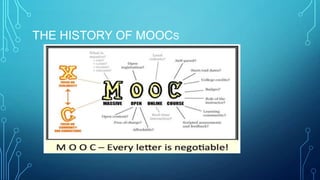
THE HISTORY OF MOOCS
1.THE PRE-HISTORY OF MOOCS,
ELECTRONIC MEDIA
• Correspondence study only predominated until the arrival of electronic
media, which lead to popularization of radio and television as
educational tools in the 20th century. Teachers and learners from all
parts of the world took advantage of the new technology. Those who
did not have access to formal learning could watch or listen to classes
for free, wherever they were. The content was adapted to reach
different types of audiences, and even students in remote areas could
have knowledge in academic subjects.
2.DEMOCRATIZING THROUGH OPENNESS
AND MEDIA
• An influence to many other ideas in the future, the Open University
revitalized distance education because it combined correspondence
instruction, supplementary broadcasting and publishing, residential
short courses and support services at local and regional levels. Its
founders believed communication technologies could be explored to
provide high-quality degrees.
3.MOOCS ARRIVE: WHEN KNOWLEDGE
MEETS NETWORKS
• It is within networks that learning can generate quite interesting
experiences. This leads us to the raise of MOOCs. Did you know that
the first one was launched in 2008? It was called ‘Connectivism and
Connective Knowledge/2008’ (CCK8), created by educators Stephen
Downes and George Siemens. Building off a for-credit course at the
University of Manitoba, Canada, this was the first class designed
behind the acronym of ‘MOOC’ and used many different platforms to
engage students with the topic, including Facebook groups, Wiki
pages, blogs, forums and other resources.
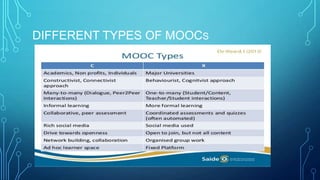
DIFFERENT TYPES OF MOOCS
DIFFERENT TYPES OF MOOCS CONT.
• Introduction to Artificial Intelligence (AI) 2011 (CS221).
The course ran over three months and included feedback and a
statement of accomplishment. A small percentage of participants
enrolled registered for the campus-based Stanford course. The course
was primarily based around interactive multimedia resources. The
course is now based on the Audacity platform
CONT.
•

2. Openness

and innovation in elearning (H817). The

course is part of the Masters in Open and Distance Education offered by the
Open University UK. H817 runs between February and October 2013
months, however the MOOC component of the course consists of 100
learning hours spread over seven weeks from March 2013 and is open to a
wider audience than those registered on the OU course. The course adopts
an ‘activity-based’ pedagogy. There is an emphasis on communication
through blog postings and the forum. Participants have the opportunity to
acquire badges for accomplishments.
FIELDS OF INTERESTS IN MY FUTURE
MOOCS
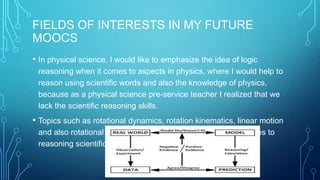
• In physical science, I would like to emphasize the idea of logic
reasoning when it comes to aspects in physics, where I would help to
reason using scientific words and also the knowledge of physics,
because as a physical science pre-service teacher I realized that we
lack the scientific reasoning skills.

• Topics such as rotational dynamics, rotation kinematics, linear motion
and also rotational motion should be emphasized when it comes to
reasoning scientifically.
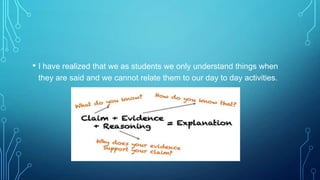
• I have realized that we as students we only understand things when
they are said and we cannot relate them to our day to day activities.
REFERENCES
• Bates, T. (2012). What’s right and what’s wrong about courser-style
MOOCs? http://www.tonybates.ca/2012/08/05/what’s right and what’s
wrong about courser-style MOOCs.

• Popenici, S. (2013). MOOCs and the change of higher education.
http://popenici.com/2013/08/21/shmoocs/#!

• Cormier, D. (2010). What is a MOOC? [CC-BY].
http://www.youtube.com/watch?v=r8avYQ5ZqM0.

Mooc s

  • 1.
    MOOCS BY: MASHA LD 21FEBRUARY 2014
  • 2.
    WHAT IS AMOOC • A massive open online course. • MOOCs are an example of open learning and its best. With MOOCs, it is the process of networking and making connections with others, which leads to communication, learning and then to greater knowledge and understanding.
  • 3.
  • 4.
    1.THE PRE-HISTORY OFMOOCS, ELECTRONIC MEDIA • Correspondence study only predominated until the arrival of electronic media, which lead to popularization of radio and television as educational tools in the 20th century. Teachers and learners from all parts of the world took advantage of the new technology. Those who did not have access to formal learning could watch or listen to classes for free, wherever they were. The content was adapted to reach different types of audiences, and even students in remote areas could have knowledge in academic subjects.
  • 5.
    2.DEMOCRATIZING THROUGH OPENNESS ANDMEDIA • An influence to many other ideas in the future, the Open University revitalized distance education because it combined correspondence instruction, supplementary broadcasting and publishing, residential short courses and support services at local and regional levels. Its founders believed communication technologies could be explored to provide high-quality degrees.
  • 6.
    3.MOOCS ARRIVE: WHENKNOWLEDGE MEETS NETWORKS • It is within networks that learning can generate quite interesting experiences. This leads us to the raise of MOOCs. Did you know that the first one was launched in 2008? It was called ‘Connectivism and Connective Knowledge/2008’ (CCK8), created by educators Stephen Downes and George Siemens. Building off a for-credit course at the University of Manitoba, Canada, this was the first class designed behind the acronym of ‘MOOC’ and used many different platforms to engage students with the topic, including Facebook groups, Wiki pages, blogs, forums and other resources.
  • 7.
  • 8.
    DIFFERENT TYPES OFMOOCS CONT. • Introduction to Artificial Intelligence (AI) 2011 (CS221). The course ran over three months and included feedback and a statement of accomplishment. A small percentage of participants enrolled registered for the campus-based Stanford course. The course was primarily based around interactive multimedia resources. The course is now based on the Audacity platform
  • 9.
    CONT. • 2. Openness and innovationin elearning (H817). The course is part of the Masters in Open and Distance Education offered by the Open University UK. H817 runs between February and October 2013 months, however the MOOC component of the course consists of 100 learning hours spread over seven weeks from March 2013 and is open to a wider audience than those registered on the OU course. The course adopts an ‘activity-based’ pedagogy. There is an emphasis on communication through blog postings and the forum. Participants have the opportunity to acquire badges for accomplishments.
  • 10.
    FIELDS OF INTERESTSIN MY FUTURE MOOCS • In physical science, I would like to emphasize the idea of logic reasoning when it comes to aspects in physics, where I would help to reason using scientific words and also the knowledge of physics, because as a physical science pre-service teacher I realized that we lack the scientific reasoning skills. • Topics such as rotational dynamics, rotation kinematics, linear motion and also rotational motion should be emphasized when it comes to reasoning scientifically.
  • 11.
    • I haverealized that we as students we only understand things when they are said and we cannot relate them to our day to day activities.
  • 12.
    REFERENCES • Bates, T.(2012). What’s right and what’s wrong about courser-style MOOCs? http://www.tonybates.ca/2012/08/05/what’s right and what’s wrong about courser-style MOOCs. • Popenici, S. (2013). MOOCs and the change of higher education. http://popenici.com/2013/08/21/shmoocs/#! • Cormier, D. (2010). What is a MOOC? [CC-BY]. http://www.youtube.com/watch?v=r8avYQ5ZqM0.