MOOCs
Introduction
The

presentation is based on massive open
online courses (MOOCs). It elaborate on what is
MOOCs. It also states the Pros and Cons of
MOOCs. Other focal elements include :
• It’s history,
• Types of MOOCs and
• The field that I want to pursue on my future
MOOCs experience.
what is mooc s ?
•

A way of learning , a course, an open participatory
distribution and life long learning.

•

An environment where people who are more

advanced , reasons, thinkers , motivators and
educators can practice their skill in a public way.
•

It is a compilation of learning material.

•

MOOCs is not a course it’s self but it a
transmission of a course used to communicate.
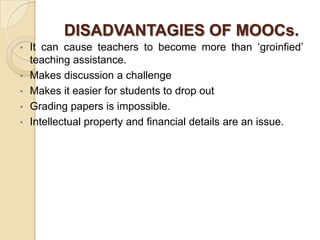
DISADVANTAGIES OF MOOCs.
•
•
•
•
•

It can cause teachers to become more than ‘groinfied’
teaching assistance.
Makes discussion a challenge
Makes it easier for students to drop out
Grading papers is impossible.
Intellectual property and financial details are an issue.
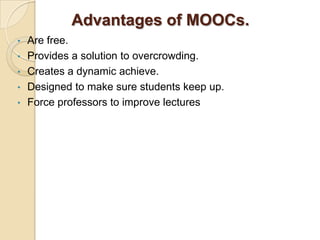
Advantages of MOOCs.
•
•
•
•
•

Are free.
Provides a solution to overcrowding.
Creates a dynamic achieve.
Designed to make sure students keep up.
Force professors to improve lectures
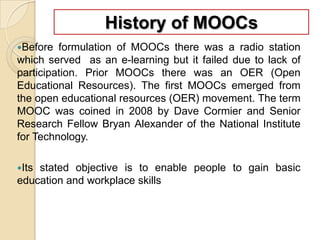
History of MOOCs
Before

formulation of MOOCs there was a radio station
which served as an e-learning but it failed due to lack of
participation. Prior MOOCs there was an OER (Open
Educational Resources). The first MOOCs emerged from
the open educational resources (OER) movement. The term
MOOC was coined in 2008 by Dave Cormier and Senior
Research Fellow Bryan Alexander of the National Institute
for Technology.
Its

stated objective is to enable people to gain basic
education and workplace skills
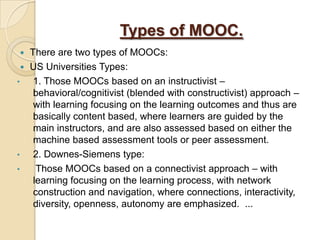
Types of MOOC.
There are two types of MOOCs:
 US Universities Types:
•
1. Those MOOCs based on an instructivist –
behavioral/cognitivist (blended with constructivist) approach –
with learning focusing on the learning outcomes and thus are
basically content based, where learners are guided by the
main instructors, and are also assessed based on either the
machine based assessment tools or peer assessment.
•
2. Downes-Siemens type:
•
Those MOOCs based on a connectivist approach – with
learning focusing on the learning process, with network
construction and navigation, where connections, interactivity,
diversity, openness, autonomy are emphasized. ...

Topic to pursue.
•
•

My field of interest is EMS.
Topic to explore would be accounting equation

Moo cs presentation.............

  • 1.
  • 2.
    Introduction The presentation is basedon massive open online courses (MOOCs). It elaborate on what is MOOCs. It also states the Pros and Cons of MOOCs. Other focal elements include : • It’s history, • Types of MOOCs and • The field that I want to pursue on my future MOOCs experience.
  • 3.
    what is moocs ? • A way of learning , a course, an open participatory distribution and life long learning. • An environment where people who are more advanced , reasons, thinkers , motivators and educators can practice their skill in a public way. • It is a compilation of learning material. • MOOCs is not a course it’s self but it a transmission of a course used to communicate.
  • 4.
    DISADVANTAGIES OF MOOCs. • • • • • Itcan cause teachers to become more than ‘groinfied’ teaching assistance. Makes discussion a challenge Makes it easier for students to drop out Grading papers is impossible. Intellectual property and financial details are an issue.
  • 5.
    Advantages of MOOCs. • • • • • Arefree. Provides a solution to overcrowding. Creates a dynamic achieve. Designed to make sure students keep up. Force professors to improve lectures
  • 6.
    History of MOOCs Before formulationof MOOCs there was a radio station which served as an e-learning but it failed due to lack of participation. Prior MOOCs there was an OER (Open Educational Resources). The first MOOCs emerged from the open educational resources (OER) movement. The term MOOC was coined in 2008 by Dave Cormier and Senior Research Fellow Bryan Alexander of the National Institute for Technology. Its stated objective is to enable people to gain basic education and workplace skills
  • 7.
    Types of MOOC. Thereare two types of MOOCs:  US Universities Types: • 1. Those MOOCs based on an instructivist – behavioral/cognitivist (blended with constructivist) approach – with learning focusing on the learning outcomes and thus are basically content based, where learners are guided by the main instructors, and are also assessed based on either the machine based assessment tools or peer assessment. • 2. Downes-Siemens type: • Those MOOCs based on a connectivist approach – with learning focusing on the learning process, with network construction and navigation, where connections, interactivity, diversity, openness, autonomy are emphasized. ... 
  • 8.
    Topic to pursue. • • Myfield of interest is EMS. Topic to explore would be accounting equation