1
                           한국에서 아이비리그대학 학점따기/MOOC
“Everyone has the right to education. Education shall be free . . . .”
­ Article 26 of the United Nations Universal Declaration of Human Right
"If we teach today's students as we did yesterday's, we are robbing them of
tomorrow."     ­  John Dewey
“The competition inherent in the gadarene rush to offer MOOCs will
createa sea change by obliging participating institutions to revisit their
missions and focus on teaching quality and students as never before.”
­ Sir John Daniel, 2012  MOOCs as a Game Change
Page 1 of 145
2
1. MOOC ?
1.1. Major Players in the MOOC Universe
1. 1. 1.  Udacity
1. 1. 2.  Coursera
1. 1. 3.  EdX
1. 1. 4.  MOOC2Degree
1. 2. MOOC 수업 구성
1. 2. 1. 강의
1. 2. 2.시험
1. 2. 3. 학점(Credit)
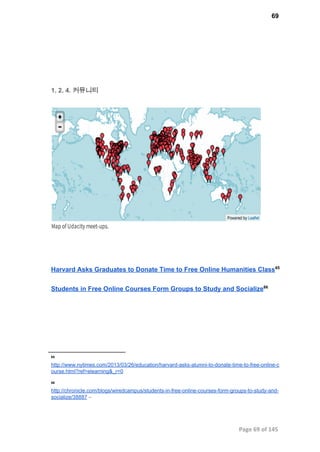
1. 2. 4. 커뮤니티
1. 2. 5. MOOC 을 통한 미국대학교육 혁명
2. OER(Open Education Resources/무료교육자료)
2.1. OCW
2.2. OER
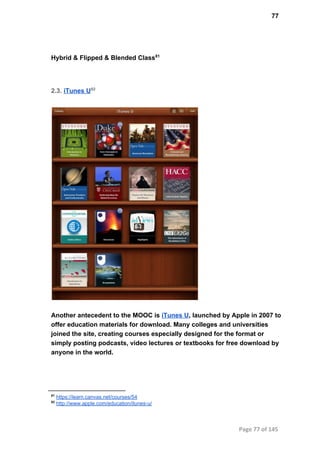
2.3. iTunes U
2.4. Khan Academy
2.5. MOOC
Page 2 of 145
3
2.5.1. In what way is a MOOC a
course?/대학정규강의/강의&시험&점수&수료증
2.5.2. In what way is a MOOC online?/온라인강의 & 오프라인
스타디그룹&감독하에 최종시험
2.5.3. In what way is a MOOC open?/무료화 & 민주화 & 지적재산권 해제
2.5.4. In what way is a MOOC massive?/강의당 수만명 수강
3.  MOOC 대학교육혁명
3.1. 미국대학혁명
3. 1. 1. 학점인정
a. MOOC2Degree
b. San Jose  Uni.
c. Georgia Tech
3. 1. 2. 법제화
캘리포니아주
플로리다주
연방정부
3. 1. 3. 일자리 연결
AT&T
Yahoo
3. 1. 4. MOOC 에 대한 비판과 저항
Page 3 of 145
4
버지니아대학
3.2. 대학입시 스펙
듀크대학
컬럼비아대학
AP&MOOC
4. 세계 각국의 MOOC
Germany/독일 MOOC
United Kingdom  MOOC
Netherlands MOOC
France MOOC
Spain MOOC
Australia MOOC
Independent MOOCs
5. MOOC 수강후기
참고문헌
Page 4 of 145
5
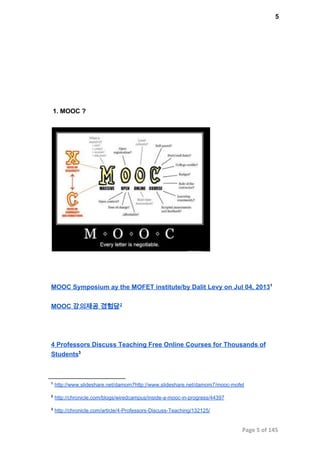
 1. MOOC ?
MOOC Symposium ay the MOFET institute/by Dalit Levy on Jul 04, 20131
MOOC 강의제공 경험담2
4 Professors Discuss Teaching Free Online Courses for Thousands of
Students3
1
 http://www.slideshare.net/damom7http://www.slideshare.net/damom7/mooc­mofet
2
 http://chronicle.com/blogs/wiredcampus/inside­a­mooc­in­progress/44397
3
 http://chronicle.com/article/4­Professors­Discuss­Teaching/132125/
Page 5 of 145
6
It is also exciting to see students forming communities within the
discussion forums, to help one another with questions about content or
technology. Our more ambitious students have  developed study guides.
Some self­identified writing­and­communication instructors have formed
their own forum, to consider how they can use our course to teach their
own students.
The most rewarding aspect of the course is the weekly “Hangout”
session, live­streamed using Google Air. We invite students to join the
discussions and ask  questions. Finally, I get to know some of my
students!
So, what hasn’t gone as planned? Certainly some things do not translate
from a traditional classroom course to a MOOC. Our team realized quickly
that we needed to do a better job cross­linking material on the course site.
For example, if we mention the syllabus, we must link to it. Some students,
we have learned, want a great deal of guidance.
MOOCs and the student experience of blended learning4
And when you do embark on a MOOC, you can have a good learning
experience by considering some of the tips and strategies other students
and teachers have shared here.5
4
 http://blogs.usyd.edu.au/stl/2013/07/debate_moocs_and_the_student_e_1.html
5
 http://moocnewsandreviews.com/category/success­strategies/
Page 6 of 145
7
Of course, MOOC formats may differ from one platform to another, but on
the major platforms you can expect to find more than video lectures. They
usually offer discussion forums, quizzes, peer grading exercises, exams
and readings to guide you through the content. Additionally, students are
inspired to create study groups and networks online (on Facebook, for
example), or even offline through the MeetUp website. Most courses
provide a syllabus with a schedule and detailed explanations about the
content.
Two Cheers for Web U!6
I’m getting Ivy League (or Ivy League equivalent) wisdom free.
Anyone can, whether you live in South Dakota or Senegal, whether it’s
noon or 5 a.m., whether you’re broke or a billionaire. Professors from
Harvard, M.I.T. and dozens of other schools prerecord their lectures; you
watch them online and take quizzes at your leisure.
The MOOC classrooms are growing at Big Bang rates: more than five
million students worldwide have registered for classes in topics ranging
from physics to history to aboriginal worldviews.
It creates a strange paradox: these professors are simultaneously the
most and least accessible teachers in history. And it’s not the only tension
inherent in MOOCs.
MOOC boosters tend to speak of these global online classes as if they are
6
 http://www.nytimes.com/2013/04/21/opinion/sunday/grading­the­mooc­university.html?_r=0
Page 7 of 145
8
the greatest educational advancement since the Athenian agora, highlight
in their potential to lift millions of people out of poverty.Skeptics —
including the blogger and University of California, Berkeley, doctoral
student Aaron Bady — worry that MOOCs will offer a watered­down
education, give politicians an excuse to gut state school budgets, and
harm less prestigious colleges and universities.
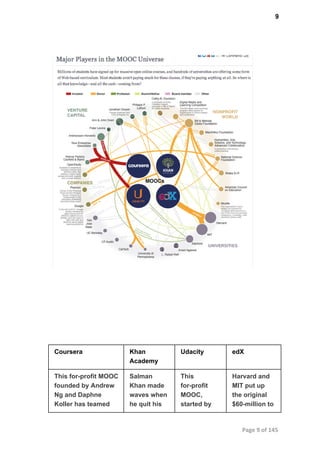
1.1. Major Players in the MOOC Universe7
7
http://chronicle.com/article/Major­Players­in­the­MOOC/138817/?cid=at&utm_source=at&utm_me
dium=en
Page 8 of 145
9
Coursera Khan
Academy
Udacity edX
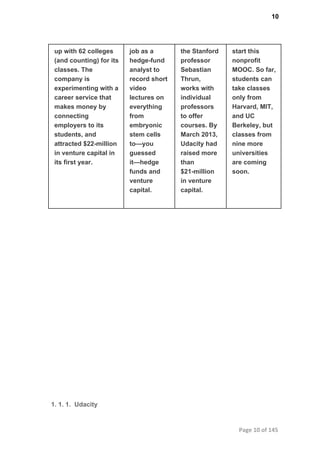
This for­profit MOOC
founded by Andrew
Ng and Daphne
Koller has teamed
Salman
Khan made
waves when
he quit his
This
for­profit
MOOC,
started by
Harvard and
MIT put up
the original
$60­million to
Page 9 of 145
10
up with 62 colleges
(and counting) for its
classes. The
company is
experimenting with a
career service that
makes money by
connecting
employers to its
students, and
attracted $22­million
in venture capital in
its first year.
job as a
hedge­fund
analyst to
record short
video
lectures on
everything
from
embryonic
stem cells
to—you
guessed
it—hedge
funds and
venture
capital.
the Stanford
professor
Sebastian
Thrun,
works with
individual
professors
to offer
courses. By
March 2013,
Udacity had
raised more
than
$21­million
in venture
capital.
start this
nonprofit
MOOC. So far,
students can
take classes
only from
Harvard, MIT,
and UC
Berkeley, but
classes from
nine more
universities
are coming
soon.
1. 1. 1.  Udacity
Page 10 of 145
11
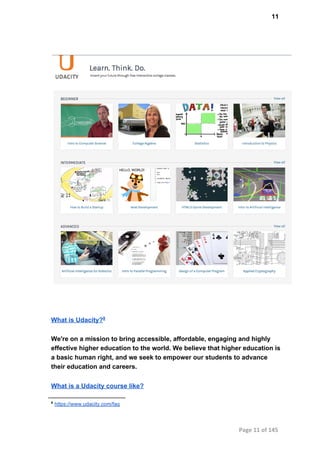
What is Udacity?8
We're on a mission to bring accessible, affordable, engaging and highly
effective higher education to the world. We believe that higher education is
a basic human right, and we seek to empower our students to advance
their education and careers.
What is a Udacity course like?
8
 https://www.udacity.com/faq
Page 11 of 145
12
Udacity courses are highly interactive with activities, quizzes, and
exercises interspersed between short videos and talks by instructors and
industry experts. You can take the courses at your own pace, there are no
deadlines. You can re­watch the videos at any time and and retake
quizzes, if you wish. Usually after a lesson you will have a problem set
with exercises that will help you to determine if you have learned the
material taught in that lesson. These exercises will count towards your
mastery level. See the Mastery section in this FAQ for more information on
how that works.
How much does it cost?
All of our courses are available to take for free. However, there is a
for­credit path for some of our courses, which is clearly indicated on each
course overview page. You can learn more in this FAQ. The content of the
class is the same for both options. The primary difference between
for­credit and free classes are the support services and proctored exams
that are part of the credit pathway.
What languages are Udacity courses available in?
All of our courses are closed captioned in English. Many of our courses
have subtitles available in many different languages, including Spanish,
Chinese, French, Portuguese and even less widespread languages such
as Croatian. To see course­specific information, go to the course's
overview page and click on the "cc" button on the video. To help us
translate our videos, join the Udacity team on Amara.
How can I get the most out of Udacity courses?
Page 12 of 145
13
To get the most out of any Udacity course, it's important to be an active
learner. Take lessons as often as possible and be sure to do the exercises!
It's also great to practice and engage with other students through the
forums or meetups. Applying what you learn through different projects will
also be vital to your learning.
When does each course begin?
There is no official start date for courses; all classes are open enrollment,
which enables you to take the course on your own time. Some of our
newer courses may open for enrollment in advance when the course may
not yet be available, but we will keep you updated about those start dates
if you sign up for the course.
How many courses do you offer?
Check out a full list of our courses here: http://www.udacity.com/courses
How long is a Udacity course available?
In most cases, Udacity classes are always available once they have
launched.
Are there deadlines within each course?
Nope. Udacity courses have no deadlines; you can take these courses at
your own pace.
Page 13 of 145
14
Can I enroll in more than one class?
Yes! Enroll in as many classes as you like, but know that each course is
about the equivalent amount of coursework to an undergraduate course.
What are the rules on collaboration?
Working with other students is often the best way to learn new things. We
hope students in the class will form vibrant communities, both on­line and
in­person, to help each other learn. The key is to use collaboration as a
way to enhance learning, not as a way of sharing answers without
understanding them. You are welcome (and encouraged) to view the
lectures with others, and discuss and work together on answering the
in­lecture quizzes. For the problem sets, you may discuss the questions
with other students in the on­line forums and in­person study groups, but
everything you submit should be your own work. For the final exam, you
are not permitted to work with anyone else, and should only ask
clarification questions on the on­line forums.
What are my testing options?
We have different options for our courses. For all courses, there will be
final assessments that you can take on your own. For courses that need to
be proctored (in order for you to receive credit or certification), we have
both proctored exam at a Pearson VUE testing center and online
proctored exam on our site. We can also provide a "testing kit" to any
institution for a low fee if they are interested in providing proctored exams
on our courses. Please look at your specific courses to see options
available.
Page 14 of 145
15
Where do I go to find official testing centers?
To find a testing center, visit this page from Pearson VUE
Are there assignments?
Yes. To learn any subject, it is important to solve problems on your own.
Each course includes a number of problem sets. There are no due dates
for these and they will be similar to the in­class quizzes. You will receive
instant feedback on these questions and you can try them as many times
as you like.
How will my final grade be determined?
Your final grade will be determined by your exam grade.
How do I get answers to questions I have related to the courses?
We love to see an active academic community, so we encourage you to
post your question to the course forum. One of your peers will likely
provide an adequate answer, but if not, one of our course managers will
chime in.
Mastery / Certificates / Credits9
9
 https://www.udacity.com/faq
Page 15 of 145
16
What is mastery?
Mastery points (coming soon) are earned when you complete certain
questions correctly in a course. Some questions may be worth more
points than others. Each class has a different distribution of mastery
points, often they appear in Problem Sets and Open Exams. You can see
where you can earn mastery points in the course details on the My
Courses page after you have enrolled.
Mastery levels are achievement targets for each course. Courses have four
different mastery levels, which are reached by accumulating mastery
points. In the course details on the My Courses page you can see how
many mastery points you will need to reach each mastery level.
How do I get a certificate?
Once you have achieved at least level 1 mastery in a course, you can
download your certificate from the course section in My Courses page.
When you achieve a higher mastery level, you can re­download the
updated certificate.
How do I get credit?
We have different options for our courses.
For all courses, there will be final assessments that you can take on your
own to earn mastery and receive our certificates. These are free and do not
give you college credit.
For courses provided together with our partner organizations you have to
refer to the FAQ of the particular organization. These tests might be for a
fee and might provide you with a path to receive credit for them.
For CS101 you can opt in for a proctored exam for a fee at a Pearson VUE
testing center. To find a testing center, visit this page from Pearson VUE.
Page 16 of 145
17
How does online proctoring work?
Exams will be proctored online by ProctorU for those enrolled for credit
through SJSU. There will still be exams (unproctored) for students taking
the open course. The final exam will be posted no later than May 22, 2013.
Community10
FORUMS
How do I use the forums?
If you're new to the forums, welcome. The forums are where you can post
any ideas and thoughts you have about the course, ask questions, and
receive feedback from other students.
The forum is an important social element of the classroom where the
priority is a friendly, open atmosphere that allows students to ask
questions freely. We encourage free flowing conversation.
If you're uncomfortable about posting in English, you are encouraged to
post in your own language rather than not post at all.
What is the forum?
A classroom where learning is the goal.
A place where people can ask questions and help each other out.
A place where people can express their feelings about the course and get
support and encouragement.
A place where extra information relating to the course can be shared
10
 https://www.udacity.com/faq
Page 17 of 145
18
A place where students can contact other students to form study. groups,
arrange hangouts and learn together.
A place where people can get feedback about their co서로 비슷한 게시물을
올리는 것은 괜찮습니다. 비슷한 질문을 올de from their fellow students.
What should I NOT do in the forums?
Post a full solution when somebody just asked for a hint.
Vote down questions where someone asks for help, or tell them their
question is stupid, or they shouldn't have asked it.
Any other behavior which creates an atmosphere where people are
unwilling to post.
What should I post?
Problem set code using the special spoiler tag. It's ok to post it even if
someone else has posted a similar post ­ no one should be afraid to ask
someone to look at their code even if someone else asked a similar
question.
Guide people on how to search the forums ­ try to provide a link to a useful
post, and say what you used to find it as it can be hard to use the right
search terms when you're unfamiliar with the terminology.
Clarify what the homework is asking.
How do I thank someone for their answer?
Up­vote their post by clicking the thumbs up button on the left side of the
post.
Accept their answer ­ You can accept an answer by pressing the check
mark on the left side, below the thumbs icons. This is helpful so others can
see that you're happy with an answer and so they don't need to answer it
Page 18 of 145
19
again. It also shows the poster they've done a good job in helping you.
Let people know they've helped you with a comment or answer in the
thread saying thanks
Who moderates this community?
This forum is moderated by the students, as well as official Udacity
representatives, who can be recognized by two diamonds next to their
name. The community features a karma system that allows users to earn
rights to perform a variety of moderation tasks.
How does the karma system work?
When a question or answer is up­voted, the student who posted it will gain
"karma points". These points serve as a rough measure of the
community's trust in him/her. Various moderation tasks are gradually
assigned to students based on those points. For example, if you ask an
interesting question or give a helpful answer, your input will be up­voted.
On the other hand, if the answer is misleading, it will be down­voted. Each
vote in favor generates 15 points, each vote against subtracts one points.
There is a limit of 200 points that can be accumulated per question or
answer. The table below explains karma requirements for each type of
moderation task:
add comments ­> 1
retag questions ­> 500
edit any answer ­> 2000
delete any comment ­> 10,000
What is a gravatar?
Gravatar means globally recognized avatar ­ your unique avatar image is
associated with your email address. It's simply a picture that shows up
next to your posts on the websites that support gravatar protocol. The
default gravatar appears as a square filled with a snowflake­like figure. You
Page 19 of 145
20
can set your image at gravatar.com. It takes a few minutes for your
gravatar to sync with your account.
How come other people can edit my questions/answers?
Allowing experienced members of this community to curate the questions
and answers improves the overall quality of the knowledge base content. If
this approach is not for you, we respect your choice.
MEETUPS11
What's the best way to organize a study group?
Study groups can be organized any way you'd like. You can form online
study groups through Google Hangouts or any similar platform or arrange
for an in person meetup.
What's the best way to organize a meetup?
Meetups are already being organized. To see which ones currently exists
click here. Feel free to organize a meetup in your area if one doesn't
already exist.
Career12
What companies do Udacity students work for?
Our students work for a variety of companies from Fortune 500
companies, like Google and Oracle, to startups like Square and Spotify.
What kinds of jobs do Udacity students get?
Students have gotten jobs as Software Engineer, Data Scientist, Assistant
Instructors, Instructors, and Web Developers.
11
 https://www.udacity.com/faq
12
 https://www.udacity.com/faq
Page 20 of 145
21
How can Udacity make me a more desirable job candidate?
Take Udacity courses that are relevant for your dream job(s). You'll learn
relevant skills during the course, and you could even put those skills to
work on independent projects outside of class. Also make sure to update
your profile, share your resume, and be responsive to employers when
they contact you.
Who sees my CV on the Profile Page?
Our trusted partners and Udacity employees.
How do I start the job placement process?
Make sure to have your profile updated and opt into sharing your resume.
This will help make you more visible to potential employers.
Whom do I contact if I'm an employer that is interested in hiring Udacity
students?
Please send an email to employers@udacity.com if you want more
information.
Page 21 of 145
22
1. 1. 2.  Coursera
Courses13
13
 https://www.coursera.org/courses
Page 22 of 145
23
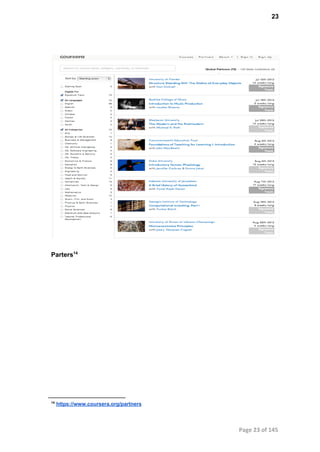
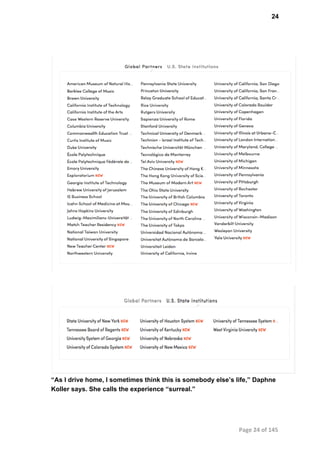
Parters14
14
 https://www.coursera.org/partners
Page 23 of 145
24
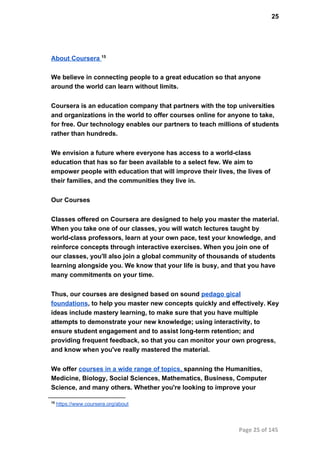
“As I drive home, I sometimes think this is somebody else’s life,” Daphne
Koller says. She calls the experience “surreal.”
Page 24 of 145
25
About Coursera 15
We believe in connecting people to a great education so that anyone
around the world can learn without limits.
Coursera is an education company that partners with the top universities
and organizations in the world to offer courses online for anyone to take,
for free. Our technology enables our partners to teach millions of students
rather than hundreds.
We envision a future where everyone has access to a world­class
education that has so far been available to a select few. We aim to
empower people with education that will improve their lives, the lives of
their families, and the communities they live in.
Our Courses
Classes offered on Coursera are designed to help you master the material.
When you take one of our classes, you will watch lectures taught by
world­class professors, learn at your own pace, test your knowledge, and
reinforce concepts through interactive exercises. When you join one of
our classes, you'll also join a global community of thousands of students
learning alongside you. We know that your life is busy, and that you have
many commitments on your time.
Thus, our courses are designed based on sound pedago gical
foundations, to help you master new concepts quickly and effectively. Key
ideas include mastery learning, to make sure that you have multiple
attempts to demonstrate your new knowledge; using interactivity, to
ensure student engagement and to assist long­term retention; and
providing frequent feedback, so that you can monitor your own progress,
and know when you've really mastered the material.
We offer courses in a wide range of topics, spanning the Humanities,
Medicine, Biology, Social Sciences, Mathematics, Business, Computer
Science, and many others. Whether you're looking to improve your
15
 https://www.coursera.org/about
Page 25 of 145
26
resume, advance your career, or just learn more and expand your
knowledge, we hope there will be multiple courses that you find
interesting.
teaching methods that use active learning and interactive engagement
between faculty and students, and between students and their peers
Coursera Takes A Big Step Toward Monetization, Now Lets Students Earn
“Verified Certificates” For A Fee16
Coursera today unveiled its next phase and what will likely be its most
significant source of revenue: Verified certificates./January 8th, 2013
Students who take a course on its platform will now be able to earn
“Verified Certificates” for a small fee. The new option, called Signature
Track, is available on a course­by­course basis and is designed to provide
verification for the work students complete on its platform, giving value to
that work in the form of the startup’s first foray into credentialing. The
certificate, however does not include credit toward a degree program, it
simply aims to give them a more meaningful way to prove that they’ve
completed the course.
Students will have up to three weeks from the beginning of the course to
sign up for a Signature Track. If they participate, they take two photos with
their webcam, one of themselves, the other of a photo ID and create a
“biometric profile of their unique typing patterns by typing a short phrase.”
When submitting work for a course, they type the same phrase to match
16
http://techcrunch.com/2013/01/08/coursera­takes­a­big­step­toward­monetization­now­lets­
students­earn­verified­certificates­for­a­fee/
Page 26 of 145
27
the record to their ID. Upon completion, students receive a certificate
issued by the university and Coursera, which they’ll be able to share with
anyone they choose via their “personal Course Records” page on
Coursera.
The price of admission into Signature track depends on the course, but
will range from $30 to $100, and students who cannot afford the fee will be
able to register for financial assistance.
Five Courses Receive College Credit Recommendations17
Coursera is committed to seeing that our courses meet our students’
educational goals, from simply experiencing the joy of learning something
new, to seeking improved employment opportunities, to working towards
a degree. To this end, we are proud to announce that theAmerican Council
on Education’s College Credit Recommendation Service (ACE CREDIT) 18
hasevaluated and recommended college credit for five courses on
Coursera. Many students face enormous financial obstacles in pursuit of
their degrees. We want to help more students enter college with credit
already accrued and exit college on time, on budget and with a degree in
hand.
ACE CREDIT is a recognized authority in assessing non­traditional
education experiences, with more than 2,000 colleges and universities
considering ACE CREDIT recommendations in determining the
applicability to their course and degree programs.19
The five courses approved for
college credit recommendation include four undergraduate credit courses:
20
17
http://blog.coursera.org/post/42486198362/five­courses­receive­college­credit­recommend
ations
18
http://www.acenet.edu/news­room/Pages/College­Credit­Recommendation­Service­CRED
IT.aspx
19
 http://www2.acenet.edu/programs/ccrs/adult_learners/
20
 https://www.coursera.org/signature/college­credit­guidebook
Page 27 of 145
28
● Pre­Calculus from the University of California, Irvine21
● Introduction to Genetics and Evolution from Duke University22
● Bioelectricity: A Quantitative Approach from Duke University23
● Calculus: Single Variable from the University of Pennsylvania24
And one course approved for developmental math vocational credit
recommendation:
● Algebra from the University of California, Irvine25
You can earn an ACE CREDIT college credit recommendation by signing
up for an eligible course in the Signature Track  and then taking an online26
proctored Credit Exam at the end of the course.We are working with a
third­party provider, ProctorU,  to enable online proctoring so that27
students anywhere in the world can take these special proctored
assessments via a webcam at their convenience. There is an additional fee
for the Credit Exam.
Students who meet all requirements and successfully complete one of
these five pre­approved courses may request a transcript with credit
recommendations from ACE, which they can then present to the college or
university of their choice for prerequisite or undergraduate credit
consideration, to be granted at the discretion of the institution.
Duke Provost Peter Lange said “We are excited by this opportunity to
experiment with new ways of using our MOOC courses to extend our
educational reach and provide credit for students who would not
21
 https://www.coursera.org/course/precalculus
22
 https://www.coursera.org/course/geneticsevolution
23
 https://www.coursera.org/course/bioelectricity
24
 https://www.coursera.org/course/calcsing
25
 https://www.coursera.org/course/algebra
26
 https://www.coursera.org/signature/guidebook
27
 http://proctoru.com/howitworks.php
Page 28 of 145
29
otherwise have access to our faculty. MOOCs, often in combination with
the creativity of individual universities, have much potential to open and
enrich the educational offerings available to students across the United
States and the globe."
Learn more at the Coursera College Credit Recommendation Guidebook.28
Earning an ACE CREDIT college credit recommendation29
1) Join the Signature Track for an eligible course
To receive transfer credit, you must join the Signature Track of the eligible
course. Registration is open during the first two to three weeks of the
course. Learn more about joining Signature Track.
The Signature Track securely links your coursework to your real identity
using your photo ID and unique typing pattern. In your course’s Signature
Track, you will be able to verify your identity with each piece of graded
coursework you submit, such as quizzes, exams, homeworks and
assignments.
At this time, not all courses featuring Signature Track are eligible for ACE
CREDIT college credit recommendations. Currently, only the courses
listed above are eligible for ACE CREDIT college credit recommendations.
2) Sign­up for and take course's Credit Recommendation Exam
Once in the Signature Track, you must complete the online proctored
Credit Recommendation Exam at the end of the course. This exam covers
broad course learning objectives and tests your skills and knowledge in
the course material at the college course level. Your performance on the
28
 https://www.coursera.org/signature/college­credit­guidebook
29
 https://www.coursera.org/signature/college­credit­guidebook
Page 29 of 145
30
Credit Recommendation Exam will be a large determinant of your final
grade. The Credit Recommendation Exam is separate from the normal
course final exam, though you are encouraged to take both.
The Credit Recommendation Exam will be online proctored, and
conducted on Coursera in partnership with ProctorU, which will provide
live human proctors who will digitally connect with you during your exam
session. You will need access to a webcam, a microphone, and a reliable,
high­speed internet connection for this (if you’d like to test your computer,
you can do so at ProctorU).
The Credit Recommendation Exam can be taken for an additional fee,
which varies by course. Please see Eligible Courses for the costs.
Signing up for a course's Credit Recommendation Exam
Towards the end of the course, students who have joined the Signature
Track will receive more information on how to sign up for the Credit
Recommendation Exam. After successfully registering for the Credit
Recommendation Exam, you will receive a confirmation email with
instructions on how to schedule your Credit Recommendation Exam
test­taking appointment with ProctorU.
Each course has its own Credit Recommendation Exam availability dates,
which are available here. You must schedule your exam at least 72 hours
(3 days) in advance of your appointment. We strongly recommend you
schedule your appointment well in advance to avoid potential problems
with limited appointment availability or late scheduling fees.
Taking your Credit Recommendation Exam
Once you have scheduled your exam, you will be sent a special link to visit
on the date and time of your examination appointment. This link will
connect you with your live proctor, who will guide you through to your
examination on Coursera.
Your proctor:
● Is knowledgeable about the examination policies
Page 30 of 145
31
● Will ask you to conduct a review of your testing area using your
webcam
● Will monitor webcam, audio and screensharing feeds while you are
taking your exam
● Can close the exam session at any time if necessary
● Can communicate with you via chat or audio if you have any
questions
Credit Recommendation Exam grading policies
You must meet the criteria set forth in your course’s Credit
Recommendation Exam grading policy in order to receive an ACE CREDIT
college credit recommendation. This grading policy, which will be outlined
in your class site, is different from the regular course grading policy.
In the Credit Recommendation Exam grading policy, the Credit
Recommendation Exam will be worth 80% of your course grade, with
regular assignments making up the remaining 20%. Each course will have
its own unique minimum passing grade for the purposes of determining
eligibility for college credit recommendation.
Verified Certificate with Credit Recommendation Exam
Students who take the Credit Recommendation Exam and pass the criteria
outlined in the Credit Recommendation Exam grading policy will receive a
Verified Certificate and the option to request for ACE CREDIT transcripts.
This Verified Certificate will additionally indicate that you’ve completed a
proctored exam.
If your class offers a “distinction” grade, we will take the higher score on
either the regular course final or the Credit Recommendation Exam to
determine eligibility. Therefore, students who attempt the Credit
Recommendation Exam will not be required to attempt the regular course
final.
Retake policy
A student can only attempt the Credit Recommendation Exam once per
course offering. Students who do not meet the passing requirements for
Page 31 of 145
32
college credit recommendations will be able to attempt the Credit
Recommendation Exam again in future offerings of the course.
3) Send your ACE CREDIT transcripts to your school
If you meet the course’s passing criteria for ACE CREDIT college credit
recommendations, Coursera will report your course information to the
American Council on Education’s (ACE) Transcript Service.
The ACE Transcript Service offers a lifelong record for students who have
successfully completed our courses that have been reviewed by ACE
CREDIT. This service enables adult learners to present a nationally
recognized transcript to the college or university of their choice for the
potential award of academic credit. For more information, visit the ACE
CREDIT Transcript Service website.30
Coursera Career Services31
Coursera and your career32
People from around the world come to Coursera with professional
aspirations in mind and some of our favorite e­mails have been from
students who have used their courses to find new jobs. One student
recently told us how the Gamification course helped him land a position
with a gamification company. Another student, Dawn, accepted a
communications position with the University of Illinois Cancer Center after
completing Fundamentals of Pharmacology. She talked about the course
content at length during the interview process and now uses her
newfound knowledge regularly in her new position.
30
 http://www.acenet.edu/higher­education/topics/Pages/Transcript­Services.aspx
31
 https://www.coursera.org/account/careerservices
32
 http://blog.coursera.org/post/37200369286/coursera­and­your­career
Page 32 of 145
33
With students like these in mind, we are developing Coursera Career
Services, a recruiting service that connects passionate and committed
Coursera students with positions that match their skills and interests.
If you opt­in to our Career Services, we will try to find companies that
match your interests, skills and knowledge.  If you do well in a Coursera
class and allow us to share that information with potential employers (who
will have agreed to keep this information in strict confidence, and use only
for the purpose of considering you for employment), this could make you
even more appealing to employers.
We’ve been piloting the program for a few months and results have been
good!  We use sophisticated analytics to automatically find good
student­company matches, and make an introduction only if we think
there’s a reasonable chance of interest on both sides.  Recently, one of
our partner companies said “the candidates we’ve gotten from Coursera
are performing better in our process than candidates from any other
source.”  We’re working with companies of varying stage and size who are
finding great talent in innovative ways, like Facebook, Twitter, AppDirect
and TrialPay.
Essentially, Coursera’s new service is an opt­in to a recruiting program
that allows students to find and connect with positions that “match their
skills and interests.”
Using “sophisticated analytics,” Coursera looks for matches between
students and companies. Once it identifies a match, it sends an email to
students, seeking their approval, only making an intro if the student gives
them the go­ahead.Companies pay Coursera a flat fee for each
introduction, with a share of that revenue going to the colleges offering the
course.
Udacity has also begun employing a similar model and has started to
make money doing it.
VERIFIED CERTIFICATES FOR YOUR EMPLOYEES33
33
 https://www.coursera.org/about/programs
Page 33 of 145
34
Looking for an innovative way to support your employees' ongoing
learning and development? Try sponsoring Verified Certificates within
your organization!
By sponsoring Verified Certificates, you can:
● Point your employees to a new learning resource with courses
across a range of topics like technical, business, leadership and
many more.
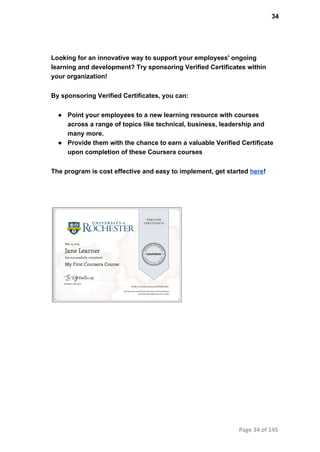
● Provide them with the chance to earn a valuable Verified Certificate
upon completion of these Coursera courses
The program is cost effective and easy to implement, get started here!
Page 34 of 145
35
1. 1. 3.  EdX34
Schools/The colleges and universities that comprise the edX consortium are
among the best in the world. They are dedicated to quality education both on
campus and online. EdX is honored they have chosen to become part of the
initiative by opening their virtual doors to the world.35
34
 https://www.edx.org/
35
 https://www.edx.org/schools
Page 35 of 145
36
MIT and Harvard launch a ‘revolution in education’36
36
 http://web.mit.edu/newsoffice/2012/edx­launched­0502.html
Page 36 of 145
37
MIT President Susan Hockfield and Harvard University President Drew
Faust37
WE’RE EMPOWERING LEARNING IN THE CLASSROOM AND AROUND
THE GLOBE38
At edX, we believe in the highest quality education, both online and in the
classroom.
EdX was created for students and institutions that seek to transform
themselves through cutting­edge technologies, innovative pedagogy, and
rigorous courses.
Through our institutional partners, the XConsortium, we present the best
of higher education online, offering opportunity to anyone who wants to
achieve, thrive, and grow.
Our goals, however, go beyond offering courses and content. We are
committed to research that will allow us to understand how students learn,
how technology can transform learning, and the ways teachers teach on
campus and beyond.
37
 http://web.mit.edu/newsoffice/2012/edx­launched­0502.html
38
 https://www.edx.org/about­us
Page 37 of 145
38
As innovators and experimenters, we want to share what we discover. The
edX platform will be available as open source. By conducting and
publishing significant research on how students learn, we will empower
and inspire educators around the world and promote success in learning.
Our aim is to become a leading resource for learners and learning
worldwide by staying focused on the goals and principles set forth when
forming edX:
Our goals
● Expand access to education for everyone
● Enhance teaching and learning on campus and online
● Advance teaching and learning through research
Our principles
● Not for profit
● Open source platform
● Collaborative
● Financially sustainable
We are not only expanding access to knowledge, but developing best
practices to enhance the student experience and improve teaching and
learning both on campus and online.
edx FAQs39
What is edX?
EdX is a not­for­profit initiative composed of over 20 leading global
institutions, the xConsortium. We offer the highest quality education, both
online and in the classroom.
Founded by the Massachusetts Institute of Technology (MIT) and Harvard
University, edX offers online learning to on­campus students and to
39
 https://www.edx.org/org­faq#
Page 38 of 145
39
millions of people around the world. EdX is building an open­source online
learning platform and hosts a web portal at www.edx.org for online
education.
What institutions offer courses and modules through edX?
EdX offers online courses from more than 20 edX xConsortium
institutions, including University of California at Berkeley, the University of
Texas system, and founders MIT and Harvard. More courses from leading
global institutions will be coming online over the months to come.
What are the goals of the partner universities and colleges?
The edX partners aim to extend their collective reach to build a global
community of online students. Along with offering online courses, partner
institutions plan to use their online courses to enhance education on their
own campuses and to undertake research on how students learn and how
technology can transform learning.
Will edX be adding additional X Universities?
EdX is committed to expanding the number of universities offering
courses on its platform. It will welcome new partners as it builds capacity
to accommodate the growing interest among universities and learners.
Potential partners are welcome to approach Director of Business
Development, Johannes Heinlein (johannes@edx.org) for any initial
inquiries.
Page 39 of 145
40
What is the “X University” Consortium?
In addition to providing online courses on the edX platform, the "X
University" Consortium is a forum in which members can share
experiences around online learning. Harvard, MIT, the University of
California at Berkeley, the University of Texas system and the other
consortium members are building the "X University" Consortium, whose
membership is expanding to include additional "X Universities". Each
member of the consortium will offer courses on the edX platform as an "X
University."
Open Source & the edX Technology Platform40
What technology does edX use?
Features that are available or planned for the edX learning platform
include: self­paced learning, online discussion groups, wiki­based
collaborative learning, assessment of learning as a student progresses
through a course, and online laboratories and other interactive learning
tools. The first version of the technology was used in the first MITx course,
6.002x Circuits and Electronics, which launched in Spring 2012. Because it
is open source, the platform will be continuously improved by a worldwide
community of collaborators, with new features added as needs arise.

How is this different from what other universities are doing online?
EdX is a not­for­profit enterprise that promotes the educational missions of
40
 https://www.edx.org/org­faq#
Page 40 of 145
41
like­minded universities, all dedicated to improving our understanding of
learning and delivering better educational experiences both on campus
and beyond. The platform will also serve as a laboratory from which data
will be gathered to better understand how students learn.
What is Open Source?
Open source is a philosophy that refers to making software freely available
for use and/or modification as users see fit. In exchange for use of the
software, users add their contributions to the software, making it in a form
of public collaboration. Before the contributions are officially incorporated
within the primary source code, an oversight body typically ensures
additions meet a certain standard of quality and usefulness. The edX
platform was made available as open source code on June 1st, 2013.
When/how can I get the edX open­source platform technology?
The edX learning platform source code, as well as platform developments
from Stanford, edX and other contributors, is available as of June 1, 2013
and can be accessed from the edX Platform Repository located at
http://code.edx.org/
My organization is interested in using edX software or the edX platform to
host our own content. What level of support does edX provide to do so?
Currently, the open­sourced edX software is intended to be used by
developers who will contribute towards the platform development efforts.
While some edX partner organizations are using the platform to host their
own content, we don't encourage organizations outside of the partnership
Page 41 of 145
42
group to do so at this point.
EdX does not offer hosting or support services beyond its partner group
at this time.However, edX may evolve its participation models in the future;
we may for example offer hosting and support services to interested
organizations. Future releases of the software may also offer self
publishing capabilities. Please check our website for updates about when
these participation models may become available.
STUDENT FAQS41
edX BASICS
How do I sign up to take a course?
Simply create an edX account (it's free) and then register for the course of
your choice. Choose Register Now to get started.
Who can take an edX course?
EdX courses are open to everyone. All you need is an Internet connection
and a desire to learn.
What does it cost to take a course?
Currently, edX courses are free for everyone.
41
 https://www.edx.org/org­faq#
Page 42 of 145
43
What happens after I sign up?
You will receive an activation email. Follow the prompts in that email to
activate your account.
You will need to log in each time you access your course(s). Once the
course begins, it’s time to hit the virtual books. You can access the
lectures, homework, tutorials, etc., for each week, one week at a time.
Are courses accessible to students with disabilities?
EdX strives to create an innovative online­learning platform that promotes
accessibility for everyone, including students with disabilities. We are
dedicated to improving the accessibility of the platform and welcome your
comments or questions at accessibility@edx.org.
Are the courses only offered in English?
Some edX courses include a translation of the lecture in the text bar to the
right of the video. Some have the specific option of requesting a course in
other languages. Please check your course to determine foreign language
options.
When will there be more courses on other subjects?
We are continually reviewing and creating courses to add to the edX
platform. Please check the website for future course announcements or
register with edX and we will send you an email when new courses are
available. You can also "like" edXonline on Facebook, circle us on
Page 43 of 145
44
Google+, or follow us on Twitter – you'll receive updates and
announcements there too
When does my course start and/or finish?
You can find the start and stop dates for each course on each course
description page.
Is there a walk­through of a sample course session?
Each course begins with an introduction of how the course works and
what to expect.You can also join a past course and walk through the user
experience there.
What happens if I have to quit a course? Will I be able to take the same or
another course in the future?
You may unregister from an edX course at anytime, there are absolutely no
penalties associated with incomplete edX studies, and you may register
for the same course (provided we are still offering it) at a later time.
What is the edX honor code?
You’ll find the edX honor code here. Each course may also have specific
agreements for student collaboration and discussion.
Page 44 of 145
45
How can I help improve edX?
You may not realize it, but just by taking a course you are helping edX.
That’s because the edX platform has been specifically designed to not
only teach, but also gather data about learning. EdX will use this data to
find out how to improve education online and on­campus. Additionally, if
you have enjoyed your experience on edX, we encourage you to share
your insights and enthusiasm with us and others (in­person and online.)
THE COURSES42
How much work will I have to do to pass my course?
The projected hours of study required for each course are described on
the specific course description page.
What should I do before I take a course (prerequisites)?
Each course is different ­ some have prerequisites, and some don't. Take a
look at your specific courses recommended prerequisites. If you do not
have a particular prerequisite, you may still take the course.
What books should I read? (I am interested in reading materials before the
class starts.)
42
 https://www.edx.org/org­faq#
Page 45 of 145
46
Take a look at the specific course prerequisites. All required academic
materials will be provided during the course, within the browser. Some of
the course descriptions may list additional resources. For supplemental
reading material during the course, you can post a question on the
course's discussion forum to ask your online classmates for suggestions.
Can I download the book for my course?
Unless specifically noted in the course, edX book content may only be
viewed within the browser; downloading it violates copyright laws. If you
need or want a hard copy of the book, we recommend that you purchase a
copy.
Can I take more than one course at a time?
You may take multiple edX courses, however we recommend checking the
requirements on each course description page to determine your available
study hours and the demands of the intended courses.
How do I log in to take an edX course?
Once you sign up for a course and activate your account, click on the Log
In button on the edx.org home page. You will need to type in your email
address and edX password each time you log in.///////
What time is the class?
EdX classes take place at your convenience. Prefer to sleep in and study
late? No worries. Videos and problem sets are available 24 hours a day,
Page 46 of 145
47
which means you can watch video and complete work whenever you have
spare time. You simply log in to your course via the Internet and work
through the course material, one week at a time.
If I miss a week, how does this affect my performance?
It is certainly possible to pass an edX course if you miss a week; however,
coursework is progressive, so you should review and study what you may
have missed. Also, homework and exams may not be submitted after their
due dates. Check your course schedule for important dates and times.
How can I meet/find other students?
All edX courses have Discussion Forums where you can chat with and
help each other within the framework of the honor code. You can also
“like” edXonline on Facebook, circle us on Google+, or follow us on
Twitter ­ you'll be joining a community of others with a shared interest in
edX.
How can I meet/find other students?
All edX courses have Discussion Forums where you can chat with and
help each other within the framework of the honor code. You can also
“like” edXonline on Facebook, circle us on Google+, or follow us on
Twitter ­ you'll be joining a community of others with a shared interest in
edX.
Getting help and support
You have a vibrant, global community of fellow online learners available
Page 47 of 145
48
24­7 to help with the course within the framework of the honor code, as
well as support from the TAs who monitor the course. Take a look at the
course's Discussion Forum where you can review questions, answers and
comments from fellow online learners, as well as post a question.
Can I re­take a course?
You may re­take edX courses as often as you wish. Each offering of a
course is assessed independently.
Is there an exam at the end?
Different courses have slightly different structures. Please check the
course materials.
Will the same courses be offered again in the future?
Most, if not all, existing edX courses will be re­offered, and more courses
added on a regular basis.
Enrollment for a course that I am interested in is open, but the course has
already started. Can I still enroll?
Yes, but you will not be able to turn in any assignments or exams that are
past due. If it is early in the course, you might still be able to complete
enough assignments and exams to earn a certificate. Check the course
syllabus and grading policy in order to find out more.
Page 48 of 145
49
CERTIFICATES & CREDITS43
What is a certificate of mastery?
A certificate of mastery certifies that you have fully participated in an edX
course made available through one of its X institutions. You get a
certificate when/if you complete your course successfully (watch the
videos and successfully fulfill the requirements, per the course syllabus). If
you achieve a certificate, you should be proud. All edX courses are
rigorous and successful completion is a real accomplishment. EdX
students haveused certificates of mastery on university or job
applications, or with their employers to showcase their abilities. Today,
certificates of mastery are free. This may change in the future to help cover
our costs. See a sample certificate here.
Will my university accept my edX coursework for credit?
Each educational institution makes its own decision regarding credit.
Check with your university for its policy.
Please note: EdX does not currently offer transcripts or proof of
registration for the purpose of obtaining credit.
Will the associated X University grant credit for my course?
X Universities do not currently offer formal academic credit for edX
coursework and do not certify that MOOC students have met the same
requirements as matriculated students taking the original course on which
the MOOC is based.
43
 https://www.edx.org/org­faq#
Page 49 of 145
50
How are certificates of mastery determined?
Online learners who receive a passing grade for a course will receive a
certificate at thediscretion of edX and the underlying X University that
offered the course. For example, a certificate for MITx’s 6.002x Circuits &
Electronics will come from edX and MITx.
If you passed the course, your certificate will be delivered online through
edx.org. So be sure to check your email in the weeks following the final
grading – you will be able todownload and print your certificate.
Note: At this time, edX is holding certificates for students connected with
Cuba, Iran, and Sudan pending confirmation that the issuance is in
compliance with U.S. embargoes.
What is the difference between a proctored certificate and an honor code
certificate?
A proctored certificate is given to students who take and pass
an exam under proctored conditions in addition to completing all the
required online coursework. An honor­code certificate of mastery is
granted to students who have completed all of the required coursework
online and are in compliance with the edX honor code.
Note: Not all courses offer a proctored exam. A proctored exam happens
in a proctored facility where students register and are charged a fee.
Honor code coursework is free and available to everyone.
Page 50 of 145
51
Can I get both a proctored certificate and an honor code certificate?
Yes. The requirements for both certificates can be independently satisfied.
Note: At this time, edX is holding certificates for learners connected with
Cuba, Iran, and Sudan pending confirmation that the issuance is in
compliance with U.S. embargoes.
Will my grade be shown on my certificate?
No. Grades are not displayed on either honor code or proctored
certificates. The only certificates distributed with grades by edX were for
the initial prototype course.
Why did I not receive my certificate?
Certificates of Mastery are delivered approximately one week after each
course closes. If you did not receive one in this time and are certain that
you completed the requirements, please check your dashboard. The
certificate will display with your course.
I lost my edX certificate – can you resend it to me?
Please log back in to your account to find certificates from the same profile
page where they were originally posted. You will be able to re­print your
certificate from there.
1. 1. 4.  MOOC2Degree44
44
 http://www.mooc2degree.com/
Page 51 of 145
52
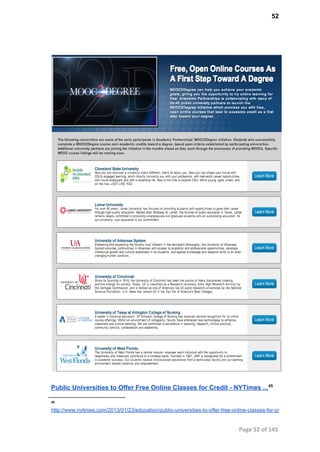
Public Universities to Offer Free Online Classes for Credit ­ NYTimes ...45
45
http://www.nytimes.com/2013/01/23/education/public­universities­to­offer­free­online­classes­for­cr
Page 52 of 145
53
With MOOC2Degree, Academic Partnerships has collaborated with public
universities to offer credit­bearing MOOCs as a first step and a free start
toward earning a degree. Through this new initiative, the initial course in
select online degree programs will be converted into a MOOC. Each MOOC
will be the same course with the same academic content, taught by the
same instructors, as currently offered degree programs at participating
universities. Students who successfully complete a MOOC2Degree course
earn academic credits toward a degree, based upon criteria established by
participating universities.
Academic Partnerships (AP) helps universities convert their traditional
degree programs into an online format, recruits qualified students and
supports enrolled students through graduation. Serving more than 40
state institutions, AP is one of the largest representatives of public
universities' online learning in the United States. The company was
founded by social entrepreneur, Randy Best, an 18­year veteran of
developing innovative learning solutions to improve education. AP is
guided by the principle that the opportunities presented through distance
learning make higher education more accessible and achievable for
students in the U.S. and globally. 46
edit.html
46
 http://www.academicpartnerships.com/
Page 53 of 145
54
1. 2. MOOC 수업 구성47
What You Need to Know About MOOCs
The MOOC­Led Meritocracy/강의의 질
THE PROFESSORS: B+
The pop star analogy is not trivial. While MOOCs are a great equalizer
when it comes to students around the world, they are a great unequalizer
when it comes to teachers.
MOOCs are creating a breed of A­list celebrity professors who have
lopsided sway over the landscape of ideas. I pity the offline teachers. I fear
one of the casualties of these online courses might be the biodiversity of
the academic ecosystem.
CONVENIENCE: A
MOOCs shift control to the student.
“I’m hyper. I’m nuts ... The good news is, you can always skip parts you
don’t enjoy. Whereas if you were in the class you’d have to suffer me
throughout.”
47
 http://www.nytimes.com/2013/04/21/opinion/sunday/grading­the­mooc­university.html?_r=0
Page 54 of 145
55
TEACHER­TO­STUDENT INTERACTION: D
As I mentioned, I had little to no contact with the professors. Not that I
didn’t try. I entered a lottery to join an exclusive 10­person Google hangout
with my genetics professor, the Duke University biologistMohamed A.
Noor. I lost. My cosmology professor, S. George Djorgovski, of Caltech,
held office hours on Second Life, the virtual world. But the professor told
those of us who were Second Life virgins that we might not want to
bother, since the software is complicated.
A handful of lucky students got responses from professors on the
discussion boards, and a few handfuls more from teaching assistants. I
was not among them. Perhaps I should have been more solicitous, like the
student who offered to send one flu­ridden instructor camomile tea. The
professor gamely responded that whiskey kills more bacteria.
For MOOCs to fulfill their potential, Coursera and its competitors will have
to figure out how to make teachers and teaching assistants more
reachable. More like local pastors, less like deities on high. To their credit,
the MOOC providers seem aware of the problem and are experimenting
with fixes, like recruiting experienced students to guide discussions.Some
reformers have suggested an online­offline hybrid model.Students in, say,
Ecuador, could gather in a Quito classroom, watch the MOOC lectures on
video, and then have a local teacher facilitate a discussion. As I learned in
my science literacy course, it’s hard to predict what will work in the real
world, but this seems worth testing.
STUDENT­TO­STUDENT INTERACTION: B­
As psychologists will tell you, if you don’t talk about what you’ve learned,
Page 55 of 145
56
the knowledge will evaporate. With MOOCs, there is no shortage of ways
to connect with other students: Facebook, Google Plus, Skype, Twitter,
Coursera discussion boards — even shutting your laptop and meeting a
classmate in a three­dimensional Dunkin’ Donuts.
I video­chatted twice with a clutch of students in my Google Plus modern
history group. Our conversations on Haitian independence and the
professor’s possible first­world biases were worthwhile and wonderfully
international: a Filipino scientist told me about his country’s education
system, and a Brazilian businessman shared a data point on his country’s
pronounced wealth inequality.
ASSIGNMENTS: B­
Coursework comes in various forms: multiple­choice quizzes, essays and
projects
Of course, since students are taking quizzes without proctors, cheatingis
a big MOOC concern. As it should be. When I Googled some quiz
questions for my genetics course — as a journalist, I swear — I found a
Canadian Web site with the answers.
A company called ProctorU has designed software to allow its employees
to monitor students taking quizzes via webcam. When it comes to
cheating, the cat­and­mouse game is likely to play out for a while.
Most of the quizzes are graded instantly by computer, but a few
assignments are judged by fellow students. I wrote an essay for my
“Aboriginal Worldviews” course in which I had to describe an American
Page 56 of 145
57
ritual as if it were foreign to me (I chose birthday parties). Three of my
peers graded the paper. They were kind over all, but I bristled at every
slight. Who died and made you professor?
The flexibility of courses
The flexibility of courses also may differ. On Udacity, for example, you can
start a class anytime you like and complete every task or exam at your own
pace. This reduces the massiveness and the opportunity to interact with
other students. On Coursera, classes have a start and an end date.
Although it’s possible to watch lectures at any time you want (and to
pause, start again, rewind and make your comments), most assignments
and exams have a deadline.
You might notice that most classes offered at the moment by universities
are introductory, taken from undergraduate disciplines. However, it is also
possible to find subjects in other levels or MOOCs specializing in a
particular field of knowledge.
Self­paced, synchronous and asynchronous48
48
http://moocnewsandreviews.com/what­is­a­massive­open­online­course­anyway­attempting­definiti
on/
Page 57 of 145
58
The terms self­paced, synchronous and asynchronous are applied to
these different models in inconsistent ways. A self­paced class at Udacity
is usually called asynchronous, since you don’t have to take it during a
specific period. You may be taking the class a year after the teacher
produced and published it.
From that perspective, the classes at Coursera and edX are often called
synchronous. Everyone is moving through the material at approximately
the same pace established by a schedule and deadlines.
Gates Foundation Offers Grants for MOOC’s in Introductory Classe49
The foundation will award as many as 10 grants of up to $50,000 each for
MOOC’s in  “high­enrollment, low­success introductory­level courses.”
“We are cautiously optimistic that MOOC’s might be able to improve
outcomes for low­income students who are working toward credentials,
but there are a lot of questions that we can’t yet answer,” says Josh
Jarrett, the foundation’s deputy director for postsecondary success.
1. 2. 1. 강의
1. 2. 2.시험
49
http://chronicle.com/blogs/wiredcampus/gates­foundation­offers­grants­for­moocs­in­introductory­cl
asses/39792
Page 58 of 145
59
Credit by Exam50
And when you do embark on a MOOC, you can have a good learning
experience by considering some of the tips and strategies other students
and teachers have shared here.
MOOC platforms set hours of homework every week besides lecture
videos, and the homework is either graded automatically or by students'
peers.
The importance of retrieval and testing for learning51
Many people think that the primary purpose of homework is to assess or
to evaluate students. We believe that a far more important purpose is that
they drive learning, and ensure long­term retention. A key factor in the
design of the Coursera system is the extensive use of interactive
exercises, which we believe are critical for student engagement and
learning. Even within our videos, there are multiple opportunities for
interactions: the video frequently stops, and students are asked to answer
a simple question to test whether they are tracking the material. This
strategy has value not only in maintaining student focus and engagement.
Research shows that even simple retrieval questions have significant
pedagogical value. For example, in two papers in Science, (Karpicke and
Roediger III, 2008; Karpicke and Blunt, 2011) show that activities that
require students to retrieve or reconstruct knowledge produces significant
gains in learning ­ much more so than many other learning strategies.
50
 http://degreeoffreedom.org/college­credit­by­exam/
51
 https://www.coursera.org/about/pedagogy
Page 59 of 145
60
Mastery Learning
Many of our courses’ homework are designed to give students multiple
opportunities to learn the content and demonstrate their knowledge. In
many traditional classes, if a student attempts a homework and does not
do well, he or she simply gets a low score on the assignment, and
instruction moves to the next topic, providing the student a poor basis for
learning the next concept. The feedback is also often given weeks after the
concept was taught, by which point the student barely remembers the
material, and rarely goes back to review the concepts to understand them
better. In the Coursera platform, we typically giveimmediate feedback on
that concept the student did not understand. In many cases, we provide
randomized versions of the same assignment, so that a studentcan
re­study and re­attempt the homework. This process is called Mastery
Learning, and was shown in a seminal paper by Bloom to increase student
performance by about one standard deviation over more traditional forms
of instruction. This means that if in a traditional class 50% of all students
pass a certain (median) level of performance, with Mastery Learning, about
84% of students now achieve this level of performance.
Peer assessments
In many courses, the most meaningful assignments do not lend
themselves easily to automated grading by a computer. For example, in a
poetry course, we would want the students to practice critical thinking and
interpretive skills by answeringessay­style questions, which do not have
clear right or wrong answers. Similar issues arise when we are evaluating
business plans, engineering designs, medical chart reviews, or many
others. This is particularly an issue in courses in the Humanities, Social
Sciences, Business, and other disciplines where a relatively small fraction
of the content lends itself well to an auto­graded format. Given our
commitment to offer courses from a broad range of disciplines, we have
invested substantial effort in developing the technology of peer
assessments, wherestudents can evaluate and provide feedback on each
other’s work. This technology draws on two bodies of literature: First, the
education literature on peer assessments. Following the literature on
Page 60 of 145
61
student peer reviews, we have developed a process in which students are
first trained using a grading rubric to grade other assessments. This has
been shown to result in accurate feedback to other students, and also
provide a valuable learning experience for the students doing the grading.
Second, we draw on ideas from the literature on crowd­sourcing, which
studies how one can take many ratings (of varying degrees of reliability)
and combine them to obtain a highly accurate score. Using such
algorithms, we expect that by having multiple students grade each
homework, we will be able to obtain grading accuracy comparable or even
superior to that provided by a single teaching assistant.
teaching methods that use active learning and interactive engagement
between faculty and students, and between students and their peers
1. 2. 3. 학점(Credit)
Credit for MOOCs52
College Credit
Educational Portfolios53
Signaling Learning
52
 http://degreeoffreedom.org/aceing­college/
53
 http://degreeoffreedom.org/aceing­college/
Page 61 of 145
62
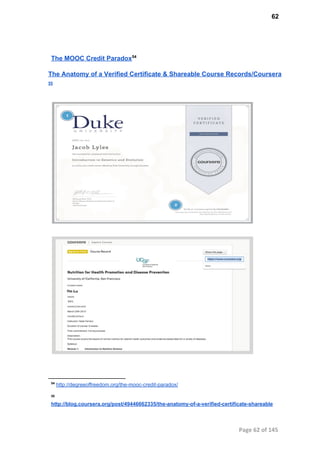
The MOOC Credit Paradox54
The Anatomy of a Verified Certificate & Shareable Course Records/Coursera
55
54
 http://degreeoffreedom.org/the­mooc­credit­paradox/
55
http://blog.coursera.org/post/49446662335/the­anatomy­of­a­verified­certificate­shareable
Page 62 of 145
63
All three of the leading MOOC providers — Coursera, edX and Udacity,
another Stanford spinoff — started by offering courses free but with no
credit, attracting millions of learners around the world. But all three are
now adapting those courses, often in blended form, for use in public
universities that will offer students credit and extra support — and bring
the MOOC providers a steady revenue stream.
56
A First for Udacity: a U.S. University Will Accept Transfer Credit for One of
Its Courses57
Colorado State to Offer Credits for Online Class58
By TAMAR LEWIN;
Colorado State University’s Global Campus would give three credits to
students who complete one of Udacity’s free “massive open online
courses.”
September 7, 2012, Friday
MOOCs for Credit/Georgia State University59
Public Universities to Offer Free Online Classes for Credit60
56
 http://www.nytimes.com/2013/06/20/education/online­classes­fuel­a­campus­debate.html?_r=0
57
 http://chronicle.com/article/A­First­for­Udacity­Transfer/134162/
58
http://www.nytimes.com/2012/09/07/education/colorado­state­to­offer­credits­for­online­class.html
?ref=tamarlewin
59
 http://www.insidehighered.com/news/2013/01/23/public­universities­move­offer­moocs­credit
60
http://www.nytimes.com/2013/01/23/education/public­universities­to­offer­free­online­classes­for­cr
edit.html?ref=tamarlewin
Page 63 of 145
64
10 large public university systems team with Coursera61
Coursera, the California company that offers free college classes online, is
forming partnerships with 10 large public university systems and public
uflagship universities to create courses that students can take for credit,
either fully online or with classroom sessions.
At the State University of New York system, the partnership is tied to
Chancellor Nancy L. Zimpher’s announcement of Open SUNY, an online
effort to enroll 100,000 new students.
The move could open online classes to 1.25 million students at public
institutions across the United States, and could help increase graduation
rates by making introductory and required classes — often a bottleneck
because of high demand — more widely available.
Joining Coursera will be the State University of New York system, the
Tennessee Board of Regents and the University of Tennessee systems,
the University of Colorado system, theUniversity of Houston system, the
University of Kentucky, the University of Nebraska, theUniversity of New
Mexico, the University System of Georgia and West Virginia University.
Some systems plan to blend online materials with faculty­led classroom
sessions. Others will offer credit to students who take the courses online
followed by a proctored exam on campus.
Some will use existing Coursera materials developed by faculties at elite
61
 http://www.nytimes.com/2013/05/30/education/universities­team­with­online­course­provider.html
Page 64 of 145
65
universities, but others expect that their own faculties will develop
materials for the Coursera platform, making them available at campuses
systemwide and beyond.
Faculty members will be able to customize existing courses, adding their
own lessons and refinements, the company said.
Coursera’s fees will vary, depending on the size of the class. For a large
course, universities would pay about $8 a student to use the Coursera
platform. In addition, for use of content developed at a different university,
Coursera would charge $30 to $60 per student per course.
At SUNY, which has 468,000 students at 64 campuses, the Coursera
partnership is tied to Chancellor Nancy L. Zimpher’s announcement this
year of Open SUNY, an online effort to enroll 100,000 new students and
make it possible for a quarter of them to earn a degree in three years.
Students could take courses at any campus, or at other universities on the
Coursera platform, toward a degree at their home campus. Dr. Zimpher
said it would be some time before a decision about how many of the
system’s online offerings, and which ones, would use the Coursera
platform.
Houston Davis, the chief academic officer of the University System of
Georgia, with 314,000 students, said that while the system would start with
just a handful of Coursera courses next fall, he hoped a full menu of
general education courses — the gateway classes usually taken in a
student’s first two years — would eventually be available online through
Coursera, for sharing by all the campuses.
“As I’ve told the faculty, we’re not outsourcing content delivery or casting
students to the winds,” he said. “But there are thousands and thousands
of students in Georgia with a high school diploma, or some college but no
degree, and we need to explore new ways to reach them.”
The partnerships represent a new direction for Coursera, and for the
“massive open online courses,” known as MOOCs, that have
galvanizedhigher education over the last year, as millions of students
worldwide registered for free classes that carried no credit.
Page 65 of 145
66
“Our first year, we were enamored with the possibilities of scale in
MOOCs,” said Daphne Koller, one of the two Stanford computer science
professors who founded Coursera. “Now we are thinking about how to
use the materials on campus to move along the completion agenda and
other challenges facing the largest public university systems.”
Initially, Coursera recruited as partners only the elite research universities
in the Association of American Universities. Now the company is eager to
work with a broader range of institutions, to see how its materials can help
more students complete their degrees.
Other leading online providers, too, have begun projects with public
universities: edX, the nonprofit collaboration founded by Harvard and the
Massachusetts Institute of Technology, has teamed with the University of
Texas and some California State University campuses, and Udacity,
another Stanford spinoff, with San Jose State University.
Some faculty resistance has emerged recently against using online
materials, even if they are blended with classroom work. This week, 58
Harvard professors wrote a letter seeking the creation of a new committee
to consider the ethical issues related to edX and its impact on higher
education.
Both Dr. Koller and university officials involved in the new partnerships
said that they had no intention of undercutting faculty control over course
content and that the provision allowing faculties to customize online
materials or put their own courses onto the Coursera platform was critical
to the project’s success.
“We hope this will help public universities do more with the less they’re
getting in state support,” Dr. Koller said.
William G. Bowen, the former Princeton president and founding chairman
of Ithaka, a nonprofit organization that studies online education, sees
promise in the arrangement.
“We have encouraged Coursera to work with the large state university
systems, and the large state university systems to work with Coursera,
Page 66 of 145
67
because that’s where the numbers are, and that’s where there are the
biggest issues in terms of cost, completion and access,” said Dr. Bowen.
“It’s still exploratory, but this partnership has the potential to make real
headway in dealing with those issues.”
Five Courses Receive College Credit Recommendations62
The End of Nuclear Institutions63
There is compelling reason to think that unbundling institutional
knowledge provision and credentialing is not only gaining momentum but
is inevitable. Recent events confirm Peter Stokes's observation that the
fusion of the core elements of land­based education (faculty, curriculum,
credentials) is no longer inseparably tied to a single institution.3
 The
emergence of MOOCs as an alternative to location­bound, proprietary
forms of campus­based learning and portals like edX, Coursera, and
Udacity that host them undermine the individually crafted course model
that sustains the "college credit monopoly."4
 The acceptance of credit for
MOOCs by accredited institutions, such as Colorado State University's
Global Campus,5
 Antioch University,6
 San Jose State University,7
 Georgia
State University,8
 and the recently announced MOOC2Degree
collaboration between dozens of public universities and Academic
Partnerships,9 
the impetus from Gates Foundation grants to develop
MOOCs for "high enrollment, low­success" introductory courses,10
 and
the partnership between the Saylor Foundation and Excelsior College and
StraigherLine11
 are all opening upa path to credit for free and low­cost
courses. A parallel movement away from seat­time to competency­based
learning at Western Governors University, Southern New Hampshire
University, and the University of Wisconsin System further erodes the
62
 http://blog.coursera.org/post/42486198362/five­courses­receive­college­credit­recommendations
63
 http://www.educause.edu/ero/article/mooc­model­challenging­traditional­education
Page 67 of 145
68
value proposition underlying the traditional model of land­based
education.
MOOCs, as currently designed, address two of the three challenges facing
postsecondary education: access and cost. MOOC­based degree
programs would not only democratize education, but their scalability
would help end the unsustainable trajectory of tuition. They are an
effective remedy to the "cost disease" plaguing higher education12
 and a
viable solution to the problem of providing global access to educational
credentials
edX Offers Proctored Exams64
Students enrolled in a free open online course offered through edX will
now have the option of getting their learning validated with a proctored
final exam, under a new program announced today.
The nonprofit online­learning venture, founded by MIT and Harvard, will let
students take on­site exams administered by the Pearson VUE service,
which has more than 450 testing centers in more than 110 countries.
Students who pass the tests will receivecertificates noting that they
completed a proctored exam.
In a conference call with reporters, Anant Agarwal, president of edX, said
the proctoring option would make the certificates“significantly more
valuable.”
“From our discussions with employers and institutions, they certainly feel
much more comfortable with proctored certificates, because these really
reflect the students’ own work,” he said.
For the Udacity course, the proctored exam will cost $89.
64
http://chronicle.com/blogs/wiredcampus/edx­offers­proctored­exams­for­open­online­course/39656
Page 68 of 145
69
1. 2. 4. 커뮤니티
Harvard Asks Graduates to Donate Time to Free Online Humanities Class65
Students in Free Online Courses Form Groups to Study and Socialize66
65
http://www.nytimes.com/2013/03/26/education/harvard­asks­alumni­to­donate­time­to­free­online­c
ourse.html?ref=elearning&_r=0
66
http://chronicle.com/blogs/wiredcampus/students­in­free­online­courses­form­groups­to­study­and­
socialize/38887 –
Page 69 of 145
70
"The biggest revolution of MOOC is the interactions between students and
teachers as well as other students," says Ng of a system that offers
materials including videos and tests together with community­building
user forums.67
Another major departure from previous online courses is that MOOC has
successfully brought together student communities. They either discuss
difficult points online or come together in the real world to meet.
수강중 무료 교과서 제공68
Coursera partners with publishers to bring digital textbooks to the masses
69
67
 http://news.xinhuanet.com/english/indepth/2013­04/02/c_132279991.htm
68
http://venturebeat.com/2013/05/08/coursera­partners­with­publishers­to­bring­digital­textbooks­to­t
he­masses/
69
http://venturebeat.com/2013/05/08/coursera­partners­with­publishers­to­bring­digital­textbooks­to­t
he­masses/
Page 70 of 145
71
활용예/The Student Hub/강의중에만 구독가능
1. 2. 5. MOOC 을 통한 미국대학교육 혁명
Former U.S. secretary of education William Bennett has written that he
senses“an Athens­like renaissance”  in the making. Stanford president70
John Hennessy told the New Yorker he sees “a tsunami coming.”71
The Crisis in Higher Education72
The excitement over MOOCs comes at a time of growing dissatisfaction
with the state of college education. The average price tag for a bachelor’s
degree has shot up to more than $100,000. Spending four years on
campus often leaves young people or their parents weighed down with big
debts, a burden not only on their personal finances but on the overall
economy.  And many people worry that even as the cost of higher73
education has risen, its quality has fallen. Dropout rates are often high,
particularly at public colleges, and many graduates display little evidence
that college improved their critical­thinking skills. Close to 60 percent of
Americans believe that the country’s colleges and universities are failing to
provide students with “good value for the money they and their families
spend,” according to a 2011 survey by the Pew Research Center.
Proponents of MOOCs say the efficiency and flexibility of online
instruction will offer a timely remedy.
70
 http://www.cnn.com/2012/07/05/opinion/bennett­udacity­education/index.html
71
 http://www.newyorker.com/reporting/2012/04/30/120430fa_fact_auletta?currentPage=all
72
 http://www.technologyreview.com/featuredstory/429376/the­crisis­in­higher­education/
73
 http://nces.ed.gov/programs/coe/tables/table­cst­1.asp
Page 71 of 145
72
Students Rush to Web Classes, but Profits May Be Much Later74
By TAMAR LEWIN;
New companies are partnering with universities to offer online courses, in
an effort that could define the future of higher education — if anyone can
figure out how to make money.
January 7, 2013, Monday
The MOOC Model: Challenging Traditional Education75
MOOCs represent the latest stage in the evolution of open educational
resources. First was open access to course content, and then access to
free online courses. Accredited institutions are now accepting MOOCs as
well as free courses and experiential learning as partial credit toward a
degree. The next disruptor will likely mark a tipping point: an entirely free
online curriculum leading to a degree from an accredited institution. With
this new business model, students might still have to pay to certify their
credentials, but not for the process leading to their acquisition. If free
access to a degree­granting curriculum were to occur, the business model
of higher education would dramatically and irreversibly change. As Nathan
Harden ominously noted, "recent history shows us that the internet is a
74
http://www.nytimes.com/2013/01/07/education/massive­open­online­courses­prove­popular­if­not­lu
crative­yet.html?ref=tamarlewin
75
 http://www.educause.edu/ero/article/mooc­model­challenging­traditional­education
Page 72 of 145
73
great destroyer of any traditional business that relies on the sale of
information."1
Colleges have a problem here: the way in which the core services of
education are rendered is changing, but the underlying business model is
not. This widening disconnect threatens not only the financial viability of
traditional campuses following the "Law of More,"2
 but, more
fundamentally, their rationale.
A number of converging trends pose a challenge to brick­and­mortar
institutions:
● the emergence of the learning sciences and their application to
educational practice,
● the movement toward competency­based education, and
● new business models that effectively combine instructional quality,
lower cost, and increased access through unlimited scalability
(MOOCs).
A turning point will occur when a MOOC­based program of study leads to a
degree from an accredited institution. Indeed, we are already partially
there: students can now receive transfer credit toward a degree from an
accredited institution for learning not obtained at a college or university.
MOOCs: Quality Matters76
Notwithstanding the importance of their role in reducing cost and
expanding access, the remaining unresolved issue facing the acceptance
of MOOCs is access to what? The major obstacle to their acceptance
relates to the third challenge: their quality. As some rightly point out,
current course models can aptly be described as"self­service learning and
crowdsourced teaching."13
 Although self­directed learning and peer
mentoring have instructional benefits when part of a well­designed
curriculum, most MOOCs (especially in STEM areas) are designed in a way
that skews toward autodidacts and more advanced learners. Novice
76
 http://www.educause.edu/ero/article/mooc­model­challenging­traditional­education
Page 73 of 145
74
learners needing instructional guidance are largely on their own and no
better off perhaps than those in a large gateway course delivered in a
lecture hall on campus. Although improving the quality of student learning
is one of the priorities of the major MOOC providers, most of their courses
currently lack a sophisticated learning architecture that effectively adapts
to the individual needs of each learner.
Addressing the quality of the learning experience that MOOCs provide is
therefore of paramount importance to their credibility and acceptance.
According to the most recent Babson Research Group survey, institutional
decision makers have yet to be convinced of the value of MOOCs.
Although not specifically attributing their skepticism to the perceived
quality of MOOCs, the report finds that only 28 percent of chief academic
officers believe that they are a sustainable method for offering courses.14
What potential, then, do MOOCs have not only to improve learning but to
provide the best possible educational experience? Contrary to what some
may think, designing the best learning environments does not entail their
being taught by the best professors or affiliated with elite universities.
Instead of simply using scholarly reputation and institutional prestige as
quality standards, we should judge MOOCs by how well they enable the
conditions that optimize learning for each student.
Although critics may scoff at the simplistic design of most current MOOCs,
it would be shortsighted to dismiss them as hopelessly inferior to
classroom­based instruction. If there is one lesson from the history of
disruptive innovation, it is that we often wrongly assume that a product or
practice that dominates a current market defines enduring standards of
optimal quality. It would be a mistake, then, to think that the near­term
shortcomings of MOOCs inhibit their potential to improve in quality.
MOOCs and other forms of open curricula will transform how people learn
only to the extent that they enable effective learning. What, then, might a
learning­optimized MOOC look like?
San Jose State U. Says Replacing Live Lectures With Videos Increased
Test Scores77
77
http://chronicle.com/blogs/wiredcampus/san­jose­state­u­says­replacing­live­lectures­with­videos­i
ncreased­test­scores/40470
Page 74 of 145
75
In an effort to raise student performance in a difficult course, San Jose
State University has turned to a “flipped classroom” format,requiring
students to watch lecture videos produced by the Massachusetts Institute
of Technology and using class time for discussion.
The 85 students in the flipped course at San Jose State watched the edX
lecture videos at home and attended class twice a week to practice what
they had learned and ask questions. Two other sections of students took a
traditional version of the course.
The midterm­examination scores of students in the flipped section were
higher than those in the traditional sections, said Mr. Ghadiri. Although the
midterm questions were more difficult for the flipped students, their
median score was 10 to 11 points higher.
How Will MOOCs Make Money?78
Winning the MOOC space will require a combination of investment capital,
branded credibility in the marketplace, deep expertise in academics, and
deep expertise in the formation and scaling of hugely popular online
enterprises.
78
http://www.insidehighered.com/news/2012/06/11/experts­speculate­possible­business­models­mo
oc­providers#ixzz2AEv9ZYEl
Page 75 of 145
76
2. OER(Open Education Resources/무료교육자료)
2.1. OCW
As Juliana previously discussed in an article on the History of Distance
Learning, the idea to provide free academic knowledge online is not
recent. It’s been now almost 15 years, for example, since the American
university The Massachusetts Institute of Technology began its
OpenCourseWare project, giving more people access to university
lectures and other tools to enhance e­learning. 79
2.2. OER
Creative Commons80
79
http://moocnewsandreviews.com/what­is­a­massive­open­online­course­anyway­attempting­definiti
on/
80
 http://creativecommons.org/
Page 76 of 145
77
Hybrid & Flipped & Blended Class81
2.3. iTunes U82
Another antecedent to the MOOC is iTunes U, launched by Apple in 2007 to
offer education materials for download. Many colleges and universities
joined the site, creating courses especially designed for the format or
simply posting podcasts, video lectures or textbooks for free download by
anyone in the world.
81
 https://learn.canvas.net/courses/54
82
 http://www.apple.com/education/itunes­u/
Page 77 of 145
78
2.4. Khan Academy83
College 2.0: A Self­Appointed Teacher Runs a One­Man 'Academy' on
YouTube
Gates Notes84
Using basic tools on his home computer, Salman Khan began making
short math tutoring videos, first for his younger cousins and then for
anyone following his YouTube account and eventually for millions of
students around the world. That has grown into Khan Academy, a
non­profit provider of video lectures and exercises on a variety of subjects
and now, although Khan isn’t a formally trained educator, he is one of the
best­known teachers in the world.
2.5. MOOC
Birth of cMOOC  85
The concept of MOOC was first implemented in 2008 with an openonline
course offered by George Siemens and Stephen Downes at theUniversity
of Manitoba, "Connectivism and Connective Knowledge".  The
83
 https://www.khanacademy.org/
84
 http://www.thegatesnotes.com/Topics/Education/Khan­Academy­60­Minutes
85
 http://www.slideshare.net/timboileau/usdla­apr2013
Page 78 of 145
79
environment created was a web site using aggregation, remix,repurpose,
and feeding forward of content and media identified bythe students using
blogs, YouTube videos, synchronous videodiscussions, and RSS feeds to
build knowledge structures within adomain. A MOOC is a platform! (think
Google Course Builder)  Focus was on peer­constructed knowledge and
curation in a virtuallearning environment. cMOOCs emphasize creation,
creativity,autonomy and social networking learning.
MOOC Hyperbole in 2012 MOOC
The demise of the campus as we know it.  The most important education
technology in the past 200 years. Free education for all, anywhere in the
world with online access.   Professors at prestigious universities host
reviewable onlinelectures and curate videos, content and activities for
their students.  Learners can tap into Ivy League­quality instruction on
their owntime, at their own pace and with little to no cost.  Despite the
hype, MOOCs have yet to solve seemingly simpleproblems, such as
producing a sustainable business model andevaluating student
performance in a meaningful way. 86
MOOC ­ Disruptive Innovation
A disruptive innovation is an innovation that helps create anew market
with its own value network; and eventually goes on todisrupt an existing
market and value network (over a few years ordecades), displacing an
earlier technology. Examples of disruptive innovations include:  MP3 file
format and the effect on the music industry  Wikipedia and the effect on
bound encyclopedias  eBook formats, enabling self­publishing and impact
on the broaderpublishing industry  Digital readers and the effect on the
86
 http://www.slideshare.net/timboileau/usdla­apr2013
Page 79 of 145
80
newspaper and magazineindustry  MOOCs and the presumed effect on
higher education
Clayton Christensen defines a disruptive innovation as aproduct or
service designed for a new set of customers."Generally, disruptive
innovationswere technologicallystraightforward, consisting of off­the­shelf
components put togetherin a product architecture that wasoften simpler
than priorapproaches. They offered less ofwhat customers in
establishedmarkets wanted and so couldrarely be initially employed
there.They offered a different package ofattributes valued only in
emergingmarkets remote from, andunimportant to, the mainstream."
Peak of Inflated Expectations✤ MIT launched MITx (Massachusetts
Innovation & TechnologyExchange) in December of 2011, merging with
Harvard in early 2012to create edX.✤ In the same period, a consortium of
British universities has createdthere own MOOC platform called
Futurelearn.✤ More than 90 universities worldwide had teamed up with
one ormore MOOC providers, with investments of over $100M,
promptingthe New York Times to declare 2012 as "The Year of the MOOC"
Page 80 of 145
81
inNovember of last year.87
MOOC Audiences
1.Internal students on course –cost savings on volume courses
87
 http://www.slideshare.net/timboileau/usdla­apr2013
Page 81 of 145
82
2.Internal students not on course– expanding student experience
3.Potential students national –major source of income
4.Potential students international– major source of income
5.Potential students High school –reputation and preparation
6.Parents – significant in studentchoice
7.Alumni – potential income andinfluencers
8.Lifelong learners – late andlifelong adult learners
9.Professionals – related toprofessions and work
10.Government – part of accessstrateg  88
88
 http://www.slideshare.net/timboileau/usdla­apr2013
Page 82 of 145
83
Nor should we forget what, funnily enough, are now sometimes called
“traditional” online classes. For many years now, most colleges and
universities have offered at least a few of their classes in online formats for
tuition­paying students and for credit. You can even earn an entire online
degree this way from a growing number of programs. While these are not
massive and not free, they demonstrate that online learning is possible,
and much of the technology behind those classes are part of how MOOCs
function now.
전통적인 온라인강의와 MOOC 의 차이점./how it differs from other forms of
distance learning
Then, in 2012, the MOOC initiatives many of us are familiar with burst onto
the scene. Educators, social entrepreneurs, charitable foundations,
universities and venture capitalists began forming initiatives to unite the
best online tools with the best — or, at least, the most prestigious —
teaching available.
This was how Udacity, Coursera and edX (the only non­profit among those
major MOOC platforms) were founded. The response they got was
enormous, with tens of thousands students signing up for each class.
2.5.1. In what way is a MOOC a
course?/대학정규강의/강의&시험&점수&수료증
Page 83 of 145
84
A MOOC is a course in two important senses. First of all, it has
assignments and evaluations built in the way that a college class has
assignments and exams. Most MOOCs have quizzes along the way and
exams at the end, but more subjective assignments, such as written
essays or creative projects, are also possible. (The Berklee School of
Music Songwriting MOOC, for example, required . . . . writing a song.) The
evaluation may be done by the teacher, by software or by peers. Having
assignments and evaluations distinguishes a MOOC from university
initiatives like Open Yale that offer free lectures but don’t have any way of
assessing a visitor to the site.
Second, MOOCs are courses in the sense of having a completion point.
Khan Academy has exercises along the way, but if you jump in to start
learning, for example, elementary school arithmetic, you’ll never reach a
last day of school. Somehow, Sal always has recorded one more
advanced mathematics lesson for you or a lesson in a related topic. MOOC
courses are designed to come to a conclusion, usually after 4 – 12 weeks.
Most MOOCs are offered by college professors on subjects that are
usually covered in college classrooms and with a workload and schedule
resembling a college semester. So MOOCs are about getting a college
education, right?
2.5.2. In what way is a MOOC online?/온라인강의 & 오프라인
스타디그룹&감독하에 최종시험
Hybrid Class/Fipped Class/Blended Class
Page 84 of 145
85
It’s pretty obvious what online means, but one thing to keep in mind is that
some forms of distance learning are hybrid, where students do part of their
work online and meet with the teacher at school part of the time.
Increasingly, hybrid classes use materials from a MOOC to support the
class, but the class itself isn’t what most people would call a MOOC.
One example of this hybrid format is the on­campus version of Professor
Mohamed Noor’s Introduction to Genetics and Evolution class at Duke
University. He teaches it in MOOC form and he uses the MOOC materials in
a hybrid or flipped class for his on­campus students.
산호세 대학 예89
California State U. System Will Expand MOOC Experiment90
San Jose State last fall used material from an edX course, “Circuits &
Electronics,” as part of a “flipped classroom” experiment in its own
introductory course in electrical engineering. The university offered three
versions of the course: two conventional face­to­face sections and one
“blended” section, in which students watched edX videos on their own
and then participated in group activities, sans lecturing, during class time.
The pass rates in the two conventional sections were 55 percent and 59
percent. In the “flipped” section with the edX videos, 91 percent of
students passed.
89
http://chronicle.com/blogs/wiredcampus/california­state­u­system­will­expand­mooc­experiment/43
361
90
http://chronicle.com/blogs/wiredcampus/california­state­u­system­will­expand­mooc­experiment/43
361
Page 85 of 145
86
2.5.3. In what way is a MOOC open?/무료화 & 민주화 & 지적재산권 해제
This is the part of the definition that is most in dispute. Lately, most people
refer to something as a MOOC when it is free for anyone to participate in
without a fee and without any admissions process. It’s open in the sense
of being no­cost, and it’s open in the sense of having no application
requirements. All you need is a username and password.
But the original designers of MOOCs meant for them to be open in two
other important senses. MOOCs were originally open (and many still are) in
the sense of open­access, much like creative works under a Creative
Commons license can be open. These instructors use materials in the
public domain that don’t have copyright restrictions, and they intend for
their work to be freely available for others to reuse and adapt.
That’s not how today’s major MOOC providers work, though. On sites like
Coursera and edX, anyone may enter, but the materials a visitor will find
there are under copyright and can’t be removed or modified. Also, after
those classes are completed, the materials are often closed from public
view until the next time they are offered, whereas on many independent
MOOCs outside those major platforms, even after they are inactive, the
materials remain available for anyone to access.
Discusion Forum / 집단지성의 장
Second, the original MOOC concept was open in the connectivist sense.
Page 86 of 145
87
The boundaries between teacher and student and between each student
are much more open than in a traditional classroom, and the creation of
knowledge happens through connections that are unexpected and
unplanned.
People who promote open education resources (OER) are disappointed
that the term MOOC is being applied to classes without open access.
Open Text under Condition 91
Coursera, Publisher Pilot Offers Licensed Content to MOOC Students
Partnership Gives Students Access to a High­Price Text on a MOOC
Budget92
2.5.4. In what way is a MOOC massive?/강의당 수만명 수강
The massiveness of a MOOC is a natural result of being an online course
open for anyone to enter. What counts as massive varies quite a bit. Some
MOOCs have a few hundred students and a few have had more than
100,000 students. But one way to look at it is to consider a course massive
when it has more students than the teachers and assistants can
91
http://lj.libraryjournal.com/2013/05/academic­libraries/coursera­publisher­pilot­offers­licensed­conte
nt­to­mooc­students/
92
 http://chronicle.com/article/Partnership­Gives­Students/139109/
Page 87 of 145
88
themselves interact with. When machine grading, peer assessment and
other peer support become not only desirable but necessary, that counts
as massive from the teacher’s perspective, and a few thousand more or
less doesn’t make much difference.
3.  MOOC 대학교육혁명
Independent Educational Portfolios93
Davos Forum Considers Learning’s Next Wave94
Revolution Hits the Universities95
The Professors’ Big Stage96
Clayton Christensen, the Harvard Business School professor and expert
on disruptive innovation, gave a compelling talk about how much today’s
traditional university has in common with General Motors of the 1960s, just
before Toyota used a technology breakthrough to come from nowhere
and topple G.M. Christensen noted that Harvard Business School doesn’t
teach entry­level accounting anymore, because there is a professor out at
Brigham Young University whose online accounting course “is just so
good” that Harvard students use that instead. When outstanding becomes
so easily available, average is over.
93
 http://degreeoffreedom.org/independent­educational­portfolios/
94
http://www.nytimes.com/2013/01/28/business/davos­considers­learnings­next­wave.html?ref=elear
ning
95
http://www.nytimes.com/2013/01/27/opinion/sunday/friedman­revolution­hits­the­universities.html?r
ef=elearning
96
http://www.nytimes.com/2013/03/06/opinion/friedman­the­professors­big­stage.html?ref=elearning
Page 88 of 145
89
What MOOCs Can Learn from the Publishing Industry97
Only one year after the biggest MOOC platforms were founded, it is already
possible to see how fast they are changing higher education.
As you can see, MOOCs are a great source of free high quality information
about a topic, and they may also be a source of opportunities for career
advancement or educational credentials. Some free courses are now
being accepted for credit at some colleges, and some Coursera MOOCs
received credit recommendations from the American Council on
Education. In addition, students may choose to pay for a verified certificate
and share their results with potential employers, which could lead to fewer
students seeking degrees.
Meanwhile, the major American providers we’ve used as to illustrate the
different kinds of MOOCs are only the beginning of the story. When you
start searching for massive open online courses, you will also discover
that many new platforms are being developed from all over the world and
in many different languages. Some universities are also trying to reach the
stream independently. The University of Amsterdam, for example, where
Juliana is studying, built its own MOOC website.
It is normal to get confused in such a high tide, but never fear. The most
comprehensive roundup of all the sources of MOOCs is on this site in our
MOOC Around the World series. And when you do embark on a MOOC,
you can have a good learning experience by considering some of the tips
and strategies other students and teachers have shared here.
97
https://www.edsurge.com/n/2013­07­08­opinion­what­moocs­can­learn­from­the­publishing­industry
Page 89 of 145
90
3.1. 미국대학혁명
5 Tactical Questions Higher Ed Administrators Should Be Asking About
MOOCs98
There are many reasons colleges and universities provide free online
classes in the form of a MOOC to audiences beyond their own students.99
One important reason is that they are hoping to reach new audiences. In
some cases, they want to reach people who can’t have access to a full
degree or any other university course, either because of distance, cost or
a lack of time.
In other cases, they hope to influence students who may enroll in their
institution. An example of that is the MathMOOC at the University of
Wisconsin – La Crosse, which attracted students from around the world
and every state in the U.S. but most especially from “feeder schools”
around Wisconsin whose students may end up at La Crosse.
A third reason for offering MOOCs is “brand building.” Some university
98
http://moocnewsandreviews.com/5­tactical­questions­higher­ed­administrators­should­be­asking­a
bout­moocs/
99
http://moocnewsandreviews.com/what­is­a­massive­open­online­course­anyway­attempting­definiti
on/
Page 90 of 145
91
presidents have pointed out that by raising the profile of their school
through a MOOC they are increasing the value of the degree to past and
future graduates.
3. 1. 1. 학점인정100
State Lines May Ease for Classes Held Online
Higher education leaders have proposed a way to make it easier for
universities to offer online courses across state lines.
A commission on online learning led by former Secretary of
EducationRichard W. Riley outlined a proposal on Thursday under which
any institution that had received state authorization for its online
programs, based on certain quality and consumer protection standards,
would beallowed to enroll students from other states that met the same
basic standards and agreed to reciprocity.
The issue of state regulations in the era of online learning was highlighted
in October when officials in Minnesota told Coursera, a provider of
“massive open online courses,” or MOOCs, that it could not offer free
courses to Minnesota residents without registering with the state. Because
the courses were free — and because the state action was widely
ridiculed, given the difficulty of stopping Minnesotans from enrolling
100
http://www.nytimes.com/2013/04/12/education/online­courses­should­be­easier­to­offer­out­of­stat
e­panel­says.html
Page 91 of 145
92
online — the state quickly backed down.
The new proposal would not apply to MOOC providers, because they are
not accredited degree­granting institutions, or to international students.
a. MOOC2Degree
b. San Jose  Uni.
An Educational Hybrid101
For two to three decades the evidence has grown that active student
engagement with material, not brilliant lecture presentations, is the key to
learning. It seems that San Jose State’s blended version of a MOOC,
weaving material from online classes into instruction, supports that
conclusion.
As your article correctly points out, it may not be the MOOC itself that
101
 http://www.nytimes.com/2013/05/07/opinion/an­educational­hybrid.html?ref=elearning
Page 92 of 145
93
produced a 91 percent pass rate in the blended circuits course, but rather
the intensive in­person workshops and 24/7 availability of online mentors.
Let’s hope that the results at San Jose State will be replicated with a
scaling up in class size, and let’s be sure we take away the right lesson.
The MOOCs’ key role may be in enabling a more engaging structure for
courses, and if so, MOOCs have done higher education a great service.
San Jose State used the online lectures and interactive exercises of
M.I.T.’s introductory online Circuits and Electronics course. Students
would watch the M.I.T. lectures and do the exercises at home, and then
come to class, where the first 15 minutes were reserved for questions and
answers with the San Jose State professor, and the last 45 were devoted
to problem solving and discussion. Preliminary numbers indicate that
those passing the class went from nearly 60 percent to about 90 percent.
And since this course was the first step to a degree in science and
technology, it meant that many more students potentially moved on
toward a degree and career in that field
c. Georgia Tech
Georgia Tech Will Offer a Master’s Degree Online102
OMS CS PUBLIC FAQ103
Georgia Tech’s Online Master of Science in Computer Science (OMS CS) is
the first degree of its kind, and people always have questions about
something new. We tried to anticipate those questions in the information
below.
102
http://www.nytimes.com/2013/05/15/education/georgia­tech­will­offer­a­masters­degree­online.html
?ref=elearning
103
 http://www.omscs.gatech.edu/faq/
Page 93 of 145
94
Why the OMS CS?104
Why is Georgia Tech doing this?
Georgia Tech in general, and the College of Computing in particular, are
committed to fully incorporating disruptive educational technologies into
the value the Institute provides to its stakeholders. The development of
massive­online educational models bring an unprecedented opportunity
to extend access to high­quality education to an exponentially larger
number of people, from around the world, than we can accommodate on a
physical campus. Our educational mission as a public university is to
explore and maximize such opportunities.
What’s new about this approach?
It will be the first professional Online Master of Science degree in computer
science that can be earned completely through the “massive online”
format. It shows how leaders from MOOC, industry and academia can join
to offer an advanced degree program on a massive and affordable scale.
We believe this program can establish corporate acceptance of
high­quality and 100 percent online degrees as being on par with degrees
received in traditional on­campus settings, and serve as a blueprint for
helping the United States address the shortage of people with advanced
computer science and other STEM skills.
Why computer science?
There are an estimated 3 million open technology positions in the job
market today. Training skilled computing professionals is a societal need,
and that is a challenge Georgia Tech, Udacity and AT&T want to address.
How does computer science lend itself to evaluation using the
massive­online approach?
Often computer science problems have a right or wrong answer and lend
104
 http://www.omscs.gatech.edu/faq/
Page 94 of 145
95
themselves to objective, rather than subjective, assessment and
evaluation. This is what makes computer science amenable to the MOOC
platform. In instances where this is not the case, we will apply the
resources necessary to evaluate and assess student performance.
Will Georgia Tech offer other degrees in this format?
Georgia Tech has no plans at this time to launch other massive­online
degrees.
Why has AT&T decided to jump into the world of online higher education?
AT&T believes the disruptive power of the MOOC (Massive Online Open
Course) platform can help address the shortage of engineers and other
technical­degreed talent in the United States. By making graduate degrees
and certifications available online at very affordable rates, Udacity, Georgia
Tech and AT&T are eliminating barriers for many students unable to afford
or access an advanced degree, and increasing the pipeline for the next
generation of technology leaders. STEM skills are essential across
business segments in today’s digital economy.
About the Program105
How is this degree different from residential Georgia Tech MS CS?
The OMS CS will deliver educational content completely through the
massive online format. This means it will differ from the residential MS CS
in course structure, for example, but will provide an educational
experience no less rigorous than the on­campus format.
How is the OMS CS different from other distance­learning and/or online
degree programs that have existed for a long time?
The Georgia Tech OMS CS is the first online degree in computer science
from a top­tier university that students can obtain exclusively through the
massive­online format.
How much does the degree program cost?
We’re not yet ready to announce a specific program cost, but the plan is to
105
 http://www.omscs.gatech.edu/faq/
Page 95 of 145
96
offer the Georgia Tech OMS CS for a total cost of under $7,000—a fraction
of the cost of Georgia Tech’s on­campus program and even less than that
of comparable private universities.
What evidence do you have of market demand for this program?
At present, around 160,000 master’s degrees are bestowed in the United
States every year in computer science and related subject disciplines; the
worldwide market is almost certainly much larger, perhaps even an order
of magnitude larger. We conjecture that the present structure is vastly
underserving the market and will conduct market research in the first year
to check these estimates and help target our course offerings.
How long does it take to complete and receive a degree?
We anticipate the typical time for students to complete the OMS CS will be
about three years, though we will allow for longer enrollments— up to six
years—for those students who need greater flexibility.
How does the student workload compare to a residential degree? How
many hours a week will students spend on it?
The total workload is the same as the residential program; the weekly or
hourly workload depends on how quickly students wish to complete the
program.
Who can take courses?
All OMS CS courses will be available free of charge for anyone, anywhere
in the world. Degree­seeking students will be virtually separated from
“open” students to ensure degree program rigor.
Who can apply to the degree program?
Formal admission into the OMS CS program will require a Bachelor of
Science degree in computer science from an accredited institution, or a
related Bachelor of Science degree with a possible need to take and pass
remedial courses. Formal admission will also require the selection through
a graduate admission committee that will meet periodically.
When can people sign up for the courses?
Page 96 of 145
97
All courses will be open to the public as soon as they are available on the
Udacity website. Timing is to be worked out, but course previews are
expected to be available this summer for select courses. For more
information, please see www.Udacity.com/GeorgiaTech
When can they apply to the degree program?
We anticipate opening enrollment for matriculation during Fall 2014.
Why isn’t the program open to the general public immediately?
At Georgia Tech, we are not only educators but scientists. To ensure
program rigor and success, we will test our programmatic hypotheses
with a smaller student cohort before scaling the OMS CS up to larger
enrollments.
How many students ultimately do you anticipate participating?
This is difficult to determine, but we feel the current offerings of top­quality
computer science degrees vastly underserve the market. Our long­term
business models suggest an enrollment of about 10,000 students at any
given time.
How does the admissions process work?
Admissions into the OMS CS program will take place on a periodic basis,
and students have to furnish materials commonly required for graduate
admissions (prior degrees, transcripts, etc.). Georgia Tech will admit
successful applicants with special/non­degree­seeking standing and ask
them to pass designated courses with a grade of B or higher prior  to
being granted degree­seeking standing.
Do applicants need to take the GRE?
No.
Is there a cap on admissions?
Our goal at full scale is to admit all applying students who satisfy the basic
admissions prerequisites and qualifications.
What is the curriculum? How does it compare to the curriculum for the
Page 97 of 145
98
residential degree?
The curriculum in the pilot OMS CS will represent a subset of the
on­campus curriculum, allowing for a full MS in computer science but with
only some of the specializations available in the on­campus program. The
OMS CS curriculum will then expand as more courses come online.
How will you guarantee academic honesty?
All exams are proctored using national proctoring standards. We have
access to 4,500 physical proctoring facilities and are working with online
proctoring institutions.
How will you handle grading? Will each student be evaluated individually by
a human being, or is there an automated process?
Grading will be the privilege and responsibility of Georgia Tech’s
instructors. We will leverage MOOC technology to automate aspects of the
grading process, using a significant portion of the tuition fee to support
the scaling of student evaluation through such technologies. Similar
techniques already are in use at Georgia Tech to handle grading in classes
with very large enrollments.
What kind of reaction do you anticipate from current students and alumni of
your residential MS program?
So far we’ve encountered enthusiasm for our willingness to innovate and
expand access to higher education. There is broad consensus that the
quality of this program will match that of Georgia Tech’s residential degree
programs, and we will work as hard as necessary to ensure this is the
case without devaluing the experience of our current students and alumni.
Does this dilute the Georgia Tech experience—or value—for on­campus
students?
Not at all. These technologies will enhance GT educational offerings in
terms of overall quality, access and affordability. Further, Georgia Tech’s
existing MS CS program will remain a special experience that is
qualitatively different—in terms of student community, faculty interaction,
and project and thesis offerings—from the online offering, particularly for
those students who wish to pursue a Ph.D. in computer science.
Page 98 of 145
99
Provided the program is successful, why would a student choose to come
to campus and pay more for a residential degree?
Though Georgia Tech believes strongly in the value online education can
provide, the Institute acknowledges that certain aspects of on­campus
programs simply cannot be replicated at present through the
massive­online format. There will always be a premium value on close
faculty­student interaction, the ability to work directly with fellow students
in groups, and to perform hands­on research projects, to name just a few
examples.
Does this program have Board of Regents/USG approval?
Yes. This program has been approved at every relevant level of the
University System of Georgia, up to and including the Board of Regents.
About the Collaborators106
What makes Udacity the “right” delivery vehicle for this?
Udacity has been a leader in the creation of the modern MOOC and has
been dedicated to high­quality online education and improving learning
outcomes. The Udacity platform and services offer unprecedented scale
for online higher ed. Additionally, Udacity has a strong focus on
innovations in online pedagogy and active learning that complements
Georgia Tech’s faculty.
Why is Udacity collaborating with Georgia Tech? Why not other
universities?
Udacity has already collaborated with other universities, including San
Jose State University in California, and the company always seeks to work
with like­minded institutions that have a desire to broaden access to
higher learning through an innovative use of educational technology.
Georgia Tech’s computer science department is one of the very best in the
world and offers a master’s program of the highest caliber. The company
is excited to work with Georgia Tech to offer an affordable and accessible
degree program through the Udacity platform.
106
 http://www.omscs.gatech.edu/faq/
Page 99 of 145
100
Is Udacity planning other degrees with other universities?
We are trying out this new concept for the first time with Georgia Tech,
which will keep us busy for a while. However, we’re always looking for
new opportunities to bring affordable, accessible education to a broader
group of people.
Is Udacity shifting away from its strategy of collaborating with corporations
for skills­based classes?
This is not at all a shift away, but a natural complement to the high tech,
industry skill courses Udacity builds together with not just AT&T but the
Googles, Autodesks, NVIDIAs of the world. Many of these companies are
employers of Georgia Tech alumni and look forward to seeing
opportunities for talent from both the degree program and from the more
industry­focused classes.
Why is AT&T the corporate collaborator for this initiative?
As a premier global communications company and a champion for
innovation in education, AT&T will provide technology access,
connectivity and products at inception, as well as evolving service and
platform support. The company will serve on an advisory board and,
where appropriate, offer corporate projects for credit, be a source from
which Georgia Tech draws curriculum content and guest instructors and
offer internship opportunities to select students. AT&T will tap into the
program to train its own employees and will recruit graduates.
Why is AT&T collaborating with Georgia Tech and Udacity?
Georgia Tech is an international leader in scientific and technological
research and education.  Our company is already well­stocked with
Georgia Tech­educated talent and this will give us even greater access to
their world­class resources. Meanwhile, Udacity has brought the
effectiveness of MOOCs to a new level, working tirelessly to improve
learning outcomes. Udacity’s platform and services offer unprecedented
scale for online higher education. Founder Sebastian Thrun’s leadership
and passion for an educated humanity are a catalyst for re­engineering
online learning and his company is widely recognized as one of the most
innovative companies in education.
Page 100 of 145
101
What is the extent of AT&T’s involvement? Is the company providing more
than financial resources and the initial student cohort?
AT&T will be the founding corporate collaborator of the program,
contributing $2 million to the initiative, in addition to providing technology
access, connectivity and products at inception, as well as evolving service
and platform support. The company will serve on an advisory board and,
where appropriate, offer corporate projects for credit, be a source from
which Georgia Tech draws curriculum content and guest instructors, and
offer internship opportunities to select students. AT&T will tap into the
program to train its own employees and will recruit graduates.
How will AT&T technologies be integrated into the program?
AT&T will provide technology access, connectivity and products at
inception, as well as evolving service and platform support.  We’re further
defining that engagement as part of the pilot.
Is AT&T helping to determine the curriculum?
Where appropriate and subject to the approval of a GT faculty committee,
we will offer corporate projects for credit and be a source from which
Georgia Tech draws curriculum content and guest instructors.
MOOCs, Education & Learning107
What kind of evidence do you have to support positive educational
outcomes for the MOOC delivery format?
Udacity evolved the MOOC format into one for which the company has
proven learning outcomes and high retention rates. The evidence stems
from an independent study funded by the National Science Foundation, as
well as various smaller­scale evaluations. Still, Udacity believes the OMS
CS enters uncharted territory. Student outcomes are of utmost
importance, and resources will be dedicated to conducting independent
evaluations of educational and job­placement outcomes.
How do Udacity MOOCs differ from other platforms’?
107
 http://www.omscs.gatech.edu/faq/
Page 101 of 145
102
Udacity MOOCs differentiate themselves in two significant ways. First,
Udacity courses focus on active student learning and student experience,
by using interactive and collaborative elements pervasively throughout
our courses. Second, Udacity provides human services in the form of
student mentoring. In past classes, we found that the Udacity formula can
attain 100 percent retention, compared to less than 4 percent for a
conventional MOOC.
How much does it cost Udacity to produce a MOOC?
While the actual cost remains to be seen and can vary from course to
course, Udacity typically budgets about $200,000 per class. Udacity is
committed to the highest quality of service, and OMS CS MOOCs will be
developed by teams of people, led by the Georgia Tech instructor.
Does Udacity own the MOOCs it produces?
Udacity makes no claim with respect to the intellectual property of the
instructor or Georgia Tech.
The Need for STEM Education108
Why do working professionals need this degree? Can’t they just enroll in
classes?
The United States is facing a severe shortage of skilled workers in STEM
fields. The Georgia Tech master’s degree in computer science represents
an achievement and skill set that companies like AT&T value and want
more of their employees to have. The OMS CS program will produce
graduates on par with those receiving degrees from an on­campus
program, and will also bestow skills certifications for employees who
complete designated coursework and take proctored exams.
Why does AT&T care about education and STEM­skills programs in
particular?
AT&T hires about 30,000 employees a year, and STEM skills are required
across its business. It’s clear that the United States must develop a robust
108
 http://www.omscs.gatech.edu/faq/
Page 102 of 145
103
pipeline of skilled STEM workers to remain globally competitive; many
jobs are going unfilled as candidates lack the necessary skills, training or
degrees. STEM jobs are projected to grow by 17 percent over the next six
years, compared to 10 percent for other professions. Through this
program, Georgia Tech will be able to offer employers like AT&T a larger
and more diverse pool of highly qualified STEM­trained workers.
Five Online Courses Are Eligible for College Credit
By TAMAR LEWIN;
The American Council on Education and Coursera announced on
Wednesday that five Coursera offerings were similar enough to traditional
college courses to be eligible for credit.
February 7, 2013, Thursday
Public Universities to Offer Free Online Classes for Credit109
By TAMAR LEWIN;
In an unusual arrangement with a commercial company, the universities
hope that those who pass the free courses will pay tuition to complete a
degree program.
January 23, 2013, Wednesday
109
http://www.nytimes.com/2013/01/23/education/public­universities­to­offer­free­online­classes­for­cr
edit.html?ref=tamarlewin
Page 103 of 145
104
California to Give Web Courses a Big Trial110
By TAMAR LEWIN and JOHN MARKOFF;
Udacity, a start­up that offers online college courses, will offer low­cost
remedial and introductory classes to students at San Jose State University
and local community colleges and high schools.
January 15, 2013, Tuesday
Colleges Adapt Online Courses to Ease Burden/산요세대학 MOOC 활용방법
111
By TAMAR LEWIN
Published: April 29, 2013
SAN JOSE, Calif. — Dazzled by the potential of free online college classes,
educators are now turning to the gritty task of harnessing online materials
110
http://www.nytimes.com/2013/01/15/technology/california­to­give­web­courses­a­big­trial.html?ref=
tamarlewin
111
http://www.nytimes.com/2013/04/30/education/colleges­adapt­online­courses­to­ease­burden.html
?pagewanted=1
Page 104 of 145
105
to meet the toughest challenges in American higher education: giving
more students access to college, and helping them graduate on time.
Nearly half of all undergraduates in the United States arrive on campus
needing remedial work before they can begin regular credit­bearing
classes. That early detour can be costly, leading many to drop out, often in
heavy debt and with diminished prospects of finding a job.
Meanwhile, shrinking state budgets have taken a heavy toll at public
institutions, reducing the number of seats available in classes students
must take to graduate. In California alone, higher education cuts have left
hundreds of thousands of college students without access to classes they
need.
To address both problems and keep students on track to graduation,
universities are beginning to experiment with adding the new “massive
open online courses,” created to deliver elite college instruction to anyone
with an Internet connection, to their offerings.
While the courses, known as MOOCs, have enrolled millions of students
around the world, most who enroll never start a single assignment, and
very few complete the courses. So to reach students who are not ready for
college­level work, or struggling with introductory courses, universities
are beginning to add extra supports to the online materials, in hopes of
improving success rates.
Here at San Jose State, for example, two pilot programs weave material
from the online classes into the instructional mix and allow students to
earn credit for them.
“We’re in Silicon Valley, we breathe that entrepreneurial air, so it makes
sense that we are the first university to try this,” saidMohammad Qayoumi,
the university’s president. “In academia, people are scared to fail, but we
know that innovation always comes with the possibility of failure. And if it
doesn’t work the first time, we’ll figure out what went wrong and do
better.”
Page 105 of 145
106
In one pilot program, the university is working with Udacity, a company
co­founded by a Stanford professor, to see whether round­the­clock
online mentors, hired and trained by the company, can help more students
make their way through three fully online basic math courses.
The tiny for­credit pilot courses, open to both San Jose State students and
local high school and community college students, began in January, so it
is too early to draw any conclusions. But early signs are promising, so this
summer, Udacity and San Jose State are expanding those classes to 1,000
students, and adding new courses in psychology and computer
programming, with tuition of only $150 a course.
San Jose State has already achieved remarkable results with online
materials from edX, a nonprofit online provider, in its circuits course, a
longstanding hurdle for would­be engineers. Usually, two of every five
students earn a grade below C and must retake the course or change
career plans. So last spring, Ellen Junn, the provost, visited Anant
Agarwal, an M.I.T. professor who taught a free online version of the circuits
class, to ask whether San Jose State could become a living lab for his
course, the first offering from edX, an online collaboration of Harvard and
the Massachusetts Institute of Technology.
Dr. Junn hoped that blending M.I.T.'s online materials with live classroom
sessions might help more students succeed. Dr. Agarwal, the president of
edX, agreed enthusiastically, and without any formal agreement or
exchange of money, he arranged for San Jose State to offer the blended
class last fall.
The results were striking: 91 percent of those in the blended section
passed, compared with 59 percent in the traditional class.
“We’re engineers, and we check our results, but if this semester is similar,
we will not have the traditional version next year,” said Khosrow Ghadiri,
who teaches the blended class. “It would be educational malpractice.”
It is hard to say, though, how much the improved results come from the
edX online materials, and how much from the shift to classroom sessions
focusing on small group projects, rather than lectures.
Page 106 of 145
107
Finding better ways to move students through the start of college is
crucial, said Josh Jarrett, a higher education officer at the Bill and Melinda
Gates Foundation, which in the past year has given grants to develop
massive open online courses for basic and remedial courses.
“For us, 2012 was all about trying to tilt some of the MOOC attention
toward the more novice learner, the low­income and first­generation
students,” he said. “And 2013 is about blending MOOCs into college
courses where there is additional support, and students can get credit.
While some low­income young adults can benefit from what I call the
free­range MOOCs, the research suggests that most are going to need
more scaffolding, more support.”
Until now, there has been little data on how well the massive online
courses work, and for which kinds of students. Blended courses provide
valuable research data because outcomes can easily be compared with
those from a traditional class. “The results in the San Jose circuits course
are probably the most interesting data point in the whole MOOC
movement,” Mr. Jarrett said.
Said Dr. Junn, “We want to bring all the hyperbole around MOOCs down to
reality, and really see at a granular level that’s never before been available,
how well they work for underserved students.”
Online courses are undeniably chipping at the traditional boundaries of
higher education. Until now, most of the millions of students who register
for them could not earn credit for their work. But that is changing, and not
just at San Jose State. The three leading providers,Udacity, EdX and
Coursera, are all offering proctored exams, and in some cases,
certification for transfer credit through the American Council on Education.
Last month, in a controversial proposal, the president pro tem of the
California Senate announced the introduction of legislation allowing
students in the state’s public colleges and universities who cannot get a
seat in oversubscribed lower­level classes to earn credit for
faculty­approved online versions, including those from private vendors
Page 107 of 145
108
like edX and Udacity.
And on Wednesday, San Jose State announced that next fall, it will pay a
licensing fee to offer three to five more blended edX courses, probably
including Harvard’s “Ancient Greek Heroes” and Berkeley’s"Artificial
Intelligence.” And over the summer, it will train 11 other California State
campuses to use the blended M.I.T. circuits course.
Dr. Qayoumi favors the blended model for upper­level courses, but fully
online courses like Udacity’s for lower­level classes, which could be
expanded to serve many more students at low cost. Traditional teaching
will be disappearing in five to seven years, he predicts, as more professors
come to realize that lectures are not the best route to student engagement,
and cash­strapped universities continue to seek cheaper instruction.
“There may still be face­to­face classes, but they would not be in lecture
halls,” he said. “And they will have not only course material developed by
the instructor, but MOOC materials and labs, and content from public
broadcasting or corporate sources. But just as faculty currently decide
what textbook to use, they will still have the autonomy to choose what
materials to include.”
While San Jose State professors decided what material should be covered
in the three Udacity math courses, it was Udacity employees who
determined the course look and flow — and, in most cases, appeared on
camera.
“We gave them lecture notes and a textbook, and they ‘Udacified’ things,
and wrote the script, which we edited,” said Susan McClory, San Jose
State’s developmental math coordinator. “We made sure they used our
way of finding a common denominator.”
The online mentors work in shifts at Udacity’s offices in nearby Mountain
View, Calif., waiting at their laptops for the “bing” that signals a question,
and answering immediately.
“We get to hear the ‘aha’ moments, and these all­caps messages ‘THANK
YOU THANK YOU THANK YOU,’ ” said Rachel Meltzer, a former clinical
research manager at Stanford and mentor who is starting medical school
Page 108 of 145
109
next fall.
The mentors answer about 30 questions a day, like how to type the infinity
symbol or add unlike fractions — or, occasionally, whether Ms. Meltzer is
interested in a date. The questions appear in a chat box on­screen, but
tutoring can move to a whiteboard, or even a live conversation. When
many students share confusion, mentors provide feedback to the
instructors.
The San Jose State professors were surprised at the speed with which the
project came together.
“The first word was in November, and it started in January,” said Ronald
Rogers, one of the statistics professors. “Academics usually form a
committee for months before anything happens.”
But Udacity’s approach was appealing.
“What attracted us to Udacity was the pedagogy, that they break things
into very small segments, then ask students to figure things out, before
you’ve told them the answer,” said Dr. Rogers, who spends an hour a day
reading comments on the discussion forum for students in the worldwide
version of the class.
Results from the pilot for­credit version with the online mentors will not be
clear until after the final exams, which will be proctored by webcam.
But one good sign is that, in the pilot statistics course, every student,
including a group of high school students from an Oakland charter school,
completed the first, unproctored exam.
“We’re approaching this as an empirical question,” Dr. Rogers said. “If the
results are good, then we’ll scale it up, which would be very good, given
how much unmet demand we have at California public colleges.”
Any wholesale online expansion raises the specter of professors being
laid off, turned into glorified teaching assistants or relegated to second­tier
status, with only academic stars giving the lectures. Indeed, the faculty
unions at all three California higher education systems oppose the
Page 109 of 145
110
legislation requiring credit for MOOCs for students shut out of on­campus
classes. The state, they say, should restore state financing for public
universities, rather than turning to unaccredited private vendors.
But with so many students lacking access, others say, new alternatives
are necessary.
“I’m involved in this not to destroy brick­and­mortar universities, but to
increase access for more students,” Dr. Rogers said.
And if short videos and embedded quizzes with instant feedback can
improve student outcomes, why should professors go on writing and
delivering their own lectures?
“Our ego always runs ahead of us, making us think we can do it better
than anyone else in the world,” Dr. Ghadiri said. “But why should we
invent the wheel 10,000 times? This is M.I.T., No. 1 school in the nation —
why would we not want to use their material?”
There are, he said, two ways of thinking about what the MOOC revolution
portends: “One is me, me, me — me comes first. The other is, we are not in
this business for ourselves, we are here to educate students.”
3. 1. 2. 법제화
캘리포니아주112
California Bill Seeks Campus Credit for Online Study
112
http://www.nytimes.com/2013/03/13/education/california­bill­would­force­colleges­to­honor­online­c
lasses.html?ref=tamarlewin
Page 110 of 145
111
By TAMAR LEWIN;
Legislation in California would require universities to honor
faculty­approved online courses taken by those unable to register for
classes on campus.
March 13, 2013, Wednesday
Online education gets legit: California bill would give college credit113
the first time a state is mandating that universities grant credit for courses
offered by third­party providers,
Darrell Steinberg, the president pro tem of the Senate said he introduced
the bill to ensure that “no college student in California will be denied the
right to move through their education because they couldn’t get a seat in a
course they needed.”
“MOOCs have a huge role to play in addressing the quality and capacity
issues we’re seeing in the California education system,” said Koller.
113
http://venturebeat.com/2013/03/13/online­education­gets­legit­california­bill­would­give­college­cred
it/
Page 111 of 145
112
Gov. Jerry Brown has been a huge supporter of online education as a
means to reduce college costs.
In November, Brown made a comparison between the University and
California and the U.S. Postal Service, both “venerable institution[s] being
upended by digital change.”
MOOC 학점인정 반대 이유와 논리
“These low­level courses are really the largest source of revenue for the
university because [they're] large classes often taught by grad students
and a few instructors,” she said. “I think that universities will have a hard
time letting go.”
플로리다주114
MOOC2Degree
The New York Times  Public Universities to Offer Free Online Classes for
Credit115
114
http://www.insidehighered.com/quicktakes/2013/07/01/watered­down­mooc­bill­becomes­law­florid
a
115
http://www.nytimes.com/2013/01/23/education/public­universities­to­offer­free­online­classes­for­cr
Page 112 of 145
113
Inside Higher Ed  MOOCs for Credit116
'Watered Down' MOOC Bill Becomes Law In Florida
Florida Governor Rick Scott signed a bill into law last week to encourage
the state's K­12 and higher education systems to use massive open online
courses, or MOOCs.
The bill Scott signed allows MOOCs, under certain conditions, to be used
to help teach K­12 students in four subjects and also orders Florida
education officials to study and set rules that would allow students who
have yet to enroll in college to earn transfer credits by taking MOOCs.
Tom Auxter, the president of the 7,000­member United Faculty of Florida,
said "intense and feverish" opposition from faculty helped scale back the
plan. Still, he warned of a generation of "cheap and dirty" online courses
offered to students before they enroll in college. “No matter how many
times they use ‘quality,’ this is a cheapening of what higher education is all
about,” Auxter warned, referring to supporters of MOOCs for credit.
edit.html?ref=tamarlewin
116
 http://www.insidehighered.com/news/2013/01/23/public­universities­move­offer­moocs­credit
Page 113 of 145
114
Much remains up in the air now, though. Brandes said he expected the
scope of the law to eventually be expanded. Much will also be decided in
coming months as state education officials study the issue and set rules
about how to use MOOCs for college credit. “We’re giving them two years
to set up all the rules and procedures they need to allow us to work with
Udacity, or edX or Coursera to offer their wealth of knowledge in Florida,”
Brandes said, referring to three MOOC providers.
“Florida has recognized the opportunities inherent in MOOCs and in
admirable fashion reached consensus on a bill incorporating all public
education systems, from K­12 to higher ed,” he said in a statement.
연방정부
3. 1. 3. 일자리 연결117
MCKINSEY: The Massive Skills Gap Is Only Going To Get Worse Because
Our Education Systems Are Broken118
117
 http://chronicle.com/article/Providers­of­Free­MOOCs­Now/136117/
118
 http://www.businessinsider.com/mckinsey­report­on­education­skills­gap­2012­12
Page 114 of 145
115
Georgia Tech Will Offer a Master’s Degree Online119
Starting in the fall, the Georgia Institute of Technology, together with AT&T
and Udacity, an online education venture, will offer a master’s degree in
computer science that can be earned entirely through so­called massive
open online courses, or MOOCs. While the courses would be available free
online to the general public, students seeking the degree would have to
have a bachelor’s degree in computer science, and pay tuition that is
expected to be less than $7,000  Initially, the program will be limited to a
few hundred students from AT&T and Georgia Tech corporate affiliates,
but enrollment is then expected to expand in the fall of 2014.
AT&T
Yahoo
 Providers of Free MOOC's Now Charge Employers for Access to Student
Data
Providers of free online courses are officially in the headhunting business,
Coursera, which works with high­profile colleges to provide massive open
online courses, or MOOC's, announced its employee­matching service,
called Coursera Career Services. Some high­profile tech companies have
already signed up—includingFacebook and Twitter, according to a post
on Coursera's blog, though officials would not disclose how much
employers pay for the service.bringing in revenue by selling to employers
information about high­performing
119
http://www.nytimes.com/2013/05/15/education/georgia­tech­will­offer­a­masters­degree­online.html
Page 115 of 145
116
Udacity's founder, Sebastian Thrun, said in an interview that 350 partner
companies had signed up for its job program. While Mr. Thrun would not
say how much employers pay, he characterized the fee as "significantly
less than you'd pay for a headhunter, but significantly more than what
you'd pay for access to LinkedIn," a popular social network for job
hunters.students who might be a good fit for open jobs.
3. 1. 4. MOOC 에 대한 비판과 저항 120
Online Classes Fuel a Campus Debate/By TAMAR LEWIN/Published: June
19, 2013
The Illusion of Safety from Disruption 121
In their defense, legacy institutions might counter that Harden's point
about the destabilizing effect of the Internet is largely irrelevant because
120
 http://www.nytimes.com/2013/06/20/education/online­classes­fuel­a­campus­debate.html?_r=0
121
 http://www.educause.edu/ero/article/mooc­model­challenging­traditional­education
Page 116 of 145
117
they offer students more than just information. As Christensen pointed
out, brick­and­mortar institutions have advantages that are not easily
duplicated online: they provide an on­campus experience that offers
students (who can afford it) myriad socialization and networking
opportunities.24
 According to conventional thinking, college campuses,
unlike online networks, serve as career and relationship incubators. But
are even these advantages safe from disruption?
MOOCs are beginning to compete with one of the key elements of the
extendable core of location­based education: they are challenging the
proposition that in­person, on­campus networking confers a decided
advantage for those seeking to parlay their degrees into jobs. Recently the
major for­profit MOOC providers, Coursera and Udacity, disclosed that
mining and brokering talent for business clients are primary drivers behind
their business model.25
 Coursera's Career Services, for example, proposes
to use MOOCs to identify and channel talent to high­tech businesses. By
taking advantage of MOOC­enabled recruitment opportunities, talented
individualsneed not wait to earn a degree before successfully marketing
their credentials. If MOOCs can be used to create a system that rewards
demonstrable competency, then they will further undermine the value of
campus­based networking. When used to connect talent directly to
prospective employers, MOOCs can circumvent one of the few remaining
rationales for seeking a traditional college experience.
Note that, in the "recruitment services" model, MOOCs do not create talent
— they identify it and broker its acquisition. Rather than create intellectual
capital, they serve primarily as a means of certifying its possession. Even if
MOOCs were used solely as a recruitment tool, however, the rationale for
preferring a precision­built model of learning that develops the
competencies being measured would still hold. In fact, the for­profit model
of MOOCs depends on and presupposes the existence of an optimally
designed process that develops the competencies they evaluate.
Precision education therefore underlies the rationale for MOOCs as both
academic exemplars and as a litmus test for identifying those who
possess relevant job­related competencies. Whether the motivation for
adopting a MOOC is for­profit or nonprofit, the success of either model
depends on a design strategy that optimizes learning.
Page 117 of 145
118
As MOOC Debate Simmers at San Jose State, American U. Calls a Halt122
버클리
암허스트123
This spring, the Amherst faculty voted against joining edX, the nonprofit
Harvard­M.I.T. collaboration, and 58 Harvard facultymembers sought the
creation of a new committee to consider the effect online courses will have
on higher education.
산요세124
Professors at San Jose State Criticize Online Courses
By TAMAR LEWIN
122
 http://chronicle.com/article/As­MOOC­Debate­Simmers­at­San/139147/
123
 http://www.nytimes.com/2013/06/20/education/online­classes­fuel­a­campus­debate.html?_r=0
124
 http://www.nytimes.com/2013/06/20/education/online­classes­fuel­a­campus­debate.html?_r=0
Page 118 of 145
119
Published: May 2, 2013
San Jose State University has publicly committed to using online courses
to bring in more students — and bring down costs — but its philosophy
department is balking. Faculty members issued a blisteringstatement this
week about why they will not use materials from an online course called
Justice, taught by Michael Sandel of Harvard, an academic superstar.
Gary Reyes/San Jose Mercury News, via Associated Press
Mohammad H. Qayoumi, left, the president of San Jose State University,
signing a partnership agreement with Udacity.
Mohammad H. Qayoumi,  the president of San Jose State, has pushed125
his university toexperiment with new online technologies through pilot
projects with bothedX, the nonprofit Harvard­M.I.T. online collaboration
that offers Dr. Sandel’s course, and Udacity, a company producing the
massive open online courses, known as MOOCs.
125
 http://www.sjsu.edu/president/about/
Page 119 of 145
120
But this week, the philosophy department sent Dr. Sandel an open letter
asserting that such courses, designed by elite universities and widely
licensed by others, would compromise the quality of education, stifle
diverse viewpoints and lead to the dismantling of public universities.
“The thought of the exact same social justice course being taught in
various philosophy depts. across the country is downright scary,” the
letter said.
The letter came as a surprise to the provost, Ellen Junn, because, she said,
no one had demanded that the philosophy department use the Sandel
course. “All we ever did was let the deans know that these courses were
available, and if they were interested in integrating any of the edX materials
into their courses, they should let us know,” Dr. Junn said. “We’re never
telling faculty what to use. They control the content of their courses.”
Several philosophy professors, however, said that there wasadministrative
pressure to offer the Justice course. Indeed, the department chairman,
Peter J. Hadreas, said that administrators had now arranged to offer it
through the English department, reinforcing his concerns that it would be
taught by professors who are not trained in philosophy and would be
especially reliant on the edX materials.
Dr. Junn said she had e­mailed the philosophy department on Wednesday,
the day she learned of the letter, to ask whether anyone wanted to discuss
it, but was told there was no need, since the letter was mainly meant to
raise the level of discussion.
The letter echoed concerns of many university faculties across the nation
as MOOCs have spread rapidly. It emphasized the importance of individual
interaction with students, and the fear that the courses would widen the
gap between the education that elite universities can offer, and what is
available to students at most other institutions.
“The move to MOOCs comes at great peril to our university,” the letter
said, “We regard such courses as a serious compromise of quality of
education and, ironically for a social justice course, a case of social
injustice.”
Page 120 of 145
121
While expressing respect for Dr. Sandel’s scholarship and teaching, it also
chided him, saying, “Professors who care about public education should
not produce products that will replace professors, dismantle departments
and provide a diminished education for student in public universities.”
“My goal is simply to make an educational resource freely available — a
resource that faculty colleagues should be free to use in whole or in part,
or not at all, as they see fit,” Dr. Sandel said in a statement responding to
the letter. “The worry that the widespread use of online courses will
damage departments in public universities facing budgetary pressures is a
legitimate concern that deserves serious debate, at edX and throughout
higher education. The last thing I want is for my online lectures to be used
to undermine faculty colleagues at other institutions.”
San Jose State philosophy professors said there were no dissentersfrom
the letter. “We don’t have any illusions that we’ll change the world,” said
Prof. Tom Leddy. “But our position needs to be heard. It’s been amazing to
us how quickly we’ve moved to MOOCs, without faculty consultation. And
now the state government’s pushing it. It’s great to have Professor
Sandel’s lectures available free online, to use if we want. But if we buy
them from edX as the basis for our classes, we would suddenly be
second­class citizens. I would basically be a teaching assistant, and my
students, unlike those at Harvard, could not question their professor.”
Anant Agarwal, the M.I.T. professor who heads edX, had a different view.
“Really, we can think of MOOCs as the next­generation textbook, and just
as it doesn’t take away from a professor to use a chapter of someone
else’s textbook,” he said, “I don’t think it takes away from them to use as
much or as little of our materials as they want. I really believe it frees them
to interact more with their students.”
Faculty backlash against online courses has spread in recent weeks, as
the Amherst College faculty voted against joining edX, and the Duke
faculty voted down participation in Semester Online, offered by a
consortium of universities.
Most faculty objections arise out of concerns about how online
coursesimpinge on the professor­student relationship — and how they
Page 121 of 145
122
may lead to the privatization of public universities, and the loss of faculty
jobs. “I started out very enthusiastic about the democratization of higher
education through the global MOOCs, but I’ve gotten more cautious as my
colleagues talk about what it might mean for jobs, at public universities,”
said one professor, who taught a popular MOOC, but asked not to be
named because he said he had not decided whether he would continue to
teach them.
Many college presidents, too, are MOOC skeptics. In a Gallup poll released
Thursday, most of the 889 presidents surveyed said they did not expect
online education to solve colleges’ financial challenges or improve all
students’ learning.
At San Jose State University, which has led the way in allowing the
MOOCs to be used for credit, the philosophy department last month wrote
an open letter to Michael Sandel, a Harvard professor whose online
Justice course it refused to use, laying out its concerns about the impact
of such courses.
“Let us not kid ourselves,” the letter said, “administrators at C.S.U. are
beginning a process of replacing faculty with cheap online education.”
버지니아대학126
New Meeting Is Set on Fate of President of University
126
http://www.nytimes.com/2012/06/21/education/university­of­virginia­vice­rector­and­a­prominent­pro
fessor­resign.html?ref=tamarlewin
Page 122 of 145
123
By TAMAR LEWIN;
The governing board at the University of Virginia, facing increasing
pressure from on and off campus, will consider “possible changes in the
terms of employment” of Teresa Sullivan.
June 22, 2012, Friday
University of Virginia’s Governing Board to Meet on Ousted President’s
Fate127
By TAMAR LEWIN
The governing board at the University of Virginia, facing increasing
pressure from on and off campus, will consider “possible changes in the
terms of employment” of Teresa Sullivan.
June 22, 2012, Friday
2 New Resignations Rock the University of Virginia 128
By TAMAR LEWIN and RICHARD PÉREZ­PEÑA;
The vice rector and a prominent professor resigned following the ouster of
the school’s president, Teresa Sullivan.
June 21, 2012, Thursday
127
http://www.nytimes.com/2012/06/22/education/university­of­virginias­governing­board­to­meet­on­o
usted­presidents­fate.html?ref=tamarlewin
128
http://www.nytimes.com/2012/06/21/education/university­of­virginia­vice­rector­and­a­prominent­pro
fessor­resign.html?ref=tamarlewin
Page 123 of 145
124
University of Virginia Vice Rector and a Prominent Professor Resign
By TAMAR LEWIN and RICHARD PÉREZ­PEÑA
The vice rector and a prominent professor resigned following the ouster of
the school’s president, Teresa Sullivan.
June 21, 2012, Thursday
A Postindustrial Model of Teaching and Learning129
Precision­built MOOCs challenge the assumption that students need to
come to a campus to interact with resident faculty in order to acquire the
knowledge and skills necessary for credentialing. They therefore have the
potential to undermine the dominant role that campus­based educational
institutions have had as exclusive providers of knowledge and credentials.
As competition with MOOCs increases, they will face the following
dilemma: Should they compete with MOOC­based curricula head­to­head,
or should they begin to assimilate MOOCs into their traditional,
residency­based curriculum? On one hand, for those institutions without
the cachet of being highly selective, participation in the for­profit MOOC
model is problematic: acting as a talent broker for employers would likely
siphon away talented, potential degree­seeking students. It would be great
for employers and for students who are qualified to transition into good
jobs, but not so great for institutions that depend on cultivating and
retaining residential talent. On the other hand, elite private and flagship
public universities with established brands might choose to offer MOOCs
on the basis that they would not pose a threat to their residential
operations. But precision­built MOOCs will eventually compromise even
their residential academic model as well. Students who would still prefer,
for nonacademic reasons, to pay a tuition premium for a campus
experience would likely be at a competitive disadvantage if their
129
 http://www.educause.edu/ero/article/mooc­model­challenging­traditional­education
Page 124 of 145
125
curriculum were locally crafted instead of learning optimized. On the
strength of their extendable core, therefore, MOOCs represent a
postindustrial model of teaching and learning that has the potential to
undermine and replace the business model of all institutions that depend
on recruiting and retaining students for on­campus studies.
Jonathan Rees, a history professor at Colorado State University
Jonathan Rees, a history professor at Colorado State University at Pueblo,
who has written critically about MOOCs, said their spread is likely to lead
to a three­tiered world, with a few high­status “super professors” for
whom the courses provide both status and royalties; a larger pool of
tenured professors who continue to teach their regular in­person classes
until they retire; and “a huge army of adjuncts and teaching assistants,”
whose jobs will be vulnerable to online competition.130
“The problem with this MOOC­as­labor­issue argument is that it has no
place for students and learning,” said Phil Hill, an education technology
consultant. “Our starting point ought to be what students need and
whether this is an effective form of learning.”
Many educators say that high­quality online materials can help students
learn, just like a high­quality textbook.
“The issue in higher education is how we get to scale,” said M. Peter
McPherson, president of the Association of Public and Land­Grant
Universities. “The question now is how long it’s going to take for faculty
members to stop saying they can use the same textbooks as others at
other institutions, but they can’t use the same lectures.”
130
 http://www.nytimes.com/2013/06/20/education/online­classes­fuel­a­campus­debate.html?_r=0
Page 125 of 145
126
3.2. 대학입시 스펙 131
Actually, MOOCs have a much broader application than that. A growing
number of MOOCs cover material for earlier grades. The A.P. exam prep
MOOCs from the University of Miami Global Academy are one example.
Leap the College Readiness Gap: The Best MOOCs for High School
Seniors
Dartmouth Stops Credits for Excelling on A.P. Test132
By TAMAR LEWIN;
Dartmouth is concerned that Advanced Placement courses are not as
rigorous as college courses.
131
http://moocnewsandreviews.com/leap­college­readiness­gap­best­moocs­for­high­school­seniors/
132
http://www.nytimes.com/2013/01/18/education/dartmouth­stops­credits­for­excelling­on­ap­test.ht
ml?ref=tamarlewin
Page 126 of 145
127
Brown University Creates Online Course for High School Students133
Now, in what seems to be the first major effort by a university to tailor a
massive open online course, or MOOC, specifically to high school
students,Brown University is preparing to offer a free online engineering
class with the aim of teaching high school students about the merits and
challenges of the field.
If the program is truly unprecedented, as Brown’s team has come to
believe, it could start a trend of directly advising high school students and
their teachers on specific curriculums, motivated in part by the
hypercompetitive college admissions process.
“This is the kind of innovative leadership that can be a game changer for
students,” said Josh Coates, chief executive of Instructure, the software
company that provided the platform for Brown’s project. “We all know we
need more STEM education, and bridging the gap between college and
high school with an open online course is a great way to get more kids
into these kinds of fields and more interested in the college experience.”
“If a student wants to get into the University of Michigan and they’ve
actually shown that they’re already passionate about this topic, and
they’ve taken that extra step to learn more about engineering, and if they
have all the other credentials they need, then yes, that definitely is going to
set them apart,” Dr. Drexler said. “It’s how you reflect your passion. If you
look at it that way, then yes, it can be a positive addition to a college
application.”
EdX & High School
듀크대학
133
http://thechoice.blogs.nytimes.com/2013/04/17/brown­university­creates­a­mooc­for­high­school­st
udents/?ref=elearning
Page 127 of 145
128
컬럼비아대학
AP&MOOC
A Good Thing?/What MOOCs Can Learn from the Publishing Industry134
Like all changes, this creative destruction has both positive and negative
implications. This approach will lead to a more agile and dynamic
education system that will be able to adjust better to market forces, train
our youth for in­demand jobs and careers, and retrain those that are being
made obsolete by the relentless push of technology and globalization.
New tools will pop up to help individuals organize and make sense of
educational goals, as well as new credentials to capture this fragmented
learning. It's also likely that this new world will require less physical (aka
costly) infrastructure, and as a result, will offer more equal access to
education, both within developed societies, and in a global
context­­reducing the need for sprawling (and expensive) campuses.
It is not all positive though. Research, broadly, is likely to suffer, as it will
be harder to support professors in fields that are not supported by
industry, such as the humanities. The quality of labs and research
infrastructure will decrease with less available funding, potentially slowing
progress on more difficult societal problems. The best universities will
continue to prosper, but will also be forced to narrow their scope to only
what they do best, as innovation in the long tail will pull the best talent in
emerging fields away from them.
And finally, thousands of students will likely forego a traditional
134
https://www.edsurge.com/n/2013­07­08­opinion­what­moocs­can­learn­from­the­publishing
­industry
Page 128 of 145
129
brick­and­mortar college for an online education, likely saving money, but
also losing out on the invaluable holistic experience that past generations
have taken for granted.
And many massive open online courses aren’t offered by colleges or
universities at all but by cultural organizations and philanthropies. These
can be short classes for a few weeks and on topics related to the special
expertise of that organization. Staffing agencies and workforce
development nonprofits are exploring how MOOCs can be used to support
workplace readiness. And businesses are testing out ways to use MOOCs
to engage their customers and build professional skills within their
industries. Some are as large as the software giant SAP, and others are as
small as the two­man startup Instreamia. After all, if Sal Khan can become a
massively popular teacher online, why can’t you or I?
4. 세계 각국의 MOOC
Globalization of MOOCs135
Differences in infrastructure, content, language and culture begin to chip
away at the notion of global­based courses in a one­size­fits­all model for
democratizing education. Some educators worry a one­way transfer of
educational materials from the rich north to the poor south will amount to a
wave of “intellectual neocolonialism".
“If they are going to democratize education, which is a good goal, you
have to go to the different democracies and see what they want,” Lani
135
 http://www.slideshare.net/timboileau/usdla­apr2013
Page 129 of 145
130
Gunawardena, a professorof instructional technology at the University of
New Mexico who also teaches onlinecourses, said. “You cannot put your
personal point of view there and say you’re democratizing education.”
Arab students prefer significantly more rigid structure and more
interaction with their instructors compared to American students. Arab
learners need to know specifically what to do and how to do it. They find
the open flexibility and wide chance to provide their input and ideas
uncomfortable. In China, students don’t necessarily openly argue with
each other based on points ofview. They build knowledge based on
collaboration
MOOC Around the World – Our Global List of Distance Education
Resources136
MOOC around the world137
136
http://moocnewsandreviews.com/mooc­around­the­world­our­global­list­of­distance­education­reso
urces­part­1/
137
http://monitor.icef.com/2013/04/part­2­mooc­development­continues­to­pick­up­speed­around­the­
world/
Page 130 of 145
131
Germany/독일 MOOC
Iversity aims to become Europe’s leading provider of MOOCs. Iversity was
founded in 2011 by Jonas Liepmann and Hannes Klöpper to develop a
cross­university platform for distance education and to foster
communication in teaching and research. By October 2013 the
reorganized Berlin­based platform will offer free academic online courses
from German and international teachers. The core elements of their open
courses are videos, feedback and peer­to­peer learning.138
Nothing is known so far about the class topics at Iversity, but this is the
organization behind the MOOC Production Fellowship where  250
proposed courses are being put to a public vote to see which teachers get
a €250,000 award to develop their course. Iversity plans to charge money
for final exams and certificates.
United Kingdom  MOOC
Open University is building a British platform to compete with U.S. MOOC
providers that will launch “later this year.” The new platform, called
Futurelearn, will operate as an independent company yet will have courses
from state and public universities. Futurelearn is working in partnership
with the British Council, the British Library, the British Museum and more
than 20 U.K. universities to create a joint offering available to students
across the world free of charge. There is currently no specific information
138
http://moocnewsandreviews.com/mooc­around­the­world­our­global­list­of­distance­education­reso
urces­part­1/
Page 131 of 145
132
on the courses Futurelearn will be providing, but you can subscribe to a
mailing­list or follow them on Twitter @futurelearn to receive more
information.139
OU not only collaborates with Futurelearn, but also offers next to their
traditional commercial courses its Open Learn program of MOOCs and
Internet­based courses to students from anywhere around the world.
 Netherlands MOOC
The University of Amsterdam (UvA) launched their first MOOC with
Introduction to Communication Science (which Patrica van der Linden
reviewed for this site.)  The free eight­week English–language course will
start again in September 2013, delivering video lectures on every aspect of
communication, from history and theory to the influence of the media on
society.140
139
http://moocnewsandreviews.com/mooc­around­the­world­our­global­list­of­distance­education­reso
urces­part­1/
140
http://moocnewsandreviews.com/mooc­around­the­world­our­global­list­of­distance­learning­resour
ces­part­2/
Page 132 of 145
133
The Netherlands will serve as our home base for a grand tour of European
MOOCs. The “first pan­European” MOOC platform, OpenupEd.eu, was
launched April 25 at Open Universities in the Netherlands.
OpenupEd.eu  is a multi­institutional European MOOC platform with
partners in 11 countries: France, Italy, Lithuania, the Netherlands,
Portugal, Slovakia, Spain, U.K., Russia, Turkey and Israel. Each partner is
offering courses via its own distance learning platform, and at least some
are in the home language of each university. The current choices includes
the 11 languages of the partners, plus Arabic.
Around 40 courses, covering a variety of subjects ranging from
mathematics, economics, e­commerce, climate change, cultural heritage,
corporate social responsibility and the modern Middle East, will be
available free of charge. Some of the courses use the “synchronous”
model, and some are self­paced.
All courses may lead to recognition: a completion certificate, a badge or a
credit certificate that may count toward a degree. In the latter case,
students have to pay for the certificate, with the cost ranging from €25 to
€400, depending on the length of the course and institution.
France MOOC
Spain MOOC
Miriada X appears to be the ultimate Spanish­language distance learning
Page 133 of 145
134
resource. Created by Universia and Telefonica Learning Services, the
platform works with 1,241 partner universities from 23 countries in Latin
America representing 15.3 million students and academics. Miriada X
provides a platform for teachers or teaching teams of any Latin American
university to create and deliver 0pen online courses accessible to
everyone free of charge. The courses range from Astronomy to
Humanities to Sociology.141
Australia MOOC
Open Universities Australia (OUA), a private distance and online education
organization, launched a new free online education platform called
Open2Study last March. They’re starting with 10 courses including
nursing, anthropology, financial planning and management. OUA expects
to offer 40 to 50 subjects by the end of 2013. Like the FutureLearn initiative
in the U.K., Open2Study is a collaboration of many different institutions,
including Macquarie University, RMIT University and the Central Institute
of Technology.142
Open2Study has a very particular model. Each course takes four weeks,
with 10 intakes per year. Most classes have an emphasis on career
exploration and vocational and life skills. The free courses from
Open2Study are taught as “starters” that let students taste what is
available at OUA.
Like with many open online courses, the materials include recorded
lectures, animations, simulations and quizzes. The course subjects are
free to everyone, regardless of educational achievement. You just need to
register an account and enroll. You do not, however, need to register to
participate in the community forum, which allows prospective and current
141
http://moocnewsandreviews.com/mooc­around­the­world­our­global­list­of­distance­learning­resour
ces­part­2/
142
http://moocnewsandreviews.com/mooc­around­the­world­our­global­list­open­online­classes­part­3/
Page 134 of 145
135
students to ask questions.
To receive a certificate of achievement, students need to complete at least
three of the four multiple choice tests by the deadline with an average
mark of at least 60% to pass. Be aware that your total score is divided by
the number of modules in the courses. Additionally, Open2Study rewards
learning and helping other students with different categories of badges,
which are used as an incentive in a game­based approach. The more
points and badges you earn the higher you move up the high score list.
Rozalia Zeibeki and other writers for MOOCs News & Reviews are just now
finishing up their first classes on Open2Study, so watch the reviews page
for their take on how the gamified approach is working. In the meantime,
you might be also interested in Debbie Morrison’s  write up on her site,
Online Learning Insights.
Independent MOOCs
Asia’s first MOOC draws students from around world
Even though most of the media coverage of MOOCs summarize them as
“elite university classes for free,” MOOCs have a much broader scope. It’s
not just elite universities, and in reality, there’s nothing to keep a museum,
a nonprofit organization, a trade association, a single business — large or
small — or even just some individual from using free online course builder
tools to create their own MOOC. As Robert McGuire, the editor of this site,
has said in the past, MOOCs mean not only that anyone in the world be a
learner but than anyone in the world can be a teacher. Not only can we all
take a class from Harvard but we can all can put up a class next to
Harvard’s and see if it finds an audience.143
Well, through most of this series I included independent MOOCs without a
university affiliation along the way, but in the U.S. there are enough of
them that I’m listing them in this separate article. So before I leave
143
http://moocnewsandreviews.com/mooc­around­the­world­part­5­independent­moocs­for­independen
t­travelers/
Page 135 of 145
136
American MOOCs behind and head home for a rest (yes, there is a part six
to this journey in the works), let’s take another quick dash around the
country, shall we?
As before, I’ll include MOOCs that are already concluded to give a sense of
the larger MOOC landscape.
5. MOOC 수강후기
Online Education Changing the World/Davos 2013/Bill Gates,Larry
Summers,Thomas Friedman/온라인무료대학강의(MOOC)에 관한 2013 다보스
토론/Thomas Friedman(New York Times columnist) & Khadija Niazi
MOOCs are not only the best tools for students. They are equally beneficial
Page 136 of 145
137
for teachers as well. Teachers can learn how to make their teaching more
effective, and it’s time they should also use technology for teaching. The
goal should be simple for a teacher: “If you can’t do it, use the technology,
and don’t let students suffer.” Schools should also invest in these
technologies along with teacher training programs.
On Thursday, 24 January, 2013 at 12:30 (GMT+1) in Davos (Switzerland) at
the Morosani Schweizerhof Hotel the Victor Pinchuk Foundation held its
6th Davos Philanthropic Roundtable “RevolutiOnline.edu – Online
Education Changing the World” on the occasion of the Annual Meeting of
the World Economic Forum.
The panel brought together Thomas Friedman, Foreign Affairs columnist,
The New York Times (moderator); Bill Gates, Co­Chair, Bill & Melinda Gates
Foundation; Rafael Reif, President, MIT; Larry Summers, President
Emeritus, Harvard University; Daphne Koller, Co­Founder and Co­CEO,
Coursera;Sebastian Thrun, Founder, Udacity; Peter Thiel, Partner,
Founders Fund and Jimmy Wales, Founder, Wikipedia.144
Expansion of online education will bring about dramatic changes in global
education system in the nearest future. This topic was discussed by the
participants of RevolutiOnline.edu Philanthropic Roundtable organized by
the Victor Pinchuk Foundation. The discussion participants voiced out
different opinions about the expected results of the changes.
Bill Gates, the founder of Microsoft Corporation, one of the top
philanthropists in the world, believes that the revolution in education is
long overdue, but online education is only one moving force of this
revolution. “The most important factor is motivation, but not the Internet. At
the moment, online education sector is in constant search and attempts
but the quality of online courses should improve phenomenally. Education
certification and employer trust in it remain a significant problem. It is
important who and how would define quality and compliance of the
education”, Gates emphasized.
144
 http://www.penguinstep.net/?p=15447
Page 137 of 145
138
“Online education brings vast transformation opportunities, but it meets
natural resistance of the existing conventional educational institutions”,
Peter Thiel, Founders Fund partner believes. He focused attention of the
Roundtable participants on the problem of access to high­standard
education as today this is a key problem both for developing and
developed countries. According to him, since the beginning of 1980­s the
price of university education has increased 4 times and, in general, higher
education is yet another economic “bubble”, because a diploma of the
leading university does not guarantee high incomes at the workplace.
“The education sector should be redesigned in full”, Peter Thiel believes.
According to him, the education includes three functions. The first is
learning as it is, which is the main function of education. The second is
insurance, which permits individuals choosing a school and university to
guarantee potential employment and career. At last, the third function is
tournament, which, unfortunately, brings a zero gain for the participants
either at the exams or tests among schoolchildren or university students.
“People should, first of all, define themselves which one is the most
important component of education for them”, Peter Thiel emphasized.
Online education is a challenge to the universities, Rafael Reif, MIT
President admits. He told in his speech at the Roundtable that upon the
University proposed the opportunity to listen to online lectures, many
students preferred this method. “This is reality, which should be
respected”, he believes. And online education may therefore become a
significant part of educational process. At the same time, Reif accented
that the education consists not only of lectures. “Students learn to
persuade, to negotiate, to work as a team. This method of education can’t
be replaced by something else yet”, Reif believes.
Larry Summers, President Emeritus of Harvard University, believes that
online education would bring the education system transformations,
which we can’t even imagine today. In his opinion, online education has
got “huge potential for implementation of absolutely new ideas using
novel technologies. There are more opportunities here than in any other
sector.” This is especially important for students and schoolchildren in the
developing countries as they can get access to the advanced knowledge
and high­standard education staying in their home countries. “The
Page 138 of 145
139
previous generation could hardly even imagine this situation”, he said.
Jimmy Wales, Founder of the Wikipedia, agrees with him. “Speaking of
formal education, online methods are of almost zero effect on it. But the
informal education sector experiences a real revolution. In the past, any
person willing to get extra knowledge was to go to the library or register
with a University course, nowadays a person can simply come to his place
and have a home­based online access”, he said.
OUR STUDENT STORIES/Coursera/세계각국 학생들의 코세라 경험담145
http://edxstories.tumblr.com/ 세계각국 학생들의 EdX 경험담146
Pakistani Middle School Student on Education, Technology and MOOCs /
Udacity147
After “Every Astronomy Book In Pakistan,” A 12 Year Old Turns To
MOOCs/Muhammad Shaheer Niazi on Jun 17, 2013 148
145
 https://www.coursera.org/about/community
146
 http://edxstories.tumblr.com/
147
 http://blog.udacity.com/2013/06/pakistani­middle­school­student­on.html
148
http://moocnewsandreviews.com/author/muhammad­niazi/http://moocnewsandreviews.com/after­e
very­astronomy­book­in­pakistan­a­12­year­old­turns­to­moocs/
Page 139 of 145
140
My love of education through the Internet started very early. I was only
three years old when I started using an online site called Starfall, and I feel
it would be unfair not to mention the interactive educational software I
used even before going online for my education. One was Reader Rabbit
from TLC (The Learning Company) and another was Jumpstart series from
Knowledge Adventures.149
This awesome educational software was my first obsession with the
computer. I remember sitting on the computer and crossing all the stages
of the programs while learning a great amount. Education was so colorful
and amazing that I never used to get tired or bored. It was even better than
watching cartoons. Computers and education seemed necessary to me at
that time, and I quickly finished all the programs. I learned that those
interactive tools were so important in education. It opened another window
which involves doing something while learning. It was certainly more
interesting for me, at least.
Later when I started school I knew that school books are not enough for
me. I go to a very good school in Pakistan — I will be in eighth grade next
term — but my teachers have many students to work with and limited time,
and they can’t cover every subject that interests me. For example, we have
no astronomy club at my school, and astronomy has been a passion of
mine since I was one year old and my father read a book about the planets
to me. I think he let me buy every astronomy book in Pakistan.
My parents have always told me that knowledge is out there if you look for
it. So, while my passion with reading books grew, my interest with online
educational sites also grew, and finally when I was seven years old I found
the famous Khan Academy. It looked like the ultimate answer to all my
educational interests and it certainly quenched my thirst for getting
education. I felt so blessed that I was learning something out of my school.
Khan Academy really helped clarify many hard concepts in math and
149
http://moocnewsandreviews.com/author/muhammad­niazi/http://moocnewsandreviews.com/after­e
very­astronomy­book­in­pakistan­a­12­year­old­turns­to­moocs/
Page 140 of 145
141
science. It certainly offered me the outlet I was looking for. So what was
missing? I did not know what was missing or lacking until one day I found
an online Artificial Intelligence course from Stanford University. It was a
very difficult new course which I decided to take along with my sister. We
both were hardly 11 years old.
When I joined that course, I had no idea it will open a new set of
opportunities for me in education. I did not know anything about artificial
intelligence. I remember that I choose to do the course because I just loved
the picture of a robotic figure on the homepage.
Now, about the missing or lacking part I was talking about, I found out to
my amazement that the course had a forum where you can post your
problems and have interesting debates with your course mates.
Artificial Intelligence was very tough, but I was so determined to complete
it that I did not care what marks I got. The only thing I cared about was to
complete it and get as much education as I could. My sister and I were the
youngest to take that course. The course was really well taught. I was
introduced for first time in my life to probability. Professor Sebastian Thrun
and Peter Norvig were the instructors for the course, and they really taught
in a great way.
I managed to complete that course and got a certificate as well. Even
though I did not do so well, I made sure that I do not give up. It was a very
exciting course for me, and I loved interacting with other students by
going through the forums. That was the first course which was so “alive”
for me in that sense. I could feel that I was interacting with real human
beings, maybe in a different way, but it was more fun for me. I felt
education was given new meaning. It was clearly revolutionizing
education for me. New ways were introduced and new technologies were
involved. I could more easily access education, and that was really
amazing.
Not much later, I found an email from Udacity introducing many new
exciting MOOCs. I loved the site and the many new courses which were
introduced. So I quickly enrolled in the Physics (PH100) course. I must say
Page 141 of 145
142
I was totally impressed with the teacher Andy Brown. His light humorous
style and sharp perky voice used to make me smile, not to mention his
very interesting tours to different places really caught my attention. I loved
the way he taught using real scenarios and real situations.The forum for
the class was so active. Moderators and teachers, along with many
students, were ever ready to answer your queries.
When I finished that physics MOOC with distinction (My sister and I were
the youngest ever to complete it at the age of 11), I enrolled in the most
famous course on Udacity, Introduction to Computer Science (CS101).
This course was my first step in learning a programming language called
Python. It was tough for me but I completed it with distinction.
Later on I even completed Introduction to statistics (ST101) with
distinction. I choose it because of my interest in probability, which I
developed in the AI course, and because it was taught by Professor Thrun.
His way of teaching was excellent. Udacity offered “karma points” to the
students in the forum, which really encouraged students to get more
engaged. The more you help, the more karma points you get and your
reputation goes up and you are even awarded with badges, which gave
the student a sense of achievement.
Later I thought to explore new educational horizons, and I found Coursera.
What attracted me to Coursera’s MOOCs was the different variety of
subjects; it has evolved a lot ever since it was launched. In less than a year
it had more than a million students enrolled in it. It didn’t only have
science, but also art, computers, maths and most of the major subjects.
What interested me was an astronomy MOOC, which I had been seeking
for a long time. It was taught by Professor Ronen Plesser from Duke
University. The course was very well crafted with a very successful
attempt to put the subject in a nutshell; it covered almost all the
introductory topics related to the subject. It was really an intensive course,
and even I, who had a great amount of knowledge about astronomy, found
it very challenging.
This course opened my eyes. I even told Professor Plesser when I met him
Page 142 of 145
143
in the forums, “Before all I knew about astronomy was just general
knowledge. This course taught me that it is maths and calculations. It is all
about formulas and theories. I came to realize now that is what is real
astronomy!” I meant actually that books only enhance your knowledge but
getting taught by a professor and doing it practically is a different
experience altogether.
After completing Astronomy with flying colors, I did not want to stop. It was
like I was exposed to some kind of new world of education which is totally
different, but it is more global, a class of a thousand or more taking the
course and discussing things. I could reach the world using my very own
computer while sitting in my home. So I immediately took other MOOCs —
Introduction to Astrobiology, How Things Work, Pre­Calculus and
Understanding Einstein: The Theory of Relativity.
I completed these courses successfully, and my journey still goes on,
because it is a new realm of quality education. It will be seen in the future
that MOOCs have made education possible even in those areas where the
quality of education is not so good. It has really enabled many students
from third­world countries to have a chance to look at other means of
learning. Revolution has come, and it has come in the best form, which is
providing education. Coursera, Udacity and Khan Academy have really
brought the real change, and that is mixing technology with education. We
are living in a more open and global world where education will be
revolutionized, and MOOCs are actually a great step in that direction.150
참고문헌
150
http://moocnewsandreviews.com/author/muhammad­niazi/http://moocnewsandreviews.com/after­e
very­astronomy­book­in­pakistan­a­12­year­old­turns­to­moocs/
Page 143 of 145
144
1. Nathan Harden, "The End of the University as We Know It," The
American Interest (January/February 2013).
2. Jeff Denneen and Tom Dretler, "The Financially Sustainable
University," Bain & Company, 2012, pp. 3–4.
3. Peter Stokes, "What Online Learning Can Teach Us about Higher
Education," in Reinventing Higher Education: The Promise of
Innovation, Ben Wildavsky, Andrew P. Kelly, and Kevin Carey, eds.
(Cambridge, MA: Harvard Education Press, 2011).
4. Kevin Carey, "Into the Future with MOOCs," Chronicle of Higher
Education, September 3, 2012.
5. Katherine Mangan, "A First for Udacity: a U.S. University Will Accept
Transfer Credit for One of Its Courses," Chronicle of Higher
Education, September 6, 2012.
6. Nick DeSantis, "Antioch U. Will Offer MOOCs for Credit Through
Coursera," Chronicle of Higher Education, October 29, 2012.
7. Jeffrey R. Young, "California State U. Will Experiment with Offering
Credit for MOOCs," Chronicle of Higher Education, January 15, 2013.
8. Jake New, "Georgia State U. to Grant Course Credit for MOOCs,"
Chronicle of Higher Education, January 22, 2013.
9. Tamar Lewin, "Public Universities to Offer Free Online Classes for
Credit," New York Times, January 23, 2013.
10. Katherine Mangan, "Gates Foundation Offers Grants for MOOCs in
Introductory Classes," Chronicle of Higher Education, September 11,
2012.
11. Paul Fain, "Majoring in Free Content," Inside Higher Ed, August 15,
2012.
12. Candace Thille and Joel Smith, "Learning Unbound: Disrupting the
Baumol/Bowen Effect in Higher Education," Forum for the Future of
Higher Education, 2009.
13. Jeffrey R. Young, "Campuses Look to Digital Tools for Savings, and
Reinvention," Almanac of Higher Education 2012, Chronicle of
Higher Education, 2012.
14. I. Elaine Allen and Jeff Seaman, Changing Course: Ten Years of
Tracking Online Education in the United States, Babson Survey
Research Group, January 2013, p. 10.
15. Benjamin Bloom, "The 2 Sigma Problem: The Search for Methods of
Page 144 of 145
145
Group Instruction as Effective as One­to­One Tutoring," Educational
Researcher, vol. 13, no. 6 (1984).
16. Benjamin Bloom, "Learning for Mastery," Evaluation Comment, vol.
1, no. 2 (1968), p. 1.
17. Kurt Van Lehn, "The Relative Effectiveness of Human Tutoring,
Intelligent Tutoring Systems, and Other Tutoring Systems,"
Educational Psychologist, vol. 46, no. 4 (2011).
18. Marsha Lovett, Oded Meyer, Candace Thille, "The Open Learning
Initiative: Measuring the Effectiveness of the OLI Statistics Course in
Accelerating Student Learning," Journal of Interactive Media in
Education, (May 2008), pp. 1–16; and Kurt Van Lehn et al., "The
Andes Physics Tutoring System: Lessons Learned,"International
Journal of Artificial Intelligence in Education, vol. 15, no. 3 (2005).
19. Linda Baer and John Campbell, "From Metrics to Analytics,
Reporting to Action: Analytics' Role in Changing the Learning
Environment," in Game Changers: Education and Information
Technologies, Diana G. Oblinger, ed. (Boulder, CO: EDUCAUSE,
2012), p. 63.
20. Karen L. Evans, David Yaron, and Gaea Leinhardt, "Learning
stoichiometry: A comparison of text and multimedia formats,"
Chemistry Education Research and Practice, vol. 9 (2008); Lovett et
al., "The Open Learning Initiative"; Christian D. Schunn and Mellisa
M. Patchan, "An Evaluation of Accelerated Learning in the CMU Open
Learning Initiative Course 'Logic & Proofs,'" Technical Report by
Learning Research and Development Center, University of
Pittsburgh, 2009.
21. James G. Mazoué, "The Deconstructed Campus," Journal of
Computing in Higher Education, vol. 24, no. 2 (2012), pp. 74–95.
22. Maxwell Wessel and Clayton M. Christensen, "Surviving Disruption,"
Harvard Business Review, vol. 90, no. 12 (2012), p. 58.
23. Jeffrey R. Young, "Providers of Free MOOCs Now Charge Employers
for Access to Student Data," Chronicle of Higher Education,
December 4, 2012.
Page 145 of 145

한국에서 아이비리그대학 학점 따기 Mooc / 주석포함