Markov Chain Monte Carlo Methods


                     Markov Chain Monte Carlo Methods

                                       Christian P. Robert

                                Universit´ Paris-Dauphine, IuF, & CRESt
                                         e
                               http://www.ceremade.dauphine.fr/~xian


                                        October 17, 2012
Markov Chain Monte Carlo Methods


   Textbook: Monte Carlo Statistical Methods
   by Christian. P. Robert and George Casella

   Slides: Adapted from
   http://www.ceremade.dauphine.fr/~xian/coursBC.pdf


   Suggested reading
   Introducing Monte Carlo
   Methods with R by
   Christian. P. Robert and
   George Casella [trad.
   fran¸aise 2010; japonaise
       c
   2011]
Markov Chain Monte Carlo Methods


Outline


      Motivations, Random Variable Generation Chapters 1 & 2
      Monte Carlo Integration Chapter 3
      Notions on Markov Chains Chapter 6
      The Metropolis-Hastings Algorithm Chapter 7
      The Gibbs Sampler Chapters 8–10
      Further Topics Chapters 11∗ & 14∗
Markov Chain Monte Carlo Methods
  Motivation and leading example


Motivation and leading example
      Motivation and leading example
        Introduction
        Likelihood methods
        Missing variable models
        Bayesian Methods
        Bayesian troubles

      Random variable generation

      Monte Carlo Integration

      Notions on Markov Chains

      The Metropolis-Hastings Algorithm
Markov Chain Monte Carlo Methods
  Motivation and leading example
     Introduction


Latent structures make life harder!


      Even simple models may lead to computational complications, as
      in latent variable models

                                   f (x|θ) =   f (x, x |θ) dx

      If (x, x ) observed, fine!
      If only x observed, trouble!
Markov Chain Monte Carlo Methods
  Motivation and leading example
     Introduction


      Example (Mixture models)
      Models of mixtures of distributions:

                                       X ∼ fj with probability pj ,

      for j = 1, 2, . . . , k, with overall density

                                    X ∼ p1 f1 (x) + · · · + pk fk (x) .

      For a sample of independent random variables (X1 , · · · , Xn ),
      sample density
                                   n
                                         {p1 f1 (xi ) + · · · + pk fk (xi )} .
                                   i=1

      Expanding this product involves k n elementary terms: prohibitive
      to compute in large samples.
Markov Chain Monte Carlo Methods
  Motivation and leading example
     Introduction


                         3
                         2
                    µ2

                         1
                         0
                         −1


                                −1        0         1         2         3

                                                    µ1


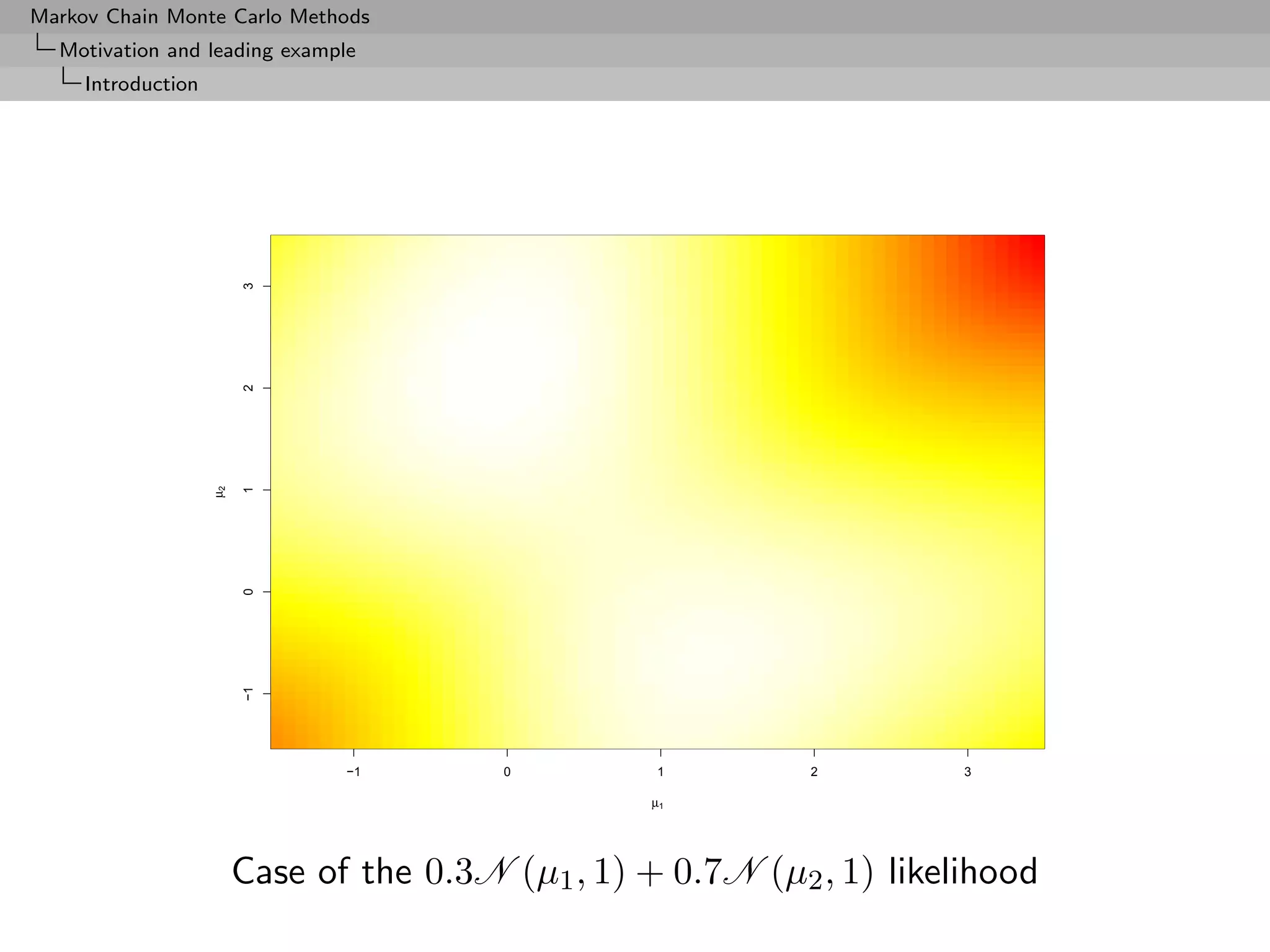
                         Case of the 0.3N (µ1 , 1) + 0.7N (µ2 , 1) likelihood
Markov Chain Monte Carlo Methods
  Motivation and leading example
     Likelihood methods


Maximum likelihood methods
         Go Bayes!!


          ◦ For an iid sample X1 , . . . , Xn from a population with density
            f (x|θ1 , . . . , θk ), the likelihood function is

                                   L(x|θ) = L(x1 , . . . , xn |θ1 , . . . , θk )
                                                      n
                                              =             f (xi |θ1 , . . . , θk ).
                                                      i=1

                                            ˆ
                                            θn = arg max L(x|θ)
                                                      θ

          ◦ Global justifications from asymptotics
          ◦ Computational difficulty depends on structure, eg latent
            variables
Markov Chain Monte Carlo Methods
  Motivation and leading example
     Likelihood methods


      Example (Mixtures again)
      For a mixture of two normal distributions,

                                   pN (µ, τ 2 ) + (1 − p)N (θ, σ 2 ) ,
      likelihood proportional to

                    n
                                       xi − µ                            xi − θ
                           pτ −1 ϕ               + (1 − p) σ −1 ϕ
                                          τ                                 σ
                   i=1

      containing 2n terms.
Markov Chain Monte Carlo Methods
  Motivation and leading example
     Likelihood methods


      Standard maximization techniques often fail to find the global
      maximum because of multimodality or undesirable behavior
      (usually at the frontier of the domain) of the likelihood function.

      Example
      In the special case

       f (x|µ, σ) = (1 − ) exp{(−1/2)x2 } +                     exp{(−1/2σ 2 )(x − µ)2 }
                                                            σ
                                                                                     (1)
      with       > 0 known, whatever n, the likelihood is unbounded:

                                   lim L(x1 , . . . , xn |µ = x1 , σ) = ∞
                                   σ→0
Markov Chain Monte Carlo Methods
  Motivation and leading example
     Missing variable models


The special case of missing variable models


      Consider again a latent variable representation

                                   g(x|θ) =       f (x, z|θ) dz
                                              Z

       Define the completed (but unobserved) likelihood

                                    Lc (x, z|θ) = f (x, z|θ)

      Useful for optimisation algorithm
Markov Chain Monte Carlo Methods
  Motivation and leading example
     Missing variable models


The EM Algorithm
         Gibbs connection                                                Bayes rather than EM


      Algorithm (Expectation–Maximisation)
      Iterate (in m)
        1. (E step) Compute
                                    ˆ                             ˆ
                               Q(θ; θ(m) , x) = E[log Lc (x, Z|θ)|θ(m) , x] ,
                                  ˆ
        2. (M step) Maximise Q(θ; θ(m) , x) in θ and take

                                   ˆ                     ˆ
                                   θ(m+1) = arg max Q(θ; θ(m) , x).
                                                    θ


      until a fixed point [of Q] is reached
Markov Chain Monte Carlo Methods
  Motivation and leading example
     Missing variable models


                         0.6
                         0.5
                         0.4
                         0.3
                         0.2
                         0.1
                         0.0


                                   −2   −1   0     1      2


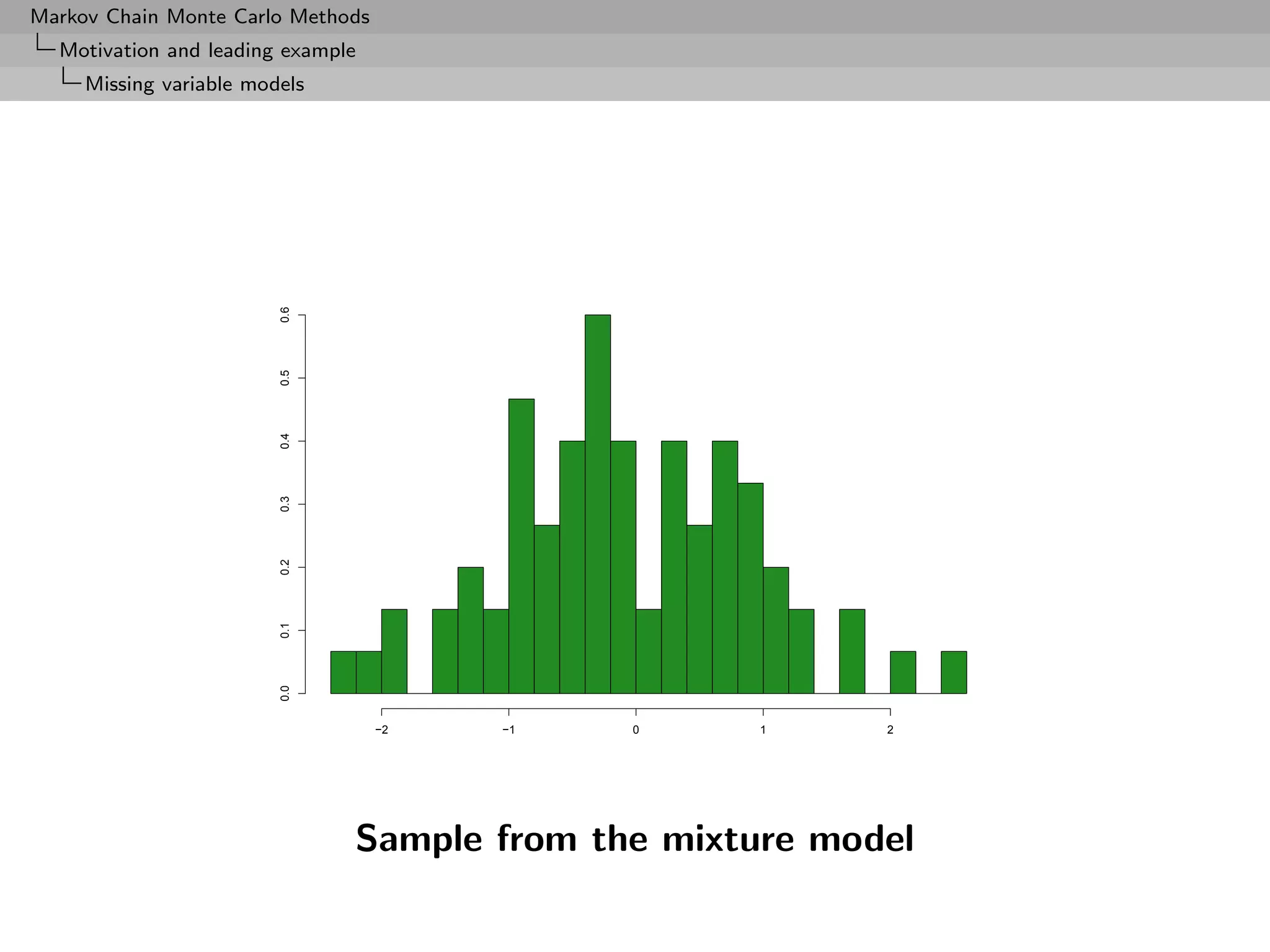
                               Sample from the mixture model
Markov Chain Monte Carlo Methods
  Motivation and leading example
     Missing variable models


                   3
                   2
              µ2

                   1
                   0
                   −1


                               −1    0         1         2         3

                                               µ1


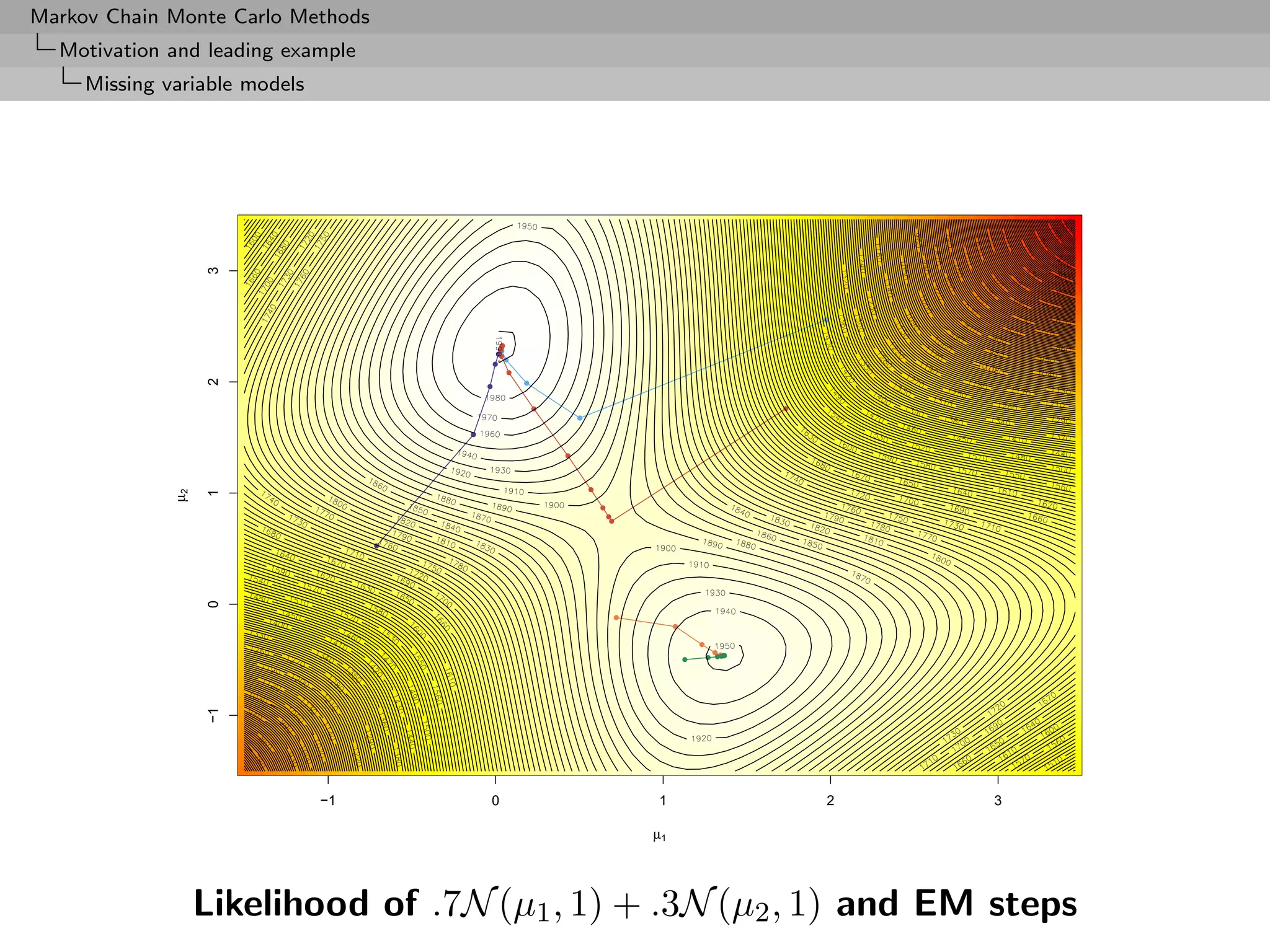
                   Likelihood of .7N (µ1 , 1) + .3N (µ2 , 1) and EM steps
Markov Chain Monte Carlo Methods
  Motivation and leading example
     Bayesian Methods


The Bayesian Perspective


      In the Bayesian paradigm, the information brought by the data x,
      realization of
                                 X ∼ f (x|θ),
      is combined with prior information specified by prior distribution
      with density
                                    π(θ)
Markov Chain Monte Carlo Methods
  Motivation and leading example
     Bayesian Methods


Central tool

      Summary in a probability distribution, π(θ|x), called the posterior
      distribution
      Derived from the joint distribution f (x|θ)π(θ), according to

                                              f (x|θ)π(θ)
                                   π(θ|x) =                 ,
                                              f (x|θ)π(θ)dθ

                                                                [Bayes Theorem]
      where
                                   Z(x) =     f (x|θ)π(θ)dθ

      is the marginal density of X also called the (Bayesian) evidence
Markov Chain Monte Carlo Methods
  Motivation and leading example
     Bayesian Methods


Central tool... central to Bayesian inference
      Posterior defined up to a constant as

                                   π(θ|x) ∝ f (x|θ) π(θ)


             Operates conditional upon the observations
             Integrate simultaneously prior information and information
             brought by x
             Avoids averaging over the unobserved values of x
             Coherent updating of the information available on θ,
             independent of the order in which i.i.d. observations are
             collected
             Provides a complete inferential scope and a unique motor of
             inference
Markov Chain Monte Carlo Methods
  Motivation and leading example
     Bayesian troubles


Conjugate bonanza...


      Example (Binomial)
      For an observation X ∼ B(n, p) so-called conjugate prior is the
      family of beta Be(a, b) distributions
      The classical Bayes estimator δ π is the posterior mean
                                                1
                         Γ(a + b + n)
                                                    p px+a−1 (1 − p)n−x+b−1 dp
                     Γ(a + x)Γ(n − x + b)   0
                         x+a
                     =          .
                       a+b+n
Markov Chain Monte Carlo Methods
  Motivation and leading example
     Bayesian troubles


Conjugate Prior


      Conjugacy
      Given a likelihood function L(y|θ), the family Π of priors π0 on Θ
      is conjugate if the posterior π(θ|y) also belong to Π

      In this case, posterior inference is tractable and reduces to
      updating the hyperparameters∗ of the prior


           ∗
          The hyperparameters are parameters of the priors; they are most often not
      treated as a random variables
Markov Chain Monte Carlo Methods
  Motivation and leading example
     Bayesian troubles


      Discrete/Multinomial & Dirichlet
      If the observations consist of positive counts Y1 , . . . , Yd modelled
      by a Multinomial distribution
                                                                 d
                                                     n!           y
                                    L(y|θ, n) =     d
                                                                 θi i
                                                    i=1 yi ! i=1

      The conjugate family is the D(α1 , . . . , αd ) distribution

                                                   d        d
                                              Γ(   i=1 αi )
                                   π(θ|α) =    d
                                                                     θi i −1
                                                                      α

                                               i=1 Γ(αi )    i

      defined on the probability simplex (θi ≥ 0, d θi = 1), where Γ
                                                 i=1
                                      ∞
      is the gamma function Γ(α) = 0 tα−1 e−t dt (Γ(k) = (k − 1)! for
      integers k)
Markov Chain Monte Carlo Methods
  Motivation and leading example
     Bayesian troubles


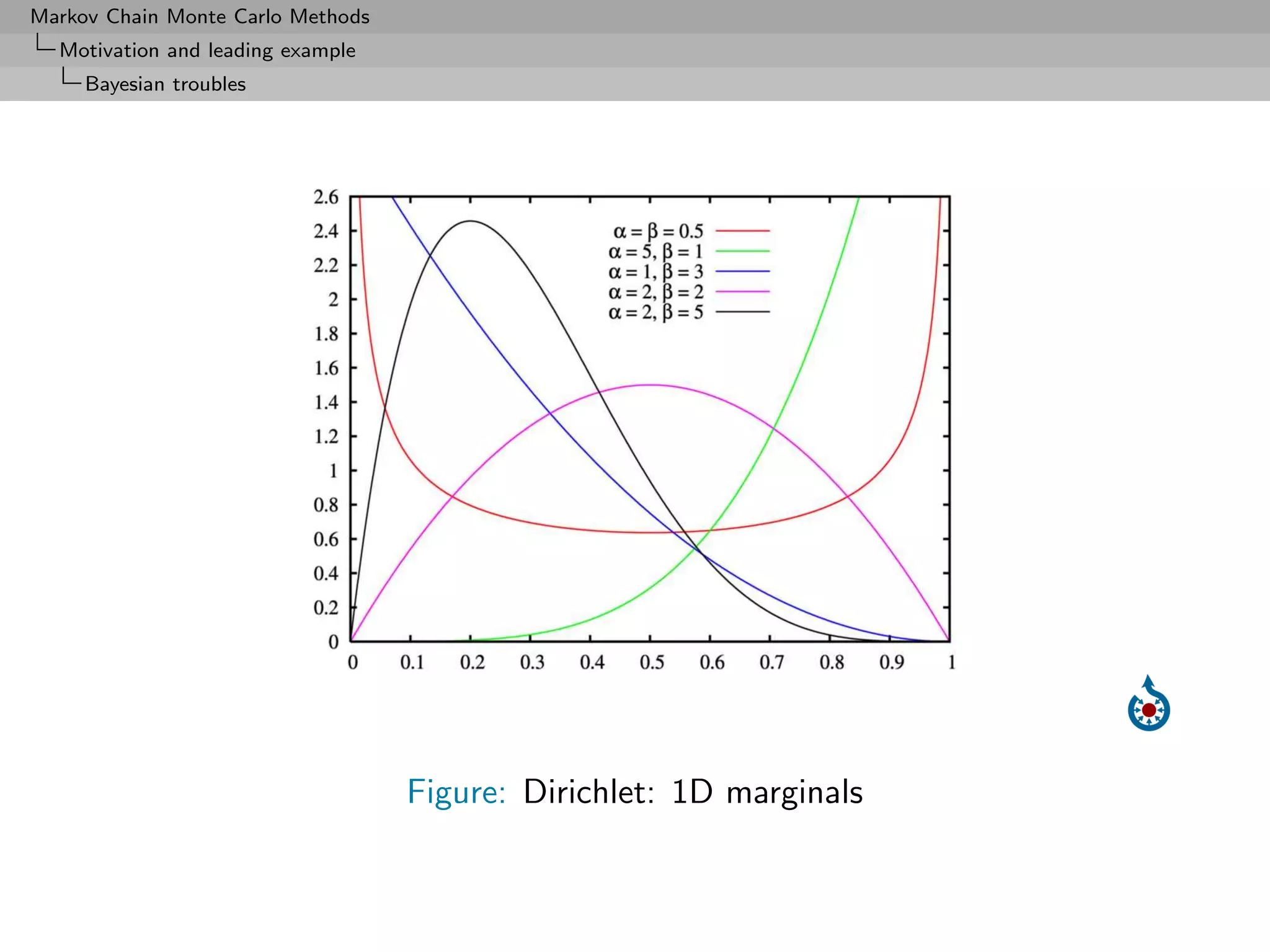
                                   Figure: Dirichlet: 1D marginals
Markov Chain Monte Carlo Methods
  Motivation and leading example
     Bayesian troubles


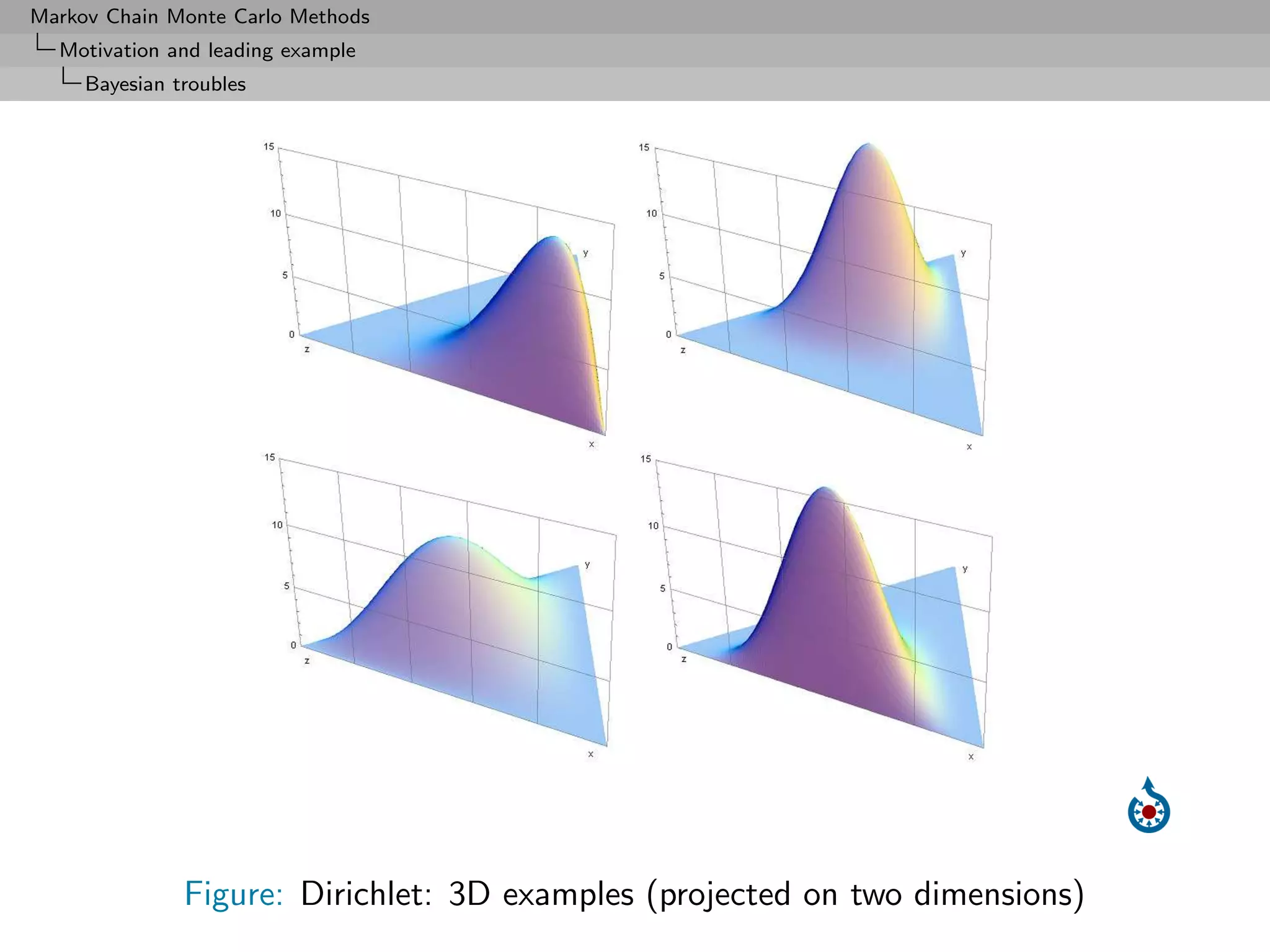
               Figure: Dirichlet: 3D examples (projected on two dimensions)
Markov Chain Monte Carlo Methods
  Motivation and leading example
     Bayesian troubles


Multinomial Posterior
               Posterior
                                       π(θ|y) = D(y1 + α1 , . . . , yd + αd )
      Posterior Mean†
                                                     yi + αi
                                                    d
                                                    j=1 yj +     αj       1≤i≤d

                  MAP
                                                 yi + αi − 1
                                                d
                                                j=1 yj + αj −         1    1≤i≤d

                            if yi + αi > 1 for i = 1, . . . , d
               Evidence
                                                      d         d
                                               Γ(     i=1 αi )  i=1 Γ(yi + αi )
                                     Z(y) =         d             d
                                                    i=1 Γ(αi )Γ( i=1 yi + αi )
           †
               Also known as Laplace smoothing when αi = 1
Markov Chain Monte Carlo Methods
  Motivation and leading example
     Bayesian troubles


Conjugate Priors for the Normal I
      Conjugate Prior for the Normal Mean
      For the N (y|µ, w) distribution with iid observations y1 , . . . , yn ,
      the conjugate prior for the mean µ is Gaussian N (µ|m0 , v0 ):
                                                                 n
                                                   2
           π(µ|y1:n ) ∝ exp −(µ − m0 ) /2v0                          exp −(yk − µ)2 /2w
                                                             k=1
                                 1       1    n         m0 sn
                          ∝ exp − µ2       +      − 2µ      +
                                 2      v0 w             v0   w
                                 sn + m0 w/v0      w
                          =N µ                ,
                                   n + w/v0     n + w/v0
                             n      a
      where sn =             k=1 yk
           a
               And y1:n denotes the collection y1 , . . . , yn
Markov Chain Monte Carlo Methods
  Motivation and leading example
     Bayesian troubles


Conjugate Priors for the Normal II
      Conjugate Priors for the Normal Variance
      If w is to be estimated and µ is known, the conjugate prior for w is
      the inverse Gamma distribution I G (w|α0 , β0 ):
                                                     α
                                                    β0 0 −α0 +1 −β0 /w
                              π0 (w|β0 , α0 ) =           w    e
                                                   Γ(α0 )

      and
                                                       n
                                   −(α0 +1) −β0 /w          1
          π(w|y1:n ) ∝ w                     e             √ exp −(yk − µ)2 /2w
                                                             w
                                                     k=1
                                   −(n/2+α0 +1)
                            = w                    exp −(s(2) /2 + β0 )/w
                                                          n

                   (2)         n
      where sn =               k=1 (Yk   − µ)2 .
Markov Chain Monte Carlo Methods
  Motivation and leading example
     Bayesian troubles


The Gamma, Chi-Square and Inverses

      The Gamma Distributiona
         a
           A different convention is to use Gam*(a,b), where b = 1/β is the scale
      parameter

                                                    β α α−1 −βθ
                                   G a(θ|α, β) =        θ  e
                                                   Γ(α)
      where α is the shape and β the inverse scale parameter
      (E(θ) = α/β, Var(θ) = α/β 2 )

              θ ∼ I G (θ|α, β): 1/θ ∼ G a(θ|α, β)
              θ ∼ χ2 (θ|ν): θ ∼ G a(θ|ν/2, 1/2)
Markov Chain Monte Carlo Methods
  Motivation and leading example
     Bayesian troubles


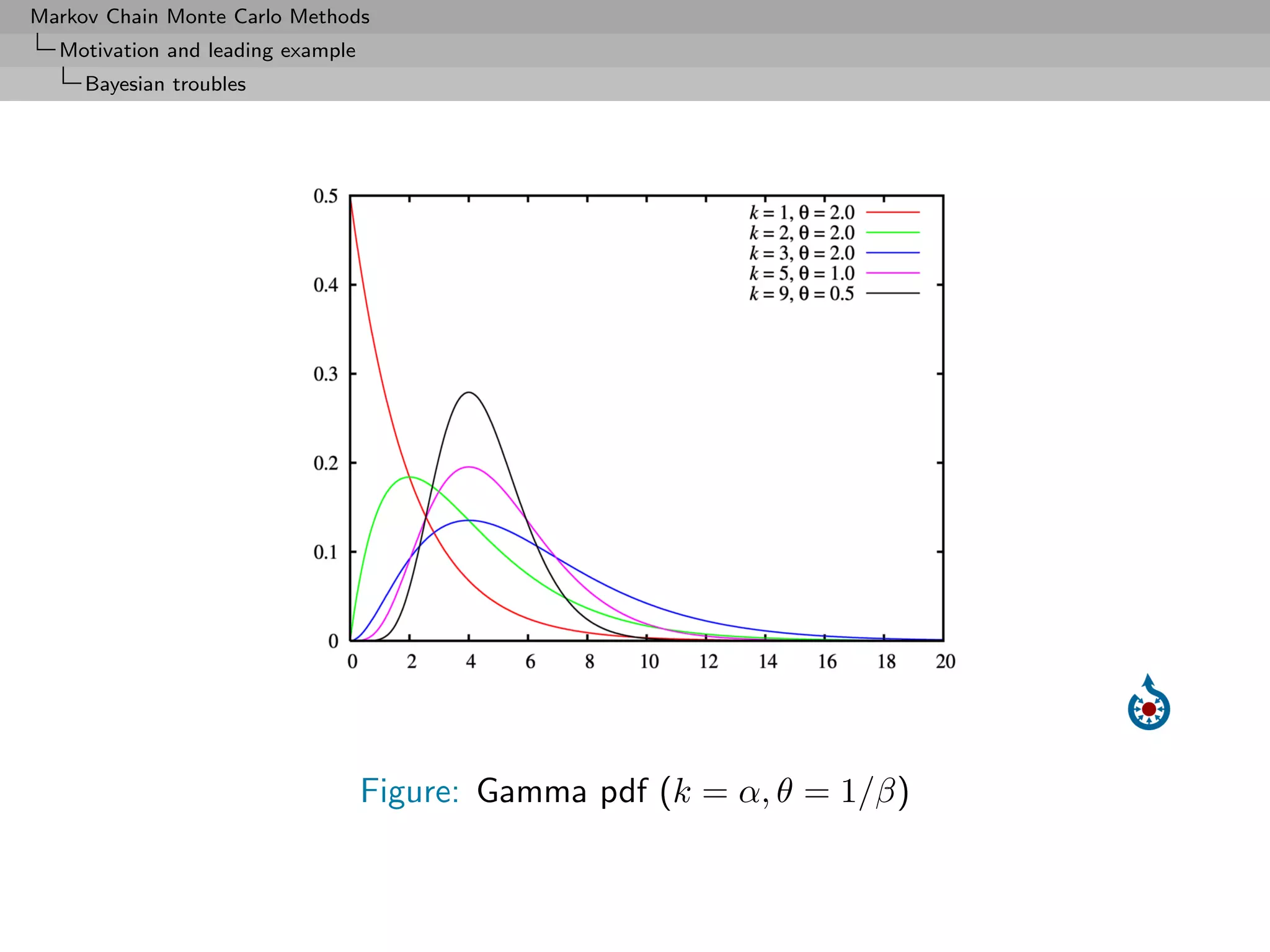
                                   Figure: Gamma pdf (k = α, θ = 1/β)
Markov Chain Monte Carlo Methods
  Motivation and leading example
     Bayesian troubles


Conjugate Priors for the Normal IV
      Example (Normal)
      In the normal N (µ, w) case, with both µ and w unknown,
      conjugate prior on θ = (µ, w) of the form

                              (w)−λw exp − λµ (µ − ξ)2 + α /w

      since

       π((µ, w)|x1 , . . . , xn ) ∝ (w)−λw exp − λµ (µ − ξ)2 + α /w
                                          ×(w)−n exp − n(µ − x)2 + s2 /w
                                                                    x

                                    ∝ (w)−λw +n exp − (λµ + n)(µ − ξx )2

                                                       nλµ
                                          +α + s2 +
                                                x              /w
                                                      n + λµ
Markov Chain Monte Carlo Methods
  Motivation and leading example
     Bayesian troubles


Conjugate Priors for the Normal III
      Conjugate Priors are However Available Only in Simple Cases
      In the previous example the conjugate prior when both µ and w are
      unknown is not particularly useful.


               Hence, it is very common to resort to independent marginally
               conjugate priors: eg., in the Gaussian case, take
               N (µ|m0 , v0 )I G (w|α0 , β0 ) as prior, then π(µ|w, y) is
               Gaussian, π(w|µ, y) is inverse-gamma but π(µ, w|y) does not
               belong to a known family‡
               There nonetheless exists some important multivariate
               extensions : Bayesian normal linear model, inverse-Wishart
               distribution for covariance matrices
           ‡
          Although closed-form expressions for π(µ|y)
      and π(w|y) are available
Markov Chain Monte Carlo Methods
  Motivation and leading example
     Bayesian troubles


...and conjugate curse


      Conjugate priors are very limited in scope

      In addition, the use ofconjugate priors only for computational
      reasons
          • implies a restriction on the modeling of the available prior
            information
          • may be detrimental to the usefulness of the Bayesian approach
          • gives an impression of subjective manipulation of the prior
            information disconnected from reality.
Markov Chain Monte Carlo Methods
  Motivation and leading example
     Bayesian troubles


A typology of Bayes computational problems


       (i). latent variable models in general
      (ii). use of a complex parameter space, as for instance in
            constrained parameter sets like those resulting from imposing
            stationarity constraints in dynamic models;
     (iii). use of a complex sampling model with an intractable
            likelihood, as for instance in some graphical models;
     (iv). use of a huge dataset;
      (v). use of a complex prior distribution (which may be the
           posterior distribution associated with an earlier sample);
Markov Chain Monte Carlo Methods
  Random variable generation


Random variable generation
      Motivation and leading example

      Random variable generation
         Basic methods
         Uniform pseudo-random generator
         Beyond Uniform distributions
         Transformation methods
         Accept-Reject Methods
         Fundamental theorem of simulation
         Log-concave densities

      Monte Carlo Integration

      Notions on Markov Chains
Markov Chain Monte Carlo Methods
  Random variable generation


Random variable generation


          • Rely on the possibility of producing (computer-wise) an
            endless flow of random variables (usually iid) from well-known
            distributions
          • Given a uniform random number generator, illustration of
            methods that produce random variables from both standard
            and nonstandard distributions
Markov Chain Monte Carlo Methods
  Random variable generation
     Basic methods


The inverse transform method


      For a function F on R, the generalized inverse of F , F − , is defined
      by
                        F − (u) = inf {x; F (x) ≥ u} .

      Definition (Probability Integral Transform)
      If U ∼ U[0,1] , then the random variable F − (U ) has the distribution
      F.
Markov Chain Monte Carlo Methods
  Random variable generation
     Basic methods


The inverse transform method (2)


      To generate a random variable X ∼ F , simply generate

                                   U ∼ U[0,1]

      and then make the transform

                                   x = F − (u)
Markov Chain Monte Carlo Methods
  Random variable generation
     Uniform pseudo-random generator


Desiderata and limitations
         skip Uniform


          • Production of a deterministic sequence of values in [0, 1] which
            imitates a sequence of iid uniform random variables U[0,1] .
          • Can’t use the physical imitation of a “random draw” [no
            guarantee of uniformity, no reproducibility]
          • Random sequence in the sense: Having generated
            (X1 , · · · , Xn ), knowledge of Xn [or of (X1 , · · · , Xn )] imparts
            no discernible knowledge of the value of Xn+1 .
          • Deterministic: Given the initial value X0 , sample
            (X1 , · · · , Xn ) always the same
          • Validity of a random number generator based on a single
            sample X1 , · · · , Xn when n tends to +∞, not on replications
                        (X11 , · · · , X1n ), (X21 , · · · , X2n ), . . . (Xk1 , · · · , Xkn )
             where n fixed and k tends to infinity.
Markov Chain Monte Carlo Methods
  Random variable generation
     Uniform pseudo-random generator


Uniform pseudo-random generator


      Algorithm starting from an initial value 0 ≤ u0 ≤ 1 and a
      transformation D, which produces a sequence

                                       (ui ) = (Di (u0 ))

      in [0, 1].
      For all n,
                                        (u1 , · · · , un )
      reproduces the behavior of an iid U[0,1] sample (V1 , · · · , Vn ) when
      compared through usual tests
Markov Chain Monte Carlo Methods
  Random variable generation
     Uniform pseudo-random generator


Uniform pseudo-random generator (2)


          • Validity means the sequence U1 , · · · , Un leads to accept the
            hypothesis

                                       H : U1 , · · · , Un   are iid   U[0,1] .


          • The set of tests used is generally of some consequence
                 ◦ Kolmogorov–Smirnov and other nonparametric tests
                 ◦ Time series methods, for correlation between Ui and
                   (Ui−1 , · · · , Ui−k )
                 ◦ Marsaglia’s battery of tests called Die Hard (!)
Markov Chain Monte Carlo Methods
  Random variable generation
     Uniform pseudo-random generator


Usual generators
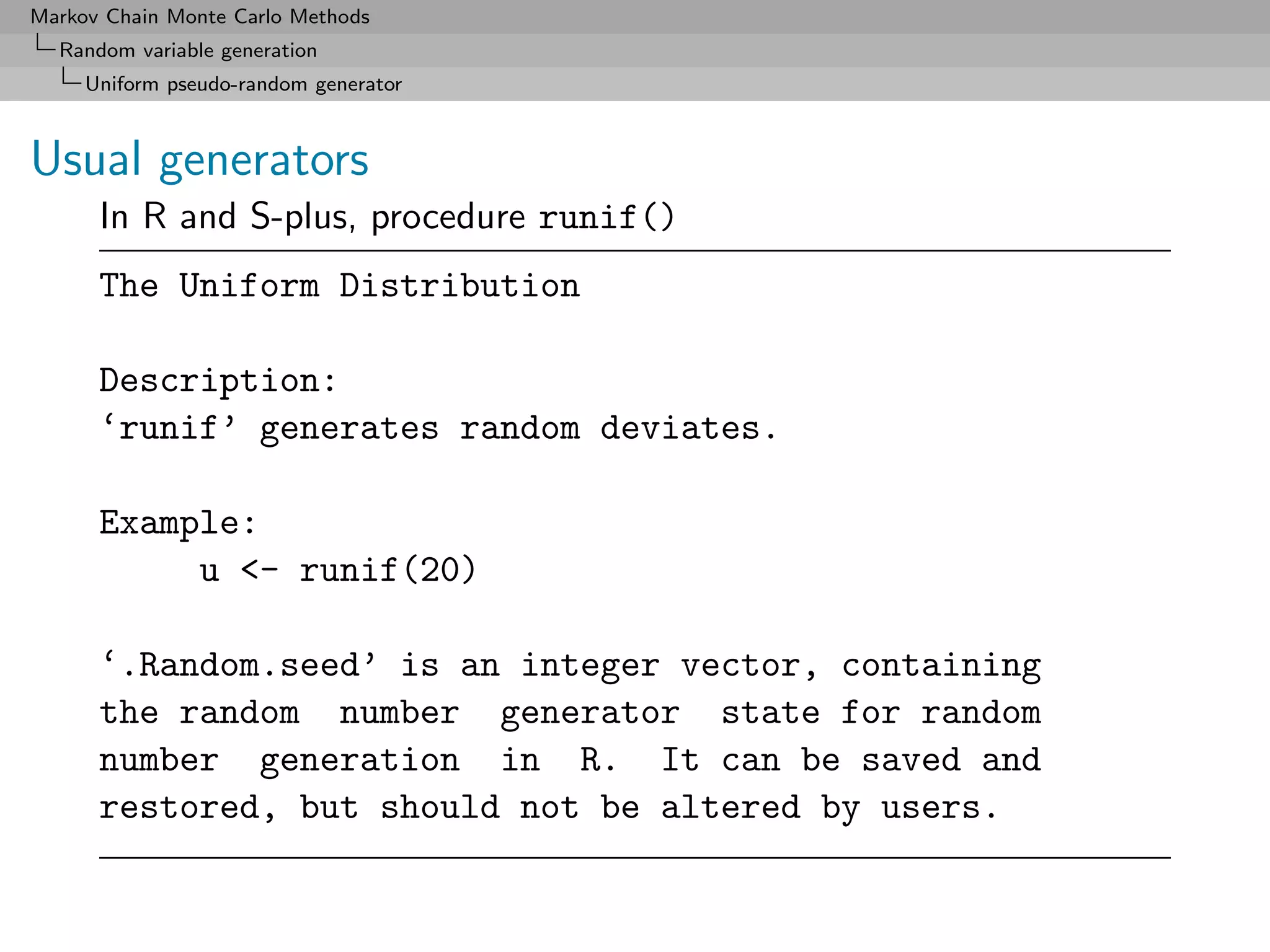
      In R and S-plus, procedure runif()
      The Uniform Distribution

      Description:
      ‘runif’ generates random deviates.

      Example:
           u <- runif(20)

      ‘.Random.seed’ is an integer vector, containing
      the random number generator state for random
      number generation in R. It can be saved and
      restored, but should not be altered by users.
Markov Chain Monte Carlo Methods
  Random variable generation
     Uniform pseudo-random generator


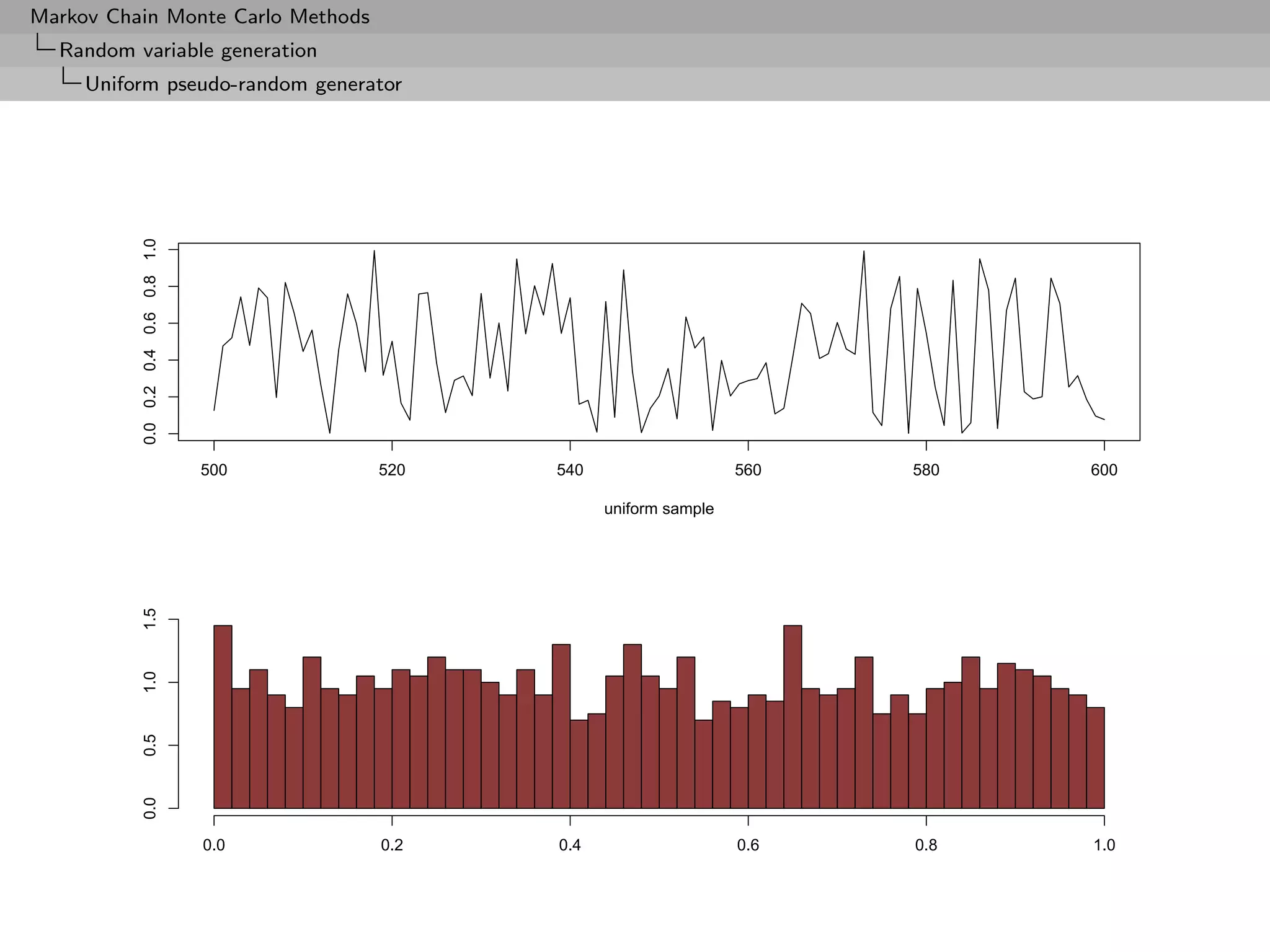
          0.0 0.2 0.4 0.6 0.8 1.0


                                    500   520   540                    560   580   600

                                                      uniform sample
          1.5
          1.0
          0.5
          0.0


                                    0.0   0.2   0.4                    0.6   0.8   1.0
Markov Chain Monte Carlo Methods
  Random variable generation
     Uniform pseudo-random generator


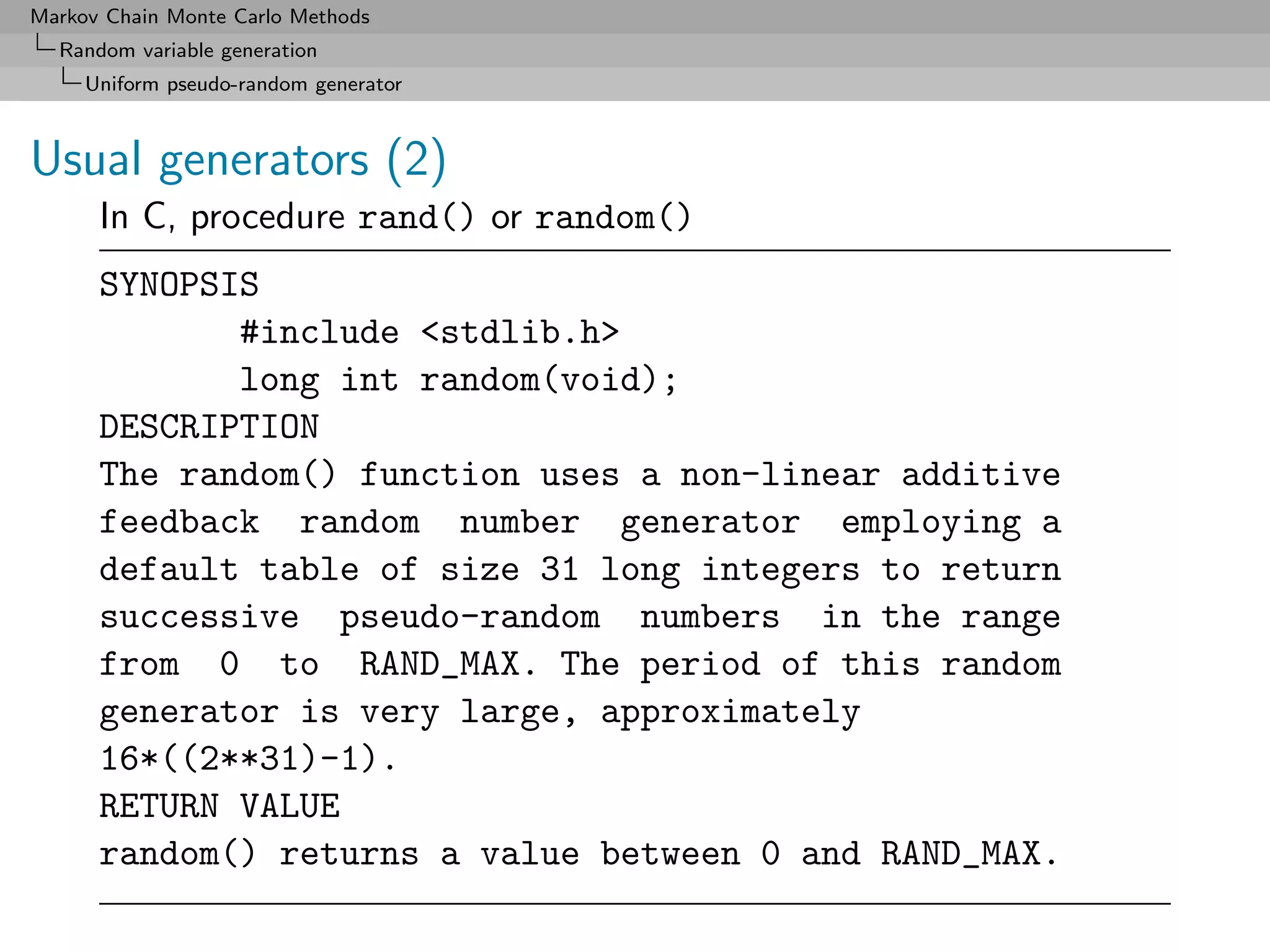
Usual generators (2)
      In C, procedure rand() or random()
      SYNOPSIS
             #include <stdlib.h>
             long int random(void);
      DESCRIPTION
      The random() function uses a non-linear additive
      feedback random number generator employing a
      default table of size 31 long integers to return
      successive pseudo-random numbers in the range
      from 0 to RAND_MAX. The period of this random
      generator is very large, approximately
      16*((2**31)-1).
      RETURN VALUE
      random() returns a value between 0 and RAND_MAX.
Markov Chain Monte Carlo Methods
  Random variable generation
     Uniform pseudo-random generator


Usual generators (3)
      In Matlab and Octave, procedure rand()

        RAND Uniformly distributed pseudorandom numbers.
           R = RAND(M,N) returns an M-by-N matrix containing
           pseudorandom values drawn from the standard uniform
           distribution on the open interval(0,1).

              The sequence of numbers produced by RAND is
              determined by the internal state of the uniform
              pseudorandom number generator that underlies RAND,
              RANDI, and RANDN.
Markov Chain Monte Carlo Methods
  Random variable generation
     Uniform pseudo-random generator


Usual generators (4)

      In Scilab, procedure rand()

      rand() : with no arguments gives a scalar whose
      value changes each time it is referenced. By
      default, random numbers are uniformly distributed
      in the interval (0,1). rand(’normal’) switches to
      a normal distribution with mean 0 and variance 1.

      EXAMPLE
        x=rand(10,10,’uniform’)
Markov Chain Monte Carlo Methods
  Random variable generation
     Beyond Uniform distributions


Beyond Uniform generators

          • Generation of any sequence of random variables can be
            formally implemented through a uniform generator
                  ◦ Distributions with explicit F − (for instance, exponential, and
                    Weibull distributions), use the probability integral transform
                         here

                  ◦ Case specific methods rely on properties of the distribution (for
                    instance, normal distribution, Poisson distribution)
                  ◦ More generic methods (for instance, accept-reject)
          • Simulation of the standard distributions is accomplished quite
            efficiently by many numerical and statistical programming
            packages.
Markov Chain Monte Carlo Methods
  Random variable generation
     Transformation methods


Transformation methods
      Case where a distribution F is linked in a simple way to another
      distribution easy to simulate.

      Example (Exponential variables)
      If U ∼ U[0,1] , the random variable

                                    X = − log U/λ

      has distribution

                         P (X ≤ x) = P (− log U ≤ λx)
                                   = P (U ≥ e−λx ) = 1 − e−λx ,

      the exponential distribution E xp(λ).
Markov Chain Monte Carlo Methods
  Random variable generation
     Transformation methods


      Other random variables that can be generated starting from an
      exponential include

                                                   ν
                                     Y = −2             log(Uj ) ∼ χ2
                                                                    2ν
                                                  j=1


                                              a
                                        1
                                   Y =−            log(Uj ) ∼ G a(a, β)
                                        β
                                            j=1


                                            a
                                            j=1 log(Uj )
                                   Y =      a+b
                                                             ∼ Be(a, b)
                                            j=1 log(Uj )
Markov Chain Monte Carlo Methods
  Random variable generation
     Transformation methods


Points to note


          ◦ Transformation quite simple to use
          ◦ There are more efficient algorithms for gamma and beta
            random variables
          ◦ Cannot generate gamma random variables with a non-integer
            shape parameter
          ◦ For instance, cannot get a χ2 variable, which would get us a
                                        1
            N (0, 1) variable.
Markov Chain Monte Carlo Methods
  Random variable generation
     Transformation methods


Box-Muller Algorithm

      Example (Normal variables)
      If r, θ polar coordinates of (X1 , X2 ), then,

                 r2 = X1 + X2 ∼ χ2 = E (1/2) and θ ∼ U [0, 2π]
                       2    2
                                 2

      Consequence: If U1 , U2 iid U[0,1] ,

                               X1 =   −2 log(U1 ) cos(2πU2 )
                               X2 =   −2 log(U1 ) sin(2πU2 )

      iid N (0, 1).
Markov Chain Monte Carlo Methods
  Random variable generation
     Transformation methods


Box-Muller Algorithm (2)


         1. Generate U1 , U2 iid U[0,1] ;
         2. Define

                                   x1 =   −2 log(u1 ) cos(2πu2 ) ,
                                   x2 =   −2 log(u1 ) sin(2πu2 ) ;

         3. Take x1 and x2 as two independent draws from N (0, 1).
Markov Chain Monte Carlo Methods
  Random variable generation
     Transformation methods


Box-Muller Algorithm (3)


          Unlike algorithms based on the CLT,
          this algorithm is exact
          Get two normals for the price of
          two uniforms


                                                0.4
          Drawback (in speed)


                                                0.3
          in calculating log, cos and sin.


                                                0.2
                                                0.1
                                                0.0
                                                      −4   −2   0   2   4
Markov Chain Monte Carlo Methods
  Random variable generation
     Transformation methods


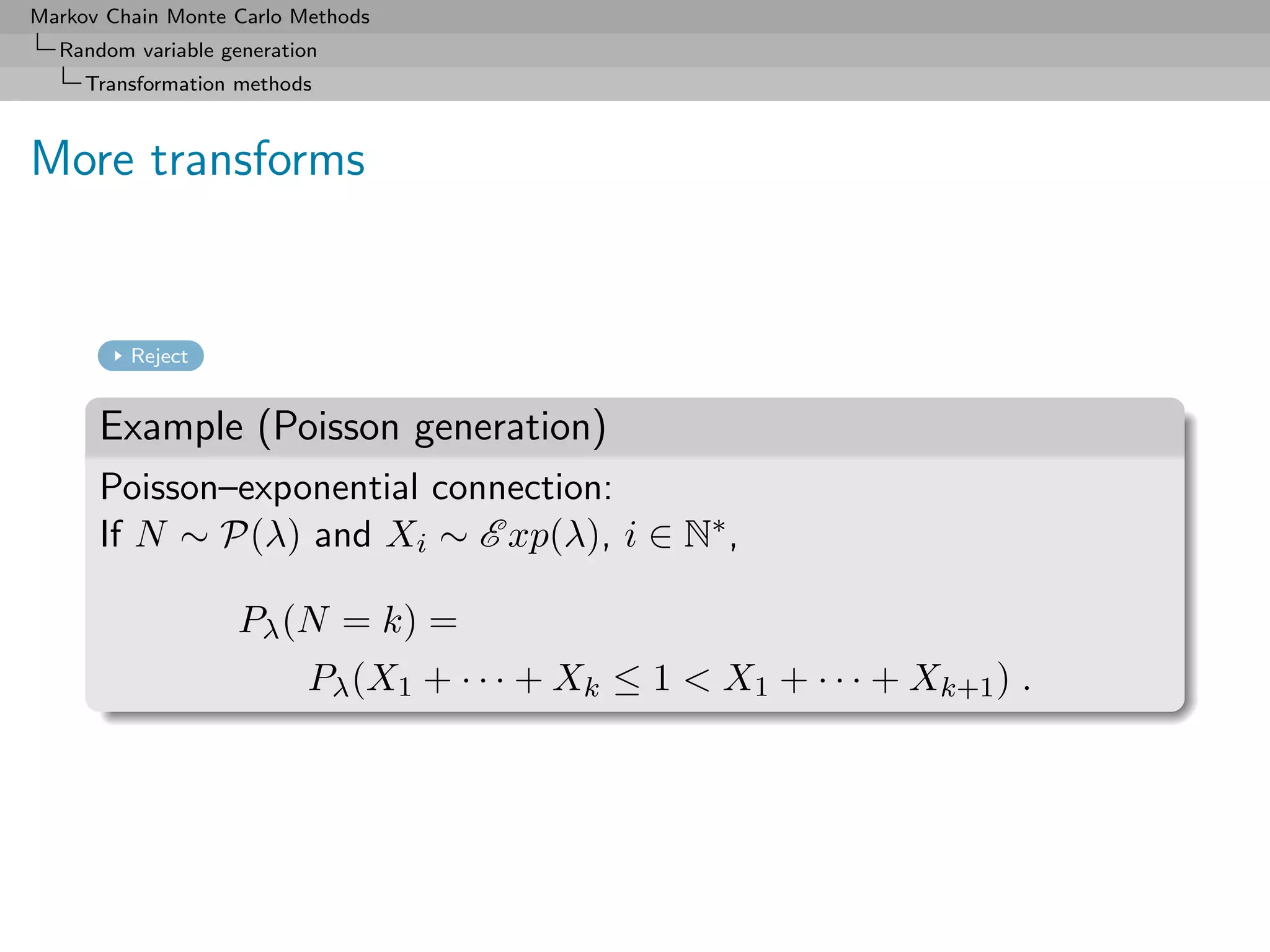
More transforms


         Reject


      Example (Poisson generation)
      Poisson–exponential connection:
      If N ∼ P(λ) and Xi ∼ E xp(λ), i ∈ N∗ ,

                   Pλ (N = k) =
                          Pλ (X1 + · · · + Xk ≤ 1 < X1 + · · · + Xk+1 ) .
Markov Chain Monte Carlo Methods
  Random variable generation
     Transformation methods


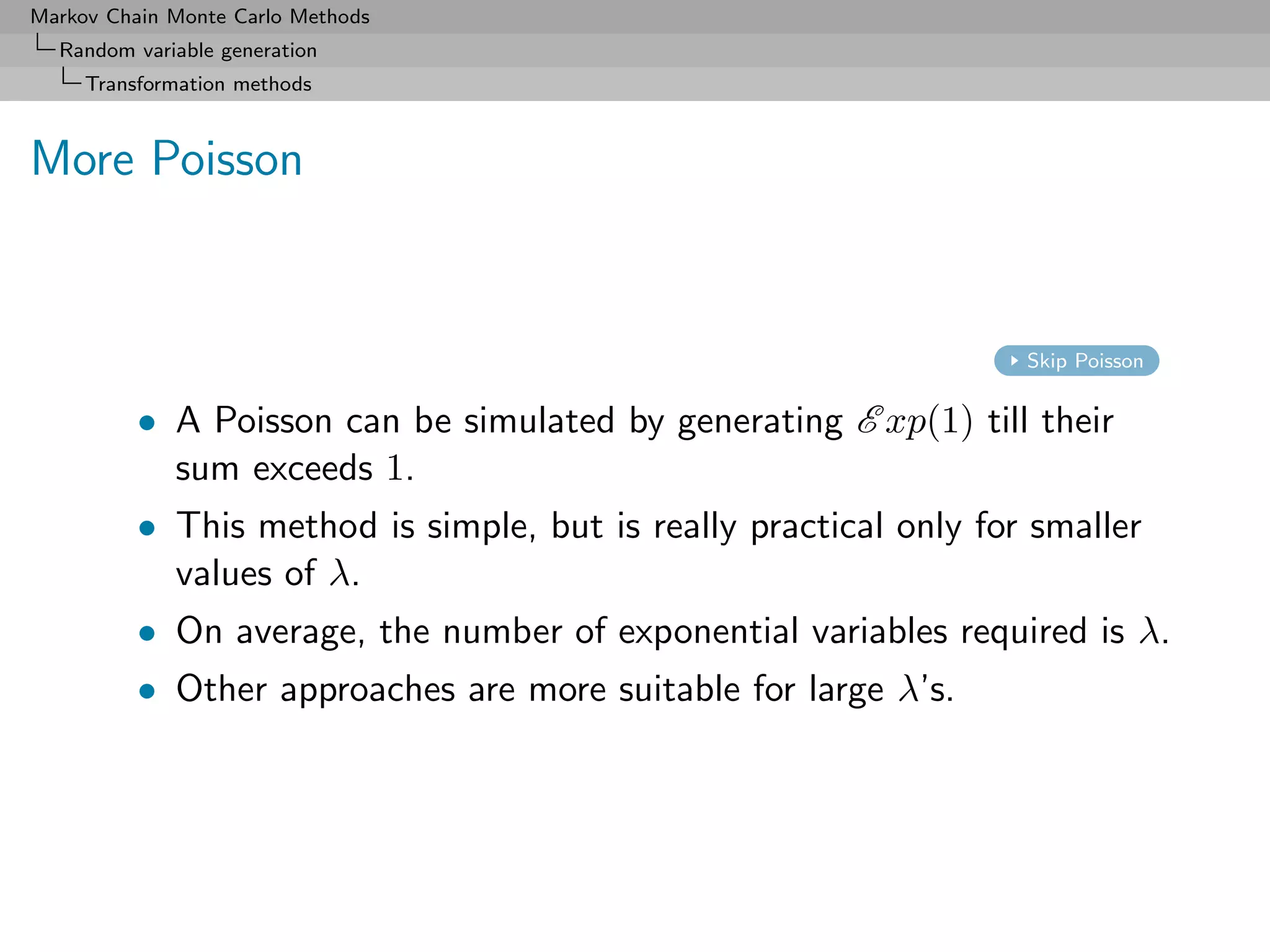
More Poisson


                                                                   Skip Poisson


          • A Poisson can be simulated by generating E xp(1) till their
            sum exceeds 1.
          • This method is simple, but is really practical only for smaller
            values of λ.
          • On average, the number of exponential variables required is λ.
          • Other approaches are more suitable for large λ’s.
Markov Chain Monte Carlo Methods
  Random variable generation
     Transformation methods


Negative extension


             A generator of Poisson random variables can produce negative
             binomial random variables since,

                                   Y ∼ Ga(n, (1 − p)/p) X|y ∼ P(y)

             implies
                                           X ∼ N eg(n, p)
Markov Chain Monte Carlo Methods
  Random variable generation
     Transformation methods


Mixture representation


          • The representation of the negative binomial is a particular
            case of a mixture distribution
          • The principle of a mixture representation is to represent a
            density f as the marginal of another distribution, for example

                                   f (x) =         pi fi (x) ,
                                             i∈Y

          • If the component distributions fi (x) can be easily generated,
            X can be obtained by first choosing fi with probability pi and
            then generating an observation from fi .
Markov Chain Monte Carlo Methods
  Random variable generation
     Transformation methods


Partitioned sampling


      Special case of mixture sampling when

                               fi (x) = f (x) IAi (x)        f (x) dx
                                                        Ai

      and
                                        pi = Pr(X ∈ Ai )
      for a partition (Ai )i
Markov Chain Monte Carlo Methods
  Random variable generation
     Accept-Reject Methods


Accept-Reject algorithm


          • Many distributions from which it is difficult, or even
            impossible, to directly simulate.
          • Another class of methods that only require us to know the
            functional form of the density f of interest only up to a
            multiplicative constant.
          • The key to this method is to use a simpler (simulation-wise)
            density g, the instrumental density , from which the simulation
            from the target density f is actually done.
Markov Chain Monte Carlo Methods
  Random variable generation
     Fundamental theorem of simulation


Fundamental theorem of simulation


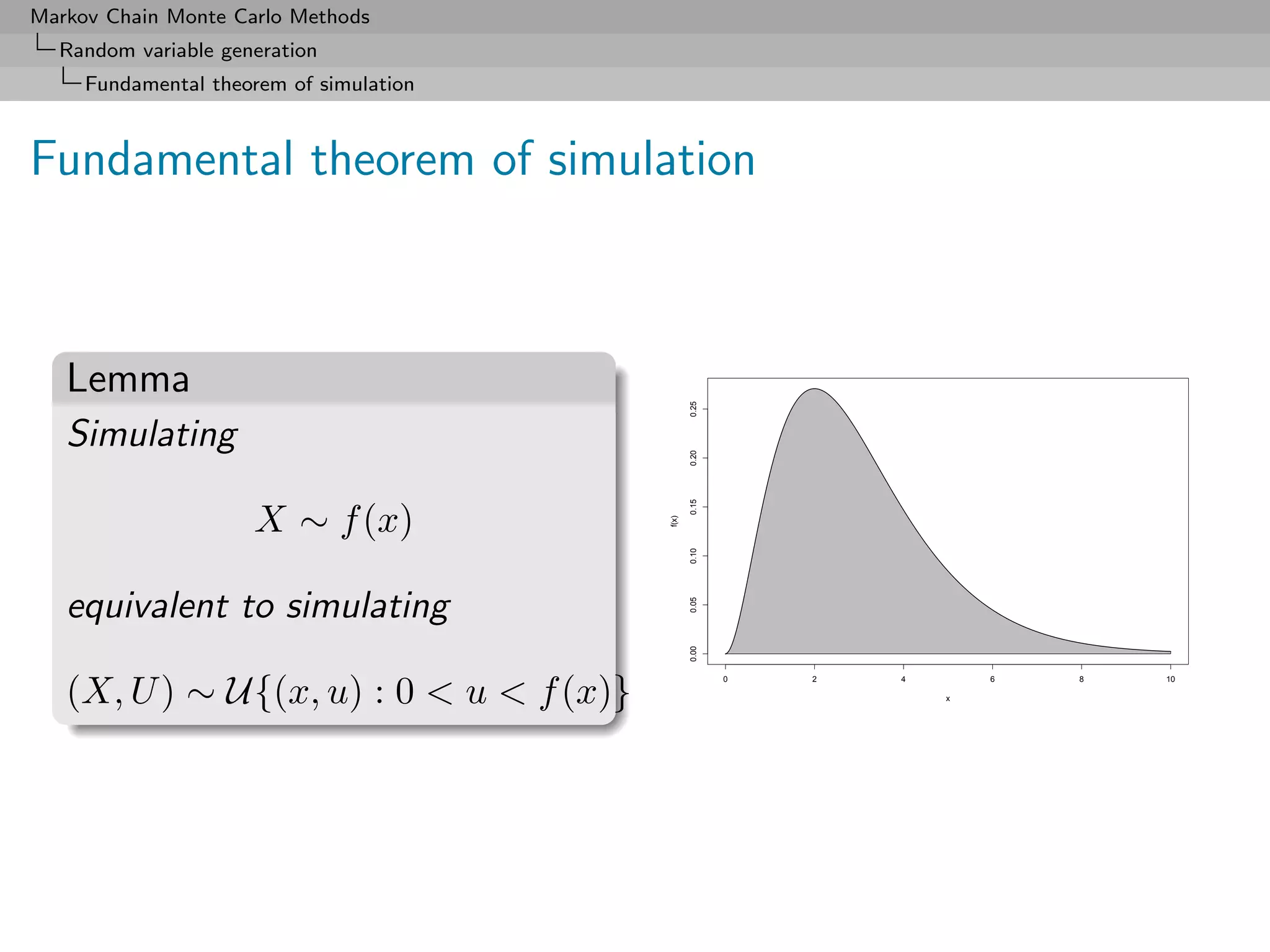
   Lemma


                                                0.25
   Simulating


                                                0.20
                                                0.15
                     X ∼ f (x)


                                         f(x)

                                                0.10
   equivalent to simulating

                                                0.05
                                                0.00
   (X, U ) ∼ U{(x, u) : 0 < u < f (x)}
                                                       0   2   4       6   8   10

                                                                   x
Markov Chain Monte Carlo Methods
  Random variable generation
     Fundamental theorem of simulation


The Accept-Reject algorithm


      Given a density of interest f , find a density g and a constant M
      such that
                                 f (x) ≤ M g(x)
      on the support of f .

      Accept-Reject Algorithm
         1. Generate X ∼ g, U ∼ U[0,1] ;
         2. Accept Y = X if U ≤ f (X)/M g(X) ;
         3. Return to 1. otherwise.
Markov Chain Monte Carlo Methods
  Random variable generation
     Fundamental theorem of simulation


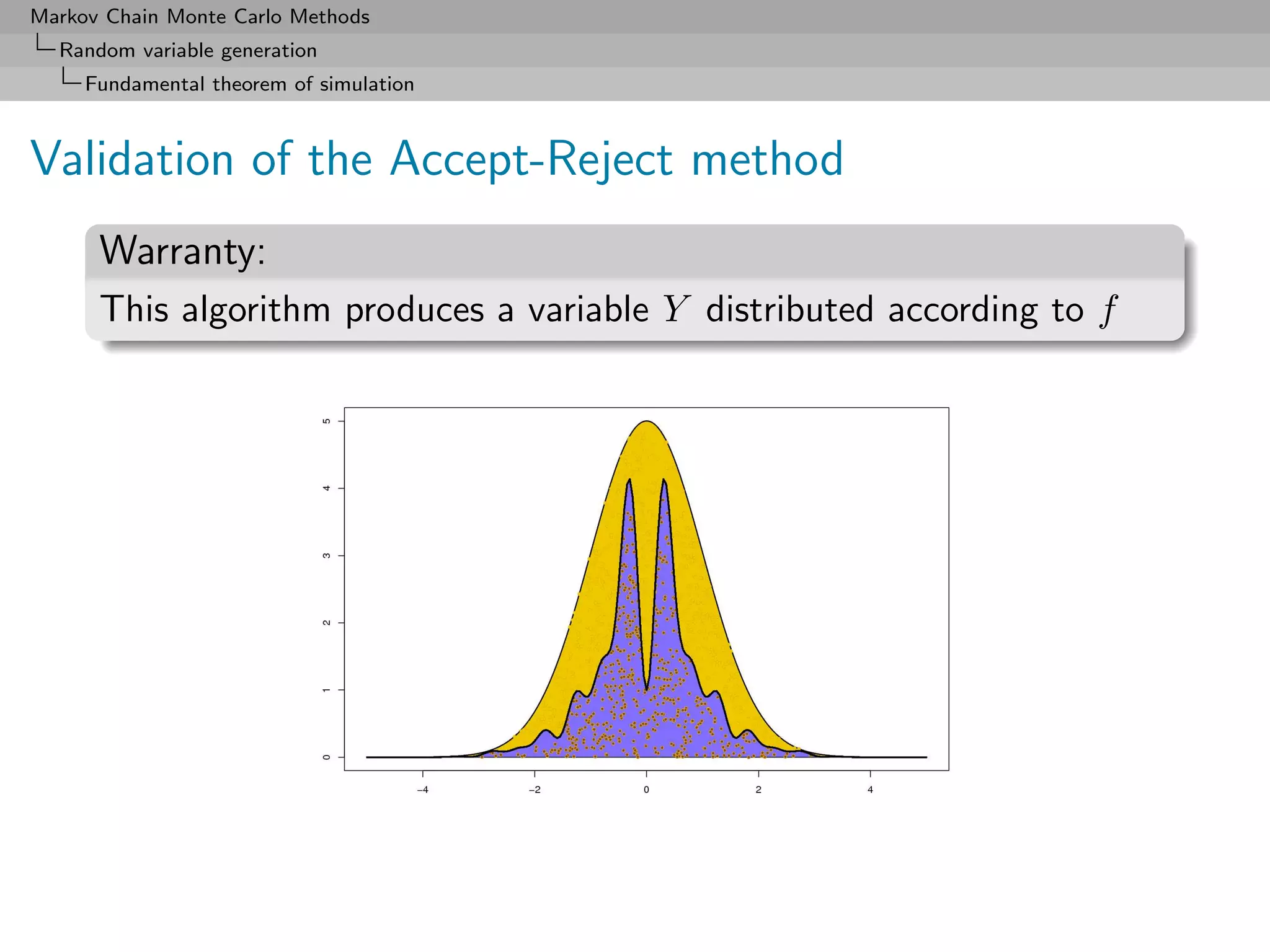
Validation of the Accept-Reject method
      Warranty:
      This algorithm produces a variable Y distributed according to f
Markov Chain Monte Carlo Methods
  Random variable generation
     Fundamental theorem of simulation


Two interesting properties


          ◦ First, it provides a generic method to simulate from any
            density f that is known up to a multiplicative factor
            Property particularly important in Bayesian calculations where
            the posterior distribution

                                         π(θ|x) ∝ π(θ) f (x|θ) .

               is specified up to a normalizing constant
          ◦ Second, the probability of acceptance in the algorithm is
            1/M , e.g., expected number of trials until a variable is
            accepted is M
Markov Chain Monte Carlo Methods
  Random variable generation
     Fundamental theorem of simulation


More interesting properties


          ◦ In cases f and g both probability densities, the constant M is
            necessarily larger that 1.
          ◦ The size of M , and thus the efficiency of the algorithm, are
            functions of how closely g can imitate f , especially in the tails
          ◦ For f /g to remain bounded, necessary for g to have tails
            thicker than those of f .
            It is therefore impossible to use the A-R algorithm to simulate
            a Cauchy distribution f using a normal distribution g, however
            the reverse works quite well.
Markov Chain Monte Carlo Methods
  Random variable generation
     Fundamental theorem of simulation


                                                                 No Cauchy!


      Example (Normal from a Cauchy)
      Take
                                                  1
                                         f (x) = √ exp(−x2 /2)
                                                  2π
      and
                                         1 1
                                            g(x) =,
                                         π 1 + x2
      densities of the normal and Cauchy distributions.
      Then
                   f (x)    π                2      2π
                         =     (1 + x2 ) e−x /2 ≤       = 1.52
                   g(x)      2                       e
       attained at x = ±1.
Markov Chain Monte Carlo Methods
  Random variable generation
     Fundamental theorem of simulation


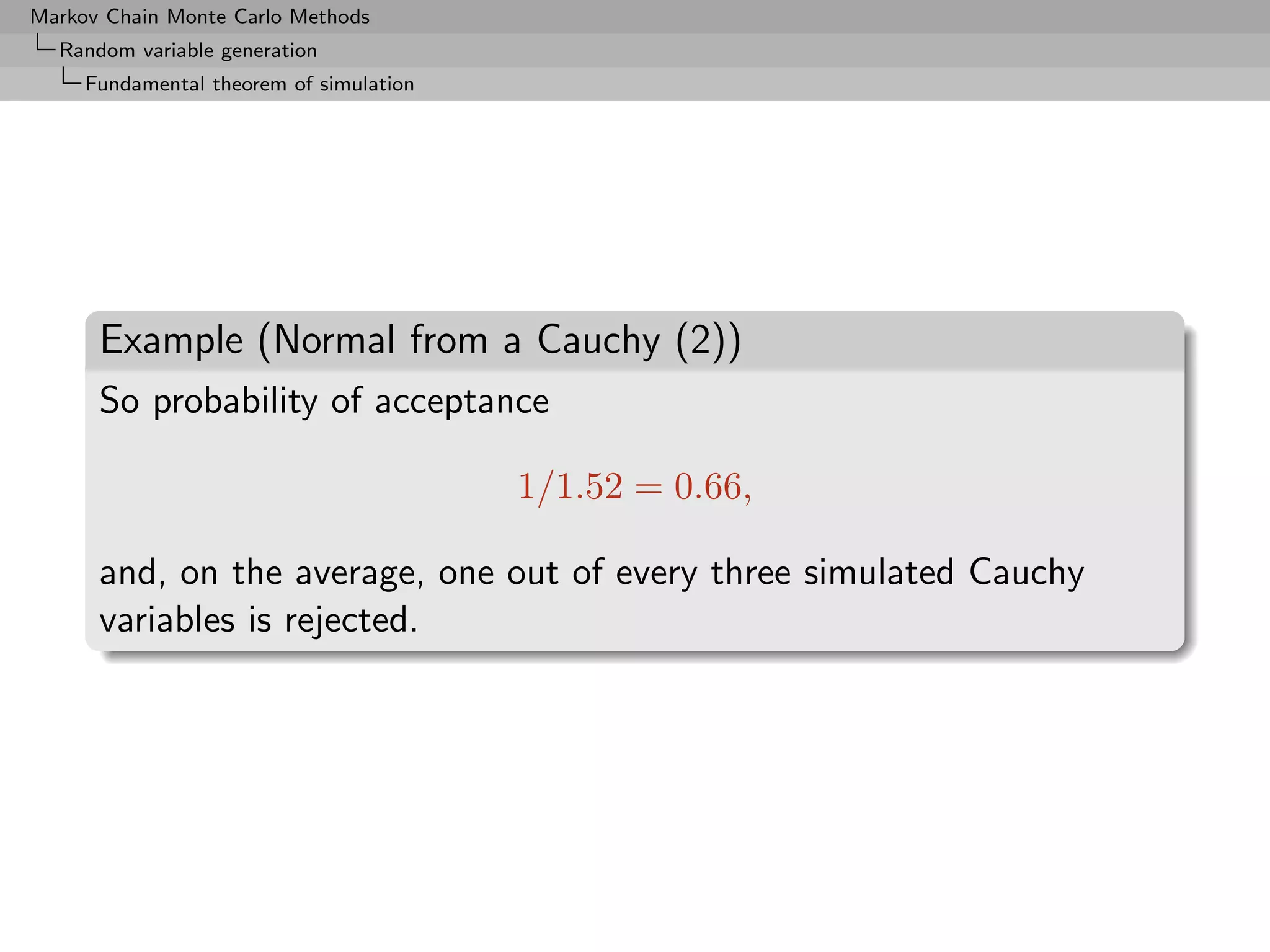
      Example (Normal from a Cauchy (2))
      So probability of acceptance

                                         1/1.52 = 0.66,

      and, on the average, one out of every three simulated Cauchy
      variables is rejected.
Markov Chain Monte Carlo Methods
  Random variable generation
     Fundamental theorem of simulation


                                                                  No Double!


      Example (Normal/Double Exponential)
      Generate a N (0, 1) by using a double-exponential distribution
      with density
                         g(x|α) = (α/2) exp(−α|x|)
      Then
                                          f (x)     2 −1 −α2 /2
                                                ≤     α e
                                         g(x|α)     π
      and minimum of this bound (in α) attained for

                                                α =1
Markov Chain Monte Carlo Methods
  Random variable generation
     Fundamental theorem of simulation


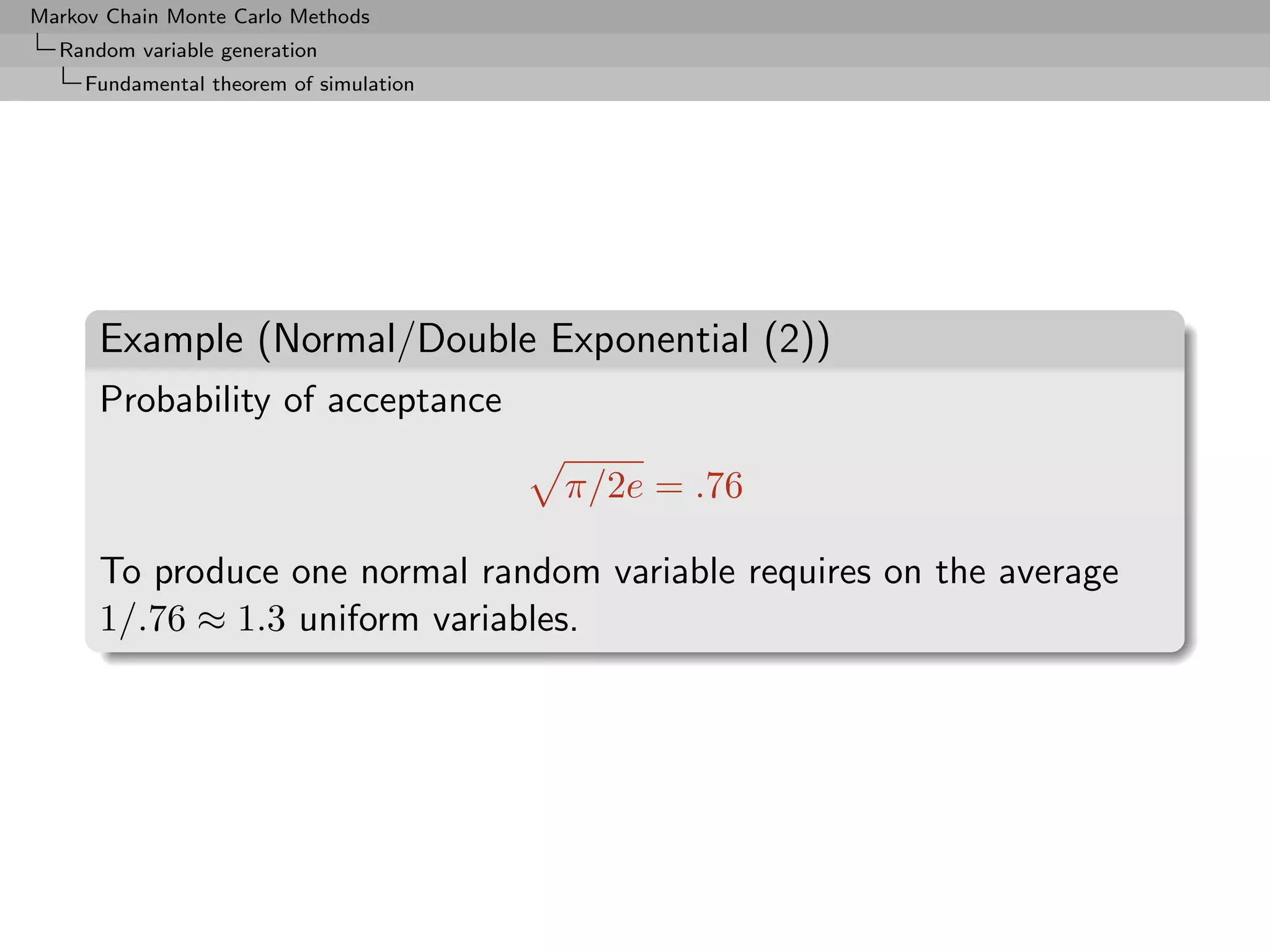
      Example (Normal/Double Exponential (2))
      Probability of acceptance

                                         π/2e = .76

      To produce one normal random variable requires on the average
      1/.76 ≈ 1.3 uniform variables.
Markov Chain Monte Carlo Methods
  Random variable generation
     Fundamental theorem of simulation


         truncate


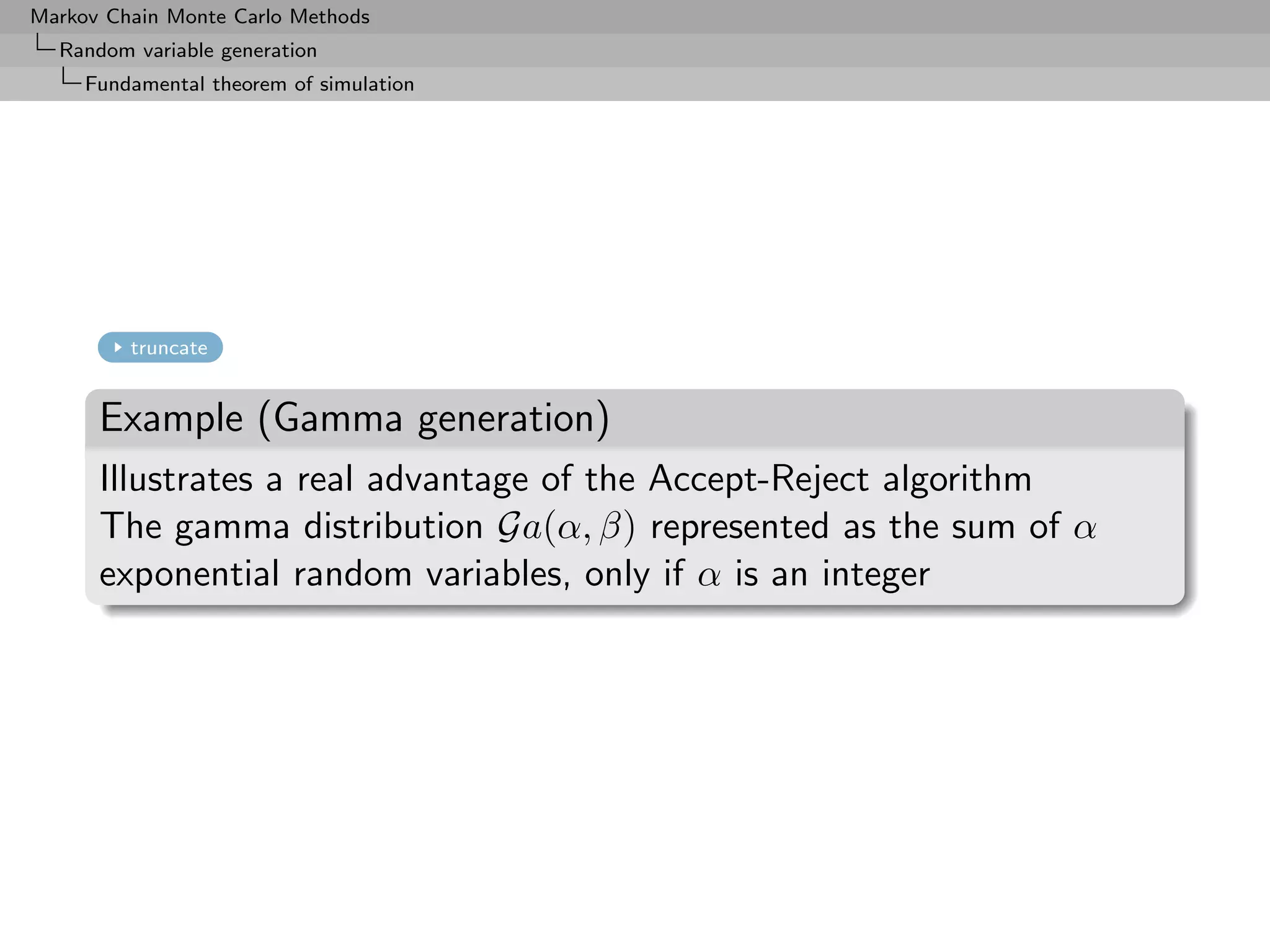
      Example (Gamma generation)
      Illustrates a real advantage of the Accept-Reject algorithm
      The gamma distribution Ga(α, β) represented as the sum of α
      exponential random variables, only if α is an integer
Markov Chain Monte Carlo Methods
  Random variable generation
     Fundamental theorem of simulation


      Example (Gamma generation (2))
      Can use the Accept-Reject algorithm with instrumental distribution

                                   Ga(a, b), with a = [α],   α ≥ 0.

      (Without loss of generality, β = 1.)
      Up to a normalizing constant,
                                                                            α−a
                                                                  α−a
              f /gb = b−a xα−a exp{−(1 − b)x} ≤ b−a
                                                                 (1 − b)e

      for b ≤ 1.
      The maximum is attained at b = a/α.
Markov Chain Monte Carlo Methods
  Random variable generation
     Fundamental theorem of simulation


Truncated Normal simulation

      Example (Truncated Normal distributions)
      Constraint x ≥ µ produces density proportional to
                                               2 /2σ 2
                                         e−(x−µ)         Ix≥µ

      for a bound µ large compared with µ
      There exists alternatives far superior to the na¨ method of
                                                      ıve
      generating a N (µ, σ 2 ) until exceeding µ, which requires an average

      number of
                                 1/Φ((µ − µ)/σ)
      simulations from N (µ, σ 2 ) for a single acceptance.
Markov Chain Monte Carlo Methods
  Random variable generation
     Fundamental theorem of simulation


      Example (Truncated Normal distributions (2))
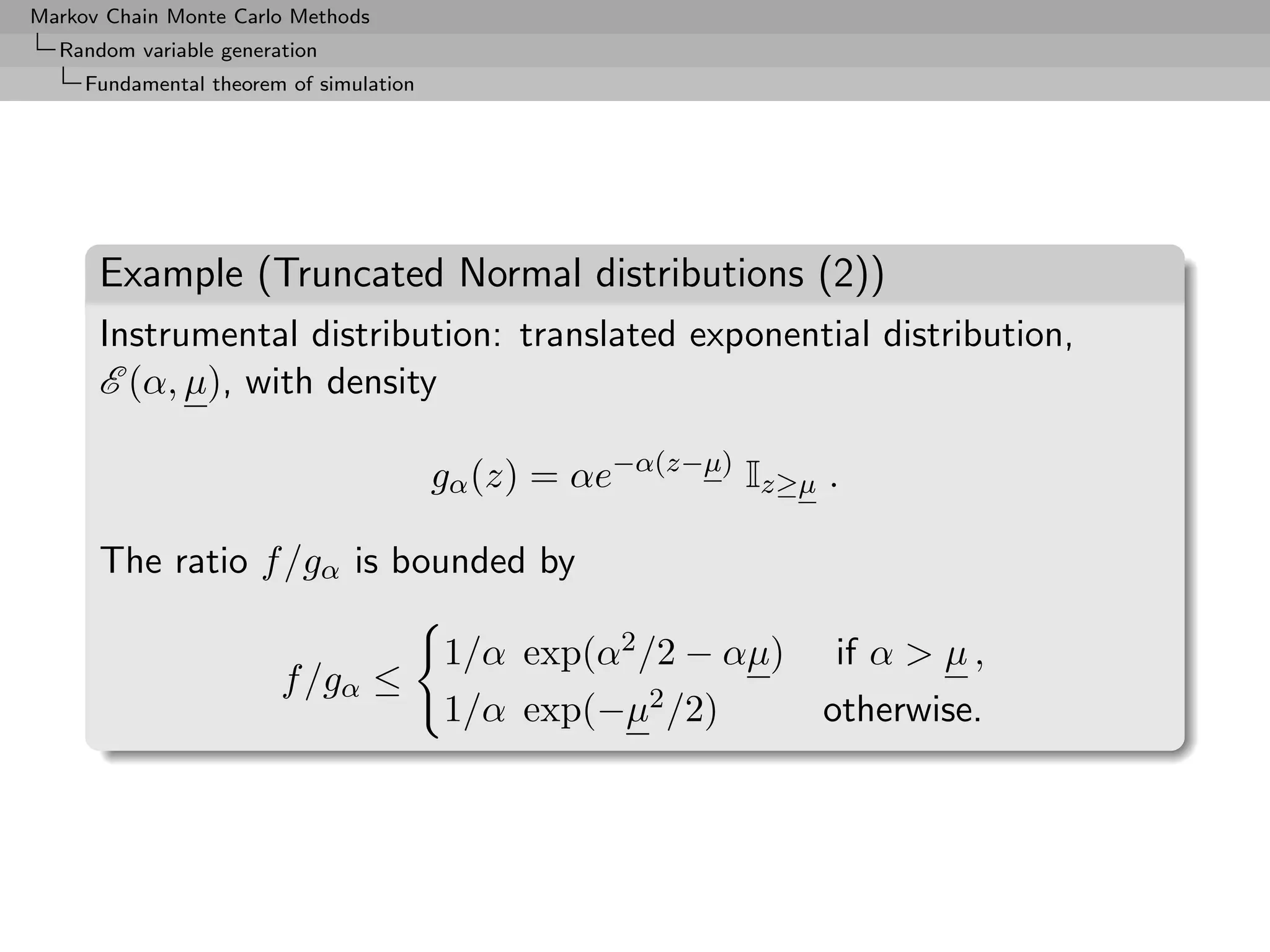
      Instrumental distribution: translated exponential distribution,
      E (α, µ), with density

                                         gα (z) = αe−α(z−µ) Iz≥µ .

      The ratio f /gα is bounded by

                                         1/α exp(α2 /2 − αµ)      if α > µ ,
                        f /gα ≤
                                         1/α exp(−µ2 /2)         otherwise.
Markov Chain Monte Carlo Methods
  Random variable generation
     Log-concave densities


Log-concave densities (1)


                      Densities f whose logarithm is concave, for
         move to next chapter

      instance Bayesian posterior distributions such that

                             log π(θ|x) = log π(θ) + log f (x|θ) + c

      concave
Markov Chain Monte Carlo Methods
  Random variable generation
     Log-concave densities


Log-concave densities (2)


      Take
                             Sn = {xi , i = 0, 1, . . . , n + 1} ⊂ supp(f )
     such that h(xi ) = log f (xi ) known up to the same constant.
   By concavity of h, line Li,i+1 through
   (xi , h(xi )) and (xi+1 , h(xi+1 ))
           below h in [xi , xi+1 ] and                                             L 2,3 (x)

                                                                                                        log f(x)

           above this graph outside this interval                       x1    x2    x3             x4
                                                                                               x
Markov Chain Monte Carlo Methods
  Random variable generation
     Log-concave densities


Log-concave densities (3)

      For x ∈ [xi , xi+1 ], if

        hn (x) = min{Li−1,i (x), Li+1,i+2 (x)} and hn (x) = Li,i+1 (x) ,

      the envelopes are
                                   hn (x) ≤ h(x) ≤ hn (x)
      uniformly on the support of f , with

                hn (x) = −∞ and hn (x) = min(L0,1 (x), Ln,n+1 (x))

      on [x0 , xn+1 ]c .
Markov Chain Monte Carlo Methods
  Random variable generation
     Log-concave densities


Log-concave densities (4)


      Therefore, if

                             f n (x) = exp hn (x) and f n (x) = exp hn (x)

      then
                                f n (x) ≤ f (x) ≤ f n (x) =   n   gn (x) ,
      where         n   normalizing constant of fn
Markov Chain Monte Carlo Methods
  Random variable generation
     Log-concave densities


ARS Algorithm


         1. Initialize n and Sn .
         2. Generate X ∼ gn (x), U ∼ U[0,1] .
         3. If U ≤ f n (X)/ n gn (X), accept X;
            otherwise, if U ≤ f (X)/ n gn (X), accept X
Markov Chain Monte Carlo Methods
  Random variable generation
     Log-concave densities


         kill ducks


   Example (Northern Pintail ducks)
   Ducks captured at time i with both probability pi and
   size N of the population unknown.
   Dataset

             (n1 , . . . , n11 ) = (32, 20, 8, 5, 1, 2, 0, 2, 1, 1, 0)

   Number of recoveries over the years 1957–1968 of 1612
   Northern Pintail ducks banded in 1956
Markov Chain Monte Carlo Methods
  Random variable generation
     Log-concave densities


      Example (Northern Pintail ducks (2))
      Corresponding conditional likelihood
                                                                I
                   L(n1 , . . . , nI |N, p1 , . . . , pI ) ∝         pni (1 − pi )N −ni ,
                                                                      i
                                                               i=1

      where I number of captures, ni number of captured animals
      during the ith capture, and r is the total number of different
      captured animals.
Markov Chain Monte Carlo Methods
  Random variable generation
     Log-concave densities


      Example (Northern Pintail ducks (3))
      Prior selection
      If
                                              N ∼ P(λ)
      and
                                                pi
                                   αi = log            ∼ N (µi , σ 2 ),
                                              1 − pi
                                                                          [Normal logistic]
Markov Chain Monte Carlo Methods
  Random variable generation
     Log-concave densities


      Example (Northern Pintail ducks (4))
      Posterior distribution
                                                             I
                                               N!     λN
           π(α, N |, n1 , . . . , nI )   ∝                        (1 + eαi )−N
                                             (N − r)! N !
                                                            i=1
                                              I
                                                                   1
                                                   exp αi ni −         (αi − µi )2
                                                                  2σ 2
                                             i=1
Markov Chain Monte Carlo Methods
  Random variable generation
     Log-concave densities


      Example (Northern Pintail ducks (5))
      For the conditional posterior distribution

                                                         1
      π(αi |N, n1 , . . . , nI ) ∝ exp αi ni −               (αi − µi )2    (1+eαi )N ,
                                                        2σ 2

      the ARS algorithm can be implemented since
                                        1
                             αi ni −        (αi − µi )2 − N log(1 + eαi )
                                       2σ 2
      is concave in αi .
Markov Chain Monte Carlo Methods
  Random variable generation
     Log-concave densities


           Posterior distributions of capture log-odds ratios for the
                                years 1957–1965.
                                       1957                                           1958                                           1959
                1.0


                                                               1.0


                                                                                                              1.0
                0.8


                                                               0.8


                                                                                                              0.8
                0.6


                                                               0.6


                                                                                                              0.6
                0.4


                                                               0.4


                                                                                                              0.4
                0.2


                                                               0.2


                                                                                                              0.2
                0.0


                                                               0.0


                                                                                                              0.0
                      −10   −9   −8   −7   −6   −5   −4   −3         −10   −9   −8   −7   −6   −5   −4   −3         −10   −9   −8   −7   −6   −5   −4   −3


                                       1960                                           1961                                           1962
                1.0


                                                               1.0


                                                                                                              1.0
                0.8


                                                               0.8


                                                                                                              0.8
                0.6


                                                               0.6


                                                                                                              0.6
                0.4


                                                               0.4


                                                                                                              0.4
                0.2


                                                               0.2


                                                                                                              0.2
                0.0


                                                               0.0


                                                                                                              0.0
                      −10   −9   −8   −7   −6   −5   −4   −3         −10   −9   −8   −7   −6   −5   −4   −3         −10   −9   −8   −7   −6   −5   −4   −3


                                       1963                                           1964                                           1965
                1.0


                                                               1.0


                                                                                                              1.0
                0.8


                                                               0.8


                                                                                                              0.8
                0.6


                                                               0.6


                                                                                                              0.6
                0.4


                                                               0.4


                                                                                                              0.4
                0.2


                                                               0.2


                                                                                                              0.2
                0.0


                                                               0.0


                                                                                                              0.0


                      −10   −9   −8   −7   −6   −5   −4   −3         −10   −9   −8   −7   −6   −5   −4   −3         −10   −9   −8   −7   −6   −5   −4   −3
Markov Chain Monte Carlo Methods
  Random variable generation
     Log-concave densities


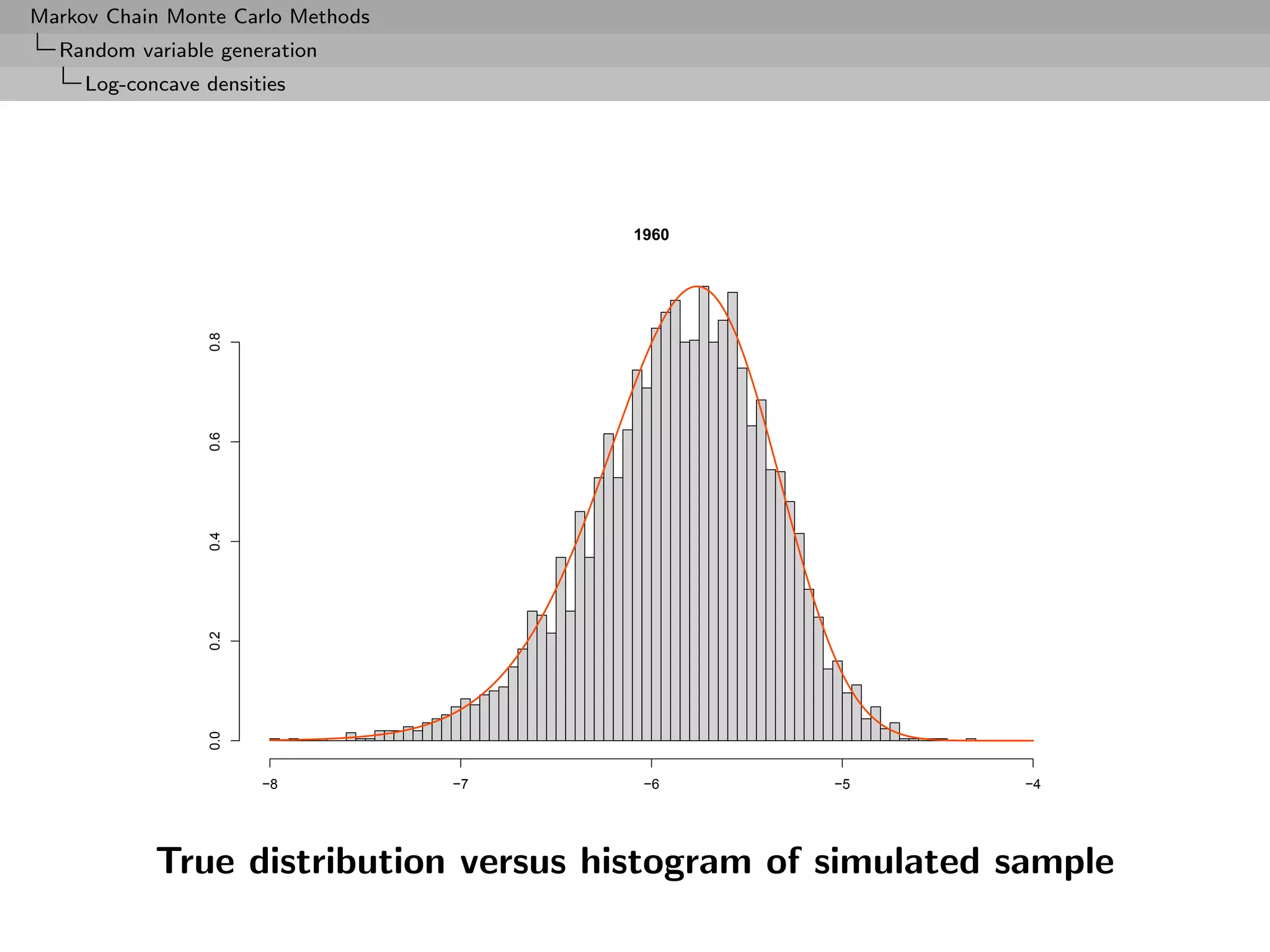
                                        1960
                  0.8
                  0.6
                  0.4
                  0.2
                  0.0


                        −8         −7    −6       −5        −4


            True distribution versus histogram of simulated sample
Markov Chain Monte Carlo Methods
  Monte Carlo Integration


Monte Carlo integration
      Motivation and leading example

      Random variable generation

      Monte Carlo Integration
        Introduction
        Monte Carlo integration
        Importance Sampling
        Acceleration methods
        Bayesian importance sampling

      Notions on Markov Chains

      The Metropolis-Hastings Algorithm
Markov Chain Monte Carlo Methods
  Monte Carlo Integration
     Introduction


Quick reminder


      Two major classes of numerical problems that arise in statistical
      inference
          ◦ Optimization - generally associated with the likelihood
            approach

          ◦ Integration- generally associated with the Bayesian approach
Markov Chain Monte Carlo Methods
  Monte Carlo Integration
     Introduction


                                                                         skip Example!


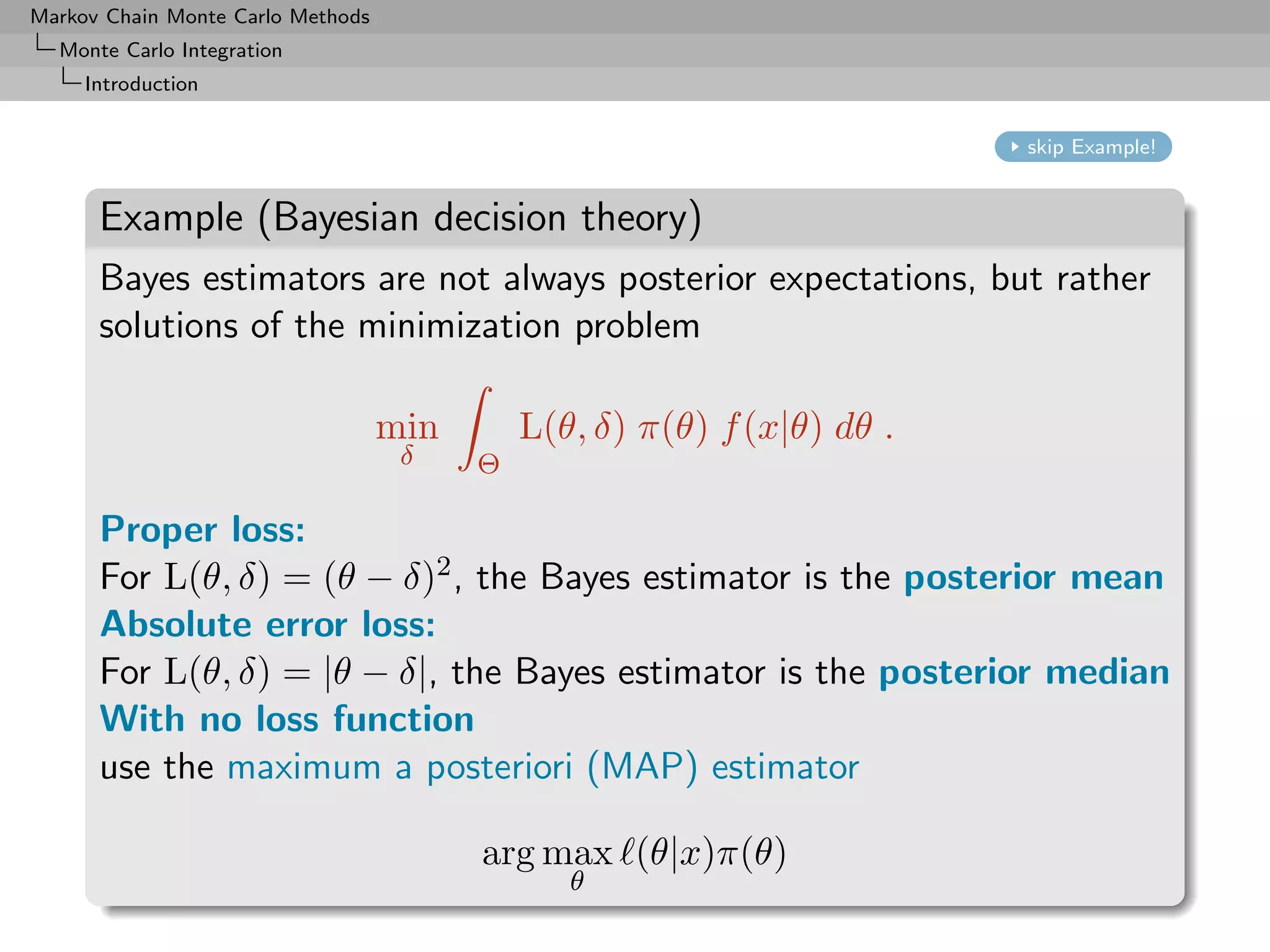
      Example (Bayesian decision theory)
      Bayes estimators are not always posterior expectations, but rather
      solutions of the minimization problem

                                   min       L(θ, δ) π(θ) f (x|θ) dθ .
                                    δ    Θ

      Proper loss:
      For L(θ, δ) = (θ − δ)2 , the Bayes estimator is the posterior mean
      Absolute error loss:
      For L(θ, δ) = |θ − δ|, the Bayes estimator is the posterior median
      With no loss function
      use the maximum a posteriori (MAP) estimator

                                         arg max (θ|x)π(θ)
                                                θ
Markov Chain Monte Carlo Methods
  Monte Carlo Integration
     Monte Carlo integration


Monte Carlo integration


      Theme:
      Generic problem of evaluating the integral

                               I = Ef [h(X)] =       h(x) f (x) dx
                                                 X

       where X is uni- or multidimensional, f is a closed form, partly
      closed form, or implicit density, and h is a function
Markov Chain Monte Carlo Methods
  Monte Carlo Integration
     Monte Carlo integration


Monte Carlo integration (2)


      Monte Carlo solution
      First use a sample (X1 , . . . , Xm ) from the density f to
      approximate the integral I by the empirical average
                                              m
                                          1
                                   hm   =           h(xj )
                                          m
                                              j=1

      which converges
                                   hm −→ Ef [h(X)]
      by the Strong Law of Large Numbers
Markov Chain Monte Carlo Methods
  Monte Carlo Integration
     Monte Carlo integration


Monte Carlo precision

      Estimate the variance with
                                                m
                                           1
                                   vm =               [h(xj ) − hm ]2 ,
                                          m−1
                                                j=1

      and for m large,

                                    hm − Ef [h(X)]
                                        √          ∼ N (0, 1).
                                          vm

      Note: This can lead to the construction of a convergence test and
      of confidence bounds on the approximation of Ef [h(X)].
Markov Chain Monte Carlo Methods
  Monte Carlo Integration
     Monte Carlo integration


      Example (Cauchy prior/normal sample)
      For estimating a normal mean, a robust prior is a Cauchy prior

                                   X ∼ N (θ, 1),     θ ∼ C(0, 1).

      Under squared error loss, posterior mean
                                           ∞
                                                  θ           2
                                                     2
                                                       e−(x−θ) /2 dθ
                                           −∞   1+θ
                               δ π (x) =    ∞
                                                  1           2
                                                       e−(x−θ) /2 dθ
                                           −∞   1 + θ2
Markov Chain Monte Carlo Methods
  Monte Carlo Integration
     Monte Carlo integration


      Example (Cauchy prior/normal sample (2))
      Form of δ π suggests simulating iid variables

                                      θ1 , · · · , θm ∼ N (x, 1)

      and calculating
                                          m               m
                               ˆπ                 θi             1
                               δm (x) =              2              2 .
                                          i=1
                                                1 + θi   i=1
                                                               1 + θi

      The Law of Large Numbers implies
                                   ˆπ
                                   δm (x) −→ δ π (x) as m −→ ∞.
Markov Chain Monte Carlo Methods
  Monte Carlo Integration
     Monte Carlo integration

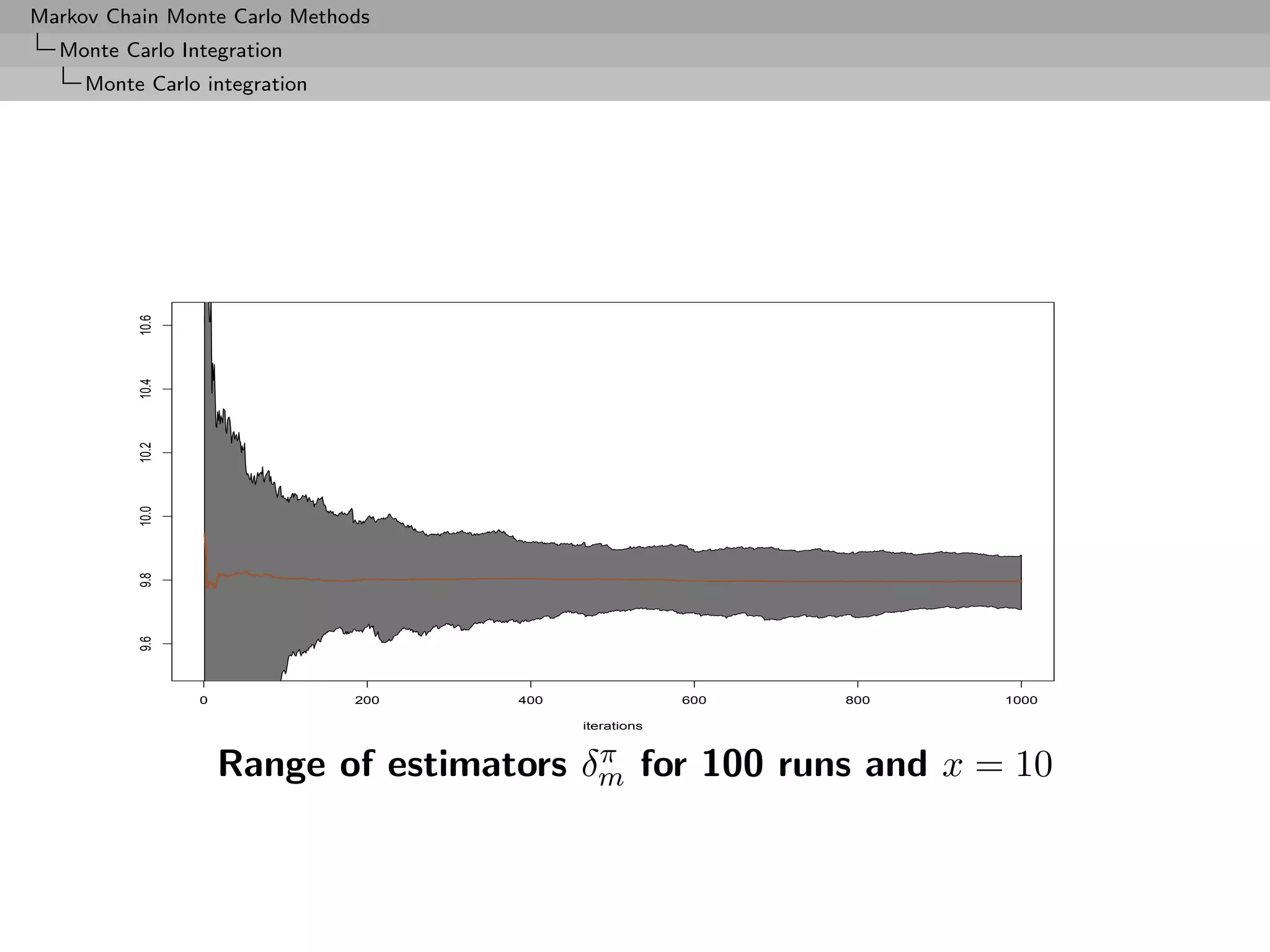
          10.6
          10.4
          10.2
          10.0
          9.8
          9.6


                 0             200   400                600   800   1000

                                           iterations


                                          π
                     Range of estimators δm for 100 runs and x = 10
Markov Chain Monte Carlo Methods
  Monte Carlo Integration
     Importance Sampling


Importance sampling


      Paradox
      Simulation from f (the true density) is not necessarily optimal

      Alternative to direct sampling from f is importance sampling,
      based on the alternative representation

                                                     f (x)
                            Ef [h(X)] =       h(x)           g(x) dx .
                                          X          g(x)

      which allows us to use other distributions than f
Markov Chain Monte Carlo Methods
  Monte Carlo Integration
     Importance Sampling


Importance sampling algorithm

          Evaluation of

                             Ef [h(X)] =         h(x) f (x) dx
                                             X

          by
            1. Generate a sample X1 , . . . , Xn from a distribution g
            2. Use the approximation
                                       m
                                   1         f (Xj )
                                                     h(Xj )
                                   m         g(Xj )
                                       j=1
Markov Chain Monte Carlo Methods
  Monte Carlo Integration
     Importance Sampling


Same thing as before!!!


      Convergence of the estimator
                             m
                        1          f (Xj )
                                           h(Xj ) −→       h(x) f (x) dx
                        m          g(Xj )              X
                            j=1


      converges for any choice of the distribution g
      [as long as supp(g) ⊃ supp(f )]
Markov Chain Monte Carlo Methods
  Monte Carlo Integration
     Importance Sampling


Important details


          ◦ Instrumental distribution g chosen from distributions easy to
            simulate
          ◦ The same sample (generated from g) can be used repeatedly,
            not only for different functions h, but also for different
            densities f
          ◦ Even dependent proposals can be used, as seen later
                 PMC chapter
Markov Chain Monte Carlo Methods
  Monte Carlo Integration
     Importance Sampling


      Although g can be any density, some choices are better than
      others:
          ◦ Finite variance only when

                                       f (X)                  f 2 (X)
                           Ef h2 (X)         =       h2 (x)           dx < ∞ .
                                       g(X)      X             g(X)

          ◦ Instrumental distributions with tails lighter than those of f
            (that is, with sup f /g = ∞) not appropriate.
          ◦ If sup f /g = ∞, the weights f (xj )/g(xj ) vary widely, giving
            too much importance to a few values xj .
          ◦ If sup f /g = M < ∞, the accept-reject algorithm can be used
            as well to simulate f directly.
Markov Chain Monte Carlo Methods
  Monte Carlo Integration
     Importance Sampling


      Example (Cauchy target)
      Case of Cauchy distribution C(0, 1) when importance function is
      Gaussian N (0, 1).
      Ratio of the densities
                                           p (x) √      exp x2 /2
                                   (x) =          = 2π
                                           p0 (x)      π (1 + x2 )

      very badly behaved: e.g.,
                                       ∞
                                            (x)2 p0 (x)dx = ∞ .
                                      −∞

      Poor performances of the associated importance sampling
      estimator
Markov Chain Monte Carlo Methods
  Monte Carlo Integration
     Importance Sampling


            200
            150
            100
            50
            0


                   0               2000   4000                6000   8000   10000

                                                 iterations


      Range and average of 500 replications of IS estimate of
      E[exp −X] over 10, 000 iterations.
Markov Chain Monte Carlo Methods
  Monte Carlo Integration
     Importance Sampling


Optimal importance function


      The choice of g that minimizes the variance of the
      importance sampling estimator is

                                                   |h(x)| f (x)
                                   g ∗ (x) =                        .
                                               Z    |h(z)| f (z) dz

      Rather formal optimality result since optimal choice of g ∗ (x)
      requires the knowledge of I, the integral of interest!
Markov Chain Monte Carlo Methods
  Monte Carlo Integration
     Importance Sampling


Practical impact
                                   m
                                   j=1   h(Xj ) f (Xj )/g(Xj )
                                         m                       ,
                                         j=1   f (Xj )/g(Xj )
      where f and g are known up to constants.
          ◦ Also converges to I by the Strong Law of Large Numbers.
          ◦ Biased, but the bias is quite small
          ◦ In some settings beats the unbiased estimator in squared error
            loss.
          ◦ Using the ‘optimal’ solution does not always work:
                  m
                  j=1 h(xj ) f (xj )/|h(xj )| f (xj )       #positive h − #negative h
                     m                                  =           m
                     j=1 f (xj )/|h(xj )| f (xj )                   j=1 1/|h(xj )|
Markov Chain Monte Carlo Methods
  Monte Carlo Integration
     Importance Sampling


Selfnormalised importance sampling


      For ratio estimator
                                           n                 n
                                     n
                                    δh =         ωi h(xi )         ωi
                                           i=1               i=1

      with Xi ∼ g(y) and Wi such that

                                   E[Wi |Xi = x] = κf (x)/g(x)
Markov Chain Monte Carlo Methods
  Monte Carlo Integration
     Importance Sampling


Selfnormalised variance

      then

           n             1
      var(δh ) ≈              var(Sh ) − 2Eπ [h] cov(Sh , S1 ) + Eπ [h]2 var(S1 ) .
                                   n                  n    n                  n
                        n2 κ2
      for
                                      n                         n
                               n                          n
                              Sh =         Wi h(Xi ) ,   S1 =         Wi
                                     i=1                        i=1


      Rough approximation
                                n     1
                            varδh ≈     varπ (h(X)) {1 + varg (W )}
                                      n
Markov Chain Monte Carlo Methods
  Monte Carlo Integration
     Importance Sampling


      Example (Student’s t distribution)
      X ∼ T (ν, θ, σ 2 ), with density
                                                                   −(ν+1)/2
                             Γ((ν + 1)/2)              (x − θ)2
                    fν (x) = √                    1+                          .
                            σ νπ Γ(ν/2)                  νσ 2

      Without loss of generality, take θ = 0, σ = 1.
      Problem: Calculate the integral
                                    ∞              n
                                         sin(x)
                                                       fν (x)dx.
                                   2.1      x
Markov Chain Monte Carlo Methods
  Monte Carlo Integration
     Importance Sampling


      Example (Student’s t distribution (2))
          • Simulation possibilities
                  ◦ Directly from fν , since fν = N (0,1)
                                                   √ 2
                                                     χν
                  ◦ Importance sampling using Cauchy C (0, 1)
                  ◦ Importance sampling using a normal N (0, 1)
                    (expected to be nonoptimal)
                  ◦ Importance sampling using a U ([0, 1/2.1])
                    change of variables
Markov Chain Monte Carlo Methods
  Monte Carlo Integration
     Importance Sampling
      7.0
      6.5
      6.0
      5.5
      5.0


            0               10000   20000   30000   40000   50000

      Sampling from f (solid lines), importance sampling with
      Cauchy instrumental (short dashes), U ([0, 1/2.1])
      instrumental (long dashes) and normal instrumental (dots).
Markov Chain Monte Carlo Methods
  Monte Carlo Integration
     Importance Sampling


IS suffers from curse of dimensionality
      As dimension increases, discrepancy between importance and
      target worsens
                                                                                     skip explanation

      Explanation:
      Take target distribution µ and instrumental distribution ν
                                                                                             n
      Simulation of a sample of iid samples of size n x1:n from µn = µ
      Importance sampling estimator for µn (fn ) = fn (x1:n )µn (dx1:n )
                                                 N          i        N
                                                 i=1   fn (ξ1:n )    j=1   Wji
                                   µn (fn ) =          N       N
                                                                                 ,
                                                       j=1     j=1   Wj

      where Wk = dµ (ξk ), and ξj are iid with distribution ν.
               i
                    dν
                         i        i

      For {Vk }k≥0 , sequence of iid nonnegative random variables and for
      n ≥ 1, Fn = σ(Vk ; k ≤ n), set
                                                         n
                                                Un =          Vk
                                                        k=1
Markov Chain Monte Carlo Methods
  Monte Carlo Integration
     Importance Sampling


IS suffers (2)
      Since E[Vn+1 ] = 1 and Vn+1 independent from Fn ,

                             E(Un+1 | Fn ) = Un E(Vn+1 | Fn ) = Un ,

      and thus {Un }n≥0 martingale
                √
      Since x → x concave, by Jensen’s inequality,

                  E( Un+1 | Fn ) ≤ E(Un+1 | Fn ) ≤                 Un
                √
      and thus { Un }n≥0 supermartingale
      Assume E( Vn+1 ) < 1. Then
                                         n
                            E( Un ) =         E( Vk ) → 0,   n → ∞.
                                        k=1
Markov Chain Monte Carlo Methods
  Monte Carlo Integration
     Importance Sampling


IS suffers (3)
           √                                                  √
      But { Un }n≥0 is a nonnegative supermartingale and thus Un
      converges a.s. to a random variable Z ≥ 0. By Fatou’s lemma,
                                                                √
                            E(Z) = E     lim     Un ≤ lim inf E( U n ) = 0.
                                         n→∞             n→∞

      Hence, Z = 0 and Un → 0 a.s., which implies that the martingale
      {Un }n≥0 is not regular.
      Apply these results to Vk = dµ (ξk ), i ∈ {1, . . . , N }:
                                  dν
                                       i


                                         dµ i         dµ i
                                    E       (ξk ) ≤ E   (ξ ) = 1.
                                         dν           dν k

                               dµ
      with equality iff         dν   = 1, ν-a.e., i.e. µ = ν.

                      Thus all importance weights converge to 0
Markov Chain Monte Carlo Methods
  Monte Carlo Integration
     Importance Sampling


                                                                          too volatile!


      Example (Stochastic volatility model)
                            yt = β exp (xt /2)   t,      t   ∼ N (0, 1)
      with AR(1) log-variance process (or volatility)

                              xt+1 = ϕxt + σut ,      ut ∼ N (0, 1)
Markov Chain Monte Carlo Methods
  Monte Carlo Integration
     Importance Sampling


   Evolution of IBM stocks (corrected from trend and log-ratio-ed)
          −6
          −7
          −8
          −9
          −10


                 0                 100   200          300   400   500

                                               days
Markov Chain Monte Carlo Methods
  Monte Carlo Integration
     Importance Sampling


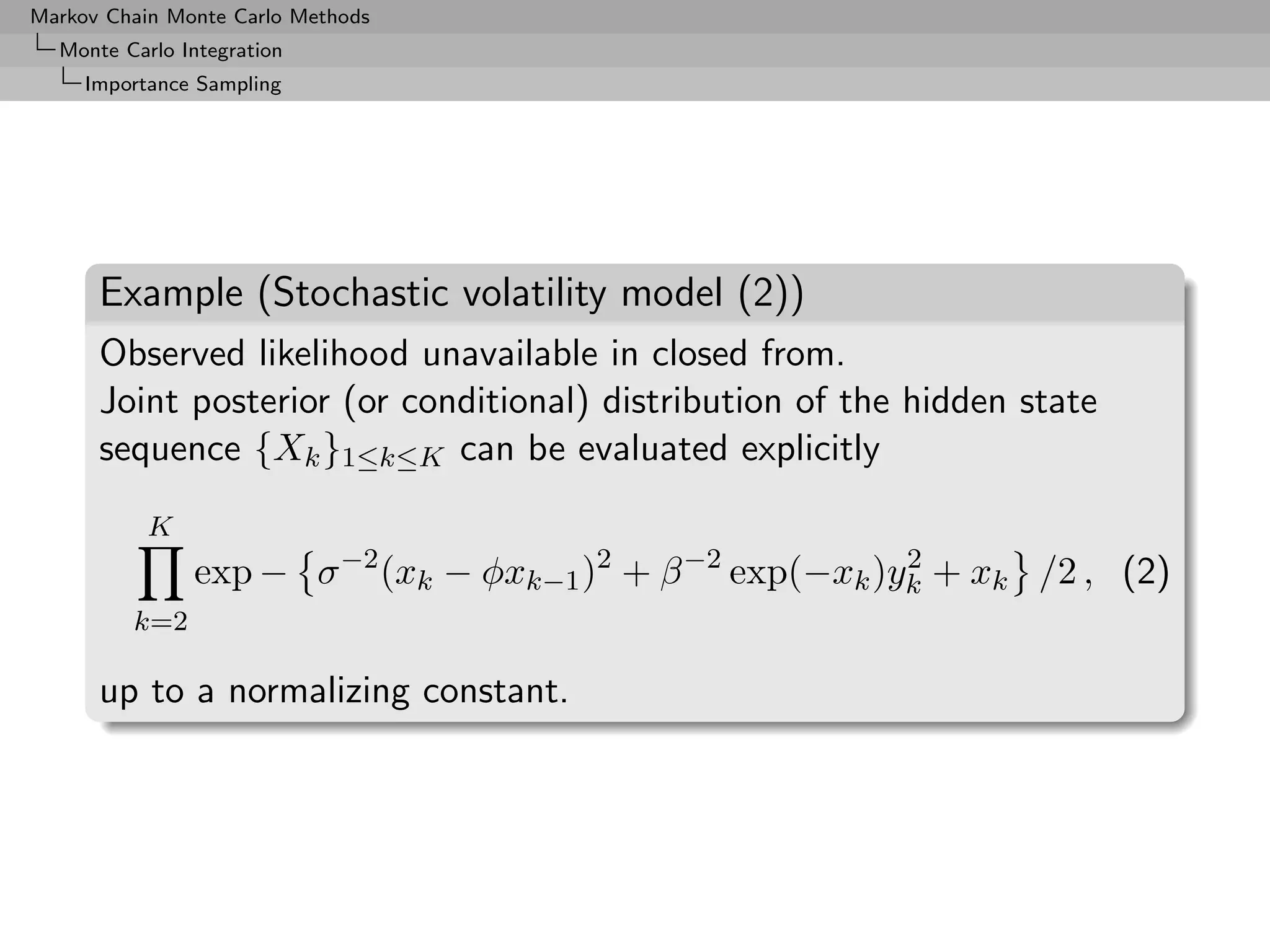
      Example (Stochastic volatility model (2))
      Observed likelihood unavailable in closed from.
      Joint posterior (or conditional) distribution of the hidden state
      sequence {Xk }1≤k≤K can be evaluated explicitly
           K
               exp − σ −2 (xk − φxk−1 )2 + β −2 exp(−xk )yk + xk /2 , (2)
                                                          2

         k=2

      up to a normalizing constant.
Markov Chain Monte Carlo Methods
  Monte Carlo Integration
     Importance Sampling


Computational problems


      Example (Stochastic volatility model (3))
      Direct simulation from this distribution impossible because of
       (a) dependence among the Xk ’s,
       (b) dimension of the sequence {Xk }1≤k≤K , and
                                      2
       (c) exponential term exp(−xk )yk within (2).
Markov Chain Monte Carlo Methods
  Monte Carlo Integration
     Importance Sampling


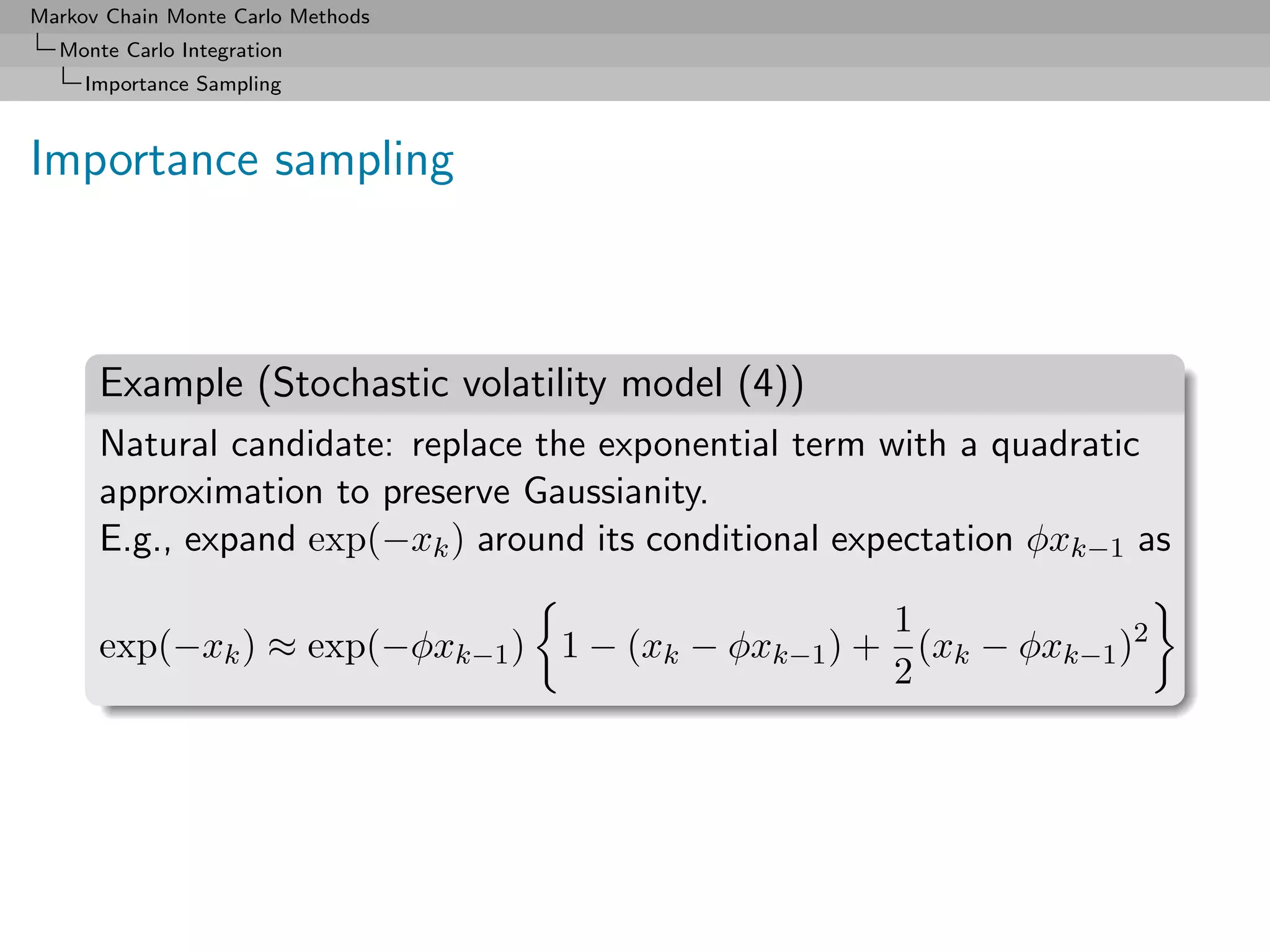
Importance sampling


      Example (Stochastic volatility model (4))
      Natural candidate: replace the exponential term with a quadratic
      approximation to preserve Gaussianity.
      E.g., expand exp(−xk ) around its conditional expectation φxk−1 as

                                                  1
      exp(−xk ) ≈ exp(−φxk−1 ) 1 − (xk − φxk−1 ) + (xk − φxk−1 )2
                                                  2
Markov Chain Monte Carlo Methods
  Monte Carlo Integration
     Importance Sampling


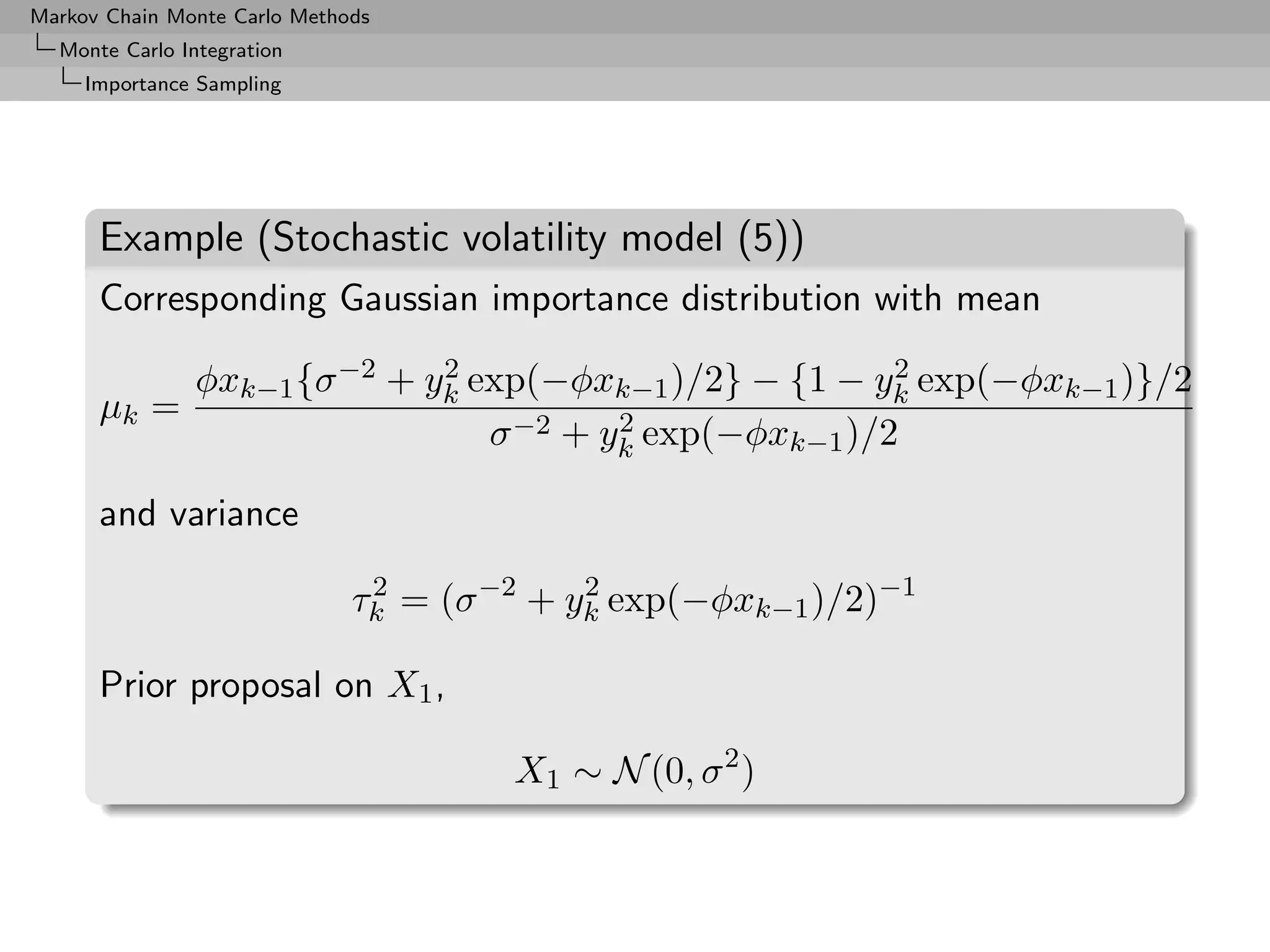
      Example (Stochastic volatility model (5))
      Corresponding Gaussian importance distribution with mean

               φxk−1 {σ −2 + yk exp(−φxk−1 )/2} − {1 − yk exp(−φxk−1 )}/2
                              2                          2
      µk =                               2
                                 σ −2 + yk exp(−φxk−1 )/2

      and variance

                              τk = (σ −2 + yk exp(−φxk−1 )/2)−1
                               2            2


      Prior proposal on X1 ,

                                       X1 ∼ N (0, σ 2 )
Markov Chain Monte Carlo Methods
  Monte Carlo Integration
     Importance Sampling


      Example (Stochastic volatility model (6))
      Simulation starts with X1 and proceeds forward to Xn , each Xk
      being generated conditional on Yk and the previously generated
      Xk−1 .
      Importance weight computed sequentially as the product of

                  exp − σ −2 (xk − φxk−1 )2 + exp(−xk )yk + xk /2
                                                        2

                                          −2             −1         .
                                   exp − τk (xk − µk )2 τk

      (1 ≤ k ≤ K)
Markov Chain Monte Carlo Methods
  Monte Carlo Integration
     Importance Sampling


                                                                                           0.1
                                       0.08


                                                                                           0.0
                                       0.06


                                                                                           −0.1
                             Density

                                       0.04


                                                                                           −0.2
                                       0.02


                                                                                           −0.3
                                       0.00


                                                                                           −0.4


                                              −20   −15   −10      −5         0   5   10          0   200   400       600   800   1000

                                                                log−weights                                       t


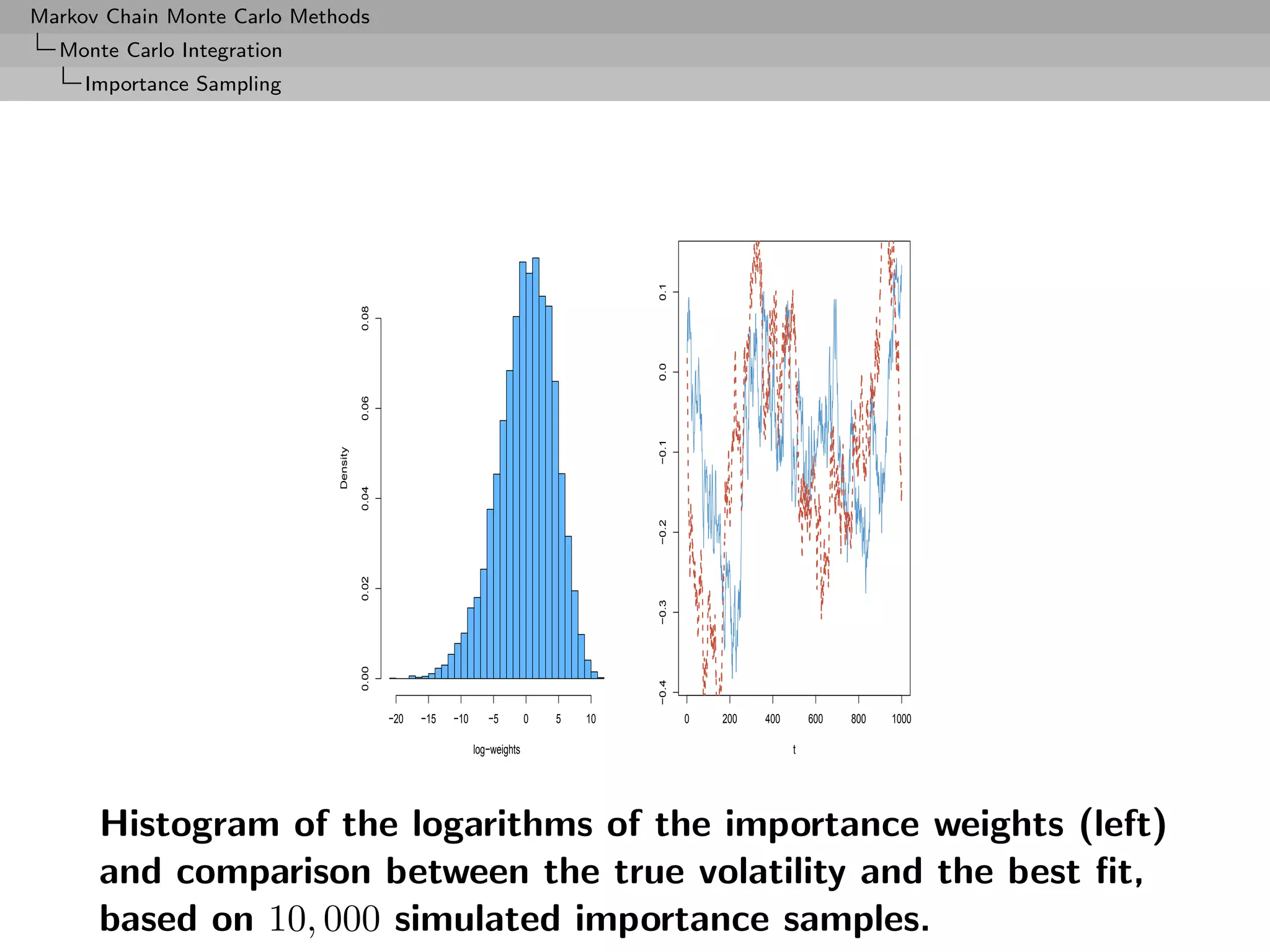
      Histogram of the logarithms of the importance weights (left)
      and comparison between the true volatility and the best fit,
      based on 10, 000 simulated importance samples.
Markov Chain Monte Carlo Methods
  Monte Carlo Integration
     Importance Sampling


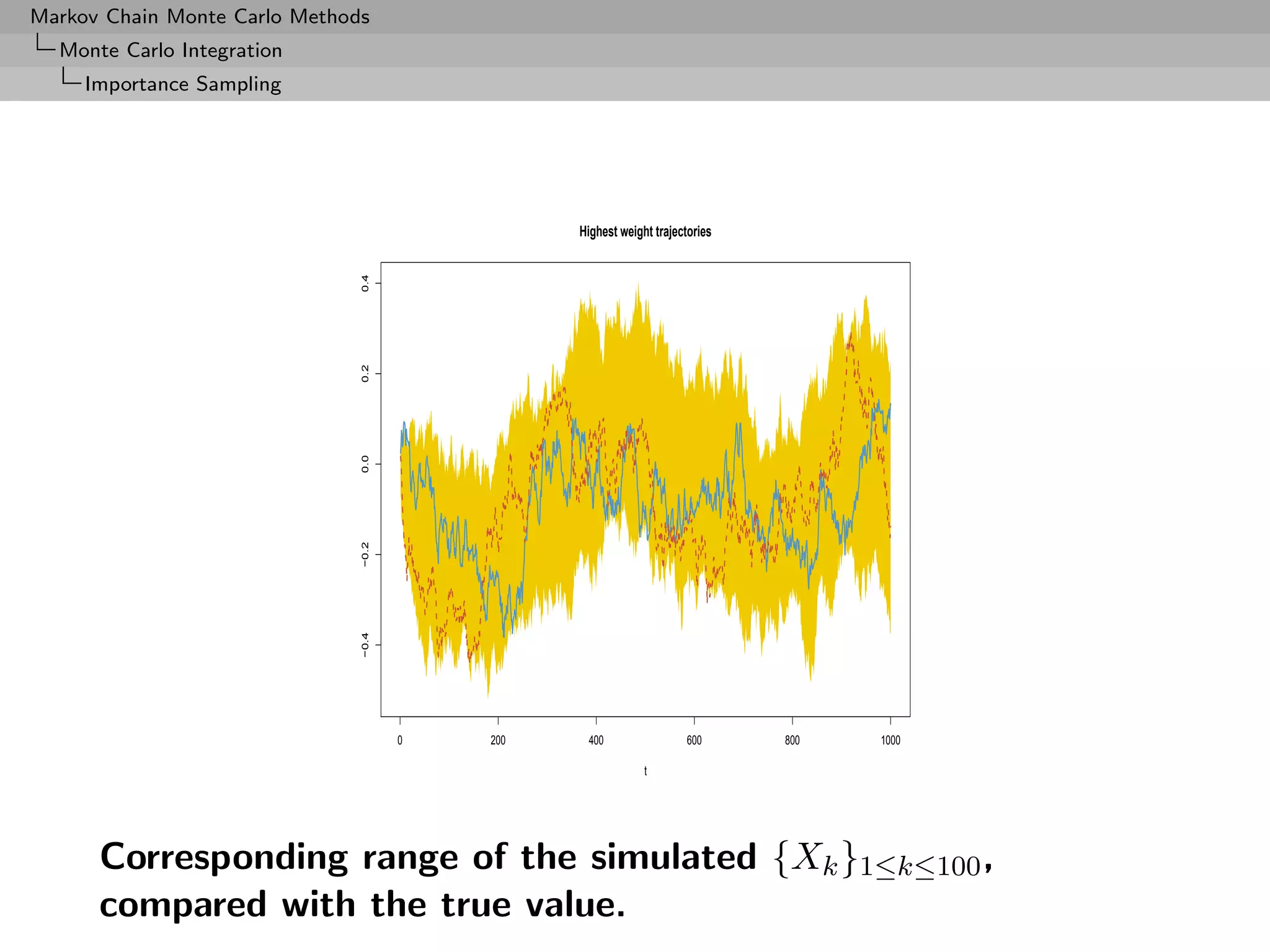
                                                Highest weight trajectories


                               0.4
                               0.2
                               0.0
                               −0.2
                               −0.4


                                      0   200    400                 600      800   1000

                                                             t


      Corresponding range of the simulated {Xk }1≤k≤100 ,
      compared with the true value.
Markov Chain Monte Carlo Methods
  Monte Carlo Integration
     Acceleration methods


Correlated simulations

                   Negative correlation reduces variance
      Special technique — but efficient when it applies
      Two samples (X1 , . . . , Xm ) and (Y1 , . . . , Ym ) from f to estimate

                                         I=           h(x)f (x)dx
                                                  R

      by
                                   m                                    m
                            1                                       1
                     I1 =                h(Xi )       and   I2 =              h(Yi )
                            m                                       m
                                   i=1                                  i=1

      with mean I and variance σ 2
Markov Chain Monte Carlo Methods
  Monte Carlo Integration
     Acceleration methods


Variance reduction


      Variance of the average

                                   I1 + I2       σ2 1
                            var              =     + cov(I1 , I2 ).
                                      2          2  2

      If the two samples are negatively correlated,

                                       cov(I1 , I2 ) ≤ 0 ,

      they improve on two independent samples of same size
Markov Chain Monte Carlo Methods
  Monte Carlo Integration
     Acceleration methods


Antithetic variables


          ◦ If f symmetric about µ, take Yi = 2µ − Xi
          ◦ If Xi = F −1 (Ui ), take Yi = F −1 (1 − Ui )
          ◦ If (Ai )i partition of X , partitioned sampling by sampling
            Xj ’s in each Ai (requires to know Pr(Ai ))
Markov Chain Monte Carlo Methods
  Monte Carlo Integration
     Acceleration methods


Control variates

                                                          out of control!

      For
                                   I=     h(x)f (x)dx

      unknown and
                                   I0 =   h0 (x)f (x)dx

      known,
              I0 estimated by I0 and
              I estimated by I
Markov Chain Monte Carlo Methods
  Monte Carlo Integration
     Acceleration methods


Control variates (2)


      Combined estimator

                                     I∗ = I + β(I0 − I0 )

                                   I∗ is unbiased for I and

                        var(I∗ ) = var(I) + β 2 var(I) + 2βcov(I, I0 )
Markov Chain Monte Carlo Methods
  Monte Carlo Integration
     Acceleration methods


Optimal control


      Optimal choice of β

                                               cov(I, I0 )
                                       β =−                  ,
                                                var(I0 )

      with
                                   var(I ) = (1 − ρ2 ) var(I) ,
      where ρ correlation between I and I0
      Usual solution: regression coefficient of h(xi ) over h0 (xi )
Markov Chain Monte Carlo Methods
  Monte Carlo Integration
     Acceleration methods


      Example (Quantile Approximation)
      Evaluate                                               ∞
                                    = Pr(X > a) =                f (x)dx
                                                         a
      by
                                               n
                                           1
                                       =             I(Xi > a),
                                           n
                                               i=1

      with Xi iid f .
                               1
      If Pr(X > µ) =           2   known
Markov Chain Monte Carlo Methods
  Monte Carlo Integration
     Acceleration methods


      Example (Quantile Approximation (2))
      Control variate
                            n                            n
               1                                   1
            ˜=                  I(Xi > a) + β                 I(Xi > µ) − Pr(X > µ)
               n                                   n
                       i=1                              i=1

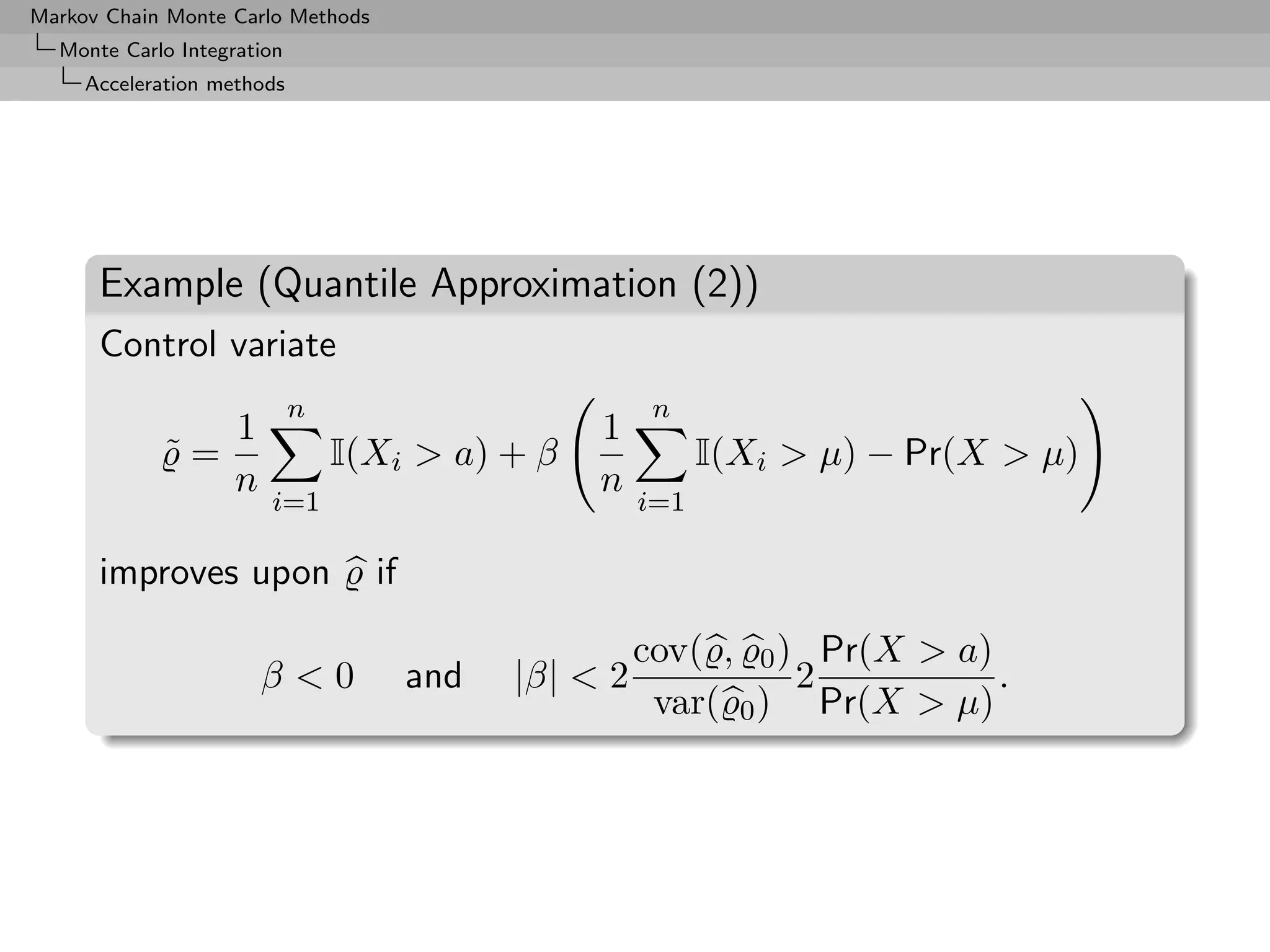
      improves upon                if

                                                        cov( , 0 ) Pr(X > a)
                      β<0               and   |β| < 2             2          .
                                                         var( 0 ) Pr(X > µ)
Markov Chain Monte Carlo Methods
  Monte Carlo Integration
     Acceleration methods


Integration by conditioning


      Use Rao-Blackwell Theorem

                                   var(E[δ(X)|Y]) ≤ var(δ(X))
Markov Chain Monte Carlo Methods
  Monte Carlo Integration
     Acceleration methods


Consequence


      If I unbiased estimator of I = Ef [h(X)], with X simulated from a
                    ˜
      joint density f (x, y), where

                                       ˜
                                       f (x, y)dy = f (x),

      the estimator
                                   I∗ = Ef [I|Y1 , . . . , Yn ]
                                         ˜

      dominate I(X1 , . . . , Xn ) variance-wise (and is unbiased)
Markov Chain Monte Carlo Methods
  Monte Carlo Integration
     Acceleration methods


                                                                       skip expectation


      Example (Student’s t expectation)
      For
                    E[h(x)] = E[exp(−x2 )] with        X ∼ T (ν, 0, σ 2 )
      a Student’s t distribution can be simulated as

                            X|y ∼ N (µ, σ 2 y)   and     Y −1 ∼ χ2 .
                                                                 ν
Markov Chain Monte Carlo Methods
  Monte Carlo Integration
     Acceleration methods


      Example (Student’s t expectation (2))
      Empirical distribution
                                              m
                                          1               2
                                                    exp(−Xj ) ,
                                          m
                                              j=1

      can be improved from the joint sample

                                      ((X1 , Y1 ), . . . , (Xm , Ym ))

      since
                            m                                  m
                     1                                    1                  1
                                   E[exp(−X 2 )|Yj ] =
                     m                                    m              2σ 2 Yj + 1
                            j=1                               j=1

      is the conditional expectation.
      In this example, precision ten times better
Markov Chain Monte Carlo Methods
  Monte Carlo Integration
     Acceleration methods


          0.60
          0.58
          0.56
          0.54
          0.52
          0.50


                 0            2000   4000   6000       8000      10000


      Estimators of E[exp(−X 2 )]: empirical average (full) and
      conditional expectation (dotted) for (ν, µ, σ) = (4.6, 0, 1).
Markov Chain Monte Carlo Methods
  Monte Carlo Integration
     Bayesian importance sampling


Bayesian model choice
                                                                                   directly Markovian

      Probabilise the entire model/parameter space
              allocate probabilities pi to all models Mi
              define priors πi (θi ) for each parameter space Θi
              compute

                                                pi         fi (x|θi )πi (θi )dθi
                                                      Θi
                               π(Mi |x) =
                                                 pj         fj (x|θj )πj (θj )dθj
                                            j          Θj


              take largest π(Mi |x) to determine “best” model,
Markov Chain Monte Carlo Methods
  Monte Carlo Integration
     Bayesian importance sampling


Bayes factor

      Definition (Bayes factors)
      For testing hypotheses H0 : θ ∈ Θ0 vs. Ha : θ ∈ Θ0 , under prior

                                    π(Θ0 )π0 (θ) + π(Θc )π1 (θ) ,
                                                      0

      central quantity

                                                             f (x|θ)π0 (θ)dθ
                               π(Θ0 |x)      π(Θ0 )     Θ0
                      B01    =                      =
                               π(Θc |x)
                                  0          π(Θc )
                                                0            f (x|θ)π1 (θ)dθ
                                                        Θc
                                                         0


                                                                      [Jeffreys, 1939]
Markov Chain Monte Carlo Methods
  Monte Carlo Integration
     Bayesian importance sampling


Evidence


      Problems using a similar quantity, the evidence

                                    Ek =        πk (θk )Lk (θk ) dθk ,
                                           Θk

      aka the marginal likelihood.
                                                                         [Jeffreys, 1939]
Markov Chain Monte Carlo Methods
  Monte Carlo Integration
     Bayesian importance sampling


Bayes factor approximation

      When approximating the Bayes factor

                                                 f0 (x|θ0 )π0 (θ0 )dθ0
                                            Θ0
                                    B01 =
                                                 f1 (x|θ1 )π1 (θ1 )dθ1
                                            Θ1

      use of importance functions                0   and   1   and

                                     n−1
                                      0
                                            n0         i       i
                                            i=1 f0 (x|θ0 )π0 (θ0 )/
                                                                             i
                                                                         0 (θ0 )
                            B01 =
                                     n−1
                                      1
                                            n1         i       i
                                            i=1 f1 (x|θ1 )π1 (θ1 )/
                                                                             i
                                                                         1 (θ1 )
Markov Chain Monte Carlo Methods
  Monte Carlo Integration
     Bayesian importance sampling


Diabetes in Pima Indian women

      Example (R benchmark)
      “A population of women who were at least 21 years old, of Pima
      Indian heritage and living near Phoenix (AZ), was tested for
      diabetes according to WHO criteria. The data were collected by
      the US National Institute of Diabetes and Digestive and Kidney
      Diseases.”
      200 Pima Indian women with observed variables
              plasma glucose concentration in oral glucose tolerance test
              diastolic blood pressure
              diabetes pedigree function
              presence/absence of diabetes
Markov Chain Monte Carlo Methods
  Monte Carlo Integration
     Bayesian importance sampling


Probit modelling on Pima Indian women


      Probability of diabetes function of above variables

                            P(y = 1|x) = Φ(x1 β1 + x2 β2 + x3 β3 ) ,
      Test of H0 : β3 = 0 for 200 observations of Pima.tr based on a
      g-prior modelling:

                                    β ∼ N3 (0, n XT X)−1
Markov Chain Monte Carlo Methods
  Monte Carlo Integration
     Bayesian importance sampling


MCMC 101 for probit models

      Use of either a random walk proposal

                                    β =β+

      in a Metropolis-Hastings algorithm (since the likelihood is
      available)
      or of a Gibbs sampler that takes advantage of the missing/latent
      variable
                     z|y, x, β ∼ N (xT β, 1) Iy × I1−y
                                              z≥0     z≤0

      (since β|y, X, z is distributed as a standard normal)
                                                  [Gibbs three times faster]
Markov Chain Monte Carlo Methods
  Monte Carlo Integration
     Bayesian importance sampling


Importance sampling for the Pima Indian dataset


      Use of the importance function inspired from the MLE estimate
      distribution
                                        ˆ ˆ
                                β ∼ N (β, Σ)

      R Importance sampling code
      model1=summary(glm(y~-1+X1,family=binomial(link="probit")))
      is1=rmvnorm(Niter,mean=model1$coeff[,1],sigma=2*model1$cov.unscaled)
      is2=rmvnorm(Niter,mean=model2$coeff[,1],sigma=2*model2$cov.unscaled)
      bfis=mean(exp(probitlpost(is1,y,X1)-dmvlnorm(is1,mean=model1$coeff[,1],
           sigma=2*model1$cov.unscaled))) / mean(exp(probitlpost(is2,y,X2)-
           dmvlnorm(is2,mean=model2$coeff[,1],sigma=2*model2$cov.unscaled)))
Markov Chain Monte Carlo Methods
  Monte Carlo Integration
     Bayesian importance sampling


Diabetes in Pima Indian women
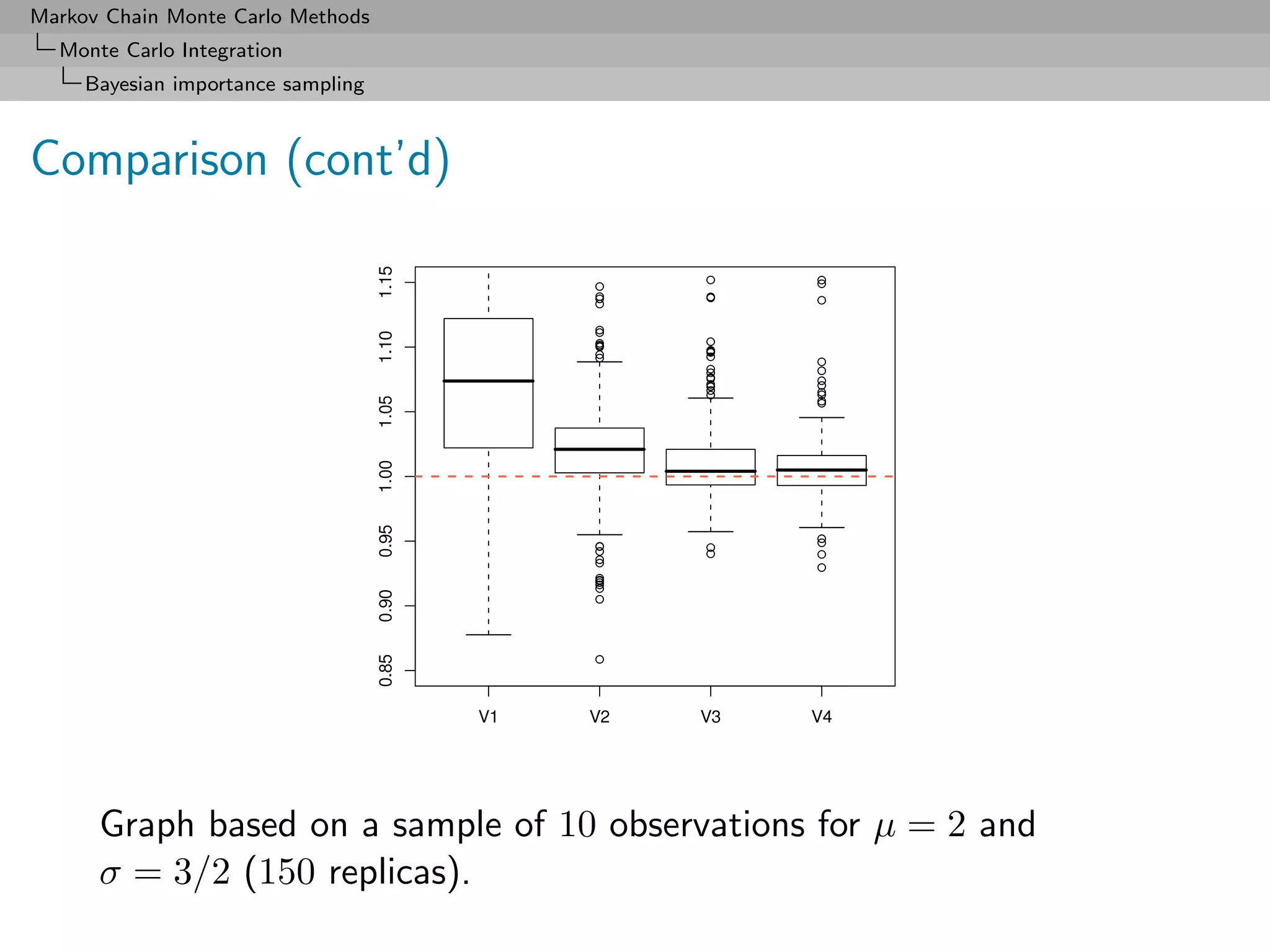
      Comparison of the variation of the Bayes factor approximations
      based on 100 replicas for 20, 000 simulations from the prior and
      the above MLE importance sampler
            5
            4
            3
            2


                              Basic Monte Carlo   Importance sampling
Markov Chain Monte Carlo Methods
  Monte Carlo Integration
     Bayesian importance sampling


Bridge sampling


      Special case:
      If
                                        π1 (θ1 |x) ∝ π1 (θ1 |x)
                                                     ˜
                                        π2 (θ2 |x) ∝ π2 (θ2 |x)
                                                     ˜
      live on the same space (Θ1 = Θ2 ), then
                                         n
                                    1         π1 (θi |x)
                                              ˜
                            B12 ≈                          θi ∼ π2 (θ|x)
                                    n         π2 (θi |x)
                                              ˜
                                        i=1

                            [Gelman & Meng, 1998; Chen, Shao & Ibrahim, 2000]
Markov Chain Monte Carlo Methods
  Monte Carlo Integration
     Bayesian importance sampling


Bridge sampling variance


      The bridge sampling estimator does poorly if
                                                               2
                             var(B12 )  1    π1 (θ) − π2 (θ)
                                 2     ≈ E
                               B12      n         π2 (θ)

      is large, i.e. if π1 and π2 have little overlap...
Markov Chain Monte Carlo Methods
  Monte Carlo Integration
     Bayesian importance sampling


(Further) bridge sampling

      General identity:

                                         π2 (θ|x)α(θ)π1 (θ|x)dθ
                                         ˜
                  B12 =                                               ∀ α(·)
                                         π1 (θ|x)α(θ)π2 (θ|x)dθ
                                         ˜

                                          n1
                                    1
                                               π2 (θ1i |x)α(θ1i )
                                               ˜
                                    n1
                                         i=1
                            ≈             n2                        θji ∼ πj (θ|x)
                                    1
                                               π1 (θ2i |x)α(θ2i )
                                               ˜
                                    n2
                                         i=1
Markov Chain Monte Carlo Methods
  Monte Carlo Integration
     Bayesian importance sampling


Optimal bridge sampling

      The optimal choice of auxiliary function is
                                                   n1 + n2
                                    α =
                                          n1 π1 (θ|x) + n2 π2 (θ|x)

      leading to
                                          n1
                                    1                    π2 (θ1i |x)
                                                          ˜
                                    n1         n1 π1 (θ1i |x) + n2 π2 (θ1i |x)
                                         i=1
                            B12 ≈         n2
                                    1                    π1 (θ2i |x)
                                                          ˜
                                    n2         n1 π1 (θ2i |x) + n2 π2 (θ2i |x)
                                         i=1

                                                                                 Back later!
Markov Chain Monte Carlo Methods
  Monte Carlo Integration
     Bayesian importance sampling


Optimal bridge sampling (2)


      Reason:

      Var(B12 )    1                π1 (θ)π2 (θ)[n1 π1 (θ) + n2 π2 (θ)]α(θ)2 dθ
          2     ≈                                                   2             −1
        B12       n1 n2                       π1 (θ)π2 (θ)α(θ) dθ

      (by the δ method)
      Drawback: Dependence on the unknown normalising constants
      solved iteratively
Markov Chain Monte Carlo Methods
  Monte Carlo Integration
     Bayesian importance sampling


Extension to varying dimensions

      When dim(Θ1 ) = dim(Θ2 ), e.g. θ2 = (θ1 , ψ), introduction of a
      pseudo-posterior density, ω(ψ|θ1 , x), augmenting π1 (θ1 |x) into
      joint distribution
                             π1 (θ1 |x) × ω(ψ|θ1 , x)
      on Θ2 so that

                              π1 (θ1 |x)α(θ1 , ψ)π2 (θ1 , ψ|x)dθ1 ω(ψ|θ1 , x) dψ
                              ˜
               B12 =
                              π2 (θ1 , ψ|x)α(θ1 , ψ)π1 (θ1 |x)dθ1 ω(ψ|θ1 , x) dψ
                              ˜

                                    π1 (θ1 )ω(ψ|θ1 )
                                    ˜                  Eϕ [˜1 (θ1 )ω(ψ|θ1 )/ϕ(θ1 , ψ)]
                                                           π
                      = Eπ2                          =
                                       π2 (θ1 , ψ)
                                       ˜                 Eϕ [˜2 (θ1 , ψ)/ϕ(θ1 , ψ)]
                                                              π

       for any conditional density ω(ψ|θ1 ) and any joint density ϕ.
Markov Chain Monte Carlo Methods
  Monte Carlo Integration
     Bayesian importance sampling


Illustration for the Pima Indian dataset

      Use of the MLE induced conditional of β3 given (β1 , β2 ) as a
      pseudo-posterior and mixture of both MLE approximations on β3
      in bridge sampling estimate
      R bridge sampling code
      cova=model2$cov.unscaled
      expecta=model2$coeff[,1]
      covw=cova[3,3]-t(cova[1:2,3])%*%ginv(cova[1:2,1:2])%*%cova[1:2,3]

      probit1=hmprobit(Niter,y,X1)
      probit2=hmprobit(Niter,y,X2)
      pseudo=rnorm(Niter,meanw(probit1),sqrt(covw))
      probit1p=cbind(probit1,pseudo)

      bfbs=mean(exp(probitlpost(probit2[,1:2],y,X1)+dnorm(probit2[,3],meanw(probit2[,1:2]),
           sqrt(covw),log=T))/ (dmvnorm(probit2,expecta,cova)+dnorm(probit2[,3],expecta[3],
           cova[3,3])))/ mean(exp(probitlpost(probit1p,y,X2))/(dmvnorm(probit1p,expecta,cova)+
           dnorm(pseudo,expecta[3],cova[3,3])))
Markov Chain Monte Carlo Methods
  Monte Carlo Integration
     Bayesian importance sampling


Diabetes in Pima Indian women (cont’d)
      Comparison of the variation of the Bayes factor approximations
      based on 100 × 20, 000 simulations from the prior (MC), the above
      bridge sampler and the above importance sampler
Markov Chain Monte Carlo Methods
  Monte Carlo Integration
     Bayesian importance sampling


The original harmonic mean estimator


      When θki ∼ πk (θ|x),
                                        T
                                    1            1
                                    T         L(θkt |x)
                                        t=1

      is an unbiased estimator of 1/mk (x)
                                                          [Newton & Raftery, 1994]

      Highly dangerous: Most often leads to an infinite variance!!!
Markov Chain Monte Carlo Methods
  Monte Carlo Integration
     Bayesian importance sampling


“The Worst Monte Carlo Method Ever”

      “The good news is that the Law of Large Numbers guarantees that
      this estimator is consistent ie, it will very likely be very close to the
      correct answer if you use a sufficiently large number of points from
      the posterior distribution.
      The bad news is that the number of points required for this
      estimator to get close to the right answer will often be greater
      than the number of atoms in the observable universe. The even
      worse news is that it’s easy for people to not realize this, and to
      na¨ıvely accept estimates that are nowhere close to the correct
      value of the marginal likelihood.”
                                       [Radford Neal’s blog, Aug. 23, 2008]
Markov Chain Monte Carlo Methods
  Monte Carlo Integration
     Bayesian importance sampling


Approximating Zk from a posterior sample


      Use of the [harmonic mean] identity

                   ϕ(θk )                 ϕ(θk )       πk (θk )Lk (θk )       1
      Eπk                       x =                                     dθk =
               πk (θk )Lk (θk )       πk (θk )Lk (θk )       Zk               Zk

      no matter what the proposal ϕ(·) is.
                          [Gelfand & Dey, 1994; Bartolucci et al., 2006]
      Direct exploitation of the MCMC output
Markov Chain Monte Carlo Methods
  Monte Carlo Integration
     Bayesian importance sampling


Comparison with regular importance sampling


      Harmonic mean: Constraint opposed to usual importance sampling
      constraints: ϕ(θ) must have lighter (rather than fatter) tails than
      πk (θk )Lk (θk ) for the approximation
                                              T               (t)
                                          1             ϕ(θk )
                                Z1k = 1                 (t)         (t)
                                          T         πk (θk )Lk (θk )
                                              t=1

      to have a finite variance.
      E.g., use finite support kernels (like Epanechnikov’s kernel) for ϕ
Markov Chain Monte Carlo Methods
  Monte Carlo Integration
     Bayesian importance sampling


Comparison with regular importance sampling (cont’d)


      Compare Z1k with a standard importance sampling approximation
                                                T         (t)         (t)
                                            1         πk (θk )Lk (θk )
                                    Z2k   =                     (t)
                                            T             ϕ(θk )
                                                t=1

                            (t)
      where the θk ’s are generated from the density ϕ(·) (with fatter
      tails like t’s)
Markov Chain Monte Carlo Methods
  Monte Carlo Integration
     Bayesian importance sampling


HPD indicator as ϕ
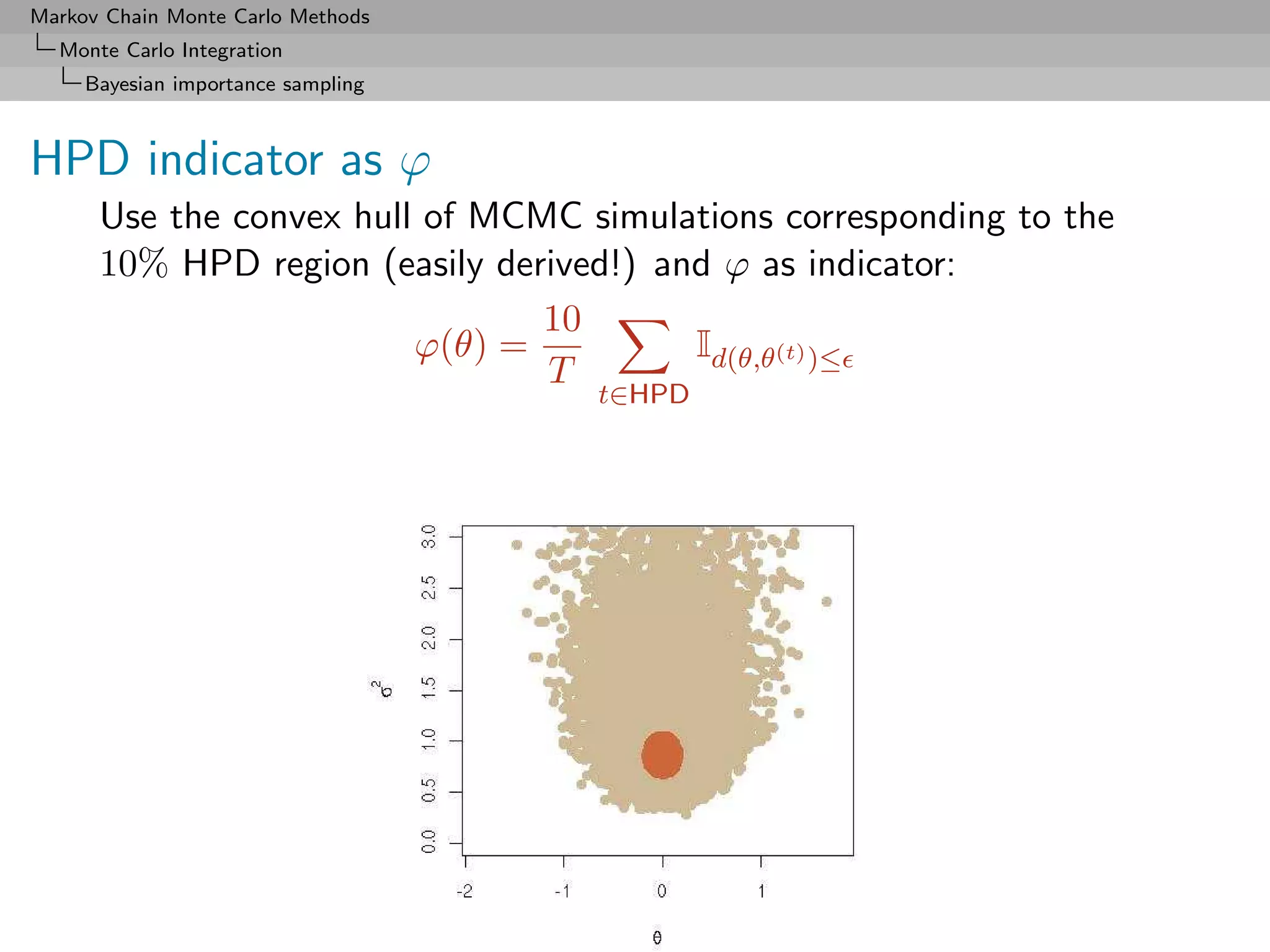
      Use the convex hull of MCMC simulations corresponding to the
      10% HPD region (easily derived!) and ϕ as indicator:
                                10
                         ϕ(θ) =          Id(θ,θ(t) )≤
                                T
                                    t∈HPD
Markov Chain Monte Carlo Methods
  Monte Carlo Integration
     Bayesian importance sampling


Diabetes in Pima Indian women (cont’d)
      Comparison of the variation of the Bayes factor approximations
      based on 100 replicas for 20, 000 simulations for a simulation from
      the above harmonic mean sampler and importance samplers
            3.102 3.104 3.106 3.108 3.110 3.112 3.114 3.116


                                                              Harmonic mean   Importance sampling
Markov Chain Monte Carlo Methods
  Monte Carlo Integration
     Bayesian importance sampling


Approximating Zk using a mixture representation


                                                                           Bridge sampling redux

      Design a specific mixture for simulation [importance sampling]
      purposes, with density

                               ϕk (θk ) ∝ ω1 πk (θk )Lk (θk ) + ϕ(θk ) ,

      where ϕ(·) is arbitrary (but normalised)
      Note: ω1 is not a probability weight
Markov Chain Monte Carlo Methods
  Monte Carlo Integration
     Bayesian importance sampling


Approximating Z using a mixture representation (cont’d)

      Corresponding MCMC (=Gibbs) sampler
      At iteration t
         1. Take δ (t) = 1 with probability

                            (t−1)         (t−1)              (t−1)         (t−1)          (t−1)
              ω1 πk (θk             )Lk (θk       )   ω1 πk (θk      )Lk (θk       ) + ϕ(θk       )

              and δ (t) = 2 otherwise;
                                              (t)                 (t−1)
         2. If δ (t) = 1, generate θk ∼ MCMC(θk          , θk ) where
            MCMC(θk , θk ) denotes an arbitrary MCMC kernel associated
            with the posterior πk (θk |x) ∝ πk (θk )Lk (θk );
                                              (t)
         3. If δ (t) = 2, generate θk ∼ ϕ(θk ) independently
Markov Chain Monte Carlo Methods
  Monte Carlo Integration
     Bayesian importance sampling


Evidence approximation by mixtures
      Rao-Blackwellised estimate
                        T
           ˆ 1
           ξ=
                                       (t)
                             ω1 πk (θk )Lk (θk )
                                                 (t)           (t)          (t)
                                                       ω1 πk (θk )Lk (θk ) + ϕ(θk ) ,
                                                                                         (t)
              T
                       t=1

      converges to ω1 Zk /{ω1 Zk + 1}
               3k
                           ˆ       ˆ        ˆ
      Deduce Zˆ from ω1 E3k /{ω1 E3k + 1} = ξ ie

                            T           (t)     (t)             (t)          (t)          (t)
                            t=1 ω1 πk (θk )Lk (θk )     ω1 π(θk )Lk (θk ) + ϕ(θk )
           ˆ
           E3k =
                                    T      (t)           (t)          (t)          (t)
                                    t=1 ϕ(θk )    ω1 πk (θk )Lk (θk ) + ϕ(θk )

                                                                            [Bridge sampler]
Markov Chain Monte Carlo Methods
  Monte Carlo Integration
     Bayesian importance sampling


Chib’s representation


      Direct application of Bayes’ theorem: given x ∼ fk (x|θk ) and
      θk ∼ πk (θk ),
                                        fk (x|θk ) πk (θk )
                        Ek = mk (x) =
                                            πk (θk |x)
      Use of an approximation to the posterior
                                                            ∗       ∗
                                                    fk (x|θk ) πk (θk )
                                    Ek = mk (x) =                       .
                                                         ˆ ∗
                                                        πk (θk |x)
Markov Chain Monte Carlo Methods
  Monte Carlo Integration
     Bayesian importance sampling


Case of latent variables


      For missing variable z as in mixture models, natural Rao-Blackwell
      estimate
                                       T
                            ∗       1          ∗      (t)
                       πk (θk |x) =       πk (θk |x, zk ) ,
                                    T
                                     t=1
                            (t)
      where the zk ’s are Gibbs sampled latent variables
Markov Chain Monte Carlo Methods
  Monte Carlo Integration
     Bayesian importance sampling


Label switching


      A mixture model [special case of missing variable model] is
      invariant under permutations of the indices of the components.
      E.g., mixtures
                          0.3N (0, 1) + 0.7N (2.3, 1)
      and
                                    0.7N (2.3, 1) + 0.3N (0, 1)
      are exactly the same!
       c The component parameters θi are not identifiable
      marginally since they are exchangeable
Markov Chain Monte Carlo Methods
  Monte Carlo Integration
     Bayesian importance sampling


Connected difficulties


         1. Number of modes of the likelihood of order O(k!):
             c Maximization and even [MCMC] exploration of the
            posterior surface harder
         2. Under exchangeable priors on (θ, p) [prior invariant under
            permutation of the indices], all posterior marginals are
            identical:
             c Posterior expectation of θ1 equal to posterior expectation
            of θ2
Markov Chain Monte Carlo Methods
  Monte Carlo Integration
     Bayesian importance sampling


License
      Since Gibbs output does not produce exchangeability, the Gibbs
      sampler has not explored the whole parameter space: it lacks
      energy to switch simultaneously enough component allocations at
      once


                                                                                                0.2 0.3 0.4 0.5
                                     3
                                     2
                                     1
                              µi


                                                                                           pi
                                     0
                                     −1


                                                     0   100   200       300   400   500                          −1         0          1         2       3
                                                                     n                                                                 µi
                                                                                                0.4 0.6 0.8 1.0
                                   0.2 0.3 0.4 0.5


                                                                                           σi
                              pi


                                                     0   100   200       300   400   500                           0.2           0.3        0.4         0.5
                                                                     n                                                                 pi
                                   0.4 0.6 0.8 1.0


                                                                                                −1 0 1 2 3
                              σi


                                                                                           µi


                                                     0   100   200       300   400   500                               0.4         0.6            0.8         1.0
                                                                     n                                                                 σi
Markov Chain Monte Carlo Methods
  Monte Carlo Integration
     Bayesian importance sampling


Label switching paradox


      We should observe the exchangeability of the components [label
      switching] to conclude about convergence of the Gibbs sampler.
      If we observe it, then we do not know how to estimate the
      parameters.
      If we do not, then we are uncertain about the convergence!!!
Markov Chain Monte Carlo Methods
  Monte Carlo Integration
     Bayesian importance sampling


Compensation for label switching
                                       (t)
      For mixture models, zk usually fails to visit all configurations in a
      balanced way, despite the symmetry predicted by the theory
                                                             1
                      πk (θk |x) = πk (σ(θk )|x) =                      πk (σ(θk )|x)
                                                             k!
                                                                  σ∈S

      for all σ’s in Sk , set of all permutations of {1, . . . , k}.
      Consequences on numerical approximation, biased by an order k!
      Recover the theoretical symmetry by using
                                                       T
                                 ∗          1                       ∗         (t)
                            πk (θk |x) =                     πk (σ(θk )|x, zk ) .
                                           T k!
                                                  σ∈Sk t=1

                                                  [Berkhof, Mechelen, & Gelman, 2003]
Markov Chain Monte Carlo Methods
  Monte Carlo Integration
     Bayesian importance sampling


Galaxy dataset
      n = 82 galaxies as a mixture of k normal distributions with both
      mean and variance unknown.
                                                          [Roeder, 1992]

                                                         Average density
                                         0.8
                                         0.6
                    Relative Frequency

                                         0.4
                                         0.2
                                         0.0


                                               −2   −1      0              1   2   3

                                                                data
Markov Chain Monte Carlo Methods
  Monte Carlo Integration
     Bayesian importance sampling


Galaxy dataset (k)
                                              ∗
      Using only the original estimate, with θk as the MAP estimator,
                                      log(mk (x)) = −105.1396
                                          ˆ
      for k = 3 (based on 103 simulations), while introducing the
      permutations leads to
                                      log(mk (x)) = −103.3479
                                          ˆ
      Note that
                                −105.1396 + log(3!) = −103.3479

        k               2              3         4         5         6         7         8
        mk (x)       -115.68        -103.35   -102.66   -101.93   -102.88   -105.48   -108.44

      Estimations of the marginal likelihoods by the symmetrised Chib’s
      approximation (based on 105 Gibbs iterations and, for k > 5, 100
      permutations selected at random in Sk ).
                                [Lee, Marin, Mengersen & Robert, 2008]
Markov Chain Monte Carlo Methods
  Monte Carlo Integration
     Bayesian importance sampling


Case of the probit model

      For the completion by z,
                                                1
                                    π (θ|x) =
                                    ˆ                     π(θ|x, z (t) )
                                                T     t

      is a simple average of normal densities
      R Bridge sampling code
      gibbs1=gibbsprobit(Niter,y,X1)
      gibbs2=gibbsprobit(Niter,y,X2)
      bfchi=mean(exp(dmvlnorm(t(t(gibbs2$mu)-model2$coeff[,1]),mean=rep(0,3),
              sigma=gibbs2$Sigma2)-probitlpost(model2$coeff[,1],y,X2)))/
            mean(exp(dmvlnorm(t(t(gibbs1$mu)-model1$coeff[,1]),mean=rep(0,2),
              sigma=gibbs1$Sigma2)-probitlpost(model1$coeff[,1],y,X1)))
Markov Chain Monte Carlo Methods
  Monte Carlo Integration
     Bayesian importance sampling


Diabetes in Pima Indian women (cont’d)
      Comparison of the variation of the Bayes factor approximations
      based on 100 replicas for 20, 000 simulations for a simulation from
      the above Chib’s and importance samplers
Markov Chain Monte Carlo Methods
  Monte Carlo Integration
     Bayesian importance sampling


The Savage–Dickey ratio
      Special representation of the Bayes factor used for simulation
      Given a test H0 : θ = θ0 in a model f (x|θ, ψ) with a nuisance
      parameter ψ, under priors π0 (ψ) and π1 (θ, ψ) such that

                                           π1 (ψ|θ0 ) = π0 (ψ)

      then
                                                    π1 (θ0 |x)
                                           B01 =               ,
                                                     π1 (θ0 )
      with the obvious notations

                π1 (θ) =            π1 (θ, ψ)dψ ,   π1 (θ|x) =     π1 (θ, ψ|x)dψ ,

                                       [Dickey, 1971; Verdinelli & Wasserman, 1995]
Markov Chain Monte Carlo Methods
  Monte Carlo Integration
     Bayesian importance sampling


Measure-theoretic difficulty

      The representation depends on the choice of versions of conditional
      densities:
                   π0 (ψ)f (x|θ0 , ψ) dψ
      B01 =                                          [by definition]
                 π1 (θ, ψ)f (x|θ, ψ) dψdθ
                  π1 (ψ|θ0 )f (x|θ0 , ψ) dψ π1 (θ0 )
             =                                       [specific version of π1 (ψ|θ0 )]
                 π1 (θ, ψ)f (x|θ, ψ) dψdθ π1 (θ0 )
                 π1 (θ0 , ψ)f (x|θ0 , ψ) dψ
             =                                       [specific version of π1 (θ0 , ψ)]
                       m1 (x)π1 (θ0 )
               π1 (θ0 |x)
             =
                π1 (θ0 )

                       c Dickey’s (1971) condition is not a condition
Markov Chain Monte Carlo Methods
  Monte Carlo Integration
     Bayesian importance sampling


Similar measure-theoretic difficulty


      Verdinelli-Wasserman extension:
                                    π1 (θ0 |x) π1 (ψ|x,θ0 ,x) π0 (ψ)
                            B01 =             E
                                     π1 (θ0 )                 π1 (ψ|θ0 )

      depends on similar choices of versions
      Monte Carlo implementation relies on continuous versions of all
      densities without making mention of it
                                          [Chen, Shao & Ibrahim, 2000]
Markov Chain Monte Carlo Methods
  Monte Carlo Integration
     Bayesian importance sampling


Computational implementation
      Starting from the (new) prior

                                         π1 (θ, ψ) = π1 (θ)π0 (ψ)
                                         ˜

      define the associated posterior

                            π1 (θ, ψ|x) = π0 (ψ)π1 (θ)f (x|θ, ψ) m1 (x)
                            ˜                                    ˜

      and impose
                                    π1 (θ0 |x)
                                    ˜               π0 (ψ)f (x|θ0 , ψ) dψ
                                               =
                                     π0 (θ0 )             m1 (x)
                                                          ˜
      to hold.
      Then
                                                   π1 (θ0 |x) m1 (x)
                                                   ˜          ˜
                                         B01 =
                                                    π1 (θ0 ) m1 (x)
Markov Chain Monte Carlo Methods
  Monte Carlo Integration
     Bayesian importance sampling


First ratio

      If (θ(1) , ψ (1) ), . . . , (θ(T ) , ψ (T ) ) ∼ π (θ, ψ|x), then
                                                      ˜
                                        1
                                                    π1 (θ0 |x, ψ (t) )
                                                    ˜
                                        T       t

      converges to π1 (θ0 |x) (if the right version is used in θ0 ).
                    ˜
      When π1 (θ0 |x, ψ unavailable, replace with
            ˜
                                            T
                                    1
                                                π1 (θ0 |x, z (t) , ψ (t) )
                                                ˜
                                    T
                                        t=1
Markov Chain Monte Carlo Methods
  Monte Carlo Integration
     Bayesian importance sampling


Bridge revival (1)

      Since m1 (x)/m1 (x) is unknown, apparent failure!
            ˜
      Use of the identity

                         π1 (θ, ψ)f (x|θ, ψ)                 π1 (ψ|θ)   m1 (x)
      Eπ1 (θ,ψ|x)
       ˜
                                               = Eπ1 (θ,ψ|x)
                                                  ˜
                                                                      =
                        π0 (ψ)π1 (θ)f (x|θ, ψ)                π0 (ψ)    m1 (x)
                                                                        ˜

      to (biasedly) estimate m1 (x)/m1 (x) by
                             ˜
                                        T
                                              π1 (ψ (t) |θ(t) )
                                    T
                                        t=1
                                                π0 (ψ (t) )

      based on the same sample from π1 .
                                    ˜
Markov Chain Monte Carlo Methods
  Monte Carlo Integration
     Bayesian importance sampling


Bridge revival (2)
      Alternative identity

                        π0 (ψ)π1 (θ)f (x|θ, ψ)                π0 (ψ)    m1 (x)
                                                                        ˜
      Eπ1 (θ,ψ|x)                              = Eπ1 (θ,ψ|x)          =
                         π1 (θ, ψ)f (x|θ, ψ)                 π1 (ψ|θ)   m1 (x)
                                                 ¯ ¯
      suggests using a second sample (θ(1) , ψ (1) , z (1) ), . . . ,
       ¯(T ) , ψ (T ) , z (T ) ) ∼ π1 (θ, ψ|x) and
      (θ       ¯

                                              T             ¯
                                         1             π0 (ψ (t) )
                                         T               ¯ ¯
                                                     π1 (ψ (t) |θ(t) )
                                             t=1

      Resulting estimate:

                                                     (t) , ψ (t) )       T            ¯
                              1     t π1 (θ0 |x, z
                                      ˜                              1           π0 (ψ (t) )
                   B01 =
                              T           π1 (θ0 )                   T
                                                                         t=1
                                                                               π1 (ψ ¯
                                                                                   ¯ (t) |θ (t) )
Markov Chain Monte Carlo Methods
  Monte Carlo Integration
     Bayesian importance sampling


Diabetes in Pima Indian women (cont’d)
      Comparison of the variation of the Bayes factor approximations
      based on 100 replicas for 20, 000 simulations for a simulation from
      the above importance, Chib’s, Savage–Dickey’s and bridge
      samplers
Markov Chain Monte Carlo Methods
  Monte Carlo Integration
     Bayesian importance sampling


Nested sampling: Goal


      Skilling’s (2007) technique using the one-dimensional
      representation:
                                                          1
                                    E = Eπ [L(θ)] =           ϕ(x) dx
                                                      0

      with
                                      ϕ−1 (l) = P π (L(θ) > l).
      Note; ϕ(·) is intractable in most cases.
Markov Chain Monte Carlo Methods
  Monte Carlo Integration
     Bayesian importance sampling


Nested sampling: First approximation

      Approximate E by a Riemann sum:
                                           j
                                    E=          (xi−1 − xi )ϕ(xi )
                                          i=1

      where the xi ’s are either:
              deterministic:        xi = e−i/N
              or random:

                                x0 = 1,   xi+1 = ti xi ,     ti ∼ Be(N, 1)

              so that E[log xi ] = −i/N .
Markov Chain Monte Carlo Methods
  Monte Carlo Integration
     Bayesian importance sampling


Extraneous white noise
      Take
                                         1 −(1−δ)θ −δθ      1 −(1−δ)θ
          E=          e−θ dθ =             e      e    = Eδ   e
                                         δ                  δ
                            N
             1
          ˆ
          E=                    δ −1 e−(1−δ)θi (xi−1 − xi ) ,   θi ∼ E(δ) I(θi ≤ θi−1 )
             N
                       i=1

        N        deterministic         random
        50           4.64                10.5
                     4.65                10.5
        100          2.47                 4.9 Comparison of variances and MSEs
                     2.48                5.02
        500          .549                1.01
                     .550                1.14
Markov Chain Monte Carlo Methods
  Monte Carlo Integration
     Bayesian importance sampling


Nested sampling: Second approximation

      Replace (intractable) ϕ(xi ) by ϕi , obtained by

      Nested sampling
      Start with N values θ1 , . . . , θN sampled from π
      At iteration i,
         1. Take ϕi = L(θk ), where θk is the point with smallest
            likelihood in the pool of θi ’s
         2. Replace θk with a sample from the prior constrained to
            L(θ) > ϕi : the current N points are sampled from prior
            constrained to L(θ) > ϕi .
Markov Chain Monte Carlo Methods
  Monte Carlo Integration
     Bayesian importance sampling


Nested sampling: Third approximation


      Iterate the above steps until a given stopping iteration j is
      reached: e.g.,
              observe very small changes in the approximation Z;
              reach the maximal value of L(θ) when the likelihood is
              bounded and its maximum is known;
              truncate the integral E at level , i.e. replace
                                        1                    1
                                            ϕ(x) dx   with       ϕ(x) dx
                                    0
Markov Chain Monte Carlo Methods
  Monte Carlo Integration
     Bayesian importance sampling


Approximation error


      Error = E − E
                      j                            1
                =           (xi−1 − xi )ϕi −           ϕ(x) dx = −         ϕ(x) dx
                    i=1                        0                       0
                      j                                  1
                +            (xi−1 − xi )ϕ(xi ) −            ϕ(x) dx       (Quadrature Error)
                      i=1
                       j
                +            (xi−1 − xi ) {ϕi − ϕ(xi )}                    (Stochastic Error)
                      i=1


                                                             [Dominated by Monte Carlo!]
Markov Chain Monte Carlo Methods
  Monte Carlo Integration
     Bayesian importance sampling


A CLT for the Stochastic Error

      The (dominating) stochastic error is OP (N −1/2 ):
                                                             D
                              N 1/2 {Stochastic Error} → N (0, V )

      with
                            V =−                sϕ (s)tϕ (t) log(s ∨ t) ds dt.
                                    s,t∈[ ,1]

                                                    [Proof based on Donsker’s theorem]


      The number of simulated points equals the number of iterations j,
      and is a multiple of N : if one stops at first iteration j such that
      e−j/N < , then: j = N − log .
Markov Chain Monte Carlo Methods
  Monte Carlo Integration
     Bayesian importance sampling


Curse of dimension


      For a simple Gaussian-Gaussian model of dimension dim(θ) = d,
      the following 3 quantities are O(d):
         1. asymptotic variance of the NS estimator;
         2. number of iterations (necessary to reach a given truncation
            error);
         3. cost of one simulated sample.
      Therefore, CPU time necessary for achieving error level e is

                                    O(d3 /e2 )
Markov Chain Monte Carlo Methods
  Monte Carlo Integration
     Bayesian importance sampling


Sampling from constr’d priors

      Exact simulation from the constrained prior is intractable in most
      cases!

      Skilling (2007) proposes to use MCMC, but:
              this introduces a bias (stopping rule).
              if MCMC stationary distribution is unconst’d prior, more and
              more difficult to sample points such that L(θ) > l as l
              increases.

      If implementable, then slice sampler can be devised at the same
      cost!
Markov Chain Monte Carlo Methods
  Monte Carlo Integration
     Bayesian importance sampling


A IS variant of nested sampling

                                                   ˜
      Consider instrumental prior π and likelihood L, weight function

                                                    π(θ)L(θ)
                                         w(θ) =
                                                    π(θ)L(θ)

      and weighted NS estimator
                                          j
                                    E=         (xi−1 − xi )ϕi w(θi ).
                                         i=1

      Then choose (π, L) so that sampling from π constrained to
      L(θ) > l is easy; e.g. N (c, Id ) constrained to c − θ < r.
Markov Chain Monte Carlo Methods
  Monte Carlo Integration
     Bayesian importance sampling


Benchmark: Target distribution


      Posterior distribution on (µ, σ) associated with the mixture

                                    pN (0, 1) + (1 − p)N (µ, σ) ,

      when p is known
Markov Chain Monte Carlo Methods
  Monte Carlo Integration
     Bayesian importance sampling


Experiment


          n observations with
          µ = 2 and σ = 3/2,
          Use of a uniform prior
          both on (−2, 6) for µ
          and on (.001, 16) for
          log σ 2 .
          occurrences of posterior
Markov Chain Monte Carlo Methods
  Monte Carlo Integration
     Bayesian importance sampling


Experiment (cont’d)


   MCMC sample for n = 16           Nested sampling sequence
   observations from the mixture.   with M = 1000 starting points.
Markov Chain Monte Carlo Methods
  Monte Carlo Integration
     Bayesian importance sampling


Experiment (cont’d)


   MCMC sample for n = 50           Nested sampling sequence
   observations from the mixture.   with M = 1000 starting points.
Markov Chain Monte Carlo Methods
  Monte Carlo Integration
     Bayesian importance sampling


Comparison


      Monte Carlo and MCMC (=Gibbs) outputs based on T = 104
      simulations and numerical integration based on a 850 × 950 grid in
      the (µ, σ) parameter space.
      Nested sampling approximation based on a starting sample of
      M = 1000 points followed by at least 103 further simulations from
      the constr’d prior and a stopping rule at 95% of the observed
      maximum likelihood.
      Constr’d prior simulation based on 50 values simulated by random
      walk accepting only steps leading to a lik’hood higher than the
      bound
Markov Chain Monte Carlo Methods
  Monte Carlo Integration
     Bayesian importance sampling


Comparison (cont’d)


      Graph based on a sample of 10 observations for µ = 2 and
      σ = 3/2 (150 replicas).
Markov Chain Monte Carlo Methods
  Monte Carlo Integration
     Bayesian importance sampling


Comparison (cont’d)


      Nested sampling gets less reliable as sample size increases
      Most reliable approach is mixture E3 although harmonic solution
      E1 close to Chib’s solution [taken as golden standard]
      Monte Carlo method E2 also producing poor approximations to E
      (Kernel φ used in E2 is a t non-parametric kernel estimate with
      standard bandwidth estimation.)
Markov Chain Monte Carlo Methods
  Notions on Markov Chains


Notions on Markov Chains


      Notions on Markov Chains
         Basics
         Irreducibility
         Transience and Recurrence
         Invariant measures
         Ergodicity and convergence
         Limit theorems
         Quantitative convergence rates
         Coupling
         Renewal and CLT
Markov Chain Monte Carlo Methods
  Notions on Markov Chains
     Basics


Basics


      Definition (Markov chain)
      A sequence of random variables whose distribution evolves over
      time as a function of past realizations

      Chain defined through its transition kernel, a function K defined
      on X × B(X ) such that
              ∀x ∈ X , K(x, ·) is a probability measure;
              ∀A ∈ B(X ), K(·, A) is measurable.
Markov Chain Monte Carlo Methods
  Notions on Markov Chains
     Basics


                                                                            no discrete


          • When X is a discrete (finite or denumerable) set, the
            transition kernel simply is a (transition) matrix K with
            elements

                             Pxy = Pr(Xn = y|Xn−1 = x) ,         x, y ∈ X

              Since, for all x ∈ X , K(x, ·) is a probability, we must have

                              Pxy ≥ 0   and K(x, X ) =           Pxy = 1
                                                           y∈X

              The matrix K is referred to as a Markov transition matrix
              or a stochastic matrix
Markov Chain Monte Carlo Methods
  Notions on Markov Chains
     Basics


          • In the continuous case, the kernel also denotes the
            conditional density K(x, x ) of the transition K(x, ·)

                                   Pr(X ∈ A|x) =        K(x, x )dx .
                                                    A
              Then, for any bounded φ, we may define

                               Kφ(x) = K(x, φ) =         K(x, dy)φ(y).
                                                     X
              Note that

                     |Kφ(x)| ≤          K(x, dy)|φ(y)| ≤ |φ|∞ = sup |φ(x)|.
                                    X                             x∈X

              We may also associate to a probability measure µ the measure
              µK, defined as

                                   µK(A) =         µ(dx)K(x, A).
                                               X
Markov Chain Monte Carlo Methods
  Notions on Markov Chains
     Basics


Markov chains


                                                                          skip definition

      Given a transition kernel K, a sequence X0 , X1 , . . . , Xn , . . . of
      random variables is a Markov chain denoted by (Xn ), if, for any
      t, the conditional distribution of Xt given xt−1 , xt−2 , . . . , x0 is the
      same as the distribution of Xt given xt−1 . That is,

              Pr(Xk+1 ∈ A|x0 , x1 , x2 , . . . , xk ) = Pr(Xk+1 ∈ A|xk )
                                                   =         K(xk , dx)
                                                         A
Markov Chain Monte Carlo Methods
  Notions on Markov Chains
     Basics


      Note that the entire structure of the chain only depends on
          ◦ The transition function K
          ◦ The initial state x0 or initial distribution X0 ∼ µ
Markov Chain Monte Carlo Methods
  Notions on Markov Chains
     Basics


      Example (Random walk)
      The normal random walk is the kernel K(x, ·) associated with the
      distribution
                               Np (x, τ 2 Ip )
      which means
                                   Xt+1 = Xt + τ   t

        t   being an iid additional noise
Markov Chain Monte Carlo Methods
  Notions on Markov Chains
     Basics

          10
          8
          6
      y

          4
          2
          0


                             −4    −2   0       2

                                    x


      100 consecutive realisations of the random walk in R2 with
      τ =1
Markov Chain Monte Carlo Methods
  Notions on Markov Chains
     Basics

                                                                       bypass remarks

      On a discrete state-space X = {x0 , x1 , . . .},
          A function φ on a discrete state space is uniquely defined by
          the (column) vector φ = (φ(x0 ), φ(x1 ), . . . , )T and

                                    Kφ(x) =          Pxy φ(y)
                                               y∈X

              can be interpreted as the xth component of the product of
              the transition matrix K and of the vector φ.
              A probability distribution on P(X ) is defined as a (row)
              vector µ = (µ(x0 ), µ(x1 ), . . .) and the probability distribution
              µK is defined, for each y ∈ X as

                                   µK({y}) =         µ({x})Pxy
                                               x∈X

              yth component of the product of the vector µ and of the
              transition matrix K.
Markov Chain Monte Carlo Methods
  Notions on Markov Chains
     Basics


Composition of kernels


      Let Q1 and Q2 be two probability kernels. Define, for any x ∈ X
      and any A ∈ B(X ) the product of kernels Q1 Q2 as

                             Q1 Q2 (x, A) =       Q1 (x, dy)Q2 (y, A)
                                              X

      When the state space X is discrete, the product of Markov kernels
      coincides with the product of matrices Q1 × Q2 .
Markov Chain Monte Carlo Methods
  Notions on Markov Chains
     Irreducibility


Irreducibility

      Irreducibility is one measure of the sensitivity of the Markov chain
      to initial conditions
      It leads to a guarantee of convergence for MCMC algorithms

      Definition (Irreducibility)
      In the discrete case, the chain is irreducible if all states
      communicate, namely if

                              Px (τy < ∞) > 0 ,   ∀x, y ∈ X ,

      τy being the first (positive) time y is visited
Markov Chain Monte Carlo Methods
  Notions on Markov Chains
     Irreducibility


Irreducibility for a continuous chain


      In the continuous case, the chain is ϕ-irreducible for some measure
      ϕ if for some n,
                                 K n (x, A) > 0


                for all x ∈ X
                for every A ∈ B(X ) with ϕ(A) > 0
Markov Chain Monte Carlo Methods
  Notions on Markov Chains
     Irreducibility


Minoration condition


      Assume there exist a probability measure ν and   > 0 such that,
      for all x ∈ X and all A ∈ B(X ),

                                   K(x, A) ≥ ν(A)

      This is called a minoration condition.
      When K is a Markov chain on a discrete state space, this is
      equivalent to saying that Pxy > 0 for all x, y ∈ X .
Markov Chain Monte Carlo Methods
  Notions on Markov Chains
     Irreducibility


Small sets


      Definition (Small set)
      If there exist C ∈ B(X ), ϕ(C) > 0, a probability measure ν and
        > 0 such that, for all x ∈ C and all A ∈ B(X ),

                                   K(x, A) ≥ ν(A)

      C is called a small set
      For discrete state space, atoms are small sets.
Markov Chain Monte Carlo Methods
  Notions on Markov Chains
     Transience and Recurrence


Towards further stability

          • Irreducibility: every set A has a chance to be visited by the
            Markov chain (Xn )
          • This property is too weak to ensure that the trajectory of
            (Xn ) will enter A often enough.
          • A Markov chain must enjoy good stability properties to
            guarantee an acceptable approximation of the simulated
            model.
                  ◦ Formalizing this stability leads to different notions of
                    recurrence
                  ◦ For discrete chains, the recurrence of a state equivalent to
                    probability one of sure return.
                  ◦ Always satisfied for irreducible chains on finite spaces
Markov Chain Monte Carlo Methods
  Notions on Markov Chains
     Transience and Recurrence


Transience and Recurrence


      In a finite state space X , denote the average number of visits to a
      state ω by
                                          ∞
                                   ηω =         Iω (Xi )
                                          i=1

      If Eω [ηω ] = ∞, the state is recurrent
      If Eω [ηω ] < ∞, the state is transient
      For irreducible chains, recurrence/transience is property of the
      chain, not of a particular state
      Similar definitions for the continuous case.
Markov Chain Monte Carlo Methods
  Notions on Markov Chains
     Transience and Recurrence


Harris recurrence
      Stronger form of recurrence:

      Definition (Harris recurrence)
      A set A is Harris recurrent if

                                   Px (ηA = ∞) = 1 for all x ∈ A.

      The chain (Xn ) is Ψ–Harris recurrent if it is
          ◦ ψ–irreducible
          ◦ for every set A with ψ(A) > 0, A is Harris recurrent.

      Note that

                             Px (ηA = ∞) = 1 implies Ex [ηA ] = ∞
Markov Chain Monte Carlo Methods
  Notions on Markov Chains
     Invariant measures


Invariant measures

      Stability increases for the chain (Xn ) if marginal distribution of Xn
      independent of n
      Requires the existence of a probability distribution π such that

                                       Xn+1 ∼ π    if     Xn ∼ π


      Definition (Invariant measure)
      A measure π is invariant for the transition kernel K(·, ·) if

                     π(B) =             K(x, B) π(dx) ,      ∀B ∈ B(X ) .
                                   X
Markov Chain Monte Carlo Methods
  Notions on Markov Chains
     Invariant measures


Stability properties and invariance


          ◦ The chain is positive recurrent if π is a probability measure.
          ◦ Otherwise it is null recurrent or transient

          • If π probability measure, π also called stationary distribution
            since
                       X0 ∼ π implies that Xn ∼ π for every n
          • The stationary distribution is unique
Markov Chain Monte Carlo Methods
  Notions on Markov Chains
     Invariant measures


Insights

                                                                    no time for that!


       Invariant probability measures are important not merely be-
       cause they define stationary processes, but also because
       they turn out to be the measures which define the long-
       term or ergodic behavior of the chain.
      To understand why, consider Pµ (Xn ∈ ·) for a starting distribution µ. If
      a limiting measure γµ exists such as

                                   Pµ (Xn ∈ A) → γµ (A)

      for all A ∈ B(X ), then
Markov Chain Monte Carlo Methods
  Notions on Markov Chains
     Invariant measures


                          γµ (A)   =   lim     µ(dx)P n (x, A)
                                       n→∞

                                   =   lim         P n−1 (x, dw)K(w, A)
                                       n→∞    X

                                   =        γµ (dw)K(w, A)
                                        X

since setwise convergence of           µP n (x, ·) implies convergence of integrals of
bounded measurable functions. Hence, if a limiting distribution exists, it is an
invariant probability measure; and obviously, if there is a unique invariant
probability measure, the limit γµ will be independent of µ whenever it exists.
Markov Chain Monte Carlo Methods
  Notions on Markov Chains
     Ergodicity and convergence


Ergodicity and convergence


      We finally consider: to what is the chain converging?
      The invariant distribution π is a natural candidate for the limiting
      distribution
      A fundamental property is ergodicity, or independence of initial
      conditions. In the discrete case, a state ω is ergodic if

                                   lim |K n (ω, ω) − π(ω)| = 0 .
                                   n→∞
Markov Chain Monte Carlo Methods
  Notions on Markov Chains
     Ergodicity and convergence


Norm and convergence

      In general , we establish convergence using the total variation norm

                                  µ1 − µ 2   TV   = sup |µ1 (A) − µ2 (A)|
                                                     A

      and we want

                                    K n (x, ·)µ(dx) − π
                                                            TV


                                  = sup           K n (x, A)µ(dx) − π(A)
                                       A

      to be small.                                                          skip minoration TV
Markov Chain Monte Carlo Methods
  Notions on Markov Chains
     Ergodicity and convergence


Total variation distance and minoration


      Lemma
      Let µ and µ be two probability measures. Then,


                        1 − inf        µ(Ai ) ∧ µ (Ai )   = µ−µ   TV .
                                   i

      where the infimum is taken over all finite partitions (Ai )i of X .
Markov Chain Monte Carlo Methods
  Notions on Markov Chains
     Ergodicity and convergence


Total variation distance and minoration (2)

      Assume that there exist a probability ν and              > 0 such that, for all
      A ∈ B(X ) we have

                                   µ(A) ∧ µ (A) ≥ ν(A).

      Then, for all I and all partitions A1 , A2 , . . ., AI ,

                                         µ(Ai ) ∧ µ (Ai ) ≥
                                   i=1

      and the previous result thus implies that

                                    µ−µ       TV   ≤ (1 − ).
Markov Chain Monte Carlo Methods
  Notions on Markov Chains
     Ergodicity and convergence


Harris recurrence and ergodicity
      Theorem
      If (Xn ) Harris positive recurrent and aperiodic, then

                              lim         K n (x, ·)µ(dx) − π        =0
                             n→∞
                                                                TV

      for every initial distribution µ.

      We thus take “Harris positive recurrent and aperiodic” as
      equivalent to “ergodic”
                                                [Meyn & Tweedie, 1993]
      Convergence in total variation implies

                                   lim |Eµ [h(Xn )] − Eπ [h(X)]| = 0
                                  n→∞

      for every bounded function h.                                    no detail of convergence
Markov Chain Monte Carlo Methods
  Notions on Markov Chains
     Ergodicity and convergence


Convergences


      There are difference speeds of convergence
          ◦ ergodic (fast enough)
          ◦ geometrically ergodic (faster)
          ◦ uniformly ergodic (fastest)
Markov Chain Monte Carlo Methods
  Notions on Markov Chains
     Ergodicity and convergence


Geometric ergodicity


      A φ-irreducible aperiodic Markov kernel P with invariant
      distribution π is geometrically ergodic if there exist V ≥ 1, and
      constants ρ < 1, R < ∞ such that (n ≥ 1)

                                   P n (x, .) − π(.)   V   ≤ RV (x)ρn ,

      on {V < ∞} which is full and absorbing.
Markov Chain Monte Carlo Methods
  Notions on Markov Chains
     Ergodicity and convergence


      Geometric ergodicity implies a lot of important results
              CLT for additive functionals n−1/2                  g(Xk ) and functions
              |g| < V
              Rosenthal’s type inequalities
                                    n             p
                              Ex         g(Xk )       ≤ C(p)np/2 ,      |g|p ≤ 2
                                   k=1


              exponential inequalities (for bounded functions and α small
              enough)
                                                        n
                                   Ex      exp α             g(Xk )   <∞
                                                       k=1
Markov Chain Monte Carlo Methods
  Notions on Markov Chains
     Ergodicity and convergence


Minoration condition and uniform ergodicity


      Under the minoration condition, the kernel K is thus contractant
      and standard results in functional analysis shows the existence and
      the unicity of a fixed point π. The previous relation implies that,
      for all x ∈ X .

                                   P n (x, ·) − π   TV   ≤ (1 − )n

      Such Markov chains are called uniformly ergodic.
Markov Chain Monte Carlo Methods
  Notions on Markov Chains
     Ergodicity and convergence


Uniform ergodicity

      Theorem (S&n ergodicity)
      The following conditions are equivalent:
              (Xn )n is uniformly ergodic,
              there exist ρ < 1 and R < ∞ such that, for all x ∈ X ,

                                     P n (x, ·) − π   TV   ≤ Rρn ,

              for some n > 0,

                                   sup P n (x, ·) − π(·)     TV   < 1.
                                   x∈X

                                                           [Meyn and Tweedie, 1993]
Markov Chain Monte Carlo Methods
  Notions on Markov Chains
     Limit theorems


Limit theorems

      Ergodicity determines the probabilistic properties of average
      behavior of the chain.
      But also need of statistical inference, made by induction from the
      observed sample.
           n
      If Px − π close to 0, no direct information about
                                         n
                                   Xn ∼ Px

      c We need LLN’s and CLT’s!!!
      Classical LLN’s and CLT’s not directly applicable due to:
          ◦ Markovian dependence structure between the observations Xi
          ◦ Non-stationarity of the sequence
Markov Chain Monte Carlo Methods
  Notions on Markov Chains
     Limit theorems


The Theorem


      Theorem (Ergodic Theorem)
      If the Markov chain (Xn ) is Harris recurrent, then for any function
      h with E|h| < ∞,

                                  1
                                   lim       h(Xi ) =   h(x)dπ(x),
                              n→∞ n
                                         i
Markov Chain Monte Carlo Methods
  Notions on Markov Chains
     Limit theorems


Central Limit Theorem


      To get a CLT, we need more assumptions.   skip conditions and results


      For MCMC, the easiest is

   Definition (reversibility)
   A Markov chain (Xn ) is reversible if for        P( θ-> θ ’)

   all n                                        θ
                                                                               θ’

                                                                  P(θ’-> θ )
        Xn+1 |Xn+2 = x ∼ Xn+1 |Xn = x

  The direction of time does not matter
Markov Chain Monte Carlo Methods
  Notions on Markov Chains
     Limit theorems


The CLT
      Theorem
      If the Markov chain (Xn ) is Harris recurrent and reversible,
                                   N
                       1                                       L
                      √                  (h(Xn ) − Eπ [h])              2
                                                              −→ N (0, γh ) .
                        N          n=1

      where
                           2                  2
                      0 < γh = Eπ [h (X0 )]
                                              ∞
                                         +2         Eπ [h(X0 )h(Xk )] < +∞.
                                              k=1

                                                             [Kipnis & Varadhan, 1986]
Markov Chain Monte Carlo Methods
  Notions on Markov Chains
     Quantitative convergence rates


Quantitative convergence rates

                                                                 skip detailed results

      Let P a Markov transition kernel on (X , B(X )), with P positive
      recurrent and π its stationary distribution
      Convergence rate Determine, from the kernel, a sequence
      B(ν, n), such that

                                      νP n − π   V   ≤ B(ν, n)

      where V : X → [1, ∞) and for any signed measure µ,

                                       µ   V   = sup |µ(φ)|
                                                 |φ|≤V
Markov Chain Monte Carlo Methods
  Notions on Markov Chains
     Quantitative convergence rates


Practical purposes?


      In the 90’s, a wealth of contributions on quantitative bounds
      triggered by MCMC algorithms to answer questions like: what is
      the appropriate burn in? or how long should the sampling continue
      after burn in?
                                    [Douc, Moulines and Rosenthal, 2001]

                                               [Jones and Hobert, 2001]
Markov Chain Monte Carlo Methods
  Notions on Markov Chains
     Quantitative convergence rates


Tools at hand

      For MCMC algorithms, kernels are “explicitly” known.
      Type of quantities (more or less directly) available:
              Minoration constants

                                      K s (x, A) ≥ ν(A),   for all   x ∈ C,

              Foster-Lyapunov Drift conditions,

                                               KV ≤ λV + bIC

      and goal is to obtain a bound depending explicitly upon , λ, b,
      &tc...
Markov Chain Monte Carlo Methods
  Notions on Markov Chains
     Coupling


Coupling
                                                                      skip coupling

      If X ∼ µ and X ∼ µ and µ ∧ µ ≥ ν, one can construct two
                       ˜     ˜
      random variables X and X such that
                  ˜      ˜
                  X ∼ µ, X ∼ µ           ˜   ˜
                                     and X = X     with probability

      The basic coupling construction
                with probability , draw Z according to ν and set
                ˜     ˜
                X = X = Z.
                                            ˜      ˜
                with probability 1 − , draw X and X under distributions

                             (µ − ν)/(1 − ) and (µ − ν)/(1 − ),

                respectively.
                                                          [Thorisson, 2000]
Markov Chain Monte Carlo Methods
  Notions on Markov Chains
     Coupling


Coupling inequality

      X, X r.v.’s with probability distribution K(x, .) and K(x , .),
      respectively, can be coupled with probability if:

                                    K(x, ·) ∧ K(x , ·) ≥ νx,x (.)

      where νx,x is a probability measure, or, equivalently,

                                   K(x, ·) − K(x , ·)   TV   ≤ (1 − )

      Define an -coupling set as a set C ⊂ X × X satisfying :
                                      ¯

         ∀(x, x ) ∈ C, ∀A ∈ B(X ),
                    ¯                            K(x, A) ∧ K(x , A) ≥ νx,x (A)
Markov Chain Monte Carlo Methods
  Notions on Markov Chains
     Coupling


Small set and coupling sets

      C ⊆ X small set if there exist            > 0 and a probability measure ν
      such that, for all A ∈ B(X )

                                   K(x, A) ≥ ν(A),    ∀x ∈ C.                (3)

      Small sets always exist when the MC is ϕ-irreducible
                                               [Jain and Jamieson, 1967]
      For MCMC kernels, small sets in general easy to find.
                                ¯
      If C is a small set, then C = C × C is a coupling set:

            ∀(x, x ) ∈ C, ∀A ∈ B(X ),
                       ¯                        K(x, A) ∧ K(x , A) ≥ ν(A).
Markov Chain Monte Carlo Methods
  Notions on Markov Chains
     Coupling


Coupling for Markov chains

      P Markov transition kernel on X × X such that, for all
       ¯
      (x, x ) ∈ C (where C is an -coupling set) and all A ∈ B(X ) :
                ¯        ¯

       P (x, x ; A × X ) = K(x, A) and P (x, x ; X × A) = K(x , A)
       ¯                               ¯

      For example,
                               ¯ ¯
                for (x, x ) ∈ C, P (x, x ; A × A ) = K(x, A)K(x , A ).
                For all (x, x ) ∈ C and all A, A ∈ B(X ), define the residual
                                  ¯
                kernel

                       R(x, x ; A × X ) = (1 − )−1 (K(x, A) − νx,x (A))
                       ¯
                       R(x, x ; X × A ) = (1 − )−1 (K(x , A) − νx,x (A )).
                       ¯
Markov Chain Monte Carlo Methods
  Notions on Markov Chains
     Coupling


Coupling algorithm

                Initialisation Let X0 ∼ ξ and X0 ∼ ξ and set d0 = 0.
                After coupling If dn = 1, then draw Xn+1 ∼ K(Xn , ·), and
                set Xn+1 = Xn+1 .
                                                          ¯
                Before coupling If dn = 0 and (Xn , X ) ∈ C,
                                                        n
                    with probability , draw Xn+1 = Xn+1 ∼ νXn ,Xn and set
                    dn+1 = 1.
                                                                 ¯
                    with probability 1 − , draw (Xn+1 , Xn+1 ) ∼ R(Xn , Xn ; ·)
                    and set dn+1 = 0.
                                               ¯
                    If dn = 0 and (Xn , Xn ) ∈ C, then draw
                                       ¯
                    (Xn+1 , Xn+1 ) ∼ P (Xn , Xn ; ·).
      (Xn , Xn , dn ) [where dn is the bell variable which indicates
      whether the chains have coupled or not] is a Markov chain on
      (X × X × {0, 1}).
Markov Chain Monte Carlo Methods
  Notions on Markov Chains
     Coupling


Coupling inequality (again!)


      Define the coupling time T as

                                   T = inf{k ≥ 1, dk = 1}

      Coupling inequality

                         sup |ξP k (A) − ξ P k (A)| ≤ Pξ,ξ ,0 [T > k]
                             A

                                                  [Pitman, 1976; Lindvall, 1992]
Markov Chain Monte Carlo Methods
  Notions on Markov Chains
     Coupling


Drift conditions
      To exploit the coupling construction, we need to control the hitting
      time
      Moments of the return time to a set C are most often controlled
      using Foster-Lyapunov drift condition:

                                     P V ≤ λV + bIC ,     V ≥1

      Mk = λ−k V (Xk )I(τC ≥ k), k ≥ 1 is a supermartingale and thus

                                   Ex [λ−τC ] ≤ V (x) + bλ−1 IC (x).

      Conversely, if there exists a set C such that Ex [λ−τC ] < ∞ for all
      x (in a full and absorbing set), then there exists a drift function
      verifying the Foster-Lyapunov conditions.
                                                [Meyn and Tweedie, 1993]
Markov Chain Monte Carlo Methods
  Notions on Markov Chains
     Coupling


      If the drift condition is imposed directly on the joint transition
              ¯                                            ¯
      kernel P , there exist V ≥ 1, 0 < λ < 1 and a set C such that :
                             ¯                                   ¯
                             P V (x, x ) ≤ λV (x, x ) ∀(x, x ) ∈ C
           ¯
      When P (x, x ; A × A ) = K(x, A)K(x , A ), one may consider
                               ¯
                               V (x, x ) = (1/2) V (x) + V (x )

      where V drift function for P (but not necessarily the best choice)
Markov Chain Monte Carlo Methods
  Notions on Markov Chains
     Coupling


Explicit bound


      Theorem
      For any distributions ξ and ξ , and any j ≤ k, then:

          ξP k (·) − ξ P k (·)      TV   ≤ (1 − )j + λk B j−1 Eξ,ξ ,0 [V (X0 , X0 )]

      where
                                   B = 1 ∨ λ−1 (1 − ) sup RV.
                                                         ¯
                                                         C


                                                                        [DMR,2001]
Markov Chain Monte Carlo Methods
  Notions on Markov Chains
     Renewal and CLT


Renewal and CLT

      Given a Markov chain (Xn )n , how good an approximation of

                                   I=     g(x)π(x)dx

      is
                                              n−1
                                          1
                                   g n :=           g(Xi ) ?
                                          n
                                              i=0

      Standard MC if CLT
                      √                     d        2
                        n (g n − Eπ [g(X)]) → N (0, γg )
                                                                   2
      and there exists an easy-to-compute, consistent estimate of γg ...
Markov Chain Monte Carlo Methods
  Notions on Markov Chains
     Renewal and CLT


Minoration


                                                                  skip construction

      Assume that the kernel density K satisfies, for some density q(·),
      ε ∈ (0, 1) and a small set C ⊆ X ,

                        K(y|x) ≥ ε q(y) for all y ∈ X and x ∈ C

      Then split K into a mixture

                               K(y|x) = ε q(y) + (1 − ε) R(y|x)

      where R is residual kernel
Markov Chain Monte Carlo Methods
  Notions on Markov Chains
     Renewal and CLT


Split chain


      Let δ0 , δ1 , δ2 , . . . be iid B(ε). Then the split chain

                                   {(X0 , δ0 ), (X1 , δ1 ), (X2 , δ2 ), . . . }

      is such that, when Xi ∈ C, δi determines Xi+1 :

                                                  q(x)          if δi = 1,
                                    Xi+1 ∼
                                                  R(x|Xi )      otherwise

      [Regeneration] When (Xi , δi ) ∈ C × {1}, Xi+1 ∼ q
Markov Chain Monte Carlo Methods
  Notions on Markov Chains
     Renewal and CLT


Renewals
      For X0 ∼ q and R successive renewals, define by τ1 < . . . < τR the
      renewal times.
      Then
                                  √         R
          √                         R 1
            R g τR − Eπ [g(X)] =              (St − Nt Eπ [g(X)])
                                   N R t=1

      where Nt length of the t th tour, and St sum of the g(Xj )’s over
      the t th tour.
      Since (Nt , St ) are iid and Eq [St − Nt Eπ [g(X)]] = 0, if Nt and St
      have finite 2nd moments,
           √                    d         2
              R g τR − Eπ g → N (0, γg )
           there is a simple, consistent estimator of γg 2

                                      [Mykland & al., 1995; Robert, 1995]
Markov Chain Monte Carlo Methods
  Notions on Markov Chains
     Renewal and CLT


Moment conditions

                                                               2
      We need to show that, for the minoration condition, Eq [N1 ] and
           2 ] are finite.
      Eq [S1
      If
         1. the chain is geometrically ergodic, and
         2. Eπ [|g|2+α ] < ∞ for some α > 0,
                2                2
      then Eq [N1 ] < ∞ and Eq [S1 ] < ∞.
                                                    [Hobert & al., 2002]

      Note that drift + minoration ensures geometric ergodicity
                            [Rosenthal, 1995; Roberts & Tweedie, 1999]
Markov Chain Monte Carlo Methods
  The Metropolis-Hastings Algorithm


The Metropolis-Hastings Algorithm
      Motivation and leading example

      Random variable generation

      Monte Carlo Integration

      Notions on Markov Chains

      The Metropolis-Hastings Algorithm
         Monte Carlo Methods based on Markov Chains
         The Metropolis–Hastings algorithm
         A collection of Metropolis-Hastings algorithms
         Extensions
Markov Chain Monte Carlo Methods
  The Metropolis-Hastings Algorithm
     Monte Carlo Methods based on Markov Chains


Running Monte Carlo via Markov Chains


      It is not necessary to use a sample from the distribution f to
      approximate the integral

                                         I=       h(x)f (x)dx ,


      We can obtain X1 , . . . , Xn ∼ f (approx) without directly
      simulating from f , using an ergodic Markov chain with
      stationary distribution f
Markov Chain Monte Carlo Methods
  The Metropolis-Hastings Algorithm
     Monte Carlo Methods based on Markov Chains


Running Monte Carlo via Markov Chains (2)
      Idea
      For an arbitrary starting value x(0) , an ergodic chain (X (t) ) is
      generated using a transition kernel with stationary distribution f


             Insures the convergence in distribution of (X (t) ) to a random
             variable from f .
             For a “large enough” T0 , X (T0 ) can be considered as
             distributed from f
             Produce a dependent sample X (T0 ) , X (T0 +1) , . . ., which is
             generated from f , sufficient for most approximation purposes.
      Problem: How can one build a Markov chain with a given
      stationary distribution?
Markov Chain Monte Carlo Methods
  The Metropolis-Hastings Algorithm
     The Metropolis–Hastings algorithm


The Metropolis–Hastings algorithm


      Basics
      The algorithm uses the objective (target) density

                                           f

      and a conditional density
                                         q(y|x)
      called the instrumental (or proposal) distribution
Markov Chain Monte Carlo Methods
  The Metropolis-Hastings Algorithm
     The Metropolis–Hastings algorithm


The MH algorithm

      Algorithm (Metropolis–Hastings)
      Given x(t) ,
         1. Generate Yt ∼ q(y|x(t) ).
         2. Take

                                            Yt     with prob. ρ(x(t) , Yt ),
                            X (t+1) =
                                            x(t)   with prob. 1 − ρ(x(t) , Yt ),

              where
                                                      f (y) q(x|y)
                                      ρ(x, y) = min                ,1     .
                                                      f (x) q(y|x)
Markov Chain Monte Carlo Methods
  The Metropolis-Hastings Algorithm
     The Metropolis–Hastings algorithm


Features


              Independent of normalizing constants for both f and q(·|x)
              (ie, those constants independent of x)
              Never move to values with f (y) = 0
              The chain (x(t) )t may take the same value several times in a
              row, even though f is a density wrt Lebesgue measure
              The sequence (yt )t is usually not a Markov chain
Markov Chain Monte Carlo Methods
  The Metropolis-Hastings Algorithm
     The Metropolis–Hastings algorithm


Convergence properties

         1. The M-H Markov chain is reversible, with
            invariant/stationary density f since it satisfies the detailed
            balance condition
                           f (y) K(y, x) = f (x) K(x, y)
         2. As f is a probability measure, the chain is positive recurrent
         3. If
                                            f (Yt ) q(X (t) |Yt )
                                      Pr                            ≥ 1 < 1.   (1)
                                           f (X (t) ) q(Yt |X (t) )

              that is, the event {X (t+1) = X (t) } is possible, then the chain
              is aperiodic
Markov Chain Monte Carlo Methods
  The Metropolis-Hastings Algorithm
     The Metropolis–Hastings algorithm


Convergence properties (2)
         4. If
                                          q(y|x) > 0 for every (x, y),                        (2)
            the chain is irreducible
         5. For M-H, f -irreducibility implies Harris recurrence
         6. Thus, for M-H satisfying (1) and (2)
                 (i) For h, with Ef |h(X)| < ∞,
                                               T
                                         1
                                   lim               h(X (t) ) =   h(x)df (x)       a.e. f.
                                T →∞     T     t=1

                (ii) and
                                         lim            K n (x, ·)µ(dx) − f        =0
                                         n→∞
                                                                              TV
                      for every initial distribution µ, where K n (x, ·) denotes the
                      kernel for n transitions.
Markov Chain Monte Carlo Methods
  The Metropolis-Hastings Algorithm
     A collection of Metropolis-Hastings algorithms


The Independent Case

      The instrumental distribution q is independent of X (t) , and is
      denoted g by analogy with Accept-Reject.

      Algorithm (Independent Metropolis-Hastings)
      Given x(t) ,
      a Generate Yt ∼ g(y)
      b Take
                                   
                                   
                                   Y                             f (Yt ) g(x(t) )
                                         t       with prob. min                    ,1 ,
                   X (t+1) =                                      f (x(t) ) g(Yt )
                                   
                                    (t)
                                    x            otherwise.
Markov Chain Monte Carlo Methods
  The Metropolis-Hastings Algorithm
     A collection of Metropolis-Hastings algorithms


Properties
      The resulting sample is not iid but there exist strong convergence
      properties:

      Theorem (Ergodicity)
      The algorithm produces a uniformly ergodic chain if there exists a
      constant M such that

                                      f (x) ≤ M g(x) ,         x ∈ supp f.

      In this case,
                                                                         n
                                       n                           1
                                   K (x, ·) − f       TV   ≤    1−           .
                                                                   M

                                                               [Mengersen & Tweedie, 1996]
Markov Chain Monte Carlo Methods
  The Metropolis-Hastings Algorithm
     A collection of Metropolis-Hastings algorithms


      Example (Noisy AR(1))
      Hidden Markov chain from a regular AR(1) model,

                               xt+1 = ϕxt +           t+1       t   ∼ N (0, τ 2 )

      and observables
                                               yt |xt ∼ N (x2 , σ 2 )
                                                            t

      The distribution of xt given xt−1 , xt+1 and yt is

                   −1                                                      τ2
           exp               (xt − ϕxt−1 )2 + (xt+1 − ϕxt )2 +                (yt − x2 )2
                                                                                     t      .
                   2τ 2                                                    σ2
Markov Chain Monte Carlo Methods
  The Metropolis-Hastings Algorithm
     A collection of Metropolis-Hastings algorithms


      Example (Noisy AR(1) too)
      Use for proposal the N (µt , ωt ) distribution, with
                                    2


                                        xt−1 + xt+1        2       τ2
                           µt = ϕ                     and ωt =          .
                                          1 + ϕ2                 1 + ϕ2
      Ratio
                                π(x)/qind (x) = exp −(yt − x2 )2 /2σ 2
                                                            t

      is bounded
Markov Chain Monte Carlo Methods
  The Metropolis-Hastings Algorithm
     A collection of Metropolis-Hastings algorithms


      (top) Last 500 realisations of the chain {Xk }k out of 10, 000
      iterations; (bottom) histogram of the chain, compared with
      the target distribution.
Markov Chain Monte Carlo Methods
  The Metropolis-Hastings Algorithm
     A collection of Metropolis-Hastings algorithms


      Example (Cauchy by normal)
                  Given a Cauchy C (0, 1) distribution, consider a normal
          go random W

      N (0, 1) proposal
      The Metropolis–Hastings acceptance ratio is

                       π(ξ )/ν(ξ )                                     1 + (ξ )2
                                   = exp              ξ 2 − (ξ )2 /2              .
                       π(ξ)/ν(ξ))                                      (1 + ξ 2 )

      Poor perfomances: the proposal distribution has lighter tails than
      the target Cauchy and convergence to the stationary distribution is
      not even geometric!
                                         [Mengersen & Tweedie, 1996]
Markov Chain Monte Carlo Methods
  The Metropolis-Hastings Algorithm
     A collection of Metropolis-Hastings algorithms


                                                            3
               0.4


                                                            2
                                                            1
               0.3


                                                            0
     Density

               0.2


                                                            −1
                                                            −2
               0.1


                                                            −3
               0.0


                                                                 0   1000   2000                3000   4000   5000
                     −4   −2    0          2          4
                                                                                   iterations


   Histogram of Markov chain                              Range and average of 1000
   (ξt )1≤t≤5000 against target                           parallel runs when initialized
   C (0, 1) distribution.                                 with a normal N (0, 1002 )
                                                          distribution.
Markov Chain Monte Carlo Methods
  The Metropolis-Hastings Algorithm
     A collection of Metropolis-Hastings algorithms


Random walk Metropolis–Hastings


      Use of a local perturbation as proposal

                                                  Yt = X (t) + εt ,

       where εt ∼ g, independent of X (t) .
      The instrumental density is now of the form g(y − x) and the
      Markov chain is a random walk if we take g to be symmetric
      g(x) = g(−x)
Markov Chain Monte Carlo Methods
  The Metropolis-Hastings Algorithm
     A collection of Metropolis-Hastings algorithms


      Algorithm (Random walk Metropolis)
      Given x(t)
         1. Generate Yt ∼ g(y − x(t) )
         2. Take
                                                                           f (Yt )
                                         
                                         Y           with prob. min 1,             ,
                              (t+1)         t
                          X            =                                  f (x(t) )
                                          (t)
                                          x           otherwise.
Markov Chain Monte Carlo Methods
  The Metropolis-Hastings Algorithm
     A collection of Metropolis-Hastings algorithms


      Example (Random walk and normal target)
                 Generate N (0, 1) based on the uniform proposal [−δ, δ]
         forget History!

                                                      [Hastings (1970)]
      The probability of acceptance is then
                                                      2
                               ρ(x(t) , yt ) = exp{(x(t) − yt )/2} ∧ 1.
                                                            2
Markov Chain Monte Carlo Methods
  The Metropolis-Hastings Algorithm
     A collection of Metropolis-Hastings algorithms


      Example (Random walk & normal (2))
                                                Sample statistics
                                        δ              0.1      0.5     1.0
                                     mean             0.399   -0.111   0.10
                                    variance          0.698    1.11    1.06


       c As δ ↑, we get better histograms and a faster exploration of the
      support of f .
Markov Chain Monte Carlo Methods
  The Metropolis-Hastings Algorithm
     A collection of Metropolis-Hastings algorithms


                                                                       400
                                           400
      250


                                    0.5


                                                                0.5


                                                                                                              0.5
                                                                       300
      200


                                           300
                                    0.0


                                                                0.0


                                                                                                              0.0
      150


                                                                       200
                                           200
                                    -0.5


                                                                -0.5


                                                                                                              -0.5
      100


                                                                       100
                                           100
                                    -1.0


                                                                -1.0


                                                                                                              -1.0
      50


                                    -1.5


                                                                -1.5


                                                                                                              -1.5
      0


                                           0


                                                                       0


            -1    0         1   2                -2   0     2                -3   -2   -1   0     1   2   3
                      (a)                             (b)                                   (c)


      Three samples based on U[−δ, δ] with (a) δ = 0.1, (b) δ = 0.5
      and (c) δ = 1.0, superimposed with the convergence of the
      means (15, 000 simulations).
Markov Chain Monte Carlo Methods
  The Metropolis-Hastings Algorithm
     A collection of Metropolis-Hastings algorithms


      Example (Mixture models (again!))
                                                n        k
                             π(θ|x) ∝                         p f (xj |µ , σ ) π(θ)
                                              j=1        =1

      Metropolis-Hastings proposal:

                                                    θ(t) + ωε(t) if u(t) < ρ(t)
                              θ(t+1) =
                                                    θ(t)         otherwise

      where
                                                      π(θ(t) + ωε(t) |x)
                                        ρ(t) =                           ∧1
                                                         π(θ(t) |x)
      and ω scaled for good acceptance rate
Markov Chain Monte Carlo Methods
  The Metropolis-Hastings Algorithm
     A collection of Metropolis-Hastings algorithms


                                      Random walk sampling (50000 iterations)
              2


                                                                    2
              1


                                                                    1
      theta


                                                            theta
              0


                                                                    0
              -1


                                                                    -1
                    0.0   0.2   0.4       0.6   0.8   1.0                                 0.2         0.4               0.6                0.8     1.0              1.2
                                      p                                                                                       tau
              1.2


                                                                    0.0 1.0 2.0
              1.0


                                                                                           -1               0                          1                 2
                                                                                                                              theta
              0.8


                                                                    0 1 2 3 4 5 6
      tau
              0.6
              0.4


                                                                                    0.0         0.2               0.4                 0.6        0.8               1.0
                                                                                                                               p
                                                                    0 2 4
              0.2


                    0.0   0.2   0.4       0.6   0.8   1.0                             0.2                   0.4                            0.6               0.8
                                      p                                                                                       tau


      General case of a 3 component normal mixture
                                              [Celeux & al., 2000]
Markov Chain Monte Carlo Methods
  The Metropolis-Hastings Algorithm
     A collection of Metropolis-Hastings algorithms

           3
           2
      µ2

           1
           0


                                                               X
           −1


                     −1                0              1    2       3

                                                      µ1


      Random walk MCMC output for .7N (µ1 , 1) + .3N (µ2 , 1)
Markov Chain Monte Carlo Methods
  The Metropolis-Hastings Algorithm
     A collection of Metropolis-Hastings algorithms


      Example (probit model)
                                                                             skip probit

      Likelihood of the probit model
                                         n
                                                T          T
                                             Φ(yi β)xi Φ(−yi β)1−xi
                                       i=1

      Random walk proposal

                                β (t+1) = β (t) + εt        εt ∼ Np (0, Σ)

      where, for instance,
                                                 Σ = α(Y Y T )−1
Markov Chain Monte Carlo Methods
  The Metropolis-Hastings Algorithm
     A collection of Metropolis-Hastings algorithms


                      5
                      0
                  β

                      −5
                      −10


                                              0           5   10

                                                      α


      Likelihood surface and random walk Metropolis-Hastings
      steps
Markov Chain Monte Carlo Methods
  The Metropolis-Hastings Algorithm
     A collection of Metropolis-Hastings algorithms


Convergence properties


      Uniform ergodicity prohibited by random walk structure
      At best, geometric ergodicity:

      Theorem (Sufficient ergodicity)
      For a symmetric density f , log-concave in the tails, and a positive
      and symmetric density g, the chain (X (t) ) is geometrically ergodic.
                                           [Mengersen & Tweedie, 1996]
                                                                  no tail effect
Markov Chain Monte Carlo Methods
  The Metropolis-Hastings Algorithm
     A collection of Metropolis-Hastings algorithms


                                                      1.5


                                                                                        1.5
                                                      1.0


                                                                                        1.0
   Example (Comparison of tail
   effects)


                                                      0.5


                                                                                        0.5
                                                      0.0


                                                                                        0.0
   Random-walk
   Metropolis–Hastings algorithms


                                                      -0.5


                                                                                        -0.5
   based on a N (0, 1) instrumental


                                                      -1.0


                                                                                        -1.0
   for the generation of (a) a

                                                      -1.5


                                                                                        -1.5
   N (0, 1) distribution and (b) a                           0   50   100

                                                                      (a)
                                                                            150   200          0   50   100

                                                                                                        (b)
                                                                                                              150   200


   distribution with density                          90% confidence envelopes of
   ψ(x) ∝ (1 + |x|)−3                                 the means, derived from 500
                                                      parallel independent chains
Markov Chain Monte Carlo Methods
  The Metropolis-Hastings Algorithm
     A collection of Metropolis-Hastings algorithms


      Example (Cauchy by normal continued)
      Again, Cauchy C (0, 1) target and Gaussian random walk proposal,
      ξ ∼ N (ξ, σ 2 ), with acceptance probability

                                                       1 + ξ2
                                                                ∧ 1,
                                                      1 + (ξ )2

      Overall fit of the Cauchy density by the histogram satisfactory, but
      poor exploration of the tails: 99% quantile of C (0, 1) equal to 3,
      but no simulation exceeds 14 out of 10, 000!
                                              [Roberts & Tweedie, 2004]
Markov Chain Monte Carlo Methods
  The Metropolis-Hastings Algorithm
     A collection of Metropolis-Hastings algorithms


      Again, lack of geometric ergodicity!
                                        [Mengersen & Tweedie, 1996]
      Slow convergence shown by the non-stable range after 10, 000
      iterations.
                 0.35
                 0.30
                 0.25
                 0.20
       Density

                 0.15
                 0.10
                 0.05
                 0.00


                                      −5              0   5


      Histogram of the 10, 000 first steps of a random walk
      Metropolis–Hastings algorithm using a N (ξ, 1) proposal
Markov Chain Monte Carlo Methods
  The Metropolis-Hastings Algorithm
     A collection of Metropolis-Hastings algorithms


             100
             50
             0
             −50
             −100


                     0               2000             4000                6000   8000   10000

                                                             iterations


      Range of 500 parallel runs for the same setup
Markov Chain Monte Carlo Methods
  The Metropolis-Hastings Algorithm
     A collection of Metropolis-Hastings algorithms


Further convergence properties
      Under assumptions                                     skip detailed convergence


              (A1) f is super-exponential, i.e. it is positive with positive
              continuous first derivative such that
              lim|x|→∞ n(x) log f (x) = −∞ where n(x) := x/|x|.
              In words : exponential decay of f in every direction with rate
              tending to ∞
              (A2) lim sup|x|→∞ n(x) m(x) < 0, where
              m(x) = f (x)/| f (x)|.
              In words: non degeneracy of the countour manifold
              Cf (y) = {y : f (y) = f (x)}
      Q is geometrically ergodic, and
      V (x) ∝ f (x)−1/2 verifies the drift condition
                                               [Jarner & Hansen, 2000]
Markov Chain Monte Carlo Methods
  The Metropolis-Hastings Algorithm
     A collection of Metropolis-Hastings algorithms


Further [further] convergence properties

                                                                           skip hyperdetailed convergence

      If P ψ-irreducible and aperiodic, for r = (r(n))n∈N real-valued non
      decreasing sequence, such that, for all n, m ∈ N,

                                            r(n + m) ≤ r(n)r(m),

      and r(0) = 1, for C a small set, τC = inf{n ≥ 1, Xn ∈ C}, and
      h ≥ 1, assume
                                                      τC −1
                                    sup Ex                    r(k)h(Xk ) < ∞,
                                    x∈C               k=0
Markov Chain Monte Carlo Methods
  The Metropolis-Hastings Algorithm
     A collection of Metropolis-Hastings algorithms


      then,
                                                         τC −1
                  S(f, C, r) :=              x ∈ X, Ex           r(k)h(Xk )   <∞
                                                         k=0

      is full and absorbing and for x ∈ S(f, C, r),

                                      lim r(n) P n (x, .) − f      h   = 0.
                                      n→∞


                                                            [Tuominen & Tweedie, 1994]
Markov Chain Monte Carlo Methods
  The Metropolis-Hastings Algorithm
     A collection of Metropolis-Hastings algorithms


Comments

              [CLT, Rosenthal’s inequality...] h-ergodicity implies CLT
              for additive (possibly unbounded) functionals of the chain,
              Rosenthal’s inequality and so on...
              [Control of the moments of the return-time] The
              condition implies (because h ≥ 1) that
                                                            τC −1
                       sup Ex [r0 (τC )] ≤ sup Ex                   r(k)h(Xk )   < ∞,
                       x∈C                            x∈C   k=0

              where r0 (n) = n r(l) Can be used to derive bounds for
                                l=0
              the coupling time, an essential step to determine computable
              bounds, using coupling inequalities
                              [Roberts & Tweedie, 1998; Fort & Moulines, 2000]
Markov Chain Monte Carlo Methods
  The Metropolis-Hastings Algorithm
     A collection of Metropolis-Hastings algorithms


Alternative conditions


      The condition is not really easy to work with...
      [Possible alternative conditions]
      (a) [Tuominen, Tweedie, 1994] There exists a sequence
          (Vn )n∈N , Vn ≥ r(n)h, such that
                (i) supC V0 < ∞,
               (ii) {V0 = ∞} ⊂ {V1 = ∞} and
              (iii) P Vn+1 ≤ Vn − r(n)h + br(n)IC .
Markov Chain Monte Carlo Methods
  The Metropolis-Hastings Algorithm
     A collection of Metropolis-Hastings algorithms


      (b) [Fort 2000] ∃V ≥ f ≥ 1 and b < ∞, such that supC V < ∞
          and
                                                  σC
                       P V (x) + Ex                    ∆r(k)f (Xk )     ≤ V (x) + bIC (x)
                                                 k=0

              where σC is the hitting time on C and

                       ∆r(k) = r(k) − r(k − 1), k ≥ 1 and ∆r(0) = r(0).

                                                                      τC −1
              Result (a) ⇔ (b) ⇔ supx∈C Ex                            k=0 r(k)f (Xk )   < ∞.
Markov Chain Monte Carlo Methods
  The Metropolis-Hastings Algorithm
     Extensions


Extensions


      There are many other families of HM algorithms
          ◦ Adaptive Rejection Metropolis Sampling
          ◦ Reversible Jump (later!)
          ◦ Langevin algorithms
      to name just a few...
Markov Chain Monte Carlo Methods
  The Metropolis-Hastings Algorithm
     Extensions


Langevin Algorithms


      Proposal based on the Langevin diffusion Lt is defined by the
      stochastic differential equation
                                                    1
                                      dLt = dBt +       log f (Lt )dt,
                                                    2
       where Bt is the standard Brownian motion
      Theorem
      The Langevin diffusion is the only non-explosive diffusion which is
      reversible with respect to f .
Markov Chain Monte Carlo Methods
  The Metropolis-Hastings Algorithm
     Extensions


Discretization


      Instead, consider the sequence

                                       σ2
              x(t+1) = x(t) +                log f (x(t) ) + σεt ,   εt ∼ Np (0, Ip )
                                       2
       where σ 2 corresponds to the discretization step
      Unfortunately, the discretized chain may be be transient, for
      instance when

                                      lim    σ2   log f (x)|x|−1 > 1
                                      x→±∞
Markov Chain Monte Carlo Methods
  The Metropolis-Hastings Algorithm
     Extensions


MH correction


      Accept the new value Yt with probability
                                                                           2
                                                      σ2
                         exp − Yt − x(t) −            2    log f (x(t) )       2σ 2
            f (Yt )
                     ·                                                                ∧1.
           f (x(t) )                                  σ2
                                                                           2
                          exp −       x(t)   − Yt −   2    log f (Yt )         2σ 2

      Choice of the scaling factor σ
      Should lead to an acceptance rate of 0.574 to achieve optimal
      convergence rates (when the components of x are uncorrelated)
                                            [Roberts & Rosenthal, 1998]
Markov Chain Monte Carlo Methods
  The Metropolis-Hastings Algorithm
     Extensions


Optimizing the Acceptance Rate


      Problem of choice of the transition kernel from a practical point of
      view
      Most common alternatives:
       (a) a fully automated algorithm like ARMS;
       (b) an instrumental density g which approximates f , such that
           f /g is bounded for uniform ergodicity to apply;
       (c) a random walk
      In both cases (b) and (c), the choice of g is critical,
Markov Chain Monte Carlo Methods
  The Metropolis-Hastings Algorithm
     Extensions


Case of the independent Metropolis–Hastings algorithm
      Choice of g that maximizes the average acceptance rate

                                           f (Y ) g(X)
                  ρ = E min                            ,1
                                           f (X) g(Y )
                                      f (Y )    f (X)
                      = 2P                    ≥         ,         X ∼ f, Y ∼ g,
                                      g(Y )      g(X)

      Related to the speed of convergence of
                                                 T
                                            1
                                                      h(X (t) )
                                            T
                                                t=1

      to Ef [h(X)] and to the ability of the algorithm to explore any
      complexity of f
Markov Chain Monte Carlo Methods
  The Metropolis-Hastings Algorithm
     Extensions


Case of the independent Metropolis–Hastings algorithm (2)


      Practical implementation
      Choose a parameterized instrumental distribution g(·|θ) and
      adjusting the corresponding parameters θ based on the evaluated
      acceptance rate
                                          m
                                      2
                             ρ(θ) =
                             ˆ                  I{f (yi )g(xi )>f (xi )g(yi )} ,
                                      m
                                          i=1

      where x1 , . . . , xm sample from f and y1 , . . . , ym iid sample from g.
Markov Chain Monte Carlo Methods
  The Metropolis-Hastings Algorithm
     Extensions


      Example (Inverse Gaussian distribution)
                                                                          no inverse

      Simulation from
                                                θ2
      f (z|θ1 , θ2 ) ∝ z −3/2 exp −θ1 z −          +2   θ1 θ2 + log   2θ2      IR+ (z)
                                                z

      based on the Gamma distribution Ga(α, β) with α = β             θ2 /θ1
      Since
                  f (x)                             θ2
                        ∝ x−α−1/2 exp (β − θ1 )x −      ,
                  g(x)                              x
      the maximum is attained at

                              (α + 1/2) −   (α + 1/2)2 + 4θ2 (θ1 − β)
                    x∗ =
                     β                                                .
                                            2(β − θ1 )
Markov Chain Monte Carlo Methods
  The Metropolis-Hastings Algorithm
     Extensions


      Example (Inverse Gaussian distribution (2))
      The analytical optimization (in β) of

                                                                                  θ2
                      M (β) = (x∗ )−α−1/2 exp (β − θ1 )x∗ −
                                β                       β
                                                                                  x∗
                                                                                   β

      is impossible
           β         0.2     0.5       0.8     0.9      1       1.1    1.2     1.5
         ρ(β)
         ˆ          0.22    0.41      0.54     0.56    0.60    0.63    0.64   0.71
         E[Z]      1.137    1.158     1.164   1.154   1.133   1.148   1.181   1.148
        E[1/Z]     1.116    1.108     1.116   1.115   1.120   1.126   1.095   1.115
      (θ1 = 1.5, θ2 = 2, and m = 5000).
Markov Chain Monte Carlo Methods
  The Metropolis-Hastings Algorithm
     Extensions


Case of the random walk


      Different approach to acceptance rates
      A high acceptance rate does not indicate that the algorithm is
      moving correctly since it indicates that the random walk is moving
      too slowly on the surface of f .
      If x(t) and yt are close, i.e. f (x(t) ) f (yt ) y is accepted with
      probability
                                       f (yt )
                              min              ,1     1.
                                     f (x(t) )
      For multimodal densities with well separated modes, the negative
      effect of limited moves on the surface of f clearly shows.
Markov Chain Monte Carlo Methods
  The Metropolis-Hastings Algorithm
     Extensions


Case of the random walk (2)


      If the average acceptance rate is low, the successive values of f (yt )
      tend to be small compared with f (x(t) ), which means that the
      random walk moves quickly on the surface of f since it often
      reaches the “borders” of the support of f
Markov Chain Monte Carlo Methods
  The Metropolis-Hastings Algorithm
     Extensions


Rule of thumb


      In small dimensions, aim at an average acceptance rate of 50%. In
      large dimensions, at an average acceptance rate of 25%.
                                       [Gelman,Gilks and Roberts, 1995]

      This rule is to be taken with a pinch of salt!
Markov Chain Monte Carlo Methods
  The Metropolis-Hastings Algorithm
     Extensions


      Example (Noisy AR(1) continued)
      For a Gaussian random walk with scale ω small enough, the
      random walk never jumps to the other mode. But if the scale ω is
      sufficiently large, the Markov chain explores both modes and give a
      satisfactory approximation of the target distribution.
Markov Chain Monte Carlo Methods
  The Metropolis-Hastings Algorithm
     Extensions


      Markov chain based on a random walk with scale ω = .1.
Markov Chain Monte Carlo Methods
  The Metropolis-Hastings Algorithm
     Extensions


      Markov chain based on a random walk with scale ω = .5.
Markov Chain Monte Carlo Methods
  The Gibbs Sampler


The Gibbs Sampler


      The Gibbs Sampler
         General Principles
         Completion
         Convergence
         The Hammersley-Clifford theorem
         Hierarchical models
         Data Augmentation
         Improper Priors
Markov Chain Monte Carlo Methods
  The Gibbs Sampler
     General Principles


General Principles

      A very specific simulation algorithm based on the target
      distribution f :
         1. Uses the conditional densities f1 , . . . , fp from f
         2. Start with the random variable X = (X1 , . . . , Xp )
         3. Simulate from the conditional densities,

                            Xi |x1 , x2 , . . . , xi−1 , xi+1 , . . . , xp
                                   ∼ fi (xi |x1 , x2 , . . . , xi−1 , xi+1 , . . . , xp )

              for i = 1, 2, . . . , p.
Markov Chain Monte Carlo Methods
  The Gibbs Sampler
     General Principles


      Algorithm (Gibbs sampler)
                                (t)         (t)
      Given x(t) = (x1 , . . . , xp ), generate
               (t+1)                  (t)           (t)
      1. X1               ∼ f1 (x1 |x2 , . . . , xp );
               (t+1)                  (t+1)       (t)             (t)
      2. X2               ∼ f2 (x2 |x1        , x3 , . . . , xp ),
                    ...
            (t+1)                     (t+1)               (t+1)
      p.   Xp             ∼ fp (xp |x1        , . . . , xp−1 )


                                            X(t+1) → X ∼ f
Markov Chain Monte Carlo Methods
  The Gibbs Sampler
     General Principles


Properties


      The full conditionals densities f1 , . . . , fp are the only densities used
      for simulation. Thus, even in a high dimensional problem, all of
      the simulations may be univariate
      The Gibbs sampler is not reversible with respect to f . However,
      each of its p components is. Besides, it can be turned into a
      reversible sampler, either using the Random Scan Gibbs sampler
        see section or running instead the (double) sequence


                                   f1 · · · fp−1 fp fp−1 · · · f1
Markov Chain Monte Carlo Methods
  The Gibbs Sampler
     General Principles


      Example (Bivariate Gibbs sampler)
                                     (X, Y ) ∼ f (x, y)
      Generate a sequence of observations by
      Set X0 = x0
      For t = 1, 2, . . . , generate

                                   Yt ∼ fY |X (·|xt−1 )
                                   Xt ∼ fX|Y (·|yt )

      where fY |X and fX|Y are the conditional distributions
Markov Chain Monte Carlo Methods
  The Gibbs Sampler
     General Principles


A Very Simple Example: Independent N (µ, σ 2 )
Observations
                                   iid
      When Y1 , . . . , Yn ∼ N (y|µ, σ 2 ) with both µ and σ unknown, the
      posterior in (µ, σ 2 ) is conjugate outside a standard familly

      But...
                                           1    n        σ2
         µ|Y 0:n , σ 2 ∼ N µ               n    i=1 Yi , n )

         σ 2 |Y 1:n , µ ∼ IG             σ 2 n − 1, 1 n (Yi
                                             2      2     i=1   − µ)2
      assuming constant (improper) priors on both µ and σ 2

              Hence we may use the Gibbs sampler for simulating from the
              posterior of (µ, σ 2 )
Markov Chain Monte Carlo Methods
  The Gibbs Sampler
     General Principles


      R Gibbs Sampler for Gaussian posterior
               n = length(Y);
               S = sum(Y);
               mu = S/n;
               for (i in 1:500)
                  S2 = sum((Y-mu)^2);
                  sigma2 = 1/rgamma(1,n/2-1,S2/2);
                  mu = S/n + sqrt(sigma2/n)*rnorm(1);
Markov Chain Monte Carlo Methods
  The Gibbs Sampler
     General Principles


Example of results with n = 10 observations from the
N (0, 1) distribution


      Number of Iterations 1, 2, 3, 4, 5, 10, 25, 50, 100, 500
Markov Chain Monte Carlo Methods
  The Gibbs Sampler
     General Principles


Limitations of the Gibbs sampler


      Formally, a special case of a sequence of 1-D M-H kernels, all with
      acceptance rate uniformly equal to 1.
      The Gibbs sampler
         1. limits the choice of instrumental distributions
         2. requires some knowledge of f
         3. is, by construction, multidimensional
         4. does not apply to problems where the number of parameters
            varies as the resulting chain is not irreducible.
Markov Chain Monte Carlo Methods
  The Gibbs Sampler
     Completion


Latent variables are back


      The Gibbs sampler can be generalized in much wider generality
      A density g is a completion of f if

                                       g(x, z) dz = f (x)
                                   Z


      Note
      The variable z may be meaningless for the problem
Markov Chain Monte Carlo Methods
  The Gibbs Sampler
     Completion


Purpose

       g should have full conditionals that are easy to simulate for a
      Gibbs sampler to be implemented with g rather than f
      For p > 1, write y = (x, z) and denote the conditional densities of
      g(y) = g(y1 , . . . , yp ) by

                             Y1 |y2 , . . . , yp ∼ g1 (y1 |y2 , . . . , yp ),
                        Y2 |y1 , y3 , . . . , yp ∼ g2 (y2 |y1 , y3 , . . . , yp ),
                                                            ...,
                         Yp |y1 , . . . , yp−1 ∼ gp (yp |y1 , . . . , yp−1 ).
Markov Chain Monte Carlo Methods
  The Gibbs Sampler
     Completion


      The move from Y (t) to Y (t+1) is defined as follows:
      Algorithm (Completion Gibbs sampler)
                    (t)            (t)
      Given (y1 , . . . , yp ), simulate
                  (t+1)                  (t)          (t)
         1. Y1            ∼ g1 (y1 |y2 , . . . , yp ),
                  (t+1)                  (t+1)      (t)             (t)
         2. Y2            ∼ g2 (y2 |y1           , y3 , . . . , yp ),
                             ...
                  (t+1)                  (t+1)              (t+1)
         p. Yp            ∼ gp (yp |y1           , . . . , yp−1 ).
Markov Chain Monte Carlo Methods
  The Gibbs Sampler
     Completion


      Example (Mixtures all over again)
      Hierarchical missing data structure:
      If
                                                       k
                                   X1 , . . . , Xn ∼         pi f (x|θi ),
                                                       i=1

      then

                  X|Z ∼ f (x|θZ ),        Z ∼ p1 I(z = 1) + . . . + pk I(z = k),

      Z is the component indicator associated with observation x
Markov Chain Monte Carlo Methods
  The Gibbs Sampler
     Completion


      Example (Mixtures (2))
      Conditionally on (Z1 , . . . , Zn ) = (z1 , . . . , zn ) :

                  π(p1 , . . . , pk , θ1 , . . . , θk |x1 , . . . , xn , z1 , . . . , zn )
                  ∝ pα1 +n1 −1 . . . pαk +nk −1
                     1                k
                    ×π(θ1 |y1 + n1 x1 , λ1 + n1 ) . . . π(θk |yk + nk xk , λk + nk ),
                                   ¯                                  ¯

      with
                      ni =          I(zj = i)            and           xi =
                                                                       ¯                  xj /ni .
                                j                                              j; zj =i
Markov Chain Monte Carlo Methods
  The Gibbs Sampler
     Completion


      Algorithm (Mixture Gibbs sampler)
      1. Simulate

                             θi ∼ π(θi |yi + ni xi , λi + ni ) (i = 1, . . . , k)
                                                ¯
                             (p1 , . . . , pk ) ∼ D(α1 + n1 , . . . , αk + nk )


      2. Simulate (j = 1, . . . , n)
                                                                       k
                        Zj |xj , p1 , . . . , pk , θ1 , . . . , θk ∼         pij I(zj = i)
                                                                       i=1

           with (i = 1, . . . , k)
                                              pij ∝ pi f (xj |θi )
           and update ni and xi (i = 1, . . . , k).
                             ¯
Markov Chain Monte Carlo Methods
  The Gibbs Sampler
     Completion


                             T = 500                                  T = 1000
      15


                                                    15
      10


                                                    10
      5


                                                    5
      0


                                                    0
           -2     0      2              4   6   8        -2   0   2              4   6   8


                             T = 2000                                 T = 3000
      15


                                                    15
      10


                                                    10
      5


                                                    5
      0


                                                    0
           -2     0      2              4   6   8        -2   0   2              4   6   8


                             T = 4000                                 T = 5000
      15


                                                    15
      10


                                                    10
      5


                                                    5
      0


                                                    0


           -2     0      2              4   6   8        -2   0   2              4   6   8


      Estimation of the pluggin density for 3 components and T
      iterations for 149 observations of acidity levels in US lakes
Markov Chain Monte Carlo Methods
  The Gibbs Sampler
     Completion

         0.25
         0.20
         0.15
         0.10
         0.05
         0.00


                  10           15   20   25   30   35


      Galaxy dataset (82 observations) with k = 2 components
      average density (yellow), and pluggins:
      average (tomato), marginal MAP (green), MAP (marroon)
Markov Chain Monte Carlo Methods
  The Gibbs Sampler
        Completion


A wee problem

                                               Gibbs stuck at the wrong mode
        4
        3


                                                    3
        2


                                                    2
   µ2

        1


                                               µ2

                                                    1
        0


                                                    0
        −1


                                                    −1


             −1      0   1         2   3   4

                             µ1

             Gibbs started at random                     −1   0   1    2   3

                                                                  µ1
Markov Chain Monte Carlo Methods
  The Gibbs Sampler
     Completion


Random Scan Gibbs sampler


         back to basics                                       don’t do random

      Modification of the above Gibbs sampler where, with probability
      1/p, the i-th component is drawn from fi (xi |X−i ), ie when the
      components are chosen at random

      Motivation
      The Random Scan Gibbs sampler is reversible.
Markov Chain Monte Carlo Methods
  The Gibbs Sampler
     Completion


Slice sampler as generic Gibbs

      If f (θ) can be written as a product
                                         k
                                             fi (θ),
                                       i=1

       it can be completed as
                                   k
                                         I0≤ωi ≤fi (θ) ,
                                   i=1

      leading to the following Gibbs algorithm:
Markov Chain Monte Carlo Methods
  The Gibbs Sampler
     Completion


      Algorithm (Slice sampler)
      Simulate
                  (t+1)
         1. ω1            ∼ U[0,f1 (θ(t) )] ;
                      ...
                (t+1)
         k.   ωk      ∼ U[0,fk (θ(t) )] ;
    k+1.      θ(t+1) ∼ UA(t+1) , with
                                                    (t+1)
                             A(t+1) = {y; fi (y) ≥ ωi       , i = 1, . . . , k}.
Markov Chain Monte Carlo Methods
  The Gibbs Sampler
     Completion


Example of results with a truncated N (−3, 1) distribution
          0.010
          0.008
          0.006
      y

          0.004
          0.002
          0.000


                  0.0   0.2   0.4       0.6   0.8   1.0

                                    x


      Number of Iterations 2, 3, 4, 5, 10, 50, 100
Markov Chain Monte Carlo Methods
  The Gibbs Sampler
     Completion


Good slices


      The slice sampler usually enjoys good theoretical properties (like
      geometric ergodicity and even uniform ergodicity under bounded f
      and bounded X ).
      As k increases, the determination of the set A(t+1) may get
      increasingly complex.
Markov Chain Monte Carlo Methods
  The Gibbs Sampler
     Completion


      Example (Stochastic volatility core distribution)
      Difficult part of the stochastic volatility model

                  π(x) ∝ exp − σ 2 (x − µ)2 + β 2 exp(−x)y 2 + x /2 ,

      simplified in exp − x2 + α exp(−x)
      Slice sampling means simulation from a uniform distribution on

                      A =          x; exp − x2 + α exp(−x) /2 ≥ u
                            =      x; x2 + α exp(−x) ≤ ω

      if we set ω = −2 log u.
      Note Inversion of x2 + α exp(−x) = ω needs to be done by
      trial-and-error.
Markov Chain Monte Carlo Methods
  The Gibbs Sampler
     Completion

                           1

                          0.8
                Density


                          0.6

                          0.4

                          0.2

                           0
                           −1       −0.5        0        0.5        1         1.5        2        2.5    3    3.5


                          0.1


                      0.05
       Correlation


                           0


                     −0.05


                      −0.1
                                0   10     20       30         40       50          60       70     80   90   100
                                                                        Lag

      Histogram of a Markov chain produced by a slice sampler
      and target distribution in overlay.
Markov Chain Monte Carlo Methods
  The Gibbs Sampler
     Convergence


Properties of the Gibbs sampler

      Theorem (Convergence)
      For
                                   (Y1 , Y2 , · · · , Yp ) ∼ g(y1 , . . . , yp ),
      if either
                                                                            [Positivity condition]
       (i)   g (i) (yi )> 0 for every i = 1, · · · , p, implies that
             g(y1 , . . . , yp ) > 0, where g (i) denotes the marginal distribution
             of Yi , or
      (ii) the transition kernel is absolutely continuous with respect to g,
      then the chain is irreducible and positive Harris recurrent.
Markov Chain Monte Carlo Methods
  The Gibbs Sampler
     Convergence


Properties of the Gibbs sampler (2)

      Consequences
      (i) If       h(y)g(y)dy < ∞, then

                                       T
                                   1
                          lim                h1 (Y (t) ) =   h(y)g(y)dy a.e. g.
                       nT →∞       T
                                       t=1

     (ii) If, in addition, (Y (t) ) is aperiodic, then

                                lim           K n (y, ·)µ(dx) − f        =0
                              n→∞
                                                                    TV

           for every initial distribution µ.
Markov Chain Monte Carlo Methods
  The Gibbs Sampler
     Convergence


Slice sampler


                                                               fast on that slice

      For convergence, the properties of Xt and of f (Xt ) are identical

      Theorem (Uniform ergodicity)
      If f is bounded and suppf is bounded, the simple slice sampler is
      uniformly ergodic.
                                                [Mira & Tierney, 1997]
Markov Chain Monte Carlo Methods
  The Gibbs Sampler
     Convergence


A small set for a slice sampler

                                                                           no slice detail

      For          >   ,
                                   C = {x ∈ X ;       < f (x) <   }
      is a small set:
                                         Pr(x, ·) ≥     µ(·)

      where
                                            1       λ(A ∩ L( ))
                                   µ(A) =                       d
                                                0     λ(L( ))
      if L( ) = {x ∈ X ; f (x) > }‘
                                                         [Roberts & Rosenthal, 1998]
Markov Chain Monte Carlo Methods
  The Gibbs Sampler
     Convergence


Slice sampler: drift


      Under differentiability and monotonicity conditions, the slice
      sampler also verifies a drift condition with V (x) = f (x)−β , is
      geometrically ergodic, and there even exist explicit bounds on the
      total variation distance
                                              [Roberts & Rosenthal, 1998]

      Example (Exponential Exp(1))
      For n > 23,

            ||K n (x, ·) − f (·)||T V ≤ .054865 (0.985015)n (n − 15.7043)
Markov Chain Monte Carlo Methods
  The Gibbs Sampler
     Convergence


Slice sampler: convergence

                                                                          no more slice detail


      Theorem
      For any density such that
                        ∂
                          λ ({x ∈ X ; f (x) > })           is non-increasing
                        ∂
      then
                                   ||K 523 (x, ·) − f (·)||T V ≤ .0095
                                                          [Roberts & Rosenthal, 1998]
Markov Chain Monte Carlo Methods
  The Gibbs Sampler
     Convergence


A poor slice sampler
   Example
   Consider
                                                                            1 dimensional run                                                     1 dimensional acf


                                                                                                              0.0 0.2 0.4 0.6 0.8 1.0
                                          d


                                               1
    f (x) = exp {−||x||}            x∈R


                                                                                                                     correlation
                                               0
                                               -1
                                               -2
                                                                 0   200      400       600      800   1000                             0   10          20             30   40


                                                                           10 dimensional run                                                    10 dimensional acf

   Slice sampler equivalent to


                                                                                                              0.0 0.2 0.4 0.6 0.8 1.0
                                               30
                                               25


                                                                                                                     correlation
                                               20
   one-dimensional slice sampler on


                                               15
                                               10
                                                                 0   200      400       600      800   1000                             0   10          20             30   40


                                                                           20 dimensional run                                                    20 dimensional acf

                      d−1 −z


                                                                                                              0.0 0.2 0.4 0.6 0.8 1.0
        π(z) = z           e       z>0

                                               60


                                                                                                                     correlation
                                               40
                                               20
                                               0
                                                                 0   200      400       600      800   1000                             0   10          20             30   40


   or on                                                                   100 dimensional run                                                   100 dimensional acf


                                                                                                              0.0 0.2 0.4 0.6 0.8 1.0
                                               100 200 300 400


                                                                                                                     correlation
                           1/d
          π(u) = e−u               u>0
                                               0


                                                                 0   200      400       600      800   1000                             0   10          20             30   40


   Poor performances when d large             Sample runs of log(u) and
   (heavy tails)                              ACFs for log(u) (Roberts
                                              & Rosenthal, 1999)
Markov Chain Monte Carlo Methods
  The Gibbs Sampler
     The Hammersley-Clifford theorem


Hammersley-Clifford theorem


      An illustration that conditionals determine the joint distribution
      Theorem
      If the joint density g(y1 , y2 ) have conditional distributions
      g1 (y1 |y2 ) and g2 (y2 |y1 ), then

                                                  g2 (y2 |y1 )
                             g(y1 , y2 ) =                            .
                                             g2 (v|y1 )/g1 (y1 |v) dv

                                              [Hammersley & Clifford, circa 1970]
Markov Chain Monte Carlo Methods
  The Gibbs Sampler
     The Hammersley-Clifford theorem


General HC decomposition


      Under the positivity condition, the joint distribution g satisfies
                                       p
                                            g j (y j |y 1 , . . . , y   j−1
                                                                              ,y   j+1
                                                                                         , . . . , y p)
              g(y1 , . . . , yp ) ∝
                                            g j (y j |y 1 , . . . , y   j−1
                                                                              ,y         , . . . , y p)
                                      j=1                                          j+1


       for every permutation                on {1, 2, . . . , p} and every y ∈ Y .
Markov Chain Monte Carlo Methods
  The Gibbs Sampler
     Hierarchical models


Hierarchical models

                                                                    no hierarchy

      The Gibbs sampler is particularly well suited to hierarchical models

      Example (Animal epidemiology)
      Counts of the number of cases of clinical mastitis in 127 dairy
      cattle herds over a one year period
      Number of cases in herd i

                                   Xi ∼ P(λi )   i = 1, · · · , m

      where λi is the underlying rate of infection in herd i
      Lack of independence might manifest itself as overdispersion.
Markov Chain Monte Carlo Methods
  The Gibbs Sampler
     Hierarchical models


      Example (Animal epidemiology (2))
      Modified model

                                   Xi ∼ P(λi )
                                   λi ∼ G a(α, βi )
                                   βi ∼ I G (a, b),

      The Gibbs sampler corresponds to conditionals

                 λi ∼ π(λi |x, α, βi ) = G a(xi + α, [1 + 1/βi ]−1 )
                 βi ∼ π(βi |x, α, a, b, λi ) = I G (α + a, [λi + 1/b]−1 )
Markov Chain Monte Carlo Methods
  The Gibbs Sampler
     Hierarchical models


         if you hate rats


      Example (Rats)
      Experiment where rats are intoxicated by a substance, then treated
      by either a placebo or a drug:

              xij                2
                      ∼ N (θi , σc ),             1 ≤ j ≤ Jic ,      control
              yij                     2
                      ∼ N (θi + δi , σa ),        1 ≤ j ≤ Jia , intoxication

              zij                          2
                      ∼ N (θi + δi + ξi , σt ),   1 ≤ j ≤ Jit ,   treatment

      Additional variable wi , equal to 1 if the rat is treated with the
      drug, and 0 otherwise.
Markov Chain Monte Carlo Methods
  The Gibbs Sampler
     Hierarchical models


      Example (Rats (2))
      Prior distributions (1 ≤ i ≤ I),
                                             2                           2
                               θi ∼ N (µθ , σθ ),          δi ∼ N (µδ , σδ ),

      and
                                         2                                   2
                           ξi ∼ N (µP , σP )          or       ξi ∼ N (µD , σD ),
      if ith rat treated with a placebo (P) or a drug (D)
      Hyperparameters of the model,

                             µθ , µδ , µP , µD , σc , σa , σt , σθ , σδ , σP , σD ,

      associated with Jeffreys’ noninformative priors.
      Alternative prior with two possible levels of intoxication
                                             2                       2
                             δi ∼ pN (µδ1 , σδ1 ) + (1 − p)N (µδ2 , σδ2 ),
Markov Chain Monte Carlo Methods
  The Gibbs Sampler
     Hierarchical models


Conditional decompositions


      Easy decomposition of the posterior distribution
      For instance, if

                               θ|θ1 ∼ π1 (θ|θ1 ),       θ1 ∼ π2 (θ1 ),

      then
                              π(θ|x) =         π(θ|θ1 , x)π(θ1 |x) dθ1 ,
                                          Θ1
Markov Chain Monte Carlo Methods
  The Gibbs Sampler
     Hierarchical models


Conditional decompositions (2)

      where
                                            f (x|θ)π1 (θ|θ1 )
                           π(θ|θ1 , x) =                      ,
                                               m1 (x|θ1 )
                           m1 (x|θ1 ) =          f (x|θ)π1 (θ|θ1 ) dθ,
                                             Θ
                                            m1 (x|θ1 )π2 (θ1 )
                              π(θ1 |x) =                       ,
                                                 m(x)
                                   m(x) =         m1 (x|θ1 )π2 (θ1 ) dθ1 .
                                             Θ1
Markov Chain Monte Carlo Methods
  The Gibbs Sampler
     Hierarchical models


Conditional decompositions (3)


      Moreover, this decomposition works for the posterior moments,
      that is, for every function h,

                           Eπ [h(θ)|x] = Eπ(θ1 |x) [Eπ1 [h(θ)|θ1 , x]] ,

      where
                           Eπ1 [h(θ)|θ1 , x] =       h(θ)π(θ|θ1 , x) dθ.
                                                 Θ
Markov Chain Monte Carlo Methods
  The Gibbs Sampler
     Hierarchical models


      Example (Rats inc., continued                            if you still hate rats   )
      Posterior complete distribution given by

                   π((θi , δi , ξi )i , µθ , . . . , σc , . . . |D) ∝
                    I
                            exp −{(θi − µθ )2 /2σθ + (δi − µδ )2 /2σδ }
                                                 2                  2

                   i=1
                     c                                         a
                    Ji                                        Ji
                                                2      2
                           exp −{(xij − θi )        /2σc }         exp −{(yij − θi − δi )2 /2σa }
                                                                                              2

                   j=1                                       j=1
                     t
                    Ji
                           exp −{(zij − θi − δi − ξi )2 /2σt }
                                                           2

                   j=1

                           exp −{(ξi − µP )2 /2σP }
                                                2
                                                                      exp −{(ξi − µD )2 /2σD }
                                                                                           2

                    i =0                                       i =1
                                 c             a               t
                    −           Ji −1 −       Ji −1 −         Ji −1
                   σc       i
                                     σa   i
                                                   σt     i
                                                                      (σθ σδ )−I−1 σD D −1 σP P −1 ,
                                                                                    −I      −I
Markov Chain Monte Carlo Methods
  The Gibbs Sampler
     Hierarchical models


Local conditioning property


      For the hierarchical model

         π(θ) =                         π1 (θ|θ1 )π2 (θ1 |θ2 ) · · · πn+1 (θn ) dθ1 · · · dθn+1 .
                           Θ1 ×...×Θn

      we have
                              π(θi |x, θ, θ1 , . . . , θn ) = π(θi |θi−1 , θi+1 )
      with the convention θ0 = θ and θn+1 = 0.
Markov Chain Monte Carlo Methods
  The Gibbs Sampler
     Hierarchical models


           Example (Rats inc., terminated                                          still this zemmiphobia?!                            )
           The full conditional distributions correspond to standard
           distributions and Gibbs sampling applies.


                                                                                                                                            140
                                                                                                    120
                                           -2.60
    1.90


                                                                                   0 20 40 60 80 100


                                                                                                                                            0 20 40 60 80100
                                           -2.70
    1.80


                                           -2.80
    1.70


                                           -2.90
    1.60


           0   2000 4000 6000 8000 10000           0   2000 4000 6000 8000 10000                          1.0 1.2 1.4 1.6 1.8 2.0 2.2 2.4                      -4.0 -3.5 -3.0 -2.5 -2.0 -1.5
                                                                                                                      control                                            intoxication
    0.70


                                           2.1


                                                                                                    300


                                                                                                                                            50 100150200250
                                           2.0


                                                                                                 250
    0.60


                                                                                              200
                                           1.9
    0.50


                                                                                           150
                                           1.8


                                                                                   0 50 100
    0.40


                                           1.7


           0   2000 4000 6000 8000 10000           0   2000 4000 6000 8000 10000


                                                                                                                                            0
Convergence of the posterior means                                                                         -1      0
                                                                                                                       placebo
                                                                                                                              1    2                           0       1
                                                                                                                                                                           drug
                                                                                                                                                                                  2     3


                                                                                                                Posteriors of the effects
Markov Chain Monte Carlo Methods
  The Gibbs Sampler
     Hierarchical models


Posterior Gibbs inference


                           µδ              µD            µP             µD − µ P
      Probability          1.00            0.9998        0.94           0.985
      Confidence            [-3.48,-2.17]   [0.94,2.50]   [-0.17,1.24]   [0.14,2.20]
                       Posterior probabilities of significant effects
Markov Chain Monte Carlo Methods
  The Gibbs Sampler
     Data Augmentation


Data Augmentation
      The Gibbs sampler with only two steps is particularly useful

      Algorithm (Data Augmentation)
      Given y (t) ,
                              (t+1)              (t)
        1.. Simulate Y1               ∼ g1 (y1 |y2 ) ;
                              (t+1)              (t+1)
        2.. Simulate Y2               ∼ g2 (y2 |y1       ).

      Theorem (Markov property)
                   (t)             (t)
      Both (Y1 ) and (Y2 ) are Markov chains, with transitions

                             Ki (x, x∗ ) =      gi (y|x)g3−i (x∗ |y) dy,
Markov Chain Monte Carlo Methods
  The Gibbs Sampler
     Data Augmentation


      Example (Grouped counting data)
      360 consecutive records of the number of passages per unit time
        Number of
         passages      0     1     2   3 4 or more
        Number of
       observations 139 128 55 25              13
Markov Chain Monte Carlo Methods
  The Gibbs Sampler
     Data Augmentation


      Example (Grouped counting data (2))
      Feature Observations with 4 passages and more are grouped
      If observations are Poisson P(λ), the likelihood is

                      (λ|x1 , . . . , x5 )
                                                             3         13
                               −347λ 128+55×2+25×3     −λ         λi
                          ∝e           λ             1−e                    ,
                                                                  i!
                                                            i=0

      which can be difficult to work with.
      Idea With a prior π(λ) = 1/λ, complete the vector (y1 , . . . , y13 ) of
      the 13 units larger than 4
Markov Chain Monte Carlo Methods
  The Gibbs Sampler
     Data Augmentation


      Algorithm (Poisson-Gamma Gibbs)
                             (t)
      a Simulate Yi                ∼ P(λ(t−1) ) Iy≥4             i = 1, . . . , 13
      b Simulate
                                                                 13
                                                                       (t)
                                   λ(t) ∼ Ga 313 +                    yi , 360         .
                                                          i=1


                                                         1.025


                                                                                  40
   The Bayes estimator


                                                                                  30
                                                         1.024


                                                                                  20
                                                                                  10
                         T                 13
              1                                          1.023


                                                                                  0
                                                   (t)
   δπ =                            313 +          yi                                       0.9         1.0
                                                                                                         lambda
                                                                                                                    1.1   1.2


            360T
                      t=1                  i=1
                                                         1.022


   converges quite rapidly              to R& B
                                                         1.021


                                                                  0      100     200             300              400      500
Markov Chain Monte Carlo Methods
  The Gibbs Sampler
     Data Augmentation


Rao-Blackwellization

      If (y1 , y2 , . . . , yp )(t) , t = 1, 2, . . . T is the output from a Gibbs
      sampler
                                        T
                                  1               (t)
                         δ0 =              h y1 → h(y1 )g(y1 )dy1
                                  T
                                     t=1

      and is unbiased.
      The Rao-Blackwellization replaces δ0 with its conditional
      expectation
                                           T
                                     1                    (t)         (t)
                            δrb    =           E h(Y1 )|y2 , . . . , yp .
                                     T
                                         t=1
Markov Chain Monte Carlo Methods
  The Gibbs Sampler
     Data Augmentation


Rao-Blackwellization (2)


      Then
          ◦ Both estimators converge to E[h(Y1 )]
          ◦ Both are unbiased,
          ◦ and
                                            (t)
                          var E h(Y1 )|Y2 , . . . , Yp(t)   ≤ var(h(Y1 )),

             so δrb is uniformly better (for Data Augmentation)
Markov Chain Monte Carlo Methods
  The Gibbs Sampler
     Data Augmentation


Examples of Rao-Blackwellization

      Example
      Bivariate normal Gibbs sampler

                                    X | y ∼ N (ρy, 1 − ρ2 )
                                    Y | x ∼ N (ρx, 1 − ρ2 ).

       Then
                      T                             T                              T
                 1                             1                               1
        δ0 =                X (i)   and δ1 =              E[X (i) |Y (i) ] =             Y (i) ,
                 T                             T                               T
                      i=1                          i=1                             i=1

                         2    2              1
      estimate E[X] and σδ0 /σδ1 =           ρ2
                                                   > 1.
Markov Chain Monte Carlo Methods
  The Gibbs Sampler
     Data Augmentation


Examples of Rao-Blackwellization (2)
      Example (Poisson-Gamma Gibbs cont’d)
      Na¨ estimate
        ıve
                                                          T
                                                    1
                                               δ0 =             λ(t)
                                                    T
                                                         t=1

      and Rao-Blackwellized version
                                   T
                             1                                          (i)   (i)          (i)
               δπ =                      E[λ(t) |x1 , x2 , . . . , x5 , y1 , y2 , . . . , y13 ]
                             T
                                   t=1
                                         T                13
                               1                                  (t)
                         =                       313 +          yi      ,
                             360T
                                         t=1              i=1

         back to graph
Markov Chain Monte Carlo Methods
  The Gibbs Sampler
     Data Augmentation


NP Rao-Blackwellization & Rao-Blackwellized NP

      Another substantial benefit of Rao-Blackwellization is in the
      approximation of densities of different components of y without
      nonparametric density estimation methods.

      Lemma
      The estimator
                                   T
                               1                (t)
                                         gi (yi |yj , j = i) −→ gi (yi ),
                               T
                                   t=1

       is unbiased.
Markov Chain Monte Carlo Methods
  The Gibbs Sampler
     Data Augmentation


The Duality Principle
         skip dual part

      Ties together the properties of the two Markov chains in Data
      Augmentation
      Consider a Markov chain (X (t) ) and a sequence (Y (t) ) of random
      variables generated from the conditional distributions
                                     X (t) |y (t) ∼ π(x|y (t) )
                             Y (t+1) |x(t) , y (t) ∼ f (y|x(t) , y (t) ) .

      Theorem (Duality properties)
      If the chain (Y (t) ) is ergodic then so is (X (t) ) and the duality also
      holds for geometric or uniform ergodicity.

      Note
      The chain (Y (t) ) can be discrete, and the chain (X (t) ) continuous.
Markov Chain Monte Carlo Methods
  The Gibbs Sampler
     Improper Priors


Improper Priors


        Unsuspected danger resulting from careless use of MCMC
      algorithms:
      It may happen that
          ◦ all conditional distributions are well defined,
          ◦ all conditional distributions may be simulated from, but...
          ◦ the system of conditional distributions may not correspond to
            any joint distribution
      Warning The problem is due to careless use of the Gibbs sampler
      in a situation for which the underlying assumptions are violated
Markov Chain Monte Carlo Methods
  The Gibbs Sampler
     Improper Priors


      Example (Conditional exponential distributions)
      For the model

                          X1 |x2 ∼ E xp(x2 ) ,     X2 |x1 ∼ E xp(x1 )

      the only candidate f (x1 , x2 ) for the joint density is

                                   f (x1 , x2 ) ∝ exp(−x1 x2 ),

      but
                                     f (x1 , x2 )dx1 dx2 = ∞
      c These conditionals do not correspond to a joint
      probability distribution
Markov Chain Monte Carlo Methods
  The Gibbs Sampler
     Improper Priors


      Example (Improper random effects)
      Consider

                       Yij = µ + αi + εij ,   i = 1, . . . , I, j = 1, . . . , J,

      where
                             αi ∼ N (0, σ 2 ) and εij ∼ N (0, τ 2 ),
      the Jeffreys (improper) prior for the parameters µ, σ and τ is
                                                          1
                                    π(µ, σ 2 , τ 2 ) =         .
                                                         σ2τ 2
Markov Chain Monte Carlo Methods
  The Gibbs Sampler
     Improper Priors


      Example (Improper random effects 2)
      The conditional distributions

                                          J(¯i − µ)
                                            y
           αi |y, µ, σ 2 , τ 2 ∼ N                    , (Jτ −2 + σ −2 )−1        ,
                                         J + τ 2 σ −2
             µ|α, y, σ 2 , τ 2     ∼ N (¯ − α, τ 2 /JI) ,
                                        y ¯

             σ 2 |α, µ, y, τ 2 ∼ IG        I/2, (1/2)              2
                                                                  αi   ,
                                                       i                        

             τ 2 |α, µ, y, σ 2 ∼ IG IJ/2, (1/2)                  (yij − αi − µ)2  ,
                                                            i,j

      are well-defined and a Gibbs sampler can be easily implemented in
      this setting.
Markov Chain Monte Carlo Methods
  The Gibbs Sampler
       Improper Priors
      30


                                                      0
                                                                     Example (Improper random
      25


                                                                     effects 2)


                                                      -2
      20


                                                      observations
                                                                     The figure shows the sequence of
    freq.
   15


                                                                     µ(t) ’s and its histogram over

                                                       -4
                                                                     1, 000 iterations. They both fail
      10


                                                      -6
                                                                     to indicate that the
      5


                                                                     corresponding “joint distribution”
                                                                     does not exist
                                                      -8
      0


            -4    -3     -2                  -1   0

                         (1000 iterations)
Markov Chain Monte Carlo Methods
  The Gibbs Sampler
     Improper Priors


Final notes on impropriety


                          The improper posterior Markov chain
                              cannot be positive recurrent


      The major task in such settings is to find indicators that flag that
      something is wrong. However, the output of an “improper” Gibbs
      sampler may not differ from a positive recurrent Markov chain.
      Example
       The random effects model was initially treated in Gelfand et al.
      (1990) as a legitimate model
Markov Chain Monte Carlo Methods
  Further Topics
     MCMC tools for variable dimension problems


MCMC tools for variable dimension problems


      Further Topics
         MCMC tools for variable dimension problems
         Introduction
         Green’s method
         Birth and Death processes
         Sequential importance sampling
         Adaptive MCMC
         Importance sampling revisited
         Dynamic extensions
         Population Monte Carlo
Markov Chain Monte Carlo Methods
  Further Topics
     Introduction


A new brand of problems


      There exist setups where
                  One of the things we do not know is the number
              of things we do not know
                                                        [Peter Green]
Markov Chain Monte Carlo Methods
  Further Topics
     Introduction


Bayesian Model Choice


      Typical in model choice settings
           - model construction (nonparametrics)
           - model checking (goodness of fit)
           - model improvement (expansion)
           - model prunning (contraction)
           - model comparison
           - hypothesis testing (Science)
           - prediction (finance)
Markov Chain Monte Carlo Methods
  Further Topics
     Introduction


Bayesian Model Choice II


      Many areas of application
              variable selection
              change point(s) determination
              image analysis
              graphical models and expert systems
              variable dimension models
              causal inference
Markov Chain Monte Carlo Methods
  Further Topics
     Introduction


      Example (Mixture again, yes!)
      Benchmark dataset: Speed of galaxies
                            [Roeder, 1990; Richardson & Green, 1997]
          2.0
          1.5
          1.0
          0.5
          0.0


                    1.0            1.5   2.0         2.5   3.0   3.5
                                            speeds
Markov Chain Monte Carlo Methods
  Further Topics
     Introduction


      Example (Mixture again (2))
      Modelling by a mixture model
                                   i
                    M i : xj ∼          p i N (µ i , σ 2i )   (j = 1, . . . , 82)
                                   =1


                                                   i?
Markov Chain Monte Carlo Methods
  Further Topics
     Introduction


Bayesian variable dimension model
      Definition
      A variable dimension model is defined as a collection of models
      (k = 1. . . . , K),

                                   Mk = {f (·|θk ); θk ∈ Θk } ,

      associated with a collection of priors on the parameters of these
      models,
                                    πk (θk ) ,
      and a prior distribution on the indices of these models,

                                     { (k) , k = 1, . . . , K} .

      Alternative notation:
                                    π(Mk , θk ) = (k) πk (θk )
Markov Chain Monte Carlo Methods
  Further Topics
     Introduction


Bayesian solution
      Formally over:
         1. Compute

                                                 pi         fi (x|θi )πi (θi )dθi
                                                       Θi
                              p(Mi |x) =
                                                  pj          fj (x|θj )πj (θj )dθj
                                             j           Θj


         2. Take largest p(Mi |x) to determine model, or use

                                        pj            fj (x|θj )πj (θj )dθj
                                    j        Θj


              as predictive
      [Different decision theoretic perspectives]
Markov Chain Monte Carlo Methods
  Further Topics
     Introduction


Difficulties
      Not at
              (formal) inference level   [see above]


              parameter space representation

                                         Θ=            Θk ,
                                                 k

              [even if there are parameters common to several models]
      Rather at
              (practical) inference level:
              model separation, interpretation, overfitting, prior modelling,
              prior coherence
              computational level:
              infinity of models, moves between models, predictive
              computation
Markov Chain Monte Carlo Methods
  Further Topics
     Green’s method


Green’s resolution


      Setting up a proper measure–theoretic framework for designing
      moves between models Mk
                                                          [Green, 1995]
      Create a reversible kernel K on H = k {k} × Θk such that

                                K(x, dy)π(x)dx =           K(y, dx)π(y)dy
                       A    B                      B   A

      for the invariant density π [x is of the form (k, θ(k) )]
Markov Chain Monte Carlo Methods
  Further Topics
     Green’s method


Green’s resolution (2)
      Write K as
                                     ∞
                      K(x, B) =             ρm (x, y)qm (x, dy) + ω(x)IB (x)
                                    m=1

       where qm (x, dy) is a transition measure to model Mm and
      ρm (x, y) the corresponding acceptance probability.
      Introduce a symmetric measure ξm (dx, dy) on H2 and impose on
      π(dx)qm (x, dy) to be absolutely continuous wrt ξm ,
                                    π(dx)qm (x, dy)
                                                    = gm (x, y)
                                      ξm (dx, dy)

      Then
                                                       gm (y, x)
                                   ρm (x, y) = min 1,
                                                       gm (x, y)
                                         ensures reversibility
Markov Chain Monte Carlo Methods
  Further Topics
     Green’s method


Special case
      When contemplating a move between two models, M1 and M2 ,
      the Markov chain being in state θ1 ∈ M1 , denote by K1→2 (θ1 , dθ)
      and K2→1 (θ2 , dθ) the corresponding kernels, under the detailed
      balance condition

                       π(dθ1 ) K1→2 (θ1 , dθ) = π(dθ2 ) K2→1 (θ2 , dθ) ,

       and take, wlog, dim(M2 ) > dim(M1 ).
      Proposal expressed as

                                   θ2 = Ψ1→2 (θ1 , v1→2 )

      where v1→2 is a random variable of dimension
      dim(M2 ) − dim(M1 ), generated as

                                   v1→2 ∼ ϕ1→2 (v1→2 ) .
Markov Chain Monte Carlo Methods
  Further Topics
     Green’s method


Special case (2)

      In this case, q1→2 (θ1 , dθ2 ) has density
                                                                  −1
                                             ∂Ψ1→2 (θ1 , v1→2 )
                             ϕ1→2 (v1→2 )                              ,
                                               ∂(θ1 , v1→2 )

      by the Jacobian rule.
      If probability 1→2 of choosing move to M2 while in M1 ,
      acceptance probability reduces to

                                         π(M2 , θ2 ) 2→1        ∂Ψ1→2 (θ1 , v1→2 )
      α(θ1 , v1→2 ) = 1 ∧                                                          .
                                   π(M1 , θ1 ) 1→2 ϕ1→2 (v1→2 )   ∂(θ1 , v1→2 )
Markov Chain Monte Carlo Methods
  Further Topics
     Green’s method


Interpretation (1)


      The representation puts us back in a fixed dimension setting:
              M1 × V1→2 and M2 are in one-to-one relation
              regular Metropolis–Hastings move from the couple (θ1 , v1→2 )
              to θ2 when stationary distributions are

                                   π(M1 , θ1 ) × ϕ1→2 (v1→2 )

              and π(M2 , θ2 ), and when proposal distribution is deterministic
              (??)
Markov Chain Monte Carlo Methods
  Further Topics
     Green’s method


Interpretation (2)
      Consider, instead, the proposals

      θ2 ∼ N (Ψ1→2 (θ1 , v1→2 ), ε)          and      Ψ1→2 (θ1 , v1→2 ) ∼ N (θ2 , ε)

      Reciprocal proposal has density

             exp −(θ2 − Ψ1→2 (θ1 , v1→2 ))2 /2ε   ∂Ψ1→2 (θ1 , v1→2 )
                         √                      ×
                           2πε                      ∂(θ1 , v1→2 )

      by the Jacobian rule.
      Thus Metropolis–Hastings acceptance probability is

                                 π(M2 , θ2 )        ∂Ψ1→2 (θ1 , v1→2 )
                      1∧
                           π(M1 , θ1 ) ϕ1→2 (v1→2 )   ∂(θ1 , v1→2 )

      Does not depend on ε: Let ε go to 0
Markov Chain Monte Carlo Methods
  Further Topics
     Green’s method


Saturation
                                                   [Brooks, Giudici, Roberts, 2003]

      Consider series of models Mi (i = 1, . . . , k) such that

                                   max dim(Mi ) = nmax < ∞
                                    i

      Parameter of model Mi then completed with an auxiliary variable
      Ui such that

                           dim(θi , ui ) = nmax     and Ui ∼ qi (ui )

      Posit the following joint distribution for [augmented] model Mi

                                        π(Mi , θi ) qi (ui )
Markov Chain Monte Carlo Methods
  Further Topics
     Green’s method


Back to fixed dimension

      Saturation: no varying dimension anymore since (θi , ui ) of fixed
      dimension.
      Algorithm (Three stage MCMC update)
         1. Update the current value of the parameter, θi ;
         2. Update ui conditional on θi ;
         3. Update the current model from Mi to Mj using the bijection

                                   (θj , uj ) = Ψi→j (θi , ui )
Markov Chain Monte Carlo Methods
  Further Topics
     Green’s method


      Example (Mixture of normal distributions)
                                           k
                                                              2
                                   Mk :         pjk N (µjk , σjk )
                                          j=1

                                                          [Richardson & Green, 1997]
      Moves:
         (i) Split
               
                pjk       = pj(k+1) + p(j+1)(k+1)
                   pjk µjk = pj(k+1) µj(k+1) + p(j+1)(k+1) µ(j+1)(k+1)
                       2             2                     2
                   pjk σjk = pj(k+1) σj(k+1) + p(j+1)(k+1) σ(j+1)(k+1)

        (ii) Merge                    (reverse)
Markov Chain Monte Carlo Methods
  Further Topics
     Green’s method


      Example (Mixture (2))
      Additional Birth and Death moves for empty components
      (created from the prior distribution)
      Equivalent
       (i). Split
                                                         ∼   U(0, 1)
                                        
                                         u1 , u2 , u3
                                        
                                         p              =   u1 pjk
                                            j(k+1)
                                   (T )
                                         µj(k+1)
                                         2              =   u2 µjk
                                        
                                          σj(k+1)        =       2
                                                             u3 σjk
Markov Chain Monte Carlo Methods
  Further Topics
     Green’s method


                                                                                      Normalised enzyme dataset
                                           Histogram of k


              1               2                  3

                                                 k


                                            Rawplot of k


     0e+00            2e+04        4e+04                    6e+04


                                                                    0.0   0.5   1.0               1.5             2.0


   Histogram and rawplot of
   100, 000 k’s under the
   constraint k ≤ 5.
Markov Chain Monte Carlo Methods
  Further Topics
     Green’s method


      Example (Hidden Markov model)
         move to birth   Extension of the mixture model

                          P (Xt + 1 = j|Xt = i) = wij ,
                                            wij   = ωij /    ωi ,

                                                            2
                                      Yt |Xt = i ∼ N (µi , σi ).
Markov Chain Monte Carlo Methods
  Further Topics
     Green’s method


                                     Yt    Yt+1
                                     
                                     6  6
                                     
                           ...     - X  - X    - ...
                                      t    t+1
Markov Chain Monte Carlo Methods
  Further Topics
     Green’s method


      Example (Hidden Markov model (2))
      Move to split component j into j1 and j2 :

                   ωij1 = ωij εi ,      ωij2 = ωij (1 − εi ),     εi ∼ U(0, 1);

                   ωj1 j = ωj j ξj ,    ωj2 j = ωj j /ξj ,    ξj ∼ log N (0, 1);

                                   similar ideas give ωj1 j2 etc.;

            µj1 = µj − 3σj εµ ,           µj2 = µj + 3σj εµ ,        εµ ∼ N (0, 1);
                       2     2           2     2
                      σj1 = σj∗ ξσ ,    σj2 = σj∗ /ξσ ,      ξσ ∼ log N (0, 1).
                                                                   [Robert  al., 2000]
Markov Chain Monte Carlo Methods
  Further Topics
     Green’s method
          5

          4

          3

          2

          1
              0                    10000   20000    30000          40000

          1


        0.5


          0
              0                    50000   100000   150000        200000

      0.015


       0.01


      0.005


          0
              0                    5000    10000    15000          20000


      Upper panel: First 40,000 values of k for SP 500 data, plotted
      every 20th sweep. Middle panel: estimated posterior distribution
      of k for SP 500 data as a function of number of sweeps. Lower
      panel: σ1 and σ2 in first 20,000 sweeps with k = 2 for SP 500
      data.
Markov Chain Monte Carlo Methods
  Further Topics
     Green’s method


      Example (Autoregressive model)
         move to birth

      Typical setting for model choice: determine order p of AR(p)
      model
      Consider the (less standard) representation
                            p
                                   (1 − λi B) Xt =   t,   t   ∼ N (0, σ 2 )
                           i=1

      where the λi ’s are within the unit circle if complex and within
      [−1, 1] if real.
                                                    [Huerta and West, 1998]
Markov Chain Monte Carlo Methods
  Further Topics
     Green’s method


AR(p) reversible jump algorithm

      Example (Autoregressive (2))
      Uniform priors for the real and complex roots λj ,

                                 1                  1                   1
                                                      I                   I
                              k/2 + 1               2 |λi |1           π |λi |1
                                            λi ∈R               λi ∈R

      and (purely birth-and-death) proposals based on these priors
              k → k+1              [Creation of real root]
              k → k+2              [Creation of complex root]
              k → k-1          [Deletion of real root]
              k → k-2          [Deletion of complex root]
Markov Chain Monte Carlo Methods
  Further Topics
     Birth and Death processes


Birth and Death processes


         instant death!

      Use of an alternative methodology based on a Birth–-Death
      (point) process
      [Preston, 1976; Ripley, 1977; Geyer  Møller, 1994; Stevens, 1999]

      Idea: Create a Markov chain in continuous time, i.e. a Markov
      jump process, moving between models Mk , by births (to increase
      the dimension), deaths (to decrease the dimension), and other
      moves.
Markov Chain Monte Carlo Methods
  Further Topics
     Birth and Death processes


Birth and Death processes
      Time till next modification (jump) is exponentially distributed
      with rate depending on current state
      Remember: if ξ1 , . . . , ξv are exponentially distributed, ξi ∼ E(λi ),


                                   min ξi ∼ E        λi
                                                 i

      Difference with MH-MCMC: Whenever a jump occurs, the
      corresponding move is always accepted. Acceptance probabilities
      replaced with holding times.
      Implausible configurations

                                      L(θ)π(θ)       1

      die quickly.
Markov Chain Monte Carlo Methods
  Further Topics
     Birth and Death processes


Balance condition


      Sufficient to have detailed balance

                   L(θ)π(θ)q(θ, θ ) = L(θ )π(θ )q(θ , θ)   for all θ, θ

       for π (θ) ∝ L(θ)π(θ) to be stationary.
           ˜
      Here q(θ, θ ) rate of moving from state θ to θ .
      Possibility to add split/merge and fixed-k processes if balance
      condition satisfied.
Markov Chain Monte Carlo Methods
  Further Topics
     Birth and Death processes


      Example (Mixture cont’d)
      Stephen’s original modelling:
              Representation as a (marked) point process

                                   Φ=    {pj , (µj , σj )}
                                                             j

              Birth rate λ0 (constant)
              Birth proposal from the prior
              Death rate δj (Φ) for removal of point j
              Death proposal removes component and modifies weights
Markov Chain Monte Carlo Methods
  Further Topics
     Birth and Death processes


      Example (Mixture cont’d (2))
              Overall death rate
                                              k
                                                  δj (Φ) = δ(Φ)
                                          j=1

              Balance condition
                                                                              π(k)
              (k+1) d(Φ∪{p, (µ, σ)}) L(Φ∪{p, (µ, σ)}) = λ0 L(Φ)
                                                                            π(k + 1)

              with
                                    d(Φ  {pj , (µj , σj )}) = δj (Φ)
              Case of Poisson prior k ∼ Poi(λ1 )

                                              λ0 L(Φ  {pj , (µj , σj )})
                                   δj (Φ) =
                                              λ1        L(Φ)
Markov Chain Monte Carlo Methods
  Further Topics
     Birth and Death processes


Stephen’s original algorithm


      Algorithm (Mixture Birth Death)
      For v = 0, 1, · · · , V
              t←v
              Run till t  v + 1
                                               L(Φ|Φj ) λ0
                   1. Compute δj (Φ) =
                                                L(Φ) λ1
                                    k
                   2. δ(Φ) ←             δj (Φj ), ξ ← λ0 + δ(Φ), u ∼ U([0, 1])
                                   j=1
                   3. t ← t − u log(u)
Markov Chain Monte Carlo Methods
  Further Topics
     Birth and Death processes


      Algorithm (Mixture Birth Death (cont’d))
         4. With probability δ(Φ)/ξ
                      Remove component j with probability δj (Φ)/δ(Φ)
                      k ←k−1
                      p ← p /(1 − pj ) ( = j)
              Otherwise,
                      Add component j from the prior π(µj , σj ) pj ∼ Be(γ, kγ)
                      p ← p (1 − pj ) ( = j)
                      k ←k+1
         5. Run I MCMC(k, β, p)
Markov Chain Monte Carlo Methods
  Further Topics
     Birth and Death processes


Rescaling time

         move to HMM      In discrete-time RJMCMC, let the time unit be 1/N ,
      put
                                 βk = λk /N                and            δk = 1 − λk /N
       As N → ∞, each birth proposal will be accepted, and having k components births occur according to a Poisson
      process with rate λk while component (w, φ) dies with rate

                                   1                 −1
               lim N δk+1 ×                × min(A        , 1)
              N →∞                k+1
                                                            1                          −1       βk           b(w, φ)
                                       =      lim N               × likelihood ratio        ×          ×
                                             N →∞         k+1                                   δk+1       (1 − w)k−1

                                                                 −1       λk          b(w, φ)
                                       =     likelihood ratio         ×         ×                 .
                                                                          k+1       (1 − w)k−1


      Hence “RJMCMC→BDMCMC”. This holds more generally.
Markov Chain Monte Carlo Methods
  Further Topics
     Birth and Death processes


      Example (HMM models (cont’d))
      Implementation of the split-and-combine rule of Richardson and
      Green (1997) in continuous time
      Move to split component j∗ into j1 and j2 :

                   ωij1 = ωij∗ i ,           ωij2 = ωij∗ (1 − i ),          i   ∼ U(0, 1);

                   ωj1 j = ωj∗ j ξj ,        ωj2 j = ωj∗ j /ξj ,    ξj ∼ log N (0, 1);

                                   similar ideas give ωj1 j2 etc.;

             µj1 = µj∗ − 3σj∗           µ,     µj2 = µj∗ + 3σj∗        µ,         µ   ∼ N (0, 1);
                      2     2                 2     2
                     σj1 = σj∗ ξσ ,          σj2 = σj∗ /ξσ ,       ξσ ∼ log N (0, 1).
                                                                                [Capp´  al, 2001]
                                                                                     e
Markov Chain Monte Carlo Methods
  Further Topics
     Birth and Death processes


                                      Wind intensity in Athens
          0.5


                                                                     6
                                                                     4
          0.4


                                                                     2
          0.3


                                                                     0
          0.2


                                                                     −2
                                                                     −4
          0.1


                                                                     −6
          0.0


                                 −5                0             5


      Histogram and rawplot of 500 wind intensities in Athens
Markov Chain Monte Carlo Methods
  Further Topics
     Birth and Death processes


                                                                         Number of states


                                                                                                                                                         5
      Relative Frequency

                           0.6


                                                                                                                                      number of states

                                                                                                                                                         4
                           0.4


                                                                                                                                                         3
                           0.2


                                                                                                                                                         2
                           0.0


                                                                                                                                                         1
                                                         2           4                   6                8               10                                                0   500   1000              1500   2000   2500

                                                                                 temp[, 1]                                                                                                   instants


                                                                     Log likelihood values


                                                                                                                                                         −200
                           0.030
      Relative Frequency


                                                                                                                                                         −1400 −1000 −600
                           0.020


                                                                                                                                      log−likelihood
                           0.010
                           0.000


                                                 −1400       −1200       −1000         −800       −600        −400             −200                                         0   500   1000              1500   2000   2500

                                                                                 temp[, 2]                                                                                                   instants


                                                                         Number of moves


                                                                                                                                                         30
                           0.00 0.05 0.10 0.15
      Relative Frequency


                                                                                                                                      Number of moves

                                                                                                                                                         20
                                                                                                                                                         5 10


                                                   5           10           15               20          25          30                                                     0   500   1000              1500   2000   2500

                                                                                 temp[, 3]                                                                                                   instants


      MCMC output on k (histogram and rawplot), corresponding
      loglikelihood values (histogram and rawplot), and number of
      moves (histogram and rawplot)
Markov Chain Monte Carlo Methods
  Further Topics
     Birth and Death processes


          0.0 0.2 0.4 0.6 0.8 1.0
      π


                                    0   500   1000   1500
          5
          4
          3
      σ

          2
          1
          0


                                    0   500   1000   1500


      MCMC sequence of the probabilities πj of the stationary
      distribution (top) and the parameters σ (bottom) of the
      three components when conditioning on k = 3
Markov Chain Monte Carlo Methods
  Further Topics
     Birth and Death processes


          0.6
          0.5
          0.4
          0.3
          0.2
          0.1
          0.0


                                   −5   0            5


      MCMC evaluation of the marginal density of the dataset
      (dashes), compared with R nonparametric density estimate
      (solid lines).
Markov Chain Monte Carlo Methods
  Further Topics
     Sequential importance sampling


Sequential importance sampling
                                                      basic importance


      Further Topics
         MCMC tools for variable dimension problems
         Introduction
         Green’s method
         Birth and Death processes
         Sequential importance sampling
         Adaptive MCMC
         Importance sampling revisited
         Dynamic extensions
         Population Monte Carlo
Markov Chain Monte Carlo Methods
  Further Topics
     Adaptive MCMC


Adaptive MCMC is not possible


         Algorithms trained on-line usually invalid:
      using the whole past of the “chain” implies that this is not a
      Markov chain any longer!
Markov Chain Monte Carlo Methods
  Further Topics
     Adaptive MCMC


      Example (Poly t distribution)
      Consider a t-distribution T (3, θ, 1) sample (x1 , . . . , xn ) with a flat
      prior π(θ) = 1
      If we try fit a normal proposal from empirical mean and variance of
      the chain so far,
                                    t                                t
                            1                (i)          2     1
                       µt =              θ         and   σt   =           (θ(i) − µt )2 ,
                            t                                   t
                                   i=1                              i=1

      Metropolis–Hastings algorithm with acceptance probability

                   n                                −(ν+1)/2
                        ν + (xj − θ(t) )2                      exp −(µt − θ(t) )2 /2σt
                                                                                     2

                         ν + (xj − ξ)2                          exp −(µt − ξ)2 /2σt 2 ,
               j=2

                         2
      where ξ ∼ N (µt , σt ).
Markov Chain Monte Carlo Methods
  Further Topics
     Adaptive MCMC


      Example (Poly t distribution (2))
      Invalid scheme:
              when range of initial values too small, the θ(i) ’s cannot
              converge to the target distribution and concentrates on too
              small a support.
              long-range dependence on past values modifies the
              distribution of the sequence.
              using past simulations to create a non-parametric
              approximation to the target distribution does not work either
Markov Chain Monte Carlo Methods
  Further Topics
     Adaptive MCMC

          0.2


                                                                                       3
          0.0


                                                                                       2
          −0.2
      x


                                                                                       1
          −0.4


                                                                                       0
                                           0   1000   2000        3000   4000   5000                                      −1.5      −1.0       −0.5        0.0         0.5

                                                         Iterations                                                                                θ
          −1.5 −1.0 −0.5 0.0 0.5 1.0 1.5


                                                                                       0.6
                                                                                       0.4
      x


                                                                                       0.2
                                                                                       0.0
                                           0   1000   2000        3000   4000   5000                                     −2        −1          0           1           2

                                                         Iterations                                                                                θ


                                                                                       0.0 0.1 0.2 0.3 0.4 0.5 0.6 0.7
          2
          1
          0
      x

          −1
          −2


                                           0   1000   2000        3000   4000   5000                                          −2   −1      0           1       2   3

                                                         Iterations                                                                                θ


      Adaptive scheme for a sample of 10 xj ∼ T and initial
      variances of (top) 0.1, (middle) 0.5, and (bottom) 2.5.
Markov Chain Monte Carlo Methods
  Further Topics
     Adaptive MCMC


            0.6
            0.5
            0.4
            0.3
            0.2
            0.1
            0.0


                     −2            −1   0       1        2

                                            θ


      Comparison of the distribution of an adaptive scheme sample
      of 25, 000 points with initial variance of 2.5 and of the target
      distribution.
Markov Chain Monte Carlo Methods
  Further Topics
     Adaptive MCMC


                                                    1.0
            1.5


                                                    0.8
            1.0


                                                    0.6
            0.5
       x


                                                    0.4
            0.0


                                                    0.2
            −0.5


                                                    0.0
            −1.0


                   0   10000        30000   50000         −1.5   −0.5       0.5   1.0   1.5

                               Iterations                               θ


      Sample produced by 50, 000 iterations of a nonparametric
      adaptive MCMC scheme and comparison of its distribution
      with the target distribution.
Markov Chain Monte Carlo Methods
  Further Topics
     Adaptive MCMC


Simply forget about it!


      Warning:
      One should not constantly adapt the proposal on past
      performances

      Either adaptation ceases after a period of burnin
      or the adaptive scheme must be theoretically assessed on its own
      right.
Markov Chain Monte Carlo Methods
  Further Topics
     Importance sampling revisited


Importance sampling revisited

      Approximation of integrals                                              back to basic importance


                                        I=         h(x)π(x)dx

      by unbiased estimators
                                                    n
                                         ˆ  1
                                         I=              i h(xi )
                                            n
                                                   i=1

      when
                                       iid                              def π(xi )
                          x1 , . . . , xn ∼ q(x)        and         i   =
                                                                            q(xi )
Markov Chain Monte Carlo Methods
  Further Topics
     Importance sampling revisited


Markov extension
      For densities f and g, and importance weight

                                         ω(x) = f (x)/g(x) ,

      for any kernel K(x, x ) with stationary distribution f ,

                                     ω(x) K(x, x ) g(x)dx = f (x ) .

                                    [McEachern, Clyde, and Liu, 1999]
      Consequence: An importance sample transformed by MCMC
      transitions keeps its weights
      Unbiasedness preservation:

                E ω(X)h(X )              =     ω(x) h(x ) K(x, x ) g(x) dx dx
                                         = Ef [h(X)]
Markov Chain Monte Carlo Methods
  Further Topics
     Importance sampling revisited


Not so exciting!


      The weights do not change!
      If x has small weight

                                     ω(x) = f (x)/g(x) ,

      then
                                       x ∼ K(x, x )
      keeps this small weight.
Markov Chain Monte Carlo Methods
  Further Topics
     Importance sampling revisited


Pros and cons of importance sampling vs. MCMC

              Production of a sample (IS) vs. of a Markov chain (MCMC)
              Dependence on importance function (IS) vs. on previous value
              (MCMC)
              Unbiasedness (IS) vs. convergence to the true distribution
              (MCMC)
              Variance control (IS) vs. learning costs (MCMC)
              Recycling of past simulations (IS) vs. progressive adaptability
              (MCMC)
              Processing of moving targets (IS) vs. handling large
              dimensional problems (MCMC)
              Non-asymptotic validity (IS) vs. difficult asymptotia for
              adaptive algorithms (MCMC)
Markov Chain Monte Carlo Methods
  Further Topics
     Dynamic extensions


Dynamic importance sampling


      Idea
      It is possible to generalise importance sampling using random
      weights ωt such that

                                   E[ωt |xt ] = π(xt )/g(xt )
Markov Chain Monte Carlo Methods
  Further Topics
     Dynamic extensions


      (a) Self-regenerative chains
                            [Sahu  Zhigljavsky, 1998; Gasemyr, 2002]
      Proposal
                             Y ∼ p(y) ∝ p(y)
                                         ˜
      and target distribution π(y) ∝ π (y)
                                     ˜
      Ratios

                   ω(x) = π(x)/p(x)             and      ω (x) = π (x)/˜(x)
                                                         ˜       ˜     p
                              Unknown                    Known

      Acceptance function
                                                1
                                   α(x) =                 κ0
                                            1 + κ˜ (x)
                                                 ω
Markov Chain Monte Carlo Methods
  Further Topics
     Dynamic extensions


Geometric jumps


      Theorem
      If
                                         Y ∼ p(y)
      and
                                   W |Y = y ∼ G (α(y)) ,
      then
                              Xt = · · · = Xt+W −1 = Y = Xt+W
      defines a Markov chain with stationary distribution π
Markov Chain Monte Carlo Methods
  Further Topics
     Dynamic extensions


Plusses

              Valid for any choice of κ [κ small = large variance and κ large
              = slow convergence]
              Only depends on current value [Difference with Metropolis]
              Random integer weight W [Similarity with Metropolis]
              Saves on the rejections: always accept [Difference with
              Metropolis]
              Introduces geometric noise compared with importance
              sampling
                                   2       2         2
                                 σSZ = 2 σIS +(1/κ)σπ
              Can be used with a sequence of proposals pk and constants
              κk [Adaptativity]
Markov Chain Monte Carlo Methods
  Further Topics
     Dynamic extensions


A generalisation

                                                        [G˚semyr, 2002]
                                                          a

      Proposal density p(y) and probability q(y) of accepting a jump.

      Algorithm (G˚semyr’s dynamic weights)
                  a
      Generate a sequence of random weights Wn by
         1. Generate Yn ∼ p(y)
         2. Generate Vn ∼ B(q(yn ))
         3. Generate Sn ∼ Geo(α(yn ))
         4. Take Wn = Vn Sn
Markov Chain Monte Carlo Methods
  Further Topics
     Dynamic extensions


Validation

         direct to PMC


                                            p(y)q(y)
                                   φ(y) =              ,
                                            p(y)q(y)dy
      the chain (Xt ) associated with the sequence (Yn , Wn ) by

                     Y1 = X1 = · · · = X1+W1 −1 , Y2 = X1+W1 = · · ·

      is a Markov chain with transition

                                   K(x, y) = α(x)φ(y)

      which has a point mass at y = x with weight 1 − α(x).
Markov Chain Monte Carlo Methods
  Further Topics
     Dynamic extensions


Ergodicity for G˚semyr’s scheme
                a


      Necessary and sufficient condition
      π is stationary for (Xt ) iff

                          α(y) = q(y)/(κπ(y)/p(y)) = q(y)/(κw(y))

      for some constant κ.
      Implies that
                                   E[W n |Y n = y] = κw(y) .
                                         [Average importance sampling]
      Special case: α(y) = 1/(1 + κw(y)) of Sahu and Zhigljavski (2001)
Markov Chain Monte Carlo Methods
  Further Topics
     Dynamic extensions


Properties
      Constraint on κ: for α(y) ≤ 1, κ must be such that

                                            p(y)q(y)
                                                     ≤κ
                                              π(y)

      Reverse of accept-reject conditions (!)
      Variance of
                                 Wn h(Yn )/               Wn            (4)
                                        n             n

      is
                                   (h(y) − µ)2                    2
                          2                    w(y)π(y)dy − (1/κ)σπ ,
                                      q(y)
      by Cramer-Wold/Slutsky
      Still worse than importance sampling.
Markov Chain Monte Carlo Methods
  Further Topics
     Dynamic extensions


      (b) Dynamic weighting
          [Wong  Liang, 1997; Liu, Liang  Wong, 2001; Liang, 2002]
         direct to PMC

      Generalisation of the above: simultaneous generation of points
      and weights, (θt , ωt ), under the constraint

                                   E[ωt |θt ] ∝ π(θt )            (5)

      Same use as importance sampling weights
Markov Chain Monte Carlo Methods
  Further Topics
     Dynamic extensions


      Algorithm (Liang’s dynamic importance sampling)
         1. Generate y ∼ K(x, y) and compute

                                              π(y)K(y, x)
                                         =ω
                                              π(x)K(x, y)

         2. Generate u ∼ U(0, 1) and take

                                       (y, (1 + δ) /a)        if u  a
                          (x , ω ) =
                                       (x, (1 + δ)ω/(1 − a)   otherwise

              where a = /( + θ), θ = θ(x, ω), and δ  0 constant or
              independent rv
Markov Chain Monte Carlo Methods
  Further Topics
     Dynamic extensions


Preservation of the equilibrium equation
      If g− and g+ denote the distributions of the augmented variable
      (X, W ) before the step and after the step, respectively, then
                            ∞
                                 ω g+ (x , ω ) dω =
                           0
                                                                                      (ω, x, x )
                               (1 + δ)     (ω, x, x ) + θ    g− (x, ω) K(x, x )                      dx dω
                                                                                    (ω, x, x ) + θ
                                           ω( (ω, x , z) + θ)                                θ
                          +      (1 + δ)                        g− (x , ω) K(x, z)                      dz dω
                                                   θ                                   (ω, x , z) + θ
                                                            π(x )K(x , x)
                          = (1 + δ)         ω g− (x, ω)                     dx dω
                                                                π(x)

                          +      ω g− (x , ω) K(x , z) dz dω


                          = (1 + δ)      π(x )    c0 K(x , x) dx + c0 π(x )

                          = 2(1 + δ)c0 π(x ) ,


       where c0 proportionality constant
      Expansion phenomenon
                                            E[ωt+1 ] = 2(1 + δ)E[ωt ]
Markov Chain Monte Carlo Methods
  Further Topics
     Dynamic extensions


Special case: R-move


                                                                  [Liang, 2002]

      δ = 0 and θ ≡ 1, and thus

                                       (y, + 1)       if u  /( + 1)
                          (x , ω ) =
                                       (x, ω( + 1))   otherwise,

                                                          [Importance sampling]
Markov Chain Monte Carlo Methods
  Further Topics
     Dynamic extensions


Special case: W -move


      θ ≡ 0, thus a = 1 and

                                        (x , ω ) = (y, ) .

      Q-move
                                                                  [Liu  al, 2001]

                                        (y, θ ∨ )    if u  1 ∧ /θ ,
                           (x , ω ) =
                                        (x, aω)      otherwise,
      with a ≥ 1 either a constant or an independent random variable.
Markov Chain Monte Carlo Methods
  Further Topics
     Dynamic extensions


Notes


              Updating step in Q and R schemes written as

                                   (xt+1 , ωt+1 ) = {xt , ωt /Pr(Rt = 0)}

              with probability Pr(Rt = 0) and

                          (xt+1 , ωt+1 ) = {yt+1 , ωt r(xt , yt+1 )/Pr(Rt = 1)}

              with probability Pr(Rt = 1), where Rt is the move indicator
              and
                                     yt+1 ∼ K(xt , y)
Markov Chain Monte Carlo Methods
  Further Topics
     Dynamic extensions


Notes (2)
              Geometric structure of the weights
                                                          ωt
                                       Pr(Rt = 0) =           .
                                                         ωt+1

              and
                                               ωt r(xt , yt )
                              Pr(Rt = 0) =                      ,   θ  0,
                                             ωt r(xt , yt ) + θ
              for the R scheme
              Number of steps T before an acceptance (a jump) such that

                            Pr (T ≥ t) = P (R1 = 0, . . . , Rt−1 = 0)
                                                      
                                             t−1
                                                  ωj 
                                       = E                ∝ E[1/ωt ] .
                                                 ωj+1
                                                  j=0
Markov Chain Monte Carlo Methods
  Further Topics
     Dynamic extensions


Alternative scheme


      Preservation of weight expectation:
                          
                          (xt , αt ωt /Pr(Rt = 0))
                          
                          
                          
                           with probability Pr(R = 0) and
                                                        t
         (xt+1 , ωt+1 ) =
                          (yt+1 , (1 − αt )ωt r(xt , yt+1 )/Pr(Rt = 1))
                          
                          
                          
                           with probability Pr(R = 1).
                                                        t
Markov Chain Monte Carlo Methods
  Further Topics
     Dynamic extensions


Alternative scheme (2)

      Then

               Pr (T = t) = P (R1 = 0, . . . , Rt−1 = 0, Rt = 1)
                                                                        
                                t−1
                                        ωj              ωt−1 r(x0 , Yt ) 
                          = E      αj        (1 − αt )
                                       ωj+1                   ωt
                                          j=0

      which is equal to

                                   αt−1 (1 − α)E[ωo r(x, Yt )/ωt ]

      when αj constant and deterministic.
Markov Chain Monte Carlo Methods
  Further Topics
     Dynamic extensions


      Example
      Choose a function 0  β(·, ·)  1 and to take, while in (x0 , ω0 ),

                                                 ω0 r(x0 , y1 )
                          (x1 , ω1 ) =    y1 ,                  (1 − β(x0 , y1 )
                                                  α(x0 , y1 )

      with probability
                                                            ∆
                                   min(1, ω0 r(x0 , y1 )) = α(x0 , y1 )

      and
                                                      ω0
                          (x1 , ω1 ) =    x0 ,                   × β(x0 , y1 )
                                                 1 − α(x0 , y1 )
      with probability 1 − α(x0 , y1 ).
Markov Chain Monte Carlo Methods
  Further Topics
     Population Monte Carlo


Population Monte Carlo


      Idea
      Simulate from the product distribution
                                                                  n
                                       n
                                   π       (x1 , . . . , xn ) =         π(xi )
                                                                  i=1

      and apply dynamic importance sampling to the sample
      (a.k.a. population)
                                                      (t)
                                       x(t) = (x1 , . . . , x(t) )
                                                             n
Markov Chain Monte Carlo Methods
  Further Topics
     Population Monte Carlo


Iterated importance sampling

      As in Markov Chain Monte Carlo (MCMC) algorithms,
      introduction of a temporal dimension :
                       (t)               (t−1)
                     xi ∼ qt (x|xi                )             i = 1, . . . , n,   t = 1, . . .

      and
                                                            n
                                         ˆ    1                       (t)  (t)
                                         It =                         i h(xi )
                                              n
                                                            i=1

      is still unbiased for
                                                      (t)
                              (t)          πt (xi )
                              i     =       (t)        (t−1)
                                                                      ,    i = 1, . . . , n
                                        qt (xi |xi                )
Markov Chain Monte Carlo Methods
  Further Topics
     Population Monte Carlo


Fundamental importance equality

      Preservation of unbiasedness


                                                 π(X (t) )
                              E h(X (t) )
                                            qt (X (t) |X (t−1) )
                                               π(x)
                                   =   h(x)            qt (x|y) g(y) dx dy
                                              qt (x|y)
                                   =   h(x) π(x) dx

      for any distribution g on X (t−1)
Markov Chain Monte Carlo Methods
  Further Topics
     Population Monte Carlo


Sequential variance decomposition

      Furthermore,
                                             n
                                  ˆ    1                (t)  (t)
                              var It = 2          var   i h(xi )   ,
                                      n
                                            i=1

                   (t)                           (t)
      if var       i      exists, because the xi ’s are conditionally uncorrelated

      Note
                                                                       (t)
      This decomposition is still valid for correlated [in i] xi ’s when
                             (t)
      incorporating weights i
Markov Chain Monte Carlo Methods
  Further Topics
     Population Monte Carlo


Simulation of a population
      The importance distribution of the sample (a.k.a. particles) x(t)

                                        qt (x(t) |x(t−1) )

      can depend on the previous sample x(t−1) in any possible way as
      long as marginal distributions

                                                               (t)
                                   qit (x) =       qt (x(t) ) dx−i

      can be expressed to build importance weights
                                                       (t)
                                                   π(xi )
                                         it    =        (t)
                                                   qit (xi )
Markov Chain Monte Carlo Methods
  Further Topics
     Population Monte Carlo


Special case of the product proposal


      If
                                                       n
                                   (t)   (t−1)                   (t)
                              qt (x |x           )=         qit (xi |x(t−1) )
                                                      i=1

                                                                       [Independent proposals]
      then
                                                  n
                                  ˆ    1                        (t)  (t)
                              var It = 2               var      i h(xi )        ,
                                      n
                                                 i=1
Markov Chain Monte Carlo Methods
  Further Topics
     Population Monte Carlo


Validation


         skip validation


                      (t)  (t)         (t)  (t)
              E       i h(Xi )         j h(Xj )

                                            π(xi )            π(xj )
                       =      h(xi )              (t−1) ) q (x |x(t−1) )
                                                                         h(xj )
                                       qit (xi |x          jt j

                              qit (xi |x(t−1) ) qjt (xj |x(t−1) ) dxi dxj g(x(t−1) )dx(t−1)
                       = Eπ [h(X)]2

      whatever the distribution g on x(t−1)
Markov Chain Monte Carlo Methods
  Further Topics
     Population Monte Carlo


Self-normalised version


      In general, π is unscaled and the weight
                                                 (t)
                                   (t)       π(xi )
                                   i     ∝        (t)
                                                         ,          i = 1, . . . , n ,
                                             qit (xi )

      is scaled so that
                                                             (t)
                                                             i     =1
                                                   i
Markov Chain Monte Carlo Methods
  Further Topics
     Population Monte Carlo


Self-normalised version properties


              Loss of the unbiasedness property and the variance
              decomposition
              Normalising constant can be estimated by
                                                 t   n         (τ )
                                            1              π(xi )
                                   t   =                        (τ )
                                           tn              qiτ (xi )
                                                τ =1 i=1

              Variance decomposition (approximately) recovered if      t−1   is
              used instead
Markov Chain Monte Carlo Methods
  Further Topics
     Population Monte Carlo


Sampling importance resampling

      Importance sampling from g can also produce samples from the
      target π
                                                        [Rubin, 1987]

      Theorem (Bootstraped importance sampling)
      If a sample (xi )1≤i≤m is derived from the weighted sample
      (xi , i )1≤i≤n by multinomial sampling with weights i , then

                                   xi ∼ π(x)

      Note
      Obviously, the xi ’s are not iid
Markov Chain Monte Carlo Methods
  Further Topics
     Population Monte Carlo


Iterated sampling importance resampling


      This principle can be extended to iterated importance sampling:
      After each iteration, resampling produces a sample from π
                                                         [Again, not iid!]

      Incentive
      Use previous sample(s) to learn about π and q
Markov Chain Monte Carlo Methods
  Further Topics
     Population Monte Carlo


Generic Population Monte Carlo


      Algorithm (Population Monte Carlo Algorithm)
      For t = 1, . . . , T
           For i = 1, . . . , n,
                   1. Select the generating distribution qit (·)
                                  (t)
                   2. Generate xi ∼ qit (x)
                                ˜
                                  (t)      (t)       (t)
                   3. Compute i = π(˜i )/qit (˜i )
                                         x         x
                                   (t)           (t)
              Normalise the        i ’s   into ¯i ’s
                                           (t)                     (t)
              Generate Ji,t ∼ M((¯i )1≤i≤N ) and set xi,t = xJi,t
                                                            ˜
Markov Chain Monte Carlo Methods
  Further Topics
     Population Monte Carlo


D-kernels in competition
      A general adaptive construction:
      Construct qi,t as a mixture of D different transition kernels
                      (t−1)
      depending on xi
                                   D                            D
                                                  (t−1)
                        qi,t =          pt, K   (xi     , x),        pt, = 1 ,
                                   =1                           =1

      and adapt the weights pt, .

      Example
      Take pt, proportional to the survival rate of the points
                          (t)
      (a.k.a. particles) xi generated from K
Markov Chain Monte Carlo Methods
  Further Topics
     Population Monte Carlo


Implementation

      Algorithm (D-kernel PMC)
      For t = 1, . . . , T
              generate (Ki,t )1≤i≤N ∼ M ((pt,k )1≤k≤D )
              for 1 ≤ i ≤ N , generate

                                       xi,t ∼ KKi,t (x)
                                       ˜

              compute and renormalize the importance weights ωi,t
              generate (Ji,t )1≤i≤N ∼ M ((ω i,t )1≤i≤N )
                                                  N
              take xi,t = xJi,t ,t and pt+1,d =
                          ˜                       i=1 ωi,t Id (Ki,t )
                                                      ¯
Markov Chain Monte Carlo Methods
  Further Topics
     Population Monte Carlo


Links with particle filters

              Usually setting where π = πt changes with t: Population
              Monte Carlo also adapts to this case
              Can be traced back all the way to Hammersley and Morton
              (1954) and the self-avoiding random walk problem
              Gilks and Berzuini (2001) produce iterated samples with (SIR)
              resampling steps, and add an MCMC step: this step must use
              a πt invariant kernel
              Chopin (2001) uses iterated importance sampling to handle
              large datasets: this is a special case of PMC where the qit ’s
              are the posterior distributions associated with a portion kt of
              the observed dataset
Markov Chain Monte Carlo Methods
  Further Topics
     Population Monte Carlo


Links with particle filters (2)
              Rubinstein and Kroese’s (2004) cross-entropy method is
              parameterised importance sampling targeted at rare events
              Stavropoulos and Titterington’s (1999) smooth bootstrap and
              Warnes’ (2001) kernel coupler use nonparametric kernels on
              the previous importance sample to build an improved
              proposal: this is a special case of PMC
              West (1992) mixture approximation is a precursor of smooth
              bootstrap
              Mengersen and Robert (2002) “pinball sampler” is an MCMC
              attempt at population sampling
              Del Moral and Doucet (2003) sequential Monte Carlo
              samplers also relates to PMC, with a Markovian dependence
              on the past sample x(t) but (limited) stationarity constraints
Markov Chain Monte Carlo Methods
  Further Topics
     Population Monte Carlo


Things can go wrong

      Unexpected behaviour of the mixture weights when the number of
      particles increases
                                   N
                                                             1
                                         ωi,t IKi,t =d −→P
                                         ¯
                                                             D
                                   i=1


      Conclusion
      At each iteration, every weight converges to 1/D:
      the algorithm fails to learn from experience!!
Markov Chain Monte Carlo Methods
  Further Topics
     Population Monte Carlo


Saved by Rao-Blackwell!!


      Modification: Rao-Blackwellisation (=conditioning)
      Use the whole mixture in the importance weight:
                                                D
                              ωi,t = π(˜i,t )
                                       x              pt,d Kd (xi,t−1 , xi,t )
                                                                        ˜
                                                d=1

      instead of
                                                   π(˜i,t )
                                                     x
                                    ωi,t =
                                             KKi,t (xi,t−1 , xi,t )
                                                             ˜
Markov Chain Monte Carlo Methods
  Further Topics
     Population Monte Carlo


Adapted algorithm

      Algorithm (Rao-Blackwellised D-kernel PMC)
      At time t (t = 1, . . . , T ),
              Generate                          iid
                                   (Ki,t )1≤i≤N ∼ M((pt,d )1≤d≤D );
              Generate
                                                 ind
                                    (˜i,t )1≤i≤N ∼ KKi,t (xi,t−1 , x)
                                     x

                                               D
              and set ωi,t = π(˜i,t )
                               x               d=1 pt,d Kd (xi,t−1 , xi,t );
                                                                     ˜

              Generate
                                                iid
                                   (Ji,t )1≤i≤N ∼ M((¯ i,t )1≤i≤N )
                                                     ω
                                                            N
              and set xi,t = xJi,t ,t and pt+1,d =
                             ˜                              i=1 ωi,t pt,d .
                                                                ¯
Markov Chain Monte Carlo Methods
  Further Topics
     Population Monte Carlo


Convergence properties

      Theorem (LLN)
      Under regularity assumptions, for h ∈ L1 and for every t ≥ 1,
                                             Π

                                       N
                                   1                     N →∞
                                             ωi,t h(xi,t ) −→P Π(h)
                                             ¯
                                   N
                                       k=1

      and
                                                  N →∞  t
                                              pt,d −→P αd
                                t
      The limiting coefficients (αd )1≤d≤D are defined recursively as

                    t    t−1                  Kd (x, x )
                   αd = αd                 D    t−1
                                                                 Π ⊗ Π(dx, dx ).
                                           j=1 αj Kj (x, x   )
Markov Chain Monte Carlo Methods
  Further Topics
     Population Monte Carlo


Recursion on the weights
      Set F as

                                       Kd (x, x )
           F (α) =            αd     D
                                                           Π ⊗ Π(dx, dx )
                                     j=1 αj Kj (x, x   )                       1≤d≤D

      on the simplex
                                                                                D
      S=           α = (α1 , . . . , αD ); ∀d ∈ {1, . . . , D}, αd ≥ 0   and         αd = 1 .
                                                                               d=1

      and define the sequence

                                         αt+1 = F (αt )
Markov Chain Monte Carlo Methods
  Further Topics
     Population Monte Carlo


Kullback divergence


      Definition (Kullback divergence)
      For α ∈ S,

                                            π(x)π(x )
          KL(α) =              log          D
                                                                  Π ⊗ Π(dx, dx ).
                                     π(x)   d=1 αd Kd (x, x   )

      Kullback divergence between Π and the mixture.

      Goal: Obtain the mixture closest to Π, i.e., that minimises KL(α)
Markov Chain Monte Carlo Methods
  Further Topics
     Population Monte Carlo


Connection with RBDPMCA ??

      Theorem
      Under the assumption

      ∀d ∈ {1, . . . , D}, −∞             log(Kd (x, x ))Π ⊗ Π(dx, dx )  ∞

      for every α ∈ SD ,

                                   KL(F (α)) ≤ KL(α).


      Conclusion
      The Kullback divergence decreases at every iteration of RBDPMCA
Markov Chain Monte Carlo Methods
  Further Topics
     Population Monte Carlo


An integrated EM interpretation
         skip interpretation

      We have

      αmin = arg min KL(α) = arg max                   log pα (¯)Π ⊗ Π(d¯)
                                                               x        x
                           α∈S                α∈S

                                       = arg max       log   pα (¯, K)dK Π ⊗ Π(d¯)
                                                                 x              x
                                              α∈S

      for x = (x, x ) and K ∼ M((αd )1≤d≤D ). Then αt+1 = F (αt )
          ¯
      means

             αt+1 = arg max                         ¯     ¯
                                       Eαt (log pα (X, K)|X = x)Π ⊗ Π(d¯)
                                                              ¯        x
                                   α

      and
                                       lim αt = αmin
                                       t→∞
Markov Chain Monte Carlo Methods
  Further Topics
     Population Monte Carlo


Illustration
      Example (A toy example)
      Take the target

                   1/4N (−1, 0.3)(x) + 1/4N (0, 1)(x) + 1/2N (3, 2)(x)

       and use 3 proposals: N (−1, 0.3), N (0, 1) and N (3, 2)
                                                            [Surprise!!!]

      Then
                              1    0.0500000 0.05000000      0.9000000
                              2    0.2605712 0.09970292      0.6397259
                              6    0.2740816 0.19160178      0.5343166
                              10   0.2989651 0.19200904      0.5090259
                              16   0.2651511 0.24129039      0.4935585
                                          Weight evolution
Markov Chain Monte Carlo Methods
  Further Topics
     Population Monte Carlo


                                   Target and mixture evolution
Markov Chain Monte Carlo Methods
  Further Topics
     Population Monte Carlo


Example : PMC for mixtures


      Observation of an iid sample x = (x1 , . . . , xn ) from

                                   pN (µ1 , σ 2 ) + (1 − p)N (µ2 , σ 2 ),

      with p = 1/2 and σ  0 known.
      Usual N (θ, σ 2 /λ) prior on µ1 and µ2 :

                              π(µ1 , µ2 |x) ∝ f (x|µ1 , µ2 ) π(µ1 , µ2 )
Markov Chain Monte Carlo Methods
  Further Topics
     Population Monte Carlo


      Algorithm (Mixture PMC)
      Step 0: Initialisation
                                                                         (0)        (0)
              For j = 1, . . . , n = pm, choose (µ1 )j , (µ2 )j
              For k = 1, . . . , p, set rk = m
      Step i: Update (i = 1, . . . , I)
          For k = 1, . . . , p,
                   1. generate a sample of size rk as
                              (i)                (i−1)                            (i)                   (i−1)
                      (µ1 )j ∼ N (µ1 )j                  , vk      and         (µ2 )j ∼ N (µ2 )j                , vk

                   2. compute the weights
                                                         (i)       (i)              (i)           (i)
                                        f x (µ1 )j , (µ2 )j               π (µ1 )j , (µ2 )j
                          j    ∝
                                           (i)           (i−1)                     (i)        (i−1)
                                    ϕ (µ1 )j      (µ1 )j         , vk ϕ (µ2 )j           (µ2 )j         , vk

                                           (i)             (i)
              Resample the (µ1 )j , (µ2 )j                         using the weights               j,
Markov Chain Monte Carlo Methods
  Further Topics
     Population Monte Carlo


Details


      After an arbitrary initialisation, use of the previous (importance)
      sample (after resampling) to build random walk proposals,
                                         (i−1)
                                   N ((µ)j       , vj )

      with a multiscale variance vj within a predetermined set of p scales
      ranging from 103 down to 10−3 , whose importance is proportional
      to its survival rate in the resampling step.
Markov Chain Monte Carlo Methods
  Further Topics
     Population Monte Carlo
        Resampling


                                                                      Resampling
                     600


                                                                                   600
                     0 200


                                                                                   0 200
                                 0   100   200      300   400   500                                 0   100   200      300   400   500

                                            Iterations                                                         Iterations
                     0 1 2 3 4


                                                                                   0.05 0.15 0.25
      Var(µ1)


                                                                      µ1
                                 0   100   200      300   400   500                                 0   100   200      300   400   500

                                            Iterations                                                         Iterations


                                                                                   2.020
                     0 1 2 3 4
      Var(µ2)


                                                                      µ2

                                                                                   2.010
                                 0   100   200      300   400   500                                 0   100   200      300   400   500

                                            Iterations
                                                                        (u.left)                               Iterations


      Number of resampled points for v1 = 5 (darker) and v2 = 2;
      (u.right) Number of resampled points for the other variances;
      (m.left) Variance of the µ1 ’s along iterations; (m.right) Average of
      the µ1 ’s over iterations; (l.left) Variance of the µ2 ’s along
      iterations; (l.right) Average of the simulated µ2 ’s over iterations.
Markov Chain Monte Carlo Methods
  Further Topics
     Population Monte Carlo


            3.0
            2.5
            2.0
            1.5
      µ2

            1.0
            0.5
            0.0


                   −2         −1   0   1    2     3    4

                                       µ1


      Log-posterior distribution and sample of means

Monte Carlo Statistical Methods

  • 1.
    Markov Chain MonteCarlo Methods Markov Chain Monte Carlo Methods Christian P. Robert Universit´ Paris-Dauphine, IuF, & CRESt e http://www.ceremade.dauphine.fr/~xian October 17, 2012
  • 2.
    Markov Chain MonteCarlo Methods Textbook: Monte Carlo Statistical Methods by Christian. P. Robert and George Casella Slides: Adapted from http://www.ceremade.dauphine.fr/~xian/coursBC.pdf Suggested reading Introducing Monte Carlo Methods with R by Christian. P. Robert and George Casella [trad. fran¸aise 2010; japonaise c 2011]
  • 3.
    Markov Chain MonteCarlo Methods Outline Motivations, Random Variable Generation Chapters 1 & 2 Monte Carlo Integration Chapter 3 Notions on Markov Chains Chapter 6 The Metropolis-Hastings Algorithm Chapter 7 The Gibbs Sampler Chapters 8–10 Further Topics Chapters 11∗ & 14∗
  • 4.
    Markov Chain MonteCarlo Methods Motivation and leading example Motivation and leading example Motivation and leading example Introduction Likelihood methods Missing variable models Bayesian Methods Bayesian troubles Random variable generation Monte Carlo Integration Notions on Markov Chains The Metropolis-Hastings Algorithm
  • 5.
    Markov Chain MonteCarlo Methods Motivation and leading example Introduction Latent structures make life harder! Even simple models may lead to computational complications, as in latent variable models f (x|θ) = f (x, x |θ) dx If (x, x ) observed, fine! If only x observed, trouble!
  • 6.
    Markov Chain MonteCarlo Methods Motivation and leading example Introduction Example (Mixture models) Models of mixtures of distributions: X ∼ fj with probability pj , for j = 1, 2, . . . , k, with overall density X ∼ p1 f1 (x) + · · · + pk fk (x) . For a sample of independent random variables (X1 , · · · , Xn ), sample density n {p1 f1 (xi ) + · · · + pk fk (xi )} . i=1 Expanding this product involves k n elementary terms: prohibitive to compute in large samples.
  • 7.
    Markov Chain MonteCarlo Methods Motivation and leading example Introduction 3 2 µ2 1 0 −1 −1 0 1 2 3 µ1 Case of the 0.3N (µ1 , 1) + 0.7N (µ2 , 1) likelihood
  • 8.
    Markov Chain MonteCarlo Methods Motivation and leading example Likelihood methods Maximum likelihood methods Go Bayes!! ◦ For an iid sample X1 , . . . , Xn from a population with density f (x|θ1 , . . . , θk ), the likelihood function is L(x|θ) = L(x1 , . . . , xn |θ1 , . . . , θk ) n = f (xi |θ1 , . . . , θk ). i=1 ˆ θn = arg max L(x|θ) θ ◦ Global justifications from asymptotics ◦ Computational difficulty depends on structure, eg latent variables
  • 9.
    Markov Chain MonteCarlo Methods Motivation and leading example Likelihood methods Example (Mixtures again) For a mixture of two normal distributions, pN (µ, τ 2 ) + (1 − p)N (θ, σ 2 ) , likelihood proportional to n xi − µ xi − θ pτ −1 ϕ + (1 − p) σ −1 ϕ τ σ i=1 containing 2n terms.
  • 10.
    Markov Chain MonteCarlo Methods Motivation and leading example Likelihood methods Standard maximization techniques often fail to find the global maximum because of multimodality or undesirable behavior (usually at the frontier of the domain) of the likelihood function. Example In the special case f (x|µ, σ) = (1 − ) exp{(−1/2)x2 } + exp{(−1/2σ 2 )(x − µ)2 } σ (1) with > 0 known, whatever n, the likelihood is unbounded: lim L(x1 , . . . , xn |µ = x1 , σ) = ∞ σ→0
  • 11.
    Markov Chain MonteCarlo Methods Motivation and leading example Missing variable models The special case of missing variable models Consider again a latent variable representation g(x|θ) = f (x, z|θ) dz Z Define the completed (but unobserved) likelihood Lc (x, z|θ) = f (x, z|θ) Useful for optimisation algorithm
  • 12.
    Markov Chain MonteCarlo Methods Motivation and leading example Missing variable models The EM Algorithm Gibbs connection Bayes rather than EM Algorithm (Expectation–Maximisation) Iterate (in m) 1. (E step) Compute ˆ ˆ Q(θ; θ(m) , x) = E[log Lc (x, Z|θ)|θ(m) , x] , ˆ 2. (M step) Maximise Q(θ; θ(m) , x) in θ and take ˆ ˆ θ(m+1) = arg max Q(θ; θ(m) , x). θ until a fixed point [of Q] is reached
  • 13.
    Markov Chain MonteCarlo Methods Motivation and leading example Missing variable models 0.6 0.5 0.4 0.3 0.2 0.1 0.0 −2 −1 0 1 2 Sample from the mixture model
  • 14.
    Markov Chain MonteCarlo Methods Motivation and leading example Missing variable models 3 2 µ2 1 0 −1 −1 0 1 2 3 µ1 Likelihood of .7N (µ1 , 1) + .3N (µ2 , 1) and EM steps
  • 15.
    Markov Chain MonteCarlo Methods Motivation and leading example Bayesian Methods The Bayesian Perspective In the Bayesian paradigm, the information brought by the data x, realization of X ∼ f (x|θ), is combined with prior information specified by prior distribution with density π(θ)
  • 16.
    Markov Chain MonteCarlo Methods Motivation and leading example Bayesian Methods Central tool Summary in a probability distribution, π(θ|x), called the posterior distribution Derived from the joint distribution f (x|θ)π(θ), according to f (x|θ)π(θ) π(θ|x) = , f (x|θ)π(θ)dθ [Bayes Theorem] where Z(x) = f (x|θ)π(θ)dθ is the marginal density of X also called the (Bayesian) evidence
  • 17.
    Markov Chain MonteCarlo Methods Motivation and leading example Bayesian Methods Central tool... central to Bayesian inference Posterior defined up to a constant as π(θ|x) ∝ f (x|θ) π(θ) Operates conditional upon the observations Integrate simultaneously prior information and information brought by x Avoids averaging over the unobserved values of x Coherent updating of the information available on θ, independent of the order in which i.i.d. observations are collected Provides a complete inferential scope and a unique motor of inference
  • 18.
    Markov Chain MonteCarlo Methods Motivation and leading example Bayesian troubles Conjugate bonanza... Example (Binomial) For an observation X ∼ B(n, p) so-called conjugate prior is the family of beta Be(a, b) distributions The classical Bayes estimator δ π is the posterior mean 1 Γ(a + b + n) p px+a−1 (1 − p)n−x+b−1 dp Γ(a + x)Γ(n − x + b) 0 x+a = . a+b+n
  • 19.
    Markov Chain MonteCarlo Methods Motivation and leading example Bayesian troubles Conjugate Prior Conjugacy Given a likelihood function L(y|θ), the family Π of priors π0 on Θ is conjugate if the posterior π(θ|y) also belong to Π In this case, posterior inference is tractable and reduces to updating the hyperparameters∗ of the prior ∗ The hyperparameters are parameters of the priors; they are most often not treated as a random variables
  • 20.
    Markov Chain MonteCarlo Methods Motivation and leading example Bayesian troubles Discrete/Multinomial & Dirichlet If the observations consist of positive counts Y1 , . . . , Yd modelled by a Multinomial distribution d n! y L(y|θ, n) = d θi i i=1 yi ! i=1 The conjugate family is the D(α1 , . . . , αd ) distribution d d Γ( i=1 αi ) π(θ|α) = d θi i −1 α i=1 Γ(αi ) i defined on the probability simplex (θi ≥ 0, d θi = 1), where Γ i=1 ∞ is the gamma function Γ(α) = 0 tα−1 e−t dt (Γ(k) = (k − 1)! for integers k)
  • 21.
    Markov Chain MonteCarlo Methods Motivation and leading example Bayesian troubles Figure: Dirichlet: 1D marginals
  • 22.
    Markov Chain MonteCarlo Methods Motivation and leading example Bayesian troubles Figure: Dirichlet: 3D examples (projected on two dimensions)
  • 23.
    Markov Chain MonteCarlo Methods Motivation and leading example Bayesian troubles Multinomial Posterior Posterior π(θ|y) = D(y1 + α1 , . . . , yd + αd ) Posterior Mean† yi + αi d j=1 yj + αj 1≤i≤d MAP yi + αi − 1 d j=1 yj + αj − 1 1≤i≤d if yi + αi > 1 for i = 1, . . . , d Evidence d d Γ( i=1 αi ) i=1 Γ(yi + αi ) Z(y) = d d i=1 Γ(αi )Γ( i=1 yi + αi ) † Also known as Laplace smoothing when αi = 1
  • 24.
    Markov Chain MonteCarlo Methods Motivation and leading example Bayesian troubles Conjugate Priors for the Normal I Conjugate Prior for the Normal Mean For the N (y|µ, w) distribution with iid observations y1 , . . . , yn , the conjugate prior for the mean µ is Gaussian N (µ|m0 , v0 ): n 2 π(µ|y1:n ) ∝ exp −(µ − m0 ) /2v0 exp −(yk − µ)2 /2w k=1 1 1 n m0 sn ∝ exp − µ2 + − 2µ + 2 v0 w v0 w sn + m0 w/v0 w =N µ , n + w/v0 n + w/v0 n a where sn = k=1 yk a And y1:n denotes the collection y1 , . . . , yn
  • 25.
    Markov Chain MonteCarlo Methods Motivation and leading example Bayesian troubles Conjugate Priors for the Normal II Conjugate Priors for the Normal Variance If w is to be estimated and µ is known, the conjugate prior for w is the inverse Gamma distribution I G (w|α0 , β0 ): α β0 0 −α0 +1 −β0 /w π0 (w|β0 , α0 ) = w e Γ(α0 ) and n −(α0 +1) −β0 /w 1 π(w|y1:n ) ∝ w e √ exp −(yk − µ)2 /2w w k=1 −(n/2+α0 +1) = w exp −(s(2) /2 + β0 )/w n (2) n where sn = k=1 (Yk − µ)2 .
  • 26.
    Markov Chain MonteCarlo Methods Motivation and leading example Bayesian troubles The Gamma, Chi-Square and Inverses The Gamma Distributiona a A different convention is to use Gam*(a,b), where b = 1/β is the scale parameter β α α−1 −βθ G a(θ|α, β) = θ e Γ(α) where α is the shape and β the inverse scale parameter (E(θ) = α/β, Var(θ) = α/β 2 ) θ ∼ I G (θ|α, β): 1/θ ∼ G a(θ|α, β) θ ∼ χ2 (θ|ν): θ ∼ G a(θ|ν/2, 1/2)
  • 27.
    Markov Chain MonteCarlo Methods Motivation and leading example Bayesian troubles Figure: Gamma pdf (k = α, θ = 1/β)
  • 28.
    Markov Chain MonteCarlo Methods Motivation and leading example Bayesian troubles Conjugate Priors for the Normal IV Example (Normal) In the normal N (µ, w) case, with both µ and w unknown, conjugate prior on θ = (µ, w) of the form (w)−λw exp − λµ (µ − ξ)2 + α /w since π((µ, w)|x1 , . . . , xn ) ∝ (w)−λw exp − λµ (µ − ξ)2 + α /w ×(w)−n exp − n(µ − x)2 + s2 /w x ∝ (w)−λw +n exp − (λµ + n)(µ − ξx )2 nλµ +α + s2 + x /w n + λµ
  • 29.
    Markov Chain MonteCarlo Methods Motivation and leading example Bayesian troubles Conjugate Priors for the Normal III Conjugate Priors are However Available Only in Simple Cases In the previous example the conjugate prior when both µ and w are unknown is not particularly useful. Hence, it is very common to resort to independent marginally conjugate priors: eg., in the Gaussian case, take N (µ|m0 , v0 )I G (w|α0 , β0 ) as prior, then π(µ|w, y) is Gaussian, π(w|µ, y) is inverse-gamma but π(µ, w|y) does not belong to a known family‡ There nonetheless exists some important multivariate extensions : Bayesian normal linear model, inverse-Wishart distribution for covariance matrices ‡ Although closed-form expressions for π(µ|y) and π(w|y) are available
  • 30.
    Markov Chain MonteCarlo Methods Motivation and leading example Bayesian troubles ...and conjugate curse Conjugate priors are very limited in scope In addition, the use ofconjugate priors only for computational reasons • implies a restriction on the modeling of the available prior information • may be detrimental to the usefulness of the Bayesian approach • gives an impression of subjective manipulation of the prior information disconnected from reality.
  • 31.
    Markov Chain MonteCarlo Methods Motivation and leading example Bayesian troubles A typology of Bayes computational problems (i). latent variable models in general (ii). use of a complex parameter space, as for instance in constrained parameter sets like those resulting from imposing stationarity constraints in dynamic models; (iii). use of a complex sampling model with an intractable likelihood, as for instance in some graphical models; (iv). use of a huge dataset; (v). use of a complex prior distribution (which may be the posterior distribution associated with an earlier sample);
  • 32.
    Markov Chain MonteCarlo Methods Random variable generation Random variable generation Motivation and leading example Random variable generation Basic methods Uniform pseudo-random generator Beyond Uniform distributions Transformation methods Accept-Reject Methods Fundamental theorem of simulation Log-concave densities Monte Carlo Integration Notions on Markov Chains
  • 33.
    Markov Chain MonteCarlo Methods Random variable generation Random variable generation • Rely on the possibility of producing (computer-wise) an endless flow of random variables (usually iid) from well-known distributions • Given a uniform random number generator, illustration of methods that produce random variables from both standard and nonstandard distributions
  • 34.
    Markov Chain MonteCarlo Methods Random variable generation Basic methods The inverse transform method For a function F on R, the generalized inverse of F , F − , is defined by F − (u) = inf {x; F (x) ≥ u} . Definition (Probability Integral Transform) If U ∼ U[0,1] , then the random variable F − (U ) has the distribution F.
  • 35.
    Markov Chain MonteCarlo Methods Random variable generation Basic methods The inverse transform method (2) To generate a random variable X ∼ F , simply generate U ∼ U[0,1] and then make the transform x = F − (u)
  • 36.
    Markov Chain MonteCarlo Methods Random variable generation Uniform pseudo-random generator Desiderata and limitations skip Uniform • Production of a deterministic sequence of values in [0, 1] which imitates a sequence of iid uniform random variables U[0,1] . • Can’t use the physical imitation of a “random draw” [no guarantee of uniformity, no reproducibility] • Random sequence in the sense: Having generated (X1 , · · · , Xn ), knowledge of Xn [or of (X1 , · · · , Xn )] imparts no discernible knowledge of the value of Xn+1 . • Deterministic: Given the initial value X0 , sample (X1 , · · · , Xn ) always the same • Validity of a random number generator based on a single sample X1 , · · · , Xn when n tends to +∞, not on replications (X11 , · · · , X1n ), (X21 , · · · , X2n ), . . . (Xk1 , · · · , Xkn ) where n fixed and k tends to infinity.
  • 37.
    Markov Chain MonteCarlo Methods Random variable generation Uniform pseudo-random generator Uniform pseudo-random generator Algorithm starting from an initial value 0 ≤ u0 ≤ 1 and a transformation D, which produces a sequence (ui ) = (Di (u0 )) in [0, 1]. For all n, (u1 , · · · , un ) reproduces the behavior of an iid U[0,1] sample (V1 , · · · , Vn ) when compared through usual tests
  • 38.
    Markov Chain MonteCarlo Methods Random variable generation Uniform pseudo-random generator Uniform pseudo-random generator (2) • Validity means the sequence U1 , · · · , Un leads to accept the hypothesis H : U1 , · · · , Un are iid U[0,1] . • The set of tests used is generally of some consequence ◦ Kolmogorov–Smirnov and other nonparametric tests ◦ Time series methods, for correlation between Ui and (Ui−1 , · · · , Ui−k ) ◦ Marsaglia’s battery of tests called Die Hard (!)
  • 39.
    Markov Chain MonteCarlo Methods Random variable generation Uniform pseudo-random generator Usual generators In R and S-plus, procedure runif() The Uniform Distribution Description: ‘runif’ generates random deviates. Example: u <- runif(20) ‘.Random.seed’ is an integer vector, containing the random number generator state for random number generation in R. It can be saved and restored, but should not be altered by users.
  • 40.
    Markov Chain MonteCarlo Methods Random variable generation Uniform pseudo-random generator 0.0 0.2 0.4 0.6 0.8 1.0 500 520 540 560 580 600 uniform sample 1.5 1.0 0.5 0.0 0.0 0.2 0.4 0.6 0.8 1.0
  • 41.
    Markov Chain MonteCarlo Methods Random variable generation Uniform pseudo-random generator Usual generators (2) In C, procedure rand() or random() SYNOPSIS #include <stdlib.h> long int random(void); DESCRIPTION The random() function uses a non-linear additive feedback random number generator employing a default table of size 31 long integers to return successive pseudo-random numbers in the range from 0 to RAND_MAX. The period of this random generator is very large, approximately 16*((2**31)-1). RETURN VALUE random() returns a value between 0 and RAND_MAX.
  • 42.
    Markov Chain MonteCarlo Methods Random variable generation Uniform pseudo-random generator Usual generators (3) In Matlab and Octave, procedure rand() RAND Uniformly distributed pseudorandom numbers. R = RAND(M,N) returns an M-by-N matrix containing pseudorandom values drawn from the standard uniform distribution on the open interval(0,1). The sequence of numbers produced by RAND is determined by the internal state of the uniform pseudorandom number generator that underlies RAND, RANDI, and RANDN.
  • 43.
    Markov Chain MonteCarlo Methods Random variable generation Uniform pseudo-random generator Usual generators (4) In Scilab, procedure rand() rand() : with no arguments gives a scalar whose value changes each time it is referenced. By default, random numbers are uniformly distributed in the interval (0,1). rand(’normal’) switches to a normal distribution with mean 0 and variance 1. EXAMPLE x=rand(10,10,’uniform’)
  • 44.
    Markov Chain MonteCarlo Methods Random variable generation Beyond Uniform distributions Beyond Uniform generators • Generation of any sequence of random variables can be formally implemented through a uniform generator ◦ Distributions with explicit F − (for instance, exponential, and Weibull distributions), use the probability integral transform here ◦ Case specific methods rely on properties of the distribution (for instance, normal distribution, Poisson distribution) ◦ More generic methods (for instance, accept-reject) • Simulation of the standard distributions is accomplished quite efficiently by many numerical and statistical programming packages.
  • 45.
    Markov Chain MonteCarlo Methods Random variable generation Transformation methods Transformation methods Case where a distribution F is linked in a simple way to another distribution easy to simulate. Example (Exponential variables) If U ∼ U[0,1] , the random variable X = − log U/λ has distribution P (X ≤ x) = P (− log U ≤ λx) = P (U ≥ e−λx ) = 1 − e−λx , the exponential distribution E xp(λ).
  • 46.
    Markov Chain MonteCarlo Methods Random variable generation Transformation methods Other random variables that can be generated starting from an exponential include ν Y = −2 log(Uj ) ∼ χ2 2ν j=1 a 1 Y =− log(Uj ) ∼ G a(a, β) β j=1 a j=1 log(Uj ) Y = a+b ∼ Be(a, b) j=1 log(Uj )
  • 47.
    Markov Chain MonteCarlo Methods Random variable generation Transformation methods Points to note ◦ Transformation quite simple to use ◦ There are more efficient algorithms for gamma and beta random variables ◦ Cannot generate gamma random variables with a non-integer shape parameter ◦ For instance, cannot get a χ2 variable, which would get us a 1 N (0, 1) variable.
  • 48.
    Markov Chain MonteCarlo Methods Random variable generation Transformation methods Box-Muller Algorithm Example (Normal variables) If r, θ polar coordinates of (X1 , X2 ), then, r2 = X1 + X2 ∼ χ2 = E (1/2) and θ ∼ U [0, 2π] 2 2 2 Consequence: If U1 , U2 iid U[0,1] , X1 = −2 log(U1 ) cos(2πU2 ) X2 = −2 log(U1 ) sin(2πU2 ) iid N (0, 1).
  • 49.
    Markov Chain MonteCarlo Methods Random variable generation Transformation methods Box-Muller Algorithm (2) 1. Generate U1 , U2 iid U[0,1] ; 2. Define x1 = −2 log(u1 ) cos(2πu2 ) , x2 = −2 log(u1 ) sin(2πu2 ) ; 3. Take x1 and x2 as two independent draws from N (0, 1).
  • 50.
    Markov Chain MonteCarlo Methods Random variable generation Transformation methods Box-Muller Algorithm (3) Unlike algorithms based on the CLT, this algorithm is exact Get two normals for the price of two uniforms 0.4 Drawback (in speed) 0.3 in calculating log, cos and sin. 0.2 0.1 0.0 −4 −2 0 2 4
  • 51.
    Markov Chain MonteCarlo Methods Random variable generation Transformation methods More transforms Reject Example (Poisson generation) Poisson–exponential connection: If N ∼ P(λ) and Xi ∼ E xp(λ), i ∈ N∗ , Pλ (N = k) = Pλ (X1 + · · · + Xk ≤ 1 < X1 + · · · + Xk+1 ) .
  • 52.
    Markov Chain MonteCarlo Methods Random variable generation Transformation methods More Poisson Skip Poisson • A Poisson can be simulated by generating E xp(1) till their sum exceeds 1. • This method is simple, but is really practical only for smaller values of λ. • On average, the number of exponential variables required is λ. • Other approaches are more suitable for large λ’s.
  • 53.
    Markov Chain MonteCarlo Methods Random variable generation Transformation methods Negative extension A generator of Poisson random variables can produce negative binomial random variables since, Y ∼ Ga(n, (1 − p)/p) X|y ∼ P(y) implies X ∼ N eg(n, p)
  • 54.
    Markov Chain MonteCarlo Methods Random variable generation Transformation methods Mixture representation • The representation of the negative binomial is a particular case of a mixture distribution • The principle of a mixture representation is to represent a density f as the marginal of another distribution, for example f (x) = pi fi (x) , i∈Y • If the component distributions fi (x) can be easily generated, X can be obtained by first choosing fi with probability pi and then generating an observation from fi .
  • 55.
    Markov Chain MonteCarlo Methods Random variable generation Transformation methods Partitioned sampling Special case of mixture sampling when fi (x) = f (x) IAi (x) f (x) dx Ai and pi = Pr(X ∈ Ai ) for a partition (Ai )i
  • 56.
    Markov Chain MonteCarlo Methods Random variable generation Accept-Reject Methods Accept-Reject algorithm • Many distributions from which it is difficult, or even impossible, to directly simulate. • Another class of methods that only require us to know the functional form of the density f of interest only up to a multiplicative constant. • The key to this method is to use a simpler (simulation-wise) density g, the instrumental density , from which the simulation from the target density f is actually done.
  • 57.
    Markov Chain MonteCarlo Methods Random variable generation Fundamental theorem of simulation Fundamental theorem of simulation Lemma 0.25 Simulating 0.20 0.15 X ∼ f (x) f(x) 0.10 equivalent to simulating 0.05 0.00 (X, U ) ∼ U{(x, u) : 0 < u < f (x)} 0 2 4 6 8 10 x
  • 58.
    Markov Chain MonteCarlo Methods Random variable generation Fundamental theorem of simulation The Accept-Reject algorithm Given a density of interest f , find a density g and a constant M such that f (x) ≤ M g(x) on the support of f . Accept-Reject Algorithm 1. Generate X ∼ g, U ∼ U[0,1] ; 2. Accept Y = X if U ≤ f (X)/M g(X) ; 3. Return to 1. otherwise.
  • 59.
    Markov Chain MonteCarlo Methods Random variable generation Fundamental theorem of simulation Validation of the Accept-Reject method Warranty: This algorithm produces a variable Y distributed according to f
  • 60.
    Markov Chain MonteCarlo Methods Random variable generation Fundamental theorem of simulation Two interesting properties ◦ First, it provides a generic method to simulate from any density f that is known up to a multiplicative factor Property particularly important in Bayesian calculations where the posterior distribution π(θ|x) ∝ π(θ) f (x|θ) . is specified up to a normalizing constant ◦ Second, the probability of acceptance in the algorithm is 1/M , e.g., expected number of trials until a variable is accepted is M
  • 61.
    Markov Chain MonteCarlo Methods Random variable generation Fundamental theorem of simulation More interesting properties ◦ In cases f and g both probability densities, the constant M is necessarily larger that 1. ◦ The size of M , and thus the efficiency of the algorithm, are functions of how closely g can imitate f , especially in the tails ◦ For f /g to remain bounded, necessary for g to have tails thicker than those of f . It is therefore impossible to use the A-R algorithm to simulate a Cauchy distribution f using a normal distribution g, however the reverse works quite well.
  • 62.
    Markov Chain MonteCarlo Methods Random variable generation Fundamental theorem of simulation No Cauchy! Example (Normal from a Cauchy) Take 1 f (x) = √ exp(−x2 /2) 2π and 1 1 g(x) =, π 1 + x2 densities of the normal and Cauchy distributions. Then f (x) π 2 2π = (1 + x2 ) e−x /2 ≤ = 1.52 g(x) 2 e attained at x = ±1.
  • 63.
    Markov Chain MonteCarlo Methods Random variable generation Fundamental theorem of simulation Example (Normal from a Cauchy (2)) So probability of acceptance 1/1.52 = 0.66, and, on the average, one out of every three simulated Cauchy variables is rejected.
  • 64.
    Markov Chain MonteCarlo Methods Random variable generation Fundamental theorem of simulation No Double! Example (Normal/Double Exponential) Generate a N (0, 1) by using a double-exponential distribution with density g(x|α) = (α/2) exp(−α|x|) Then f (x) 2 −1 −α2 /2 ≤ α e g(x|α) π and minimum of this bound (in α) attained for α =1
  • 65.
    Markov Chain MonteCarlo Methods Random variable generation Fundamental theorem of simulation Example (Normal/Double Exponential (2)) Probability of acceptance π/2e = .76 To produce one normal random variable requires on the average 1/.76 ≈ 1.3 uniform variables.
  • 66.
    Markov Chain MonteCarlo Methods Random variable generation Fundamental theorem of simulation truncate Example (Gamma generation) Illustrates a real advantage of the Accept-Reject algorithm The gamma distribution Ga(α, β) represented as the sum of α exponential random variables, only if α is an integer
  • 67.
    Markov Chain MonteCarlo Methods Random variable generation Fundamental theorem of simulation Example (Gamma generation (2)) Can use the Accept-Reject algorithm with instrumental distribution Ga(a, b), with a = [α], α ≥ 0. (Without loss of generality, β = 1.) Up to a normalizing constant, α−a α−a f /gb = b−a xα−a exp{−(1 − b)x} ≤ b−a (1 − b)e for b ≤ 1. The maximum is attained at b = a/α.
  • 68.
    Markov Chain MonteCarlo Methods Random variable generation Fundamental theorem of simulation Truncated Normal simulation Example (Truncated Normal distributions) Constraint x ≥ µ produces density proportional to 2 /2σ 2 e−(x−µ) Ix≥µ for a bound µ large compared with µ There exists alternatives far superior to the na¨ method of ıve generating a N (µ, σ 2 ) until exceeding µ, which requires an average number of 1/Φ((µ − µ)/σ) simulations from N (µ, σ 2 ) for a single acceptance.
  • 69.
    Markov Chain MonteCarlo Methods Random variable generation Fundamental theorem of simulation Example (Truncated Normal distributions (2)) Instrumental distribution: translated exponential distribution, E (α, µ), with density gα (z) = αe−α(z−µ) Iz≥µ . The ratio f /gα is bounded by 1/α exp(α2 /2 − αµ) if α > µ , f /gα ≤ 1/α exp(−µ2 /2) otherwise.
  • 70.
    Markov Chain MonteCarlo Methods Random variable generation Log-concave densities Log-concave densities (1) Densities f whose logarithm is concave, for move to next chapter instance Bayesian posterior distributions such that log π(θ|x) = log π(θ) + log f (x|θ) + c concave
  • 71.
    Markov Chain MonteCarlo Methods Random variable generation Log-concave densities Log-concave densities (2) Take Sn = {xi , i = 0, 1, . . . , n + 1} ⊂ supp(f ) such that h(xi ) = log f (xi ) known up to the same constant. By concavity of h, line Li,i+1 through (xi , h(xi )) and (xi+1 , h(xi+1 )) below h in [xi , xi+1 ] and L 2,3 (x) log f(x) above this graph outside this interval x1 x2 x3 x4 x
  • 72.
    Markov Chain MonteCarlo Methods Random variable generation Log-concave densities Log-concave densities (3) For x ∈ [xi , xi+1 ], if hn (x) = min{Li−1,i (x), Li+1,i+2 (x)} and hn (x) = Li,i+1 (x) , the envelopes are hn (x) ≤ h(x) ≤ hn (x) uniformly on the support of f , with hn (x) = −∞ and hn (x) = min(L0,1 (x), Ln,n+1 (x)) on [x0 , xn+1 ]c .
  • 73.
    Markov Chain MonteCarlo Methods Random variable generation Log-concave densities Log-concave densities (4) Therefore, if f n (x) = exp hn (x) and f n (x) = exp hn (x) then f n (x) ≤ f (x) ≤ f n (x) = n gn (x) , where n normalizing constant of fn
  • 74.
    Markov Chain MonteCarlo Methods Random variable generation Log-concave densities ARS Algorithm 1. Initialize n and Sn . 2. Generate X ∼ gn (x), U ∼ U[0,1] . 3. If U ≤ f n (X)/ n gn (X), accept X; otherwise, if U ≤ f (X)/ n gn (X), accept X
  • 75.
    Markov Chain MonteCarlo Methods Random variable generation Log-concave densities kill ducks Example (Northern Pintail ducks) Ducks captured at time i with both probability pi and size N of the population unknown. Dataset (n1 , . . . , n11 ) = (32, 20, 8, 5, 1, 2, 0, 2, 1, 1, 0) Number of recoveries over the years 1957–1968 of 1612 Northern Pintail ducks banded in 1956
  • 76.
    Markov Chain MonteCarlo Methods Random variable generation Log-concave densities Example (Northern Pintail ducks (2)) Corresponding conditional likelihood I L(n1 , . . . , nI |N, p1 , . . . , pI ) ∝ pni (1 − pi )N −ni , i i=1 where I number of captures, ni number of captured animals during the ith capture, and r is the total number of different captured animals.
  • 77.
    Markov Chain MonteCarlo Methods Random variable generation Log-concave densities Example (Northern Pintail ducks (3)) Prior selection If N ∼ P(λ) and pi αi = log ∼ N (µi , σ 2 ), 1 − pi [Normal logistic]
  • 78.
    Markov Chain MonteCarlo Methods Random variable generation Log-concave densities Example (Northern Pintail ducks (4)) Posterior distribution I N! λN π(α, N |, n1 , . . . , nI ) ∝ (1 + eαi )−N (N − r)! N ! i=1 I 1 exp αi ni − (αi − µi )2 2σ 2 i=1
  • 79.
    Markov Chain MonteCarlo Methods Random variable generation Log-concave densities Example (Northern Pintail ducks (5)) For the conditional posterior distribution 1 π(αi |N, n1 , . . . , nI ) ∝ exp αi ni − (αi − µi )2 (1+eαi )N , 2σ 2 the ARS algorithm can be implemented since 1 αi ni − (αi − µi )2 − N log(1 + eαi ) 2σ 2 is concave in αi .
  • 80.
    Markov Chain MonteCarlo Methods Random variable generation Log-concave densities Posterior distributions of capture log-odds ratios for the years 1957–1965. 1957 1958 1959 1.0 1.0 1.0 0.8 0.8 0.8 0.6 0.6 0.6 0.4 0.4 0.4 0.2 0.2 0.2 0.0 0.0 0.0 −10 −9 −8 −7 −6 −5 −4 −3 −10 −9 −8 −7 −6 −5 −4 −3 −10 −9 −8 −7 −6 −5 −4 −3 1960 1961 1962 1.0 1.0 1.0 0.8 0.8 0.8 0.6 0.6 0.6 0.4 0.4 0.4 0.2 0.2 0.2 0.0 0.0 0.0 −10 −9 −8 −7 −6 −5 −4 −3 −10 −9 −8 −7 −6 −5 −4 −3 −10 −9 −8 −7 −6 −5 −4 −3 1963 1964 1965 1.0 1.0 1.0 0.8 0.8 0.8 0.6 0.6 0.6 0.4 0.4 0.4 0.2 0.2 0.2 0.0 0.0 0.0 −10 −9 −8 −7 −6 −5 −4 −3 −10 −9 −8 −7 −6 −5 −4 −3 −10 −9 −8 −7 −6 −5 −4 −3
  • 81.
    Markov Chain MonteCarlo Methods Random variable generation Log-concave densities 1960 0.8 0.6 0.4 0.2 0.0 −8 −7 −6 −5 −4 True distribution versus histogram of simulated sample
  • 82.
    Markov Chain MonteCarlo Methods Monte Carlo Integration Monte Carlo integration Motivation and leading example Random variable generation Monte Carlo Integration Introduction Monte Carlo integration Importance Sampling Acceleration methods Bayesian importance sampling Notions on Markov Chains The Metropolis-Hastings Algorithm
  • 83.
    Markov Chain MonteCarlo Methods Monte Carlo Integration Introduction Quick reminder Two major classes of numerical problems that arise in statistical inference ◦ Optimization - generally associated with the likelihood approach ◦ Integration- generally associated with the Bayesian approach
  • 84.
    Markov Chain MonteCarlo Methods Monte Carlo Integration Introduction skip Example! Example (Bayesian decision theory) Bayes estimators are not always posterior expectations, but rather solutions of the minimization problem min L(θ, δ) π(θ) f (x|θ) dθ . δ Θ Proper loss: For L(θ, δ) = (θ − δ)2 , the Bayes estimator is the posterior mean Absolute error loss: For L(θ, δ) = |θ − δ|, the Bayes estimator is the posterior median With no loss function use the maximum a posteriori (MAP) estimator arg max (θ|x)π(θ) θ
  • 85.
    Markov Chain MonteCarlo Methods Monte Carlo Integration Monte Carlo integration Monte Carlo integration Theme: Generic problem of evaluating the integral I = Ef [h(X)] = h(x) f (x) dx X where X is uni- or multidimensional, f is a closed form, partly closed form, or implicit density, and h is a function
  • 86.
    Markov Chain MonteCarlo Methods Monte Carlo Integration Monte Carlo integration Monte Carlo integration (2) Monte Carlo solution First use a sample (X1 , . . . , Xm ) from the density f to approximate the integral I by the empirical average m 1 hm = h(xj ) m j=1 which converges hm −→ Ef [h(X)] by the Strong Law of Large Numbers
  • 87.
    Markov Chain MonteCarlo Methods Monte Carlo Integration Monte Carlo integration Monte Carlo precision Estimate the variance with m 1 vm = [h(xj ) − hm ]2 , m−1 j=1 and for m large, hm − Ef [h(X)] √ ∼ N (0, 1). vm Note: This can lead to the construction of a convergence test and of confidence bounds on the approximation of Ef [h(X)].
  • 88.
    Markov Chain MonteCarlo Methods Monte Carlo Integration Monte Carlo integration Example (Cauchy prior/normal sample) For estimating a normal mean, a robust prior is a Cauchy prior X ∼ N (θ, 1), θ ∼ C(0, 1). Under squared error loss, posterior mean ∞ θ 2 2 e−(x−θ) /2 dθ −∞ 1+θ δ π (x) = ∞ 1 2 e−(x−θ) /2 dθ −∞ 1 + θ2
  • 89.
    Markov Chain MonteCarlo Methods Monte Carlo Integration Monte Carlo integration Example (Cauchy prior/normal sample (2)) Form of δ π suggests simulating iid variables θ1 , · · · , θm ∼ N (x, 1) and calculating m m ˆπ θi 1 δm (x) = 2 2 . i=1 1 + θi i=1 1 + θi The Law of Large Numbers implies ˆπ δm (x) −→ δ π (x) as m −→ ∞.
  • 90.
    Markov Chain MonteCarlo Methods Monte Carlo Integration Monte Carlo integration 10.6 10.4 10.2 10.0 9.8 9.6 0 200 400 600 800 1000 iterations π Range of estimators δm for 100 runs and x = 10
  • 91.
    Markov Chain MonteCarlo Methods Monte Carlo Integration Importance Sampling Importance sampling Paradox Simulation from f (the true density) is not necessarily optimal Alternative to direct sampling from f is importance sampling, based on the alternative representation f (x) Ef [h(X)] = h(x) g(x) dx . X g(x) which allows us to use other distributions than f
  • 92.
    Markov Chain MonteCarlo Methods Monte Carlo Integration Importance Sampling Importance sampling algorithm Evaluation of Ef [h(X)] = h(x) f (x) dx X by 1. Generate a sample X1 , . . . , Xn from a distribution g 2. Use the approximation m 1 f (Xj ) h(Xj ) m g(Xj ) j=1
  • 93.
    Markov Chain MonteCarlo Methods Monte Carlo Integration Importance Sampling Same thing as before!!! Convergence of the estimator m 1 f (Xj ) h(Xj ) −→ h(x) f (x) dx m g(Xj ) X j=1 converges for any choice of the distribution g [as long as supp(g) ⊃ supp(f )]
  • 94.
    Markov Chain MonteCarlo Methods Monte Carlo Integration Importance Sampling Important details ◦ Instrumental distribution g chosen from distributions easy to simulate ◦ The same sample (generated from g) can be used repeatedly, not only for different functions h, but also for different densities f ◦ Even dependent proposals can be used, as seen later PMC chapter
  • 95.
    Markov Chain MonteCarlo Methods Monte Carlo Integration Importance Sampling Although g can be any density, some choices are better than others: ◦ Finite variance only when f (X) f 2 (X) Ef h2 (X) = h2 (x) dx < ∞ . g(X) X g(X) ◦ Instrumental distributions with tails lighter than those of f (that is, with sup f /g = ∞) not appropriate. ◦ If sup f /g = ∞, the weights f (xj )/g(xj ) vary widely, giving too much importance to a few values xj . ◦ If sup f /g = M < ∞, the accept-reject algorithm can be used as well to simulate f directly.
  • 96.
    Markov Chain MonteCarlo Methods Monte Carlo Integration Importance Sampling Example (Cauchy target) Case of Cauchy distribution C(0, 1) when importance function is Gaussian N (0, 1). Ratio of the densities p (x) √ exp x2 /2 (x) = = 2π p0 (x) π (1 + x2 ) very badly behaved: e.g., ∞ (x)2 p0 (x)dx = ∞ . −∞ Poor performances of the associated importance sampling estimator
  • 97.
    Markov Chain MonteCarlo Methods Monte Carlo Integration Importance Sampling 200 150 100 50 0 0 2000 4000 6000 8000 10000 iterations Range and average of 500 replications of IS estimate of E[exp −X] over 10, 000 iterations.
  • 98.
    Markov Chain MonteCarlo Methods Monte Carlo Integration Importance Sampling Optimal importance function The choice of g that minimizes the variance of the importance sampling estimator is |h(x)| f (x) g ∗ (x) = . Z |h(z)| f (z) dz Rather formal optimality result since optimal choice of g ∗ (x) requires the knowledge of I, the integral of interest!
  • 99.
    Markov Chain MonteCarlo Methods Monte Carlo Integration Importance Sampling Practical impact m j=1 h(Xj ) f (Xj )/g(Xj ) m , j=1 f (Xj )/g(Xj ) where f and g are known up to constants. ◦ Also converges to I by the Strong Law of Large Numbers. ◦ Biased, but the bias is quite small ◦ In some settings beats the unbiased estimator in squared error loss. ◦ Using the ‘optimal’ solution does not always work: m j=1 h(xj ) f (xj )/|h(xj )| f (xj ) #positive h − #negative h m = m j=1 f (xj )/|h(xj )| f (xj ) j=1 1/|h(xj )|
  • 100.
    Markov Chain MonteCarlo Methods Monte Carlo Integration Importance Sampling Selfnormalised importance sampling For ratio estimator n n n δh = ωi h(xi ) ωi i=1 i=1 with Xi ∼ g(y) and Wi such that E[Wi |Xi = x] = κf (x)/g(x)
  • 101.
    Markov Chain MonteCarlo Methods Monte Carlo Integration Importance Sampling Selfnormalised variance then n 1 var(δh ) ≈ var(Sh ) − 2Eπ [h] cov(Sh , S1 ) + Eπ [h]2 var(S1 ) . n n n n n2 κ2 for n n n n Sh = Wi h(Xi ) , S1 = Wi i=1 i=1 Rough approximation n 1 varδh ≈ varπ (h(X)) {1 + varg (W )} n
  • 102.
    Markov Chain MonteCarlo Methods Monte Carlo Integration Importance Sampling Example (Student’s t distribution) X ∼ T (ν, θ, σ 2 ), with density −(ν+1)/2 Γ((ν + 1)/2) (x − θ)2 fν (x) = √ 1+ . σ νπ Γ(ν/2) νσ 2 Without loss of generality, take θ = 0, σ = 1. Problem: Calculate the integral ∞ n sin(x) fν (x)dx. 2.1 x
  • 103.
    Markov Chain MonteCarlo Methods Monte Carlo Integration Importance Sampling Example (Student’s t distribution (2)) • Simulation possibilities ◦ Directly from fν , since fν = N (0,1) √ 2 χν ◦ Importance sampling using Cauchy C (0, 1) ◦ Importance sampling using a normal N (0, 1) (expected to be nonoptimal) ◦ Importance sampling using a U ([0, 1/2.1]) change of variables
  • 104.
    Markov Chain MonteCarlo Methods Monte Carlo Integration Importance Sampling 7.0 6.5 6.0 5.5 5.0 0 10000 20000 30000 40000 50000 Sampling from f (solid lines), importance sampling with Cauchy instrumental (short dashes), U ([0, 1/2.1]) instrumental (long dashes) and normal instrumental (dots).
  • 105.
    Markov Chain MonteCarlo Methods Monte Carlo Integration Importance Sampling IS suffers from curse of dimensionality As dimension increases, discrepancy between importance and target worsens skip explanation Explanation: Take target distribution µ and instrumental distribution ν n Simulation of a sample of iid samples of size n x1:n from µn = µ Importance sampling estimator for µn (fn ) = fn (x1:n )µn (dx1:n ) N i N i=1 fn (ξ1:n ) j=1 Wji µn (fn ) = N N , j=1 j=1 Wj where Wk = dµ (ξk ), and ξj are iid with distribution ν. i dν i i For {Vk }k≥0 , sequence of iid nonnegative random variables and for n ≥ 1, Fn = σ(Vk ; k ≤ n), set n Un = Vk k=1
  • 106.
    Markov Chain MonteCarlo Methods Monte Carlo Integration Importance Sampling IS suffers (2) Since E[Vn+1 ] = 1 and Vn+1 independent from Fn , E(Un+1 | Fn ) = Un E(Vn+1 | Fn ) = Un , and thus {Un }n≥0 martingale √ Since x → x concave, by Jensen’s inequality, E( Un+1 | Fn ) ≤ E(Un+1 | Fn ) ≤ Un √ and thus { Un }n≥0 supermartingale Assume E( Vn+1 ) < 1. Then n E( Un ) = E( Vk ) → 0, n → ∞. k=1
  • 107.
    Markov Chain MonteCarlo Methods Monte Carlo Integration Importance Sampling IS suffers (3) √ √ But { Un }n≥0 is a nonnegative supermartingale and thus Un converges a.s. to a random variable Z ≥ 0. By Fatou’s lemma, √ E(Z) = E lim Un ≤ lim inf E( U n ) = 0. n→∞ n→∞ Hence, Z = 0 and Un → 0 a.s., which implies that the martingale {Un }n≥0 is not regular. Apply these results to Vk = dµ (ξk ), i ∈ {1, . . . , N }: dν i dµ i dµ i E (ξk ) ≤ E (ξ ) = 1. dν dν k dµ with equality iff dν = 1, ν-a.e., i.e. µ = ν. Thus all importance weights converge to 0
  • 108.
    Markov Chain MonteCarlo Methods Monte Carlo Integration Importance Sampling too volatile! Example (Stochastic volatility model) yt = β exp (xt /2) t, t ∼ N (0, 1) with AR(1) log-variance process (or volatility) xt+1 = ϕxt + σut , ut ∼ N (0, 1)
  • 109.
    Markov Chain MonteCarlo Methods Monte Carlo Integration Importance Sampling Evolution of IBM stocks (corrected from trend and log-ratio-ed) −6 −7 −8 −9 −10 0 100 200 300 400 500 days
  • 110.
    Markov Chain MonteCarlo Methods Monte Carlo Integration Importance Sampling Example (Stochastic volatility model (2)) Observed likelihood unavailable in closed from. Joint posterior (or conditional) distribution of the hidden state sequence {Xk }1≤k≤K can be evaluated explicitly K exp − σ −2 (xk − φxk−1 )2 + β −2 exp(−xk )yk + xk /2 , (2) 2 k=2 up to a normalizing constant.
  • 111.
    Markov Chain MonteCarlo Methods Monte Carlo Integration Importance Sampling Computational problems Example (Stochastic volatility model (3)) Direct simulation from this distribution impossible because of (a) dependence among the Xk ’s, (b) dimension of the sequence {Xk }1≤k≤K , and 2 (c) exponential term exp(−xk )yk within (2).
  • 112.
    Markov Chain MonteCarlo Methods Monte Carlo Integration Importance Sampling Importance sampling Example (Stochastic volatility model (4)) Natural candidate: replace the exponential term with a quadratic approximation to preserve Gaussianity. E.g., expand exp(−xk ) around its conditional expectation φxk−1 as 1 exp(−xk ) ≈ exp(−φxk−1 ) 1 − (xk − φxk−1 ) + (xk − φxk−1 )2 2
  • 113.
    Markov Chain MonteCarlo Methods Monte Carlo Integration Importance Sampling Example (Stochastic volatility model (5)) Corresponding Gaussian importance distribution with mean φxk−1 {σ −2 + yk exp(−φxk−1 )/2} − {1 − yk exp(−φxk−1 )}/2 2 2 µk = 2 σ −2 + yk exp(−φxk−1 )/2 and variance τk = (σ −2 + yk exp(−φxk−1 )/2)−1 2 2 Prior proposal on X1 , X1 ∼ N (0, σ 2 )
  • 114.
    Markov Chain MonteCarlo Methods Monte Carlo Integration Importance Sampling Example (Stochastic volatility model (6)) Simulation starts with X1 and proceeds forward to Xn , each Xk being generated conditional on Yk and the previously generated Xk−1 . Importance weight computed sequentially as the product of exp − σ −2 (xk − φxk−1 )2 + exp(−xk )yk + xk /2 2 −2 −1 . exp − τk (xk − µk )2 τk (1 ≤ k ≤ K)
  • 115.
    Markov Chain MonteCarlo Methods Monte Carlo Integration Importance Sampling 0.1 0.08 0.0 0.06 −0.1 Density 0.04 −0.2 0.02 −0.3 0.00 −0.4 −20 −15 −10 −5 0 5 10 0 200 400 600 800 1000 log−weights t Histogram of the logarithms of the importance weights (left) and comparison between the true volatility and the best fit, based on 10, 000 simulated importance samples.
  • 116.
    Markov Chain MonteCarlo Methods Monte Carlo Integration Importance Sampling Highest weight trajectories 0.4 0.2 0.0 −0.2 −0.4 0 200 400 600 800 1000 t Corresponding range of the simulated {Xk }1≤k≤100 , compared with the true value.
  • 117.
    Markov Chain MonteCarlo Methods Monte Carlo Integration Acceleration methods Correlated simulations Negative correlation reduces variance Special technique — but efficient when it applies Two samples (X1 , . . . , Xm ) and (Y1 , . . . , Ym ) from f to estimate I= h(x)f (x)dx R by m m 1 1 I1 = h(Xi ) and I2 = h(Yi ) m m i=1 i=1 with mean I and variance σ 2
  • 118.
    Markov Chain MonteCarlo Methods Monte Carlo Integration Acceleration methods Variance reduction Variance of the average I1 + I2 σ2 1 var = + cov(I1 , I2 ). 2 2 2 If the two samples are negatively correlated, cov(I1 , I2 ) ≤ 0 , they improve on two independent samples of same size
  • 119.
    Markov Chain MonteCarlo Methods Monte Carlo Integration Acceleration methods Antithetic variables ◦ If f symmetric about µ, take Yi = 2µ − Xi ◦ If Xi = F −1 (Ui ), take Yi = F −1 (1 − Ui ) ◦ If (Ai )i partition of X , partitioned sampling by sampling Xj ’s in each Ai (requires to know Pr(Ai ))
  • 120.
    Markov Chain MonteCarlo Methods Monte Carlo Integration Acceleration methods Control variates out of control! For I= h(x)f (x)dx unknown and I0 = h0 (x)f (x)dx known, I0 estimated by I0 and I estimated by I
  • 121.
    Markov Chain MonteCarlo Methods Monte Carlo Integration Acceleration methods Control variates (2) Combined estimator I∗ = I + β(I0 − I0 ) I∗ is unbiased for I and var(I∗ ) = var(I) + β 2 var(I) + 2βcov(I, I0 )
  • 122.
    Markov Chain MonteCarlo Methods Monte Carlo Integration Acceleration methods Optimal control Optimal choice of β cov(I, I0 ) β =− , var(I0 ) with var(I ) = (1 − ρ2 ) var(I) , where ρ correlation between I and I0 Usual solution: regression coefficient of h(xi ) over h0 (xi )
  • 123.
    Markov Chain MonteCarlo Methods Monte Carlo Integration Acceleration methods Example (Quantile Approximation) Evaluate ∞ = Pr(X > a) = f (x)dx a by n 1 = I(Xi > a), n i=1 with Xi iid f . 1 If Pr(X > µ) = 2 known
  • 124.
    Markov Chain MonteCarlo Methods Monte Carlo Integration Acceleration methods Example (Quantile Approximation (2)) Control variate n n 1 1 ˜= I(Xi > a) + β I(Xi > µ) − Pr(X > µ) n n i=1 i=1 improves upon if cov( , 0 ) Pr(X > a) β<0 and |β| < 2 2 . var( 0 ) Pr(X > µ)
  • 125.
    Markov Chain MonteCarlo Methods Monte Carlo Integration Acceleration methods Integration by conditioning Use Rao-Blackwell Theorem var(E[δ(X)|Y]) ≤ var(δ(X))
  • 126.
    Markov Chain MonteCarlo Methods Monte Carlo Integration Acceleration methods Consequence If I unbiased estimator of I = Ef [h(X)], with X simulated from a ˜ joint density f (x, y), where ˜ f (x, y)dy = f (x), the estimator I∗ = Ef [I|Y1 , . . . , Yn ] ˜ dominate I(X1 , . . . , Xn ) variance-wise (and is unbiased)
  • 127.
    Markov Chain MonteCarlo Methods Monte Carlo Integration Acceleration methods skip expectation Example (Student’s t expectation) For E[h(x)] = E[exp(−x2 )] with X ∼ T (ν, 0, σ 2 ) a Student’s t distribution can be simulated as X|y ∼ N (µ, σ 2 y) and Y −1 ∼ χ2 . ν
  • 128.
    Markov Chain MonteCarlo Methods Monte Carlo Integration Acceleration methods Example (Student’s t expectation (2)) Empirical distribution m 1 2 exp(−Xj ) , m j=1 can be improved from the joint sample ((X1 , Y1 ), . . . , (Xm , Ym )) since m m 1 1 1 E[exp(−X 2 )|Yj ] = m m 2σ 2 Yj + 1 j=1 j=1 is the conditional expectation. In this example, precision ten times better
  • 129.
    Markov Chain MonteCarlo Methods Monte Carlo Integration Acceleration methods 0.60 0.58 0.56 0.54 0.52 0.50 0 2000 4000 6000 8000 10000 Estimators of E[exp(−X 2 )]: empirical average (full) and conditional expectation (dotted) for (ν, µ, σ) = (4.6, 0, 1).
  • 130.
    Markov Chain MonteCarlo Methods Monte Carlo Integration Bayesian importance sampling Bayesian model choice directly Markovian Probabilise the entire model/parameter space allocate probabilities pi to all models Mi define priors πi (θi ) for each parameter space Θi compute pi fi (x|θi )πi (θi )dθi Θi π(Mi |x) = pj fj (x|θj )πj (θj )dθj j Θj take largest π(Mi |x) to determine “best” model,
  • 131.
    Markov Chain MonteCarlo Methods Monte Carlo Integration Bayesian importance sampling Bayes factor Definition (Bayes factors) For testing hypotheses H0 : θ ∈ Θ0 vs. Ha : θ ∈ Θ0 , under prior π(Θ0 )π0 (θ) + π(Θc )π1 (θ) , 0 central quantity f (x|θ)π0 (θ)dθ π(Θ0 |x) π(Θ0 ) Θ0 B01 = = π(Θc |x) 0 π(Θc ) 0 f (x|θ)π1 (θ)dθ Θc 0 [Jeffreys, 1939]
  • 132.
    Markov Chain MonteCarlo Methods Monte Carlo Integration Bayesian importance sampling Evidence Problems using a similar quantity, the evidence Ek = πk (θk )Lk (θk ) dθk , Θk aka the marginal likelihood. [Jeffreys, 1939]
  • 133.
    Markov Chain MonteCarlo Methods Monte Carlo Integration Bayesian importance sampling Bayes factor approximation When approximating the Bayes factor f0 (x|θ0 )π0 (θ0 )dθ0 Θ0 B01 = f1 (x|θ1 )π1 (θ1 )dθ1 Θ1 use of importance functions 0 and 1 and n−1 0 n0 i i i=1 f0 (x|θ0 )π0 (θ0 )/ i 0 (θ0 ) B01 = n−1 1 n1 i i i=1 f1 (x|θ1 )π1 (θ1 )/ i 1 (θ1 )
  • 134.
    Markov Chain MonteCarlo Methods Monte Carlo Integration Bayesian importance sampling Diabetes in Pima Indian women Example (R benchmark) “A population of women who were at least 21 years old, of Pima Indian heritage and living near Phoenix (AZ), was tested for diabetes according to WHO criteria. The data were collected by the US National Institute of Diabetes and Digestive and Kidney Diseases.” 200 Pima Indian women with observed variables plasma glucose concentration in oral glucose tolerance test diastolic blood pressure diabetes pedigree function presence/absence of diabetes
  • 135.
    Markov Chain MonteCarlo Methods Monte Carlo Integration Bayesian importance sampling Probit modelling on Pima Indian women Probability of diabetes function of above variables P(y = 1|x) = Φ(x1 β1 + x2 β2 + x3 β3 ) , Test of H0 : β3 = 0 for 200 observations of Pima.tr based on a g-prior modelling: β ∼ N3 (0, n XT X)−1
  • 136.
    Markov Chain MonteCarlo Methods Monte Carlo Integration Bayesian importance sampling MCMC 101 for probit models Use of either a random walk proposal β =β+ in a Metropolis-Hastings algorithm (since the likelihood is available) or of a Gibbs sampler that takes advantage of the missing/latent variable z|y, x, β ∼ N (xT β, 1) Iy × I1−y z≥0 z≤0 (since β|y, X, z is distributed as a standard normal) [Gibbs three times faster]
  • 137.
    Markov Chain MonteCarlo Methods Monte Carlo Integration Bayesian importance sampling Importance sampling for the Pima Indian dataset Use of the importance function inspired from the MLE estimate distribution ˆ ˆ β ∼ N (β, Σ) R Importance sampling code model1=summary(glm(y~-1+X1,family=binomial(link="probit"))) is1=rmvnorm(Niter,mean=model1$coeff[,1],sigma=2*model1$cov.unscaled) is2=rmvnorm(Niter,mean=model2$coeff[,1],sigma=2*model2$cov.unscaled) bfis=mean(exp(probitlpost(is1,y,X1)-dmvlnorm(is1,mean=model1$coeff[,1], sigma=2*model1$cov.unscaled))) / mean(exp(probitlpost(is2,y,X2)- dmvlnorm(is2,mean=model2$coeff[,1],sigma=2*model2$cov.unscaled)))
  • 138.
    Markov Chain MonteCarlo Methods Monte Carlo Integration Bayesian importance sampling Diabetes in Pima Indian women Comparison of the variation of the Bayes factor approximations based on 100 replicas for 20, 000 simulations from the prior and the above MLE importance sampler 5 4 3 2 Basic Monte Carlo Importance sampling
  • 139.
    Markov Chain MonteCarlo Methods Monte Carlo Integration Bayesian importance sampling Bridge sampling Special case: If π1 (θ1 |x) ∝ π1 (θ1 |x) ˜ π2 (θ2 |x) ∝ π2 (θ2 |x) ˜ live on the same space (Θ1 = Θ2 ), then n 1 π1 (θi |x) ˜ B12 ≈ θi ∼ π2 (θ|x) n π2 (θi |x) ˜ i=1 [Gelman & Meng, 1998; Chen, Shao & Ibrahim, 2000]
  • 140.
    Markov Chain MonteCarlo Methods Monte Carlo Integration Bayesian importance sampling Bridge sampling variance The bridge sampling estimator does poorly if 2 var(B12 ) 1 π1 (θ) − π2 (θ) 2 ≈ E B12 n π2 (θ) is large, i.e. if π1 and π2 have little overlap...
  • 141.
    Markov Chain MonteCarlo Methods Monte Carlo Integration Bayesian importance sampling (Further) bridge sampling General identity: π2 (θ|x)α(θ)π1 (θ|x)dθ ˜ B12 = ∀ α(·) π1 (θ|x)α(θ)π2 (θ|x)dθ ˜ n1 1 π2 (θ1i |x)α(θ1i ) ˜ n1 i=1 ≈ n2 θji ∼ πj (θ|x) 1 π1 (θ2i |x)α(θ2i ) ˜ n2 i=1
  • 142.
    Markov Chain MonteCarlo Methods Monte Carlo Integration Bayesian importance sampling Optimal bridge sampling The optimal choice of auxiliary function is n1 + n2 α = n1 π1 (θ|x) + n2 π2 (θ|x) leading to n1 1 π2 (θ1i |x) ˜ n1 n1 π1 (θ1i |x) + n2 π2 (θ1i |x) i=1 B12 ≈ n2 1 π1 (θ2i |x) ˜ n2 n1 π1 (θ2i |x) + n2 π2 (θ2i |x) i=1 Back later!
  • 143.
    Markov Chain MonteCarlo Methods Monte Carlo Integration Bayesian importance sampling Optimal bridge sampling (2) Reason: Var(B12 ) 1 π1 (θ)π2 (θ)[n1 π1 (θ) + n2 π2 (θ)]α(θ)2 dθ 2 ≈ 2 −1 B12 n1 n2 π1 (θ)π2 (θ)α(θ) dθ (by the δ method) Drawback: Dependence on the unknown normalising constants solved iteratively
  • 144.
    Markov Chain MonteCarlo Methods Monte Carlo Integration Bayesian importance sampling Extension to varying dimensions When dim(Θ1 ) = dim(Θ2 ), e.g. θ2 = (θ1 , ψ), introduction of a pseudo-posterior density, ω(ψ|θ1 , x), augmenting π1 (θ1 |x) into joint distribution π1 (θ1 |x) × ω(ψ|θ1 , x) on Θ2 so that π1 (θ1 |x)α(θ1 , ψ)π2 (θ1 , ψ|x)dθ1 ω(ψ|θ1 , x) dψ ˜ B12 = π2 (θ1 , ψ|x)α(θ1 , ψ)π1 (θ1 |x)dθ1 ω(ψ|θ1 , x) dψ ˜ π1 (θ1 )ω(ψ|θ1 ) ˜ Eϕ [˜1 (θ1 )ω(ψ|θ1 )/ϕ(θ1 , ψ)] π = Eπ2 = π2 (θ1 , ψ) ˜ Eϕ [˜2 (θ1 , ψ)/ϕ(θ1 , ψ)] π for any conditional density ω(ψ|θ1 ) and any joint density ϕ.
  • 145.
    Markov Chain MonteCarlo Methods Monte Carlo Integration Bayesian importance sampling Illustration for the Pima Indian dataset Use of the MLE induced conditional of β3 given (β1 , β2 ) as a pseudo-posterior and mixture of both MLE approximations on β3 in bridge sampling estimate R bridge sampling code cova=model2$cov.unscaled expecta=model2$coeff[,1] covw=cova[3,3]-t(cova[1:2,3])%*%ginv(cova[1:2,1:2])%*%cova[1:2,3] probit1=hmprobit(Niter,y,X1) probit2=hmprobit(Niter,y,X2) pseudo=rnorm(Niter,meanw(probit1),sqrt(covw)) probit1p=cbind(probit1,pseudo) bfbs=mean(exp(probitlpost(probit2[,1:2],y,X1)+dnorm(probit2[,3],meanw(probit2[,1:2]), sqrt(covw),log=T))/ (dmvnorm(probit2,expecta,cova)+dnorm(probit2[,3],expecta[3], cova[3,3])))/ mean(exp(probitlpost(probit1p,y,X2))/(dmvnorm(probit1p,expecta,cova)+ dnorm(pseudo,expecta[3],cova[3,3])))
  • 146.
    Markov Chain MonteCarlo Methods Monte Carlo Integration Bayesian importance sampling Diabetes in Pima Indian women (cont’d) Comparison of the variation of the Bayes factor approximations based on 100 × 20, 000 simulations from the prior (MC), the above bridge sampler and the above importance sampler
  • 147.
    Markov Chain MonteCarlo Methods Monte Carlo Integration Bayesian importance sampling The original harmonic mean estimator When θki ∼ πk (θ|x), T 1 1 T L(θkt |x) t=1 is an unbiased estimator of 1/mk (x) [Newton & Raftery, 1994] Highly dangerous: Most often leads to an infinite variance!!!
  • 148.
    Markov Chain MonteCarlo Methods Monte Carlo Integration Bayesian importance sampling “The Worst Monte Carlo Method Ever” “The good news is that the Law of Large Numbers guarantees that this estimator is consistent ie, it will very likely be very close to the correct answer if you use a sufficiently large number of points from the posterior distribution. The bad news is that the number of points required for this estimator to get close to the right answer will often be greater than the number of atoms in the observable universe. The even worse news is that it’s easy for people to not realize this, and to na¨ıvely accept estimates that are nowhere close to the correct value of the marginal likelihood.” [Radford Neal’s blog, Aug. 23, 2008]
  • 149.
    Markov Chain MonteCarlo Methods Monte Carlo Integration Bayesian importance sampling Approximating Zk from a posterior sample Use of the [harmonic mean] identity ϕ(θk ) ϕ(θk ) πk (θk )Lk (θk ) 1 Eπk x = dθk = πk (θk )Lk (θk ) πk (θk )Lk (θk ) Zk Zk no matter what the proposal ϕ(·) is. [Gelfand & Dey, 1994; Bartolucci et al., 2006] Direct exploitation of the MCMC output
  • 150.
    Markov Chain MonteCarlo Methods Monte Carlo Integration Bayesian importance sampling Comparison with regular importance sampling Harmonic mean: Constraint opposed to usual importance sampling constraints: ϕ(θ) must have lighter (rather than fatter) tails than πk (θk )Lk (θk ) for the approximation T (t) 1 ϕ(θk ) Z1k = 1 (t) (t) T πk (θk )Lk (θk ) t=1 to have a finite variance. E.g., use finite support kernels (like Epanechnikov’s kernel) for ϕ
  • 151.
    Markov Chain MonteCarlo Methods Monte Carlo Integration Bayesian importance sampling Comparison with regular importance sampling (cont’d) Compare Z1k with a standard importance sampling approximation T (t) (t) 1 πk (θk )Lk (θk ) Z2k = (t) T ϕ(θk ) t=1 (t) where the θk ’s are generated from the density ϕ(·) (with fatter tails like t’s)
  • 152.
    Markov Chain MonteCarlo Methods Monte Carlo Integration Bayesian importance sampling HPD indicator as ϕ Use the convex hull of MCMC simulations corresponding to the 10% HPD region (easily derived!) and ϕ as indicator: 10 ϕ(θ) = Id(θ,θ(t) )≤ T t∈HPD
  • 153.
    Markov Chain MonteCarlo Methods Monte Carlo Integration Bayesian importance sampling Diabetes in Pima Indian women (cont’d) Comparison of the variation of the Bayes factor approximations based on 100 replicas for 20, 000 simulations for a simulation from the above harmonic mean sampler and importance samplers 3.102 3.104 3.106 3.108 3.110 3.112 3.114 3.116 Harmonic mean Importance sampling
  • 154.
    Markov Chain MonteCarlo Methods Monte Carlo Integration Bayesian importance sampling Approximating Zk using a mixture representation Bridge sampling redux Design a specific mixture for simulation [importance sampling] purposes, with density ϕk (θk ) ∝ ω1 πk (θk )Lk (θk ) + ϕ(θk ) , where ϕ(·) is arbitrary (but normalised) Note: ω1 is not a probability weight
  • 155.
    Markov Chain MonteCarlo Methods Monte Carlo Integration Bayesian importance sampling Approximating Z using a mixture representation (cont’d) Corresponding MCMC (=Gibbs) sampler At iteration t 1. Take δ (t) = 1 with probability (t−1) (t−1) (t−1) (t−1) (t−1) ω1 πk (θk )Lk (θk ) ω1 πk (θk )Lk (θk ) + ϕ(θk ) and δ (t) = 2 otherwise; (t) (t−1) 2. If δ (t) = 1, generate θk ∼ MCMC(θk , θk ) where MCMC(θk , θk ) denotes an arbitrary MCMC kernel associated with the posterior πk (θk |x) ∝ πk (θk )Lk (θk ); (t) 3. If δ (t) = 2, generate θk ∼ ϕ(θk ) independently
  • 156.
    Markov Chain MonteCarlo Methods Monte Carlo Integration Bayesian importance sampling Evidence approximation by mixtures Rao-Blackwellised estimate T ˆ 1 ξ= (t) ω1 πk (θk )Lk (θk ) (t) (t) (t) ω1 πk (θk )Lk (θk ) + ϕ(θk ) , (t) T t=1 converges to ω1 Zk /{ω1 Zk + 1} 3k ˆ ˆ ˆ Deduce Zˆ from ω1 E3k /{ω1 E3k + 1} = ξ ie T (t) (t) (t) (t) (t) t=1 ω1 πk (θk )Lk (θk ) ω1 π(θk )Lk (θk ) + ϕ(θk ) ˆ E3k = T (t) (t) (t) (t) t=1 ϕ(θk ) ω1 πk (θk )Lk (θk ) + ϕ(θk ) [Bridge sampler]
  • 157.
    Markov Chain MonteCarlo Methods Monte Carlo Integration Bayesian importance sampling Chib’s representation Direct application of Bayes’ theorem: given x ∼ fk (x|θk ) and θk ∼ πk (θk ), fk (x|θk ) πk (θk ) Ek = mk (x) = πk (θk |x) Use of an approximation to the posterior ∗ ∗ fk (x|θk ) πk (θk ) Ek = mk (x) = . ˆ ∗ πk (θk |x)
  • 158.
    Markov Chain MonteCarlo Methods Monte Carlo Integration Bayesian importance sampling Case of latent variables For missing variable z as in mixture models, natural Rao-Blackwell estimate T ∗ 1 ∗ (t) πk (θk |x) = πk (θk |x, zk ) , T t=1 (t) where the zk ’s are Gibbs sampled latent variables
  • 159.
    Markov Chain MonteCarlo Methods Monte Carlo Integration Bayesian importance sampling Label switching A mixture model [special case of missing variable model] is invariant under permutations of the indices of the components. E.g., mixtures 0.3N (0, 1) + 0.7N (2.3, 1) and 0.7N (2.3, 1) + 0.3N (0, 1) are exactly the same! c The component parameters θi are not identifiable marginally since they are exchangeable
  • 160.
    Markov Chain MonteCarlo Methods Monte Carlo Integration Bayesian importance sampling Connected difficulties 1. Number of modes of the likelihood of order O(k!): c Maximization and even [MCMC] exploration of the posterior surface harder 2. Under exchangeable priors on (θ, p) [prior invariant under permutation of the indices], all posterior marginals are identical: c Posterior expectation of θ1 equal to posterior expectation of θ2
  • 161.
    Markov Chain MonteCarlo Methods Monte Carlo Integration Bayesian importance sampling License Since Gibbs output does not produce exchangeability, the Gibbs sampler has not explored the whole parameter space: it lacks energy to switch simultaneously enough component allocations at once 0.2 0.3 0.4 0.5 3 2 1 µi pi 0 −1 0 100 200 300 400 500 −1 0 1 2 3 n µi 0.4 0.6 0.8 1.0 0.2 0.3 0.4 0.5 σi pi 0 100 200 300 400 500 0.2 0.3 0.4 0.5 n pi 0.4 0.6 0.8 1.0 −1 0 1 2 3 σi µi 0 100 200 300 400 500 0.4 0.6 0.8 1.0 n σi
  • 162.
    Markov Chain MonteCarlo Methods Monte Carlo Integration Bayesian importance sampling Label switching paradox We should observe the exchangeability of the components [label switching] to conclude about convergence of the Gibbs sampler. If we observe it, then we do not know how to estimate the parameters. If we do not, then we are uncertain about the convergence!!!
  • 163.
    Markov Chain MonteCarlo Methods Monte Carlo Integration Bayesian importance sampling Compensation for label switching (t) For mixture models, zk usually fails to visit all configurations in a balanced way, despite the symmetry predicted by the theory 1 πk (θk |x) = πk (σ(θk )|x) = πk (σ(θk )|x) k! σ∈S for all σ’s in Sk , set of all permutations of {1, . . . , k}. Consequences on numerical approximation, biased by an order k! Recover the theoretical symmetry by using T ∗ 1 ∗ (t) πk (θk |x) = πk (σ(θk )|x, zk ) . T k! σ∈Sk t=1 [Berkhof, Mechelen, & Gelman, 2003]
  • 164.
    Markov Chain MonteCarlo Methods Monte Carlo Integration Bayesian importance sampling Galaxy dataset n = 82 galaxies as a mixture of k normal distributions with both mean and variance unknown. [Roeder, 1992] Average density 0.8 0.6 Relative Frequency 0.4 0.2 0.0 −2 −1 0 1 2 3 data
  • 165.
    Markov Chain MonteCarlo Methods Monte Carlo Integration Bayesian importance sampling Galaxy dataset (k) ∗ Using only the original estimate, with θk as the MAP estimator, log(mk (x)) = −105.1396 ˆ for k = 3 (based on 103 simulations), while introducing the permutations leads to log(mk (x)) = −103.3479 ˆ Note that −105.1396 + log(3!) = −103.3479 k 2 3 4 5 6 7 8 mk (x) -115.68 -103.35 -102.66 -101.93 -102.88 -105.48 -108.44 Estimations of the marginal likelihoods by the symmetrised Chib’s approximation (based on 105 Gibbs iterations and, for k > 5, 100 permutations selected at random in Sk ). [Lee, Marin, Mengersen & Robert, 2008]
  • 166.
    Markov Chain MonteCarlo Methods Monte Carlo Integration Bayesian importance sampling Case of the probit model For the completion by z, 1 π (θ|x) = ˆ π(θ|x, z (t) ) T t is a simple average of normal densities R Bridge sampling code gibbs1=gibbsprobit(Niter,y,X1) gibbs2=gibbsprobit(Niter,y,X2) bfchi=mean(exp(dmvlnorm(t(t(gibbs2$mu)-model2$coeff[,1]),mean=rep(0,3), sigma=gibbs2$Sigma2)-probitlpost(model2$coeff[,1],y,X2)))/ mean(exp(dmvlnorm(t(t(gibbs1$mu)-model1$coeff[,1]),mean=rep(0,2), sigma=gibbs1$Sigma2)-probitlpost(model1$coeff[,1],y,X1)))
  • 167.
    Markov Chain MonteCarlo Methods Monte Carlo Integration Bayesian importance sampling Diabetes in Pima Indian women (cont’d) Comparison of the variation of the Bayes factor approximations based on 100 replicas for 20, 000 simulations for a simulation from the above Chib’s and importance samplers
  • 168.
    Markov Chain MonteCarlo Methods Monte Carlo Integration Bayesian importance sampling The Savage–Dickey ratio Special representation of the Bayes factor used for simulation Given a test H0 : θ = θ0 in a model f (x|θ, ψ) with a nuisance parameter ψ, under priors π0 (ψ) and π1 (θ, ψ) such that π1 (ψ|θ0 ) = π0 (ψ) then π1 (θ0 |x) B01 = , π1 (θ0 ) with the obvious notations π1 (θ) = π1 (θ, ψ)dψ , π1 (θ|x) = π1 (θ, ψ|x)dψ , [Dickey, 1971; Verdinelli & Wasserman, 1995]
  • 169.
    Markov Chain MonteCarlo Methods Monte Carlo Integration Bayesian importance sampling Measure-theoretic difficulty The representation depends on the choice of versions of conditional densities: π0 (ψ)f (x|θ0 , ψ) dψ B01 = [by definition] π1 (θ, ψ)f (x|θ, ψ) dψdθ π1 (ψ|θ0 )f (x|θ0 , ψ) dψ π1 (θ0 ) = [specific version of π1 (ψ|θ0 )] π1 (θ, ψ)f (x|θ, ψ) dψdθ π1 (θ0 ) π1 (θ0 , ψ)f (x|θ0 , ψ) dψ = [specific version of π1 (θ0 , ψ)] m1 (x)π1 (θ0 ) π1 (θ0 |x) = π1 (θ0 ) c Dickey’s (1971) condition is not a condition
  • 170.
    Markov Chain MonteCarlo Methods Monte Carlo Integration Bayesian importance sampling Similar measure-theoretic difficulty Verdinelli-Wasserman extension: π1 (θ0 |x) π1 (ψ|x,θ0 ,x) π0 (ψ) B01 = E π1 (θ0 ) π1 (ψ|θ0 ) depends on similar choices of versions Monte Carlo implementation relies on continuous versions of all densities without making mention of it [Chen, Shao & Ibrahim, 2000]
  • 171.
    Markov Chain MonteCarlo Methods Monte Carlo Integration Bayesian importance sampling Computational implementation Starting from the (new) prior π1 (θ, ψ) = π1 (θ)π0 (ψ) ˜ define the associated posterior π1 (θ, ψ|x) = π0 (ψ)π1 (θ)f (x|θ, ψ) m1 (x) ˜ ˜ and impose π1 (θ0 |x) ˜ π0 (ψ)f (x|θ0 , ψ) dψ = π0 (θ0 ) m1 (x) ˜ to hold. Then π1 (θ0 |x) m1 (x) ˜ ˜ B01 = π1 (θ0 ) m1 (x)
  • 172.
    Markov Chain MonteCarlo Methods Monte Carlo Integration Bayesian importance sampling First ratio If (θ(1) , ψ (1) ), . . . , (θ(T ) , ψ (T ) ) ∼ π (θ, ψ|x), then ˜ 1 π1 (θ0 |x, ψ (t) ) ˜ T t converges to π1 (θ0 |x) (if the right version is used in θ0 ). ˜ When π1 (θ0 |x, ψ unavailable, replace with ˜ T 1 π1 (θ0 |x, z (t) , ψ (t) ) ˜ T t=1
  • 173.
    Markov Chain MonteCarlo Methods Monte Carlo Integration Bayesian importance sampling Bridge revival (1) Since m1 (x)/m1 (x) is unknown, apparent failure! ˜ Use of the identity π1 (θ, ψ)f (x|θ, ψ) π1 (ψ|θ) m1 (x) Eπ1 (θ,ψ|x) ˜ = Eπ1 (θ,ψ|x) ˜ = π0 (ψ)π1 (θ)f (x|θ, ψ) π0 (ψ) m1 (x) ˜ to (biasedly) estimate m1 (x)/m1 (x) by ˜ T π1 (ψ (t) |θ(t) ) T t=1 π0 (ψ (t) ) based on the same sample from π1 . ˜
  • 174.
    Markov Chain MonteCarlo Methods Monte Carlo Integration Bayesian importance sampling Bridge revival (2) Alternative identity π0 (ψ)π1 (θ)f (x|θ, ψ) π0 (ψ) m1 (x) ˜ Eπ1 (θ,ψ|x) = Eπ1 (θ,ψ|x) = π1 (θ, ψ)f (x|θ, ψ) π1 (ψ|θ) m1 (x) ¯ ¯ suggests using a second sample (θ(1) , ψ (1) , z (1) ), . . . , ¯(T ) , ψ (T ) , z (T ) ) ∼ π1 (θ, ψ|x) and (θ ¯ T ¯ 1 π0 (ψ (t) ) T ¯ ¯ π1 (ψ (t) |θ(t) ) t=1 Resulting estimate: (t) , ψ (t) ) T ¯ 1 t π1 (θ0 |x, z ˜ 1 π0 (ψ (t) ) B01 = T π1 (θ0 ) T t=1 π1 (ψ ¯ ¯ (t) |θ (t) )
  • 175.
    Markov Chain MonteCarlo Methods Monte Carlo Integration Bayesian importance sampling Diabetes in Pima Indian women (cont’d) Comparison of the variation of the Bayes factor approximations based on 100 replicas for 20, 000 simulations for a simulation from the above importance, Chib’s, Savage–Dickey’s and bridge samplers
  • 176.
    Markov Chain MonteCarlo Methods Monte Carlo Integration Bayesian importance sampling Nested sampling: Goal Skilling’s (2007) technique using the one-dimensional representation: 1 E = Eπ [L(θ)] = ϕ(x) dx 0 with ϕ−1 (l) = P π (L(θ) > l). Note; ϕ(·) is intractable in most cases.
  • 177.
    Markov Chain MonteCarlo Methods Monte Carlo Integration Bayesian importance sampling Nested sampling: First approximation Approximate E by a Riemann sum: j E= (xi−1 − xi )ϕ(xi ) i=1 where the xi ’s are either: deterministic: xi = e−i/N or random: x0 = 1, xi+1 = ti xi , ti ∼ Be(N, 1) so that E[log xi ] = −i/N .
  • 178.
    Markov Chain MonteCarlo Methods Monte Carlo Integration Bayesian importance sampling Extraneous white noise Take 1 −(1−δ)θ −δθ 1 −(1−δ)θ E= e−θ dθ = e e = Eδ e δ δ N 1 ˆ E= δ −1 e−(1−δ)θi (xi−1 − xi ) , θi ∼ E(δ) I(θi ≤ θi−1 ) N i=1 N deterministic random 50 4.64 10.5 4.65 10.5 100 2.47 4.9 Comparison of variances and MSEs 2.48 5.02 500 .549 1.01 .550 1.14
  • 179.
    Markov Chain MonteCarlo Methods Monte Carlo Integration Bayesian importance sampling Nested sampling: Second approximation Replace (intractable) ϕ(xi ) by ϕi , obtained by Nested sampling Start with N values θ1 , . . . , θN sampled from π At iteration i, 1. Take ϕi = L(θk ), where θk is the point with smallest likelihood in the pool of θi ’s 2. Replace θk with a sample from the prior constrained to L(θ) > ϕi : the current N points are sampled from prior constrained to L(θ) > ϕi .
  • 180.
    Markov Chain MonteCarlo Methods Monte Carlo Integration Bayesian importance sampling Nested sampling: Third approximation Iterate the above steps until a given stopping iteration j is reached: e.g., observe very small changes in the approximation Z; reach the maximal value of L(θ) when the likelihood is bounded and its maximum is known; truncate the integral E at level , i.e. replace 1 1 ϕ(x) dx with ϕ(x) dx 0
  • 181.
    Markov Chain MonteCarlo Methods Monte Carlo Integration Bayesian importance sampling Approximation error Error = E − E j 1 = (xi−1 − xi )ϕi − ϕ(x) dx = − ϕ(x) dx i=1 0 0 j 1 + (xi−1 − xi )ϕ(xi ) − ϕ(x) dx (Quadrature Error) i=1 j + (xi−1 − xi ) {ϕi − ϕ(xi )} (Stochastic Error) i=1 [Dominated by Monte Carlo!]
  • 182.
    Markov Chain MonteCarlo Methods Monte Carlo Integration Bayesian importance sampling A CLT for the Stochastic Error The (dominating) stochastic error is OP (N −1/2 ): D N 1/2 {Stochastic Error} → N (0, V ) with V =− sϕ (s)tϕ (t) log(s ∨ t) ds dt. s,t∈[ ,1] [Proof based on Donsker’s theorem] The number of simulated points equals the number of iterations j, and is a multiple of N : if one stops at first iteration j such that e−j/N < , then: j = N − log .
  • 183.
    Markov Chain MonteCarlo Methods Monte Carlo Integration Bayesian importance sampling Curse of dimension For a simple Gaussian-Gaussian model of dimension dim(θ) = d, the following 3 quantities are O(d): 1. asymptotic variance of the NS estimator; 2. number of iterations (necessary to reach a given truncation error); 3. cost of one simulated sample. Therefore, CPU time necessary for achieving error level e is O(d3 /e2 )
  • 184.
    Markov Chain MonteCarlo Methods Monte Carlo Integration Bayesian importance sampling Sampling from constr’d priors Exact simulation from the constrained prior is intractable in most cases! Skilling (2007) proposes to use MCMC, but: this introduces a bias (stopping rule). if MCMC stationary distribution is unconst’d prior, more and more difficult to sample points such that L(θ) > l as l increases. If implementable, then slice sampler can be devised at the same cost!
  • 185.
    Markov Chain MonteCarlo Methods Monte Carlo Integration Bayesian importance sampling A IS variant of nested sampling ˜ Consider instrumental prior π and likelihood L, weight function π(θ)L(θ) w(θ) = π(θ)L(θ) and weighted NS estimator j E= (xi−1 − xi )ϕi w(θi ). i=1 Then choose (π, L) so that sampling from π constrained to L(θ) > l is easy; e.g. N (c, Id ) constrained to c − θ < r.
  • 186.
    Markov Chain MonteCarlo Methods Monte Carlo Integration Bayesian importance sampling Benchmark: Target distribution Posterior distribution on (µ, σ) associated with the mixture pN (0, 1) + (1 − p)N (µ, σ) , when p is known
  • 187.
    Markov Chain MonteCarlo Methods Monte Carlo Integration Bayesian importance sampling Experiment n observations with µ = 2 and σ = 3/2, Use of a uniform prior both on (−2, 6) for µ and on (.001, 16) for log σ 2 . occurrences of posterior
  • 188.
    Markov Chain MonteCarlo Methods Monte Carlo Integration Bayesian importance sampling Experiment (cont’d) MCMC sample for n = 16 Nested sampling sequence observations from the mixture. with M = 1000 starting points.
  • 189.
    Markov Chain MonteCarlo Methods Monte Carlo Integration Bayesian importance sampling Experiment (cont’d) MCMC sample for n = 50 Nested sampling sequence observations from the mixture. with M = 1000 starting points.
  • 190.
    Markov Chain MonteCarlo Methods Monte Carlo Integration Bayesian importance sampling Comparison Monte Carlo and MCMC (=Gibbs) outputs based on T = 104 simulations and numerical integration based on a 850 × 950 grid in the (µ, σ) parameter space. Nested sampling approximation based on a starting sample of M = 1000 points followed by at least 103 further simulations from the constr’d prior and a stopping rule at 95% of the observed maximum likelihood. Constr’d prior simulation based on 50 values simulated by random walk accepting only steps leading to a lik’hood higher than the bound
  • 191.
    Markov Chain MonteCarlo Methods Monte Carlo Integration Bayesian importance sampling Comparison (cont’d) Graph based on a sample of 10 observations for µ = 2 and σ = 3/2 (150 replicas).
  • 192.
    Markov Chain MonteCarlo Methods Monte Carlo Integration Bayesian importance sampling Comparison (cont’d) Nested sampling gets less reliable as sample size increases Most reliable approach is mixture E3 although harmonic solution E1 close to Chib’s solution [taken as golden standard] Monte Carlo method E2 also producing poor approximations to E (Kernel φ used in E2 is a t non-parametric kernel estimate with standard bandwidth estimation.)
  • 193.
    Markov Chain MonteCarlo Methods Notions on Markov Chains Notions on Markov Chains Notions on Markov Chains Basics Irreducibility Transience and Recurrence Invariant measures Ergodicity and convergence Limit theorems Quantitative convergence rates Coupling Renewal and CLT
  • 194.
    Markov Chain MonteCarlo Methods Notions on Markov Chains Basics Basics Definition (Markov chain) A sequence of random variables whose distribution evolves over time as a function of past realizations Chain defined through its transition kernel, a function K defined on X × B(X ) such that ∀x ∈ X , K(x, ·) is a probability measure; ∀A ∈ B(X ), K(·, A) is measurable.
  • 195.
    Markov Chain MonteCarlo Methods Notions on Markov Chains Basics no discrete • When X is a discrete (finite or denumerable) set, the transition kernel simply is a (transition) matrix K with elements Pxy = Pr(Xn = y|Xn−1 = x) , x, y ∈ X Since, for all x ∈ X , K(x, ·) is a probability, we must have Pxy ≥ 0 and K(x, X ) = Pxy = 1 y∈X The matrix K is referred to as a Markov transition matrix or a stochastic matrix
  • 196.
    Markov Chain MonteCarlo Methods Notions on Markov Chains Basics • In the continuous case, the kernel also denotes the conditional density K(x, x ) of the transition K(x, ·) Pr(X ∈ A|x) = K(x, x )dx . A Then, for any bounded φ, we may define Kφ(x) = K(x, φ) = K(x, dy)φ(y). X Note that |Kφ(x)| ≤ K(x, dy)|φ(y)| ≤ |φ|∞ = sup |φ(x)|. X x∈X We may also associate to a probability measure µ the measure µK, defined as µK(A) = µ(dx)K(x, A). X
  • 197.
    Markov Chain MonteCarlo Methods Notions on Markov Chains Basics Markov chains skip definition Given a transition kernel K, a sequence X0 , X1 , . . . , Xn , . . . of random variables is a Markov chain denoted by (Xn ), if, for any t, the conditional distribution of Xt given xt−1 , xt−2 , . . . , x0 is the same as the distribution of Xt given xt−1 . That is, Pr(Xk+1 ∈ A|x0 , x1 , x2 , . . . , xk ) = Pr(Xk+1 ∈ A|xk ) = K(xk , dx) A
  • 198.
    Markov Chain MonteCarlo Methods Notions on Markov Chains Basics Note that the entire structure of the chain only depends on ◦ The transition function K ◦ The initial state x0 or initial distribution X0 ∼ µ
  • 199.
    Markov Chain MonteCarlo Methods Notions on Markov Chains Basics Example (Random walk) The normal random walk is the kernel K(x, ·) associated with the distribution Np (x, τ 2 Ip ) which means Xt+1 = Xt + τ t t being an iid additional noise
  • 200.
    Markov Chain MonteCarlo Methods Notions on Markov Chains Basics 10 8 6 y 4 2 0 −4 −2 0 2 x 100 consecutive realisations of the random walk in R2 with τ =1
  • 201.
    Markov Chain MonteCarlo Methods Notions on Markov Chains Basics bypass remarks On a discrete state-space X = {x0 , x1 , . . .}, A function φ on a discrete state space is uniquely defined by the (column) vector φ = (φ(x0 ), φ(x1 ), . . . , )T and Kφ(x) = Pxy φ(y) y∈X can be interpreted as the xth component of the product of the transition matrix K and of the vector φ. A probability distribution on P(X ) is defined as a (row) vector µ = (µ(x0 ), µ(x1 ), . . .) and the probability distribution µK is defined, for each y ∈ X as µK({y}) = µ({x})Pxy x∈X yth component of the product of the vector µ and of the transition matrix K.
  • 202.
    Markov Chain MonteCarlo Methods Notions on Markov Chains Basics Composition of kernels Let Q1 and Q2 be two probability kernels. Define, for any x ∈ X and any A ∈ B(X ) the product of kernels Q1 Q2 as Q1 Q2 (x, A) = Q1 (x, dy)Q2 (y, A) X When the state space X is discrete, the product of Markov kernels coincides with the product of matrices Q1 × Q2 .
  • 203.
    Markov Chain MonteCarlo Methods Notions on Markov Chains Irreducibility Irreducibility Irreducibility is one measure of the sensitivity of the Markov chain to initial conditions It leads to a guarantee of convergence for MCMC algorithms Definition (Irreducibility) In the discrete case, the chain is irreducible if all states communicate, namely if Px (τy < ∞) > 0 , ∀x, y ∈ X , τy being the first (positive) time y is visited
  • 204.
    Markov Chain MonteCarlo Methods Notions on Markov Chains Irreducibility Irreducibility for a continuous chain In the continuous case, the chain is ϕ-irreducible for some measure ϕ if for some n, K n (x, A) > 0 for all x ∈ X for every A ∈ B(X ) with ϕ(A) > 0
  • 205.
    Markov Chain MonteCarlo Methods Notions on Markov Chains Irreducibility Minoration condition Assume there exist a probability measure ν and > 0 such that, for all x ∈ X and all A ∈ B(X ), K(x, A) ≥ ν(A) This is called a minoration condition. When K is a Markov chain on a discrete state space, this is equivalent to saying that Pxy > 0 for all x, y ∈ X .
  • 206.
    Markov Chain MonteCarlo Methods Notions on Markov Chains Irreducibility Small sets Definition (Small set) If there exist C ∈ B(X ), ϕ(C) > 0, a probability measure ν and > 0 such that, for all x ∈ C and all A ∈ B(X ), K(x, A) ≥ ν(A) C is called a small set For discrete state space, atoms are small sets.
  • 207.
    Markov Chain MonteCarlo Methods Notions on Markov Chains Transience and Recurrence Towards further stability • Irreducibility: every set A has a chance to be visited by the Markov chain (Xn ) • This property is too weak to ensure that the trajectory of (Xn ) will enter A often enough. • A Markov chain must enjoy good stability properties to guarantee an acceptable approximation of the simulated model. ◦ Formalizing this stability leads to different notions of recurrence ◦ For discrete chains, the recurrence of a state equivalent to probability one of sure return. ◦ Always satisfied for irreducible chains on finite spaces
  • 208.
    Markov Chain MonteCarlo Methods Notions on Markov Chains Transience and Recurrence Transience and Recurrence In a finite state space X , denote the average number of visits to a state ω by ∞ ηω = Iω (Xi ) i=1 If Eω [ηω ] = ∞, the state is recurrent If Eω [ηω ] < ∞, the state is transient For irreducible chains, recurrence/transience is property of the chain, not of a particular state Similar definitions for the continuous case.
  • 209.
    Markov Chain MonteCarlo Methods Notions on Markov Chains Transience and Recurrence Harris recurrence Stronger form of recurrence: Definition (Harris recurrence) A set A is Harris recurrent if Px (ηA = ∞) = 1 for all x ∈ A. The chain (Xn ) is Ψ–Harris recurrent if it is ◦ ψ–irreducible ◦ for every set A with ψ(A) > 0, A is Harris recurrent. Note that Px (ηA = ∞) = 1 implies Ex [ηA ] = ∞
  • 210.
    Markov Chain MonteCarlo Methods Notions on Markov Chains Invariant measures Invariant measures Stability increases for the chain (Xn ) if marginal distribution of Xn independent of n Requires the existence of a probability distribution π such that Xn+1 ∼ π if Xn ∼ π Definition (Invariant measure) A measure π is invariant for the transition kernel K(·, ·) if π(B) = K(x, B) π(dx) , ∀B ∈ B(X ) . X
  • 211.
    Markov Chain MonteCarlo Methods Notions on Markov Chains Invariant measures Stability properties and invariance ◦ The chain is positive recurrent if π is a probability measure. ◦ Otherwise it is null recurrent or transient • If π probability measure, π also called stationary distribution since X0 ∼ π implies that Xn ∼ π for every n • The stationary distribution is unique
  • 212.
    Markov Chain MonteCarlo Methods Notions on Markov Chains Invariant measures Insights no time for that! Invariant probability measures are important not merely be- cause they define stationary processes, but also because they turn out to be the measures which define the long- term or ergodic behavior of the chain. To understand why, consider Pµ (Xn ∈ ·) for a starting distribution µ. If a limiting measure γµ exists such as Pµ (Xn ∈ A) → γµ (A) for all A ∈ B(X ), then
  • 213.
    Markov Chain MonteCarlo Methods Notions on Markov Chains Invariant measures γµ (A) = lim µ(dx)P n (x, A) n→∞ = lim P n−1 (x, dw)K(w, A) n→∞ X = γµ (dw)K(w, A) X since setwise convergence of µP n (x, ·) implies convergence of integrals of bounded measurable functions. Hence, if a limiting distribution exists, it is an invariant probability measure; and obviously, if there is a unique invariant probability measure, the limit γµ will be independent of µ whenever it exists.
  • 214.
    Markov Chain MonteCarlo Methods Notions on Markov Chains Ergodicity and convergence Ergodicity and convergence We finally consider: to what is the chain converging? The invariant distribution π is a natural candidate for the limiting distribution A fundamental property is ergodicity, or independence of initial conditions. In the discrete case, a state ω is ergodic if lim |K n (ω, ω) − π(ω)| = 0 . n→∞
  • 215.
    Markov Chain MonteCarlo Methods Notions on Markov Chains Ergodicity and convergence Norm and convergence In general , we establish convergence using the total variation norm µ1 − µ 2 TV = sup |µ1 (A) − µ2 (A)| A and we want K n (x, ·)µ(dx) − π TV = sup K n (x, A)µ(dx) − π(A) A to be small. skip minoration TV
  • 216.
    Markov Chain MonteCarlo Methods Notions on Markov Chains Ergodicity and convergence Total variation distance and minoration Lemma Let µ and µ be two probability measures. Then, 1 − inf µ(Ai ) ∧ µ (Ai ) = µ−µ TV . i where the infimum is taken over all finite partitions (Ai )i of X .
  • 217.
    Markov Chain MonteCarlo Methods Notions on Markov Chains Ergodicity and convergence Total variation distance and minoration (2) Assume that there exist a probability ν and > 0 such that, for all A ∈ B(X ) we have µ(A) ∧ µ (A) ≥ ν(A). Then, for all I and all partitions A1 , A2 , . . ., AI , µ(Ai ) ∧ µ (Ai ) ≥ i=1 and the previous result thus implies that µ−µ TV ≤ (1 − ).
  • 218.
    Markov Chain MonteCarlo Methods Notions on Markov Chains Ergodicity and convergence Harris recurrence and ergodicity Theorem If (Xn ) Harris positive recurrent and aperiodic, then lim K n (x, ·)µ(dx) − π =0 n→∞ TV for every initial distribution µ. We thus take “Harris positive recurrent and aperiodic” as equivalent to “ergodic” [Meyn & Tweedie, 1993] Convergence in total variation implies lim |Eµ [h(Xn )] − Eπ [h(X)]| = 0 n→∞ for every bounded function h. no detail of convergence
  • 219.
    Markov Chain MonteCarlo Methods Notions on Markov Chains Ergodicity and convergence Convergences There are difference speeds of convergence ◦ ergodic (fast enough) ◦ geometrically ergodic (faster) ◦ uniformly ergodic (fastest)
  • 220.
    Markov Chain MonteCarlo Methods Notions on Markov Chains Ergodicity and convergence Geometric ergodicity A φ-irreducible aperiodic Markov kernel P with invariant distribution π is geometrically ergodic if there exist V ≥ 1, and constants ρ < 1, R < ∞ such that (n ≥ 1) P n (x, .) − π(.) V ≤ RV (x)ρn , on {V < ∞} which is full and absorbing.
  • 221.
    Markov Chain MonteCarlo Methods Notions on Markov Chains Ergodicity and convergence Geometric ergodicity implies a lot of important results CLT for additive functionals n−1/2 g(Xk ) and functions |g| < V Rosenthal’s type inequalities n p Ex g(Xk ) ≤ C(p)np/2 , |g|p ≤ 2 k=1 exponential inequalities (for bounded functions and α small enough) n Ex exp α g(Xk ) <∞ k=1
  • 222.
    Markov Chain MonteCarlo Methods Notions on Markov Chains Ergodicity and convergence Minoration condition and uniform ergodicity Under the minoration condition, the kernel K is thus contractant and standard results in functional analysis shows the existence and the unicity of a fixed point π. The previous relation implies that, for all x ∈ X . P n (x, ·) − π TV ≤ (1 − )n Such Markov chains are called uniformly ergodic.
  • 223.
    Markov Chain MonteCarlo Methods Notions on Markov Chains Ergodicity and convergence Uniform ergodicity Theorem (S&n ergodicity) The following conditions are equivalent: (Xn )n is uniformly ergodic, there exist ρ < 1 and R < ∞ such that, for all x ∈ X , P n (x, ·) − π TV ≤ Rρn , for some n > 0, sup P n (x, ·) − π(·) TV < 1. x∈X [Meyn and Tweedie, 1993]
  • 224.
    Markov Chain MonteCarlo Methods Notions on Markov Chains Limit theorems Limit theorems Ergodicity determines the probabilistic properties of average behavior of the chain. But also need of statistical inference, made by induction from the observed sample. n If Px − π close to 0, no direct information about n Xn ∼ Px c We need LLN’s and CLT’s!!! Classical LLN’s and CLT’s not directly applicable due to: ◦ Markovian dependence structure between the observations Xi ◦ Non-stationarity of the sequence
  • 225.
    Markov Chain MonteCarlo Methods Notions on Markov Chains Limit theorems The Theorem Theorem (Ergodic Theorem) If the Markov chain (Xn ) is Harris recurrent, then for any function h with E|h| < ∞, 1 lim h(Xi ) = h(x)dπ(x), n→∞ n i
  • 226.
    Markov Chain MonteCarlo Methods Notions on Markov Chains Limit theorems Central Limit Theorem To get a CLT, we need more assumptions. skip conditions and results For MCMC, the easiest is Definition (reversibility) A Markov chain (Xn ) is reversible if for P( θ-> θ ’) all n θ θ’ P(θ’-> θ ) Xn+1 |Xn+2 = x ∼ Xn+1 |Xn = x The direction of time does not matter
  • 227.
    Markov Chain MonteCarlo Methods Notions on Markov Chains Limit theorems The CLT Theorem If the Markov chain (Xn ) is Harris recurrent and reversible, N 1 L √ (h(Xn ) − Eπ [h]) 2 −→ N (0, γh ) . N n=1 where 2 2 0 < γh = Eπ [h (X0 )] ∞ +2 Eπ [h(X0 )h(Xk )] < +∞. k=1 [Kipnis & Varadhan, 1986]
  • 228.
    Markov Chain MonteCarlo Methods Notions on Markov Chains Quantitative convergence rates Quantitative convergence rates skip detailed results Let P a Markov transition kernel on (X , B(X )), with P positive recurrent and π its stationary distribution Convergence rate Determine, from the kernel, a sequence B(ν, n), such that νP n − π V ≤ B(ν, n) where V : X → [1, ∞) and for any signed measure µ, µ V = sup |µ(φ)| |φ|≤V
  • 229.
    Markov Chain MonteCarlo Methods Notions on Markov Chains Quantitative convergence rates Practical purposes? In the 90’s, a wealth of contributions on quantitative bounds triggered by MCMC algorithms to answer questions like: what is the appropriate burn in? or how long should the sampling continue after burn in? [Douc, Moulines and Rosenthal, 2001] [Jones and Hobert, 2001]
  • 230.
    Markov Chain MonteCarlo Methods Notions on Markov Chains Quantitative convergence rates Tools at hand For MCMC algorithms, kernels are “explicitly” known. Type of quantities (more or less directly) available: Minoration constants K s (x, A) ≥ ν(A), for all x ∈ C, Foster-Lyapunov Drift conditions, KV ≤ λV + bIC and goal is to obtain a bound depending explicitly upon , λ, b, &tc...
  • 231.
    Markov Chain MonteCarlo Methods Notions on Markov Chains Coupling Coupling skip coupling If X ∼ µ and X ∼ µ and µ ∧ µ ≥ ν, one can construct two ˜ ˜ random variables X and X such that ˜ ˜ X ∼ µ, X ∼ µ ˜ ˜ and X = X with probability The basic coupling construction with probability , draw Z according to ν and set ˜ ˜ X = X = Z. ˜ ˜ with probability 1 − , draw X and X under distributions (µ − ν)/(1 − ) and (µ − ν)/(1 − ), respectively. [Thorisson, 2000]
  • 232.
    Markov Chain MonteCarlo Methods Notions on Markov Chains Coupling Coupling inequality X, X r.v.’s with probability distribution K(x, .) and K(x , .), respectively, can be coupled with probability if: K(x, ·) ∧ K(x , ·) ≥ νx,x (.) where νx,x is a probability measure, or, equivalently, K(x, ·) − K(x , ·) TV ≤ (1 − ) Define an -coupling set as a set C ⊂ X × X satisfying : ¯ ∀(x, x ) ∈ C, ∀A ∈ B(X ), ¯ K(x, A) ∧ K(x , A) ≥ νx,x (A)
  • 233.
    Markov Chain MonteCarlo Methods Notions on Markov Chains Coupling Small set and coupling sets C ⊆ X small set if there exist > 0 and a probability measure ν such that, for all A ∈ B(X ) K(x, A) ≥ ν(A), ∀x ∈ C. (3) Small sets always exist when the MC is ϕ-irreducible [Jain and Jamieson, 1967] For MCMC kernels, small sets in general easy to find. ¯ If C is a small set, then C = C × C is a coupling set: ∀(x, x ) ∈ C, ∀A ∈ B(X ), ¯ K(x, A) ∧ K(x , A) ≥ ν(A).
  • 234.
    Markov Chain MonteCarlo Methods Notions on Markov Chains Coupling Coupling for Markov chains P Markov transition kernel on X × X such that, for all ¯ (x, x ) ∈ C (where C is an -coupling set) and all A ∈ B(X ) : ¯ ¯ P (x, x ; A × X ) = K(x, A) and P (x, x ; X × A) = K(x , A) ¯ ¯ For example, ¯ ¯ for (x, x ) ∈ C, P (x, x ; A × A ) = K(x, A)K(x , A ). For all (x, x ) ∈ C and all A, A ∈ B(X ), define the residual ¯ kernel R(x, x ; A × X ) = (1 − )−1 (K(x, A) − νx,x (A)) ¯ R(x, x ; X × A ) = (1 − )−1 (K(x , A) − νx,x (A )). ¯
  • 235.
    Markov Chain MonteCarlo Methods Notions on Markov Chains Coupling Coupling algorithm Initialisation Let X0 ∼ ξ and X0 ∼ ξ and set d0 = 0. After coupling If dn = 1, then draw Xn+1 ∼ K(Xn , ·), and set Xn+1 = Xn+1 . ¯ Before coupling If dn = 0 and (Xn , X ) ∈ C, n with probability , draw Xn+1 = Xn+1 ∼ νXn ,Xn and set dn+1 = 1. ¯ with probability 1 − , draw (Xn+1 , Xn+1 ) ∼ R(Xn , Xn ; ·) and set dn+1 = 0. ¯ If dn = 0 and (Xn , Xn ) ∈ C, then draw ¯ (Xn+1 , Xn+1 ) ∼ P (Xn , Xn ; ·). (Xn , Xn , dn ) [where dn is the bell variable which indicates whether the chains have coupled or not] is a Markov chain on (X × X × {0, 1}).
  • 236.
    Markov Chain MonteCarlo Methods Notions on Markov Chains Coupling Coupling inequality (again!) Define the coupling time T as T = inf{k ≥ 1, dk = 1} Coupling inequality sup |ξP k (A) − ξ P k (A)| ≤ Pξ,ξ ,0 [T > k] A [Pitman, 1976; Lindvall, 1992]
  • 237.
    Markov Chain MonteCarlo Methods Notions on Markov Chains Coupling Drift conditions To exploit the coupling construction, we need to control the hitting time Moments of the return time to a set C are most often controlled using Foster-Lyapunov drift condition: P V ≤ λV + bIC , V ≥1 Mk = λ−k V (Xk )I(τC ≥ k), k ≥ 1 is a supermartingale and thus Ex [λ−τC ] ≤ V (x) + bλ−1 IC (x). Conversely, if there exists a set C such that Ex [λ−τC ] < ∞ for all x (in a full and absorbing set), then there exists a drift function verifying the Foster-Lyapunov conditions. [Meyn and Tweedie, 1993]
  • 238.
    Markov Chain MonteCarlo Methods Notions on Markov Chains Coupling If the drift condition is imposed directly on the joint transition ¯ ¯ kernel P , there exist V ≥ 1, 0 < λ < 1 and a set C such that : ¯ ¯ P V (x, x ) ≤ λV (x, x ) ∀(x, x ) ∈ C ¯ When P (x, x ; A × A ) = K(x, A)K(x , A ), one may consider ¯ V (x, x ) = (1/2) V (x) + V (x ) where V drift function for P (but not necessarily the best choice)
  • 239.
    Markov Chain MonteCarlo Methods Notions on Markov Chains Coupling Explicit bound Theorem For any distributions ξ and ξ , and any j ≤ k, then: ξP k (·) − ξ P k (·) TV ≤ (1 − )j + λk B j−1 Eξ,ξ ,0 [V (X0 , X0 )] where B = 1 ∨ λ−1 (1 − ) sup RV. ¯ C [DMR,2001]
  • 240.
    Markov Chain MonteCarlo Methods Notions on Markov Chains Renewal and CLT Renewal and CLT Given a Markov chain (Xn )n , how good an approximation of I= g(x)π(x)dx is n−1 1 g n := g(Xi ) ? n i=0 Standard MC if CLT √ d 2 n (g n − Eπ [g(X)]) → N (0, γg ) 2 and there exists an easy-to-compute, consistent estimate of γg ...
  • 241.
    Markov Chain MonteCarlo Methods Notions on Markov Chains Renewal and CLT Minoration skip construction Assume that the kernel density K satisfies, for some density q(·), ε ∈ (0, 1) and a small set C ⊆ X , K(y|x) ≥ ε q(y) for all y ∈ X and x ∈ C Then split K into a mixture K(y|x) = ε q(y) + (1 − ε) R(y|x) where R is residual kernel
  • 242.
    Markov Chain MonteCarlo Methods Notions on Markov Chains Renewal and CLT Split chain Let δ0 , δ1 , δ2 , . . . be iid B(ε). Then the split chain {(X0 , δ0 ), (X1 , δ1 ), (X2 , δ2 ), . . . } is such that, when Xi ∈ C, δi determines Xi+1 : q(x) if δi = 1, Xi+1 ∼ R(x|Xi ) otherwise [Regeneration] When (Xi , δi ) ∈ C × {1}, Xi+1 ∼ q
  • 243.
    Markov Chain MonteCarlo Methods Notions on Markov Chains Renewal and CLT Renewals For X0 ∼ q and R successive renewals, define by τ1 < . . . < τR the renewal times. Then √ R √ R 1 R g τR − Eπ [g(X)] = (St − Nt Eπ [g(X)]) N R t=1 where Nt length of the t th tour, and St sum of the g(Xj )’s over the t th tour. Since (Nt , St ) are iid and Eq [St − Nt Eπ [g(X)]] = 0, if Nt and St have finite 2nd moments, √ d 2 R g τR − Eπ g → N (0, γg ) there is a simple, consistent estimator of γg 2 [Mykland & al., 1995; Robert, 1995]
  • 244.
    Markov Chain MonteCarlo Methods Notions on Markov Chains Renewal and CLT Moment conditions 2 We need to show that, for the minoration condition, Eq [N1 ] and 2 ] are finite. Eq [S1 If 1. the chain is geometrically ergodic, and 2. Eπ [|g|2+α ] < ∞ for some α > 0, 2 2 then Eq [N1 ] < ∞ and Eq [S1 ] < ∞. [Hobert & al., 2002] Note that drift + minoration ensures geometric ergodicity [Rosenthal, 1995; Roberts & Tweedie, 1999]
  • 245.
    Markov Chain MonteCarlo Methods The Metropolis-Hastings Algorithm The Metropolis-Hastings Algorithm Motivation and leading example Random variable generation Monte Carlo Integration Notions on Markov Chains The Metropolis-Hastings Algorithm Monte Carlo Methods based on Markov Chains The Metropolis–Hastings algorithm A collection of Metropolis-Hastings algorithms Extensions
  • 246.
    Markov Chain MonteCarlo Methods The Metropolis-Hastings Algorithm Monte Carlo Methods based on Markov Chains Running Monte Carlo via Markov Chains It is not necessary to use a sample from the distribution f to approximate the integral I= h(x)f (x)dx , We can obtain X1 , . . . , Xn ∼ f (approx) without directly simulating from f , using an ergodic Markov chain with stationary distribution f
  • 247.
    Markov Chain MonteCarlo Methods The Metropolis-Hastings Algorithm Monte Carlo Methods based on Markov Chains Running Monte Carlo via Markov Chains (2) Idea For an arbitrary starting value x(0) , an ergodic chain (X (t) ) is generated using a transition kernel with stationary distribution f Insures the convergence in distribution of (X (t) ) to a random variable from f . For a “large enough” T0 , X (T0 ) can be considered as distributed from f Produce a dependent sample X (T0 ) , X (T0 +1) , . . ., which is generated from f , sufficient for most approximation purposes. Problem: How can one build a Markov chain with a given stationary distribution?
  • 248.
    Markov Chain MonteCarlo Methods The Metropolis-Hastings Algorithm The Metropolis–Hastings algorithm The Metropolis–Hastings algorithm Basics The algorithm uses the objective (target) density f and a conditional density q(y|x) called the instrumental (or proposal) distribution
  • 249.
    Markov Chain MonteCarlo Methods The Metropolis-Hastings Algorithm The Metropolis–Hastings algorithm The MH algorithm Algorithm (Metropolis–Hastings) Given x(t) , 1. Generate Yt ∼ q(y|x(t) ). 2. Take Yt with prob. ρ(x(t) , Yt ), X (t+1) = x(t) with prob. 1 − ρ(x(t) , Yt ), where f (y) q(x|y) ρ(x, y) = min ,1 . f (x) q(y|x)
  • 250.
    Markov Chain MonteCarlo Methods The Metropolis-Hastings Algorithm The Metropolis–Hastings algorithm Features Independent of normalizing constants for both f and q(·|x) (ie, those constants independent of x) Never move to values with f (y) = 0 The chain (x(t) )t may take the same value several times in a row, even though f is a density wrt Lebesgue measure The sequence (yt )t is usually not a Markov chain
  • 251.
    Markov Chain MonteCarlo Methods The Metropolis-Hastings Algorithm The Metropolis–Hastings algorithm Convergence properties 1. The M-H Markov chain is reversible, with invariant/stationary density f since it satisfies the detailed balance condition f (y) K(y, x) = f (x) K(x, y) 2. As f is a probability measure, the chain is positive recurrent 3. If f (Yt ) q(X (t) |Yt ) Pr ≥ 1 < 1. (1) f (X (t) ) q(Yt |X (t) ) that is, the event {X (t+1) = X (t) } is possible, then the chain is aperiodic
  • 252.
    Markov Chain MonteCarlo Methods The Metropolis-Hastings Algorithm The Metropolis–Hastings algorithm Convergence properties (2) 4. If q(y|x) > 0 for every (x, y), (2) the chain is irreducible 5. For M-H, f -irreducibility implies Harris recurrence 6. Thus, for M-H satisfying (1) and (2) (i) For h, with Ef |h(X)| < ∞, T 1 lim h(X (t) ) = h(x)df (x) a.e. f. T →∞ T t=1 (ii) and lim K n (x, ·)µ(dx) − f =0 n→∞ TV for every initial distribution µ, where K n (x, ·) denotes the kernel for n transitions.
  • 253.
    Markov Chain MonteCarlo Methods The Metropolis-Hastings Algorithm A collection of Metropolis-Hastings algorithms The Independent Case The instrumental distribution q is independent of X (t) , and is denoted g by analogy with Accept-Reject. Algorithm (Independent Metropolis-Hastings) Given x(t) , a Generate Yt ∼ g(y) b Take   Y f (Yt ) g(x(t) ) t with prob. min ,1 , X (t+1) = f (x(t) ) g(Yt )   (t) x otherwise.
  • 254.
    Markov Chain MonteCarlo Methods The Metropolis-Hastings Algorithm A collection of Metropolis-Hastings algorithms Properties The resulting sample is not iid but there exist strong convergence properties: Theorem (Ergodicity) The algorithm produces a uniformly ergodic chain if there exists a constant M such that f (x) ≤ M g(x) , x ∈ supp f. In this case, n n 1 K (x, ·) − f TV ≤ 1− . M [Mengersen & Tweedie, 1996]
  • 255.
    Markov Chain MonteCarlo Methods The Metropolis-Hastings Algorithm A collection of Metropolis-Hastings algorithms Example (Noisy AR(1)) Hidden Markov chain from a regular AR(1) model, xt+1 = ϕxt + t+1 t ∼ N (0, τ 2 ) and observables yt |xt ∼ N (x2 , σ 2 ) t The distribution of xt given xt−1 , xt+1 and yt is −1 τ2 exp (xt − ϕxt−1 )2 + (xt+1 − ϕxt )2 + (yt − x2 )2 t . 2τ 2 σ2
  • 256.
    Markov Chain MonteCarlo Methods The Metropolis-Hastings Algorithm A collection of Metropolis-Hastings algorithms Example (Noisy AR(1) too) Use for proposal the N (µt , ωt ) distribution, with 2 xt−1 + xt+1 2 τ2 µt = ϕ and ωt = . 1 + ϕ2 1 + ϕ2 Ratio π(x)/qind (x) = exp −(yt − x2 )2 /2σ 2 t is bounded
  • 257.
    Markov Chain MonteCarlo Methods The Metropolis-Hastings Algorithm A collection of Metropolis-Hastings algorithms (top) Last 500 realisations of the chain {Xk }k out of 10, 000 iterations; (bottom) histogram of the chain, compared with the target distribution.
  • 258.
    Markov Chain MonteCarlo Methods The Metropolis-Hastings Algorithm A collection of Metropolis-Hastings algorithms Example (Cauchy by normal) Given a Cauchy C (0, 1) distribution, consider a normal go random W N (0, 1) proposal The Metropolis–Hastings acceptance ratio is π(ξ )/ν(ξ ) 1 + (ξ )2 = exp ξ 2 − (ξ )2 /2 . π(ξ)/ν(ξ)) (1 + ξ 2 ) Poor perfomances: the proposal distribution has lighter tails than the target Cauchy and convergence to the stationary distribution is not even geometric! [Mengersen & Tweedie, 1996]
  • 259.
    Markov Chain MonteCarlo Methods The Metropolis-Hastings Algorithm A collection of Metropolis-Hastings algorithms 3 0.4 2 1 0.3 0 Density 0.2 −1 −2 0.1 −3 0.0 0 1000 2000 3000 4000 5000 −4 −2 0 2 4 iterations Histogram of Markov chain Range and average of 1000 (ξt )1≤t≤5000 against target parallel runs when initialized C (0, 1) distribution. with a normal N (0, 1002 ) distribution.
  • 260.
    Markov Chain MonteCarlo Methods The Metropolis-Hastings Algorithm A collection of Metropolis-Hastings algorithms Random walk Metropolis–Hastings Use of a local perturbation as proposal Yt = X (t) + εt , where εt ∼ g, independent of X (t) . The instrumental density is now of the form g(y − x) and the Markov chain is a random walk if we take g to be symmetric g(x) = g(−x)
  • 261.
    Markov Chain MonteCarlo Methods The Metropolis-Hastings Algorithm A collection of Metropolis-Hastings algorithms Algorithm (Random walk Metropolis) Given x(t) 1. Generate Yt ∼ g(y − x(t) ) 2. Take f (Yt )  Y with prob. min 1, , (t+1) t X = f (x(t) )  (t) x otherwise.
  • 262.
    Markov Chain MonteCarlo Methods The Metropolis-Hastings Algorithm A collection of Metropolis-Hastings algorithms Example (Random walk and normal target) Generate N (0, 1) based on the uniform proposal [−δ, δ] forget History! [Hastings (1970)] The probability of acceptance is then 2 ρ(x(t) , yt ) = exp{(x(t) − yt )/2} ∧ 1. 2
  • 263.
    Markov Chain MonteCarlo Methods The Metropolis-Hastings Algorithm A collection of Metropolis-Hastings algorithms Example (Random walk & normal (2)) Sample statistics δ 0.1 0.5 1.0 mean 0.399 -0.111 0.10 variance 0.698 1.11 1.06 c As δ ↑, we get better histograms and a faster exploration of the support of f .
  • 264.
    Markov Chain MonteCarlo Methods The Metropolis-Hastings Algorithm A collection of Metropolis-Hastings algorithms 400 400 250 0.5 0.5 0.5 300 200 300 0.0 0.0 0.0 150 200 200 -0.5 -0.5 -0.5 100 100 100 -1.0 -1.0 -1.0 50 -1.5 -1.5 -1.5 0 0 0 -1 0 1 2 -2 0 2 -3 -2 -1 0 1 2 3 (a) (b) (c) Three samples based on U[−δ, δ] with (a) δ = 0.1, (b) δ = 0.5 and (c) δ = 1.0, superimposed with the convergence of the means (15, 000 simulations).
  • 265.
    Markov Chain MonteCarlo Methods The Metropolis-Hastings Algorithm A collection of Metropolis-Hastings algorithms Example (Mixture models (again!)) n k π(θ|x) ∝ p f (xj |µ , σ ) π(θ) j=1 =1 Metropolis-Hastings proposal: θ(t) + ωε(t) if u(t) < ρ(t) θ(t+1) = θ(t) otherwise where π(θ(t) + ωε(t) |x) ρ(t) = ∧1 π(θ(t) |x) and ω scaled for good acceptance rate
  • 266.
    Markov Chain MonteCarlo Methods The Metropolis-Hastings Algorithm A collection of Metropolis-Hastings algorithms Random walk sampling (50000 iterations) 2 2 1 1 theta theta 0 0 -1 -1 0.0 0.2 0.4 0.6 0.8 1.0 0.2 0.4 0.6 0.8 1.0 1.2 p tau 1.2 0.0 1.0 2.0 1.0 -1 0 1 2 theta 0.8 0 1 2 3 4 5 6 tau 0.6 0.4 0.0 0.2 0.4 0.6 0.8 1.0 p 0 2 4 0.2 0.0 0.2 0.4 0.6 0.8 1.0 0.2 0.4 0.6 0.8 p tau General case of a 3 component normal mixture [Celeux & al., 2000]
  • 267.
    Markov Chain MonteCarlo Methods The Metropolis-Hastings Algorithm A collection of Metropolis-Hastings algorithms 3 2 µ2 1 0 X −1 −1 0 1 2 3 µ1 Random walk MCMC output for .7N (µ1 , 1) + .3N (µ2 , 1)
  • 268.
    Markov Chain MonteCarlo Methods The Metropolis-Hastings Algorithm A collection of Metropolis-Hastings algorithms Example (probit model) skip probit Likelihood of the probit model n T T Φ(yi β)xi Φ(−yi β)1−xi i=1 Random walk proposal β (t+1) = β (t) + εt εt ∼ Np (0, Σ) where, for instance, Σ = α(Y Y T )−1
  • 269.
    Markov Chain MonteCarlo Methods The Metropolis-Hastings Algorithm A collection of Metropolis-Hastings algorithms 5 0 β −5 −10 0 5 10 α Likelihood surface and random walk Metropolis-Hastings steps
  • 270.
    Markov Chain MonteCarlo Methods The Metropolis-Hastings Algorithm A collection of Metropolis-Hastings algorithms Convergence properties Uniform ergodicity prohibited by random walk structure At best, geometric ergodicity: Theorem (Sufficient ergodicity) For a symmetric density f , log-concave in the tails, and a positive and symmetric density g, the chain (X (t) ) is geometrically ergodic. [Mengersen & Tweedie, 1996] no tail effect
  • 271.
    Markov Chain MonteCarlo Methods The Metropolis-Hastings Algorithm A collection of Metropolis-Hastings algorithms 1.5 1.5 1.0 1.0 Example (Comparison of tail effects) 0.5 0.5 0.0 0.0 Random-walk Metropolis–Hastings algorithms -0.5 -0.5 based on a N (0, 1) instrumental -1.0 -1.0 for the generation of (a) a -1.5 -1.5 N (0, 1) distribution and (b) a 0 50 100 (a) 150 200 0 50 100 (b) 150 200 distribution with density 90% confidence envelopes of ψ(x) ∝ (1 + |x|)−3 the means, derived from 500 parallel independent chains
  • 272.
    Markov Chain MonteCarlo Methods The Metropolis-Hastings Algorithm A collection of Metropolis-Hastings algorithms Example (Cauchy by normal continued) Again, Cauchy C (0, 1) target and Gaussian random walk proposal, ξ ∼ N (ξ, σ 2 ), with acceptance probability 1 + ξ2 ∧ 1, 1 + (ξ )2 Overall fit of the Cauchy density by the histogram satisfactory, but poor exploration of the tails: 99% quantile of C (0, 1) equal to 3, but no simulation exceeds 14 out of 10, 000! [Roberts & Tweedie, 2004]
  • 273.
    Markov Chain MonteCarlo Methods The Metropolis-Hastings Algorithm A collection of Metropolis-Hastings algorithms Again, lack of geometric ergodicity! [Mengersen & Tweedie, 1996] Slow convergence shown by the non-stable range after 10, 000 iterations. 0.35 0.30 0.25 0.20 Density 0.15 0.10 0.05 0.00 −5 0 5 Histogram of the 10, 000 first steps of a random walk Metropolis–Hastings algorithm using a N (ξ, 1) proposal
  • 274.
    Markov Chain MonteCarlo Methods The Metropolis-Hastings Algorithm A collection of Metropolis-Hastings algorithms 100 50 0 −50 −100 0 2000 4000 6000 8000 10000 iterations Range of 500 parallel runs for the same setup
  • 275.
    Markov Chain MonteCarlo Methods The Metropolis-Hastings Algorithm A collection of Metropolis-Hastings algorithms Further convergence properties Under assumptions skip detailed convergence (A1) f is super-exponential, i.e. it is positive with positive continuous first derivative such that lim|x|→∞ n(x) log f (x) = −∞ where n(x) := x/|x|. In words : exponential decay of f in every direction with rate tending to ∞ (A2) lim sup|x|→∞ n(x) m(x) < 0, where m(x) = f (x)/| f (x)|. In words: non degeneracy of the countour manifold Cf (y) = {y : f (y) = f (x)} Q is geometrically ergodic, and V (x) ∝ f (x)−1/2 verifies the drift condition [Jarner & Hansen, 2000]
  • 276.
    Markov Chain MonteCarlo Methods The Metropolis-Hastings Algorithm A collection of Metropolis-Hastings algorithms Further [further] convergence properties skip hyperdetailed convergence If P ψ-irreducible and aperiodic, for r = (r(n))n∈N real-valued non decreasing sequence, such that, for all n, m ∈ N, r(n + m) ≤ r(n)r(m), and r(0) = 1, for C a small set, τC = inf{n ≥ 1, Xn ∈ C}, and h ≥ 1, assume τC −1 sup Ex r(k)h(Xk ) < ∞, x∈C k=0
  • 277.
    Markov Chain MonteCarlo Methods The Metropolis-Hastings Algorithm A collection of Metropolis-Hastings algorithms then, τC −1 S(f, C, r) := x ∈ X, Ex r(k)h(Xk ) <∞ k=0 is full and absorbing and for x ∈ S(f, C, r), lim r(n) P n (x, .) − f h = 0. n→∞ [Tuominen & Tweedie, 1994]
  • 278.
    Markov Chain MonteCarlo Methods The Metropolis-Hastings Algorithm A collection of Metropolis-Hastings algorithms Comments [CLT, Rosenthal’s inequality...] h-ergodicity implies CLT for additive (possibly unbounded) functionals of the chain, Rosenthal’s inequality and so on... [Control of the moments of the return-time] The condition implies (because h ≥ 1) that τC −1 sup Ex [r0 (τC )] ≤ sup Ex r(k)h(Xk ) < ∞, x∈C x∈C k=0 where r0 (n) = n r(l) Can be used to derive bounds for l=0 the coupling time, an essential step to determine computable bounds, using coupling inequalities [Roberts & Tweedie, 1998; Fort & Moulines, 2000]
  • 279.
    Markov Chain MonteCarlo Methods The Metropolis-Hastings Algorithm A collection of Metropolis-Hastings algorithms Alternative conditions The condition is not really easy to work with... [Possible alternative conditions] (a) [Tuominen, Tweedie, 1994] There exists a sequence (Vn )n∈N , Vn ≥ r(n)h, such that (i) supC V0 < ∞, (ii) {V0 = ∞} ⊂ {V1 = ∞} and (iii) P Vn+1 ≤ Vn − r(n)h + br(n)IC .
  • 280.
    Markov Chain MonteCarlo Methods The Metropolis-Hastings Algorithm A collection of Metropolis-Hastings algorithms (b) [Fort 2000] ∃V ≥ f ≥ 1 and b < ∞, such that supC V < ∞ and σC P V (x) + Ex ∆r(k)f (Xk ) ≤ V (x) + bIC (x) k=0 where σC is the hitting time on C and ∆r(k) = r(k) − r(k − 1), k ≥ 1 and ∆r(0) = r(0). τC −1 Result (a) ⇔ (b) ⇔ supx∈C Ex k=0 r(k)f (Xk ) < ∞.
  • 281.
    Markov Chain MonteCarlo Methods The Metropolis-Hastings Algorithm Extensions Extensions There are many other families of HM algorithms ◦ Adaptive Rejection Metropolis Sampling ◦ Reversible Jump (later!) ◦ Langevin algorithms to name just a few...
  • 282.
    Markov Chain MonteCarlo Methods The Metropolis-Hastings Algorithm Extensions Langevin Algorithms Proposal based on the Langevin diffusion Lt is defined by the stochastic differential equation 1 dLt = dBt + log f (Lt )dt, 2 where Bt is the standard Brownian motion Theorem The Langevin diffusion is the only non-explosive diffusion which is reversible with respect to f .
  • 283.
    Markov Chain MonteCarlo Methods The Metropolis-Hastings Algorithm Extensions Discretization Instead, consider the sequence σ2 x(t+1) = x(t) + log f (x(t) ) + σεt , εt ∼ Np (0, Ip ) 2 where σ 2 corresponds to the discretization step Unfortunately, the discretized chain may be be transient, for instance when lim σ2 log f (x)|x|−1 > 1 x→±∞
  • 284.
    Markov Chain MonteCarlo Methods The Metropolis-Hastings Algorithm Extensions MH correction Accept the new value Yt with probability 2 σ2 exp − Yt − x(t) − 2 log f (x(t) ) 2σ 2 f (Yt ) · ∧1. f (x(t) ) σ2 2 exp − x(t) − Yt − 2 log f (Yt ) 2σ 2 Choice of the scaling factor σ Should lead to an acceptance rate of 0.574 to achieve optimal convergence rates (when the components of x are uncorrelated) [Roberts & Rosenthal, 1998]
  • 285.
    Markov Chain MonteCarlo Methods The Metropolis-Hastings Algorithm Extensions Optimizing the Acceptance Rate Problem of choice of the transition kernel from a practical point of view Most common alternatives: (a) a fully automated algorithm like ARMS; (b) an instrumental density g which approximates f , such that f /g is bounded for uniform ergodicity to apply; (c) a random walk In both cases (b) and (c), the choice of g is critical,
  • 286.
    Markov Chain MonteCarlo Methods The Metropolis-Hastings Algorithm Extensions Case of the independent Metropolis–Hastings algorithm Choice of g that maximizes the average acceptance rate f (Y ) g(X) ρ = E min ,1 f (X) g(Y ) f (Y ) f (X) = 2P ≥ , X ∼ f, Y ∼ g, g(Y ) g(X) Related to the speed of convergence of T 1 h(X (t) ) T t=1 to Ef [h(X)] and to the ability of the algorithm to explore any complexity of f
  • 287.
    Markov Chain MonteCarlo Methods The Metropolis-Hastings Algorithm Extensions Case of the independent Metropolis–Hastings algorithm (2) Practical implementation Choose a parameterized instrumental distribution g(·|θ) and adjusting the corresponding parameters θ based on the evaluated acceptance rate m 2 ρ(θ) = ˆ I{f (yi )g(xi )>f (xi )g(yi )} , m i=1 where x1 , . . . , xm sample from f and y1 , . . . , ym iid sample from g.
  • 288.
    Markov Chain MonteCarlo Methods The Metropolis-Hastings Algorithm Extensions Example (Inverse Gaussian distribution) no inverse Simulation from θ2 f (z|θ1 , θ2 ) ∝ z −3/2 exp −θ1 z − +2 θ1 θ2 + log 2θ2 IR+ (z) z based on the Gamma distribution Ga(α, β) with α = β θ2 /θ1 Since f (x) θ2 ∝ x−α−1/2 exp (β − θ1 )x − , g(x) x the maximum is attained at (α + 1/2) − (α + 1/2)2 + 4θ2 (θ1 − β) x∗ = β . 2(β − θ1 )
  • 289.
    Markov Chain MonteCarlo Methods The Metropolis-Hastings Algorithm Extensions Example (Inverse Gaussian distribution (2)) The analytical optimization (in β) of θ2 M (β) = (x∗ )−α−1/2 exp (β − θ1 )x∗ − β β x∗ β is impossible β 0.2 0.5 0.8 0.9 1 1.1 1.2 1.5 ρ(β) ˆ 0.22 0.41 0.54 0.56 0.60 0.63 0.64 0.71 E[Z] 1.137 1.158 1.164 1.154 1.133 1.148 1.181 1.148 E[1/Z] 1.116 1.108 1.116 1.115 1.120 1.126 1.095 1.115 (θ1 = 1.5, θ2 = 2, and m = 5000).
  • 290.
    Markov Chain MonteCarlo Methods The Metropolis-Hastings Algorithm Extensions Case of the random walk Different approach to acceptance rates A high acceptance rate does not indicate that the algorithm is moving correctly since it indicates that the random walk is moving too slowly on the surface of f . If x(t) and yt are close, i.e. f (x(t) ) f (yt ) y is accepted with probability f (yt ) min ,1 1. f (x(t) ) For multimodal densities with well separated modes, the negative effect of limited moves on the surface of f clearly shows.
  • 291.
    Markov Chain MonteCarlo Methods The Metropolis-Hastings Algorithm Extensions Case of the random walk (2) If the average acceptance rate is low, the successive values of f (yt ) tend to be small compared with f (x(t) ), which means that the random walk moves quickly on the surface of f since it often reaches the “borders” of the support of f
  • 292.
    Markov Chain MonteCarlo Methods The Metropolis-Hastings Algorithm Extensions Rule of thumb In small dimensions, aim at an average acceptance rate of 50%. In large dimensions, at an average acceptance rate of 25%. [Gelman,Gilks and Roberts, 1995] This rule is to be taken with a pinch of salt!
  • 293.
    Markov Chain MonteCarlo Methods The Metropolis-Hastings Algorithm Extensions Example (Noisy AR(1) continued) For a Gaussian random walk with scale ω small enough, the random walk never jumps to the other mode. But if the scale ω is sufficiently large, the Markov chain explores both modes and give a satisfactory approximation of the target distribution.
  • 294.
    Markov Chain MonteCarlo Methods The Metropolis-Hastings Algorithm Extensions Markov chain based on a random walk with scale ω = .1.
  • 295.
    Markov Chain MonteCarlo Methods The Metropolis-Hastings Algorithm Extensions Markov chain based on a random walk with scale ω = .5.
  • 296.
    Markov Chain MonteCarlo Methods The Gibbs Sampler The Gibbs Sampler The Gibbs Sampler General Principles Completion Convergence The Hammersley-Clifford theorem Hierarchical models Data Augmentation Improper Priors
  • 297.
    Markov Chain MonteCarlo Methods The Gibbs Sampler General Principles General Principles A very specific simulation algorithm based on the target distribution f : 1. Uses the conditional densities f1 , . . . , fp from f 2. Start with the random variable X = (X1 , . . . , Xp ) 3. Simulate from the conditional densities, Xi |x1 , x2 , . . . , xi−1 , xi+1 , . . . , xp ∼ fi (xi |x1 , x2 , . . . , xi−1 , xi+1 , . . . , xp ) for i = 1, 2, . . . , p.
  • 298.
    Markov Chain MonteCarlo Methods The Gibbs Sampler General Principles Algorithm (Gibbs sampler) (t) (t) Given x(t) = (x1 , . . . , xp ), generate (t+1) (t) (t) 1. X1 ∼ f1 (x1 |x2 , . . . , xp ); (t+1) (t+1) (t) (t) 2. X2 ∼ f2 (x2 |x1 , x3 , . . . , xp ), ... (t+1) (t+1) (t+1) p. Xp ∼ fp (xp |x1 , . . . , xp−1 ) X(t+1) → X ∼ f
  • 299.
    Markov Chain MonteCarlo Methods The Gibbs Sampler General Principles Properties The full conditionals densities f1 , . . . , fp are the only densities used for simulation. Thus, even in a high dimensional problem, all of the simulations may be univariate The Gibbs sampler is not reversible with respect to f . However, each of its p components is. Besides, it can be turned into a reversible sampler, either using the Random Scan Gibbs sampler see section or running instead the (double) sequence f1 · · · fp−1 fp fp−1 · · · f1
  • 300.
    Markov Chain MonteCarlo Methods The Gibbs Sampler General Principles Example (Bivariate Gibbs sampler) (X, Y ) ∼ f (x, y) Generate a sequence of observations by Set X0 = x0 For t = 1, 2, . . . , generate Yt ∼ fY |X (·|xt−1 ) Xt ∼ fX|Y (·|yt ) where fY |X and fX|Y are the conditional distributions
  • 301.
    Markov Chain MonteCarlo Methods The Gibbs Sampler General Principles A Very Simple Example: Independent N (µ, σ 2 ) Observations iid When Y1 , . . . , Yn ∼ N (y|µ, σ 2 ) with both µ and σ unknown, the posterior in (µ, σ 2 ) is conjugate outside a standard familly But... 1 n σ2 µ|Y 0:n , σ 2 ∼ N µ n i=1 Yi , n ) σ 2 |Y 1:n , µ ∼ IG σ 2 n − 1, 1 n (Yi 2 2 i=1 − µ)2 assuming constant (improper) priors on both µ and σ 2 Hence we may use the Gibbs sampler for simulating from the posterior of (µ, σ 2 )
  • 302.
    Markov Chain MonteCarlo Methods The Gibbs Sampler General Principles R Gibbs Sampler for Gaussian posterior n = length(Y); S = sum(Y); mu = S/n; for (i in 1:500) S2 = sum((Y-mu)^2); sigma2 = 1/rgamma(1,n/2-1,S2/2); mu = S/n + sqrt(sigma2/n)*rnorm(1);
  • 303.
    Markov Chain MonteCarlo Methods The Gibbs Sampler General Principles Example of results with n = 10 observations from the N (0, 1) distribution Number of Iterations 1, 2, 3, 4, 5, 10, 25, 50, 100, 500
  • 304.
    Markov Chain MonteCarlo Methods The Gibbs Sampler General Principles Limitations of the Gibbs sampler Formally, a special case of a sequence of 1-D M-H kernels, all with acceptance rate uniformly equal to 1. The Gibbs sampler 1. limits the choice of instrumental distributions 2. requires some knowledge of f 3. is, by construction, multidimensional 4. does not apply to problems where the number of parameters varies as the resulting chain is not irreducible.
  • 305.
    Markov Chain MonteCarlo Methods The Gibbs Sampler Completion Latent variables are back The Gibbs sampler can be generalized in much wider generality A density g is a completion of f if g(x, z) dz = f (x) Z Note The variable z may be meaningless for the problem
  • 306.
    Markov Chain MonteCarlo Methods The Gibbs Sampler Completion Purpose g should have full conditionals that are easy to simulate for a Gibbs sampler to be implemented with g rather than f For p > 1, write y = (x, z) and denote the conditional densities of g(y) = g(y1 , . . . , yp ) by Y1 |y2 , . . . , yp ∼ g1 (y1 |y2 , . . . , yp ), Y2 |y1 , y3 , . . . , yp ∼ g2 (y2 |y1 , y3 , . . . , yp ), ..., Yp |y1 , . . . , yp−1 ∼ gp (yp |y1 , . . . , yp−1 ).
  • 307.
    Markov Chain MonteCarlo Methods The Gibbs Sampler Completion The move from Y (t) to Y (t+1) is defined as follows: Algorithm (Completion Gibbs sampler) (t) (t) Given (y1 , . . . , yp ), simulate (t+1) (t) (t) 1. Y1 ∼ g1 (y1 |y2 , . . . , yp ), (t+1) (t+1) (t) (t) 2. Y2 ∼ g2 (y2 |y1 , y3 , . . . , yp ), ... (t+1) (t+1) (t+1) p. Yp ∼ gp (yp |y1 , . . . , yp−1 ).
  • 308.
    Markov Chain MonteCarlo Methods The Gibbs Sampler Completion Example (Mixtures all over again) Hierarchical missing data structure: If k X1 , . . . , Xn ∼ pi f (x|θi ), i=1 then X|Z ∼ f (x|θZ ), Z ∼ p1 I(z = 1) + . . . + pk I(z = k), Z is the component indicator associated with observation x
  • 309.
    Markov Chain MonteCarlo Methods The Gibbs Sampler Completion Example (Mixtures (2)) Conditionally on (Z1 , . . . , Zn ) = (z1 , . . . , zn ) : π(p1 , . . . , pk , θ1 , . . . , θk |x1 , . . . , xn , z1 , . . . , zn ) ∝ pα1 +n1 −1 . . . pαk +nk −1 1 k ×π(θ1 |y1 + n1 x1 , λ1 + n1 ) . . . π(θk |yk + nk xk , λk + nk ), ¯ ¯ with ni = I(zj = i) and xi = ¯ xj /ni . j j; zj =i
  • 310.
    Markov Chain MonteCarlo Methods The Gibbs Sampler Completion Algorithm (Mixture Gibbs sampler) 1. Simulate θi ∼ π(θi |yi + ni xi , λi + ni ) (i = 1, . . . , k) ¯ (p1 , . . . , pk ) ∼ D(α1 + n1 , . . . , αk + nk ) 2. Simulate (j = 1, . . . , n) k Zj |xj , p1 , . . . , pk , θ1 , . . . , θk ∼ pij I(zj = i) i=1 with (i = 1, . . . , k) pij ∝ pi f (xj |θi ) and update ni and xi (i = 1, . . . , k). ¯
  • 311.
    Markov Chain MonteCarlo Methods The Gibbs Sampler Completion T = 500 T = 1000 15 15 10 10 5 5 0 0 -2 0 2 4 6 8 -2 0 2 4 6 8 T = 2000 T = 3000 15 15 10 10 5 5 0 0 -2 0 2 4 6 8 -2 0 2 4 6 8 T = 4000 T = 5000 15 15 10 10 5 5 0 0 -2 0 2 4 6 8 -2 0 2 4 6 8 Estimation of the pluggin density for 3 components and T iterations for 149 observations of acidity levels in US lakes
  • 312.
    Markov Chain MonteCarlo Methods The Gibbs Sampler Completion 0.25 0.20 0.15 0.10 0.05 0.00 10 15 20 25 30 35 Galaxy dataset (82 observations) with k = 2 components average density (yellow), and pluggins: average (tomato), marginal MAP (green), MAP (marroon)
  • 313.
    Markov Chain MonteCarlo Methods The Gibbs Sampler Completion A wee problem Gibbs stuck at the wrong mode 4 3 3 2 2 µ2 1 µ2 1 0 0 −1 −1 −1 0 1 2 3 4 µ1 Gibbs started at random −1 0 1 2 3 µ1
  • 314.
    Markov Chain MonteCarlo Methods The Gibbs Sampler Completion Random Scan Gibbs sampler back to basics don’t do random Modification of the above Gibbs sampler where, with probability 1/p, the i-th component is drawn from fi (xi |X−i ), ie when the components are chosen at random Motivation The Random Scan Gibbs sampler is reversible.
  • 315.
    Markov Chain MonteCarlo Methods The Gibbs Sampler Completion Slice sampler as generic Gibbs If f (θ) can be written as a product k fi (θ), i=1 it can be completed as k I0≤ωi ≤fi (θ) , i=1 leading to the following Gibbs algorithm:
  • 316.
    Markov Chain MonteCarlo Methods The Gibbs Sampler Completion Algorithm (Slice sampler) Simulate (t+1) 1. ω1 ∼ U[0,f1 (θ(t) )] ; ... (t+1) k. ωk ∼ U[0,fk (θ(t) )] ; k+1. θ(t+1) ∼ UA(t+1) , with (t+1) A(t+1) = {y; fi (y) ≥ ωi , i = 1, . . . , k}.
  • 317.
    Markov Chain MonteCarlo Methods The Gibbs Sampler Completion Example of results with a truncated N (−3, 1) distribution 0.010 0.008 0.006 y 0.004 0.002 0.000 0.0 0.2 0.4 0.6 0.8 1.0 x Number of Iterations 2, 3, 4, 5, 10, 50, 100
  • 318.
    Markov Chain MonteCarlo Methods The Gibbs Sampler Completion Good slices The slice sampler usually enjoys good theoretical properties (like geometric ergodicity and even uniform ergodicity under bounded f and bounded X ). As k increases, the determination of the set A(t+1) may get increasingly complex.
  • 319.
    Markov Chain MonteCarlo Methods The Gibbs Sampler Completion Example (Stochastic volatility core distribution) Difficult part of the stochastic volatility model π(x) ∝ exp − σ 2 (x − µ)2 + β 2 exp(−x)y 2 + x /2 , simplified in exp − x2 + α exp(−x) Slice sampling means simulation from a uniform distribution on A = x; exp − x2 + α exp(−x) /2 ≥ u = x; x2 + α exp(−x) ≤ ω if we set ω = −2 log u. Note Inversion of x2 + α exp(−x) = ω needs to be done by trial-and-error.
  • 320.
    Markov Chain MonteCarlo Methods The Gibbs Sampler Completion 1 0.8 Density 0.6 0.4 0.2 0 −1 −0.5 0 0.5 1 1.5 2 2.5 3 3.5 0.1 0.05 Correlation 0 −0.05 −0.1 0 10 20 30 40 50 60 70 80 90 100 Lag Histogram of a Markov chain produced by a slice sampler and target distribution in overlay.
  • 321.
    Markov Chain MonteCarlo Methods The Gibbs Sampler Convergence Properties of the Gibbs sampler Theorem (Convergence) For (Y1 , Y2 , · · · , Yp ) ∼ g(y1 , . . . , yp ), if either [Positivity condition] (i) g (i) (yi )> 0 for every i = 1, · · · , p, implies that g(y1 , . . . , yp ) > 0, where g (i) denotes the marginal distribution of Yi , or (ii) the transition kernel is absolutely continuous with respect to g, then the chain is irreducible and positive Harris recurrent.
  • 322.
    Markov Chain MonteCarlo Methods The Gibbs Sampler Convergence Properties of the Gibbs sampler (2) Consequences (i) If h(y)g(y)dy < ∞, then T 1 lim h1 (Y (t) ) = h(y)g(y)dy a.e. g. nT →∞ T t=1 (ii) If, in addition, (Y (t) ) is aperiodic, then lim K n (y, ·)µ(dx) − f =0 n→∞ TV for every initial distribution µ.
  • 323.
    Markov Chain MonteCarlo Methods The Gibbs Sampler Convergence Slice sampler fast on that slice For convergence, the properties of Xt and of f (Xt ) are identical Theorem (Uniform ergodicity) If f is bounded and suppf is bounded, the simple slice sampler is uniformly ergodic. [Mira & Tierney, 1997]
  • 324.
    Markov Chain MonteCarlo Methods The Gibbs Sampler Convergence A small set for a slice sampler no slice detail For > , C = {x ∈ X ; < f (x) < } is a small set: Pr(x, ·) ≥ µ(·) where 1 λ(A ∩ L( )) µ(A) = d 0 λ(L( )) if L( ) = {x ∈ X ; f (x) > }‘ [Roberts & Rosenthal, 1998]
  • 325.
    Markov Chain MonteCarlo Methods The Gibbs Sampler Convergence Slice sampler: drift Under differentiability and monotonicity conditions, the slice sampler also verifies a drift condition with V (x) = f (x)−β , is geometrically ergodic, and there even exist explicit bounds on the total variation distance [Roberts & Rosenthal, 1998] Example (Exponential Exp(1)) For n > 23, ||K n (x, ·) − f (·)||T V ≤ .054865 (0.985015)n (n − 15.7043)
  • 326.
    Markov Chain MonteCarlo Methods The Gibbs Sampler Convergence Slice sampler: convergence no more slice detail Theorem For any density such that ∂ λ ({x ∈ X ; f (x) > }) is non-increasing ∂ then ||K 523 (x, ·) − f (·)||T V ≤ .0095 [Roberts & Rosenthal, 1998]
  • 327.
    Markov Chain MonteCarlo Methods The Gibbs Sampler Convergence A poor slice sampler Example Consider 1 dimensional run 1 dimensional acf 0.0 0.2 0.4 0.6 0.8 1.0 d 1 f (x) = exp {−||x||} x∈R correlation 0 -1 -2 0 200 400 600 800 1000 0 10 20 30 40 10 dimensional run 10 dimensional acf Slice sampler equivalent to 0.0 0.2 0.4 0.6 0.8 1.0 30 25 correlation 20 one-dimensional slice sampler on 15 10 0 200 400 600 800 1000 0 10 20 30 40 20 dimensional run 20 dimensional acf d−1 −z 0.0 0.2 0.4 0.6 0.8 1.0 π(z) = z e z>0 60 correlation 40 20 0 0 200 400 600 800 1000 0 10 20 30 40 or on 100 dimensional run 100 dimensional acf 0.0 0.2 0.4 0.6 0.8 1.0 100 200 300 400 correlation 1/d π(u) = e−u u>0 0 0 200 400 600 800 1000 0 10 20 30 40 Poor performances when d large Sample runs of log(u) and (heavy tails) ACFs for log(u) (Roberts & Rosenthal, 1999)
  • 328.
    Markov Chain MonteCarlo Methods The Gibbs Sampler The Hammersley-Clifford theorem Hammersley-Clifford theorem An illustration that conditionals determine the joint distribution Theorem If the joint density g(y1 , y2 ) have conditional distributions g1 (y1 |y2 ) and g2 (y2 |y1 ), then g2 (y2 |y1 ) g(y1 , y2 ) = . g2 (v|y1 )/g1 (y1 |v) dv [Hammersley & Clifford, circa 1970]
  • 329.
    Markov Chain MonteCarlo Methods The Gibbs Sampler The Hammersley-Clifford theorem General HC decomposition Under the positivity condition, the joint distribution g satisfies p g j (y j |y 1 , . . . , y j−1 ,y j+1 , . . . , y p) g(y1 , . . . , yp ) ∝ g j (y j |y 1 , . . . , y j−1 ,y , . . . , y p) j=1 j+1 for every permutation on {1, 2, . . . , p} and every y ∈ Y .
  • 330.
    Markov Chain MonteCarlo Methods The Gibbs Sampler Hierarchical models Hierarchical models no hierarchy The Gibbs sampler is particularly well suited to hierarchical models Example (Animal epidemiology) Counts of the number of cases of clinical mastitis in 127 dairy cattle herds over a one year period Number of cases in herd i Xi ∼ P(λi ) i = 1, · · · , m where λi is the underlying rate of infection in herd i Lack of independence might manifest itself as overdispersion.
  • 331.
    Markov Chain MonteCarlo Methods The Gibbs Sampler Hierarchical models Example (Animal epidemiology (2)) Modified model Xi ∼ P(λi ) λi ∼ G a(α, βi ) βi ∼ I G (a, b), The Gibbs sampler corresponds to conditionals λi ∼ π(λi |x, α, βi ) = G a(xi + α, [1 + 1/βi ]−1 ) βi ∼ π(βi |x, α, a, b, λi ) = I G (α + a, [λi + 1/b]−1 )
  • 332.
    Markov Chain MonteCarlo Methods The Gibbs Sampler Hierarchical models if you hate rats Example (Rats) Experiment where rats are intoxicated by a substance, then treated by either a placebo or a drug: xij 2 ∼ N (θi , σc ), 1 ≤ j ≤ Jic , control yij 2 ∼ N (θi + δi , σa ), 1 ≤ j ≤ Jia , intoxication zij 2 ∼ N (θi + δi + ξi , σt ), 1 ≤ j ≤ Jit , treatment Additional variable wi , equal to 1 if the rat is treated with the drug, and 0 otherwise.
  • 333.
    Markov Chain MonteCarlo Methods The Gibbs Sampler Hierarchical models Example (Rats (2)) Prior distributions (1 ≤ i ≤ I), 2 2 θi ∼ N (µθ , σθ ), δi ∼ N (µδ , σδ ), and 2 2 ξi ∼ N (µP , σP ) or ξi ∼ N (µD , σD ), if ith rat treated with a placebo (P) or a drug (D) Hyperparameters of the model, µθ , µδ , µP , µD , σc , σa , σt , σθ , σδ , σP , σD , associated with Jeffreys’ noninformative priors. Alternative prior with two possible levels of intoxication 2 2 δi ∼ pN (µδ1 , σδ1 ) + (1 − p)N (µδ2 , σδ2 ),
  • 334.
    Markov Chain MonteCarlo Methods The Gibbs Sampler Hierarchical models Conditional decompositions Easy decomposition of the posterior distribution For instance, if θ|θ1 ∼ π1 (θ|θ1 ), θ1 ∼ π2 (θ1 ), then π(θ|x) = π(θ|θ1 , x)π(θ1 |x) dθ1 , Θ1
  • 335.
    Markov Chain MonteCarlo Methods The Gibbs Sampler Hierarchical models Conditional decompositions (2) where f (x|θ)π1 (θ|θ1 ) π(θ|θ1 , x) = , m1 (x|θ1 ) m1 (x|θ1 ) = f (x|θ)π1 (θ|θ1 ) dθ, Θ m1 (x|θ1 )π2 (θ1 ) π(θ1 |x) = , m(x) m(x) = m1 (x|θ1 )π2 (θ1 ) dθ1 . Θ1
  • 336.
    Markov Chain MonteCarlo Methods The Gibbs Sampler Hierarchical models Conditional decompositions (3) Moreover, this decomposition works for the posterior moments, that is, for every function h, Eπ [h(θ)|x] = Eπ(θ1 |x) [Eπ1 [h(θ)|θ1 , x]] , where Eπ1 [h(θ)|θ1 , x] = h(θ)π(θ|θ1 , x) dθ. Θ
  • 337.
    Markov Chain MonteCarlo Methods The Gibbs Sampler Hierarchical models Example (Rats inc., continued if you still hate rats ) Posterior complete distribution given by π((θi , δi , ξi )i , µθ , . . . , σc , . . . |D) ∝ I exp −{(θi − µθ )2 /2σθ + (δi − µδ )2 /2σδ } 2 2 i=1 c a Ji Ji 2 2 exp −{(xij − θi ) /2σc } exp −{(yij − θi − δi )2 /2σa } 2 j=1 j=1 t Ji exp −{(zij − θi − δi − ξi )2 /2σt } 2 j=1 exp −{(ξi − µP )2 /2σP } 2 exp −{(ξi − µD )2 /2σD } 2 i =0 i =1 c a t − Ji −1 − Ji −1 − Ji −1 σc i σa i σt i (σθ σδ )−I−1 σD D −1 σP P −1 , −I −I
  • 338.
    Markov Chain MonteCarlo Methods The Gibbs Sampler Hierarchical models Local conditioning property For the hierarchical model π(θ) = π1 (θ|θ1 )π2 (θ1 |θ2 ) · · · πn+1 (θn ) dθ1 · · · dθn+1 . Θ1 ×...×Θn we have π(θi |x, θ, θ1 , . . . , θn ) = π(θi |θi−1 , θi+1 ) with the convention θ0 = θ and θn+1 = 0.
  • 339.
    Markov Chain MonteCarlo Methods The Gibbs Sampler Hierarchical models Example (Rats inc., terminated still this zemmiphobia?! ) The full conditional distributions correspond to standard distributions and Gibbs sampling applies. 140 120 -2.60 1.90 0 20 40 60 80 100 0 20 40 60 80100 -2.70 1.80 -2.80 1.70 -2.90 1.60 0 2000 4000 6000 8000 10000 0 2000 4000 6000 8000 10000 1.0 1.2 1.4 1.6 1.8 2.0 2.2 2.4 -4.0 -3.5 -3.0 -2.5 -2.0 -1.5 control intoxication 0.70 2.1 300 50 100150200250 2.0 250 0.60 200 1.9 0.50 150 1.8 0 50 100 0.40 1.7 0 2000 4000 6000 8000 10000 0 2000 4000 6000 8000 10000 0 Convergence of the posterior means -1 0 placebo 1 2 0 1 drug 2 3 Posteriors of the effects
  • 340.
    Markov Chain MonteCarlo Methods The Gibbs Sampler Hierarchical models Posterior Gibbs inference µδ µD µP µD − µ P Probability 1.00 0.9998 0.94 0.985 Confidence [-3.48,-2.17] [0.94,2.50] [-0.17,1.24] [0.14,2.20] Posterior probabilities of significant effects
  • 341.
    Markov Chain MonteCarlo Methods The Gibbs Sampler Data Augmentation Data Augmentation The Gibbs sampler with only two steps is particularly useful Algorithm (Data Augmentation) Given y (t) , (t+1) (t) 1.. Simulate Y1 ∼ g1 (y1 |y2 ) ; (t+1) (t+1) 2.. Simulate Y2 ∼ g2 (y2 |y1 ). Theorem (Markov property) (t) (t) Both (Y1 ) and (Y2 ) are Markov chains, with transitions Ki (x, x∗ ) = gi (y|x)g3−i (x∗ |y) dy,
  • 342.
    Markov Chain MonteCarlo Methods The Gibbs Sampler Data Augmentation Example (Grouped counting data) 360 consecutive records of the number of passages per unit time Number of passages 0 1 2 3 4 or more Number of observations 139 128 55 25 13
  • 343.
    Markov Chain MonteCarlo Methods The Gibbs Sampler Data Augmentation Example (Grouped counting data (2)) Feature Observations with 4 passages and more are grouped If observations are Poisson P(λ), the likelihood is (λ|x1 , . . . , x5 ) 3 13 −347λ 128+55×2+25×3 −λ λi ∝e λ 1−e , i! i=0 which can be difficult to work with. Idea With a prior π(λ) = 1/λ, complete the vector (y1 , . . . , y13 ) of the 13 units larger than 4
  • 344.
    Markov Chain MonteCarlo Methods The Gibbs Sampler Data Augmentation Algorithm (Poisson-Gamma Gibbs) (t) a Simulate Yi ∼ P(λ(t−1) ) Iy≥4 i = 1, . . . , 13 b Simulate 13 (t) λ(t) ∼ Ga 313 + yi , 360 . i=1 1.025 40 The Bayes estimator 30 1.024 20 10 T 13 1 1.023 0 (t) δπ = 313 + yi 0.9 1.0 lambda 1.1 1.2 360T t=1 i=1 1.022 converges quite rapidly to R& B 1.021 0 100 200 300 400 500
  • 345.
    Markov Chain MonteCarlo Methods The Gibbs Sampler Data Augmentation Rao-Blackwellization If (y1 , y2 , . . . , yp )(t) , t = 1, 2, . . . T is the output from a Gibbs sampler T 1 (t) δ0 = h y1 → h(y1 )g(y1 )dy1 T t=1 and is unbiased. The Rao-Blackwellization replaces δ0 with its conditional expectation T 1 (t) (t) δrb = E h(Y1 )|y2 , . . . , yp . T t=1
  • 346.
    Markov Chain MonteCarlo Methods The Gibbs Sampler Data Augmentation Rao-Blackwellization (2) Then ◦ Both estimators converge to E[h(Y1 )] ◦ Both are unbiased, ◦ and (t) var E h(Y1 )|Y2 , . . . , Yp(t) ≤ var(h(Y1 )), so δrb is uniformly better (for Data Augmentation)
  • 347.
    Markov Chain MonteCarlo Methods The Gibbs Sampler Data Augmentation Examples of Rao-Blackwellization Example Bivariate normal Gibbs sampler X | y ∼ N (ρy, 1 − ρ2 ) Y | x ∼ N (ρx, 1 − ρ2 ). Then T T T 1 1 1 δ0 = X (i) and δ1 = E[X (i) |Y (i) ] = Y (i) , T T T i=1 i=1 i=1 2 2 1 estimate E[X] and σδ0 /σδ1 = ρ2 > 1.
  • 348.
    Markov Chain MonteCarlo Methods The Gibbs Sampler Data Augmentation Examples of Rao-Blackwellization (2) Example (Poisson-Gamma Gibbs cont’d) Na¨ estimate ıve T 1 δ0 = λ(t) T t=1 and Rao-Blackwellized version T 1 (i) (i) (i) δπ = E[λ(t) |x1 , x2 , . . . , x5 , y1 , y2 , . . . , y13 ] T t=1 T 13 1 (t) = 313 + yi , 360T t=1 i=1 back to graph
  • 349.
    Markov Chain MonteCarlo Methods The Gibbs Sampler Data Augmentation NP Rao-Blackwellization & Rao-Blackwellized NP Another substantial benefit of Rao-Blackwellization is in the approximation of densities of different components of y without nonparametric density estimation methods. Lemma The estimator T 1 (t) gi (yi |yj , j = i) −→ gi (yi ), T t=1 is unbiased.
  • 350.
    Markov Chain MonteCarlo Methods The Gibbs Sampler Data Augmentation The Duality Principle skip dual part Ties together the properties of the two Markov chains in Data Augmentation Consider a Markov chain (X (t) ) and a sequence (Y (t) ) of random variables generated from the conditional distributions X (t) |y (t) ∼ π(x|y (t) ) Y (t+1) |x(t) , y (t) ∼ f (y|x(t) , y (t) ) . Theorem (Duality properties) If the chain (Y (t) ) is ergodic then so is (X (t) ) and the duality also holds for geometric or uniform ergodicity. Note The chain (Y (t) ) can be discrete, and the chain (X (t) ) continuous.
  • 351.
    Markov Chain MonteCarlo Methods The Gibbs Sampler Improper Priors Improper Priors Unsuspected danger resulting from careless use of MCMC algorithms: It may happen that ◦ all conditional distributions are well defined, ◦ all conditional distributions may be simulated from, but... ◦ the system of conditional distributions may not correspond to any joint distribution Warning The problem is due to careless use of the Gibbs sampler in a situation for which the underlying assumptions are violated
  • 352.
    Markov Chain MonteCarlo Methods The Gibbs Sampler Improper Priors Example (Conditional exponential distributions) For the model X1 |x2 ∼ E xp(x2 ) , X2 |x1 ∼ E xp(x1 ) the only candidate f (x1 , x2 ) for the joint density is f (x1 , x2 ) ∝ exp(−x1 x2 ), but f (x1 , x2 )dx1 dx2 = ∞ c These conditionals do not correspond to a joint probability distribution
  • 353.
    Markov Chain MonteCarlo Methods The Gibbs Sampler Improper Priors Example (Improper random effects) Consider Yij = µ + αi + εij , i = 1, . . . , I, j = 1, . . . , J, where αi ∼ N (0, σ 2 ) and εij ∼ N (0, τ 2 ), the Jeffreys (improper) prior for the parameters µ, σ and τ is 1 π(µ, σ 2 , τ 2 ) = . σ2τ 2
  • 354.
    Markov Chain MonteCarlo Methods The Gibbs Sampler Improper Priors Example (Improper random effects 2) The conditional distributions J(¯i − µ) y αi |y, µ, σ 2 , τ 2 ∼ N , (Jτ −2 + σ −2 )−1 , J + τ 2 σ −2 µ|α, y, σ 2 , τ 2 ∼ N (¯ − α, τ 2 /JI) , y ¯ σ 2 |α, µ, y, τ 2 ∼ IG I/2, (1/2) 2 αi ,  i  τ 2 |α, µ, y, σ 2 ∼ IG IJ/2, (1/2) (yij − αi − µ)2  , i,j are well-defined and a Gibbs sampler can be easily implemented in this setting.
  • 355.
    Markov Chain MonteCarlo Methods The Gibbs Sampler Improper Priors 30 0 Example (Improper random 25 effects 2) -2 20 observations The figure shows the sequence of freq. 15 µ(t) ’s and its histogram over -4 1, 000 iterations. They both fail 10 -6 to indicate that the 5 corresponding “joint distribution” does not exist -8 0 -4 -3 -2 -1 0 (1000 iterations)
  • 356.
    Markov Chain MonteCarlo Methods The Gibbs Sampler Improper Priors Final notes on impropriety The improper posterior Markov chain cannot be positive recurrent The major task in such settings is to find indicators that flag that something is wrong. However, the output of an “improper” Gibbs sampler may not differ from a positive recurrent Markov chain. Example The random effects model was initially treated in Gelfand et al. (1990) as a legitimate model
  • 357.
    Markov Chain MonteCarlo Methods Further Topics MCMC tools for variable dimension problems MCMC tools for variable dimension problems Further Topics MCMC tools for variable dimension problems Introduction Green’s method Birth and Death processes Sequential importance sampling Adaptive MCMC Importance sampling revisited Dynamic extensions Population Monte Carlo
  • 358.
    Markov Chain MonteCarlo Methods Further Topics Introduction A new brand of problems There exist setups where One of the things we do not know is the number of things we do not know [Peter Green]
  • 359.
    Markov Chain MonteCarlo Methods Further Topics Introduction Bayesian Model Choice Typical in model choice settings - model construction (nonparametrics) - model checking (goodness of fit) - model improvement (expansion) - model prunning (contraction) - model comparison - hypothesis testing (Science) - prediction (finance)
  • 360.
    Markov Chain MonteCarlo Methods Further Topics Introduction Bayesian Model Choice II Many areas of application variable selection change point(s) determination image analysis graphical models and expert systems variable dimension models causal inference
  • 361.
    Markov Chain MonteCarlo Methods Further Topics Introduction Example (Mixture again, yes!) Benchmark dataset: Speed of galaxies [Roeder, 1990; Richardson & Green, 1997] 2.0 1.5 1.0 0.5 0.0 1.0 1.5 2.0 2.5 3.0 3.5 speeds
  • 362.
    Markov Chain MonteCarlo Methods Further Topics Introduction Example (Mixture again (2)) Modelling by a mixture model i M i : xj ∼ p i N (µ i , σ 2i ) (j = 1, . . . , 82) =1 i?
  • 363.
    Markov Chain MonteCarlo Methods Further Topics Introduction Bayesian variable dimension model Definition A variable dimension model is defined as a collection of models (k = 1. . . . , K), Mk = {f (·|θk ); θk ∈ Θk } , associated with a collection of priors on the parameters of these models, πk (θk ) , and a prior distribution on the indices of these models, { (k) , k = 1, . . . , K} . Alternative notation: π(Mk , θk ) = (k) πk (θk )
  • 364.
    Markov Chain MonteCarlo Methods Further Topics Introduction Bayesian solution Formally over: 1. Compute pi fi (x|θi )πi (θi )dθi Θi p(Mi |x) = pj fj (x|θj )πj (θj )dθj j Θj 2. Take largest p(Mi |x) to determine model, or use pj fj (x|θj )πj (θj )dθj j Θj as predictive [Different decision theoretic perspectives]
  • 365.
    Markov Chain MonteCarlo Methods Further Topics Introduction Difficulties Not at (formal) inference level [see above] parameter space representation Θ= Θk , k [even if there are parameters common to several models] Rather at (practical) inference level: model separation, interpretation, overfitting, prior modelling, prior coherence computational level: infinity of models, moves between models, predictive computation
  • 366.
    Markov Chain MonteCarlo Methods Further Topics Green’s method Green’s resolution Setting up a proper measure–theoretic framework for designing moves between models Mk [Green, 1995] Create a reversible kernel K on H = k {k} × Θk such that K(x, dy)π(x)dx = K(y, dx)π(y)dy A B B A for the invariant density π [x is of the form (k, θ(k) )]
  • 367.
    Markov Chain MonteCarlo Methods Further Topics Green’s method Green’s resolution (2) Write K as ∞ K(x, B) = ρm (x, y)qm (x, dy) + ω(x)IB (x) m=1 where qm (x, dy) is a transition measure to model Mm and ρm (x, y) the corresponding acceptance probability. Introduce a symmetric measure ξm (dx, dy) on H2 and impose on π(dx)qm (x, dy) to be absolutely continuous wrt ξm , π(dx)qm (x, dy) = gm (x, y) ξm (dx, dy) Then gm (y, x) ρm (x, y) = min 1, gm (x, y) ensures reversibility
  • 368.
    Markov Chain MonteCarlo Methods Further Topics Green’s method Special case When contemplating a move between two models, M1 and M2 , the Markov chain being in state θ1 ∈ M1 , denote by K1→2 (θ1 , dθ) and K2→1 (θ2 , dθ) the corresponding kernels, under the detailed balance condition π(dθ1 ) K1→2 (θ1 , dθ) = π(dθ2 ) K2→1 (θ2 , dθ) , and take, wlog, dim(M2 ) > dim(M1 ). Proposal expressed as θ2 = Ψ1→2 (θ1 , v1→2 ) where v1→2 is a random variable of dimension dim(M2 ) − dim(M1 ), generated as v1→2 ∼ ϕ1→2 (v1→2 ) .
  • 369.
    Markov Chain MonteCarlo Methods Further Topics Green’s method Special case (2) In this case, q1→2 (θ1 , dθ2 ) has density −1 ∂Ψ1→2 (θ1 , v1→2 ) ϕ1→2 (v1→2 ) , ∂(θ1 , v1→2 ) by the Jacobian rule. If probability 1→2 of choosing move to M2 while in M1 , acceptance probability reduces to π(M2 , θ2 ) 2→1 ∂Ψ1→2 (θ1 , v1→2 ) α(θ1 , v1→2 ) = 1 ∧ . π(M1 , θ1 ) 1→2 ϕ1→2 (v1→2 ) ∂(θ1 , v1→2 )
  • 370.
    Markov Chain MonteCarlo Methods Further Topics Green’s method Interpretation (1) The representation puts us back in a fixed dimension setting: M1 × V1→2 and M2 are in one-to-one relation regular Metropolis–Hastings move from the couple (θ1 , v1→2 ) to θ2 when stationary distributions are π(M1 , θ1 ) × ϕ1→2 (v1→2 ) and π(M2 , θ2 ), and when proposal distribution is deterministic (??)
  • 371.
    Markov Chain MonteCarlo Methods Further Topics Green’s method Interpretation (2) Consider, instead, the proposals θ2 ∼ N (Ψ1→2 (θ1 , v1→2 ), ε) and Ψ1→2 (θ1 , v1→2 ) ∼ N (θ2 , ε) Reciprocal proposal has density exp −(θ2 − Ψ1→2 (θ1 , v1→2 ))2 /2ε ∂Ψ1→2 (θ1 , v1→2 ) √ × 2πε ∂(θ1 , v1→2 ) by the Jacobian rule. Thus Metropolis–Hastings acceptance probability is π(M2 , θ2 ) ∂Ψ1→2 (θ1 , v1→2 ) 1∧ π(M1 , θ1 ) ϕ1→2 (v1→2 ) ∂(θ1 , v1→2 ) Does not depend on ε: Let ε go to 0
  • 372.
    Markov Chain MonteCarlo Methods Further Topics Green’s method Saturation [Brooks, Giudici, Roberts, 2003] Consider series of models Mi (i = 1, . . . , k) such that max dim(Mi ) = nmax < ∞ i Parameter of model Mi then completed with an auxiliary variable Ui such that dim(θi , ui ) = nmax and Ui ∼ qi (ui ) Posit the following joint distribution for [augmented] model Mi π(Mi , θi ) qi (ui )
  • 373.
    Markov Chain MonteCarlo Methods Further Topics Green’s method Back to fixed dimension Saturation: no varying dimension anymore since (θi , ui ) of fixed dimension. Algorithm (Three stage MCMC update) 1. Update the current value of the parameter, θi ; 2. Update ui conditional on θi ; 3. Update the current model from Mi to Mj using the bijection (θj , uj ) = Ψi→j (θi , ui )
  • 374.
    Markov Chain MonteCarlo Methods Further Topics Green’s method Example (Mixture of normal distributions) k 2 Mk : pjk N (µjk , σjk ) j=1 [Richardson & Green, 1997] Moves: (i) Split   pjk = pj(k+1) + p(j+1)(k+1) pjk µjk = pj(k+1) µj(k+1) + p(j+1)(k+1) µ(j+1)(k+1)  2 2 2 pjk σjk = pj(k+1) σj(k+1) + p(j+1)(k+1) σ(j+1)(k+1) (ii) Merge (reverse)
  • 375.
    Markov Chain MonteCarlo Methods Further Topics Green’s method Example (Mixture (2)) Additional Birth and Death moves for empty components (created from the prior distribution) Equivalent (i). Split ∼ U(0, 1)   u1 , u2 , u3   p = u1 pjk j(k+1) (T )  µj(k+1)  2 = u2 µjk  σj(k+1) = 2 u3 σjk
  • 376.
    Markov Chain MonteCarlo Methods Further Topics Green’s method Normalised enzyme dataset Histogram of k 1 2 3 k Rawplot of k 0e+00 2e+04 4e+04 6e+04 0.0 0.5 1.0 1.5 2.0 Histogram and rawplot of 100, 000 k’s under the constraint k ≤ 5.
  • 377.
    Markov Chain MonteCarlo Methods Further Topics Green’s method Example (Hidden Markov model) move to birth Extension of the mixture model P (Xt + 1 = j|Xt = i) = wij , wij = ωij / ωi , 2 Yt |Xt = i ∼ N (µi , σi ).
  • 378.
    Markov Chain MonteCarlo Methods Further Topics Green’s method Yt Yt+1 6 6 ... - X - X - ... t t+1
  • 379.
    Markov Chain MonteCarlo Methods Further Topics Green’s method Example (Hidden Markov model (2)) Move to split component j into j1 and j2 : ωij1 = ωij εi , ωij2 = ωij (1 − εi ), εi ∼ U(0, 1); ωj1 j = ωj j ξj , ωj2 j = ωj j /ξj , ξj ∼ log N (0, 1); similar ideas give ωj1 j2 etc.; µj1 = µj − 3σj εµ , µj2 = µj + 3σj εµ , εµ ∼ N (0, 1); 2 2 2 2 σj1 = σj∗ ξσ , σj2 = σj∗ /ξσ , ξσ ∼ log N (0, 1). [Robert al., 2000]
  • 380.
    Markov Chain MonteCarlo Methods Further Topics Green’s method 5 4 3 2 1 0 10000 20000 30000 40000 1 0.5 0 0 50000 100000 150000 200000 0.015 0.01 0.005 0 0 5000 10000 15000 20000 Upper panel: First 40,000 values of k for SP 500 data, plotted every 20th sweep. Middle panel: estimated posterior distribution of k for SP 500 data as a function of number of sweeps. Lower panel: σ1 and σ2 in first 20,000 sweeps with k = 2 for SP 500 data.
  • 381.
    Markov Chain MonteCarlo Methods Further Topics Green’s method Example (Autoregressive model) move to birth Typical setting for model choice: determine order p of AR(p) model Consider the (less standard) representation p (1 − λi B) Xt = t, t ∼ N (0, σ 2 ) i=1 where the λi ’s are within the unit circle if complex and within [−1, 1] if real. [Huerta and West, 1998]
  • 382.
    Markov Chain MonteCarlo Methods Further Topics Green’s method AR(p) reversible jump algorithm Example (Autoregressive (2)) Uniform priors for the real and complex roots λj , 1 1 1 I I k/2 + 1 2 |λi |1 π |λi |1 λi ∈R λi ∈R and (purely birth-and-death) proposals based on these priors k → k+1 [Creation of real root] k → k+2 [Creation of complex root] k → k-1 [Deletion of real root] k → k-2 [Deletion of complex root]
  • 383.
    Markov Chain MonteCarlo Methods Further Topics Birth and Death processes Birth and Death processes instant death! Use of an alternative methodology based on a Birth–-Death (point) process [Preston, 1976; Ripley, 1977; Geyer Møller, 1994; Stevens, 1999] Idea: Create a Markov chain in continuous time, i.e. a Markov jump process, moving between models Mk , by births (to increase the dimension), deaths (to decrease the dimension), and other moves.
  • 384.
    Markov Chain MonteCarlo Methods Further Topics Birth and Death processes Birth and Death processes Time till next modification (jump) is exponentially distributed with rate depending on current state Remember: if ξ1 , . . . , ξv are exponentially distributed, ξi ∼ E(λi ), min ξi ∼ E λi i Difference with MH-MCMC: Whenever a jump occurs, the corresponding move is always accepted. Acceptance probabilities replaced with holding times. Implausible configurations L(θ)π(θ) 1 die quickly.
  • 385.
    Markov Chain MonteCarlo Methods Further Topics Birth and Death processes Balance condition Sufficient to have detailed balance L(θ)π(θ)q(θ, θ ) = L(θ )π(θ )q(θ , θ) for all θ, θ for π (θ) ∝ L(θ)π(θ) to be stationary. ˜ Here q(θ, θ ) rate of moving from state θ to θ . Possibility to add split/merge and fixed-k processes if balance condition satisfied.
  • 386.
    Markov Chain MonteCarlo Methods Further Topics Birth and Death processes Example (Mixture cont’d) Stephen’s original modelling: Representation as a (marked) point process Φ= {pj , (µj , σj )} j Birth rate λ0 (constant) Birth proposal from the prior Death rate δj (Φ) for removal of point j Death proposal removes component and modifies weights
  • 387.
    Markov Chain MonteCarlo Methods Further Topics Birth and Death processes Example (Mixture cont’d (2)) Overall death rate k δj (Φ) = δ(Φ) j=1 Balance condition π(k) (k+1) d(Φ∪{p, (µ, σ)}) L(Φ∪{p, (µ, σ)}) = λ0 L(Φ) π(k + 1) with d(Φ {pj , (µj , σj )}) = δj (Φ) Case of Poisson prior k ∼ Poi(λ1 ) λ0 L(Φ {pj , (µj , σj )}) δj (Φ) = λ1 L(Φ)
  • 388.
    Markov Chain MonteCarlo Methods Further Topics Birth and Death processes Stephen’s original algorithm Algorithm (Mixture Birth Death) For v = 0, 1, · · · , V t←v Run till t v + 1 L(Φ|Φj ) λ0 1. Compute δj (Φ) = L(Φ) λ1 k 2. δ(Φ) ← δj (Φj ), ξ ← λ0 + δ(Φ), u ∼ U([0, 1]) j=1 3. t ← t − u log(u)
  • 389.
    Markov Chain MonteCarlo Methods Further Topics Birth and Death processes Algorithm (Mixture Birth Death (cont’d)) 4. With probability δ(Φ)/ξ Remove component j with probability δj (Φ)/δ(Φ) k ←k−1 p ← p /(1 − pj ) ( = j) Otherwise, Add component j from the prior π(µj , σj ) pj ∼ Be(γ, kγ) p ← p (1 − pj ) ( = j) k ←k+1 5. Run I MCMC(k, β, p)
  • 390.
    Markov Chain MonteCarlo Methods Further Topics Birth and Death processes Rescaling time move to HMM In discrete-time RJMCMC, let the time unit be 1/N , put βk = λk /N and δk = 1 − λk /N As N → ∞, each birth proposal will be accepted, and having k components births occur according to a Poisson process with rate λk while component (w, φ) dies with rate 1 −1 lim N δk+1 × × min(A , 1) N →∞ k+1 1 −1 βk b(w, φ) = lim N × likelihood ratio × × N →∞ k+1 δk+1 (1 − w)k−1 −1 λk b(w, φ) = likelihood ratio × × . k+1 (1 − w)k−1 Hence “RJMCMC→BDMCMC”. This holds more generally.
  • 391.
    Markov Chain MonteCarlo Methods Further Topics Birth and Death processes Example (HMM models (cont’d)) Implementation of the split-and-combine rule of Richardson and Green (1997) in continuous time Move to split component j∗ into j1 and j2 : ωij1 = ωij∗ i , ωij2 = ωij∗ (1 − i ), i ∼ U(0, 1); ωj1 j = ωj∗ j ξj , ωj2 j = ωj∗ j /ξj , ξj ∼ log N (0, 1); similar ideas give ωj1 j2 etc.; µj1 = µj∗ − 3σj∗ µ, µj2 = µj∗ + 3σj∗ µ, µ ∼ N (0, 1); 2 2 2 2 σj1 = σj∗ ξσ , σj2 = σj∗ /ξσ , ξσ ∼ log N (0, 1). [Capp´ al, 2001] e
  • 392.
    Markov Chain MonteCarlo Methods Further Topics Birth and Death processes Wind intensity in Athens 0.5 6 4 0.4 2 0.3 0 0.2 −2 −4 0.1 −6 0.0 −5 0 5 Histogram and rawplot of 500 wind intensities in Athens
  • 393.
    Markov Chain MonteCarlo Methods Further Topics Birth and Death processes Number of states 5 Relative Frequency 0.6 number of states 4 0.4 3 0.2 2 0.0 1 2 4 6 8 10 0 500 1000 1500 2000 2500 temp[, 1] instants Log likelihood values −200 0.030 Relative Frequency −1400 −1000 −600 0.020 log−likelihood 0.010 0.000 −1400 −1200 −1000 −800 −600 −400 −200 0 500 1000 1500 2000 2500 temp[, 2] instants Number of moves 30 0.00 0.05 0.10 0.15 Relative Frequency Number of moves 20 5 10 5 10 15 20 25 30 0 500 1000 1500 2000 2500 temp[, 3] instants MCMC output on k (histogram and rawplot), corresponding loglikelihood values (histogram and rawplot), and number of moves (histogram and rawplot)
  • 394.
    Markov Chain MonteCarlo Methods Further Topics Birth and Death processes 0.0 0.2 0.4 0.6 0.8 1.0 π 0 500 1000 1500 5 4 3 σ 2 1 0 0 500 1000 1500 MCMC sequence of the probabilities πj of the stationary distribution (top) and the parameters σ (bottom) of the three components when conditioning on k = 3
  • 395.
    Markov Chain MonteCarlo Methods Further Topics Birth and Death processes 0.6 0.5 0.4 0.3 0.2 0.1 0.0 −5 0 5 MCMC evaluation of the marginal density of the dataset (dashes), compared with R nonparametric density estimate (solid lines).
  • 396.
    Markov Chain MonteCarlo Methods Further Topics Sequential importance sampling Sequential importance sampling basic importance Further Topics MCMC tools for variable dimension problems Introduction Green’s method Birth and Death processes Sequential importance sampling Adaptive MCMC Importance sampling revisited Dynamic extensions Population Monte Carlo
  • 397.
    Markov Chain MonteCarlo Methods Further Topics Adaptive MCMC Adaptive MCMC is not possible Algorithms trained on-line usually invalid: using the whole past of the “chain” implies that this is not a Markov chain any longer!
  • 398.
    Markov Chain MonteCarlo Methods Further Topics Adaptive MCMC Example (Poly t distribution) Consider a t-distribution T (3, θ, 1) sample (x1 , . . . , xn ) with a flat prior π(θ) = 1 If we try fit a normal proposal from empirical mean and variance of the chain so far, t t 1 (i) 2 1 µt = θ and σt = (θ(i) − µt )2 , t t i=1 i=1 Metropolis–Hastings algorithm with acceptance probability n −(ν+1)/2 ν + (xj − θ(t) )2 exp −(µt − θ(t) )2 /2σt 2 ν + (xj − ξ)2 exp −(µt − ξ)2 /2σt 2 , j=2 2 where ξ ∼ N (µt , σt ).
  • 399.
    Markov Chain MonteCarlo Methods Further Topics Adaptive MCMC Example (Poly t distribution (2)) Invalid scheme: when range of initial values too small, the θ(i) ’s cannot converge to the target distribution and concentrates on too small a support. long-range dependence on past values modifies the distribution of the sequence. using past simulations to create a non-parametric approximation to the target distribution does not work either
  • 400.
    Markov Chain MonteCarlo Methods Further Topics Adaptive MCMC 0.2 3 0.0 2 −0.2 x 1 −0.4 0 0 1000 2000 3000 4000 5000 −1.5 −1.0 −0.5 0.0 0.5 Iterations θ −1.5 −1.0 −0.5 0.0 0.5 1.0 1.5 0.6 0.4 x 0.2 0.0 0 1000 2000 3000 4000 5000 −2 −1 0 1 2 Iterations θ 0.0 0.1 0.2 0.3 0.4 0.5 0.6 0.7 2 1 0 x −1 −2 0 1000 2000 3000 4000 5000 −2 −1 0 1 2 3 Iterations θ Adaptive scheme for a sample of 10 xj ∼ T and initial variances of (top) 0.1, (middle) 0.5, and (bottom) 2.5.
  • 401.
    Markov Chain MonteCarlo Methods Further Topics Adaptive MCMC 0.6 0.5 0.4 0.3 0.2 0.1 0.0 −2 −1 0 1 2 θ Comparison of the distribution of an adaptive scheme sample of 25, 000 points with initial variance of 2.5 and of the target distribution.
  • 402.
    Markov Chain MonteCarlo Methods Further Topics Adaptive MCMC 1.0 1.5 0.8 1.0 0.6 0.5 x 0.4 0.0 0.2 −0.5 0.0 −1.0 0 10000 30000 50000 −1.5 −0.5 0.5 1.0 1.5 Iterations θ Sample produced by 50, 000 iterations of a nonparametric adaptive MCMC scheme and comparison of its distribution with the target distribution.
  • 403.
    Markov Chain MonteCarlo Methods Further Topics Adaptive MCMC Simply forget about it! Warning: One should not constantly adapt the proposal on past performances Either adaptation ceases after a period of burnin or the adaptive scheme must be theoretically assessed on its own right.
  • 404.
    Markov Chain MonteCarlo Methods Further Topics Importance sampling revisited Importance sampling revisited Approximation of integrals back to basic importance I= h(x)π(x)dx by unbiased estimators n ˆ 1 I= i h(xi ) n i=1 when iid def π(xi ) x1 , . . . , xn ∼ q(x) and i = q(xi )
  • 405.
    Markov Chain MonteCarlo Methods Further Topics Importance sampling revisited Markov extension For densities f and g, and importance weight ω(x) = f (x)/g(x) , for any kernel K(x, x ) with stationary distribution f , ω(x) K(x, x ) g(x)dx = f (x ) . [McEachern, Clyde, and Liu, 1999] Consequence: An importance sample transformed by MCMC transitions keeps its weights Unbiasedness preservation: E ω(X)h(X ) = ω(x) h(x ) K(x, x ) g(x) dx dx = Ef [h(X)]
  • 406.
    Markov Chain MonteCarlo Methods Further Topics Importance sampling revisited Not so exciting! The weights do not change! If x has small weight ω(x) = f (x)/g(x) , then x ∼ K(x, x ) keeps this small weight.
  • 407.
    Markov Chain MonteCarlo Methods Further Topics Importance sampling revisited Pros and cons of importance sampling vs. MCMC Production of a sample (IS) vs. of a Markov chain (MCMC) Dependence on importance function (IS) vs. on previous value (MCMC) Unbiasedness (IS) vs. convergence to the true distribution (MCMC) Variance control (IS) vs. learning costs (MCMC) Recycling of past simulations (IS) vs. progressive adaptability (MCMC) Processing of moving targets (IS) vs. handling large dimensional problems (MCMC) Non-asymptotic validity (IS) vs. difficult asymptotia for adaptive algorithms (MCMC)
  • 408.
    Markov Chain MonteCarlo Methods Further Topics Dynamic extensions Dynamic importance sampling Idea It is possible to generalise importance sampling using random weights ωt such that E[ωt |xt ] = π(xt )/g(xt )
  • 409.
    Markov Chain MonteCarlo Methods Further Topics Dynamic extensions (a) Self-regenerative chains [Sahu Zhigljavsky, 1998; Gasemyr, 2002] Proposal Y ∼ p(y) ∝ p(y) ˜ and target distribution π(y) ∝ π (y) ˜ Ratios ω(x) = π(x)/p(x) and ω (x) = π (x)/˜(x) ˜ ˜ p Unknown Known Acceptance function 1 α(x) = κ0 1 + κ˜ (x) ω
  • 410.
    Markov Chain MonteCarlo Methods Further Topics Dynamic extensions Geometric jumps Theorem If Y ∼ p(y) and W |Y = y ∼ G (α(y)) , then Xt = · · · = Xt+W −1 = Y = Xt+W defines a Markov chain with stationary distribution π
  • 411.
    Markov Chain MonteCarlo Methods Further Topics Dynamic extensions Plusses Valid for any choice of κ [κ small = large variance and κ large = slow convergence] Only depends on current value [Difference with Metropolis] Random integer weight W [Similarity with Metropolis] Saves on the rejections: always accept [Difference with Metropolis] Introduces geometric noise compared with importance sampling 2 2 2 σSZ = 2 σIS +(1/κ)σπ Can be used with a sequence of proposals pk and constants κk [Adaptativity]
  • 412.
    Markov Chain MonteCarlo Methods Further Topics Dynamic extensions A generalisation [G˚semyr, 2002] a Proposal density p(y) and probability q(y) of accepting a jump. Algorithm (G˚semyr’s dynamic weights) a Generate a sequence of random weights Wn by 1. Generate Yn ∼ p(y) 2. Generate Vn ∼ B(q(yn )) 3. Generate Sn ∼ Geo(α(yn )) 4. Take Wn = Vn Sn
  • 413.
    Markov Chain MonteCarlo Methods Further Topics Dynamic extensions Validation direct to PMC p(y)q(y) φ(y) = , p(y)q(y)dy the chain (Xt ) associated with the sequence (Yn , Wn ) by Y1 = X1 = · · · = X1+W1 −1 , Y2 = X1+W1 = · · · is a Markov chain with transition K(x, y) = α(x)φ(y) which has a point mass at y = x with weight 1 − α(x).
  • 414.
    Markov Chain MonteCarlo Methods Further Topics Dynamic extensions Ergodicity for G˚semyr’s scheme a Necessary and sufficient condition π is stationary for (Xt ) iff α(y) = q(y)/(κπ(y)/p(y)) = q(y)/(κw(y)) for some constant κ. Implies that E[W n |Y n = y] = κw(y) . [Average importance sampling] Special case: α(y) = 1/(1 + κw(y)) of Sahu and Zhigljavski (2001)
  • 415.
    Markov Chain MonteCarlo Methods Further Topics Dynamic extensions Properties Constraint on κ: for α(y) ≤ 1, κ must be such that p(y)q(y) ≤κ π(y) Reverse of accept-reject conditions (!) Variance of Wn h(Yn )/ Wn (4) n n is (h(y) − µ)2 2 2 w(y)π(y)dy − (1/κ)σπ , q(y) by Cramer-Wold/Slutsky Still worse than importance sampling.
  • 416.
    Markov Chain MonteCarlo Methods Further Topics Dynamic extensions (b) Dynamic weighting [Wong Liang, 1997; Liu, Liang Wong, 2001; Liang, 2002] direct to PMC Generalisation of the above: simultaneous generation of points and weights, (θt , ωt ), under the constraint E[ωt |θt ] ∝ π(θt ) (5) Same use as importance sampling weights
  • 417.
    Markov Chain MonteCarlo Methods Further Topics Dynamic extensions Algorithm (Liang’s dynamic importance sampling) 1. Generate y ∼ K(x, y) and compute π(y)K(y, x) =ω π(x)K(x, y) 2. Generate u ∼ U(0, 1) and take (y, (1 + δ) /a) if u a (x , ω ) = (x, (1 + δ)ω/(1 − a) otherwise where a = /( + θ), θ = θ(x, ω), and δ 0 constant or independent rv
  • 418.
    Markov Chain MonteCarlo Methods Further Topics Dynamic extensions Preservation of the equilibrium equation If g− and g+ denote the distributions of the augmented variable (X, W ) before the step and after the step, respectively, then ∞ ω g+ (x , ω ) dω = 0 (ω, x, x ) (1 + δ) (ω, x, x ) + θ g− (x, ω) K(x, x ) dx dω (ω, x, x ) + θ ω( (ω, x , z) + θ) θ + (1 + δ) g− (x , ω) K(x, z) dz dω θ (ω, x , z) + θ π(x )K(x , x) = (1 + δ) ω g− (x, ω) dx dω π(x) + ω g− (x , ω) K(x , z) dz dω = (1 + δ) π(x ) c0 K(x , x) dx + c0 π(x ) = 2(1 + δ)c0 π(x ) , where c0 proportionality constant Expansion phenomenon E[ωt+1 ] = 2(1 + δ)E[ωt ]
  • 419.
    Markov Chain MonteCarlo Methods Further Topics Dynamic extensions Special case: R-move [Liang, 2002] δ = 0 and θ ≡ 1, and thus (y, + 1) if u /( + 1) (x , ω ) = (x, ω( + 1)) otherwise, [Importance sampling]
  • 420.
    Markov Chain MonteCarlo Methods Further Topics Dynamic extensions Special case: W -move θ ≡ 0, thus a = 1 and (x , ω ) = (y, ) . Q-move [Liu al, 2001] (y, θ ∨ ) if u 1 ∧ /θ , (x , ω ) = (x, aω) otherwise, with a ≥ 1 either a constant or an independent random variable.
  • 421.
    Markov Chain MonteCarlo Methods Further Topics Dynamic extensions Notes Updating step in Q and R schemes written as (xt+1 , ωt+1 ) = {xt , ωt /Pr(Rt = 0)} with probability Pr(Rt = 0) and (xt+1 , ωt+1 ) = {yt+1 , ωt r(xt , yt+1 )/Pr(Rt = 1)} with probability Pr(Rt = 1), where Rt is the move indicator and yt+1 ∼ K(xt , y)
  • 422.
    Markov Chain MonteCarlo Methods Further Topics Dynamic extensions Notes (2) Geometric structure of the weights ωt Pr(Rt = 0) = . ωt+1 and ωt r(xt , yt ) Pr(Rt = 0) = , θ 0, ωt r(xt , yt ) + θ for the R scheme Number of steps T before an acceptance (a jump) such that Pr (T ≥ t) = P (R1 = 0, . . . , Rt−1 = 0)   t−1 ωj  = E ∝ E[1/ωt ] . ωj+1 j=0
  • 423.
    Markov Chain MonteCarlo Methods Further Topics Dynamic extensions Alternative scheme Preservation of weight expectation:  (xt , αt ωt /Pr(Rt = 0))     with probability Pr(R = 0) and t (xt+1 , ωt+1 ) = (yt+1 , (1 − αt )ωt r(xt , yt+1 )/Pr(Rt = 1))     with probability Pr(R = 1). t
  • 424.
    Markov Chain MonteCarlo Methods Further Topics Dynamic extensions Alternative scheme (2) Then Pr (T = t) = P (R1 = 0, . . . , Rt−1 = 0, Rt = 1)   t−1 ωj ωt−1 r(x0 , Yt )  = E αj (1 − αt ) ωj+1 ωt j=0 which is equal to αt−1 (1 − α)E[ωo r(x, Yt )/ωt ] when αj constant and deterministic.
  • 425.
    Markov Chain MonteCarlo Methods Further Topics Dynamic extensions Example Choose a function 0 β(·, ·) 1 and to take, while in (x0 , ω0 ), ω0 r(x0 , y1 ) (x1 , ω1 ) = y1 , (1 − β(x0 , y1 ) α(x0 , y1 ) with probability ∆ min(1, ω0 r(x0 , y1 )) = α(x0 , y1 ) and ω0 (x1 , ω1 ) = x0 , × β(x0 , y1 ) 1 − α(x0 , y1 ) with probability 1 − α(x0 , y1 ).
  • 426.
    Markov Chain MonteCarlo Methods Further Topics Population Monte Carlo Population Monte Carlo Idea Simulate from the product distribution n n π (x1 , . . . , xn ) = π(xi ) i=1 and apply dynamic importance sampling to the sample (a.k.a. population) (t) x(t) = (x1 , . . . , x(t) ) n
  • 427.
    Markov Chain MonteCarlo Methods Further Topics Population Monte Carlo Iterated importance sampling As in Markov Chain Monte Carlo (MCMC) algorithms, introduction of a temporal dimension : (t) (t−1) xi ∼ qt (x|xi ) i = 1, . . . , n, t = 1, . . . and n ˆ 1 (t) (t) It = i h(xi ) n i=1 is still unbiased for (t) (t) πt (xi ) i = (t) (t−1) , i = 1, . . . , n qt (xi |xi )
  • 428.
    Markov Chain MonteCarlo Methods Further Topics Population Monte Carlo Fundamental importance equality Preservation of unbiasedness π(X (t) ) E h(X (t) ) qt (X (t) |X (t−1) ) π(x) = h(x) qt (x|y) g(y) dx dy qt (x|y) = h(x) π(x) dx for any distribution g on X (t−1)
  • 429.
    Markov Chain MonteCarlo Methods Further Topics Population Monte Carlo Sequential variance decomposition Furthermore, n ˆ 1 (t) (t) var It = 2 var i h(xi ) , n i=1 (t) (t) if var i exists, because the xi ’s are conditionally uncorrelated Note (t) This decomposition is still valid for correlated [in i] xi ’s when (t) incorporating weights i
  • 430.
    Markov Chain MonteCarlo Methods Further Topics Population Monte Carlo Simulation of a population The importance distribution of the sample (a.k.a. particles) x(t) qt (x(t) |x(t−1) ) can depend on the previous sample x(t−1) in any possible way as long as marginal distributions (t) qit (x) = qt (x(t) ) dx−i can be expressed to build importance weights (t) π(xi ) it = (t) qit (xi )
  • 431.
    Markov Chain MonteCarlo Methods Further Topics Population Monte Carlo Special case of the product proposal If n (t) (t−1) (t) qt (x |x )= qit (xi |x(t−1) ) i=1 [Independent proposals] then n ˆ 1 (t) (t) var It = 2 var i h(xi ) , n i=1
  • 432.
    Markov Chain MonteCarlo Methods Further Topics Population Monte Carlo Validation skip validation (t) (t) (t) (t) E i h(Xi ) j h(Xj ) π(xi ) π(xj ) = h(xi ) (t−1) ) q (x |x(t−1) ) h(xj ) qit (xi |x jt j qit (xi |x(t−1) ) qjt (xj |x(t−1) ) dxi dxj g(x(t−1) )dx(t−1) = Eπ [h(X)]2 whatever the distribution g on x(t−1)
  • 433.
    Markov Chain MonteCarlo Methods Further Topics Population Monte Carlo Self-normalised version In general, π is unscaled and the weight (t) (t) π(xi ) i ∝ (t) , i = 1, . . . , n , qit (xi ) is scaled so that (t) i =1 i
  • 434.
    Markov Chain MonteCarlo Methods Further Topics Population Monte Carlo Self-normalised version properties Loss of the unbiasedness property and the variance decomposition Normalising constant can be estimated by t n (τ ) 1 π(xi ) t = (τ ) tn qiτ (xi ) τ =1 i=1 Variance decomposition (approximately) recovered if t−1 is used instead
  • 435.
    Markov Chain MonteCarlo Methods Further Topics Population Monte Carlo Sampling importance resampling Importance sampling from g can also produce samples from the target π [Rubin, 1987] Theorem (Bootstraped importance sampling) If a sample (xi )1≤i≤m is derived from the weighted sample (xi , i )1≤i≤n by multinomial sampling with weights i , then xi ∼ π(x) Note Obviously, the xi ’s are not iid
  • 436.
    Markov Chain MonteCarlo Methods Further Topics Population Monte Carlo Iterated sampling importance resampling This principle can be extended to iterated importance sampling: After each iteration, resampling produces a sample from π [Again, not iid!] Incentive Use previous sample(s) to learn about π and q
  • 437.
    Markov Chain MonteCarlo Methods Further Topics Population Monte Carlo Generic Population Monte Carlo Algorithm (Population Monte Carlo Algorithm) For t = 1, . . . , T For i = 1, . . . , n, 1. Select the generating distribution qit (·) (t) 2. Generate xi ∼ qit (x) ˜ (t) (t) (t) 3. Compute i = π(˜i )/qit (˜i ) x x (t) (t) Normalise the i ’s into ¯i ’s (t) (t) Generate Ji,t ∼ M((¯i )1≤i≤N ) and set xi,t = xJi,t ˜
  • 438.
    Markov Chain MonteCarlo Methods Further Topics Population Monte Carlo D-kernels in competition A general adaptive construction: Construct qi,t as a mixture of D different transition kernels (t−1) depending on xi D D (t−1) qi,t = pt, K (xi , x), pt, = 1 , =1 =1 and adapt the weights pt, . Example Take pt, proportional to the survival rate of the points (t) (a.k.a. particles) xi generated from K
  • 439.
    Markov Chain MonteCarlo Methods Further Topics Population Monte Carlo Implementation Algorithm (D-kernel PMC) For t = 1, . . . , T generate (Ki,t )1≤i≤N ∼ M ((pt,k )1≤k≤D ) for 1 ≤ i ≤ N , generate xi,t ∼ KKi,t (x) ˜ compute and renormalize the importance weights ωi,t generate (Ji,t )1≤i≤N ∼ M ((ω i,t )1≤i≤N ) N take xi,t = xJi,t ,t and pt+1,d = ˜ i=1 ωi,t Id (Ki,t ) ¯
  • 440.
    Markov Chain MonteCarlo Methods Further Topics Population Monte Carlo Links with particle filters Usually setting where π = πt changes with t: Population Monte Carlo also adapts to this case Can be traced back all the way to Hammersley and Morton (1954) and the self-avoiding random walk problem Gilks and Berzuini (2001) produce iterated samples with (SIR) resampling steps, and add an MCMC step: this step must use a πt invariant kernel Chopin (2001) uses iterated importance sampling to handle large datasets: this is a special case of PMC where the qit ’s are the posterior distributions associated with a portion kt of the observed dataset
  • 441.
    Markov Chain MonteCarlo Methods Further Topics Population Monte Carlo Links with particle filters (2) Rubinstein and Kroese’s (2004) cross-entropy method is parameterised importance sampling targeted at rare events Stavropoulos and Titterington’s (1999) smooth bootstrap and Warnes’ (2001) kernel coupler use nonparametric kernels on the previous importance sample to build an improved proposal: this is a special case of PMC West (1992) mixture approximation is a precursor of smooth bootstrap Mengersen and Robert (2002) “pinball sampler” is an MCMC attempt at population sampling Del Moral and Doucet (2003) sequential Monte Carlo samplers also relates to PMC, with a Markovian dependence on the past sample x(t) but (limited) stationarity constraints
  • 442.
    Markov Chain MonteCarlo Methods Further Topics Population Monte Carlo Things can go wrong Unexpected behaviour of the mixture weights when the number of particles increases N 1 ωi,t IKi,t =d −→P ¯ D i=1 Conclusion At each iteration, every weight converges to 1/D: the algorithm fails to learn from experience!!
  • 443.
    Markov Chain MonteCarlo Methods Further Topics Population Monte Carlo Saved by Rao-Blackwell!! Modification: Rao-Blackwellisation (=conditioning) Use the whole mixture in the importance weight: D ωi,t = π(˜i,t ) x pt,d Kd (xi,t−1 , xi,t ) ˜ d=1 instead of π(˜i,t ) x ωi,t = KKi,t (xi,t−1 , xi,t ) ˜
  • 444.
    Markov Chain MonteCarlo Methods Further Topics Population Monte Carlo Adapted algorithm Algorithm (Rao-Blackwellised D-kernel PMC) At time t (t = 1, . . . , T ), Generate iid (Ki,t )1≤i≤N ∼ M((pt,d )1≤d≤D ); Generate ind (˜i,t )1≤i≤N ∼ KKi,t (xi,t−1 , x) x D and set ωi,t = π(˜i,t ) x d=1 pt,d Kd (xi,t−1 , xi,t ); ˜ Generate iid (Ji,t )1≤i≤N ∼ M((¯ i,t )1≤i≤N ) ω N and set xi,t = xJi,t ,t and pt+1,d = ˜ i=1 ωi,t pt,d . ¯
  • 445.
    Markov Chain MonteCarlo Methods Further Topics Population Monte Carlo Convergence properties Theorem (LLN) Under regularity assumptions, for h ∈ L1 and for every t ≥ 1, Π N 1 N →∞ ωi,t h(xi,t ) −→P Π(h) ¯ N k=1 and N →∞ t pt,d −→P αd t The limiting coefficients (αd )1≤d≤D are defined recursively as t t−1 Kd (x, x ) αd = αd D t−1 Π ⊗ Π(dx, dx ). j=1 αj Kj (x, x )
  • 446.
    Markov Chain MonteCarlo Methods Further Topics Population Monte Carlo Recursion on the weights Set F as Kd (x, x ) F (α) = αd D Π ⊗ Π(dx, dx ) j=1 αj Kj (x, x ) 1≤d≤D on the simplex D S= α = (α1 , . . . , αD ); ∀d ∈ {1, . . . , D}, αd ≥ 0 and αd = 1 . d=1 and define the sequence αt+1 = F (αt )
  • 447.
    Markov Chain MonteCarlo Methods Further Topics Population Monte Carlo Kullback divergence Definition (Kullback divergence) For α ∈ S, π(x)π(x ) KL(α) = log D Π ⊗ Π(dx, dx ). π(x) d=1 αd Kd (x, x ) Kullback divergence between Π and the mixture. Goal: Obtain the mixture closest to Π, i.e., that minimises KL(α)
  • 448.
    Markov Chain MonteCarlo Methods Further Topics Population Monte Carlo Connection with RBDPMCA ?? Theorem Under the assumption ∀d ∈ {1, . . . , D}, −∞ log(Kd (x, x ))Π ⊗ Π(dx, dx ) ∞ for every α ∈ SD , KL(F (α)) ≤ KL(α). Conclusion The Kullback divergence decreases at every iteration of RBDPMCA
  • 449.
    Markov Chain MonteCarlo Methods Further Topics Population Monte Carlo An integrated EM interpretation skip interpretation We have αmin = arg min KL(α) = arg max log pα (¯)Π ⊗ Π(d¯) x x α∈S α∈S = arg max log pα (¯, K)dK Π ⊗ Π(d¯) x x α∈S for x = (x, x ) and K ∼ M((αd )1≤d≤D ). Then αt+1 = F (αt ) ¯ means αt+1 = arg max ¯ ¯ Eαt (log pα (X, K)|X = x)Π ⊗ Π(d¯) ¯ x α and lim αt = αmin t→∞
  • 450.
    Markov Chain MonteCarlo Methods Further Topics Population Monte Carlo Illustration Example (A toy example) Take the target 1/4N (−1, 0.3)(x) + 1/4N (0, 1)(x) + 1/2N (3, 2)(x) and use 3 proposals: N (−1, 0.3), N (0, 1) and N (3, 2) [Surprise!!!] Then 1 0.0500000 0.05000000 0.9000000 2 0.2605712 0.09970292 0.6397259 6 0.2740816 0.19160178 0.5343166 10 0.2989651 0.19200904 0.5090259 16 0.2651511 0.24129039 0.4935585 Weight evolution
  • 451.
    Markov Chain MonteCarlo Methods Further Topics Population Monte Carlo Target and mixture evolution
  • 452.
    Markov Chain MonteCarlo Methods Further Topics Population Monte Carlo Example : PMC for mixtures Observation of an iid sample x = (x1 , . . . , xn ) from pN (µ1 , σ 2 ) + (1 − p)N (µ2 , σ 2 ), with p = 1/2 and σ 0 known. Usual N (θ, σ 2 /λ) prior on µ1 and µ2 : π(µ1 , µ2 |x) ∝ f (x|µ1 , µ2 ) π(µ1 , µ2 )
  • 453.
    Markov Chain MonteCarlo Methods Further Topics Population Monte Carlo Algorithm (Mixture PMC) Step 0: Initialisation (0) (0) For j = 1, . . . , n = pm, choose (µ1 )j , (µ2 )j For k = 1, . . . , p, set rk = m Step i: Update (i = 1, . . . , I) For k = 1, . . . , p, 1. generate a sample of size rk as (i) (i−1) (i) (i−1) (µ1 )j ∼ N (µ1 )j , vk and (µ2 )j ∼ N (µ2 )j , vk 2. compute the weights (i) (i) (i) (i) f x (µ1 )j , (µ2 )j π (µ1 )j , (µ2 )j j ∝ (i) (i−1) (i) (i−1) ϕ (µ1 )j (µ1 )j , vk ϕ (µ2 )j (µ2 )j , vk (i) (i) Resample the (µ1 )j , (µ2 )j using the weights j,
  • 454.
    Markov Chain MonteCarlo Methods Further Topics Population Monte Carlo Details After an arbitrary initialisation, use of the previous (importance) sample (after resampling) to build random walk proposals, (i−1) N ((µ)j , vj ) with a multiscale variance vj within a predetermined set of p scales ranging from 103 down to 10−3 , whose importance is proportional to its survival rate in the resampling step.
  • 455.
    Markov Chain MonteCarlo Methods Further Topics Population Monte Carlo Resampling Resampling 600 600 0 200 0 200 0 100 200 300 400 500 0 100 200 300 400 500 Iterations Iterations 0 1 2 3 4 0.05 0.15 0.25 Var(µ1) µ1 0 100 200 300 400 500 0 100 200 300 400 500 Iterations Iterations 2.020 0 1 2 3 4 Var(µ2) µ2 2.010 0 100 200 300 400 500 0 100 200 300 400 500 Iterations (u.left) Iterations Number of resampled points for v1 = 5 (darker) and v2 = 2; (u.right) Number of resampled points for the other variances; (m.left) Variance of the µ1 ’s along iterations; (m.right) Average of the µ1 ’s over iterations; (l.left) Variance of the µ2 ’s along iterations; (l.right) Average of the simulated µ2 ’s over iterations.
  • 456.
    Markov Chain MonteCarlo Methods Further Topics Population Monte Carlo 3.0 2.5 2.0 1.5 µ2 1.0 0.5 0.0 −2 −1 0 1 2 3 4 µ1 Log-posterior distribution and sample of means