
1
MONOCLONAL ANTIBODIES IN CANCER THERAPY
Introduction
Monoclonal Antibodies that are identical because they were produced by one
type of immune cell (B cell), all clones of a single parent cell.
specifically bind to target cells. This may then stimulate the patient's immune
system to attack those cells.
It is possible to create a MAb specific to almost any extracellular/ cell surface
target, and thus there is a large amountof research and development currently
being undergone to create monoclonals for numerous serious diseases (such
as rheumatoid arthritis, multiple sclerosis and different types of cancers)
When monoclonal antibodies enter the body and attach to cancer cells, they
function in several different ways: first, they can trigger the immune system to
attack and kill that cancer cell; second, they can block the growth signals; third,
they can prevent the formation of new blood vessels.
2
Discovery
The idea of a "magic bullet" was first proposed by Paul Ehrlich, who, at the
beginning of the 20th century, postulated that, a compound can be made that
selectively targeted a disease-causing agent.
Production of monoclonalantibodie involving human–mousehybrid cells was
described by Jerrold Schwaber in 1973.
In 1988, Greg Winter and his team pioneered the techniques to humanize
monoclonal antibodies.
3
Production of monoclonal antibodies
 By Hybridoma Technique -
A hybridoma, is produced by the injection of a specific antigen into a
mouse, procuring the antigen-specific plasma cells (antibody-producing
cell) fromthe mouse's spleen and the subsequentfusion of this cell with
a cancerous immune cell called a myeloma cell.
4
Once splenocytes areisolated from the mammal’s spleen, the B cells are
fused with immortalised myeloma cells. The hybrid cell, which is thus
produced, can be cloned to produce many identical daughter clones.
These daughter clones then secrete the immune cell product. Since
these antibodies come from only one type of cell (the hybridoma cell)
they are called monoclonalantibodies.The advantage of this process is
that it can combine the qualities of the two different types of cells; the
ability to grow continually, and to producelarge amounts of pure
antibody.
HAT medium (HypoxanthineAminopetrin Thymidine) is used for
preparation of monoclonal antibodies. Laboratory animals (eg. mice) are
firstexposed to an antigen to which we are interested in isolating an
antibody against.
Once splenocytes are isolated from the mammal, the B cells are fused
with immortalized myeloma cells - which lack the HGPRT(hypoxanthine-
guanine phosphoribosyltransferase) gene - using polyethylene glycol or
the Sendai virus.
Fused cells are incubated in the HAT (HypoxanthineAminopetrin
Thymidine) medium. Aminopterin in the myeloma cells die, as they
cannot produce nucleotides by the de novo or salvagemedium blocks
the pathway that allows for nucleotide synthesis. Hence, unfused D cell
die.
Unfused B cells die as they havea shortlife span. Only the cell-myeloma
hybrids survive, sincethe HGPRTgene coming from the B cells is
functional. These cells produceantibodies (a property of B cells) and are
immortal (a property of myeloma cells)
The incubated medium is then diluted into multiwell plates to such an
extent that each well contains only 1 cell.Then the supernatantin each
well can be checked for desired antibody.
Since the antibodies in a well are produced by the sameB cell, they will
be directed towards the sameepitope, and are known as monoclonal
antibodies
5
Fig- Production of monoclonalantibodies
 Types of Monoclonal Antibodies
6
Murine antibody
Whole of the antibody is of murine origin.
rodent MAbs with excellent affinities and specificities, generated using
conventional hydrioma technology. Clinical efficacy compromised by
HAMA(human anti murine antibody) response, which lead to allergic or
immune complex hyrpersensitivities.
 Major problems associated with murine antibodies include-
• reduced stimulation of cytotoxicity
• Formation of complexes after repeated administration
• allergic reactions
• anaphylactic shock
7
Chimeric antibodies
 Chimeric antibodies are composed of
murine variable regions fused onto
human constant regions. Affinity and
specificity unchanged. Also cause human
antichimeric antibody response (30%
murine resource)
 Antibodies are approximately 65%
human.
 This reduces immunogenicity and thus
increases serum half-life.
8
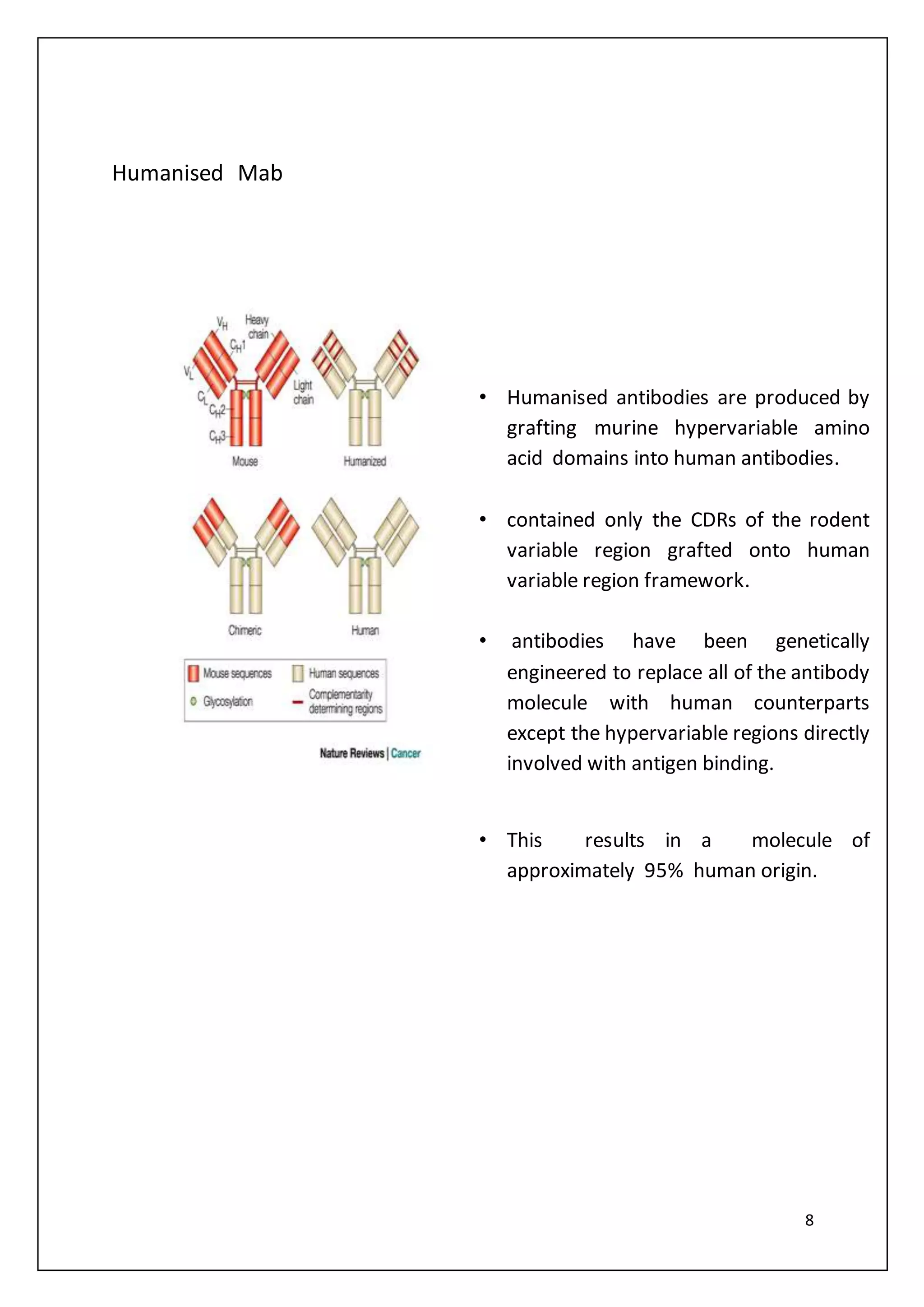
Humanised Mab
• Humanised antibodies are produced by
grafting murine hypervariable amino
acid domains into human antibodies.
• contained only the CDRs of the rodent
variable region grafted onto human
variable region framework.
• antibodies have been genetically
engineered to replace all of the antibody
molecule with human counterparts
except the hypervariable regions directly
involved with antigen binding.
• This results in a molecule of
approximately 95% human origin.
9
Human Monoclonal antibody
Human monoclonal antibodies are produced by transferring human
immunoglobulin genes ito the murine genome, after which the transgenic
mouse is vaccinated against the desired antigen, leading to the production of
monoclonal antibodies.
Humanised MAbs consist of mouse derived complementary determining
regions (CDR) which are bound to a human IgG framework.
Humanised MAbs contain 5-10% of mouse proteins unlike chimeric MAbs
which contains approximately 34% murine protein.
Humanized MAbs are ideally employed as part of a therapeutic regime against
diseases such as Cancers e.g. Non-Hodgkin’s Lymphoma (NHL), breast cancer
and renal cell carcinoma.
10
Applications of Monoclonal Antibodies
 Diagnostic Applications
as research tools, scientists quickly
recognized their practical uses,
especially in diagnostic tests and in
therapy
 Detects protein of interest either by
blottingor immunofloroscence.
 In diagnosis, pregnancy can be detected
by assaying of hormones with
monoclonal.
 A monoclonal antibody can be used to detect
pregnancy only 14 days after conception.
Other monoclonal antibodies allow rapid
diagnosis of hepatitis, influenza, herpes,
streptococcal, and Chlamydia infections.
 They can be used to detect for the presence
and quantity of this substance, for instance in
a Western blot test (to detect a substance in a
solution) or an immunofluorescence test.
 Monoclonal antibodies can also be used to
purify a substance with techniques called
immunoprecipitation and affinity
chromatography
 Therapeutic Applications
 Transplant rejection
 Cancer
 Autoimmune disorders
 Inflammatory disease
11
Antitumor MABs
A.Murine source mAbs:
rodent mAbs with excellent affinities and specificities, generated using
conventional hydrioma technology. Clinical efficacy compromised by
HAMA(human anti murine antibody) response, which lead to allergic or
immune complex herpersensitivities.
B.Chimeric mAbs:
chimers combine the human constant regions with the intact rodent variable
regions. Affinity and specificity unchanged. Also cause human antichimeric
antibody response (30% murine resource)
C.Humanized mAbs:
contained only the CDRs of the rodent variable region grafted onto human
variable region framework
12
Mechanism of antitumor effect
• Antibody dependent cellular cytotoxicity (ADCC)
• Complement dependent cytotoxicity (CDC)
• Direct induction of apoptosis
• MAb may be conjugated with a toxin e.g. gemtuzumab-ozogamicin
• MAb can also be conjugated with radioisotope
A. MAb act directely when binding to a cancer specific antigens
and induce immunological response to cancer cells. Such as
inducing cancer cell apoptosis, inhibiting growth, or interfering
with a key function.
B. MAb was modified for delivery of a toxin, radioisotope,
cytokine or other active conjugates.
C. it is also possible to design bispecific antibodies that can bind
with their Fab regions both to target antigen and to a conjugate
or effector cell.
13
ADEPT (Antibody Directed Enzyme Prodrug Therapy)
 Involves the application of cancer associated
monoclonal antibodies which are linked to a
drug-activating enzyme.
 Subsequent systemic administration of a
non-toxic agent results in its conversion to a
toxic drug, and resulting in a cytotoxic effect
which can be targeted at malignant cells.
ADEPT is a system that aims to restrict the
action of a high concentration of a cytotoxic
drug to cancer sites. This is achieved by
using an antibody (or antibody fragment) to
deliver a non-human enzyme to cancer
sites.
14
Immunoliposomes
• Immunoliposomes are antibody-conjugated liposomes.
• Liposomes can carry drugs or therapeutic nucleotides and when
conjugated with monoclonal antibodies.
• When conjugated with antibodies as targeting ligands,
immunoliposomes can target tumor cells with high specificity and
affinity, resulting in significantly improved antitumor activity over
untargeted liposomes.
• antitumor activity could be further ehanced for liposomes through
ligand-mediated targeting.
• For liposomes, the ligands would promote the selective binding and
facilitate the intracellular delivery. The most commonly used ligands
include MAbs or antibody fragments.
15
Cetuximab, Panitumumab
• MAB that targets epidermal growth factor receptor (EGFR)
• Binding of cetuximab to EGFR inhibits tumor growth by variety of
mechanisms, including decrease in kinase activity, MMP activity, growth
factor production and increased apoptosis
• Approved for metastatic colorectal carcinoma whose tumor
overexpresses EGFR.
• Cetuximab 400 mg/kg loading followed by 200 mg/kg weekly IV alone or
in combination with irinotecan
Bevacizumab, Ranibizumab
• Humanized antibody against Vascular endothelial growth facto, thus
preventing angiogenesis
• Approved 5 mg/kg IV every 2 weekly ,For non–small-cell lung cancer.
• S/E – Since it is antiangiogenic, pt should be watched for hemorrhage, GI
perforations and wound healing problems.
16
Alemtuzumab
• Humanised anti CD52 antiboby that binds to normal and malignant B
and T cells, NK cells
• Approved 30 mg IV once weekly for treatment of B-cell CLL failed to
respond to alkylating agents
• S/E – neutropenia, thrombocytopenia, pt should be closely monitored
for opportunistic infections
Some others-
• Gemtuzumab
• Rituximab
• Ofatumumab
• Trastuzumab
• Denileukin diftitox
17
MABs conjugated with radioisotopes
• Provide targeted delivery of radionucleotides to tumor cells
• generally preferred because it is readily available, inexpensive and easily
conjugated
• Can be used for diagnosis as well as therapeutic purpose
Ibritumomab
• Anti CD20 murine antibody coupled with isotopic yttrium (90
Y)
• Approved for refractory B cell non hodgkins lymphoma, not even
responding to rituximab therapy
• S/E – common to both ibritumomab and tositumomab are severe
cytopenias
Tositumumab
• Used for refractory non hodgkins lymphoma notresponding to rituximab
and chemotherapy agents.
18
Drugs in pipeline-
• Ibalizumab: an anti-CD4 monoclonal antibody for the treatment of HIV-1
infection
• HN125: A Novel Immunoadhesin Targeting MUC16 with Potential for
ovarian cancer Therapy.
• AMU32901 - Anti-phospholipid human monoclonal antibodies inhibit
CCR5-tropic HIV-1.
Possible side effects can include:-
• Vomiting
• Fever
• Diarrhea
• Chills
• Low blood pressure
• Weakness
• Rashes
• Headache
• Nausea
19
Conclusion
 MAb are Antigen specific, can be produced against any type of antigen,
hence vast diagnostic applications
 Target specificity, a novel therapeutic approach particularly in cancer.
• MAbs have not only been used as diagnostics, therapeutics, research
reagents, drug targettor for various infectious diseases but also
cancerous, metabolic and hormonal disorders.
• MAb technology in conjunction with recombinant DNA technology has
successfully led to the reconstruction of chimeric, humanized and fully
human antibodies and has enormous potentials for therapeutic uses.
20
References
• Adams, G.P. And Weiner, L.M. (2005) Monoclonal Antibody Therapy of
Cancer, Nature Biotechnology , 23,1147-1157
• Douglas Lake, Immunopharmacology; Bertram G. Katzung, Basic and
clinical pharmacology:11:963-85;2009
• Bruce A. Chamber, Jeol Neal et.al, Targeted therapies, Tyrosine kinase
inhibitors, monoclonal antibodies; Goodman and Gilmans,
Pharmacological basis of therapeutics; 12;1731-50; 2010.
• Ronald V.M.,Immunomodulation; Harrisons Principle of internal
medicine; 17; 1600-20;2009.
• HL Sharma and KK Sharma, Immunomodulation and immunotherapy,
Principles of Pharmacology;2;871-91;2010
• Tripathi K.D.,Immunotherapy; Essentials to medical pharmacology;
6;710-18;2009.
• Raben D, Helfrich B,The effects of cetuximab alone and in combination
with radiation and/or chemotherapy in lung cancer, PubMed; 2010
• Uehara K, Ishiguro S, Bevacizumab for Locally Advanced Rectal Cancer,
Pub Med; 2009
• Bruno CJ, Jacobson JM, Ibalizumab: an anti-CD4 monoclonal antibody for
the treatment of HIV-1 infection; J Antimicrob Chemother;1839-41; 2010
• Kishimoto, T., Narazaki, M. & Tanaka, T. 2011. Anti-interleukin-6
receptor antibody, Tocilizumab, for the treatment of autoimmune
diseases. FEB letters, 585, p.3699-3709
21
• Mehren, M.V., Adams, G.P., Weiner, L.M., (2003) Monoclonal Antibody
Therapy For Cancer, Annual Review of Medicine, 54, 343-369
• Burris III, H.A., Holden, S.N., Lewis-Phillips, G.D., Sliwkowski, M.X. &
Tibbitts, J. 2011. Trastuzumab Emtansine (T-DM1): A Novel Agent for
Targeting HER2+ Breast Cancer. Clinical Breast Cancer, 11(5), p.275-82
• Albanell, J., Baselga, J., Clinton, G.M., García-Conde, J., García-Conde, J.,
Keenan, E.J., Lluch, A., Molina, M.A., Ramsey, E.E., Rojo, F. & Sáez, R.
2006. p95HER-2 predicts worse outcome in patients with HER-2-positive
breast cancer. Clinical Cancer Research, 12(2), p.424-31.

Monoclonal antibodies in cancer treatment By Ankit Tribhuvane

  • 1.
    1 MONOCLONAL ANTIBODIES INCANCER THERAPY Introduction Monoclonal Antibodies that are identical because they were produced by one type of immune cell (B cell), all clones of a single parent cell. specifically bind to target cells. This may then stimulate the patient's immune system to attack those cells. It is possible to create a MAb specific to almost any extracellular/ cell surface target, and thus there is a large amountof research and development currently being undergone to create monoclonals for numerous serious diseases (such as rheumatoid arthritis, multiple sclerosis and different types of cancers) When monoclonal antibodies enter the body and attach to cancer cells, they function in several different ways: first, they can trigger the immune system to attack and kill that cancer cell; second, they can block the growth signals; third, they can prevent the formation of new blood vessels.
  • 2.
    2 Discovery The idea ofa "magic bullet" was first proposed by Paul Ehrlich, who, at the beginning of the 20th century, postulated that, a compound can be made that selectively targeted a disease-causing agent. Production of monoclonalantibodie involving human–mousehybrid cells was described by Jerrold Schwaber in 1973. In 1988, Greg Winter and his team pioneered the techniques to humanize monoclonal antibodies.
  • 3.
    3 Production of monoclonalantibodies  By Hybridoma Technique - A hybridoma, is produced by the injection of a specific antigen into a mouse, procuring the antigen-specific plasma cells (antibody-producing cell) fromthe mouse's spleen and the subsequentfusion of this cell with a cancerous immune cell called a myeloma cell.
  • 4.
    4 Once splenocytes areisolatedfrom the mammal’s spleen, the B cells are fused with immortalised myeloma cells. The hybrid cell, which is thus produced, can be cloned to produce many identical daughter clones. These daughter clones then secrete the immune cell product. Since these antibodies come from only one type of cell (the hybridoma cell) they are called monoclonalantibodies.The advantage of this process is that it can combine the qualities of the two different types of cells; the ability to grow continually, and to producelarge amounts of pure antibody. HAT medium (HypoxanthineAminopetrin Thymidine) is used for preparation of monoclonal antibodies. Laboratory animals (eg. mice) are firstexposed to an antigen to which we are interested in isolating an antibody against. Once splenocytes are isolated from the mammal, the B cells are fused with immortalized myeloma cells - which lack the HGPRT(hypoxanthine- guanine phosphoribosyltransferase) gene - using polyethylene glycol or the Sendai virus. Fused cells are incubated in the HAT (HypoxanthineAminopetrin Thymidine) medium. Aminopterin in the myeloma cells die, as they cannot produce nucleotides by the de novo or salvagemedium blocks the pathway that allows for nucleotide synthesis. Hence, unfused D cell die. Unfused B cells die as they havea shortlife span. Only the cell-myeloma hybrids survive, sincethe HGPRTgene coming from the B cells is functional. These cells produceantibodies (a property of B cells) and are immortal (a property of myeloma cells) The incubated medium is then diluted into multiwell plates to such an extent that each well contains only 1 cell.Then the supernatantin each well can be checked for desired antibody. Since the antibodies in a well are produced by the sameB cell, they will be directed towards the sameepitope, and are known as monoclonal antibodies
  • 5.
    5 Fig- Production ofmonoclonalantibodies  Types of Monoclonal Antibodies
  • 6.
    6 Murine antibody Whole ofthe antibody is of murine origin. rodent MAbs with excellent affinities and specificities, generated using conventional hydrioma technology. Clinical efficacy compromised by HAMA(human anti murine antibody) response, which lead to allergic or immune complex hyrpersensitivities.  Major problems associated with murine antibodies include- • reduced stimulation of cytotoxicity • Formation of complexes after repeated administration • allergic reactions • anaphylactic shock
  • 7.
    7 Chimeric antibodies  Chimericantibodies are composed of murine variable regions fused onto human constant regions. Affinity and specificity unchanged. Also cause human antichimeric antibody response (30% murine resource)  Antibodies are approximately 65% human.  This reduces immunogenicity and thus increases serum half-life.
  • 8.
    8 Humanised Mab • Humanisedantibodies are produced by grafting murine hypervariable amino acid domains into human antibodies. • contained only the CDRs of the rodent variable region grafted onto human variable region framework. • antibodies have been genetically engineered to replace all of the antibody molecule with human counterparts except the hypervariable regions directly involved with antigen binding. • This results in a molecule of approximately 95% human origin.
  • 9.
    9 Human Monoclonal antibody Humanmonoclonal antibodies are produced by transferring human immunoglobulin genes ito the murine genome, after which the transgenic mouse is vaccinated against the desired antigen, leading to the production of monoclonal antibodies. Humanised MAbs consist of mouse derived complementary determining regions (CDR) which are bound to a human IgG framework. Humanised MAbs contain 5-10% of mouse proteins unlike chimeric MAbs which contains approximately 34% murine protein. Humanized MAbs are ideally employed as part of a therapeutic regime against diseases such as Cancers e.g. Non-Hodgkin’s Lymphoma (NHL), breast cancer and renal cell carcinoma.
  • 10.
    10 Applications of MonoclonalAntibodies  Diagnostic Applications as research tools, scientists quickly recognized their practical uses, especially in diagnostic tests and in therapy  Detects protein of interest either by blottingor immunofloroscence.  In diagnosis, pregnancy can be detected by assaying of hormones with monoclonal.  A monoclonal antibody can be used to detect pregnancy only 14 days after conception. Other monoclonal antibodies allow rapid diagnosis of hepatitis, influenza, herpes, streptococcal, and Chlamydia infections.  They can be used to detect for the presence and quantity of this substance, for instance in a Western blot test (to detect a substance in a solution) or an immunofluorescence test.  Monoclonal antibodies can also be used to purify a substance with techniques called immunoprecipitation and affinity chromatography  Therapeutic Applications  Transplant rejection  Cancer  Autoimmune disorders  Inflammatory disease
  • 11.
    11 Antitumor MABs A.Murine sourcemAbs: rodent mAbs with excellent affinities and specificities, generated using conventional hydrioma technology. Clinical efficacy compromised by HAMA(human anti murine antibody) response, which lead to allergic or immune complex herpersensitivities. B.Chimeric mAbs: chimers combine the human constant regions with the intact rodent variable regions. Affinity and specificity unchanged. Also cause human antichimeric antibody response (30% murine resource) C.Humanized mAbs: contained only the CDRs of the rodent variable region grafted onto human variable region framework
  • 12.
    12 Mechanism of antitumoreffect • Antibody dependent cellular cytotoxicity (ADCC) • Complement dependent cytotoxicity (CDC) • Direct induction of apoptosis • MAb may be conjugated with a toxin e.g. gemtuzumab-ozogamicin • MAb can also be conjugated with radioisotope A. MAb act directely when binding to a cancer specific antigens and induce immunological response to cancer cells. Such as inducing cancer cell apoptosis, inhibiting growth, or interfering with a key function. B. MAb was modified for delivery of a toxin, radioisotope, cytokine or other active conjugates. C. it is also possible to design bispecific antibodies that can bind with their Fab regions both to target antigen and to a conjugate or effector cell.
  • 13.
    13 ADEPT (Antibody DirectedEnzyme Prodrug Therapy)  Involves the application of cancer associated monoclonal antibodies which are linked to a drug-activating enzyme.  Subsequent systemic administration of a non-toxic agent results in its conversion to a toxic drug, and resulting in a cytotoxic effect which can be targeted at malignant cells. ADEPT is a system that aims to restrict the action of a high concentration of a cytotoxic drug to cancer sites. This is achieved by using an antibody (or antibody fragment) to deliver a non-human enzyme to cancer sites.
  • 14.
    14 Immunoliposomes • Immunoliposomes areantibody-conjugated liposomes. • Liposomes can carry drugs or therapeutic nucleotides and when conjugated with monoclonal antibodies. • When conjugated with antibodies as targeting ligands, immunoliposomes can target tumor cells with high specificity and affinity, resulting in significantly improved antitumor activity over untargeted liposomes. • antitumor activity could be further ehanced for liposomes through ligand-mediated targeting. • For liposomes, the ligands would promote the selective binding and facilitate the intracellular delivery. The most commonly used ligands include MAbs or antibody fragments.
  • 15.
    15 Cetuximab, Panitumumab • MABthat targets epidermal growth factor receptor (EGFR) • Binding of cetuximab to EGFR inhibits tumor growth by variety of mechanisms, including decrease in kinase activity, MMP activity, growth factor production and increased apoptosis • Approved for metastatic colorectal carcinoma whose tumor overexpresses EGFR. • Cetuximab 400 mg/kg loading followed by 200 mg/kg weekly IV alone or in combination with irinotecan Bevacizumab, Ranibizumab • Humanized antibody against Vascular endothelial growth facto, thus preventing angiogenesis • Approved 5 mg/kg IV every 2 weekly ,For non–small-cell lung cancer. • S/E – Since it is antiangiogenic, pt should be watched for hemorrhage, GI perforations and wound healing problems.
  • 16.
    16 Alemtuzumab • Humanised antiCD52 antiboby that binds to normal and malignant B and T cells, NK cells • Approved 30 mg IV once weekly for treatment of B-cell CLL failed to respond to alkylating agents • S/E – neutropenia, thrombocytopenia, pt should be closely monitored for opportunistic infections Some others- • Gemtuzumab • Rituximab • Ofatumumab • Trastuzumab • Denileukin diftitox
  • 17.
    17 MABs conjugated withradioisotopes • Provide targeted delivery of radionucleotides to tumor cells • generally preferred because it is readily available, inexpensive and easily conjugated • Can be used for diagnosis as well as therapeutic purpose Ibritumomab • Anti CD20 murine antibody coupled with isotopic yttrium (90 Y) • Approved for refractory B cell non hodgkins lymphoma, not even responding to rituximab therapy • S/E – common to both ibritumomab and tositumomab are severe cytopenias Tositumumab • Used for refractory non hodgkins lymphoma notresponding to rituximab and chemotherapy agents.
  • 18.
    18 Drugs in pipeline- •Ibalizumab: an anti-CD4 monoclonal antibody for the treatment of HIV-1 infection • HN125: A Novel Immunoadhesin Targeting MUC16 with Potential for ovarian cancer Therapy. • AMU32901 - Anti-phospholipid human monoclonal antibodies inhibit CCR5-tropic HIV-1. Possible side effects can include:- • Vomiting • Fever • Diarrhea • Chills • Low blood pressure • Weakness • Rashes • Headache • Nausea
  • 19.
    19 Conclusion  MAb areAntigen specific, can be produced against any type of antigen, hence vast diagnostic applications  Target specificity, a novel therapeutic approach particularly in cancer. • MAbs have not only been used as diagnostics, therapeutics, research reagents, drug targettor for various infectious diseases but also cancerous, metabolic and hormonal disorders. • MAb technology in conjunction with recombinant DNA technology has successfully led to the reconstruction of chimeric, humanized and fully human antibodies and has enormous potentials for therapeutic uses.
  • 20.
    20 References • Adams, G.P.And Weiner, L.M. (2005) Monoclonal Antibody Therapy of Cancer, Nature Biotechnology , 23,1147-1157 • Douglas Lake, Immunopharmacology; Bertram G. Katzung, Basic and clinical pharmacology:11:963-85;2009 • Bruce A. Chamber, Jeol Neal et.al, Targeted therapies, Tyrosine kinase inhibitors, monoclonal antibodies; Goodman and Gilmans, Pharmacological basis of therapeutics; 12;1731-50; 2010. • Ronald V.M.,Immunomodulation; Harrisons Principle of internal medicine; 17; 1600-20;2009. • HL Sharma and KK Sharma, Immunomodulation and immunotherapy, Principles of Pharmacology;2;871-91;2010 • Tripathi K.D.,Immunotherapy; Essentials to medical pharmacology; 6;710-18;2009. • Raben D, Helfrich B,The effects of cetuximab alone and in combination with radiation and/or chemotherapy in lung cancer, PubMed; 2010 • Uehara K, Ishiguro S, Bevacizumab for Locally Advanced Rectal Cancer, Pub Med; 2009 • Bruno CJ, Jacobson JM, Ibalizumab: an anti-CD4 monoclonal antibody for the treatment of HIV-1 infection; J Antimicrob Chemother;1839-41; 2010 • Kishimoto, T., Narazaki, M. & Tanaka, T. 2011. Anti-interleukin-6 receptor antibody, Tocilizumab, for the treatment of autoimmune diseases. FEB letters, 585, p.3699-3709
  • 21.
    21 • Mehren, M.V.,Adams, G.P., Weiner, L.M., (2003) Monoclonal Antibody Therapy For Cancer, Annual Review of Medicine, 54, 343-369 • Burris III, H.A., Holden, S.N., Lewis-Phillips, G.D., Sliwkowski, M.X. & Tibbitts, J. 2011. Trastuzumab Emtansine (T-DM1): A Novel Agent for Targeting HER2+ Breast Cancer. Clinical Breast Cancer, 11(5), p.275-82 • Albanell, J., Baselga, J., Clinton, G.M., García-Conde, J., García-Conde, J., Keenan, E.J., Lluch, A., Molina, M.A., Ramsey, E.E., Rojo, F. & Sáez, R. 2006. p95HER-2 predicts worse outcome in patients with HER-2-positive breast cancer. Clinical Cancer Research, 12(2), p.424-31.