What is amono-repository?
• a.k.a. Monolith
• A single code base for multiple projects
• Projects can be
• Libraries
• Microservices
• Jupyter notebooks/explorations
• Projects can be in more than 1 language
Mono-repos
When does itmake sense?
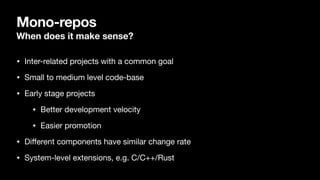
• Inter-related projects with a common goal
• Small to medium level code-base
• Early stage projects
• Better development velocity
• Easier promotion
• Di
ff
erent components have similar change rate
• System-level extensions, e.g. C/C++/Rust
7.
Python Mono-repos
Advantages
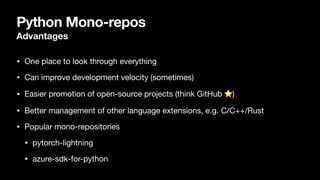
• Oneplace to look through everything
• Can improve development velocity (sometimes)
• Easier promotion of open-source projects (think GitHub ⭐)
• Better management of other language extensions, e.g. C/C++/Rust
• Popular mono-repositories
• pytorch-lightning
• azure-sdk-for-python
8.
Python Mono-repos
Disadvantages
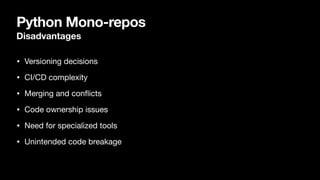
• Versioningdecisions
• CI/CD complexity
• Merging and con
fl
icts
• Code ownership issues
• Need for specialized tools
• Unintended code breakage
Project Scenario
Data Science
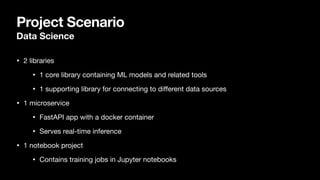
•2 libraries
• 1 core library containing ML models and related tools
• 1 supporting library for connecting to di
ff
erent data sources
• 1 microservice
• FastAPI app with a docker container
• Serves real-time inference
• 1 notebook project
• Contains training jobs in Jupyter notebooks
11.
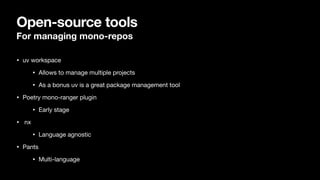
Open-source tools
For managingmono-repos
• uv workspace
• Allows to manage multiple projects
• As a bonus uv is a great package management tool
• Poetry mono-ranger plugin
• Early stage
• nx
• Language agnostic
• Pants
• Multi-language
12.
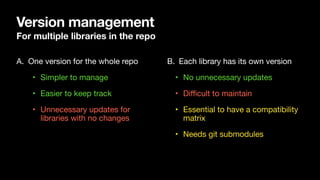
Version management
For multiplelibraries in the repo
A. One version for the whole repo
‣ Simpler to manage
‣ Easier to keep track
‣ Unnecessary updates for
libraries with no changes
B. Each library has its own version
‣ No unnecessary updates
‣ Di
ffi
cult to maintain
‣ Essential to have a compatibility
matrix
‣ Needs git submodules