Integrating ntop
                 with Python


pycon 2010 - May 2010      1
What’s ntop ?

ntop is a simple, open source (GPL),
portable traffic measurement and
monitoring tool, which supports various
management activities, including network
optimization and planning, and detection
of network security violations.


                                           2
                pycon 2010 - May 2010
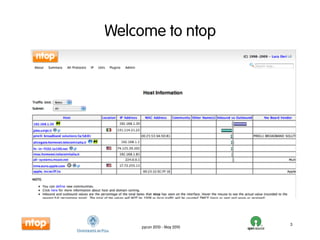
Welcome to ntop


                             3
     pycon 2010 - May 2010
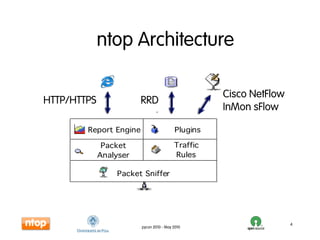
ntop Architecture

                                          Cisco NetFlow
HTTP/HTTPS        RRD
                                          InMon sFlow


                                                          4
                  pycon 2010 - May 2010
Towards ntop Scripting [1/2]
• ntop report engine is written in C
   – Pros:
       • Fast and efficient
       • Tight to the ntop architecture
   – Cons:
       • Changing anything in pages requires C/ntop coding skills
       • Inability to modify/change web pages on the fly without ntop restart.


• ntop engine is monolithic and it represents “the view of network” from
  ntop’s point of view.
   – Pros:
       • Small in size and efficient while handling binary packets
   – Cons:
       • ntop was not designed to offer a simple API for extending its engine


                                     pycon 2010 - May 2010                       5
Towards ntop Scripting [2/2]
Why is ntop scripting necessary ?
– It allows ntop to be easily extended in non-performance critical
  sections.
– It can provide an uniform API for non ntop core-developers to add
  new functionalities:
    • Easily: scripting vs. C skills can be often found among system
      administrator
    • The API allows users to extend the application without breaking or adding
      extra-weight on the core that’s still under control of core-developers.
    • Scripting languages offers many features (e.g. HTML page templates, or
      PDF support) not easily implementable using plain C.
    • Code can run on a sandbox without interfering with the engine.
    • Memory management, in particular for rendering HTML content, is
      handled automatically by the interpreter.


                                pycon 2010 - May 2010                          6
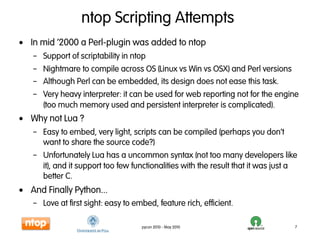
ntop Scripting Attempts
• In mid ‘2000 a Perl-plugin was added to ntop
   – Support of scriptability in ntop
   – Nightmare to compile across OS (Linux vs Win vs OSX) and Perl versions
   – Although Perl can be embedded, its design does not ease this task.
   – Very heavy interpreter: it can be used for web reporting not for the engine
     (too much memory used and persistent interpreter is complicated).
• Why not Lua ?
   – Easy to embed, very light, scripts can be compiled (perhaps you don’t
     want to share the source code?)
   – Unfortunately Lua has a uncommon syntax (not too many developers like
     it), and it support too few functionalities with the result that it was just a
     better C.
• And Finally Python...
   – Love at first sight: easy to embed, feature rich, efficient.

                                    pycon 2010 - May 2010                         7
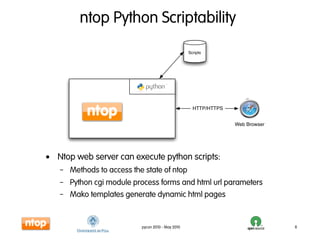
ntop Python Scriptability
                                                  Scripts


                                                    HTTP/HTTPS


                                                                 Web Browser


• Ntop web server can execute python scripts:
   – Methods to access the state of ntop
   – Python cgi module process forms and html url parameters
   – Mako templates generate dynamic html pages


                          pycon 2010 - May 2010                                8
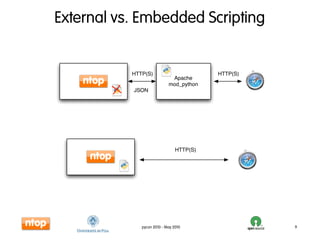
External vs. Embedded Scripting


           HTTP(S)                        HTTP(S)
                             Apache
                            mod_python
           JSON


                                HTTP(S)


              pycon 2010 - May 2010                 9
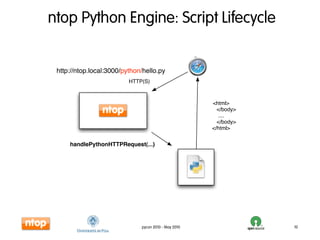
ntop Python Engine: Script Lifecycle


 http://ntop.local:3000/python/hello.py
                          HTTP(S)


                                                      <html>
                                                        </body>
                                                        ....
                                                        </body>
                                                      </html>


     handlePythonHTTPRequest(...)


                              pycon 2010 - May 2010               10
ntop Python Engine: Interpreter Lifecycle
              static void init_python_ntop(void) {
                createMutex(&python_mutex);
                Py_InitModule("ntop", ntop_methods);
                Py_InitModule("interface", interface_methods);
                Py_InitModule("host", host_methods);
....            Py_InitModule("fastbit", fastbit_methods);
ntop.c        }
                             int handlePythonHTTPRequest(char *url, uint postLen) {
ntop_darwin.c                /* 1 - Parse HTTP(S) request */
ntop_win32.c                 ...
pbuf.c
plugin.c                      /* 2 - Setup Environment */
pluginSkeleton.c              safe_snprintf(__FILE__, __LINE__, buf, sizeof(buf),
prefs.c                                    "import osnos.environ['DOCUMENT_ROOT']='%s'n"
protocols.c                                "os.environ['REQUEST_METHOD']='POST'n"
python.c                                   "os.environ['CONTENT_TYPE']='application/x-www-form-urlencoded'n"
report.c                                   "os.environ['CONTENT_LENGTH']='%u'n",
reportUtils.c                              document_root, postLen);
.....                          PyRun_SimpleString(buf);

                               PyRun_SimpleFile(fd, python_path); /* 3 - Run the script */
                              }

                   void term_python(void) {
                     Py_Finalize(); /* Cleaning up the interpreter */
                   }


                                              pycon 2010 - May 2010                                  11
ntop Python Engine: Methods Implementation
 static PyMethodDef ntop_methods[] = {
   { "sendHTTPHeader", python_sendHTTPHeader, METH_VARARGS| METH_KEYWORDS, "" },
   { "returnHTTPnotImplemented", python_returnHTTPnotImplemented, METH_VARARGS, "" },
   { "returnHTTPversionServerError", python_returnHTTPversionServerError, METH_VARARGS, "" },
   { "getFirstHost", python_getFirstHost, METH_VARARGS, "" },
   { "getNextHost", python_getNextHost, METH_VARARGS, "" },
   .....
   { NULL, NULL, 0, NULL }
 }

                        static PyObject* python_getFirstHost(PyObject *self, PyObject *args) {
                         int actualDeviceId;

                            /* parse the incoming arguments */
                            if(!PyArg_ParseTuple(args, "i", &actualDeviceId))
                              return NULL;

                            ntop_host = getFirstHost(actualDeviceId);

                            return Py_BuildValue("i", ntop_host ? 1 : 0);
                        }


                                              pycon 2010 - May 2010                              12
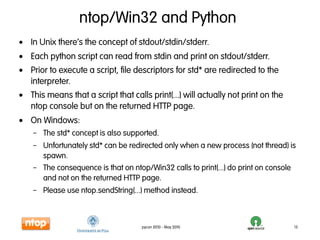
ntop/Win32 and Python
• In Unix there’s the concept of stdout/stdin/stderr.
• Each python script can read from stdin and print on stdout/stderr.
• Prior to execute a script, file descriptors for std* are redirected to the
  interpreter.
• This means that a script that calls print(...) will actually not print on the
  ntop console but on the returned HTTP page.
• On Windows:
    – The std* concept is also supported.
    – Unfortunately std* can be redirected only when a new process (not thread) is
      spawn.
    – The consequence is that on ntop/Win32 calls to print(...) do print on console
      and not on the returned HTTP page.
    – Please use ntop.sendString(...) method instead.


                                    pycon 2010 - May 2010                         13
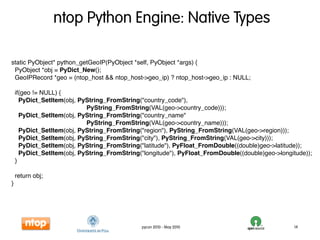
ntop Python Engine: Native Types

static PyObject* python_getGeoIP(PyObject *self, PyObject *args) {
 PyObject *obj = PyDict_New();
 GeoIPRecord *geo = (ntop_host && ntop_host->geo_ip) ? ntop_host->geo_ip : NULL;

    if(geo != NULL) {
      PyDict_SetItem(obj, PyString_FromString("country_code"),
                            PyString_FromString(VAL(geo->country_code)));
      PyDict_SetItem(obj, PyString_FromString("country_name"
                            PyString_FromString(VAL(geo->country_name)));
      PyDict_SetItem(obj, PyString_FromString("region"), PyString_FromString(VAL(geo->region)));
      PyDict_SetItem(obj, PyString_FromString("city"), PyString_FromString(VAL(geo->city)));
      PyDict_SetItem(obj, PyString_FromString("latitude"), PyFloat_FromDouble((double)geo->latitude));
      PyDict_SetItem(obj, PyString_FromString("longitude"), PyFloat_FromDouble((double)geo->longitude));
    }

    return obj;
}


                                              pycon 2010 - May 2010                              14
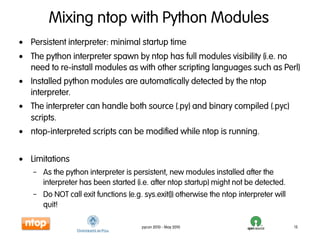
Mixing ntop with Python Modules
• Persistent interpreter: minimal startup time
• The python interpreter spawn by ntop has full modules visibility (i.e. no
  need to re-install modules as with other scripting languages such as Perl)
• Installed python modules are automatically detected by the ntop
  interpreter.
• The interpreter can handle both source (.py) and binary compiled (.pyc)
  scripts.
• ntop-interpreted scripts can be modified while ntop is running.


• Limitations
   – As the python interpreter is persistent, new modules installed after the
     interpreter has been started (i.e. after ntop startup) might not be detected.
   – Do NOT call exit functions (e.g. sys.exit()) otherwise the ntop interpreter will
     quit!

                                      pycon 2010 - May 2010                             15
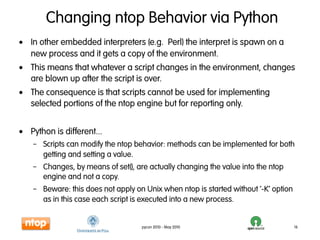
Changing ntop Behavior via Python
• In other embedded interpreters (e.g. Perl) the interpret is spawn on a
  new process and it gets a copy of the environment.
• This means that whatever a script changes in the environment, changes
  are blown up after the script is over.
• The consequence is that scripts cannot be used for implementing
  selected portions of the ntop engine but for reporting only.


• Python is different...
    – Scripts can modify the ntop behavior: methods can be implemented for both
      getting and setting a value.
    – Changes, by means of set(), are actually changing the value into the ntop
      engine and not a copy.
    – Beware: this does not apply on Unix when ntop is started without ‘-K’ option
      as in this case each script is executed into a new process.


                                    pycon 2010 - May 2010                            16
Simple ntop/Python Script
import ntop;
import host;
import cgi, cgitb
cgitb.enable();
form = cgi.FieldStorage();
ntop.printHTMLHeader("Welcome to ntop+Python ["+ntop.getPreference("ntop.devices")
+"]", 1, 0);
ntop.sendString("<center><table border>n");
ntop.sendString("<tr><th>MAC Address</th><th>IP Address</th><th>Name</th><th>#
Sessions</th><th># Contacted Peers</th><th>Fingerprint</th><th>Serial</th></tr>n");
while ntop.getNextHost(0):
    ntop.sendString("<tr><td align=right>"+host.ethAddress()+"</td>"
                +"<td align=right>"+host.ipAddress()+"</td>"+"<td
align=right>"+host.hostResolvedName()+"</td>"
                +"<td align=center>"+host.numHostSessions()+"</td>"+"<td
align=center>"+host.totContactedSentPeers()+"</td>"
                +"<td align=right>"+host.fingerprint()+"</td>"+"<td
align=center>"+host.serial()+"</td>"+"</tr>n");
ntop.sendString("</table></center>n");
ntop.printHTMLFooter();


                                    pycon 2010 - May 2010                            17
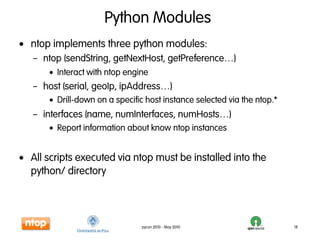
Python Modules
• ntop implements three python modules:
   – ntop (sendString, getNextHost, getPreference…)
       • Interact with ntop engine
   – host (serial, geoIp, ipAddress…)
       • Drill-down on a specific host instance selected via the ntop.*
   – interfaces (name, numInterfaces, numHosts…)
       • Report information about know ntop instances


• All scripts executed via ntop must be installed into the
  python/ directory


                                 pycon 2010 - May 2010                    18
Some Python Advantages
• High level object oriented scripting language
• Easy to embed and to extend
• Fast and portable across platforms
• Supports template technology for building html pages
• Open source


                          pycon 2010 - May 2010          19
Python Online Documentation [1/2]


              pycon 2010 - May 2010   20
Python Online Documentation [2/2]


              pycon 2010 - May 2010   21
ntop Python Modules: ntop
• Allow people to:
   – Return content to remote users via HTTP
   – Find hosts using various criteria such as IP address
   – Retrieve information about ntop (e.g. version, operating system etc.)
   – Read/write preferences stored on GDBM databases
   – Update RRD archives
                            rsp = {}

                            rsp['version'] = ntop.version();
                            rsp['os'] = ntop.os();
                            rsp['uptime'] = ntop.uptime();

                            ntop.sendHTTPHeader(1) # 1 = HTTP
                            ntop.sendString(json.dumps(rsp, sort_keys=False, indent=4))

 ntop.printHTMLHeader("Welcome to ntop+Python ["+ntop.getPreference("ntop.devices")
 +"]", 1, 0);
 ntop.sendString("Hello Worldn");
 ntop.printHTMLFooter();


                                       pycon 2010 - May 2010                          22
ntop Python Modules: interface
• Allow people to:
   – List known ntop interfaces
   – Retrieve interface attributes
   – Access interface traffic statistics


 ifnames = []

 try:
         for i in range(interface.numInterfaces()):
                  ifnames.append(interface.name(i))

 except Exception as inst:
     print type(inst)      # the exception instance
     print inst.args       # arguments stored in .args
     print inst            # __str__ allows args to printed directly

 ntop.sendHTTPHeader(1) # 1 = HTML
 ntop.sendString(json.dumps(ifnames, sort_keys=True, indent=4))


                                      pycon 2010 - May 2010            23
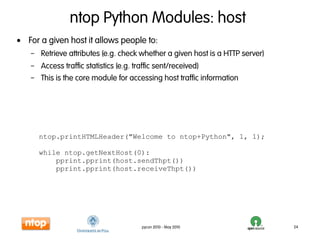
ntop Python Modules: host
• For a given host it allows people to:
   – Retrieve attributes (e.g. check whether a given host is a HTTP server)
   – Access traffic statistics (e.g. traffic sent/received)
   – This is the core module for accessing host traffic information


      ntop.printHTMLHeader("Welcome to ntop+Python", 1, 1);

      while ntop.getNextHost(0):
          pprint.pprint(host.sendThpt())
          pprint.pprint(host.receiveThpt())


                                     pycon 2010 - May 2010                    24
ntop Python Modules: fastbit
 • Fastbit is a column-oriented database that features compressed bitmap
   indexes.
 • nProbe (a Cisco NetFlow compliant probe)
                                                                         sFlow      NetFlow
   allows flows to be saved on fastbit-indexed
   databases.                                Packet
                                                           Capture                             Flow Export
 • This ntop modules allow queries to                                         nProbe

   be performed on fastbit databases.
                                                                     Data Dump


                                                                Raw Files / MySQL / SQLite / FastBit

print "Query: SELECT %s FROM %s WHERE %s LIMIT %i" %(selectArg,os.path.join
(pathFastBit, fromArg), whereArg, limit)
res = fastbit.query(os.path.join(pathFastBit, fromArg), selectArg, whereArg,
limit)
print 'Number of records: %i' % len(res['values'])


                                   pycon 2010 - May 2010                                                     25
Host Region Map [1/3]

• Interactive Flash™ world map, that displays hosts distribution
  by country and by cities of a selected country
• Ntop + GeoIP + Python + Google Visualization. The script
   – Cycles through all the hosts seen by ntop
   – Gets their GeoIP info
   – Counts them based on their location.
• Google GeoMap and Visualization Table
• Ajax/JSON communications with ntop server for updated data


                             pycon 2010 - May 2010            26
Host Region Map [2/3]


       pycon 2010 - May 2010   27
Host Region Map [3/3]


       pycon 2010 - May 2010   28
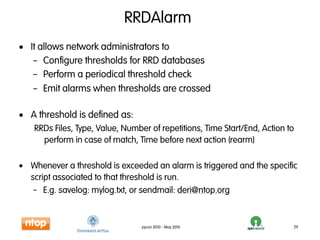
RRDAlarm
• It allows network administrators to
   – Configure thresholds for RRD databases
   – Perform a periodical threshold check
   – Emit alarms when thresholds are crossed

• A threshold is defined as:
    RRDs Files, Type, Value, Number of repetitions, Time Start/End, Action to
      perform in case of match, Time before next action (rearm)

• Whenever a threshold is exceeded an alarm is triggered and the specific
  script associated to that threshold is run.
  – E.g. savelog: mylog.txt, or sendmail: deri@ntop.org


                                  pycon 2010 - May 2010                     29
RRDAlarm Configuration [1/2]
• Create or load a configuration files for RRDAlarm
• View, set, modify existing thresholds
• Autocomplete feature for RRD File Path field
   – To see the actual file/s associated to the threshold
   – Browser Ajax request, json response (json module)
• Parameters validation (javascript and python regex)
• Start a check with html report


                                    pycon 2010 - May 2010   30
Using RRDAlarm Configuration [2/2]


               pycon 2010 - May 2010   31
RRDAlarm Check [1/2]
• Performs a check based on the configuration file passed
• Uses Python pickle to store information on the thresholds
  exceeded and the alarms triggered
• Stores persistently
   – the number of alarms triggered and the time of execution in
     two different RRD databases.
   – A history of the actions executed so far.
• RRD databases access is based on ntop/python rrdtool
  interface

                             pycon 2010 - May 2010             32
RRDAlarm Check [2/2]
• Modus Operandi:
   – Html output, for interactive testing purpose
   – Batch (quiet) mode for continuous periodical check
       • CRON script to perform a GET every minute on URL
       • e.g. http://localhost:3000/python/rrdAlarm/start.py?noHTML=true


• Further actions (to perform in case of threshold cross) can be
   installed adding new scripts to the ntopInstallPath/python/
   script directory


                                 pycon 2010 - May 2010                33
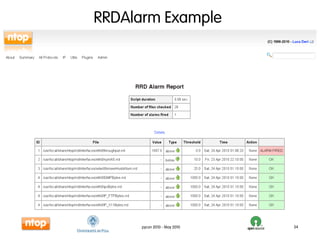
RRDAlarm Example


      pycon 2010 - May 2010   34
ntop on-the-go [1/2]
• Apple iPhone is commonly used as mobile web pad.
• Accessing ntop information in mobility is often required by network
  administrators.
• The ntop web GUI can be accessed via Apple Safari, however a tighten
  and more comprehensive interface was necessary.
• Ability to control several ntop
  instances via a single device.
• Access traffic information as well                                ntop


  as configuration information.                         HTTP(S)


• Available (soon) on the AppleStore.                    JSON


                                pycon 2010 - May 2010                      35
ntop on-the-go [2/2]


       pycon 2010 - May 2010   36
References

• ntop Web Site: http://www.ntop.org/
• Author Papers: http://luca.ntop.org

       All work is open-source and released under GPL.


                          pycon 2010 - May 2010          37

Monitoraggio del Traffico di Rete Usando Python ed ntop

  • 1.
    Integrating ntop with Python pycon 2010 - May 2010 1
  • 2.
    What’s ntop ? ntopis a simple, open source (GPL), portable traffic measurement and monitoring tool, which supports various management activities, including network optimization and planning, and detection of network security violations. 2 pycon 2010 - May 2010
  • 3.
    Welcome to ntop 3 pycon 2010 - May 2010
  • 4.
    ntop Architecture Cisco NetFlow HTTP/HTTPS RRD InMon sFlow 4 pycon 2010 - May 2010
  • 5.
    Towards ntop Scripting[1/2] • ntop report engine is written in C – Pros: • Fast and efficient • Tight to the ntop architecture – Cons: • Changing anything in pages requires C/ntop coding skills • Inability to modify/change web pages on the fly without ntop restart. • ntop engine is monolithic and it represents “the view of network” from ntop’s point of view. – Pros: • Small in size and efficient while handling binary packets – Cons: • ntop was not designed to offer a simple API for extending its engine pycon 2010 - May 2010 5
  • 6.
    Towards ntop Scripting[2/2] Why is ntop scripting necessary ? – It allows ntop to be easily extended in non-performance critical sections. – It can provide an uniform API for non ntop core-developers to add new functionalities: • Easily: scripting vs. C skills can be often found among system administrator • The API allows users to extend the application without breaking or adding extra-weight on the core that’s still under control of core-developers. • Scripting languages offers many features (e.g. HTML page templates, or PDF support) not easily implementable using plain C. • Code can run on a sandbox without interfering with the engine. • Memory management, in particular for rendering HTML content, is handled automatically by the interpreter. pycon 2010 - May 2010 6
  • 7.
    ntop Scripting Attempts •In mid ‘2000 a Perl-plugin was added to ntop – Support of scriptability in ntop – Nightmare to compile across OS (Linux vs Win vs OSX) and Perl versions – Although Perl can be embedded, its design does not ease this task. – Very heavy interpreter: it can be used for web reporting not for the engine (too much memory used and persistent interpreter is complicated). • Why not Lua ? – Easy to embed, very light, scripts can be compiled (perhaps you don’t want to share the source code?) – Unfortunately Lua has a uncommon syntax (not too many developers like it), and it support too few functionalities with the result that it was just a better C. • And Finally Python... – Love at first sight: easy to embed, feature rich, efficient. pycon 2010 - May 2010 7
  • 8.
    ntop Python Scriptability Scripts HTTP/HTTPS Web Browser • Ntop web server can execute python scripts: – Methods to access the state of ntop – Python cgi module process forms and html url parameters – Mako templates generate dynamic html pages pycon 2010 - May 2010 8
  • 9.
    External vs. EmbeddedScripting HTTP(S) HTTP(S) Apache mod_python JSON HTTP(S) pycon 2010 - May 2010 9
  • 10.
    ntop Python Engine:Script Lifecycle http://ntop.local:3000/python/hello.py HTTP(S) <html> </body> .... </body> </html> handlePythonHTTPRequest(...) pycon 2010 - May 2010 10
  • 11.
    ntop Python Engine:Interpreter Lifecycle static void init_python_ntop(void) { createMutex(&python_mutex); Py_InitModule("ntop", ntop_methods); Py_InitModule("interface", interface_methods); Py_InitModule("host", host_methods); .... Py_InitModule("fastbit", fastbit_methods); ntop.c } int handlePythonHTTPRequest(char *url, uint postLen) { ntop_darwin.c /* 1 - Parse HTTP(S) request */ ntop_win32.c ... pbuf.c plugin.c /* 2 - Setup Environment */ pluginSkeleton.c safe_snprintf(__FILE__, __LINE__, buf, sizeof(buf), prefs.c "import osnos.environ['DOCUMENT_ROOT']='%s'n" protocols.c "os.environ['REQUEST_METHOD']='POST'n" python.c "os.environ['CONTENT_TYPE']='application/x-www-form-urlencoded'n" report.c "os.environ['CONTENT_LENGTH']='%u'n", reportUtils.c document_root, postLen); ..... PyRun_SimpleString(buf); PyRun_SimpleFile(fd, python_path); /* 3 - Run the script */ } void term_python(void) { Py_Finalize(); /* Cleaning up the interpreter */ } pycon 2010 - May 2010 11
  • 12.
    ntop Python Engine:Methods Implementation static PyMethodDef ntop_methods[] = { { "sendHTTPHeader", python_sendHTTPHeader, METH_VARARGS| METH_KEYWORDS, "" }, { "returnHTTPnotImplemented", python_returnHTTPnotImplemented, METH_VARARGS, "" }, { "returnHTTPversionServerError", python_returnHTTPversionServerError, METH_VARARGS, "" }, { "getFirstHost", python_getFirstHost, METH_VARARGS, "" }, { "getNextHost", python_getNextHost, METH_VARARGS, "" }, ..... { NULL, NULL, 0, NULL } } static PyObject* python_getFirstHost(PyObject *self, PyObject *args) { int actualDeviceId; /* parse the incoming arguments */ if(!PyArg_ParseTuple(args, "i", &actualDeviceId)) return NULL; ntop_host = getFirstHost(actualDeviceId); return Py_BuildValue("i", ntop_host ? 1 : 0); } pycon 2010 - May 2010 12
  • 13.
    ntop/Win32 and Python •In Unix there’s the concept of stdout/stdin/stderr. • Each python script can read from stdin and print on stdout/stderr. • Prior to execute a script, file descriptors for std* are redirected to the interpreter. • This means that a script that calls print(...) will actually not print on the ntop console but on the returned HTTP page. • On Windows: – The std* concept is also supported. – Unfortunately std* can be redirected only when a new process (not thread) is spawn. – The consequence is that on ntop/Win32 calls to print(...) do print on console and not on the returned HTTP page. – Please use ntop.sendString(...) method instead. pycon 2010 - May 2010 13
  • 14.
    ntop Python Engine:Native Types static PyObject* python_getGeoIP(PyObject *self, PyObject *args) { PyObject *obj = PyDict_New(); GeoIPRecord *geo = (ntop_host && ntop_host->geo_ip) ? ntop_host->geo_ip : NULL; if(geo != NULL) { PyDict_SetItem(obj, PyString_FromString("country_code"), PyString_FromString(VAL(geo->country_code))); PyDict_SetItem(obj, PyString_FromString("country_name" PyString_FromString(VAL(geo->country_name))); PyDict_SetItem(obj, PyString_FromString("region"), PyString_FromString(VAL(geo->region))); PyDict_SetItem(obj, PyString_FromString("city"), PyString_FromString(VAL(geo->city))); PyDict_SetItem(obj, PyString_FromString("latitude"), PyFloat_FromDouble((double)geo->latitude)); PyDict_SetItem(obj, PyString_FromString("longitude"), PyFloat_FromDouble((double)geo->longitude)); } return obj; } pycon 2010 - May 2010 14
  • 15.
    Mixing ntop withPython Modules • Persistent interpreter: minimal startup time • The python interpreter spawn by ntop has full modules visibility (i.e. no need to re-install modules as with other scripting languages such as Perl) • Installed python modules are automatically detected by the ntop interpreter. • The interpreter can handle both source (.py) and binary compiled (.pyc) scripts. • ntop-interpreted scripts can be modified while ntop is running. • Limitations – As the python interpreter is persistent, new modules installed after the interpreter has been started (i.e. after ntop startup) might not be detected. – Do NOT call exit functions (e.g. sys.exit()) otherwise the ntop interpreter will quit! pycon 2010 - May 2010 15
  • 16.
    Changing ntop Behaviorvia Python • In other embedded interpreters (e.g. Perl) the interpret is spawn on a new process and it gets a copy of the environment. • This means that whatever a script changes in the environment, changes are blown up after the script is over. • The consequence is that scripts cannot be used for implementing selected portions of the ntop engine but for reporting only. • Python is different... – Scripts can modify the ntop behavior: methods can be implemented for both getting and setting a value. – Changes, by means of set(), are actually changing the value into the ntop engine and not a copy. – Beware: this does not apply on Unix when ntop is started without ‘-K’ option as in this case each script is executed into a new process. pycon 2010 - May 2010 16
  • 17.
    Simple ntop/Python Script importntop; import host; import cgi, cgitb cgitb.enable(); form = cgi.FieldStorage(); ntop.printHTMLHeader("Welcome to ntop+Python ["+ntop.getPreference("ntop.devices") +"]", 1, 0); ntop.sendString("<center><table border>n"); ntop.sendString("<tr><th>MAC Address</th><th>IP Address</th><th>Name</th><th># Sessions</th><th># Contacted Peers</th><th>Fingerprint</th><th>Serial</th></tr>n"); while ntop.getNextHost(0): ntop.sendString("<tr><td align=right>"+host.ethAddress()+"</td>" +"<td align=right>"+host.ipAddress()+"</td>"+"<td align=right>"+host.hostResolvedName()+"</td>" +"<td align=center>"+host.numHostSessions()+"</td>"+"<td align=center>"+host.totContactedSentPeers()+"</td>" +"<td align=right>"+host.fingerprint()+"</td>"+"<td align=center>"+host.serial()+"</td>"+"</tr>n"); ntop.sendString("</table></center>n"); ntop.printHTMLFooter(); pycon 2010 - May 2010 17
  • 18.
    Python Modules • ntopimplements three python modules: – ntop (sendString, getNextHost, getPreference…) • Interact with ntop engine – host (serial, geoIp, ipAddress…) • Drill-down on a specific host instance selected via the ntop.* – interfaces (name, numInterfaces, numHosts…) • Report information about know ntop instances • All scripts executed via ntop must be installed into the python/ directory pycon 2010 - May 2010 18
  • 19.
    Some Python Advantages •High level object oriented scripting language • Easy to embed and to extend • Fast and portable across platforms • Supports template technology for building html pages • Open source pycon 2010 - May 2010 19
  • 20.
    Python Online Documentation[1/2] pycon 2010 - May 2010 20
  • 21.
    Python Online Documentation[2/2] pycon 2010 - May 2010 21
  • 22.
    ntop Python Modules:ntop • Allow people to: – Return content to remote users via HTTP – Find hosts using various criteria such as IP address – Retrieve information about ntop (e.g. version, operating system etc.) – Read/write preferences stored on GDBM databases – Update RRD archives rsp = {} rsp['version'] = ntop.version(); rsp['os'] = ntop.os(); rsp['uptime'] = ntop.uptime(); ntop.sendHTTPHeader(1) # 1 = HTTP ntop.sendString(json.dumps(rsp, sort_keys=False, indent=4)) ntop.printHTMLHeader("Welcome to ntop+Python ["+ntop.getPreference("ntop.devices") +"]", 1, 0); ntop.sendString("Hello Worldn"); ntop.printHTMLFooter(); pycon 2010 - May 2010 22
  • 23.
    ntop Python Modules:interface • Allow people to: – List known ntop interfaces – Retrieve interface attributes – Access interface traffic statistics ifnames = [] try: for i in range(interface.numInterfaces()): ifnames.append(interface.name(i)) except Exception as inst: print type(inst) # the exception instance print inst.args # arguments stored in .args print inst # __str__ allows args to printed directly ntop.sendHTTPHeader(1) # 1 = HTML ntop.sendString(json.dumps(ifnames, sort_keys=True, indent=4)) pycon 2010 - May 2010 23
  • 24.
    ntop Python Modules:host • For a given host it allows people to: – Retrieve attributes (e.g. check whether a given host is a HTTP server) – Access traffic statistics (e.g. traffic sent/received) – This is the core module for accessing host traffic information ntop.printHTMLHeader("Welcome to ntop+Python", 1, 1); while ntop.getNextHost(0): pprint.pprint(host.sendThpt()) pprint.pprint(host.receiveThpt()) pycon 2010 - May 2010 24
  • 25.
    ntop Python Modules:fastbit • Fastbit is a column-oriented database that features compressed bitmap indexes. • nProbe (a Cisco NetFlow compliant probe) sFlow NetFlow allows flows to be saved on fastbit-indexed databases. Packet Capture Flow Export • This ntop modules allow queries to nProbe be performed on fastbit databases. Data Dump Raw Files / MySQL / SQLite / FastBit print "Query: SELECT %s FROM %s WHERE %s LIMIT %i" %(selectArg,os.path.join (pathFastBit, fromArg), whereArg, limit) res = fastbit.query(os.path.join(pathFastBit, fromArg), selectArg, whereArg, limit) print 'Number of records: %i' % len(res['values']) pycon 2010 - May 2010 25
  • 26.
    Host Region Map[1/3] • Interactive Flash™ world map, that displays hosts distribution by country and by cities of a selected country • Ntop + GeoIP + Python + Google Visualization. The script – Cycles through all the hosts seen by ntop – Gets their GeoIP info – Counts them based on their location. • Google GeoMap and Visualization Table • Ajax/JSON communications with ntop server for updated data pycon 2010 - May 2010 26
  • 27.
    Host Region Map[2/3] pycon 2010 - May 2010 27
  • 28.
    Host Region Map[3/3] pycon 2010 - May 2010 28
  • 29.
    RRDAlarm • It allowsnetwork administrators to – Configure thresholds for RRD databases – Perform a periodical threshold check – Emit alarms when thresholds are crossed • A threshold is defined as: RRDs Files, Type, Value, Number of repetitions, Time Start/End, Action to perform in case of match, Time before next action (rearm) • Whenever a threshold is exceeded an alarm is triggered and the specific script associated to that threshold is run. – E.g. savelog: mylog.txt, or sendmail: deri@ntop.org pycon 2010 - May 2010 29
  • 30.
    RRDAlarm Configuration [1/2] •Create or load a configuration files for RRDAlarm • View, set, modify existing thresholds • Autocomplete feature for RRD File Path field – To see the actual file/s associated to the threshold – Browser Ajax request, json response (json module) • Parameters validation (javascript and python regex) • Start a check with html report pycon 2010 - May 2010 30
  • 31.
    Using RRDAlarm Configuration[2/2] pycon 2010 - May 2010 31
  • 32.
    RRDAlarm Check [1/2] •Performs a check based on the configuration file passed • Uses Python pickle to store information on the thresholds exceeded and the alarms triggered • Stores persistently – the number of alarms triggered and the time of execution in two different RRD databases. – A history of the actions executed so far. • RRD databases access is based on ntop/python rrdtool interface pycon 2010 - May 2010 32
  • 33.
    RRDAlarm Check [2/2] •Modus Operandi: – Html output, for interactive testing purpose – Batch (quiet) mode for continuous periodical check • CRON script to perform a GET every minute on URL • e.g. http://localhost:3000/python/rrdAlarm/start.py?noHTML=true • Further actions (to perform in case of threshold cross) can be installed adding new scripts to the ntopInstallPath/python/ script directory pycon 2010 - May 2010 33
  • 34.
    RRDAlarm Example pycon 2010 - May 2010 34
  • 35.
    ntop on-the-go [1/2] •Apple iPhone is commonly used as mobile web pad. • Accessing ntop information in mobility is often required by network administrators. • The ntop web GUI can be accessed via Apple Safari, however a tighten and more comprehensive interface was necessary. • Ability to control several ntop instances via a single device. • Access traffic information as well ntop as configuration information. HTTP(S) • Available (soon) on the AppleStore. JSON pycon 2010 - May 2010 35
  • 36.
    ntop on-the-go [2/2] pycon 2010 - May 2010 36
  • 37.
    References • ntop WebSite: http://www.ntop.org/ • Author Papers: http://luca.ntop.org All work is open-source and released under GPL. pycon 2010 - May 2010 37