Organizational
Structure & Design
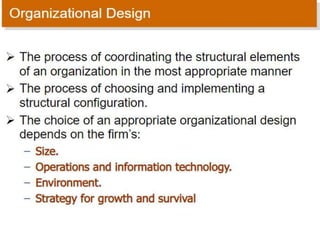
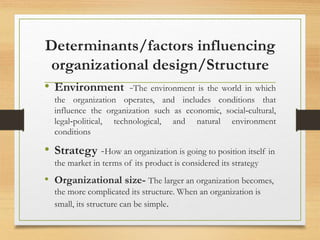
Determinants/factors influencing
organizational design/Structure
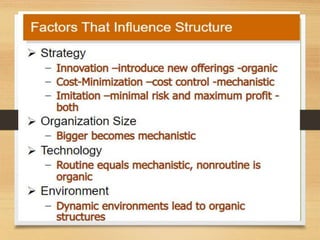
• Environment -The environment is the world in which
the organization operates, and includes conditions that
influence the organization such as economic, social‐cultural,
legal‐political, technological, and natural environment
conditions
• Strategy -How an organization is going to position itself in
the market in terms of its product is considered its strategy
• Organizational size- The larger an organization becomes,
the more complicated its structure. When an organization is
small, its structure can be simple.
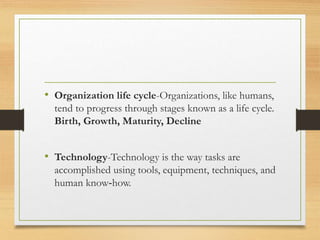
• Organization life cycle-Organizations, like humans,
tend to progress through stages known as a life cycle.
Birth, Growth, Maturity, Decline
• Technology-Technology is the way tasks are
accomplished using tools, equipment, techniques, and
human know‐how.
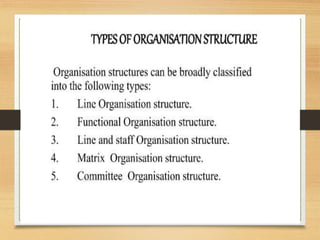
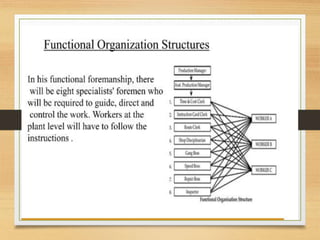
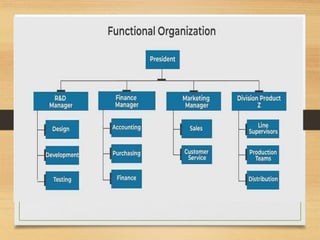
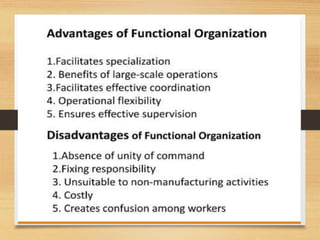
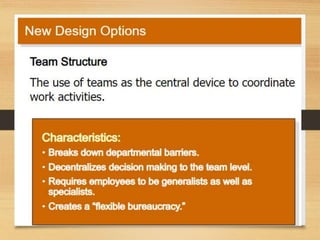
• A functional organizational structure is a
team structure that groups employees
into different departments based on areas
of expertise.
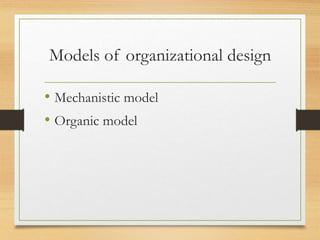
Models of organizational design
• Mechanistic model
• Organic model
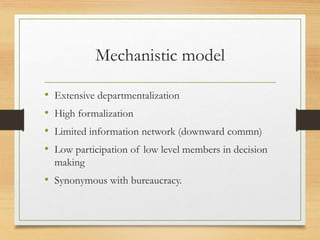
Mechanistic model
• Extensive departmentalization
• High formalization
• Limited information network (downward commn)
• Low participation of low level members in decision
making
• Synonymous with bureaucracy.
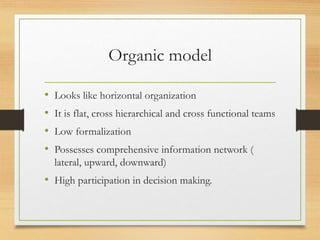
Organic model
• Looks like horizontal organization
• It is flat, cross hierarchical and cross functional teams
• Low formalization
• Possesses comprehensive information network (
lateral, upward, downward)
• High participation in decision making.

MODULE II.pptx

  • 1.
  • 10.
    Determinants/factors influencing organizational design/Structure •Environment -The environment is the world in which the organization operates, and includes conditions that influence the organization such as economic, social‐cultural, legal‐political, technological, and natural environment conditions • Strategy -How an organization is going to position itself in the market in terms of its product is considered its strategy • Organizational size- The larger an organization becomes, the more complicated its structure. When an organization is small, its structure can be simple.
  • 11.
    • Organization lifecycle-Organizations, like humans, tend to progress through stages known as a life cycle. Birth, Growth, Maturity, Decline • Technology-Technology is the way tasks are accomplished using tools, equipment, techniques, and human know‐how.
  • 19.
    • A functionalorganizational structure is a team structure that groups employees into different departments based on areas of expertise.
  • 35.
    Models of organizationaldesign • Mechanistic model • Organic model
  • 36.
    Mechanistic model • Extensivedepartmentalization • High formalization • Limited information network (downward commn) • Low participation of low level members in decision making • Synonymous with bureaucracy.
  • 37.
    Organic model • Lookslike horizontal organization • It is flat, cross hierarchical and cross functional teams • Low formalization • Possesses comprehensive information network ( lateral, upward, downward) • High participation in decision making.