Silberschatz, Galvin and Gagne 2002
7.1
Operating System Concepts
Chapter 7: Process Synchronization
■ Background
■ The Critical-Section Problem
■ Synchronization Hardware
■ Semaphores
■ Classical Problems of Synchronization
■ Critical Regions
■ Monitors
■ Synchronization in Solaris 2 & Windows 2000
Silberschatz, Galvin and Gagne 2002
7.2
Operating System Concepts
Background
■ Concurrent access to shared data may result in data
inconsistency.
■ Maintaining data consistency requires mechanisms to
ensure the orderly execution of cooperating processes.
■ Shared-memory solution to bounded-butter problem
(Chapter 4) allows at most n – 1 items in buffer at the
same time. A solution, where all N buffers are used is not
simple.
✦ Suppose that we modify the producer-consumer code by
adding a variable counter, initialized to 0 and incremented
each time a new item is added to the buffer
Silberschatz, Galvin and Gagne 2002
7.3
Operating System Concepts
Bounded-Buffer
■ Shared data
#define BUFFER_SIZE 10
typedef struct {
. . .
} item;
item buffer[BUFFER_SIZE];
int in = 0;
int out = 0;
int counter = 0;
Silberschatz, Galvin and Gagne 2002
7.4
Operating System Concepts
Bounded-Buffer
■ Producer process
item nextProduced;
while (1) {
while (counter == BUFFER_SIZE)
; /* do nothing */
buffer[in] = nextProduced;
in = (in + 1) % BUFFER_SIZE;
counter++;
}
Silberschatz, Galvin and Gagne 2002
7.5
Operating System Concepts
Bounded-Buffer
■ Consumer process
item nextConsumed;
while (1) {
while (counter == 0)
; /* do nothing */
nextConsumed = buffer[out];
out = (out + 1) % BUFFER_SIZE;
counter--;
}
Silberschatz, Galvin and Gagne 2002
7.6
Operating System Concepts
Bounded Buffer
■ The statements
counter++;
counter--;
must be performed atomically.
■ Atomic operation means an operation that completes in
its entirety without interruption.
Silberschatz, Galvin and Gagne 2002
7.7
Operating System Concepts
Bounded Buffer
■ The statement “count++” may be implemented in
machine language as:
register1 = counter
register1 = register1 + 1
counter = register1
■ The statement “count—” may be implemented as:
register2 = counter
register2 = register2 – 1
counter = register2
Silberschatz, Galvin and Gagne 2002
7.8
Operating System Concepts
Bounded Buffer
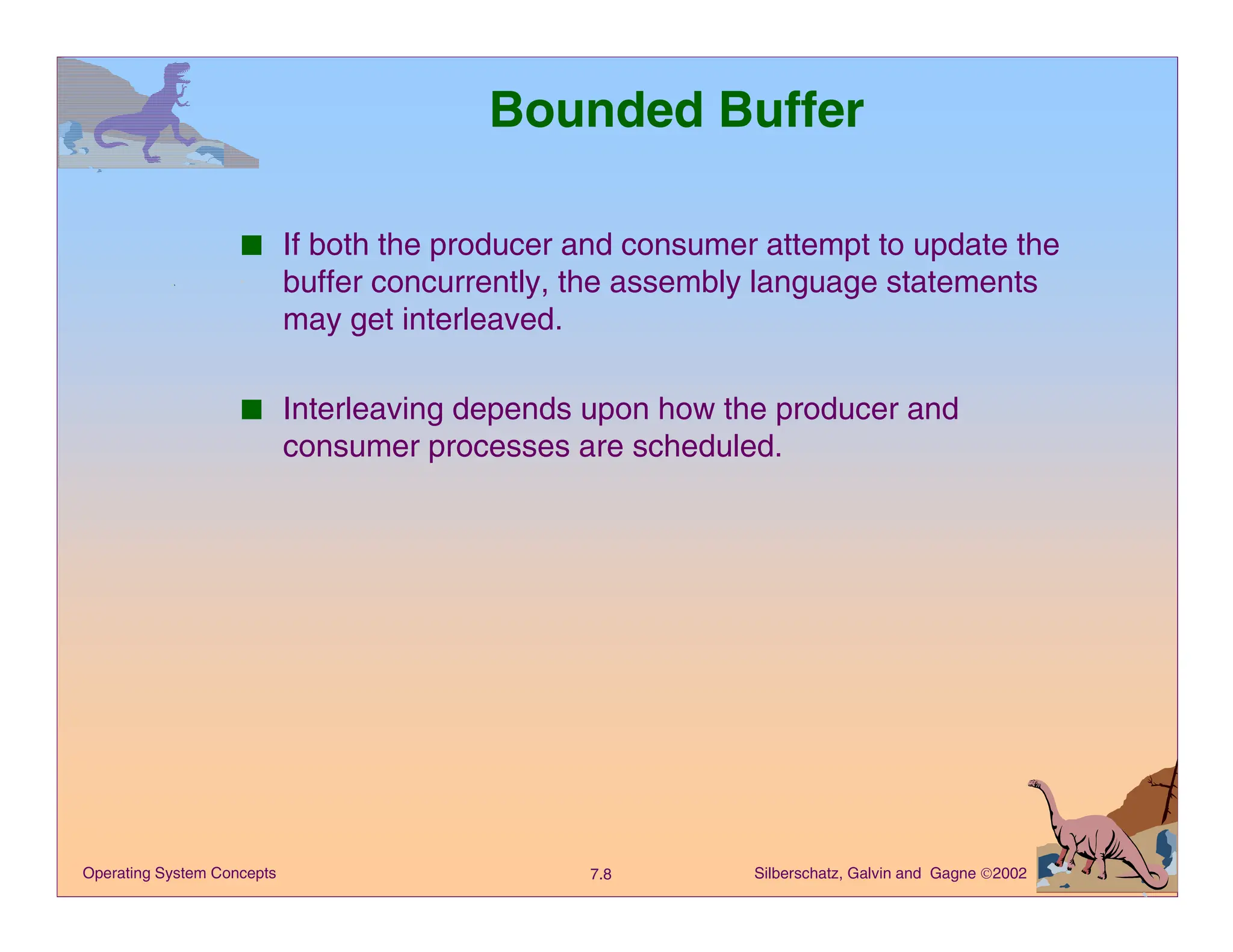
■ If both the producer and consumer attempt to update the
buffer concurrently, the assembly language statements
may get interleaved.
■ Interleaving depends upon how the producer and
consumer processes are scheduled.
Silberschatz, Galvin and Gagne 2002
7.9
Operating System Concepts
Bounded Buffer
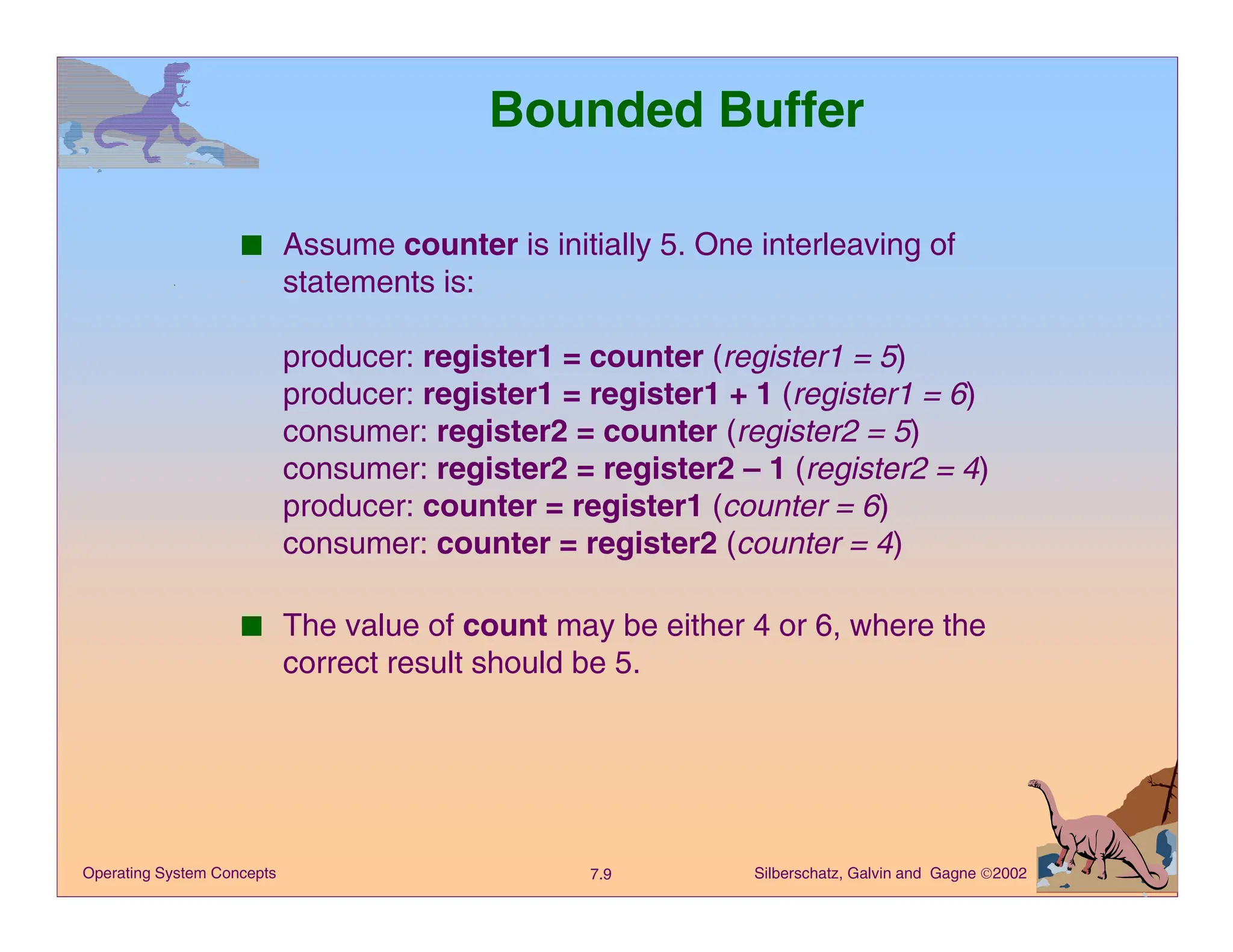
■ Assume counter is initially 5. One interleaving of
statements is:
producer: register1 = counter (register1 = 5)
producer: register1 = register1 + 1 (register1 = 6)
consumer: register2 = counter (register2 = 5)
consumer: register2 = register2 – 1 (register2 = 4)
producer: counter = register1 (counter = 6)
consumer: counter = register2 (counter = 4)
■ The value of count may be either 4 or 6, where the
correct result should be 5.
Silberschatz, Galvin and Gagne 2002
7.10
Operating System Concepts
Race Condition
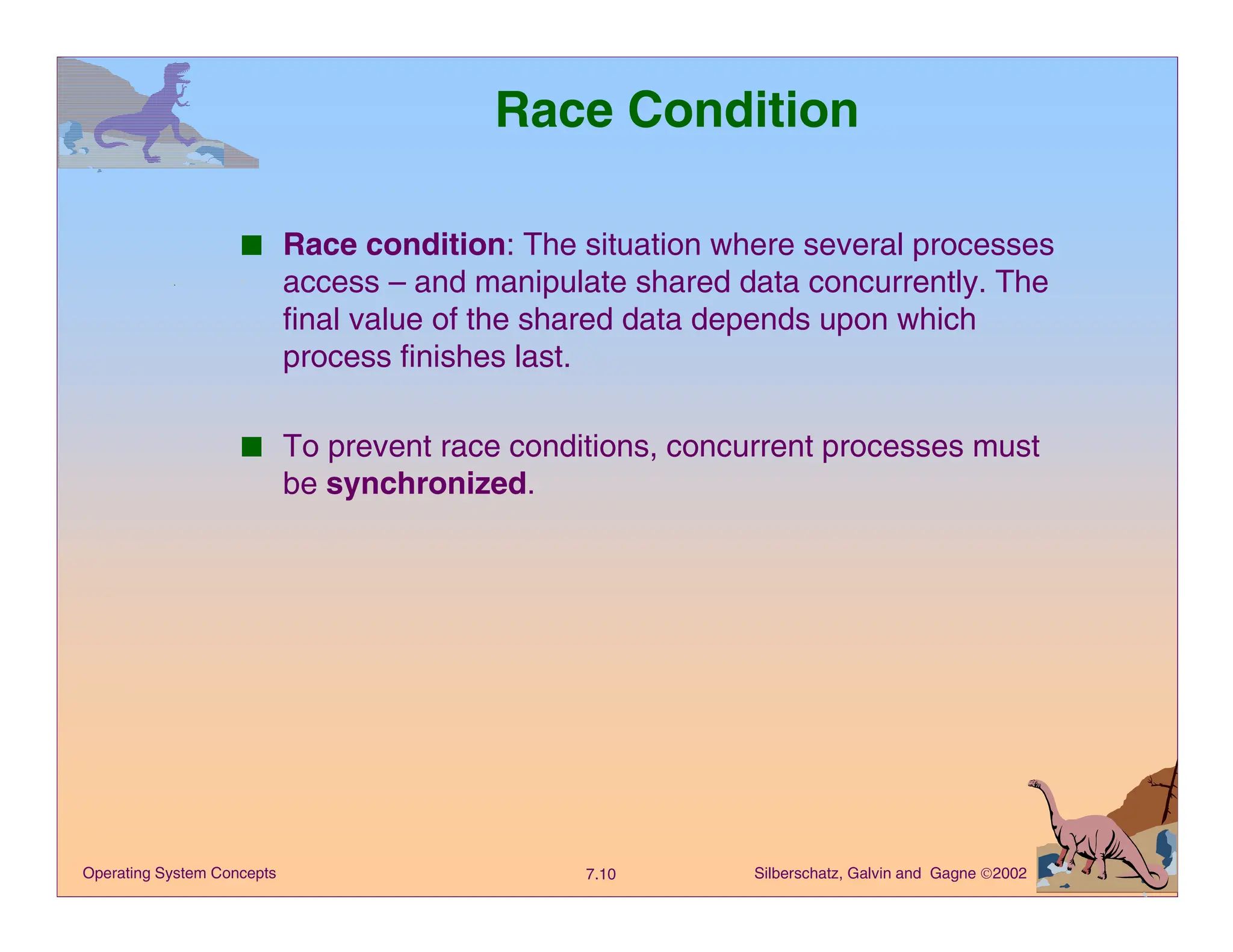
■ Race condition: The situation where several processes
access – and manipulate shared data concurrently. The
final value of the shared data depends upon which
process finishes last.
■ To prevent race conditions, concurrent processes must
be synchronized.
Silberschatz, Galvin and Gagne 2002
7.11
Operating System Concepts
The Critical-Section Problem
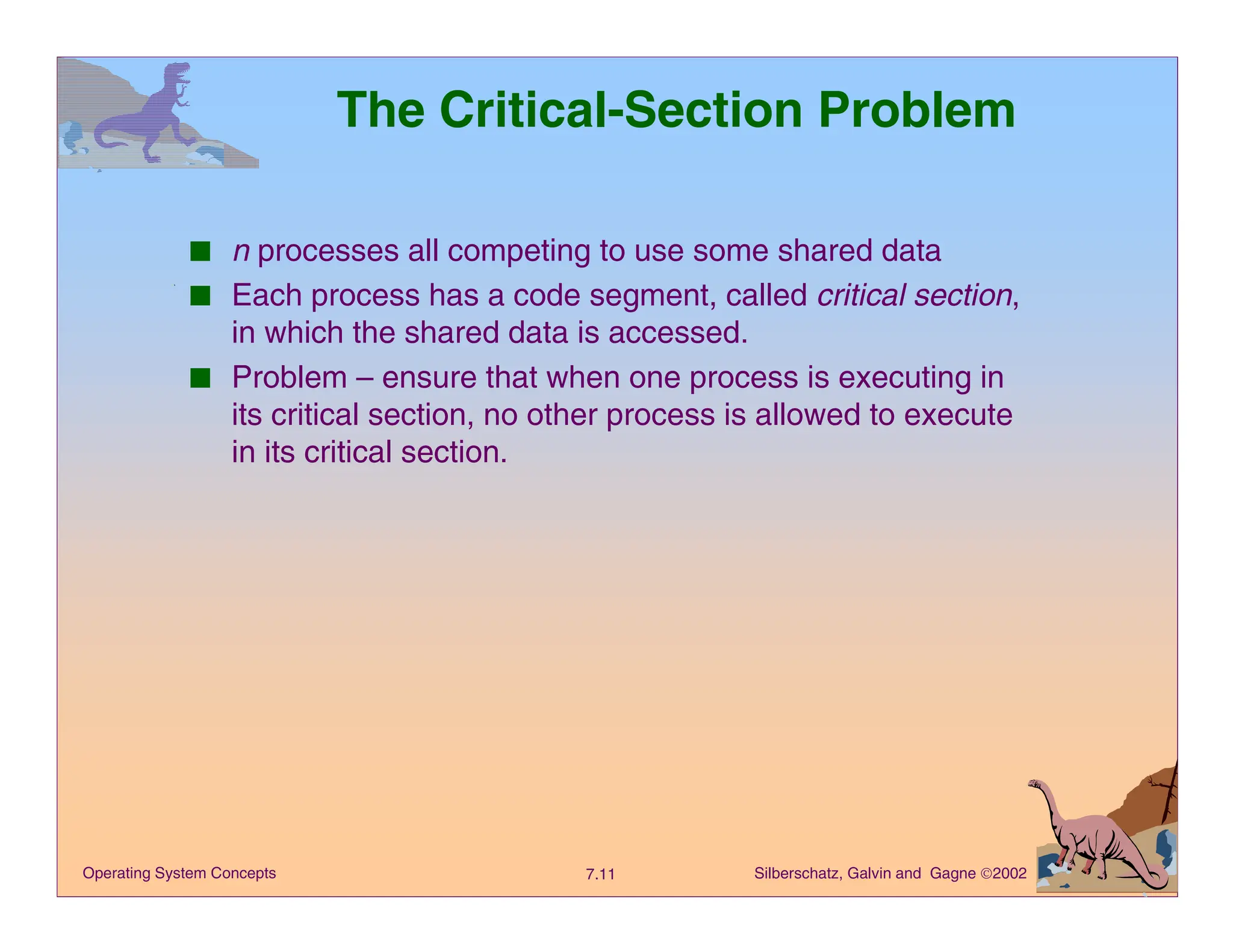
■ n processes all competing to use some shared data
■ Each process has a code segment, called critical section,
in which the shared data is accessed.
■ Problem – ensure that when one process is executing in
its critical section, no other process is allowed to execute
in its critical section.
Silberschatz, Galvin and Gagne 2002
7.12
Operating System Concepts
Solution to Critical-Section Problem
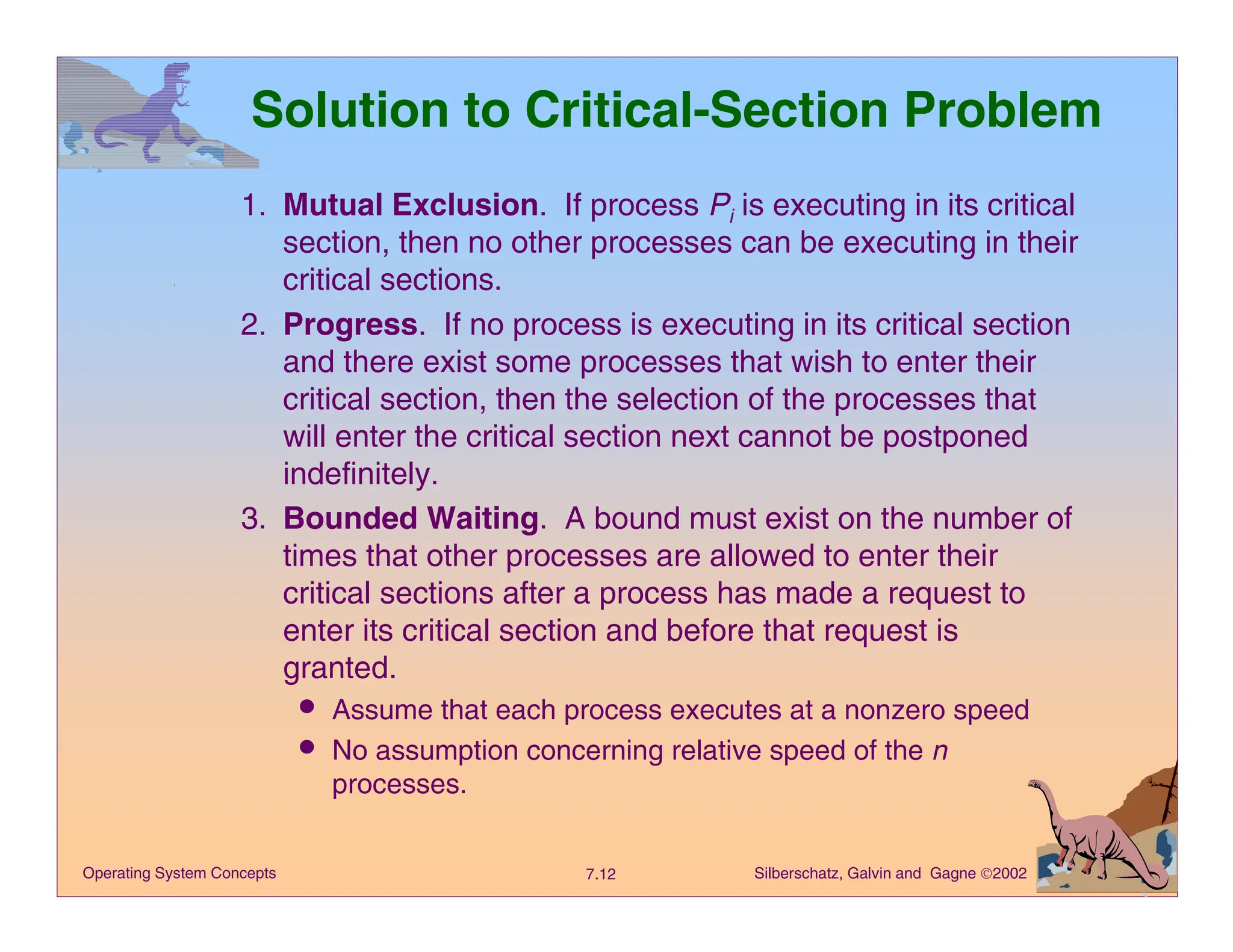
1. Mutual Exclusion. If process Pi is executing in its critical
section, then no other processes can be executing in their
critical sections.
2. Progress. If no process is executing in its critical section
and there exist some processes that wish to enter their
critical section, then the selection of the processes that
will enter the critical section next cannot be postponed
indefinitely.
3. Bounded Waiting. A bound must exist on the number of
times that other processes are allowed to enter their
critical sections after a process has made a request to
enter its critical section and before that request is
granted.
a Assume that each process executes at a nonzero speed
a No assumption concerning relative speed of the n
processes.
Silberschatz, Galvin and Gagne 2002
7.13
Operating System Concepts
Initial Attempts to Solve Problem
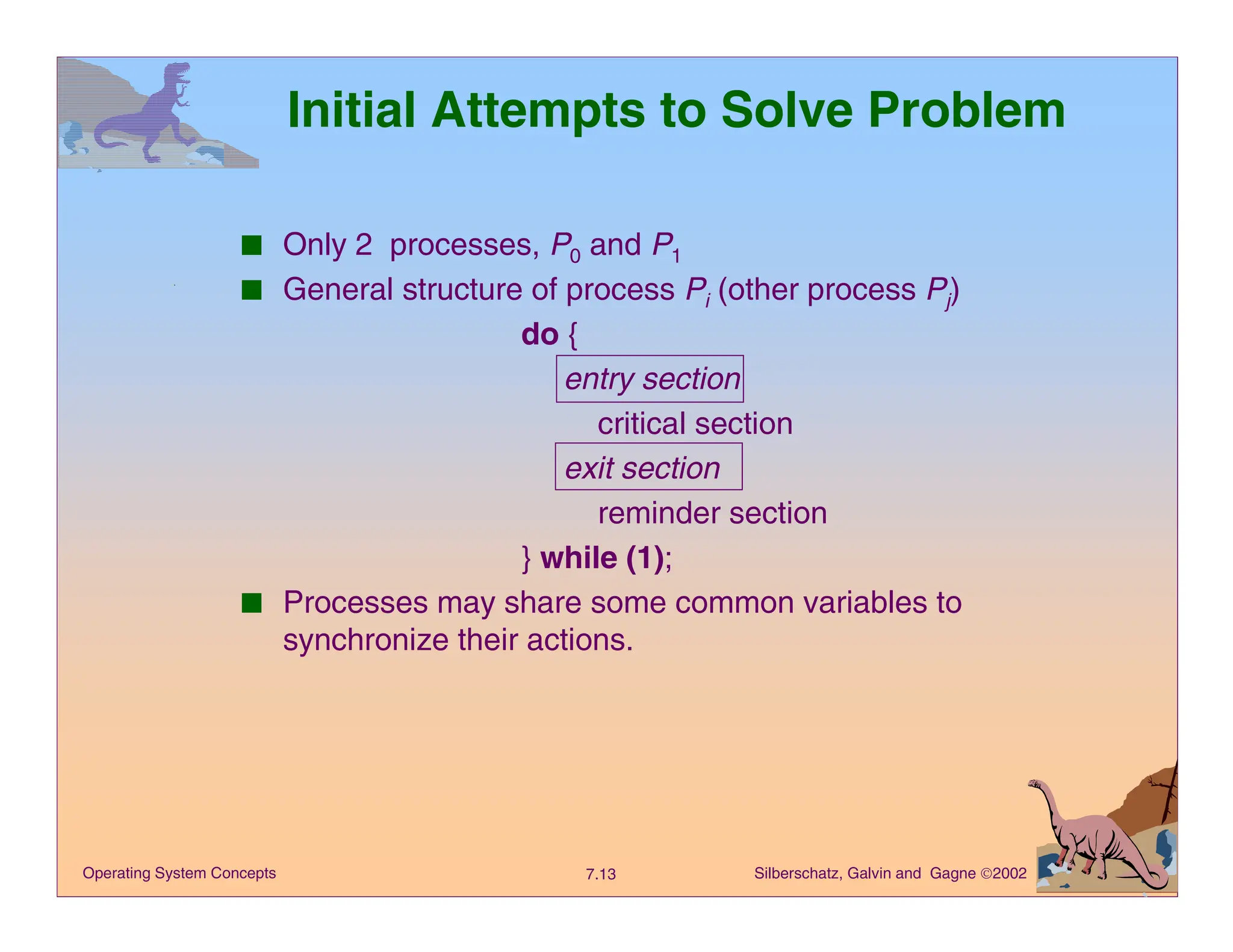
■ Only 2 processes, P0 and P1
■ General structure of process Pi (other process Pj)
do {
entry section
critical section
exit section
reminder section
} while (1);
■ Processes may share some common variables to
synchronize their actions.
Silberschatz, Galvin and Gagne 2002
7.14
Operating System Concepts
Algorithm 1
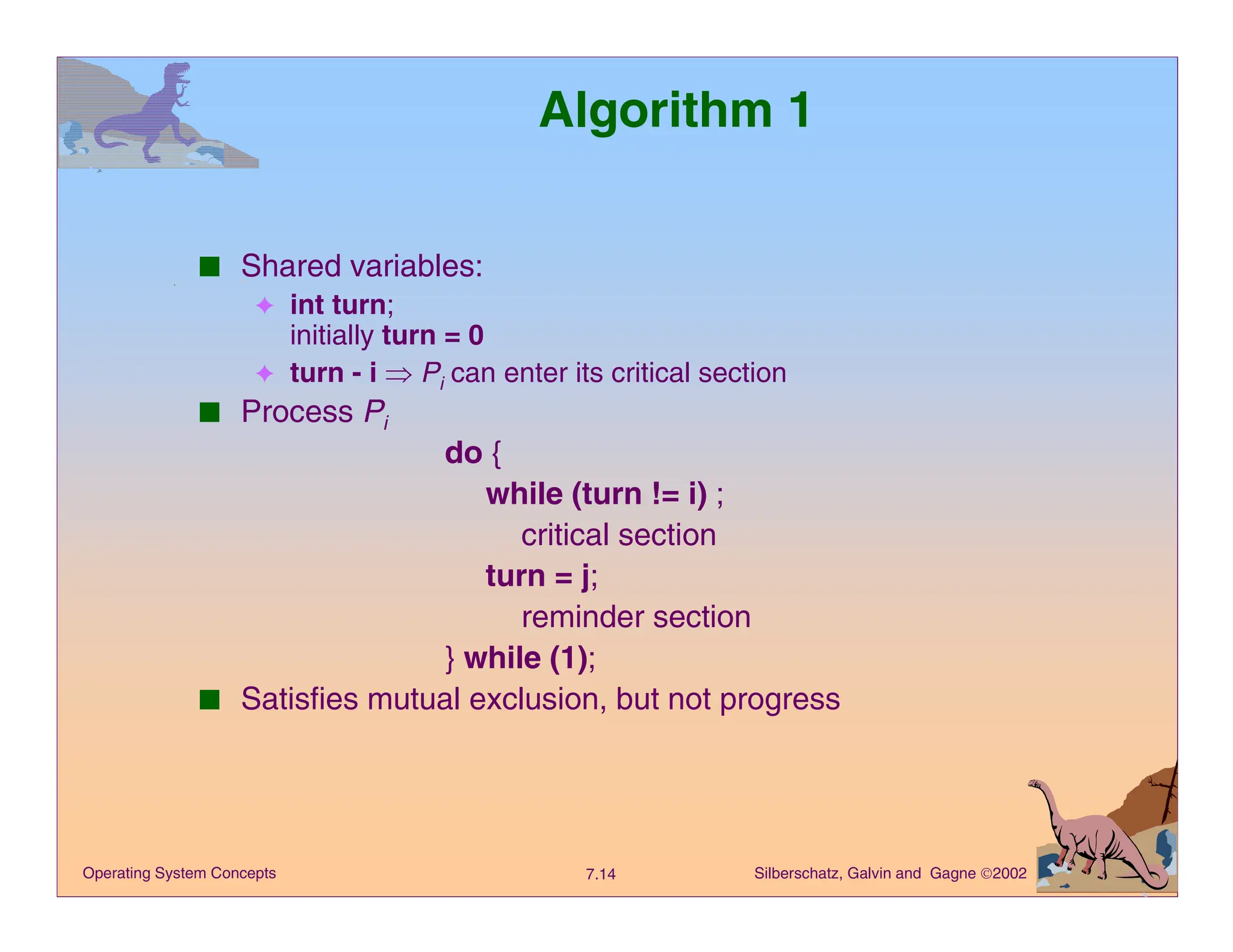
■ Shared variables:
✦ int turn;
initially turn = 0
✦ turn - i Þ Pi can enter its critical section
■ Process Pi
do {
while (turn != i) ;
critical section
turn = j;
reminder section
} while (1);
■ Satisfies mutual exclusion, but not progress
Silberschatz, Galvin and Gagne 2002
7.15
Operating System Concepts
Algorithm 2
■ Shared variables
✦ boolean flag[2];
initially flag [0] = flag [1] = false.
✦ flag [i] = true Þ Pi ready to enter its critical section
■ Process Pi
do {
flag[i] := true;
while (flag[j]) ;
critical section
flag [i] = false;
remainder section
} while (1);
■ Satisfies mutual exclusion, but not progress requirement.
Silberschatz, Galvin and Gagne 2002
7.16
Operating System Concepts
Algorithm 3
■ Combined shared variables of algorithms 1 and 2.
■ Process Pi
do {
flag [i]:= true;
turn = j;
while (flag [j] and turn = j) ;
critical section
flag [i] = false;
remainder section
} while (1);
■ Meets all three requirements; solves the critical-section
problem for two processes.
Silberschatz, Galvin and Gagne 2002
7.17
Operating System Concepts
Bakery Algorithm
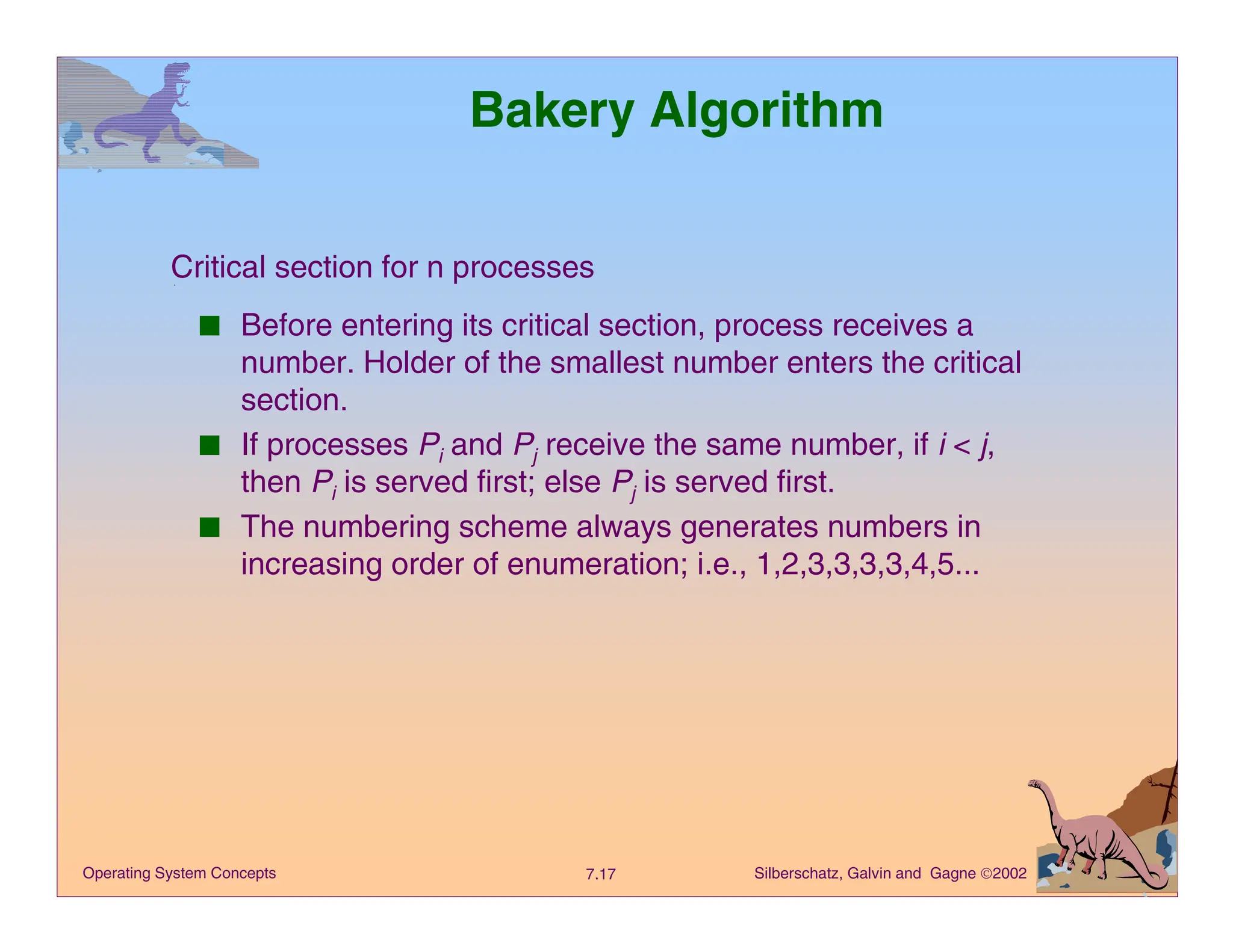
■ Before entering its critical section, process receives a
number. Holder of the smallest number enters the critical
section.
■ If processes Pi and Pj receive the same number, if i < j,
then Pi is served first; else Pj is served first.
■ The numbering scheme always generates numbers in
increasing order of enumeration; i.e., 1,2,3,3,3,3,4,5...
Critical section for n processes
Silberschatz, Galvin and Gagne 2002
7.18
Operating System Concepts
Bakery Algorithm
■ Notation <≡ lexicographical order (ticket #, process id #)
✦ (a,b) < c,d) if a < c or if a = c and b < d
✦ max (a0,…, an-1) is a number, k, such that k ≥ ai for i - 0,
…, n – 1
■ Shared data
boolean choosing[n];
int number[n];
Data structures are initialized to false and 0 respectively
Silberschatz, Galvin and Gagne 2002
7.19
Operating System Concepts
Bakery Algorithm
do {
choosing[i] = true;
number[i] = max(number[0], number[1], …, number [n – 1])+1;
choosing[i] = false;
for (j = 0; j < n; j++) {
while (choosing[j]) ;
while ((number[j] != 0) && (number[j,j] < number[i,i])) ;
}
critical section
number[i] = 0;
remainder section
} while (1);
Silberschatz, Galvin and Gagne 2002
7.20
Operating System Concepts
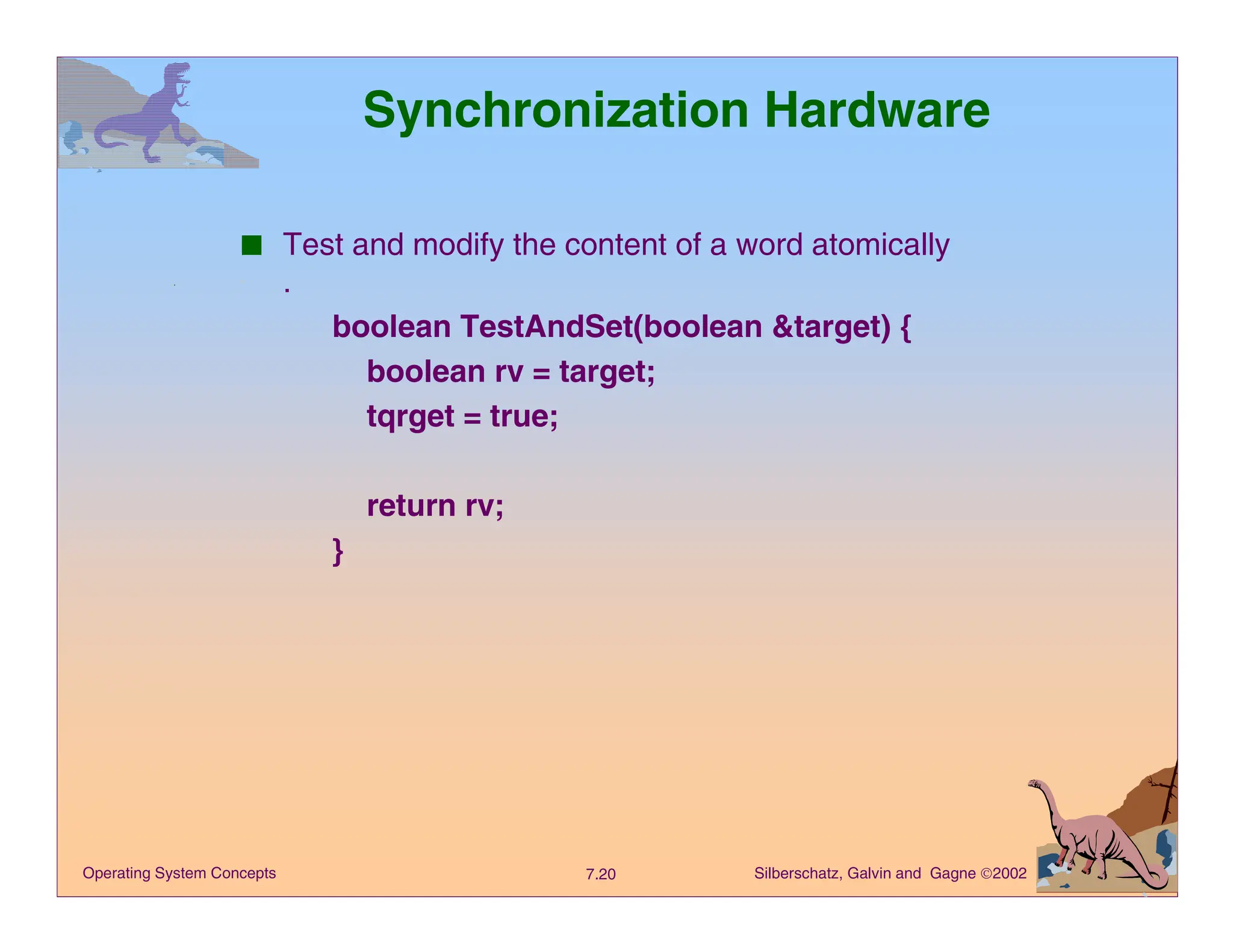
Synchronization Hardware
■ Test and modify the content of a word atomically
.
boolean TestAndSet(boolean &target) {
boolean rv = target;
tqrget = true;
return rv;
}
Silberschatz, Galvin and Gagne 2002
7.21
Operating System Concepts
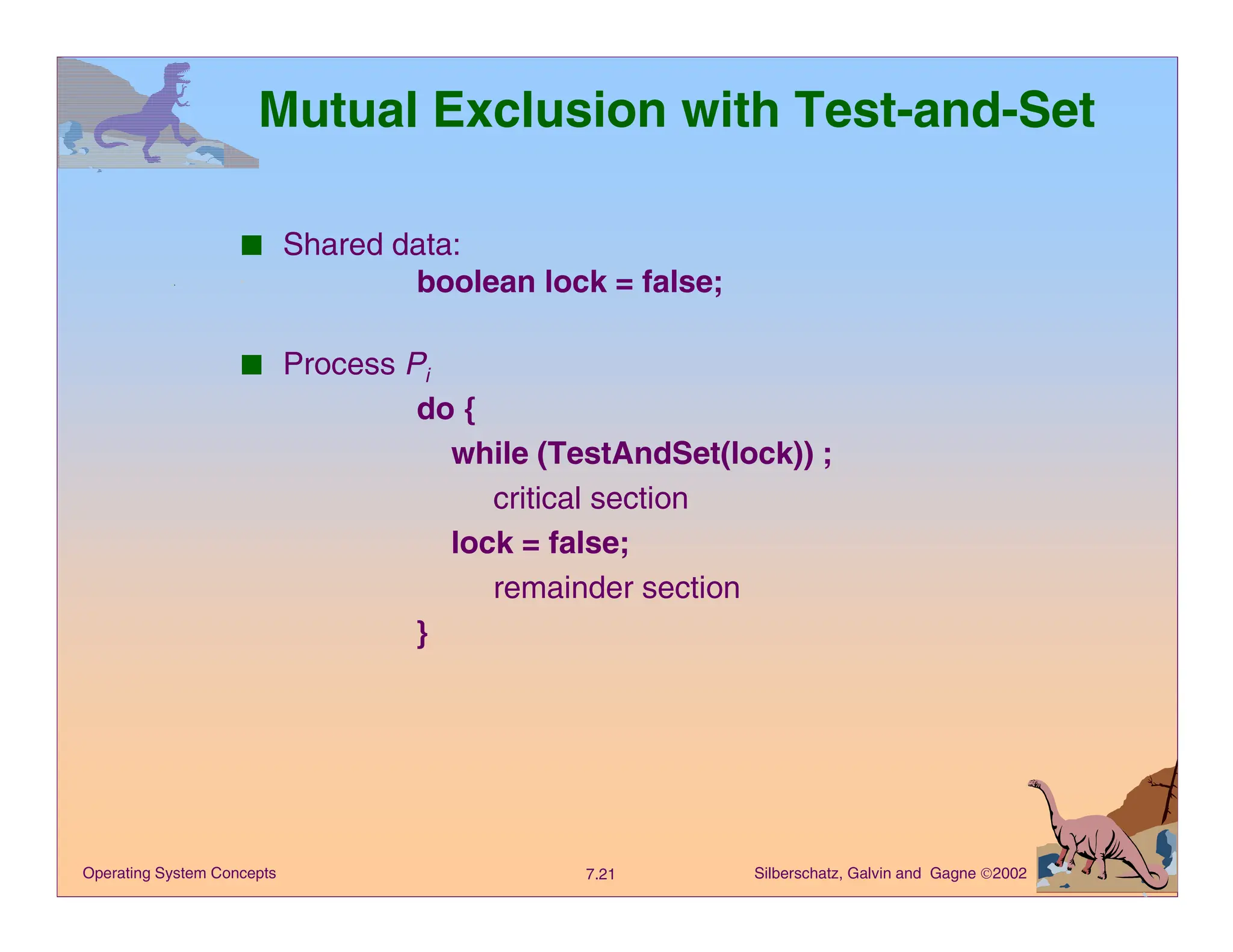
Mutual Exclusion with Test-and-Set
■ Shared data:
boolean lock = false;
■ Process Pi
do {
while (TestAndSet(lock)) ;
critical section
lock = false;
remainder section
}
Silberschatz, Galvin and Gagne 2002
7.22
Operating System Concepts
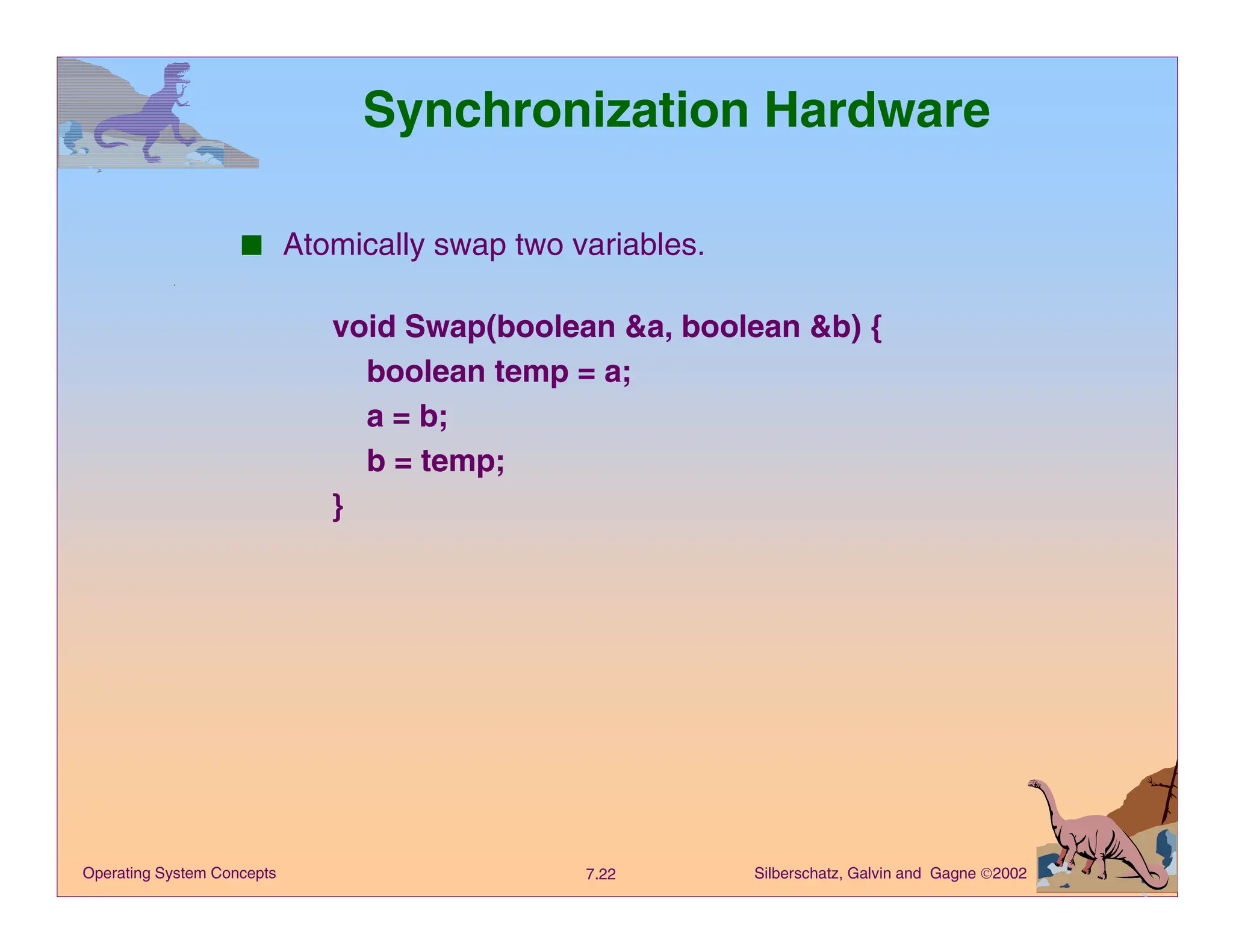
Synchronization Hardware
■ Atomically swap two variables.
void Swap(boolean &a, boolean &b) {
boolean temp = a;
a = b;
b = temp;
}
Silberschatz, Galvin and Gagne 2002
7.23
Operating System Concepts
Mutual Exclusion with Swap
■ Shared data (initialized to false):
boolean lock;
boolean waiting[n];
■ Process Pi
do {
key = true;
while (key == true)
Swap(lock,key);
critical section
lock = false;
remainder section
}
Silberschatz, Galvin and Gagne 2002
7.24
Operating System Concepts
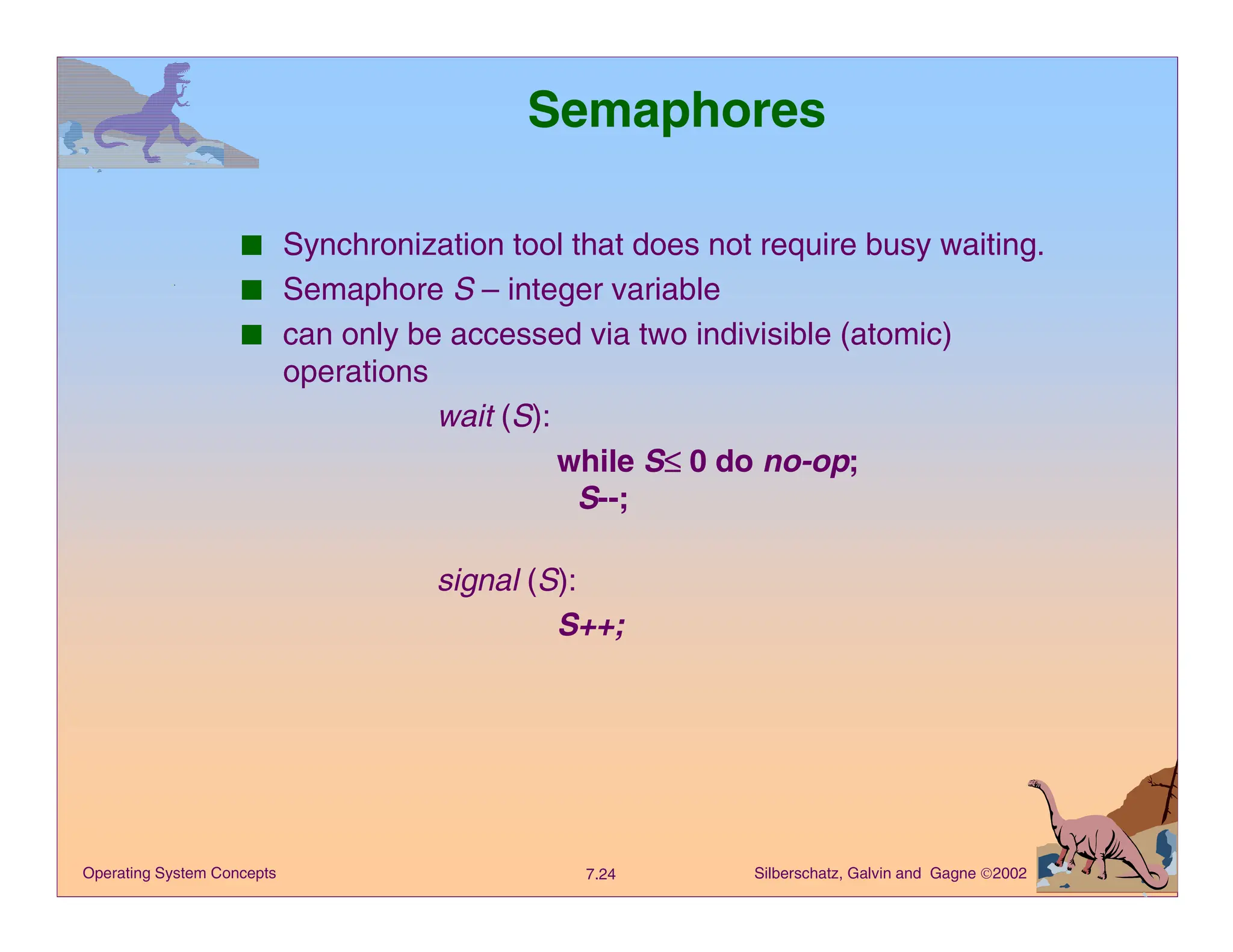
Semaphores
■ Synchronization tool that does not require busy waiting.
■ Semaphore S – integer variable
■ can only be accessed via two indivisible (atomic)
operations
wait (S):
while S≤
≤
≤
≤ 0 do no-op;
S--;
signal (S):
S++;
Silberschatz, Galvin and Gagne 2002
7.25
Operating System Concepts
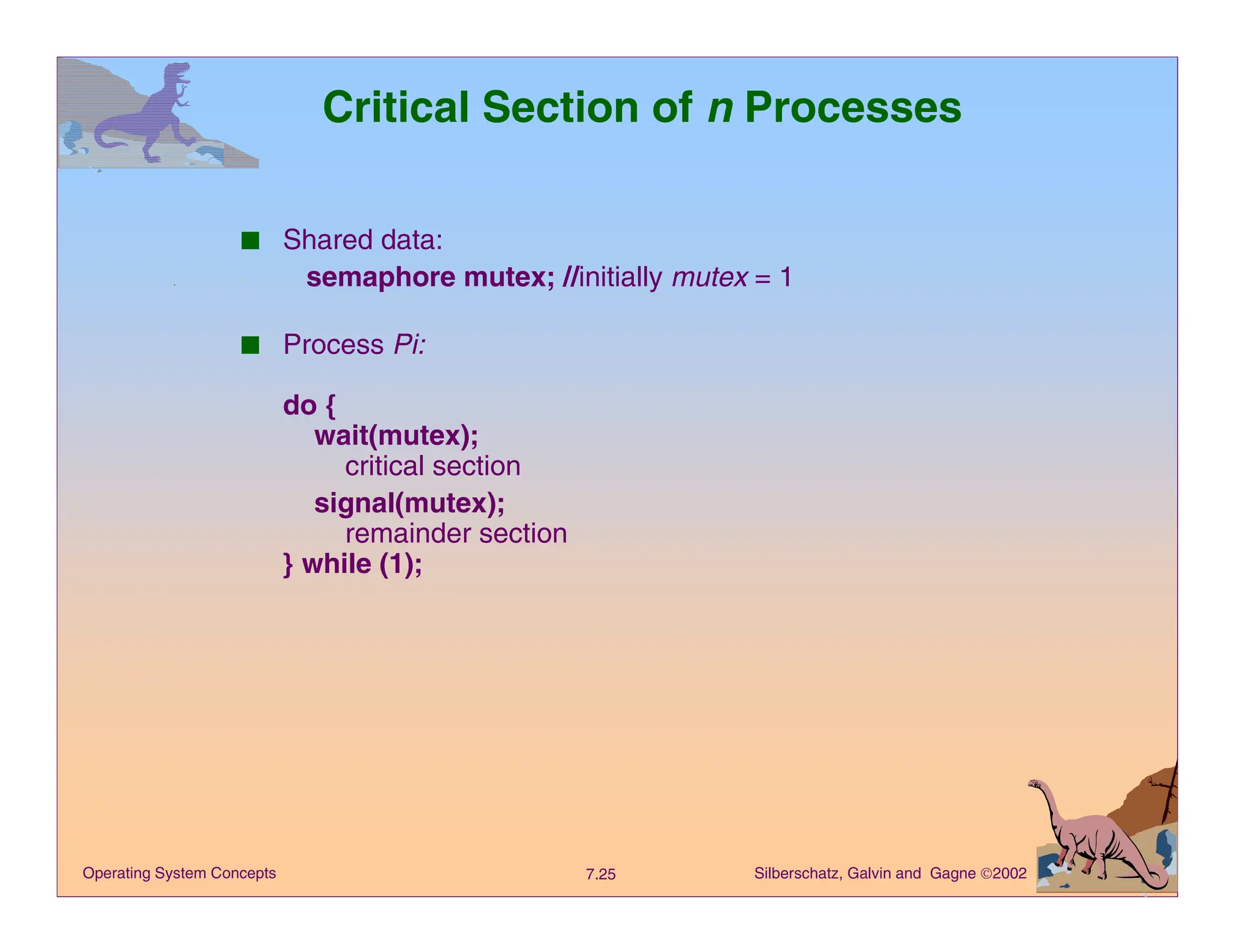
Critical Section of n Processes
■ Shared data:
semaphore mutex; //initially mutex = 1
■ Process Pi:
do {
wait(mutex);
critical section
signal(mutex);
remainder section
} while (1);
Silberschatz, Galvin and Gagne 2002
7.26
Operating System Concepts
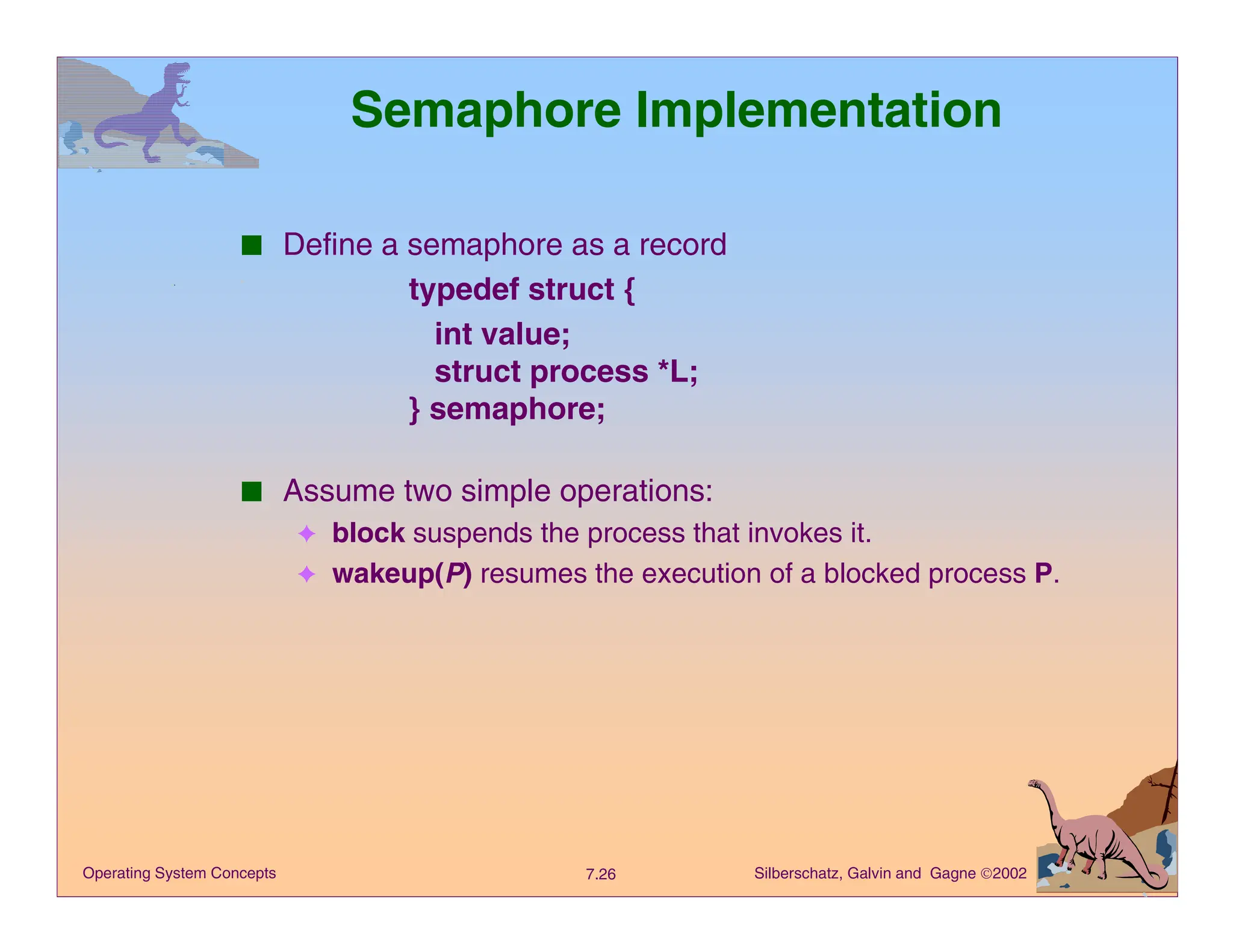
Semaphore Implementation
■ Define a semaphore as a record
typedef struct {
int value;
struct process *L;
} semaphore;
■ Assume two simple operations:
✦ block suspends the process that invokes it.
✦ wakeup(P) resumes the execution of a blocked process P.
Silberschatz, Galvin and Gagne 2002
7.27
Operating System Concepts
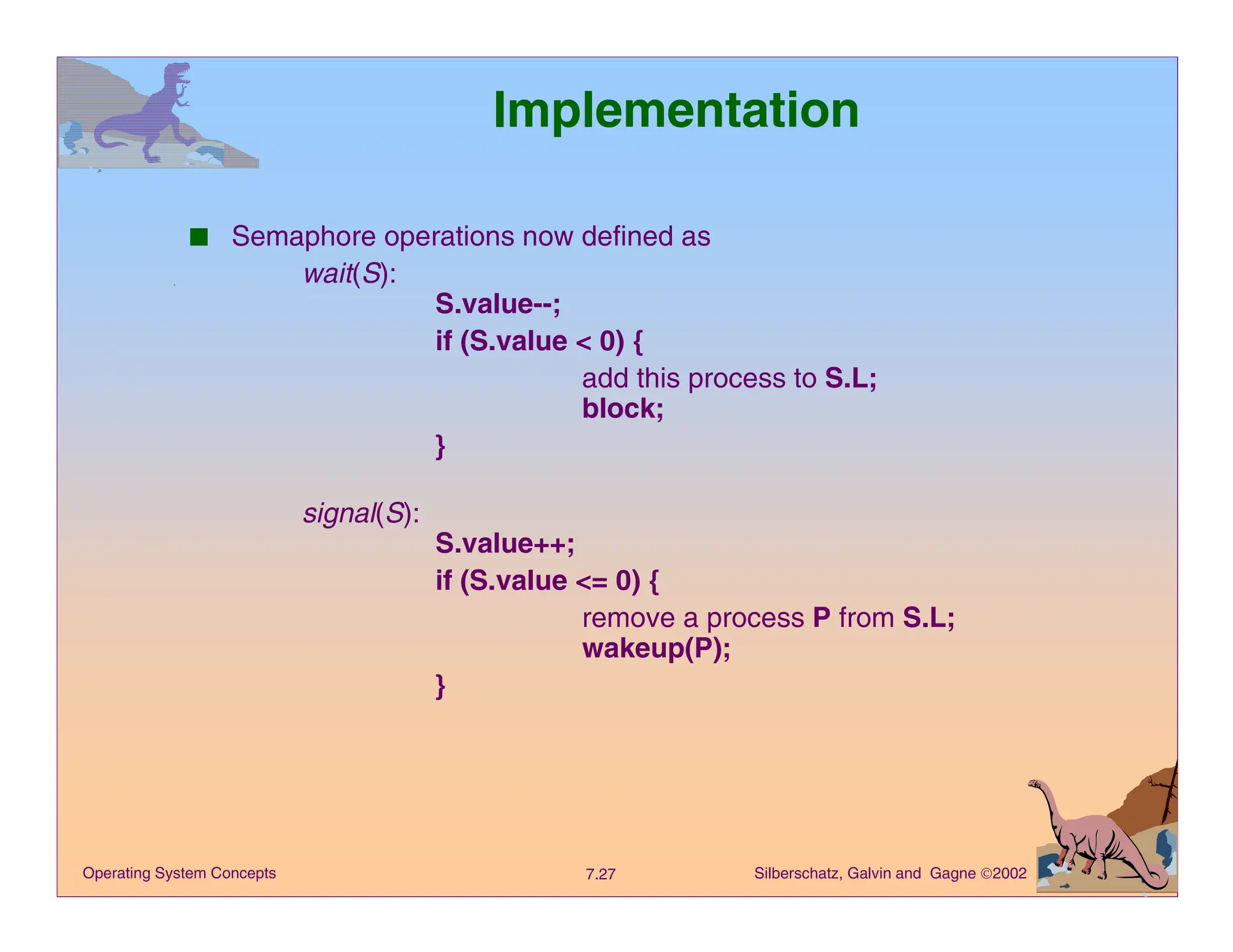
Implementation
■ Semaphore operations now defined as
wait(S):
S.value--;
if (S.value < 0) {
add this process to S.L;
block;
}
signal(S):
S.value++;
if (S.value <= 0) {
remove a process P from S.L;
wakeup(P);
}
Silberschatz, Galvin and Gagne 2002
7.28
Operating System Concepts
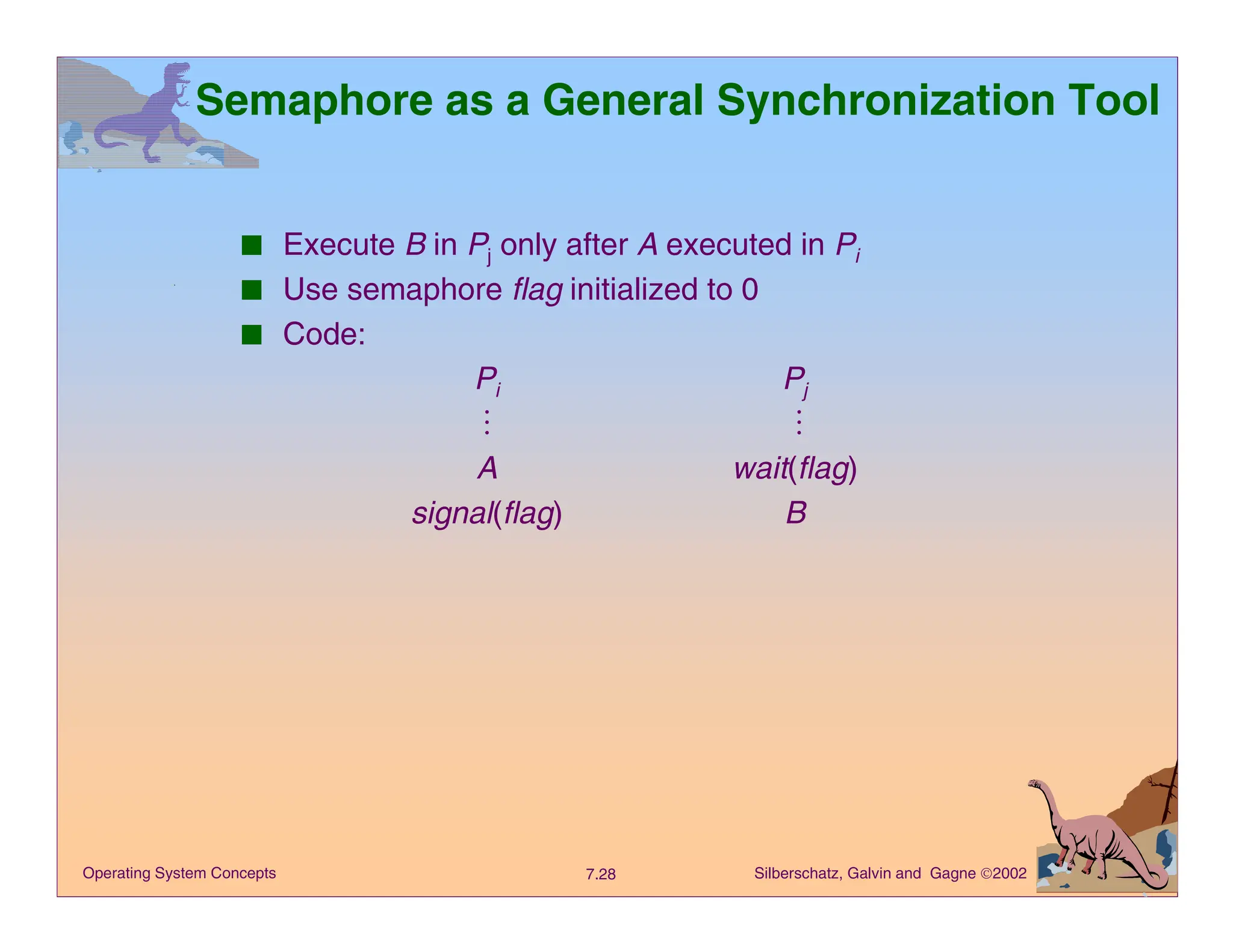
Semaphore as a General Synchronization Tool
■ Execute B in Pj only after A executed in Pi
■ Use semaphore flag initialized to 0
■ Code:
Pi Pj
M M
A wait(flag)
signal(flag) B
Silberschatz, Galvin and Gagne 2002
7.29
Operating System Concepts
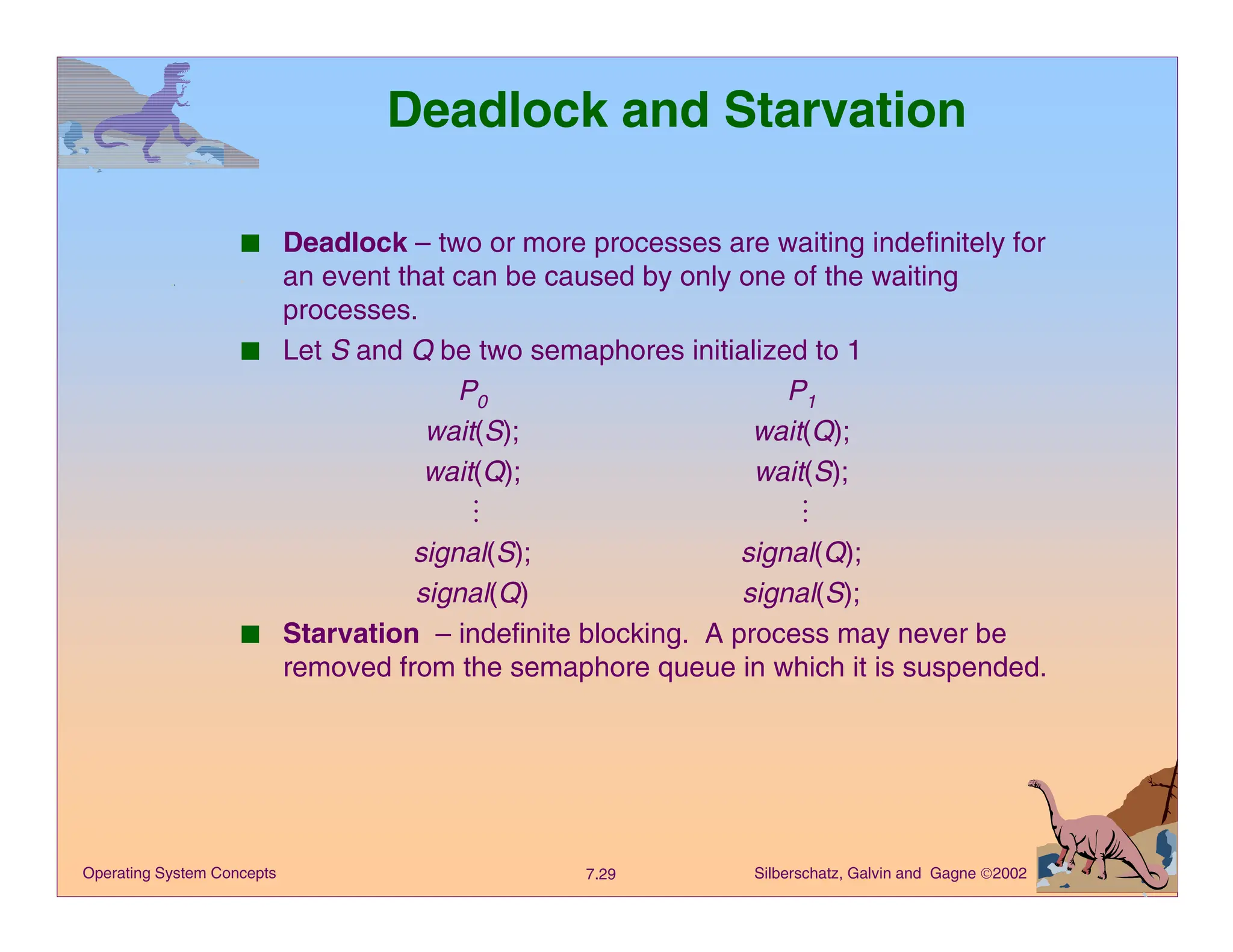
Deadlock and Starvation
■ Deadlock – two or more processes are waiting indefinitely for
an event that can be caused by only one of the waiting
processes.
■ Let S and Q be two semaphores initialized to 1
P0 P1
wait(S); wait(Q);
wait(Q); wait(S);
M M
signal(S); signal(Q);
signal(Q) signal(S);
■ Starvation – indefinite blocking. A process may never be
removed from the semaphore queue in which it is suspended.
Silberschatz, Galvin and Gagne 2002
7.30
Operating System Concepts
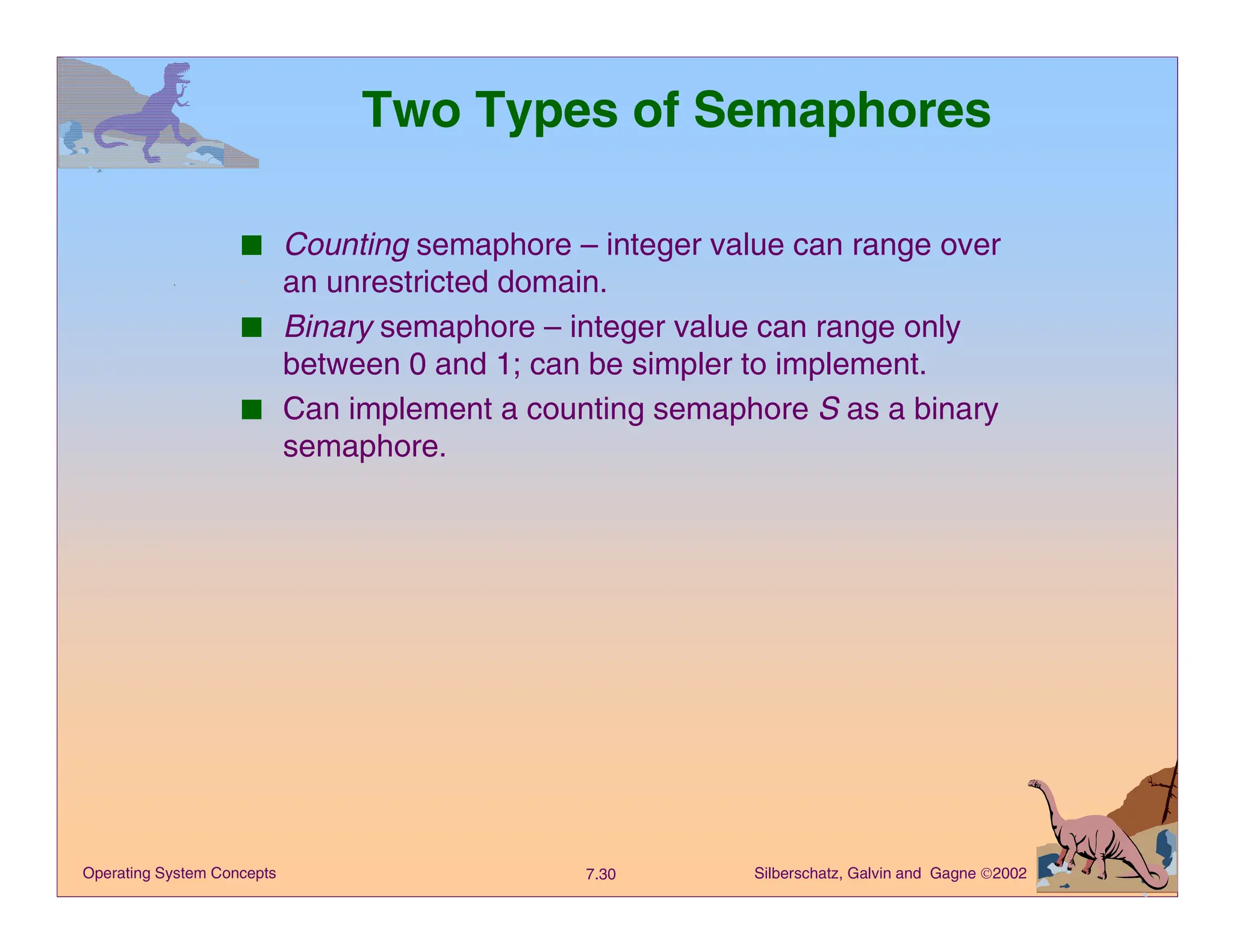
Two Types of Semaphores
■ Counting semaphore – integer value can range over
an unrestricted domain.
■ Binary semaphore – integer value can range only
between 0 and 1; can be simpler to implement.
■ Can implement a counting semaphore S as a binary
semaphore.
Silberschatz, Galvin and Gagne 2002
7.31
Operating System Concepts
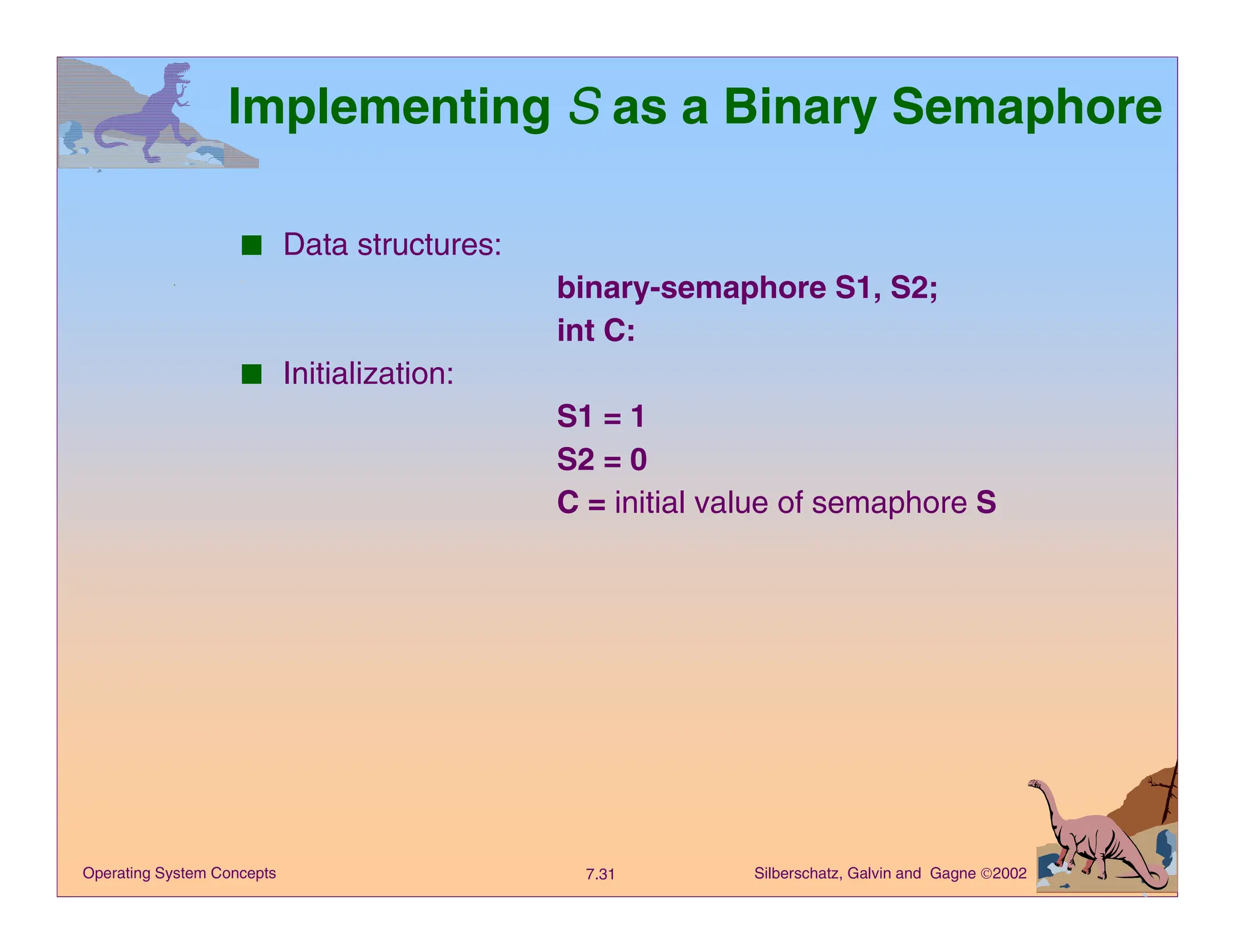
Implementing S as a Binary Semaphore
■ Data structures:
binary-semaphore S1, S2;
int C:
■ Initialization:
S1 = 1
S2 = 0
C = initial value of semaphore S
Silberschatz, Galvin and Gagne 2002
7.32
Operating System Concepts
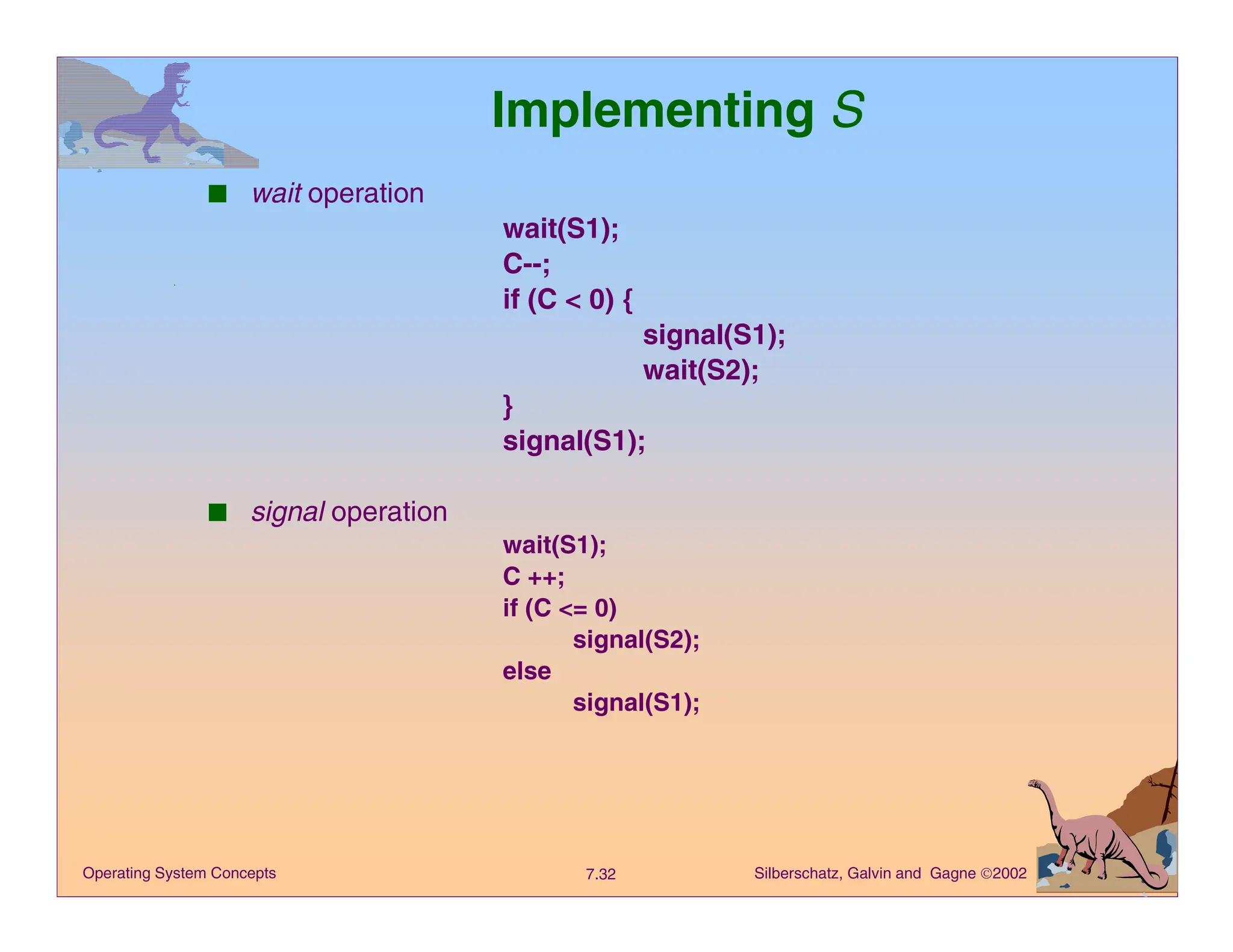
Implementing S
■ wait operation
wait(S1);
C--;
if (C < 0) {
signal(S1);
wait(S2);
}
signal(S1);
■ signal operation
wait(S1);
C ++;
if (C <= 0)
signal(S2);
else
signal(S1);
Silberschatz, Galvin and Gagne 2002
7.33
Operating System Concepts
Classical Problems of Synchronization
■ Bounded-Buffer Problem
■ Readers and Writers Problem
■ Dining-Philosophers Problem
Silberschatz, Galvin and Gagne 2002
7.34
Operating System Concepts
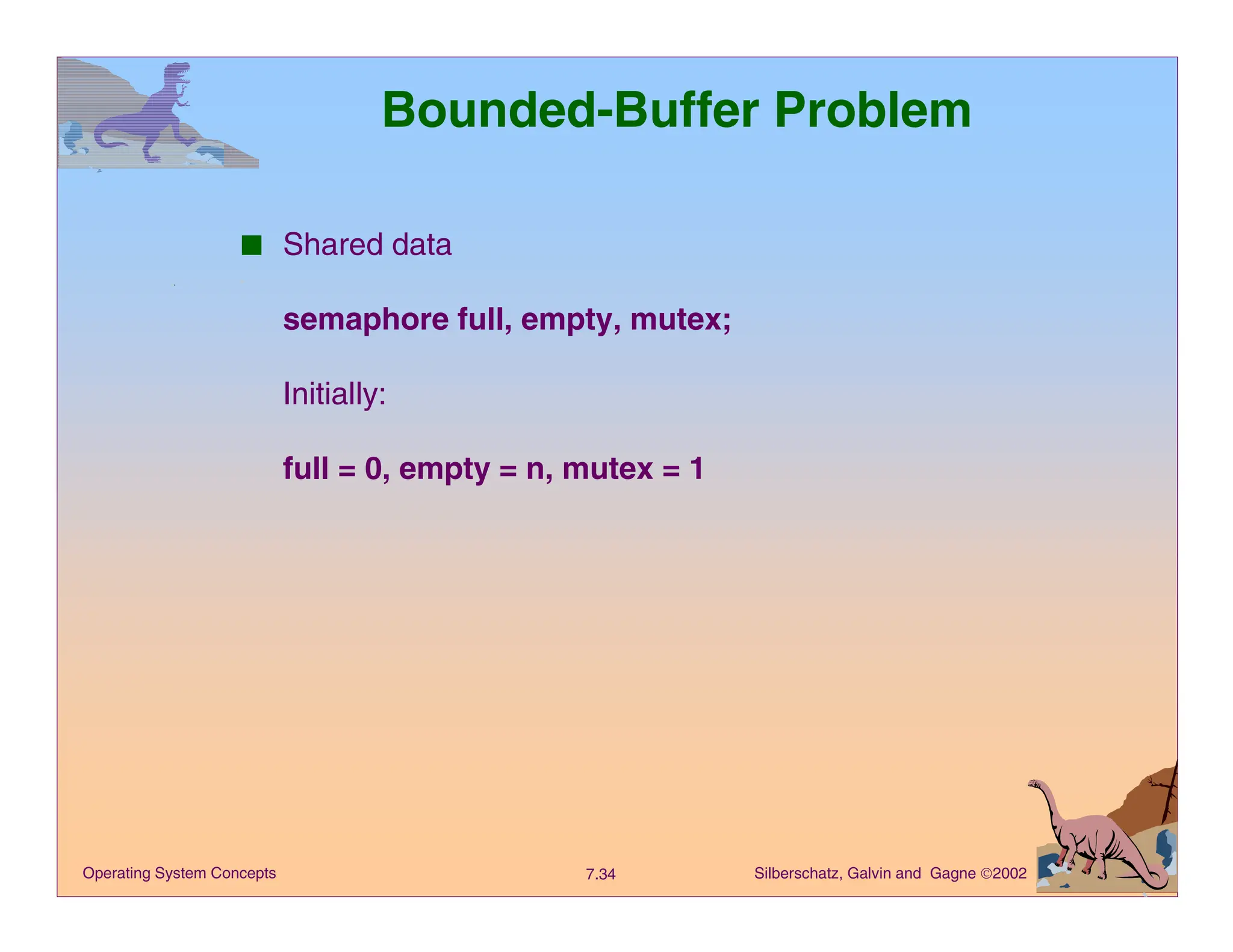
Bounded-Buffer Problem
■ Shared data
semaphore full, empty, mutex;
Initially:
full = 0, empty = n, mutex = 1
Silberschatz, Galvin and Gagne 2002
7.35
Operating System Concepts
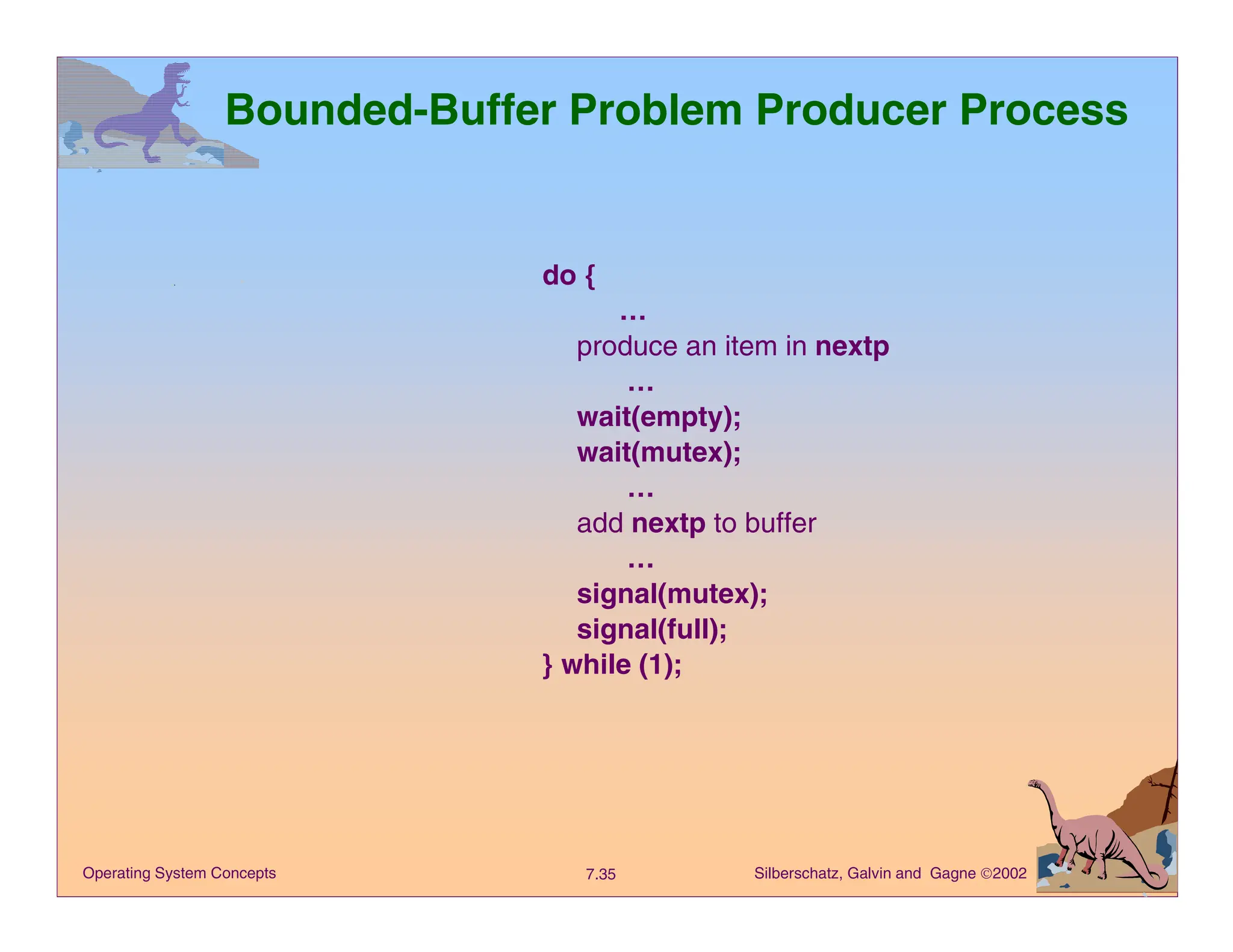
Bounded-Buffer Problem Producer Process
do {
…
produce an item in nextp
…
wait(empty);
wait(mutex);
…
add nextp to buffer
…
signal(mutex);
signal(full);
} while (1);
Silberschatz, Galvin and Gagne 2002
7.36
Operating System Concepts
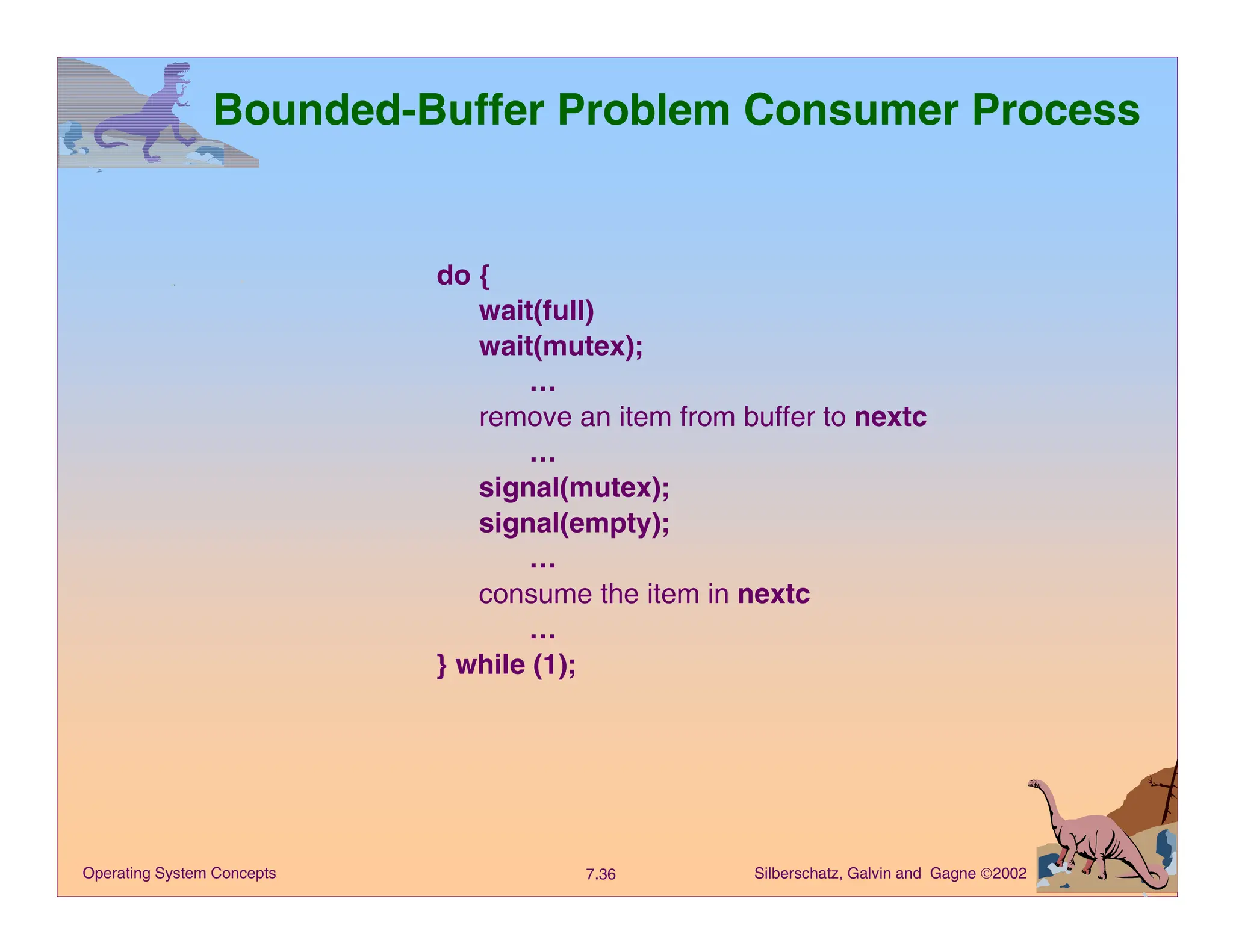
Bounded-Buffer Problem Consumer Process
do {
wait(full)
wait(mutex);
…
remove an item from buffer to nextc
…
signal(mutex);
signal(empty);
…
consume the item in nextc
…
} while (1);
Silberschatz, Galvin and Gagne 2002
7.37
Operating System Concepts
Readers-Writers Problem
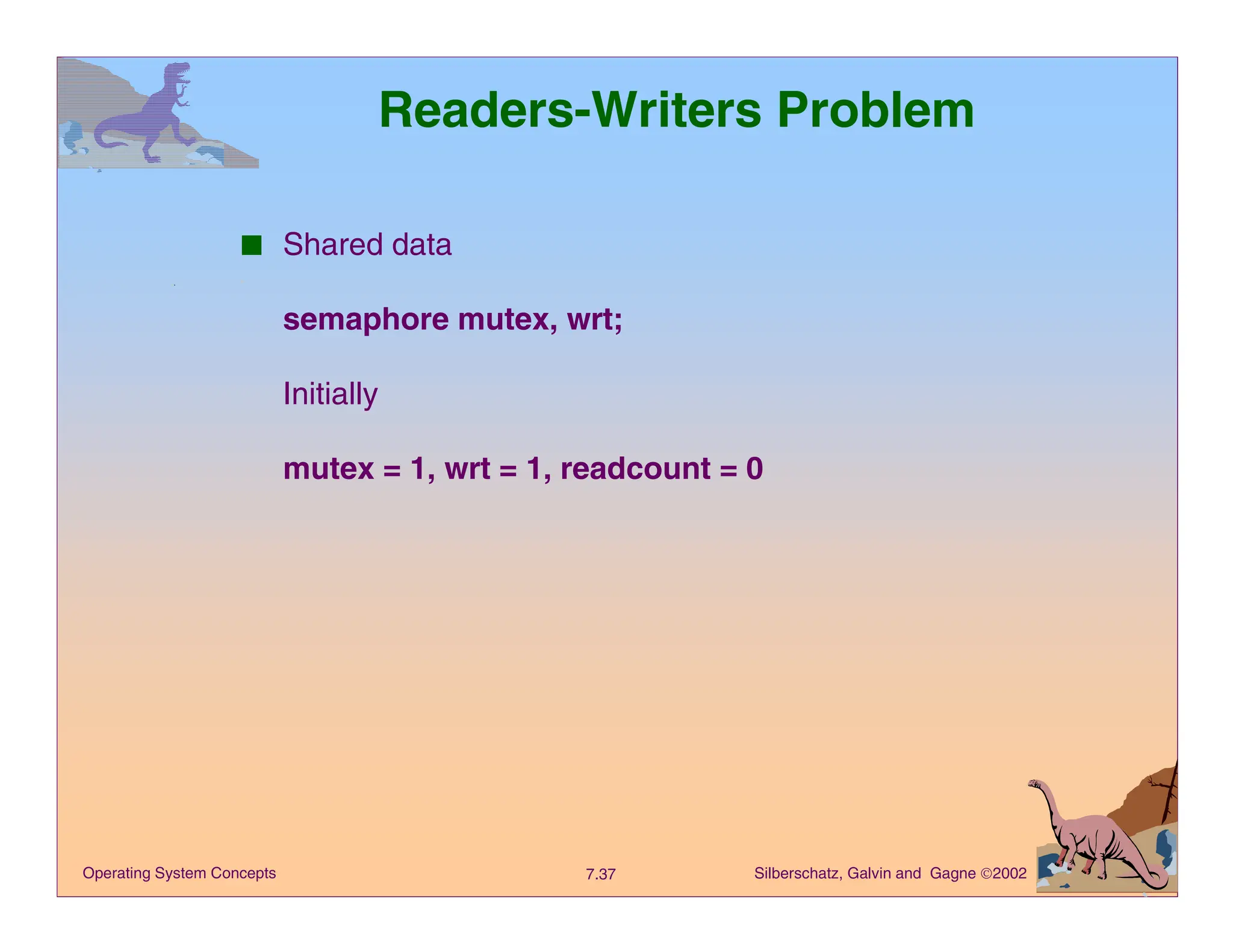
■ Shared data
semaphore mutex, wrt;
Initially
mutex = 1, wrt = 1, readcount = 0
Silberschatz, Galvin and Gagne 2002
7.38
Operating System Concepts
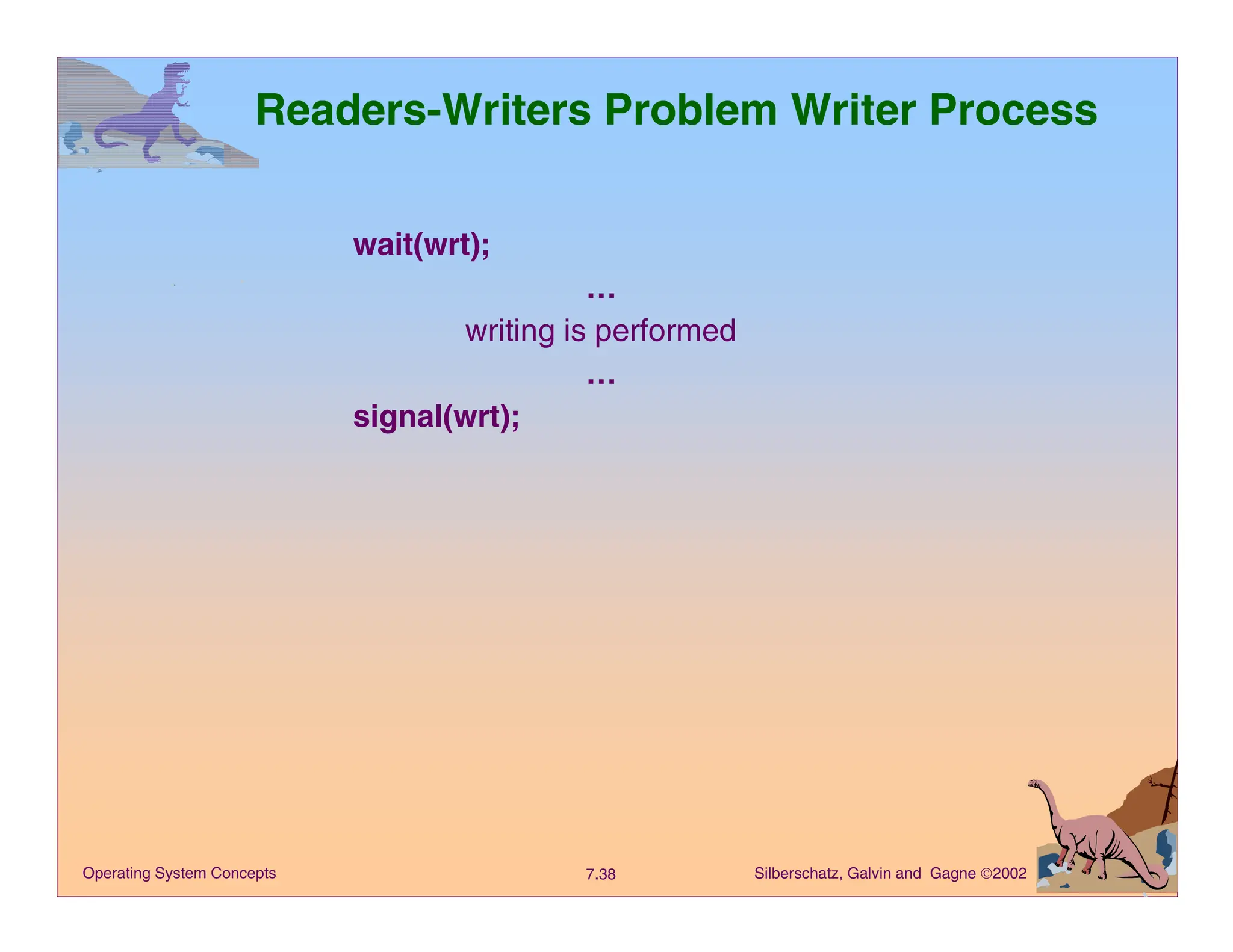
Readers-Writers Problem Writer Process
wait(wrt);
…
writing is performed
…
signal(wrt);
Silberschatz, Galvin and Gagne 2002
7.39
Operating System Concepts
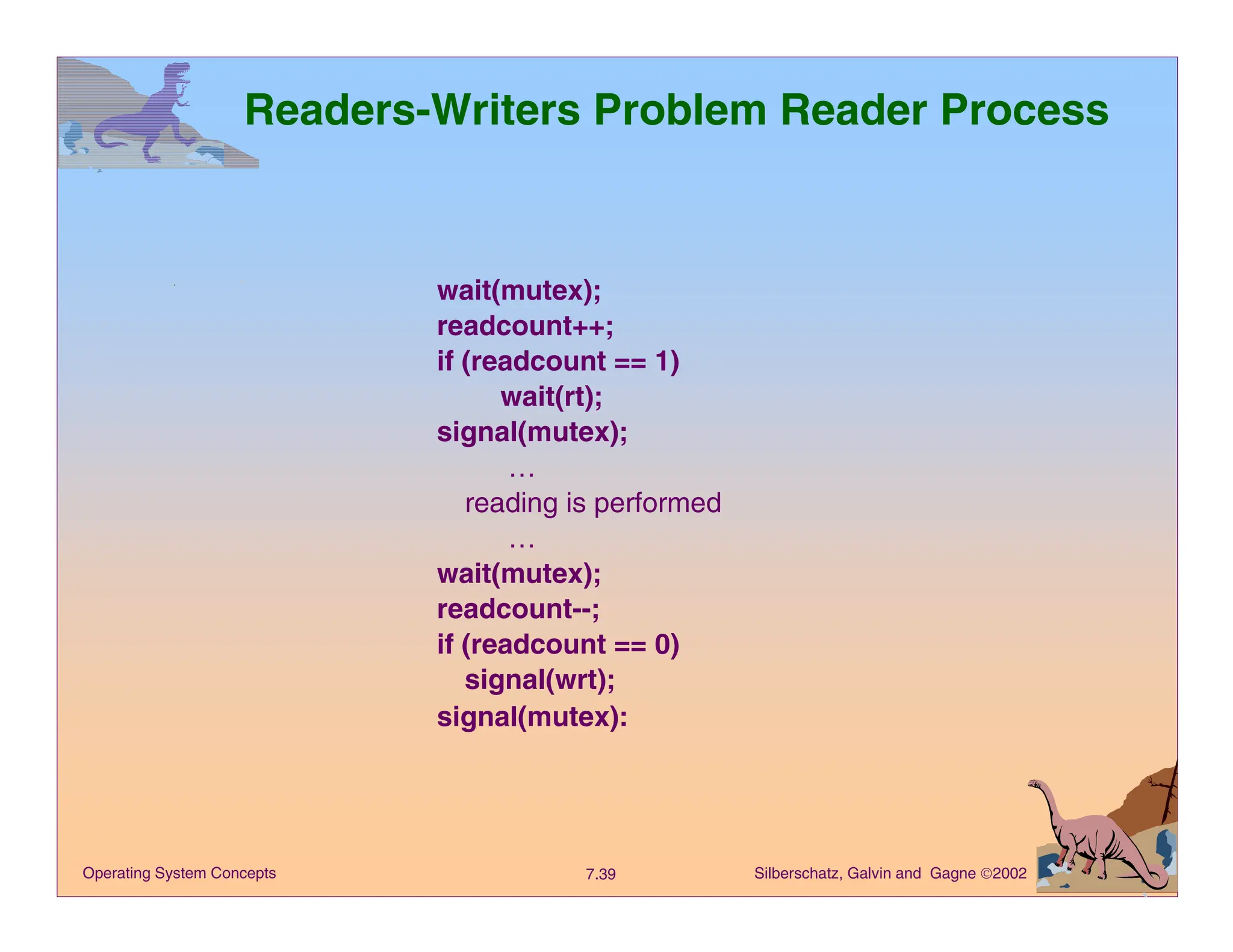
Readers-Writers Problem Reader Process
wait(mutex);
readcount++;
if (readcount == 1)
wait(rt);
signal(mutex);
…
reading is performed
…
wait(mutex);
readcount--;
if (readcount == 0)
signal(wrt);
signal(mutex):
Silberschatz, Galvin and Gagne 2002
7.40
Operating System Concepts
Dining-Philosophers Problem
■ Shared data
semaphore chopstick[5];
Initially all values are 1
Silberschatz, Galvin and Gagne 2002
7.41
Operating System Concepts
Dining-Philosophers Problem
■ Philosopher i:
do {
wait(chopstick[i])
wait(chopstick[(i+1) % 5])
…
eat
…
signal(chopstick[i]);
signal(chopstick[(i+1) % 5]);
…
think
…
} while (1);
Silberschatz, Galvin and Gagne 2002
7.42
Operating System Concepts
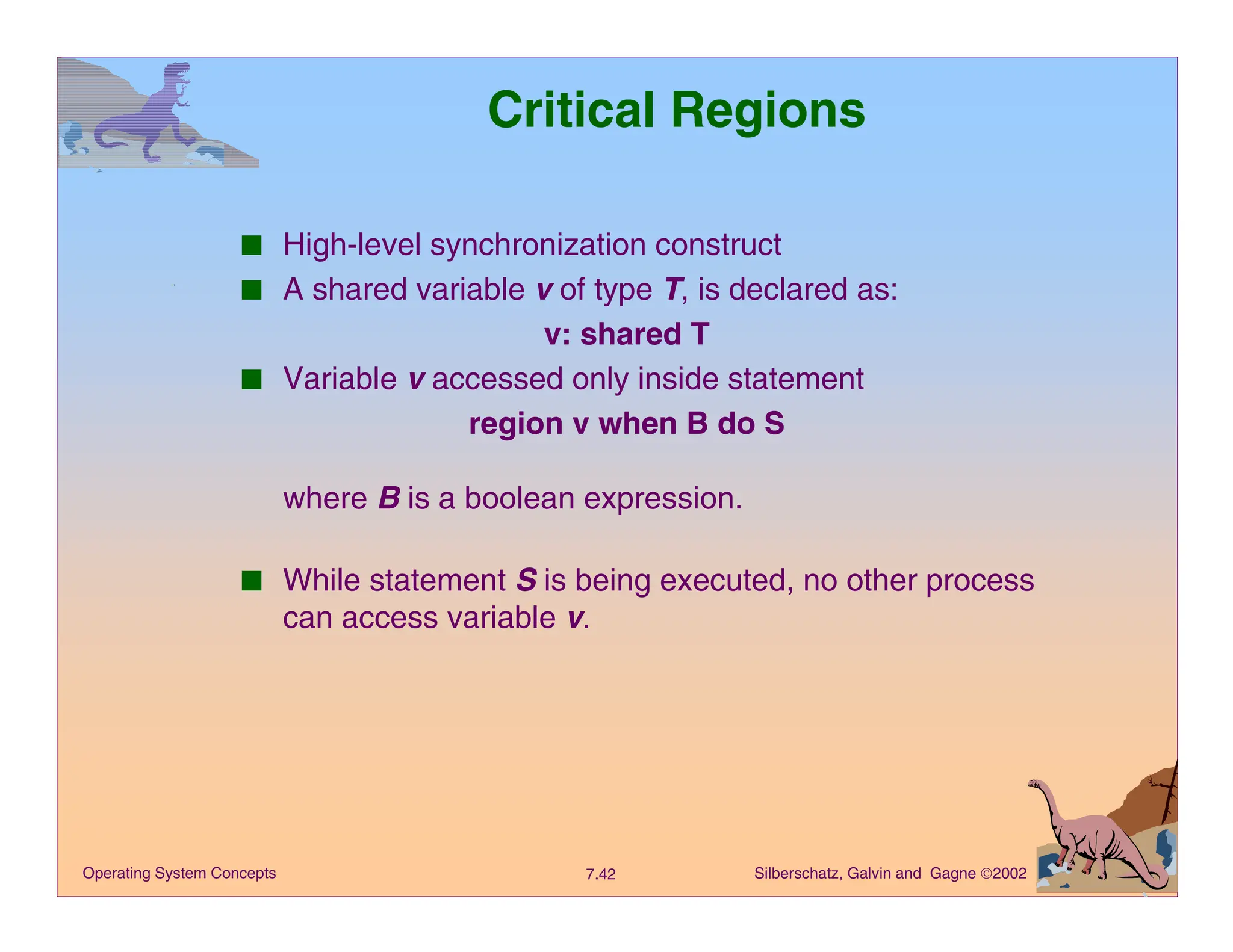
Critical Regions
■ High-level synchronization construct
■ A shared variable v of type T, is declared as:
v: shared T
■ Variable v accessed only inside statement
region v when B do S
where B is a boolean expression.
■ While statement S is being executed, no other process
can access variable v.
Silberschatz, Galvin and Gagne 2002
7.43
Operating System Concepts
Critical Regions
■ Regions referring to the same shared variable exclude
each other in time.
■ When a process tries to execute the region statement, the
Boolean expression B is evaluated. If B is true, statement
S is executed. If it is false, the process is delayed until B
becomes true and no other process is in the region
associated with v.
Silberschatz, Galvin and Gagne 2002
7.44
Operating System Concepts
Example – Bounded Buffer
■ Shared data:
struct buffer {
int pool[n];
int count, in, out;
}
Silberschatz, Galvin and Gagne 2002
7.45
Operating System Concepts
Bounded Buffer Producer Process
■ Producer process inserts nextp into the shared buffer
region buffer when( count < n) {
pool[in] = nextp;
in:= (in+1) % n;
count++;
}
Silberschatz, Galvin and Gagne 2002
7.46
Operating System Concepts
Bounded Buffer Consumer Process
■ Consumer process removes an item from the shared
buffer and puts it in nextc
region buffer when (count > 0) {
nextc = pool[out];
out = (out+1) % n;
count--;
}
Silberschatz, Galvin and Gagne 2002
7.47
Operating System Concepts
Implementation region x when B do S
■ Associate with the shared variable x, the following
variables:
semaphore mutex, first-delay, second-delay;
int first-count, second-count;
■ Mutually exclusive access to the critical section is
provided by mutex.
■ If a process cannot enter the critical section because the
Boolean expression B is false, it initially waits on the
first-delay semaphore; moved to the second-delay
semaphore before it is allowed to reevaluate B.
Silberschatz, Galvin and Gagne 2002
7.48
Operating System Concepts
Implementation
■ Keep track of the number of processes waiting on first-
delay and second-delay, with first-count and second-
count respectively.
■ The algorithm assumes a FIFO ordering in the queuing of
processes for a semaphore.
■ For an arbitrary queuing discipline, a more complicated
implementation is required.
Silberschatz, Galvin and Gagne 2002
7.49
Operating System Concepts
Monitors
■ High-level synchronization construct that allows the safe sharing
of an abstract data type among concurrent processes.
monitor monitor-name
{
shared variable declarations
procedure body P1 (…) {
. . .
}
procedure body P2 (…) {
. . .
}
procedure body Pn (…) {
. . .
}
{
initialization code
}
}
Silberschatz, Galvin and Gagne 2002
7.50
Operating System Concepts
Monitors
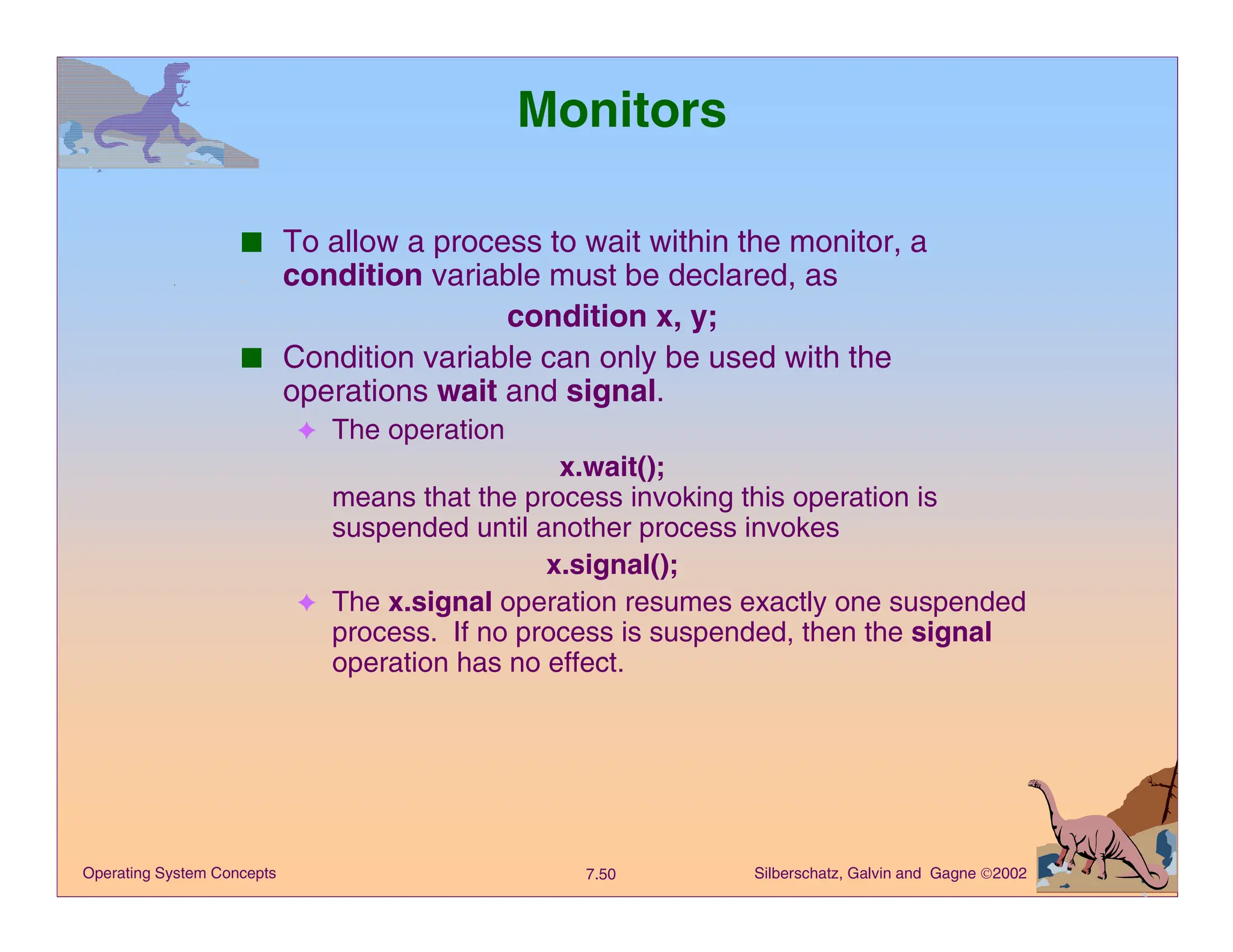
■ To allow a process to wait within the monitor, a
condition variable must be declared, as
condition x, y;
■ Condition variable can only be used with the
operations wait and signal.
✦ The operation
x.wait();
means that the process invoking this operation is
suspended until another process invokes
x.signal();
✦ The x.signal operation resumes exactly one suspended
process. If no process is suspended, then the signal
operation has no effect.
Silberschatz, Galvin and Gagne 2002
7.51
Operating System Concepts
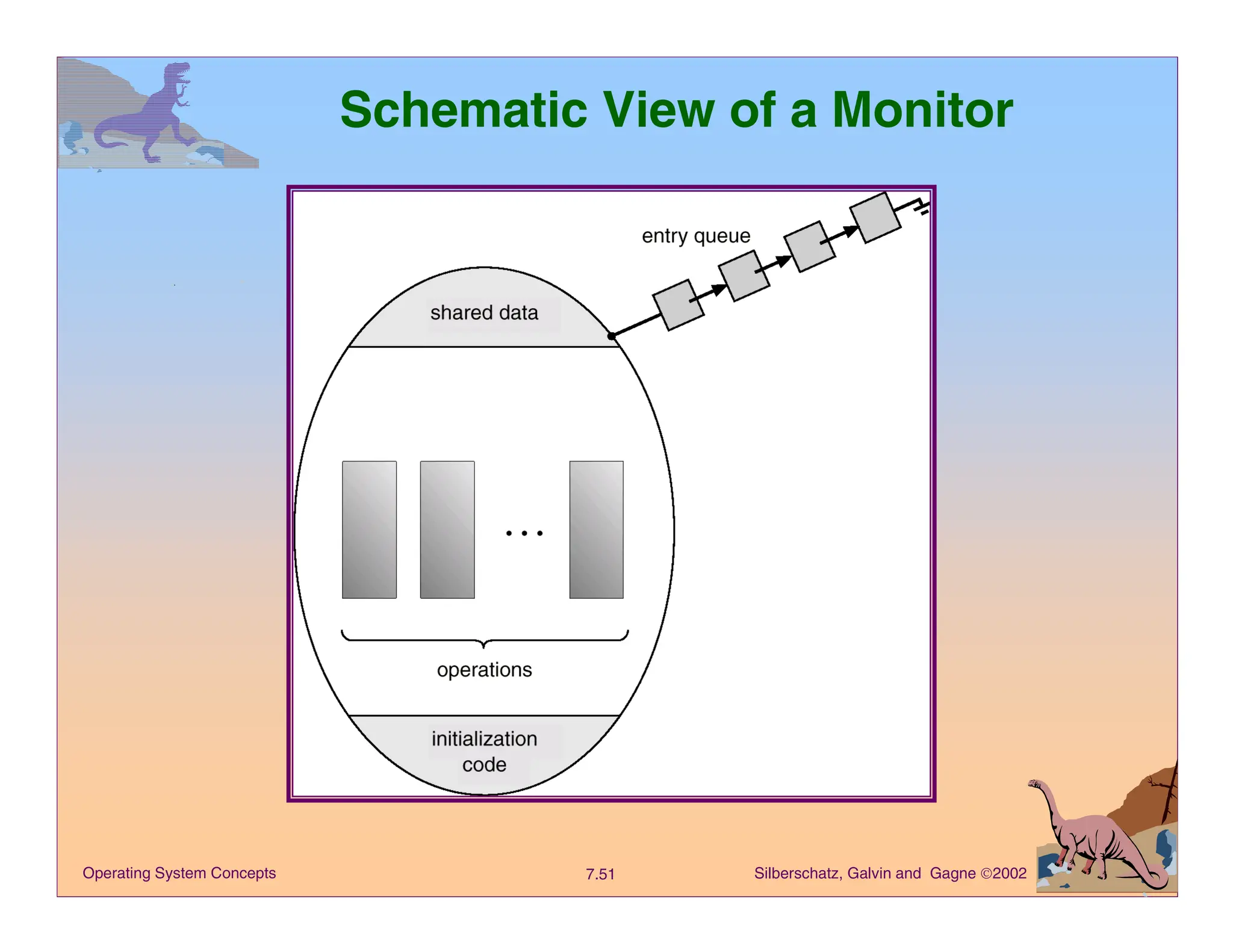
Schematic View of a Monitor
Silberschatz, Galvin and Gagne 2002
7.52
Operating System Concepts
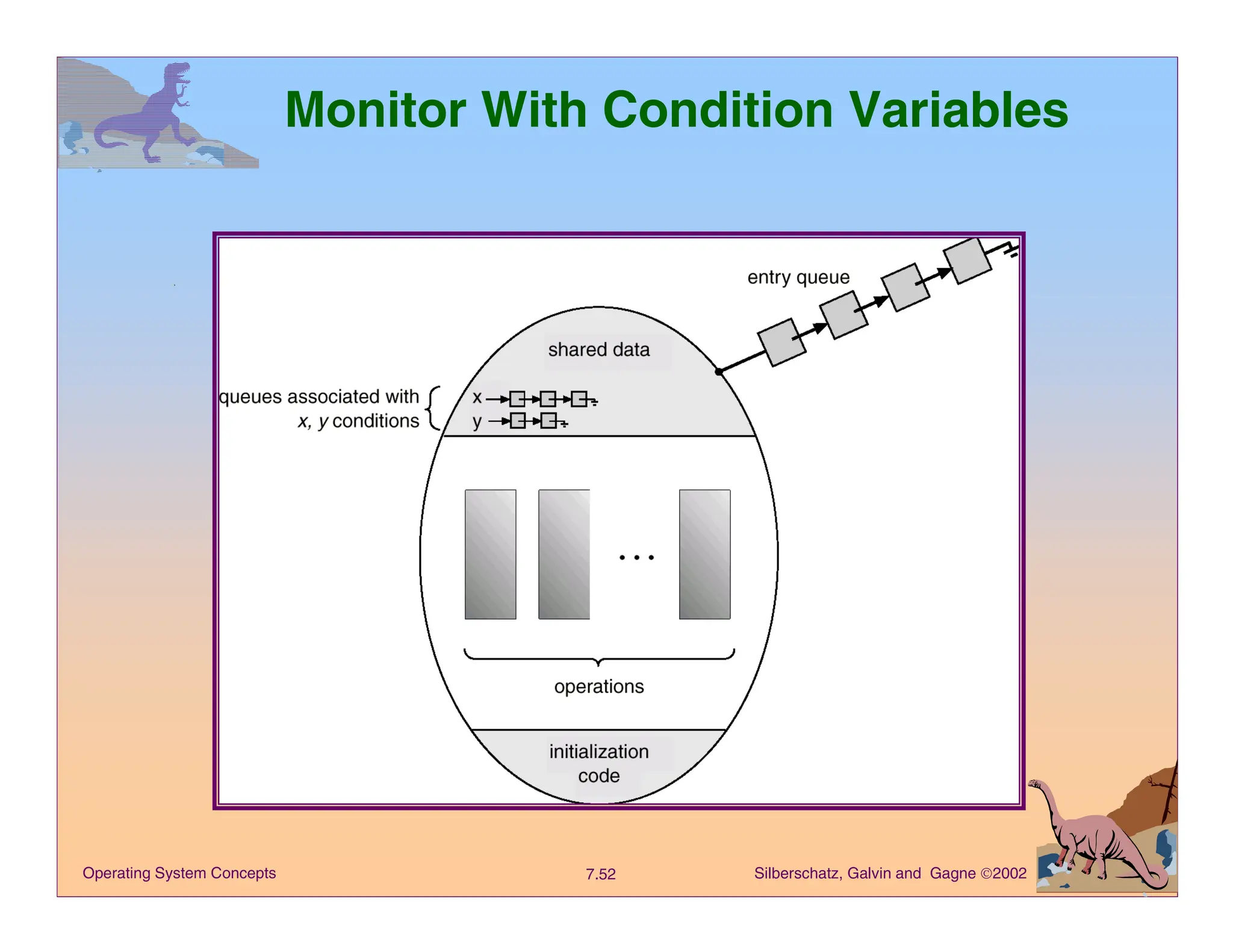
Monitor With Condition Variables
Silberschatz, Galvin and Gagne 2002
7.53
Operating System Concepts
Dining Philosophers Example
monitor dp
{
enum {thinking, hungry, eating} state[5];
condition self[5];
void pickup(int i) // following slides
void putdown(int i) // following slides
void test(int i) // following slides
void init() {
for (int i = 0; i < 5; i++)
state[i] = thinking;
}
}
Silberschatz, Galvin and Gagne 2002
7.54
Operating System Concepts
Dining Philosophers
void pickup(int i) {
state[i] = hungry;
test[i];
if (state[i] != eating)
self[i].wait();
}
void putdown(int i) {
state[i] = thinking;
// test left and right neighbors
test((i+4) % 5);
test((i+1) % 5);
}
Silberschatz, Galvin and Gagne 2002
7.55
Operating System Concepts
Dining Philosophers
void test(int i) {
if ( (state[(I + 4) % 5] != eating) &&
(state[i] == hungry) &&
(state[(i + 1) % 5] != eating)) {
state[i] = eating;
self[i].signal();
}
}
Silberschatz, Galvin and Gagne 2002
7.56
Operating System Concepts
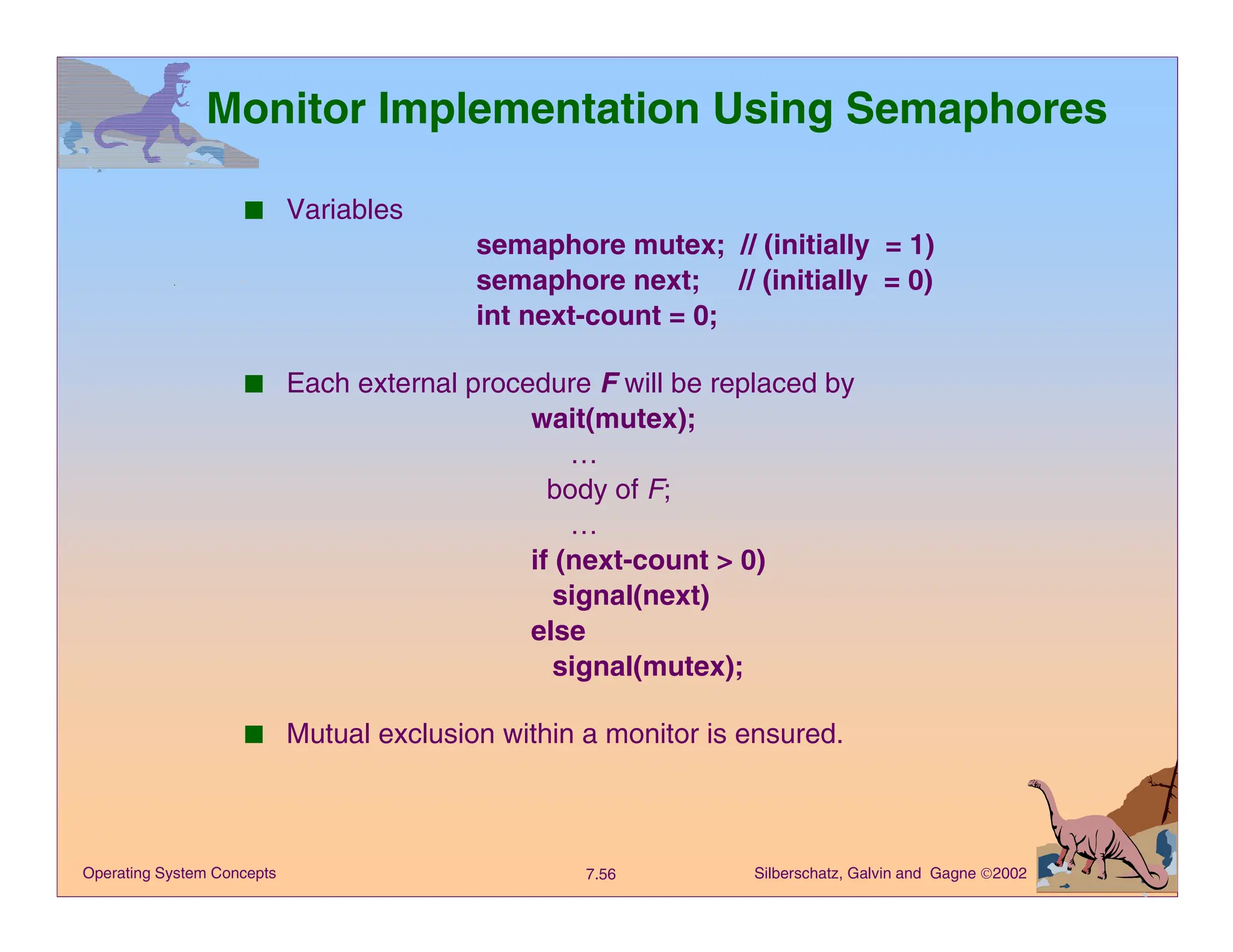
Monitor Implementation Using Semaphores
■ Variables
semaphore mutex; // (initially = 1)
semaphore next; // (initially = 0)
int next-count = 0;
■ Each external procedure F will be replaced by
wait(mutex);
…
body of F;
…
if (next-count > 0)
signal(next)
else
signal(mutex);
■ Mutual exclusion within a monitor is ensured.
Silberschatz, Galvin and Gagne 2002
7.57
Operating System Concepts
Monitor Implementation
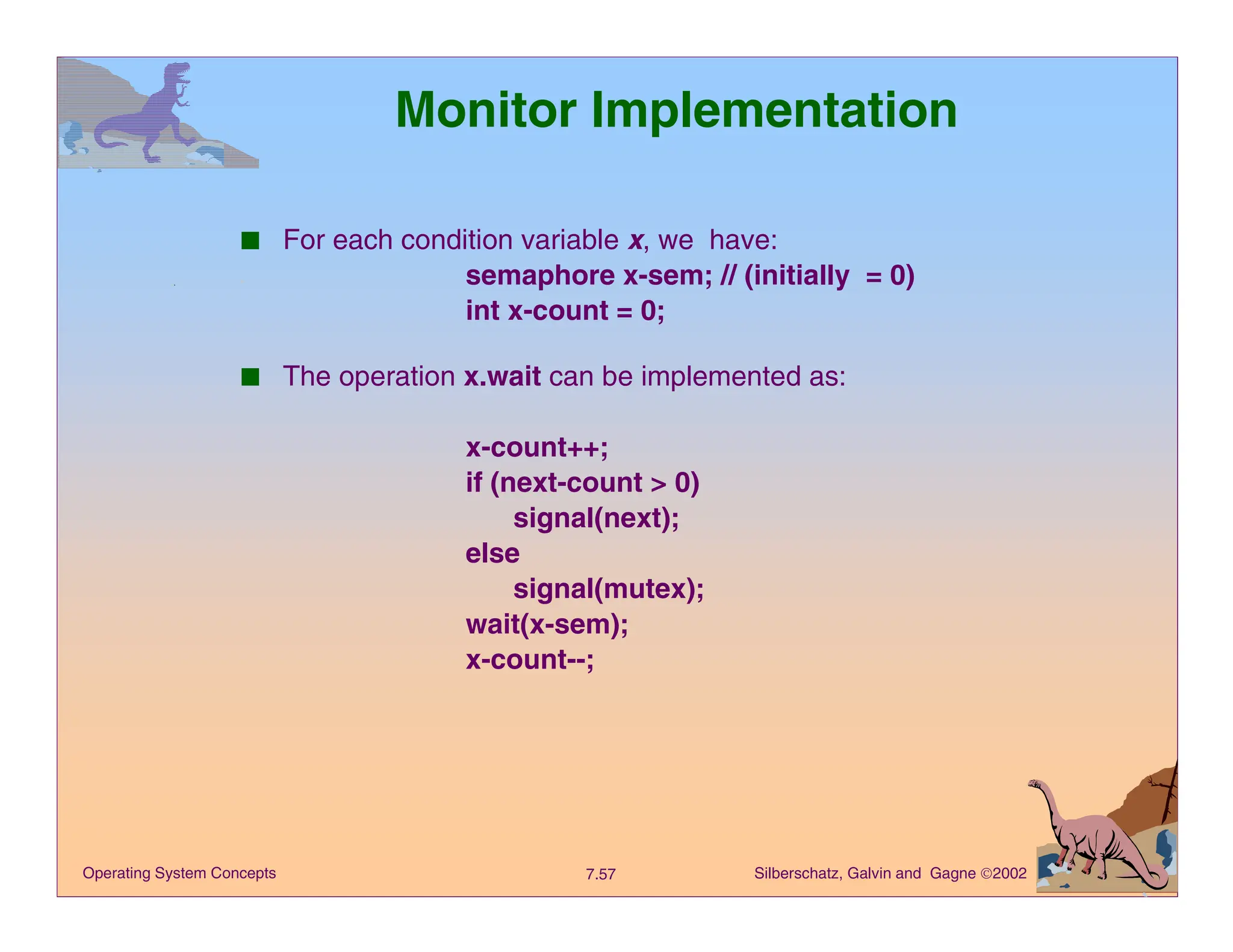
■ For each condition variable x, we have:
semaphore x-sem; // (initially = 0)
int x-count = 0;
■ The operation x.wait can be implemented as:
x-count++;
if (next-count > 0)
signal(next);
else
signal(mutex);
wait(x-sem);
x-count--;
Silberschatz, Galvin and Gagne 2002
7.58
Operating System Concepts
Monitor Implementation
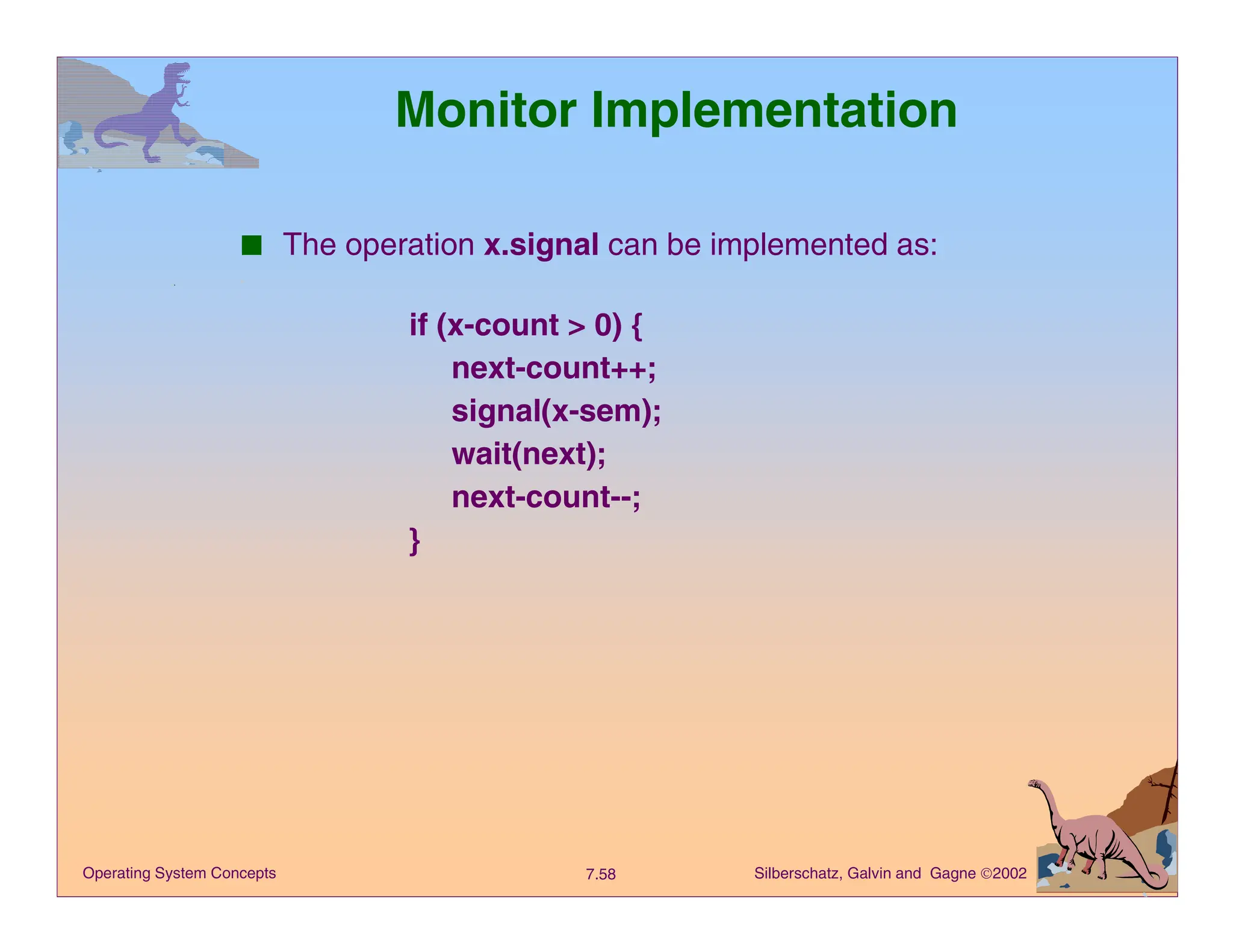
■ The operation x.signal can be implemented as:
if (x-count > 0) {
next-count++;
signal(x-sem);
wait(next);
next-count--;
}
Silberschatz, Galvin and Gagne 2002
7.59
Operating System Concepts
Monitor Implementation
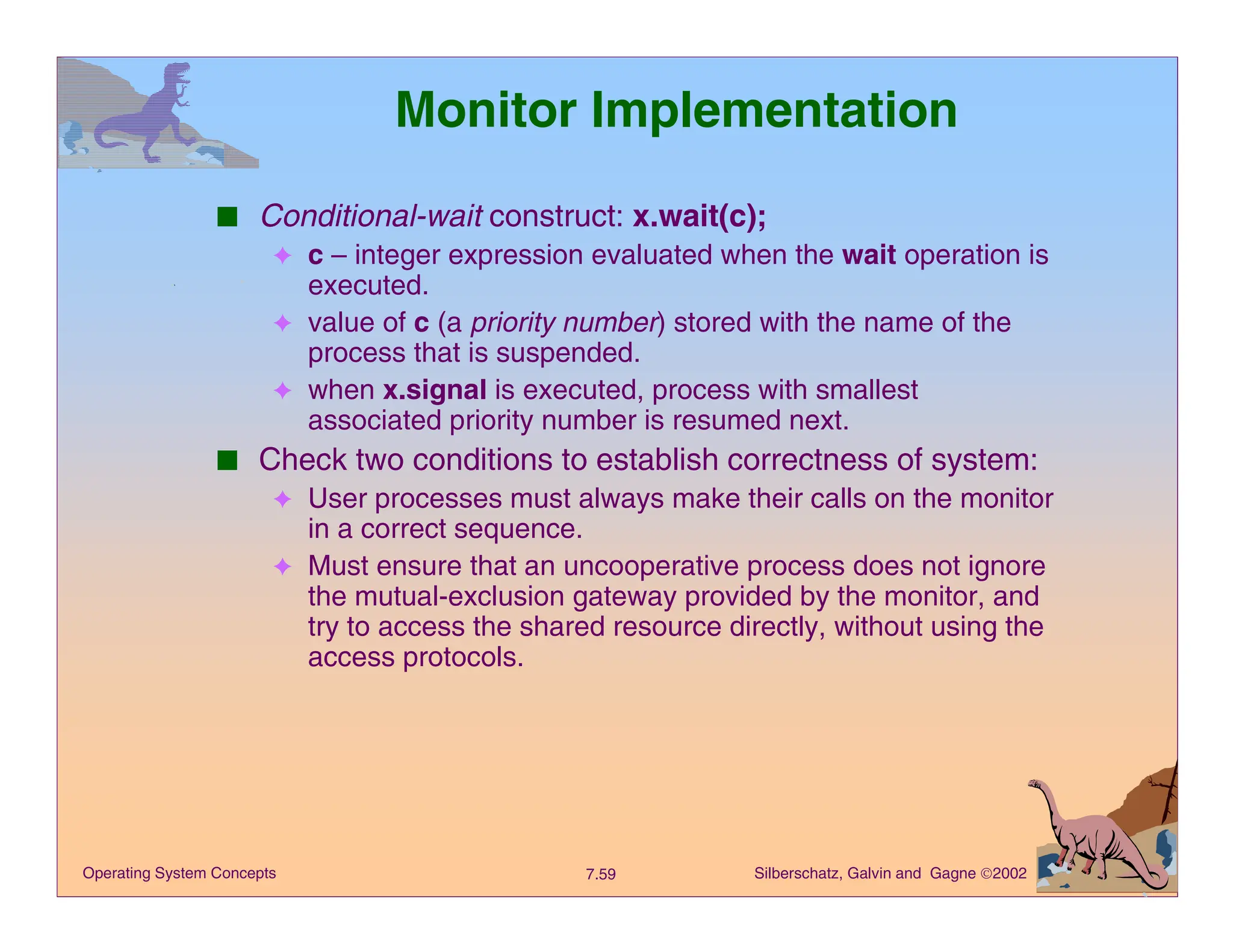
■ Conditional-wait construct: x.wait(c);
✦ c – integer expression evaluated when the wait operation is
executed.
✦ value of c (a priority number) stored with the name of the
process that is suspended.
✦ when x.signal is executed, process with smallest
associated priority number is resumed next.
■ Check two conditions to establish correctness of system:
✦ User processes must always make their calls on the monitor
in a correct sequence.
✦ Must ensure that an uncooperative process does not ignore
the mutual-exclusion gateway provided by the monitor, and
try to access the shared resource directly, without using the
access protocols.
Silberschatz, Galvin and Gagne 2002
7.60
Operating System Concepts
Solaris 2 Synchronization
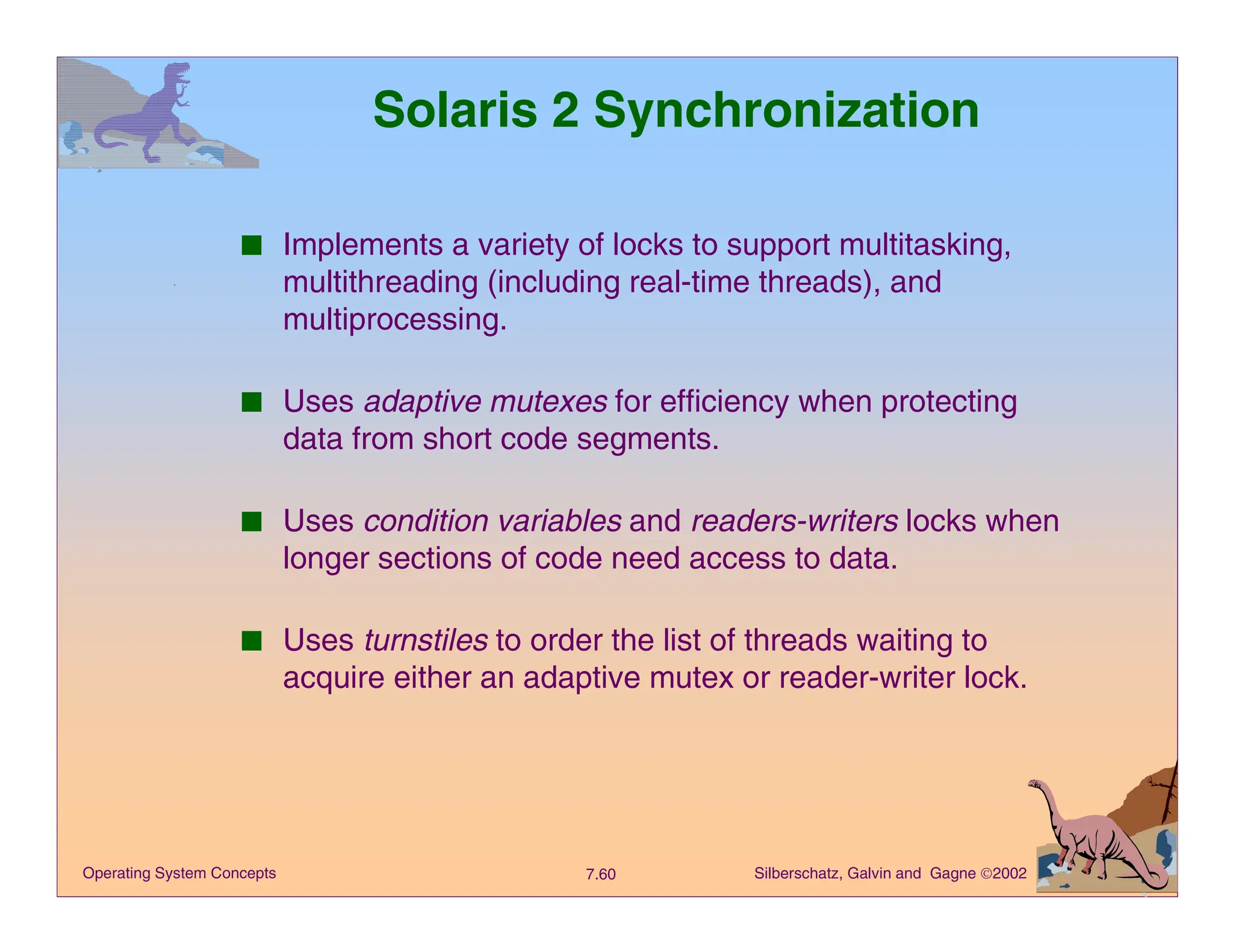
■ Implements a variety of locks to support multitasking,
multithreading (including real-time threads), and
multiprocessing.
■ Uses adaptive mutexes for efficiency when protecting
data from short code segments.
■ Uses condition variables and readers-writers locks when
longer sections of code need access to data.
■ Uses turnstiles to order the list of threads waiting to
acquire either an adaptive mutex or reader-writer lock.
Silberschatz, Galvin and Gagne 2002
7.61
Operating System Concepts
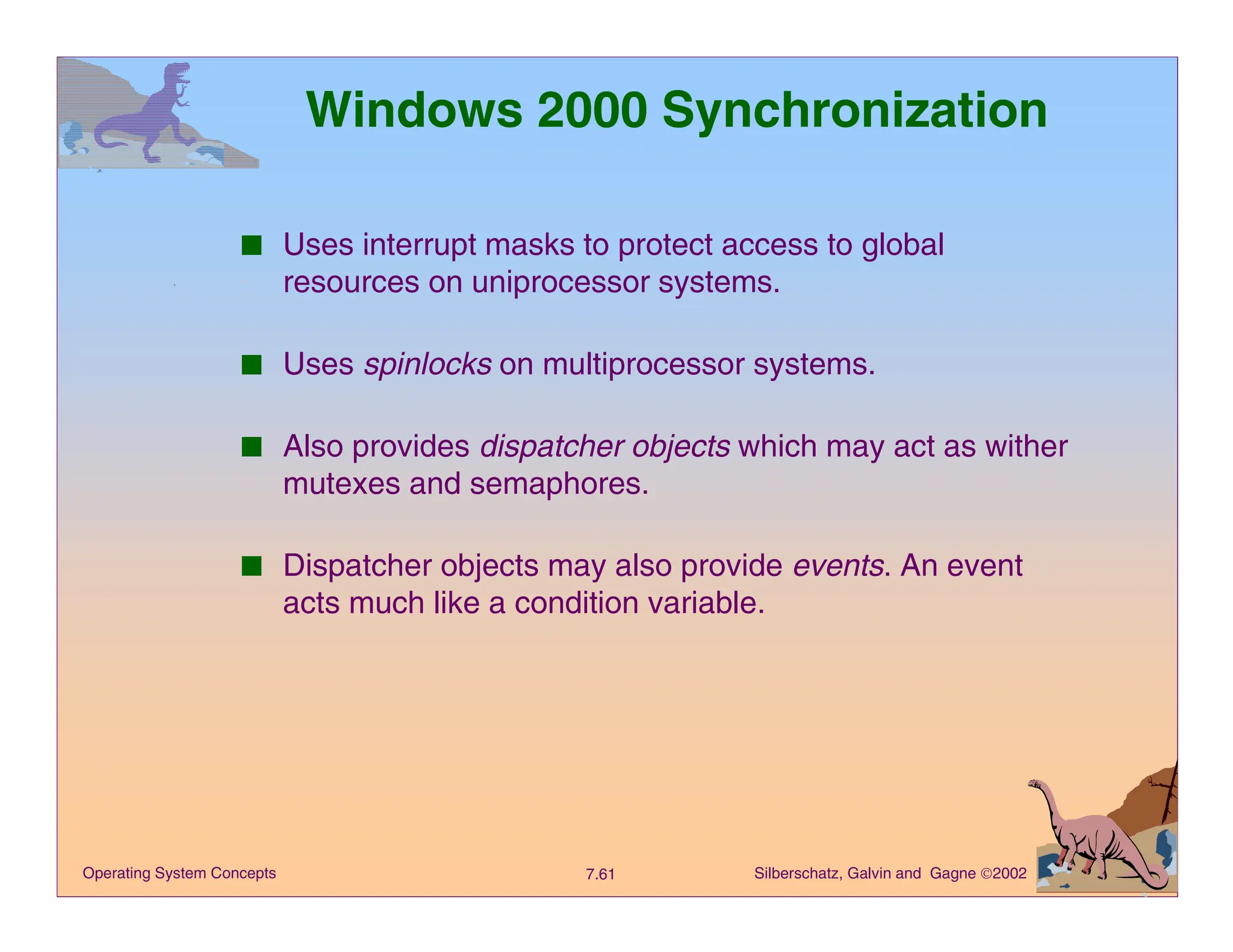
Windows 2000 Synchronization
■ Uses interrupt masks to protect access to global
resources on uniprocessor systems.
■ Uses spinlocks on multiprocessor systems.
■ Also provides dispatcher objects which may act as wither
mutexes and semaphores.
■ Dispatcher objects may also provide events. An event
acts much like a condition variable.

Module-3-Operating system process-COE.pdf

  • 1.
    Silberschatz, Galvin andGagne 2002 7.1 Operating System Concepts Chapter 7: Process Synchronization ■ Background ■ The Critical-Section Problem ■ Synchronization Hardware ■ Semaphores ■ Classical Problems of Synchronization ■ Critical Regions ■ Monitors ■ Synchronization in Solaris 2 & Windows 2000
  • 2.
    Silberschatz, Galvin andGagne 2002 7.2 Operating System Concepts Background ■ Concurrent access to shared data may result in data inconsistency. ■ Maintaining data consistency requires mechanisms to ensure the orderly execution of cooperating processes. ■ Shared-memory solution to bounded-butter problem (Chapter 4) allows at most n – 1 items in buffer at the same time. A solution, where all N buffers are used is not simple. ✦ Suppose that we modify the producer-consumer code by adding a variable counter, initialized to 0 and incremented each time a new item is added to the buffer
  • 3.
    Silberschatz, Galvin andGagne 2002 7.3 Operating System Concepts Bounded-Buffer ■ Shared data #define BUFFER_SIZE 10 typedef struct { . . . } item; item buffer[BUFFER_SIZE]; int in = 0; int out = 0; int counter = 0;
  • 4.
    Silberschatz, Galvin andGagne 2002 7.4 Operating System Concepts Bounded-Buffer ■ Producer process item nextProduced; while (1) { while (counter == BUFFER_SIZE) ; /* do nothing */ buffer[in] = nextProduced; in = (in + 1) % BUFFER_SIZE; counter++; }
  • 5.
    Silberschatz, Galvin andGagne 2002 7.5 Operating System Concepts Bounded-Buffer ■ Consumer process item nextConsumed; while (1) { while (counter == 0) ; /* do nothing */ nextConsumed = buffer[out]; out = (out + 1) % BUFFER_SIZE; counter--; }
  • 6.
    Silberschatz, Galvin andGagne 2002 7.6 Operating System Concepts Bounded Buffer ■ The statements counter++; counter--; must be performed atomically. ■ Atomic operation means an operation that completes in its entirety without interruption.
  • 7.
    Silberschatz, Galvin andGagne 2002 7.7 Operating System Concepts Bounded Buffer ■ The statement “count++” may be implemented in machine language as: register1 = counter register1 = register1 + 1 counter = register1 ■ The statement “count—” may be implemented as: register2 = counter register2 = register2 – 1 counter = register2
  • 8.
    Silberschatz, Galvin andGagne 2002 7.8 Operating System Concepts Bounded Buffer ■ If both the producer and consumer attempt to update the buffer concurrently, the assembly language statements may get interleaved. ■ Interleaving depends upon how the producer and consumer processes are scheduled.
  • 9.
    Silberschatz, Galvin andGagne 2002 7.9 Operating System Concepts Bounded Buffer ■ Assume counter is initially 5. One interleaving of statements is: producer: register1 = counter (register1 = 5) producer: register1 = register1 + 1 (register1 = 6) consumer: register2 = counter (register2 = 5) consumer: register2 = register2 – 1 (register2 = 4) producer: counter = register1 (counter = 6) consumer: counter = register2 (counter = 4) ■ The value of count may be either 4 or 6, where the correct result should be 5.
  • 10.
    Silberschatz, Galvin andGagne 2002 7.10 Operating System Concepts Race Condition ■ Race condition: The situation where several processes access – and manipulate shared data concurrently. The final value of the shared data depends upon which process finishes last. ■ To prevent race conditions, concurrent processes must be synchronized.
  • 11.
    Silberschatz, Galvin andGagne 2002 7.11 Operating System Concepts The Critical-Section Problem ■ n processes all competing to use some shared data ■ Each process has a code segment, called critical section, in which the shared data is accessed. ■ Problem – ensure that when one process is executing in its critical section, no other process is allowed to execute in its critical section.
  • 12.
    Silberschatz, Galvin andGagne 2002 7.12 Operating System Concepts Solution to Critical-Section Problem 1. Mutual Exclusion. If process Pi is executing in its critical section, then no other processes can be executing in their critical sections. 2. Progress. If no process is executing in its critical section and there exist some processes that wish to enter their critical section, then the selection of the processes that will enter the critical section next cannot be postponed indefinitely. 3. Bounded Waiting. A bound must exist on the number of times that other processes are allowed to enter their critical sections after a process has made a request to enter its critical section and before that request is granted. a Assume that each process executes at a nonzero speed a No assumption concerning relative speed of the n processes.
  • 13.
    Silberschatz, Galvin andGagne 2002 7.13 Operating System Concepts Initial Attempts to Solve Problem ■ Only 2 processes, P0 and P1 ■ General structure of process Pi (other process Pj) do { entry section critical section exit section reminder section } while (1); ■ Processes may share some common variables to synchronize their actions.
  • 14.
    Silberschatz, Galvin andGagne 2002 7.14 Operating System Concepts Algorithm 1 ■ Shared variables: ✦ int turn; initially turn = 0 ✦ turn - i Þ Pi can enter its critical section ■ Process Pi do { while (turn != i) ; critical section turn = j; reminder section } while (1); ■ Satisfies mutual exclusion, but not progress
  • 15.
    Silberschatz, Galvin andGagne 2002 7.15 Operating System Concepts Algorithm 2 ■ Shared variables ✦ boolean flag[2]; initially flag [0] = flag [1] = false. ✦ flag [i] = true Þ Pi ready to enter its critical section ■ Process Pi do { flag[i] := true; while (flag[j]) ; critical section flag [i] = false; remainder section } while (1); ■ Satisfies mutual exclusion, but not progress requirement.
  • 16.
    Silberschatz, Galvin andGagne 2002 7.16 Operating System Concepts Algorithm 3 ■ Combined shared variables of algorithms 1 and 2. ■ Process Pi do { flag [i]:= true; turn = j; while (flag [j] and turn = j) ; critical section flag [i] = false; remainder section } while (1); ■ Meets all three requirements; solves the critical-section problem for two processes.
  • 17.
    Silberschatz, Galvin andGagne 2002 7.17 Operating System Concepts Bakery Algorithm ■ Before entering its critical section, process receives a number. Holder of the smallest number enters the critical section. ■ If processes Pi and Pj receive the same number, if i < j, then Pi is served first; else Pj is served first. ■ The numbering scheme always generates numbers in increasing order of enumeration; i.e., 1,2,3,3,3,3,4,5... Critical section for n processes
  • 18.
    Silberschatz, Galvin andGagne 2002 7.18 Operating System Concepts Bakery Algorithm ■ Notation <≡ lexicographical order (ticket #, process id #) ✦ (a,b) < c,d) if a < c or if a = c and b < d ✦ max (a0,…, an-1) is a number, k, such that k ≥ ai for i - 0, …, n – 1 ■ Shared data boolean choosing[n]; int number[n]; Data structures are initialized to false and 0 respectively
  • 19.
    Silberschatz, Galvin andGagne 2002 7.19 Operating System Concepts Bakery Algorithm do { choosing[i] = true; number[i] = max(number[0], number[1], …, number [n – 1])+1; choosing[i] = false; for (j = 0; j < n; j++) { while (choosing[j]) ; while ((number[j] != 0) && (number[j,j] < number[i,i])) ; } critical section number[i] = 0; remainder section } while (1);
  • 20.
    Silberschatz, Galvin andGagne 2002 7.20 Operating System Concepts Synchronization Hardware ■ Test and modify the content of a word atomically . boolean TestAndSet(boolean &target) { boolean rv = target; tqrget = true; return rv; }
  • 21.
    Silberschatz, Galvin andGagne 2002 7.21 Operating System Concepts Mutual Exclusion with Test-and-Set ■ Shared data: boolean lock = false; ■ Process Pi do { while (TestAndSet(lock)) ; critical section lock = false; remainder section }
  • 22.
    Silberschatz, Galvin andGagne 2002 7.22 Operating System Concepts Synchronization Hardware ■ Atomically swap two variables. void Swap(boolean &a, boolean &b) { boolean temp = a; a = b; b = temp; }
  • 23.
    Silberschatz, Galvin andGagne 2002 7.23 Operating System Concepts Mutual Exclusion with Swap ■ Shared data (initialized to false): boolean lock; boolean waiting[n]; ■ Process Pi do { key = true; while (key == true) Swap(lock,key); critical section lock = false; remainder section }
  • 24.
    Silberschatz, Galvin andGagne 2002 7.24 Operating System Concepts Semaphores ■ Synchronization tool that does not require busy waiting. ■ Semaphore S – integer variable ■ can only be accessed via two indivisible (atomic) operations wait (S): while S≤ ≤ ≤ ≤ 0 do no-op; S--; signal (S): S++;
  • 25.
    Silberschatz, Galvin andGagne 2002 7.25 Operating System Concepts Critical Section of n Processes ■ Shared data: semaphore mutex; //initially mutex = 1 ■ Process Pi: do { wait(mutex); critical section signal(mutex); remainder section } while (1);
  • 26.
    Silberschatz, Galvin andGagne 2002 7.26 Operating System Concepts Semaphore Implementation ■ Define a semaphore as a record typedef struct { int value; struct process *L; } semaphore; ■ Assume two simple operations: ✦ block suspends the process that invokes it. ✦ wakeup(P) resumes the execution of a blocked process P.
  • 27.
    Silberschatz, Galvin andGagne 2002 7.27 Operating System Concepts Implementation ■ Semaphore operations now defined as wait(S): S.value--; if (S.value < 0) { add this process to S.L; block; } signal(S): S.value++; if (S.value <= 0) { remove a process P from S.L; wakeup(P); }
  • 28.
    Silberschatz, Galvin andGagne 2002 7.28 Operating System Concepts Semaphore as a General Synchronization Tool ■ Execute B in Pj only after A executed in Pi ■ Use semaphore flag initialized to 0 ■ Code: Pi Pj M M A wait(flag) signal(flag) B
  • 29.
    Silberschatz, Galvin andGagne 2002 7.29 Operating System Concepts Deadlock and Starvation ■ Deadlock – two or more processes are waiting indefinitely for an event that can be caused by only one of the waiting processes. ■ Let S and Q be two semaphores initialized to 1 P0 P1 wait(S); wait(Q); wait(Q); wait(S); M M signal(S); signal(Q); signal(Q) signal(S); ■ Starvation – indefinite blocking. A process may never be removed from the semaphore queue in which it is suspended.
  • 30.
    Silberschatz, Galvin andGagne 2002 7.30 Operating System Concepts Two Types of Semaphores ■ Counting semaphore – integer value can range over an unrestricted domain. ■ Binary semaphore – integer value can range only between 0 and 1; can be simpler to implement. ■ Can implement a counting semaphore S as a binary semaphore.
  • 31.
    Silberschatz, Galvin andGagne 2002 7.31 Operating System Concepts Implementing S as a Binary Semaphore ■ Data structures: binary-semaphore S1, S2; int C: ■ Initialization: S1 = 1 S2 = 0 C = initial value of semaphore S
  • 32.
    Silberschatz, Galvin andGagne 2002 7.32 Operating System Concepts Implementing S ■ wait operation wait(S1); C--; if (C < 0) { signal(S1); wait(S2); } signal(S1); ■ signal operation wait(S1); C ++; if (C <= 0) signal(S2); else signal(S1);
  • 33.
    Silberschatz, Galvin andGagne 2002 7.33 Operating System Concepts Classical Problems of Synchronization ■ Bounded-Buffer Problem ■ Readers and Writers Problem ■ Dining-Philosophers Problem
  • 34.
    Silberschatz, Galvin andGagne 2002 7.34 Operating System Concepts Bounded-Buffer Problem ■ Shared data semaphore full, empty, mutex; Initially: full = 0, empty = n, mutex = 1
  • 35.
    Silberschatz, Galvin andGagne 2002 7.35 Operating System Concepts Bounded-Buffer Problem Producer Process do { … produce an item in nextp … wait(empty); wait(mutex); … add nextp to buffer … signal(mutex); signal(full); } while (1);
  • 36.
    Silberschatz, Galvin andGagne 2002 7.36 Operating System Concepts Bounded-Buffer Problem Consumer Process do { wait(full) wait(mutex); … remove an item from buffer to nextc … signal(mutex); signal(empty); … consume the item in nextc … } while (1);
  • 37.
    Silberschatz, Galvin andGagne 2002 7.37 Operating System Concepts Readers-Writers Problem ■ Shared data semaphore mutex, wrt; Initially mutex = 1, wrt = 1, readcount = 0
  • 38.
    Silberschatz, Galvin andGagne 2002 7.38 Operating System Concepts Readers-Writers Problem Writer Process wait(wrt); … writing is performed … signal(wrt);
  • 39.
    Silberschatz, Galvin andGagne 2002 7.39 Operating System Concepts Readers-Writers Problem Reader Process wait(mutex); readcount++; if (readcount == 1) wait(rt); signal(mutex); … reading is performed … wait(mutex); readcount--; if (readcount == 0) signal(wrt); signal(mutex):
  • 40.
    Silberschatz, Galvin andGagne 2002 7.40 Operating System Concepts Dining-Philosophers Problem ■ Shared data semaphore chopstick[5]; Initially all values are 1
  • 41.
    Silberschatz, Galvin andGagne 2002 7.41 Operating System Concepts Dining-Philosophers Problem ■ Philosopher i: do { wait(chopstick[i]) wait(chopstick[(i+1) % 5]) … eat … signal(chopstick[i]); signal(chopstick[(i+1) % 5]); … think … } while (1);
  • 42.
    Silberschatz, Galvin andGagne 2002 7.42 Operating System Concepts Critical Regions ■ High-level synchronization construct ■ A shared variable v of type T, is declared as: v: shared T ■ Variable v accessed only inside statement region v when B do S where B is a boolean expression. ■ While statement S is being executed, no other process can access variable v.
  • 43.
    Silberschatz, Galvin andGagne 2002 7.43 Operating System Concepts Critical Regions ■ Regions referring to the same shared variable exclude each other in time. ■ When a process tries to execute the region statement, the Boolean expression B is evaluated. If B is true, statement S is executed. If it is false, the process is delayed until B becomes true and no other process is in the region associated with v.
  • 44.
    Silberschatz, Galvin andGagne 2002 7.44 Operating System Concepts Example – Bounded Buffer ■ Shared data: struct buffer { int pool[n]; int count, in, out; }
  • 45.
    Silberschatz, Galvin andGagne 2002 7.45 Operating System Concepts Bounded Buffer Producer Process ■ Producer process inserts nextp into the shared buffer region buffer when( count < n) { pool[in] = nextp; in:= (in+1) % n; count++; }
  • 46.
    Silberschatz, Galvin andGagne 2002 7.46 Operating System Concepts Bounded Buffer Consumer Process ■ Consumer process removes an item from the shared buffer and puts it in nextc region buffer when (count > 0) { nextc = pool[out]; out = (out+1) % n; count--; }
  • 47.
    Silberschatz, Galvin andGagne 2002 7.47 Operating System Concepts Implementation region x when B do S ■ Associate with the shared variable x, the following variables: semaphore mutex, first-delay, second-delay; int first-count, second-count; ■ Mutually exclusive access to the critical section is provided by mutex. ■ If a process cannot enter the critical section because the Boolean expression B is false, it initially waits on the first-delay semaphore; moved to the second-delay semaphore before it is allowed to reevaluate B.
  • 48.
    Silberschatz, Galvin andGagne 2002 7.48 Operating System Concepts Implementation ■ Keep track of the number of processes waiting on first- delay and second-delay, with first-count and second- count respectively. ■ The algorithm assumes a FIFO ordering in the queuing of processes for a semaphore. ■ For an arbitrary queuing discipline, a more complicated implementation is required.
  • 49.
    Silberschatz, Galvin andGagne 2002 7.49 Operating System Concepts Monitors ■ High-level synchronization construct that allows the safe sharing of an abstract data type among concurrent processes. monitor monitor-name { shared variable declarations procedure body P1 (…) { . . . } procedure body P2 (…) { . . . } procedure body Pn (…) { . . . } { initialization code } }
  • 50.
    Silberschatz, Galvin andGagne 2002 7.50 Operating System Concepts Monitors ■ To allow a process to wait within the monitor, a condition variable must be declared, as condition x, y; ■ Condition variable can only be used with the operations wait and signal. ✦ The operation x.wait(); means that the process invoking this operation is suspended until another process invokes x.signal(); ✦ The x.signal operation resumes exactly one suspended process. If no process is suspended, then the signal operation has no effect.
  • 51.
    Silberschatz, Galvin andGagne 2002 7.51 Operating System Concepts Schematic View of a Monitor
  • 52.
    Silberschatz, Galvin andGagne 2002 7.52 Operating System Concepts Monitor With Condition Variables
  • 53.
    Silberschatz, Galvin andGagne 2002 7.53 Operating System Concepts Dining Philosophers Example monitor dp { enum {thinking, hungry, eating} state[5]; condition self[5]; void pickup(int i) // following slides void putdown(int i) // following slides void test(int i) // following slides void init() { for (int i = 0; i < 5; i++) state[i] = thinking; } }
  • 54.
    Silberschatz, Galvin andGagne 2002 7.54 Operating System Concepts Dining Philosophers void pickup(int i) { state[i] = hungry; test[i]; if (state[i] != eating) self[i].wait(); } void putdown(int i) { state[i] = thinking; // test left and right neighbors test((i+4) % 5); test((i+1) % 5); }
  • 55.
    Silberschatz, Galvin andGagne 2002 7.55 Operating System Concepts Dining Philosophers void test(int i) { if ( (state[(I + 4) % 5] != eating) && (state[i] == hungry) && (state[(i + 1) % 5] != eating)) { state[i] = eating; self[i].signal(); } }
  • 56.
    Silberschatz, Galvin andGagne 2002 7.56 Operating System Concepts Monitor Implementation Using Semaphores ■ Variables semaphore mutex; // (initially = 1) semaphore next; // (initially = 0) int next-count = 0; ■ Each external procedure F will be replaced by wait(mutex); … body of F; … if (next-count > 0) signal(next) else signal(mutex); ■ Mutual exclusion within a monitor is ensured.
  • 57.
    Silberschatz, Galvin andGagne 2002 7.57 Operating System Concepts Monitor Implementation ■ For each condition variable x, we have: semaphore x-sem; // (initially = 0) int x-count = 0; ■ The operation x.wait can be implemented as: x-count++; if (next-count > 0) signal(next); else signal(mutex); wait(x-sem); x-count--;
  • 58.
    Silberschatz, Galvin andGagne 2002 7.58 Operating System Concepts Monitor Implementation ■ The operation x.signal can be implemented as: if (x-count > 0) { next-count++; signal(x-sem); wait(next); next-count--; }
  • 59.
    Silberschatz, Galvin andGagne 2002 7.59 Operating System Concepts Monitor Implementation ■ Conditional-wait construct: x.wait(c); ✦ c – integer expression evaluated when the wait operation is executed. ✦ value of c (a priority number) stored with the name of the process that is suspended. ✦ when x.signal is executed, process with smallest associated priority number is resumed next. ■ Check two conditions to establish correctness of system: ✦ User processes must always make their calls on the monitor in a correct sequence. ✦ Must ensure that an uncooperative process does not ignore the mutual-exclusion gateway provided by the monitor, and try to access the shared resource directly, without using the access protocols.
  • 60.
    Silberschatz, Galvin andGagne 2002 7.60 Operating System Concepts Solaris 2 Synchronization ■ Implements a variety of locks to support multitasking, multithreading (including real-time threads), and multiprocessing. ■ Uses adaptive mutexes for efficiency when protecting data from short code segments. ■ Uses condition variables and readers-writers locks when longer sections of code need access to data. ■ Uses turnstiles to order the list of threads waiting to acquire either an adaptive mutex or reader-writer lock.
  • 61.
    Silberschatz, Galvin andGagne 2002 7.61 Operating System Concepts Windows 2000 Synchronization ■ Uses interrupt masks to protect access to global resources on uniprocessor systems. ■ Uses spinlocks on multiprocessor systems. ■ Also provides dispatcher objects which may act as wither mutexes and semaphores. ■ Dispatcher objects may also provide events. An event acts much like a condition variable.