Name of Institution


Module II – (Traditional Media)
Introduction to traditional media


                                                          1
Name of Institution

         Introduction to traditional media
• The boom of electronic media cannot undermine the
  significance of folk media. These arts or media assume
  more significance in a country of villages like india.
• The alien electronic media can fail to impress upon the
  rural poor, the print media may be out rightly rejected by
  illiterate or semi-literate people but not the traditional/folk
  media as they have lived with us over the centuries.
• They are close to people’s hearts, therefore, have the
  direct-to-heart power of transmitting the messages.
• The folk arts deserve to be called the mediums of mass-
  communication.
• Folklores have been inextricably interwoven in our
                                                                         2
Name of Institution

        Introduction to traditional media
• culture since time immemorial to communicate with us
  on socio-religious issues.
• They attract and appeal masses with effective and
  idiosyncratic way of communication.
The folklores possess the following pre-requisites of being
  called a medium of mass-communication:
 The message (the theme of the presentation),
 The sender (folk artist),
 The receiver (audience),
 Common platform: The audience of the folklore are on
  the same platform at the same time, receiving the same
  message through same channel,
                                                                     3
Name of Institution

        Introduction to traditional media
 The feedback (applause or whistle of the public to
  appreciate the presentation)
 The channel, which can be diverse as per the kind of the
  concerned folklore.
That is why; we construe folklore as a mass media. In a
  country like ours where majority lives in villages, the
  effectiveness of the folk medium cannot be ignored.
• The folk media, that are basically the mediums of
  entertainment, are now being seen as ‘edutainment’, that
  is, a combination of education and entertainment.
• The development needs of our country in view of
  rampant poverty, ignorance and illiteracy have led to the
                                                                    4
Name of Institution

        Introduction to traditional media
revival of folklores as an effective means of communicating
  with the poor and illiterate masses who are in majority
  and who cannot afford mechanical devices.
Developments:
• The development thinkers and policy makers have been
  emphasizing folklore to be included in social marketing
  as its essential element.
• Innumerable voluntary organizations of our country have
  been using folk media to communicate with the rural
  masses on development issues.
• Not only voluntary organizations even government is
  also trying to make effective use of folk media on
  different issues.                                                  5
Name of Institution

        Introduction to traditional media
• The National Council for Science and Technology
  Communication (NCSTC), Department of Science and
  Technology, Government of India, has introduced the art
  of puppetry for popularizing science and technology
  communication in the masses
• The National Literacy Mission also uses folk media in
  order to sensitize the rural people on the issue of
  education
• Two departments under the Ministry of Information and
  Broadcasting, viz., Directorate of Field Publicity and
  Song and Drama Division invariably use all the mediums
  of folklore to transmit the message of public welfare,
  development and government’s policies especially to the
                                                                    6
Name of Institution

         Introduction to traditional media
rural people. Be it health or hygiene, literacy or rights of
   people; messages are easily got through to rural folk by
   these departments with the help of puppetry, Nukkad
   Nataks, songs, dramas and dances apart from
   organizing melas and exhibitions.


                                                                       7
Name of Institution

         Introduction to traditional media
Following qualities of folk media make it distinct from other
   mediums of communication:
1. These mediums are a part of our culture, close to the
   heart of the people.
2. Because of flexibility, the folk medium can be moulded
   as per the need and situation.
3. Integration of local language, local ways of life, local
   customs etc. leaving a lasting impact on the minds f the
   people.
4. The colorful presentations attract people easily.
5. The folk media are usually economic unlike radio and
   TV.
6. People have an easy access to these mediums in                      8
Name of Institution

         Introduction to traditional media
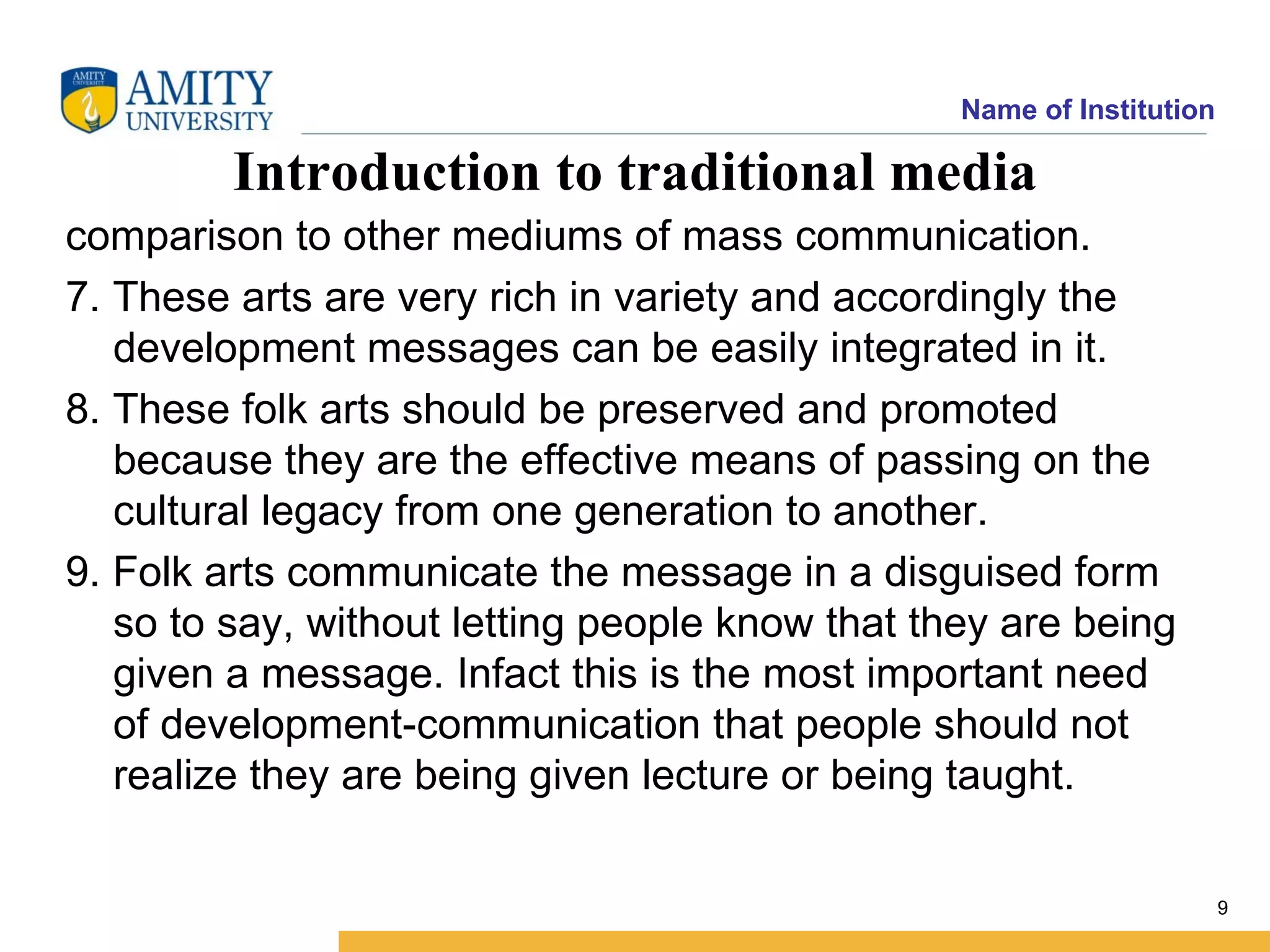
comparison to other mediums of mass communication.
7. These arts are very rich in variety and accordingly the
   development messages can be easily integrated in it.
8. These folk arts should be preserved and promoted
   because they are the effective means of passing on the
   cultural legacy from one generation to another.
9. Folk arts communicate the message in a disguised form
   so to say, without letting people know that they are being
   given a message. Infact this is the most important need
   of development-communication that people should not
   realize they are being given lecture or being taught.

                                                                       9
Name of Institution

         Introduction to traditional media
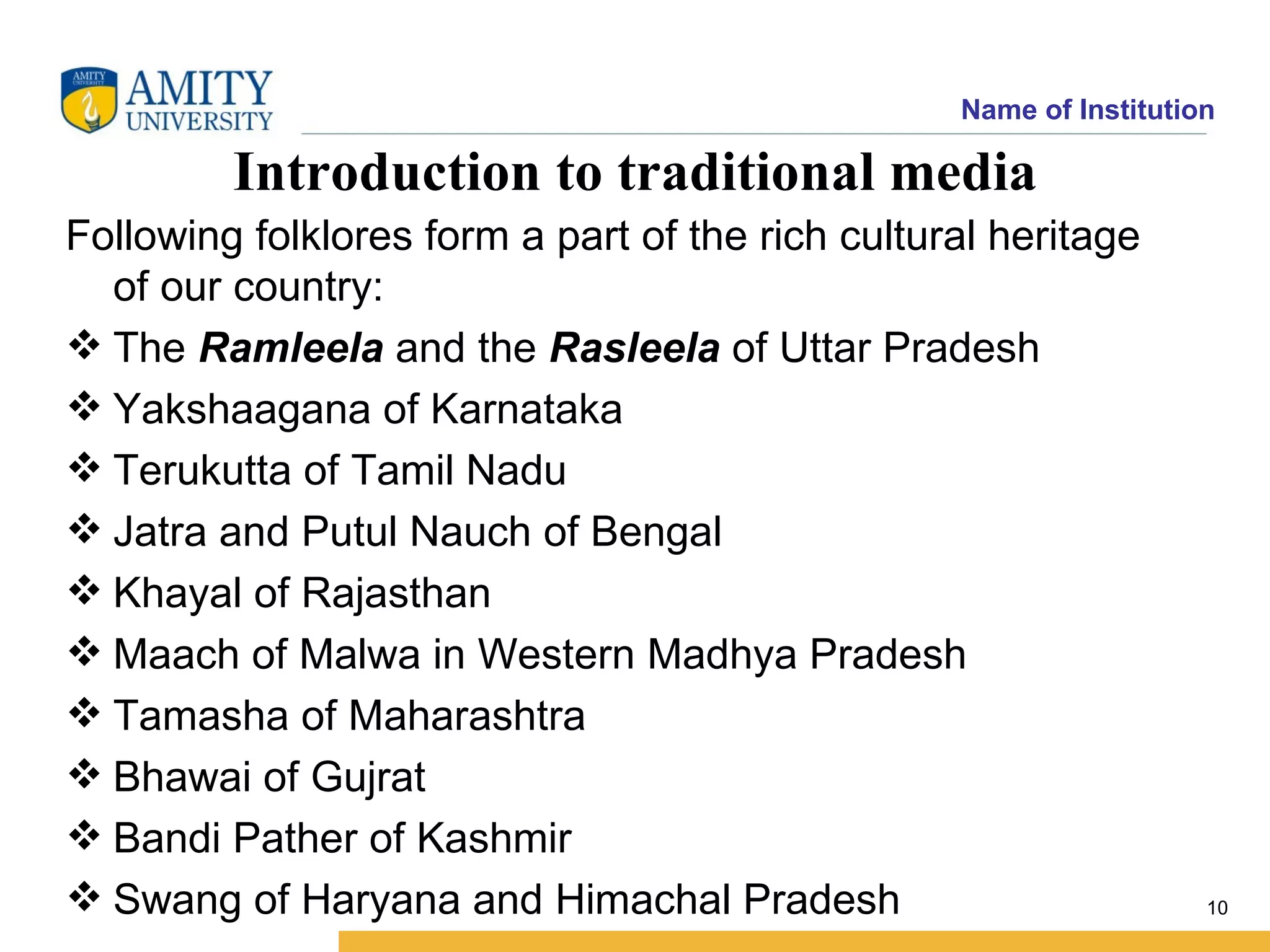
Following folklores form a part of the rich cultural heritage
  of our country:
 The Ramleela and the Rasleela of Uttar Pradesh
 Yakshaagana of Karnataka
 Terukutta of Tamil Nadu
 Jatra and Putul Nauch of Bengal
 Khayal of Rajasthan
 Maach of Malwa in Western Madhya Pradesh
 Tamasha of Maharashtra
 Bhawai of Gujrat
 Bandi Pather of Kashmir
 Swang of Haryana and Himachal Pradesh                             10
Name of Institution

         Introduction to traditional media
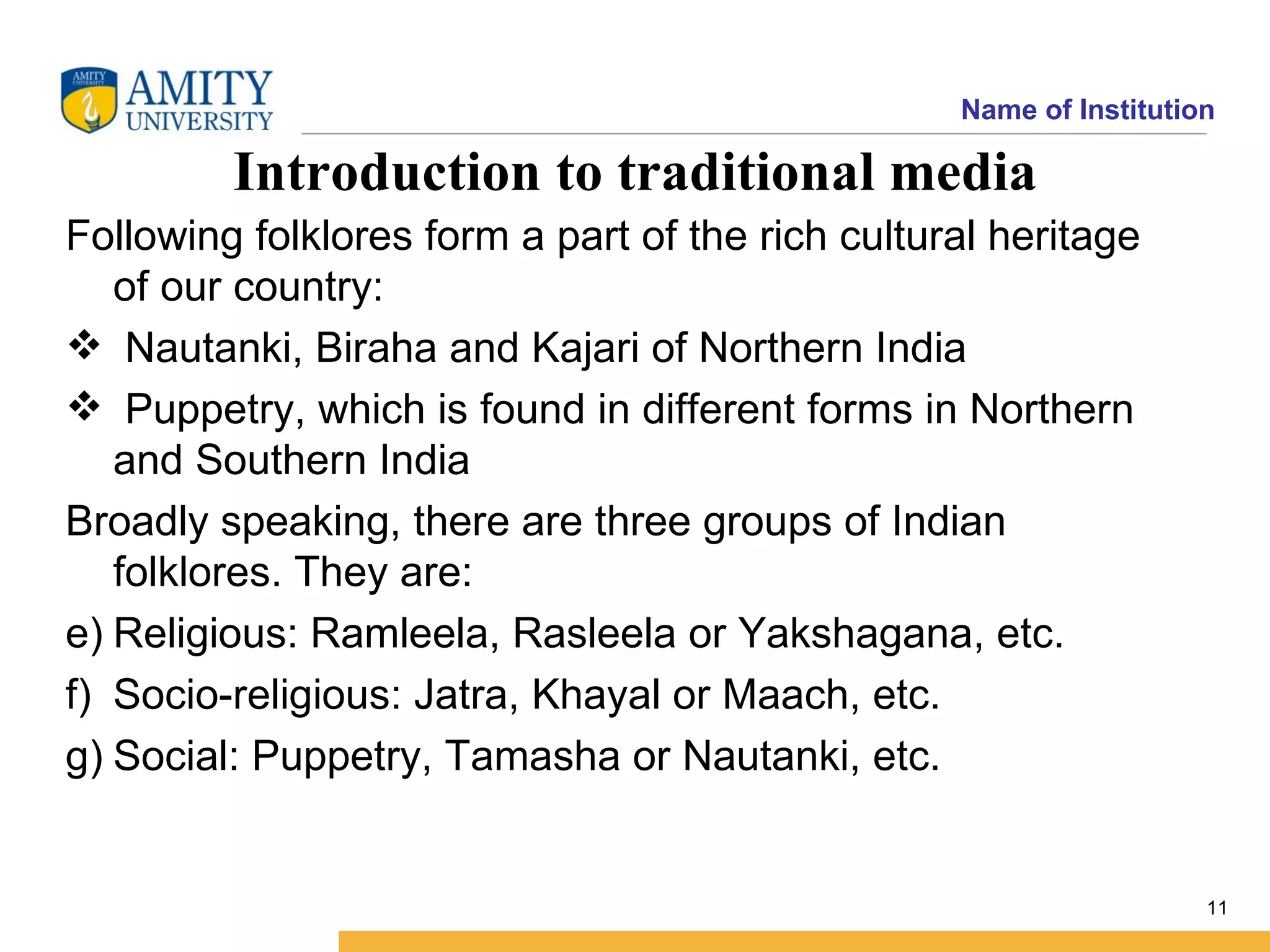
Following folklores form a part of the rich cultural heritage
   of our country:
 Nautanki, Biraha and Kajari of Northern India
 Puppetry, which is found in different forms in Northern
   and Southern India
Broadly speaking, there are three groups of Indian
   folklores. They are:
e) Religious: Ramleela, Rasleela or Yakshagana, etc.
f) Socio-religious: Jatra, Khayal or Maach, etc.
g) Social: Puppetry, Tamasha or Nautanki, etc.


                                                                    11

Module 2 (Intro to traditional media) Zakia Ma'am

  • 1.
    Name of Institution ModuleII – (Traditional Media) Introduction to traditional media 1
  • 2.
    Name of Institution Introduction to traditional media • The boom of electronic media cannot undermine the significance of folk media. These arts or media assume more significance in a country of villages like india. • The alien electronic media can fail to impress upon the rural poor, the print media may be out rightly rejected by illiterate or semi-literate people but not the traditional/folk media as they have lived with us over the centuries. • They are close to people’s hearts, therefore, have the direct-to-heart power of transmitting the messages. • The folk arts deserve to be called the mediums of mass- communication. • Folklores have been inextricably interwoven in our 2
  • 3.
    Name of Institution Introduction to traditional media • culture since time immemorial to communicate with us on socio-religious issues. • They attract and appeal masses with effective and idiosyncratic way of communication. The folklores possess the following pre-requisites of being called a medium of mass-communication:  The message (the theme of the presentation),  The sender (folk artist),  The receiver (audience),  Common platform: The audience of the folklore are on the same platform at the same time, receiving the same message through same channel, 3
  • 4.
    Name of Institution Introduction to traditional media  The feedback (applause or whistle of the public to appreciate the presentation)  The channel, which can be diverse as per the kind of the concerned folklore. That is why; we construe folklore as a mass media. In a country like ours where majority lives in villages, the effectiveness of the folk medium cannot be ignored. • The folk media, that are basically the mediums of entertainment, are now being seen as ‘edutainment’, that is, a combination of education and entertainment. • The development needs of our country in view of rampant poverty, ignorance and illiteracy have led to the 4
  • 5.
    Name of Institution Introduction to traditional media revival of folklores as an effective means of communicating with the poor and illiterate masses who are in majority and who cannot afford mechanical devices. Developments: • The development thinkers and policy makers have been emphasizing folklore to be included in social marketing as its essential element. • Innumerable voluntary organizations of our country have been using folk media to communicate with the rural masses on development issues. • Not only voluntary organizations even government is also trying to make effective use of folk media on different issues. 5
  • 6.
    Name of Institution Introduction to traditional media • The National Council for Science and Technology Communication (NCSTC), Department of Science and Technology, Government of India, has introduced the art of puppetry for popularizing science and technology communication in the masses • The National Literacy Mission also uses folk media in order to sensitize the rural people on the issue of education • Two departments under the Ministry of Information and Broadcasting, viz., Directorate of Field Publicity and Song and Drama Division invariably use all the mediums of folklore to transmit the message of public welfare, development and government’s policies especially to the 6
  • 7.
    Name of Institution Introduction to traditional media rural people. Be it health or hygiene, literacy or rights of people; messages are easily got through to rural folk by these departments with the help of puppetry, Nukkad Nataks, songs, dramas and dances apart from organizing melas and exhibitions. 7
  • 8.
    Name of Institution Introduction to traditional media Following qualities of folk media make it distinct from other mediums of communication: 1. These mediums are a part of our culture, close to the heart of the people. 2. Because of flexibility, the folk medium can be moulded as per the need and situation. 3. Integration of local language, local ways of life, local customs etc. leaving a lasting impact on the minds f the people. 4. The colorful presentations attract people easily. 5. The folk media are usually economic unlike radio and TV. 6. People have an easy access to these mediums in 8
  • 9.
    Name of Institution Introduction to traditional media comparison to other mediums of mass communication. 7. These arts are very rich in variety and accordingly the development messages can be easily integrated in it. 8. These folk arts should be preserved and promoted because they are the effective means of passing on the cultural legacy from one generation to another. 9. Folk arts communicate the message in a disguised form so to say, without letting people know that they are being given a message. Infact this is the most important need of development-communication that people should not realize they are being given lecture or being taught. 9
  • 10.
    Name of Institution Introduction to traditional media Following folklores form a part of the rich cultural heritage of our country:  The Ramleela and the Rasleela of Uttar Pradesh  Yakshaagana of Karnataka  Terukutta of Tamil Nadu  Jatra and Putul Nauch of Bengal  Khayal of Rajasthan  Maach of Malwa in Western Madhya Pradesh  Tamasha of Maharashtra  Bhawai of Gujrat  Bandi Pather of Kashmir  Swang of Haryana and Himachal Pradesh 10
  • 11.
    Name of Institution Introduction to traditional media Following folklores form a part of the rich cultural heritage of our country:  Nautanki, Biraha and Kajari of Northern India  Puppetry, which is found in different forms in Northern and Southern India Broadly speaking, there are three groups of Indian folklores. They are: e) Religious: Ramleela, Rasleela or Yakshagana, etc. f) Socio-religious: Jatra, Khayal or Maach, etc. g) Social: Puppetry, Tamasha or Nautanki, etc. 11

Editor's Notes

  • #2 Amity Business School