MODULE 2
DESIGN ANALYSIS AND ALGORITHMS
CREATED AND NARRATED BY – ARYANVARSHNEYA(18BCE10064)
INDEX • Brute Force Approach
String Matching
• Analysis of Linear Search
• Divide and Conquer
Merge Sort
• Strassen’s Matrix Multiplication
• Analysis of Binary Search
• Decrease and Conquer
Brute Force
Approach
• Brute force - the simplest of the design strategies
• Is a straightforward approach to solving a problem,
usually directly based on the problem’s statement and
definitions of the concepts involved.
• Just do it - the brute-force strategy is easiest to apply.
• Results in an algorithm that can be improved with a
modest amount of time.
• Brute force is important due to its wide applicability
and simplicity.
• Weakness is subpar efficiency of most brute-force
algorithms.
• Important examples:
• – Selection sort, String matching,Convex-hull
problem, and Exhaustive search
BFA:
String
Matching
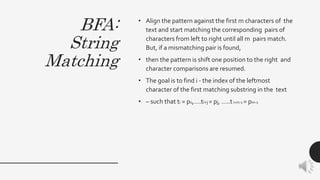
• Align the pattern against the first m characters of the
text and start matching the corresponding pairs of
characters from left to right until all m pairs match.
But, if a mismatching pair is found,
• then the pattern is shift one position to the right and
character comparisons are resumed.
• The goal is to find i - the index of the leftmost
character of the first matching substring in the text
• – such that ti = p0,….ti+j = pj, …..ti+m-1 = pm-1
BFA:
String
Matching
(Cont…)
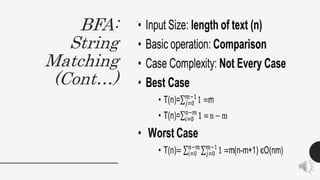
• Algorithm BruteForceStringMatching (T[0..n - 1],
P[0..m - 1])
• //Implements string matching
• //Input:An arrayT[0..n - 1] of n characters representing
a text
• // an array P[0..m - 1] of m characters representing a
pattern
• //Output:The position of the first character in the text
that starts the first
• // matching substring if the search is successful and -1
otherwise.
• for i ← 0 to n - m do j ← 0
• while j < m and P[j] =T[i + j] do j ← j + 1
• if j = m return i return -1
.
BFA:
String
Matching
(Cont…)
Linear
Search
Example
element
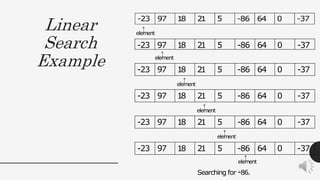
-23 97 18 21 5 -86 64 0 -37
-23 97 18 21 5 -86 64 0 -37
-23 97 18 21 5 -86 64 0 -37
-23 97 18 21 5 -86 64 0 -37
-23 97 18 21 5 -86 64 0 -37
element
element
element
element
element
Searching for -86.
Analysis
of
Linear
Search
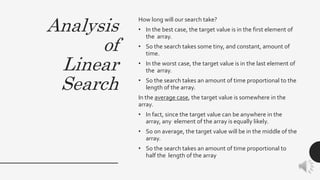
How long will our search take?
• In the best case, the target value is in the first element of
the array.
• So the search takes some tiny, and constant, amount of
time.
• In the worst case, the target value is in the last element of
the array.
• So the search takes an amount of time proportional to the
length of the array.
In the average case, the target value is somewhere in the
array.
• In fact, since the target value can be anywhere in the
array, any element of the array is equally likely.
• So on average, the target value will be in the middle of the
array.
• So the search takes an amount of time proportional to
half the length of the array
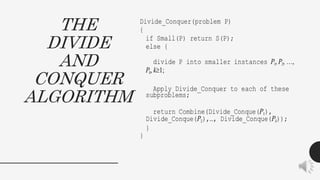
Divide
and
Conquer
The most well known algorithm design
strategy:
• Divide the problem into two or more
smaller subproblems.
• Conquer the subproblems by solving
them recursively.
• Combine the solutions to the
subproblems into the solutions for the
original problem.
THE
DIVIDE
AND
CONQUER
ALGORITHM
Divide
and
Conquer:
Merge Sort
The merge sort algorithm works from “the bottom up”
• start by solving the smallest pieces of the main problem
• keep combining their results into larger solutions
• eventually the original problem will be solved
Sort into nondecreasing order
[25][57][48][37][12][92][86][33]
pass 1
[25 57][37 48][12 92][33 86]
pass 2
[25 37 48 57][12 33 86 92]
pass 3
[12 25 33 37 48 57 86 92]
• log2n passes are required.
• time complexity: O(nlogn)
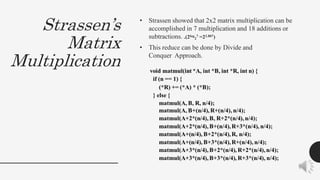
Strassen’s
Matrix
Multiplication
• Strassen showed that 2x2 matrix multiplication can be
accomplished in 7 multiplication and 18 additions or
subtractions. .(2log
2
7 =22.807)
• This reduce can be done by Divide and
Conquer Approach.
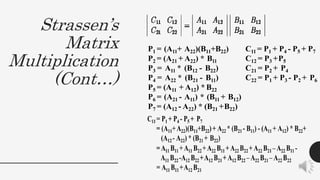
Strassen’s
Matrix
Multiplication
(Cont…)
P1 = (A11+ A22)(B11+B22)
P2 = (A21 + A22) * B11
P3 = A11 * (B12 - B22)
P4 = A22 * (B21 - B11)
P5 = (A11 + A12) * B22
P6 = (A21 - A11) * (B11 + B12)
P7 = (A12 - A22) * (B21 +B22)
C11 = P1 + P4 - P5 + P7
C12 = P3 +P5
C21 = P2 + P4
C22 = P1 + P3 - P2 + P6
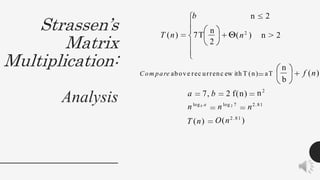
Strassen’s
Matrix
Multiplication:
Analysis
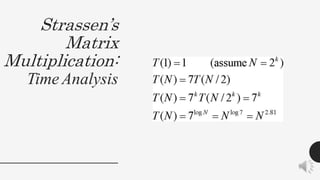
n 2
(n2
) n 2T (n) 7T
n
2
b
f (n)Com pare above rec urrenc ew ith T (n) aT
n
b
n2
n2.81
nlog 2 7
O(n2.81
)
a 7, b 2 f(n)
nlog b a
T (n)
Strassen’s
Matrix
Multiplication:
Time Analysis
Analysis
of
Binary
Search
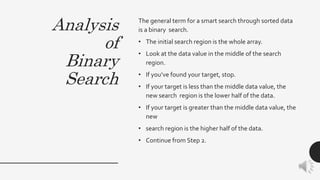
The general term for a smart search through sorted data
is a binary search.
• The initial search region is the whole array.
• Look at the data value in the middle of the search
region.
• If you’ve found your target, stop.
• If your target is less than the middle data value, the
new search region is the lower half of the data.
• If your target is greater than the middle data value, the
new
• search region is the higher half of the data.
• Continue from Step 2.
Binary
Search
Example
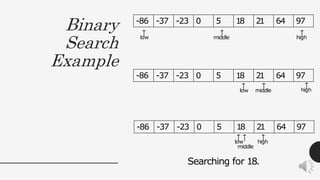
low
Searching for 18.
middle high
-86 -37 -23 0 5 18 21 64 97
-86 -37 -23 0 5 18 21 64 97
low middle high
-86 -37 -23 0 5 18 21 64 97
low
middle
high
Analysis
of
Binary
Search:
Time
Complexity
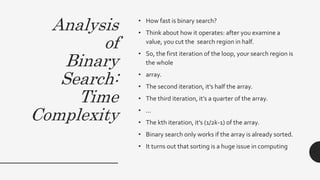
• How fast is binary search?
• Think about how it operates: after you examine a
value, you cut the search region in half.
• So, the first iteration of the loop, your search region is
the whole
• array.
• The second iteration, it’s half the array.
• The third iteration, it’s a quarter of the array.
• ...
• The kth iteration, it’s (1/2k-1) of the array.
• Binary search only works if the array is already sorted.
• It turns out that sorting is a huge issue in computing
Decrease
and
Conquer
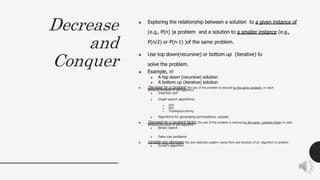
 Exploring the relationship between a solution to a given instance of
(e.g., P(n) )a problem and a solution to a smaller instance (e.g.,
P(n/2) or P(n-1) )of the same problem.
 Use top down(recursive) or bottom up (iterative) to
solve the problem.
 Example, n!
 A top down (recursive) solution
 A bottom up (iterative) solution
 Decrease by a constant: the size of the problem is reduced by the same constant on each
iteration/recursion of the algorithm.
 Insertion sort
 Graph search algorithms:
 DFS
 BFS
 Topological sorting
 Algorithms for generating permutations, subsets
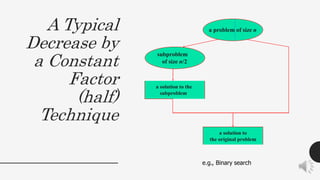
 Decrease by a constant factor: the size of the problem is reduced by the same constant factor on each
iteration/recursion of the algorithm.
 Binary search
 Fake-coin problems
 Variable-size decrease: the size reduction pattern varies from one iteration of an algorithm to another.
 Euclid’s algorithm
A Typical
Decrease by
a Constant
Factor
(half)
Technique
subproblem
of size n/2
a solution to the
subproblem
a problem of size n
a solution to
the original problem
e.g., Binary search
Module 2 Design Analysis and Algorithms

Module 2 Design Analysis and Algorithms

  • 1.
    MODULE 2 DESIGN ANALYSISAND ALGORITHMS CREATED AND NARRATED BY – ARYANVARSHNEYA(18BCE10064)
  • 2.
    INDEX • BruteForce Approach String Matching • Analysis of Linear Search • Divide and Conquer Merge Sort • Strassen’s Matrix Multiplication • Analysis of Binary Search • Decrease and Conquer
  • 3.
    Brute Force Approach • Bruteforce - the simplest of the design strategies • Is a straightforward approach to solving a problem, usually directly based on the problem’s statement and definitions of the concepts involved. • Just do it - the brute-force strategy is easiest to apply. • Results in an algorithm that can be improved with a modest amount of time. • Brute force is important due to its wide applicability and simplicity. • Weakness is subpar efficiency of most brute-force algorithms. • Important examples: • – Selection sort, String matching,Convex-hull problem, and Exhaustive search
  • 4.
    BFA: String Matching • Align thepattern against the first m characters of the text and start matching the corresponding pairs of characters from left to right until all m pairs match. But, if a mismatching pair is found, • then the pattern is shift one position to the right and character comparisons are resumed. • The goal is to find i - the index of the leftmost character of the first matching substring in the text • – such that ti = p0,….ti+j = pj, …..ti+m-1 = pm-1
  • 5.
    BFA: String Matching (Cont…) • Algorithm BruteForceStringMatching(T[0..n - 1], P[0..m - 1]) • //Implements string matching • //Input:An arrayT[0..n - 1] of n characters representing a text • // an array P[0..m - 1] of m characters representing a pattern • //Output:The position of the first character in the text that starts the first • // matching substring if the search is successful and -1 otherwise. • for i ← 0 to n - m do j ← 0 • while j < m and P[j] =T[i + j] do j ← j + 1 • if j = m return i return -1
  • 6.
  • 7.
    Linear Search Example element -23 97 1821 5 -86 64 0 -37 -23 97 18 21 5 -86 64 0 -37 -23 97 18 21 5 -86 64 0 -37 -23 97 18 21 5 -86 64 0 -37 -23 97 18 21 5 -86 64 0 -37 element element element element element Searching for -86.
  • 8.
    Analysis of Linear Search How long willour search take? • In the best case, the target value is in the first element of the array. • So the search takes some tiny, and constant, amount of time. • In the worst case, the target value is in the last element of the array. • So the search takes an amount of time proportional to the length of the array. In the average case, the target value is somewhere in the array. • In fact, since the target value can be anywhere in the array, any element of the array is equally likely. • So on average, the target value will be in the middle of the array. • So the search takes an amount of time proportional to half the length of the array
  • 9.
    Divide and Conquer The most wellknown algorithm design strategy: • Divide the problem into two or more smaller subproblems. • Conquer the subproblems by solving them recursively. • Combine the solutions to the subproblems into the solutions for the original problem.
  • 10.
  • 11.
    Divide and Conquer: Merge Sort The mergesort algorithm works from “the bottom up” • start by solving the smallest pieces of the main problem • keep combining their results into larger solutions • eventually the original problem will be solved Sort into nondecreasing order [25][57][48][37][12][92][86][33] pass 1 [25 57][37 48][12 92][33 86] pass 2 [25 37 48 57][12 33 86 92] pass 3 [12 25 33 37 48 57 86 92] • log2n passes are required. • time complexity: O(nlogn)
  • 12.
    Strassen’s Matrix Multiplication • Strassen showedthat 2x2 matrix multiplication can be accomplished in 7 multiplication and 18 additions or subtractions. .(2log 2 7 =22.807) • This reduce can be done by Divide and Conquer Approach.
  • 13.
    Strassen’s Matrix Multiplication (Cont…) P1 = (A11+A22)(B11+B22) P2 = (A21 + A22) * B11 P3 = A11 * (B12 - B22) P4 = A22 * (B21 - B11) P5 = (A11 + A12) * B22 P6 = (A21 - A11) * (B11 + B12) P7 = (A12 - A22) * (B21 +B22) C11 = P1 + P4 - P5 + P7 C12 = P3 +P5 C21 = P2 + P4 C22 = P1 + P3 - P2 + P6
  • 14.
    Strassen’s Matrix Multiplication: Analysis n 2 (n2 ) n2T (n) 7T n 2 b f (n)Com pare above rec urrenc ew ith T (n) aT n b n2 n2.81 nlog 2 7 O(n2.81 ) a 7, b 2 f(n) nlog b a T (n)
  • 15.
  • 16.
    Analysis of Binary Search The general termfor a smart search through sorted data is a binary search. • The initial search region is the whole array. • Look at the data value in the middle of the search region. • If you’ve found your target, stop. • If your target is less than the middle data value, the new search region is the lower half of the data. • If your target is greater than the middle data value, the new • search region is the higher half of the data. • Continue from Step 2.
  • 17.
    Binary Search Example low Searching for 18. middlehigh -86 -37 -23 0 5 18 21 64 97 -86 -37 -23 0 5 18 21 64 97 low middle high -86 -37 -23 0 5 18 21 64 97 low middle high
  • 18.
    Analysis of Binary Search: Time Complexity • How fastis binary search? • Think about how it operates: after you examine a value, you cut the search region in half. • So, the first iteration of the loop, your search region is the whole • array. • The second iteration, it’s half the array. • The third iteration, it’s a quarter of the array. • ... • The kth iteration, it’s (1/2k-1) of the array. • Binary search only works if the array is already sorted. • It turns out that sorting is a huge issue in computing
  • 19.
    Decrease and Conquer  Exploring therelationship between a solution to a given instance of (e.g., P(n) )a problem and a solution to a smaller instance (e.g., P(n/2) or P(n-1) )of the same problem.  Use top down(recursive) or bottom up (iterative) to solve the problem.  Example, n!  A top down (recursive) solution  A bottom up (iterative) solution  Decrease by a constant: the size of the problem is reduced by the same constant on each iteration/recursion of the algorithm.  Insertion sort  Graph search algorithms:  DFS  BFS  Topological sorting  Algorithms for generating permutations, subsets  Decrease by a constant factor: the size of the problem is reduced by the same constant factor on each iteration/recursion of the algorithm.  Binary search  Fake-coin problems  Variable-size decrease: the size reduction pattern varies from one iteration of an algorithm to another.  Euclid’s algorithm
  • 20.
    A Typical Decrease by aConstant Factor (half) Technique subproblem of size n/2 a solution to the subproblem a problem of size n a solution to the original problem e.g., Binary search