By
C.Rajeswari,
M.Sc(info.tech),
Nadar Saraswathi College of Arts and Science,
Theni.
• Clustering is the process of grouping a set of data objects into
multiple groups or clusters so that objects within a cluster have
high similarity, but are very dissimilar to objects in other
clusters.
• The requirements of clustering methods for massive amounts
of data and various applications.
• Its learn several basic clustering techniques, organized into the
following categories:
=> partitioning methods
=> hierarchical methods
=> density-based methods
=> grid-based methods
I. What is cluster analysis:
• cluster analysis or simply clustering is the process of
partitioning a set of data objects into subsets.
• each subset is a cluster, such that objects in a cluster are
similar to one another , yet dissimilar to objects in other
clusters.
• cluster analysis has been widely used in many applications
such as business intelligence, image pattern recognition,
web search, biology, and security.
II. Requirements for cluster analysis:
The following are typical requirements of clustering in data mining.
 Scalability: many clustering algorithms work well on small data sets
containing fewer then several hundred data objects.
 Ability to deal with different types of attributes: many algorithms are
designed to cluster numeric (interval-based)data.
 Discovery of clusters with arbitrary shape: many clustering algorithms
determine clusters based on Euclidean or Manhattan distance measures.
 Capability of clustering high-dimensionality data: a data set can contain
numerous dimensions or attributes.
 Requirements for domain knowledge to determine input parameters:
many clustering algorithms require users to provide domain knowledge in
the form of input parameters such as the desired number of clusters.
 Ability to deal with noisy data: most real-world data sets contain outliers
and/or missing unknown, or erroneous data.
 Incremental clustering and insensitivity to input order: in many
applications, incremental updates may arrive at any time.
 Constraint-based clustering: real-world applications may need to
perform clustering under various kinds of constraints.
 Separation of clusters: some methods partition data objects into
mutually exclusive clusters.
 Interpretability and usability: users want clustering results to be
interpretable, comprehensible, and usable. The methods for
orthogonal aspects with which clustering.
 The partitioning criteria: in some methods, all the objects are
partitioned so that no hierarchy exists among the clusters.
 Similarity measure: some methods determine the similarity
between two objects by the distance between them.
 Clustering space: many clustering methods search for clusters
within the entire given data space.
III. Overview of basic clustering methods:
There are many clustering algorithms in the literature. It is difficult to
provide a crisp categorization of clustering methods because these categories
may overlap so that a method may have features from several categories.
• Partitioning methods: given a set of n objects, a partitioning method
constructs k partitions of the data, where each partition represents a cluster
and k ≤ n. it then uses an iterative relocation technique that attempts to
improve the partitioning by moving objects from one group to another.
• Hierarchical methods: A hierarchical method creates a hierarchical
decomposition of agglomerative or divisive, based on how the hierarchical
decomposition is formed.
• Density-based methods: most partitioning methods cluster objects
based on the distance between objects. Such methods can find only
spherical-shaped clusters and encounter difficulty in discovering
clusters of arbitrary shapes.
• Grid-based methods: grid-based methods quantize the object space
into a finite number of cells that form a grid structure. Using grids is
often an efficient approach to many spatial data mining problems,
including clustering. Therefore, grid-based methods can be
integrated with other clustering methods such as density-based
methods and hierarchical methods.
• The simplest and most fundamental version of cluster analysis is
partitioning, which organizes the objects of a set into several
exclusive groups or cluster.
• A data set, D, of n objects, and k, the number of clusters to form, a
partitioning algorithm organizes the objects into k partitions(k≤n),
where each partition represents a cluster.
• The most well-known and commonly used partitioning methods k-
means and k-medoids.
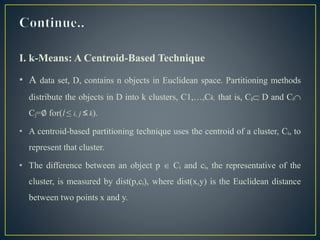
I. k-Means: A Centroid-Based Technique
• A data set, D, contains n objects in Euclidean space. Partitioning methods
distribute the objects in D into k clusters, C1,…,Ck, that is, Cᵢ D and Cᵢ
Cⱼ=∅ for(Í ≤ i, j ≤ k).
• A centroid-based partitioning technique uses the centroid of a cluster, Cᵢ, to
represent that cluster.
• The difference between an object p  Cᵢ and cᵢ, the representative of the
cluster, is measured by dist(p,cᵢ), where dist(x,y) is the Euclidean distance
between two points x and y.
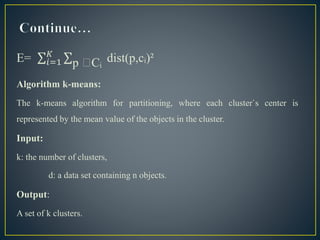
E= 𝑖=1
𝐾
p Cᵢ dist(p,cᵢ)²
Algorithm k-means:
The k-means algorithm for partitioning, where each cluster`s center is
represented by the mean value of the objects in the cluster.
Input:
k: the number of clusters,
d: a data set containing n objects.
Output:
A set of k clusters.
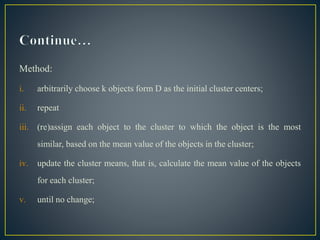
Method:
i. arbitrarily choose k objects form D as the initial cluster centers;
ii. repeat
iii. (re)assign each object to the cluster to which the object is the most
similar, based on the mean value of the objects in the cluster;
iv. update the cluster means, that is, calculate the mean value of the objects
for each cluster;
v. until no change;
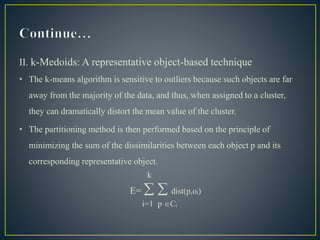
II. k-Medoids: A representative object-based technique
• The k-means algorithm is sensitive to outliers because such objects are far
away from the majority of the data, and thus, when assigned to a cluster,
they can dramatically distort the mean value of the cluster.
• The partitioning method is then performed based on the principle of
minimizing the sum of the dissimilarities between each object p and its
corresponding representative object.
k
E=   dist(p,oᵢ)
i=1 p Cᵢ
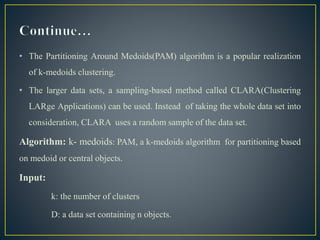
• The Partitioning Around Medoids(PAM) algorithm is a popular realization
of k-medoids clustering.
• The larger data sets, a sampling-based method called CLARA(Clustering
LARge Applications) can be used. Instead of taking the whole data set into
consideration, CLARA uses a random sample of the data set.
Algorithm: k- medoids: PAM, a k-medoids algorithm for partitioning based
on medoid or central objects.
Input:
k: the number of clusters
D: a data set containing n objects.
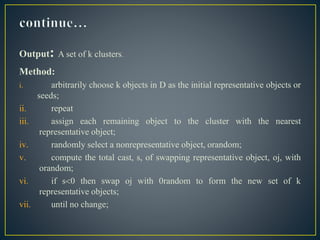
Output: A set of k clusters.
Method:
i. arbitrarily choose k objects in D as the initial representative objects or
seeds;
ii. repeat
iii. assign each remaining object to the cluster with the nearest
representative object;
iv. randomly select a nonrepresentative object, ᴏrandom;
v. compute the total cast, s, of swapping representative object, ᴏj, with
ᴏrandom;
vi. if s0 then swap oj with 0random to form the new set of k
representative objects;
vii. until no change;
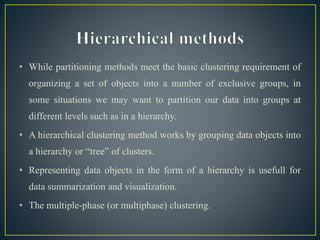
• While partitioning methods meet the basic clustering requirement of
organizing a set of objects into a number of exclusive groups, in
some situations we may want to partition our data into groups at
different levels such as in a hierarchy.
• A hierarchical clustering method works by grouping data objects into
a hierarchy or “tree” of clusters.
• Representing data objects in the form of a hierarchy is usefull for
data summarization and visualization.
• The multiple-phase (or multiphase) clustering.
I. Agglomerative versus Divisive Hierarchical Clustering:
• A hierarchical clustering method can be either agglomerative or divisive,
depending on whether the hierarchical decomposition is formed in a bottom-up
or top-down fashion.
• An agglomerative hierarchical clustering method uses a bottom-up strategy. A
divisive hierarchical clustering method employs a top-down strategy.
• This is a single-linkage approach in that each cluster is represented by all the
objects in the cluster, and the similarity between two clusters is measured by the
similarity of the closest pair of data points belonging to different cluster.
• A tree structure called a dendrogram is commonly used to represent the process
of hierarchical clustering.
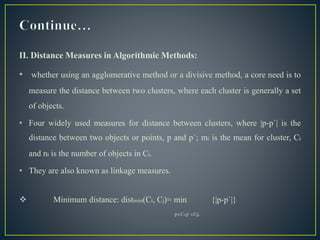
II. Distance Measures in Algorithmic Methods:
• whether using an agglomerative method or a divisive method, a core need is to
measure the distance between two clusters, where each cluster is generally a set
of objects.
• Four widely used measures for distance between clusters, where |p-p`| is the
distance between two objects or points, p and p`; mi is the mean for cluster, Ci
and ni is the number of objects in Ci.
• They are also known as linkage measures.
 Minimum distance: distmin(Ci, Cj)= min {|p-p`|}
pCi;p`Cjj
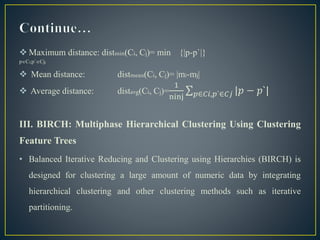
 Maximum distance: distmin(Ci, Cj)= min {|p-p`|}
pCi;p`Cjj
 Mean distance: distmean(Ci, Cj)= |mi-mj|
 Average distance: distavg(Ci, Cj)=
1
ninj 𝑝∈𝐶𝑖,𝑝`∈𝐶𝑗 |𝑝 − 𝑝`|
III. BIRCH: Multiphase Hierarchical Clustering Using Clustering
Feature Trees
• Balanced Iterative Reducing and Clustering using Hierarchies (BIRCH) is
designed for clustering a large amount of numeric data by integrating
hierarchical clustering and other clustering methods such as iterative
partitioning.
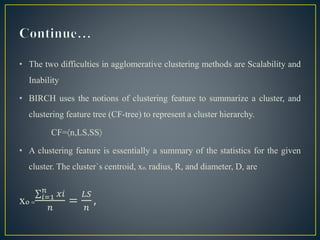
• The two difficulties in agglomerative clustering methods are Scalability and
Inability
• BIRCH uses the notions of clustering feature to summarize a cluster, and
clustering feature tree (CF-tree) to represent a cluster hierarchy.
CF=n,LS,SS
• A clustering feature is essentially a summary of the statistics for the given
cluster. The cluster`s centroid, xo, radius, R, and diameter, D, are
xo= 𝑖=1
𝑛
𝑥𝑖
𝑛
=
𝐿𝑆
𝑛
,
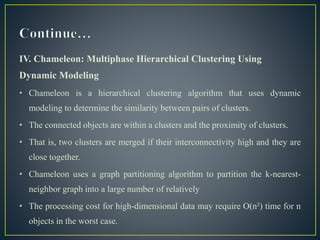
IV. Chameleon: Multiphase Hierarchical Clustering Using
Dynamic Modeling
• Chameleon is a hierarchical clustering algorithm that uses dynamic
modeling to determine the similarity between pairs of clusters.
• The connected objects are within a clusters and the proximity of clusters.
• That is, two clusters are merged if their interconnectivity high and they are
close together.
• Chameleon uses a graph partitioning algorithm to partition the k-nearest-
neighbor graph into a large number of relatively
• The processing cost for high-dimensional data may require O(n²) time for n
objects in the worst case.
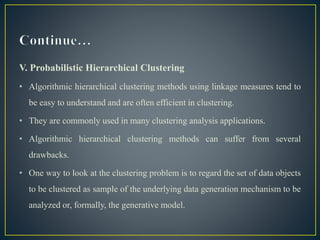
V. Probabilistic Hierarchical Clustering
• Algorithmic hierarchical clustering methods using linkage measures tend to
be easy to understand and are often efficient in clustering.
• They are commonly used in many clustering analysis applications.
• Algorithmic hierarchical clustering methods can suffer from several
drawbacks.
• One way to look at the clustering problem is to regard the set of data objects
to be clustered as sample of the underlying data generation mechanism to be
analyzed or, formally, the generative model.
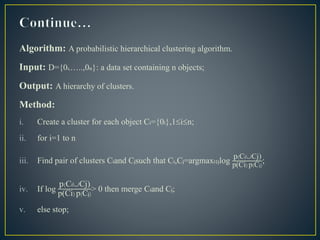
Algorithm: A probabilistic hierarchical clustering algorithm.
Input: D={01,…..,0n}: a data set containing n objects;
Output: A hierarchy of clusters.
Method:
i. Create a cluster for each object Ci={0i},1in;
ii. for i=1 to n
iii. Find pair of clusters Ciand Cjsuch that Ci,Cj=argmaxi‡jlog
p(CiCj)
p(Ci)p(Cj);
iv. If log
p(CiCj)
p(Ci)p(Cj)
> 0 then merge Ciand Cj;
v. else stop;
Clusters techniques

Clusters techniques

  • 1.
  • 2.
    • Clustering isthe process of grouping a set of data objects into multiple groups or clusters so that objects within a cluster have high similarity, but are very dissimilar to objects in other clusters.
  • 3.
    • The requirementsof clustering methods for massive amounts of data and various applications. • Its learn several basic clustering techniques, organized into the following categories: => partitioning methods => hierarchical methods => density-based methods => grid-based methods
  • 4.
    I. What iscluster analysis: • cluster analysis or simply clustering is the process of partitioning a set of data objects into subsets. • each subset is a cluster, such that objects in a cluster are similar to one another , yet dissimilar to objects in other clusters. • cluster analysis has been widely used in many applications such as business intelligence, image pattern recognition, web search, biology, and security.
  • 5.
    II. Requirements forcluster analysis: The following are typical requirements of clustering in data mining.  Scalability: many clustering algorithms work well on small data sets containing fewer then several hundred data objects.  Ability to deal with different types of attributes: many algorithms are designed to cluster numeric (interval-based)data.  Discovery of clusters with arbitrary shape: many clustering algorithms determine clusters based on Euclidean or Manhattan distance measures.  Capability of clustering high-dimensionality data: a data set can contain numerous dimensions or attributes.
  • 6.
     Requirements fordomain knowledge to determine input parameters: many clustering algorithms require users to provide domain knowledge in the form of input parameters such as the desired number of clusters.  Ability to deal with noisy data: most real-world data sets contain outliers and/or missing unknown, or erroneous data.  Incremental clustering and insensitivity to input order: in many applications, incremental updates may arrive at any time.  Constraint-based clustering: real-world applications may need to perform clustering under various kinds of constraints.  Separation of clusters: some methods partition data objects into mutually exclusive clusters.
  • 7.
     Interpretability andusability: users want clustering results to be interpretable, comprehensible, and usable. The methods for orthogonal aspects with which clustering.  The partitioning criteria: in some methods, all the objects are partitioned so that no hierarchy exists among the clusters.  Similarity measure: some methods determine the similarity between two objects by the distance between them.  Clustering space: many clustering methods search for clusters within the entire given data space.
  • 8.
    III. Overview ofbasic clustering methods: There are many clustering algorithms in the literature. It is difficult to provide a crisp categorization of clustering methods because these categories may overlap so that a method may have features from several categories. • Partitioning methods: given a set of n objects, a partitioning method constructs k partitions of the data, where each partition represents a cluster and k ≤ n. it then uses an iterative relocation technique that attempts to improve the partitioning by moving objects from one group to another. • Hierarchical methods: A hierarchical method creates a hierarchical decomposition of agglomerative or divisive, based on how the hierarchical decomposition is formed.
  • 9.
    • Density-based methods:most partitioning methods cluster objects based on the distance between objects. Such methods can find only spherical-shaped clusters and encounter difficulty in discovering clusters of arbitrary shapes. • Grid-based methods: grid-based methods quantize the object space into a finite number of cells that form a grid structure. Using grids is often an efficient approach to many spatial data mining problems, including clustering. Therefore, grid-based methods can be integrated with other clustering methods such as density-based methods and hierarchical methods.
  • 10.
    • The simplestand most fundamental version of cluster analysis is partitioning, which organizes the objects of a set into several exclusive groups or cluster. • A data set, D, of n objects, and k, the number of clusters to form, a partitioning algorithm organizes the objects into k partitions(k≤n), where each partition represents a cluster. • The most well-known and commonly used partitioning methods k- means and k-medoids.
  • 11.
    I. k-Means: ACentroid-Based Technique • A data set, D, contains n objects in Euclidean space. Partitioning methods distribute the objects in D into k clusters, C1,…,Ck, that is, Cᵢ D and Cᵢ Cⱼ=∅ for(Í ≤ i, j ≤ k). • A centroid-based partitioning technique uses the centroid of a cluster, Cᵢ, to represent that cluster. • The difference between an object p  Cᵢ and cᵢ, the representative of the cluster, is measured by dist(p,cᵢ), where dist(x,y) is the Euclidean distance between two points x and y.
  • 12.
    E= 𝑖=1 𝐾 p Cᵢdist(p,cᵢ)² Algorithm k-means: The k-means algorithm for partitioning, where each cluster`s center is represented by the mean value of the objects in the cluster. Input: k: the number of clusters, d: a data set containing n objects. Output: A set of k clusters.
  • 13.
    Method: i. arbitrarily choosek objects form D as the initial cluster centers; ii. repeat iii. (re)assign each object to the cluster to which the object is the most similar, based on the mean value of the objects in the cluster; iv. update the cluster means, that is, calculate the mean value of the objects for each cluster; v. until no change;
  • 14.
    II. k-Medoids: Arepresentative object-based technique • The k-means algorithm is sensitive to outliers because such objects are far away from the majority of the data, and thus, when assigned to a cluster, they can dramatically distort the mean value of the cluster. • The partitioning method is then performed based on the principle of minimizing the sum of the dissimilarities between each object p and its corresponding representative object. k E=   dist(p,oᵢ) i=1 p Cᵢ
  • 15.
    • The PartitioningAround Medoids(PAM) algorithm is a popular realization of k-medoids clustering. • The larger data sets, a sampling-based method called CLARA(Clustering LARge Applications) can be used. Instead of taking the whole data set into consideration, CLARA uses a random sample of the data set. Algorithm: k- medoids: PAM, a k-medoids algorithm for partitioning based on medoid or central objects. Input: k: the number of clusters D: a data set containing n objects.
  • 16.
    Output: A setof k clusters. Method: i. arbitrarily choose k objects in D as the initial representative objects or seeds; ii. repeat iii. assign each remaining object to the cluster with the nearest representative object; iv. randomly select a nonrepresentative object, ᴏrandom; v. compute the total cast, s, of swapping representative object, ᴏj, with ᴏrandom; vi. if s0 then swap oj with 0random to form the new set of k representative objects; vii. until no change;
  • 17.
    • While partitioningmethods meet the basic clustering requirement of organizing a set of objects into a number of exclusive groups, in some situations we may want to partition our data into groups at different levels such as in a hierarchy. • A hierarchical clustering method works by grouping data objects into a hierarchy or “tree” of clusters. • Representing data objects in the form of a hierarchy is usefull for data summarization and visualization. • The multiple-phase (or multiphase) clustering.
  • 18.
    I. Agglomerative versusDivisive Hierarchical Clustering: • A hierarchical clustering method can be either agglomerative or divisive, depending on whether the hierarchical decomposition is formed in a bottom-up or top-down fashion. • An agglomerative hierarchical clustering method uses a bottom-up strategy. A divisive hierarchical clustering method employs a top-down strategy. • This is a single-linkage approach in that each cluster is represented by all the objects in the cluster, and the similarity between two clusters is measured by the similarity of the closest pair of data points belonging to different cluster. • A tree structure called a dendrogram is commonly used to represent the process of hierarchical clustering.
  • 19.
    II. Distance Measuresin Algorithmic Methods: • whether using an agglomerative method or a divisive method, a core need is to measure the distance between two clusters, where each cluster is generally a set of objects. • Four widely used measures for distance between clusters, where |p-p`| is the distance between two objects or points, p and p`; mi is the mean for cluster, Ci and ni is the number of objects in Ci. • They are also known as linkage measures.  Minimum distance: distmin(Ci, Cj)= min {|p-p`|} pCi;p`Cjj
  • 20.
     Maximum distance:distmin(Ci, Cj)= min {|p-p`|} pCi;p`Cjj  Mean distance: distmean(Ci, Cj)= |mi-mj|  Average distance: distavg(Ci, Cj)= 1 ninj 𝑝∈𝐶𝑖,𝑝`∈𝐶𝑗 |𝑝 − 𝑝`| III. BIRCH: Multiphase Hierarchical Clustering Using Clustering Feature Trees • Balanced Iterative Reducing and Clustering using Hierarchies (BIRCH) is designed for clustering a large amount of numeric data by integrating hierarchical clustering and other clustering methods such as iterative partitioning.
  • 21.
    • The twodifficulties in agglomerative clustering methods are Scalability and Inability • BIRCH uses the notions of clustering feature to summarize a cluster, and clustering feature tree (CF-tree) to represent a cluster hierarchy. CF=n,LS,SS • A clustering feature is essentially a summary of the statistics for the given cluster. The cluster`s centroid, xo, radius, R, and diameter, D, are xo= 𝑖=1 𝑛 𝑥𝑖 𝑛 = 𝐿𝑆 𝑛 ,
  • 22.
    IV. Chameleon: MultiphaseHierarchical Clustering Using Dynamic Modeling • Chameleon is a hierarchical clustering algorithm that uses dynamic modeling to determine the similarity between pairs of clusters. • The connected objects are within a clusters and the proximity of clusters. • That is, two clusters are merged if their interconnectivity high and they are close together. • Chameleon uses a graph partitioning algorithm to partition the k-nearest- neighbor graph into a large number of relatively • The processing cost for high-dimensional data may require O(n²) time for n objects in the worst case.
  • 23.
    V. Probabilistic HierarchicalClustering • Algorithmic hierarchical clustering methods using linkage measures tend to be easy to understand and are often efficient in clustering. • They are commonly used in many clustering analysis applications. • Algorithmic hierarchical clustering methods can suffer from several drawbacks. • One way to look at the clustering problem is to regard the set of data objects to be clustered as sample of the underlying data generation mechanism to be analyzed or, formally, the generative model.
  • 24.
    Algorithm: A probabilistichierarchical clustering algorithm. Input: D={01,…..,0n}: a data set containing n objects; Output: A hierarchy of clusters. Method: i. Create a cluster for each object Ci={0i},1in; ii. for i=1 to n iii. Find pair of clusters Ciand Cjsuch that Ci,Cj=argmaxi‡jlog p(CiCj) p(Ci)p(Cj); iv. If log p(CiCj) p(Ci)p(Cj) > 0 then merge Ciand Cj; v. else stop;