2
ACCOUNTING AND STATUTORY
REQUIREMENTS OF BANKING
COMPANIES
Unit structure
2.1. Introduction
2.2. Important Accounting provisions of Banking Regulation Act
1949.
2.3. Books of Accounts
2.4. Provisioning of Non-Performing Assets
2.5. Final Accounts
2.6. Some important transactions
2.7. Illustrations
2.8. Exercises
2.1. INTRODUCTION
2.1.1 Meaning of Banking Companies:
A bank is a commercial institution, permitted to accept,
collect, transfer, lend and exchange money and claims to money
both the domestically and internationally and thereby conduct
smooth banking activities.
2.1.2. Definition:
Banking companies are governed by the Banking Regulation
Act of 1949 and also subject to the companies act. 1956.
According to Banking Regulation act, 1949 Banking means –
“The accepting, for the purpose of lending or investment, of deposit
of money from the public repayable on demand or otherwise and
withdraw able by cheque, draft, order or otherwise.’
2.1.3 Business of Banking Companies:
As per section 6 of the Act, banking companies may engage
in the following business in addition to their usual banking business.
76
1. The borrowing, raising or taking up on money, the lending or
advancing of money either upon or without security, the drawing,
making, accepting, discounting, buying, selling, collecting and
dealing in bills of exchange, ‘hundies’, promissory notes, drafts,
bills of lading, railways receipt, warrants, debentures, certificates,
scrip’s and other instruments and securities whether transferable or
negotiable or not; granting and issuing of letters of credit, traveller’s
cheques and circular notes; the buying, selling and dealing in
bullion and specie; the buying and selling of foreign exchange
including foreign bank notes; the acquiring, holding, issuing on
commission, underwriting and dealing in stock, funds, shares,
debentures, debenture stock bonds, obligations, securities and
investments of all kinds; the purchasing and selling of bonds, scrips
or other forms of securities on behalf of constituents or other, the
negotiating of loans and advances; the receiving of all kinds of
bonds, scrips or valuables on deposit or for safe custody or
otherwise; the providing of safe deposit vaults; the collecting and
transmitting of money and securities.
2. Acting as agents for any Government or local authority or any
other person or persons; the carrying on of agency business of any
description including the clearing and forwarding of goods, giving of
receipts and discharges and otherwise acting as on attorney on
behalf of customers but excluding the business of (managing agent
or secretary and treasurer) of a company.
3. Contracting for public and private loans and negotiating and
issuing the same.
4. The effecting, insuring, guaranterring, underwriting, participating
in managing and carrying out of any issue, public or private of state,
municipal or other loans or of shares, stock, debentures or
debenture stock of any Company Corporation or association and of
the lending of money for the purpose of any such issue.
5. Carrying on and transacting every kind of guarantee and
indemnity business.
6. Managing, selling and realizing any property which may come
into the possession of the company in satisfaction or part
satisfaction of any of its claims.
7. Acquiring and holding and generally dealing with any property or
any right, title or interest in any such property which may form the
security or part of the security for any loans or advances which may
be connected with any such security.
8. Undertaking and executing trusts.
77
9. Undertaking the administration of estates as executor, trustee or
otherwise.
10. Establishing and supporting or aiding in the establishment and
support of associations, institutions, funds, trusts and conveniences
calculated to benefit employees or ex-employees of the company or
the dependents or connections of such persons; granting pensions
and allowances and making payments towards insurance;
subscribing to or guaranteeing moneys for charitable or benevolent
objects or for any exhibition or for any public, general or useful
object.
11. The acquisition, construction maintenance and alteration of any
building or works necessary or convenient for the purpose of the
company.
12. Selling, improving, managing, developing, exchanging, leasing,
mortgaging, disposing of or turning into account or otherwise
dealing with all or any part of the property and rights of the
company.
13. Acquiring and undertaking the whole or any part of the business
of any person or company, when such business is of a nature
enumerated or described in section 6.
14. Doing all such other things as are incidental or conclusion to the
promotion or advancement of the business of the company.
15. Any other form of business which the central Government may
by notification in the official Gazette, specify as a form of business
in which it is lawful for a banking company to engage.
No Banking Company shall engage in any form of business
other than those referred to in section 6.
2.1.4 Restrictions on Business:
The Banking Companies are restricted from conducting
certain activities.
A bank can not directly or indirectly deal in the buying or
selling or bartering of goods, except in connection with the
realization of security given to or held by it, or engage in any trade
or buy or sell of barter goods for others otherwise than in
connection with bills of exchange, immovable property, except that
required for its own use, however acquired, must be disposed of
within seven years from the date of acquisition.
78
2.1.5 Non-Banking Assets:
The case in which the customer to whom a bank sanctioned
loan against some security and if he fails to repay the same, the
bank decides to acquire such property kept as security to satisfy its
claim. Such property or assets termed as ‘Non-Banking Assets’.
These Assets are exhibited in schedule 11 – “Other Assets”.
2.2. IMPORTANT ACCOUNTING PROVISIONS OF
BANKING REGULATION ACT 1949.
2.2.1 Minimum Capital and reserves – Section 11.
According to the provision of section 11 (2) of the Banking
Regulation Act 1949 the following are the limits imposed on value
of paid up Capital and Reserves of a banking Company.
1) In the case of Banking Company incorporated outside India.
If it has a place or places of business in the city of Bombay or
Calcutta or both Rs. 20 lakhs.
If the places of business are other than Bombay or Calcutta
Rs. 15 lakhs. In addition 20% of the profits earned in India must be
added to the sums mentioned above.
2) In the case of a banking company incorporated in India.
a) If it has places of business in more than one state and it has
a place or places of business in Bombay or Calcutta or both
Rs. 10 lakhs.
b) It is has places of business in more than one state but not in
Bombay or Calcutta Rs. 5 lakhs.
c) If it has places of business in one state but not in Bombay or
Calcutta. Rs. 1 lakhs in respect of its principle place plus Rs.
10,000 for each of its other places of business in the same
district and Rs. 25,000 in respect of each place of business
outside the district. The total need not exceed Rs. 5 lakhs. In
case there is only one place of business Rs. 50,000.
(In case of companies, which have commenced business after the
commencement of the Banking Companies (Amendment) Act of
1962, a minimum of Rs. 5 lakhs is required)
d) If it has all its places of business in one state / Rs. 5 lakhs
and if the places of business are also in / plus Rs. 25,000
Bombay or Calcutta. / In respect of each place of business
situated outside the city of Bombay or Calcutta. The total
need not exceed Rs. 10 lakhs.
79
2.2.2 Restriction on commission Brokerage, Discount, etc. on
sale of shares-section B:
A Banking company is not allowed to pay directly or
indirectly commission, Brokerage, Discount or remuneration in any
form in respect of any shares issued by it, any amount exceeding
two and one-half person of the paid up value of the said shares.
2.2.3 Restriction on payment of dividend – section 15:
A Banking company shall not pay dividend unless all of its
capitalized expenses (including preliminary expenses, organization
expenses, share selling commission, Brokerage, amount of losses
incurred and any other item. Of expenditure not represented by
tangible assets) have been completely written-off.
However, a banking company may pay dividend on its
shares without writing off.
2.2.4 Statutory Reserve – Section 17:
Section 17 of the act lays down that every banking company
should create a reserve fund by transferring to it at least 20 percent
of its annual profit as disclosed by its profit and loss account before
any declaration of dividend, such reserve is known as statutory
Reserve. The transfer of profit to reserve fund should be continued
even after the accumulated amount of reserve fund and share
premium account together exceed its paid up capital. Unless the
central government grant on exemption in this regard on the
recommendation of Reserve Bank of India.
2.2.5 Cash Reserves – Section 18:
Every Banking Company requires to maintain a balance
equal to 3 percent of its time and demand liabilities with RBI (a non
scheduled bank has to keep similar balances either in cash or
deposit with RBI)
2.2.6 Restrictions on loans and Advances –section 20
A Bank can not
i) grant loans and advances on the security of its own shares
and
ii) grant or agree to grant loan or advance to or on behalf of
a) Any of its directors;
b) Any firm in which any of its directors is interested as partner,
manager or gurantor;
80
c) Any company of which any of its directors is a director
manager, employee or guarantor or in which he holds
substantial interest; or
d) Any individual in respect of whom any of its directors is a
partner or guarantor.
2.3. BOOKS OF ACCOUNTS
In order to have immediate entry of voluminous transaction
and enables continuous internal check on the record of these
transactions, Banks are required to maintain subsidiary books
along with its principal books of accounts.
A) Subsidiary books
i. Receiving cashier’s counter cash book;
ii. Paying cashier’s counter cash book;
iii. Current accounts ledger.
iv. Savings bank accounts ledger
v. Fixed deposit accounts ledger
vi. Investments Ledger
vii. Loans Ledger
viii. Bills discounted and purchased ledger
ix. Customer’s acceptances endorsements and guarantee
ledger
B) Principal Books
i. Cash book : It records all cash transactions
ii. General Leger : It contains control Accounts of all subsidiary
ledgers and different assets and liabilities account
2.4. PROVISIONING OF NON-PERFORMING ASSETS
Meaning:
The ‘Non-Performing Assets’ refers to those assets which
fails to generate expected returns to the bank due to borrowers
default in making repayment.
In accordance with the international practice and the
directives of RBI, the bank should recognized income on Non-
Performing Assets (NPA) when it is actually received and not on
accrual basis.
81
Similarly, the RBI has accepted the definition of a NPA given
by Narasimham committee from March 1995 onwards –
‘as an advance where, as on the bank’s balance sheet date,
(a) interest on a term loan account is past due or (b) a cash credit /
overdraft account remains out of order or (c) a bill purchased /
discounted is unpaid or overdue or (d) any amount to be received in
respect of any other account remains past due, for a period more
than 180 days. (e) in respect of agricultural finance / advance (eg
crop loans) interest and / or installment of principal remains
overdue for two harvest seasons but for a period not exceeding two
half years. The period of 180 days has been reduced to 90 days
effective from March 31, 2004.
A ‘past due’ account has been defined as an amount which
remains outstanding 30 days beyond the due date.
Assets classification and provisioning
In order to make adequate provisions, assets have been
classified as follows:
i. Standard assets – These are the assets which does not
disclose any problems and does not carry more than normal
risk attached to the business therefore no provision is to be
made against them.
ii. Substandard assets – These assets exhibit problems and
would include assets classified as non-performing for a
period not exceeding two years. Hence the provision is to be
made at the rate of 10 percent of the total outstanding
amount of substandard assets.
iii. Doubtful assets – these are the assets which remain non
performing for a period exceeding two years and would also
include loans in respect of which installments are overdue
for a period exceeding two years.
The provision for doubtful assets as follows:
Period for which the advance Provision requirements (%)
Has been considered
As doubtful
Upto one year 20
One to three years 30
More than three years 50
82
iv. Loss assets – Loss assets are those assets where the loss
has been identified but the amounts have not been return
off.
Illustration
Exe bank ltd. having the following advances as on 31st
March 2009 and provision is to be made against them.
Bills Purchased
and Discounted
Cash credit,
overdraft
Term
loans
i) Standard Assets
ii) Sub-standard Assets
iii) Doubtful Assets:
- upto one year
- One to 3 years
- More than 3 years
iv) Loss Assets
5,150
4,000
--
--
--
4,925
1,500
500
1,800
1,275
350
2,375
1,000
1,800
700
550
225
9,150 10,350 6,650
Solution
Amount
(Rs.)
% of Provision Amount of
Provision (Rs)
i) Standard Assets
ii) Sub-standard Assets
iii) Doubtful Assets:
- upto one year
- One to 3years
- More than 3 years
iv) Loss Assets
12,450
6,500
2,300
2,500
1,825
575
Nil
10%
20%
30%
50%
100%
Nil
650
460
750
912.5
575
Total Provision on Advances 3,347.5
2.5. FINAL ACCOUNTS
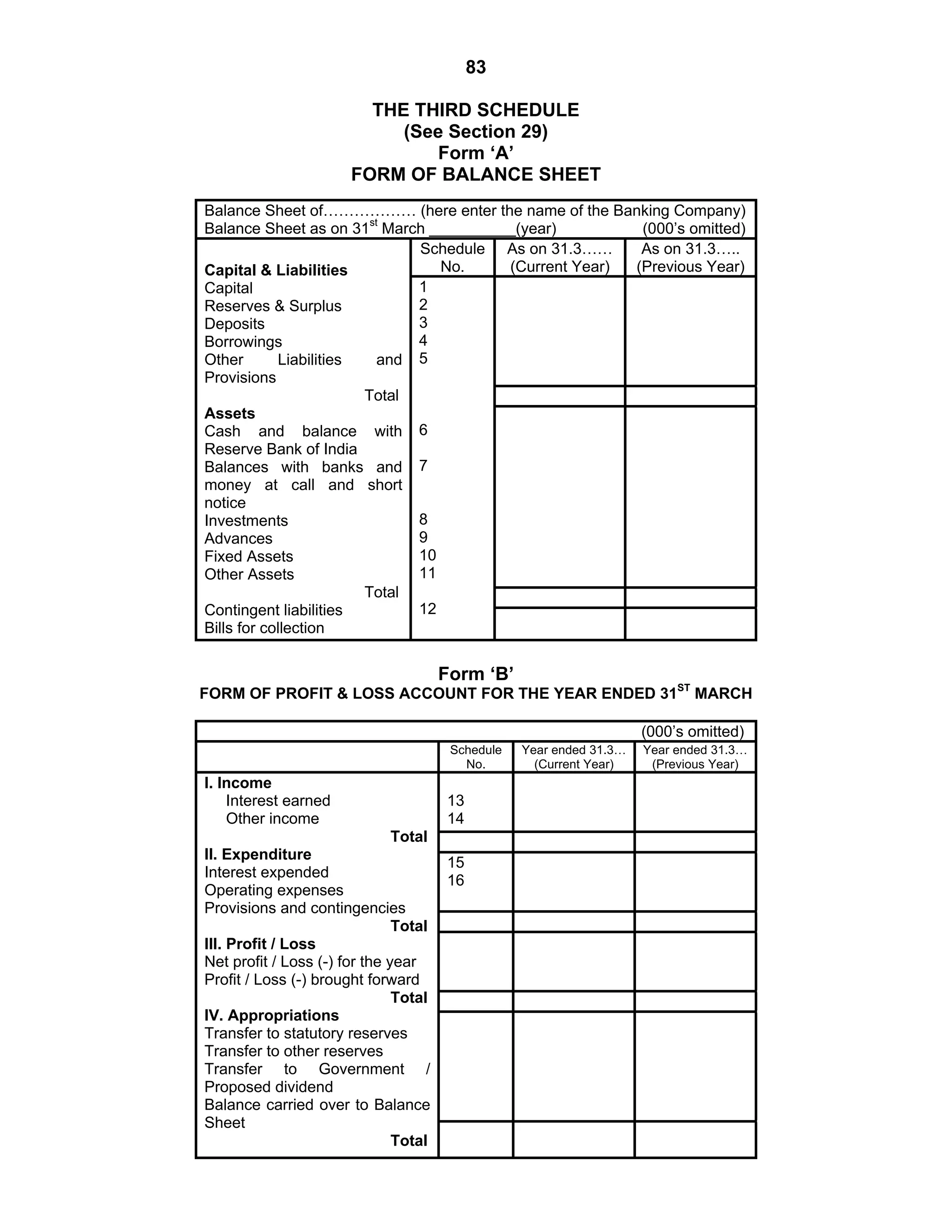
The Banking Regulation act, 1949 prescribes formats of
preparing final accounts of the Banking companies. The third
schedule of section 29 gives forms ‘A’ for the balance sheet and
Form ‘B’ for Profit and loss account. The balance sheet consists of
total 12 schedules. Schedule 1 to schedule 5 depicts capital and
liabilities and schedule 6 to schedule 11 shows Assets of the bank
and schedule 12 shows contingent liabilities and there is no specific
schedule prescribes for bills for collection.
83
THE THIRD SCHEDULE
(See Section 29)
Form ‘A’
FORM OF BALANCE SHEET
Balance Sheet of……………… (here enter the name of the Banking Company)
Balance Sheet as on 31st
March __________(year) (000’s omitted)
Schedule
No.
As on 31.3……
(Current Year)
As on 31.3…..
(Previous Year)Capital & Liabilities
Capital
Reserves & Surplus
Deposits
Borrowings
Other Liabilities and
Provisions
Total
Assets
Cash and balance with
Reserve Bank of India
Balances with banks and
money at call and short
notice
Investments
Advances
Fixed Assets
Other Assets
Total
Contingent liabilities
Bills for collection
1
2
3
4
5
6
7
8
9
10
11
12
Form ‘B’
FORM OF PROFIT & LOSS ACCOUNT FOR THE YEAR ENDED 31ST
MARCH
(000’s omitted)
Schedule
No.
Year ended 31.3…
(Current Year)
Year ended 31.3…
(Previous Year)
13
14
15
16
I. Income
Interest earned
Other income
Total
II. Expenditure
Interest expended
Operating expenses
Provisions and contingencies
Total
III. Profit / Loss
Net profit / Loss (-) for the year
Profit / Loss (-) brought forward
Total
IV. Appropriations
Transfer to statutory reserves
Transfer to other reserves
Transfer to Government /
Proposed dividend
Balance carried over to Balance
Sheet
Total
84
NOTE: 1. The total income includes income of foreign branches of Rs.______
2. The total expenditure includes expenditure of foreign branches at Rs. _____
3. Surplus / deficit of foreign branches Rs. ______
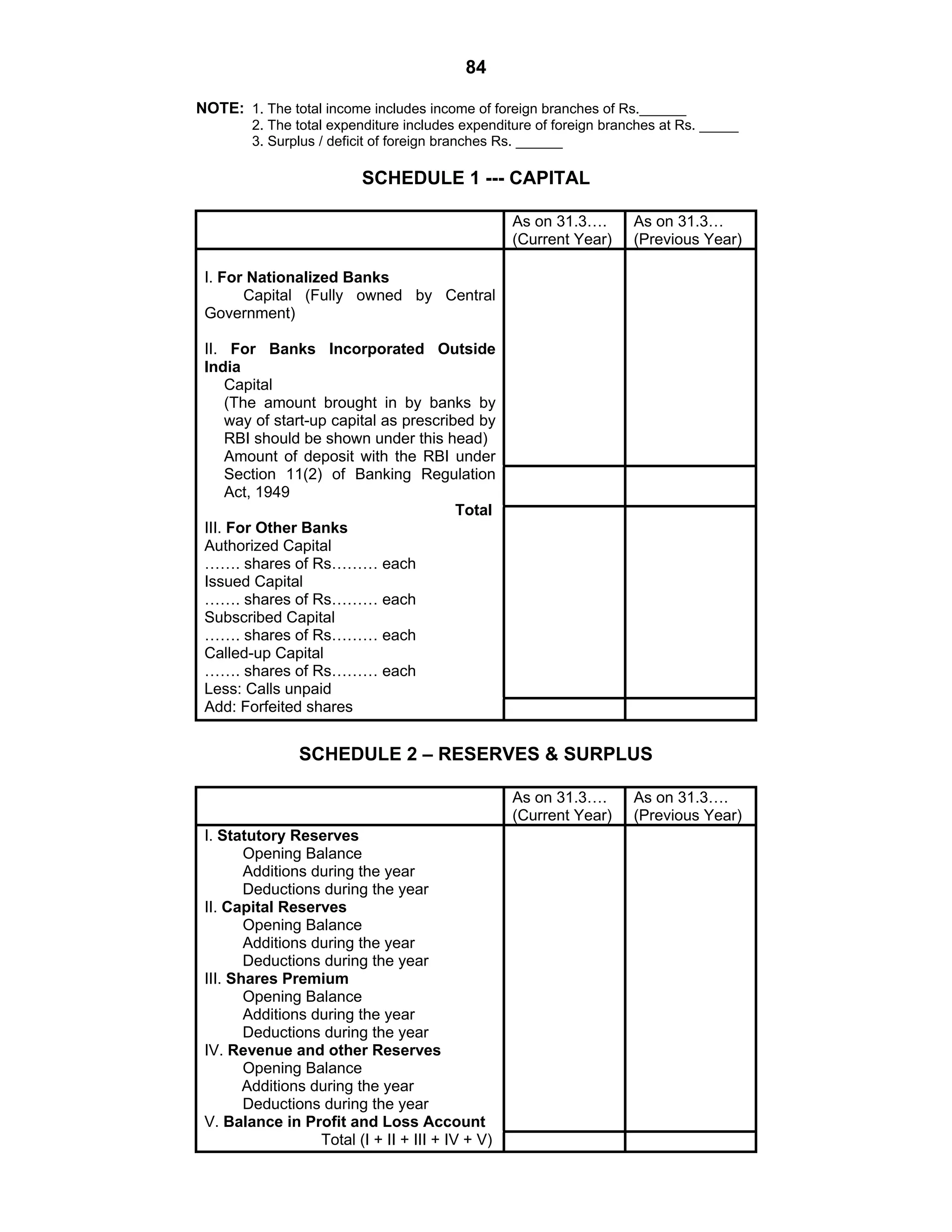
SCHEDULE 1 --- CAPITAL
As on 31.3….
(Current Year)
As on 31.3…
(Previous Year)
I. For Nationalized Banks
Capital (Fully owned by Central
Government)
II. For Banks Incorporated Outside
India
Capital
(The amount brought in by banks by
way of start-up capital as prescribed by
RBI should be shown under this head)
Amount of deposit with the RBI under
Section 11(2) of Banking Regulation
Act, 1949
Total
III. For Other Banks
Authorized Capital
……. shares of Rs……… each
Issued Capital
……. shares of Rs……… each
Subscribed Capital
……. shares of Rs……… each
Called-up Capital
……. shares of Rs……… each
Less: Calls unpaid
Add: Forfeited shares
SCHEDULE 2 – RESERVES & SURPLUS
As on 31.3….
(Current Year)
As on 31.3….
(Previous Year)
I. Statutory Reserves
Opening Balance
Additions during the year
Deductions during the year
II. Capital Reserves
Opening Balance
Additions during the year
Deductions during the year
III. Shares Premium
Opening Balance
Additions during the year
Deductions during the year
IV. Revenue and other Reserves
Opening Balance
Additions during the year
Deductions during the year
V. Balance in Profit and Loss Account
Total (I + II + III + IV + V)
85
SCHEDULE 3 – DEPOSITS
As on 31.3….
(Current Year)
As on 31.3….
(Previous Year)
A. I. Demand Deposits
i) From Banks
ii) From Banks
II. Savings Bank Deposits
III. Term Deposits
i) From banks
ii) From others
Total (I + II + III)
B. i) Deposits of branches in India
ii) Deposits of branches outside India
Total
SCHEDULE 4 – BORROWINGS
As on 31.3….
(Current Year)
As on 31.3….
(Previous Year)
I. Borrowings in India
i) Reserve Bank of India
ii) Other banks
iii) Other institutions and agencies
II. Borrowings outside India
Total (I + II)
Secured borrowings included in I & II
above – Rs.
SCHEDULE 5 – OTHER LIABILITIES AND PROVISIONS
As on 31.3….
(Current Year)
As on 31.3….
(Previous Year)
I. Bills payable
II. Inter-office adjustments (net)
III. Interest accrued
IV. Others (including provisions)
Total
SCHEDULE 6 – CASH AND BALANCES WITH RESERVE BANK
OF India
As on 31.3…
(Current Year)
As on 31.3…
(Previous Year)
I. Cash in hand (including foreign
currency notes)
II. Balances with RBI
(i) in Current Account
(ii) in Other Accounts
Total (I + II)
86
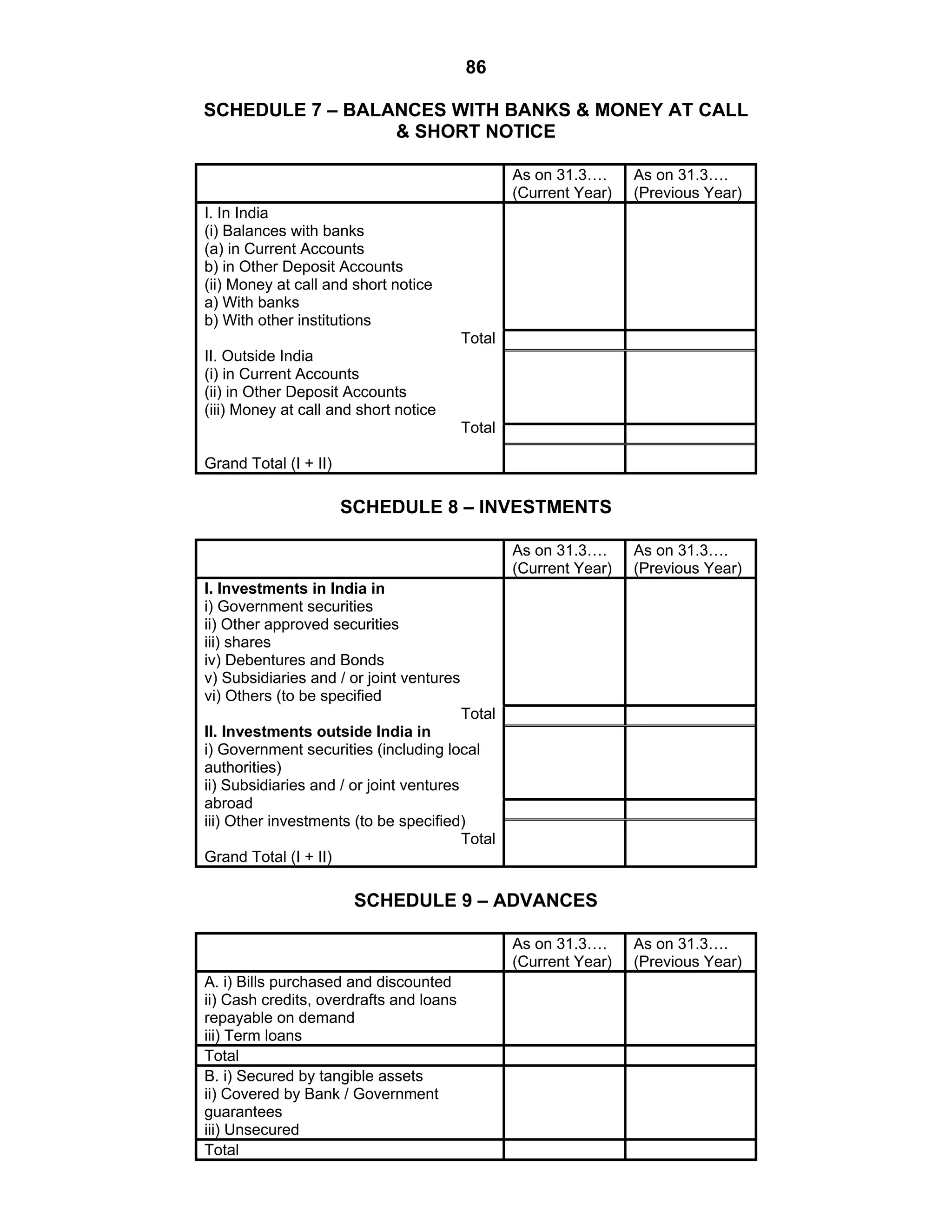
SCHEDULE 7 – BALANCES WITH BANKS & MONEY AT CALL
& SHORT NOTICE
As on 31.3….
(Current Year)
As on 31.3….
(Previous Year)
I. In India
(i) Balances with banks
(a) in Current Accounts
b) in Other Deposit Accounts
(ii) Money at call and short notice
a) With banks
b) With other institutions
Total
II. Outside India
(i) in Current Accounts
(ii) in Other Deposit Accounts
(iii) Money at call and short notice
Total
Grand Total (I + II)
SCHEDULE 8 – INVESTMENTS
As on 31.3….
(Current Year)
As on 31.3….
(Previous Year)
I. Investments in India in
i) Government securities
ii) Other approved securities
iii) shares
iv) Debentures and Bonds
v) Subsidiaries and / or joint ventures
vi) Others (to be specified
Total
II. Investments outside India in
i) Government securities (including local
authorities)
ii) Subsidiaries and / or joint ventures
abroad
iii) Other investments (to be specified)
Total
Grand Total (I + II)
SCHEDULE 9 – ADVANCES
As on 31.3….
(Current Year)
As on 31.3….
(Previous Year)
A. i) Bills purchased and discounted
ii) Cash credits, overdrafts and loans
repayable on demand
iii) Term loans
Total
B. i) Secured by tangible assets
ii) Covered by Bank / Government
guarantees
iii) Unsecured
Total
87
C. I. Advances in India
i) Priority Sectors
ii) Public Sector
iii) Banks
iv) Others
Total
II. Advances outside India
i) Due from banks
ii) Due from others
a) Bills purchased and discounted
b) Syndicated loans
c) Others
Total
Grand Total (C. I. + C. II.)
SCHEDULE 10 – FIXED ASSETS
As on 31.3…
(Current Year)
As on 31.3…
(Previous Year)
I. Premises
At cost as on 31st
March of the preceding
year
Additions during the year
Deductions during the year
Depreciation to date
II. Other Fixed Assets (including
furniture and fixtures)
At cost as on 31st
March of the preceding
year
Additions during the year
Deductions during the year
Depreciation to date
Total (I + II)
SCHEDULE 11 – OTHER ASSETS
As on 31.3….
(Current Year)
As on 31.3….
(Previous Year)
I. Inter-office adjustments (net)
II. Interest accrued
III. Tax paid in advance / tax deducted at
source
IV. Stationery and stamps
V. Non-banking assets acquired in
satisfaction of claims
VI. Others @
Total
@ In case there is any unadjusted balance of loss, the same may
be shown under this item with appropriate foot-note.
88
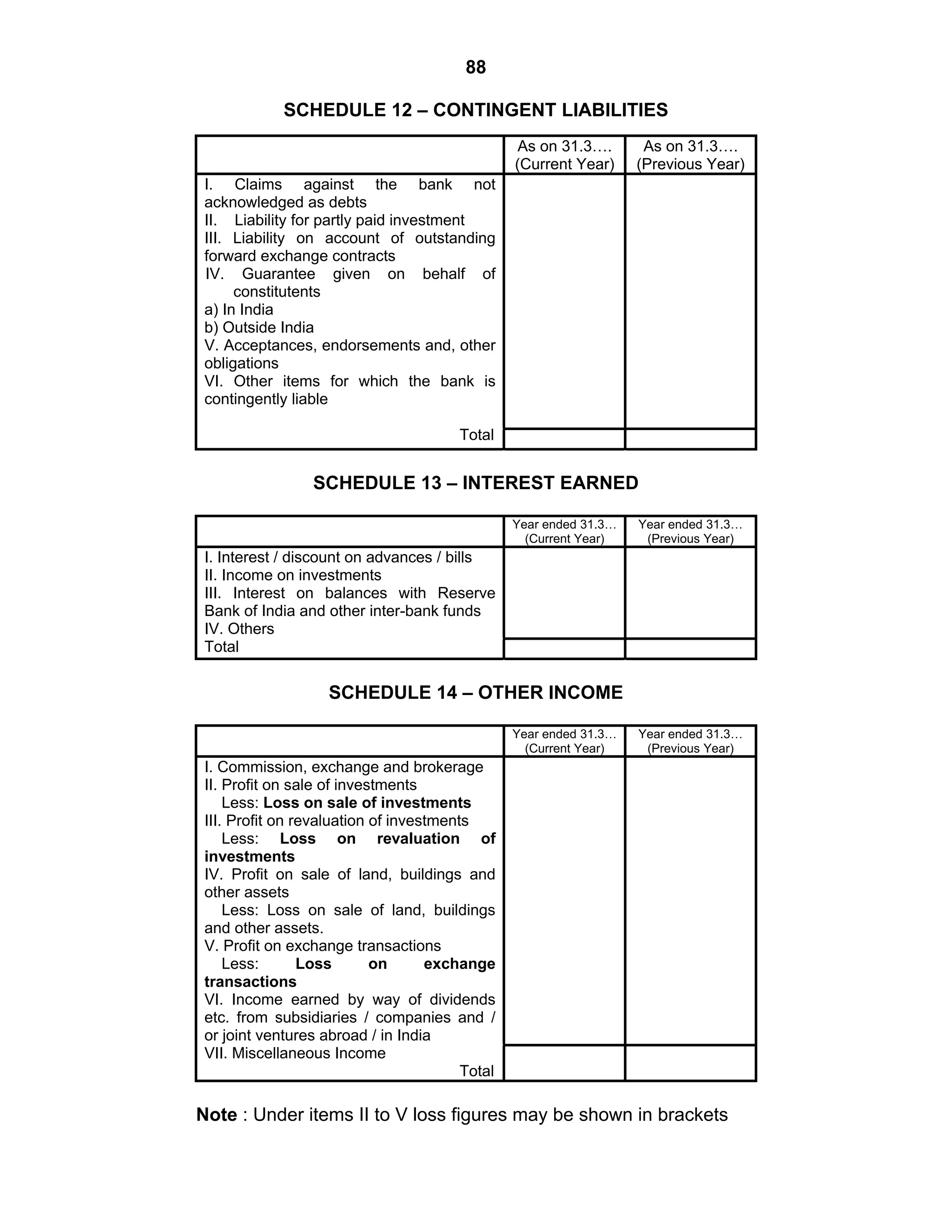
SCHEDULE 12 – CONTINGENT LIABILITIES
As on 31.3….
(Current Year)
As on 31.3….
(Previous Year)
I. Claims against the bank not
acknowledged as debts
II. Liability for partly paid investment
III. Liability on account of outstanding
forward exchange contracts
IV. Guarantee given on behalf of
constitutents
a) In India
b) Outside India
V. Acceptances, endorsements and, other
obligations
VI. Other items for which the bank is
contingently liable
Total
SCHEDULE 13 – INTEREST EARNED
Year ended 31.3…
(Current Year)
Year ended 31.3…
(Previous Year)
I. Interest / discount on advances / bills
II. Income on investments
III. Interest on balances with Reserve
Bank of India and other inter-bank funds
IV. Others
Total
SCHEDULE 14 – OTHER INCOME
Year ended 31.3…
(Current Year)
Year ended 31.3…
(Previous Year)
I. Commission, exchange and brokerage
II. Profit on sale of investments
Less: Loss on sale of investments
III. Profit on revaluation of investments
Less: Loss on revaluation of
investments
IV. Profit on sale of land, buildings and
other assets
Less: Loss on sale of land, buildings
and other assets.
V. Profit on exchange transactions
Less: Loss on exchange
transactions
VI. Income earned by way of dividends
etc. from subsidiaries / companies and /
or joint ventures abroad / in India
VII. Miscellaneous Income
Total
Note : Under items II to V loss figures may be shown in brackets
89
SCHEDULE 15 – INTEREST EXPENDED
Year ended 31.3…
(Current Year)
Year ended 31.3…
(Previous Year)
I. Interest on deposits
II. Interest on Reserve Bank of India /
inter-bank borrowings
III. Others
Total
SCHEDULE 16 – OPERATING EXPENSES
Year ended 31.3…
(Current Year)
Year ended 31.3…
(Previous Year)
I. Payments to and provisions for
employees
II. Rent, taxes and lighting
III. Printing and stationery
IV. Advertisement and publicity
V. Depreciation on bank’s property
VI. Directors’ fees, allowances and
expenses
VII. Auditor’ fees and expenses (including
branch auditors’ fees and expenses)
VII. Law charges
IX. Postages, telegrams, telephone, etc.
X. Repairs and maintenance
XI. Insurance
XII. Other expenditure
Total
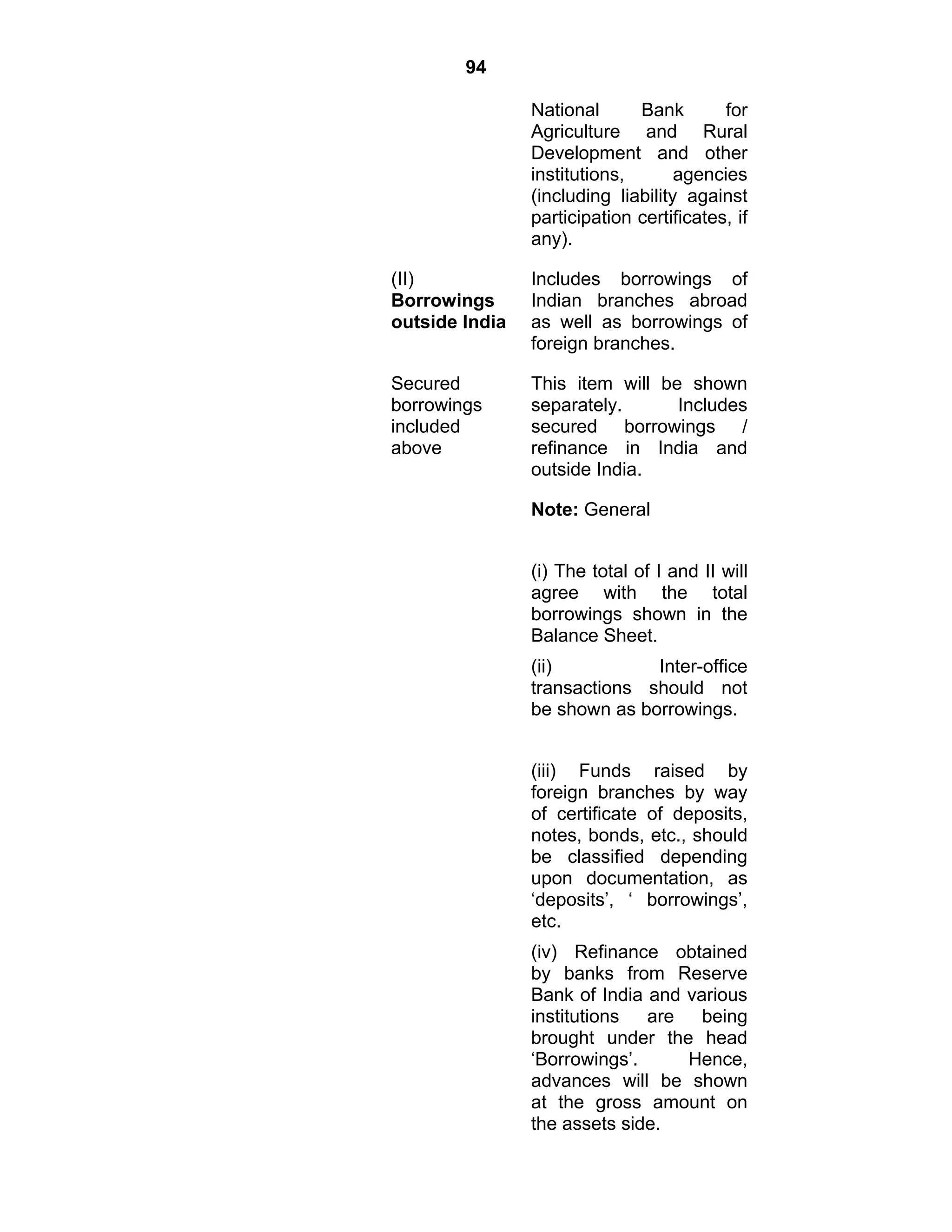
GUIDELINES OF RBI FOR COMPILATION OF FINANCIAL
STATEMENTS BALANCE SHEET
Item Schedule Coverage Notes and instructions for
compilation
(1) (2) (3) (4)
Capital 1 Nationalized
Banks
Capital (fully
owned by
Central
Government)
The capital owned by
Central Government as
on the date of the
Balance Sheet, including
contribution from
Government, if any, for
participating in World
Bank, Projects, should be
shown.
90
Banking
Companies
incorporated
outside India
(i) The amount brought in
by banks by way of start-
up capital as prescribed
by RBI, should be shown
under this head.
(ii) The amount or
deposits kept with RBI
under sub-section 2 of
Section 11 of the Banking
Regulation Act, 1949
should also be shown.
Other Banks
(Indian)
Authorized
Capital
(… shares of
Rs… each)
Issued Capital
(… Shares of
Rs... Each)
Subscribed
Capital
(… Shares of
Rs…. Each)
Called-up
Capital
(… Shares of
Rs… each)
Less: Calls
unpaid Add:
Forfeited
shares: Paid-
up Capital
Authorized, Issued,
Subscribed, Called-up
Capital should be given
separately. Calls-in-
arrears will be deducted
from Called-up Capital
while the paid-up value of
forfeited shares should be
added, thus arriving at the
paid-up capital. The
necessary items which
can be combined should
be shown under one
head, for instance,
“Issued and Subscribed
Capital”.
Notes: General
The changes in the above
items, if any, during the
years, say, fresh
contribution made by the
Government, fresh issue
of capital, capitalization of
reserves, etc., may be
explained in the notes.
91
Reserves
and
Surplus
2 (I) Statutory
Reserves
Reserves created in
terms of Section 17 or
another section of
Banking Regulation Act,
must be separately
disclosed.
(II) Capital
Reserves
The expression ‘capital
reserve’ shall not include
any amount regarded as
free for distribution
through the Profit and
Loss Account. Surplus on
revaluation should be
treated as Capital
Reserves. Surplus on
translation of the financial
statements of foreign
branches (which includes
fixed assets also) is not a
revaluation reserve.
(III) Share
Premium
Premium on issue of
share capital may be
shown separately under
this head.
(IV) Revenue
and other
Reserves
The expression ‘Revenue
Reserve’ shall mean any
reserve other than those
separately classified. This
expression ‘reserve’ shall
not include any amount,
written-off or retained by
way of providing for
depreciation, renewals or
diminution in value of
assets or retained by way
of providing for any
known liability.
(V) Balance
of Profit
Includes balance of profit
after appropriation. In
case of loss the balance
may be shown as a
deduction.
92
Notes : General
Movement in various
categories of reserves
should be shown as
indicated in the schedule.
Deposi
ts
3 A. (I) Demand
Deposits
(i) from banks
(ii) from others
Includes all bank deposits
repayable on demand.
Include all demand
deposits of the non-
banking sectors.
Credit balances in
overdrafts, cash credit
accounts, deposits
payable at call, overdue
deposits, inoperative
current accounts,
matured time deposits
and cash certificates,
certificate of deposits, etc.
are to be included under
this category.
(ii) Saving
Bank
Deposits
Includes all savings bank
deposits (including
inoperative savings bank
accounts).
(III) Term
Deposits
(i) from banks
(ii) from others
Includes all types of bank
deposits repayable after
specified term.
Includes all types of
deposits of the non-
banking sector, repayable
after a specified term.
Fixed deposits,
cumulative and recurring
deposits, annuity
deposits, deposits
mobilized under various
schemes, ordinary staff
deposits, foreign currency
non-resident deposit
accounts, etc., are to be
included under this
category.
93
B.
(i) Deposits
of branches
in India
(ii) Deposits
of branches
outside India
The total of these two
items will agree with the
total deposits.
Notes : General
(a) Interest payable on
deposits which is accrued
but not due should not be
included but shown under
other liabilities.
b) Matured time deposits
and cash certificates, etc.,
should be treated as
demand deposits.
c) Deposits under special
schemes should be
included under the term
deposits, if they are not
payable on demand.
When such deposits have
matured for payment they
should be shown under
demand deposits.
d) Deposits from banks
will include deposits from
the banking system in
India, co-operative banks,
foreign banks, which may
or may not have presence
in India.
Borrow
ings
4 (I)
Borrowings
in India
(i) Reserve
Bank of India
(II) Other
Banks
(iii) Other
institutions
and agencies.
Includes borrowing /
refinance obtained from
Reserve Bank of India
Includes borrowings /
refinance obtained from
commercial banks
(including co-operative
banks).
Includes borrowings /
refinance obtained from
industrial Development
Bank of India, Export-
Import of Bank of India,
94
National Bank for
Agriculture and Rural
Development and other
institutions, agencies
(including liability against
participation certificates, if
any).
(II)
Borrowings
outside India
Includes borrowings of
Indian branches abroad
as well as borrowings of
foreign branches.
Secured
borrowings
included
above
This item will be shown
separately. Includes
secured borrowings /
refinance in India and
outside India.
Note: General
(i) The total of I and II will
agree with the total
borrowings shown in the
Balance Sheet.
(ii) Inter-office
transactions should not
be shown as borrowings.
(iii) Funds raised by
foreign branches by way
of certificate of deposits,
notes, bonds, etc., should
be classified depending
upon documentation, as
‘deposits’, ‘ borrowings’,
etc.
(iv) Refinance obtained
by banks from Reserve
Bank of India and various
institutions are being
brought under the head
‘Borrowings’. Hence,
advances will be shown
at the gross amount on
the assets side.
95
Other
Liabiliti
es and
Provisi
ons
5 I.Bills
Payable
Includes drafts,
telegraphic transfers,
traveler cheques, mail
transfers payable, pay
slips, bankers cheques
and other miscellaneous
items.
II. Inter-office
Adjustments
The inter-office
adjustments balance, if
the credit should be
shown under this head.
Only net position of inter-
office accounts, inland as
well as foreign, should be
shown here.
III.Interest
Accrued
Includes interest accrued
but not due on deposits
and borrowings.
IV.Others
(including
provisions)
Includes net provision for
income tax and other
taxes like interest tax
(less advance payment,
tax deducted at source,
etc.,) surplus in aggregate
in provisions for
depreciation in securities,
contingency funds which
are not disclosed under
any of the major heads
such as unclaimed
dividend, provisions and
funds kept for specific
purpose, unexpired
discount, outstanding
charges like rent,
conveyance, etc. Certain
types of deposits like staff
security deposits, margin
deposits, etc. where the
repayment is not free,
should also be included
under this head.
96
Notes: General
i) For arriving at the net
balance of inter-office
adjustments all connected
inter-office accounts
should be aggregated
and the net balance
should only be shown,
representing mostly items
in transit and unadjusted
items.
(ii) the interest accruing
on all deposits, whether
the payment is due or not,
should be treated as a
liability.
iii) it is proposed to show
only pure deposits under
the head ‘deposits’, and
hence, all surplus
provisions for bad and
doubtful debts,
contingency funds, secret
reserves, etc., which are
not netted off against the
relative assets, should be
brought under the head
‘others’ (including
provisions).
Cash
and
Balanc
es with
the
Reserv
e Bank
of India
6 I. Cash in
hand
(including
foreign
currency
notes)
II. Balance
with RBI
i) In current
Account
ii) in other
Accounts
Includes cash in hand,
including foreign currency
notes and also of foreign
branches in the case of
banks having such
branches.
97
Balanc
e with
banks
and
money
at call
and
short
notice
7 I. In India
i) Balance with
Banks
a) in current
accounts
b) in other
deposit
accounts
Includes all balance with
banks in India (including
co-operative banks).
Balances in current
accounts and deposit
accounts should be
shown separately.
ii) Money at
call and short
notice
a) with banks
b) with other
institutions
Includes deposits
repayable within 15 days
notice, lent in the inter-
bank call money market.
II. Outside
India
i) Current
accounts
ii) Deposits
Includes balances held by
foreign branches and
balances held by Indian
branches of the banks
outside India. Balance
held with foreign
branches by other
branches of the bank,
should not show under
this head but should be
included in the inter-
branch accounts. The
amounts held in ‘current
accounts’ and ‘deposit
accounts should be
shown separately.
iii) Money at
call and short
notice
Includes deposits usually
classified in foreign
currencies as money at
call and short notice.
Invest
ment
8 I. Investment
in India
i) Government
securities
Includes Central and
State Government
securities and
Government treasury
bills. These securities
should be at the book
value. However, the
difference between the
98
book value and market
value should be given in
the notes to the Balance
Sheet.
ii) Other
approved
securities
Securities other than
Government securities,
which according to the
Banking Regulation Act,
1949, are treated as
approved securities,
should be included here.
iii) Shares Investment in shares of
companies and
corporations not included
in item (ii) should be
included here.
iv) Debentures
and Bonds
Investments in
debentures and bonds of
Companies, Corporations
not included in item (ii)
should be included here.
v) Investments
in subsidiaries
/ joint ventures
Investment in subsidiary /
joint ventures (including
R. R. Bs) should be in
included here.
vi) Others Includes general
investments, if any, like
gold, commercial paper
and other instruments in
the nature of shares /
debentures / bonds.
II. Investment
outside India
i) Government
securities
(including
local
authorities)
ii) Subsidiaries
and / or joint
ventures
abroad
All foreign Government
securities including
securities issued by local
authorities may be
classified under this head.
All investments made in
the share capital of
subsidiaries, floated
outside India and / or joint
99
iii) Others
ventures abroad, should
be classified under this
head.
All other investments
outside India may be
shown under this head.
Advanc
es
9 A. i) Bills
purchased
and
discounted
ii) Cash
credits,
overdrafts and
loans
repayable on
demand
iii) Terms
loans
In classification under
Section ‘A’, all
outstanding – in India as
well as outside – less
provisions made, will be
classified under three
heads as indicated, and
both secured and
unsecured advances will
be included under these
heads including overdue
installments.
B. i) Secured
by tangible
assets
All advances or part of
advances which are
secured by tangible
assets may be shown
here. The item will include
advances in India and
outside India.
ii) Covered by
Bank /
Government
Guarantee
Advances in India and
outside India to the extent
they are covered by
guarantees of Indian and
foreign governments and
Indian and foreign banks
and DICGC & ECGC are
to be included.
iii) Unsecured All advances not
classified under (i) and (ii)
will be included here.
Total of ‘A’ should tally
with the total of ‘B’.
C.I. Advances
in India
i) Priority
sectors
Advances should be
broadly classified into
‘Advances in India’ and
‘Advances outside India’.
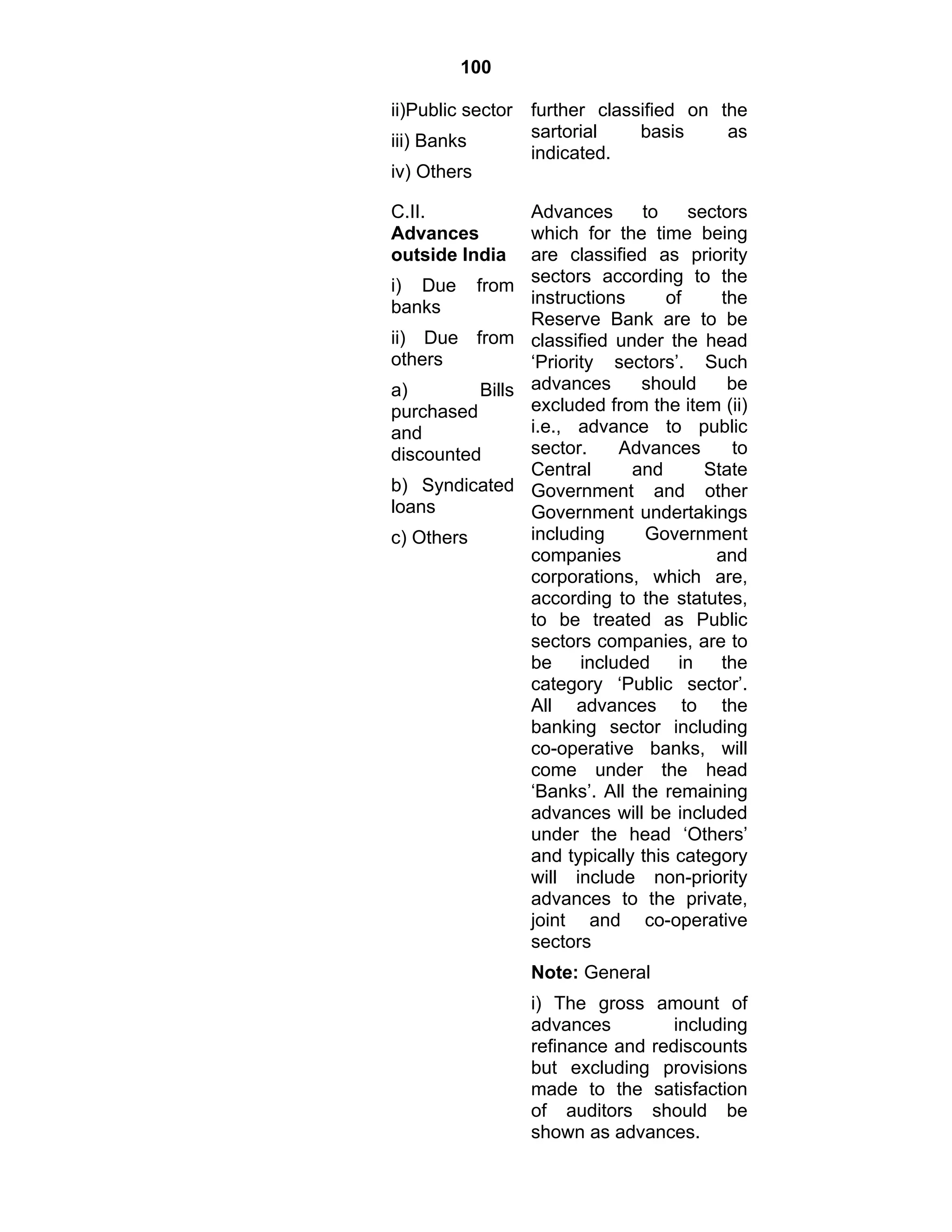
Advances in India will be
100
ii)Public sector
iii) Banks
iv) Others
further classified on the
sartorial basis as
indicated.
C.II.
Advances
outside India
i) Due from
banks
ii) Due from
others
a) Bills
purchased
and
discounted
b) Syndicated
loans
c) Others
Advances to sectors
which for the time being
are classified as priority
sectors according to the
instructions of the
Reserve Bank are to be
classified under the head
‘Priority sectors’. Such
advances should be
excluded from the item (ii)
i.e., advance to public
sector. Advances to
Central and State
Government and other
Government undertakings
including Government
companies and
corporations, which are,
according to the statutes,
to be treated as Public
sectors companies, are to
be included in the
category ‘Public sector’.
All advances to the
banking sector including
co-operative banks, will
come under the head
‘Banks’. All the remaining
advances will be included
under the head ‘Others’
and typically this category
will include non-priority
advances to the private,
joint and co-operative
sectors
Note: General
i) The gross amount of
advances including
refinance and rediscounts
but excluding provisions
made to the satisfaction
of auditors should be
shown as advances.
101
ii) Term loans will be
loans not repayable on
demand.
iii) Consortium advances
would be shown net of
share from other
participating banks /
institutions.
Fixed
Assets
10 I. Premises
i) At cost as
on 31st
March
of the
preceding
year
ii) Addition
during the
year
iii)
Deductions
during the
year
iv)
Depreciation
to due
Premises wholly or partly
owned by the banking
company for the purpose
of business, including
residential premises
should be shown against
‘premises’. In the case of
premises and other fixed
assets, the previous
balance, additions there
to, deductions there from,
during the year, and also
the total depreciation
written-off should be
shown. Where sums have
been written off on
reduction of capital and
revaluation of assets,
every Balances Sheet
after the first Balance
Sheet, subsequent to the
reduction or revaluation
should show the revised
figures for a period of five
years, with the date and
amount of revision made.
II.Other Fixed
Assets
(including
furniture and
fixtures)
i) At cost on
31st
March of
the preceding
year
Motor vehicles and all
other fixed assets other
than premises but
including furniture and
fixtures should be shown
under this head.
102
ii)Additions
during the
year
iii) deductions
during the
year
iv) Depreciation
to date
Other
Assets
11 I. Inter-office
Adjustments
(net)
The inter-office
adjustment balance, if in
debit, should be shown
under this head. Only net
position of inter-office
accounts, inland as well
as foreign, should be
shown here. For arriving
at the net balance of
inter-office adjustment
accounts, all connected
inter-office accounts
should be aggregated
and the net balance, if in
debit, only should be
shown, representing
monthly items in transit
and unadjusted items.
II.Interest
Accrued
Interest accrued but not
due or investments and,
advance and interest due
but not collected on
investment, will be the
main components of this
item. As banks normally
debit the borrowers
account with the interest
due on the Balance Sheet
date, usually there may
not be any amount of
interest due on advances.
Only such interest as can
be realized in the ordinary
course should be shown
under this head.
103
III. Tax paid
in advance /
tax deducted
at source
The amount of tax
deducted at source on
securities, advance tax
paid etc. to the extent that
these items are not set off
against relative tax
provisions should be
shown against this item.
IV. Stationery
and Stamps
Only exceptional items of
expenditure on stationery
like bulk purchase of
security paper, loose leaf
or other ledgers, etc.
which are shown as
quasi-asset to be written-
off over a period of time,
should be shown here.
The value should be on a
realistic basis and cost
escalation should not be
taken into account, as
these items are for
internal use.
V.Non-
banking
assets
acquired in
satisfaction
of claims
Immovable properties /
tangible assets acquired
in satisfaction of claims
are to be shown under
this head.
VI. Others This will include items like
claims which have not
been met, for instance,
clearing items, debit items
representing addition to
assets or reduction in
liabilities, which have not
been adjusted for
technical reasons, want of
particulars, etc.,
advances given to staff by
a bank as an employer
and not as a banker, etc.
Items which are in the
nature of expenses,
which are pending
104
adjustments, should be
provided for and the
provision netted against
this item, so that only
realizable value is shown
under this head. Accrued
income other than interest
may also be included
here.
Conting
ent
Liabilitie
s
12 I. Claims
against the
bank not
acknowledge
d as debts
II. Liabilities
for partly
paid
investments
Liabilities on partly paid
shares, debentures, etc.,
will be included in this
head.
III. Liabilities
on account of
outstanding
forward
exchange
contracts
Outstanding forward
exchange contracts may
be included here
IV.
Guarantees
given on
behalf of
constituents
i) in India
ii)outside
India
Guarantees given for
constituents in India and
outside India may be
shown separately.
V)
Acceptances,
endorsement
and other
obligations
This item will include
letters of credit and bills
accepted by the bank on
behalf of customers.
105
VI. Other items
for which the
Bank is
contingently
liable
Arrears of cumulative
dividends, bills
rediscounted under
under-writing contracts,
estimated amount of
contracts remaining to be
executed on Capital
Account and not provided
for, etc., are to be
included here.
Bills for
Collection
Bills and other items in
the course of collection
and not adjusted will be
shown against this item in
summary version only, a
separate schedule is
proposed.
Profit and Loss Account
Interest
earned
13 I. Interest /
discount on
advance / bills
Includes interest and
discount on all types of
loans and advances, cash
credit, demand loans,
overdrafts, export loans,
term loans, domestic and
foreign bills purchased
and discounted (including
those rediscounted), over
interest and also interest
subsidy, if any, relating to
advances / bills
II. Income on
investments
Includes all income
derived from the
investment portfolio by
way of interest and
dividend.
III. Interest on
balances with
the Reserve
Bank of India
and other inter-
bank funds
Includes interest on
balances with Reserve
Ban and other banks, call
loans, money market
placements etc.
106
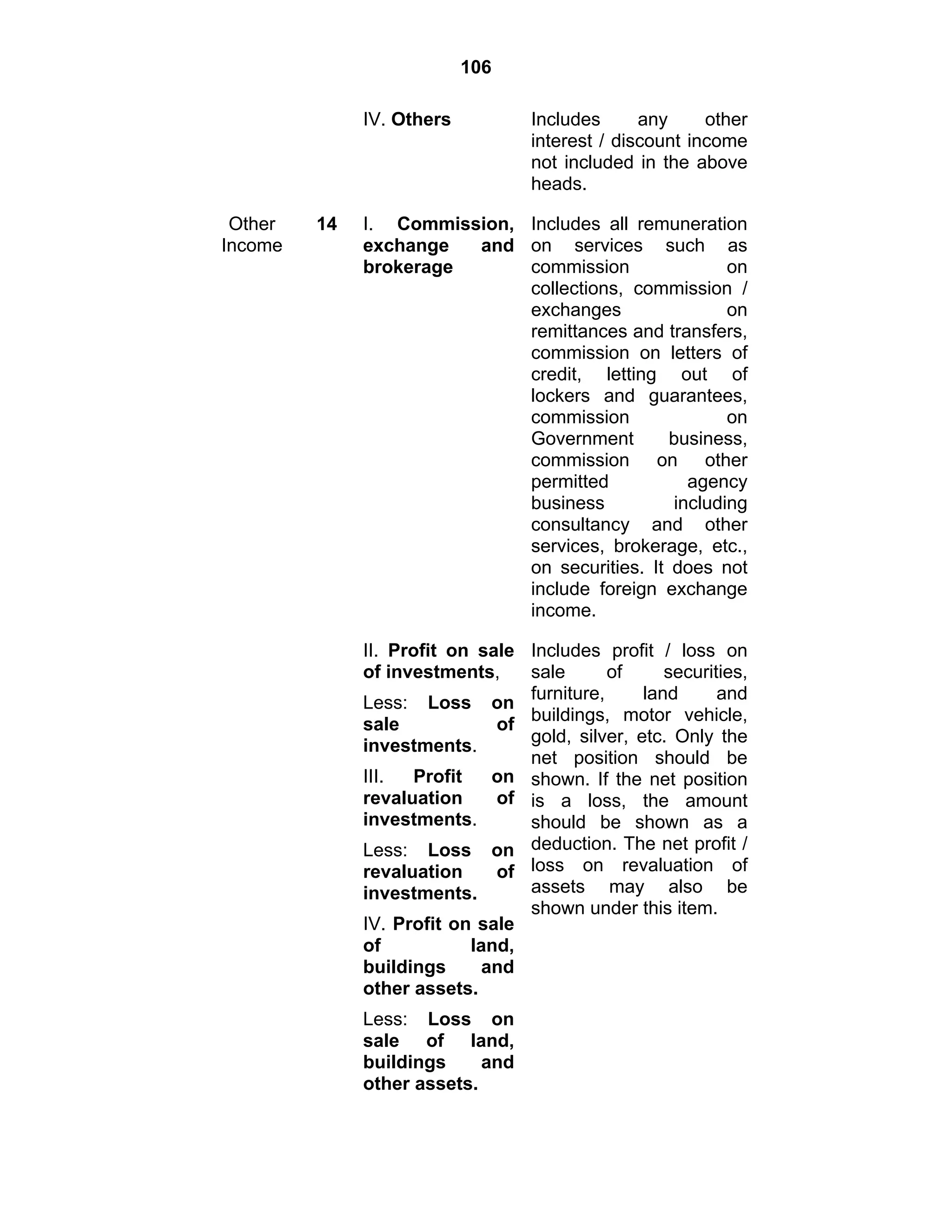
IV. Others Includes any other
interest / discount income
not included in the above
heads.
Other
Income
14 I. Commission,
exchange and
brokerage
Includes all remuneration
on services such as
commission on
collections, commission /
exchanges on
remittances and transfers,
commission on letters of
credit, letting out of
lockers and guarantees,
commission on
Government business,
commission on other
permitted agency
business including
consultancy and other
services, brokerage, etc.,
on securities. It does not
include foreign exchange
income.
II. Profit on sale
of investments,
Less: Loss on
sale of
investments.
III. Profit on
revaluation of
investments.
Less: Loss on
revaluation of
investments.
IV. Profit on sale
of land,
buildings and
other assets.
Less: Loss on
sale of land,
buildings and
other assets.
Includes profit / loss on
sale of securities,
furniture, land and
buildings, motor vehicle,
gold, silver, etc. Only the
net position should be
shown. If the net position
is a loss, the amount
should be shown as a
deduction. The net profit /
loss on revaluation of
assets may also be
shown under this item.
107
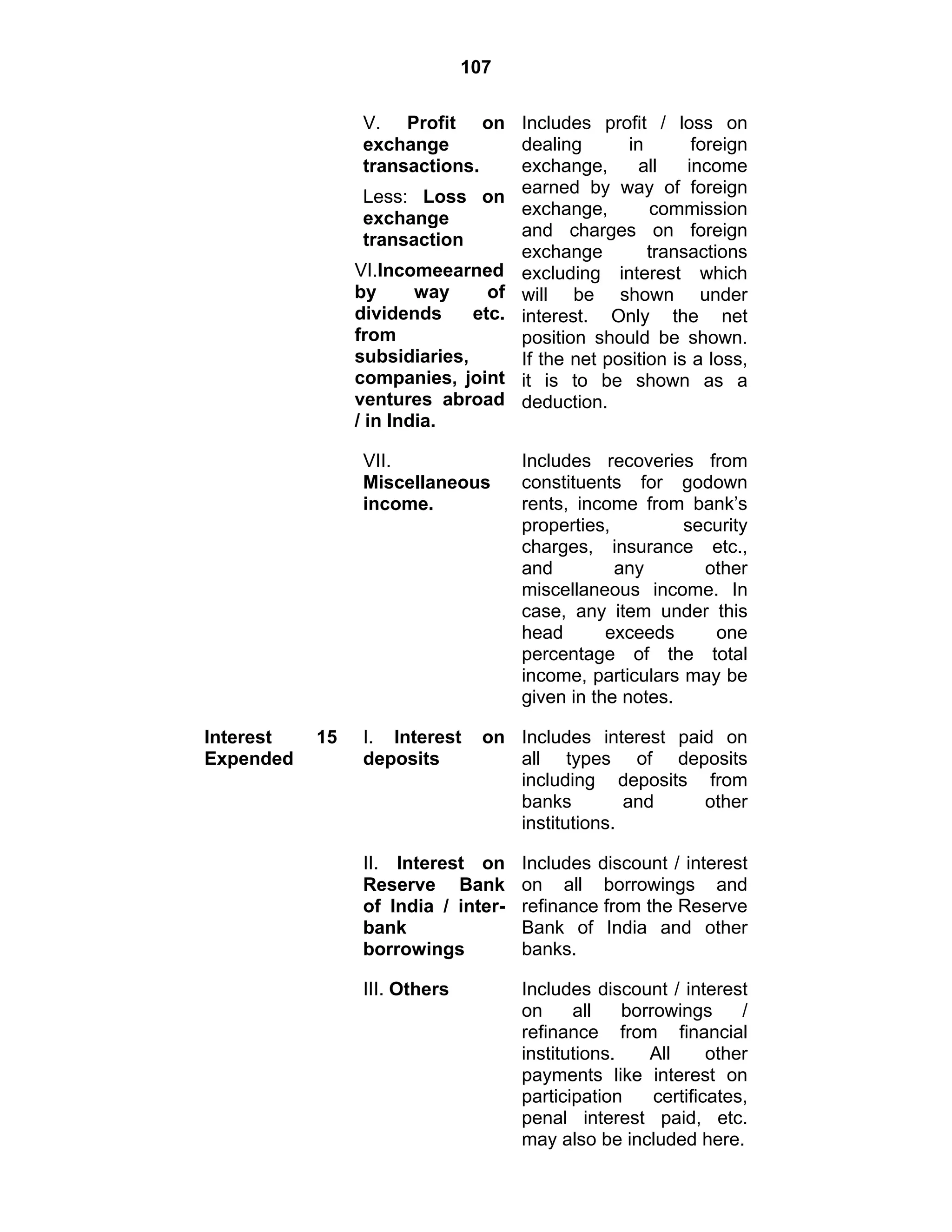
V. Profit on
exchange
transactions.
Less: Loss on
exchange
transaction
VI.Incomeearned
by way of
dividends etc.
from
subsidiaries,
companies, joint
ventures abroad
/ in India.
Includes profit / loss on
dealing in foreign
exchange, all income
earned by way of foreign
exchange, commission
and charges on foreign
exchange transactions
excluding interest which
will be shown under
interest. Only the net
position should be shown.
If the net position is a loss,
it is to be shown as a
deduction.
VII.
Miscellaneous
income.
Includes recoveries from
constituents for godown
rents, income from bank’s
properties, security
charges, insurance etc.,
and any other
miscellaneous income. In
case, any item under this
head exceeds one
percentage of the total
income, particulars may be
given in the notes.
Interest
Expended
15 I. Interest on
deposits
Includes interest paid on
all types of deposits
including deposits from
banks and other
institutions.
II. Interest on
Reserve Bank
of India / inter-
bank
borrowings
Includes discount / interest
on all borrowings and
refinance from the Reserve
Bank of India and other
banks.
III. Others Includes discount / interest
on all borrowings /
refinance from financial
institutions. All other
payments like interest on
participation certificates,
penal interest paid, etc.
may also be included here.
108
Operating
Expanses
16 I. Payments to
and provisions
for employees
Includes staff salaries /
wages, allowances, bonus,
and other staff benefits,
like provident fund,
pension, gratuity, liveries
to staff, leave fare
concessions, staff welfare,
medical allowance to staff,
etc.
II. Rent, taxes
and lighting
Includes rent paid by the
banks on buildings and
municipal and other taxes
paid (excluding income-tax
and interest tax) electricity
and other similar charges
and levies. House rent
allowance and other
similar payments to staff
should appear under the
head ‘Payments to and
Provisions for Employees’.
III. Printing and
Stationery
Includes books and forms,
and stationery used by the
bank and other printing
charges, which are not
incurred by way of publicity
expenditure.
IV.
Advertisement
and Publicity
Includes expenditure
incurred by the bank of
advertisement and
publicity purposes
including printing charges
of publicity matter.
V. Depreciation
on bank’s
property
Includes depreciation on
bank’s own property, motor
cars and other vehicles,
furniture, electric fittings,
vaults, lifts, leasehold
properties, non-banking
assets, etc.
VI. Director’s
fees,
allowances and
expenses
Includes sitting fees and all
other items of expenditure
incurred on behalf of the
directors. The daily
109
allowance, hotel charges,
conveyance charges, etc.
which though in the nature
of reimbursement of
expenses incurred, may be
included under this head.
Similar expenses of Local
Committee members may
also be included under this
head.
VII. Auditor’s
fees and
expenses
(including
branch
auditor’s fees
and expenses)
Includes the fees paid to
the statutory auditors and
branch auditors for the
professional services
rendered and also all
expenses for performing
their duties, even though
they may be in the nature
of reimbursement of
expenses. If external
auditors have been
appointed by the banks
themselves for internal
inspections and audits and
other services, the
expenses incurred in that
context including fees may
not be included under this
head but should be shown
under ‘other expenditure’.
VIII. Law
charges
All legal expenses and
reimbursement of
expenses incurred in
connection with legal
services are to be included
here.
IX. Postage,
telegraphs,
telephones, etc.
Includes all postal charges
like stamps, telegrams,
telephones, teleprinter etc.
X Repairs and
maintenance
Includes repairs to bank’s
property, their
maintenance charges, etc.
110
XI. Insurance Includes insurance
charges on bank’s
property, insurance premia
paid to Deposit Insurance
and Credit Guarantee
Corporation, etc. to the
extent they are not
recovered from the
concerned parties.
XII. Other
expenditure
Provisions and
contingencies
All expenses other than
those not included in any
of the other heads, like,
licence fees, donations,
subscriptions to papers,
periodicals, entertainment
expenses, travel
expenses, etc., may be
included under this head.
In case, any particular item
under this head exceeds
one percentage of the total
income, the particulars
may be given in the notes.
Includes all provisions
made for bad and doubtful
debts, provisions for
taxation, provisions for
diminution in the value of
investments, transfers to
contingencies and other
similar items.
Disclosure of Accounting Policies
In order that the financial position of banks represent a true
and fair view, the Reserve Bank of India has directed the banks to
disclose the accounting policies regarding the key areas of
operations along with the notes of account in their financial
statements for the accounting year ending 31.3.1991 and onwards,
on a regular basis. The accounting policies disclosed may contain
the following aspects subject to modification by individual banks:
1) General
The accompanying financial statements have been prepared
on the historical cost and conform to the statutory provisions and
practices prevailing in the country.
111
2) Transactions involving Foreign Exchange
a) Monetary assets and liabilities have been translated at the
exchange rates, prevailing at the close of the year. Non-monetary
assets have been carried in the books at the historical cost.
b) Income and expenditure items in respect of Indian branches
have been translated at the exchange rates, ruling on the date of
the transaction and in respect of overseas branches at the
exchange rates prevailing at the close of the year.
c) Profit or losses on pending forward contracts have been
accounted for.
3) Investments
a) Investments in Governments and other approved securities in
India are valued at the lower of cost or market value.
b) Investments in subsidiary companies and associate companies
(i.e., companies in which the bank holds at least 25 percent of the
share capital) have been accounted for on the historical cost basis.
c) All other investments are valued at the lower of cost or market
value.
4) Advances
a) Provisions for doubtful advances have been made to the
satisfaction of the auditors:
i) In respect of identified advances, based on a periodic review of
advances and after taking into account the portion of advance
guaranteed by the Deposit Insurance and Credit Guarantee
Corporation, the Export Credit and Guarantee Corporation and
similar statutory bodies;
ii) In respect of general advances, as a percentage of total
advances taking into account the guidelines issued by the
Government of India and the Reserve Bank of India.
b) Provisions in respect of doubtful advances have been deducted
from the advances to the extent necessary and the excess have
been included under “Other Liabilities and Provisions”.
c) Provisions have been made on a gross basis. Tax relief, which
will be available when the advance is written-off, will be accounted
for in the year of write-off.
5) Fixed Assets
a) Premises and other fixed assets have been accounted for at
their historical cost. Premises which have been revalued are
112
accounted for the value determined on the basis of such
revaluation made by the professional values; profit arising on
revaluation has been credited to Capital Reserve.
b) Depreciation has been provided for on the straight
line/diminishing balance method.
c) In respect of revalued assets, depreciation is provided for on the
revalued figures and an amount equal to the additional depreciation
consequent of revaluation is transferred annually from the Capital
Reserve to the General Reserve / Profit and Loss Account.
6) Staff Benefits
Provisions for gratuity / pension benefits to staff have been
made on an accrual / casual basis. Separate funds for gratuity /
pension have been created.
7) Net Profit
a) The net profit disclosed in the Profit and Loss Account is after:
i) provisions for taxes on income, in accordance with the statutory
requirements.
ii) provisions for doubtful advances.
iii) adjustments to the value of “current investments” in Government
and other approved securities in India, valued at lower of cost or
market value.
iv) transfers to contingency funds.
v) other usual or necessary provisions.
b) Contingency funds have been grouped in the Balance Sheet
under the head “Other Liabilities and Provisions”.
2.6. SOME IMPORTANT TRANSACTIONS
2.6.1 Rebate on Bills Discounted:
Rebate on Bills Discounted is the Discount income not
earned by the bank of discounting off the Bill of the Bill as it gets
mature after the closing date of its accounting year.
Journal entries :
i) On discounting of Bill
Bills Discounted and purchased A/c Dr (with its full value)
To Customer’s Account (with the proceeds value)
To Discount A/c (with the amount of Discount earned during
the year)
113
To Rebate on Bills Discounted (with the amount of unearned
Discount)
‘Rebate on Bills Discounted’ appears on Liabilities side of
Balance sheet under – “other liabilities and provisions” (schedule-5)
as it is the income received in advance.
ii) At the beginning of Accounting year entry will be Rebate on
Bills Discounted A/c Dr.
To Discount A/c (with the amount of unearned Discount)
Illustration 1:
On 1st
January 2008 Ajmer Bank Ltd. Discounted a bill of Rs. 3,
00,000 @ 10 percent p.a. The Bills falls due on 31st
May 2008 and
bank closes its account on 31st
March every year. Pass necessary
journal entry.
Journal Entry
Solution:
1 Jan, 08 Bills discounted and purchased A/c Dr
To Customers’ A/c
To Discount A/c
To Rebate on bills discounted
(Being the bills discounted)
3,00,000
2,87,500
7,500
5,000
1 April, 08 Rebate on bills discounted A/c Dr.
To Discount A/c
(Being in next accounting year Rebate
on bills discounted transferred to
discount A/c)
5,000
5,000
Note : Discount for 3 months = 3,00,000
10 3
7,500
100 12
Rebate on bills for 2 months = 3, 00,000
10 2
5,000
100 12
Illustration 2:
Following are the details of bills discounted by UCO Bank Ltd.
During the year ended 31/3/08
Date of Bill
2009
Amount
(Rs).
Term
(Months)
Rate of
Discount
p.a. (%)
Discount
(Rs.)
Jan 15
March 5
Feb. 6
1,00,000
1,50,000
80,000
4
3
5
12
15
18
4,000
5,625
6,000
Total 3,30,000 15,625
114
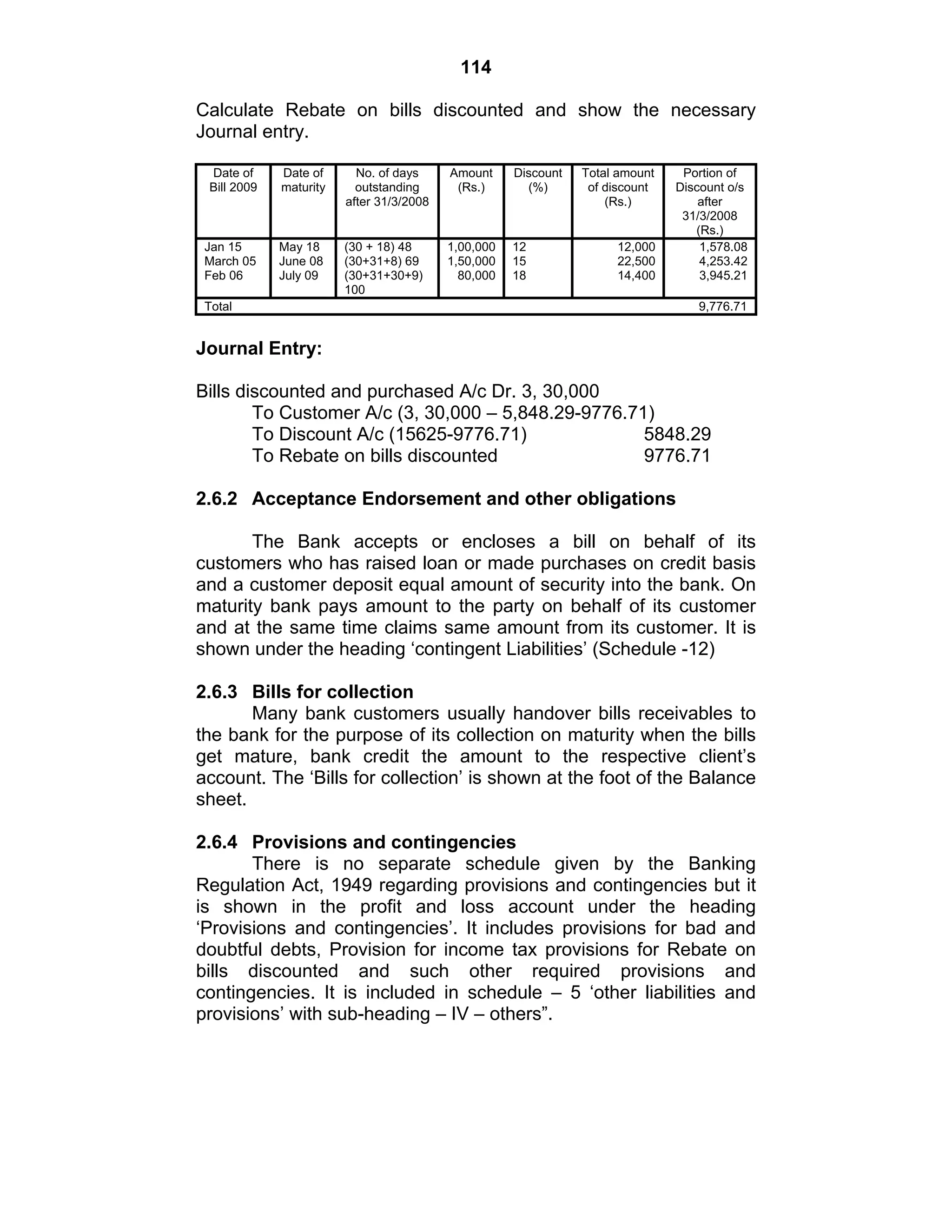
Calculate Rebate on bills discounted and show the necessary
Journal entry.
Date of
Bill 2009
Date of
maturity
No. of days
outstanding
after 31/3/2008
Amount
(Rs.)
Discount
(%)
Total amount
of discount
(Rs.)
Portion of
Discount o/s
after
31/3/2008
(Rs.)
Jan 15
March 05
Feb 06
May 18
June 08
July 09
(30 + 18) 48
(30+31+8) 69
(30+31+30+9)
100
1,00,000
1,50,000
80,000
12
15
18
12,000
22,500
14,400
1,578.08
4,253.42
3,945.21
Total 9,776.71
Journal Entry:
Bills discounted and purchased A/c Dr. 3, 30,000
To Customer A/c (3, 30,000 – 5,848.29-9776.71)
To Discount A/c (15625-9776.71) 5848.29
To Rebate on bills discounted 9776.71
2.6.2 Acceptance Endorsement and other obligations
The Bank accepts or encloses a bill on behalf of its
customers who has raised loan or made purchases on credit basis
and a customer deposit equal amount of security into the bank. On
maturity bank pays amount to the party on behalf of its customer
and at the same time claims same amount from its customer. It is
shown under the heading ‘contingent Liabilities’ (Schedule -12)
2.6.3 Bills for collection
Many bank customers usually handover bills receivables to
the bank for the purpose of its collection on maturity when the bills
get mature, bank credit the amount to the respective client’s
account. The ‘Bills for collection’ is shown at the foot of the Balance
sheet.
2.6.4 Provisions and contingencies
There is no separate schedule given by the Banking
Regulation Act, 1949 regarding provisions and contingencies but it
is shown in the profit and loss account under the heading
‘Provisions and contingencies’. It includes provisions for bad and
doubtful debts, Provision for income tax provisions for Rebate on
bills discounted and such other required provisions and
contingencies. It is included in schedule – 5 ‘other liabilities and
provisions’ with sub-heading – IV – others”.
115
2.7 SOLVED PROBLEMS
Illustration 1
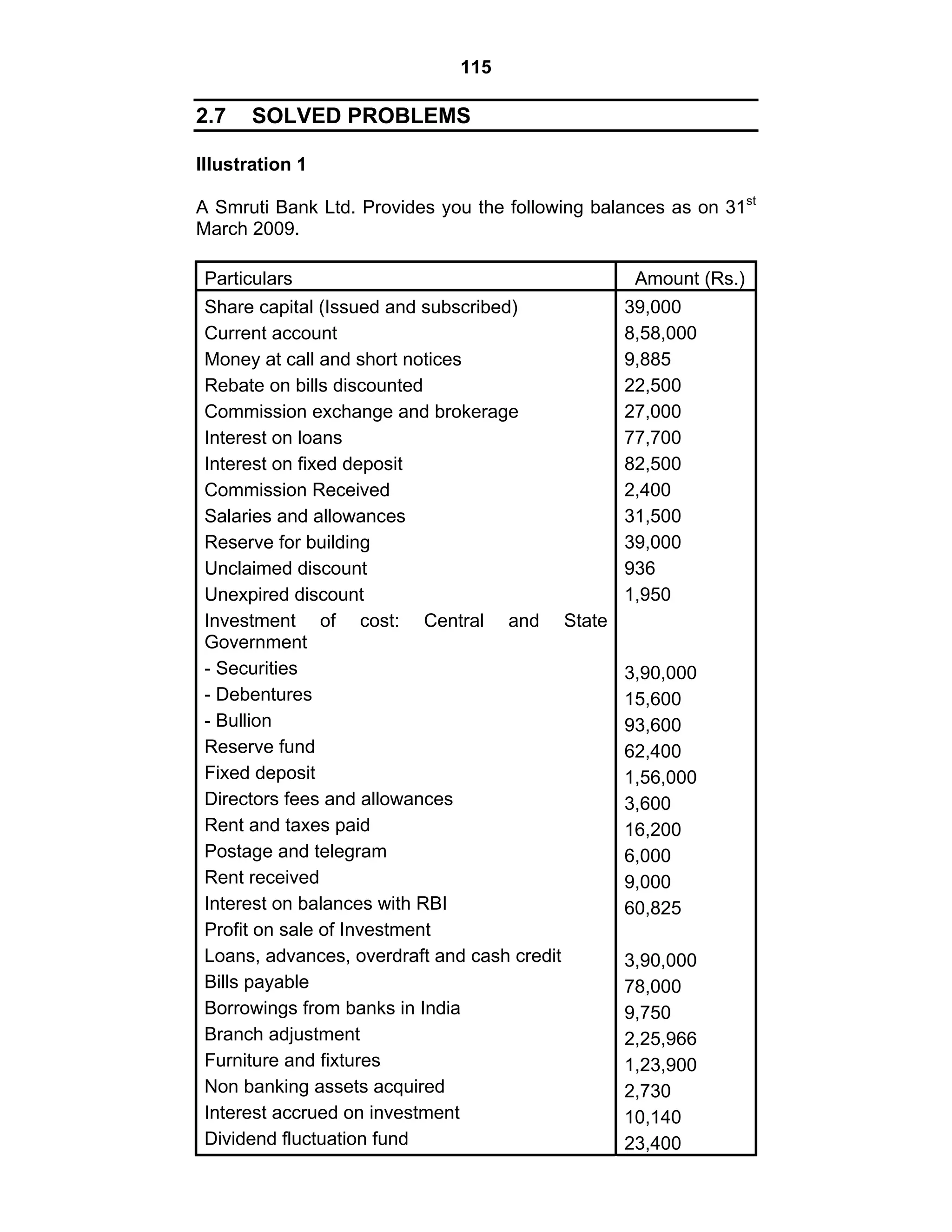
A Smruti Bank Ltd. Provides you the following balances as on 31st
March 2009.
Particulars Amount (Rs.)
Share capital (Issued and subscribed)
Current account
Money at call and short notices
Rebate on bills discounted
Commission exchange and brokerage
Interest on loans
Interest on fixed deposit
Commission Received
Salaries and allowances
Reserve for building
Unclaimed discount
Unexpired discount
Investment of cost: Central and State
Government
- Securities
- Debentures
- Bullion
Reserve fund
Fixed deposit
Directors fees and allowances
Rent and taxes paid
Postage and telegram
Rent received
Interest on balances with RBI
Profit on sale of Investment
Loans, advances, overdraft and cash credit
Bills payable
Borrowings from banks in India
Branch adjustment
Furniture and fixtures
Non banking assets acquired
Interest accrued on investment
Dividend fluctuation fund
39,000
8,58,000
9,885
22,500
27,000
77,700
82,500
2,400
31,500
39,000
936
1,950
3,90,000
15,600
93,600
62,400
1,56,000
3,600
16,200
6,000
9,000
60,825
3,90,000
78,000
9,750
2,25,966
1,23,900
2,730
10,140
23,400
116
Profit and loss A/c (Credit balance)
Locker rent
Transfer fees
Interest on saving bank deposits
Interest on cash credit
Premises at cost
Additions to premises
Advance payment of tax
Silver bullion
Saving Bank deposit
Cash balances with RBI
Cash balances with other banks
Depreciation Fund on premises
7,800
3,000
1,500
20,400
66,900
3,90,000
78,000
4,290
7,800
2,34,000
1,32,600
46,800
3,12,000
Other Information:
1) There was a claim of rupees 7,800 against bank but not
acknowledge as debt.
2) Bank transfer reserve for building to depreciation fund of
premises
3) Directors decided to declare 10 percent dividend
4) Provide rupees 1, 05,000 for income tax and rupees 15,000
for doubtful debts.
5) Transfer 20 percent of profit to statutory reserve. Prepare
final accounts of the bank.
Solution:
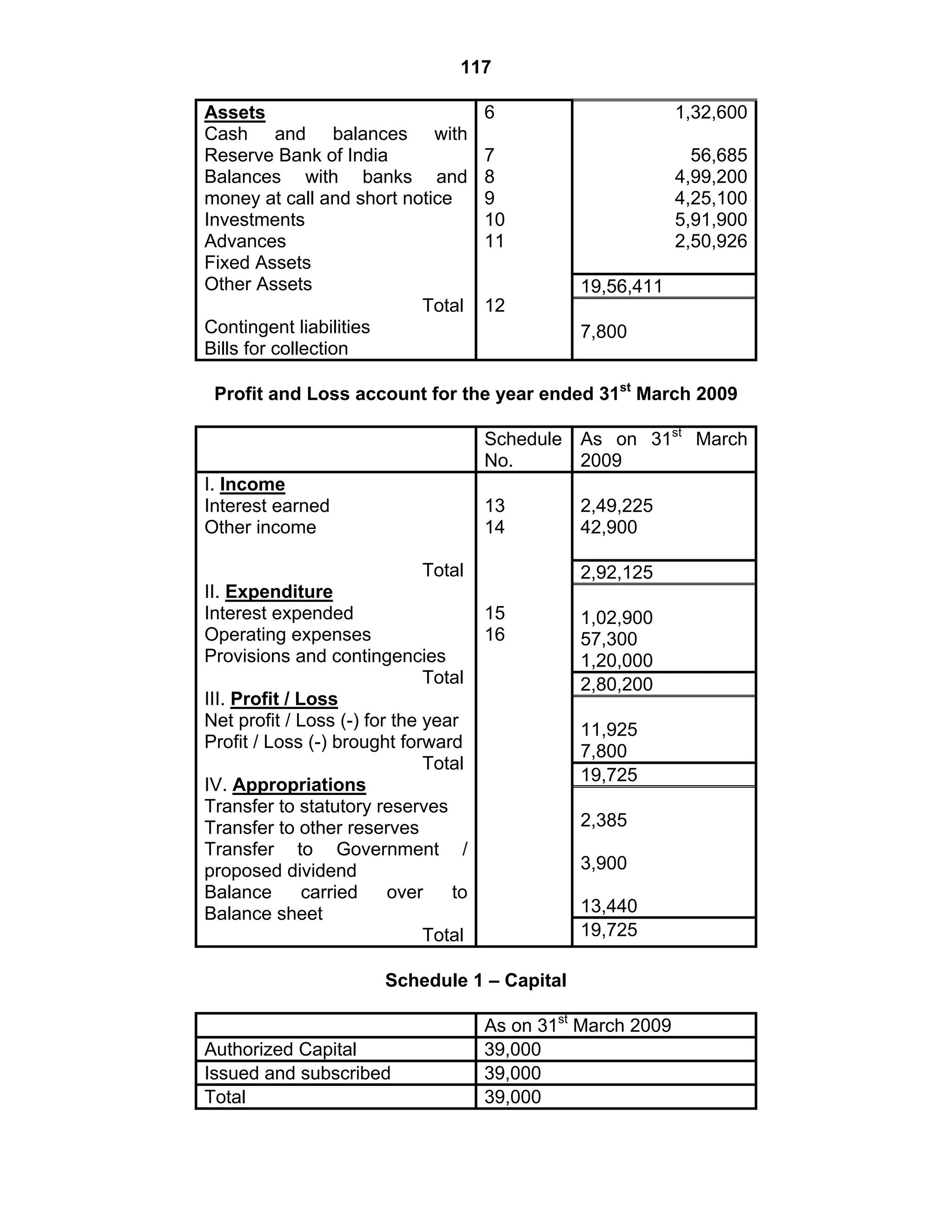
Smruti Bank Ltd.
Balance Sheet as on 31st
March 2009
Schedule
No.
As on 31st
March
2009
39,000
1,01,625
12,48,000
9,750
5,58,036
19,56,411
Capital and Liabilities
Capital
Reserves and surplus
Deposits
Borrowings
Other Liabilities and provisions
Total
1
2
3
4
5
117
1,32,600
56,685
4,99,200
4,25,100
5,91,900
2,50,926
19,56,411
Assets
Cash and balances with
Reserve Bank of India
Balances with banks and
money at call and short notice
Investments
Advances
Fixed Assets
Other Assets
Total
Contingent liabilities
Bills for collection
6
7
8
9
10
11
12
7,800
Profit and Loss account for the year ended 31st
March 2009
Schedule
No.
As on 31st
March
2009
2,49,225
42,900
2,92,125
1,02,900
57,300
1,20,000
2,80,200
11,925
7,800
19,725
2,385
3,900
13,440
I. Income
Interest earned
Other income
Total
II. Expenditure
Interest expended
Operating expenses
Provisions and contingencies
Total
III. Profit / Loss
Net profit / Loss (-) for the year
Profit / Loss (-) brought forward
Total
IV. Appropriations
Transfer to statutory reserves
Transfer to other reserves
Transfer to Government /
proposed dividend
Balance carried over to
Balance sheet
Total
13
14
15
16
19,725
Schedule 1 – Capital
As on 31st
March 2009
Authorized Capital 39,000
Issued and subscribed 39,000
Total 39,000
118
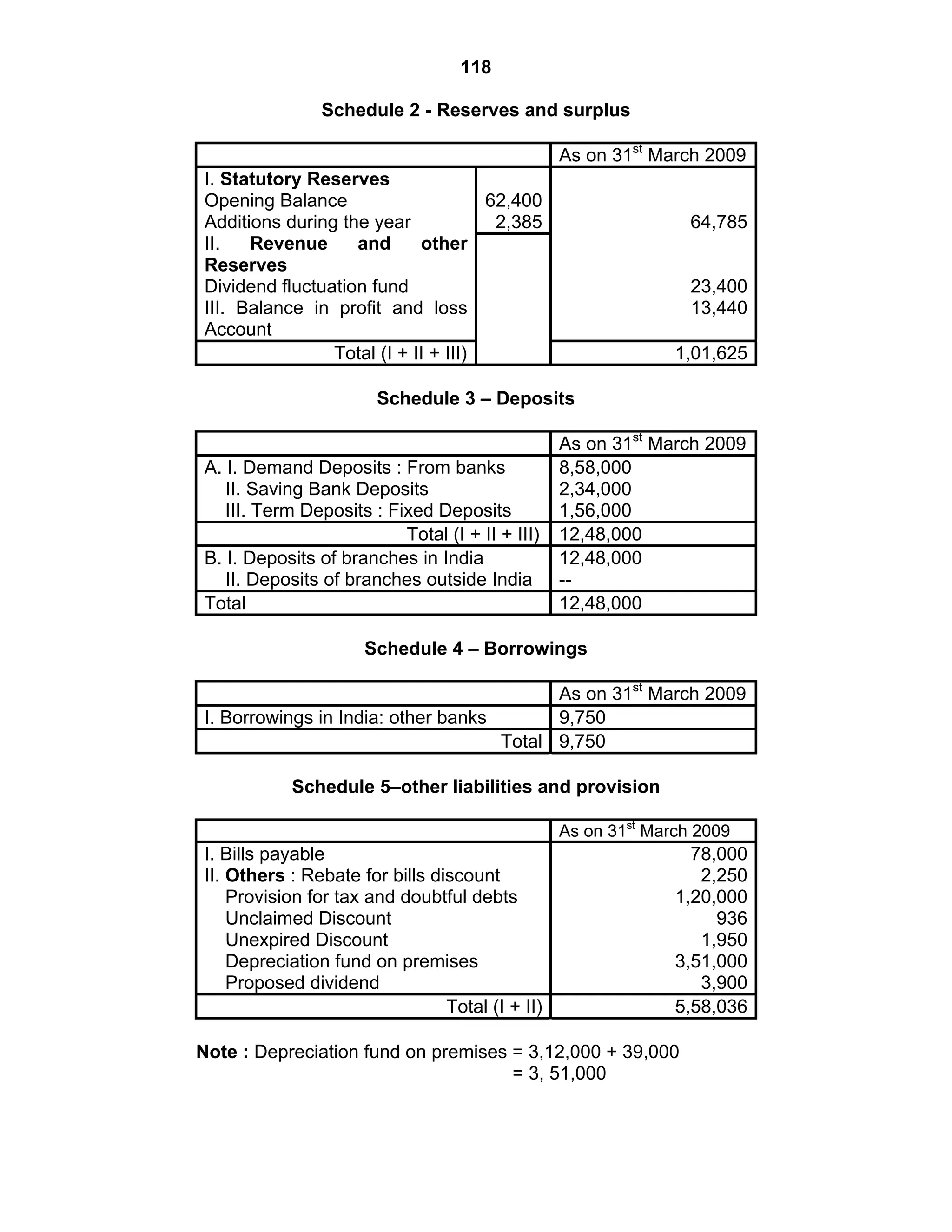
Schedule 2 - Reserves and surplus
As on 31st
March 2009
62,400
2,385
I. Statutory Reserves
Opening Balance
Additions during the year
II. Revenue and other
Reserves
Dividend fluctuation fund
III. Balance in profit and loss
Account
64,785
23,400
13,440
Total (I + II + III) 1,01,625
Schedule 3 – Deposits
As on 31st
March 2009
A. I. Demand Deposits : From banks
II. Saving Bank Deposits
III. Term Deposits : Fixed Deposits
8,58,000
2,34,000
1,56,000
Total (I + II + III) 12,48,000
B. I. Deposits of branches in India
II. Deposits of branches outside India
12,48,000
--
Total 12,48,000
Schedule 4 – Borrowings
As on 31st
March 2009
I. Borrowings in India: other banks 9,750
Total 9,750
Schedule 5–other liabilities and provision
As on 31st
March 2009
I. Bills payable
II. Others : Rebate for bills discount
Provision for tax and doubtful debts
Unclaimed Discount
Unexpired Discount
Depreciation fund on premises
Proposed dividend
78,000
2,250
1,20,000
936
1,950
3,51,000
3,900
Total (I + II) 5,58,036
Note : Depreciation fund on premises = 3,12,000 + 39,000
= 3, 51,000
119
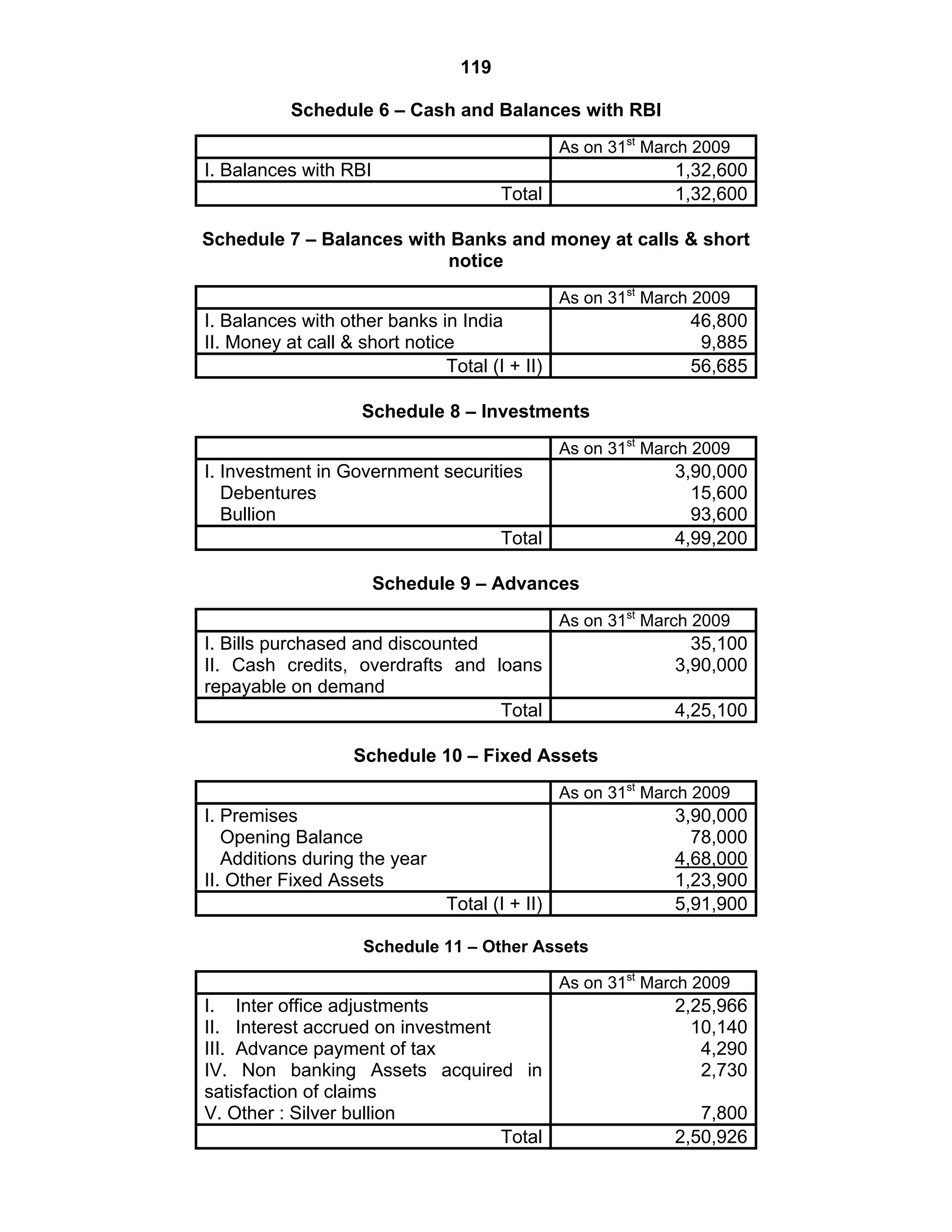
Schedule 6 – Cash and Balances with RBI
As on 31st
March 2009
I. Balances with RBI 1,32,600
Total 1,32,600
Schedule 7 – Balances with Banks and money at calls & short
notice
As on 31st
March 2009
I. Balances with other banks in India
II. Money at call & short notice
46,800
9,885
Total (I + II) 56,685
Schedule 8 – Investments
As on 31st
March 2009
I. Investment in Government securities
Debentures
Bullion
3,90,000
15,600
93,600
Total 4,99,200
Schedule 9 – Advances
As on 31st
March 2009
I. Bills purchased and discounted
II. Cash credits, overdrafts and loans
repayable on demand
35,100
3,90,000
Total 4,25,100
Schedule 10 – Fixed Assets
As on 31st
March 2009
I. Premises
Opening Balance
Additions during the year
II. Other Fixed Assets
3,90,000
78,000
4,68,000
1,23,900
Total (I + II) 5,91,900
Schedule 11 – Other Assets
As on 31st
March 2009
I. Inter office adjustments
II. Interest accrued on investment
III. Advance payment of tax
IV. Non banking Assets acquired in
satisfaction of claims
V. Other : Silver bullion
2,25,966
10,140
4,290
2,730
7,800
Total 2,50,926
120
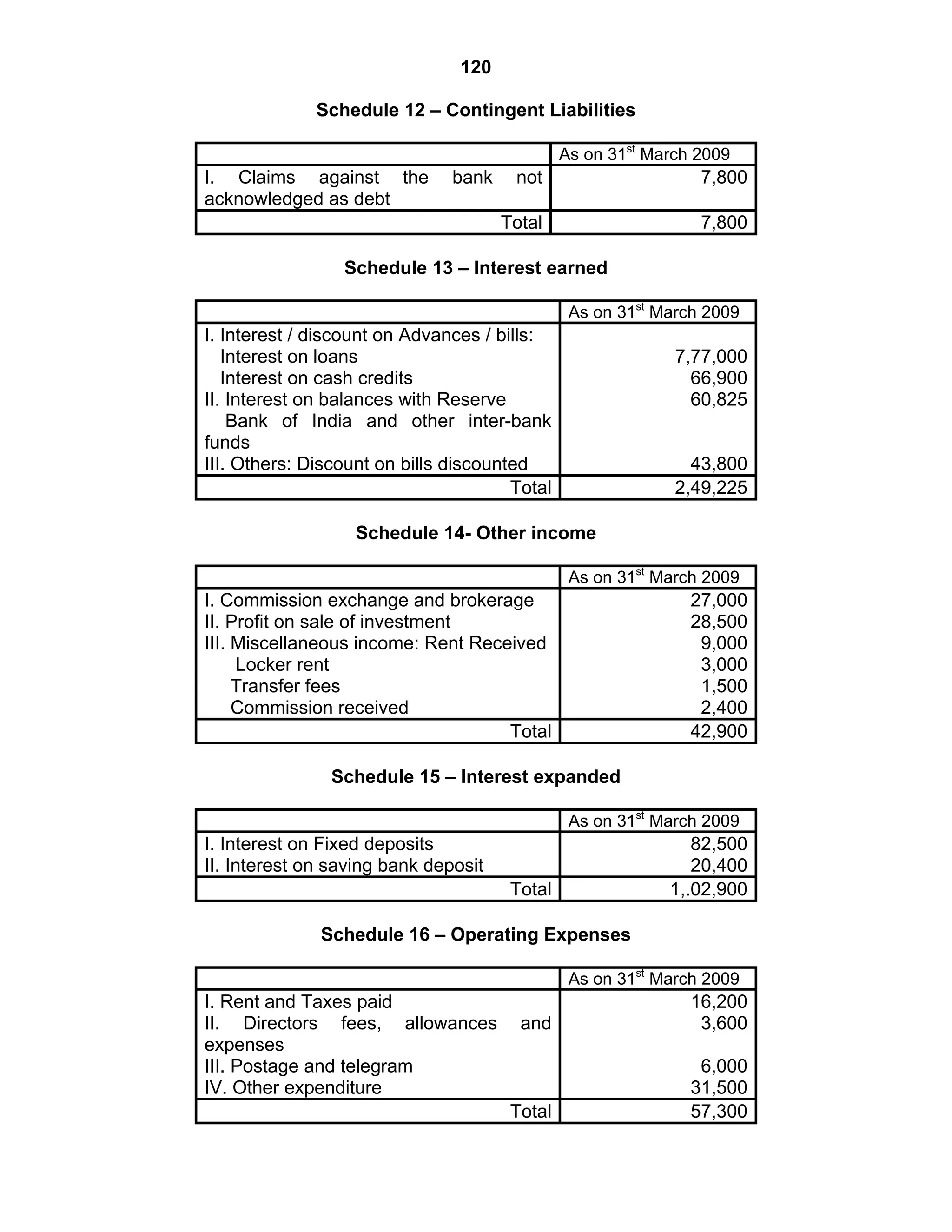
Schedule 12 – Contingent Liabilities
As on 31st
March 2009
I. Claims against the bank not
acknowledged as debt
7,800
Total 7,800
Schedule 13 – Interest earned
As on 31st
March 2009
I. Interest / discount on Advances / bills:
Interest on loans
Interest on cash credits
II. Interest on balances with Reserve
Bank of India and other inter-bank
funds
III. Others: Discount on bills discounted
7,77,000
66,900
60,825
43,800
Total 2,49,225
Schedule 14- Other income
As on 31st
March 2009
I. Commission exchange and brokerage
II. Profit on sale of investment
III. Miscellaneous income: Rent Received
Locker rent
Transfer fees
Commission received
27,000
28,500
9,000
3,000
1,500
2,400
Total 42,900
Schedule 15 – Interest expanded
As on 31st
March 2009
I. Interest on Fixed deposits
II. Interest on saving bank deposit
82,500
20,400
Total 1,.02,900
Schedule 16 – Operating Expenses
As on 31st
March 2009
I. Rent and Taxes paid
II. Directors fees, allowances and
expenses
III. Postage and telegram
IV. Other expenditure
16,200
3,600
6,000
31,500
Total 57,300
121
Illustration 2:
On 31st
March 2010 the following trial balance was extracted from
Amin Bank Ltd. You are required to prepare profit and loss account
for the year ended 31st
March 2010 and also the balance sheet as
on that date.
Debit Balances Amount
(Rs.)
Insurance charges on bank property
Depreciation on banks property
Fees paid to statutory auditor
Staff salaries and medical allowances
Rent on building and municipal taxes
Interest due but not collected on investment
Land and building at cost
Other fixed Assets
Loss on sale of other fixed Assets
Repairs and maintenance
Legal charges
Tax deducted at source
Cash in hand
Balances with RBI: Current A/c
Other Accounts
Printing and stationary
Printing charges of publicity matters
Stationary and stamp
Term loans
Licence fee
Directors sitting fees
Other expenditure
Balance with other bank: In current A/c
In other deposit A/c
Money call and short notices with bank
Cash credit and overdraft
Investment:
Government treasury bills
Other approved securities
Joint ventures
Debentures and bonds of companies
Non banking Assets acquired in satisfaction of claims
Interest on RBI borrowings
Bills purchased and discounted
Interest paid on deposit: From banks
Other institution
Inter-office adjustment (net)
2,899
3,523
21,944
1,45,366
9,035
33,280
4,693
24,570
2,795
1,508
221
93,873
27,482
9,75,026
12,805
2,418
520
1,846
9,11,599
12,155
4,524
9,295
7,139
3,560
325
12,96,984
12,78,576
4,91,452
16,380
19,721
6,500
5,785
2,84,089
59,280
2,37,159
16,562
122
Credit Balances Amount
(Rs.)
Issued, subscribed and paid up share capital:
3250 shares of Rs. 10 each
Interest on debentures and bonds
Rebate on bills discounted
Depreciation on building to date
Statutory Reserve
Revenue Reserves
Depreciation on other fixed assets to date
Demand deposits : From banks
From others
Saving bank deposits
Term deposits
Commission on remittances and transfer
Letting out lockers
Interest on balances with RBI and other
Inter-bank funds
Income earned by way of dividend from joint venture
Interest on advances, cash credit and overdraft
Interest accrued
Profit on sale of investment
Bills payable
Borrowings from RBI
Profit and loss account
32,500
1,86,706
42,939
1,417
97,591
71,500
12,610
13,39,050
10,9,540
15,41,865
19,04,760
53,582
5,920
44,811
2,274
4,04,859
16,328
2,275
71,162
37,700
45,500
Adjustments:
1. The authorized capital of bank is rupees 65,000 divided into
6,500 shares of Rupees10 each, 50 percent of it is issued and
subscribed.
2. The provision for income tax to be made @ 45 percent
3. All advances are in India and they are classified as follows:
priority sectors 12, 46,336; public sector 4, 98,534; banks 3,
94,198; others 3, 53,604. Advances secured by tangible assets
Rs. 11, 21,702; covered by bank/ Government guarantees Rs.
8, 72,435 and remaining are unsecured 4, 98,535.
4. Bank Transfer 20 percent of profit to statutory reserve and 15
percent to revenue reserves.
5. contingent liabilities:
i) Claim against the bank not acknowledged as debt Rs.
2,150.
ii) Liability on account of outstanding forward exchange
contracts Rs. 640.
iii) Acceptance, endorsement and other obligations 4542.
123
Solution 2:
Amin Bank Ltd.
Balance Sheet as on 31st
March 2010
Schedule
No.
As on 31st
March
2010
Capital & Liabilities
Capital
Reserves & Surplus
Deposits
Borrowings
Other Liabilities and provisions
32,500
3,14,691
48,95,215
37,700
2,12,329
Total 54,92,435
Assets
Cash and balances with Reserve
Bank of India
Balances with banks and money at
call and short notice
Investments
Advances
Fixed Assets
Other assets
10,15,313
11,024
18,06,129
24,92,672
15,236
1,52,061
Total 54,92,435
Contingent Liabilities
1
2
3
4
5
6
7
8
9
10
11
7,332
PROFIT & LOSS A/C FOR THE YEAR ENDED ON
31ST
MARCH, 2010
Schedule
No.
As on 31-3-
10
I. Income: Interest earned
Other Income
6,36,376
61,256
Total 6,97,632
II. Expenditure: Interest expended
Operating expenses
Provisions and contingencies
3,02,224
2,13,408
81,900
Total 5,97,532
III. Profit / Loss:
Net Profit / Loss (-) for the year
Profit / Loss (-) brought forward
1,00,100
45,500
Total 1,45,600
IV. appropriations:
Transfer to statutory reserves
Transfer to other reserves
Transfer to Government/proposed
dividend
Balance carried over to Balance Sheet
29,120
21,840
94,640
Total
13
14
15
16
1,45,600
124
Schedule 1 – Capital
As on 31st
March 2010
65,000
32,500
32,500
32,500
For other banks
Authorized capital
6500 shares of Rs. 10 each
Issue capital
3250 shares of Rs. 10 each
Subscribed capital:
3250 shares of Rs. 10 each
Called-up capital:
3250 shares of Rs. 10 each
32,500
Schedule 2 – Reserves and surplus
As on 31st
March 2010
97,591
29,120
1,26,711
71,500
21,840
93,340
I. Statutory reserves:
Opening balance
Additions during the year
II. Revenue and other reserves
Opening balance
Additions during the year
III. Balance in profit and loss A/c 94,640
Total (I + II + III) 3,14,691
Schedule 3 – Deposits
As on 31st
March, 2010
I. Demand deposits: From banks
From others
II. Savings bank deposits
III. Term deposits
13,39,050
1,09,540
15,41,865
19,04,760
Total ( I + II + III) 48,95,215
Schedule 4 – Borrowings
As on 31st
March, 2010
I. Borrowings in India : Reserve bank
of India
37,700
Total 37,700
125
Schedule 5– Other Liabilities and provisions
As on 31st
March, 2010
Bills payable
Interest accrued
Others: Rebate on bills discounted
Provision for income tax
71,162
16,328
42,939
81,900
Total 2,12,329
Schedule 6 – Cash and balances with RBI
As on 31st
March, 2010
I. Cash in hand
II. Balances with RBI:
In current A/c
In other A/c
27,482
9,75,026
12,805
Total 10,15,313
Schedule 7 – Balances with banks & money at call
& short notice
As on 31st
March, 2010
I. Balances with banks:
In current A/c
In other deposit A/c
II. Money at call & short notice
7,139
3,560
325
Total ( I + II) 11,024
Schedule 8 – Investment
As on 31st
March, 2010
Investments in:
Government treasury bills
Other approved securities
Debentures and bonds of companies
Subsidiaries and joint venture
12,78,576
4,91,452
19,721
16,380
Total 18,06,129
Schedule 9 – Advances
As on 31st
March, 2010
A)
i) Bills purchased and discounted
ii) Cash credit, overdraft and loans
repayable on demand
iii) Terms loans
2,84,089
12,96,984
9,11,599
Total 24,92,672
126
B)
i) Secured by tangible assets
ii) Covered by bank / Government
guarantees
iii) Unsecured
11,21,702
8,72,435
4,98,535
Total 24,92,672
C)
I) Advances in India :
i) Priority sectors
ii) Public sector
iii) Banks
iv) Others
12,46,336
4,98,534
3,94,198
3,53,604
Total 24,92,672
II) Advances outside India --
Schedule 10 – Fixed Assets
As on 31st
March, 2010
4,693
(1,417)
3,276
24,570
(12,610)
I) Premises: At cost
Depreciation to date
II) Other fixed assets (including
Furniture and fixtures):
At cost
Depreciation to date
11,960
Total (I + II) 15,236
Schedule 11 – Other Assets
As on 31st
March, 2010
Inter office adjustments
Interest due on investment but not
collected
Tax deducted at source
Stationary and stamps
Non banking assets acquired in
satisfaction of claims
16,562
33,280
93,873
1,846
6,500
Total 1,52,061
127
Schedule 12 – Contingent Liabilities
As on 31st
March, 2010
Claim against the bank not
acknowledge as debts
Liability on account of outstanding
forward exchange contracts
Acceptance, endorsement and other
obligations
2,150
640
4,542
Total 7,332
Schedule 13 – Interest earned
As on 31st
March, 2010
Interest on advances, cash credit and
overdraft
Interest on debentures and bonds
Interest on balances with RBI and
other inter bank funds
4,04,859
1,86,706
44,811
Total 6,36,376
Schedule 14 – Other income
As on 31st
March, 2010
Commission on remittances and
transfer
Profit on sale of investment
Loss on sale of other fixed assets
Income earned by way of dividend, etc
Form subsidiaries / companies
Miscellaneous income:
Letting out lockers
53,582
2,275
(2,795)
2,274
5,920
Total 61,256
Schedule 15 – Interest expanded
As on 31st
March, 2010
Interest on deposits:
From banks
From other Institution
Interest on RBI / inter bank borrowings
59,280
2,37,159
5,785
Total 3,02,224
128
Schedule 16 – Operating Expenses
As on 31st
March, 2010
Staff salaries and medical allowances
Rent on building and municipal taxes
Printing and stationery
Printing charges of publicity matters
Depreciation on banks property
Directors fees, allowances and
expenses
Fees paid to statutory auditor
Law charges
Repairs and maintenance
Insurance charges on bank property
Other expenditure: license fee
Other expenses
1,45,366
9,035
2,418
520
3,523
4,524
21,944
221
1,508
2,899
12,155
9,295
Total 2,13,408
Illustration 3
From the following information, prepare final accounts of Jetty Bank
Ltd. as on 31st
March, 2010
Debit Balances Amount
(Rs.)
Inter-office Adjustments (Net)
Interest on investment not collected but accrued
Stationery and stamp
Interest on deposits
Interest on RBI and Inter-Bank borrowings
Investment: In India
Government securities
Other approved securities
Subsidiaries and Joint Ventures
Mutual fund
Commercial paper
Unit Trust of India
Outside India
Foreign Government securities (Issued by local
authorities)
Subsidiaries and Joint Ventures
Rent, Taxes, lighting
Printing and stationery
Depreciation on land and Building
135
365
410
2,100
820
2,215
1,600
310
225
60
365
665
234
500
775
400
129
663
220
900
516
1,295
615
785
1,315
771
1,710
644
224
Directors Fees, allowances and expenses
Law charges
Non-banking assets acquired in satisfaction of claims
Tax paid in advance
Land and Building at cost
Other fixed assets
Bills purchased and discounted
Cash credit, overdrafts and loans
Terms loans
Balance with RBI
Balance with other Banks
Money at call and short notices
20,837
Credit Balances Amount
(Rs.)
2,000
225
311
1,775
1,100
1,322
775
1,120
1,335
330
1,000
925
885
700
435
1,100
375
446
1,135
531
411
225
800
665
911
Authorised, issued and subscribed capital
Deposits Repayable on demand
Certificates of deposits from non-bank sectors
Saving Bank deposits
Term Deposits: From Banks
Cumulative and Recurring deposits
Interest on Balances with other banks
Interest / discount on advances / bills
Income on investment
Commission, exchange and brokerage
Profit on sale of land and building
Income earned by way of dividend from subsidiaries
Statutory Reserves
Capital Reserves
Revenue and other Reserves
Borrowings in India : RBI
Other banks
Borrowings outside India
Profit on sale of investment (Net)
Profit on exchange transactions (Net)
Bills Payable
Inter-office Adjustment (Net)
Interest accrued
Other provisions
Interest on call loans
20,837
130
Adjustments:
1. Advances amounting Rs. 1,439 are secured by tangible assets;
Rs. 1,210 covered by guarantees of Indian and foreign
governments and banks; and remaining are unsecured.
2. Advances are made both in India and outside India:
Advances in India on sectoral basis – priority sector Rs. 860;
public sector Rs. 574; Banks Rs. 287 and other Rs. 193
Advances outside India – Due from Banks Rs. 623 and due
from others Rs. 334
3. Provision is to be made for income tax at the rate of 30%.
4. Dividend is proposed at the rate of 15 percent.
5. The contingent liabilities appears as on 31st
March 2010 as
follows.
i) Acceptance, endorsement and other obligations Rs. 310.
ii) Claims against bank not acknowledged as debt Rs. 620.
6. Out of total deposits, Rs. 1,317 are deposits of branches outside
India.
Solution:
Balance Sheet of Jetty Bank Ltd. as on 31-03-10
Schedule
No.
As on 31st
March
2010
Capital & Liabilities
Capital
Reserves & Surplus
Deposits
Borrowings
Other Liabilities and provisions
2,000
3,528.8
4,733
1,921
3,176.2
Total 15,359
Assets
Cash and balances with RBI
Balances with banks and money at
call and short notice
Investments
Advances
Fixed Assets
Other assets
1,710
868
5,674
2,871
1,910
2,326
Total 15,359
Contingent Liabilities
Bills for collection
1
2
3
4
5
6
7
8
9
10
11
12
--
930
--
131
PROFIT & LOSS A/C FOR THE YEAR ENDED ON
31ST
MARCH, 2010
Schedule
No.
As on 31-3-
10
I. Income:
Interest earned
Other Income
4,141
3,921
Total 8,062
II. Expenditure:
Interest expended
Operating expenses
Provisions and contingencies
2,920
2,558
775.2
Total 6253.2
III. Profit / Loss:
Net Profit for the year 1808.8
IV. Appropriations:
Transfer to statutory reserves
Transfer to other reserves
Transfer to proposed dividend
Balance carried over to Balance Sheet
361.76
--
300
1147.04
Total
13
14
15
16
1,808.8
Schedule 1 – Capital
As on 31st
March 2010
2,000Authorized, Issue, Subscribed capital:
2,000
Schedule 2 – Reserves and surplus
As on 31st
March 2010
885
361.76
1246.76
I. Statutory reserves:
Opening balance
Additions during the year
II. Capital reserve
III. Revenue and other reserves
IV. Balance in profit and loss A/c
700
435
1147.04
Total 3,528.8
132
Schedule 3 – Deposits
As on 31st
March, 2010
A) I. Demand deposits:
Bank deposits repayable on demand
Certificate of deposits from non bank
II. Savings bank deposits
III. Term deposits
Cumulative and recurring deposits
225
311
1,775
1,100
1,322
Total ( I + II + III) 4,733
B)
I) Deposits of branches in India
II) Deposits of branches outside India
3,416
1,317
Total (I +II) 4,733
Schedule 4 – Borrowings
As on 31st
March, 2010
I. Borrowings in India : RBI
Other Banks
II. Borrowings outside India
1,100
375
446
Total (I + II) 1,921
Schedule 5 – Other Liabilities and provisions
As on 31st
March, 2010
I) Bills payable
II) Inter office adjustment
III) Interest accrued
IV) Others: Provision for tax
Dividend
411
225
800
775.2
300
Total (I + II + III + IV) 3176.2
Schedule 6 – Cash and balances with RBI
As on 31st
March, 2010
I. Cash in hand
II. Balances with RBI:
--
1,710
Total 1,710
133
Schedule 7 – Balances with banks & money at call
& short notice
As on 31st
March, 2010
I. In India: Balances with banks:
Money at call & short notice
644
224
Total 868
II. Outside India --
Total (I + II) 868
Schedule 8 – Investment
As on 31st
March, 2010
I. Investments in India in:
Government securities
Other approved securities
Subsidiaries and joint ventures
Others: mutual fund 225
Commercial papers 60
UTI 365
2,215
1,600
310
650
Total 4,775
II. Investment outside India in:
Government securities (including
local authorities)
Subsidiaries and joint ventures
abroad
Total
665
234
899
Grand Total (I + II) 5,674
Schedule 9 – Advances
As on 31st
March, 2010
A)
i) Bills purchased and discounted
ii) Cash credit, overdraft and loans
repayable on demand
iii) Terms loans
785
1,315
771
Total 2,871
B)
i) Secured by tangible assets
ii) Covered by bank / Government
guarantees
iii) Unsecured
1,439
1,210
222
Total 2,871
134
C)
I) Advances in India :
i) Priority sectors
ii) Public sector
iii) Banks
iv) Others
860
574
287
193
Total 1,914
II) Advances outside India
i) Due from banks
ii) Due from others
623
334
Total 957
Grand Total (C. I + C. II) 2,871
Schedule 10 – Fixed Assets
As on 31st
March, 2010
I) Premises: At cost
II) Other fixed assets (including
Furniture and fixtures)
1,295
615
Total (I + II) 1,910
Schedule 11 – Other Assets
As on 31st
March, 2010
i) Inter office adjustments
ii) Interest accrued
iii) Tax paid in advance
iv) Stationary and stamps
v) Non banking assets acquired in
satisfaction of claims
135
365
516
410
900
Total 2,326
Schedule 12 – Contingent Liabilities
As on 31st
March, 2010
i) Claim against the bank not
acknowledge as debts
ii) Acceptance, endorsement and
other obligations
620
310
Total 930
135
Schedule 13 – Interest earned
As on 31st
March, 2010
I) Interest / discount on advances /
bills (911 + 1120)
II) Income on investment
III) Interest on balances with other
bank
2,031
1,335
775
Total 4,141
Schedule 14 – Other income
As on 31st
March, 2010
I) Commission, exchange and
brokerage
II) Profit on sale of investments
III) Profit on sale of land, buildings and
other assets
IV) Profit on exchange transactions
V) Income earned by way of dividend
etc, from subsidiaries / companies
330
1,135
1,000
531
925
Total 3,921
Schedule 15 – Interest expanded
As on 31st
March, 2010
I) Interest on deposits:
II) Interest on RBI / inter bank
borrowings
2,100
820
Total 2,920
Schedule 16 – Operating Expenses
As on 31st
March, 2010
I) Rent, taxes and lighting
II) Printing and stationery
III) Depreciation on banks property
IV) Directors fees, allowances and
expenses
V) Law charges
500
775
400
663
220
Total 2,558
Illustration 4
The following are the balances of merchant Bank Ltd. for the year
ended 31st
March, 2008. Prepare profit and loss account for the
year ended 31st
March, 2008 and also balance sheet as on that
date.
136
Debit Balances Amount
(Rs.)
Balance with RBI
Premises at cost
Additions during the year
Other fixed assets
Balances with other banks in current account
Balances with banks in other deposit A/c
Money at call and short notices
Inter-office adjustment
Interest accrued
Stationary and stamps
Tax paid in advance
Non banking assets acquired in satisfaction of
claims
Medical allowances
Allowances to employees
Staff provident fund
Other provisions for employees
Expenses on books and forms
Insurance charges
Telephone and stamp
Subscription to periodicals
Rent and taxes
Audit fees and expenses
Interest on deposits
Interest on inter bank borrowings
Bills purchased and discounted
Cash credit, overdraft and loans
Term loans
Investment: In Government securities
Shares
Debentures and bonds
Subsidiaries
1,500
860
900
1,300
3,300
1,000
3,000
800
800
1,750
380
240
410
525
230
333
125
400
360
250
155
600
930
630
1,830
2,070
1,330
3,450
3,000
782
2,200
Total 32,470
137
Credit Balances (Rs. In‘ 000)
Amount
(Rs.)
Issued, subscribed and called up capital:
30,000 shares of Rs. 100 each
Rent received
Miscellaneous income
Income earned from subsidiaries
Commission on remittances and transfer
Interest on balance with RBI
Dividend on shares
Profit on sale of investment
Depreciation to date (Premises)
Depreciation to date (other assets)
Revenue reserves
Profit on sale of other assets
Borrowings: From NABARD
From RBI
From Co-operative Banks
Capital reserves
Statutory reserves
Share premium
Bills payable
Inter office adjustment
Interest on loans and advances
Discount on bills purchased
Balances in profit and loss A/c
Interest accrued
Interest on debentures and bonds
Demand deposits: From banks
From others
Fixed deposit
Saving bank deposit
3,000
310
400
830
730
840
350
650
350
210
910
1,100
1,200
1,100
980
1,400
1,000
590
2,000
900
1,940
960
2,220
1,500
500
2,790
1,210
1,050
1,450
Total 32,470
138
Other Information:
1) On 31st
March, 2008 advances appears as follows:
(Rs. In ‘000)
Bills purchased
and discounted
Cash credit,
overdraft, loans
Term loan
Standard assets
Sub-standard assets
Doubtful assets:
- upto 1 year
- 1 year to 3 year
- more than 3 years
Loss assets
1,030
800
--
--
--
--
985
300
100
360
255
70
475
200
360
140
110
45
Total 1,830 2,070 1,330
The provision is yet to be made on above advances.
2) Depreciation to be charged on premises Rs. 1, 53,000 and
other assets Rs. 1, 10,000.
3) Directors declare interim dividend @ 10 Percent
4) Claims against the bank not acknowledged as debt Rs. 7,
80,000. Liability for partly paid investment Rs. 5, 95,000.
Solution:
MERCHANT BANK LTD.
Balance Sheet as on 31-3-2008
Schedule
No.
As on 31st
March
2010
(Rs. In ‘000)
Capital & Liabilities
Capital
Reserves & Surplus
Deposits
Borrowings
Other Liabilities and provisions
3,000
8,299.5
6,500
3,280
4,950
Total 26029.5
Assets
Cash and balances with RBI
Balances with banks and money at
call and short notice
Investments
Advances
Fixed Assets
Other assets
1,500
4,330
9,432
4560.5
2,237
3,970
Total 26,029.5
Contingent Liabilities
Bills for collection
1
2
3
4
5
6
7
8
9
10
11
12
--
1,695
--
139
PROFIT & LOSS A/C FOR THE YEAR ENDED ON
31ST
MARCH, 2008
Schedule
No.
As on 31-3-10
(Rs. In ‘000)
I. Income: Interest earned
Other Income
4,590
4,020
Total 8,610
II. Expenditure: Interest expended
Operating expenses
Provisions and contingencies
1,560
3,651
919.5
Total 6,130.5
III. Profit / Loss:
Net Profit / Loss (-) for the year
Profit / Loss (-) brought forward
2,479.5
2,220
Total 4,699.5
IV. Appropriations:
Transfer to statutory reserves
Transfer to other reserves
Transfer to Government / proposed
dividend
Balance carried over to Balance Sheet
495.9
300
3,903.6
Total
13
14
15
16
4,699.5
Schedule 1 – Capital
As on 31st
March 2008
3,000
3,000
3,000
Authorized capital
30,000 shares of Rs. 100 each
Issue capital
30,000 shares of Rs. 100 each
Subscribed capital:
30,000 shares of Rs. 100 each
Called-up capital:
30,000 shares of Rs. 100 each 3,000
140
Schedule 2 – Reserves and surplus
As on 31st
March 2008
1,000
495.9
1,495.9
I. Statutory reserves:
Additions during the year
II. Capital reserve
III. Shares Premium
IV. Revenue and other Reserves
V. Balance in profit and loss account
1,400
590
910
3,903.6
Total (I + II +III +IV + V) 8,299.5
Schedule 3 – Deposits
As on 31st
March, 2008
I. Demand deposits:
i) From banks
ii) From others
II. Savings bank deposits
III. Term deposits
2,790
1,210
1,450
1,050
Total ( I + II + III) 6,500
Schedule 4 – Borrowings
As on 31st
March, 2008
I. Borrowings in India :
Reserve Bank of India
Other Banks: From NABARD
From Co-operative banks
1,100
1,200
980
Total 3,280
Schedule 5 – Other Liabilities and provisions
As on 31st
March, 2008
I) Bills payable
II) Inter office adjustment (Net)
III) Interest accrued
IV) Others: Interim Dividend
Provision on tax
2,000
900
1,500
300
250
Total 4,950
Schedule 6 – Cash and balances with RBI
As on 31st
March, 2008
I. Balances with RBI 1,500
Total 1,500
141
Schedule 7 – Balances with banks & money at call
& short notice
As on 31st
March, 2008
In India:
i) Balances with banks:
a) In current Accounts
b) In other deposit accounts
ii) Money at call & short notice
330
1,000
3,000
Total 4,330
Schedule 8 – Investment
As on 31st
March, 2008
I. Investments in India:
i) Government securities
ii) Shares
iii) Debentures and bonds
iv) Subsidiaries and / or joint ventures
3,450
3,000
782
2,200
Total 9,432
Schedule 9 – Advances
As on 31st
March, 2008
i) Bills purchased and discounted
ii) Cash credit, overdraft and loans
repayable on demand
iii) Terms loans
1,750
1,714.5
1,096
Total 4,560.5
Schedule 10 – Fixed Assets
As on 31st
March, 2008
I) Premises: At cost
Additions during the year
Depreciation to date (350+153)
II) Other fixed assets (including
Furniture and fixtures) at cost
Depreciation to date (210 + 110)
860
900
(503)
1,300
(320)
Total (I + II) 2,237
142
Schedule 11 – Other Assets
As on 31st
March, 2008
i) Inter office adjustments (net)
ii) Interest accrued
iii) Tax paid in advance / tax deducted
at source
iv) Stationary and stamps
v) Non banking assets acquired in
satisfaction of claims
800
800
380
1,750
240
Total 3,970
Schedule 12 – Contingent Liabilities
As on 31st
March, 2008
i) Claim against the bank not
acknowledge as debts
ii) Liability for partly paid investments
ii) Acceptance, endorsement and
other obligations
780
595
320
Total 1,695
Schedule 13 – Interest earned
As on 31st
March, 2008
I) Interest / discount on advances /
bills
Discount on bills purchased
Interest on loans and advances
II) Income on investment
Interest on debentures and bonds
Dividend on shares
III) Interest on balances with RBI and
other inter bank Funds
960
1,940
500
350
840
Total 4,590
143
Schedule 14 – Other income
As on 31st
March, 2008
I) Commission on remittance and
transfer.
II) Profit on sale of investments
III) Profit on sale of land, buildings and
other assets
IV) Income earned by way of dividend
etc, from subsidiaries / companies
V) Miscellaneous income:
Rent received
Other miscellaneous income
730
650
1,100
830
310
400
Total 4,020
Schedule 15 – Interest expanded
As on 31st
March, 2008
I) Interest on deposits:
II) Interest on RBI / inter bank
borrowings
930
630
Total 1,560
Schedule 16 – Operating Expenses
As on 31st
March, 2008
I. Allowances to employees
II. Medical allowances
III. Staff providend fund
IV. Other provision for employees
V. Rent, taxes and lighting
VI. Expenses on books and forms
VII. Depreciation on banks property
(153 + 110)
VIII. Audit fees and expenses
IX. Postage and telephones
X. Insurance
XI. Other expenditure:
Subscription to periodicals
525
410
230
333
155
125
263
600
360
400
250
Total 3,651
144
I. Provisions on Advances:
(Rs. In ‘000)
Assets Bills
Purchased &
Discounted
Cash Cr.,
Overdraft,
loans
Term
loans
% of
provision
Bills Purchased
& Discounted
Cash Cr.,
Overdraft,
loans
Term
loans
Standard Assets
Sub-standard Assets
Doubtful assets:
- upto 1 year
- 1 to 3 years
- More than 3 years
Loss Assets
1,030
800
--
--
--
--
985
300
100
360
255
70
475
200
360
140
110
45
--
10%
20%
30%
50%
100%
--
80
--
--
--
--
--
30
20
108
127.5
70
--
20
72
42
55
45
1,830 2,070 1,330 80 355.5 234
Total Provision on Advances = Rs. 669.5
II Interim dividend
10
30,00,000 3,00,000
100
III Provision on Tax = 2, 50,000
Illustration – 5
Kranti Bank Ltd. provides you the following balances as on 31st
March, 2007. Prepare profit and loss account and balance sheet
from the given balances and other information.
Particulars Amount
Annuity deposit
Matured time deposits
Pay slips and bankers cheques
Bills purchased and discounted
Borrowings from: PNB bank of India
Rajgrih co-operative bank
Statutory reserve fund
Profit and loss A/c (Credit)
Deposits repayable within 15 days notice (in India)
Deposits with Wilson Financial agency (in India)
Capital reserve
Saving bank deposits
Term loans
Prepaid Insurance
Non banking assets acquired in satisfaction of
claims
Remuneration for consultancy and other services
Land and building (cost Rs. 1,38,000)
Furniture and Fixtures (Cost Rs. 23,920)
Interest paid on deposits
18,81,630
13,85,980
46,000
6,80,110
46,000
69,000
32,200
23,000
23,460
5,29,000
92,000
9,30,580
32,75,200
161
691
46,000
94,300
16,790
28,750
145
Cash balance
Balances with RBI
Share premium
Contingency fund
Repairs and maintenance of buildings
Directors fees, allowances and expenses
Payment to and provision for employees
Fees paid to statutory auditor
Traveling allowances
Postage and telephone
Advertisement and publicity
Other expenditure
Profit on exchange transaction
Income on investment
Investment in India: share capital of subsidiaries
Government bonds
Branch adjustment – A/c (Credit)
Share capital
1,93,200
1,84,000
5,000
27,600
19,320
4,600
2,990
2,990
3,910
1,380
1,380
690
4,600
1,20,750
2,34,600
2,31,380
17,940
8,00,000
Other Adjustments:
1. Authorized capital in equity shares of Rs. 100 each,
Rs. 16, 00,000. Issued, sub scribed and called up capital
Rs. 50 per share.
2. Bills accepted by bank of behalf of customer amounting
Rs. 33,000.
3. Depreciation on Land & building Rs. 3,680 and furniture
Rs. 1,610 is to be provided.
4. Transfer 20% of net profit to statutory reserve.
Kranti Bank Ltd.
Balance Sheet as on 31st
March 2007
Schedule
No.
As on 31-3-07
Capital & Liabilities
Capital
Reserves & Surplus
Deposits
Borrowings
Other Liabilities and provisions
8,00,000
2,52,250
41,98,190
1,15,000
91,540
Total
1
2
3
4
5
54,56,980
146
Assets
Cash and balances with RBI
Balances with banks and money at
call and short notice
Investments
Advances
Fixed Assets
Other assets
3,77,200
5,52,460
4,65,980
39,55,310
1,05,800
230
Total 54,56,980
Contingent Liabilities
Bills for collection
6
7
8
9
10
11
12 33,000
PROFIT & LOSS A/C FOR THE YEAR ENDED ON
31ST
MARCH, 2007
Schedule
No.
Year ended
31.03.07
I. Income:
Interest earned
Other Income
1,20,750
50,600
Total 1,71,350
II. Expenditure:
Interest expended
Operating expenses
Provisions and contingencies
28,750
42,550
Total 71,300
III. Profit / Loss:
Net Profit / Loss (-) for the year
Profit / Loss (-) brought forward
1,00,050
23,000
Total 1,23,050
IV. Appropriations:
Transfer to statutory reserves
Transfer to other reserves
Transfer to Government / proposed
dividend
Balance carried over to Balance Sheet
13
14
15
16
20,010
--
--
1,03,040
Schedule 1 – Capital
As on 31st
March 2007
16,000,00
8,00,000
8,00,000
Authorized capital
16,000 shares of Rs. 100 each
Issue capital
16,000 shares of Rs. 50 each
Subscribed capital:
16,000 shares of Rs. 50 each
Called-up capital:
16,000 shares of Rs. 50 each 8,00,000
147
Schedule 2 – Reserves and surplus
As on 31st
March 2007
32,200
20,010
52,210
I. Statutory reserves:
Additions during the year
Total
II. Capital reserve
Opening balance
III. Shares Premium
Opening balance
IV. Revenue and other Reserves
V. Balance in profit and loss account
92,000
5,000
1,03,040
Total 2,52,250
Schedule 3 – Deposits
As on 31st
March, 2007
I. Demand deposits: matured time
deposit
II. Savings bank deposits
III. Term deposits: Annuity deposit
13,85,980
9,30,580
18,81,630
Total 41,98,190
Schedule 4 – Borrowings
As on 31st
March, 2007
I. Borrowings in India :
i) RBI
ii) Other Banks: PNB Bank of India
Rajgrih Co-operative Bank
46,000
69,000
Total 1,15,000
Schedule 5 – Other Liabilities and provisions
As on 31st
March, 2007
I) Bills payable: Pay slips and bankers’
cheques
II) Inter office adjustment
III) Others (including provisions)
- Contingency Fund
46,000
17,940
27,600
Total 91,540
148
Schedule 6 – Cash and balances with RBI
As on 31st
March, 2007
I. Cash in hand
II. Balances with RBI
1,93,200
1,84,000
Total 3,77,200
Schedule 7 – Balances with banks & money at call
& short notice
As on 31st
March, 2007
In India:
i) Balances with banks:
ii) Money at call & short notice:
Deposits repayable within 15 days
notice
Deposits with Wilson financial agency
23,460
5,29,000
Total 5,52,460
Schedule 8 – Investment
As on 31st
March, 2007
Investments in India:
Government bonds
Share capital of subsidiaries
2,31,380
2,34,600
Total 4,65,980
Schedule 9 – Advances
As on 31st
March, 2007
Bills purchased and discounted
Terms loans
6,80,110
32,75,200
Total 39,55,310
Schedule 10 – Fixed Assets
As on 31st
March, 2007
1,38,000
(47,380)
90,620
23,920
8,740
I) Premises: At cost
Depreciation to date (43,700 +
3,680)
II) Other fixed assets (including
Furniture and fixtures) At cost as
on 31st
March of the preceding year.
Depreciation to date (7,130 + 1, 610)
15,180
Total (I + II) 1,05,800
149
Schedule 11 – Other Assets
As on 31st
March, 2007
Non banking assets acquired in
satisfaction of claims.
Prepaid Insurance
69
161
Total 230
Schedule 12 – Contingent Liabilities
As on 31st
March, 2007
Bills accepted on behalf of customer 33,000
Schedule 13 – Interest earned
As on 31st
March, 2007
Income on investment 1,20,750
Total 1,20,750
Schedule 14 – Other income
As on 31st
March, 2007
I. Commission brokerage and
exchange:
Remuneration for consultancy and
other services
II. Profit on exchange transactions
46,000
4,600
Total 50,600
Schedule 15 – Interest expanded
As on 31st
March, 2007
I) Interest paid on deposits: 28,750
Total 28,750
150
Schedule 16 – Operating Expenses
As on 31st
March, 2007
Payment to and provision for
employees
Advertisement and publicity
Depreciation on bank’s property
(3,680 + 1,610)
Director’s fees, allowances and
expenses
Fees paid to statutory auditor
Traveling expenses
Postage and telephone
Repairs and maintenance of building
Other expenditure
2,990
1,380
5,290
4,600
2,990
3,910
1,380
19,320
690
Total 39,859
Summary:
A bank is a commercial institution, which accepts deposits
and repay on demand; lend; transfer and invest the money.
Banking companies are governed by Banking Regulation Act, 1949
and also subject to the companies Act, 1956.
Section 6 of the Banking Regulation Act prescribes various
business of banking companies which includes borrowing, raising
or taking up of money, acting as on agent for any government or
local authority or any other person; contracting, guaranteeing and
so on. Also the banks are restricted to deal in buying, selling or
bartering of goods and also not allowed to engage in any trade
related to bills of exchange received for collection or negotiation or
such of its business.
The various accounting provisions regarding minimum
capital and reserves; restriction on commission, brokerage,
discount on sale of shares, restrictions on payment of dividend,
statutory reserves, cash reserves and restrictions on loans and
advances given under various sections of Banking Regulation Act,
1949.
The banks keep subsidiary and principal books of accounts
to minimize the errors in maintaining records of voluminous
transactions.
The recommendation of Narsimham Committee report on
Non-performing Assets was accepted by RBI and accordingly
issued directives to all the banks regarding income recognition,
assets classification and loan provisioning. The assets have been
151
classified as standard assets, sub-standard assets, doubtful assets
and loss assets and provisioning norms for each category is given.
The final accounts of banking companies are prepared as
per the formats given under form ‘A’ for balance sheet and form ‘B’
for profit and loss account. Out of 16 schedules, form A contains 12
schedules and form B contains the remaining 4 schedules.
2.8 EXERCISES:
Q.1 State whether the followings are True or False:
1) All nationalized Banks are governed by the Banking Regulation
Act.
2) Section 6 of the Banking Regulation Act, 1949 prescribes
requirements of minimum paid-up capital and reserves to be
maintained by banking companies.
3) It is voluntary for all Banking companies to publish their Balance
Sheet in newspapers.
4) The assets and liabilities of Banking Companies are shown
vertically along with the figures of last year.
5) The commission, exchange and brokerage are shown in
Schedule 15 of the Bank’s Profit and loss account.
6) Every bank needs to create a reserve fund by transferring 20
percent of its annual profit after the declaration of dividend.
7) Money at call is refundable at 24 hours’ notice and money at
short notice is refundable at 7 days notice.
8) The income from non-performing assets should not be taken
into profit and loss account unless income had been realized.
9) A credit facility is classified as non-performing if interest and / or
installment of principal have remained unpaid for two quarters
after it has become past due.
10)The assets which do not yield positive returns become non-
performing assets.
Answer: True - 1; 4; 7; 8; 9; 10;
False - 2; 3; 5; 6;
Q.2 Multiple choice Question
1) For internal purpose, banks may close their accounts on
________________.
i) 31st
December
152
ii) 30th
June
iii) 31st
March
iv) 30th
September
2) The principal books of a banking company that gives the
summary of the receiving cashier’s counter cash books and
the paying cashiers counter cash book.
i) General Ledger
ii) Saving Bank accounts ledger
iii) Cash book
iv) Investment Ledger
3) The ___________ of section 29 of the Banking Regulation
Act, 1949 prescribes formats of Balance sheet and profit and
loss account of banking companies.
i) Third schedule
ii) Second schedule
iii) Sixth schedule
iv) Fourth schedule
4) It is the last item to appear under ‘Capital and liabilities of the
Balance Sheet of a bank.
i) Reserves and surplus
ii) Deposits
iii) Borrowings
iv) Other liabilities and provision.
5) It is shown by way of a footnote and details are given in
schedule 12.
i) Contingent Liabilities
ii) Other Assets
iii) Investments
iv) Other liabilities and provisions.
6) Bills purchased and discounted are shown in _________ on
the Balance sheet of a Bank.
i) Schedule 10
ii) Schedule 8
iii) Schedule 9
iv) Schedule 12
153
7) Every Bank needs to maintain a cash reserves of at least
_________ of the total of its demand and time liabilities.
i) 3 percent
ii) 5 percent
iii) 7 percent
iv) 20 percent
8) In respect of sub-standard assets, a general provision of
___________ of the total outstanding should be created.
i) 20 percent
ii) 10 percent
iii) 30 percent
iv) None of the above
9) The assets which does not disclose any problems and which
does not carry more than normal risk attached to the
business.
i) Standard assets
ii) Sub-standard assets
iii) Doubtful assets
iv) Loss assets
10) Section 20 of the Banking Regulation Act, 1949 deals with
_____________.
i) Cash Reserves
ii) Restrictions on loans and advances
iii) Statutory Reserves
iv) Final account
Answers: 1 – iv; 2 – iii; 3 – I; 4 – iv; 5 – I; 6 – iii; 7 – I; 8 – ii;
9 – I; 10 – ii.
Q.3 Match the following
A)
1) Principal Books a) Personal ledger
2) Contingent liabilities b) Schedule 11
3) Share Premium c) Cash book and General ledger
4) Subsidiary Books d) Reserves and surplus
e) Schedule 12
f) Bills purchased and discounted
Answer: 1-c; 2-e; 3-d; 4-a
154
B)
1) Income on investment a) Schedule 8
2) Stationery and stamp b) Schedule 2
3) Balance of profit c) Schedule 5
4) Bills payable d) Schedule 11
e) Schedule 13
f) Schedule 16
Answer: 1-e; 2-d; 3-b; 4-c.
Q.4 Define Banking Companies and write a note on ‘Business of
banking companies.
Q.5 Explain the provisions given by Banking Regulation Act,
1949 with regard to following –
i) Statutory Reserve
ii) Minimum capital and Reserves
iii) Restrictions on Payment of Dividend
Q.6 Explain in brief the classification of assets and provisioning
of NPA.
Q.7 Explain the following terms:
1) Non-banking assets
2) Doubtful assets and loss assets
3) Rebate on bills discounted
4) Bills for collection
5) Provisions and contingencies
Q.8 The asset of the Bank is bifurcated as performing and non-
performing assets and accordingly income to be recognized.
Interest Earned Interest Received
Performing Assets
Cash credit and overdraft
Bills purchased and discounted
Term loans
Non-performing Assets
Cash credit and overdraft
Bills purchased and discounted
Term loans
10,50,000
2,10,000
1,68,000
2,10,000
1,40,000
1,05,000
8,68,000
2,10,000
1,12,000
16,800
28,000
7,000
Answer: Income Recognized – Rs. 14, 79,800.
155
Q.9 The following are the balances of Armo Bank Ltd. for the
year ended 31st
March, 2008.
Debit Balances Amount (Rs.)
Money at call and short notices
Constituents, Liability for acceptance & endorsement
Non-banking assets acquired in satisfaction of claims
Land and Building
Furniture and fixtures
Advances
Investment in Government bonds
Gold bullion
Other investment
Balances with RBI
Cash in hand
Interest accrued on investment
Interest on deposits
Bills receivable being bills for collection
Law charges
Loss on sale of building
Printing and stationery
Rent, taxes and lighting
Repairs and maintenance
Bills discounted and purchased
Directors Remuneration
Branch adjustment
Loss on sale of investment
Deposits with other Banks
1,82,000
3,95,500
14,000
35,000
4,55,000
14,00,000
13,60,590
1,05,910
10,89,410
2,16,300
1,08,150
1,72,340
55,650
3,04,500
35,000
7,000
350
1,48,400
8,400
87,500
84,000
1,40,000
2,10,000
5,25,000
Total 71,40,000
Credit Balances Amount (Rs.)
Term deposits from banks
Demand deposits
Share capital
Provision for depreciation on furniture & fixtures
Security deposits of employee
Statutory Reserves
Share Premium account
Borrowings from institutions and agencies
Profit and loss account
Rent received
Profit on bullion
Acceptance and endorsement
51,940
1,61,350
20,00,000
1,40,000
1,05,000
9,80,000
7,30,000
5,40,610
45,500
4,200
8,400
3,95,500
156
Bills for collection
Commission, exchange and brokerage
Discount on advances
Other miscellaneous income
Current ledger control account
Interest on balances with RBI
3,04,500
1,77,100
2,94,000
18,900
6,79,000
5,04,000
Total 71,40,000
Adjustment:
1) Depreciation on Furniture and Fixtures for the year
amounted to Rs. 35,000 and proposed dividend is 8 percent.
2) Transfer 20 percent to statutory Reserve from the profit
earned during the year.
3) Rebate on bills discounted Rs. 35,000.
4) Current account ledger depicts credit balance Rs. 8, 54,000
after the overdrawn to the extent of Rs. 1, 75,000.
5) Liability for partly paid investment Rs. 80,000.
Answer: Current year profit Rs. 1, 50,240
Balance sheet Total Rs. 58, 91,200
Q.10 On 31st
March, 2009 the following balances was extracted
from Oasis Bank Ltd. You are required to prepared profit and
loss account for the year ended 31st
March 2009 and also
the balance sheet as on that date.
Particulars Amount (Rs.)
Capital Reserve
Interest accrued on Government Bonds
Bills for collection
Investment in Government Bonds
Investment in Gold bullion
Current Deposits
Reserve Fund
Interest and discount received
Profit and loss account (Credit Balance)
Brokerage, exchange and commission received
Capital
Loans and advances
Saving account
Cumulative and recurring deposits
Sundry creditors
Debts due to banks (secured)
Branch adjustments (Credit)
Balances : Cash and hand
1,50,000
26,125
9,95,500
55,000
1,32,000
25,02,500
6,87,500
3,19,000
46,860
96,525
4,00,000
22,93,500
9,08,600
19,34,900
25,025
6,71,000
2,50,525
71,885
157
Cash with other banks
Liabilities for partly paid investment
Furniture and office equipment
Depreciation on assets
Interest paid on Inter-Bank borrowings
Brokerage, exchange and commission paid
Rebate on bills discounted
Non-banking assets
Customer’s liability for acceptance
Investments in shares
Payment to employees
Auditor’s fees
Repairs and maintenance
Advertisement and publicity
Premises
Current a/c balance with other Banks
Short notices with other institutions and Agencies
3,30,000
8,34,240
27,500
27,500
66,000
5,500
825
2,750
8,34,240
8,74,500
1,32,000
5,500
22,000
16,500
1,87,000
49,500
33,000
Additional Information:
1) The authorized capital of the bank is Rs. 800,000 divided
into 16,000 shares of Rs. 50 each. Out of this 8,000 shares
issued, subscribed and paid-up.
2) Current account includes Rs. 4, 67,500 debit balances being
overdraft. One of the accounts for Rs. 5,500 including
interest Rs. 550 is doubtful.
3) During the year, a property was acquired in satisfaction of a
claim amounting to Rs. 2,750 and was sold Rs. 1,980. The
loss resulting there from remained unadjusted in the books.
4) Bank guaranteed Rs. 1, 00,000 on behalf of its constituents.
5) Provision for taxation is Rs. 55,000.
Answers: Provisions and contingencies – Rs. 59,950
Profit for the current year – Rs. 63,404
Balance sheet total – Rs. 81,79,490
Q.11 Yashoda Bank Ltd. provides you the following balances you
are asked to prepare Profit and Loss account and Balance
Sheet.
Particulars Amount (Rs.)
Share capital
Statutory Reserves
Other Reserves
Term Loans
3,40,000
1,04,000
1,00,000
17,00,000
158
Cash credit
Bills purchased
Rebate on bills discounted
Deposits from other Banks
Current deposits
Saving account
Legal charges
Repairs
Insurance on bank property
Entertainment expenses
Directors sitting fees
Printing charges
Rent and Taxes
Bonus and other staff benefits
Profit and loss account (credit Balances)
Interest paid on deposits
Discount on domestic Bills purchased
Commission received on letter of credit
Bank property
Cash with RBI
Interest received on loans and advances
Investments
Stationery and stamps
Cash with Exe Bank Ltd.
Income on investments
37,62,100
27,89,700
81,600
14,87,500
23,23,900
29,44,400
62,500
2,62,000
95,500
71,100
1,51,000
67,000
35,000
2,30,000
13,94,000
12,71,600
7,59,900
4,98,100
81,6,000
39,100
21,86,200
2,58,100
1,38,000
4,84,500
13,600
Other Information
1) The Bank provided depreciation on its property at the rate of
12 percent p.a.
2) Tax to be provided at 40 percent.
3) Directors declared dividend at 10 percent.
4) Liabilities on partly paid investment Rs. 81,600
Answer: Profit for current year Rs. 22, 51,344
Balance sheet total Rs. 98, 89,580

Accounts of Banking Companies (1.90MB)

  • 1.
    2 ACCOUNTING AND STATUTORY REQUIREMENTSOF BANKING COMPANIES Unit structure 2.1. Introduction 2.2. Important Accounting provisions of Banking Regulation Act 1949. 2.3. Books of Accounts 2.4. Provisioning of Non-Performing Assets 2.5. Final Accounts 2.6. Some important transactions 2.7. Illustrations 2.8. Exercises 2.1. INTRODUCTION 2.1.1 Meaning of Banking Companies: A bank is a commercial institution, permitted to accept, collect, transfer, lend and exchange money and claims to money both the domestically and internationally and thereby conduct smooth banking activities. 2.1.2. Definition: Banking companies are governed by the Banking Regulation Act of 1949 and also subject to the companies act. 1956. According to Banking Regulation act, 1949 Banking means – “The accepting, for the purpose of lending or investment, of deposit of money from the public repayable on demand or otherwise and withdraw able by cheque, draft, order or otherwise.’ 2.1.3 Business of Banking Companies: As per section 6 of the Act, banking companies may engage in the following business in addition to their usual banking business.
  • 2.
    76 1. The borrowing,raising or taking up on money, the lending or advancing of money either upon or without security, the drawing, making, accepting, discounting, buying, selling, collecting and dealing in bills of exchange, ‘hundies’, promissory notes, drafts, bills of lading, railways receipt, warrants, debentures, certificates, scrip’s and other instruments and securities whether transferable or negotiable or not; granting and issuing of letters of credit, traveller’s cheques and circular notes; the buying, selling and dealing in bullion and specie; the buying and selling of foreign exchange including foreign bank notes; the acquiring, holding, issuing on commission, underwriting and dealing in stock, funds, shares, debentures, debenture stock bonds, obligations, securities and investments of all kinds; the purchasing and selling of bonds, scrips or other forms of securities on behalf of constituents or other, the negotiating of loans and advances; the receiving of all kinds of bonds, scrips or valuables on deposit or for safe custody or otherwise; the providing of safe deposit vaults; the collecting and transmitting of money and securities. 2. Acting as agents for any Government or local authority or any other person or persons; the carrying on of agency business of any description including the clearing and forwarding of goods, giving of receipts and discharges and otherwise acting as on attorney on behalf of customers but excluding the business of (managing agent or secretary and treasurer) of a company. 3. Contracting for public and private loans and negotiating and issuing the same. 4. The effecting, insuring, guaranterring, underwriting, participating in managing and carrying out of any issue, public or private of state, municipal or other loans or of shares, stock, debentures or debenture stock of any Company Corporation or association and of the lending of money for the purpose of any such issue. 5. Carrying on and transacting every kind of guarantee and indemnity business. 6. Managing, selling and realizing any property which may come into the possession of the company in satisfaction or part satisfaction of any of its claims. 7. Acquiring and holding and generally dealing with any property or any right, title or interest in any such property which may form the security or part of the security for any loans or advances which may be connected with any such security. 8. Undertaking and executing trusts.
  • 3.
    77 9. Undertaking theadministration of estates as executor, trustee or otherwise. 10. Establishing and supporting or aiding in the establishment and support of associations, institutions, funds, trusts and conveniences calculated to benefit employees or ex-employees of the company or the dependents or connections of such persons; granting pensions and allowances and making payments towards insurance; subscribing to or guaranteeing moneys for charitable or benevolent objects or for any exhibition or for any public, general or useful object. 11. The acquisition, construction maintenance and alteration of any building or works necessary or convenient for the purpose of the company. 12. Selling, improving, managing, developing, exchanging, leasing, mortgaging, disposing of or turning into account or otherwise dealing with all or any part of the property and rights of the company. 13. Acquiring and undertaking the whole or any part of the business of any person or company, when such business is of a nature enumerated or described in section 6. 14. Doing all such other things as are incidental or conclusion to the promotion or advancement of the business of the company. 15. Any other form of business which the central Government may by notification in the official Gazette, specify as a form of business in which it is lawful for a banking company to engage. No Banking Company shall engage in any form of business other than those referred to in section 6. 2.1.4 Restrictions on Business: The Banking Companies are restricted from conducting certain activities. A bank can not directly or indirectly deal in the buying or selling or bartering of goods, except in connection with the realization of security given to or held by it, or engage in any trade or buy or sell of barter goods for others otherwise than in connection with bills of exchange, immovable property, except that required for its own use, however acquired, must be disposed of within seven years from the date of acquisition.
  • 4.
    78 2.1.5 Non-Banking Assets: Thecase in which the customer to whom a bank sanctioned loan against some security and if he fails to repay the same, the bank decides to acquire such property kept as security to satisfy its claim. Such property or assets termed as ‘Non-Banking Assets’. These Assets are exhibited in schedule 11 – “Other Assets”. 2.2. IMPORTANT ACCOUNTING PROVISIONS OF BANKING REGULATION ACT 1949. 2.2.1 Minimum Capital and reserves – Section 11. According to the provision of section 11 (2) of the Banking Regulation Act 1949 the following are the limits imposed on value of paid up Capital and Reserves of a banking Company. 1) In the case of Banking Company incorporated outside India. If it has a place or places of business in the city of Bombay or Calcutta or both Rs. 20 lakhs. If the places of business are other than Bombay or Calcutta Rs. 15 lakhs. In addition 20% of the profits earned in India must be added to the sums mentioned above. 2) In the case of a banking company incorporated in India. a) If it has places of business in more than one state and it has a place or places of business in Bombay or Calcutta or both Rs. 10 lakhs. b) It is has places of business in more than one state but not in Bombay or Calcutta Rs. 5 lakhs. c) If it has places of business in one state but not in Bombay or Calcutta. Rs. 1 lakhs in respect of its principle place plus Rs. 10,000 for each of its other places of business in the same district and Rs. 25,000 in respect of each place of business outside the district. The total need not exceed Rs. 5 lakhs. In case there is only one place of business Rs. 50,000. (In case of companies, which have commenced business after the commencement of the Banking Companies (Amendment) Act of 1962, a minimum of Rs. 5 lakhs is required) d) If it has all its places of business in one state / Rs. 5 lakhs and if the places of business are also in / plus Rs. 25,000 Bombay or Calcutta. / In respect of each place of business situated outside the city of Bombay or Calcutta. The total need not exceed Rs. 10 lakhs.
  • 5.
    79 2.2.2 Restriction oncommission Brokerage, Discount, etc. on sale of shares-section B: A Banking company is not allowed to pay directly or indirectly commission, Brokerage, Discount or remuneration in any form in respect of any shares issued by it, any amount exceeding two and one-half person of the paid up value of the said shares. 2.2.3 Restriction on payment of dividend – section 15: A Banking company shall not pay dividend unless all of its capitalized expenses (including preliminary expenses, organization expenses, share selling commission, Brokerage, amount of losses incurred and any other item. Of expenditure not represented by tangible assets) have been completely written-off. However, a banking company may pay dividend on its shares without writing off. 2.2.4 Statutory Reserve – Section 17: Section 17 of the act lays down that every banking company should create a reserve fund by transferring to it at least 20 percent of its annual profit as disclosed by its profit and loss account before any declaration of dividend, such reserve is known as statutory Reserve. The transfer of profit to reserve fund should be continued even after the accumulated amount of reserve fund and share premium account together exceed its paid up capital. Unless the central government grant on exemption in this regard on the recommendation of Reserve Bank of India. 2.2.5 Cash Reserves – Section 18: Every Banking Company requires to maintain a balance equal to 3 percent of its time and demand liabilities with RBI (a non scheduled bank has to keep similar balances either in cash or deposit with RBI) 2.2.6 Restrictions on loans and Advances –section 20 A Bank can not i) grant loans and advances on the security of its own shares and ii) grant or agree to grant loan or advance to or on behalf of a) Any of its directors; b) Any firm in which any of its directors is interested as partner, manager or gurantor;
  • 6.
    80 c) Any companyof which any of its directors is a director manager, employee or guarantor or in which he holds substantial interest; or d) Any individual in respect of whom any of its directors is a partner or guarantor. 2.3. BOOKS OF ACCOUNTS In order to have immediate entry of voluminous transaction and enables continuous internal check on the record of these transactions, Banks are required to maintain subsidiary books along with its principal books of accounts. A) Subsidiary books i. Receiving cashier’s counter cash book; ii. Paying cashier’s counter cash book; iii. Current accounts ledger. iv. Savings bank accounts ledger v. Fixed deposit accounts ledger vi. Investments Ledger vii. Loans Ledger viii. Bills discounted and purchased ledger ix. Customer’s acceptances endorsements and guarantee ledger B) Principal Books i. Cash book : It records all cash transactions ii. General Leger : It contains control Accounts of all subsidiary ledgers and different assets and liabilities account 2.4. PROVISIONING OF NON-PERFORMING ASSETS Meaning: The ‘Non-Performing Assets’ refers to those assets which fails to generate expected returns to the bank due to borrowers default in making repayment. In accordance with the international practice and the directives of RBI, the bank should recognized income on Non- Performing Assets (NPA) when it is actually received and not on accrual basis.
  • 7.
    81 Similarly, the RBIhas accepted the definition of a NPA given by Narasimham committee from March 1995 onwards – ‘as an advance where, as on the bank’s balance sheet date, (a) interest on a term loan account is past due or (b) a cash credit / overdraft account remains out of order or (c) a bill purchased / discounted is unpaid or overdue or (d) any amount to be received in respect of any other account remains past due, for a period more than 180 days. (e) in respect of agricultural finance / advance (eg crop loans) interest and / or installment of principal remains overdue for two harvest seasons but for a period not exceeding two half years. The period of 180 days has been reduced to 90 days effective from March 31, 2004. A ‘past due’ account has been defined as an amount which remains outstanding 30 days beyond the due date. Assets classification and provisioning In order to make adequate provisions, assets have been classified as follows: i. Standard assets – These are the assets which does not disclose any problems and does not carry more than normal risk attached to the business therefore no provision is to be made against them. ii. Substandard assets – These assets exhibit problems and would include assets classified as non-performing for a period not exceeding two years. Hence the provision is to be made at the rate of 10 percent of the total outstanding amount of substandard assets. iii. Doubtful assets – these are the assets which remain non performing for a period exceeding two years and would also include loans in respect of which installments are overdue for a period exceeding two years. The provision for doubtful assets as follows: Period for which the advance Provision requirements (%) Has been considered As doubtful Upto one year 20 One to three years 30 More than three years 50
  • 8.
    82 iv. Loss assets– Loss assets are those assets where the loss has been identified but the amounts have not been return off. Illustration Exe bank ltd. having the following advances as on 31st March 2009 and provision is to be made against them. Bills Purchased and Discounted Cash credit, overdraft Term loans i) Standard Assets ii) Sub-standard Assets iii) Doubtful Assets: - upto one year - One to 3 years - More than 3 years iv) Loss Assets 5,150 4,000 -- -- -- 4,925 1,500 500 1,800 1,275 350 2,375 1,000 1,800 700 550 225 9,150 10,350 6,650 Solution Amount (Rs.) % of Provision Amount of Provision (Rs) i) Standard Assets ii) Sub-standard Assets iii) Doubtful Assets: - upto one year - One to 3years - More than 3 years iv) Loss Assets 12,450 6,500 2,300 2,500 1,825 575 Nil 10% 20% 30% 50% 100% Nil 650 460 750 912.5 575 Total Provision on Advances 3,347.5 2.5. FINAL ACCOUNTS The Banking Regulation act, 1949 prescribes formats of preparing final accounts of the Banking companies. The third schedule of section 29 gives forms ‘A’ for the balance sheet and Form ‘B’ for Profit and loss account. The balance sheet consists of total 12 schedules. Schedule 1 to schedule 5 depicts capital and liabilities and schedule 6 to schedule 11 shows Assets of the bank and schedule 12 shows contingent liabilities and there is no specific schedule prescribes for bills for collection.
  • 9.
    83 THE THIRD SCHEDULE (SeeSection 29) Form ‘A’ FORM OF BALANCE SHEET Balance Sheet of……………… (here enter the name of the Banking Company) Balance Sheet as on 31st March __________(year) (000’s omitted) Schedule No. As on 31.3…… (Current Year) As on 31.3….. (Previous Year)Capital & Liabilities Capital Reserves & Surplus Deposits Borrowings Other Liabilities and Provisions Total Assets Cash and balance with Reserve Bank of India Balances with banks and money at call and short notice Investments Advances Fixed Assets Other Assets Total Contingent liabilities Bills for collection 1 2 3 4 5 6 7 8 9 10 11 12 Form ‘B’ FORM OF PROFIT & LOSS ACCOUNT FOR THE YEAR ENDED 31ST MARCH (000’s omitted) Schedule No. Year ended 31.3… (Current Year) Year ended 31.3… (Previous Year) 13 14 15 16 I. Income Interest earned Other income Total II. Expenditure Interest expended Operating expenses Provisions and contingencies Total III. Profit / Loss Net profit / Loss (-) for the year Profit / Loss (-) brought forward Total IV. Appropriations Transfer to statutory reserves Transfer to other reserves Transfer to Government / Proposed dividend Balance carried over to Balance Sheet Total
  • 10.
    84 NOTE: 1. Thetotal income includes income of foreign branches of Rs.______ 2. The total expenditure includes expenditure of foreign branches at Rs. _____ 3. Surplus / deficit of foreign branches Rs. ______ SCHEDULE 1 --- CAPITAL As on 31.3…. (Current Year) As on 31.3… (Previous Year) I. For Nationalized Banks Capital (Fully owned by Central Government) II. For Banks Incorporated Outside India Capital (The amount brought in by banks by way of start-up capital as prescribed by RBI should be shown under this head) Amount of deposit with the RBI under Section 11(2) of Banking Regulation Act, 1949 Total III. For Other Banks Authorized Capital ……. shares of Rs……… each Issued Capital ……. shares of Rs……… each Subscribed Capital ……. shares of Rs……… each Called-up Capital ……. shares of Rs……… each Less: Calls unpaid Add: Forfeited shares SCHEDULE 2 – RESERVES & SURPLUS As on 31.3…. (Current Year) As on 31.3…. (Previous Year) I. Statutory Reserves Opening Balance Additions during the year Deductions during the year II. Capital Reserves Opening Balance Additions during the year Deductions during the year III. Shares Premium Opening Balance Additions during the year Deductions during the year IV. Revenue and other Reserves Opening Balance Additions during the year Deductions during the year V. Balance in Profit and Loss Account Total (I + II + III + IV + V)
  • 11.
    85 SCHEDULE 3 –DEPOSITS As on 31.3…. (Current Year) As on 31.3…. (Previous Year) A. I. Demand Deposits i) From Banks ii) From Banks II. Savings Bank Deposits III. Term Deposits i) From banks ii) From others Total (I + II + III) B. i) Deposits of branches in India ii) Deposits of branches outside India Total SCHEDULE 4 – BORROWINGS As on 31.3…. (Current Year) As on 31.3…. (Previous Year) I. Borrowings in India i) Reserve Bank of India ii) Other banks iii) Other institutions and agencies II. Borrowings outside India Total (I + II) Secured borrowings included in I & II above – Rs. SCHEDULE 5 – OTHER LIABILITIES AND PROVISIONS As on 31.3…. (Current Year) As on 31.3…. (Previous Year) I. Bills payable II. Inter-office adjustments (net) III. Interest accrued IV. Others (including provisions) Total SCHEDULE 6 – CASH AND BALANCES WITH RESERVE BANK OF India As on 31.3… (Current Year) As on 31.3… (Previous Year) I. Cash in hand (including foreign currency notes) II. Balances with RBI (i) in Current Account (ii) in Other Accounts Total (I + II)
  • 12.
    86 SCHEDULE 7 –BALANCES WITH BANKS & MONEY AT CALL & SHORT NOTICE As on 31.3…. (Current Year) As on 31.3…. (Previous Year) I. In India (i) Balances with banks (a) in Current Accounts b) in Other Deposit Accounts (ii) Money at call and short notice a) With banks b) With other institutions Total II. Outside India (i) in Current Accounts (ii) in Other Deposit Accounts (iii) Money at call and short notice Total Grand Total (I + II) SCHEDULE 8 – INVESTMENTS As on 31.3…. (Current Year) As on 31.3…. (Previous Year) I. Investments in India in i) Government securities ii) Other approved securities iii) shares iv) Debentures and Bonds v) Subsidiaries and / or joint ventures vi) Others (to be specified Total II. Investments outside India in i) Government securities (including local authorities) ii) Subsidiaries and / or joint ventures abroad iii) Other investments (to be specified) Total Grand Total (I + II) SCHEDULE 9 – ADVANCES As on 31.3…. (Current Year) As on 31.3…. (Previous Year) A. i) Bills purchased and discounted ii) Cash credits, overdrafts and loans repayable on demand iii) Term loans Total B. i) Secured by tangible assets ii) Covered by Bank / Government guarantees iii) Unsecured Total
  • 13.
    87 C. I. Advancesin India i) Priority Sectors ii) Public Sector iii) Banks iv) Others Total II. Advances outside India i) Due from banks ii) Due from others a) Bills purchased and discounted b) Syndicated loans c) Others Total Grand Total (C. I. + C. II.) SCHEDULE 10 – FIXED ASSETS As on 31.3… (Current Year) As on 31.3… (Previous Year) I. Premises At cost as on 31st March of the preceding year Additions during the year Deductions during the year Depreciation to date II. Other Fixed Assets (including furniture and fixtures) At cost as on 31st March of the preceding year Additions during the year Deductions during the year Depreciation to date Total (I + II) SCHEDULE 11 – OTHER ASSETS As on 31.3…. (Current Year) As on 31.3…. (Previous Year) I. Inter-office adjustments (net) II. Interest accrued III. Tax paid in advance / tax deducted at source IV. Stationery and stamps V. Non-banking assets acquired in satisfaction of claims VI. Others @ Total @ In case there is any unadjusted balance of loss, the same may be shown under this item with appropriate foot-note.
  • 14.
    88 SCHEDULE 12 –CONTINGENT LIABILITIES As on 31.3…. (Current Year) As on 31.3…. (Previous Year) I. Claims against the bank not acknowledged as debts II. Liability for partly paid investment III. Liability on account of outstanding forward exchange contracts IV. Guarantee given on behalf of constitutents a) In India b) Outside India V. Acceptances, endorsements and, other obligations VI. Other items for which the bank is contingently liable Total SCHEDULE 13 – INTEREST EARNED Year ended 31.3… (Current Year) Year ended 31.3… (Previous Year) I. Interest / discount on advances / bills II. Income on investments III. Interest on balances with Reserve Bank of India and other inter-bank funds IV. Others Total SCHEDULE 14 – OTHER INCOME Year ended 31.3… (Current Year) Year ended 31.3… (Previous Year) I. Commission, exchange and brokerage II. Profit on sale of investments Less: Loss on sale of investments III. Profit on revaluation of investments Less: Loss on revaluation of investments IV. Profit on sale of land, buildings and other assets Less: Loss on sale of land, buildings and other assets. V. Profit on exchange transactions Less: Loss on exchange transactions VI. Income earned by way of dividends etc. from subsidiaries / companies and / or joint ventures abroad / in India VII. Miscellaneous Income Total Note : Under items II to V loss figures may be shown in brackets
  • 15.
    89 SCHEDULE 15 –INTEREST EXPENDED Year ended 31.3… (Current Year) Year ended 31.3… (Previous Year) I. Interest on deposits II. Interest on Reserve Bank of India / inter-bank borrowings III. Others Total SCHEDULE 16 – OPERATING EXPENSES Year ended 31.3… (Current Year) Year ended 31.3… (Previous Year) I. Payments to and provisions for employees II. Rent, taxes and lighting III. Printing and stationery IV. Advertisement and publicity V. Depreciation on bank’s property VI. Directors’ fees, allowances and expenses VII. Auditor’ fees and expenses (including branch auditors’ fees and expenses) VII. Law charges IX. Postages, telegrams, telephone, etc. X. Repairs and maintenance XI. Insurance XII. Other expenditure Total GUIDELINES OF RBI FOR COMPILATION OF FINANCIAL STATEMENTS BALANCE SHEET Item Schedule Coverage Notes and instructions for compilation (1) (2) (3) (4) Capital 1 Nationalized Banks Capital (fully owned by Central Government) The capital owned by Central Government as on the date of the Balance Sheet, including contribution from Government, if any, for participating in World Bank, Projects, should be shown.
  • 16.
    90 Banking Companies incorporated outside India (i) Theamount brought in by banks by way of start- up capital as prescribed by RBI, should be shown under this head. (ii) The amount or deposits kept with RBI under sub-section 2 of Section 11 of the Banking Regulation Act, 1949 should also be shown. Other Banks (Indian) Authorized Capital (… shares of Rs… each) Issued Capital (… Shares of Rs... Each) Subscribed Capital (… Shares of Rs…. Each) Called-up Capital (… Shares of Rs… each) Less: Calls unpaid Add: Forfeited shares: Paid- up Capital Authorized, Issued, Subscribed, Called-up Capital should be given separately. Calls-in- arrears will be deducted from Called-up Capital while the paid-up value of forfeited shares should be added, thus arriving at the paid-up capital. The necessary items which can be combined should be shown under one head, for instance, “Issued and Subscribed Capital”. Notes: General The changes in the above items, if any, during the years, say, fresh contribution made by the Government, fresh issue of capital, capitalization of reserves, etc., may be explained in the notes.
  • 17.
    91 Reserves and Surplus 2 (I) Statutory Reserves Reservescreated in terms of Section 17 or another section of Banking Regulation Act, must be separately disclosed. (II) Capital Reserves The expression ‘capital reserve’ shall not include any amount regarded as free for distribution through the Profit and Loss Account. Surplus on revaluation should be treated as Capital Reserves. Surplus on translation of the financial statements of foreign branches (which includes fixed assets also) is not a revaluation reserve. (III) Share Premium Premium on issue of share capital may be shown separately under this head. (IV) Revenue and other Reserves The expression ‘Revenue Reserve’ shall mean any reserve other than those separately classified. This expression ‘reserve’ shall not include any amount, written-off or retained by way of providing for depreciation, renewals or diminution in value of assets or retained by way of providing for any known liability. (V) Balance of Profit Includes balance of profit after appropriation. In case of loss the balance may be shown as a deduction.
  • 18.
    92 Notes : General Movementin various categories of reserves should be shown as indicated in the schedule. Deposi ts 3 A. (I) Demand Deposits (i) from banks (ii) from others Includes all bank deposits repayable on demand. Include all demand deposits of the non- banking sectors. Credit balances in overdrafts, cash credit accounts, deposits payable at call, overdue deposits, inoperative current accounts, matured time deposits and cash certificates, certificate of deposits, etc. are to be included under this category. (ii) Saving Bank Deposits Includes all savings bank deposits (including inoperative savings bank accounts). (III) Term Deposits (i) from banks (ii) from others Includes all types of bank deposits repayable after specified term. Includes all types of deposits of the non- banking sector, repayable after a specified term. Fixed deposits, cumulative and recurring deposits, annuity deposits, deposits mobilized under various schemes, ordinary staff deposits, foreign currency non-resident deposit accounts, etc., are to be included under this category.
  • 19.
    93 B. (i) Deposits of branches inIndia (ii) Deposits of branches outside India The total of these two items will agree with the total deposits. Notes : General (a) Interest payable on deposits which is accrued but not due should not be included but shown under other liabilities. b) Matured time deposits and cash certificates, etc., should be treated as demand deposits. c) Deposits under special schemes should be included under the term deposits, if they are not payable on demand. When such deposits have matured for payment they should be shown under demand deposits. d) Deposits from banks will include deposits from the banking system in India, co-operative banks, foreign banks, which may or may not have presence in India. Borrow ings 4 (I) Borrowings in India (i) Reserve Bank of India (II) Other Banks (iii) Other institutions and agencies. Includes borrowing / refinance obtained from Reserve Bank of India Includes borrowings / refinance obtained from commercial banks (including co-operative banks). Includes borrowings / refinance obtained from industrial Development Bank of India, Export- Import of Bank of India,
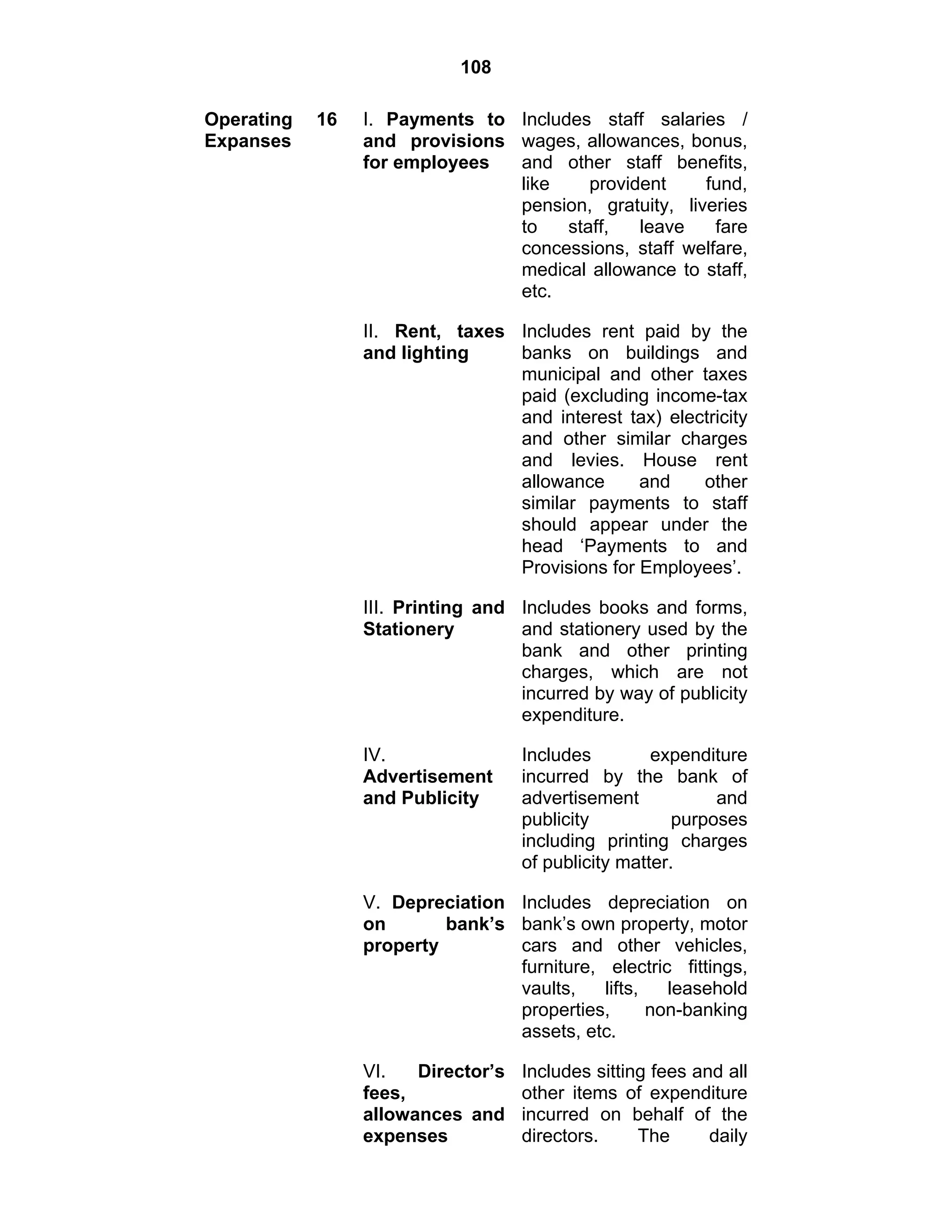
  • 20.
    94 National Bank for Agricultureand Rural Development and other institutions, agencies (including liability against participation certificates, if any). (II) Borrowings outside India Includes borrowings of Indian branches abroad as well as borrowings of foreign branches. Secured borrowings included above This item will be shown separately. Includes secured borrowings / refinance in India and outside India. Note: General (i) The total of I and II will agree with the total borrowings shown in the Balance Sheet. (ii) Inter-office transactions should not be shown as borrowings. (iii) Funds raised by foreign branches by way of certificate of deposits, notes, bonds, etc., should be classified depending upon documentation, as ‘deposits’, ‘ borrowings’, etc. (iv) Refinance obtained by banks from Reserve Bank of India and various institutions are being brought under the head ‘Borrowings’. Hence, advances will be shown at the gross amount on the assets side.
  • 21.
    95 Other Liabiliti es and Provisi ons 5 I.Bills Payable Includesdrafts, telegraphic transfers, traveler cheques, mail transfers payable, pay slips, bankers cheques and other miscellaneous items. II. Inter-office Adjustments The inter-office adjustments balance, if the credit should be shown under this head. Only net position of inter- office accounts, inland as well as foreign, should be shown here. III.Interest Accrued Includes interest accrued but not due on deposits and borrowings. IV.Others (including provisions) Includes net provision for income tax and other taxes like interest tax (less advance payment, tax deducted at source, etc.,) surplus in aggregate in provisions for depreciation in securities, contingency funds which are not disclosed under any of the major heads such as unclaimed dividend, provisions and funds kept for specific purpose, unexpired discount, outstanding charges like rent, conveyance, etc. Certain types of deposits like staff security deposits, margin deposits, etc. where the repayment is not free, should also be included under this head.
  • 22.
    96 Notes: General i) Forarriving at the net balance of inter-office adjustments all connected inter-office accounts should be aggregated and the net balance should only be shown, representing mostly items in transit and unadjusted items. (ii) the interest accruing on all deposits, whether the payment is due or not, should be treated as a liability. iii) it is proposed to show only pure deposits under the head ‘deposits’, and hence, all surplus provisions for bad and doubtful debts, contingency funds, secret reserves, etc., which are not netted off against the relative assets, should be brought under the head ‘others’ (including provisions). Cash and Balanc es with the Reserv e Bank of India 6 I. Cash in hand (including foreign currency notes) II. Balance with RBI i) In current Account ii) in other Accounts Includes cash in hand, including foreign currency notes and also of foreign branches in the case of banks having such branches.
  • 23.
    97 Balanc e with banks and money at call and short notice 7I. In India i) Balance with Banks a) in current accounts b) in other deposit accounts Includes all balance with banks in India (including co-operative banks). Balances in current accounts and deposit accounts should be shown separately. ii) Money at call and short notice a) with banks b) with other institutions Includes deposits repayable within 15 days notice, lent in the inter- bank call money market. II. Outside India i) Current accounts ii) Deposits Includes balances held by foreign branches and balances held by Indian branches of the banks outside India. Balance held with foreign branches by other branches of the bank, should not show under this head but should be included in the inter- branch accounts. The amounts held in ‘current accounts’ and ‘deposit accounts should be shown separately. iii) Money at call and short notice Includes deposits usually classified in foreign currencies as money at call and short notice. Invest ment 8 I. Investment in India i) Government securities Includes Central and State Government securities and Government treasury bills. These securities should be at the book value. However, the difference between the
  • 24.
    98 book value andmarket value should be given in the notes to the Balance Sheet. ii) Other approved securities Securities other than Government securities, which according to the Banking Regulation Act, 1949, are treated as approved securities, should be included here. iii) Shares Investment in shares of companies and corporations not included in item (ii) should be included here. iv) Debentures and Bonds Investments in debentures and bonds of Companies, Corporations not included in item (ii) should be included here. v) Investments in subsidiaries / joint ventures Investment in subsidiary / joint ventures (including R. R. Bs) should be in included here. vi) Others Includes general investments, if any, like gold, commercial paper and other instruments in the nature of shares / debentures / bonds. II. Investment outside India i) Government securities (including local authorities) ii) Subsidiaries and / or joint ventures abroad All foreign Government securities including securities issued by local authorities may be classified under this head. All investments made in the share capital of subsidiaries, floated outside India and / or joint
  • 25.
    99 iii) Others ventures abroad,should be classified under this head. All other investments outside India may be shown under this head. Advanc es 9 A. i) Bills purchased and discounted ii) Cash credits, overdrafts and loans repayable on demand iii) Terms loans In classification under Section ‘A’, all outstanding – in India as well as outside – less provisions made, will be classified under three heads as indicated, and both secured and unsecured advances will be included under these heads including overdue installments. B. i) Secured by tangible assets All advances or part of advances which are secured by tangible assets may be shown here. The item will include advances in India and outside India. ii) Covered by Bank / Government Guarantee Advances in India and outside India to the extent they are covered by guarantees of Indian and foreign governments and Indian and foreign banks and DICGC & ECGC are to be included. iii) Unsecured All advances not classified under (i) and (ii) will be included here. Total of ‘A’ should tally with the total of ‘B’. C.I. Advances in India i) Priority sectors Advances should be broadly classified into ‘Advances in India’ and ‘Advances outside India’. Advances in India will be
  • 26.
    100 ii)Public sector iii) Banks iv)Others further classified on the sartorial basis as indicated. C.II. Advances outside India i) Due from banks ii) Due from others a) Bills purchased and discounted b) Syndicated loans c) Others Advances to sectors which for the time being are classified as priority sectors according to the instructions of the Reserve Bank are to be classified under the head ‘Priority sectors’. Such advances should be excluded from the item (ii) i.e., advance to public sector. Advances to Central and State Government and other Government undertakings including Government companies and corporations, which are, according to the statutes, to be treated as Public sectors companies, are to be included in the category ‘Public sector’. All advances to the banking sector including co-operative banks, will come under the head ‘Banks’. All the remaining advances will be included under the head ‘Others’ and typically this category will include non-priority advances to the private, joint and co-operative sectors Note: General i) The gross amount of advances including refinance and rediscounts but excluding provisions made to the satisfaction of auditors should be shown as advances.
  • 27.
    101 ii) Term loanswill be loans not repayable on demand. iii) Consortium advances would be shown net of share from other participating banks / institutions. Fixed Assets 10 I. Premises i) At cost as on 31st March of the preceding year ii) Addition during the year iii) Deductions during the year iv) Depreciation to due Premises wholly or partly owned by the banking company for the purpose of business, including residential premises should be shown against ‘premises’. In the case of premises and other fixed assets, the previous balance, additions there to, deductions there from, during the year, and also the total depreciation written-off should be shown. Where sums have been written off on reduction of capital and revaluation of assets, every Balances Sheet after the first Balance Sheet, subsequent to the reduction or revaluation should show the revised figures for a period of five years, with the date and amount of revision made. II.Other Fixed Assets (including furniture and fixtures) i) At cost on 31st March of the preceding year Motor vehicles and all other fixed assets other than premises but including furniture and fixtures should be shown under this head.
  • 28.
    102 ii)Additions during the year iii) deductions duringthe year iv) Depreciation to date Other Assets 11 I. Inter-office Adjustments (net) The inter-office adjustment balance, if in debit, should be shown under this head. Only net position of inter-office accounts, inland as well as foreign, should be shown here. For arriving at the net balance of inter-office adjustment accounts, all connected inter-office accounts should be aggregated and the net balance, if in debit, only should be shown, representing monthly items in transit and unadjusted items. II.Interest Accrued Interest accrued but not due or investments and, advance and interest due but not collected on investment, will be the main components of this item. As banks normally debit the borrowers account with the interest due on the Balance Sheet date, usually there may not be any amount of interest due on advances. Only such interest as can be realized in the ordinary course should be shown under this head.
  • 29.
    103 III. Tax paid inadvance / tax deducted at source The amount of tax deducted at source on securities, advance tax paid etc. to the extent that these items are not set off against relative tax provisions should be shown against this item. IV. Stationery and Stamps Only exceptional items of expenditure on stationery like bulk purchase of security paper, loose leaf or other ledgers, etc. which are shown as quasi-asset to be written- off over a period of time, should be shown here. The value should be on a realistic basis and cost escalation should not be taken into account, as these items are for internal use. V.Non- banking assets acquired in satisfaction of claims Immovable properties / tangible assets acquired in satisfaction of claims are to be shown under this head. VI. Others This will include items like claims which have not been met, for instance, clearing items, debit items representing addition to assets or reduction in liabilities, which have not been adjusted for technical reasons, want of particulars, etc., advances given to staff by a bank as an employer and not as a banker, etc. Items which are in the nature of expenses, which are pending
  • 30.
    104 adjustments, should be providedfor and the provision netted against this item, so that only realizable value is shown under this head. Accrued income other than interest may also be included here. Conting ent Liabilitie s 12 I. Claims against the bank not acknowledge d as debts II. Liabilities for partly paid investments Liabilities on partly paid shares, debentures, etc., will be included in this head. III. Liabilities on account of outstanding forward exchange contracts Outstanding forward exchange contracts may be included here IV. Guarantees given on behalf of constituents i) in India ii)outside India Guarantees given for constituents in India and outside India may be shown separately. V) Acceptances, endorsement and other obligations This item will include letters of credit and bills accepted by the bank on behalf of customers.
  • 31.
    105 VI. Other items forwhich the Bank is contingently liable Arrears of cumulative dividends, bills rediscounted under under-writing contracts, estimated amount of contracts remaining to be executed on Capital Account and not provided for, etc., are to be included here. Bills for Collection Bills and other items in the course of collection and not adjusted will be shown against this item in summary version only, a separate schedule is proposed. Profit and Loss Account Interest earned 13 I. Interest / discount on advance / bills Includes interest and discount on all types of loans and advances, cash credit, demand loans, overdrafts, export loans, term loans, domestic and foreign bills purchased and discounted (including those rediscounted), over interest and also interest subsidy, if any, relating to advances / bills II. Income on investments Includes all income derived from the investment portfolio by way of interest and dividend. III. Interest on balances with the Reserve Bank of India and other inter- bank funds Includes interest on balances with Reserve Ban and other banks, call loans, money market placements etc.
  • 32.
    106 IV. Others Includesany other interest / discount income not included in the above heads. Other Income 14 I. Commission, exchange and brokerage Includes all remuneration on services such as commission on collections, commission / exchanges on remittances and transfers, commission on letters of credit, letting out of lockers and guarantees, commission on Government business, commission on other permitted agency business including consultancy and other services, brokerage, etc., on securities. It does not include foreign exchange income. II. Profit on sale of investments, Less: Loss on sale of investments. III. Profit on revaluation of investments. Less: Loss on revaluation of investments. IV. Profit on sale of land, buildings and other assets. Less: Loss on sale of land, buildings and other assets. Includes profit / loss on sale of securities, furniture, land and buildings, motor vehicle, gold, silver, etc. Only the net position should be shown. If the net position is a loss, the amount should be shown as a deduction. The net profit / loss on revaluation of assets may also be shown under this item.
  • 33.
    107 V. Profit on exchange transactions. Less:Loss on exchange transaction VI.Incomeearned by way of dividends etc. from subsidiaries, companies, joint ventures abroad / in India. Includes profit / loss on dealing in foreign exchange, all income earned by way of foreign exchange, commission and charges on foreign exchange transactions excluding interest which will be shown under interest. Only the net position should be shown. If the net position is a loss, it is to be shown as a deduction. VII. Miscellaneous income. Includes recoveries from constituents for godown rents, income from bank’s properties, security charges, insurance etc., and any other miscellaneous income. In case, any item under this head exceeds one percentage of the total income, particulars may be given in the notes. Interest Expended 15 I. Interest on deposits Includes interest paid on all types of deposits including deposits from banks and other institutions. II. Interest on Reserve Bank of India / inter- bank borrowings Includes discount / interest on all borrowings and refinance from the Reserve Bank of India and other banks. III. Others Includes discount / interest on all borrowings / refinance from financial institutions. All other payments like interest on participation certificates, penal interest paid, etc. may also be included here.
  • 34.
    108 Operating Expanses 16 I. Paymentsto and provisions for employees Includes staff salaries / wages, allowances, bonus, and other staff benefits, like provident fund, pension, gratuity, liveries to staff, leave fare concessions, staff welfare, medical allowance to staff, etc. II. Rent, taxes and lighting Includes rent paid by the banks on buildings and municipal and other taxes paid (excluding income-tax and interest tax) electricity and other similar charges and levies. House rent allowance and other similar payments to staff should appear under the head ‘Payments to and Provisions for Employees’. III. Printing and Stationery Includes books and forms, and stationery used by the bank and other printing charges, which are not incurred by way of publicity expenditure. IV. Advertisement and Publicity Includes expenditure incurred by the bank of advertisement and publicity purposes including printing charges of publicity matter. V. Depreciation on bank’s property Includes depreciation on bank’s own property, motor cars and other vehicles, furniture, electric fittings, vaults, lifts, leasehold properties, non-banking assets, etc. VI. Director’s fees, allowances and expenses Includes sitting fees and all other items of expenditure incurred on behalf of the directors. The daily
  • 35.
    109 allowance, hotel charges, conveyancecharges, etc. which though in the nature of reimbursement of expenses incurred, may be included under this head. Similar expenses of Local Committee members may also be included under this head. VII. Auditor’s fees and expenses (including branch auditor’s fees and expenses) Includes the fees paid to the statutory auditors and branch auditors for the professional services rendered and also all expenses for performing their duties, even though they may be in the nature of reimbursement of expenses. If external auditors have been appointed by the banks themselves for internal inspections and audits and other services, the expenses incurred in that context including fees may not be included under this head but should be shown under ‘other expenditure’. VIII. Law charges All legal expenses and reimbursement of expenses incurred in connection with legal services are to be included here. IX. Postage, telegraphs, telephones, etc. Includes all postal charges like stamps, telegrams, telephones, teleprinter etc. X Repairs and maintenance Includes repairs to bank’s property, their maintenance charges, etc.
  • 36.
    110 XI. Insurance Includesinsurance charges on bank’s property, insurance premia paid to Deposit Insurance and Credit Guarantee Corporation, etc. to the extent they are not recovered from the concerned parties. XII. Other expenditure Provisions and contingencies All expenses other than those not included in any of the other heads, like, licence fees, donations, subscriptions to papers, periodicals, entertainment expenses, travel expenses, etc., may be included under this head. In case, any particular item under this head exceeds one percentage of the total income, the particulars may be given in the notes. Includes all provisions made for bad and doubtful debts, provisions for taxation, provisions for diminution in the value of investments, transfers to contingencies and other similar items. Disclosure of Accounting Policies In order that the financial position of banks represent a true and fair view, the Reserve Bank of India has directed the banks to disclose the accounting policies regarding the key areas of operations along with the notes of account in their financial statements for the accounting year ending 31.3.1991 and onwards, on a regular basis. The accounting policies disclosed may contain the following aspects subject to modification by individual banks: 1) General The accompanying financial statements have been prepared on the historical cost and conform to the statutory provisions and practices prevailing in the country.
  • 37.
    111 2) Transactions involvingForeign Exchange a) Monetary assets and liabilities have been translated at the exchange rates, prevailing at the close of the year. Non-monetary assets have been carried in the books at the historical cost. b) Income and expenditure items in respect of Indian branches have been translated at the exchange rates, ruling on the date of the transaction and in respect of overseas branches at the exchange rates prevailing at the close of the year. c) Profit or losses on pending forward contracts have been accounted for. 3) Investments a) Investments in Governments and other approved securities in India are valued at the lower of cost or market value. b) Investments in subsidiary companies and associate companies (i.e., companies in which the bank holds at least 25 percent of the share capital) have been accounted for on the historical cost basis. c) All other investments are valued at the lower of cost or market value. 4) Advances a) Provisions for doubtful advances have been made to the satisfaction of the auditors: i) In respect of identified advances, based on a periodic review of advances and after taking into account the portion of advance guaranteed by the Deposit Insurance and Credit Guarantee Corporation, the Export Credit and Guarantee Corporation and similar statutory bodies; ii) In respect of general advances, as a percentage of total advances taking into account the guidelines issued by the Government of India and the Reserve Bank of India. b) Provisions in respect of doubtful advances have been deducted from the advances to the extent necessary and the excess have been included under “Other Liabilities and Provisions”. c) Provisions have been made on a gross basis. Tax relief, which will be available when the advance is written-off, will be accounted for in the year of write-off. 5) Fixed Assets a) Premises and other fixed assets have been accounted for at their historical cost. Premises which have been revalued are
  • 38.
    112 accounted for thevalue determined on the basis of such revaluation made by the professional values; profit arising on revaluation has been credited to Capital Reserve. b) Depreciation has been provided for on the straight line/diminishing balance method. c) In respect of revalued assets, depreciation is provided for on the revalued figures and an amount equal to the additional depreciation consequent of revaluation is transferred annually from the Capital Reserve to the General Reserve / Profit and Loss Account. 6) Staff Benefits Provisions for gratuity / pension benefits to staff have been made on an accrual / casual basis. Separate funds for gratuity / pension have been created. 7) Net Profit a) The net profit disclosed in the Profit and Loss Account is after: i) provisions for taxes on income, in accordance with the statutory requirements. ii) provisions for doubtful advances. iii) adjustments to the value of “current investments” in Government and other approved securities in India, valued at lower of cost or market value. iv) transfers to contingency funds. v) other usual or necessary provisions. b) Contingency funds have been grouped in the Balance Sheet under the head “Other Liabilities and Provisions”. 2.6. SOME IMPORTANT TRANSACTIONS 2.6.1 Rebate on Bills Discounted: Rebate on Bills Discounted is the Discount income not earned by the bank of discounting off the Bill of the Bill as it gets mature after the closing date of its accounting year. Journal entries : i) On discounting of Bill Bills Discounted and purchased A/c Dr (with its full value) To Customer’s Account (with the proceeds value) To Discount A/c (with the amount of Discount earned during the year)
  • 39.
    113 To Rebate onBills Discounted (with the amount of unearned Discount) ‘Rebate on Bills Discounted’ appears on Liabilities side of Balance sheet under – “other liabilities and provisions” (schedule-5) as it is the income received in advance. ii) At the beginning of Accounting year entry will be Rebate on Bills Discounted A/c Dr. To Discount A/c (with the amount of unearned Discount) Illustration 1: On 1st January 2008 Ajmer Bank Ltd. Discounted a bill of Rs. 3, 00,000 @ 10 percent p.a. The Bills falls due on 31st May 2008 and bank closes its account on 31st March every year. Pass necessary journal entry. Journal Entry Solution: 1 Jan, 08 Bills discounted and purchased A/c Dr To Customers’ A/c To Discount A/c To Rebate on bills discounted (Being the bills discounted) 3,00,000 2,87,500 7,500 5,000 1 April, 08 Rebate on bills discounted A/c Dr. To Discount A/c (Being in next accounting year Rebate on bills discounted transferred to discount A/c) 5,000 5,000 Note : Discount for 3 months = 3,00,000 10 3 7,500 100 12 Rebate on bills for 2 months = 3, 00,000 10 2 5,000 100 12 Illustration 2: Following are the details of bills discounted by UCO Bank Ltd. During the year ended 31/3/08 Date of Bill 2009 Amount (Rs). Term (Months) Rate of Discount p.a. (%) Discount (Rs.) Jan 15 March 5 Feb. 6 1,00,000 1,50,000 80,000 4 3 5 12 15 18 4,000 5,625 6,000 Total 3,30,000 15,625
  • 40.
    114 Calculate Rebate onbills discounted and show the necessary Journal entry. Date of Bill 2009 Date of maturity No. of days outstanding after 31/3/2008 Amount (Rs.) Discount (%) Total amount of discount (Rs.) Portion of Discount o/s after 31/3/2008 (Rs.) Jan 15 March 05 Feb 06 May 18 June 08 July 09 (30 + 18) 48 (30+31+8) 69 (30+31+30+9) 100 1,00,000 1,50,000 80,000 12 15 18 12,000 22,500 14,400 1,578.08 4,253.42 3,945.21 Total 9,776.71 Journal Entry: Bills discounted and purchased A/c Dr. 3, 30,000 To Customer A/c (3, 30,000 – 5,848.29-9776.71) To Discount A/c (15625-9776.71) 5848.29 To Rebate on bills discounted 9776.71 2.6.2 Acceptance Endorsement and other obligations The Bank accepts or encloses a bill on behalf of its customers who has raised loan or made purchases on credit basis and a customer deposit equal amount of security into the bank. On maturity bank pays amount to the party on behalf of its customer and at the same time claims same amount from its customer. It is shown under the heading ‘contingent Liabilities’ (Schedule -12) 2.6.3 Bills for collection Many bank customers usually handover bills receivables to the bank for the purpose of its collection on maturity when the bills get mature, bank credit the amount to the respective client’s account. The ‘Bills for collection’ is shown at the foot of the Balance sheet. 2.6.4 Provisions and contingencies There is no separate schedule given by the Banking Regulation Act, 1949 regarding provisions and contingencies but it is shown in the profit and loss account under the heading ‘Provisions and contingencies’. It includes provisions for bad and doubtful debts, Provision for income tax provisions for Rebate on bills discounted and such other required provisions and contingencies. It is included in schedule – 5 ‘other liabilities and provisions’ with sub-heading – IV – others”.
  • 41.
    115 2.7 SOLVED PROBLEMS Illustration1 A Smruti Bank Ltd. Provides you the following balances as on 31st March 2009. Particulars Amount (Rs.) Share capital (Issued and subscribed) Current account Money at call and short notices Rebate on bills discounted Commission exchange and brokerage Interest on loans Interest on fixed deposit Commission Received Salaries and allowances Reserve for building Unclaimed discount Unexpired discount Investment of cost: Central and State Government - Securities - Debentures - Bullion Reserve fund Fixed deposit Directors fees and allowances Rent and taxes paid Postage and telegram Rent received Interest on balances with RBI Profit on sale of Investment Loans, advances, overdraft and cash credit Bills payable Borrowings from banks in India Branch adjustment Furniture and fixtures Non banking assets acquired Interest accrued on investment Dividend fluctuation fund 39,000 8,58,000 9,885 22,500 27,000 77,700 82,500 2,400 31,500 39,000 936 1,950 3,90,000 15,600 93,600 62,400 1,56,000 3,600 16,200 6,000 9,000 60,825 3,90,000 78,000 9,750 2,25,966 1,23,900 2,730 10,140 23,400
  • 42.
    116 Profit and lossA/c (Credit balance) Locker rent Transfer fees Interest on saving bank deposits Interest on cash credit Premises at cost Additions to premises Advance payment of tax Silver bullion Saving Bank deposit Cash balances with RBI Cash balances with other banks Depreciation Fund on premises 7,800 3,000 1,500 20,400 66,900 3,90,000 78,000 4,290 7,800 2,34,000 1,32,600 46,800 3,12,000 Other Information: 1) There was a claim of rupees 7,800 against bank but not acknowledge as debt. 2) Bank transfer reserve for building to depreciation fund of premises 3) Directors decided to declare 10 percent dividend 4) Provide rupees 1, 05,000 for income tax and rupees 15,000 for doubtful debts. 5) Transfer 20 percent of profit to statutory reserve. Prepare final accounts of the bank. Solution: Smruti Bank Ltd. Balance Sheet as on 31st March 2009 Schedule No. As on 31st March 2009 39,000 1,01,625 12,48,000 9,750 5,58,036 19,56,411 Capital and Liabilities Capital Reserves and surplus Deposits Borrowings Other Liabilities and provisions Total 1 2 3 4 5
  • 43.
    117 1,32,600 56,685 4,99,200 4,25,100 5,91,900 2,50,926 19,56,411 Assets Cash and balanceswith Reserve Bank of India Balances with banks and money at call and short notice Investments Advances Fixed Assets Other Assets Total Contingent liabilities Bills for collection 6 7 8 9 10 11 12 7,800 Profit and Loss account for the year ended 31st March 2009 Schedule No. As on 31st March 2009 2,49,225 42,900 2,92,125 1,02,900 57,300 1,20,000 2,80,200 11,925 7,800 19,725 2,385 3,900 13,440 I. Income Interest earned Other income Total II. Expenditure Interest expended Operating expenses Provisions and contingencies Total III. Profit / Loss Net profit / Loss (-) for the year Profit / Loss (-) brought forward Total IV. Appropriations Transfer to statutory reserves Transfer to other reserves Transfer to Government / proposed dividend Balance carried over to Balance sheet Total 13 14 15 16 19,725 Schedule 1 – Capital As on 31st March 2009 Authorized Capital 39,000 Issued and subscribed 39,000 Total 39,000
  • 44.
    118 Schedule 2 -Reserves and surplus As on 31st March 2009 62,400 2,385 I. Statutory Reserves Opening Balance Additions during the year II. Revenue and other Reserves Dividend fluctuation fund III. Balance in profit and loss Account 64,785 23,400 13,440 Total (I + II + III) 1,01,625 Schedule 3 – Deposits As on 31st March 2009 A. I. Demand Deposits : From banks II. Saving Bank Deposits III. Term Deposits : Fixed Deposits 8,58,000 2,34,000 1,56,000 Total (I + II + III) 12,48,000 B. I. Deposits of branches in India II. Deposits of branches outside India 12,48,000 -- Total 12,48,000 Schedule 4 – Borrowings As on 31st March 2009 I. Borrowings in India: other banks 9,750 Total 9,750 Schedule 5–other liabilities and provision As on 31st March 2009 I. Bills payable II. Others : Rebate for bills discount Provision for tax and doubtful debts Unclaimed Discount Unexpired Discount Depreciation fund on premises Proposed dividend 78,000 2,250 1,20,000 936 1,950 3,51,000 3,900 Total (I + II) 5,58,036 Note : Depreciation fund on premises = 3,12,000 + 39,000 = 3, 51,000
  • 45.
    119 Schedule 6 –Cash and Balances with RBI As on 31st March 2009 I. Balances with RBI 1,32,600 Total 1,32,600 Schedule 7 – Balances with Banks and money at calls & short notice As on 31st March 2009 I. Balances with other banks in India II. Money at call & short notice 46,800 9,885 Total (I + II) 56,685 Schedule 8 – Investments As on 31st March 2009 I. Investment in Government securities Debentures Bullion 3,90,000 15,600 93,600 Total 4,99,200 Schedule 9 – Advances As on 31st March 2009 I. Bills purchased and discounted II. Cash credits, overdrafts and loans repayable on demand 35,100 3,90,000 Total 4,25,100 Schedule 10 – Fixed Assets As on 31st March 2009 I. Premises Opening Balance Additions during the year II. Other Fixed Assets 3,90,000 78,000 4,68,000 1,23,900 Total (I + II) 5,91,900 Schedule 11 – Other Assets As on 31st March 2009 I. Inter office adjustments II. Interest accrued on investment III. Advance payment of tax IV. Non banking Assets acquired in satisfaction of claims V. Other : Silver bullion 2,25,966 10,140 4,290 2,730 7,800 Total 2,50,926
  • 46.
    120 Schedule 12 –Contingent Liabilities As on 31st March 2009 I. Claims against the bank not acknowledged as debt 7,800 Total 7,800 Schedule 13 – Interest earned As on 31st March 2009 I. Interest / discount on Advances / bills: Interest on loans Interest on cash credits II. Interest on balances with Reserve Bank of India and other inter-bank funds III. Others: Discount on bills discounted 7,77,000 66,900 60,825 43,800 Total 2,49,225 Schedule 14- Other income As on 31st March 2009 I. Commission exchange and brokerage II. Profit on sale of investment III. Miscellaneous income: Rent Received Locker rent Transfer fees Commission received 27,000 28,500 9,000 3,000 1,500 2,400 Total 42,900 Schedule 15 – Interest expanded As on 31st March 2009 I. Interest on Fixed deposits II. Interest on saving bank deposit 82,500 20,400 Total 1,.02,900 Schedule 16 – Operating Expenses As on 31st March 2009 I. Rent and Taxes paid II. Directors fees, allowances and expenses III. Postage and telegram IV. Other expenditure 16,200 3,600 6,000 31,500 Total 57,300
  • 47.
    121 Illustration 2: On 31st March2010 the following trial balance was extracted from Amin Bank Ltd. You are required to prepare profit and loss account for the year ended 31st March 2010 and also the balance sheet as on that date. Debit Balances Amount (Rs.) Insurance charges on bank property Depreciation on banks property Fees paid to statutory auditor Staff salaries and medical allowances Rent on building and municipal taxes Interest due but not collected on investment Land and building at cost Other fixed Assets Loss on sale of other fixed Assets Repairs and maintenance Legal charges Tax deducted at source Cash in hand Balances with RBI: Current A/c Other Accounts Printing and stationary Printing charges of publicity matters Stationary and stamp Term loans Licence fee Directors sitting fees Other expenditure Balance with other bank: In current A/c In other deposit A/c Money call and short notices with bank Cash credit and overdraft Investment: Government treasury bills Other approved securities Joint ventures Debentures and bonds of companies Non banking Assets acquired in satisfaction of claims Interest on RBI borrowings Bills purchased and discounted Interest paid on deposit: From banks Other institution Inter-office adjustment (net) 2,899 3,523 21,944 1,45,366 9,035 33,280 4,693 24,570 2,795 1,508 221 93,873 27,482 9,75,026 12,805 2,418 520 1,846 9,11,599 12,155 4,524 9,295 7,139 3,560 325 12,96,984 12,78,576 4,91,452 16,380 19,721 6,500 5,785 2,84,089 59,280 2,37,159 16,562
  • 48.
    122 Credit Balances Amount (Rs.) Issued,subscribed and paid up share capital: 3250 shares of Rs. 10 each Interest on debentures and bonds Rebate on bills discounted Depreciation on building to date Statutory Reserve Revenue Reserves Depreciation on other fixed assets to date Demand deposits : From banks From others Saving bank deposits Term deposits Commission on remittances and transfer Letting out lockers Interest on balances with RBI and other Inter-bank funds Income earned by way of dividend from joint venture Interest on advances, cash credit and overdraft Interest accrued Profit on sale of investment Bills payable Borrowings from RBI Profit and loss account 32,500 1,86,706 42,939 1,417 97,591 71,500 12,610 13,39,050 10,9,540 15,41,865 19,04,760 53,582 5,920 44,811 2,274 4,04,859 16,328 2,275 71,162 37,700 45,500 Adjustments: 1. The authorized capital of bank is rupees 65,000 divided into 6,500 shares of Rupees10 each, 50 percent of it is issued and subscribed. 2. The provision for income tax to be made @ 45 percent 3. All advances are in India and they are classified as follows: priority sectors 12, 46,336; public sector 4, 98,534; banks 3, 94,198; others 3, 53,604. Advances secured by tangible assets Rs. 11, 21,702; covered by bank/ Government guarantees Rs. 8, 72,435 and remaining are unsecured 4, 98,535. 4. Bank Transfer 20 percent of profit to statutory reserve and 15 percent to revenue reserves. 5. contingent liabilities: i) Claim against the bank not acknowledged as debt Rs. 2,150. ii) Liability on account of outstanding forward exchange contracts Rs. 640. iii) Acceptance, endorsement and other obligations 4542.
  • 49.
    123 Solution 2: Amin BankLtd. Balance Sheet as on 31st March 2010 Schedule No. As on 31st March 2010 Capital & Liabilities Capital Reserves & Surplus Deposits Borrowings Other Liabilities and provisions 32,500 3,14,691 48,95,215 37,700 2,12,329 Total 54,92,435 Assets Cash and balances with Reserve Bank of India Balances with banks and money at call and short notice Investments Advances Fixed Assets Other assets 10,15,313 11,024 18,06,129 24,92,672 15,236 1,52,061 Total 54,92,435 Contingent Liabilities 1 2 3 4 5 6 7 8 9 10 11 7,332 PROFIT & LOSS A/C FOR THE YEAR ENDED ON 31ST MARCH, 2010 Schedule No. As on 31-3- 10 I. Income: Interest earned Other Income 6,36,376 61,256 Total 6,97,632 II. Expenditure: Interest expended Operating expenses Provisions and contingencies 3,02,224 2,13,408 81,900 Total 5,97,532 III. Profit / Loss: Net Profit / Loss (-) for the year Profit / Loss (-) brought forward 1,00,100 45,500 Total 1,45,600 IV. appropriations: Transfer to statutory reserves Transfer to other reserves Transfer to Government/proposed dividend Balance carried over to Balance Sheet 29,120 21,840 94,640 Total 13 14 15 16 1,45,600
  • 50.
    124 Schedule 1 –Capital As on 31st March 2010 65,000 32,500 32,500 32,500 For other banks Authorized capital 6500 shares of Rs. 10 each Issue capital 3250 shares of Rs. 10 each Subscribed capital: 3250 shares of Rs. 10 each Called-up capital: 3250 shares of Rs. 10 each 32,500 Schedule 2 – Reserves and surplus As on 31st March 2010 97,591 29,120 1,26,711 71,500 21,840 93,340 I. Statutory reserves: Opening balance Additions during the year II. Revenue and other reserves Opening balance Additions during the year III. Balance in profit and loss A/c 94,640 Total (I + II + III) 3,14,691 Schedule 3 – Deposits As on 31st March, 2010 I. Demand deposits: From banks From others II. Savings bank deposits III. Term deposits 13,39,050 1,09,540 15,41,865 19,04,760 Total ( I + II + III) 48,95,215 Schedule 4 – Borrowings As on 31st March, 2010 I. Borrowings in India : Reserve bank of India 37,700 Total 37,700
  • 51.
    125 Schedule 5– OtherLiabilities and provisions As on 31st March, 2010 Bills payable Interest accrued Others: Rebate on bills discounted Provision for income tax 71,162 16,328 42,939 81,900 Total 2,12,329 Schedule 6 – Cash and balances with RBI As on 31st March, 2010 I. Cash in hand II. Balances with RBI: In current A/c In other A/c 27,482 9,75,026 12,805 Total 10,15,313 Schedule 7 – Balances with banks & money at call & short notice As on 31st March, 2010 I. Balances with banks: In current A/c In other deposit A/c II. Money at call & short notice 7,139 3,560 325 Total ( I + II) 11,024 Schedule 8 – Investment As on 31st March, 2010 Investments in: Government treasury bills Other approved securities Debentures and bonds of companies Subsidiaries and joint venture 12,78,576 4,91,452 19,721 16,380 Total 18,06,129 Schedule 9 – Advances As on 31st March, 2010 A) i) Bills purchased and discounted ii) Cash credit, overdraft and loans repayable on demand iii) Terms loans 2,84,089 12,96,984 9,11,599 Total 24,92,672
  • 52.
    126 B) i) Secured bytangible assets ii) Covered by bank / Government guarantees iii) Unsecured 11,21,702 8,72,435 4,98,535 Total 24,92,672 C) I) Advances in India : i) Priority sectors ii) Public sector iii) Banks iv) Others 12,46,336 4,98,534 3,94,198 3,53,604 Total 24,92,672 II) Advances outside India -- Schedule 10 – Fixed Assets As on 31st March, 2010 4,693 (1,417) 3,276 24,570 (12,610) I) Premises: At cost Depreciation to date II) Other fixed assets (including Furniture and fixtures): At cost Depreciation to date 11,960 Total (I + II) 15,236 Schedule 11 – Other Assets As on 31st March, 2010 Inter office adjustments Interest due on investment but not collected Tax deducted at source Stationary and stamps Non banking assets acquired in satisfaction of claims 16,562 33,280 93,873 1,846 6,500 Total 1,52,061
  • 53.
    127 Schedule 12 –Contingent Liabilities As on 31st March, 2010 Claim against the bank not acknowledge as debts Liability on account of outstanding forward exchange contracts Acceptance, endorsement and other obligations 2,150 640 4,542 Total 7,332 Schedule 13 – Interest earned As on 31st March, 2010 Interest on advances, cash credit and overdraft Interest on debentures and bonds Interest on balances with RBI and other inter bank funds 4,04,859 1,86,706 44,811 Total 6,36,376 Schedule 14 – Other income As on 31st March, 2010 Commission on remittances and transfer Profit on sale of investment Loss on sale of other fixed assets Income earned by way of dividend, etc Form subsidiaries / companies Miscellaneous income: Letting out lockers 53,582 2,275 (2,795) 2,274 5,920 Total 61,256 Schedule 15 – Interest expanded As on 31st March, 2010 Interest on deposits: From banks From other Institution Interest on RBI / inter bank borrowings 59,280 2,37,159 5,785 Total 3,02,224
  • 54.
    128 Schedule 16 –Operating Expenses As on 31st March, 2010 Staff salaries and medical allowances Rent on building and municipal taxes Printing and stationery Printing charges of publicity matters Depreciation on banks property Directors fees, allowances and expenses Fees paid to statutory auditor Law charges Repairs and maintenance Insurance charges on bank property Other expenditure: license fee Other expenses 1,45,366 9,035 2,418 520 3,523 4,524 21,944 221 1,508 2,899 12,155 9,295 Total 2,13,408 Illustration 3 From the following information, prepare final accounts of Jetty Bank Ltd. as on 31st March, 2010 Debit Balances Amount (Rs.) Inter-office Adjustments (Net) Interest on investment not collected but accrued Stationery and stamp Interest on deposits Interest on RBI and Inter-Bank borrowings Investment: In India Government securities Other approved securities Subsidiaries and Joint Ventures Mutual fund Commercial paper Unit Trust of India Outside India Foreign Government securities (Issued by local authorities) Subsidiaries and Joint Ventures Rent, Taxes, lighting Printing and stationery Depreciation on land and Building 135 365 410 2,100 820 2,215 1,600 310 225 60 365 665 234 500 775 400
  • 55.
    129 663 220 900 516 1,295 615 785 1,315 771 1,710 644 224 Directors Fees, allowancesand expenses Law charges Non-banking assets acquired in satisfaction of claims Tax paid in advance Land and Building at cost Other fixed assets Bills purchased and discounted Cash credit, overdrafts and loans Terms loans Balance with RBI Balance with other Banks Money at call and short notices 20,837 Credit Balances Amount (Rs.) 2,000 225 311 1,775 1,100 1,322 775 1,120 1,335 330 1,000 925 885 700 435 1,100 375 446 1,135 531 411 225 800 665 911 Authorised, issued and subscribed capital Deposits Repayable on demand Certificates of deposits from non-bank sectors Saving Bank deposits Term Deposits: From Banks Cumulative and Recurring deposits Interest on Balances with other banks Interest / discount on advances / bills Income on investment Commission, exchange and brokerage Profit on sale of land and building Income earned by way of dividend from subsidiaries Statutory Reserves Capital Reserves Revenue and other Reserves Borrowings in India : RBI Other banks Borrowings outside India Profit on sale of investment (Net) Profit on exchange transactions (Net) Bills Payable Inter-office Adjustment (Net) Interest accrued Other provisions Interest on call loans 20,837
  • 56.
    130 Adjustments: 1. Advances amountingRs. 1,439 are secured by tangible assets; Rs. 1,210 covered by guarantees of Indian and foreign governments and banks; and remaining are unsecured. 2. Advances are made both in India and outside India: Advances in India on sectoral basis – priority sector Rs. 860; public sector Rs. 574; Banks Rs. 287 and other Rs. 193 Advances outside India – Due from Banks Rs. 623 and due from others Rs. 334 3. Provision is to be made for income tax at the rate of 30%. 4. Dividend is proposed at the rate of 15 percent. 5. The contingent liabilities appears as on 31st March 2010 as follows. i) Acceptance, endorsement and other obligations Rs. 310. ii) Claims against bank not acknowledged as debt Rs. 620. 6. Out of total deposits, Rs. 1,317 are deposits of branches outside India. Solution: Balance Sheet of Jetty Bank Ltd. as on 31-03-10 Schedule No. As on 31st March 2010 Capital & Liabilities Capital Reserves & Surplus Deposits Borrowings Other Liabilities and provisions 2,000 3,528.8 4,733 1,921 3,176.2 Total 15,359 Assets Cash and balances with RBI Balances with banks and money at call and short notice Investments Advances Fixed Assets Other assets 1,710 868 5,674 2,871 1,910 2,326 Total 15,359 Contingent Liabilities Bills for collection 1 2 3 4 5 6 7 8 9 10 11 12 -- 930 --
  • 57.
    131 PROFIT & LOSSA/C FOR THE YEAR ENDED ON 31ST MARCH, 2010 Schedule No. As on 31-3- 10 I. Income: Interest earned Other Income 4,141 3,921 Total 8,062 II. Expenditure: Interest expended Operating expenses Provisions and contingencies 2,920 2,558 775.2 Total 6253.2 III. Profit / Loss: Net Profit for the year 1808.8 IV. Appropriations: Transfer to statutory reserves Transfer to other reserves Transfer to proposed dividend Balance carried over to Balance Sheet 361.76 -- 300 1147.04 Total 13 14 15 16 1,808.8 Schedule 1 – Capital As on 31st March 2010 2,000Authorized, Issue, Subscribed capital: 2,000 Schedule 2 – Reserves and surplus As on 31st March 2010 885 361.76 1246.76 I. Statutory reserves: Opening balance Additions during the year II. Capital reserve III. Revenue and other reserves IV. Balance in profit and loss A/c 700 435 1147.04 Total 3,528.8
  • 58.
    132 Schedule 3 –Deposits As on 31st March, 2010 A) I. Demand deposits: Bank deposits repayable on demand Certificate of deposits from non bank II. Savings bank deposits III. Term deposits Cumulative and recurring deposits 225 311 1,775 1,100 1,322 Total ( I + II + III) 4,733 B) I) Deposits of branches in India II) Deposits of branches outside India 3,416 1,317 Total (I +II) 4,733 Schedule 4 – Borrowings As on 31st March, 2010 I. Borrowings in India : RBI Other Banks II. Borrowings outside India 1,100 375 446 Total (I + II) 1,921 Schedule 5 – Other Liabilities and provisions As on 31st March, 2010 I) Bills payable II) Inter office adjustment III) Interest accrued IV) Others: Provision for tax Dividend 411 225 800 775.2 300 Total (I + II + III + IV) 3176.2 Schedule 6 – Cash and balances with RBI As on 31st March, 2010 I. Cash in hand II. Balances with RBI: -- 1,710 Total 1,710
  • 59.
    133 Schedule 7 –Balances with banks & money at call & short notice As on 31st March, 2010 I. In India: Balances with banks: Money at call & short notice 644 224 Total 868 II. Outside India -- Total (I + II) 868 Schedule 8 – Investment As on 31st March, 2010 I. Investments in India in: Government securities Other approved securities Subsidiaries and joint ventures Others: mutual fund 225 Commercial papers 60 UTI 365 2,215 1,600 310 650 Total 4,775 II. Investment outside India in: Government securities (including local authorities) Subsidiaries and joint ventures abroad Total 665 234 899 Grand Total (I + II) 5,674 Schedule 9 – Advances As on 31st March, 2010 A) i) Bills purchased and discounted ii) Cash credit, overdraft and loans repayable on demand iii) Terms loans 785 1,315 771 Total 2,871 B) i) Secured by tangible assets ii) Covered by bank / Government guarantees iii) Unsecured 1,439 1,210 222 Total 2,871
  • 60.
    134 C) I) Advances inIndia : i) Priority sectors ii) Public sector iii) Banks iv) Others 860 574 287 193 Total 1,914 II) Advances outside India i) Due from banks ii) Due from others 623 334 Total 957 Grand Total (C. I + C. II) 2,871 Schedule 10 – Fixed Assets As on 31st March, 2010 I) Premises: At cost II) Other fixed assets (including Furniture and fixtures) 1,295 615 Total (I + II) 1,910 Schedule 11 – Other Assets As on 31st March, 2010 i) Inter office adjustments ii) Interest accrued iii) Tax paid in advance iv) Stationary and stamps v) Non banking assets acquired in satisfaction of claims 135 365 516 410 900 Total 2,326 Schedule 12 – Contingent Liabilities As on 31st March, 2010 i) Claim against the bank not acknowledge as debts ii) Acceptance, endorsement and other obligations 620 310 Total 930
  • 61.
    135 Schedule 13 –Interest earned As on 31st March, 2010 I) Interest / discount on advances / bills (911 + 1120) II) Income on investment III) Interest on balances with other bank 2,031 1,335 775 Total 4,141 Schedule 14 – Other income As on 31st March, 2010 I) Commission, exchange and brokerage II) Profit on sale of investments III) Profit on sale of land, buildings and other assets IV) Profit on exchange transactions V) Income earned by way of dividend etc, from subsidiaries / companies 330 1,135 1,000 531 925 Total 3,921 Schedule 15 – Interest expanded As on 31st March, 2010 I) Interest on deposits: II) Interest on RBI / inter bank borrowings 2,100 820 Total 2,920 Schedule 16 – Operating Expenses As on 31st March, 2010 I) Rent, taxes and lighting II) Printing and stationery III) Depreciation on banks property IV) Directors fees, allowances and expenses V) Law charges 500 775 400 663 220 Total 2,558 Illustration 4 The following are the balances of merchant Bank Ltd. for the year ended 31st March, 2008. Prepare profit and loss account for the year ended 31st March, 2008 and also balance sheet as on that date.
  • 62.
    136 Debit Balances Amount (Rs.) Balancewith RBI Premises at cost Additions during the year Other fixed assets Balances with other banks in current account Balances with banks in other deposit A/c Money at call and short notices Inter-office adjustment Interest accrued Stationary and stamps Tax paid in advance Non banking assets acquired in satisfaction of claims Medical allowances Allowances to employees Staff provident fund Other provisions for employees Expenses on books and forms Insurance charges Telephone and stamp Subscription to periodicals Rent and taxes Audit fees and expenses Interest on deposits Interest on inter bank borrowings Bills purchased and discounted Cash credit, overdraft and loans Term loans Investment: In Government securities Shares Debentures and bonds Subsidiaries 1,500 860 900 1,300 3,300 1,000 3,000 800 800 1,750 380 240 410 525 230 333 125 400 360 250 155 600 930 630 1,830 2,070 1,330 3,450 3,000 782 2,200 Total 32,470
  • 63.
    137 Credit Balances (Rs.In‘ 000) Amount (Rs.) Issued, subscribed and called up capital: 30,000 shares of Rs. 100 each Rent received Miscellaneous income Income earned from subsidiaries Commission on remittances and transfer Interest on balance with RBI Dividend on shares Profit on sale of investment Depreciation to date (Premises) Depreciation to date (other assets) Revenue reserves Profit on sale of other assets Borrowings: From NABARD From RBI From Co-operative Banks Capital reserves Statutory reserves Share premium Bills payable Inter office adjustment Interest on loans and advances Discount on bills purchased Balances in profit and loss A/c Interest accrued Interest on debentures and bonds Demand deposits: From banks From others Fixed deposit Saving bank deposit 3,000 310 400 830 730 840 350 650 350 210 910 1,100 1,200 1,100 980 1,400 1,000 590 2,000 900 1,940 960 2,220 1,500 500 2,790 1,210 1,050 1,450 Total 32,470
  • 64.
    138 Other Information: 1) On31st March, 2008 advances appears as follows: (Rs. In ‘000) Bills purchased and discounted Cash credit, overdraft, loans Term loan Standard assets Sub-standard assets Doubtful assets: - upto 1 year - 1 year to 3 year - more than 3 years Loss assets 1,030 800 -- -- -- -- 985 300 100 360 255 70 475 200 360 140 110 45 Total 1,830 2,070 1,330 The provision is yet to be made on above advances. 2) Depreciation to be charged on premises Rs. 1, 53,000 and other assets Rs. 1, 10,000. 3) Directors declare interim dividend @ 10 Percent 4) Claims against the bank not acknowledged as debt Rs. 7, 80,000. Liability for partly paid investment Rs. 5, 95,000. Solution: MERCHANT BANK LTD. Balance Sheet as on 31-3-2008 Schedule No. As on 31st March 2010 (Rs. In ‘000) Capital & Liabilities Capital Reserves & Surplus Deposits Borrowings Other Liabilities and provisions 3,000 8,299.5 6,500 3,280 4,950 Total 26029.5 Assets Cash and balances with RBI Balances with banks and money at call and short notice Investments Advances Fixed Assets Other assets 1,500 4,330 9,432 4560.5 2,237 3,970 Total 26,029.5 Contingent Liabilities Bills for collection 1 2 3 4 5 6 7 8 9 10 11 12 -- 1,695 --
  • 65.
    139 PROFIT & LOSSA/C FOR THE YEAR ENDED ON 31ST MARCH, 2008 Schedule No. As on 31-3-10 (Rs. In ‘000) I. Income: Interest earned Other Income 4,590 4,020 Total 8,610 II. Expenditure: Interest expended Operating expenses Provisions and contingencies 1,560 3,651 919.5 Total 6,130.5 III. Profit / Loss: Net Profit / Loss (-) for the year Profit / Loss (-) brought forward 2,479.5 2,220 Total 4,699.5 IV. Appropriations: Transfer to statutory reserves Transfer to other reserves Transfer to Government / proposed dividend Balance carried over to Balance Sheet 495.9 300 3,903.6 Total 13 14 15 16 4,699.5 Schedule 1 – Capital As on 31st March 2008 3,000 3,000 3,000 Authorized capital 30,000 shares of Rs. 100 each Issue capital 30,000 shares of Rs. 100 each Subscribed capital: 30,000 shares of Rs. 100 each Called-up capital: 30,000 shares of Rs. 100 each 3,000
  • 66.
    140 Schedule 2 –Reserves and surplus As on 31st March 2008 1,000 495.9 1,495.9 I. Statutory reserves: Additions during the year II. Capital reserve III. Shares Premium IV. Revenue and other Reserves V. Balance in profit and loss account 1,400 590 910 3,903.6 Total (I + II +III +IV + V) 8,299.5 Schedule 3 – Deposits As on 31st March, 2008 I. Demand deposits: i) From banks ii) From others II. Savings bank deposits III. Term deposits 2,790 1,210 1,450 1,050 Total ( I + II + III) 6,500 Schedule 4 – Borrowings As on 31st March, 2008 I. Borrowings in India : Reserve Bank of India Other Banks: From NABARD From Co-operative banks 1,100 1,200 980 Total 3,280 Schedule 5 – Other Liabilities and provisions As on 31st March, 2008 I) Bills payable II) Inter office adjustment (Net) III) Interest accrued IV) Others: Interim Dividend Provision on tax 2,000 900 1,500 300 250 Total 4,950 Schedule 6 – Cash and balances with RBI As on 31st March, 2008 I. Balances with RBI 1,500 Total 1,500
  • 67.
    141 Schedule 7 –Balances with banks & money at call & short notice As on 31st March, 2008 In India: i) Balances with banks: a) In current Accounts b) In other deposit accounts ii) Money at call & short notice 330 1,000 3,000 Total 4,330 Schedule 8 – Investment As on 31st March, 2008 I. Investments in India: i) Government securities ii) Shares iii) Debentures and bonds iv) Subsidiaries and / or joint ventures 3,450 3,000 782 2,200 Total 9,432 Schedule 9 – Advances As on 31st March, 2008 i) Bills purchased and discounted ii) Cash credit, overdraft and loans repayable on demand iii) Terms loans 1,750 1,714.5 1,096 Total 4,560.5 Schedule 10 – Fixed Assets As on 31st March, 2008 I) Premises: At cost Additions during the year Depreciation to date (350+153) II) Other fixed assets (including Furniture and fixtures) at cost Depreciation to date (210 + 110) 860 900 (503) 1,300 (320) Total (I + II) 2,237
  • 68.
    142 Schedule 11 –Other Assets As on 31st March, 2008 i) Inter office adjustments (net) ii) Interest accrued iii) Tax paid in advance / tax deducted at source iv) Stationary and stamps v) Non banking assets acquired in satisfaction of claims 800 800 380 1,750 240 Total 3,970 Schedule 12 – Contingent Liabilities As on 31st March, 2008 i) Claim against the bank not acknowledge as debts ii) Liability for partly paid investments ii) Acceptance, endorsement and other obligations 780 595 320 Total 1,695 Schedule 13 – Interest earned As on 31st March, 2008 I) Interest / discount on advances / bills Discount on bills purchased Interest on loans and advances II) Income on investment Interest on debentures and bonds Dividend on shares III) Interest on balances with RBI and other inter bank Funds 960 1,940 500 350 840 Total 4,590
  • 69.
    143 Schedule 14 –Other income As on 31st March, 2008 I) Commission on remittance and transfer. II) Profit on sale of investments III) Profit on sale of land, buildings and other assets IV) Income earned by way of dividend etc, from subsidiaries / companies V) Miscellaneous income: Rent received Other miscellaneous income 730 650 1,100 830 310 400 Total 4,020 Schedule 15 – Interest expanded As on 31st March, 2008 I) Interest on deposits: II) Interest on RBI / inter bank borrowings 930 630 Total 1,560 Schedule 16 – Operating Expenses As on 31st March, 2008 I. Allowances to employees II. Medical allowances III. Staff providend fund IV. Other provision for employees V. Rent, taxes and lighting VI. Expenses on books and forms VII. Depreciation on banks property (153 + 110) VIII. Audit fees and expenses IX. Postage and telephones X. Insurance XI. Other expenditure: Subscription to periodicals 525 410 230 333 155 125 263 600 360 400 250 Total 3,651
  • 70.
    144 I. Provisions onAdvances: (Rs. In ‘000) Assets Bills Purchased & Discounted Cash Cr., Overdraft, loans Term loans % of provision Bills Purchased & Discounted Cash Cr., Overdraft, loans Term loans Standard Assets Sub-standard Assets Doubtful assets: - upto 1 year - 1 to 3 years - More than 3 years Loss Assets 1,030 800 -- -- -- -- 985 300 100 360 255 70 475 200 360 140 110 45 -- 10% 20% 30% 50% 100% -- 80 -- -- -- -- -- 30 20 108 127.5 70 -- 20 72 42 55 45 1,830 2,070 1,330 80 355.5 234 Total Provision on Advances = Rs. 669.5 II Interim dividend 10 30,00,000 3,00,000 100 III Provision on Tax = 2, 50,000 Illustration – 5 Kranti Bank Ltd. provides you the following balances as on 31st March, 2007. Prepare profit and loss account and balance sheet from the given balances and other information. Particulars Amount Annuity deposit Matured time deposits Pay slips and bankers cheques Bills purchased and discounted Borrowings from: PNB bank of India Rajgrih co-operative bank Statutory reserve fund Profit and loss A/c (Credit) Deposits repayable within 15 days notice (in India) Deposits with Wilson Financial agency (in India) Capital reserve Saving bank deposits Term loans Prepaid Insurance Non banking assets acquired in satisfaction of claims Remuneration for consultancy and other services Land and building (cost Rs. 1,38,000) Furniture and Fixtures (Cost Rs. 23,920) Interest paid on deposits 18,81,630 13,85,980 46,000 6,80,110 46,000 69,000 32,200 23,000 23,460 5,29,000 92,000 9,30,580 32,75,200 161 691 46,000 94,300 16,790 28,750
  • 71.
    145 Cash balance Balances withRBI Share premium Contingency fund Repairs and maintenance of buildings Directors fees, allowances and expenses Payment to and provision for employees Fees paid to statutory auditor Traveling allowances Postage and telephone Advertisement and publicity Other expenditure Profit on exchange transaction Income on investment Investment in India: share capital of subsidiaries Government bonds Branch adjustment – A/c (Credit) Share capital 1,93,200 1,84,000 5,000 27,600 19,320 4,600 2,990 2,990 3,910 1,380 1,380 690 4,600 1,20,750 2,34,600 2,31,380 17,940 8,00,000 Other Adjustments: 1. Authorized capital in equity shares of Rs. 100 each, Rs. 16, 00,000. Issued, sub scribed and called up capital Rs. 50 per share. 2. Bills accepted by bank of behalf of customer amounting Rs. 33,000. 3. Depreciation on Land & building Rs. 3,680 and furniture Rs. 1,610 is to be provided. 4. Transfer 20% of net profit to statutory reserve. Kranti Bank Ltd. Balance Sheet as on 31st March 2007 Schedule No. As on 31-3-07 Capital & Liabilities Capital Reserves & Surplus Deposits Borrowings Other Liabilities and provisions 8,00,000 2,52,250 41,98,190 1,15,000 91,540 Total 1 2 3 4 5 54,56,980
  • 72.
    146 Assets Cash and balanceswith RBI Balances with banks and money at call and short notice Investments Advances Fixed Assets Other assets 3,77,200 5,52,460 4,65,980 39,55,310 1,05,800 230 Total 54,56,980 Contingent Liabilities Bills for collection 6 7 8 9 10 11 12 33,000 PROFIT & LOSS A/C FOR THE YEAR ENDED ON 31ST MARCH, 2007 Schedule No. Year ended 31.03.07 I. Income: Interest earned Other Income 1,20,750 50,600 Total 1,71,350 II. Expenditure: Interest expended Operating expenses Provisions and contingencies 28,750 42,550 Total 71,300 III. Profit / Loss: Net Profit / Loss (-) for the year Profit / Loss (-) brought forward 1,00,050 23,000 Total 1,23,050 IV. Appropriations: Transfer to statutory reserves Transfer to other reserves Transfer to Government / proposed dividend Balance carried over to Balance Sheet 13 14 15 16 20,010 -- -- 1,03,040 Schedule 1 – Capital As on 31st March 2007 16,000,00 8,00,000 8,00,000 Authorized capital 16,000 shares of Rs. 100 each Issue capital 16,000 shares of Rs. 50 each Subscribed capital: 16,000 shares of Rs. 50 each Called-up capital: 16,000 shares of Rs. 50 each 8,00,000
  • 73.
    147 Schedule 2 –Reserves and surplus As on 31st March 2007 32,200 20,010 52,210 I. Statutory reserves: Additions during the year Total II. Capital reserve Opening balance III. Shares Premium Opening balance IV. Revenue and other Reserves V. Balance in profit and loss account 92,000 5,000 1,03,040 Total 2,52,250 Schedule 3 – Deposits As on 31st March, 2007 I. Demand deposits: matured time deposit II. Savings bank deposits III. Term deposits: Annuity deposit 13,85,980 9,30,580 18,81,630 Total 41,98,190 Schedule 4 – Borrowings As on 31st March, 2007 I. Borrowings in India : i) RBI ii) Other Banks: PNB Bank of India Rajgrih Co-operative Bank 46,000 69,000 Total 1,15,000 Schedule 5 – Other Liabilities and provisions As on 31st March, 2007 I) Bills payable: Pay slips and bankers’ cheques II) Inter office adjustment III) Others (including provisions) - Contingency Fund 46,000 17,940 27,600 Total 91,540
  • 74.
    148 Schedule 6 –Cash and balances with RBI As on 31st March, 2007 I. Cash in hand II. Balances with RBI 1,93,200 1,84,000 Total 3,77,200 Schedule 7 – Balances with banks & money at call & short notice As on 31st March, 2007 In India: i) Balances with banks: ii) Money at call & short notice: Deposits repayable within 15 days notice Deposits with Wilson financial agency 23,460 5,29,000 Total 5,52,460 Schedule 8 – Investment As on 31st March, 2007 Investments in India: Government bonds Share capital of subsidiaries 2,31,380 2,34,600 Total 4,65,980 Schedule 9 – Advances As on 31st March, 2007 Bills purchased and discounted Terms loans 6,80,110 32,75,200 Total 39,55,310 Schedule 10 – Fixed Assets As on 31st March, 2007 1,38,000 (47,380) 90,620 23,920 8,740 I) Premises: At cost Depreciation to date (43,700 + 3,680) II) Other fixed assets (including Furniture and fixtures) At cost as on 31st March of the preceding year. Depreciation to date (7,130 + 1, 610) 15,180 Total (I + II) 1,05,800
  • 75.
    149 Schedule 11 –Other Assets As on 31st March, 2007 Non banking assets acquired in satisfaction of claims. Prepaid Insurance 69 161 Total 230 Schedule 12 – Contingent Liabilities As on 31st March, 2007 Bills accepted on behalf of customer 33,000 Schedule 13 – Interest earned As on 31st March, 2007 Income on investment 1,20,750 Total 1,20,750 Schedule 14 – Other income As on 31st March, 2007 I. Commission brokerage and exchange: Remuneration for consultancy and other services II. Profit on exchange transactions 46,000 4,600 Total 50,600 Schedule 15 – Interest expanded As on 31st March, 2007 I) Interest paid on deposits: 28,750 Total 28,750
  • 76.
    150 Schedule 16 –Operating Expenses As on 31st March, 2007 Payment to and provision for employees Advertisement and publicity Depreciation on bank’s property (3,680 + 1,610) Director’s fees, allowances and expenses Fees paid to statutory auditor Traveling expenses Postage and telephone Repairs and maintenance of building Other expenditure 2,990 1,380 5,290 4,600 2,990 3,910 1,380 19,320 690 Total 39,859 Summary: A bank is a commercial institution, which accepts deposits and repay on demand; lend; transfer and invest the money. Banking companies are governed by Banking Regulation Act, 1949 and also subject to the companies Act, 1956. Section 6 of the Banking Regulation Act prescribes various business of banking companies which includes borrowing, raising or taking up of money, acting as on agent for any government or local authority or any other person; contracting, guaranteeing and so on. Also the banks are restricted to deal in buying, selling or bartering of goods and also not allowed to engage in any trade related to bills of exchange received for collection or negotiation or such of its business. The various accounting provisions regarding minimum capital and reserves; restriction on commission, brokerage, discount on sale of shares, restrictions on payment of dividend, statutory reserves, cash reserves and restrictions on loans and advances given under various sections of Banking Regulation Act, 1949. The banks keep subsidiary and principal books of accounts to minimize the errors in maintaining records of voluminous transactions. The recommendation of Narsimham Committee report on Non-performing Assets was accepted by RBI and accordingly issued directives to all the banks regarding income recognition, assets classification and loan provisioning. The assets have been
  • 77.
    151 classified as standardassets, sub-standard assets, doubtful assets and loss assets and provisioning norms for each category is given. The final accounts of banking companies are prepared as per the formats given under form ‘A’ for balance sheet and form ‘B’ for profit and loss account. Out of 16 schedules, form A contains 12 schedules and form B contains the remaining 4 schedules. 2.8 EXERCISES: Q.1 State whether the followings are True or False: 1) All nationalized Banks are governed by the Banking Regulation Act. 2) Section 6 of the Banking Regulation Act, 1949 prescribes requirements of minimum paid-up capital and reserves to be maintained by banking companies. 3) It is voluntary for all Banking companies to publish their Balance Sheet in newspapers. 4) The assets and liabilities of Banking Companies are shown vertically along with the figures of last year. 5) The commission, exchange and brokerage are shown in Schedule 15 of the Bank’s Profit and loss account. 6) Every bank needs to create a reserve fund by transferring 20 percent of its annual profit after the declaration of dividend. 7) Money at call is refundable at 24 hours’ notice and money at short notice is refundable at 7 days notice. 8) The income from non-performing assets should not be taken into profit and loss account unless income had been realized. 9) A credit facility is classified as non-performing if interest and / or installment of principal have remained unpaid for two quarters after it has become past due. 10)The assets which do not yield positive returns become non- performing assets. Answer: True - 1; 4; 7; 8; 9; 10; False - 2; 3; 5; 6; Q.2 Multiple choice Question 1) For internal purpose, banks may close their accounts on ________________. i) 31st December
  • 78.
    152 ii) 30th June iii) 31st March iv)30th September 2) The principal books of a banking company that gives the summary of the receiving cashier’s counter cash books and the paying cashiers counter cash book. i) General Ledger ii) Saving Bank accounts ledger iii) Cash book iv) Investment Ledger 3) The ___________ of section 29 of the Banking Regulation Act, 1949 prescribes formats of Balance sheet and profit and loss account of banking companies. i) Third schedule ii) Second schedule iii) Sixth schedule iv) Fourth schedule 4) It is the last item to appear under ‘Capital and liabilities of the Balance Sheet of a bank. i) Reserves and surplus ii) Deposits iii) Borrowings iv) Other liabilities and provision. 5) It is shown by way of a footnote and details are given in schedule 12. i) Contingent Liabilities ii) Other Assets iii) Investments iv) Other liabilities and provisions. 6) Bills purchased and discounted are shown in _________ on the Balance sheet of a Bank. i) Schedule 10 ii) Schedule 8 iii) Schedule 9 iv) Schedule 12
  • 79.
    153 7) Every Bankneeds to maintain a cash reserves of at least _________ of the total of its demand and time liabilities. i) 3 percent ii) 5 percent iii) 7 percent iv) 20 percent 8) In respect of sub-standard assets, a general provision of ___________ of the total outstanding should be created. i) 20 percent ii) 10 percent iii) 30 percent iv) None of the above 9) The assets which does not disclose any problems and which does not carry more than normal risk attached to the business. i) Standard assets ii) Sub-standard assets iii) Doubtful assets iv) Loss assets 10) Section 20 of the Banking Regulation Act, 1949 deals with _____________. i) Cash Reserves ii) Restrictions on loans and advances iii) Statutory Reserves iv) Final account Answers: 1 – iv; 2 – iii; 3 – I; 4 – iv; 5 – I; 6 – iii; 7 – I; 8 – ii; 9 – I; 10 – ii. Q.3 Match the following A) 1) Principal Books a) Personal ledger 2) Contingent liabilities b) Schedule 11 3) Share Premium c) Cash book and General ledger 4) Subsidiary Books d) Reserves and surplus e) Schedule 12 f) Bills purchased and discounted Answer: 1-c; 2-e; 3-d; 4-a
  • 80.
    154 B) 1) Income oninvestment a) Schedule 8 2) Stationery and stamp b) Schedule 2 3) Balance of profit c) Schedule 5 4) Bills payable d) Schedule 11 e) Schedule 13 f) Schedule 16 Answer: 1-e; 2-d; 3-b; 4-c. Q.4 Define Banking Companies and write a note on ‘Business of banking companies. Q.5 Explain the provisions given by Banking Regulation Act, 1949 with regard to following – i) Statutory Reserve ii) Minimum capital and Reserves iii) Restrictions on Payment of Dividend Q.6 Explain in brief the classification of assets and provisioning of NPA. Q.7 Explain the following terms: 1) Non-banking assets 2) Doubtful assets and loss assets 3) Rebate on bills discounted 4) Bills for collection 5) Provisions and contingencies Q.8 The asset of the Bank is bifurcated as performing and non- performing assets and accordingly income to be recognized. Interest Earned Interest Received Performing Assets Cash credit and overdraft Bills purchased and discounted Term loans Non-performing Assets Cash credit and overdraft Bills purchased and discounted Term loans 10,50,000 2,10,000 1,68,000 2,10,000 1,40,000 1,05,000 8,68,000 2,10,000 1,12,000 16,800 28,000 7,000 Answer: Income Recognized – Rs. 14, 79,800.
  • 81.
    155 Q.9 The followingare the balances of Armo Bank Ltd. for the year ended 31st March, 2008. Debit Balances Amount (Rs.) Money at call and short notices Constituents, Liability for acceptance & endorsement Non-banking assets acquired in satisfaction of claims Land and Building Furniture and fixtures Advances Investment in Government bonds Gold bullion Other investment Balances with RBI Cash in hand Interest accrued on investment Interest on deposits Bills receivable being bills for collection Law charges Loss on sale of building Printing and stationery Rent, taxes and lighting Repairs and maintenance Bills discounted and purchased Directors Remuneration Branch adjustment Loss on sale of investment Deposits with other Banks 1,82,000 3,95,500 14,000 35,000 4,55,000 14,00,000 13,60,590 1,05,910 10,89,410 2,16,300 1,08,150 1,72,340 55,650 3,04,500 35,000 7,000 350 1,48,400 8,400 87,500 84,000 1,40,000 2,10,000 5,25,000 Total 71,40,000 Credit Balances Amount (Rs.) Term deposits from banks Demand deposits Share capital Provision for depreciation on furniture & fixtures Security deposits of employee Statutory Reserves Share Premium account Borrowings from institutions and agencies Profit and loss account Rent received Profit on bullion Acceptance and endorsement 51,940 1,61,350 20,00,000 1,40,000 1,05,000 9,80,000 7,30,000 5,40,610 45,500 4,200 8,400 3,95,500
  • 82.
    156 Bills for collection Commission,exchange and brokerage Discount on advances Other miscellaneous income Current ledger control account Interest on balances with RBI 3,04,500 1,77,100 2,94,000 18,900 6,79,000 5,04,000 Total 71,40,000 Adjustment: 1) Depreciation on Furniture and Fixtures for the year amounted to Rs. 35,000 and proposed dividend is 8 percent. 2) Transfer 20 percent to statutory Reserve from the profit earned during the year. 3) Rebate on bills discounted Rs. 35,000. 4) Current account ledger depicts credit balance Rs. 8, 54,000 after the overdrawn to the extent of Rs. 1, 75,000. 5) Liability for partly paid investment Rs. 80,000. Answer: Current year profit Rs. 1, 50,240 Balance sheet Total Rs. 58, 91,200 Q.10 On 31st March, 2009 the following balances was extracted from Oasis Bank Ltd. You are required to prepared profit and loss account for the year ended 31st March 2009 and also the balance sheet as on that date. Particulars Amount (Rs.) Capital Reserve Interest accrued on Government Bonds Bills for collection Investment in Government Bonds Investment in Gold bullion Current Deposits Reserve Fund Interest and discount received Profit and loss account (Credit Balance) Brokerage, exchange and commission received Capital Loans and advances Saving account Cumulative and recurring deposits Sundry creditors Debts due to banks (secured) Branch adjustments (Credit) Balances : Cash and hand 1,50,000 26,125 9,95,500 55,000 1,32,000 25,02,500 6,87,500 3,19,000 46,860 96,525 4,00,000 22,93,500 9,08,600 19,34,900 25,025 6,71,000 2,50,525 71,885
  • 83.
    157 Cash with otherbanks Liabilities for partly paid investment Furniture and office equipment Depreciation on assets Interest paid on Inter-Bank borrowings Brokerage, exchange and commission paid Rebate on bills discounted Non-banking assets Customer’s liability for acceptance Investments in shares Payment to employees Auditor’s fees Repairs and maintenance Advertisement and publicity Premises Current a/c balance with other Banks Short notices with other institutions and Agencies 3,30,000 8,34,240 27,500 27,500 66,000 5,500 825 2,750 8,34,240 8,74,500 1,32,000 5,500 22,000 16,500 1,87,000 49,500 33,000 Additional Information: 1) The authorized capital of the bank is Rs. 800,000 divided into 16,000 shares of Rs. 50 each. Out of this 8,000 shares issued, subscribed and paid-up. 2) Current account includes Rs. 4, 67,500 debit balances being overdraft. One of the accounts for Rs. 5,500 including interest Rs. 550 is doubtful. 3) During the year, a property was acquired in satisfaction of a claim amounting to Rs. 2,750 and was sold Rs. 1,980. The loss resulting there from remained unadjusted in the books. 4) Bank guaranteed Rs. 1, 00,000 on behalf of its constituents. 5) Provision for taxation is Rs. 55,000. Answers: Provisions and contingencies – Rs. 59,950 Profit for the current year – Rs. 63,404 Balance sheet total – Rs. 81,79,490 Q.11 Yashoda Bank Ltd. provides you the following balances you are asked to prepare Profit and Loss account and Balance Sheet. Particulars Amount (Rs.) Share capital Statutory Reserves Other Reserves Term Loans 3,40,000 1,04,000 1,00,000 17,00,000
  • 84.
    158 Cash credit Bills purchased Rebateon bills discounted Deposits from other Banks Current deposits Saving account Legal charges Repairs Insurance on bank property Entertainment expenses Directors sitting fees Printing charges Rent and Taxes Bonus and other staff benefits Profit and loss account (credit Balances) Interest paid on deposits Discount on domestic Bills purchased Commission received on letter of credit Bank property Cash with RBI Interest received on loans and advances Investments Stationery and stamps Cash with Exe Bank Ltd. Income on investments 37,62,100 27,89,700 81,600 14,87,500 23,23,900 29,44,400 62,500 2,62,000 95,500 71,100 1,51,000 67,000 35,000 2,30,000 13,94,000 12,71,600 7,59,900 4,98,100 81,6,000 39,100 21,86,200 2,58,100 1,38,000 4,84,500 13,600 Other Information 1) The Bank provided depreciation on its property at the rate of 12 percent p.a. 2) Tax to be provided at 40 percent. 3) Directors declared dividend at 10 percent. 4) Liabilities on partly paid investment Rs. 81,600 Answer: Profit for current year Rs. 22, 51,344 Balance sheet total Rs. 98, 89,580