Modern Movement Theories
• ALVAR ALTO
• ERICH MENDELSOHN
• KENZOTANGE
• EEROSARINEN
• RICHARD NEUTRA
• OTTOWAGNER
Philosophy:
Functionalism
Bio Architecture
Humanistic Modernism
Embodied Rationalism
Nordic modernism
•His design philosphy was influenced by nature
and ORGANIC MATERIAL.
•He designed vases with curvilinear bases and
Striaght sides for savoy restaurant-turku.
•With his innovative designs and nature forms, he
Changed the course of design towards
ORGANIC MODERNISM.
•The beauty of his work is hidden in his design
Approach of functionalism but with strong
Connection
•To organic relationship between man, nature and
Buildings.
•He coordinated these three components and
Created a synthesis of life in materialized form.
•He designed in very different scales-ranging from
Buildings,town Plans,furniture,glassware,
jewellery and other Forms of art.
CHILDREN’S STOOL (1935) LOUNGE CHAIR (1931)
PAIMIOPAIMIO SANITARIUMSANITARIUM
ALVAR ALTOALVAR ALTO
VillaMaireaVillaMairea
Built in -Built in - 1938-19391938-1939
--LocationLocation
Noormarkku , finlandNoormarkku , finland
Built inBuilt in --1929-1933
- LocationLocation--Alvar aallontie 275,
21540 preitilä, paimio, finland
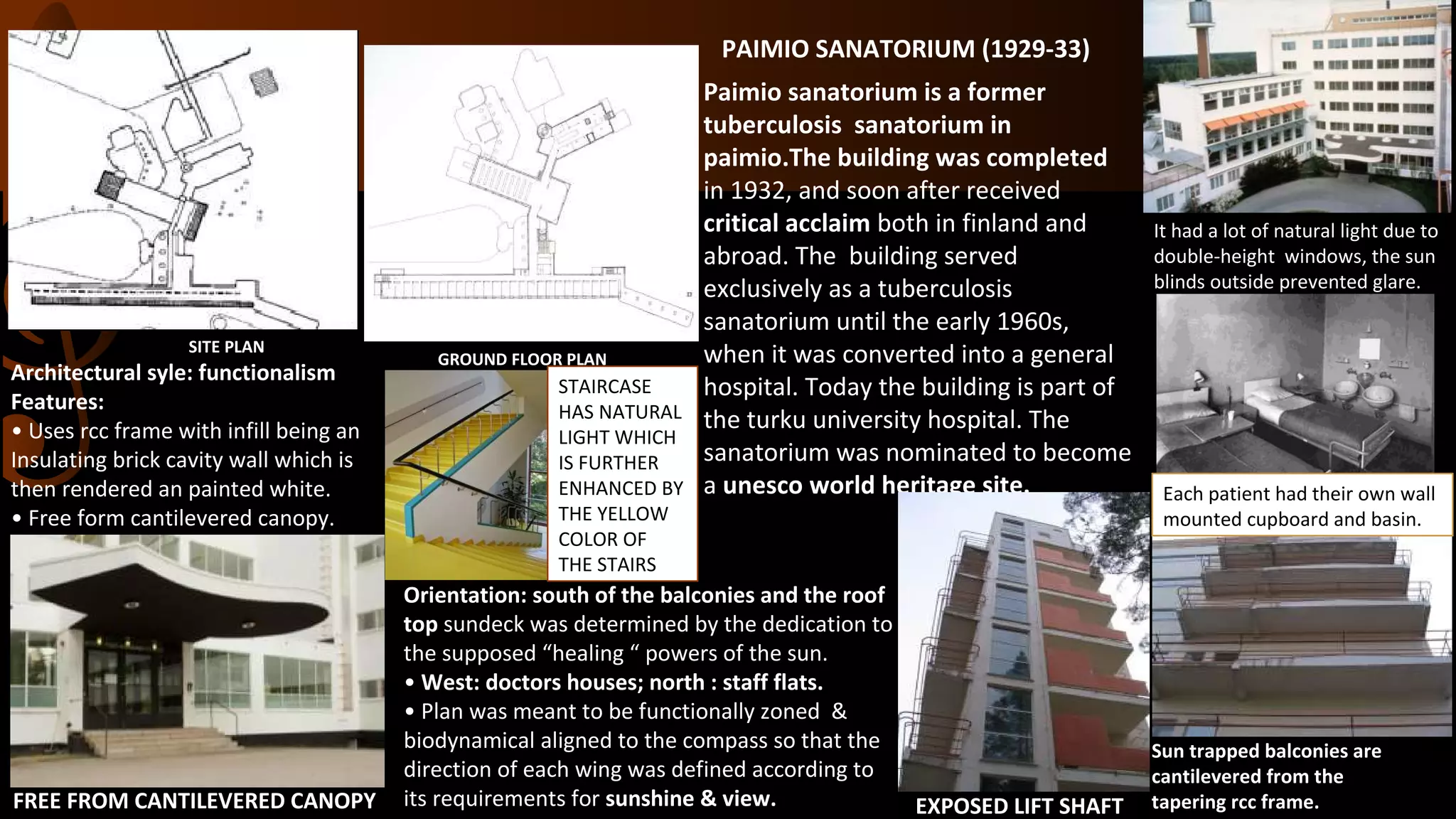
Paimio sanatorium is a former
tuberculosis sanatorium in
paimio.The building was completed
in 1932, and soon after received
critical acclaim both in finland and
abroad. The building served
exclusively as a tuberculosis
sanatorium until the early 1960s,
when it was converted into a general
hospital. Today the building is part of
the turku university hospital. The
sanatorium was nominated to become
a unesco world heritage site.
PAIMIO SANATORIUM (1929-33)
Architectural syle: functionalism
Features:
• Uses rcc frame with infill being an
Insulating brick cavity wall which is
then rendered an painted white.
• Free form cantilevered canopy.
SITE PLAN
GROUND FLOOR PLAN
Sun trapped balconies are
cantilevered from the
tapering rcc frame.EXPOSED LIFT SHAFTFREE FROM CANTILEVERED CANOPY
Orientation: south of the balconies and the roof
top sundeck was determined by the dedication to
the supposed “healing “ powers of the sun.
• West: doctors houses; north : staff flats.
• Plan was meant to be functionally zoned &
biodynamical aligned to the compass so that the
direction of each wing was defined according to
its requirements for sunshine & view.
It had a lot of natural light due to
double-height windows, the sun
blinds outside prevented glare.
STAIRCASE
HAS NATURAL
LIGHT WHICH
IS FURTHER
ENHANCED BY
THE YELLOW
COLOR OF
THE STAIRS
Each patient had their own wall
mounted cupboard and basin.
ConceptConcept –
1. marks a transition from traditional to
modern architecture.
2. The constant theme of a shifting and
advancing technology is ever present in
Aalto’s design.
3. As it is placed in such an such a
mesmerizing natural environment, Aalto
used this to his advantage and designed
with the intentions of blurring the lines
between being inside or outdoors.
villa mairea is a villa, guest-house, and
rural retreat designed for harry and
maire gullichsen in noormarkku ,finland.
the gullichsens were a wealthy couple
and members of the ahlström family.
They told aalto that he should regard it
as 'an experimental house'. aalto
seems to have treated the house as an
opportunity to bring together all the
themes that had been preoccupying
him in his work to that point but had
not been ableWEST ELEVATION
FRONT ELEVATION
SIDE ELEVATION
Architectural syle:experimentation
features: exterior • the courtyard of
the villa was inspired by the
organization of vernacular farmstead.
• the massing was inspired by the
falling waters by frank lloyd wright.
The main entrance to the – the door is approached
under a two level canopy supported by compound
timber column &screened by miniature forest of poles
To enter this inner sanctum, columns
are made to resemble tree trunks are
located at certain points to create the
impression similar to that of emerging
through the fringes of a forest clearing.
•Screening by vertical poles help to
differentiate the interlinked spaces
ERICH MENDELSOHN
DOB-21 march 1887 He was a
German Architect ,know for
his expressionist architecture
in 1920s, as well as for
developing a dynamic
functionalism in his projects.
Characteristics of Expressionist Architecture
1. Distortion of form for an emotional effect.
2. Subordination of realism to symbolic or stylistic expression
of inner experience.
3. An underlying effort at achieving the new, original,&
visionary.
4. Conception of architecture as a work of art.
5. Profusion of works on paper, and models, with discovery
and representations of concepts more important than
pragmatic finished products.
6. Often hybrid solutions, irreducible to a single concept.
7. Themes of natural romantic phenomena, such as caves,
mountains, lightning, crystal and rock formations.[10] As such
it is more mineral and elemental than florid and organic which
characterized its close contemporary art nouveau.
8. Uses creative potential of artisan craftsmanship.
• Mendelsohn was known as a great lover of nature.
• He made use of shapes derived from nature, especially
the spiral structures seen in the shells of sea mollusks.
Such spirals served as the basis for his design of
staircases.
• He insisted on planning the gardens and interior design
details of his buildings, including lighting and furniture.
• Among Mendelsohn's famous works in Germany are
the Einstein Tower in Potsdam, various factories, the
Schocken family commercial buildings, and power plants.
The Tower shows expressionist architecture
style The building is built with brick & concrete
Mendelsohn wanted the building without
angles ,ie; he wanted smooth ,rounded corners.
Einstein Tower represented the:
• Truth of reinforced concrete construction in
which a steel frame or skeleton supported and
stiffened the concrete flesh
• Stresses shaping the form (the compression
and tension of both reinforced concrete and
the human body)
• Intricate curved pieces of the human spine
corresponded to his aesthetic taste
Human presence that could arouse the empathy of viewers.o "Erich
Mendelsohn's small, but powerfully modeled tower, built to symbolize the
greatness of the Einsteinian concepts, was also a quite functional house.It
was designed too hold Einstein's own astronomical laboratory.
o Mendelsohn was after a completely plastic kind of building, moulded
rather than built, without angles and with smooth, rounded corners.
o He needed a malleable material like reinforced concrete, which could be
made to curve and create its own surface plasticity, but due to post-war
shortages, some parts had to be in brick and others in concrete.
o Even so, this 'sarcophagus of architectural Expressionism' is one of the
most brilliantly original buildings of the twentieth century.
EINSTEIN TOWER -BERLIN [1919-1922]
HAT FACTORY
,GERMANY
[1921]- at
Luckenwalde
On an area of 10,000 square meters, four​​
production halls, a boiler, turbine house, a
dyeing hall and two gatehouses were designed
and built. The tower also resembled a hat.
The vast dyeing hall was supported by great
concrete rib cage.
Huge skylight panels ran the length of the hall,
flooding the building with natural light for the
workers. This was a functional space as well as
a striking work of architecture.
Hat factory in Luckenwalde
established his reputation. The
Hat Factory was commissioned in
1921, Mendelsohn's design
included four production halls, a
boiler, a turbine house, two
gatehouses and a dyeing hall.
The dyeing hall became a
distinctive feature of the factory,
the building was shaped with a
modern, ventilation hood that
expelled the toxic fumes used in
the dyeing process. The structure
even ironically resembled a hat.
KENZO TANGE Metabolist movement.
“"Architecture must have something that appeals to
the human heart, but even then,
basic forms, spaces and appearances must be logical.
Creative work is expressed in our
time as a union of technology and humanity”.
 He was pioneer of movement known as
“METABOLISM”.
 The word Metabolism describes the process of
maintaining living cells.
 Young Japanese architects after World War II
used this word to describe their beliefs
about how buildings and cities should be
designed, emulating a living being.
 Metabolist architects and designers believed
that “cities and buildings are not static
entities, but are ever-changing.”
 His vision for cities of future inhabited by a
mass society were characterized by a large
scale, flexible and expandable structures that
evoked the process of the organic growth.
Japanese Architect and Urban Planner
St. Mary’s Cathedral, Tokyo
The layout of the building is in the form of a cross
The perbolas open upwards to form a cross of light which
continues vertically along the length of four
facades
To this rhomboid volume other secondary constructions
were added including the baptistry and baptismal font.
The rectuangular shape contrast with the symbolic
character of the cathedral The bell tower is 61.6m high,
standing a short distance away from the main building
The exterior cladding is made of stainless steel.
In 2004 a large organ built by Italian firm mascioni was
installed It has covered a total floor area of 3,650 sqm
Following his term “metabolism”, designed the cathedral as a
living entity that should transcend beyond the borders of Japan to
become an architecture used for all peoples, combining
technology and humanity, rising above the mundane
 On a concrete base shaped like a Latin cross walls rise high
reaffirming the design of the plant and which are deployed eight
hyperbolic parables that support the roof of the cathedral and
leading to four main facades. The structure consists of eight
curved panels together and upright almost vertically.
 The roof, windows with skylights, a large cross shape and is
the only place where the temple receives natural light, while it
extends to the ends of the cross, reaching the ground as skirts,
design that is appreciated better from the outside.
 The exterior surfaces of the cathedral are lined with sheets of
galvanized aluminum and stainless steel frames and supported
by iron bolts, while the back wall of reinforced concrete to be in
sight, feature the works of the architect.
YOYOGI NATIONAL GYMNASIUM
Built for the Olympics in 1964.
• It is comprised of two buildings.
• Inspired by the skyline of the Colosseum in Rome.
• The gymnasium has a capacity of approximately
16,000 & smaller building can accommodate up 5,300
people.
• Plan resembles a snail.
• Its aerodynamic monumental and suggestive design
became an icon of the Japanese capital and a
benchmark in the Metabolist movement distancing
himself from the international style.
• Infact ,despite their monumental size, they give the
impression that the park itself, emphasizing its
relationship with the surrounding environment.
• The plan [of the larger stadium] is in the
form of two semi-circles, slightly displaced
in relation to one another, with their
unconnecting ends elongated into points.
• The entrances are located in the concave
sides. The roof is supported on two
reinforced concrete pillars, and is made up
of a system of steel cables onto which
enamelled steel plates are then soldered.
• The curving form of the roof serves to
make it more resistant to wind, which can
reach hurricane force in this region.
EERO SAARINEN
Eero Saarinen (1910 –1961) was
a Finnish American architect and
industrial designer of the 20th century
famous for shaping his Neo futuristic
style according to the demands of the
project: simple, sweeping, arching
structural curves or machine-like
rationalism.
Saarinen was challenged by furniture design,
especially the chair, which presents
aesthetical and structural problems that are
particularly difficult to solve.
In 1948 Saarinen created a womblike chair
using a glass fibre shell upholstered in foam
rubber and fabric. His last furniture designs
comprised a series of pedestal-based chairs
and tables (1957) that combined
The Tulip Table & Womb
Chair.
TWA Terminal, New york
• IT WS A MAJOR AMERICAN AIRLINE FROM 1924 UNTIL 2001 .
• In order to capture the concept of flight, Saarinen used curves to create spaces
that flowed into one another. It demonstrates his expressionism and the
technical marvel in concrete shells. This represented a futuristic style.
• The flowing, curvilinear forms which define this airport terminal make this work
a good example of expressionist architecture.
• The forms symbolically suggest flight.
• Interior spaces are also open and flowing.
• The exterior's concrete roof imitates a bird in flight with two massive "wings.“
• The interior consists of a continuous ribbon of elements, all whisking
themselves in from the exterior, so that ceilings continuously run into walls and
those walls become floors.
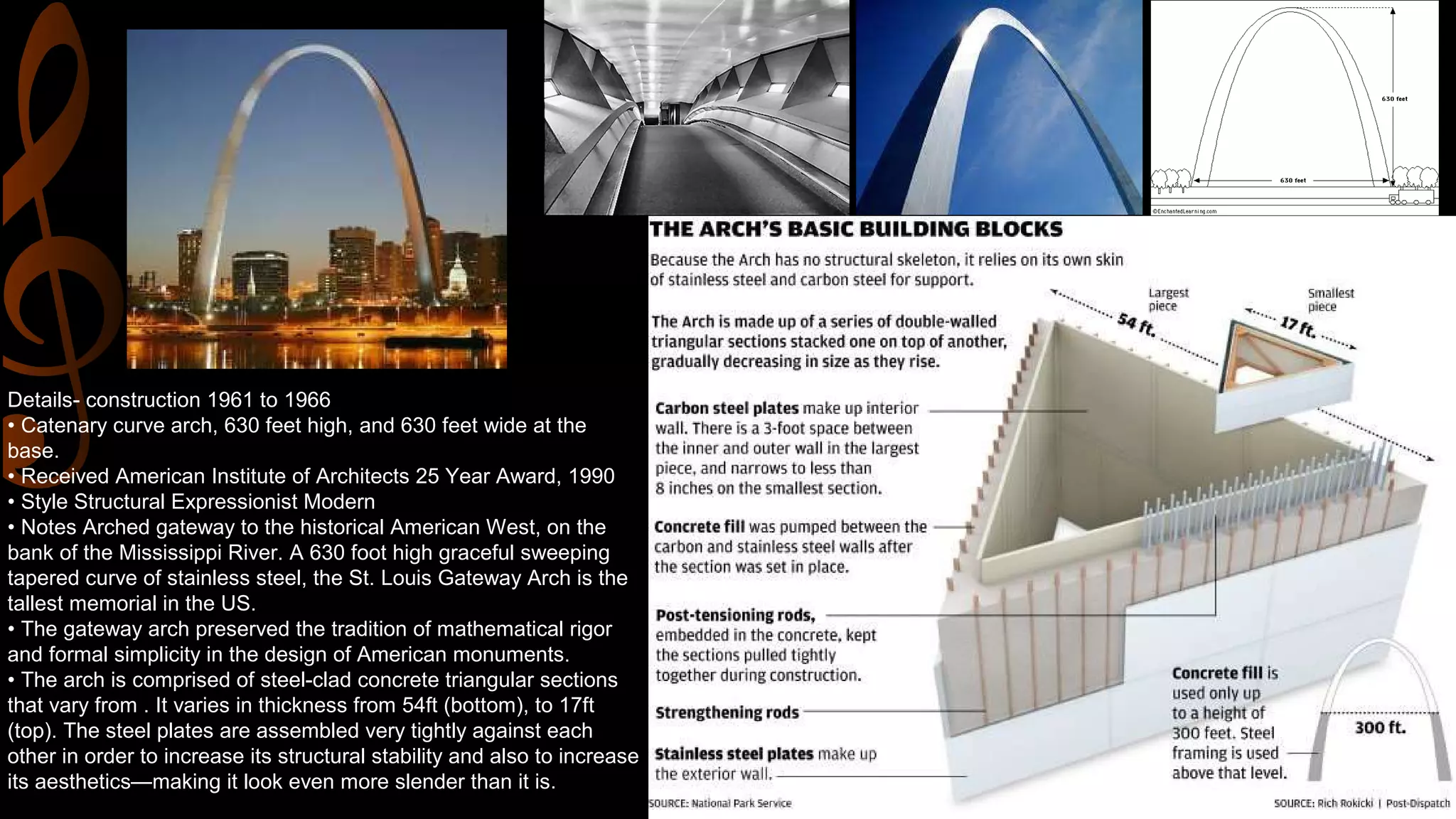
Details- construction 1961 to 1966
• Catenary curve arch, 630 feet high, and 630 feet wide at the
base.
• Received American Institute of Architects 25 Year Award, 1990
• Style Structural Expressionist Modern
• Notes Arched gateway to the historical American West, on the
bank of the Mississippi River. A 630 foot high graceful sweeping
tapered curve of stainless steel, the St. Louis Gateway Arch is the
tallest memorial in the US.
• The gateway arch preserved the tradition of mathematical rigor
and formal simplicity in the design of American monuments.
• The arch is comprised of steel-clad concrete triangular sections
that vary from . It varies in thickness from 54ft (bottom), to 17ft
(top). The steel plates are assembled very tightly against each
other in order to increase its structural stability and also to increase
its aesthetics—making it look even more slender than it is.
OTTOWAGNER
PROTO-RATIONALISM
A movement tending towards reduction:
- Architecture is reduced to construction
- Function is reduced to material function
- Architectural form is reduced to abstraction
- Building is reduced to an economic enterprise
Austrian architect and urban planner,
Austrian Postal Savings Bank
Interior reveals an astonishing purity of design.
- Has a glass-roofed interior court.
- Glass and iron vaulting does not merely fulfil all functional
requirements but also blends into and
- Tapered vertical supports of steel seem to increase the
floating effect of the glass ceiling.
- Linearity of the space is hard.
- All ornament is omitted.
- The individual elements, despite the curve of the ceiling,
are essentially rectangular and exhibit
a machined, non-organic character.
- Contains no movement or continuities, no decoration.
- Double glass roof—barrel vault under gable roof.
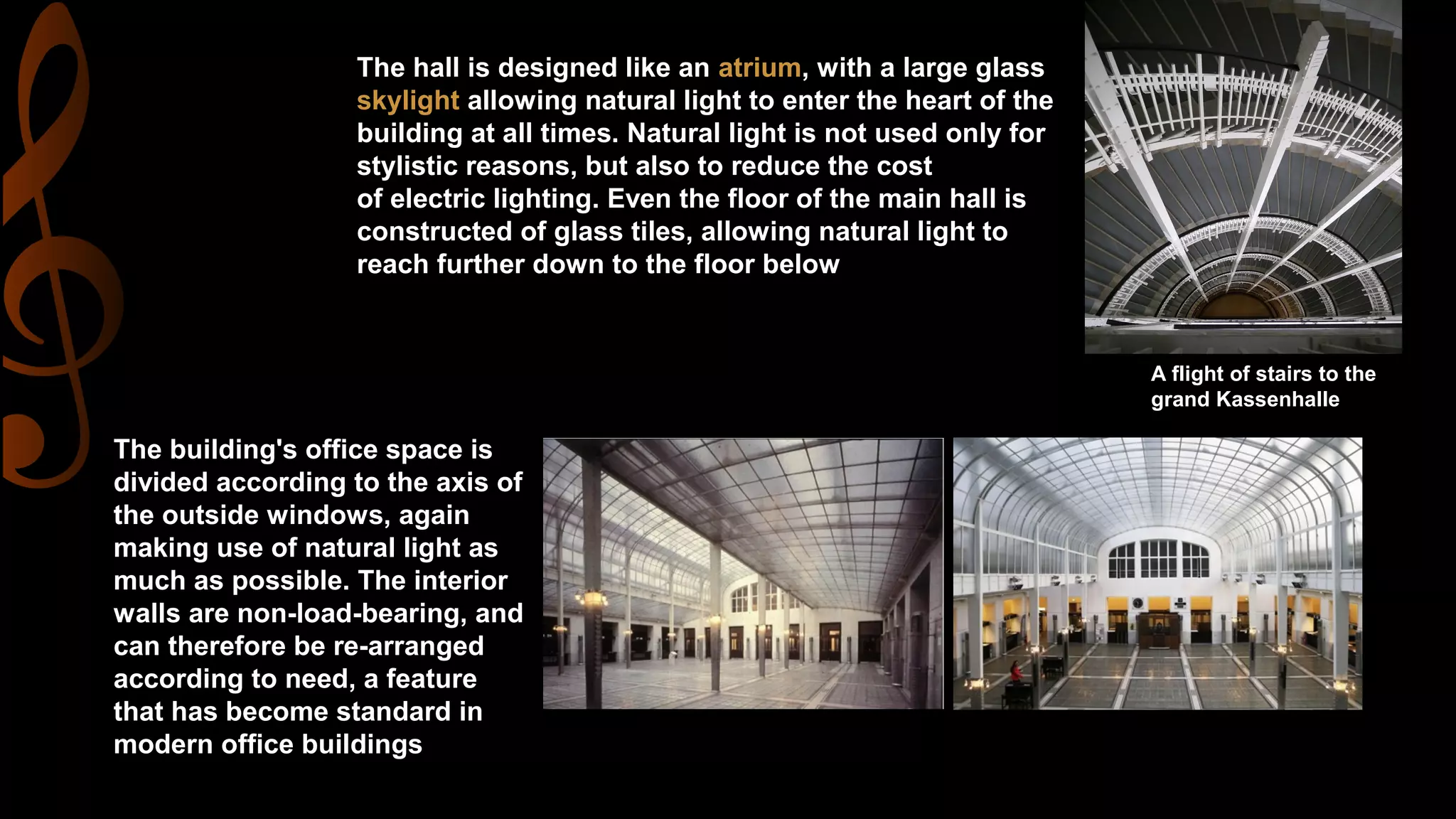
A flight of stairs to the
grand Kassenhalle
The hall is designed like an atrium, with a large glass
skylight allowing natural light to enter the heart of the
building at all times. Natural light is not used only for
stylistic reasons, but also to reduce the cost
of electric lighting. Even the floor of the main hall is
constructed of glass tiles, allowing natural light to
reach further down to the floor below
The building's office space is
divided according to the axis of
the outside windows, again
making use of natural light as
much as possible. The interior
walls are non-load-bearing, and
can therefore be re-arranged
according to need, a feature
that has become standard in
modern office buildings

ALVAR ALTO, ERICH MENDELSOHN, KENZOTANGE, EEROSARINEN, RICHARD NEUTRA, OTTOWAGNER

  • 1.
    Modern Movement Theories •ALVAR ALTO • ERICH MENDELSOHN • KENZOTANGE • EEROSARINEN • RICHARD NEUTRA • OTTOWAGNER
  • 2.
    Philosophy: Functionalism Bio Architecture Humanistic Modernism EmbodiedRationalism Nordic modernism •His design philosphy was influenced by nature and ORGANIC MATERIAL. •He designed vases with curvilinear bases and Striaght sides for savoy restaurant-turku. •With his innovative designs and nature forms, he Changed the course of design towards ORGANIC MODERNISM. •The beauty of his work is hidden in his design Approach of functionalism but with strong Connection •To organic relationship between man, nature and Buildings. •He coordinated these three components and Created a synthesis of life in materialized form. •He designed in very different scales-ranging from Buildings,town Plans,furniture,glassware, jewellery and other Forms of art. CHILDREN’S STOOL (1935) LOUNGE CHAIR (1931) PAIMIOPAIMIO SANITARIUMSANITARIUM ALVAR ALTOALVAR ALTO VillaMaireaVillaMairea Built in -Built in - 1938-19391938-1939 --LocationLocation Noormarkku , finlandNoormarkku , finland Built inBuilt in --1929-1933 - LocationLocation--Alvar aallontie 275, 21540 preitilä, paimio, finland
  • 3.
    Paimio sanatorium isa former tuberculosis sanatorium in paimio.The building was completed in 1932, and soon after received critical acclaim both in finland and abroad. The building served exclusively as a tuberculosis sanatorium until the early 1960s, when it was converted into a general hospital. Today the building is part of the turku university hospital. The sanatorium was nominated to become a unesco world heritage site. PAIMIO SANATORIUM (1929-33) Architectural syle: functionalism Features: • Uses rcc frame with infill being an Insulating brick cavity wall which is then rendered an painted white. • Free form cantilevered canopy. SITE PLAN GROUND FLOOR PLAN Sun trapped balconies are cantilevered from the tapering rcc frame.EXPOSED LIFT SHAFTFREE FROM CANTILEVERED CANOPY Orientation: south of the balconies and the roof top sundeck was determined by the dedication to the supposed “healing “ powers of the sun. • West: doctors houses; north : staff flats. • Plan was meant to be functionally zoned & biodynamical aligned to the compass so that the direction of each wing was defined according to its requirements for sunshine & view. It had a lot of natural light due to double-height windows, the sun blinds outside prevented glare. STAIRCASE HAS NATURAL LIGHT WHICH IS FURTHER ENHANCED BY THE YELLOW COLOR OF THE STAIRS Each patient had their own wall mounted cupboard and basin.
  • 4.
    ConceptConcept – 1. marksa transition from traditional to modern architecture. 2. The constant theme of a shifting and advancing technology is ever present in Aalto’s design. 3. As it is placed in such an such a mesmerizing natural environment, Aalto used this to his advantage and designed with the intentions of blurring the lines between being inside or outdoors. villa mairea is a villa, guest-house, and rural retreat designed for harry and maire gullichsen in noormarkku ,finland. the gullichsens were a wealthy couple and members of the ahlström family. They told aalto that he should regard it as 'an experimental house'. aalto seems to have treated the house as an opportunity to bring together all the themes that had been preoccupying him in his work to that point but had not been ableWEST ELEVATION FRONT ELEVATION SIDE ELEVATION Architectural syle:experimentation features: exterior • the courtyard of the villa was inspired by the organization of vernacular farmstead. • the massing was inspired by the falling waters by frank lloyd wright. The main entrance to the – the door is approached under a two level canopy supported by compound timber column &screened by miniature forest of poles To enter this inner sanctum, columns are made to resemble tree trunks are located at certain points to create the impression similar to that of emerging through the fringes of a forest clearing. •Screening by vertical poles help to differentiate the interlinked spaces
  • 5.
    ERICH MENDELSOHN DOB-21 march1887 He was a German Architect ,know for his expressionist architecture in 1920s, as well as for developing a dynamic functionalism in his projects. Characteristics of Expressionist Architecture 1. Distortion of form for an emotional effect. 2. Subordination of realism to symbolic or stylistic expression of inner experience. 3. An underlying effort at achieving the new, original,& visionary. 4. Conception of architecture as a work of art. 5. Profusion of works on paper, and models, with discovery and representations of concepts more important than pragmatic finished products. 6. Often hybrid solutions, irreducible to a single concept. 7. Themes of natural romantic phenomena, such as caves, mountains, lightning, crystal and rock formations.[10] As such it is more mineral and elemental than florid and organic which characterized its close contemporary art nouveau. 8. Uses creative potential of artisan craftsmanship. • Mendelsohn was known as a great lover of nature. • He made use of shapes derived from nature, especially the spiral structures seen in the shells of sea mollusks. Such spirals served as the basis for his design of staircases. • He insisted on planning the gardens and interior design details of his buildings, including lighting and furniture. • Among Mendelsohn's famous works in Germany are the Einstein Tower in Potsdam, various factories, the Schocken family commercial buildings, and power plants.
  • 6.
    The Tower showsexpressionist architecture style The building is built with brick & concrete Mendelsohn wanted the building without angles ,ie; he wanted smooth ,rounded corners. Einstein Tower represented the: • Truth of reinforced concrete construction in which a steel frame or skeleton supported and stiffened the concrete flesh • Stresses shaping the form (the compression and tension of both reinforced concrete and the human body) • Intricate curved pieces of the human spine corresponded to his aesthetic taste Human presence that could arouse the empathy of viewers.o "Erich Mendelsohn's small, but powerfully modeled tower, built to symbolize the greatness of the Einsteinian concepts, was also a quite functional house.It was designed too hold Einstein's own astronomical laboratory. o Mendelsohn was after a completely plastic kind of building, moulded rather than built, without angles and with smooth, rounded corners. o He needed a malleable material like reinforced concrete, which could be made to curve and create its own surface plasticity, but due to post-war shortages, some parts had to be in brick and others in concrete. o Even so, this 'sarcophagus of architectural Expressionism' is one of the most brilliantly original buildings of the twentieth century. EINSTEIN TOWER -BERLIN [1919-1922]
  • 7.
    HAT FACTORY ,GERMANY [1921]- at Luckenwalde Onan area of 10,000 square meters, four​​ production halls, a boiler, turbine house, a dyeing hall and two gatehouses were designed and built. The tower also resembled a hat. The vast dyeing hall was supported by great concrete rib cage. Huge skylight panels ran the length of the hall, flooding the building with natural light for the workers. This was a functional space as well as a striking work of architecture. Hat factory in Luckenwalde established his reputation. The Hat Factory was commissioned in 1921, Mendelsohn's design included four production halls, a boiler, a turbine house, two gatehouses and a dyeing hall. The dyeing hall became a distinctive feature of the factory, the building was shaped with a modern, ventilation hood that expelled the toxic fumes used in the dyeing process. The structure even ironically resembled a hat.
  • 8.
    KENZO TANGE Metabolistmovement. “"Architecture must have something that appeals to the human heart, but even then, basic forms, spaces and appearances must be logical. Creative work is expressed in our time as a union of technology and humanity”.  He was pioneer of movement known as “METABOLISM”.  The word Metabolism describes the process of maintaining living cells.  Young Japanese architects after World War II used this word to describe their beliefs about how buildings and cities should be designed, emulating a living being.  Metabolist architects and designers believed that “cities and buildings are not static entities, but are ever-changing.”  His vision for cities of future inhabited by a mass society were characterized by a large scale, flexible and expandable structures that evoked the process of the organic growth. Japanese Architect and Urban Planner
  • 9.
    St. Mary’s Cathedral,Tokyo The layout of the building is in the form of a cross The perbolas open upwards to form a cross of light which continues vertically along the length of four facades To this rhomboid volume other secondary constructions were added including the baptistry and baptismal font. The rectuangular shape contrast with the symbolic character of the cathedral The bell tower is 61.6m high, standing a short distance away from the main building The exterior cladding is made of stainless steel. In 2004 a large organ built by Italian firm mascioni was installed It has covered a total floor area of 3,650 sqm Following his term “metabolism”, designed the cathedral as a living entity that should transcend beyond the borders of Japan to become an architecture used for all peoples, combining technology and humanity, rising above the mundane  On a concrete base shaped like a Latin cross walls rise high reaffirming the design of the plant and which are deployed eight hyperbolic parables that support the roof of the cathedral and leading to four main facades. The structure consists of eight curved panels together and upright almost vertically.  The roof, windows with skylights, a large cross shape and is the only place where the temple receives natural light, while it extends to the ends of the cross, reaching the ground as skirts, design that is appreciated better from the outside.  The exterior surfaces of the cathedral are lined with sheets of galvanized aluminum and stainless steel frames and supported by iron bolts, while the back wall of reinforced concrete to be in sight, feature the works of the architect.
  • 10.
    YOYOGI NATIONAL GYMNASIUM Builtfor the Olympics in 1964. • It is comprised of two buildings. • Inspired by the skyline of the Colosseum in Rome. • The gymnasium has a capacity of approximately 16,000 & smaller building can accommodate up 5,300 people. • Plan resembles a snail. • Its aerodynamic monumental and suggestive design became an icon of the Japanese capital and a benchmark in the Metabolist movement distancing himself from the international style. • Infact ,despite their monumental size, they give the impression that the park itself, emphasizing its relationship with the surrounding environment. • The plan [of the larger stadium] is in the form of two semi-circles, slightly displaced in relation to one another, with their unconnecting ends elongated into points. • The entrances are located in the concave sides. The roof is supported on two reinforced concrete pillars, and is made up of a system of steel cables onto which enamelled steel plates are then soldered. • The curving form of the roof serves to make it more resistant to wind, which can reach hurricane force in this region.
  • 11.
    EERO SAARINEN Eero Saarinen(1910 –1961) was a Finnish American architect and industrial designer of the 20th century famous for shaping his Neo futuristic style according to the demands of the project: simple, sweeping, arching structural curves or machine-like rationalism. Saarinen was challenged by furniture design, especially the chair, which presents aesthetical and structural problems that are particularly difficult to solve. In 1948 Saarinen created a womblike chair using a glass fibre shell upholstered in foam rubber and fabric. His last furniture designs comprised a series of pedestal-based chairs and tables (1957) that combined The Tulip Table & Womb Chair.
  • 12.
    TWA Terminal, Newyork • IT WS A MAJOR AMERICAN AIRLINE FROM 1924 UNTIL 2001 . • In order to capture the concept of flight, Saarinen used curves to create spaces that flowed into one another. It demonstrates his expressionism and the technical marvel in concrete shells. This represented a futuristic style. • The flowing, curvilinear forms which define this airport terminal make this work a good example of expressionist architecture. • The forms symbolically suggest flight. • Interior spaces are also open and flowing. • The exterior's concrete roof imitates a bird in flight with two massive "wings.“ • The interior consists of a continuous ribbon of elements, all whisking themselves in from the exterior, so that ceilings continuously run into walls and those walls become floors.
  • 13.
    Details- construction 1961to 1966 • Catenary curve arch, 630 feet high, and 630 feet wide at the base. • Received American Institute of Architects 25 Year Award, 1990 • Style Structural Expressionist Modern • Notes Arched gateway to the historical American West, on the bank of the Mississippi River. A 630 foot high graceful sweeping tapered curve of stainless steel, the St. Louis Gateway Arch is the tallest memorial in the US. • The gateway arch preserved the tradition of mathematical rigor and formal simplicity in the design of American monuments. • The arch is comprised of steel-clad concrete triangular sections that vary from . It varies in thickness from 54ft (bottom), to 17ft (top). The steel plates are assembled very tightly against each other in order to increase its structural stability and also to increase its aesthetics—making it look even more slender than it is.
  • 14.
    OTTOWAGNER PROTO-RATIONALISM A movement tendingtowards reduction: - Architecture is reduced to construction - Function is reduced to material function - Architectural form is reduced to abstraction - Building is reduced to an economic enterprise Austrian architect and urban planner,
  • 15.
    Austrian Postal SavingsBank Interior reveals an astonishing purity of design. - Has a glass-roofed interior court. - Glass and iron vaulting does not merely fulfil all functional requirements but also blends into and - Tapered vertical supports of steel seem to increase the floating effect of the glass ceiling. - Linearity of the space is hard. - All ornament is omitted. - The individual elements, despite the curve of the ceiling, are essentially rectangular and exhibit a machined, non-organic character. - Contains no movement or continuities, no decoration. - Double glass roof—barrel vault under gable roof.
  • 16.
    A flight ofstairs to the grand Kassenhalle The hall is designed like an atrium, with a large glass skylight allowing natural light to enter the heart of the building at all times. Natural light is not used only for stylistic reasons, but also to reduce the cost of electric lighting. Even the floor of the main hall is constructed of glass tiles, allowing natural light to reach further down to the floor below The building's office space is divided according to the axis of the outside windows, again making use of natural light as much as possible. The interior walls are non-load-bearing, and can therefore be re-arranged according to need, a feature that has become standard in modern office buildings