BIOMIC & GEOMORPHIC STYLE
CHILEHAUS,GERMANY GRUNDTVIGS CHURCH
FRAGMENTS OF METROPOLIS
• Erich Mendelsohn was born in Alenstein, East Prussia in
1887.
• He was a German Jewish architect, known for his
expressionist buildings in the 1920s.
• He studied in Berlin and Munich where he became involved
with Expressionism.
• He escaped from Nazi Germany to England in 1933 and after
1934 designed medical centers and other buildings in Haifa
and Jerusalem.
• In 1941, Mendelsohn became a resident of the United States,
where he designed several impressive synagogues in the
Midwest.
• He is best known for his exuberant, sculptural design for the
Einstein Tower in Potsdam (1919-21).
ERICH MENDELSOHN (1887 –1953)
• HAT FACTORY (1919-20)
• EINSTEIN TOWER (1917-1920).
• MOSSEHAUS (1921-23).
• RED FLAG TEXTILE FACTORY, 1926.
• SCHOCKEN DEPARTMENT STORE,1928.
• THE DE LA WARR PAVILION, 1934.
IMPORTANT PROJECTS
i. He adopted only certain fundamental aspects of expressionism –The principle of organic unity.
ii. His conscious aim in design was to achieve organic unity, used the structural potentialities of steel and reinforced
concrete.
iii. Another aspect of Expressionism- “Dynamism” achieved in his projects for department stores and cinemas (Dynamic
functionalism).
iv. Mendelsohn used no historical precedents in formulating his designs. As a result, his early buildings avoid the
eclectic borrowing that mark so many of his contemporaries.
v. His architectural ideas were derived from expressionistic sketches which recognized that the qualities of modern
building materials should dictate a new architecture.
vi. In later designs, Mendelson moved away from his earlier expressionist architecture, designing a series of buildings in a
more linear fashion.
IDEOLOGIES AND PHILOSOPHIES
• The Einstein Tower was built for astronomer Erwin
Finlay-Freundlich to support experiments and
observations to validate Albert Einstein's relativity
theory.
• This organic, self-contained form of the tower was used
as “Astronomical observatory” and “Factory for optical
instruments”.
EINSTEIN TOWER (1917-1920)
• The exterior was originally conceived in concrete, but
due to construction difficulties, much of the building
was actually in brick, covered with stucco.
• Due to Formwork problem -the specified material could
be used only for the entrance portal and the topmost
ring of the tower.
• Light from the telescope is brought down through the
shaft to the basement where the instruments and
laboratory are located.
• This sculpted building with its expressionistic form is
devoid of applied ornament.
• Logical and perfectly sufficient to its purpose, stood out
like an "ungainly spaceship"
CONCEPT
• The complexity of shapes that make up the tower reflects on
the one hand, a great sense of artistic freedom and,
secondly, follows the ideas of Mendelsohn on what he called
“functional dynamics”.
• It is considered not only an advanced lab but also a monument
“firmly supported on the ground but also ready to
fly or take a leap,” a product of the aerodynamic shapes that
compose it.
SPACES
• Einstein Tower, restored in the 1980s – houses a telescope, a
laboratory and housing facilities for a limited number of
scientists and technicians.
• To get the light captured by the telescope to the lab than were
available a system of mirrors at 45 degrees that reflected
light from the top of the tower to its base.
https://youtu.be/jUkXAwZuEYQ
• Bruno Julius Florian Taut was an author, German architect and urban
planner .
• After training in Berlin and joining the office of Theodor Fischer in
Stuttgart, Taut opened his own Berlin office in 1910.
• After the war, Taut's theories and designs marked him as a leader in
architectural innovation.
• In 1924 he was made chief architect of GEHAG, a private housing concern,
and designed several successful large residential developments in Berlin.
• Taut moved to Turkey in 1936, designed a number of educational buildings
in Ankara and Trabzon.
• Taut's best-known single building is the prismatic dome of the Glass
Pavilion at the Cologne Werkbund Exhibition (1914).
BRUNO JULIUS FLORIAN TAUT (1880- 1938)
• Many of the works of Bruno Taut were domed, such as the Glass
Pavilion and Horseshoe Development in Berlin.
• Bruno Taut used brick as to show mass and repetition.
• Taut is unique among his European modernist contemporaries in
his devotion to color. (eg.1912 Falkenberg housing estate in Berlin,
which became known as the "Paint Box Estates“).
• controversially modern flat roofs,
• human access to sun, air and gardens,
• generous amenities like gas, electric
light, and bathrooms.
HOUSING LAYOUTS
IDEOLOGIES AND WORKS
MONUMENT DES EISENS
WORPSWEDER KASEGLOCKE
HORSESHOE DEVELOPMENT
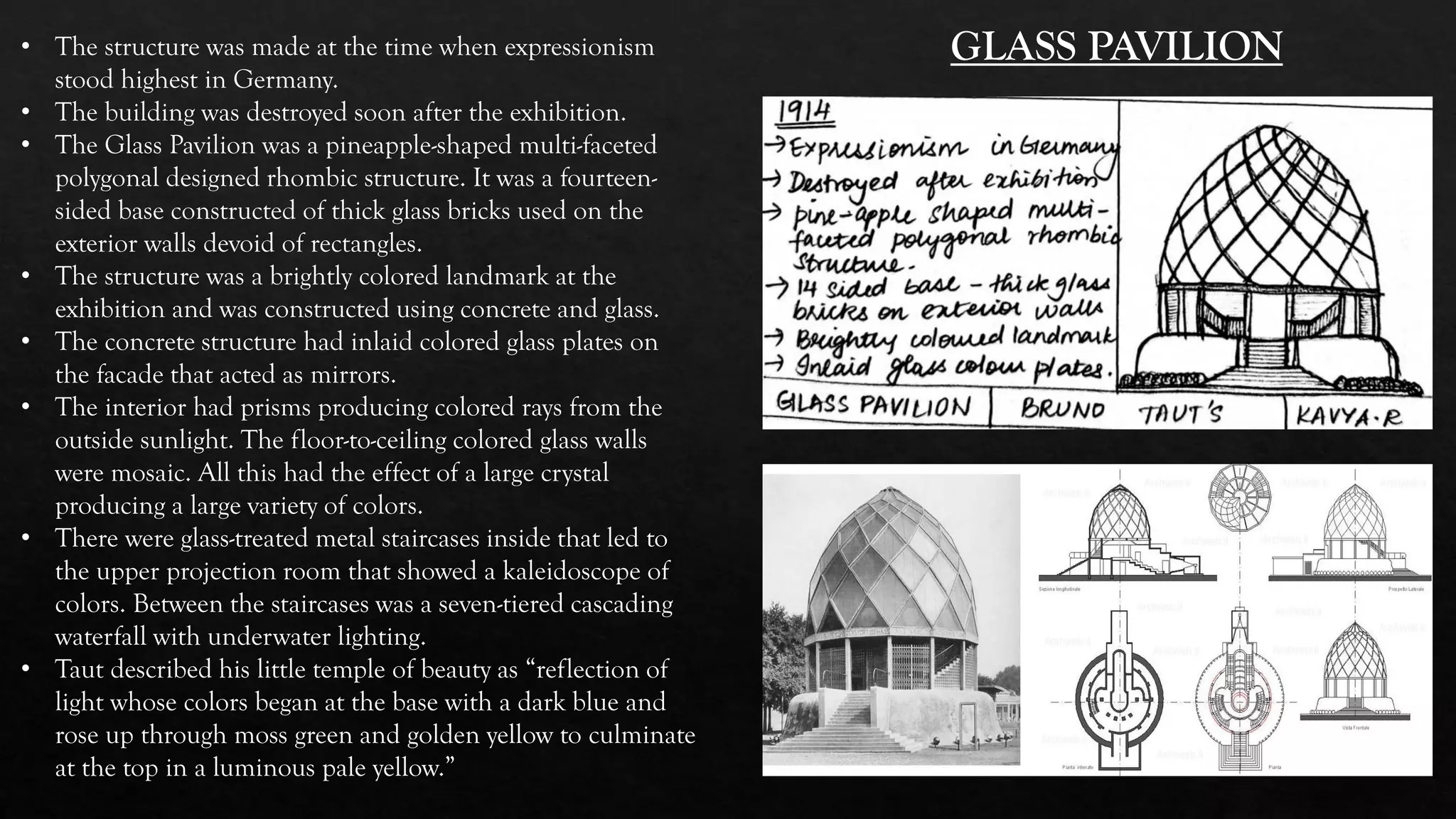
• The structure was made at the time when expressionism
stood highest in Germany.
• The building was destroyed soon after the exhibition.
• The Glass Pavilion was a pineapple-shaped multi-faceted
polygonal designed rhombic structure. It was a fourteen-
sided base constructed of thick glass bricks used on the
exterior walls devoid of rectangles.
• The structure was a brightly colored landmark at the
exhibition and was constructed using concrete and glass.
• The concrete structure had inlaid colored glass plates on
the facade that acted as mirrors.
• The interior had prisms producing colored rays from the
outside sunlight. The floor-to-ceiling colored glass walls
were mosaic. All this had the effect of a large crystal
producing a large variety of colors.
• There were glass-treated metal staircases inside that led to
the upper projection room that showed a kaleidoscope of
colors. Between the staircases was a seven-tiered cascading
waterfall with underwater lighting.
• Taut described his little temple of beauty as “reflection of
light whose colors began at the base with a dark blue and
rose up through moss green and golden yellow to culminate
at the top in a luminous pale yellow.”
GLASS PAVILION
CONCEPT
• Glass could be used in construction along with light &
transparency, but also as the material used to organize the
human emotions and help in construction of a spiritual
utopia.
• Taut described his little temple of beauty as :
“The reflection of light, whose colors are initiated at the base with
a dark blue and rise through moss green and golden yellow to
culminate at the top with a pale yellow color. ”
UPSTAIRS
• The two outer stairs led the visitor directly to the top
floor.
• Inside, the color effects produced by sunlight looked
enhanced by reflections from the pool and waterfall that
ran on an existing yellow glass on the lower level, visible
through a circular opening in the floor upstairs.
STAIRS
• Two flights of stairs metal coated glass and enclosed in
glass walls produced the sensation of descending to the
lowest level as if done by “water with gas ”
DOWNSTAIRS
• This plant is descended on both interior stairs enclosed
between glass walls, reaching to the ground where the
pool is opened and began its journey waterfall.
WATERFALL & POOL
• The cascade was carried out with yellow crystal, with
seven levels for the pool while a complementary color,
purple was used.
• A mechanical kaleidoscope projected images, a first
version of a light show, intensifying the overall
impression of the visitor.
STRUCTURE
• The structure of the Pavilion was built on a concrete pedestal,
whose two entrances on both sides of the building are
achieved up two flights of stairs, which gives the same
appearance of the temple.
• Glass walls are capped by a perimeter concrete lintels over
which the double dome prismatic glass skin reflected in
prisms forms the interior and exterior colors supported. This
dome -like pineapple is a multifaceted polygonal structure
whose concrete ribs allowed to develop a rhombic structure of
thick glass blocks.
https://youtu.be/1DM-J27Oxi8

EXPRESSIONISM (HOA) - KAVYA RAVI

  • 3.
    BIOMIC & GEOMORPHICSTYLE CHILEHAUS,GERMANY GRUNDTVIGS CHURCH FRAGMENTS OF METROPOLIS
  • 6.
    • Erich Mendelsohnwas born in Alenstein, East Prussia in 1887. • He was a German Jewish architect, known for his expressionist buildings in the 1920s. • He studied in Berlin and Munich where he became involved with Expressionism. • He escaped from Nazi Germany to England in 1933 and after 1934 designed medical centers and other buildings in Haifa and Jerusalem. • In 1941, Mendelsohn became a resident of the United States, where he designed several impressive synagogues in the Midwest. • He is best known for his exuberant, sculptural design for the Einstein Tower in Potsdam (1919-21). ERICH MENDELSOHN (1887 –1953) • HAT FACTORY (1919-20) • EINSTEIN TOWER (1917-1920). • MOSSEHAUS (1921-23). • RED FLAG TEXTILE FACTORY, 1926. • SCHOCKEN DEPARTMENT STORE,1928. • THE DE LA WARR PAVILION, 1934. IMPORTANT PROJECTS
  • 7.
    i. He adoptedonly certain fundamental aspects of expressionism –The principle of organic unity. ii. His conscious aim in design was to achieve organic unity, used the structural potentialities of steel and reinforced concrete. iii. Another aspect of Expressionism- “Dynamism” achieved in his projects for department stores and cinemas (Dynamic functionalism). iv. Mendelsohn used no historical precedents in formulating his designs. As a result, his early buildings avoid the eclectic borrowing that mark so many of his contemporaries. v. His architectural ideas were derived from expressionistic sketches which recognized that the qualities of modern building materials should dictate a new architecture. vi. In later designs, Mendelson moved away from his earlier expressionist architecture, designing a series of buildings in a more linear fashion. IDEOLOGIES AND PHILOSOPHIES
  • 8.
    • The EinsteinTower was built for astronomer Erwin Finlay-Freundlich to support experiments and observations to validate Albert Einstein's relativity theory. • This organic, self-contained form of the tower was used as “Astronomical observatory” and “Factory for optical instruments”. EINSTEIN TOWER (1917-1920) • The exterior was originally conceived in concrete, but due to construction difficulties, much of the building was actually in brick, covered with stucco. • Due to Formwork problem -the specified material could be used only for the entrance portal and the topmost ring of the tower. • Light from the telescope is brought down through the shaft to the basement where the instruments and laboratory are located. • This sculpted building with its expressionistic form is devoid of applied ornament. • Logical and perfectly sufficient to its purpose, stood out like an "ungainly spaceship"
  • 9.
    CONCEPT • The complexityof shapes that make up the tower reflects on the one hand, a great sense of artistic freedom and, secondly, follows the ideas of Mendelsohn on what he called “functional dynamics”. • It is considered not only an advanced lab but also a monument “firmly supported on the ground but also ready to fly or take a leap,” a product of the aerodynamic shapes that compose it. SPACES • Einstein Tower, restored in the 1980s – houses a telescope, a laboratory and housing facilities for a limited number of scientists and technicians. • To get the light captured by the telescope to the lab than were available a system of mirrors at 45 degrees that reflected light from the top of the tower to its base. https://youtu.be/jUkXAwZuEYQ
  • 10.
    • Bruno JuliusFlorian Taut was an author, German architect and urban planner . • After training in Berlin and joining the office of Theodor Fischer in Stuttgart, Taut opened his own Berlin office in 1910. • After the war, Taut's theories and designs marked him as a leader in architectural innovation. • In 1924 he was made chief architect of GEHAG, a private housing concern, and designed several successful large residential developments in Berlin. • Taut moved to Turkey in 1936, designed a number of educational buildings in Ankara and Trabzon. • Taut's best-known single building is the prismatic dome of the Glass Pavilion at the Cologne Werkbund Exhibition (1914). BRUNO JULIUS FLORIAN TAUT (1880- 1938)
  • 11.
    • Many ofthe works of Bruno Taut were domed, such as the Glass Pavilion and Horseshoe Development in Berlin. • Bruno Taut used brick as to show mass and repetition. • Taut is unique among his European modernist contemporaries in his devotion to color. (eg.1912 Falkenberg housing estate in Berlin, which became known as the "Paint Box Estates“). • controversially modern flat roofs, • human access to sun, air and gardens, • generous amenities like gas, electric light, and bathrooms. HOUSING LAYOUTS IDEOLOGIES AND WORKS MONUMENT DES EISENS WORPSWEDER KASEGLOCKE HORSESHOE DEVELOPMENT
  • 12.
    • The structurewas made at the time when expressionism stood highest in Germany. • The building was destroyed soon after the exhibition. • The Glass Pavilion was a pineapple-shaped multi-faceted polygonal designed rhombic structure. It was a fourteen- sided base constructed of thick glass bricks used on the exterior walls devoid of rectangles. • The structure was a brightly colored landmark at the exhibition and was constructed using concrete and glass. • The concrete structure had inlaid colored glass plates on the facade that acted as mirrors. • The interior had prisms producing colored rays from the outside sunlight. The floor-to-ceiling colored glass walls were mosaic. All this had the effect of a large crystal producing a large variety of colors. • There were glass-treated metal staircases inside that led to the upper projection room that showed a kaleidoscope of colors. Between the staircases was a seven-tiered cascading waterfall with underwater lighting. • Taut described his little temple of beauty as “reflection of light whose colors began at the base with a dark blue and rose up through moss green and golden yellow to culminate at the top in a luminous pale yellow.” GLASS PAVILION
  • 13.
    CONCEPT • Glass couldbe used in construction along with light & transparency, but also as the material used to organize the human emotions and help in construction of a spiritual utopia. • Taut described his little temple of beauty as : “The reflection of light, whose colors are initiated at the base with a dark blue and rise through moss green and golden yellow to culminate at the top with a pale yellow color. ” UPSTAIRS • The two outer stairs led the visitor directly to the top floor. • Inside, the color effects produced by sunlight looked enhanced by reflections from the pool and waterfall that ran on an existing yellow glass on the lower level, visible through a circular opening in the floor upstairs. STAIRS • Two flights of stairs metal coated glass and enclosed in glass walls produced the sensation of descending to the lowest level as if done by “water with gas ” DOWNSTAIRS • This plant is descended on both interior stairs enclosed between glass walls, reaching to the ground where the pool is opened and began its journey waterfall. WATERFALL & POOL • The cascade was carried out with yellow crystal, with seven levels for the pool while a complementary color, purple was used. • A mechanical kaleidoscope projected images, a first version of a light show, intensifying the overall impression of the visitor. STRUCTURE • The structure of the Pavilion was built on a concrete pedestal, whose two entrances on both sides of the building are achieved up two flights of stairs, which gives the same appearance of the temple. • Glass walls are capped by a perimeter concrete lintels over which the double dome prismatic glass skin reflected in prisms forms the interior and exterior colors supported. This dome -like pineapple is a multifaceted polygonal structure whose concrete ribs allowed to develop a rhombic structure of thick glass blocks. https://youtu.be/1DM-J27Oxi8