Modern C For Software Developers Serious C Development 13 Karen Singh Garewal
Modern C For Software Developers Serious C Development 13 Karen Singh Garewal
Modern C For Software Developers Serious C Development 13 Karen Singh Garewal
Modern C For Software Developers Serious C Development 13 Karen Singh Garewal
Modern C For Software Developers Serious C Development 13 Karen Singh Garewal
1.
Modern C ForSoftware Developers Serious C
Development 13 Karen Singh Garewal download
https://ebookbell.com/product/modern-c-for-software-developers-
serious-c-development-13-karen-singh-garewal-47208814
Explore and download more ebooks at ebookbell.com
2.
Here are somerecommended products that we believe you will be
interested in. You can click the link to download.
Modern C For Software Developers Serious C Development Karan Singh
Garewal
https://ebookbell.com/product/modern-c-for-software-developers-
serious-c-development-karan-singh-garewal-47254448
Design Patterns In Modern C Reusable Approaches For Objectoriented
Software Design Dmitri Nesteruk
https://ebookbell.com/product/design-patterns-in-modern-c-reusable-
approaches-for-objectoriented-software-design-dmitri-nesteruk-47372406
C 12 For Cloud Web And Desktop Applications Modern Concepts And
Techniques For Software Development With C 12 1st Edition Thiago Vivas
De Araujo
https://ebookbell.com/product/c-12-for-cloud-web-and-desktop-
applications-modern-concepts-and-techniques-for-software-development-
with-c-12-1st-edition-thiago-vivas-de-araujo-145860460
Design Patterns In Modern C20 Reusable Approaches For Objectoriented
Software Design 2nd Edition Dmitri Nesteruk
https://ebookbell.com/product/design-patterns-in-modern-c20-reusable-
approaches-for-objectoriented-software-design-2nd-edition-dmitri-
nesteruk-36127942
3.
Design Patterns InModern C20 Reusable Approaches For Objectoriented
Software Design 2nd Edition Dmitri Nesteruk
https://ebookbell.com/product/design-patterns-in-modern-c20-reusable-
approaches-for-objectoriented-software-design-2nd-edition-dmitri-
nesteruk-36132696
Design Patterns In Modern C Reusable Approaches For Objectoriented
Software Design Dmitri Nesteruk
https://ebookbell.com/product/design-patterns-in-modern-c-reusable-
approaches-for-objectoriented-software-design-dmitri-nesteruk-7003986
Modern Cmake For C Discover A Better Approach To Building Testing And
Packaging Your Software 1 Rafal Swidzinski
https://ebookbell.com/product/modern-cmake-for-c-discover-a-better-
approach-to-building-testing-and-packaging-your-software-1-rafal-
swidzinski-50769834
Modern C For Absolute Beginners A Friendly Introduction To The C
Programming Language And C11 To C23 Standards 2nd Edition 2nd Edition
Slobodan Dmitrovi
https://ebookbell.com/product/modern-c-for-absolute-beginners-a-
friendly-introduction-to-the-c-programming-language-
and-c11-to-c23-standards-2nd-edition-2nd-edition-slobodan-
dmitrovi-48278302
Modern C For Absolute Beginners A Friendly Introduction To C
Programming Language And C11 To C20 Standards 1st Edition Slobodan
Dmitrovi
https://ebookbell.com/product/modern-c-for-absolute-beginners-a-
friendly-introduction-to-c-programming-language-
and-c11-to-c20-standards-1st-edition-slobodan-dmitrovi-50195194
5.
Modern C++ ForSoftware Developers
Serious C++ Development
Karan Singh Garewal
Changelog
Date Version Notes
October10, 2022 1.3 new chapter on coroutines
additions to the GDB Debugger chapter
August 30, 2022 1.2 std::format library function
Revise threads chapter with additional working
examples.
Numerous edits to improve readability and improve
comprehension.
July 30, 2022 1.1 setjmp and longjmp section
refactor smart pointers chapter
C++ Sanitizers chapter
fix errors in some code examples
[[maybe_unused]] – C++17 features
C++ SonarLint chapter
various edits to explain concepts more simply
February 28, 2022 1.0 Initial release
II
8.
Preface
This is abook on serious software development with Modern C++. It is
my go-to desktop reference when I am developing C++ applications. I
hope that you will also consider this book in such an exalted light.
This book is divided into eight main sections. The first section is a C
language refresher. Knowledge of the C language is presumed. The
next section exposes core C++. This is C++ before C++11. This
section is followed by four sections that discuss important features of
C++11, C++14, C++17 and the latest standard, C++20. This is
followed by a section that discusses important functions in the C++
Standard Library. The next section is devoted to the GNU C++
compiler and the GNU debugger. The last section looks at some
miscellaneous topics.
Every important C++ feature that is discussed in this book is
accompanied by a short C++ program to demonstrate how the feature
works. You can cut and paste these examples into wandbox
(https://wandbox.org) and then compile and execute them.
This book can be read sequentially or you can go directly to topics of
interest.
The reminder of this preface is merely my opinionated meandering on
C++ web applications. Is C++ web application development an
anachronism? You can safely omit this part of the preface.
III
9.
A Journey ThroughC++ Land
When I was going to university, I had a friend who was fond of saying
“I think in C”. He obviously liked C a lot. Over forty years later, after
it’s inception, C still remains very popular. A lot of people really like C.
It appears that C imposes very little cognitive load on the brain; C fits
easily into the brain.
But C has it’s limitations. A few years back I was developing a deep
neural network in C. After writing about 30,000 lines I started having
difficulty reasoning about the application in it’s entirety. This is not a
critique about the language, it is an observation that C does not
provide language constructs to architect large applications.
This is where C++ comes in. C++ provides constructs to structure and
architect extremely large applications. Applications in the multi-million
line range are eminently feasible. This is entirely due to constructs
such as classes, encapsulation, function overloading, run-time
polymorphism and templates. These constructs are remarkably
versatile and a very large domain of problems can be modelled with
these constructs.
But this not to say that C++ is perfect. It is possible that absolutely
massive software applications such as the F-35 fighter jet program (up
to 30 million C++ Source lines of code) are exposing the deficiencies
in C++. In other words, C++ source code is not reliable enough at this
scale. The C++ Steering Committee is aware of this issue. Each new
release of C++ brings new constructs to improve the correctness of
IV
10.
C++ programs. Considerfor example, const, static_assert, constexpr,
consteval, constinit, typed enums, constant templates, auto, type
deduction, braced initialization, noexcept, override, [[nodiscard]] and
a plethora of other language constructs.. The list of C++ correctness
constructs is long and expanding.
C++ Is Not A Web Programming Language
This is a frequently repeated canard on the Internet. It may have been
true in the past but it is not true today. Web frameworks based on
dynamically typed languages are invariably held forth as being the
best environments to develop web applications. I am alluding to the
Python/Django and Ruby/Rails frameworks in particular. I came from a
heavy C++ background and migrated to web development. I spent
nearly a decade developing Rails applications. Never liked the
language or the framework. But it would have been an unforgivable
heresy to oppose conventional wisdom.
Frameworks based on dynamically typed languages are held out as
being suitable for fast web development. I disagree. An experienced
C++ programmer can develop web applications just as fast as
someone developing in the Ruby and Rails environment for example. If
not faster. How can web development in C++ be faster? It all boils
down to the compile-link cycle in C++. If your C++ web application
compiles and links properly it is almost certain that it will also run on
the web. Your main concern will be the “business” logic of your
program. In contrast, if the application is developed in a dynamically
typed language, you can write the application quickly but you will
V
11.
spend a lotof time debugging the program at run-time. This is due to
the fact that in a dynamically typed language variable types
frequently change at run-time. Additionally the debugging tools for
dynamically typed languages are mediocre.
In the discussion that follows I will use Ruby and Rails as a bete noire.
Simply because this is the framework with which I have the most
experience and this framework has a huge hype machine behind it.
However the discussion applies equally to other frameworks built with
dynamically typed languages.
Performance
There is a dirty little secret concerning web applications built with
dynamically typed languages. These applications are very slow and a
lot of engineering effort goes into making them run faster. For
example, a C++ web application developed in the Drogon framework:
( https://github.com/drogonframework/drogon ) is over fifty times
faster than a Ruby/Rails application.
See: https://www.techempower.com/benchmarks/#section=data-
r19&hw=ph&test=composite
The main culprit is the interpreter in these languages which must read
each source code statement (or it’s bytecode) before executing the
statement.
Also see a comparison of the Drogon webserver with the gold standard
in webservers: Nginx.
https://drogon.docsforge.com/master/benchmarks/#test-plan-and-
VI
12.
results
It is worth-notingthat a medium-sized C++ web application will hardly
register any CPU usage. An equivalent Ruby/Rails application will
stress the CPU and you might end up having to load balance incoming
HTTP requests to multiple machines.
Libraries vs. Frameworks
Using a web framework leads the developer into vendor lock-in. If you
develop a web application in Python and Django or Ruby and Rails,
your application will for all practical purposes be locked into the
vendor’s framework. Migration to another framework will be a major
undertaking.
Libraries do not produce such a lock-in effect. After all, you can easily
switch libraries or develop your own library functions. For example.
Drogon is a very thin framework layer wrapped around the drogon
webserver.
Deployment
Deploying Ruby and Rails applications to production servers is
complicated. All of the source files and static resources have to be
deployed on the production server. In contrast the deployment of a C+
+ web application is simple. One or more executable files and the
static resources are deployed on the production server. rsync can
easily manage this deployment.
VII
13.
Trying The TheoryOut
I wanted to confirm my suspicions with a production quality C++ web
application. Since I am an Attorney at Law, I developed
https://truelawdocs.com as a Drogon C++ application. This is a multi-
threaded application for document production. It took about four
months of part-time work. The application uses the Cassandra NoSQL
database for document storage. This is clearly massive overkill for an
application like TrueLawDocs. Cassandra slowed the development
cycle since I had zero prior Cassandra experience. I wanted to learn
Cassandra on the supposition that I might need this column-oriented
NoSQL database in the future. I really liked Cassandra, it’s very well
designed.
TrueLawDocs has a front-end developed in Bootstrap, Vue, Javascript
and CSS. The C++ back-end and the front-end communicate through
websockets. As you can surmise TrueLawDocs has a strongly
decoupled architecture.
Aside from the Drogon framework and the C++ standard library, the
only libraries used were nlohmann/json a C++ JSON library, AES.hpp a
header only C++ encryption library, the DataStax C driver library for
Cassandra, ASAN (address sanitizer) and UBSAN (undefined behaviour
sanitizer). That is it for third party libraries. Everything else was hand-
coded.
For payment integration with Stripe, the LibCurl library was used to
interact with the Stripe payment server. Stripe does not support C++
and provides no sample code to integrate C++ applications. The
integration of the TrueLawDocs C++ code with the Stripe server
VIII
14.
exemplifies the rawpower of C++.
The overall development experience was very pleasant. The Drogon
source code is easy to digest; it’s written by a master of Modern C++.
TrueLawDocs including Cassandra is running on a seven dollar a
month VPS rented from a company In Sharjah.
Lessons Learned
During my tenure contracting on Rails applications I rarely met
developers who had broad experience with other programming
languages. They typically only knew their framework. In a decade of
contracting, I never met a Rails programmer who was reasonably
proficient in C++.
One of the reasons that dynamically typed web languages are popular
is that they are easy to learn. You can master Rails in less than three
months. In contrast one cannot gain reasonable proficiency in C++
unless one has programmed in the language for about two years. The
Modern C++ learning curve is very steep. Unfortunately. It’s
unavoidable.
Another factor is economics. Web applications built in dynamically
typed languages rely on cheap labour. Fortune 500 companies use
large inputs of foreign contractors and software quality testers to
develop and maintain their applications. To my mind, this is a
statement on the inadequacy of dynamically typed languages for web
development. If these cheap resources were not available, the
development model would shift to conserving expensive, high quality
IX
15.
manpower.
In terms ofthe debugging effort that was expended developing
TrueLawDocs, I estimate that 75% of the effort involved debugging the
Vue and Javascript front-end. C++ provides superb debugging tools so
debugging the back-end was a snap. Insofar as the back-end
debugging infrastructure was concerned, I relied on the extensive use
of Debug macros, ASAN (to detect memory errors), UBSAN and the
GDB debugger. Sonarlint was used check syntax.
The development environment was Linux Mint (classic GNOME
interface with 24 open virtual windows). The IDE was VisualCode. The
compiler suite was GCC. Compiling and debugging was done in a
terminal. A python script executed the compile-link-run-debug cycle. A
terminal was always open to tail the debug output. The application
generates a huge quantity of debug messages. Special attention was
devoted to generating high quality debug output. This made tracing
errors exceptionally easy. User acceptance testing was effected with
Selenium.
As you may have surmised I walked away from Rails. It was a good
decision. I have been playing around in the back of my mind with
developing a C++ YouTube clone. Like Rails, I finally got sick of
google’s censorship. Anyways, that’s the power of C++ for you.
Thank you for your kind consideration.
Karan Singh
X
16.
Table of Contents
Changelog................................................................................................................................................II
Preface....................................................................................................................................................III
AJourney Through C++ Land........................................................................................................IV
C++ Is Not A Web Programming Language....................................................................................V
C Language Review.................................................................................................................................1
Declarations And Definitions................................................................................................................1
Statement Termination...........................................................................................................................2
Literals...................................................................................................................................................2
Hexadecimal And Octal Literals.......................................................................................................3
Literal Prefixes And Suffixes................................................................................................................4
Variable Scope In C And C++.................................................................................................................6
C Language: Function Prototypes..........................................................................................................8
Forward Declarations............................................................................................................................8
The void Type........................................................................................................................................9
C Language: C Style Casts....................................................................................................................10
Function-Style Casts.......................................................................................................................10
Implicit Type Conversion....................................................................................................................10
C Language: Comma Operator............................................................................................................12
C Language: Pointers............................................................................................................................13
Pointer Arithmetic...............................................................................................................................14
Multiple Indirection With Pointers: Pointer To Pointer (**ptr)......................................................14
C Language: Arrays...............................................................................................................................16
Single Dimensional Arrays..................................................................................................................16
Pointers To Arrays...............................................................................................................................17
Arrays And Double Indirection (** ptr)..............................................................................................17
Array Initializers..................................................................................................................................17
Passing Single-Dimension Arrays to Functions..................................................................................18
Multi-Dimensional Arrays..............................................................................................................18
C Language: Strings..............................................................................................................................20
C Language: Structs..............................................................................................................................22
Struct Initialization..............................................................................................................................22
Passing Structs to Functions................................................................................................................23
Arrow Operator...................................................................................................................................23
C Language: Files...................................................................................................................................24
Reading Text Files...............................................................................................................................24
EOF: End Of File................................................................................................................................25
Reading Lines From A Text File.........................................................................................................25
Formatted Input For A File..................................................................................................................26
Writing To Files...................................................................................................................................26
Binary Files.........................................................................................................................................27
C Language: Memory Allocation..........................................................................................................28
C Language: Storage Class Specifiers..................................................................................................30
XI
17.
extern..............................................................................................................................................30
Static Variables...............................................................................................................................31
Static VariablesInside Functions....................................................................................................31
Static Global Variables...................................................................................................................32
Register Variables................................................................................................................................32
C Language: const..................................................................................................................................33
const In Functions...........................................................................................................................34
C Language: Function Pointers............................................................................................................35
C Language: setjmp And longjmp........................................................................................................37
C Language: typedef..............................................................................................................................39
C Language: Enumerations..................................................................................................................40
C Language: size_t And sizeof..............................................................................................................42
The Compile Time Operator sizeof.....................................................................................................42
C Language: Preprocessor....................................................................................................................43
Preprocessor Syntax............................................................................................................................43
The #define Directive..........................................................................................................................44
Defining Function-like Macros.......................................................................................................45
The NULL Macro...........................................................................................................................46
#error..............................................................................................................................................47
The #include Directive........................................................................................................................47
Conditional Compilation Directives....................................................................................................48
#if, #elif, #else and #endif..............................................................................................................48
#ifdef and #ifndef...........................................................................................................................50
Using defined..................................................................................................................................52
#undef..................................................................................................................................................52
#line.....................................................................................................................................................53
#pragma...............................................................................................................................................53
C Language: assert.................................................................................................................................54
C Language: Calling C Functions From C++.....................................................................................55
Header Files.........................................................................................................................................55
Including A Non-System C Header File In C++ Code........................................................................56
Call A Non-System C function From C++ Code.................................................................................57
C++ Classes.............................................................................................................................................59
Accessing Public Members.............................................................................................................61
The Scope Resolution Operator..........................................................................................................62
Class Function Implementations.........................................................................................................62
Static Class Members..........................................................................................................................63
Object Assignment..............................................................................................................................64
Local Classes.......................................................................................................................................64
C++ Namespaces....................................................................................................................................66
The Global Namespace.......................................................................................................................68
Bringing An Identifier Into Scope..................................................................................................68
Importing Namespaces: The using Directive......................................................................................69
The Dangers of using namespace...................................................................................................69
Unnamed Namespaces........................................................................................................................70
XII
18.
Joining Namespaces........................................................................................................................71
The stdNamespace..............................................................................................................................73
Namespace Alias.................................................................................................................................73
C++ Structs And Unions........................................................................................................................74
Unions And Classes.............................................................................................................................75
Anonymous Unions.............................................................................................................................76
C++ Friend Functions And Friend Classes..........................................................................................78
Forward Declarations Or Forward References...............................................................................79
Friend Classes......................................................................................................................................79
C++ Inline Functions.............................................................................................................................81
Defining Inline Functions Within a Class...........................................................................................82
C++ Constructors And Destructors......................................................................................................84
Constructors With One Formal Parameter..........................................................................................84
Initializing An Object.....................................................................................................................85
Calling Constructors And Destructors.................................................................................................86
Private Destructors..............................................................................................................................87
Passing Objects To Functions..............................................................................................................88
Returning Objects................................................................................................................................90
C++ Memory Allocation........................................................................................................................92
Initializing Allocated Memory............................................................................................................94
Allocating Memory For Arrays...........................................................................................................94
Allocating Memory For Objects..........................................................................................................95
C++ Arrays.............................................................................................................................................97
Array Initialization With Single Parameter Constructors...............................................................97
Creating Initialized And Uninitialized Arrays.....................................................................................99
Constructing Arrays Dynamically.....................................................................................................100
C++ Pointers.........................................................................................................................................101
Incrementing Pointers........................................................................................................................101
Pointers To Member Functions.........................................................................................................102
Type Checking C++ Pointers............................................................................................................104
Pointers To Data Members In A Class...............................................................................................104
The this Pointer.................................................................................................................................105
C++ References.....................................................................................................................................107
Function Reference Parameters.........................................................................................................108
Passing References To Objects..........................................................................................................110
Returning References........................................................................................................................112
Independent References.....................................................................................................................113
Restrictions On References...............................................................................................................114
Dangling References.........................................................................................................................115
Returning A Const Reference From A Class Member Function...................................................115
C++ Function Overloading..................................................................................................................117
Overloading Constructor Functions..................................................................................................118
Finding the Address of an Overloaded Function..........................................................................118
Default Function Arguments.............................................................................................................120
Function Overloading And Implicit Casts.........................................................................................121
XIII
19.
C++ Const AndMutable Member Functions....................................................................................122
const Member Functions...................................................................................................................122
Overloading Functions With const Reference Parameters...........................................................123
Const Classes.....................................................................................................................................124
Mutable Data Members.....................................................................................................................125
Why Using const Is Important......................................................................................................126
Volatile Variables...............................................................................................................................126
Volatile Member Functions...........................................................................................................126
C++ Copy Constructors.......................................................................................................................127
C++ Operators......................................................................................................................................131
Creating An Operator Member Function...........................................................................................132
Overloading The Shorthand Operators.........................................................................................135
Operator Overloading Restrictions....................................................................................................135
Operator Inheritance..........................................................................................................................135
Operator Overloading Using a Friend Function...........................................................................135
C++ Class Inheritance.........................................................................................................................138
Base Class Access Control................................................................................................................138
Understanding Class Inheritance.......................................................................................................140
Inheritance And Protected Members.................................................................................................140
Protected Base-Class Inheritance......................................................................................................141
Pointers To Derived Classes..............................................................................................................142
References To Derived Types............................................................................................................144
Inheriting From Multiple Base Classes.............................................................................................144
Constructors, Destructors And Inheritance.......................................................................................145
Passing Parameters to Base-Class Constructors................................................................................146
Virtual Base Classes..........................................................................................................................148
C++ Virtual Functions And Polymorphism.......................................................................................152
Virtual Functions...............................................................................................................................152
Calling a Virtual Function Through a Base Class Reference............................................................154
The Virtual Attribute Is Inherited.................................................................................................155
Virtual Functions Are Hierarchical...............................................................................................156
Pure Virtual Functions.......................................................................................................................156
Abstract Classes................................................................................................................................156
Using Virtual Functions................................................................................................................157
Implementing Class Interfaces In C++..............................................................................................157
Early And Late Binding.....................................................................................................................158
Calling Virtual Functions In Constructors And Destructors.........................................................158
Virtual Destructors............................................................................................................................159
C++: Static Class Members.................................................................................................................162
Static Class Members........................................................................................................................162
Static Data Members.........................................................................................................................163
C++ Templates: Generic Functions....................................................................................................164
Generic Functions..............................................................................................................................164
A Function With Two Or More Generic Types.................................................................................167
Explicitly Overloading a Generic Function.......................................................................................168
XIV
20.
Overloading Function Templates......................................................................................................170
UsingOrdinary Parameters With Function Templates......................................................................170
C++ Templates: Generic Classes.........................................................................................................172
An Example With Multiple Generic Data Types..........................................................................175
Using Non-Generic Arguments with class templates........................................................................176
Allowed Non-generic Template Parameters.................................................................................177
Using Default Arguments With Class Templates..............................................................................177
Explicit Class Specializations...........................................................................................................177
The typename Keyword....................................................................................................................179
C++ Exception Handling.....................................................................................................................180
Levels Of Exception Safety...............................................................................................................183
Catching Exception Class Types.......................................................................................................184
Standard Library Exceptions.............................................................................................................185
Using Multiple Catch Statements......................................................................................................185
Handling Derived-Class Exceptions.............................................................................................186
Catch All Exception Handler........................................................................................................187
Rethrowing An Exception.................................................................................................................187
Exceptions And Destructors..............................................................................................................189
terminate() and unexpected().............................................................................................................189
Setting Terminate and Unexpected Handlers................................................................................189
The uncaught_exception Function....................................................................................................191
C++ Run-time Type Identification......................................................................................................192
typeid And References..................................................................................................................195
Applying Typeid To Class Templates...........................................................................................197
C++ Type Cast Operators....................................................................................................................199
dynamic_cast.....................................................................................................................................199
Replacing dynamic_cast With typeid................................................................................................202
dynamic_cast And Different Derived Types.................................................................................203
dynamic_cast And References...........................................................................................................204
static_cast..........................................................................................................................................205
const_cast..........................................................................................................................................207
reinterpret_cast..................................................................................................................................208
C++ And Assembler.............................................................................................................................210
C++ Linkage Specification..................................................................................................................211
Summarizing the Differences Between C and C++...........................................................................213
C++ Standard Template Library........................................................................................................215
Containers.....................................................................................................................................215
Algorithms....................................................................................................................................215
Iterators.........................................................................................................................................215
Other STL Elements.....................................................................................................................216
The Container Classes.......................................................................................................................217
General Theory Of Operation.......................................................................................................218
Vector Containers..............................................................................................................................219
Accessing a Vector Through an Iterator.......................................................................................222
Understanding begin() And end().................................................................................................224
XV
21.
Inserting and DeletingElements in a Vector................................................................................224
Storing Class Objects in a Vector.................................................................................................226
List Containers..................................................................................................................................227
push_front vs push_back..............................................................................................................230
Storing Class Objects in a List......................................................................................................231
Maps (std::map).................................................................................................................................233
Inserting Elements Into A Map..........................................................................................................235
Getting A Map Key And A Key Value...............................................................................................236
A Map Container Example................................................................................................................236
Algorithms.........................................................................................................................................237
C++: Functors.......................................................................................................................................240
C++ Strings...........................................................................................................................................241
String Constructors............................................................................................................................241
String Operators................................................................................................................................241
String Concatenation.........................................................................................................................242
Convert A String Object To A C-Style String....................................................................................243
STL Algorithms For Strings..............................................................................................................244
Modern C++: Type_Traits (C++11)....................................................................................................245
Modern C++: Automatic Type Inference (C++11)............................................................................247
Modern C++: Type Deduction With decltype (C++11).....................................................................249
Type Attributes With auto And decltype.......................................................................................249
Modern C++: Trailing Return Types (C++11)...................................................................................251
Simplification Of Code.................................................................................................................252
Modern C++: Variable Initialization (C++11)...................................................................................253
Copy Assignment..............................................................................................................................253
Direct Initialization............................................................................................................................254
Brace Initialization............................................................................................................................254
The Meaning Of return {}.................................................................................................................255
std::initializer_list..............................................................................................................................256
Modern C++: explicit Keyword (C++11)...........................................................................................259
Modern C++: Range-Based For Loops (C++11)...............................................................................260
Modern C++: Lambda Functions (C++11)........................................................................................262
Lambda Specification........................................................................................................................263
Lambda Parameters...........................................................................................................................264
Access To Variables In The Outer Scope..........................................................................................265
Mutable Lambdas..............................................................................................................................267
The Type Of A Lambda................................................................................................................268
Generic Lambda Expressions............................................................................................................268
Generalized Lambda Introducer...................................................................................................269
Modern C++: Constexpr (C++11).......................................................................................................270
constexpr Functions...........................................................................................................................271
Restrictions On Constexpr Functions...........................................................................................272
Arrays And constexpr Functions.......................................................................................................272
Evaluating constexpr Objects at Compile-time.................................................................................273
Modern C++: lvalue And rvalue References (C++11)......................................................................275
XVI
22.
Understanding lvalues andrvalues....................................................................................................275
Functions Returning lvalues And rvalues..........................................................................................276
lvalue References..........................................................................................................................277
Modern C++: Move Semantics (C++11)............................................................................................279
lvalues And rvalues...........................................................................................................................279
References.....................................................................................................................................280
Moving Objects.................................................................................................................................281
Moving A lvalue To A rvalue.............................................................................................................285
Throwing Exceptions........................................................................................................................286
Modern C++: Smart Pointers (C++11)..............................................................................................287
The Stack...........................................................................................................................................287
The Heap.......................................................................................................................................288
Types Of Memory Errors..................................................................................................................289
RAII...................................................................................................................................................291
The Smart Pointer Types...................................................................................................................293
std::unique_ptr...................................................................................................................................294
std::shared_ptr...................................................................................................................................299
Weak Pointers....................................................................................................................................302
Modern C++: Variadic Templates (C++11).......................................................................................305
Variadic Function Templates.............................................................................................................306
Parameter Pack Expansion................................................................................................................307
The sizeof… Operator.......................................................................................................................307
Modern C++: nullpointer (C++11).....................................................................................................309
Modern C++: Raw Strings (C++11)...................................................................................................311
Raw Strings.......................................................................................................................................311
Encoding String Literals....................................................................................................................312
Modern C++: noexcept Attribute (C++11)........................................................................................313
Modern C++: Override And Final (C++11).......................................................................................315
The override Attribute.......................................................................................................................315
Using override Can Prevent A Dangerous Bug............................................................................315
Override And Trailing Return Types............................................................................................316
Final Member Functions...................................................................................................................316
Final Member Classes.......................................................................................................................317
Modern C++: Constructor Delegation (C++11)................................................................................318
Modern C++: Static Assertions (C++11)............................................................................................321
Modern C++: Deleted And Default Functions (C++11)....................................................................323
default Keyword................................................................................................................................323
Deleted Functions And The Delete Keyword....................................................................................324
Modern C++: Typed Enums (C++ 11)................................................................................................326
C and C++ Enums.............................................................................................................................326
Typed Enums.....................................................................................................................................327
Data Types For An Enum..............................................................................................................328
Enum Type Safety.............................................................................................................................328
Forward References For Enums........................................................................................................329
Well-defined Enum Sizes: <cstdint>.................................................................................................329
XVII
23.
Modern C++: TypeAlias (C++11).......................................................................................................331
Typedef..............................................................................................................................................331
Type Alias Declarations With The using Keyword (using =)............................................................331
using And Templates.........................................................................................................................332
Modern C++: User Defined Literals (C++11)....................................................................................334
Restrictions On User Defined Types.................................................................................................335
Naming Rules For User Defined Literals..........................................................................................336
Modern C++: Template Constants (C++14)......................................................................................337
Modern C++: Return Type Deduction (C++14)................................................................................339
Return type deduction for functions..................................................................................................339
Modern C++: Generic Lambdas (C++14).........................................................................................340
Extended Capture In Lambdas..........................................................................................................340
Modern C++: Constexpr Template Constants (C++14)...................................................................343
Modern C++: Constexpr Functions (C++14)....................................................................................344
Modern C++: Digit Separator (C++14)..............................................................................................346
Modern C++: [[deprecated]] Attribute (C++14)...............................................................................347
Modern C++: Template Type Deduction (C++17)............................................................................348
Template Argument Type Deduction For Functions.........................................................................348
Template Type Deduction For Classes..............................................................................................349
Template Argument Deduction Guides.............................................................................................350
Modern C++: Non-Template Type Parameters (C++17)..................................................................351
Summary Of Non Template-Type Parameters...................................................................................351
Auto Non-Template Parameters........................................................................................................352
Modern C++: Nested Namespaces (C++17).......................................................................................353
Modern C++: Constexpr If Statements (C++17)...............................................................................354
Modern C++: Initialization Of Auto Types (C++17).........................................................................355
Modern C++: Structured Bindings (C++17).....................................................................................357
Using Structured Bindings................................................................................................................358
Structured Binding For Arrays.....................................................................................................359
Inheritance And Structured Bindings................................................................................................359
Modern C++: Initialization In If And Switch Statements (C++17).................................................360
Switch Statement With Initialization.................................................................................................361
Modern C++: Inline Variables (C++17).............................................................................................363
Using Inline Variables.......................................................................................................................364
Modern C++: Lambda Extensions (C++17)......................................................................................365
constexpr Lambdas............................................................................................................................365
Accessing The This Pointer In A Lambda.........................................................................................366
Modern C++: Type Includes The Exception Spec (C++17)..............................................................367
Modern C++: Empty Enum Initialization (C++17)..........................................................................369
Modern C++: Fold Expressions (C++17)...........................................................................................371
Using Fold Expressions.....................................................................................................................371
Handling Empty Parameter Packs.....................................................................................................372
Modern C++: string_view (C++17)....................................................................................................373
string_view And Scope......................................................................................................................374
A string_view Anti-Pattern...........................................................................................................376
XVIII
24.
Modern C++: InitializationOf Aggregates (C++17).........................................................................377
Zero Initialization Of Aggregates.................................................................................................378
Modern C++: [[nodiscard]] Attribute (C++17).................................................................................380
Modern C++: [[maybe_unused]] Attribute (C++17)........................................................................382
Modern C++: __has_include Preprocessor Directive (C++17)........................................................383
Modern C++: The Spaceship Operator (C++20)..............................................................................384
Modern C++: consteval And constinit (C++20)................................................................................387
constinit Variables.............................................................................................................................388
constexpr try-catch Blocks................................................................................................................388
Modern C++: Initializers In Range-Based Loops (C++20)..............................................................391
Modern C++: Functions With auto Parameters (C++20)...............................................................392
Modern C++: Non-Parameter Types In Templates (C++20)...........................................................393
Modern C++: Virtual Constexpr Functions (C++20).......................................................................394
Modern C++: Concepts (C++20)........................................................................................................396
The Four Ways To Specify A Concept..............................................................................................397
The Requires Clause..........................................................................................................................398
Applying Concepts To The Return Type Of A Function...................................................................399
Using More Than One Concept.........................................................................................................399
Writing A Custom Concept...............................................................................................................399
Constrain auto With Concepts......................................................................................................402
Modern C++: Modules (C++20).........................................................................................................403
The Structure Of A Module File........................................................................................................404
Ways To Export Module Symbols.....................................................................................................405
Using Exported Module Symbols.....................................................................................................406
Module Interface Units And Module Implementation Units.............................................................406
Sub-modules......................................................................................................................................407
Module Partitions..............................................................................................................................408
A Note On Templates........................................................................................................................409
Linkage..............................................................................................................................................410
Header Units......................................................................................................................................410
Modern C++: Lambda Improvements (C++20)................................................................................411
Allow lambda-capture [=, this].....................................................................................................411
Modern C++: Designated Initialization (C++20)..............................................................................412
Modern C++: Using enum (C++20)....................................................................................................414
Modern C++: Conversion From ptr To bool (C++20)......................................................................415
Modern C++: boolalpha (C++20).......................................................................................................416
Modern C++: [[no_unique_address]] (C++20)..................................................................................417
Modern C++: [[likely]] and [[unlikely]] (C++20)..............................................................................418
Modern C++: Coroutines (C++20).....................................................................................................419
Introduction.......................................................................................................................................419
Why Is co_return Used Instead Of return?........................................................................................420
Coroutine Return Objects..................................................................................................................420
Instantiating A Coroutine...................................................................................................................422
Returning From A Coroutine.............................................................................................................423
Returning A Value From A Coroutine...............................................................................................424
XIX
25.
Suspending A Coroutine....................................................................................................................425
ResumingA Suspended Coroutine....................................................................................................427
Passing Intermediate Values From A Suspended Coroutine..............................................................431
Destroying A Coroutine.....................................................................................................................434
Coroutine Restrictions......................................................................................................................434
Modern C++: #pragma once...............................................................................................................435
Header Management And Include Guards........................................................................................436
Why Does C And C++ Require Header Files...................................................................................436
Effective Header Management..........................................................................................................437
Forward Declarations....................................................................................................................437
Include Guards..................................................................................................................................439
pragma once directive.......................................................................................................................440
__has_include Preprocessor Directive..............................................................................................440
C++ Standard Library: std::any........................................................................................................441
C++ Standard Library: std::async, std::future.................................................................................444
std::async Launch Types....................................................................................................................445
Using std::promise.............................................................................................................................445
C++ Standard Library: std::atomic...................................................................................................450
C++ Standard Library: std::bind.......................................................................................................452
C++ Standard Library: std::chrono...................................................................................................454
Clocks................................................................................................................................................454
The std::ratio Class Template............................................................................................................455
Durations...........................................................................................................................................456
Time Points........................................................................................................................................460
System Time Computations...............................................................................................................461
Elapsed Time Calculation..................................................................................................................462
Put The Current Thread To Sleep......................................................................................................463
Time In Seconds Since Unix Epoch..................................................................................................463
C++ Standard Library: std::copy.......................................................................................................464
C++ Standard Library: std::format...................................................................................................465
C++ Standard Library: std::function................................................................................................467
C++ Standard Library: std::initializer_list.......................................................................................471
C++ Standard Library: std::map.......................................................................................................473
Insert A Key-Value............................................................................................................................473
Remove A Key-Value........................................................................................................................473
Test That A Map Has A Key..............................................................................................................473
Test That Map Has A Value...............................................................................................................473
C++ Standard Library: std::move.....................................................................................................474
C++ Standard Library: std::optional.................................................................................................475
C++ Standard Library: std::reference_wrapper..............................................................................477
C++ Standard Library: std::sample...................................................................................................479
C++ Standard Library: std::string.....................................................................................................480
C++20 String Interpolation...............................................................................................................480
C++17 String Interpolation...............................................................................................................480
erase...................................................................................................................................................481
XX
26.
find.....................................................................................................................................................481
front...................................................................................................................................................482
Numeric To String.............................................................................................................................482
replace...............................................................................................................................................482
starts_withand ends_with.................................................................................................................483
String To Integer................................................................................................................................483
Integer To String................................................................................................................................483
Substrings..........................................................................................................................................483
C++ Standard Library: std::swap......................................................................................................484
C++ Standard Library: std::thread...................................................................................................485
Basic Thread Creation.......................................................................................................................485
Executing A Lamda Function In A Thread........................................................................................487
Executing A Non-Static Public Member Function In A Thread........................................................487
Executing A Static Member Function In A Thread...........................................................................488
Thread Joins......................................................................................................................................489
Detaching A Thread From It’s Parent Thread....................................................................................489
Mutexes.............................................................................................................................................490
Locking Multiple Mutexes With std::lock().................................................................................490
try_lock()......................................................................................................................................492
Locking Multiple Mutexes With std::try_lock(m1, m2, ... mn)...................................................493
Timed Mutex.................................................................................................................................495
Recursive Mutex...........................................................................................................................497
Using std::lock_guard<mutex>....................................................................................................498
std::unique_lock<std::mutex>......................................................................................................500
Condition Variables...........................................................................................................................501
Thread Local Storage........................................................................................................................503
C++ Standard Library: std::tuple......................................................................................................505
Tuple Assignment.........................................................................................................................505
Get Tuple Elements......................................................................................................................505
Tuple Concatenation.....................................................................................................................506
Setting The Value Of A Tuple Element.........................................................................................506
Tuple Type Traits..........................................................................................................................507
std::pair..............................................................................................................................................507
C++ Standard Library: std::tie..........................................................................................................508
Memory Layout Of C And C++ Programs........................................................................................510
C++ GNU C++ Compiler.....................................................................................................................513
Check The GNU C++ Compiler Version...........................................................................................513
The Difference Between gcc and g++..........................................................................................513
g++ Semantics...................................................................................................................................513
gcc and g++ Options.........................................................................................................................514
The Compilation Process...................................................................................................................515
Creating Static And Shared Libraries................................................................................................516
Static And Shared Libraries...............................................................................................................516
Header File And Library Location....................................................................................................516
Compiling And Linking A Static Library..........................................................................................517
XXI
27.
Creating A StaticLibrary...................................................................................................................518
GCC Environment Variables.............................................................................................................521
Finding A Shared Library..................................................................................................................521
Setting The Shared Library Location With rpath..............................................................................521
Updating The Loader Config.............................................................................................................522
List The Shared Libraries Used By A Program.................................................................................522
C++ GDB Debugger.............................................................................................................................524
Basic Debugging...............................................................................................................................524
Command Completion......................................................................................................................525
Debugging An Already Running Process..........................................................................................525
Setting A Breakpoint.........................................................................................................................525
Saving Breakpoints Between Debugging Sessions...........................................................................526
Stepping Through A Program............................................................................................................527
Stepping Out Of A Function..............................................................................................................527
Listing Program Statements..............................................................................................................527
Continuing The Debugging Session..................................................................................................528
Restarting A Debugging Session.......................................................................................................528
Examining And Setting Variables......................................................................................................528
Watching Variables............................................................................................................................529
Quit A Debugging Session................................................................................................................529
The .gdbinit File................................................................................................................................530
Tracing Program Execution...............................................................................................................530
Debugging Core Dumps....................................................................................................................530
Debugging A Segmentation Fault......................................................................................................531
SIGSEGV Signals.............................................................................................................................532
GDB Errors........................................................................................................................................533
C++ Sanitizers......................................................................................................................................534
The Address Sanitizer (Asan)............................................................................................................534
Undefined Behavior Sanitizer (UBSan)............................................................................................535
SonarLint..............................................................................................................................................536
C++ main Function..............................................................................................................................537
Misc: How To Call A Function Before main......................................................................................538
Misc: Hide The Address Of An Object...............................................................................................539
Misc: Inheritance And Composition..................................................................................................540
C++ Glossary........................................................................................................................................541
XXII
28.
C Language Review
DeclarationsAnd Definitions
In C and C++ an identifier is a name that is assigned by a user to a program element
such as a variable, type, template, class, function or namespace.
A variable holds a value. In C and C++, variables must be declared before they can be
used. A declaration specifies the type of the variable and the name of the variable. A
declaration implicitly specifies the amount of memory that the variable needs to hold a
value. For example:
int x;
declares that x is a variable of type int and this type of variable needs 32 bits of memory.
A declaration of a function consists of a function return type, the function name and the
types of the function parameters. For example:
int foo(int x, int y);
A variable definition creates a variable and may set (assign) a value to the variable:
int x; // declaration of a variable x
x = 5; // definition of variable x
This definition places the value 5 inside the memory that has been allocated to the
variable x.
Declarations and definitions can be combined into one statement. For example:
-1-
29.
int x =5;
or
int x; // x holds some unknown value
For primitive C and C++ types such as int, long, float and double, a declaration is also a
definition. This however is not the case for more complex types that we will encounter
later.
A definition of a function tells the compiler how the function works. It shows the
instructions that are executed by a function:
// declaration of function foo (also called a fuction prototype)
int foo();
// definition of function foo;
int foo () {
int x = 5;
return x;
}
Statement Termination
In C and C++ statements are not terminated by a new line (‘/n’). They are terminated by
a semi-colon. Thus C and C++ statements can freely extend over more than one line.
Literals
Literals are constants. C has four types of literals: integer literals such as 45, floating
point literals such as 3.12, string literals such as “hello world”; and character literals
such as ‘c’.
A literal is a program element that directly represents a value. For example, 509 is an
integer literal or constant.
-2-
30.
Hexadecimal And OctalLiterals
Hexadecimal and octal literals are literals of integer type.
A hexadecimal literal, begins with the prefix 0x or 0X and is followed by a sequence
of digits in the range{ 0 through 9, a-f, A-F}. For example:
0x23A, 0Xb4C, 0XFEA, 0xDEAD, 0x5
Hexadecimal literals have base 16.
An octal literal, begins with 0 and is followed by a sequence of digits in the range 0-7.
For example:
045, 076, 06210
Octal literals have base 8.
Floating Point Literals
Floating point literals represent real numbers. A real number has a real part, a fractional
part and an optional exponential part:
9.87654
987.654
9.87654e+006
9.87654e-005
e is the irrational number 2.7182818...
Valid floating point literals have the following properties:
• In decimal form, the number must include either the decimal point or an
exponent part or both.
• In exponential form, the number must include an exponential part.
-3-
31.
Floating point numbershave type float, double or long double.
Char Literals
A char literal is a single character enclosed by single quotes. An error will be thrown if
there is more than one character enclosed by single quotes.
A char literal has type char:
char chr = 'G';
wchar_t chr = L'A'; // wchar_t (wide)
String Literals
A string literal is a sequence of characters enclosed in double quotation marks.
char* s0 = "hello world"; // char*
char* s1 = u8"hello world"; // char*, encoded as UTF-8
wchar_t* s2 = L"hello world"; // char*, encoded as wchar_t
A string literal is always terminated by the null character ‘0’. The null character is
automatically appended by the compiler to the string literal.
Literal Prefixes And Suffixes
In C, a literal can optionally have a prefix and a suffix. A prefix to an integral literal
indicates the base of the number. The suffix indicates the type of the integer. For
example, in 0xDEAD, 0x implies that DEAD is a hexadecimal integer (base 16).
-4-
32.
An integral literalwithout a prefix indicates a decimal number (base 10).
Type Representation
unsigned int U or u
unsigned long int UL or ul
long long LL or ll
unsigned long long ULL or ull
-5-
33.
Variable Scope InC And C++
Variable scope refers to the region of a program where a variable exists and can be
accessed.
In C there are three places where a variable can be declared:
• inside a brace delimited block { ... } (local variables)
• in the parameter list of a function
• outside all functions (global variables)
A pair of braces {} defines a block and variables declared inside a block have their scope
restricted to the block. In C, the scope of a variable begins at the point of it’s declaration.
C and C++ implement lexical scope. This means that the scope of any variable can be
determined at compile-time by examining the source code.
Lexical scope can be explained as follows. Suppose that the compiler encounters a
variable name in a block of code and wants to know whether the name exists and it’s
value. The compiler first examines the current block for the declaration of the name and
if not found; it examines any outer enclosing block(s) and finally the global scope for the
variable name.
The following C++ program shows C/C++ lexical scoping:
#include <iostream>
int value = 999;
void f()
{
{
int value = 1;
std::cout << "value in f - " << value << std::endl;
}
-6-
34.
{
std::cout << "valuein f - " << value << std::endl;
}
}
int main()
{
int value = 2;
f();
std::cout << "value in main - " << value << std::endl;
return 0;
}
// output
value in f - 1
value in f - 999
value in main - 2
-7-
35.
C Language: FunctionPrototypes
Forward Declarations
The following program will not compile:
#include <stdio.h>
int main() {
printMe(5);
}
// printme declared and defined here
void printMe(int x) {
printf(“%d”, x);
}
The problem is that when the compiler encounters the printMe statement in main, it does
not know what printMe is, since printMe has not been declared. This problem can be
solved by including the definition of printMe before main or by including the declaration
of printMe before it it is used.
#include <stdio.h>
// forward declaration
void printMe(int);
int main() {
printMe(5);
}
// definition of printMe
void printMe(int x) {
printf(“%d”, x);
}
This forward declaration of printMe is also called a function prototype.
-8-
36.
The void Type
Thedata type void represents no value. Functions should always be declared as void if
they do not take any parameters.
Consider the following two prototypes:
void foo(void);
void foo();
The C compiler interprets the first prototype as not taking any parameters and not
returning any value. The second declaration is interpreted by the C compiler as not
knowing whether foo takes any parameters and returning no value (the C++ compiler
behaves differently).
-9-
37.
C Language: CStyle Casts
A variable value is stored as a sequence of bits. The data type of a variable tells the
compiler how to translate these bits into meaningful values. Different data types may
represent the “same” number differently. For example, the integer value 3 and the float
value 3.0 are stored as completely different bit patterns.
In C we can convert a variable or a literal from one type to another by preceding the
variable or literal with the target type in round brackets:
float y = (float) 6 /4;
This is an example of type conversion. The compiler will convert the integer number 6 to
a float and then divide it by 4 to get 1.25. Note that if the float type conversion is not
present on the right hand side, then the right hand side will evaluate to 1 and 1.0 will be
assigned to y. Since y is a float type the compiler performs an implicit type conversion of
the integer 1 to a float type.
Function-Style Casts
C also implements function-style casts:
T(expression)
where T is some type. For example
int x = int(3.14) // 3.14 is cast to an int type.
Implicit Type Conversion
-10-
38.
The type conversionsthat we have shown in the examples above are explicit type
conversions. However the compiler will automatically attempt an implicit type
conversion when the target type is a type different from the subject type. An implicit
type conversion or automatic type conversion will occur in three cases:
During Initialization:
float y = 5; // int type 5 converted to float
When Setting Function Parameters:
int myFunc(float p);
// myFunc is called with an int argument. For example, myFunc(3)
Function Return Values:
A function’s return value is changed to a different type.
float y = myFunc(5); // myFunc returns an integer type
Automatic type conversion frequently occurs whenever a value from one fundamental
data type is converted into a value of a larger fundamental data type from the same
family (this is called widening). For example, an int can be widened into a long, and a
float promoted into a double.
Shortening will occur when a type conversion converts a value to a type which has a
shorter bit length. For example, this occurs when a variable of an int type is converted to
a char type or a long type variable (64 bit length) is converted to a variable of int type
(32 bits). These types of conversions are called shortening conversions. They are
dangerous because they can result in a loss of value.
-11-
39.
C Language: CommaOperator
The comma operator causes a sequence of expressions to be evaluated from left to right.
The value of a comma-separated sequence of expressions is the value of the right-most
expression. For example:
int j = 10
int val = j+10, j + 5, j + 1;
In this example, first the expression j+10 is evaluated. Then the expression j+5. Finally
the expression j+1 is evaluated. The result of the last expression (26) is assigned to val.
Comma separated expressions are frequently found in loops:
for (int i = 0, int y = 10; i < 5; i++, y--) {
...
}
Note: the comma operator has a lower precedence than the assignment operator.
-12-
40.
C Language: Pointers
Apointer is a variable that stores the address of some other variable. The syntax for a
pointer variable declaration is:
int* ptr;
This states that ptr is a pointer variable and it’s value is the address of a variable of int
type. Note that this is a declaration only and ptr has not been initialized (so ptr will
contain some garbage value). Suppose that we have:
int x = 5;
Then the address of x (the memory address where the value of x is stored) is:
&x
The address operator & gets the address of the variable x.
We can initialize ptr (point ptr to x) as follows:
ptr = &x;
Now ptr contains the address of x. We can obtain the value at the address pointed to by
ptr as follows:
int value = *ptr;
This is referred to as dereferencing the pointer. * is the dereferencing operator and gets
the value at the location ptr points to.
-13-
41.
Pointer Arithmetic
Pointer variablescan be incremented and decremented. An increment sets the value of
the pointer variable to a location that is size of (the data type pointed to) bytes ahead of
the current value of the pointer.
In our example, pointer is pointing to an int type which is 4 bytes long, so ++ptr points
to the location four bytes ahead of the current location pointed to. Similarly with the
decrement operator. Ordinary addition and subtraction work similarly.
Multiple Indirection With Pointers: Pointer To Pointer (**ptr)
A pointer to a pointer is a form of multiple indirection. A pointer contains the address of
a variable. When we define a variable that is a pointer to a pointer, the variable points to
an address that contains the address of a pointer variable. The second pointer points to
the location that contains the actual value. This can be shown as:
A variable that is a pointer to a pointer must be declared as such. This is done by placing
an additional asterisk in front of the name of the double pointer:
int x **ptr;
When a target value is indirectly pointed to by a pointer to a pointer, accessing the value
requires that the dereferencing operator * be applied twice to the pointer variable:
-14-
42.
#include <iostream>
int main(){
int x = 5;
int *ptr1;
int **ptr2;
ptr1 = &x;
ptr2 = &ptr1;
int z = **ptr2;
std::cout << z << std::endl;
}
# result
5
-15-
43.
C Language: Arrays
Anarray is a collection of variables of the same type that are referenced through a
common name. A specific element in an array is accessed through an index. In C and C+
+, arrays consist of contiguous memory locations. The lowest address corresponds to the
first element of the array and the highest address to the last element. Arrays may have
from one to several dimensions. The most common array is the null-terminated string,
which is simply a sequence of characters enclosed in quotation marks terminated by a
null character (‘0’).
Single Dimensional Arrays
These types of arrays are specified with the following syntax:
type name[size];
Here, type declares the type of the array, which is the type of each element of the array,
and size defines the number of elements that the array will hold. Arrays must be
explicitly declared so that the compiler can allocate space for them in memory. Here is
an example:
int flowers[5];
Array elements are accessed with the bracket operator ([]) and an index value which
starts at zero and ranges up to but not including the size of the array. The index 0 refers
to the first element of the array:
int p = flowers[0];
int p = flowers[2]; // third array element
-16-
44.
C and C++do not perform bounds-checking on arrays.
Pointers To Arrays
In C as well as C++, the name of an array is defined to be a pointer to the first element of
the array:
int *p;
int sample[10];
p = sample;
We can also define a pointer to the first element with:
p = &sample[0];
Arrays And Double Indirection (** ptr)
Consider an array where each element of the array is a null terminated string:
char* names[10];
names[0] = “hello”;
...
names[9] = “world”;
char* ptr = names;
ptr is a pointer to the names array. ptr = names and ptr = &names[0] are equivalent.
However names[0] is itself a pointer to a null terminated string. Thus *ptr is a pointer to
a null terminated string. Thus the first string in the array is **ptr.
Due to this, char **ptr is a pointer to an array of null terminated strings. **(ptr+1)
points to the second null terminated string.
Array Initializers
In C++ we can initialize an array as follows:
-17-
45.
int array[5] ={1, 2, 3, 4, 5};
We can have fewer initializers than the length of the array, in which case, the remaining
array elements will be initialized to the ‘zero’ of the type of the array.
Passing Single-Dimension Arrays to Functions
In C and C++, we cannot pass an entire array as an argument to a function. We can,
however, pass a pointer to the array by specifying the array's name without an index.
int main(void)
{
int sample[10];
func(sample);
}
An array name (without an index) is a pointer to the first element of the array.
The formal parameter of a function that receives an array can be declared as a pointer to
the array’s data type or as a sized or unsized array. For example:
func (int *p)
func (int m[10]);
func(int m[])
All of the above are equivalent. The array size can be any value; for example, func(int
m[100000]) is also valid. An array parameter in a function parameter list is syntactic
sugar since only a pointer to an array is received by the function. The programmer is
responsible to ensure that a buffer overrun does not occur.
Multi-Dimensional Arrays
A multi-dimensional array can be specified with the following syntax:
int m[6][8]; // two dimensional array of integers
char s[7][3][5]; // three dimensional array of chars
-18-
46.
An array canhave an arbitrary number of dimensions.
-19-
47.
C Language: Strings
Can C++ implement null-terminated strings. A string is a null-terminated character array
(a null is ASCII 0 and is represented as ‘0’). Thus a C-style null-terminated string is an
array of characters that has a null character as it’s last array element. Here is an example:
“hello world”
The C compiler will automatically append a null character to the end of this string literal.
A sequence of characters enclosed in double quotation marks is interpreted as a constant
character string by the C compiler. A constant string cannot be changed.
char* str = “hello world”;
*str = ‘z’; // error – attempt to change ‘h’ to ‘z’
When declaring a character array that will hold a null-terminated string, we must declare
it to be one character longer than the largest string that it can hold. The extra character is
for the null character (‘0’).
The following string declarations are all equivalent:
char *str = “hello world”;
char str[12] = “hello world”;
char str[] = “hello world”;
If we use an array declaration (instead of a string literal) then the string is mutable:
char* str[] = “hello world”;
str[0] = ‘z’; // OK
str without the array notation points to the first character of the string.
-20-
48.
We can getthe length of a string with:
strlen(str);
We can copy a string with:
char* source = “hello world”;
char dest[12];
strcpy(dest, source);
n characters can be copied with:
strncpy(dest, source, n);
-21-
49.
C Language: Structs
InC, a struct is a container data type that can hold data of different types. A struct is
declared as follows:
struct employee {
char name[];
int employee_no;
float salary;
};
This declaration creates a new type called struct employee (not just employee). We can
instantiate instances of this data type as follows:
struct employee alice_smith;
Members of alice_smith can be accessed with the dot operator:
char* name = alice_smith.name;
float slr = alice_smith.salary;
Struct Initialization
A struct can be initialized at the time that it is declared as follows:
struct employee emp = {“alice_smith”, 1200, 10000.25};
All of the fields of the struct do not have to be initialized. Missing initializers are set to
the zero of the field’s type.
There is a problem with this initialization. If we subsequently change the order of the
fields of the struct then the initialization will become invalid. We can avoid this problem
-22-
50.
by making theinitialization independent of the field order:
struct employee emp = {.name=”alice_smith”,.employee_no=1200,.salary=10000};
Passing Structs to Functions
A struct can be passed to a function by value or by reference (pointer).
Arrow Operator
Suppose that we have a pointer to a struct:
struct employee emp = {“alice_smith”, 123, 10000};
struct employee* ptrEmployee;
ptrEmployee = &emp;
We can address members of emp as follows:
ptrEmployee->name;
This is the same as:
(*ptrEmployee).name;
-23-
51.
C Language: Files
Whenwe do any kind of I/O in C, we do so through a pointer to a structure of type
FILE. FILE holds all the information needed to communicate with the I/O subsystem:
the name of the file that we have opened, where we are in the file, and so on.
In the C programming language, a file is a type of stream. A stream is simply a flow of
data from some source.
When a C language program is executed, three streams (pointers to FILE objects) are
opened by default, these are:
stdin Standard Input, generally the keyboard by default.
stdout Standard Output, generally the screen by default.
stderr Standard Error, also generally the screen by default.
Reading Text Files
Streams are either text streams or binary streams. A text file is a sequence of characters
where each sub-sequence is separated by a newline (n).
The following C program is a canonical way to read a text file containing the string:
“Hello World!”:
#include <stdio.h>
int main(void)
{
// Variable to represent an open file
FILE *fp;
// Open a file for reading
-24-
52.
fp = fopen("hello.txt","r");
// Read a single character
char c = fgetc(fp);
// Print the character to stdout
printf("%cn", c);
// Close the file when done
fclose(fp);
}
EOF: End Of File
The special symbol EOF is returned if fgetc attempts to read a character past the end of a
file. EOF is a macro. The previous program can be written as:
#include <stdio.h>
int main(void)
{
FILE *fp;
char c;
fp = fopen("hello.txt", "r");
while ((c = fgetc(fp)) != EOF)
printf("%c", c);
fclose(fp);
}
Reading Lines From A Text File
The function fgets() can be used to read lines from a text file. fgets returns NULL if there
is an error or an attempt is made to read past the end of a file. It’s signature is:
fgets(char* buffer, size_t sizeof buffer, FILE* fptr)
The first parameter is a buffer large enough to hold a line. The second parameter is the
size of the buffer. The third parameter is a pointer to a FILE structure.
-25-
53.
Formatted Input ForA File
The function fscanf reads data from a text file and puts the data into variables. The data
elements in the file must be separated by white space. fscanf returns EOF if there is an
error or an attempt is made to read past the end of the file. Here is an example:
#include <stdio.h>
int main(void)
{
FILE *fp;
char name[1024];
float length;
int mass;
fp = fopen("animals.txt", "r");
while (fscanf(fp, "%s %f %d", name, &length, &mass) != EOF)
printf("%s animal, %d lbs, %.1f metersn", name, mass, length);
fclose(fp);
}
Writing To Files
We open a file for writing with fopen(“filename”, “w”). If the file already exists, it is
truncated to length 0.
The file read functions fgetc, fgets and fscanf have file write analogues: fputc, fputs and
fprintf. We use these functions as follows:
#include <stdio.h>
int main(void)
{
FILE *fp;
int x = 32;
fp = fopen("output.txt", "w");
fputc('B', fp);
fputc('n', fp);
fprintf(fp, "x = %dn", x)
fputs("Hello, world!n", fp);
-26-
54.
fclose(fp);
}
Notice that sincestdout is a pointer to a FILE, we can do f = stdout.
Binary Files
Binary files work very similarly to text files, except that the I/O subsystem doesn’t
perform any translations on the data like it might with a text file. With binary files, we
get a raw stream of bytes that is not translated by the I/O subsystem.
To open a file in binary mode, we add a ‘b’ to the file mode (‘rb’ or ‘wb’). The most
common functions are fread() and fwrite(). These functions read or write a specified
number of bytes from or to a filestream.
-27-
me start, andsent my glance to the curtained window, to which the
king had his back. I had supposed that Beela was with Lentala; but
there she was at the window, her hand upraised in warning. It
brought me instant control.
The king also had heard, and looked round sharply, but the curtain
was down.
“What was that?” he inquired.
“My big toe, Sire,” answered Christopher.
“What did you do with it?”
“I cracked the joint.”
“Why?”
“It feels good, Sire.”
His Majesty curiously regarded Christopher’s feet. “It must be a
large joint,” he said.
Christopher stood in gentle silence. The king turned to me, and
found me docile.
“That look of rebellion was the white blood in you,” he said.
“Only for a moment. Your Majesty may trust me.”
Nevertheless, he was troubled, and shook his head.
“He won’t no more, Sire,” said Christopher.
“How do you know?”
“I know him.”
“Explain.”
“He does little things short and big things long.”
My amused smile was fortunate, because it put an end to the
king’s tragic gravity.
“I am satisfied,” he remarked. “Now, the first thing for you two to
do, while the army is assembling, is to go out, find, and bring to the
palace all the white men that have escaped. The next,———”
The sentence was never concluded, for there came a rumble and
a sharp, pervading jolt. The king stiffened, looked about in fear, and
57.
groped for thetable. Following was a gentle quiver, which rapidly
increased till it became an oscillation, and with it a deep rumbling. It
ended in a mighty wrench and a violent swaying, accompanied with
a hoarse explosive sound. The stones of the palace were grinding
and groaning. The table slid a yard, stopped, and shot back as the
king tried to seize it.
I found myself plunging and lurching for a footing as the
oscillation continued, and so were the king and Christopher. They sat
down on the floor. Surely the violence would ease in a moment.
Instead, the convulsion rose to a fearful crash, which sent my feet
away and my body smashing on Christopher. He caught me with one
hand and with the other diverted the flying table from the king.
The spasm ended abruptly, but the menacing tremble was again in
play.
“Be careful!” rasped the king; “the third is the worst.”
As before, the quiver rose through oscillation to a heavy swaying,
more violent than ever, and ended in a tumult of jerks, which sent us
sliding and scrambling as we fought the portable things that were
hurled about the room.
It was suddenly gone. We rose, much dazed. There was no sign of
Beela at the window.
“It is over,” weakly said the king. “The worst in many years. And
what has it done? It has terrified my people into madness. I see
them.” He was losing self-control, and was staring as at a vision.
“They are beginning to rise from the ground. Many are digging out
of their ruined huts.... Their teeth are chattering. They look at one
another in horror. No one has a sister, a brother, a father, a mother, a
friend. All are blind and mad.... They run hither and thither. They
——”
A confused screech and roar, as of wild animals driven to a focus
by a surrounding forest fire, rang through the closed door of the
room. The king listened.
“The palace servants,” he mumbled through quivering lips. “They
are seeking me—their father and protestor. Imagine from this how
58.
the island isswarming and groaning, and with a terror that is half
vengeance.”
The man was beside himself.
“Peace, Sire!” I begged, but he did not hear.
“The terror does not abate: it increases with the freer flow of their
blood after the shock.... They are beginning to think. They look at
one another and see their kind; then kindred and friends.... ‘The
Black Face!’ says one, softly. ‘Ay, the Black Face!’ is the louder reply.”
The king stood with clasped hands and closed eyes.
“‘This is only the beginning,’ they say. ‘The Black Face has been
denied while it looked down on abundance.’ Who has denied it? The
heavens ring with the answer, ‘Our father whom we loved, our
protector whom we trusted, our king whom we have thought a
brother of the gods. Why has he flouted the Face and challenged its
wrath? What terrors or witcheries have been wrought by the gods of
the people in the valley, that our king has gone driveling behind his
walls? ‘”
“Your Majesty!” I called, shaking him by the arm.
He opened glazed eyes, and listened to the howling din at his
door.
“The guard are leaving the passes. The white people are wise;
they understand, and are joyful. They send scouts.... My soldiers
mingle with my roaring, mobbing people. They all push and roll
through the pools of rain-water in the highways, churning them to
mud. They grind their teeth; they laugh horribly, like imbeciles. The
palace is their aim, and their king sits grinning and mumbling there.
All the trouble has come from the people in the valley. The white
blood breeds all there is of that in the world. May ten thousand
curses fall on it!”
He was flinging his arms and lunging about. I woke to the urgency
of action, for undoubtedly in his madness he had correctly seen the
turbulence in the island, and the sweating hordes plunging over all
roads converging to the palace. A glance passed between
59.
Christopher and me,and I nodded toward the door, which a packed,
howling mass was already straining.
“Come,” I said, seizing the tottering king about the waist and
dragging him to the anteroom. I thrust him within, and secured the
door back of the curtain.
When I turned, Christopher, his hand on the key of the door into
the corridor, was listening. There was no sign of Beela at the
window.
“What’s going on?” I inquired.
“Her, sir.”
“She’s out there?” I asked in alarm.
“Yes, sir.”
“Open the door,” I ordered, stepping back to guard the anteroom.
He opened it, swinging behind it against the wall.
It was done so suddenly that those pressed against it fell into the
room. The next came tumbling on them, and more on these,
squeezing horrible sounds from the mouths of the lowermost, and
bringing unpleasant grimaces to their faces. In a second the opening
was jammed half way to the top, and still the pile grew. Behind it
were frenzied men and women, vociferating prodigiously, and
fighting for the diminishing passage to the king.
The pressure outside being somewhat relieved, one of the more
agile men leaped on the pile and sprang with a howl to the floor; but
Christopher had emerged, and a blow from him dropped the
adventurer. The next, less active than the first, was scrambling over
the heap, and paused as he found himself grazed by the flying body
of the first, for Christopher had picked him up and tossed him over
the heap into the pandemonium beyond. The following man drew
back, and slid down to the corridor floor.
I had been looking for Beela without, but she was not in range.
Before another maniac could mount the pile, Christopher had
dragged a body off the squirming mass and flung it out. Another
followed, and another, and others, the succession of them so close
60.
that none daredbreast the fusillade. Christopher streamed with
sweat, and the mildness in his eyes had become a glare.
All this had a cooling effect in the corridor. Christopher, not waiting
to look for cracked ribs at the bottom of the heap, cleared the last
away, and walked forth. None can say how much his unearthly pale
eyes, minatory expression, and extraordinary figure had to do with
what followed. I went to the door. A hush fell as he advanced on the
mob, which fell back in silent terror. With each hand he seized a
man, jammed their heads together with a murderous thwack, shook
them, stood them up, left them stunned, and immediately snatched
two others and treated them similarly. A third pair and a fourth
nursed aching skulls. Christopher swept through the groups with two
long, strong arms for scythes, mowing a wide swath as he brushed
women along, sent a man spinning from a blow, dashed another
against the wall, and brought them into subjugation with a counter-
panic of his own manufacture. He came upon two men with some
appearance of character, and ordered them to finish the work and
send the people to their quarters. They obeyed him promptly. At last
he sauntered back to me, calm but puffing.
Beela approached from the opposite direction. I stepped forward
in gladness to meet her.
61.
W
CHAPTER XX.—A Habitof
Concealment.
Beela Undergoes a Transformation. The Uprising of the People.
Contrition of Beela. I Declare Myself. An Amazing Disclosure by the
King.
HAT news, my friend?” I cheerily inquired.
“We’ll go to the king’s reception-room and talk,” she
answered, looking at Christopher. “Dear old Christopher!”
she said, deep and sweet.
“Yes,” I remarked; “I left the king in the anteroom.” Christopher
and I followed her into the reception-room.
“He’s not there now,” she replied, seating herself, “but with the
queen. Christopher, go and stand down the corridor, opposite the
queen’s apartments, and wait for the king. Those lunatics may break
loose again when they hear the mob outside the wall.”
He started.
“Christopher!” she called. He turned. “Do you love me?”
“Yes, ma’am.”
“That’s all.”
I had never seen her so calm and steady, so rich in ultimate
qualities, so little the volatile, meteoric, yet wise child-woman who
had been my sunshine, my tease, my playfellow. She had become a
composed and gracious woman. It came to me with something like
pain that this was the truer and finer Beela. There was another
feeling,—one of a great need in my life.
She wore a becoming dress that might have suited either a
woman or a man; but everything about her spoke of the sweetness
and grace that only a lovely woman can have. I was tired of the
62.
foolish Beelo sham.We had grown too near for me longer to tolerate
that absurd barrier.
“Now for your news, dear Beela,” I asked.
There was the slightest start when she heard that pronunciation of
the name, but she did not turn to me at once.
“When the earthquake began,” she said, “I ran to the queen, for
such things frighten her dreadfully. After it was over there came the
uproar by the servants. I locked the queen’s apartments and kept
them out. But their noise frightened her even more than the
earthquake, for they battered her doors. It wouldn’t do to admit
them. Presently the king came by the private entrance, and although
he was badly shaken, the necessity to comfort the queen brought
him composure. They are together and quiet now. Then I came to
this corridor, where the servants were massed against the door. I
could do nothing with them. For a moment I was frightened when
the door opened, but when I saw what Christopher’s plan was, I
knew that all was safe. I went then and secured the gates opening
to the palace grounds.”
“And what’s ahead, Beela?”
“The worst,” she quietly answered, but gave me a slow,
mischievous look over that repetition of her feminine name. “We
have a little time before the king comes,” she brightly added, “and
we need it to rest.” There was a challenge in her glance.
“But the mob is coming!” I protested.
“The king told me that you and Christopher and I should be quiet
till it assembles. Then he will come, for you.”
I drew up my stool facing her, took both her hands, and said:
“I have a confession to make, dear friend.”
“Really, Joseph?” she exclaimed in mock alarm, pronouncing the
name perfectly.
“You know. And you’ve been only pretending that English wasn’t
perfectly familiar to you.”
63.
She gave amusical, purring little laugh. Any man would deserve
great credit for self-restraint in resisting it—and the chin.
Thenceforward she spoke in English of the purest accent.
“What’s the confession, Joseph?”
“I’ve known something for a long time, Beela, and I’ve been
deceiving you with thinking that I didn’t know; but I did so because
you evidently wished me to be deceived. Everything might have
gone wrong if I had betrayed my knowledge to you. But it has
served its time. You will forgive me for deceiving you,—dear?”
All that went to make her a miracle of precious womanhood was
vibrant. There was the same sweet flutter that I had seen before in
her velvety throat. Of course she enjoyed her little triumph of
knowing that even for a time her deception had prospered, and she
was a-thrill with the recollection of it. After that came contrition. A
half-smile lingered on her lips, though her eyes were rueful.
“You are good and generous, Joseph, for not giving me a chiding
word; and I don’t think there is the least of it in your big heart.”
“Chiding, sweet girl? I understood your feeling for the necessity of
the deception. Your wish is my law, and to serve it is less a duty
than a privilege.”
There was a slight puzzle in the glow that flooded her heavenly
eyes.
“You found it out all by yourself, Joseph?”
“Yes, dear.”
“That is remarkable. Neither Christopher nor Annabel gave you the
smallest hint? They knew.”
“Not the smallest.” The hurt of their keeping the secret from me
must have shown in my face, for Beela laughed teasingly. It restored
me. “You pledged Annabel not to tell me,” I said, “and Christopher is
silent,—and a gentleman. Is that the explanation?”
“Yes.” A soft embarrassment crept over her, and she gently
withdrew her hands and sat regarding me in sweet content. “I also
64.
have a confessionto make, Joseph.” She tried hard to look just a
trifle anxious. “What, dear?”
“Joseph!” she cried, frowning and stamping; “how can I think
when that is in your eyes and your voice! I won’t look, and I won’t
listen.” She turned her shoulder to me.
“What is in my eyes and my voice, dear?”
She sat still a moment, and then slowly turned her head a trifle
and peered at me as if baffled.
“You mustn’t tease me, Joseph.”
She saw my smile and again turned away.
“What is the confession?” I asked.
“Let’s go back to the beginning. There were two real reasons why
I posed as a boy. One was that it gave me more freedom of limb for
going through the forest and for scaling the valley wall, and the
other was that it made me less conspicuous to the guards,—I could
have escaped if they had detected me. On my word, dear Joseph, I
never intended to deceive you long about that.”
She cautiously looked round at me, for I was silent. A cheap
resentment at learning that I had been unnecessarily tricked must
have betrayed itself, for the dear girl took my hands.
“Joseph,———” she began.
“Then why did you keep it up, dear?” I asked.
“Joseph, the time was when your want of perception was
mistaken by me for dulness, for obtuseness,—for such a lack of
understanding as makes a man or a woman not worth while. But I
discovered that it was not dulness at all. For a time I refused to
believe that a human being could have what I saw in you.”
If I have ever seen wondering fondness it was in her eyes.
“What was it, dear?” I asked uneasily.
“Your trust which sees only the true, and, unwittingly taking into
your heart the false with the true, makes the false true with your
trust.”
65.
I was silentwith the deep thankfulness that God had sent such a
woman into the world and into my meager life.
“So, Joseph, I prolonged that deception until all doubt of what you
are was gone. I am glad that I did, and am sorry that I can think of
no more tests.” There was a dash of her dear mischief in that
speech. “And now that this is a time of confession and
understanding,—you started it, remember,—I must say that one of
the deceptions played on you———They were really harmless,
weren’t they, dear Joseph?”
“Perfectly,” I smiled.
“——that one of them was unnecessary. It was such fun to play
those pranks on you, Joseph! I couldn’t help it. I know it was
wicked, but you were always gentle and kind, and I knew you would
forgive me. Joseph, you would forgive me anything, wouldn’t you?”
“Yes, dear heart.”
“It was delicious to see you walking so trustingly through the
complications that beset you.”
“Dear!” I cried, my senses afloat and my arms aching for her; “I
am only human. Your sweetness——”
She pushed back her chair before my advance.
“And you don’t know in the least,” she went flying on, “how often I
had to leap from one of my selves to the other, and how exciting it
was.”
I was getting little out of her chatter except the music of her voice
and the picture of loveliness that she made.
“Don’t you care to know which of the deceptions was
unnecessary?” she demanded, trying to look injured.
“Indeed I do.”
She came and stood beside me, gazing down into my face and
clasping my hand warmly in both her own.
“Beela,” she answered.
“Beela?” after a mystified pause; then, thinking that she was
teasing, I laughed.
66.
She appeared muchrelieved, and brightly said: “I’m glad you
understand and forgive me.... But you resented her at first.”
“Beelo had become very precious, dear, and so my readjustments
where you are concerned are slow. But a new fondness grew with
Beela’s coming.”
“Poor Joseph! And she wasn’t necessary. I am sorry now that I
——”
“She? Who?”
“Beela.”
I was a little taken aback, but came to my feet with a dazzling
consciousness that all the glories of earth were packed into this
moment.
“Not at first, dear,” I said, “but in time she became more
necessary than my life. My heart sits in gratitude at Lentala’s feet for
sending me her sweet sister.”
She was stricken into a statue, and was staring at me as at some
strange creature from another planet.
I stood in silent misery. How had I hurt her?
She took a turn of the room, and flung herself on her knees at the
couch, buried her face in her arms, and went into laughter mingled
with sobs. I seated myself on the couch and laid a caressing hand
on her head.
“Beela,” I pleaded, “forgive me. Let me know what I have done
that hurt you.”
“No,” she cried. “I wouldn’t for all the world! My heart is breaking
with gladness!”
Surely no other mortal could have put such startling contradictions
into so few words. My hand found hers; she caught it tight.
“You dear old Joseph!” she said. “Choseph, Choseph!”
It was plainly hysteria; the brave soul had been on a breaking
strain too long. I drew her to me, bent her head to my shoulder, and
pressed my cheek to hers.
67.
“Dear heart!” Isaid.
She made no resistance, and gradually grew quiet.
“Sweet,” I went on, “we have been through many trials together,
and there are more ahead. The days were dark till Beelo came. He
stole into my heart with hope, courage, and love. A shock came
when he passed. I don’t know, but perhaps I never should have
loved you but for him. He was the sunny highway leading to you;
and now I have the daring to lay my love and my life at your feet.”
The sigh that drifted through her parted lips had no threat for my
anxiety, but she did not answer. Her hand gently drew mine down
from her cheek, and she rose. She studied me a moment.
“Let’s talk, Joseph. Perhaps we have been hasty.” I noted the
patient weariness in her voice. She sat beside me, and after a short
silence resumed: “I have never loved a man till———It hasn’t been
possible here. But you have known beautiful, lovely women.”
“Yes.”
“And liked them very much.”
“Very much.”
Her glance fell, and a little quiver crossed her lips.
“You have known Annabel a long time. You were close to her; you
and she talked long and often.”
“Yes.”
“She is beautiful and sweet.”
“Exceptionally so.”
“And accomplished—and gracious—and has good manners and a
velvet voice.”
“All of that.”
“And she’s kind—and gentle—and has high principles.”
“True.”
“She belongs to your people, your world.”
I only smiled.
68.
“Joseph,” raising hersad eyes to mine, “you have loved her once,
and now love me?”
“I have never loved Annabel, dear heart, but I do love you.”
“Why haven’t you loved her? How could you help it?”
“Because I was waiting for you.”
“You have never told her that you loved her?”
“No. But, dear Beela, I can’t discuss Annabel in this way.”
Her eyes blazed. “She loves you!”
“That is not true; and no one has the right to say such a thing of a
woman without knowing that her love is returned.”
Beela bit her lip, and came stiffly to her feet.
“You are unkind!” she exclaimed. “I have a right—a woman’s right
—to reasons for believing what is incredible without them.”
The picture of outraged dignity that she made was so ravishing
that I feared my adoration would override the sternness which I had
taken so much trouble to set in my face.
“What is incredible, dear?”
She impatiently turned away. I think she did it to hide a smile, but
she was too wary to answer. Instead, she drew from her bosom the
little toilet case I had given Lentala on the day of the feast, and
gravely examined her reflection.
“If I were beautiful like Annabel,———” she began.
“Beela!”
“———or Lentala, and———”
“Beela!”
“———and were pink and white———”
“Beela!”
She made exactly such a face at herself in the mirror as Lentala
had, and suddenly turned on me.
“Joseph, Lentala used to be beautiful and good and true, and an
angel.”
69.
“She is allof that yet.”
She returned the case to her bosom.
“I think you nearly loved her once.”
My tongue was silent. Beela laughed mischievously; little devils
were dancing in her eyes.
“Joseph, I’m serious. Reflect because it wouldn’t be wise to act
hastily now and suffer for the rest of life. Annabel would make a
perfect wife. She would play no pranks and childish deceptions. You
understand her and she knows you. I’m only a wild, uncouth
savage.”
“Anything more, dear?” I wearily asked.
She gathered breath to resume: “And there’s Lentala. She is to be
a queen some day, and very rich. With rank and wealth, she would
be a shining woman in America, and her husband would be the
happiest man in the world; for with all of that he would have the far
richer treasure of her love.”
“A worthy man will come to her some day, Beela.”
“Didn’t you think she was—was fascinating?”
“I do think so.”
“Reflect again, Joseph: Would you prefer her poor, obscure, wild
little sister?”
“Yes. But what right have we to make so free with Lentala’s name,
especially as she is foreign to the matter?”
Again Beela was offended, but she controlled herself.
“You would be ashamed of me with people of your kind.”
“You alone are of my kind, dear Beela; and shame for you would
be shame for myself, shame for all that is precious to me.”
“Suppose, Joseph, that I should refuse to leave this island.”
“The highest privilege of my life would be to stay here with you.”
She stood in a melting happiness.
Her rosy mouth was conveniently near. I should have been a fool
to let the opportunity pass, and she was not on her guard. She drew
70.
back too late.The dignity with which she came to her feet had a
new tenderness. I also rose. She gazed at me with a wistfulness that
searched all the hidden places in my soul. Never had she been so
lovely as in this moment.
“Dear Joseph, take more time. There is something... you don’t
know, though I... thought you understood. Now I dare not———A
great fear fills me.”
“Love knows no fear, sweetheart.”
“Not for itself, but for its loved ones. Joseph, will you forgive me?
It was a foolish thing to do, and I am very, very sorry. Your trust has
shamed me. Dear Joseph, I———But first let me tell you something
else. The colony must now be marching out of the valley, for I told
Captain Mason that a severe earthquake would be his signal for
starting at once. Annabel is coming, and———”
The door opened to the king and Christopher. His Majesty, anxious
and broken though he was, gave us an approving smile,—perhaps
from what he read in our faces.
“My maddened people are gathering,” he said. “It was wise of you
to lock the gates, my child. When the crowd grows larger it will
begin an assault. That will be the time for me to appear. I will call
out the soldiers from the crowd and put them under your command.”
That surprised me. “Pardon me, Sire. I understood your Majesty to
say an hour ago that Lentala was to have command.”
“So I did.”
“But your Majesty has just said that Beela is to have it.”
“Beela? I couldn’t have said that, as I don’t know any such
person.”
I was dismayed at the king’s apparent condition, and Beela in
great perturbation was trying to speak. The man must be roused
from his shaken state.
“This is Beela, Sire, Lentala’s sister.”
“She has no sister,” he answered clearly, and turned sharply on
Beela. “Lentala, have you been playing one of your pranks?” He
H
CHAPTER XXI—Both Sidesof the
Wall.
A Mob at the Palace Gate. What the King Heard Through the Wall.
Lentala’s Call on Christopher to Save Her. The King Abdicates. Long
Live the Queen!
ABIT is the strongest force in animate nature. Though I was
shaken, the bent of an urgent purpose remained, and I went
forward to it with all the will at my command.
The roar of a mob—that most horrible of sounds—smote my
hearing when Christopher and I emerged from the palace into the
grounds. A turn in a broad, curving walk through the trees brought
the barred main gate into view. It was a massive affair of wood,
iron, and bolts, with a small wicket, which was closed.
The king, all alone, wearing his crown and his cloak of state, was
awaiting us near the gate. He beckoned us to raise a ladder to the
wall. It was done.
“I will presently go up alone,” he said, calm but sad, “and will talk
to them. Men have gone for a heavy beam with which to ram the
gate. The crowd is densely packed here. That will make an attack on
the gate impossible for a time. It is likely that the soldiers will
assemble and clear a working space.”
“What can we do, Sire?” I asked.
“Nothing now. The most that I can hope for is to hold the situation
until Lentala returns.”
“She has gone?”
“Yes. It was something about the white people. I couldn’t keep
her. She was confident we could hold the mob.”
“And your Majesty’s plan———?”
73.
“I will showmyself on the wall, and talk to them. At the proper
moment I will call you up. If I am stricken down, you and your
brother retreat to the palace. Defend it by any means and at any
cost.”
His sorrow was too great to be companioned by fear, and it bore
an impressive dignity which his haggardness intensified.
“The mob is swelling rapidly,” he said with perfect quiet. “Unless a
diversion happens soon, many will be crushed against the gate and
the wall.”
Seeing that he stood inactive, I wondered whether he was so
numbed as to be incapacitated; but he cleared the doubt.
“If the beam-carriers force their way through the mass, many will
be maimed or killed. I am listening to the sounds.”
His coolness and clearness were remarkable. Christopher,
unruffled, was studying our surroundings.
“There come the beam-carriers,” said the king. “They are much
excited, and are not working smoothly together.... One fell then; he
was stepped on and hurt.... Now they are forging ahead. They are
blindly ramming the mass before them.... A woman is hurt.”
The king’s back was to the ladder and the wall. He was gazing into
space behind me, listening.”... Hark! Yes, that is he,—one of Gato’s
captains, a big, strong man, with a great voice. He has just arrived,
fighting his way through the crowd, and calling the soldiers, telling
them that I have murdered Gato. I have been kind to this man. On
the chance of Gato’s being out of the way, he sees his opportunity to
step into his leader’s shoes, carry out his plan, and usurp the
throne.... The soldiers are rallying. They fight ruthlessly for passage
to the captain.... It is bungling, cruel work.”
“Isn’t this the moment for you to appear, Sire?” We had to shout.
“No.”
“Let me go up.”
“No.” He was firm as well as calm. “Wait. The soldiers are
unwittingly preparing my moment. I have partisans as well as
74.
enemies there. IfI showed myself now, it would increase the frenzy.
My friends and enemies would at once begin a fight of factions. They
could not, would not, hear my voice. I will let the soldiers clear the
way.”
We waited.
“Why don’t they scale the wall, Sire?”
“That will come later,—by the soldiers.”
He stood listening. That was trying to my mercurial nature, and
almost a mad desire to be over the wall in the thick of the mêlée
was straining within me.
The king produced a key, handed it to me, and composedly said:
“That opens the vault containing the cargo from the white people’s
vessel, including the arms. If I fall, you and your brother will know
what to do in defending the palace. But don’t be hasty. Be merciful if
you can. This outbreak will not last long. Violent earthquakes are
likely to come again at any moment, and the red fire and purple
flame on the summit make me think that there may be a volcanic
eruption.”
“What will happen then?”
“The white people will seize the opportunity to escape from the
valley,—if they have not already started. That would mean the
annihilation of the entire party, for all the Senatras, including the
army, would fall upon them. Then my people would be satisfied, and
order would be restored.”
My respect for his insight gave his words a crushing force. But
what did it mean that Lentala had told Captain Mason to bring the
colony out?
I was moving toward the ladder under an impulse to be in action,
but a firm grasp fell on my arm. An apologetic look of warning
reminded me that Christopher never slept when a beloved one was
in danger.
The king had noticed nothing, so deeply absorbed was he. A
puzzle was sharpening his senses and wrinkling his brow.
75.
“I don’t understandthat,” he said.
“What, Sire?”
“I wish I knew that Lentala was safe.”
“How could she be in danger, your Majesty?”
“Her white blood. It makes her too daring.” He was looking about,
but his attitude of concentrated listening returned. “There it is
again!” he exclaimed.
“What, your Majesty?”
He did not answer for a while; then, “Do you hear that?”
“Yes.”
“It is a new trouble. It started on the outskirts of the mob, and is
drawing nearer.... I can’t make it out.”
He was at the highest pitch of alertness, and was silent for a time.
“Don’t you hear the voice? That is no Senatra! His cries—don’t you
hear them, man?... The people are falling away from him in terror....
Don’t you hear?”
“Yes, Sire.”
“They are crying, ‘A demon sent by the Black Face! He will take
our children, and the hungry Face will devour them!’ Don’t you hear
that?”
“Something of it, Sire.”
“The people are stricken with fear.... The women are fighting to
escape. Don’t you hear their screams?”
“Yes, Sire. Isn’t it time to mount the wall?”
“No. There is no foreseeing what this diversion will accomplish.”
There was a pause.
“He is advancing toward the gate, bellowing. Surely you hear
him?”
“Yes, Sire.” My heart bounded, for I recognized the voice.
“He is crying in English, ‘They brought me out to eat me!’ He
thinks we are cannibals!” exclaimed the king, aghast.
76.
“All the whitepeople in the valley think so, your Majesty.”
He blazed with resentment, but his attention was again
concentrated on the proceedings without.
“He is calling me the chief of the cannibals,” resumed the king,
“and is fighting his way to the gate. He shouts that he must be the
first to enter, and that he will find me and strangle me.... He is a
maniac. The natives have a horror of that malady. The noise is
subsiding. Don’t you notice?”
“Yes, Sire; and now I will rescue the madman.”
I started for the ladder, but with a fierce grip the king withheld
me.
“Would you be a fool and spoil everything?” he shouted in a
sudden fury.
He was again composed and listening. “Wonderful!” he said.
“Some of the men, seeing how easily he clears the way, are hailing
him as a leader. They are not the soldiers.... The beam-bearers are
advancing again, for the madman is opening a passage. They carry
the beam on their shoulders.... They are gradually approaching the
gate. Don’t you hear the lunatic shouting?”
“Yes, Sire.”
“A considerable body of soldiers must be massed at the gate,
awaiting the bearers, but they are silent. They must be consulting
what to do. They are drawing their swords.”
“Sire!” I cried; “I won’t let that happen.”
“Wait,” he peremptorily commanded. “What is that?” He was
listening more breathlessly than before. “Strange!... Strange!... It
——-”
“What is it?” I demanded in a rage of impatience.
“I don’t understand,” he resumed after a pause. “What can make
it? There is no earthquake. Did you feel one?”
“No, Sire. But I can’t———”
“Wait.” His clutch was on my arm. “Surely it can’t be the white
people from the valley!”
77.
He reeled, andI seized the instant to spring upon the ladder. But I
had forgotten Christopher. He turned me round to face the king.
The stricken monarch was standing in a tenseness sprung from
unnamable fears. But he started as something new fell on his
hearing.
“No,” he said, “not they. Something else. They are growing more
quiet.... It is a woman.... They are hailing her. She speaks. Don’t you
hear her voice?”
I could hear only a blur of noises.
“She is shaming the women.... And sending them away.... She is
my friend!... Do you know the voice?” He seized my arm and gazed
into my face.
“No, Sire.”
“She is fighting her way through the men.... She calls them fools,
cowards, ingrates.... They are dazed.... Only one woman on all this
island would have the courage to do that.”
“Sire, if you———”
“She is calling, pleading; she is saying that I am the kind, wise
father of them all.”
I turned to Christopher, and found a startling transformation. No
longer was he the dull, patient, waiting man. Every nerve was
strung.
The king’s mouth was open; his eyes bulged; his clutch on my arm
tightened.
“Listen!” he commanded. “She is———”
“Sire, you must mount the wall. We must rescue her!”
“No, no! She is in little danger. May the gods give her strength!...
Hush! What is that?... They are going forward with the beam. She is
standing erect upon it.... Did you hear that?”
“What, Sire?”
“The soldiers are advancing with drawn swords.”
78.
With a violenteffort I broke the king’s grasp and sprang for the
ladder, but a giant hand fell on my shoulder and thrust me back.
Above the subsiding din rose a clear, unterrified call from without:
“Christopher! Christopher!”
He had been waiting for that. His answer rang keen and far, and
he leaped upon the ladder.
“Come when I call,” he said to us.
In a moment he was on the wall. In another he had deliberately
sent the ladder crashing to the ground. He studied the outer scene a
moment, crouched, and sprang into the maelstrom.
Five thousand throats opened at the spectacle.
“The gate, Sire! Give me the gate key!” I shouted.
“No! It would be death. The ladder!”
I knew that Christopher must have acted intelligently in throwing
the ladder. Had he done it merely to delay our ascent? When it was
up, the king interposed before my clutch at the rungs.
“Your king first,” he said.
“Mount then, Sire, in heaven’s name,” cried I, cursing inwardly at
the delay and my own impotence.
“Stay below until I summon you,” said his Majesty.
“Your appearance at this time may bring ruin to us all.”
Vaguely realizing that he was in the right, I gritted my teeth and
waited.
Meanwhile, what was happening to Christopher and Lentala in
that swirl of blind mob passion beyond the wall, and what meant the
groans of men and the clang of metal? Christopher might save her
life until the king should create a diversion, but what could a man do
for himself, with a hundred swords at his breast?
As with dignity and deliberation King Rangan stepped upon the
broad top of the wall, the afternoon sun came forth in imperial
splendor, and wrapped him in its glory. He slowly faced the mob,
raised his hand, and held it firmly aloft.
79.
He had beenseen before assuming the impressive attitude, and a
mighty shout of mingled adoration and derision arose; it continued
jarringly till he raised his hand; then gradually it fell into the deep
roar of breakers after a storm, and thus faded to a silence broken
only by the rumble of distant hordes moving on the palace. The king
swept the multitude with his gaze, and spoke:
“Your king has grown old in service to his people, and now———”
“Gato! Gato! Give us Gato!”
“Every true subject of mine holds his life at the service of his
king.”
“Give us Gato!”
The king stood in an iron silence.
“Show us Gato! We must see him! We must have him!”
Rangan raised both arms, and a hush fell.
“Very well,” his deep voice rang out. “You shall have Gato.”
Before I could recover from my surprise he turned to me, tossed
me a key, and in a manner that showed his perfect seriousness,
ordered me to bring Gato immediately.
“Is all well with my brother and Lentala, Sire?” I begged.
“Yes, but go at once!”
I dashed through the grounds and the palace to the dungeon
door, which upon reaching I flung open, and, unable to see within,
said sharply:
“Bring Gato.” An echo as of emptiness buffeted my voice. “Be
quick!” I called.
A stir began to rise. “What is going on?” stole a voice.
“Bring Gato!” I shouted, with a fury in my voice that brought
immediate response.
The shadows took dim shapes, stooped and lifted something
heavy, and shuffled hastily toward the door.
“On my shoulder!” I rapped.
80.
They laid himacross. I slammed the door, locked it, staggered up
the steps, and arrived at the foot of the ladder.
The king was still addressing the mob, but his glance fell upon me
in answer to my call.
“Bring him up,” he commanded. Again turning to the crowd, he
said: “Gato is here. You shall see him; you shall have him. From him
you will learn what it means to betray your king.”
I was nearly at the top of the ladder, which sagged and cracked
under the double weight. The king made a detaining gesture toward
me.
“Where is the ladder that I ordered?” he asked of those without.
“Here, Sire,” answered a liquid voice that ran sweetly over the wall
and into my heart.
“Place it, you men. Good. Now you shall have Gato.”
I clambered upon the top.
“Stand him up to face the people,” directed the king for all to hear.
I dragged the stiffening Gato to his feet, and, my breast against
his back and my arms locked round his body, turned him to the
crowd. An inability to credit the senses held them dumb at first.
They looked from one to another, horror in their eyes. His Majesty
was calmly observing; then he spoke in the awed silence, and his
voice carried grief and pity.
“You have called for Gato. Behold him! The gods have long, swift
arms for those who strike at your king and you, O my people!”
A groan swept over the multitude; it passed, leaving a stillness
inconceivably impressive.
“You wished to see Gato; you have seen him. You demanded him;
you shall have him.” He gave me an order.
I raised Gato aloft, and started toward the gate, where the
soldiers were massed. In a loud voice the king cried:
“Unfaithful soldiers of the king, take your leader!”
82.
I hurled Gatodown among them. The heavy body struck
something,—I did not see what. Lentala was standing between the
soldiers and the gate. Neither Christopher nor Mr. Vancouver was
anywhere visible. The people, including the soldiers, were smitten
deeply.
“Lentala!” rang the king’s voice.
A way to the foot of the ladder opened, and the king gave her a
hand at the top. Deep sadness was in her eyes, as she turned them
for a moment upon me.
The king, still holding her hand, reached for mine also. Standing
thus between us, he addressed the throng:
83.
“My people, thesetwo and the one who leaped from the wall have
been tried as by fire. They would die for their king if he but gave the
word. You have seen Gato. Behold these!”
He gazed on the cowed soldiers, and resumed:
“Soldiers of the king, did I but raise my hand, thousands of my
loyal and loving people would rend you where you stand. What
should be done, my children,” turning to the mob, “to honored and
trusted sons who would steal upon their father to strike him down
with an assassin’s knife?”
A murmur which rapidly swelled, and a stir which began to seethe,
warned the king.
“Peace!” he cried. “A king can forgive. My soldiers were never bad
at heart; they were led away. Soldiers of the king, raise a hand in
token of your loyalty.”
Every one obeyed. Besides those at the gate were many
throughout the crowd.
“Your faithless leader gone, I appoint Lentala, my daughter, as
commander of the army.”
There was a craning of necks. The soldiers made no concealment
of their surprise, but in their gratitude for the king’s pardon shouted
their acceptance.
The king laid his hand on Lentala’s head.
“I now make this proclamation: I am old and broken, and the grief
of this day has brought me near the end. To this one, true and wise,
brave and devoted, so deeply loved and trusted by us all, I resign
the ruler-ship of my people.” He removed his crown and cloak, and
placed them on her. “Obey her as you love her, and peace and
security will abide with you. This is your ruler henceforth.” He raised
both arms, and, after a pause, cried, “Obeisance and greetings to
Queen Lentala!”
A thrill ran through the gathering, and all sank to the ground. I
was on my knees at her feet, pressing her fingers to my lips and
trying to speak.
84.
“Joseph!” she scoldedunder her breath, giving my hand a little
squeeze; “don’t do that! How can I cry when you are so absurd!”
Tears were falling from her lashes. She turned, put her arms on the
king’s shoulders, and bowed her head, while mighty salvos of huzzas
rent the skies.
85.
I
CHAPTER XXII.—Wit andDash to
the Fore.
The New Sovereign Assumes Charge. Our Plans for Escape Go
Awry. Victims Taken to the Sacrificial Altar. A Bold Act Turns a Tragic
Event.
T was some time before Lentala could lift her face to her
subjects. The king’s renunciation—the finishing touch to the bold
diplomacy with which he had turned the crisis—had come to her
as a bolt from heaven. I wondered how it would affed her deeply
laid plans for the rescue of the colony; for, though it would give her
extraordinary power, it would abruptly check her irresponsible
freedom of movement. Furthermore, it had thrust upon her the
necessity for swift rearrangement. Her hold on neither the people
nor the army had been firmly secured. I knew that her quick
understanding apprehended the new complications, and that she
understood the king’s wisdom fitted to the hour’s need. She gave me
a frightened look, and brightened under my smile.
With reassuring words the old man disengaged her hands,
stepped back, and left her to face the crowd. Thus she stood alone
between us. It seemed a cruelly trying moment in which to place a
girl, but she made the fight to face her duty. It was not long. Her
voice, tremulous at first, stole out clear and fine, reaching to the
limits of the crowd; and as she proceeded it came rounder and fuller,
bearing the richness that I knew.
“Thank you, my people. With the deepest love I accept the crown,
and I pledge my life to wear it worthily. Only love and trust me as
you have loved and trusted the good father who has ruled us so long
and so kindly, and you will find me faithful. This great change comes
upon us at a trying time. Neither a king nor a queen can govern a
people without their consent and love and confidence. Give me time
86.
Welcome to ourwebsite – the perfect destination for book lovers and
knowledge seekers. We believe that every book holds a new world,
offering opportunities for learning, discovery, and personal growth.
That’s why we are dedicated to bringing you a diverse collection of
books, ranging from classic literature and specialized publications to
self-development guides and children's books.
More than just a book-buying platform, we strive to be a bridge
connecting you with timeless cultural and intellectual values. With an
elegant, user-friendly interface and a smart search system, you can
quickly find the books that best suit your interests. Additionally,
our special promotions and home delivery services help you save time
and fully enjoy the joy of reading.
Join us on a journey of knowledge exploration, passion nurturing, and
personal growth every day!
ebookbell.com




![Changelog
Date Version Notes
October 10, 2022 1.3 new chapter on coroutines
additions to the GDB Debugger chapter
August 30, 2022 1.2 std::format library function
Revise threads chapter with additional working
examples.
Numerous edits to improve readability and improve
comprehension.
July 30, 2022 1.1 setjmp and longjmp section
refactor smart pointers chapter
C++ Sanitizers chapter
fix errors in some code examples
[[maybe_unused]] – C++17 features
C++ SonarLint chapter
various edits to explain concepts more simply
February 28, 2022 1.0 Initial release
II](https://image.slidesharecdn.com/23604407-250513071845-400567f3/75/Modern-C-For-Software-Developers-Serious-C-Development-13-Karen-Singh-Garewal-7-2048.jpg)
![C++ programs. Consider for example, const, static_assert, constexpr,
consteval, constinit, typed enums, constant templates, auto, type
deduction, braced initialization, noexcept, override, [[nodiscard]] and
a plethora of other language constructs.. The list of C++ correctness
constructs is long and expanding.
C++ Is Not A Web Programming Language
This is a frequently repeated canard on the Internet. It may have been
true in the past but it is not true today. Web frameworks based on
dynamically typed languages are invariably held forth as being the
best environments to develop web applications. I am alluding to the
Python/Django and Ruby/Rails frameworks in particular. I came from a
heavy C++ background and migrated to web development. I spent
nearly a decade developing Rails applications. Never liked the
language or the framework. But it would have been an unforgivable
heresy to oppose conventional wisdom.
Frameworks based on dynamically typed languages are held out as
being suitable for fast web development. I disagree. An experienced
C++ programmer can develop web applications just as fast as
someone developing in the Ruby and Rails environment for example. If
not faster. How can web development in C++ be faster? It all boils
down to the compile-link cycle in C++. If your C++ web application
compiles and links properly it is almost certain that it will also run on
the web. Your main concern will be the “business” logic of your
program. In contrast, if the application is developed in a dynamically
typed language, you can write the application quickly but you will
V](https://image.slidesharecdn.com/23604407-250513071845-400567f3/75/Modern-C-For-Software-Developers-Serious-C-Development-13-Karen-Singh-Garewal-10-2048.jpg)
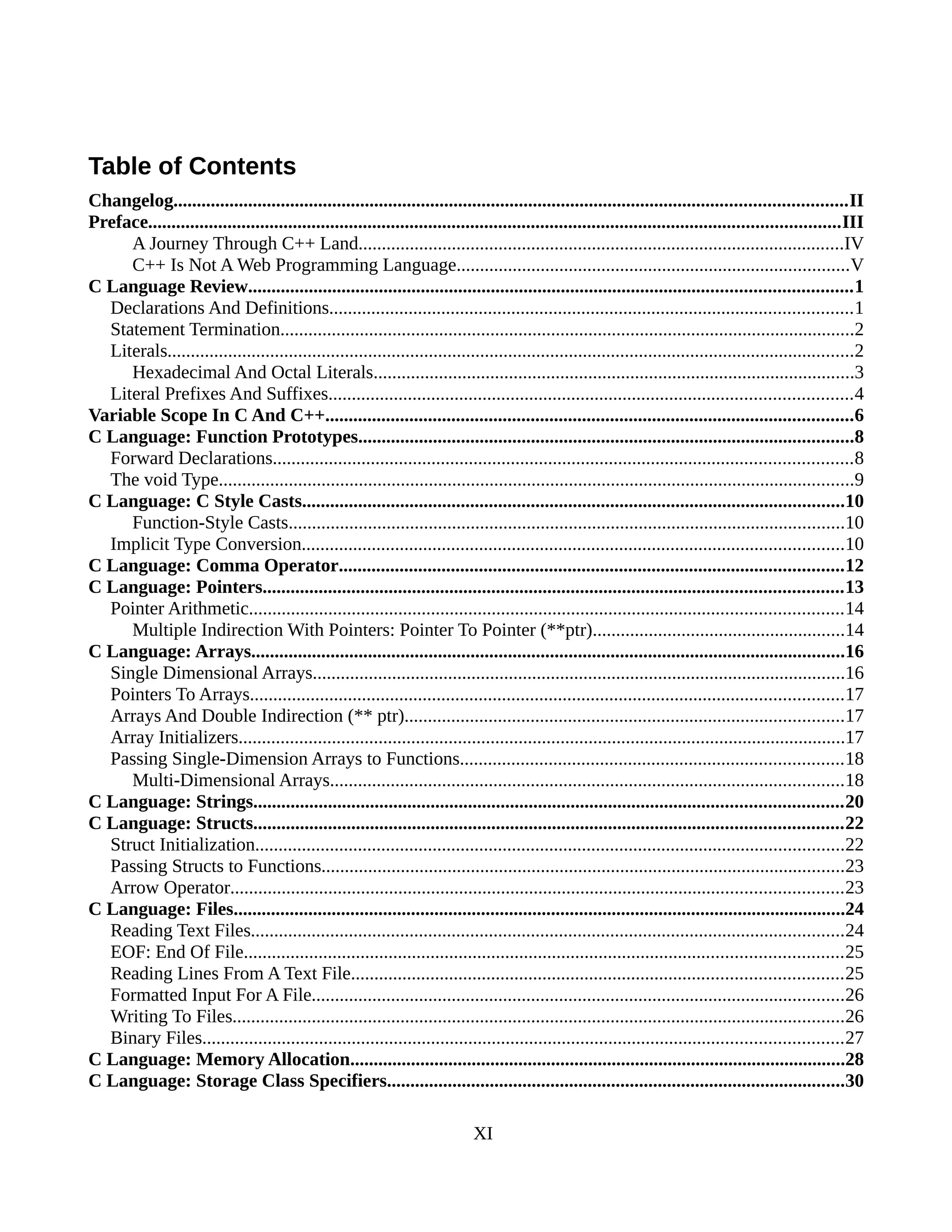
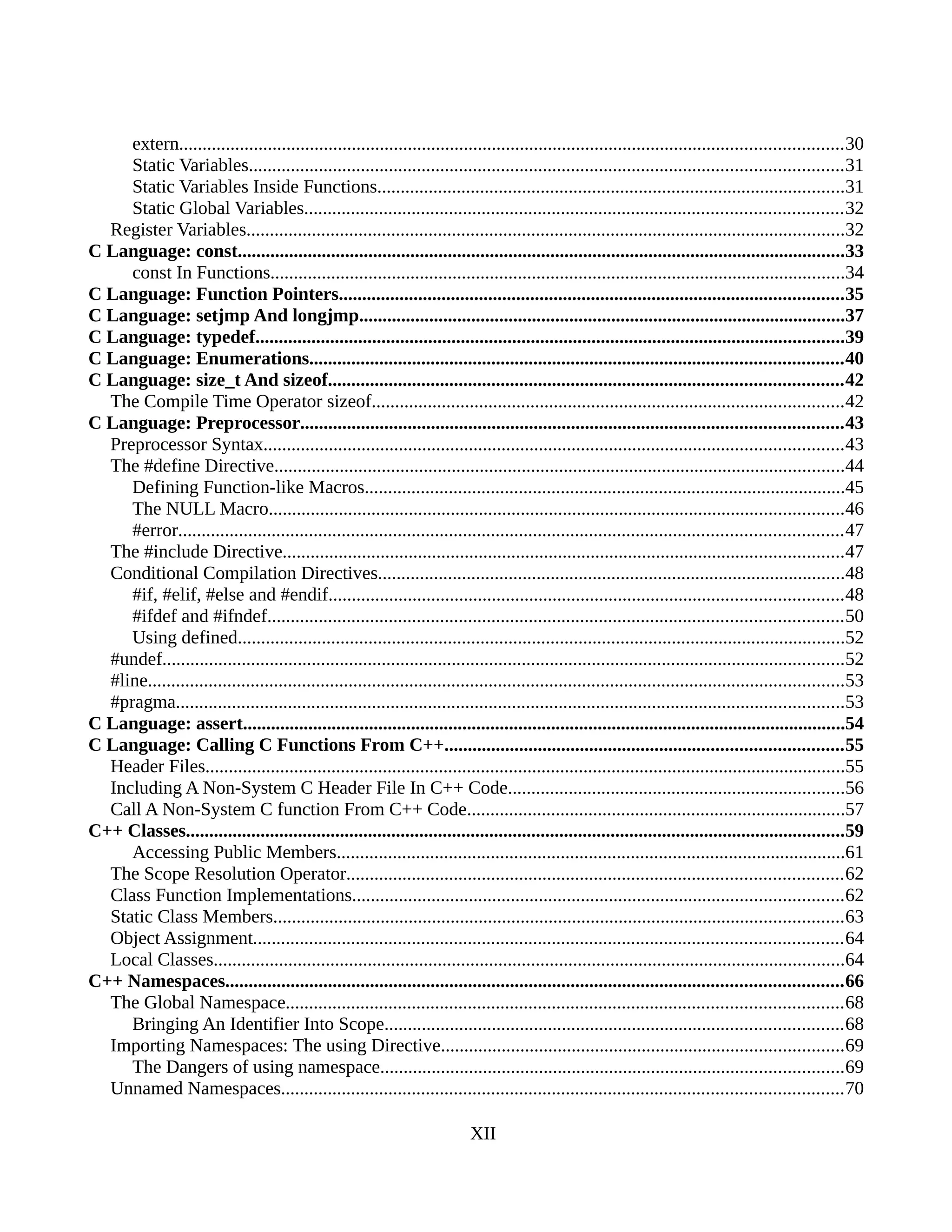
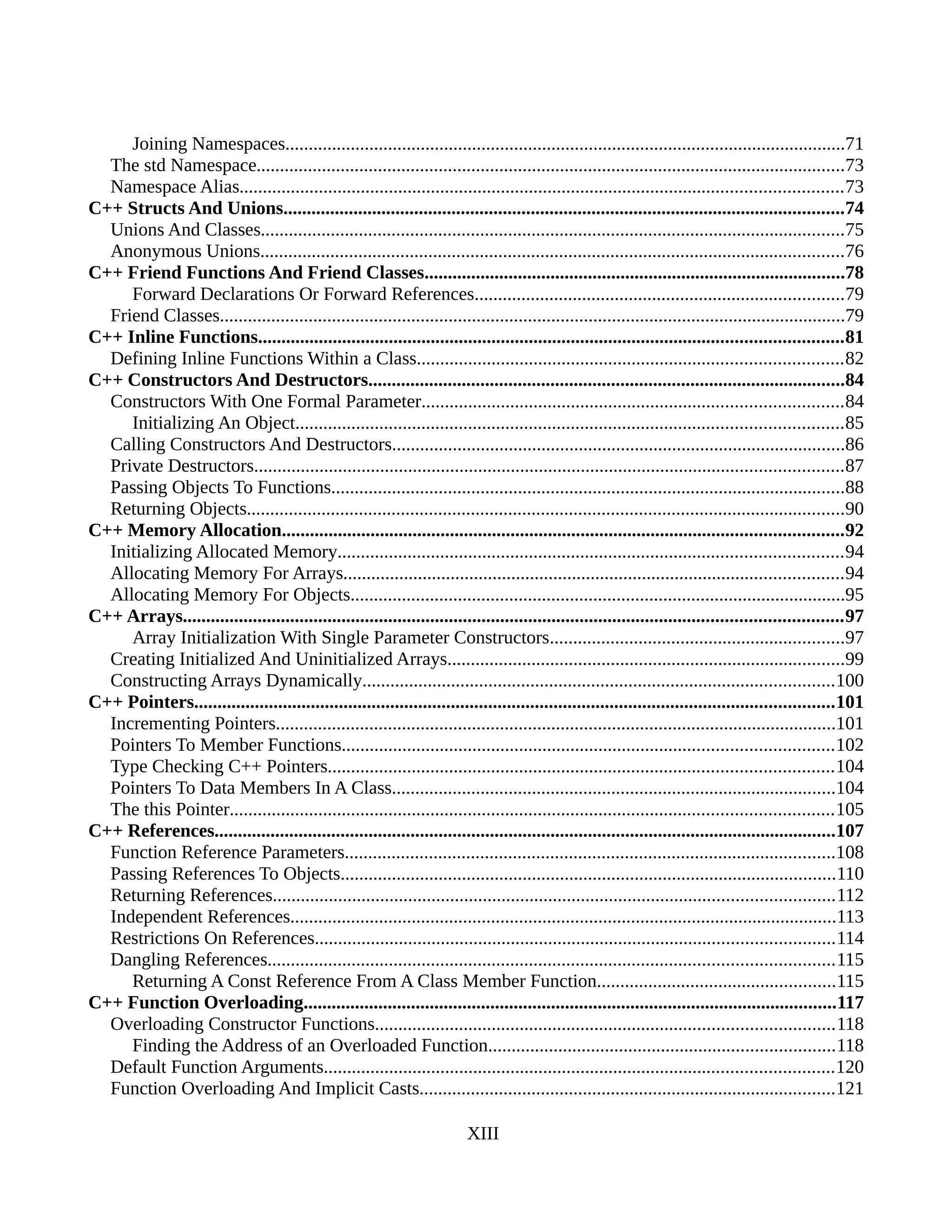
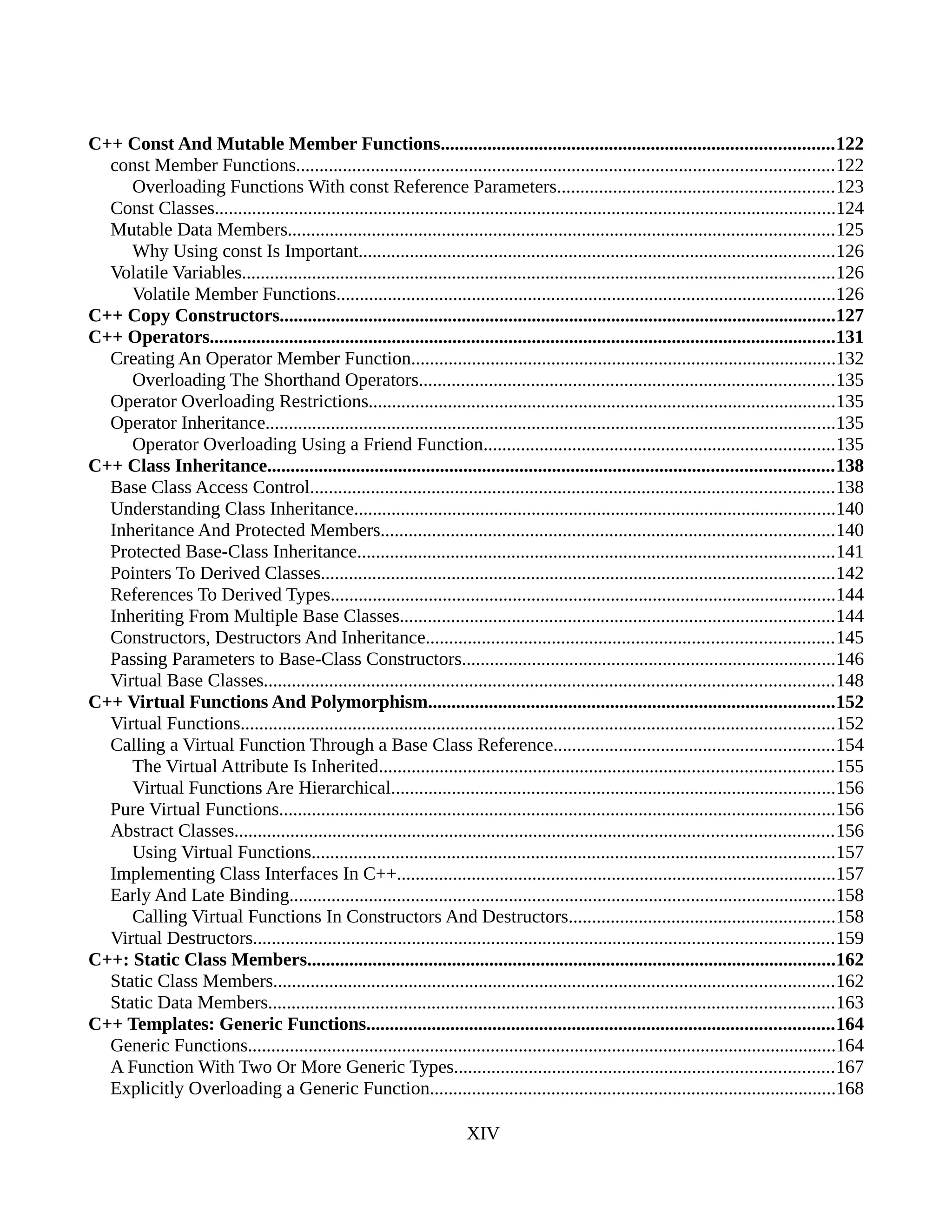
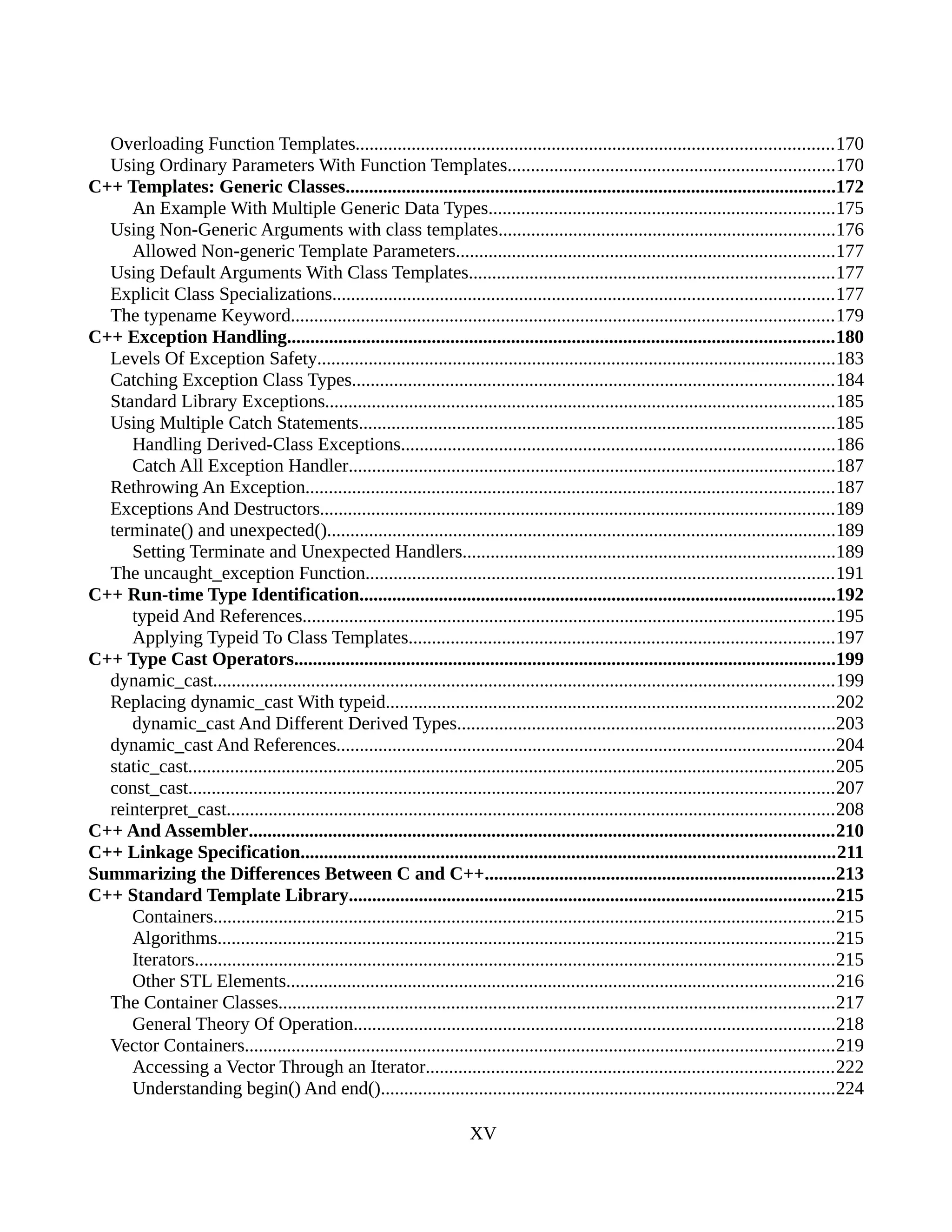
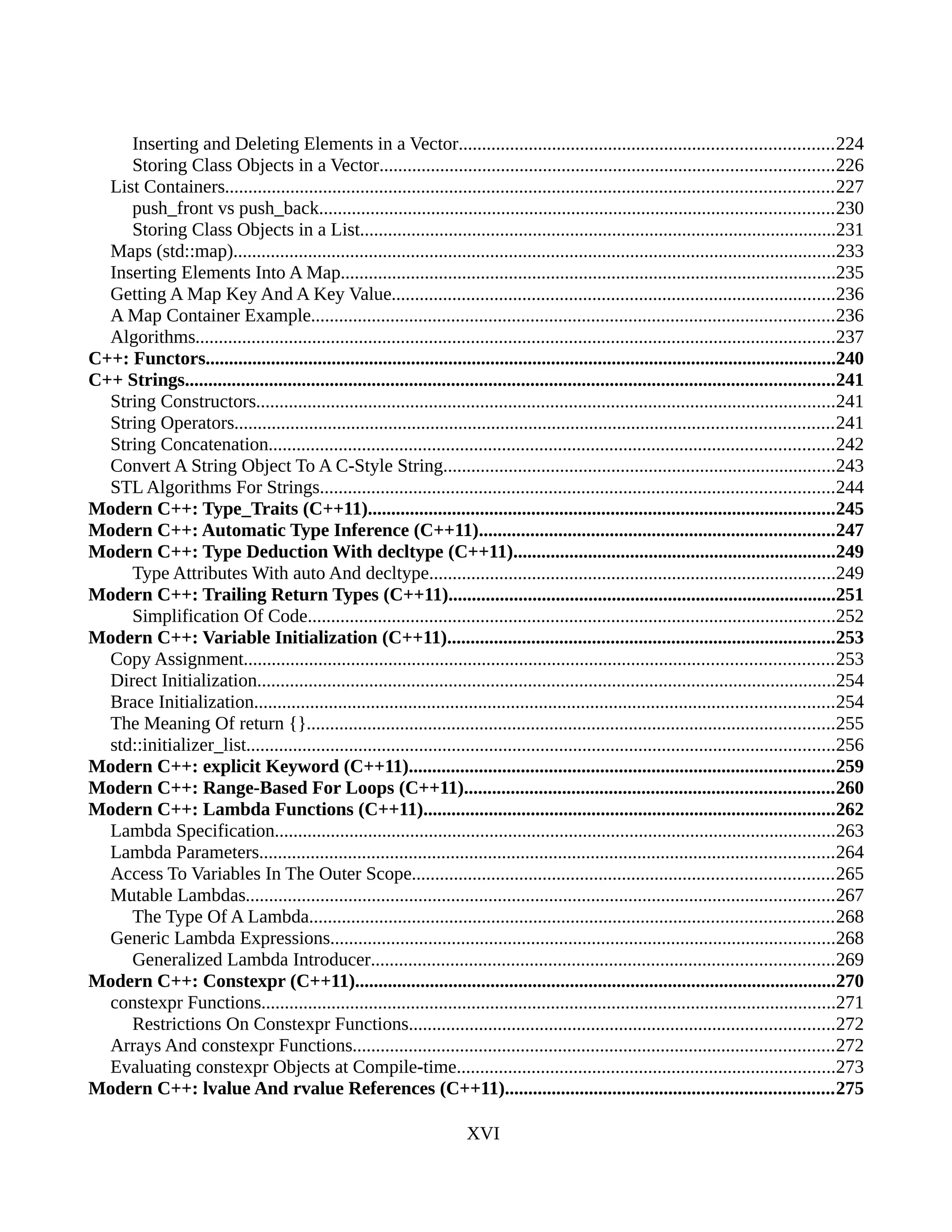
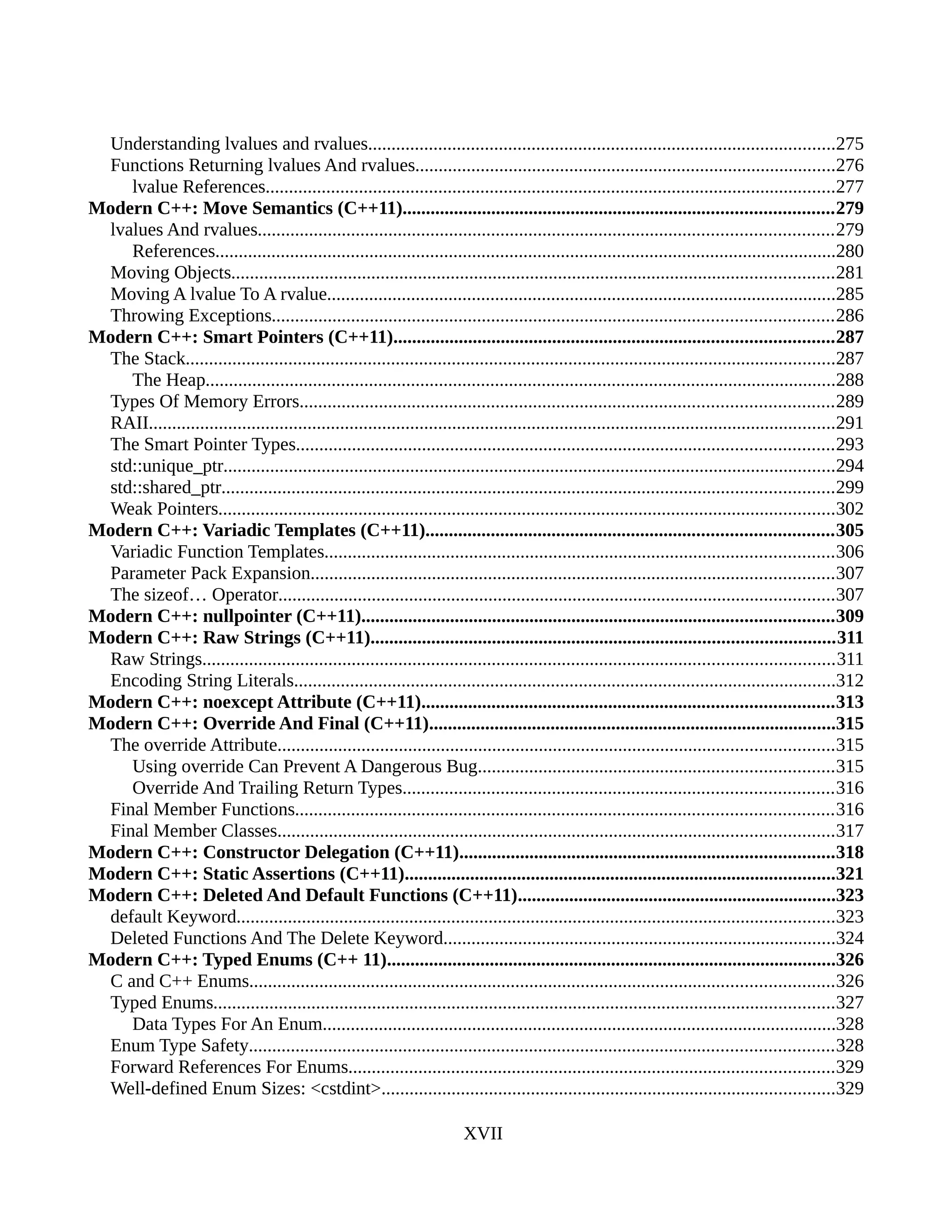
![Modern C++: Type Alias (C++11).......................................................................................................331
Typedef..............................................................................................................................................331
Type Alias Declarations With The using Keyword (using =)............................................................331
using And Templates.........................................................................................................................332
Modern C++: User Defined Literals (C++11)....................................................................................334
Restrictions On User Defined Types.................................................................................................335
Naming Rules For User Defined Literals..........................................................................................336
Modern C++: Template Constants (C++14)......................................................................................337
Modern C++: Return Type Deduction (C++14)................................................................................339
Return type deduction for functions..................................................................................................339
Modern C++: Generic Lambdas (C++14).........................................................................................340
Extended Capture In Lambdas..........................................................................................................340
Modern C++: Constexpr Template Constants (C++14)...................................................................343
Modern C++: Constexpr Functions (C++14)....................................................................................344
Modern C++: Digit Separator (C++14)..............................................................................................346
Modern C++: [[deprecated]] Attribute (C++14)...............................................................................347
Modern C++: Template Type Deduction (C++17)............................................................................348
Template Argument Type Deduction For Functions.........................................................................348
Template Type Deduction For Classes..............................................................................................349
Template Argument Deduction Guides.............................................................................................350
Modern C++: Non-Template Type Parameters (C++17)..................................................................351
Summary Of Non Template-Type Parameters...................................................................................351
Auto Non-Template Parameters........................................................................................................352
Modern C++: Nested Namespaces (C++17).......................................................................................353
Modern C++: Constexpr If Statements (C++17)...............................................................................354
Modern C++: Initialization Of Auto Types (C++17).........................................................................355
Modern C++: Structured Bindings (C++17).....................................................................................357
Using Structured Bindings................................................................................................................358
Structured Binding For Arrays.....................................................................................................359
Inheritance And Structured Bindings................................................................................................359
Modern C++: Initialization In If And Switch Statements (C++17).................................................360
Switch Statement With Initialization.................................................................................................361
Modern C++: Inline Variables (C++17).............................................................................................363
Using Inline Variables.......................................................................................................................364
Modern C++: Lambda Extensions (C++17)......................................................................................365
constexpr Lambdas............................................................................................................................365
Accessing The This Pointer In A Lambda.........................................................................................366
Modern C++: Type Includes The Exception Spec (C++17)..............................................................367
Modern C++: Empty Enum Initialization (C++17)..........................................................................369
Modern C++: Fold Expressions (C++17)...........................................................................................371
Using Fold Expressions.....................................................................................................................371
Handling Empty Parameter Packs.....................................................................................................372
Modern C++: string_view (C++17)....................................................................................................373
string_view And Scope......................................................................................................................374
A string_view Anti-Pattern...........................................................................................................376
XVIII](https://image.slidesharecdn.com/23604407-250513071845-400567f3/75/Modern-C-For-Software-Developers-Serious-C-Development-13-Karen-Singh-Garewal-23-2048.jpg)
![Modern C++: Initialization Of Aggregates (C++17).........................................................................377
Zero Initialization Of Aggregates.................................................................................................378
Modern C++: [[nodiscard]] Attribute (C++17).................................................................................380
Modern C++: [[maybe_unused]] Attribute (C++17)........................................................................382
Modern C++: __has_include Preprocessor Directive (C++17)........................................................383
Modern C++: The Spaceship Operator (C++20)..............................................................................384
Modern C++: consteval And constinit (C++20)................................................................................387
constinit Variables.............................................................................................................................388
constexpr try-catch Blocks................................................................................................................388
Modern C++: Initializers In Range-Based Loops (C++20)..............................................................391
Modern C++: Functions With auto Parameters (C++20)...............................................................392
Modern C++: Non-Parameter Types In Templates (C++20)...........................................................393
Modern C++: Virtual Constexpr Functions (C++20).......................................................................394
Modern C++: Concepts (C++20)........................................................................................................396
The Four Ways To Specify A Concept..............................................................................................397
The Requires Clause..........................................................................................................................398
Applying Concepts To The Return Type Of A Function...................................................................399
Using More Than One Concept.........................................................................................................399
Writing A Custom Concept...............................................................................................................399
Constrain auto With Concepts......................................................................................................402
Modern C++: Modules (C++20).........................................................................................................403
The Structure Of A Module File........................................................................................................404
Ways To Export Module Symbols.....................................................................................................405
Using Exported Module Symbols.....................................................................................................406
Module Interface Units And Module Implementation Units.............................................................406
Sub-modules......................................................................................................................................407
Module Partitions..............................................................................................................................408
A Note On Templates........................................................................................................................409
Linkage..............................................................................................................................................410
Header Units......................................................................................................................................410
Modern C++: Lambda Improvements (C++20)................................................................................411
Allow lambda-capture [=, this].....................................................................................................411
Modern C++: Designated Initialization (C++20)..............................................................................412
Modern C++: Using enum (C++20)....................................................................................................414
Modern C++: Conversion From ptr To bool (C++20)......................................................................415
Modern C++: boolalpha (C++20).......................................................................................................416
Modern C++: [[no_unique_address]] (C++20)..................................................................................417
Modern C++: [[likely]] and [[unlikely]] (C++20)..............................................................................418
Modern C++: Coroutines (C++20).....................................................................................................419
Introduction.......................................................................................................................................419
Why Is co_return Used Instead Of return?........................................................................................420
Coroutine Return Objects..................................................................................................................420
Instantiating A Coroutine...................................................................................................................422
Returning From A Coroutine.............................................................................................................423
Returning A Value From A Coroutine...............................................................................................424
XIX](https://image.slidesharecdn.com/23604407-250513071845-400567f3/75/Modern-C-For-Software-Developers-Serious-C-Development-13-Karen-Singh-Garewal-24-2048.jpg)
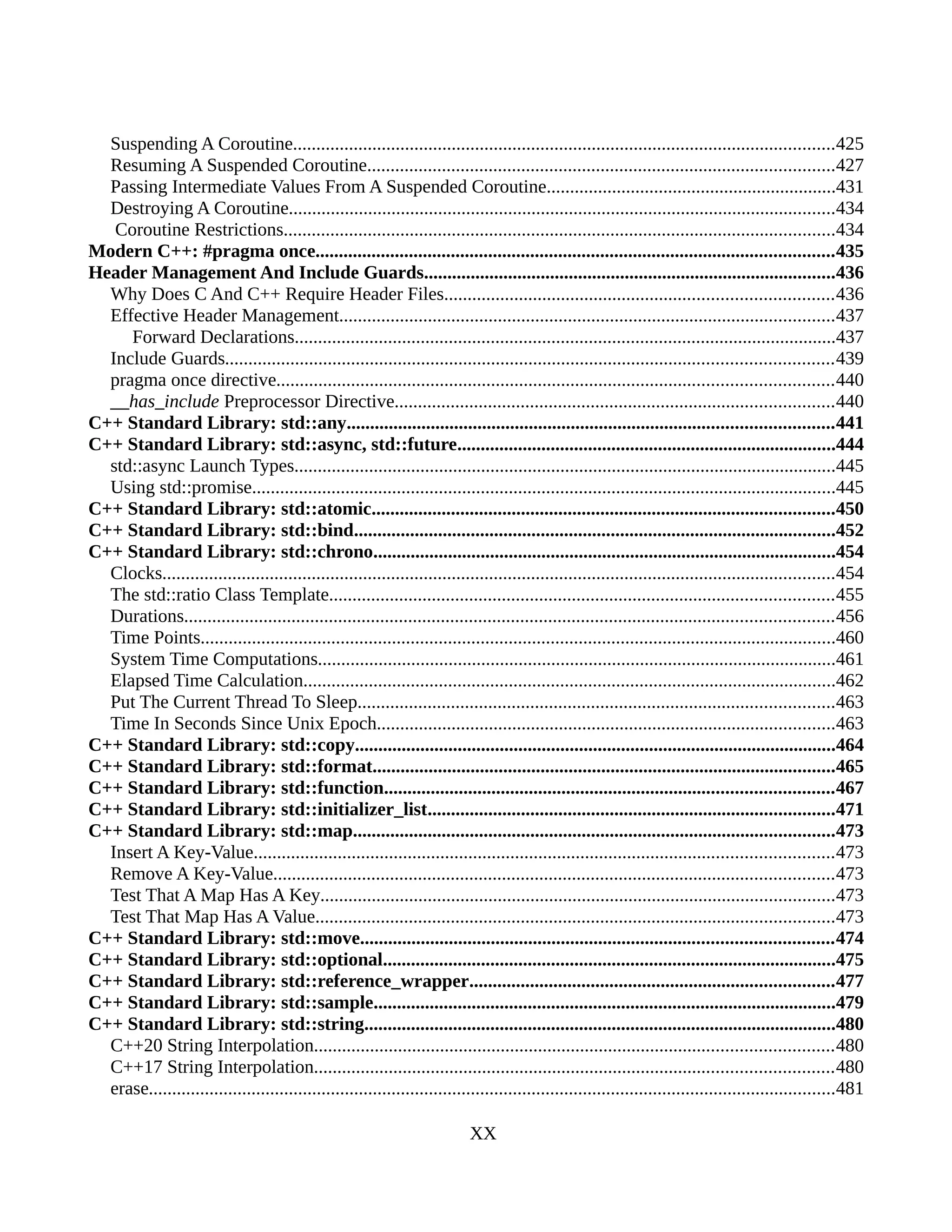
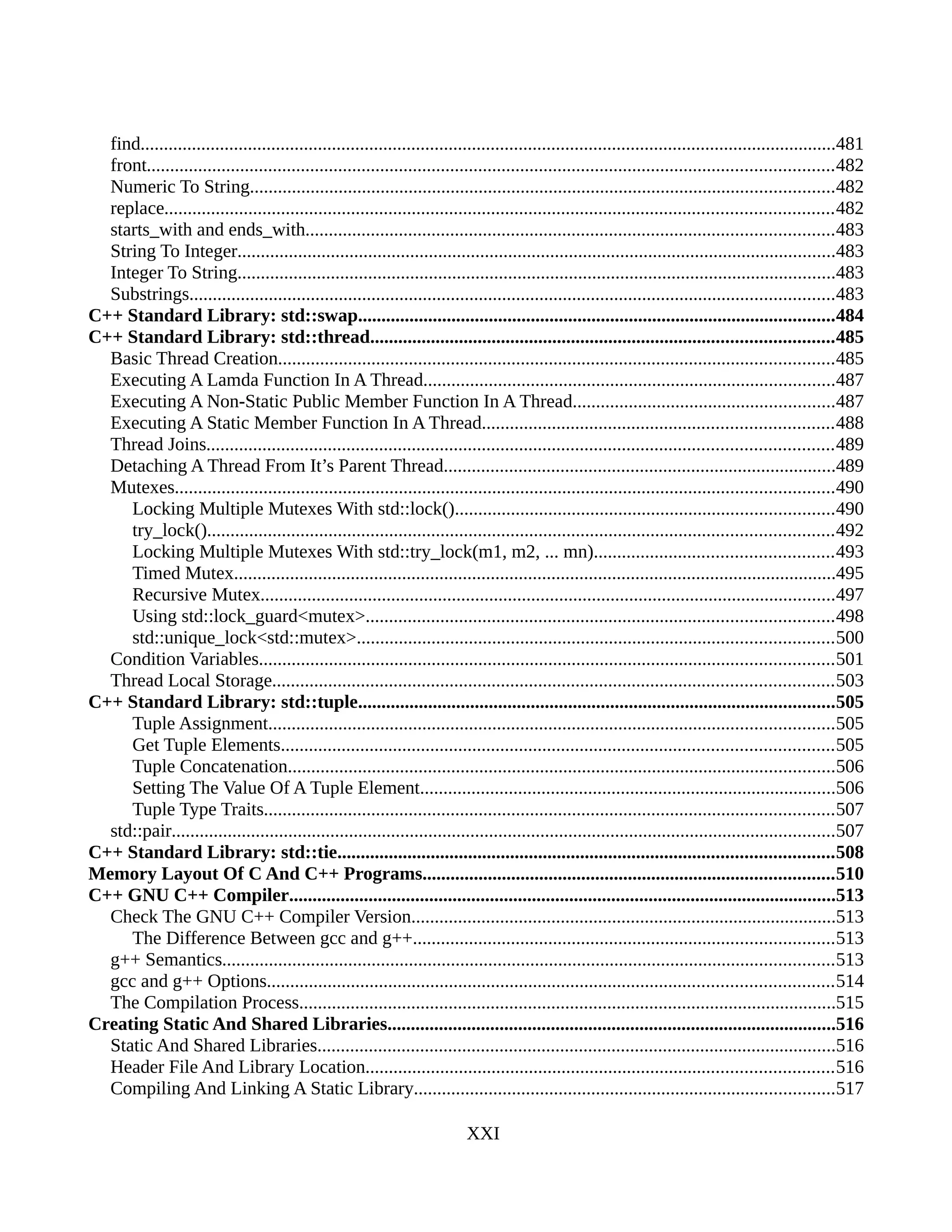
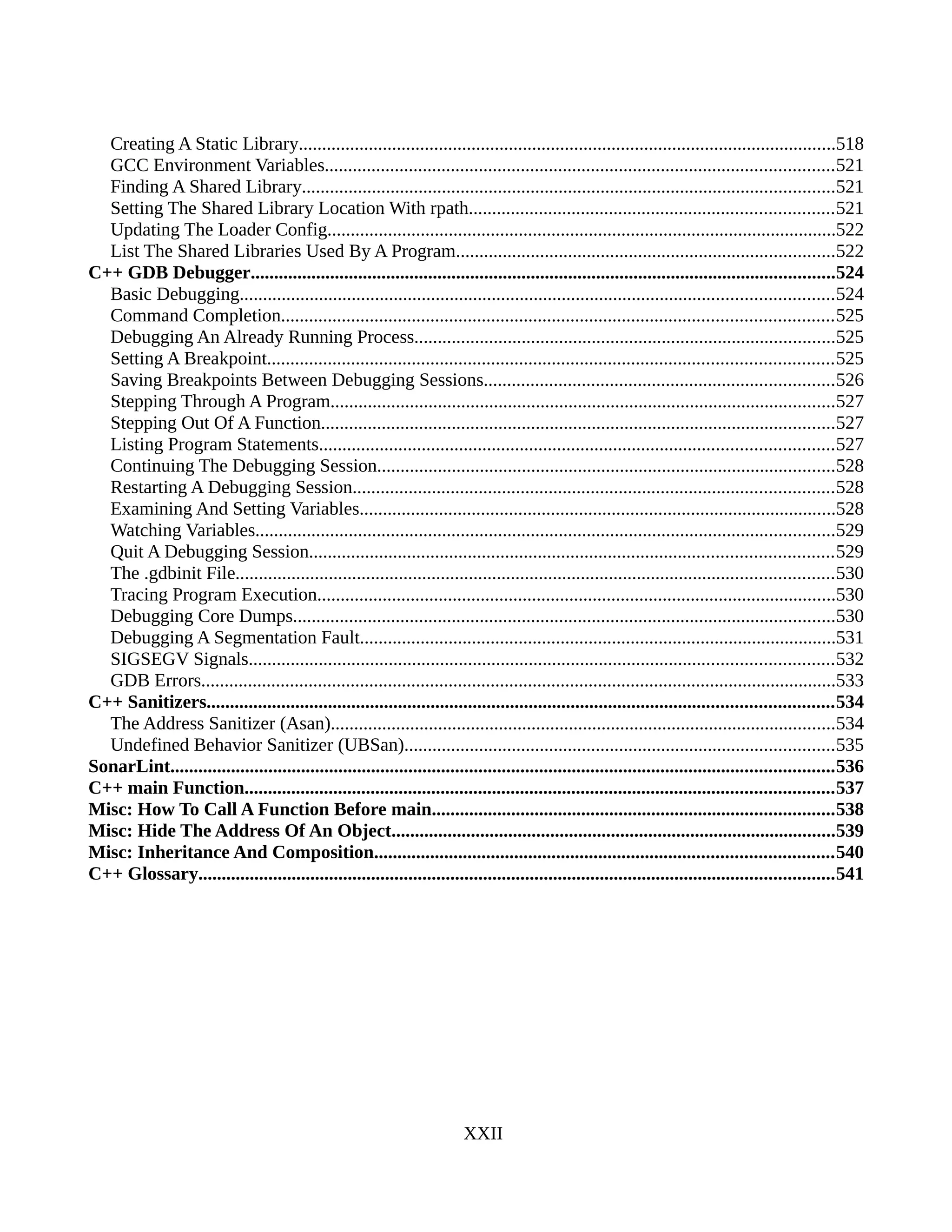
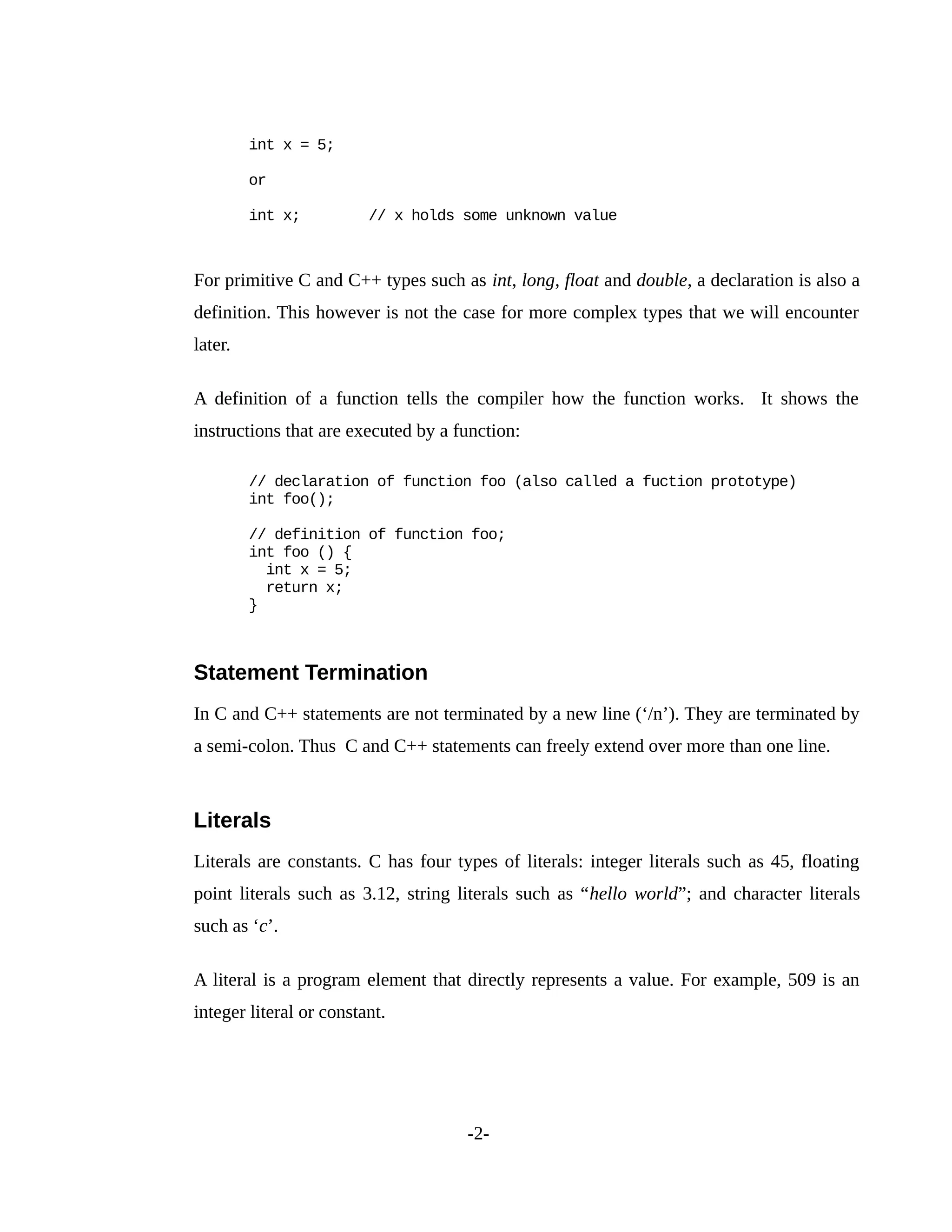
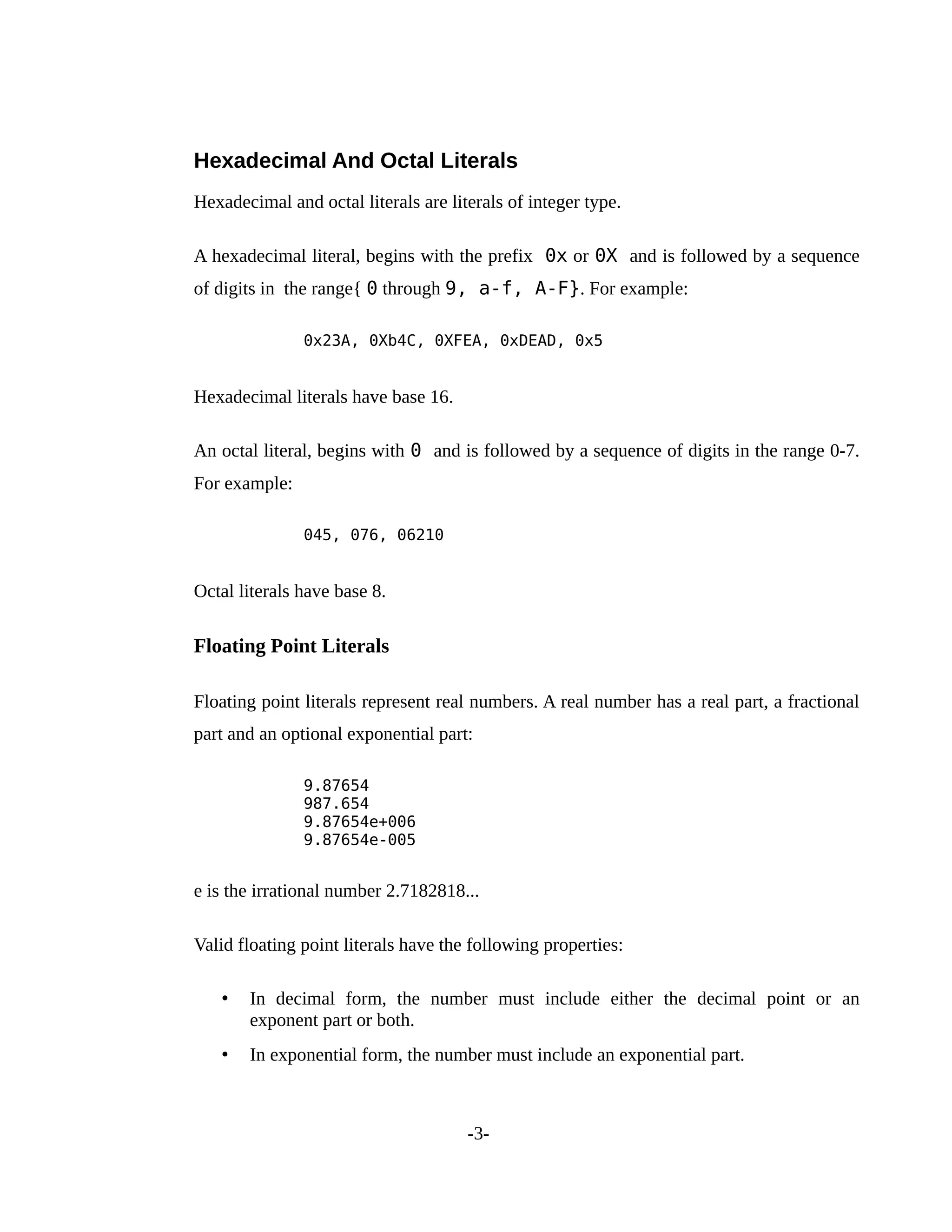
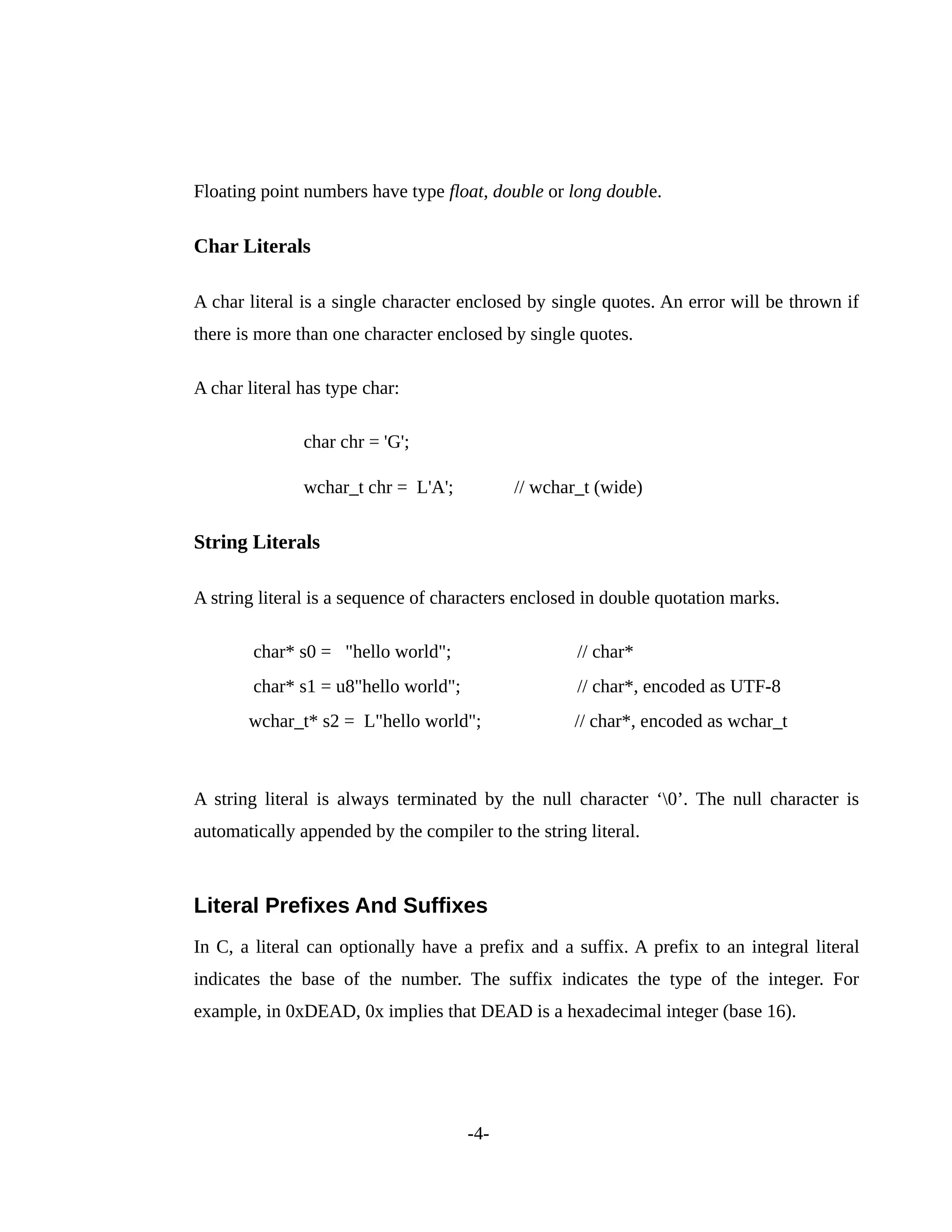
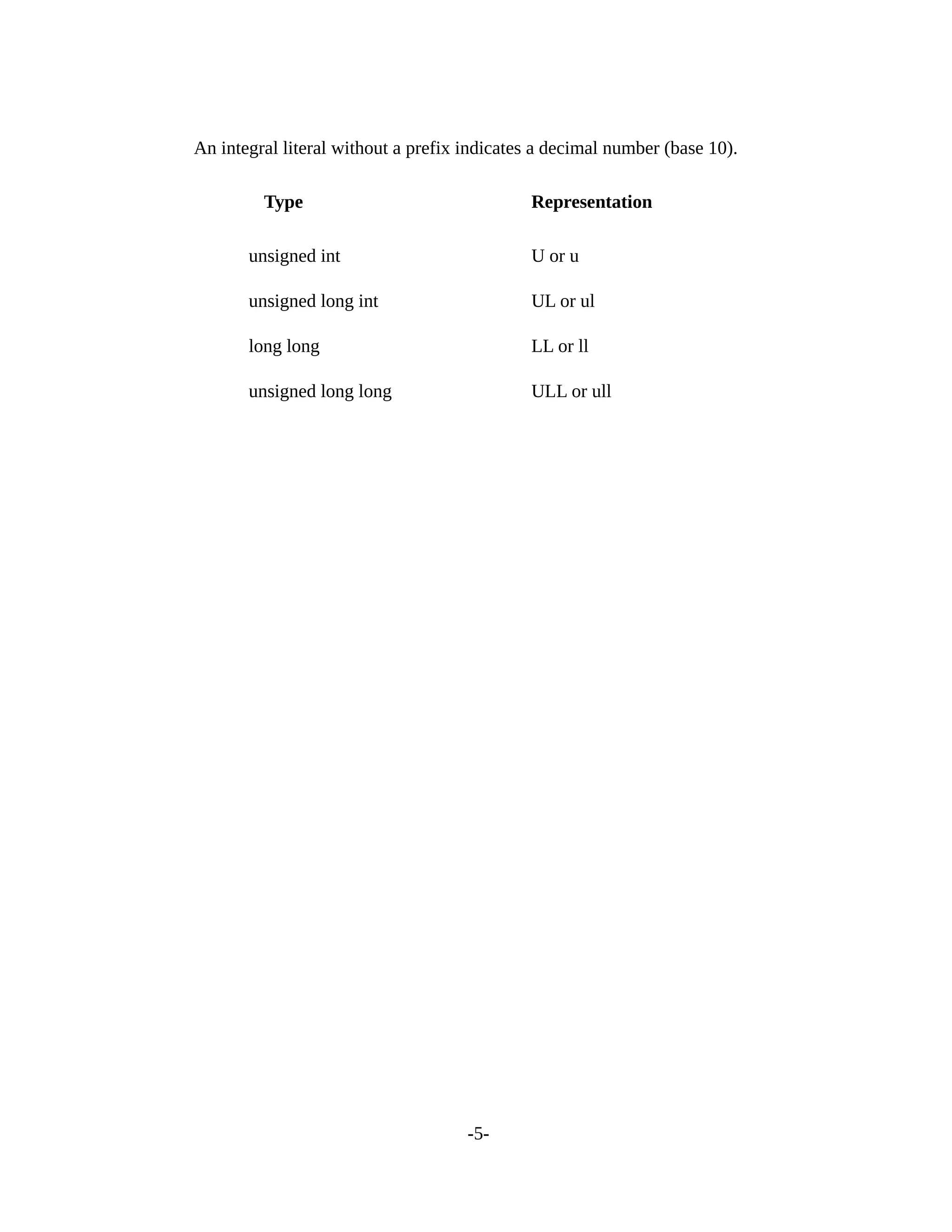
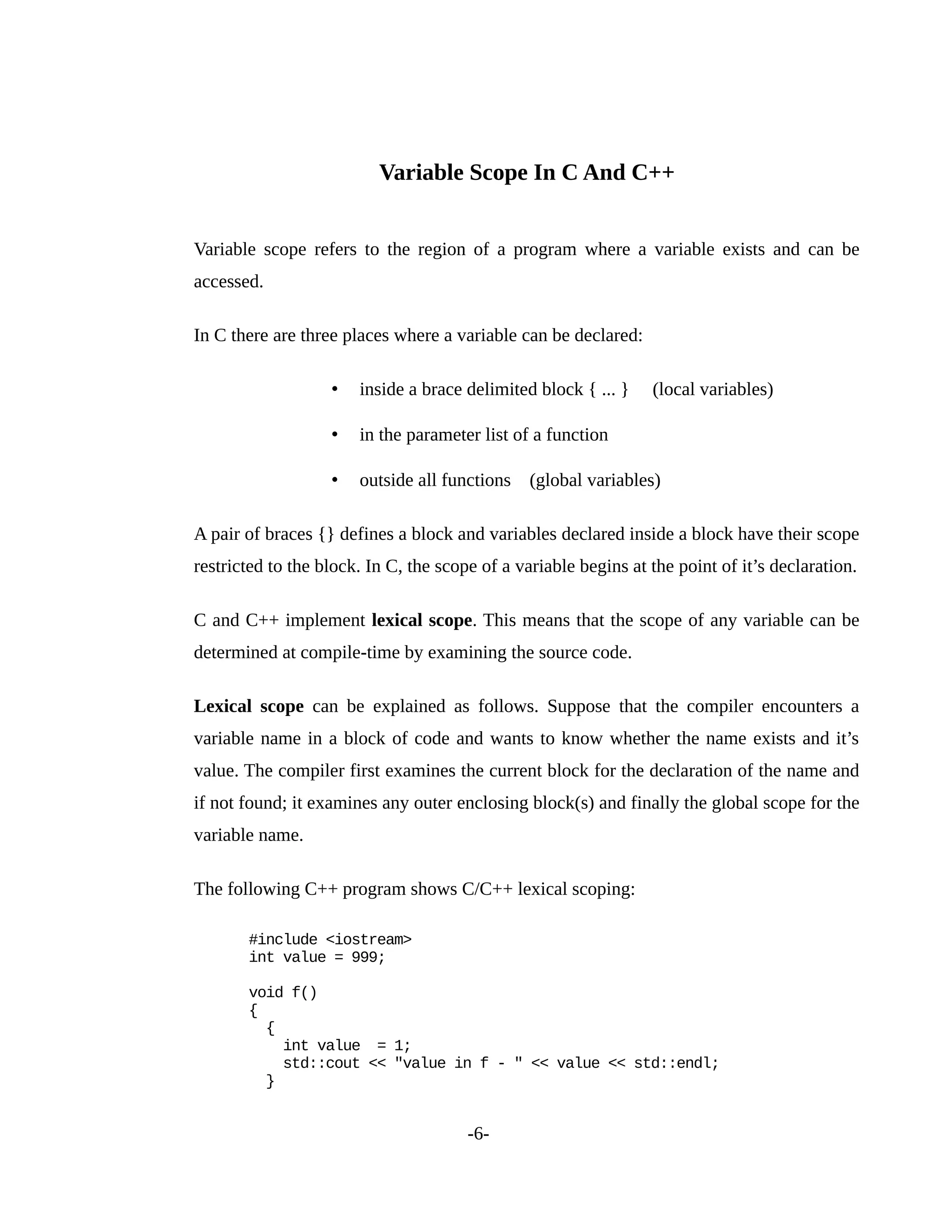
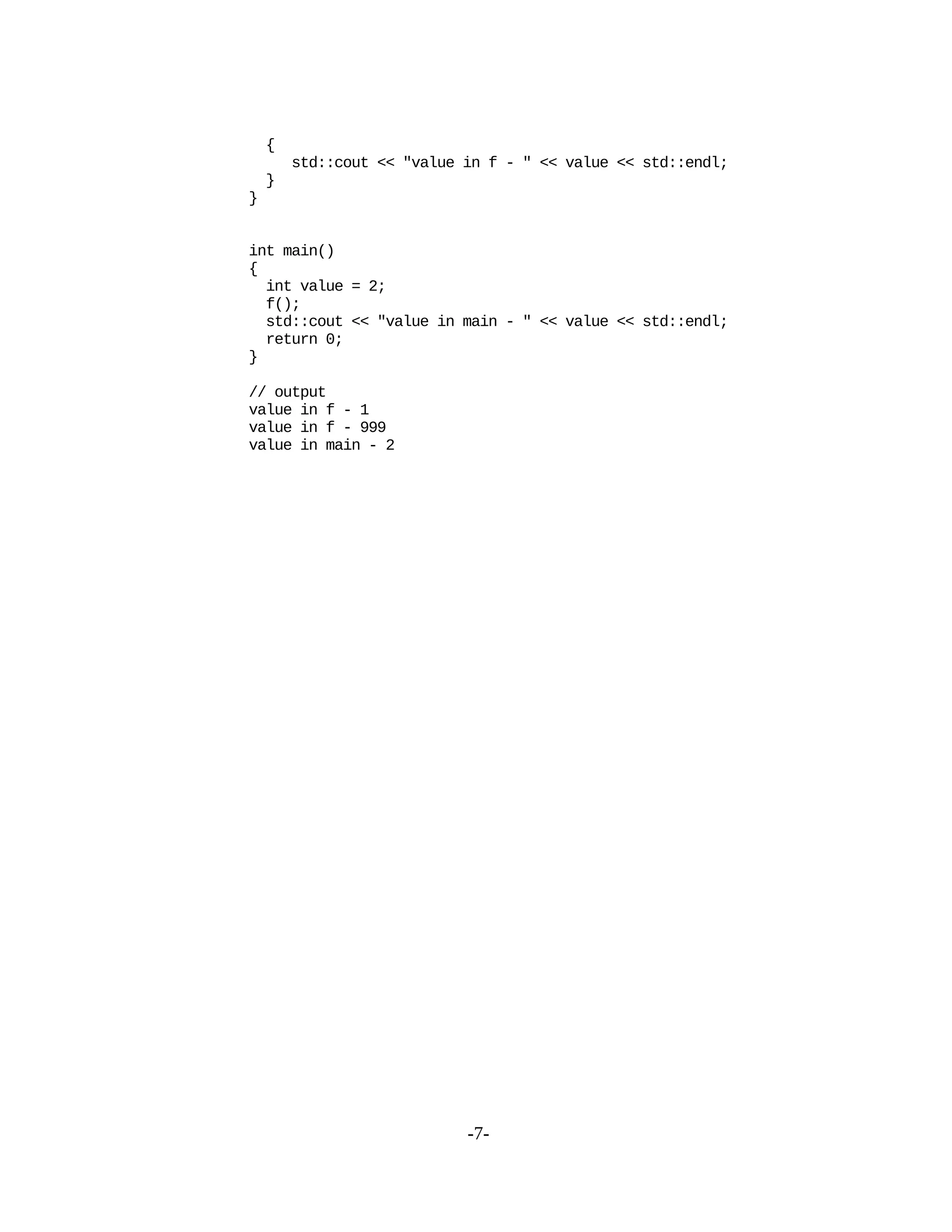
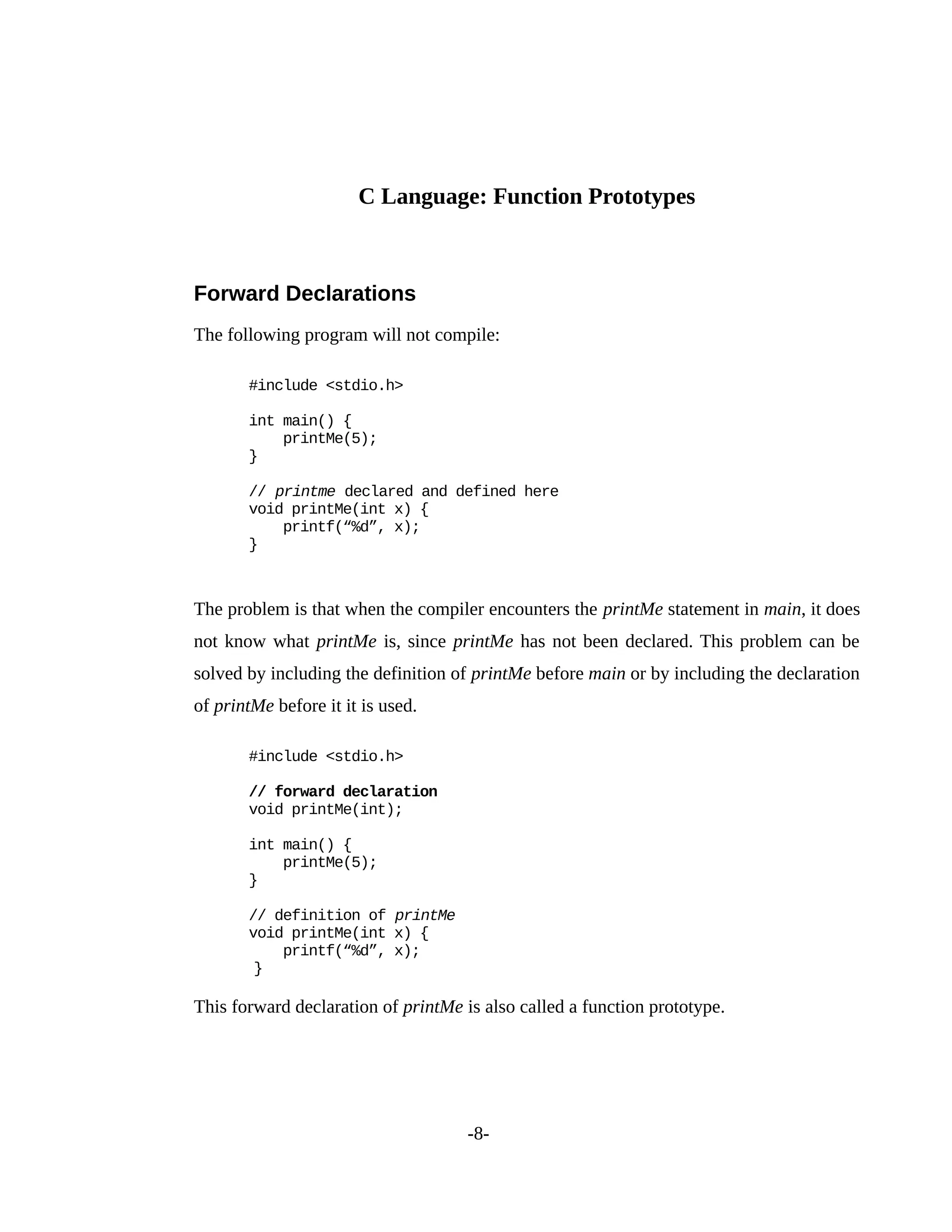
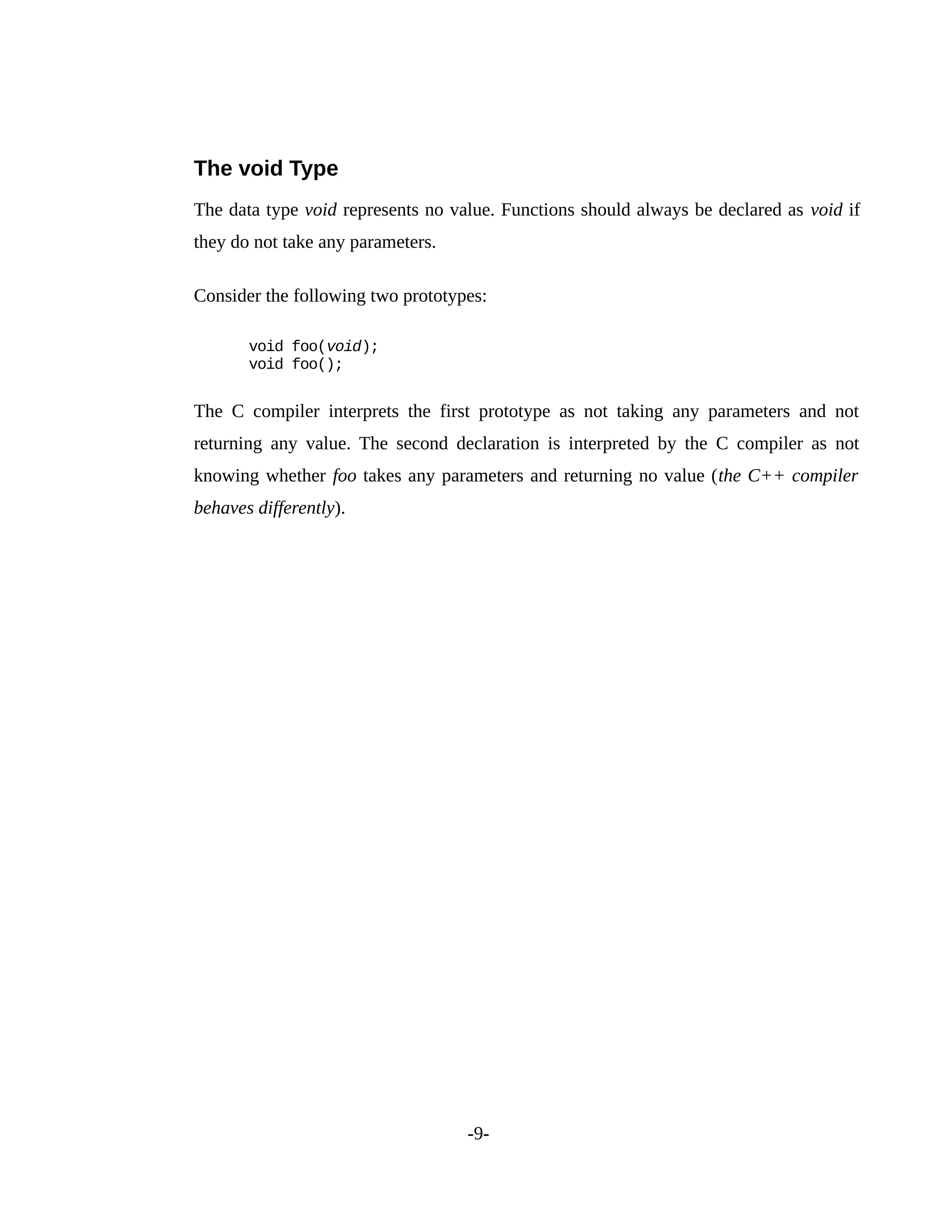
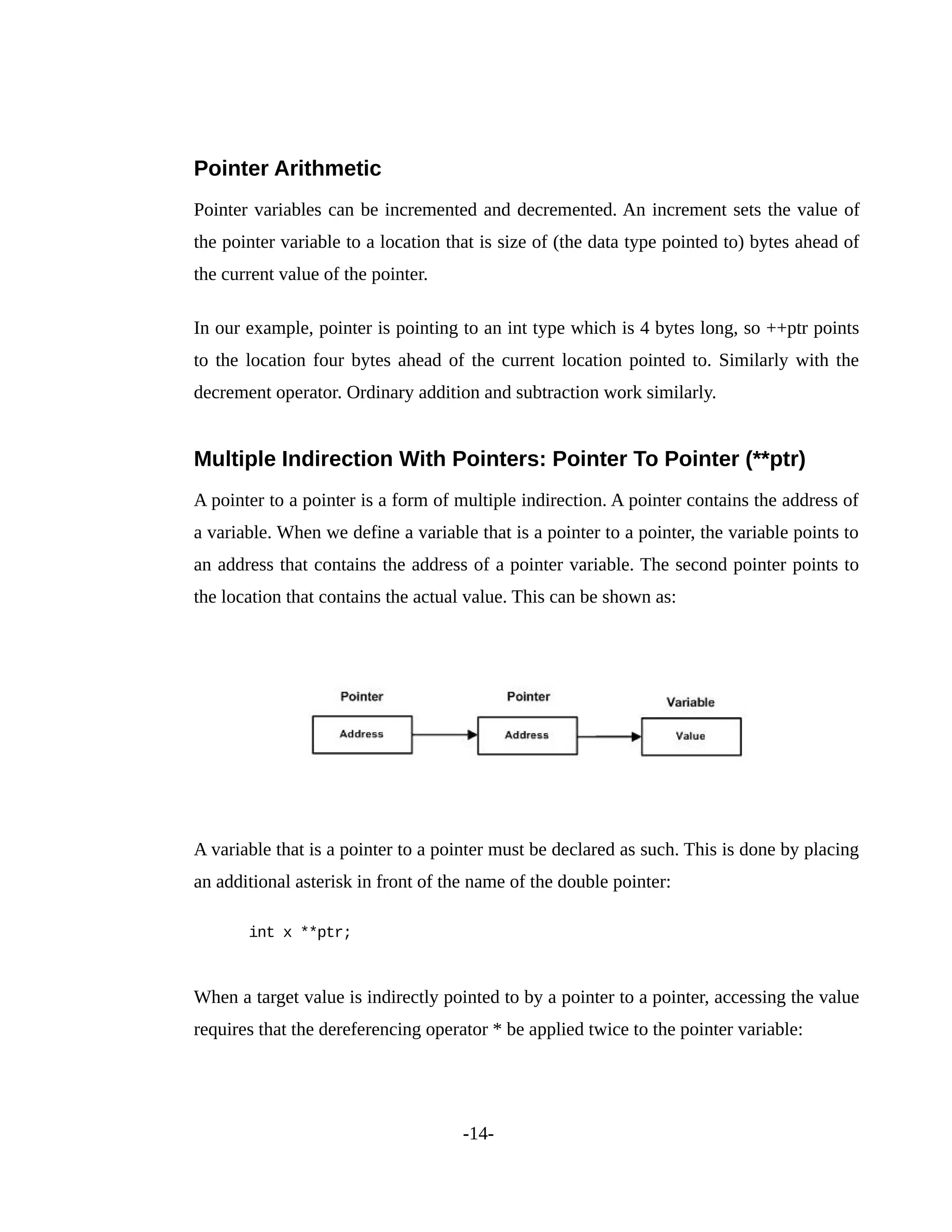
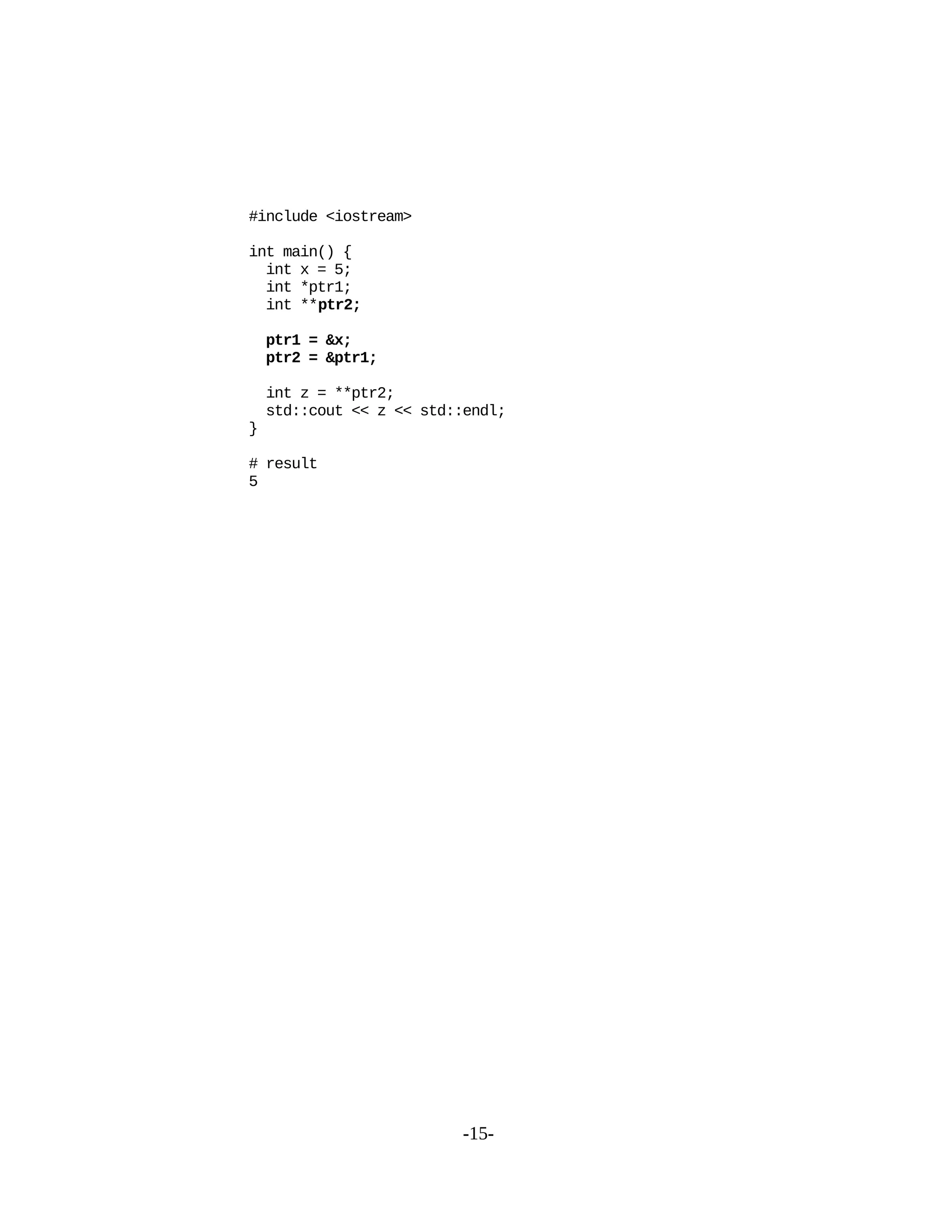
![C Language: Arrays
An array is a collection of variables of the same type that are referenced through a
common name. A specific element in an array is accessed through an index. In C and C+
+, arrays consist of contiguous memory locations. The lowest address corresponds to the
first element of the array and the highest address to the last element. Arrays may have
from one to several dimensions. The most common array is the null-terminated string,
which is simply a sequence of characters enclosed in quotation marks terminated by a
null character (‘0’).
Single Dimensional Arrays
These types of arrays are specified with the following syntax:
type name[size];
Here, type declares the type of the array, which is the type of each element of the array,
and size defines the number of elements that the array will hold. Arrays must be
explicitly declared so that the compiler can allocate space for them in memory. Here is
an example:
int flowers[5];
Array elements are accessed with the bracket operator ([]) and an index value which
starts at zero and ranges up to but not including the size of the array. The index 0 refers
to the first element of the array:
int p = flowers[0];
int p = flowers[2]; // third array element
-16-](https://image.slidesharecdn.com/23604407-250513071845-400567f3/75/Modern-C-For-Software-Developers-Serious-C-Development-13-Karen-Singh-Garewal-43-2048.jpg)
![C and C++ do not perform bounds-checking on arrays.
Pointers To Arrays
In C as well as C++, the name of an array is defined to be a pointer to the first element of
the array:
int *p;
int sample[10];
p = sample;
We can also define a pointer to the first element with:
p = &sample[0];
Arrays And Double Indirection (** ptr)
Consider an array where each element of the array is a null terminated string:
char* names[10];
names[0] = “hello”;
...
names[9] = “world”;
char* ptr = names;
ptr is a pointer to the names array. ptr = names and ptr = &names[0] are equivalent.
However names[0] is itself a pointer to a null terminated string. Thus *ptr is a pointer to
a null terminated string. Thus the first string in the array is **ptr.
Due to this, char **ptr is a pointer to an array of null terminated strings. **(ptr+1)
points to the second null terminated string.
Array Initializers
In C++ we can initialize an array as follows:
-17-](https://image.slidesharecdn.com/23604407-250513071845-400567f3/75/Modern-C-For-Software-Developers-Serious-C-Development-13-Karen-Singh-Garewal-44-2048.jpg)
![int array[5] = {1, 2, 3, 4, 5};
We can have fewer initializers than the length of the array, in which case, the remaining
array elements will be initialized to the ‘zero’ of the type of the array.
Passing Single-Dimension Arrays to Functions
In C and C++, we cannot pass an entire array as an argument to a function. We can,
however, pass a pointer to the array by specifying the array's name without an index.
int main(void)
{
int sample[10];
func(sample);
}
An array name (without an index) is a pointer to the first element of the array.
The formal parameter of a function that receives an array can be declared as a pointer to
the array’s data type or as a sized or unsized array. For example:
func (int *p)
func (int m[10]);
func(int m[])
All of the above are equivalent. The array size can be any value; for example, func(int
m[100000]) is also valid. An array parameter in a function parameter list is syntactic
sugar since only a pointer to an array is received by the function. The programmer is
responsible to ensure that a buffer overrun does not occur.
Multi-Dimensional Arrays
A multi-dimensional array can be specified with the following syntax:
int m[6][8]; // two dimensional array of integers
char s[7][3][5]; // three dimensional array of chars
-18-](https://image.slidesharecdn.com/23604407-250513071845-400567f3/75/Modern-C-For-Software-Developers-Serious-C-Development-13-Karen-Singh-Garewal-45-2048.jpg)

![C Language: Strings
C an C++ implement null-terminated strings. A string is a null-terminated character array
(a null is ASCII 0 and is represented as ‘0’). Thus a C-style null-terminated string is an
array of characters that has a null character as it’s last array element. Here is an example:
“hello world”
The C compiler will automatically append a null character to the end of this string literal.
A sequence of characters enclosed in double quotation marks is interpreted as a constant
character string by the C compiler. A constant string cannot be changed.
char* str = “hello world”;
*str = ‘z’; // error – attempt to change ‘h’ to ‘z’
When declaring a character array that will hold a null-terminated string, we must declare
it to be one character longer than the largest string that it can hold. The extra character is
for the null character (‘0’).
The following string declarations are all equivalent:
char *str = “hello world”;
char str[12] = “hello world”;
char str[] = “hello world”;
If we use an array declaration (instead of a string literal) then the string is mutable:
char* str[] = “hello world”;
str[0] = ‘z’; // OK
str without the array notation points to the first character of the string.
-20-](https://image.slidesharecdn.com/23604407-250513071845-400567f3/75/Modern-C-For-Software-Developers-Serious-C-Development-13-Karen-Singh-Garewal-47-2048.jpg)
![We can get the length of a string with:
strlen(str);
We can copy a string with:
char* source = “hello world”;
char dest[12];
strcpy(dest, source);
n characters can be copied with:
strncpy(dest, source, n);
-21-](https://image.slidesharecdn.com/23604407-250513071845-400567f3/75/Modern-C-For-Software-Developers-Serious-C-Development-13-Karen-Singh-Garewal-48-2048.jpg)
![C Language: Structs
In C, a struct is a container data type that can hold data of different types. A struct is
declared as follows:
struct employee {
char name[];
int employee_no;
float salary;
};
This declaration creates a new type called struct employee (not just employee). We can
instantiate instances of this data type as follows:
struct employee alice_smith;
Members of alice_smith can be accessed with the dot operator:
char* name = alice_smith.name;
float slr = alice_smith.salary;
Struct Initialization
A struct can be initialized at the time that it is declared as follows:
struct employee emp = {“alice_smith”, 1200, 10000.25};
All of the fields of the struct do not have to be initialized. Missing initializers are set to
the zero of the field’s type.
There is a problem with this initialization. If we subsequently change the order of the
fields of the struct then the initialization will become invalid. We can avoid this problem
-22-](https://image.slidesharecdn.com/23604407-250513071845-400567f3/75/Modern-C-For-Software-Developers-Serious-C-Development-13-Karen-Singh-Garewal-49-2048.jpg)
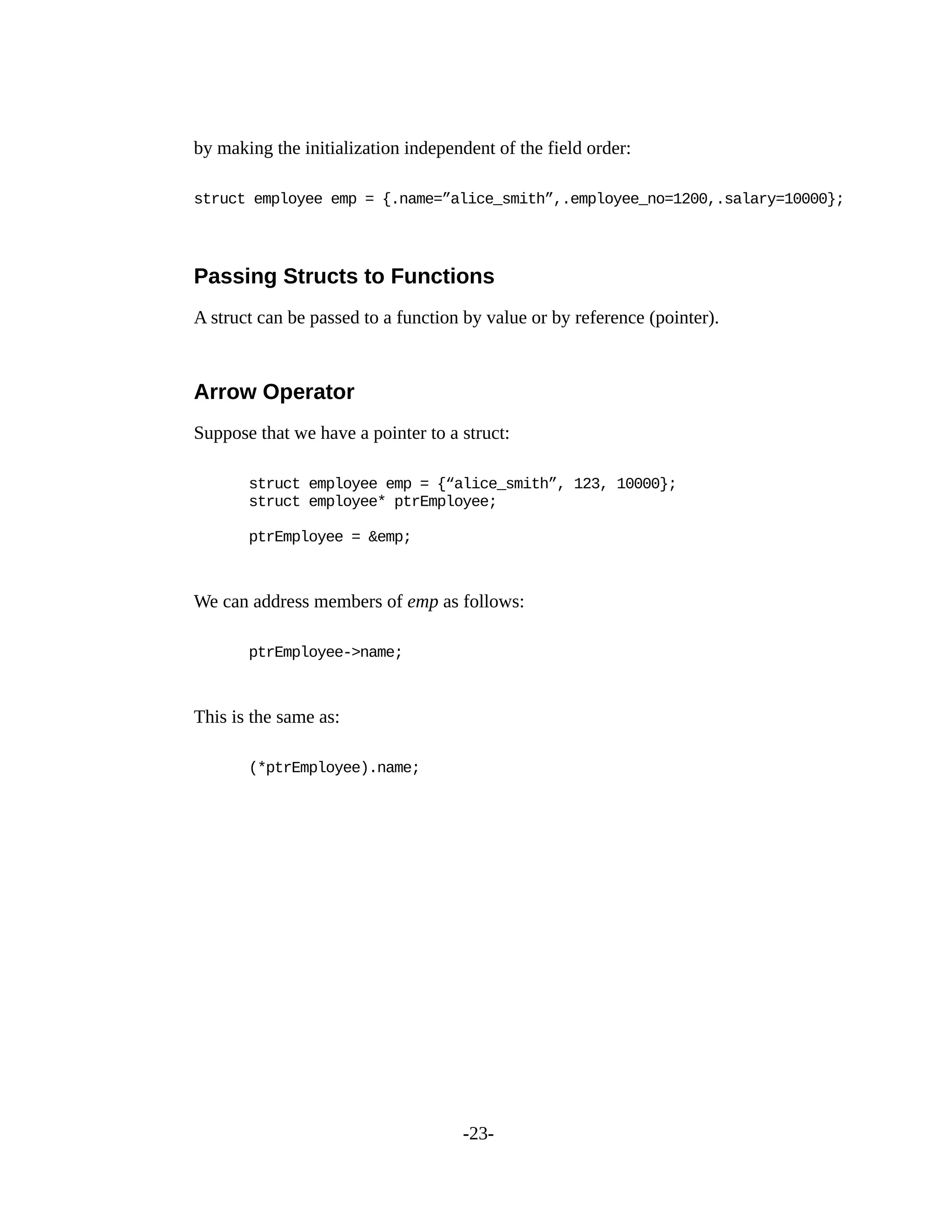
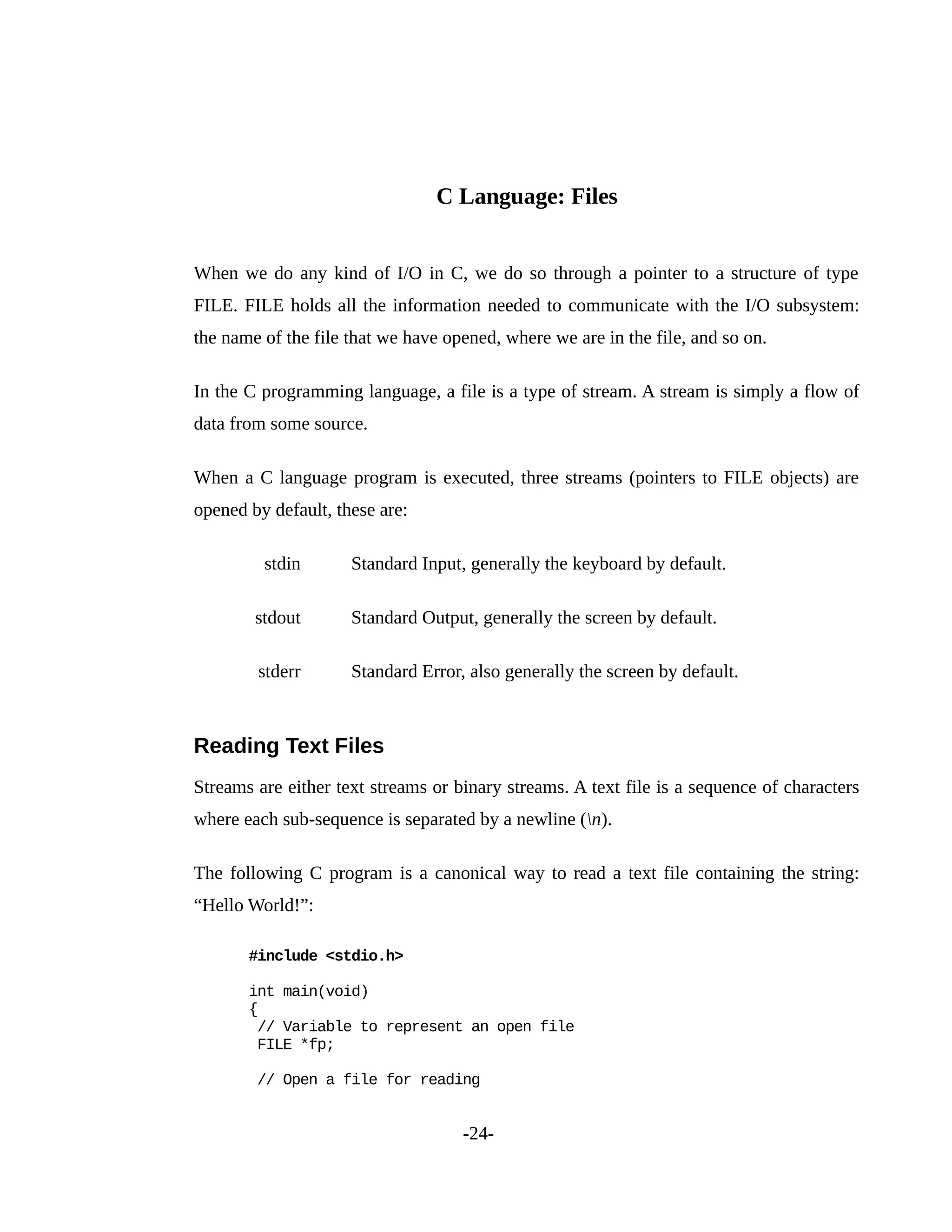
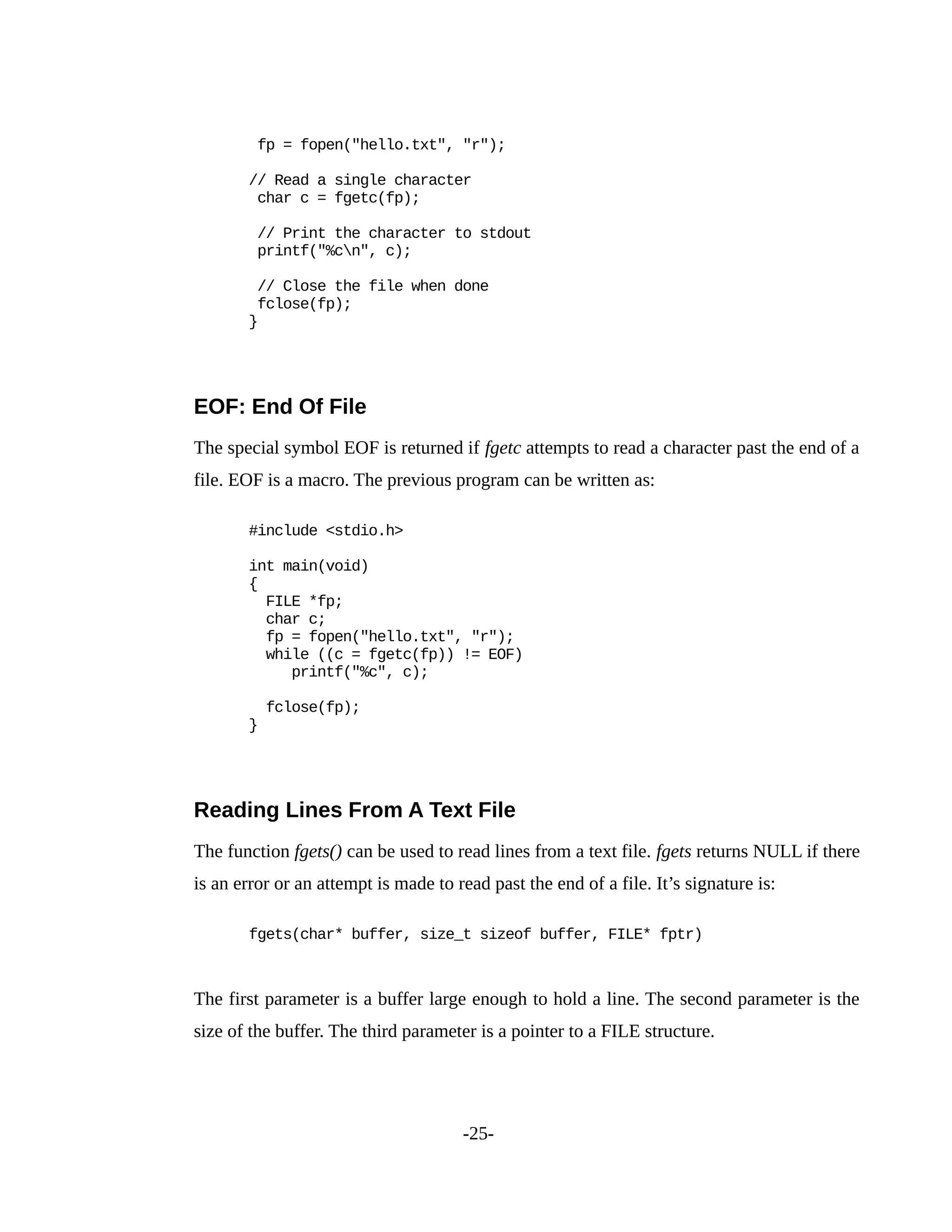
![Formatted Input For A File
The function fscanf reads data from a text file and puts the data into variables. The data
elements in the file must be separated by white space. fscanf returns EOF if there is an
error or an attempt is made to read past the end of the file. Here is an example:
#include <stdio.h>
int main(void)
{
FILE *fp;
char name[1024];
float length;
int mass;
fp = fopen("animals.txt", "r");
while (fscanf(fp, "%s %f %d", name, &length, &mass) != EOF)
printf("%s animal, %d lbs, %.1f metersn", name, mass, length);
fclose(fp);
}
Writing To Files
We open a file for writing with fopen(“filename”, “w”). If the file already exists, it is
truncated to length 0.
The file read functions fgetc, fgets and fscanf have file write analogues: fputc, fputs and
fprintf. We use these functions as follows:
#include <stdio.h>
int main(void)
{
FILE *fp;
int x = 32;
fp = fopen("output.txt", "w");
fputc('B', fp);
fputc('n', fp);
fprintf(fp, "x = %dn", x)
fputs("Hello, world!n", fp);
-26-](https://image.slidesharecdn.com/23604407-250513071845-400567f3/75/Modern-C-For-Software-Developers-Serious-C-Development-13-Karen-Singh-Garewal-53-2048.jpg)