EVOLUTION
OF MOBILE
WALLETS…
-Rohit
Namboodiri
WHAT IS A MOBILE WALLET?
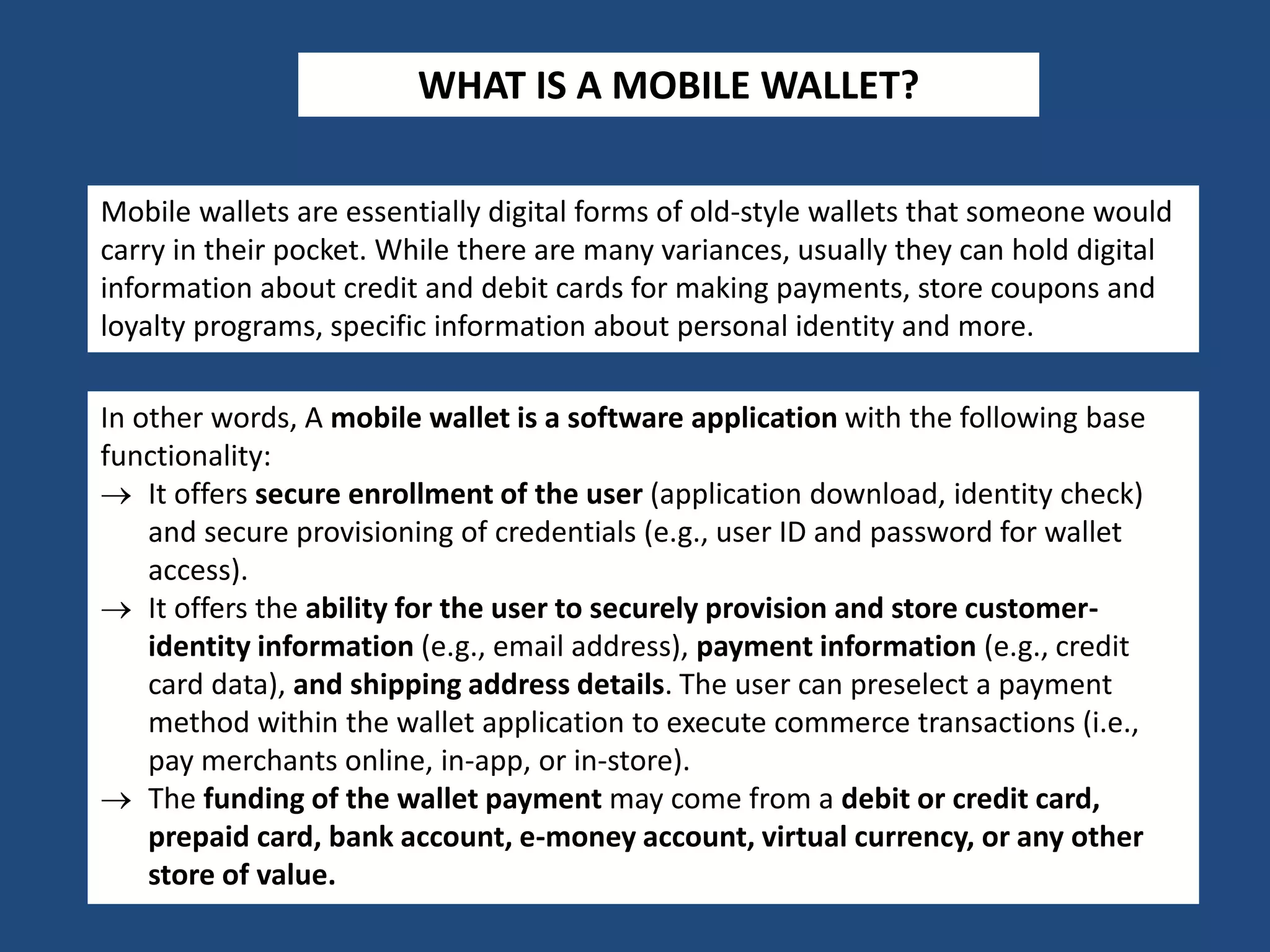
Mobile wallets are essentially digital forms of old-style wallets that someone would
carry in their pocket. While there are many variances, usually they can hold digital
information about credit and debit cards for making payments, store coupons and
loyalty programs, specific information about personal identity and more.
In other words, A mobile wallet is a software application with the following base
functionality:
 It offers secure enrollment of the user (application download, identity check)
and secure provisioning of credentials (e.g., user ID and password for wallet
access).
 It offers the ability for the user to securely provision and store customer-
identity information (e.g., email address), payment information (e.g., credit
card data), and shipping address details. The user can preselect a payment
method within the wallet application to execute commerce transactions (i.e.,
pay merchants online, in-app, or in-store).
 The funding of the wallet payment may come from a debit or credit card,
prepaid card, bank account, e-money account, virtual currency, or any other
store of value.
MOBILE WALLETS IN INDIA
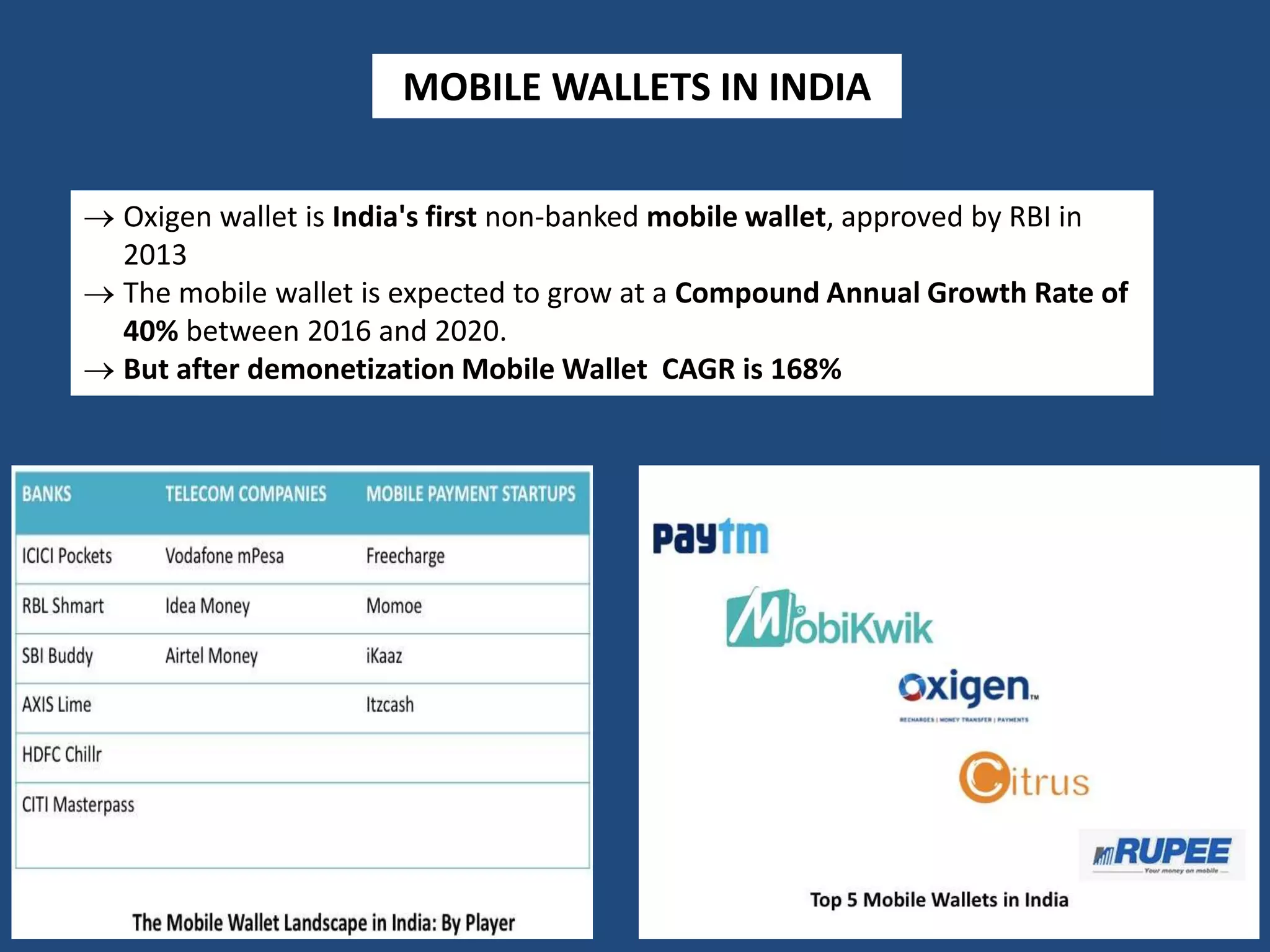
 Oxigen wallet is India's first non-banked mobile wallet, approved by RBI in
2013
 The mobile wallet is expected to grow at a Compound Annual Growth Rate of
40% between 2016 and 2020.
 But after demonetization Mobile Wallet CAGR is 168%
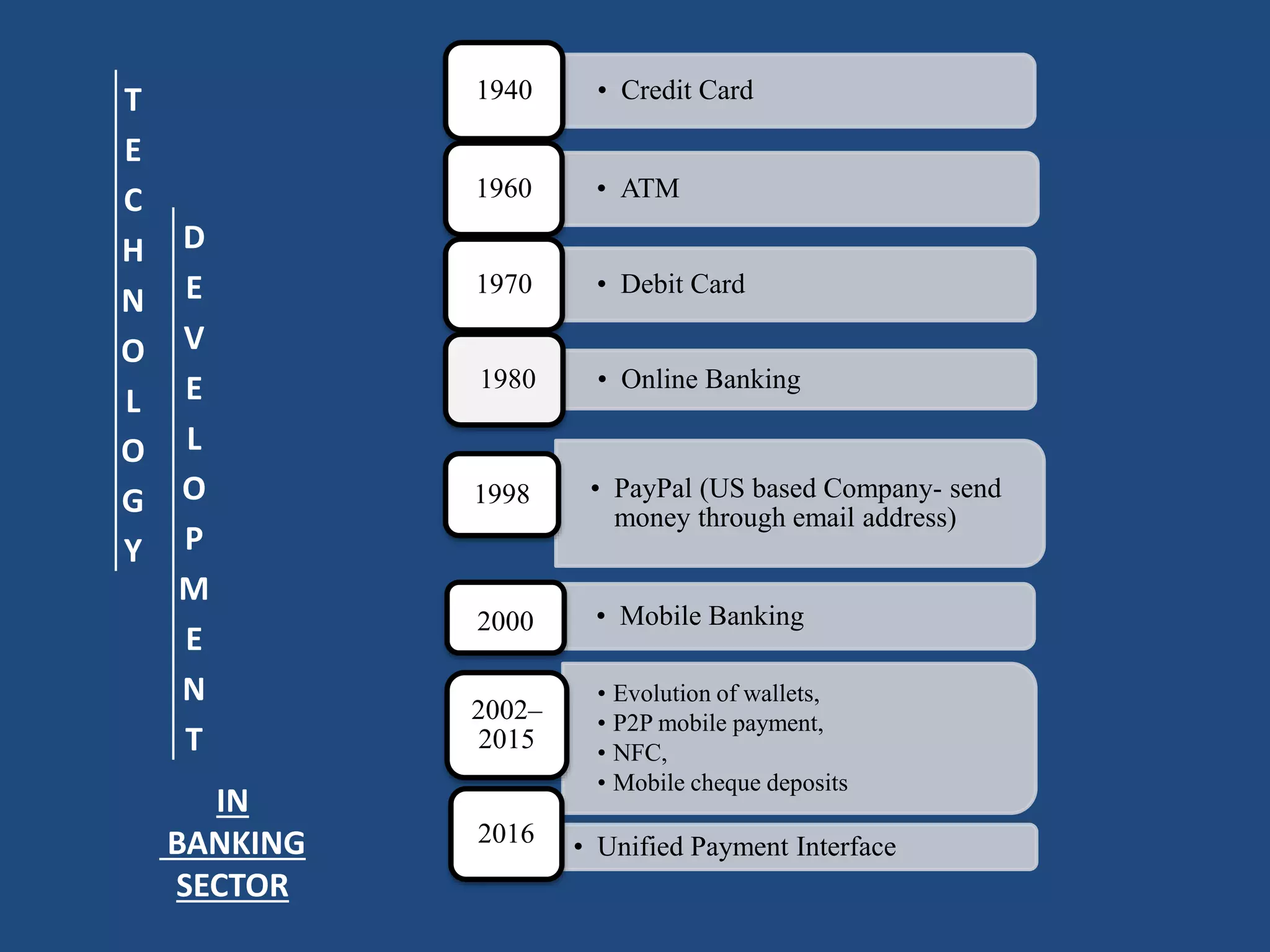
• Credit Card1940
• ATM1960
• Debit Card1970
• Online Banking1980
• PayPal (US based Company- send
money through email address)
1998
• Mobile Banking2000
• Evolution of wallets,
• P2P mobile payment,
• NFC,
• Mobile cheque deposits
2002–
2015
• Unified Payment Interface2016
T
E
C
H
N
O
L
O
G
Y
D
E
V
E
L
O
P
M
E
N
T
IN
BANKING
SECTOR
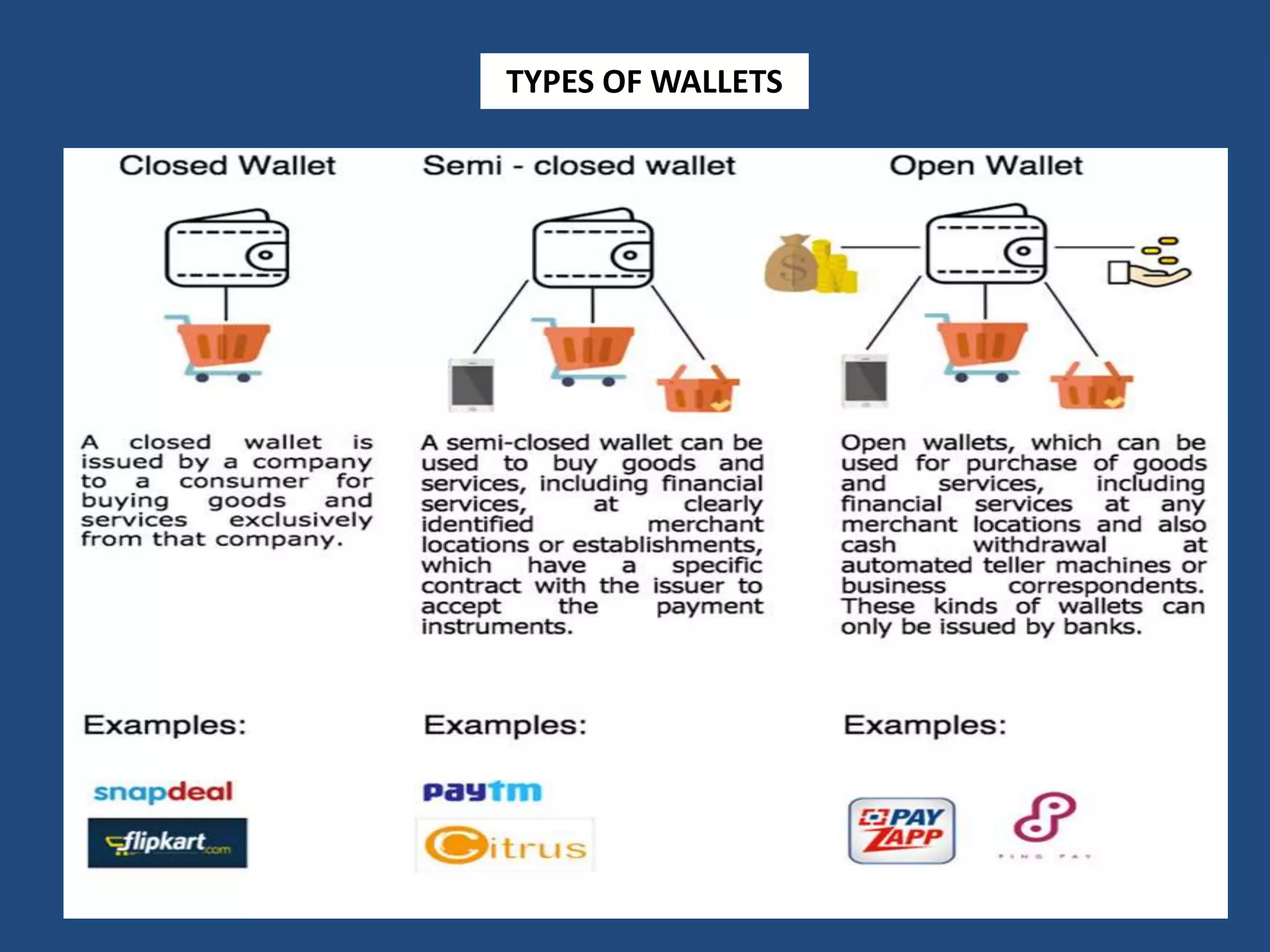
TYPES OF WALLETS
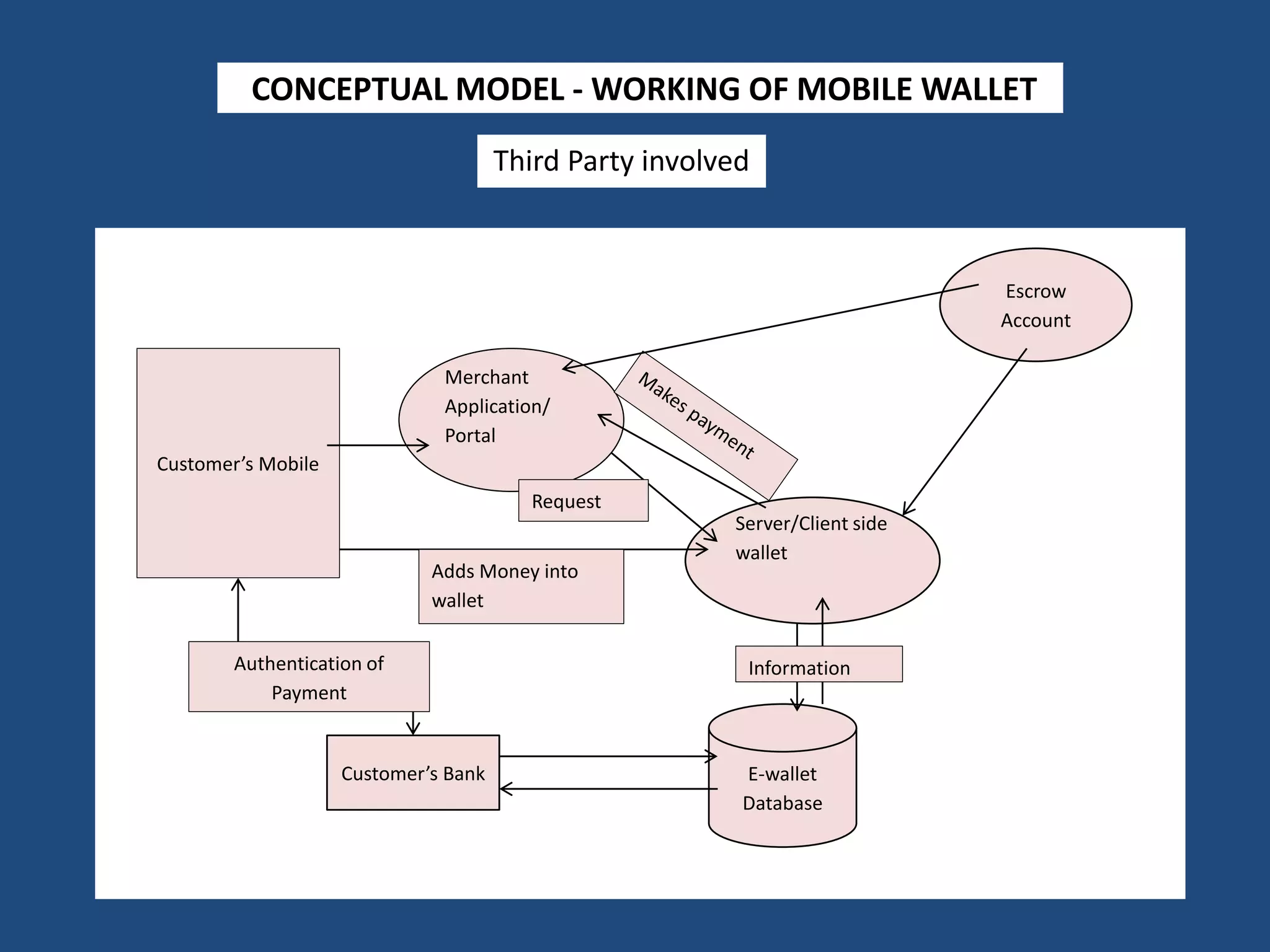
CONCEPTUAL MODEL - WORKING OF MOBILE WALLET
Customer’s Mobile
Merchant
Application/
Portal
Server/Client side
wallet
E-wallet
Database
Customer’s Bank
Adds Money into
wallet
Escrow
Account
Request
InformationAuthentication of
Payment
Third Party involved
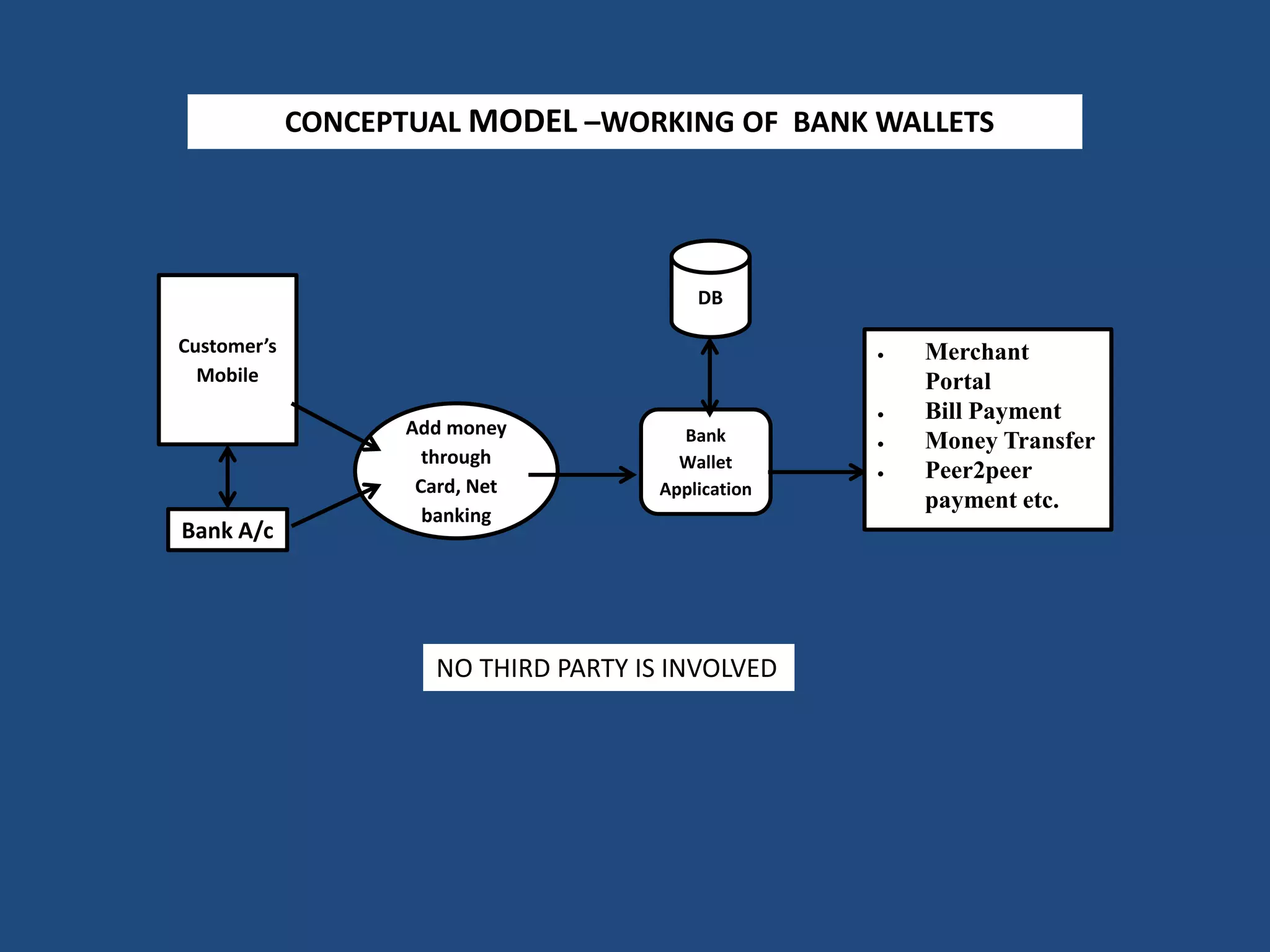
CONCEPTUAL MODEL –WORKING OF BANK WALLETS
Customer’s
Mobile
Bank A/c
Add money
through
Card, Net
banking
Bank
Wallet
Application
DB
 Merchant
Portal
 Bill Payment
 Money Transfer
 Peer2peer
payment etc.
NO THIRD PARTY IS INVOLVED
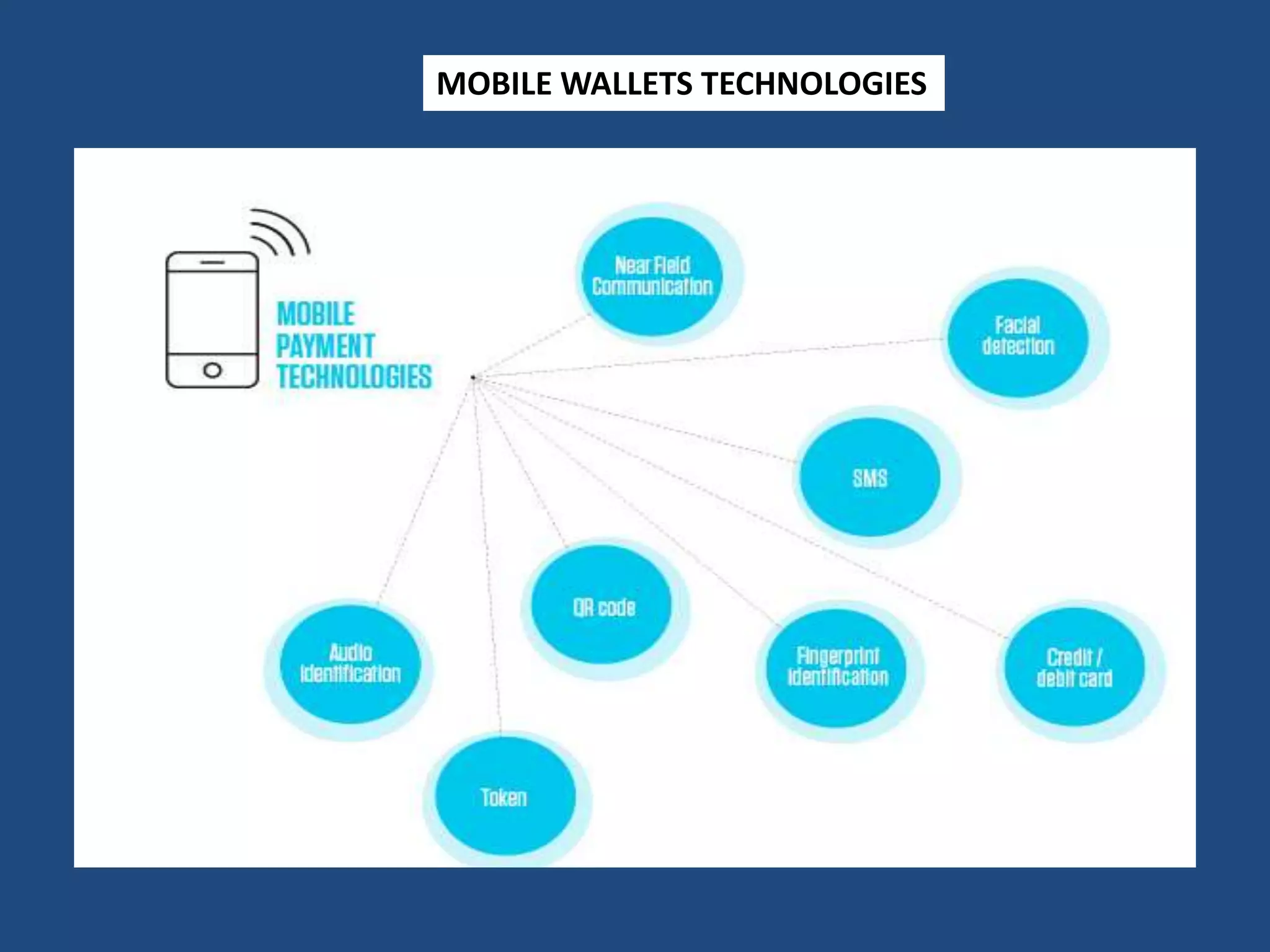
MOBILE WALLETS TECHNOLOGIES
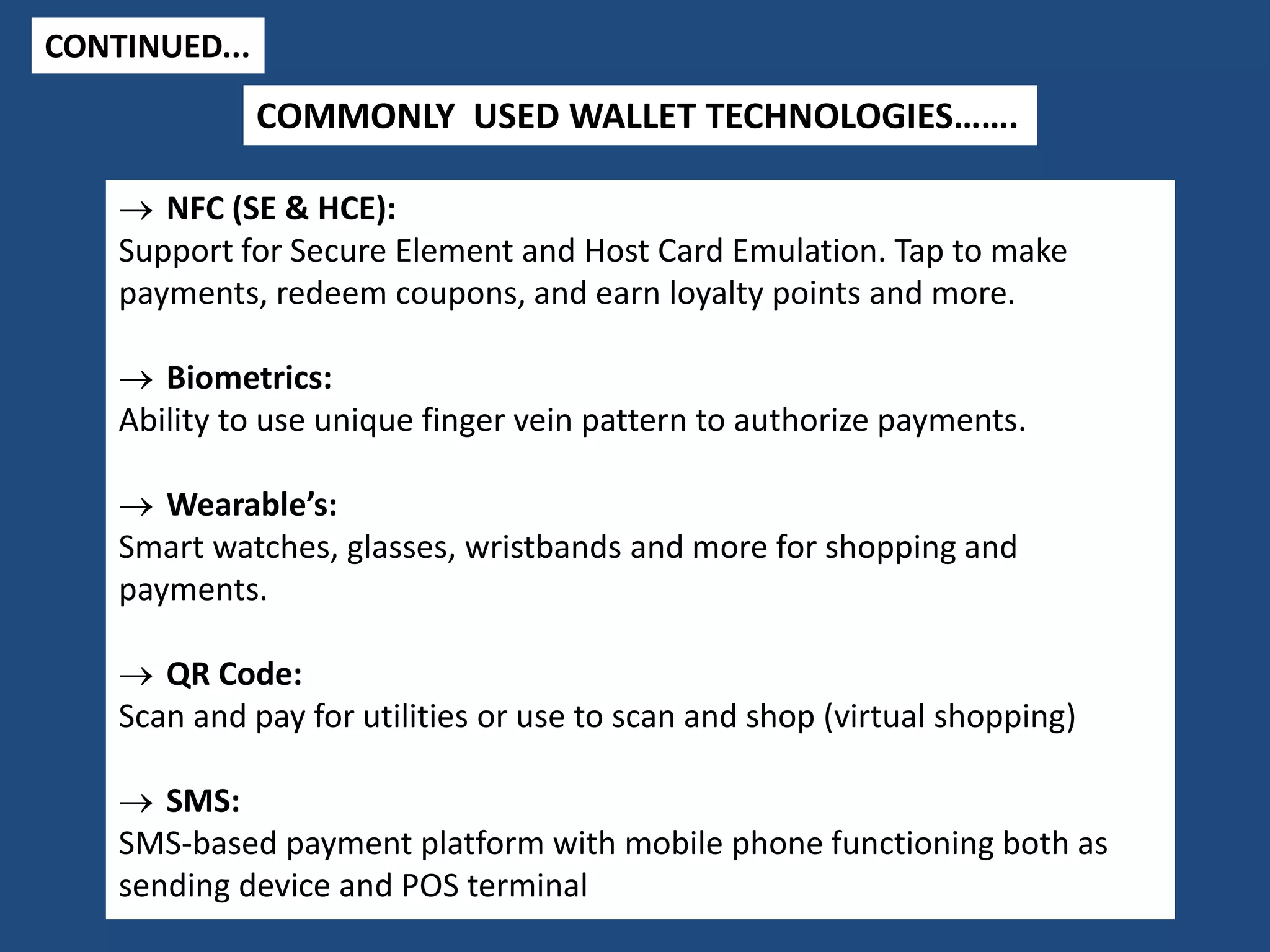
CONTINUED...
 NFC (SE & HCE):
Support for Secure Element and Host Card Emulation. Tap to make
payments, redeem coupons, and earn loyalty points and more.
 Biometrics:
Ability to use unique finger vein pattern to authorize payments.
 Wearable’s:
Smart watches, glasses, wristbands and more for shopping and
payments.
 QR Code:
Scan and pay for utilities or use to scan and shop (virtual shopping)
 SMS:
SMS-based payment platform with mobile phone functioning both as
sending device and POS terminal
COMMONLY USED WALLET TECHNOLOGIES…….
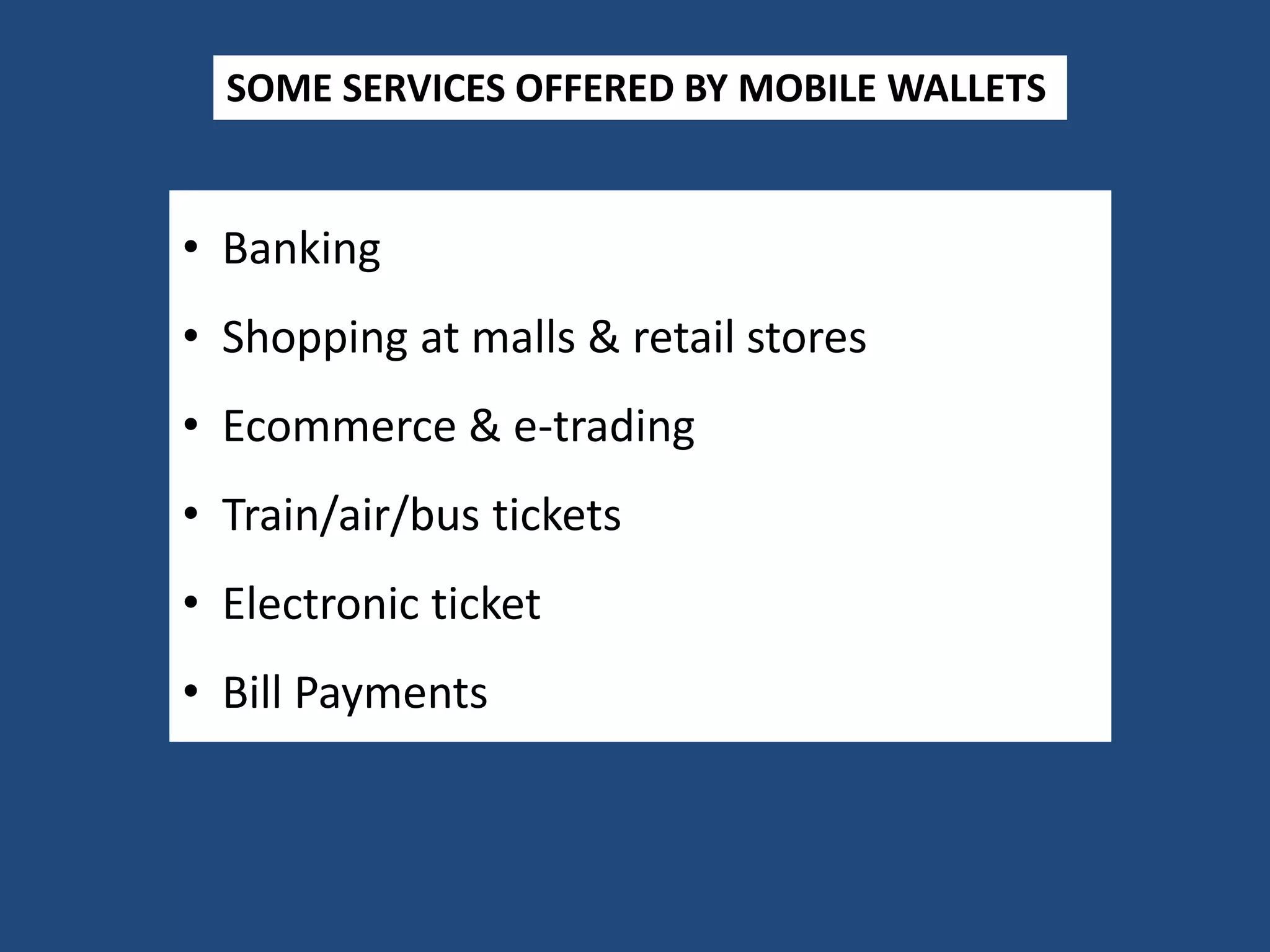
• Banking
• Shopping at malls & retail stores
• Ecommerce & e-trading
• Train/air/bus tickets
• Electronic ticket
• Bill Payments
SOME SERVICES OFFERED BY MOBILE WALLETS
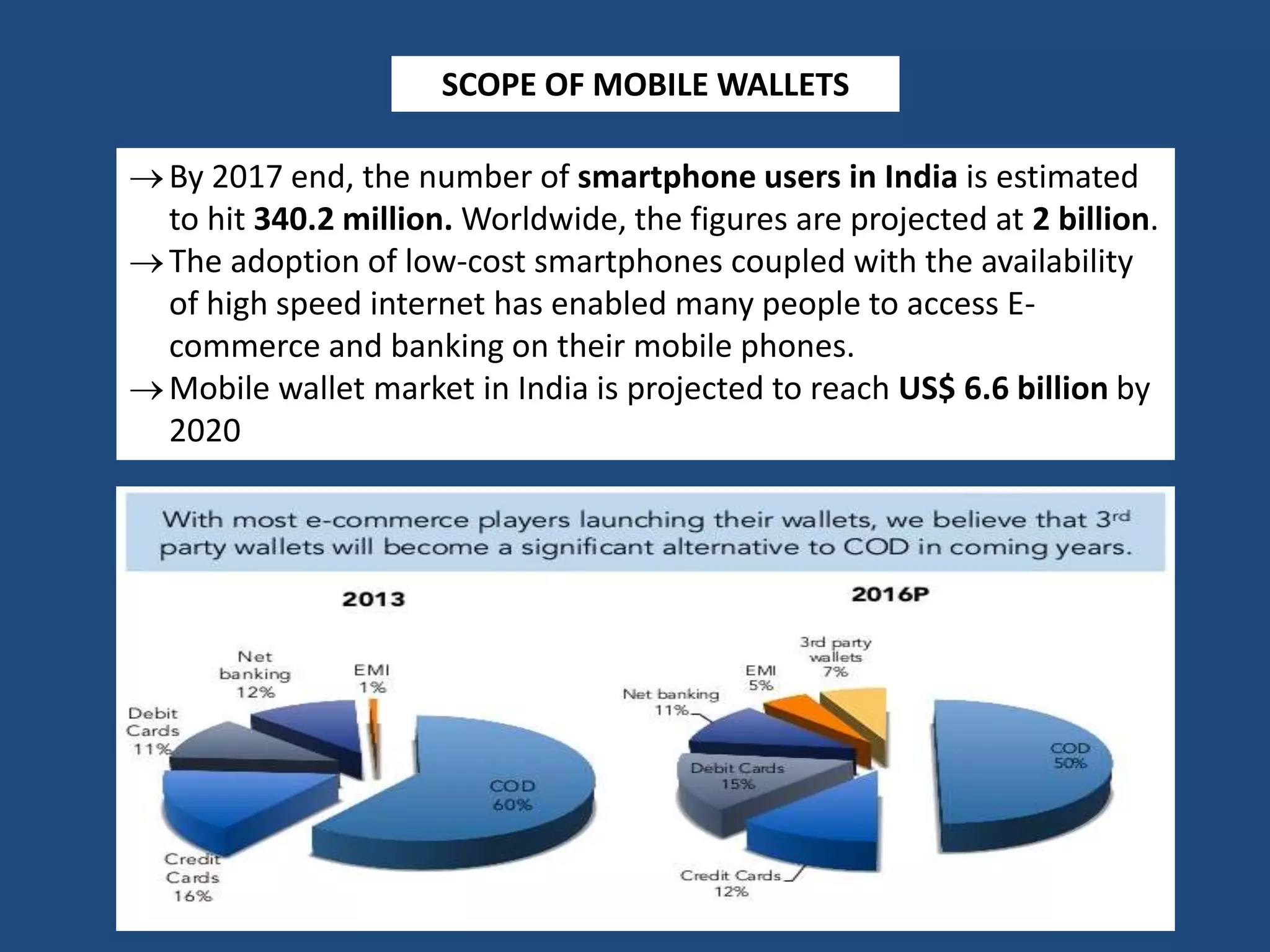
By 2017 end, the number of smartphone users in India is estimated
to hit 340.2 million. Worldwide, the figures are projected at 2 billion.
The adoption of low-cost smartphones coupled with the availability
of high speed internet has enabled many people to access E-
commerce and banking on their mobile phones.
Mobile wallet market in India is projected to reach US$ 6.6 billion by
2020
SCOPE OF MOBILE WALLETS
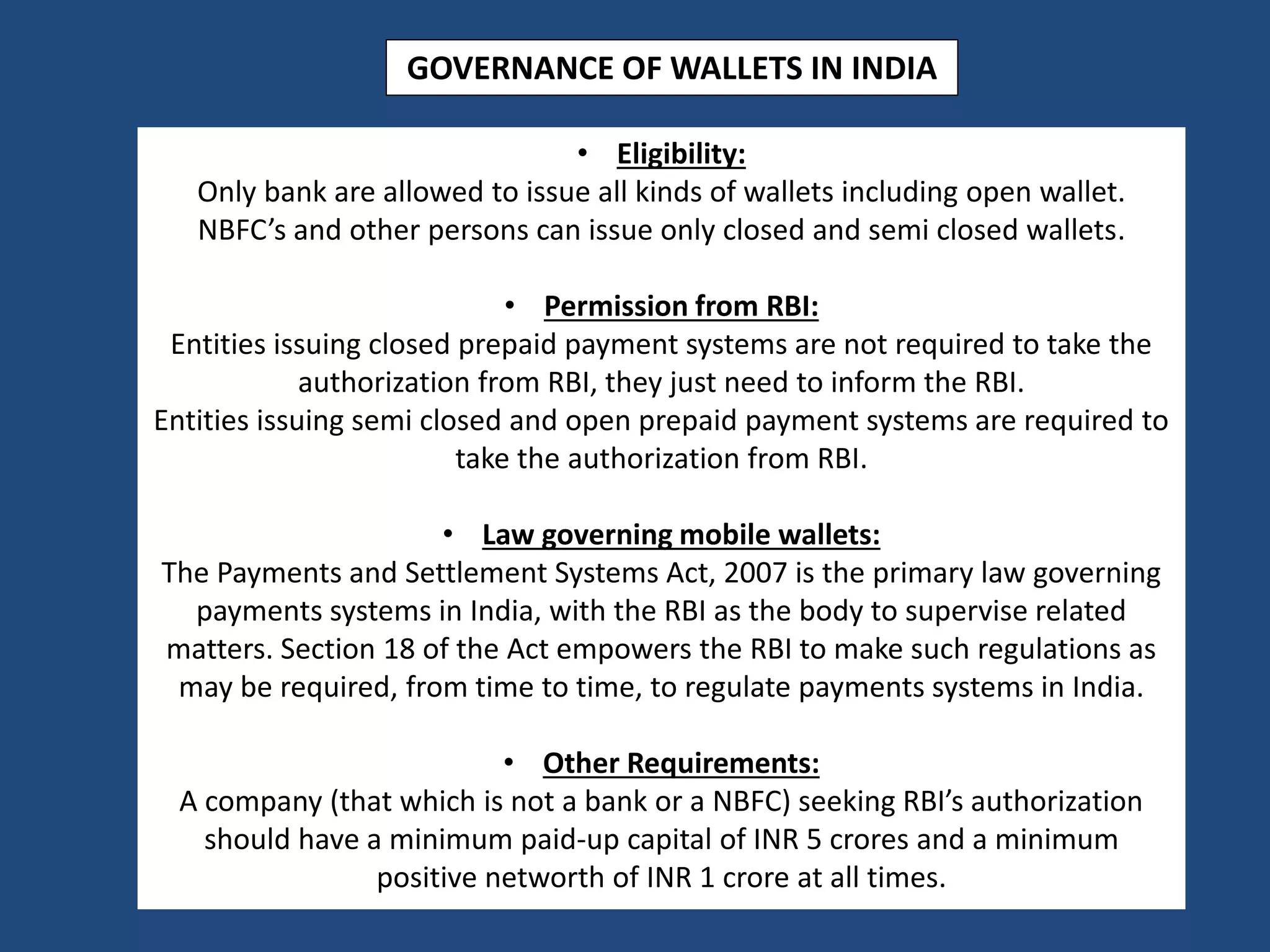
• Eligibility:
Only bank are allowed to issue all kinds of wallets including open wallet.
NBFC’s and other persons can issue only closed and semi closed wallets.
• Permission from RBI:
Entities issuing closed prepaid payment systems are not required to take the
authorization from RBI, they just need to inform the RBI.
Entities issuing semi closed and open prepaid payment systems are required to
take the authorization from RBI.
• Law governing mobile wallets:
The Payments and Settlement Systems Act, 2007 is the primary law governing
payments systems in India, with the RBI as the body to supervise related
matters. Section 18 of the Act empowers the RBI to make such regulations as
may be required, from time to time, to regulate payments systems in India.
• Other Requirements:
A company (that which is not a bank or a NBFC) seeking RBI’s authorization
should have a minimum paid-up capital of INR 5 crores and a minimum
positive networth of INR 1 crore at all times.
GOVERNANCE OF WALLETS IN INDIA
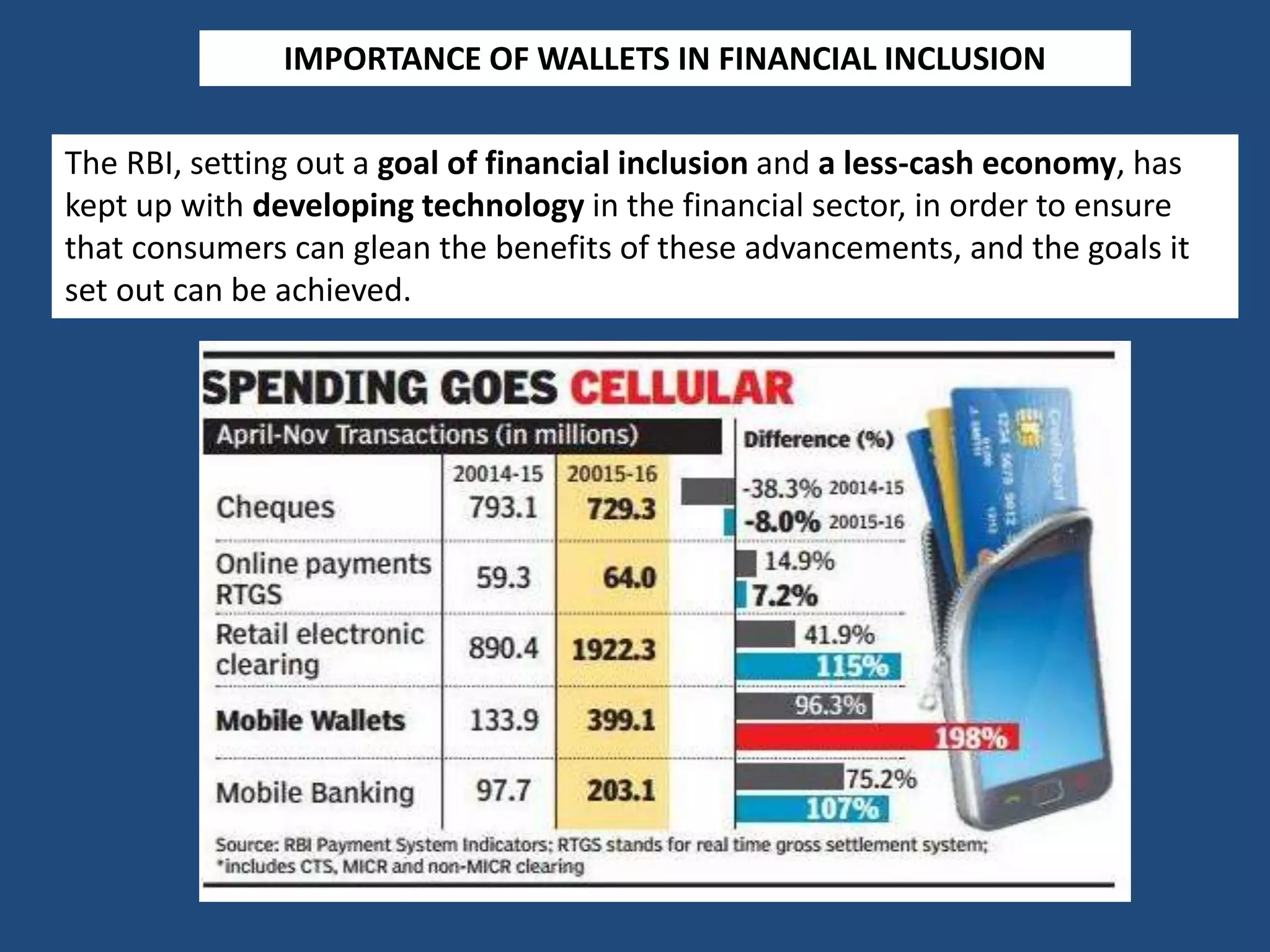
IMPORTANCE OF WALLETS IN FINANCIAL INCLUSION
The RBI, setting out a goal of financial inclusion and a less-cash economy, has
kept up with developing technology in the financial sector, in order to ensure
that consumers can glean the benefits of these advancements, and the goals it
set out can be achieved.
THREAT FOR WALLETS
The Unified Payments Interface (UPI) – a new open source platform
developed by the National Payments Corporation of India (NPCI), is a
channel that powers multiple bank accounts into a single mobile
application (of any bank) of a participating bank, merging several
banking features, seamless fund routing and merchant payments into
one hood and also empower users to perform instant push and pull
transactions easily. Built on the country’s existing IMPS (Immediate
Payment System), where funds can be transferred from one account to
another 24×7, consumers will be able to send and receive money
through smart phones without revealing their bank account details.
Wallet Companies are diversifying their business into new format
banking that is Payment Banks. RBI has issued license for 11
Companies to start with these kind of banking system. Thus big players
changing their business into new system, this is a threat for other
wallet companies who has not still adopted this change
CONCLUSION
 Mobile Wallets in India is growing day by day but Payments
Banks & UPI are other payment system which will eat up the
Market Share of wallets and more people will turn into such
system soon.
 Hence these mobile wallets need to bring some changes in
their apps so that it can be used more easily like UPI apps and
should also give more focus on discounts, offers & loyalty
programs in order to attract existing and new customers.

Mobile wallets Analysis - Evolution, Scope & Future in India

  • 1.
  • 2.
    WHAT IS AMOBILE WALLET? Mobile wallets are essentially digital forms of old-style wallets that someone would carry in their pocket. While there are many variances, usually they can hold digital information about credit and debit cards for making payments, store coupons and loyalty programs, specific information about personal identity and more. In other words, A mobile wallet is a software application with the following base functionality:  It offers secure enrollment of the user (application download, identity check) and secure provisioning of credentials (e.g., user ID and password for wallet access).  It offers the ability for the user to securely provision and store customer- identity information (e.g., email address), payment information (e.g., credit card data), and shipping address details. The user can preselect a payment method within the wallet application to execute commerce transactions (i.e., pay merchants online, in-app, or in-store).  The funding of the wallet payment may come from a debit or credit card, prepaid card, bank account, e-money account, virtual currency, or any other store of value.
  • 3.
    MOBILE WALLETS ININDIA  Oxigen wallet is India's first non-banked mobile wallet, approved by RBI in 2013  The mobile wallet is expected to grow at a Compound Annual Growth Rate of 40% between 2016 and 2020.  But after demonetization Mobile Wallet CAGR is 168%
  • 4.
    • Credit Card1940 •ATM1960 • Debit Card1970 • Online Banking1980 • PayPal (US based Company- send money through email address) 1998 • Mobile Banking2000 • Evolution of wallets, • P2P mobile payment, • NFC, • Mobile cheque deposits 2002– 2015 • Unified Payment Interface2016 T E C H N O L O G Y D E V E L O P M E N T IN BANKING SECTOR
  • 5.
  • 6.
    CONCEPTUAL MODEL -WORKING OF MOBILE WALLET Customer’s Mobile Merchant Application/ Portal Server/Client side wallet E-wallet Database Customer’s Bank Adds Money into wallet Escrow Account Request InformationAuthentication of Payment Third Party involved
  • 7.
    CONCEPTUAL MODEL –WORKINGOF BANK WALLETS Customer’s Mobile Bank A/c Add money through Card, Net banking Bank Wallet Application DB  Merchant Portal  Bill Payment  Money Transfer  Peer2peer payment etc. NO THIRD PARTY IS INVOLVED
  • 8.
  • 9.
    CONTINUED...  NFC (SE& HCE): Support for Secure Element and Host Card Emulation. Tap to make payments, redeem coupons, and earn loyalty points and more.  Biometrics: Ability to use unique finger vein pattern to authorize payments.  Wearable’s: Smart watches, glasses, wristbands and more for shopping and payments.  QR Code: Scan and pay for utilities or use to scan and shop (virtual shopping)  SMS: SMS-based payment platform with mobile phone functioning both as sending device and POS terminal COMMONLY USED WALLET TECHNOLOGIES…….
  • 10.
    • Banking • Shoppingat malls & retail stores • Ecommerce & e-trading • Train/air/bus tickets • Electronic ticket • Bill Payments SOME SERVICES OFFERED BY MOBILE WALLETS
  • 11.
    By 2017 end,the number of smartphone users in India is estimated to hit 340.2 million. Worldwide, the figures are projected at 2 billion. The adoption of low-cost smartphones coupled with the availability of high speed internet has enabled many people to access E- commerce and banking on their mobile phones. Mobile wallet market in India is projected to reach US$ 6.6 billion by 2020 SCOPE OF MOBILE WALLETS
  • 12.
    • Eligibility: Only bankare allowed to issue all kinds of wallets including open wallet. NBFC’s and other persons can issue only closed and semi closed wallets. • Permission from RBI: Entities issuing closed prepaid payment systems are not required to take the authorization from RBI, they just need to inform the RBI. Entities issuing semi closed and open prepaid payment systems are required to take the authorization from RBI. • Law governing mobile wallets: The Payments and Settlement Systems Act, 2007 is the primary law governing payments systems in India, with the RBI as the body to supervise related matters. Section 18 of the Act empowers the RBI to make such regulations as may be required, from time to time, to regulate payments systems in India. • Other Requirements: A company (that which is not a bank or a NBFC) seeking RBI’s authorization should have a minimum paid-up capital of INR 5 crores and a minimum positive networth of INR 1 crore at all times. GOVERNANCE OF WALLETS IN INDIA
  • 13.
    IMPORTANCE OF WALLETSIN FINANCIAL INCLUSION The RBI, setting out a goal of financial inclusion and a less-cash economy, has kept up with developing technology in the financial sector, in order to ensure that consumers can glean the benefits of these advancements, and the goals it set out can be achieved.
  • 14.
    THREAT FOR WALLETS TheUnified Payments Interface (UPI) – a new open source platform developed by the National Payments Corporation of India (NPCI), is a channel that powers multiple bank accounts into a single mobile application (of any bank) of a participating bank, merging several banking features, seamless fund routing and merchant payments into one hood and also empower users to perform instant push and pull transactions easily. Built on the country’s existing IMPS (Immediate Payment System), where funds can be transferred from one account to another 24×7, consumers will be able to send and receive money through smart phones without revealing their bank account details. Wallet Companies are diversifying their business into new format banking that is Payment Banks. RBI has issued license for 11 Companies to start with these kind of banking system. Thus big players changing their business into new system, this is a threat for other wallet companies who has not still adopted this change
  • 15.
    CONCLUSION  Mobile Walletsin India is growing day by day but Payments Banks & UPI are other payment system which will eat up the Market Share of wallets and more people will turn into such system soon.  Hence these mobile wallets need to bring some changes in their apps so that it can be used more easily like UPI apps and should also give more focus on discounts, offers & loyalty programs in order to attract existing and new customers.