MIXING & MIXING INDEX
WHAT IS MIXING ?
 Many processing operations depends for their success on the
effective agitation and mixing of fluid or solid particles.
 Though often confused , agitation and mixing are not
synonymous of each other . both having different meaning.
 Agitation refers to induced motion of material in specified way
, usually in circulatory pattern inside in container.
 Mixing is the random distribution or addition.
 A single homogeneous material, such as a tankful of cold
water , can be agitated ,but it can not be mixed until some
other material is added to it.
 Hence , it should be necessary to having two material for
mixing and for agitation only one material is enough.
 The term mixing is applied to a variety of operation , differing
widely in the degree of homogeneity of mixed material.
 Consider in one case , two gases that are brought together
and thoroughly blended and in second case , sand ,gravel,
cement and water tumbled in rotating drum for long time.
 In both the case final product said to be mixed. Yet the
product are obviously not equal homogeneous.
 The machine which is used for mixing is known as mixer.
 Many type of mixing is available such as ,
 solid mixing
 liquid mixing
 gas mixing
 The mixing of solids, weather free flowing or cohesive ,
resembles to some extent the mixing of low-viscosity liquid.
the processes intermingle two or more separate component to
from a more or less uniform product.
 Some equipment normally used for blending liquid may, on
occasion, be used to mix solid.
 There are significant difference between the two processes.
liquid blending depends on the creation of flow currents ,
which transport unmixed material to the mixing zone adjacent
to impeller.
 In solid mixing , much more power is required .
 There are two types of solid such as cohesive solids and non-cohesive
solids.
 Obviously the mixer is used for both solids are different.
 Mixer for Non-cohesive solids :
Ribbon mixer and tumbling mixer are generally use for non-
cohesive solids.
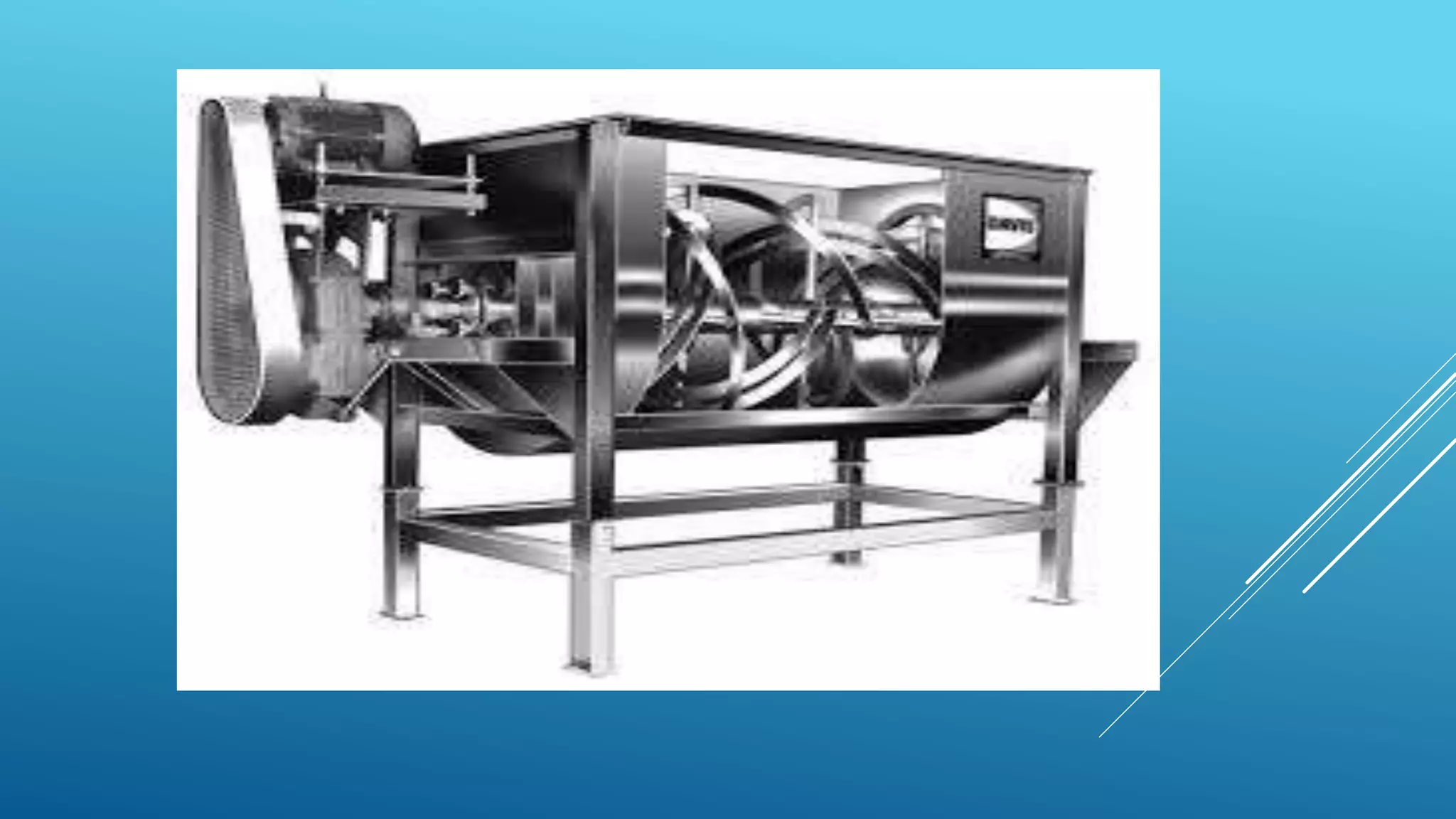
1. Ribbon mixer :
 In a ribbon mixer , two counteracting ribbons are mounted on the same
shaft .
 One shaft moving the solid slowly in one direction and the other moving it
quickly.
 The ribbons may be continuous or interrupted. Some unit operate batch
wise , some are continuously.
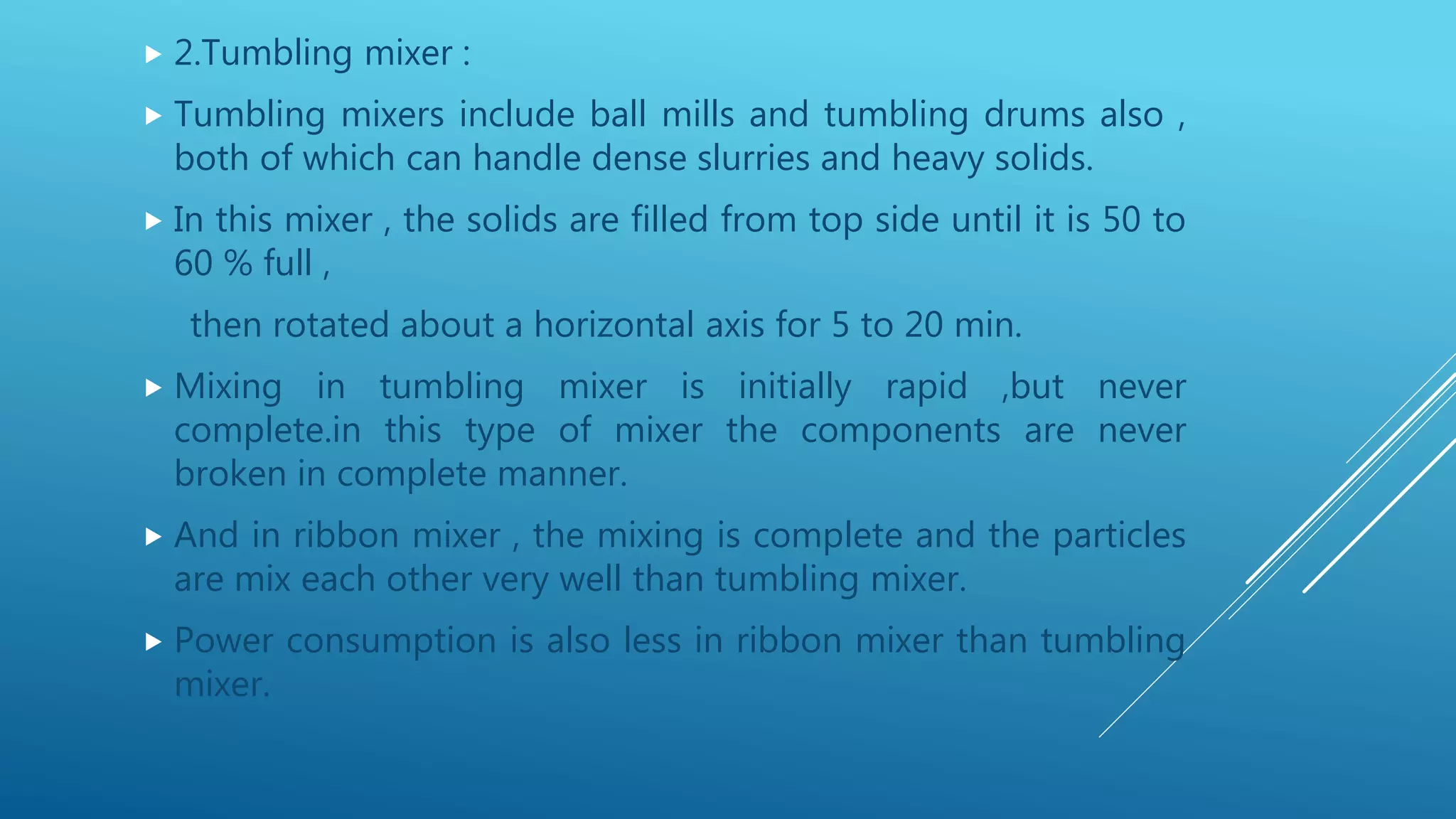
 2.Tumbling mixer :
 Tumbling mixers include ball mills and tumbling drums also ,
both of which can handle dense slurries and heavy solids.
 In this mixer , the solids are filled from top side until it is 50 to
60 % full ,
then rotated about a horizontal axis for 5 to 20 min.
 Mixing in tumbling mixer is initially rapid ,but never
complete.in this type of mixer the components are never
broken in complete manner.
 And in ribbon mixer , the mixing is complete and the particles
are mix each other very well than tumbling mixer.
 Power consumption is also less in ribbon mixer than tumbling
mixer.
 Mixer for cohesive solids :
pony mixer and beater mixer are used for cohesive solids
mixing.
 Some of the most difficult of all mixing problems involve
cohesive solids such as pastes , plastic materials , rubber.
 In some ways , these substance resemble liquids , but their
enormously high viscosity.
 It means the equipment which is used for mixing is more
effective in this case.
 The forces generated in these mixer are large and power
consumption is high.
 Change can mixers blend viscous liquids or light phases, as in
food processing or paint manufacture, in a removable agitated
can or a vessel 5 -100 gallon in size .
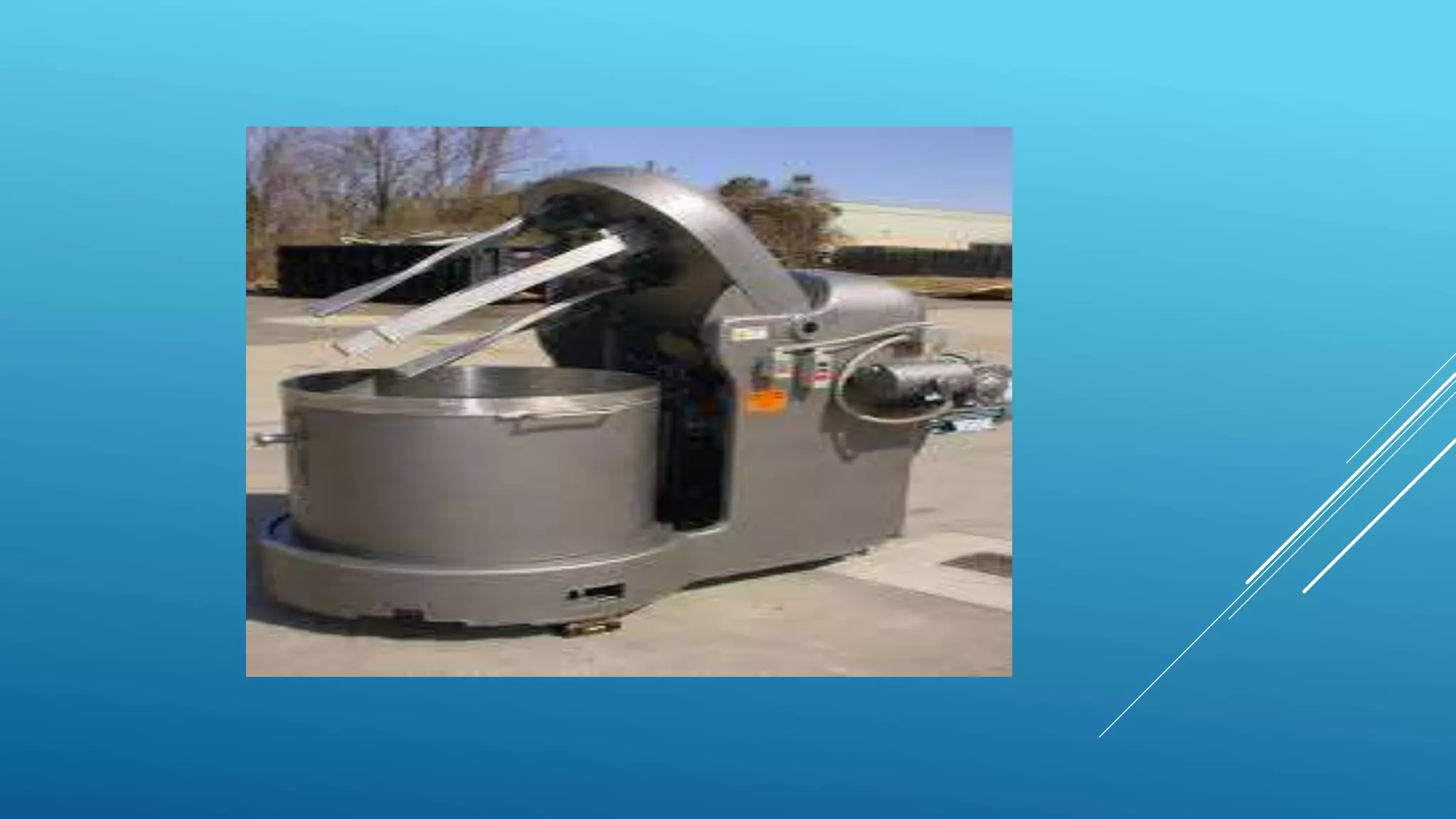
 In a pony mixture the rotating agitator carries several vertical
blades positioned near the vessel wall. The can is driven by a
turntable in a direction opposite to that of agitator.
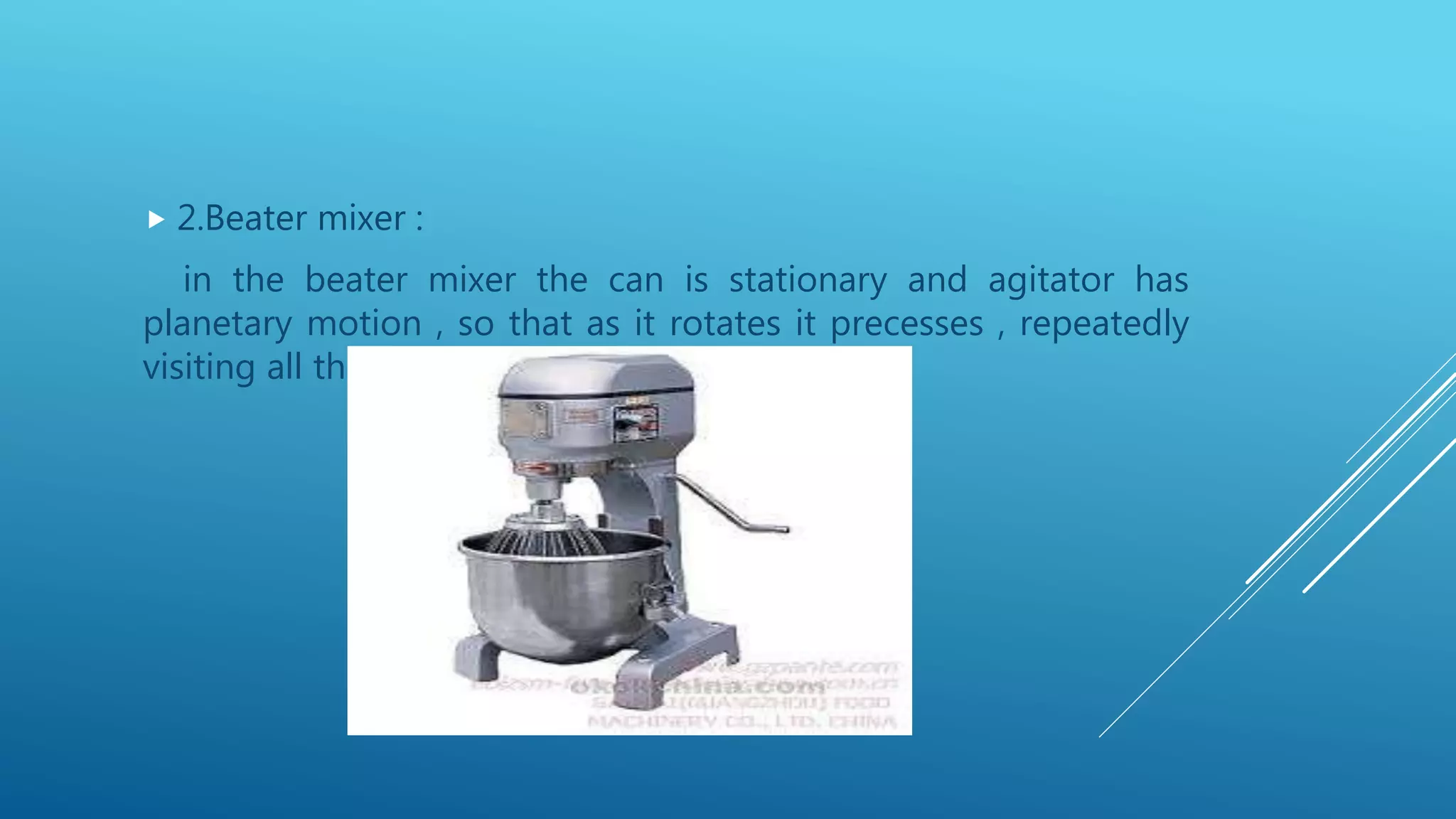
 In a beater mixture the can is stationary and the agitator has
planetary motion, so that as it rotates it precesses, repeatedly
visiting all parts of vessel
1. Pony Mixer :
 In a pony mixer the rotating agitator carries several vertical
blades positioned near the vessel wall.
 Three type of blade is use in these mixer :
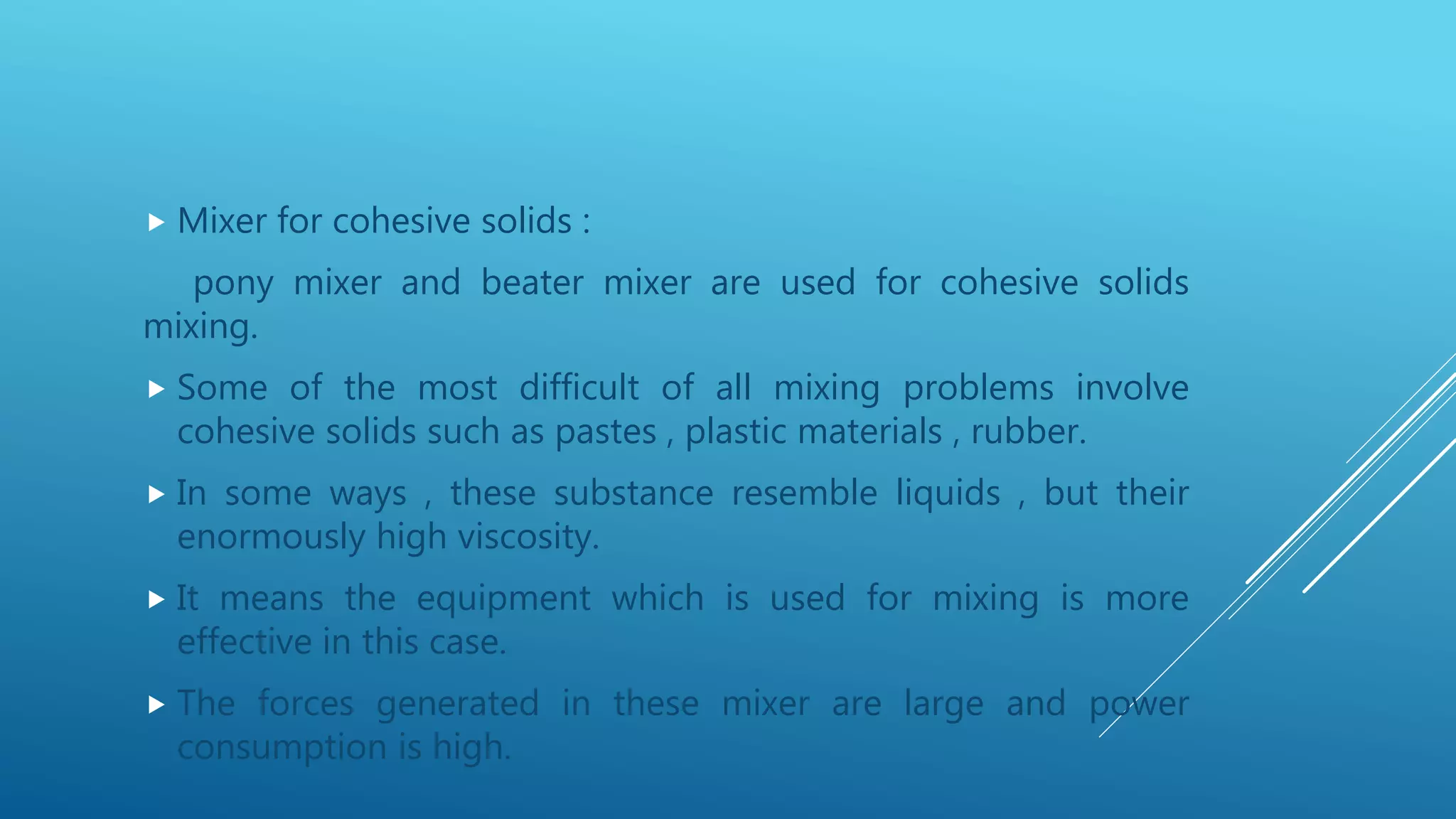
1.sigma blade
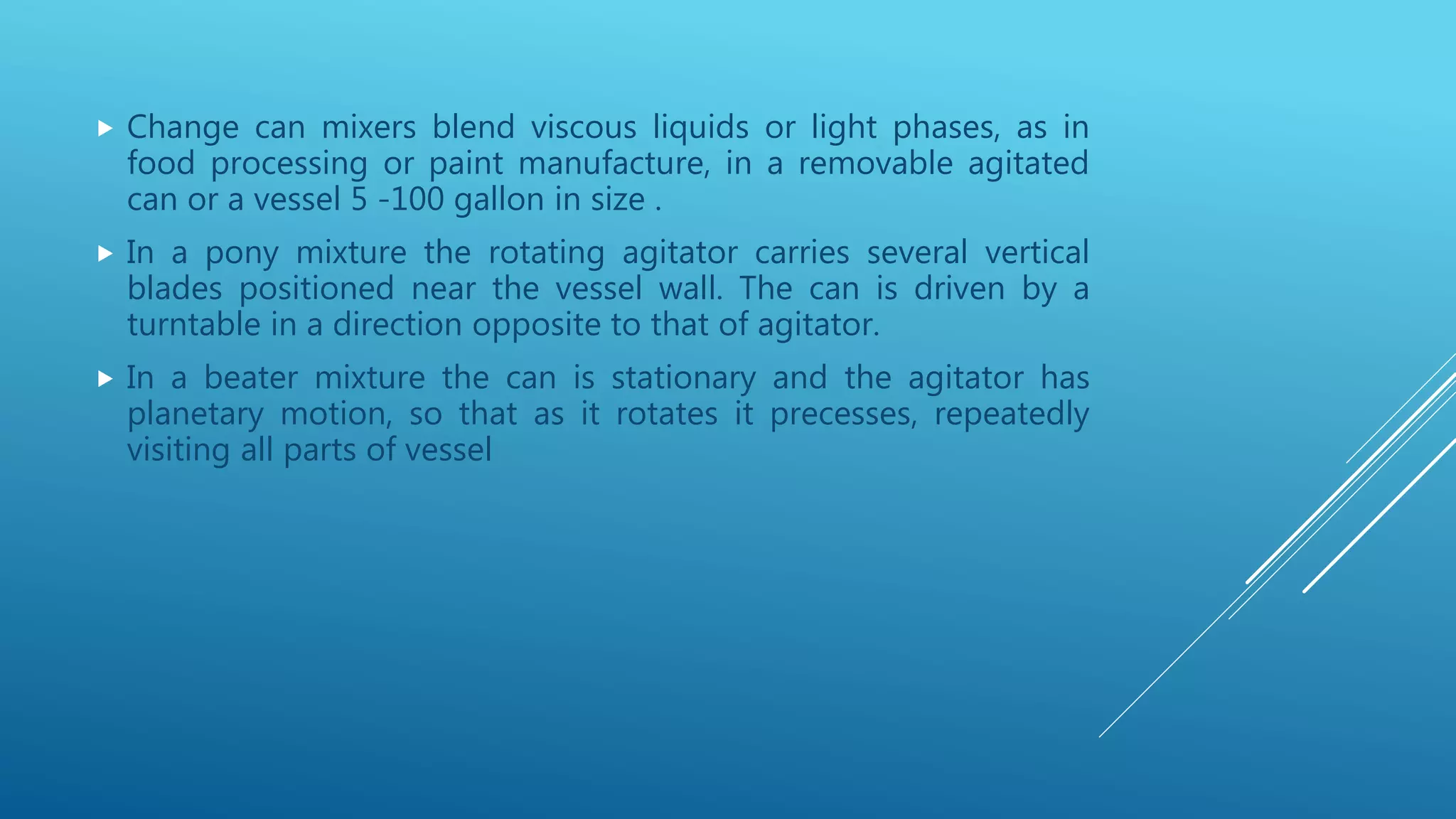
2.double-naben blade
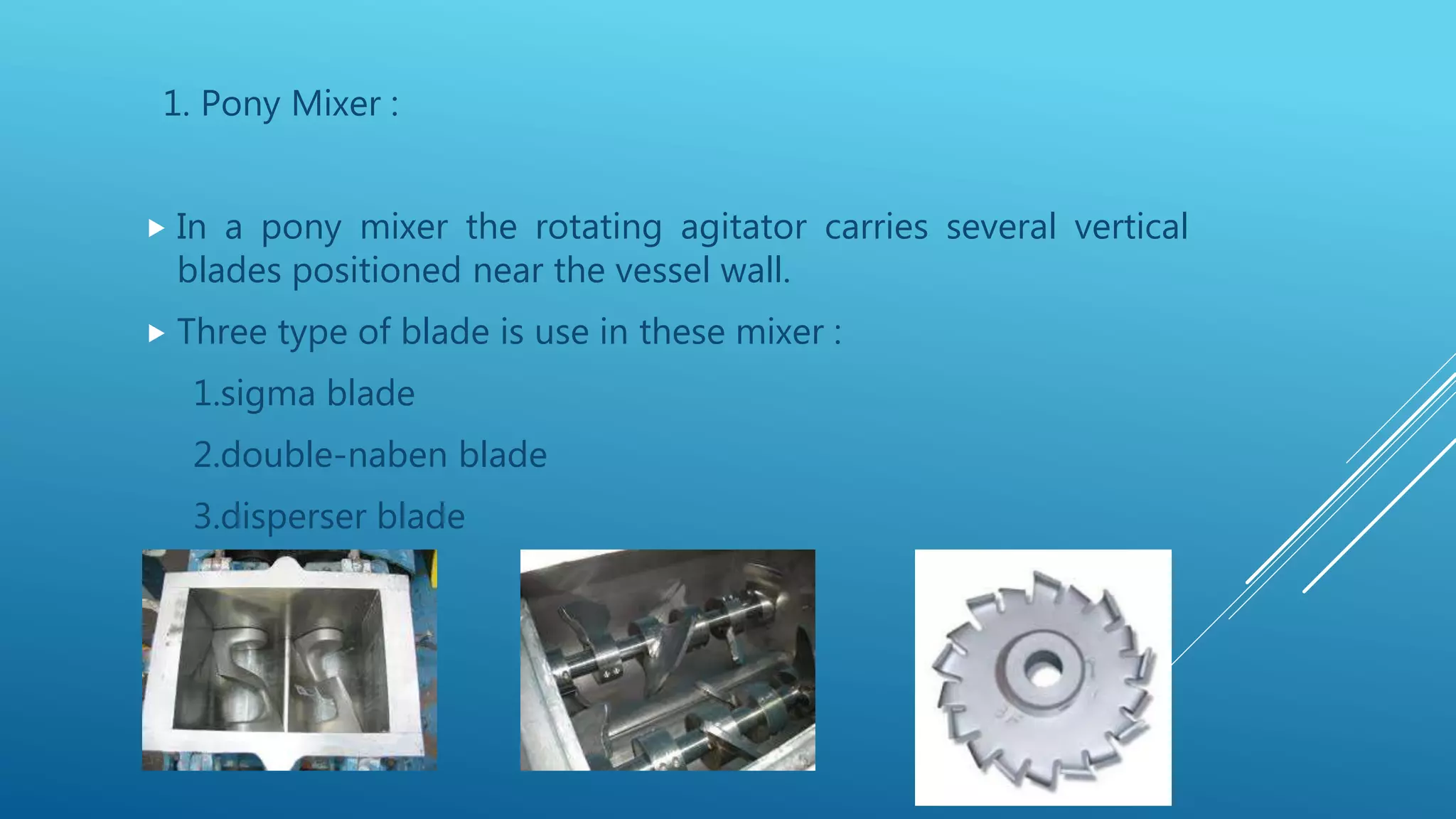
3.disperser blade
 The common sigma blade shown left is used for general-
purpose kneading . its edges may be serrated to given a
shredding action.
 The double-naben ,or fishtail, blade in center is particularly
effective with heave plastic materials.
 The dispersion blade at the right develops the high shear
forces needed to disperse powders or liquid in to plastic or
rubbery masses.
 Masticator blades are even heavier than this three blades.
Sometimes being little larger in diameter than the shaft that
drive them spiral , flattened and elliptical designs of masticator
blades are used.
 2.Beater mixer :
in the beater mixer the can is stationary and agitator has
planetary motion , so that as it rotates it precesses , repeatedly
visiting all the part of the vessel.
squashing the mass flat, folding over it, and squashing it once
more.
 Most kneading machines also tear the mass apart and shear it
between a moving blade and a stationary surface.
 Considerable energy is required even for thin materials, and
as the mass becomes stiff and rubbery power requirements
become very large.
 As per the requirements various kneader can be used.
 A disperser is heavier in construction and draws even more
power then a kneader, it works additives and coloring agents
into stiff materials.
 A masticator is even heavier and draws even more power.
MIXING INDEX
 Mixing is harder to define with solids and pastes than it is with
liquids. Quantitative measures of mixing based on statistical
procedures are sometimes used to evaluate mixer
performance.
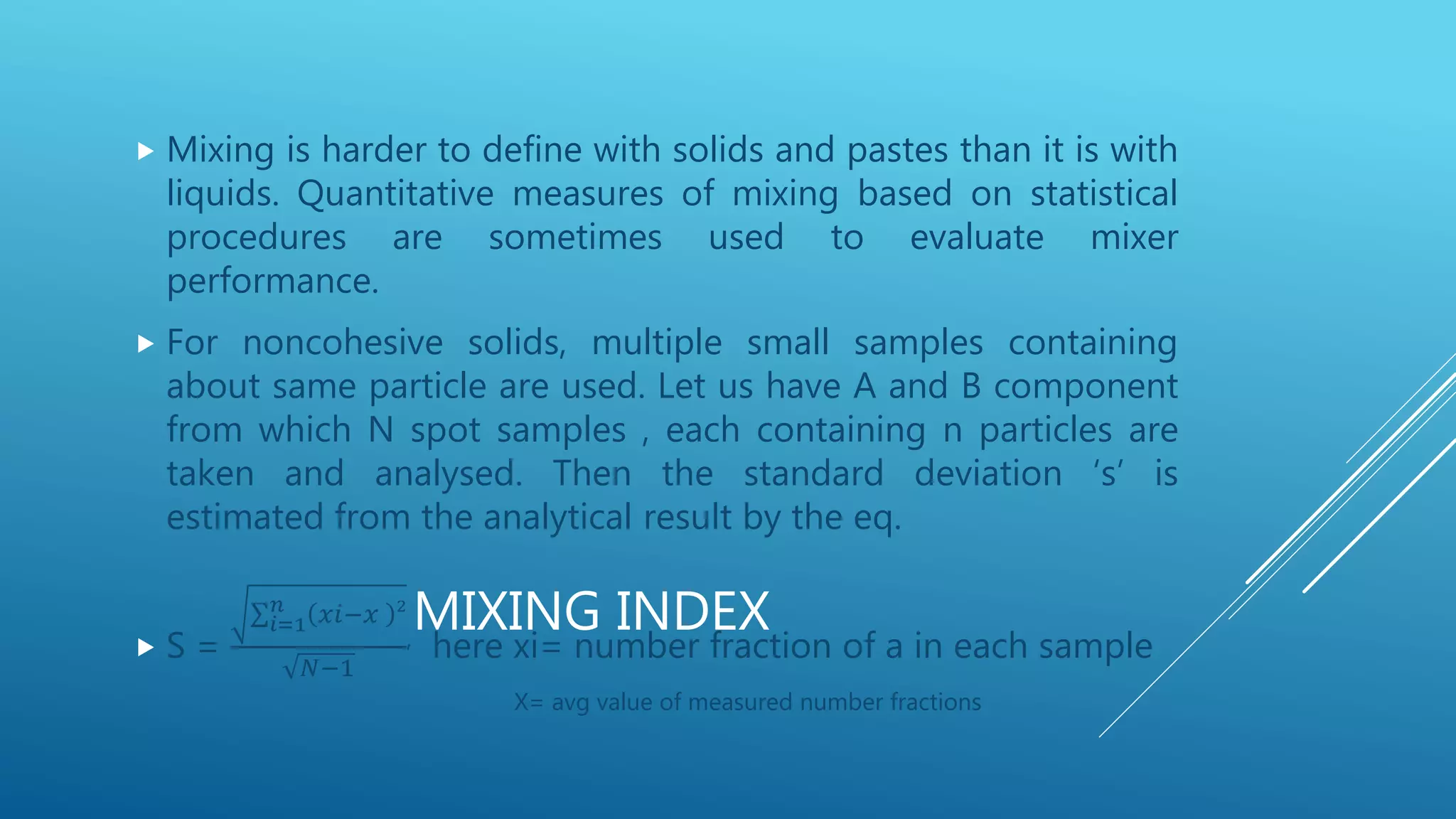
 For noncohesive solids, multiple small samples containing
about same particle are used. Let us have A and B component
from which N spot samples , each containing n particles are
taken and analysed. Then the standard deviation ‘s’ is
estimated from the analytical result by the eq.
 S =
𝑖=1
𝑛 𝑥𝑖−𝑥 2
𝑁−1
, here xi= number fraction of a in each sample
X= avg value of measured number fractions
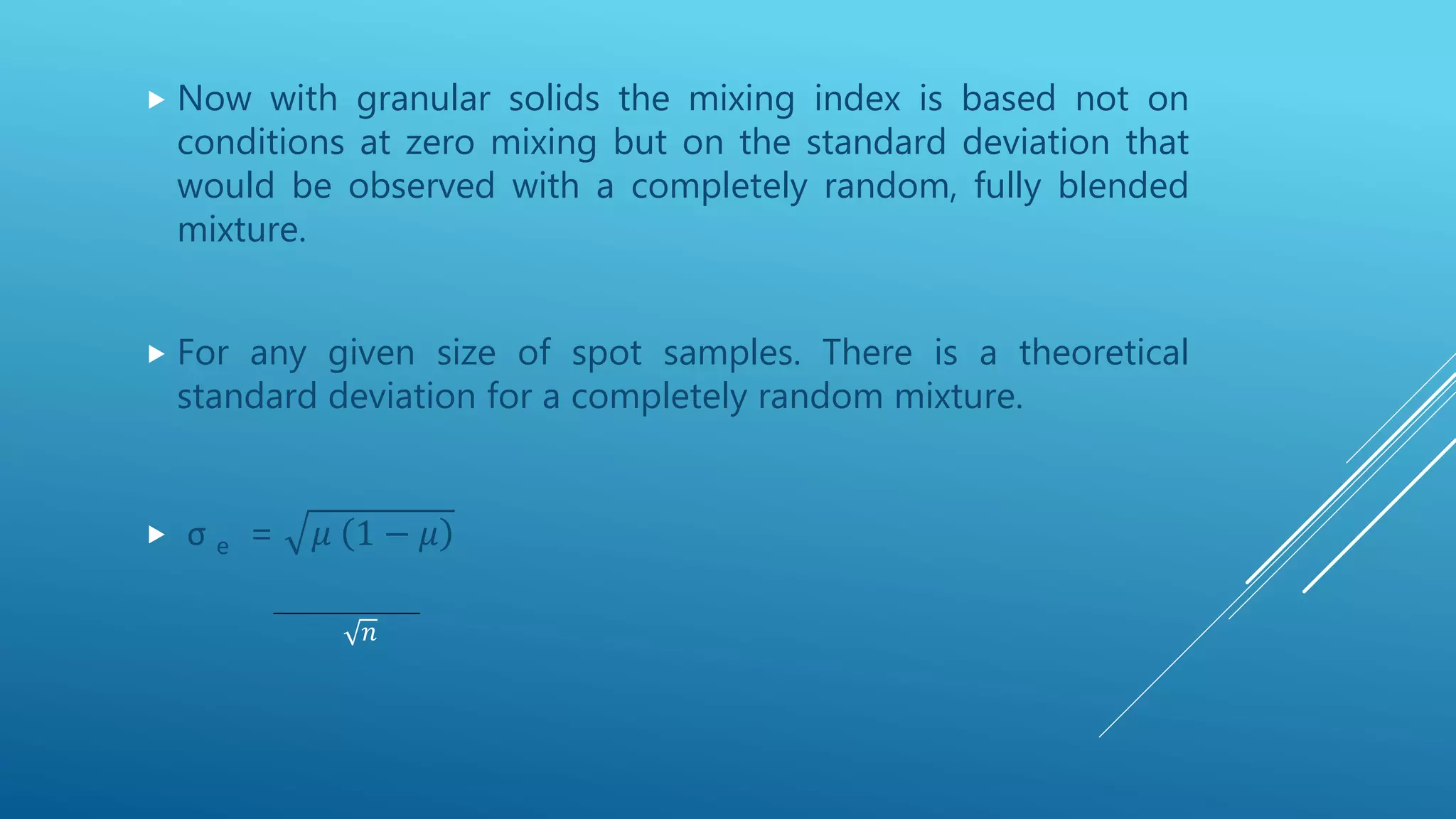
 Now with granular solids the mixing index is based not on
conditions at zero mixing but on the standard deviation that
would be observed with a completely random, fully blended
mixture.
 For any given size of spot samples. There is a theoretical
standard deviation for a completely random mixture.
 σ e = 𝜇 1 − 𝜇
𝑛
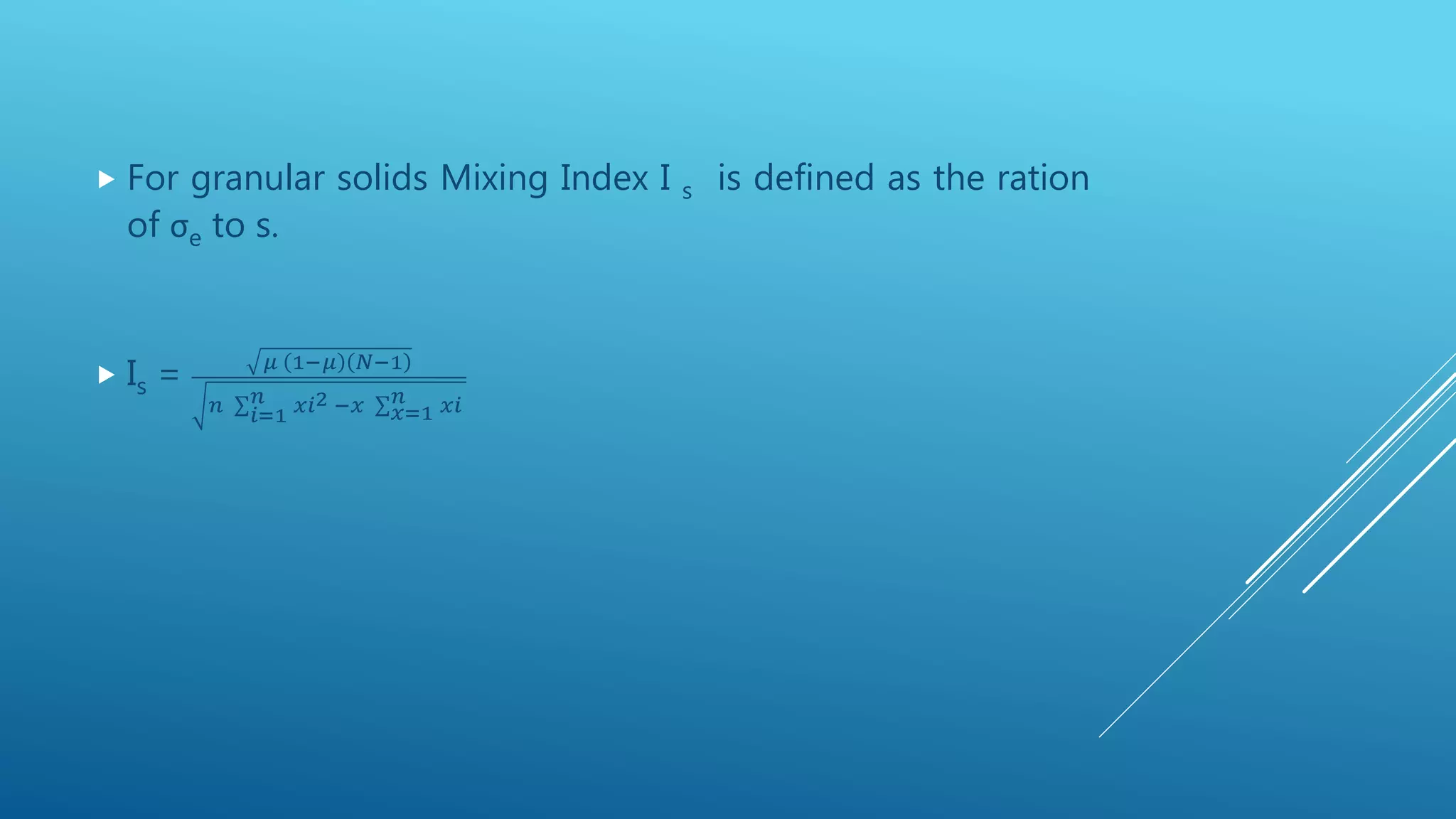
 For granular solids Mixing Index I s is defined as the ration
of σe to s.
 Is = 𝜇 1−𝜇 𝑁−1
𝑛 𝑖=1
𝑛 𝑥𝑖2 −𝑥 𝑥=1
𝑛 𝑥𝑖
THANK YOU

Mixing & mixing index

  • 1.
  • 2.
    WHAT IS MIXING?  Many processing operations depends for their success on the effective agitation and mixing of fluid or solid particles.  Though often confused , agitation and mixing are not synonymous of each other . both having different meaning.  Agitation refers to induced motion of material in specified way , usually in circulatory pattern inside in container.  Mixing is the random distribution or addition.
  • 3.
     A singlehomogeneous material, such as a tankful of cold water , can be agitated ,but it can not be mixed until some other material is added to it.  Hence , it should be necessary to having two material for mixing and for agitation only one material is enough.  The term mixing is applied to a variety of operation , differing widely in the degree of homogeneity of mixed material.  Consider in one case , two gases that are brought together and thoroughly blended and in second case , sand ,gravel, cement and water tumbled in rotating drum for long time.  In both the case final product said to be mixed. Yet the product are obviously not equal homogeneous.  The machine which is used for mixing is known as mixer.
  • 4.
     Many typeof mixing is available such as ,  solid mixing  liquid mixing  gas mixing  The mixing of solids, weather free flowing or cohesive , resembles to some extent the mixing of low-viscosity liquid. the processes intermingle two or more separate component to from a more or less uniform product.  Some equipment normally used for blending liquid may, on occasion, be used to mix solid.  There are significant difference between the two processes. liquid blending depends on the creation of flow currents , which transport unmixed material to the mixing zone adjacent to impeller.  In solid mixing , much more power is required .
  • 5.
     There aretwo types of solid such as cohesive solids and non-cohesive solids.  Obviously the mixer is used for both solids are different.  Mixer for Non-cohesive solids : Ribbon mixer and tumbling mixer are generally use for non- cohesive solids. 1. Ribbon mixer :  In a ribbon mixer , two counteracting ribbons are mounted on the same shaft .  One shaft moving the solid slowly in one direction and the other moving it quickly.  The ribbons may be continuous or interrupted. Some unit operate batch wise , some are continuously.
  • 7.
     2.Tumbling mixer:  Tumbling mixers include ball mills and tumbling drums also , both of which can handle dense slurries and heavy solids.  In this mixer , the solids are filled from top side until it is 50 to 60 % full , then rotated about a horizontal axis for 5 to 20 min.  Mixing in tumbling mixer is initially rapid ,but never complete.in this type of mixer the components are never broken in complete manner.  And in ribbon mixer , the mixing is complete and the particles are mix each other very well than tumbling mixer.  Power consumption is also less in ribbon mixer than tumbling mixer.
  • 9.
     Mixer forcohesive solids : pony mixer and beater mixer are used for cohesive solids mixing.  Some of the most difficult of all mixing problems involve cohesive solids such as pastes , plastic materials , rubber.  In some ways , these substance resemble liquids , but their enormously high viscosity.  It means the equipment which is used for mixing is more effective in this case.  The forces generated in these mixer are large and power consumption is high.
  • 10.
     Change canmixers blend viscous liquids or light phases, as in food processing or paint manufacture, in a removable agitated can or a vessel 5 -100 gallon in size .  In a pony mixture the rotating agitator carries several vertical blades positioned near the vessel wall. The can is driven by a turntable in a direction opposite to that of agitator.  In a beater mixture the can is stationary and the agitator has planetary motion, so that as it rotates it precesses, repeatedly visiting all parts of vessel
  • 11.
    1. Pony Mixer:  In a pony mixer the rotating agitator carries several vertical blades positioned near the vessel wall.  Three type of blade is use in these mixer : 1.sigma blade 2.double-naben blade 3.disperser blade
  • 12.
     The commonsigma blade shown left is used for general- purpose kneading . its edges may be serrated to given a shredding action.  The double-naben ,or fishtail, blade in center is particularly effective with heave plastic materials.  The dispersion blade at the right develops the high shear forces needed to disperse powders or liquid in to plastic or rubbery masses.  Masticator blades are even heavier than this three blades. Sometimes being little larger in diameter than the shaft that drive them spiral , flattened and elliptical designs of masticator blades are used.
  • 14.
     2.Beater mixer: in the beater mixer the can is stationary and agitator has planetary motion , so that as it rotates it precesses , repeatedly visiting all the part of the vessel.
  • 15.
    squashing the massflat, folding over it, and squashing it once more.  Most kneading machines also tear the mass apart and shear it between a moving blade and a stationary surface.  Considerable energy is required even for thin materials, and as the mass becomes stiff and rubbery power requirements become very large.  As per the requirements various kneader can be used.  A disperser is heavier in construction and draws even more power then a kneader, it works additives and coloring agents into stiff materials.  A masticator is even heavier and draws even more power.
  • 16.
    MIXING INDEX  Mixingis harder to define with solids and pastes than it is with liquids. Quantitative measures of mixing based on statistical procedures are sometimes used to evaluate mixer performance.  For noncohesive solids, multiple small samples containing about same particle are used. Let us have A and B component from which N spot samples , each containing n particles are taken and analysed. Then the standard deviation ‘s’ is estimated from the analytical result by the eq.  S = 𝑖=1 𝑛 𝑥𝑖−𝑥 2 𝑁−1 , here xi= number fraction of a in each sample X= avg value of measured number fractions
  • 17.
     Now withgranular solids the mixing index is based not on conditions at zero mixing but on the standard deviation that would be observed with a completely random, fully blended mixture.  For any given size of spot samples. There is a theoretical standard deviation for a completely random mixture.  σ e = 𝜇 1 − 𝜇 𝑛
  • 18.
     For granularsolids Mixing Index I s is defined as the ration of σe to s.  Is = 𝜇 1−𝜇 𝑁−1 𝑛 𝑖=1 𝑛 𝑥𝑖2 −𝑥 𝑥=1 𝑛 𝑥𝑖
  • 19.