Massachusetts Institute of Technology

Te ac h er Education Program

        Eric Rosenbaum, Research Manager

         Jennifer Groff, Research Manager
MI T Te acher Education Program
      HANDHELD LEARNING GAMES

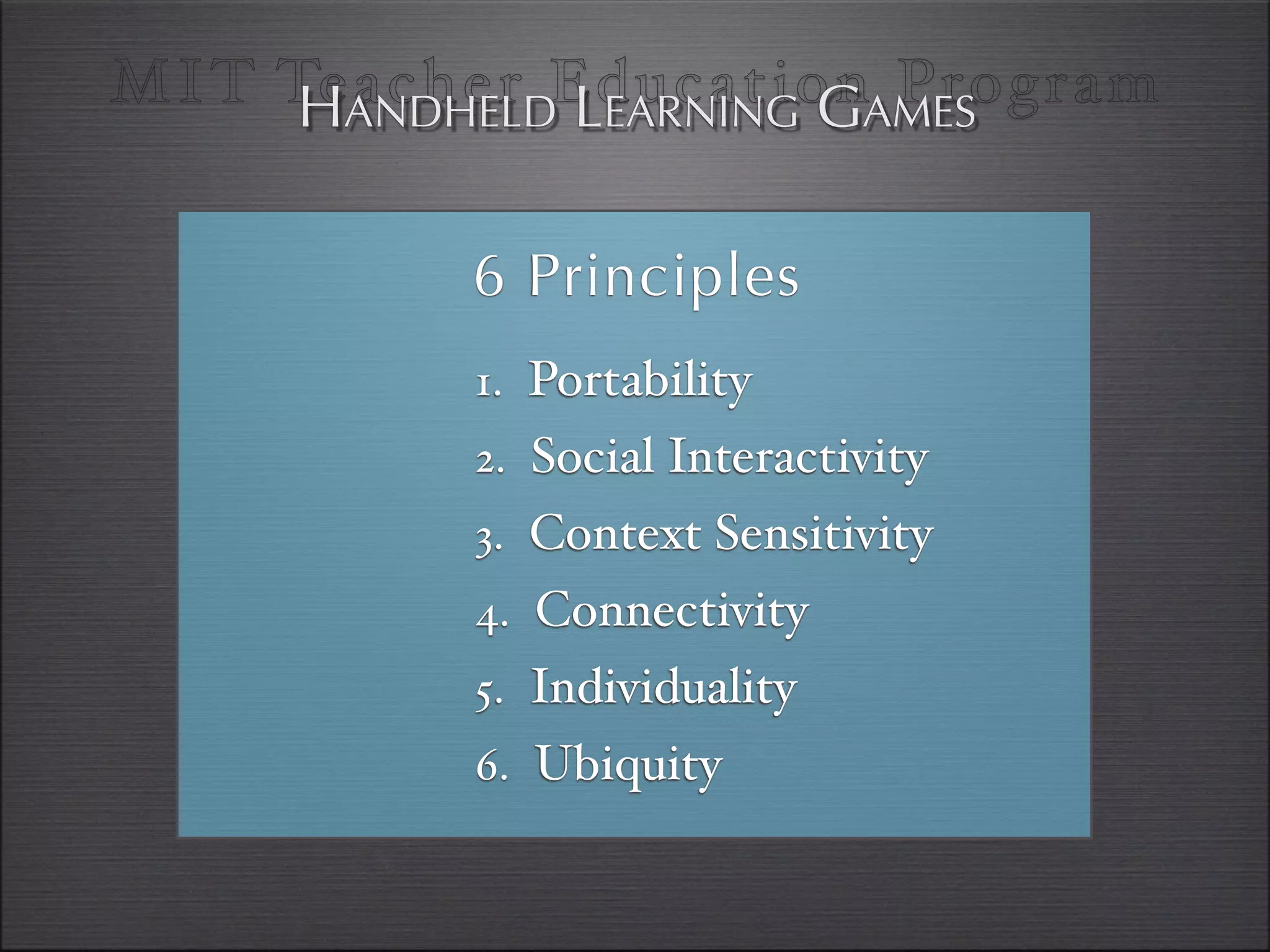
          6 Principles
          1. Portability
          2. Social Interactivity
          3. Context Sensitivity
          4. Connectivity
          5. Individuality
          6. Ubiquity
MI T Te acher Education Program
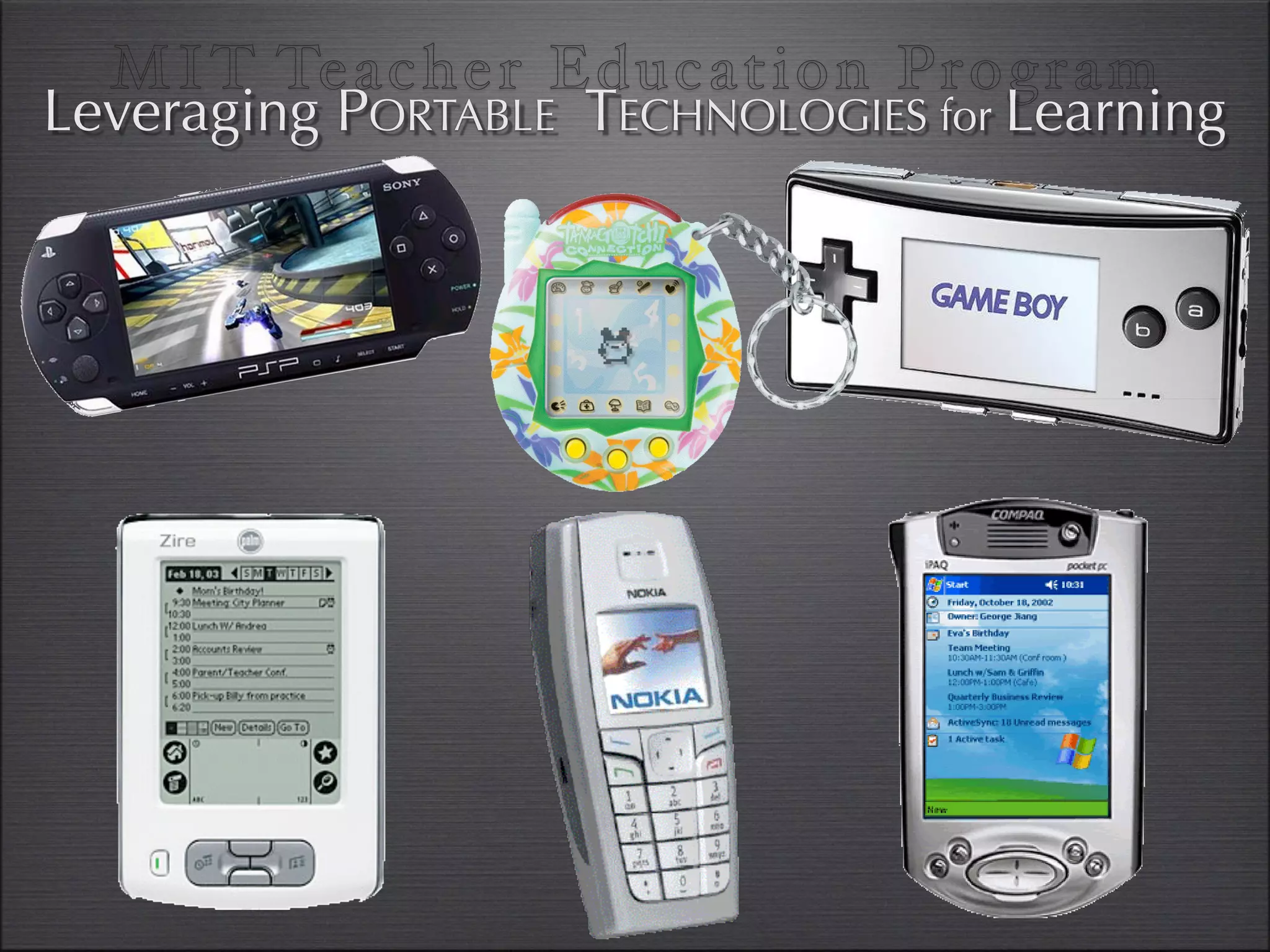
Leveraging PORTABLE TECHNOLOGIES for Learning
MI T TeANDHELDEducationAMES
       acher LEARNING G Program
     H
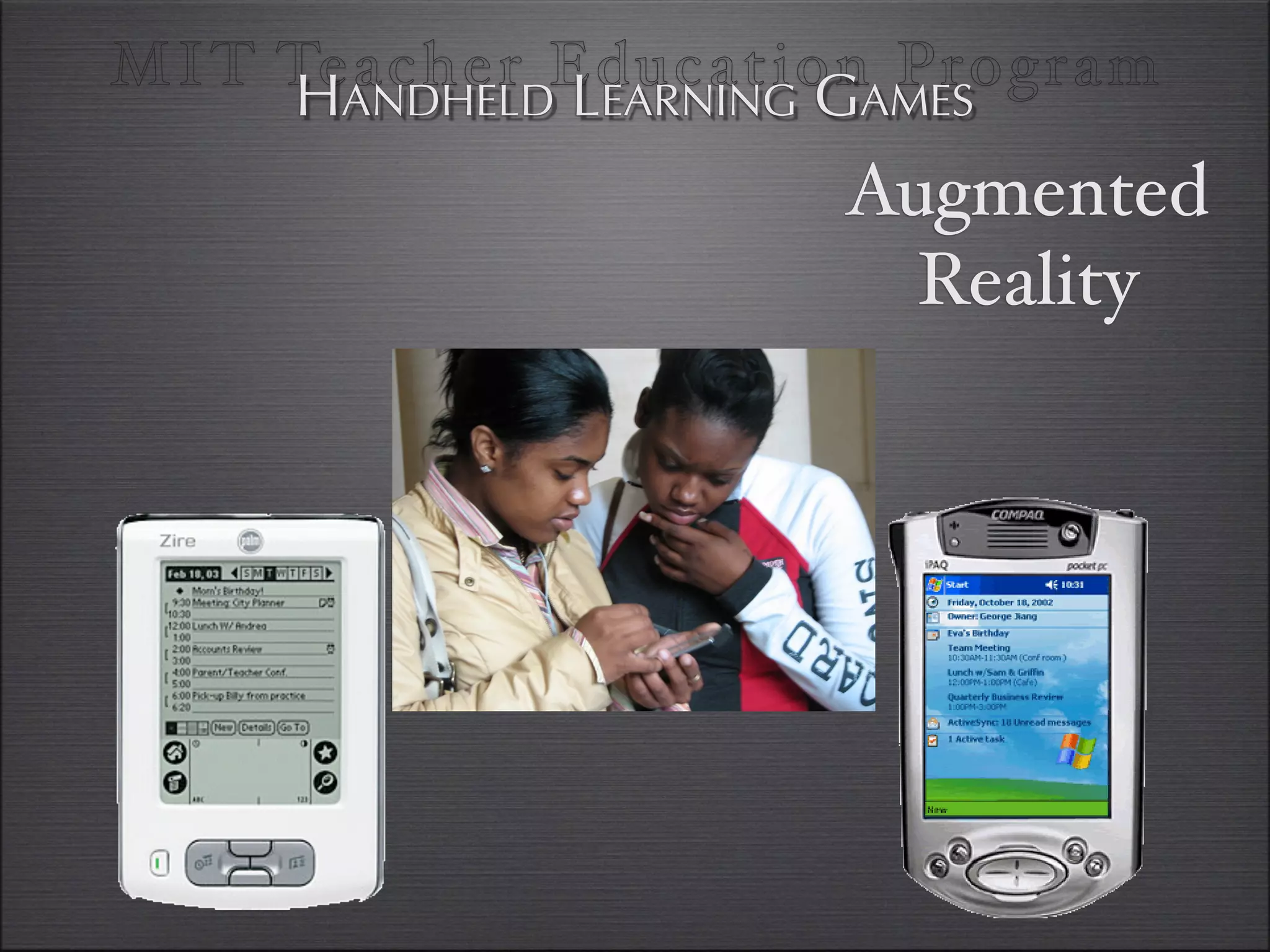
                     Augmented
                       Reality
MI T TeANDHELDEducationAMES
       acher LEARNING G Program
     H
                     Augmented
                       Reality
MI T TeANDHELDEducationAMES
       acher LEARNING G Program
     H
                     Augmented
                       Reality
MI T TeANDHELDEducationAMES
       H acher LEARNING G Program
Participatory
 Simulations


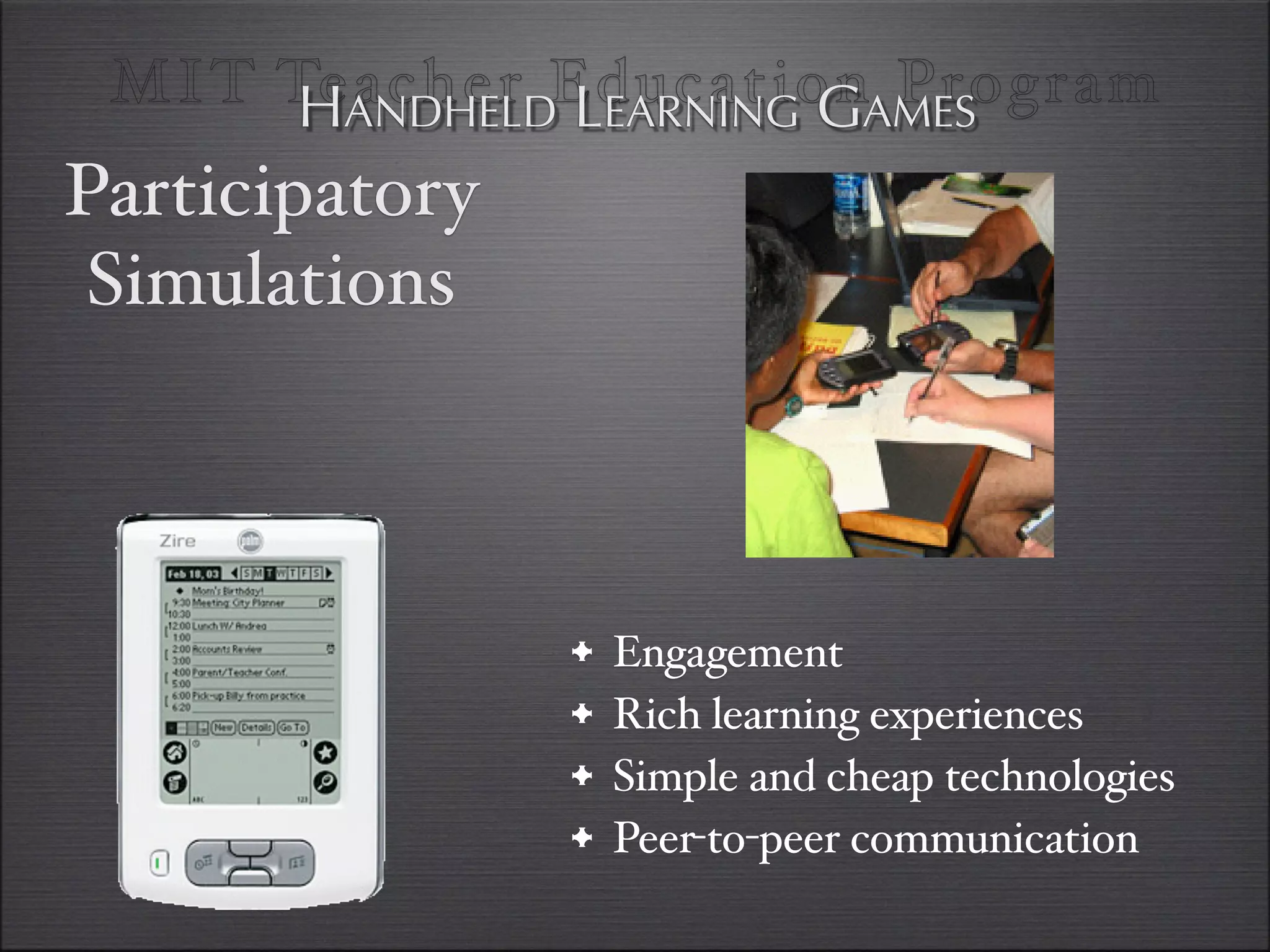
                •   Engagement
                •   Rich learning experiences
                •   Simple and cheap technologies
                •   Peer-to-peer communication
MI T TeANDHELDEducationAMES
       H acher LEARNING G Program
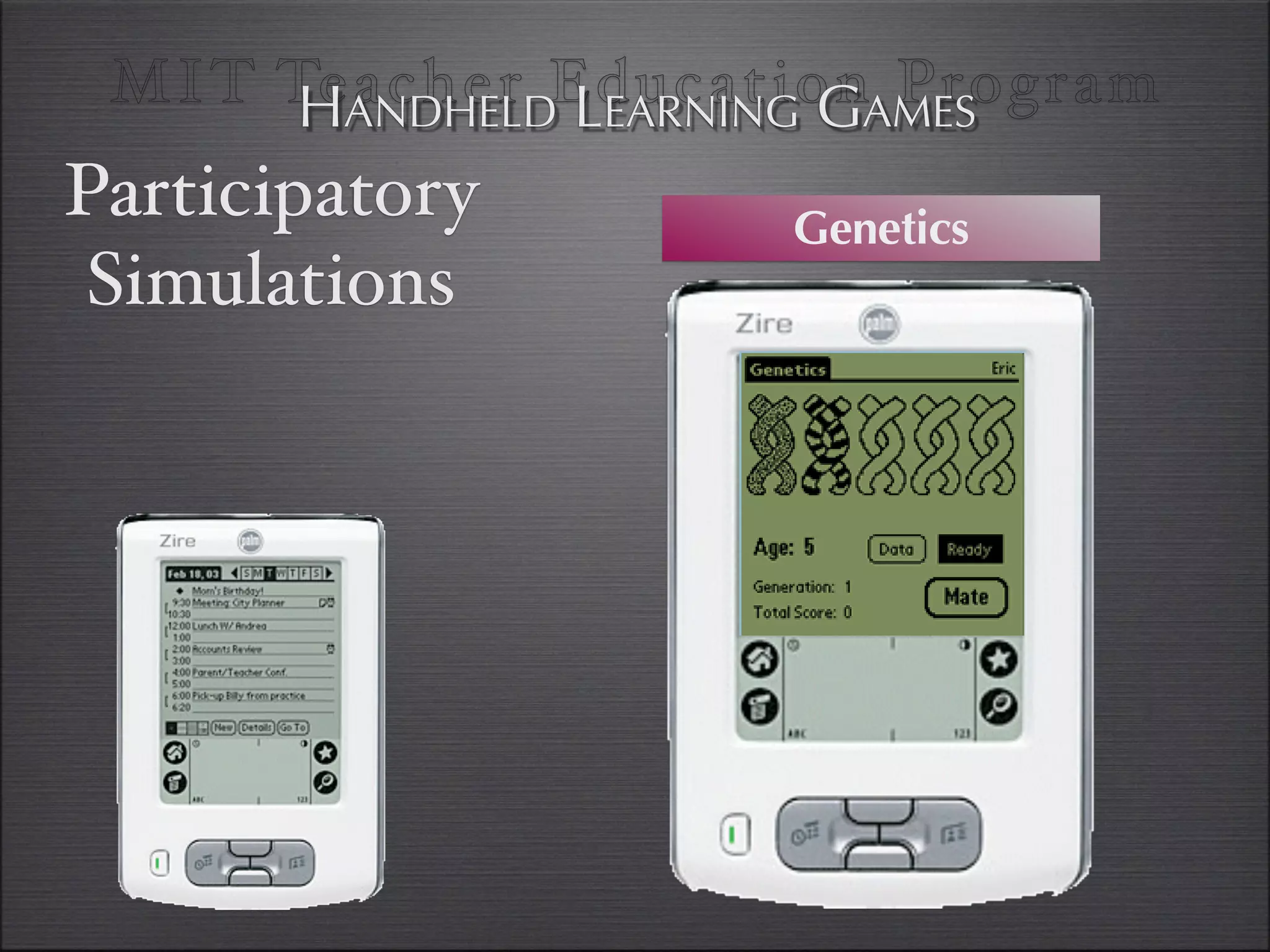
Participatory        Genetics
 Simulations
MI T TeANDHELDEducationAMES
       H acher LEARNING G Program
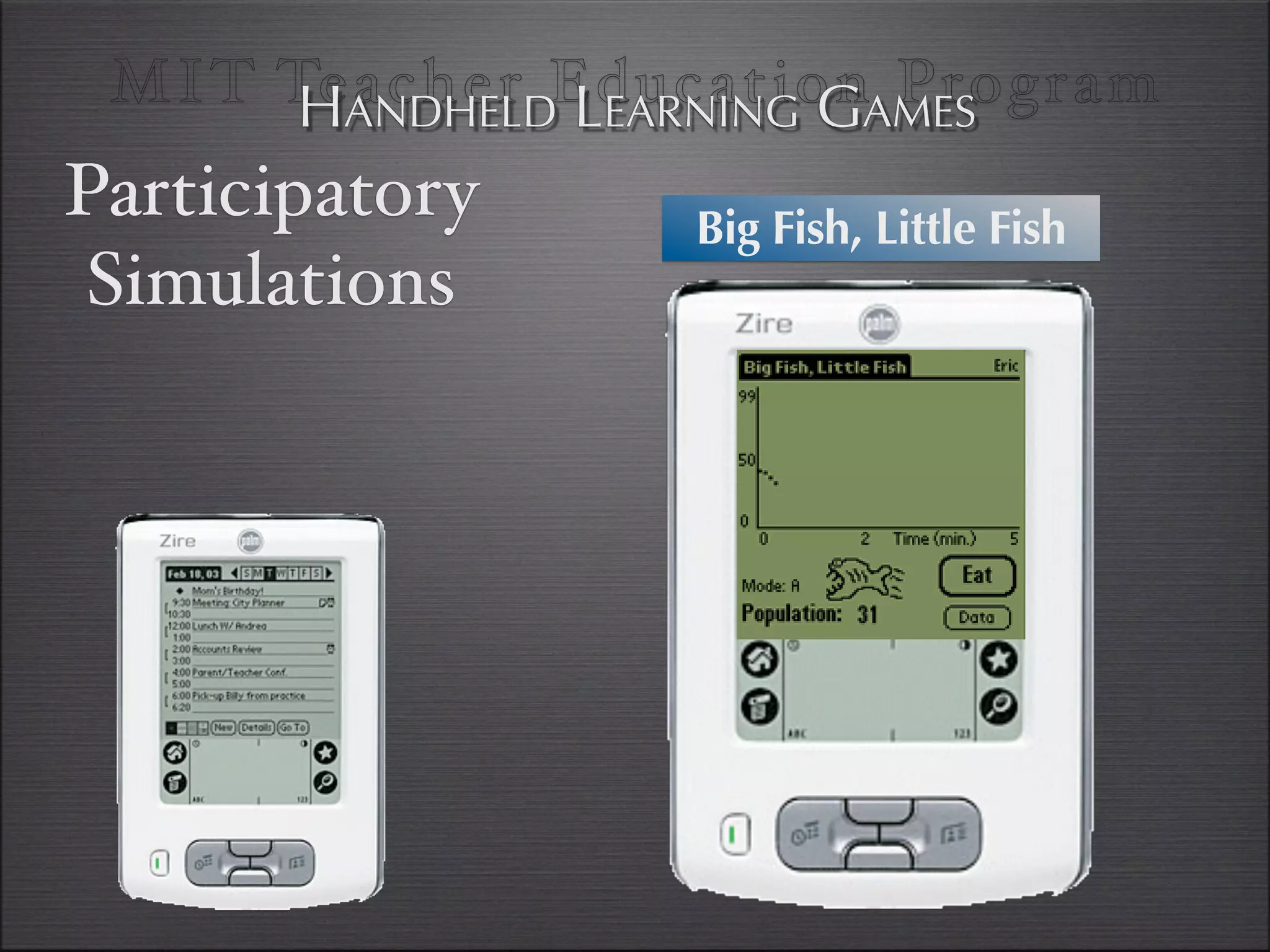
Participatory     Big Fish, Little Fish
 Simulations
MI T TeANDHELDEducationAMES
       H acher LEARNING G Program
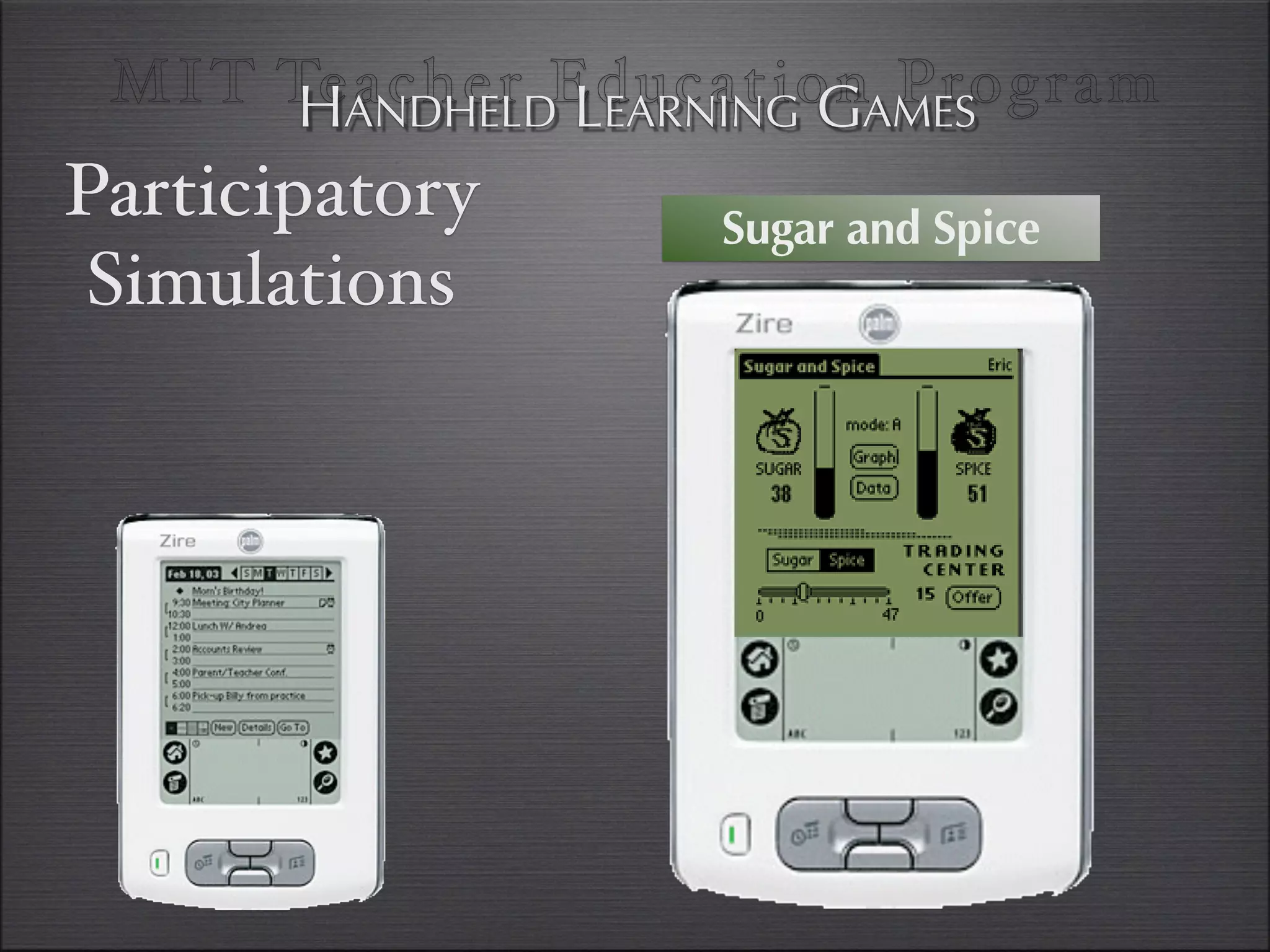
Participatory      Sugar and Spice
 Simulations
MI T TeANDHELDEducationAMES
        H acher LEARNING G Program

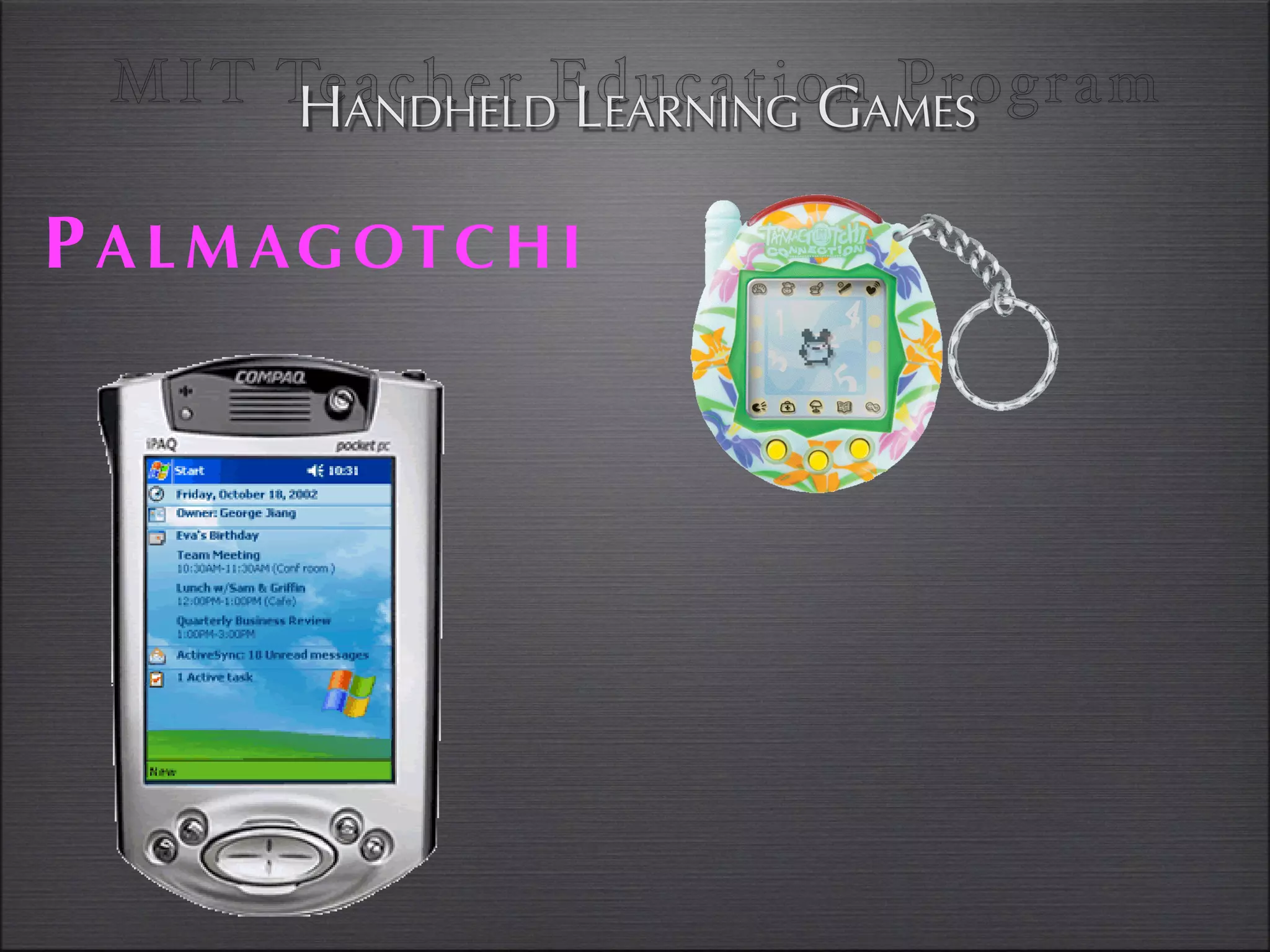
P A L M AG O T C H I
MI T TeANDHELDEducationAMES
        H acher LEARNING G Program

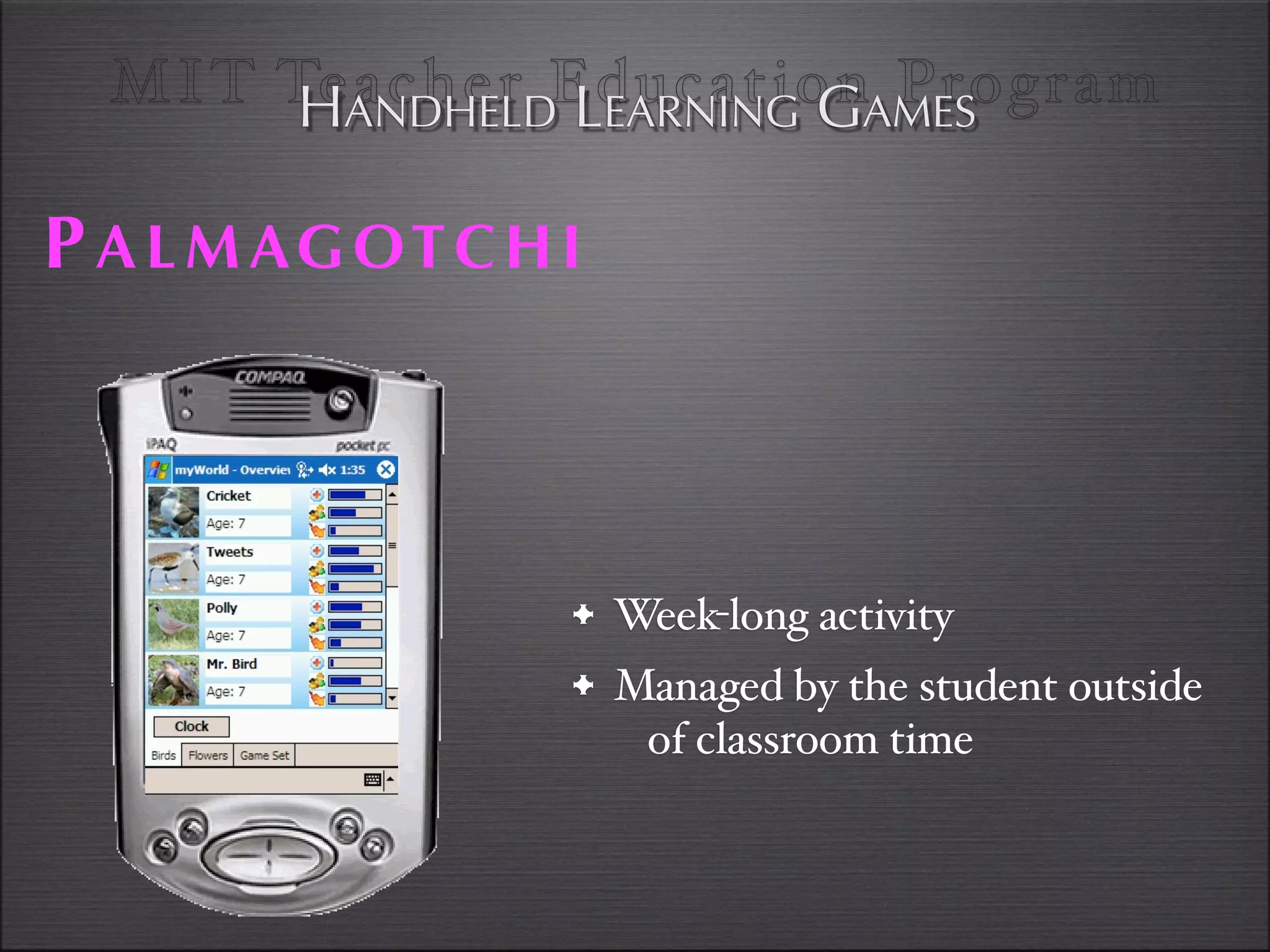
P A L M AG O T C H I


                   • Week-long activity
                   • Managed by the student outside
                       of classroom time
MI T TeANDHELDEducationAMES
         H acher LEARNING G Program
                                          Augmented
                                            Reality


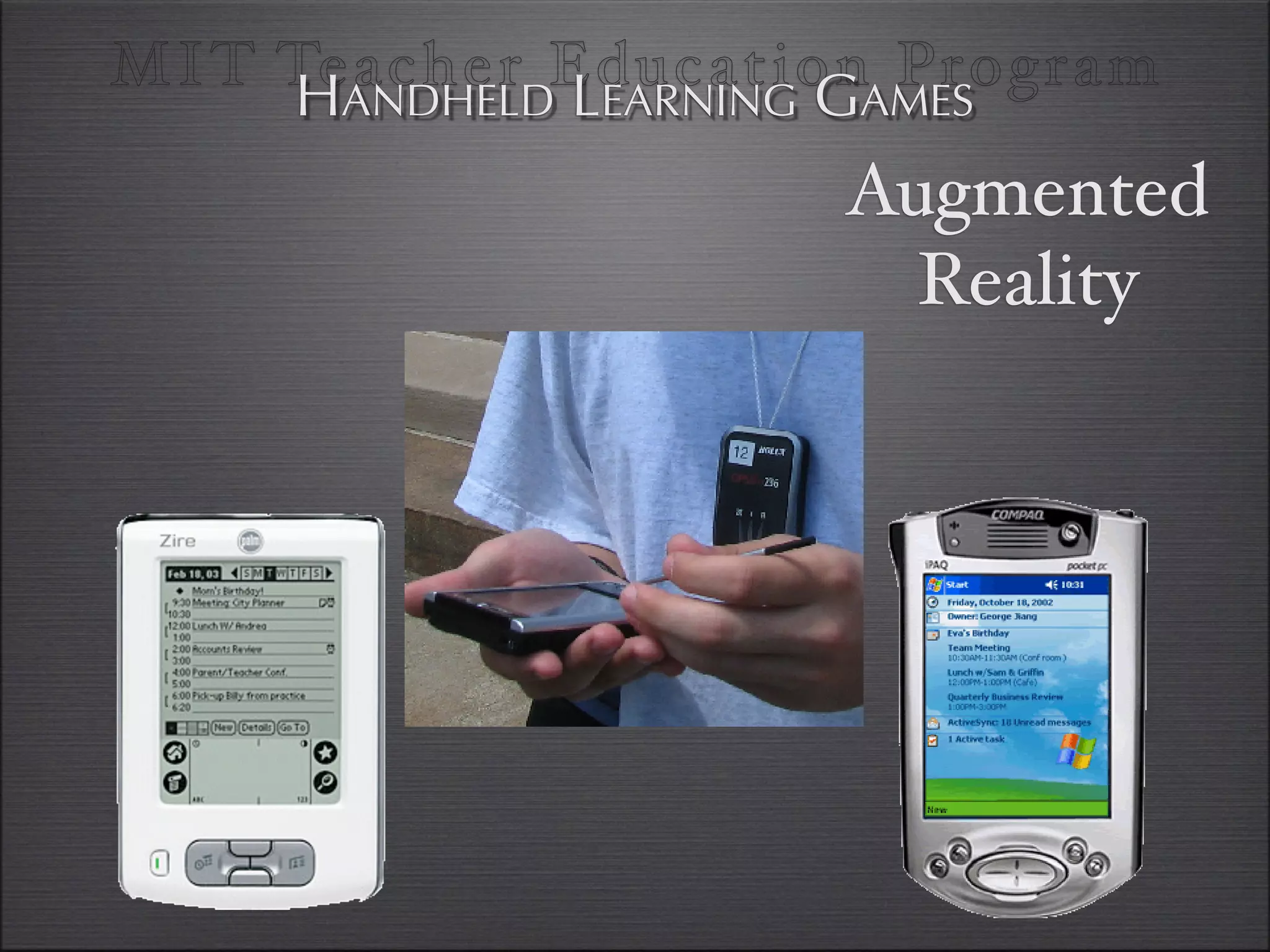
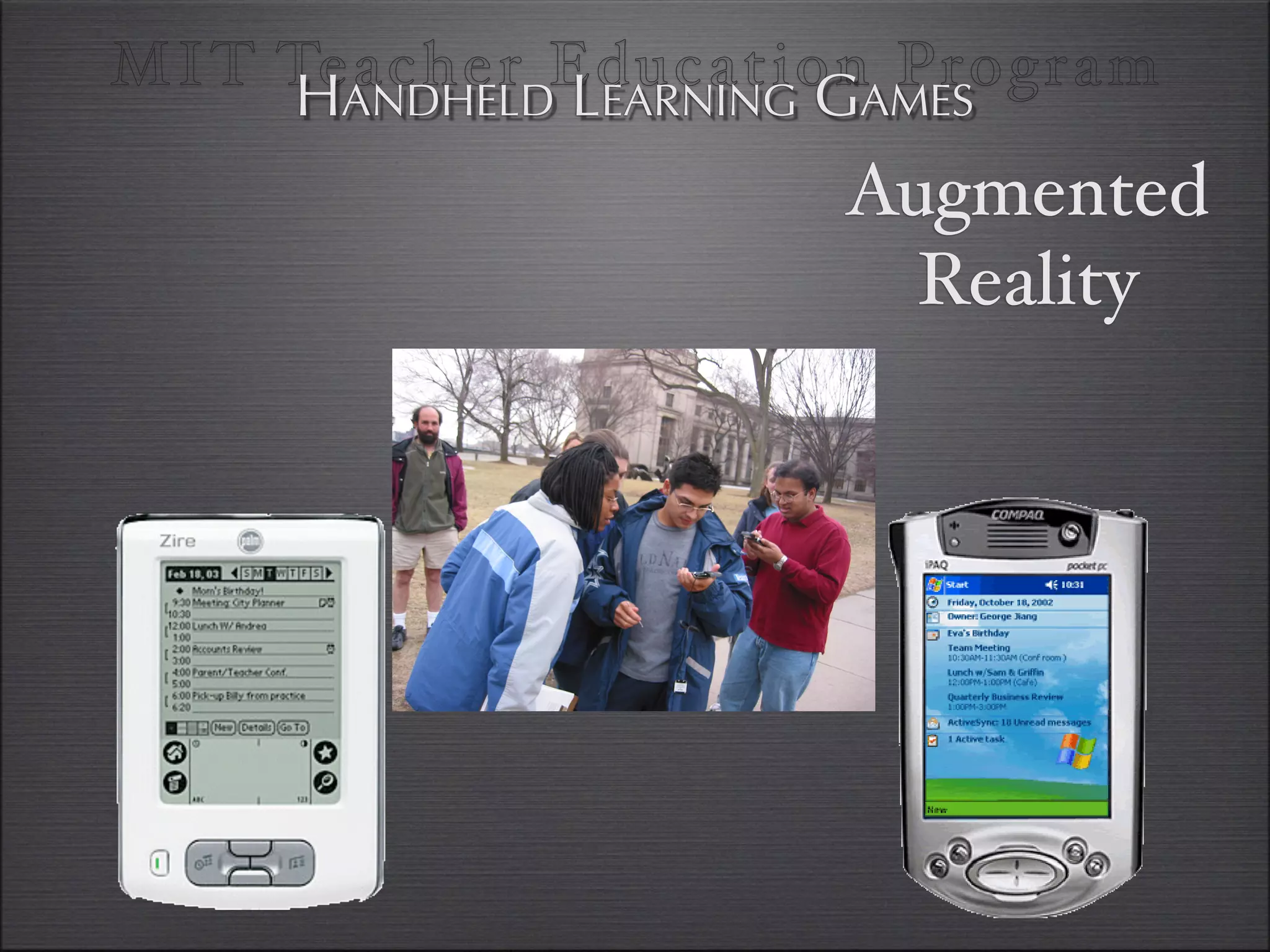
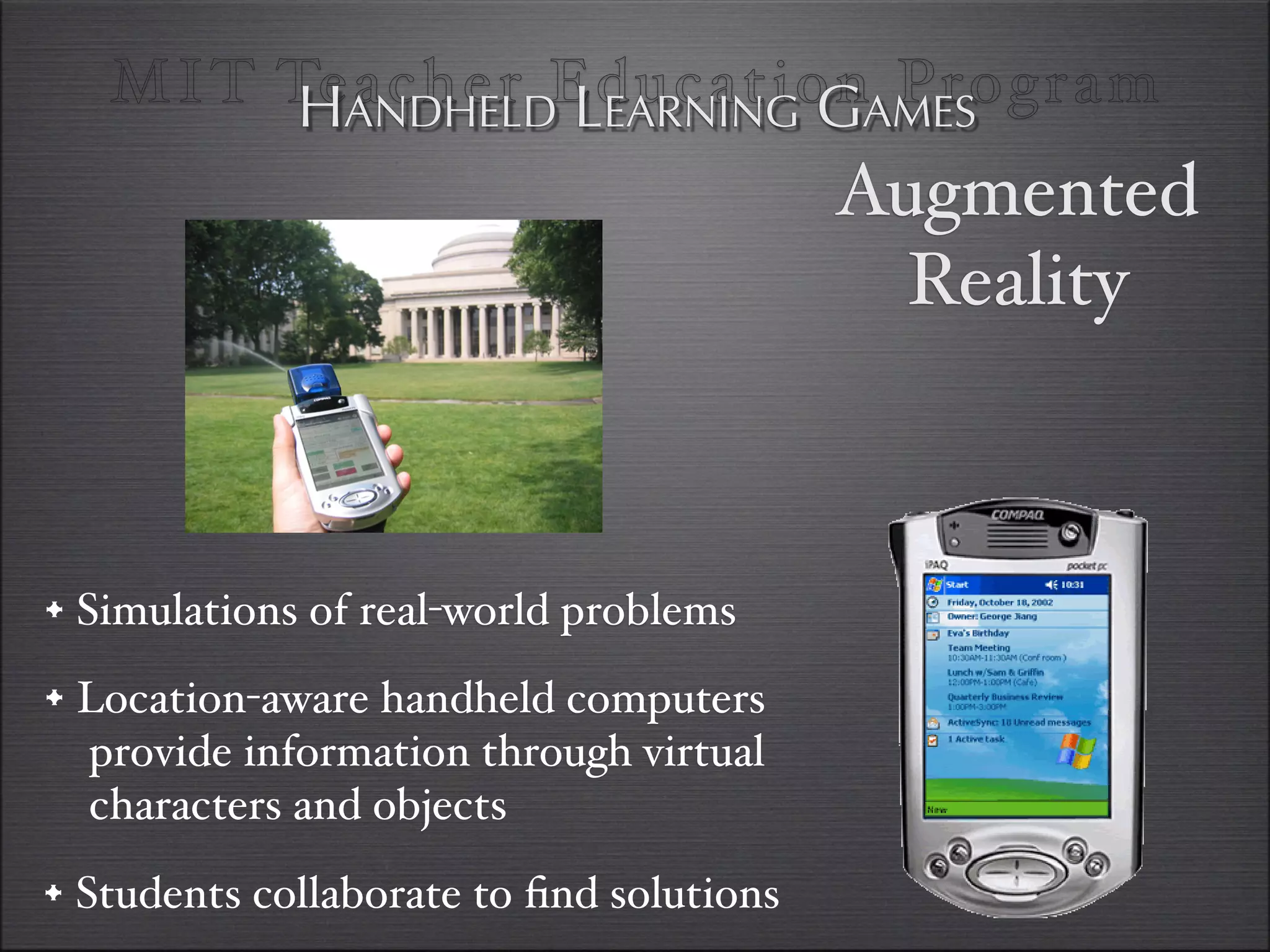
•#Simulations of real-world problems
• Location-aware handheld computers
  provide information through virtual
  characters and objects
• Students collaborate to find solutions
MI T TeANDHELDEducationAMES
       H acher LEARNING G Program
          en tal
      nm es
  viro ctiv            Augmented
En ete
  D                      Reality
MI T TeANDHELDEducationAMES
         H acher LEARNING G Program
           en tal
       nm es
   viro ctiv                                Augmented
 En ete
   D                                          Reality


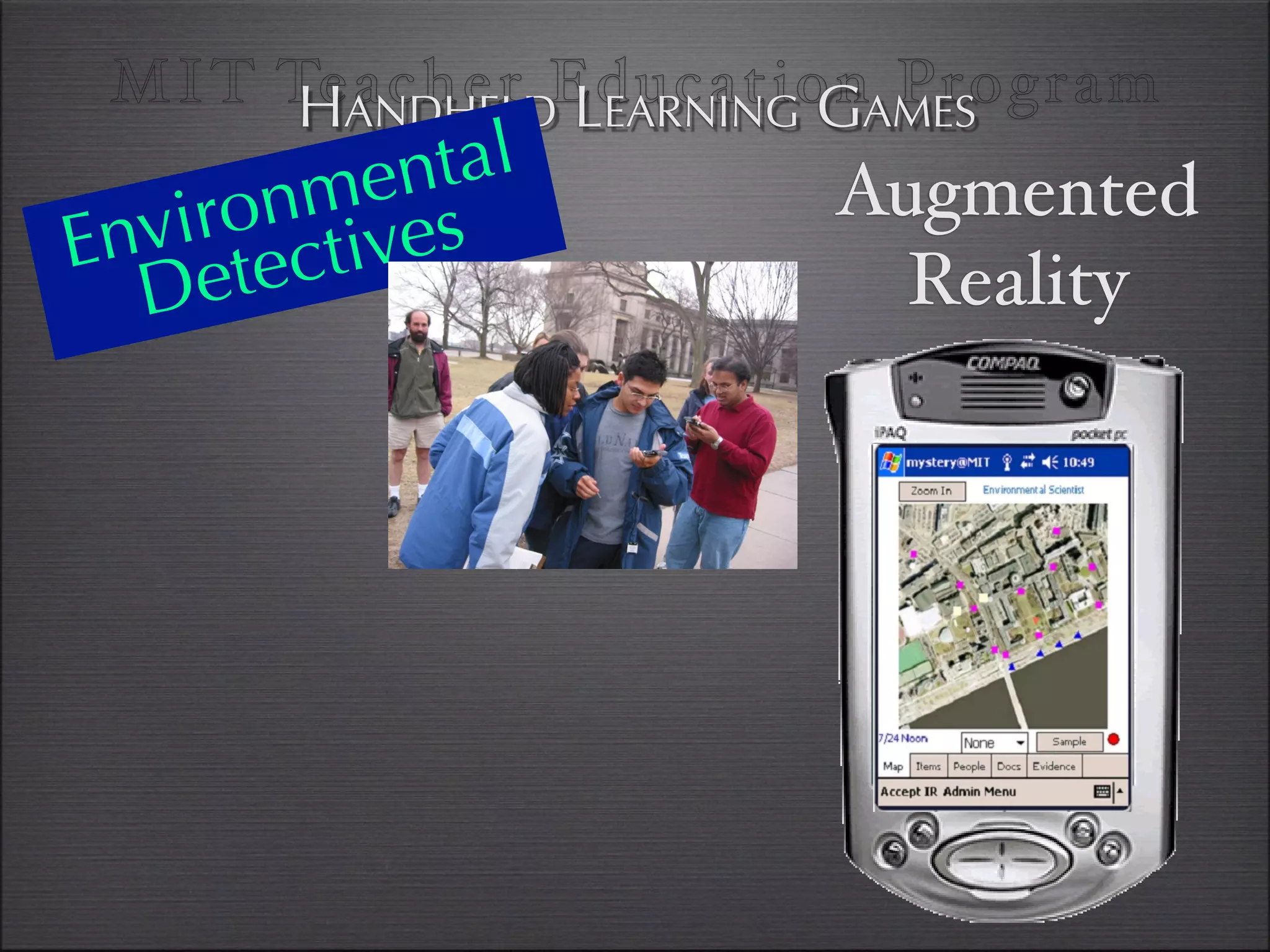
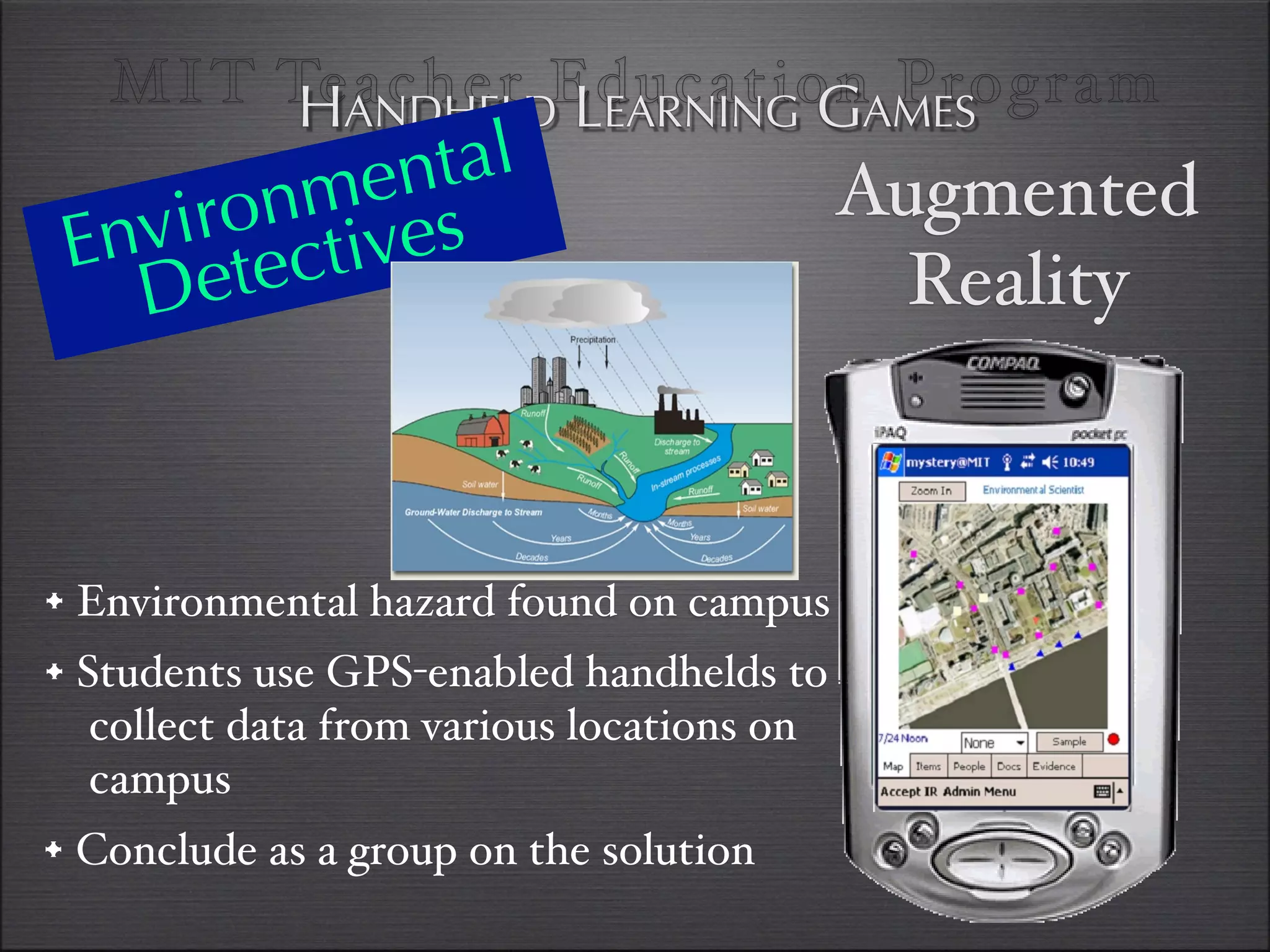
• Environmental hazard found on campus
• Students use GPS-enabled handhelds to
   collect data from various locations on
   campus
• Conclude as a group on the solution
MI T TeANDHELDEducationAMES
         H acher LEARNING G Program

              @M IT                       Augmented
    u tbr eak
O                                           Reality


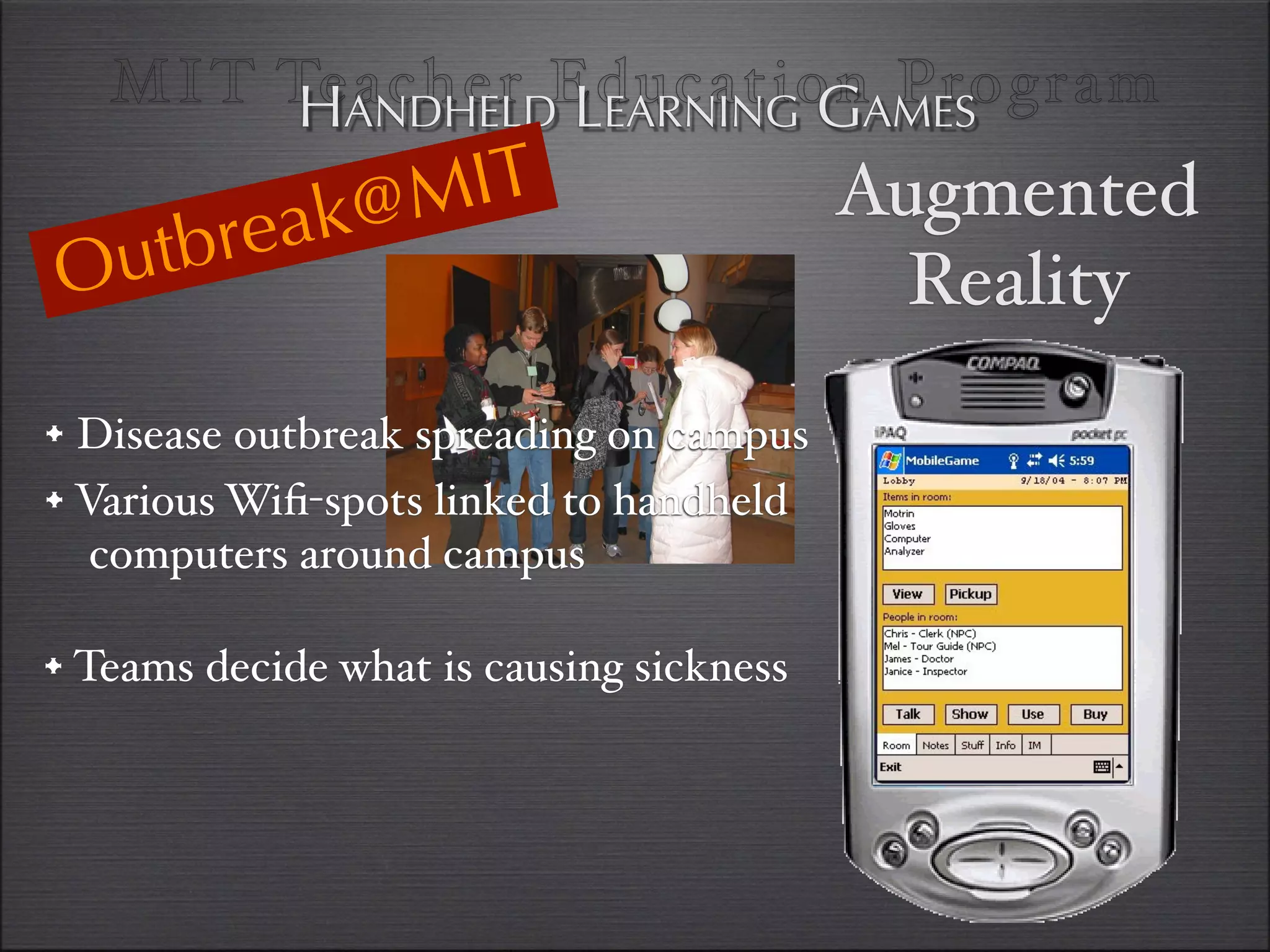
•#Simulations of real-world problems

• Location-aware handheld computers
   provide information through virtual
   characters and objects
• Students collaborate to find solutions
MI T TeANDHELDEducationAMES
         H acher LEARNING G Program

              @M IT                       Augmented
    u tbr eak
O                                           Reality
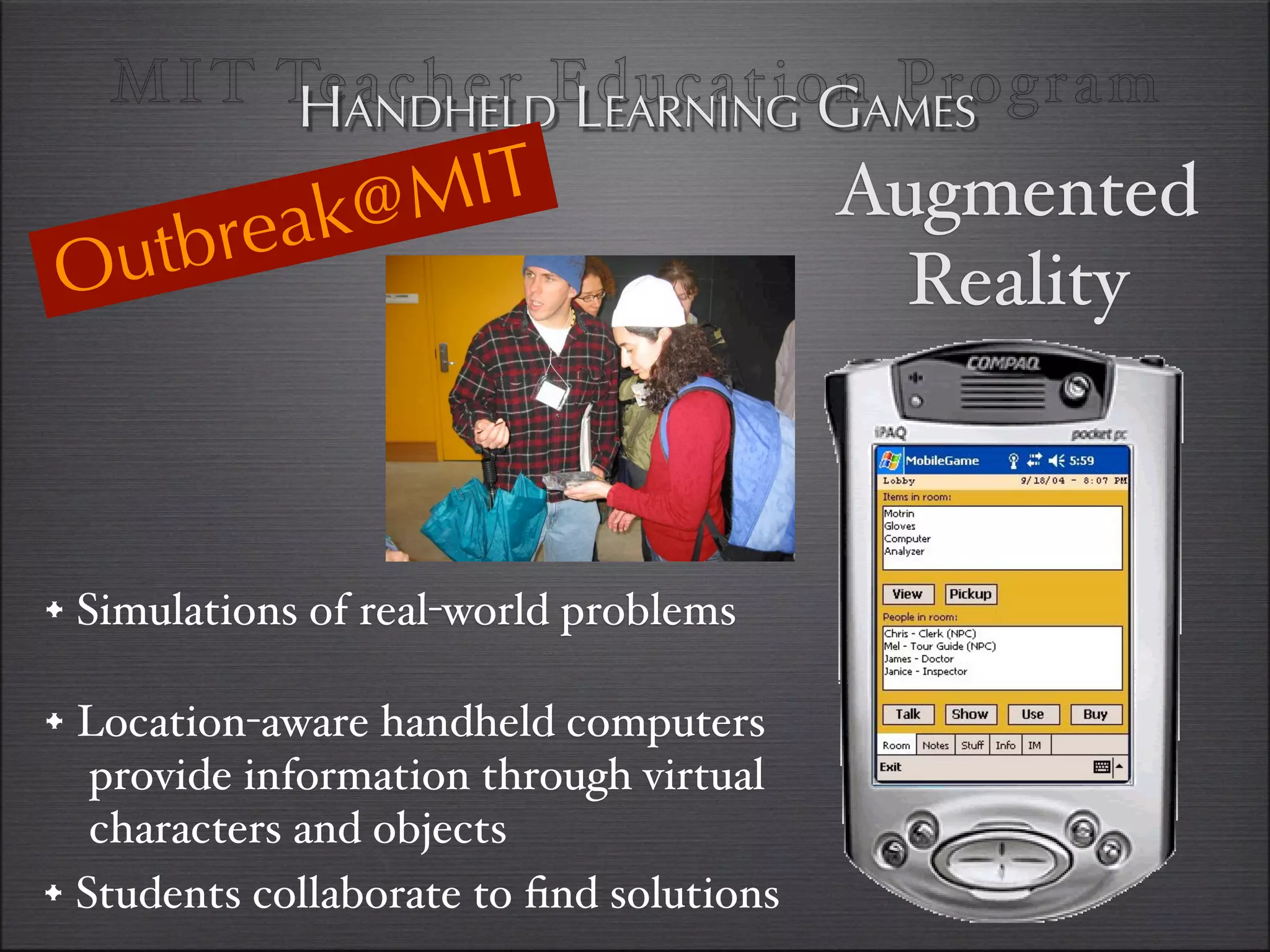
• Disease outbreak spreading on campus
• Various Wifi-spots linked to handheld
   computers around campus

• Teams decide what is causing sickness
MI T TeANDHELDEducationAMES
         H acher LEARNING G Program

  PO SIT                                  Augmented
                                            Reality


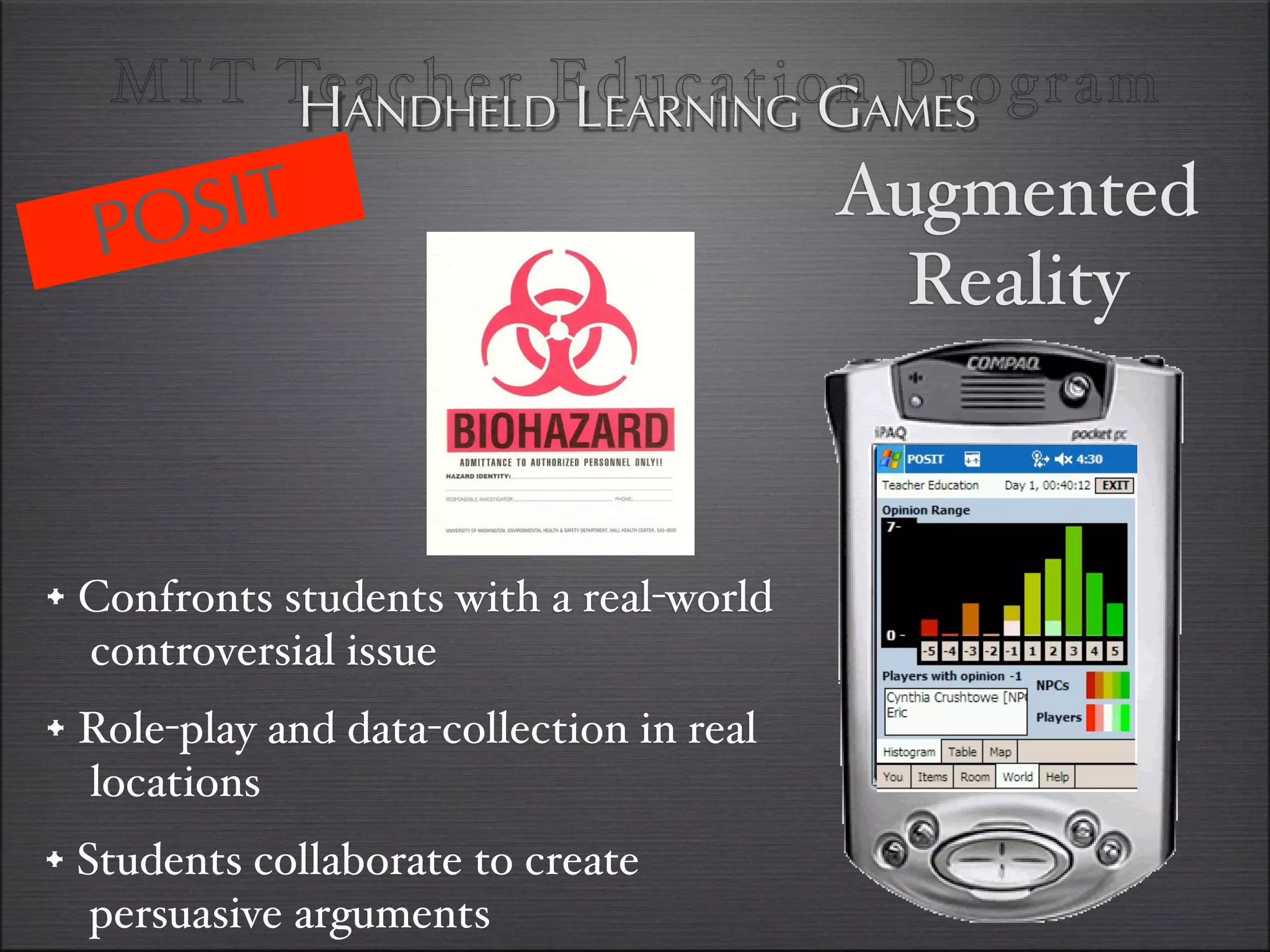
•#Confronts students with a real-world
  controversial issue
• Role-play and data-collection in real
  locations
•#Students collaborate to create
   persuasive arguments
MI T TeANDHELDEducationAMES
      H acher LEARNING G Program


           6 Principles
           1. Portability
           2. Social Interactivity
           3. Context Sensitivity
           4. Connectivity
           5. Individuality
           6. Ubiquity
Massachusetts Institute of Technology

Te ac h er Education Program

        Eric Rosenbaum, Research Manager
           eric_r@mit.edu   617.324.3652
         Jennifer Groff, Research Manager
           jgroff@mit.edu    617.452.4977

MIT-STEP

  • 1.
    Massachusetts Institute ofTechnology Te ac h er Education Program Eric Rosenbaum, Research Manager Jennifer Groff, Research Manager
  • 2.
    MI T Teacher Education Program HANDHELD LEARNING GAMES 6 Principles 1. Portability 2. Social Interactivity 3. Context Sensitivity 4. Connectivity 5. Individuality 6. Ubiquity
  • 3.
    MI T Teacher Education Program Leveraging PORTABLE TECHNOLOGIES for Learning
  • 4.
    MI T TeANDHELDEducationAMES acher LEARNING G Program H Augmented Reality
  • 5.
    MI T TeANDHELDEducationAMES acher LEARNING G Program H Augmented Reality
  • 6.
    MI T TeANDHELDEducationAMES acher LEARNING G Program H Augmented Reality
  • 7.
    MI T TeANDHELDEducationAMES H acher LEARNING G Program Participatory Simulations • Engagement • Rich learning experiences • Simple and cheap technologies • Peer-to-peer communication
  • 8.
    MI T TeANDHELDEducationAMES H acher LEARNING G Program Participatory Genetics Simulations
  • 9.
    MI T TeANDHELDEducationAMES H acher LEARNING G Program Participatory Big Fish, Little Fish Simulations
  • 10.
    MI T TeANDHELDEducationAMES H acher LEARNING G Program Participatory Sugar and Spice Simulations
  • 11.
    MI T TeANDHELDEducationAMES H acher LEARNING G Program P A L M AG O T C H I
  • 12.
    MI T TeANDHELDEducationAMES H acher LEARNING G Program P A L M AG O T C H I • Week-long activity • Managed by the student outside of classroom time
  • 13.
    MI T TeANDHELDEducationAMES H acher LEARNING G Program Augmented Reality •#Simulations of real-world problems • Location-aware handheld computers provide information through virtual characters and objects • Students collaborate to find solutions
  • 14.
    MI T TeANDHELDEducationAMES H acher LEARNING G Program en tal nm es viro ctiv Augmented En ete D Reality
  • 15.
    MI T TeANDHELDEducationAMES H acher LEARNING G Program en tal nm es viro ctiv Augmented En ete D Reality • Environmental hazard found on campus • Students use GPS-enabled handhelds to collect data from various locations on campus • Conclude as a group on the solution
  • 16.
    MI T TeANDHELDEducationAMES H acher LEARNING G Program @M IT Augmented u tbr eak O Reality •#Simulations of real-world problems • Location-aware handheld computers provide information through virtual characters and objects • Students collaborate to find solutions
  • 17.
    MI T TeANDHELDEducationAMES H acher LEARNING G Program @M IT Augmented u tbr eak O Reality • Disease outbreak spreading on campus • Various Wifi-spots linked to handheld computers around campus • Teams decide what is causing sickness
  • 18.
    MI T TeANDHELDEducationAMES H acher LEARNING G Program PO SIT Augmented Reality •#Confronts students with a real-world controversial issue • Role-play and data-collection in real locations •#Students collaborate to create persuasive arguments
  • 19.
    MI T TeANDHELDEducationAMES H acher LEARNING G Program 6 Principles 1. Portability 2. Social Interactivity 3. Context Sensitivity 4. Connectivity 5. Individuality 6. Ubiquity
  • 20.
    Massachusetts Institute ofTechnology Te ac h er Education Program Eric Rosenbaum, Research Manager eric_r@mit.edu 617.324.3652 Jennifer Groff, Research Manager jgroff@mit.edu 617.452.4977