MiniTool Partition Wizard Crack + Serial Key (2025)
➡️🌍📱👉COPY & PASTE LINK👉👉👉 https://dr-up-community.info/
MiniTool Partition Wizard Technician 2025 is a popular partition manager which allows users to create, resize, format and manage their hard disk partitions in a professional manner.
Introduction
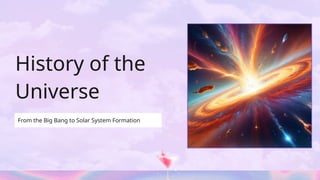
This presentation exploresthe history of the universe, starting from the Big Bang and
leading to the formation of galaxies and our solar system.
Definition and explanation
TheBig Bang is the leading explanation for the origin of the universe, proposing that it
began as an infinitely dense point around 13.8 billion years ago, rapidly expanding and
cooling to form matter, energy, and eventually galaxies and stars.
5.
Expansion of theuniverse
Following the Big Bang, the universe has continued to expand at an accelerating rate.
This expansion can be measured through the redshift of distant galaxies, indicating that
space itself is stretching as time progresses.
6.
Cosmic microwave backgroundradiation
CMBR is the remnant radiation from the Big Bang, filling the universe and providing vital
information about the early state of the universe. It is a faint glow that is consistent in all
directions, supporting the Big Bang theory.
Nucleosynthesis during BigBang
During the first few minutes after the Big Bang, conditions were suitable for nuclear
fusion, leading to the formation of the universe's first light elements: hydrogen, helium,
and trace amounts of lithium and beryllium.
9.
Formation of hydrogenand helium
Hydrogen and helium were the primary products of Big Bang nucleosynthesis,
constituting about 75% and 25% of the universe's normal matter, respectively. These
elements are the building blocks for stars and galaxies.
10.
Role of supernovaein element creation
Supernovae explosions, which occur at the end of a star’s life cycle, are crucial for the
formation of heavier elements such as carbon, oxygen, and iron. These elements are
dispersed into space, contributing to the material from which new stars and planets
form.
Initial clumping ofmatter
After the Big Bang, slight density fluctuations in the primordial plasma led to the initial
clumping of matter due to gravitational forces. This process eventually created
structures that evolved into galaxies. The density variances were crucial for the
formation of galaxies over billions of years.
13.
Types of galaxies
Galaxiesare classified into several types: spiral, elliptical, and irregular. Spiral galaxies,
like the Milky Way, have distinct arms; elliptical galaxies are more rounded and contain
older stars; irregular galaxies have no defined shape and often result from cosmic
collisions. Each type has unique characteristics influencing star formation and evolution.
14.
Evolution of galaxystructures
Over billions of years, galaxies undergo significant changes due to interactions and
mergers with other galaxies. These events can lead to the formation of new stars, the
merging of structures, and the transformation of galaxy types, affecting the overall
dynamics and composition of each galaxy over cosmic time scales.
Nebular hypothesis
The nebularhypothesis describes how the solar system formed from a rotating cloud of
gas and dust (solar nebula). As it collapsed under gravity, material formed a proto-sun at
the center while surrounding particles coalesced to form planets, moons, and other
celestial bodies over about 4.6 billion years.
17.
Accretion of planetesimals
Withinthe forming solar system, small particles collided and stuck together, forming
larger bodies known as planetesimals. These grew through further collisions and
gravitational attraction, ultimately forming planets, moons, and asteroids. This phase
was critical for the development of the celestial bodies we observe today.
18.
Formation of planetsand moons
As planetesimals coalesced, some became large enough to become planets. The
gravitational pull from these bodies attracted nearby debris, leading to the formation of
moons. The solar wind from the early Sun also played a role in shaping the composition
and atmospheres of the emerging planets.
Major events andmilestones
Key events in cosmic history include the Big Bang, formation of the first stars and
galaxies, emergence of life on Earth, and the development of complex organisms. These
milestones provide a framework for understanding the evolutionary history of the
universe and our place within it.
21.
Age of theuniverse
The universe is estimated to be 13.8 billion years old, based on measurements of cosmic
expansion and the oldest known star. Understanding the universe's age provides insight
into its evolution and the timescales of various cosmic events, including the formation of
structures and elements.
22.
Future of cosmicevolution
The future of the universe involves continued expansion, with predictions suggesting
changes in galaxy interactions, the fate of stars, and potential scenarios such as the
eventual heat death of the universe or the Big Crunch. These evolutionary paths depend
on dark energy and the mass-energy balance in the universe.
23.
Conclusions
The history ofthe universe, from the Big Bang to the formation of galaxies and our solar
system, illustrates the complex interplay of forces and events that shape cosmic
evolution. Understanding these processes helps us grasp our place in the universe and
the intricate tapestry of cosmic history.
24.
CREDITS: This presentationtemplate was created by Slidesgo, and
includes icons, infographics & images by Freepik
Thank you!
Do you have any questions?