Title of theMini - BITCOIN RATE PREDICTION USING
MACHINE LEARNING.
USN : 1RR24CS400 Name : BEERESH S
USN : 1RR24CS410 Name : RAHUL G
USN : 1RR23CS112 Name : PREM H K
USN : 1RR23CS089 Name : NIKHIL SHREEPOORN
MP
Mini Project & Activity Presentation
Course Code : BCS586
Jul / Aug / Sep / Oct / Nov 2025
Rajarajeswari College of Engineering, Bangalore, Karnataka
Department of Computer Science & Engineering
Semester : V
Mini Project
Batch No :45
Mini Project Guide
Prof.Archana A
Sec : CSE B
9-Sep-25
Dept. of CSE , RRCE
1
HoD
Dr. Kirubha D.
2.
Overview / Flowof the presentation
1.Introduction.
2.Motivation obtained to do the project.
3.Aim of the Project work & Problem Statement with Objectives.
4.Literature Review.
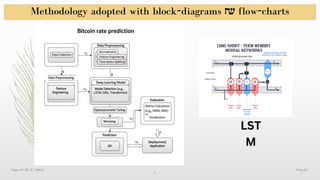
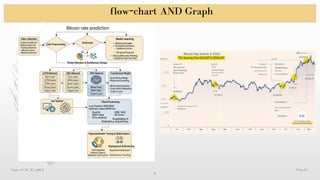
5.Methodology adopted with Block-Diagrams & Flow- Charts.
6.H/w and S/w tools used.
7.References.
9-Sep-25
Dept. of CSE (IC), RRCE
2
3.
Introduction
9-Sep-25
3
Dept. of CSE(IC), RRCE
WHAT IS BITCOIN?
• Bitcoin (BTC) is a cryptocurrency (a virtual currency) designed to act as money and a form of
payment outside the control of any one person, group, or entity. This removes the need for trusted
third-party involvement (e.g., a mint or bank) in financial transactions.
• Bitcoin is a decentralized digital currency that operates on a technology called blockchain. It was
created in 2009 by an anonymous entity known as Satoshi Nakamoto.
• All Bitcoin transactions are recorded on a public, distributed ledger called the blockchain.
• Think of the blockchain as a long, unbreakable chain of "blocks, " where each block
contains a record of transactions.
• Unlike traditional currencies (like the US dollar or Euro) which are controlled by a
central bank or government, Bitcoin operates on a peer-to-peer network.
4.
Aim of theProject work Problem Statement with Objectives
9-Sep-25
4
Dept. of CSE (IC), RRCE
• The elaborate aim is to build a sophisticated deep learning model that can predict the future price of Bitcoin by analyzing
its complex, non-linear, and highly volatile historical data.
• This project goes beyond simple statistical methods by leveraging deep learning's ability to identify intricate patterns and
long-term dependencies in time-series data
• The first step is to collect comprehensive historical data. This isn't limited to just the Bitcoin price (Open, High,
Low, Close) and volume, but also includes a variety of relevant indicators.
• The core of the project is the deep learning model itself. Given the sequential nature of financial
data, the aim is to use architectures specifically designed for time-series forecasting
5.
Literature Review
9-Sep-25
5
Dept. ofCSE (IC), RRCE
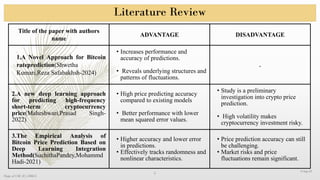
Title of the paper with authors
name
ADVANTAGE DISADVANTAGE
1.A Novel Approach for Bitcoin
rateprediction(Shwetha
Kumari,Reza Safabakhsh-2024)
• Increases performance and
accuracy of predictions.
• Reveals underlying structures and
patterns of fluctuations.
-
2.A new deep learning approach
for predicting high-frequency
short-term cryptocurrency
price(Maheshwari,Prasad Singh-
2022)
• High price predicting accuracy
compared to existing models
• Better performance with lower
mean squared error values.
• Study is a preliminary
investigation into crypto price
prediction.
• High volatility makes
cryptocurrency investment risky.
3.The Empirical Analysis of
Bitcoin Price Prediction Based on
Deep Learning Integration
Method(SuchithaPandey,Mohammd
Hadi-2021)
• Higher accuracy and lower error
in predictions.
• Effectively tracks randomness and
nonlinear characteristics.
• Price prediction accuracy can still
be challenging.
• Market risks and price
fluctuations remain significant.
6.
Literature Review
9-Sep-25
6
Dept. ofCSE (IC), RRCE
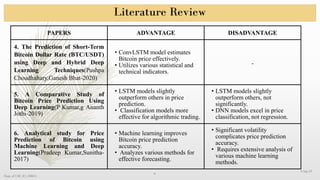
PAPERS ADVANTAGE DISADVANTAGE
4. The Prediction of Short-Term
Bitcoin Dollar Rate (BTC/USDT)
using Deep and Hybrid Deep
Learning Techniques(Pushpa
Choudhahary,Ganesh Bhat-2020)
• ConvLSTM model estimates
Bitcoin price effectively.
• Utilizes various statistical and
technical indicators.
-
5. A Comparative Study of
Bitcoin Price Prediction Using
Deep Learning(P Kumar,g Ananth
Jothi-2019)
• LSTM models slightly
outperform others in price
prediction.
• Classification models more
effective for algorithmic trading.
• LSTM models slightly
outperform others, not
significantly.
• DNN models excel in price
classification, not regression.
6. Analytical study for Price
Prediction of Bitcoin using
Machine Learning and Deep
Learning(Pradeep Kumar,Sunitha-
2017)
• Machine learning improves
Bitcoin price prediction
accuracy.
• Analyzes various methods for
effective forecasting.
• Significant volatility
complicates price prediction
accuracy.
• Requires extensive analysis of
various machine learning
methods.
Software tools used
9-Sep-25
Dept.of EEE, RRCE
9
• python: Python is the industry standard for data science and machine learning due to its simple syntax,
extensive community support, and a vast collection of specialized libraries.
• Pandas: This is a fundamental library used for data manipulation and analysis. It provides powerful data
structures like DataFrames, which are perfect for handling the time-series data of Bitcoin's price,
volume, and other indicators.
• NumPy: A foundational library for numerical computing in Python. It provides support for large,
multidimensional arrays and matrices, along with a collection of mathematical functions to operate on
these arrays, which is crucialfor handling the numerical data required by deep learning models.
10.
Hardware tools used
9-Sep-25
Dept.of EEE, RRCE
10
• Graphics Processing Unit (GPU) This is the most critical piece of hardware for a deep learning project. While a
CPU can perform the necessary calculations, a GPU is designed for massive parallel processing, which is what
training a neural network requires, rec: RTX 3060 (12 GB VRAM) or RTX 3070 (8 GB VRAM) is a solid starting
point.
• Central Processing Unit (CPU) The CPU handles tasks that are not suited for parallelization, such as data
preprocessing, loading data from storage, and managing the overall system. While the GPU does the heavy lifting, a
fast CPU is still important to avoid bottlenecks.
• Random Access Memory (RAM System RAM is used to hold the data before it is loaded into the GPU' s VRAM
for training. It' s also used for all general computing tasks
11.
References
9-Sep-25
12
Dept. of CSE(IC), RRCE
[1] G. Solomon, “Project-Based learning: A Primer, ” Technology Learning, volume 23, Jan. 2003.
[2] M. Hedley, “An undergraduate microcontroller systems laboratory, ” IEEE Transactions in Education, vol. 41(4), pp.
345–353, Nov. 1998.
[3] H. Markkanen, G. Donzellini, and D. Ponta, “NetPro: Methodologies and tools for project based learning in internet, ”
in Proceedins of World Conference on Educational Multimedia, pp. 1230–1235.
[4] D. Ponta, G. Donzellini, and H. Markkanen, “NetPro: Network based project learning in internet, ” in Proceedings of
European Symposium of Intelligent Technologies, pp. 703–708, 2002.
[5] S. A. Ambrose and C. H. Amon, “Systematic design of a first-year mechanical engineering course at Carnegie-Mellon
University, ” Journal of Engineering Education, vol. 86, pp. 173–182, Apr. 1997.
[6] “Vocabulary - Bitcoin.” [Online]. Available: https://bitcoin.org/en/vocabulary#btc.
[7] “PayPal.” [Online]. Available: http://en.wikipedia.org/wiki/PayPal.
[8] Nakamoto, S. (2008). Bitcoin: A peer-to-peer electronic cash system. https://bitcoin.org/bitcoin.pdf
[9] Harvey, C. (2014). Bitcoin myths and facts. Working paper, Duke University. Available at
http://ssrn.com/abstract=2479670
[10] Athey, S., I. Parashkevov, V. Sarukkai, and J. Xia (2016). Bitcoin pricing, adoption, and usage: Theory and evidence.
Working paper, Stanford University.
[11] Pagnotta, E. and A. Buraschi (2018). An equilibrium valuation of bitcoin and decentralized network assets. Available
at SSRN: https://ssrn.com/abstract=3142022.
[12] Raskin, M. and D. Yermack (2016). Digital currencies, decentralized ledgers, and the future of central banking.
Working paper, National Bureau of Economic Research.
[13] Yermack, D. (2017). Corporate governance and blockchains. Review of Finance 21(1), 7–31.
[14] Huberman, G., J. D. Leshno, and C. C. Moallemi (2017). Monopoly without a monopolist: An economic analysis of
the bitcoin payment system. Columbia Business School Research Paper No. 17-92.
[15] Harvey, C. (2016). Cryptofinance. Working paper, Duke University. http://ssrn.com/abstract=2438299.

![References
9-Sep-25
12
Dept. of CSE (IC), RRCE
[1] G. Solomon, “Project-Based learning: A Primer, ” Technology Learning, volume 23, Jan. 2003.
[2] M. Hedley, “An undergraduate microcontroller systems laboratory, ” IEEE Transactions in Education, vol. 41(4), pp.
345–353, Nov. 1998.
[3] H. Markkanen, G. Donzellini, and D. Ponta, “NetPro: Methodologies and tools for project based learning in internet, ”
in Proceedins of World Conference on Educational Multimedia, pp. 1230–1235.
[4] D. Ponta, G. Donzellini, and H. Markkanen, “NetPro: Network based project learning in internet, ” in Proceedings of
European Symposium of Intelligent Technologies, pp. 703–708, 2002.
[5] S. A. Ambrose and C. H. Amon, “Systematic design of a first-year mechanical engineering course at Carnegie-Mellon
University, ” Journal of Engineering Education, vol. 86, pp. 173–182, Apr. 1997.
[6] “Vocabulary - Bitcoin.” [Online]. Available: https://bitcoin.org/en/vocabulary#btc.
[7] “PayPal.” [Online]. Available: http://en.wikipedia.org/wiki/PayPal.
[8] Nakamoto, S. (2008). Bitcoin: A peer-to-peer electronic cash system. https://bitcoin.org/bitcoin.pdf
[9] Harvey, C. (2014). Bitcoin myths and facts. Working paper, Duke University. Available at
http://ssrn.com/abstract=2479670
[10] Athey, S., I. Parashkevov, V. Sarukkai, and J. Xia (2016). Bitcoin pricing, adoption, and usage: Theory and evidence.
Working paper, Stanford University.
[11] Pagnotta, E. and A. Buraschi (2018). An equilibrium valuation of bitcoin and decentralized network assets. Available
at SSRN: https://ssrn.com/abstract=3142022.
[12] Raskin, M. and D. Yermack (2016). Digital currencies, decentralized ledgers, and the future of central banking.
Working paper, National Bureau of Economic Research.
[13] Yermack, D. (2017). Corporate governance and blockchains. Review of Finance 21(1), 7–31.
[14] Huberman, G., J. D. Leshno, and C. C. Moallemi (2017). Monopoly without a monopolist: An economic analysis of
the bitcoin payment system. Columbia Business School Research Paper No. 17-92.
[15] Harvey, C. (2016). Cryptofinance. Working paper, Duke University. http://ssrn.com/abstract=2438299.](https://image.slidesharecdn.com/minipro21-250925153352-e66b51fc/85/Mini-Pro-2-1-pdfbbbbbbbhbhbhbjbbhhhbbh-11-320.jpg)



![Mini Project Final Presentation Template [Autosaved].ppt](https://cdn.slidesharecdn.com/ss_thumbnails/miniprojectfinalpresentationtemplateautosaved-251206074050-2337e704-thumbnail.jpg?width=640&height=640&fit=bounds)


