MINERAL PROCESSING
4.0 Grinding
Learning outcomes
have a knowledge and understanding of;
 factors influencing operation & be able to quantify
the effect of these factors, if possible
 the function of classification equipment in close-
circuit grinding
 the effect of the separation efficiency of the
classification equipment on mill performance &
subsequent processing
 Different mill types available
grinding
 is the final stage of comminution
 is performed in rotating cylindrical
vessels known as tumbling mills
 mills contain grinding media which are
large, hard & heavy vs ore particles
 usually performed wet although dry
process is possible
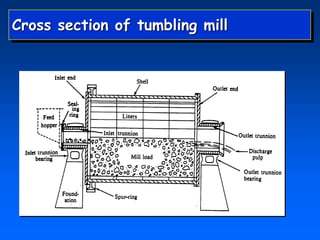
Cross section of tumbling mill
Drive System
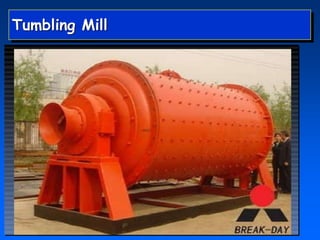
Tumbling Mill
Liners
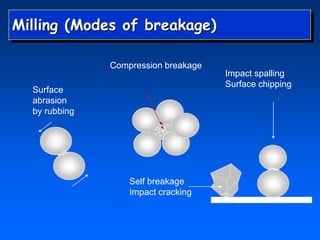
Milling (Modes of breakage)
Compression breakage
Surface
abrasion
by rubbing
Self breakage
Impact cracking
Impact spalling
Surface chipping
mill speed
Definition
Critical mill speed
 Speed at which charge starts to centrifuge
 nc = 42.3/(D-d)0.5
with nc in rpm
D = mill diameter
d = particle diameter
Charge volume
 Definition
 percentage of the cross sectional area
of the mill occupied by balls/rods and
their interstices
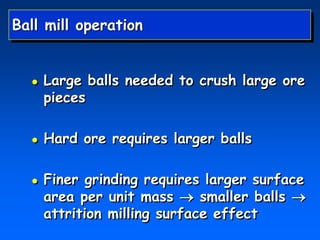
Ball mill operation
 Large balls needed to crush large ore
pieces
 Hard ore requires larger balls
 Finer grinding requires larger surface
area per unit mass  smaller balls 
attrition milling surface effect
Ball mill operation
 Usually used in closed-circuit grinding
Ball mill operation
Closed-circuit grinding
 prevent over grinding
 increase throughput
 Usually 250% circulating load
 circulating load = mass of solids in class underflow * 100
mass of solids in feed
Ball mill operation
 Slurry density
 Viscous enough to cover balls
 If H2O is increased
 reduces number of smaller particles to
be milled
 reduces number of effective impacts
 Even more H2O - slurry not viscous
enough to cover balls - power draw
decreases
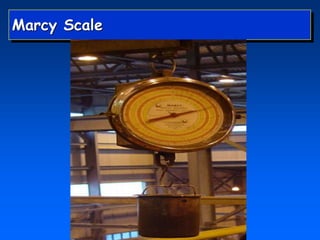
Marcy Scale
Ball milling
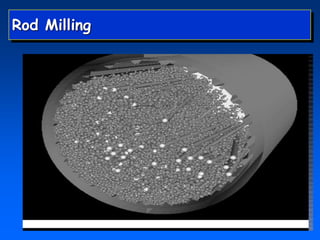
Rod Milling
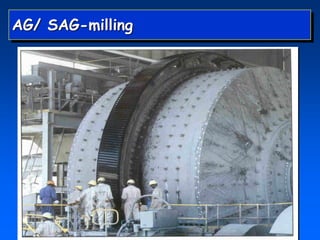
AG/ SAG-milling
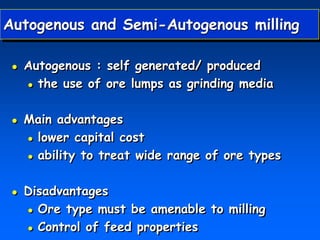
Autogenous and Semi-Autogenous milling
 Autogenous : self generated/ produced
 the use of ore lumps as grinding media
 Main advantages
 lower capital cost
 ability to treat wide range of ore types
 Disadvantages
 Ore type must be amenable to milling
 Control of feed properties
Autogenous and Semi-Autogenous milling
 Key variables
 Feed size
 Ore hardness
 Mill speed
 Ball size (SAG)
 Ball loading (SAG)
Autogenous and Semi-Autogenous milling
Feed size
 Grinding media comes from ore
 change in feed size distribution 
change in grinding size distribution
Autogenous and Semi-Autogenous milling
Feed size
AG-milling
 large enough rocks for impact breaking
of smaller sizes
 In general AG mill performs better with
coarser feeds
Autogenous and Semi-Autogenous milling
Feed size
SAG mills
 no need for large rocks for impact
breaking
 big rocks become burden
 Feed size impact greater on AG-
milling than SAG-milling
Autogenous and Semi-Autogenous milling
Ore hardness
 Harder ore requires coarser feed
size
 AG milling
 Too soft ore  not large enough
quantities of larger grinding media
produced  throughput decreases
 Too hard ore  difficult to break
critical size  throughput decreases
Autogenous and Semi-Autogenous milling
 Circuit-configuration
• lower throughput
• finer product
• cyclone cut must
not
be too small 
large
recirculating loads
Autogenous and Semi-Autogenous milling
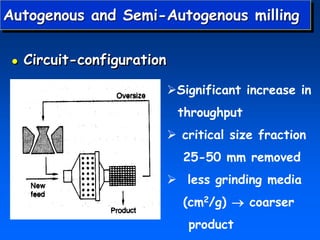
 Circuit-configuration
Significant increase in
throughput
 critical size fraction
25-50 mm removed
 less grinding media
(cm2/g)  coarser
product
Single stage milling
2 x SAG Mill
22’ D x 33’ L
5 MW
220 tph
250 tph
Mill Silo
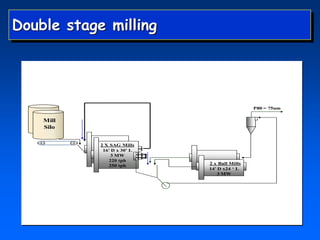
Double stage milling
P80 = 75um
Mill
Silo
2 X SAG Mills
16’ D x 30’ L
3 MW
220 tph
250 tph
Mill
Silo
2 x Ball Mills
14’ D x24 ‘ L
3 MW
Milling in Practice
 Single stage milling
 Lowest capital and working costs
 Simplicity
 Exceptions
 Fine ore : F80 < 80 mm
 Hard component in ore, build up of critical size
 Economy of scale - single large mill
 Risk ?
Control variables
COST OF GRINDING
SIZE REDUCTION & POWER RANGES
WET/ DRY GRINDING

Minerals processing notes GRINDING.pptx

  • 1.
  • 2.
  • 3.
    Learning outcomes have aknowledge and understanding of;  factors influencing operation & be able to quantify the effect of these factors, if possible  the function of classification equipment in close- circuit grinding  the effect of the separation efficiency of the classification equipment on mill performance & subsequent processing  Different mill types available
  • 4.
    grinding  is thefinal stage of comminution  is performed in rotating cylindrical vessels known as tumbling mills  mills contain grinding media which are large, hard & heavy vs ore particles  usually performed wet although dry process is possible
  • 5.
    Cross section oftumbling mill
  • 6.
  • 7.
  • 8.
  • 9.
    Milling (Modes ofbreakage) Compression breakage Surface abrasion by rubbing Self breakage Impact cracking Impact spalling Surface chipping
  • 10.
    mill speed Definition Critical millspeed  Speed at which charge starts to centrifuge  nc = 42.3/(D-d)0.5 with nc in rpm D = mill diameter d = particle diameter
  • 11.
    Charge volume  Definition percentage of the cross sectional area of the mill occupied by balls/rods and their interstices
  • 12.
    Ball mill operation Large balls needed to crush large ore pieces  Hard ore requires larger balls  Finer grinding requires larger surface area per unit mass  smaller balls  attrition milling surface effect
  • 13.
    Ball mill operation Usually used in closed-circuit grinding
  • 14.
    Ball mill operation Closed-circuitgrinding  prevent over grinding  increase throughput  Usually 250% circulating load  circulating load = mass of solids in class underflow * 100 mass of solids in feed
  • 15.
    Ball mill operation Slurry density  Viscous enough to cover balls  If H2O is increased  reduces number of smaller particles to be milled  reduces number of effective impacts  Even more H2O - slurry not viscous enough to cover balls - power draw decreases
  • 16.
  • 17.
  • 18.
  • 19.
  • 20.
    Autogenous and Semi-Autogenousmilling  Autogenous : self generated/ produced  the use of ore lumps as grinding media  Main advantages  lower capital cost  ability to treat wide range of ore types  Disadvantages  Ore type must be amenable to milling  Control of feed properties
  • 21.
    Autogenous and Semi-Autogenousmilling  Key variables  Feed size  Ore hardness  Mill speed  Ball size (SAG)  Ball loading (SAG)
  • 22.
    Autogenous and Semi-Autogenousmilling Feed size  Grinding media comes from ore  change in feed size distribution  change in grinding size distribution
  • 23.
    Autogenous and Semi-Autogenousmilling Feed size AG-milling  large enough rocks for impact breaking of smaller sizes  In general AG mill performs better with coarser feeds
  • 24.
    Autogenous and Semi-Autogenousmilling Feed size SAG mills  no need for large rocks for impact breaking  big rocks become burden  Feed size impact greater on AG- milling than SAG-milling
  • 25.
    Autogenous and Semi-Autogenousmilling Ore hardness  Harder ore requires coarser feed size  AG milling  Too soft ore  not large enough quantities of larger grinding media produced  throughput decreases  Too hard ore  difficult to break critical size  throughput decreases
  • 26.
    Autogenous and Semi-Autogenousmilling  Circuit-configuration • lower throughput • finer product • cyclone cut must not be too small  large recirculating loads
  • 27.
    Autogenous and Semi-Autogenousmilling  Circuit-configuration Significant increase in throughput  critical size fraction 25-50 mm removed  less grinding media (cm2/g)  coarser product
  • 28.
    Single stage milling 2x SAG Mill 22’ D x 33’ L 5 MW 220 tph 250 tph Mill Silo
  • 29.
    Double stage milling P80= 75um Mill Silo 2 X SAG Mills 16’ D x 30’ L 3 MW 220 tph 250 tph Mill Silo 2 x Ball Mills 14’ D x24 ‘ L 3 MW
  • 30.
    Milling in Practice Single stage milling  Lowest capital and working costs  Simplicity  Exceptions  Fine ore : F80 < 80 mm  Hard component in ore, build up of critical size  Economy of scale - single large mill  Risk ?
  • 31.
  • 32.
  • 33.
    SIZE REDUCTION &POWER RANGES
  • 34.