www.foodafactoflife.org.uk © Food – a fact of life 2019
Milk production – main stages
www.foodafactoflife.org.uk © Food – a fact of life 2019
Where does milk come from?
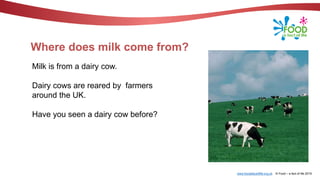
Milk is from a dairy cow.
Dairy cows are reared by farmers
around the UK.
Have you seen a dairy cow before?
www.foodafactoflife.org.uk © Food – a fact of life 2019
The dairy farm
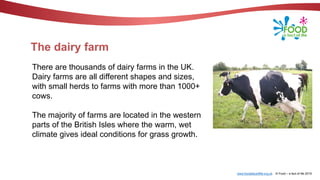
There are thousands of dairy farms in the UK.
Dairy farms are all different shapes and sizes,
with small herds to farms with more than 1000+
cows.
The majority of farms are located in the western
parts of the British Isles where the warm, wet
climate gives ideal conditions for grass growth.
www.foodafactoflife.org.uk © Food – a fact of life 2019
The dairy farm
The farmer’s most important job is to look
after the health and welfare of the cows.
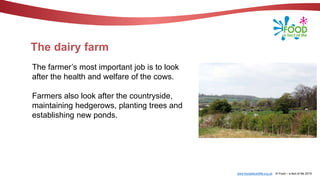
Farmers also look after the countryside,
maintaining hedgerows, planting trees and
establishing new ponds.
www.foodafactoflife.org.uk © Food – a fact of life 2019
Farmers look after the environment
There are many ways in which dairy
farmers are working to improve and
sustain the environment.
Some farmers will plant clover in
fields. This promotes reduces the
use of artificial fertilisers.
www.foodafactoflife.org.uk © Food – a fact of life 2019
Farmers look after the environment
Britain's hedgerows are regularly
maintained by farmers to provide a
breeding ground for birds and other
wildlife.
Many dairy farmers leave a strip of grass
around the edge of the pastures for
planting trees and establishing ponds to
attract wildlife.
www.foodafactoflife.org.uk © Food – a fact of life 2019
The cow
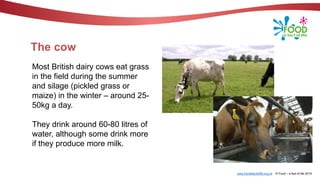
Most British dairy cows eat grass
in the field during the summer
and silage (pickled grass or
maize) in the winter – around 25-
50kg a day.
They drink around 60-80 litres of
water, although some drink more
if they produce more milk.
www.foodafactoflife.org.uk © Food – a fact of life 2019
The cow
Each cow wears ear tags with a
unique number – this is also on
their cattle passport.
www.foodafactoflife.org.uk © Food – a fact of life 2019
Where do cows live?
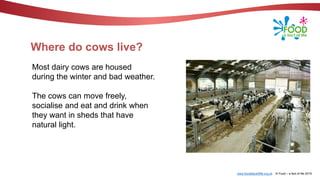
Most dairy cows are housed
during the winter and bad weather.
The cows can move freely,
socialise and eat and drink when
they want in sheds that have
natural light.
www.foodafactoflife.org.uk © Food – a fact of life 2019
Where do cows live?
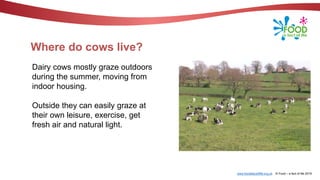
Dairy cows mostly graze outdoors
during the summer, moving from
indoor housing.
Outside they can easily graze at
their own leisure, exercise, get
fresh air and natural light.
www.foodafactoflife.org.uk © Food – a fact of life 2019
Milking
Cows are milked on
average 2-3 times a day.
Milking is not painful or
uncomfortable, it is like
the cow feeding its baby
calf.
www.foodafactoflife.org.uk © Food – a fact of life 2019
Milking
Once the cows have been
milked the milk is chilled and
stored.
A milk tanker calls at the farm to
collect the milk.
It is then taken to be processed.
www.foodafactoflife.org.uk © Food – a fact of life 2019
Processing
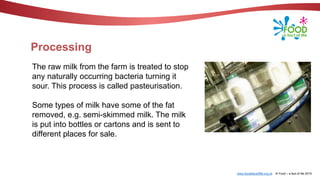
The raw milk from the farm is treated to stop
any naturally occurring bacteria turning it
sour. This process is called pasteurisation.
Some types of milk have some of the fat
removed, e.g. semi-skimmed milk. The milk
is put into bottles or cartons and is sent to
different places for sale.
www.foodafactoflife.org.uk © Food – a fact of life 2019
Processing
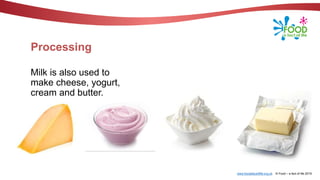
Milk is also used to
make cheese, yogurt,
cream and butter.
www.foodafactoflife.org.uk © Food – a fact of life 2019
In the shops
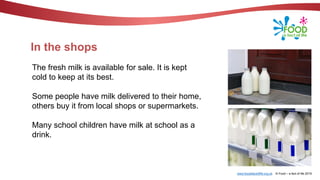
The fresh milk is available for sale. It is kept
cold to keep at its best.
Some people have milk delivered to their home,
others buy it from local shops or supermarkets.
Many school children have milk at school as a
drink.
www.foodafactoflife.org.uk © Food – a fact of life 2019
Drink and enjoy
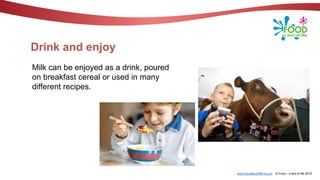
Milk can be enjoyed as a drink, poured
on breakfast cereal or used in many
different recipes.
www.foodafactoflife.org.uk © Food – a fact of life 2019
Dishes
Milk, yogurt and cheese are
also used in many dishes.
www.foodafactoflife.org.uk © Food – a fact of life 2019
For further information, go to:
www.foodafactoflife.org.uk

milk-production-ppt-711fcd.pptx

  • 1.
    www.foodafactoflife.org.uk © Food– a fact of life 2019 Milk production – main stages
  • 2.
    www.foodafactoflife.org.uk © Food– a fact of life 2019 Where does milk come from? Milk is from a dairy cow. Dairy cows are reared by farmers around the UK. Have you seen a dairy cow before?
  • 3.
    www.foodafactoflife.org.uk © Food– a fact of life 2019 The dairy farm There are thousands of dairy farms in the UK. Dairy farms are all different shapes and sizes, with small herds to farms with more than 1000+ cows. The majority of farms are located in the western parts of the British Isles where the warm, wet climate gives ideal conditions for grass growth.
  • 4.
    www.foodafactoflife.org.uk © Food– a fact of life 2019 The dairy farm The farmer’s most important job is to look after the health and welfare of the cows. Farmers also look after the countryside, maintaining hedgerows, planting trees and establishing new ponds.
  • 5.
    www.foodafactoflife.org.uk © Food– a fact of life 2019 Farmers look after the environment There are many ways in which dairy farmers are working to improve and sustain the environment. Some farmers will plant clover in fields. This promotes reduces the use of artificial fertilisers.
  • 6.
    www.foodafactoflife.org.uk © Food– a fact of life 2019 Farmers look after the environment Britain's hedgerows are regularly maintained by farmers to provide a breeding ground for birds and other wildlife. Many dairy farmers leave a strip of grass around the edge of the pastures for planting trees and establishing ponds to attract wildlife.
  • 7.
    www.foodafactoflife.org.uk © Food– a fact of life 2019 The cow Most British dairy cows eat grass in the field during the summer and silage (pickled grass or maize) in the winter – around 25- 50kg a day. They drink around 60-80 litres of water, although some drink more if they produce more milk.
  • 8.
    www.foodafactoflife.org.uk © Food– a fact of life 2019 The cow Each cow wears ear tags with a unique number – this is also on their cattle passport.
  • 9.
    www.foodafactoflife.org.uk © Food– a fact of life 2019 Where do cows live? Most dairy cows are housed during the winter and bad weather. The cows can move freely, socialise and eat and drink when they want in sheds that have natural light.
  • 10.
    www.foodafactoflife.org.uk © Food– a fact of life 2019 Where do cows live? Dairy cows mostly graze outdoors during the summer, moving from indoor housing. Outside they can easily graze at their own leisure, exercise, get fresh air and natural light.
  • 11.
    www.foodafactoflife.org.uk © Food– a fact of life 2019 Milking Cows are milked on average 2-3 times a day. Milking is not painful or uncomfortable, it is like the cow feeding its baby calf.
  • 12.
    www.foodafactoflife.org.uk © Food– a fact of life 2019 Milking Once the cows have been milked the milk is chilled and stored. A milk tanker calls at the farm to collect the milk. It is then taken to be processed.
  • 13.
    www.foodafactoflife.org.uk © Food– a fact of life 2019 Processing The raw milk from the farm is treated to stop any naturally occurring bacteria turning it sour. This process is called pasteurisation. Some types of milk have some of the fat removed, e.g. semi-skimmed milk. The milk is put into bottles or cartons and is sent to different places for sale.
  • 14.
    www.foodafactoflife.org.uk © Food– a fact of life 2019 Processing Milk is also used to make cheese, yogurt, cream and butter.
  • 15.
    www.foodafactoflife.org.uk © Food– a fact of life 2019 In the shops The fresh milk is available for sale. It is kept cold to keep at its best. Some people have milk delivered to their home, others buy it from local shops or supermarkets. Many school children have milk at school as a drink.
  • 16.
    www.foodafactoflife.org.uk © Food– a fact of life 2019 Drink and enjoy Milk can be enjoyed as a drink, poured on breakfast cereal or used in many different recipes.
  • 17.
    www.foodafactoflife.org.uk © Food– a fact of life 2019 Dishes Milk, yogurt and cheese are also used in many dishes.
  • 18.
    www.foodafactoflife.org.uk © Food– a fact of life 2019 For further information, go to: www.foodafactoflife.org.uk